




Abstract
In qualitative interviews, challenges such as deviations from the topic, interruptions, silences or counter-questions are inevitable. It is debatable whether the researcher should try to alleviate them or consider them as important indicators of power relations. In this methodological article, we adopt the latter view and examine the episodes of counter-talk that emerge in qualitative interviews on cultural practices among underprivileged popular classes by drawing on 49 individual and focus group interviews conducted in the highly egalitarian context of Finland. Our main aim is to demonstrate how counter-talk emerging in interview situations could be fruitfully analysed as moral boundary drawing. We identify three types of counter-talk: resisting the situation, resisting the topic, and resisting the interviewer. While the first type unites many of the typical challenges inherent to qualitative interviewing in general (silences, deviations from the topic and so forth), the second one shows that explicit taste distinctions are an important feature of counter-talk, yet the interviewees mostly discuss them as something belonging to the personal sphere. Finally, the third type reveals how the strongest counter-talk and clearest moral boundary stemmed from the interviewees’ attitudes towards the interviewer herself. We argue that counter-talk in general should be given more importance as a key element of the qualitative interview. We demonstrate that all three types of counter-talk are crucial to properly understanding the power relations and moral boundaries present in qualitative interviews and that cultural practices are a particularly good topic to tease them out.
Introduction
In the qualitative research tradition, the multiple different challenging aspects of interviews, such as the interviewees’ reluctance (Adler & Adler, 1991), silence (Morison & Macleod, 2014; Nairn et al., 2005), refusal to engage in conversation or to provide relevant information (Lareau, 1996, 2000) or lack of competence to operate in the interview situation (Silva & Wright, 2005), are typically seen as problems that researchers would like to resolve. Interviewers may try to prevent such issues through a variety of strategies, of which probably the most salient one is adopting a sympathetic role in relation to the interviewees and trying to alleviate potential hierarchical asymmetries (Adler & Adler, 2001). Researchers may attempt to mobilise selected aspects of their own identity and use self-disclosure for establishing a common ground with the study subjects, for example by bringing up similar life experiences (Brown, 2019). Interviews can also be turned into a conversation by using the knowledge of culturally relevant topics for the respondents (Bassett et al., 2008). Scholars have argued that even using intermediaries (Petkov & Kaoullias, 2016) could be helpful in decreasing resistance and creating rapport and trust during interviews.
However, many researchers have pointed out how the difficulties that emerge in interview settings should be accepted as an integral part of the research process because they provide significant knowledge of the research topic at hand and render study settings into experiments on how participants articulate power relations inherent to the interview situation (Heikkilä, 2011; Jacobsson & Åkerstöm, 2012; Järvinen, 2001; Katainen & Heikkilä, 2020; Vitus, 2008). Drawing on a study on ethnic minority boys, Vitus (2008) suggests that expressions of resistance can provide an important avenue to study power relations in interviews and calls for an ‘agonistic approach’ to increase researchers’ sensitivity towards dynamics of resistance. While it is suggested that the ‘microdynamics of power’ of interview settings are likely to reveal status positions relevant to participants’ local contexts as well as to the wider society (Ayrton, 2019), it has also been noted that studying an equal has its problems because widely shared understandings and concepts can affect the interview; Plesner (2011) goes as far as to suggest that ‘causing confrontation’ in the interview situation would be a good strategy. Moreover, deviances from the interview situation might actually be better understood as additional analytic cues for the researcher: there is a wide consensus that, for instance, the silences that occur in interviews are often too quickly interpreted as problematic and that such occasions could prove significant for understanding better the power dynamics of the interview (Bengtsson & Fynbo, 2018; MacLure et al., 2010).
In this methodological article, we want to scrutinise these kinds of challenging aspects of interviews by using the framework of class-based lifestyle distinctions and symbolic boundary drawing (Bourdieu, 1984; Lamont, 1992; Lamont & Molnár, 2002). We argue that when analysing symbolic boundaries and distinctions based on qualitative interview data, it is necessary to consider the interaction between the participants, especially between the researcher and the interviewees. To best discern the dynamics of lifestyle distinctions or symbolic boundaries and the interaction between the researcher and the interviewees, we have chosen to focus on the counter-talk that emerges in interviews. We understand counter-talk as the implicit or explicit disruptions of the conventional flow of the interview, such as deviations from the topic, interruptions, counter-questions, mocking, or other interactional challenges (see Roulston, 2014). In this article, our main aim is to continue the debates on the methodological challenges of qualitative interviews (Lamont & Swidler, 2014; Sølvberg & Jarness, 2019) by showing how counter-talk emerging in interview situations could be fruitfully analysed as moral boundary drawing.
The interview data used for this article were collected in a research project on cultural practices among the unprivileged classes in contemporary Finland (see Heikkilä, 2021). We will scrutinise and assess the types of counter-talk that emerged in our interviews with low-status interviewees. Our empirical case is Finland, often considered a model example of a country with a high standard of living and a large public sector combined with a low income gap and less pronounced class distinctions, being therefore more equal than other more hierarchically layered societies. It could thus be expected that the Finnish case would show, comparatively speaking, a relatively small degree of class-based boundary drawing and counter-talk in research interviews. In this article we ask two questions: (1) What kinds of different strands of counter-talk come up in interviews on cultural practices with low-status interviewees in Finland? and (2) In what contexts, how and towards what are possible distinctions made or boundaries drawn? Our article proceeds as follows: we first lay out our empirical research design, then show the main results and finally discuss the findings.
From lifestyle distinction to symbolic boundaries
Bourdieu (1984) famously departed from the idea that lifestyles are homological to the social structure: according to his homology thesis, cultural practices (understood as taste, knowledge and participation) would correspond hierarchically to the existing social class structure. His theory rests upon the assumption that the social classes – the privileged classes, the middle classes and the popular classes – all have differently distributed amounts of economic, cultural or social capital (Bourdieu, 1986), which means, in terms of lifestyle, that the cultural practices of the privileged classes look ‘highbrow’ and legitimate in the eyes of the lower classes, which try to either emulate them without properly succeeding (the middle classes) or adapt popular and practically oriented tastes because nothing else is available for them (the popular classes). Taste, something that seems aleatory and subjective, becomes a social weapon that separates the ‘legitimate’ from the ‘illegitimate’ in terms of musical and reading preferences, food and drink, different kinds of embodied skills and habits and so forth.
Bourdieu’s theory has been questioned almost since it was first presented. The most fundamental critique concerns modern lifestyle itself: modern consumer-citizens move in a rapidly changing society with practically endless opportunities to create individualistic and class-wise totally contradictory lifestyles (Bauman, 2000; Featherstone, 1991; Lahire, 2004). Investigating more closely Bourdieu’s key idea of the homology between the distribution of lifestyles and class, an important debate has concerned the so-called cultural omnivore (Hazir & Warde, 2016; Peterson, 2005): it is debatable whether new kinds of eclectic and tolerant tastes are a sign of elite snobbery being replaced by something else, or whether they just effectively camouflage existing social hierarchies. Many scholars have also wondered whether we can actually know what functions as effective cultural capital in a given time and context and to what extent it embraces social exclusion and leads to group formation and real social boundaries: for example, Lamont and Lareau argue that ‘the power exercised through cultural capital . . . is first and foremost a power to shape other people’s lives through exclusion and symbolic imposition’ (1988, p. 159).
It is this argument on symbolic exclusion that Lamont later developed as part of her theory on symbolic boundaries. Symbolic boundaries, which function as rational corollaries of societal structure formation and the reframing of existing boundaries between ‘us and them’, are ‘conceptual distinctions made by social actors to categorise objects, people, practices’ and to ‘separate people into groups’ (Lamont & Molnár, 2002, p. 168). The main difference between Bourdieu’s and Lamont’s approaches regarding boundary drawing and eventual exclusion is that while Bourdieu’s social exclusion indicates social selection and group formation through the monopolisation of the scarce cultural, economic and social resources available, for Lamont, the level of symbolic exclusion adds a layer of subjective categorisation processes: the way in which people themselves ‘construct similarities and differences between themselves and other groups’ (Lamont, 2000, p. 3). It has been argued that, rather than opposing them to each other, combining both approaches could be fruitful, essentially because symbolic boundaries need pre-existing social boundaries to function (Jarness, 2018).
Bourdieu’s premise of cultural lifestyle differences directly reflecting societal hierarchies is extended and at the same time problematised through Lamont’s empirical findings on the three different sub-types of symbolic boundaries: cultural, socio-economic and moral boundaries all had different relative salience in the evaluative repertoires of her French and American upper-middle-class interviewees, showing that different cross-cultural contexts relied on entirely different grounds for drawing symbolic boundaries, for which the cultural boundaries were stronger in France but the moral ones more relevant in the United States (Lamont, 1992). In this article, we pay particular attention to moral boundaries because lately they have been found to intertwine especially tightly with other boundaries, also in traditionally egalitarian Nordic countries (Jarness, 2018; Skjøtt-Larsen, 2012). Daniel DellaPosta (2020) has recently used the metaphor of an ‘oil spill’ to illustrate how moral and political divisions have not only become more accentuated but also started to bring along with them many areas of life, such as choices or tastes for food, clothing or music, that were traditionally not part of political opinions. We believe that moral boundaries, here expressed through counter-talk, could be an important strategy for especially low-status groups to maintain worth and dignity (cf. Jarness & Flemmen, 2019; Lamont, 2000).
An important feature of the counter-talk that emerged in this study is that particularly many deviations from the standard course of interviews appeared in the form of humorous remarks and joking. According to Kuipers (2015), types and tastes for humour are strongly linked to symbolic boundary drawing. Her study on humour preferences in the Netherlands (Kuipers, 2015) demonstrates that the upper-middle class is more likely to appreciate highbrow comedy and sharp intellectual notions while disliking jokes, whereas working-class men are more attuned to joke telling that embraces sociability and boisterousness. The taste for humour communicates class distinctions and functions as a basis for moral judgements and symbolic boundary drawing (Friedman & Kuipers, 2013). Humour, in this sense, is an arena for negotiating meanings and moral boundaries, and it serves and reflects many purposes in social interaction (Billig, 2005; Meyer, 2000). It builds social relations, group cohesion and closeness, and is therefore a desirable element especially in focus groups (Coates, 2007). Yet, humour simultaneously excludes, brings up tensions and highlights social hierarchies (Kuipers, 2015). Norrick (1993) argues that humour can even function as a form of ‘conversational aggression’ as it can be used to abruptly transform the mode of discussion and disrupt the conventional or serious course of conversation. In the interview setting, humorous remarks, sarcasm and irony can articulate power relations and be seen as attempts to question or resist the expectations inherent in the situation. Accordingly, we analyse the uses of humour in the counter-talk as a form of symbolic boundary drawing.
We argue that qualitative interviews on cultural practices and the counter-talk occurring in them is a good way of tapping into the drawing of moral boundaries. Most research on cultural practices is biased towards middle-class practices (Flemmen et al., 2018): this might make ‘culture’ look like an elitist topic from the point of view of many interviewees. Therefore, we expect that the reaction towards and especially against normative cultural practices might produce particularly interesting accounts in the interviews, and this is why we are exploring the counter-talk that emerges in them.
Research design
The interview data used in this article derive from a research project that aimed at understanding how and why the most unprivileged social classes withdraw from certain forms of cultural practices, especially participation (see Heikkilä, 2021). The data included 40 individual interviews and nine focus groups conducted in early 2018. The interview sample was formed by looking at two nationally representative Finnish surveys measuring cultural taste and participation – Culture and Leisure in Finland 2007 (N = 1388) and Finnish Views on and Engagement in Culture and the Arts 2013 (N = 7859) – and determining what background factors statistically predicted disengagement. One question on cultural participation (including items from both highbrow and lowbrow milieus) was used to assess which individual background factors best predicted never or extremely rarely attending the mentioned items. Significant variables for the groups that attended ‘never or very rarely’ were residential area (with living in the countryside predicting disengagement), province (with higher proportions of passive groups in rural areas), education (with groups with low and no education being the most disengaged) and occupation (with manual workers more disengaged than other occupations). Other statistically significant predictors for disengagement included being on a pension, being a farmer, being unemployed or being on parental leave.
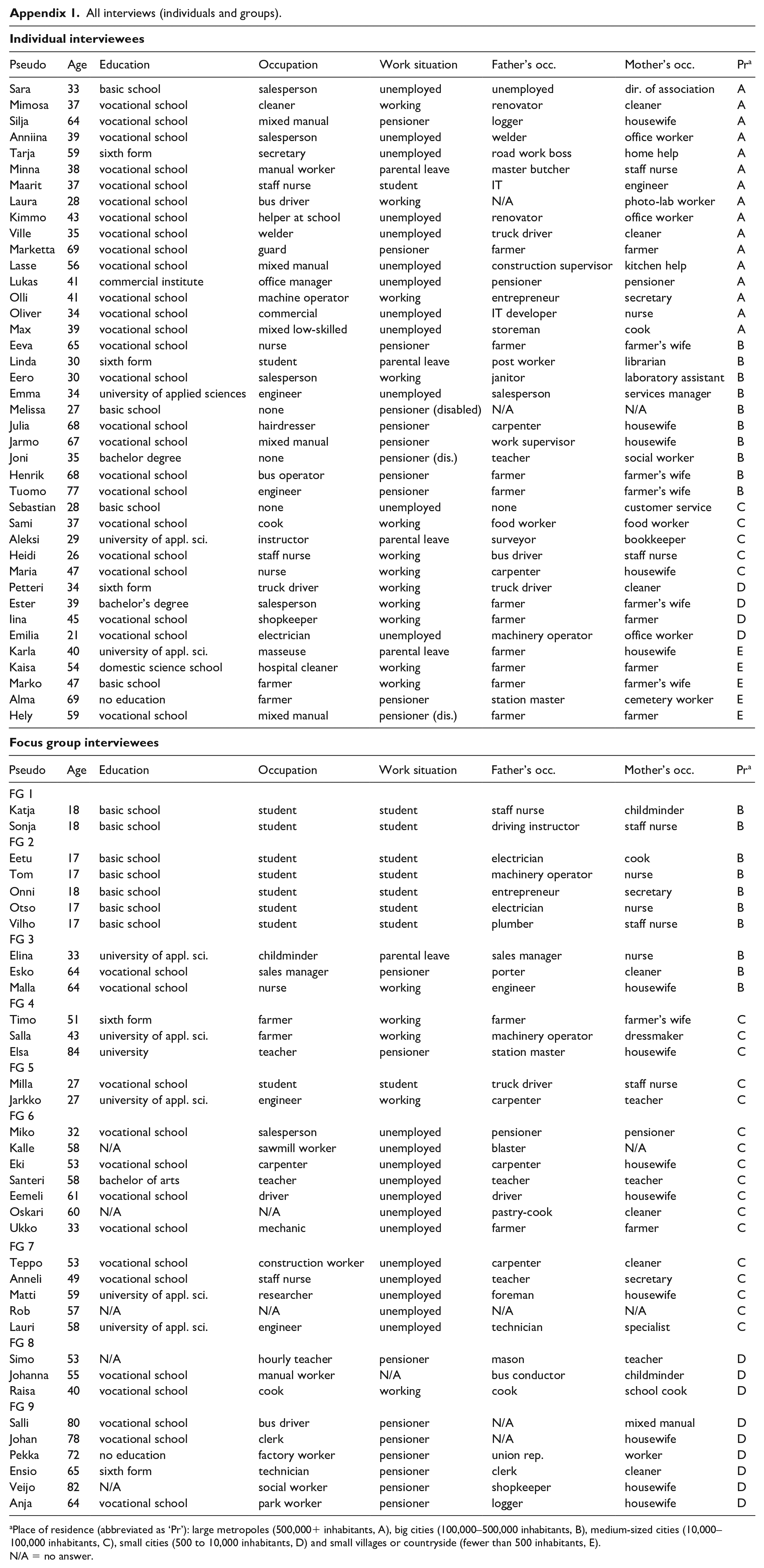
The interview sample was then built to mirror these statistical background factors. The individual interview sample was formed of people with a minimum of four of these statistically significant indicators of cultural disengagement. This strategy led to profiles such as a farmer’s wife with no basic education living in a small countryside village or an unemployed electrician in a small provincial city. The focus groups were so-called naturally occurring groups (Wilkinson, 1998) – in other words, groups that knew each other in advance. The focus group recruitment yielded groups such as groups of vocational school students in Northern Finland, pensioners’ associations in small towns, employment rehabilitation centres and a group receiving free meals organised by the church (see Appendix 1 for all interviewed individuals and groups). Group size varied from two to seven people, and while the recruitment of individual interviewees was more strictly focused on the statistically significant background indicators, for the focus groups the criteria were looser, ensuring that as many participants as possible would meet the criteria for inclusion. With the exception of one focus group participant, all interviewees were ethnic Finns. While it might be difficult to categorise the interviewees directly as ‘working class’ since some of their jobs resemble lower-middle-class jobs and some currently unemployed participants have university education, they can largely be conceived of as underprivileged popular classes, or a part of the lower echelons of Finnish society.
The interviews lasted for about 45 minutes each, and they were organised in places that best suited the interviewees: cafes, public libraries and sometimes the interviewees’ homes. The focus group interviews were always held in the place the group regularly met to maintain the benefits of the naturally occurring group (Wilkinson, 1998): the locations included vocational schools, churches, and different locations that served as meeting spaces for associations. All interviewees filled out a background sheet expressing informed consent and providing more detailed information about the size and location of their homes, their occupation and education, and their parents’ occupations. All personal information regarding the participants is carefully minimised and anonymised. For the purposes of this article, the original Finnish interviews are translated into English.
The interviews intended to cover as fully as possible the interviewees’ daily life and cultural practices, using some recent research projects’ interview guidelines as inspiration (Elliott et al., 2010; Purhonen et al., 2014), and aiming to let the participants define their own ideas and activities (or non-activities) as openly as possibly. All individual interviews started with a detailed talk about the homes, families, friends, education and current job situation of the interviewee and then moved on to more specific cultural topics organised around taste (for instance music, reading, television, cinema and food), knowledge (by showing flashcards on Finnish art and encouraging the interviewees to discuss and identify the paintings if possible) and finally participation (using a closed-end list of participation in, for instance, bingo, sports events, theatre, cinema, different types of concerts and so on). The focus group interviews proceeded similarly but omitted the personal part of the individual interviews.
Given that the interviews were in many ways asymmetric in terms of power, one should be particularly reflexive about the interviewer’s role and the power dynamics at play. The interviewer – one of the authors – was at the time of the interviews a woman in her thirties, recruiting interviewees for her university project with a prestigious state funding. In terms of especially age and education, the difference might have been interpreted as striking from the viewpoint of the participants with entirely different profiles (see Appendix 1), and this asymmetry of class positions was often referred to in the interviews, either implicitly or explicitly. In addition to class-related positions, gender also plays a role in how the roles of the interviewee and interviewer unfold. Gender creates expectations for interaction and continues to be highly relevant also in terms of power relations within the interview setting (Wojnicka, 2020). Compared to male interviewers, men may experience female interviewees less pressing and feel more at ease sharing experiences with them (Arendell, 1997). However, masculine identities can become especially apparent when a female interviews a male, leading to expressions of domination and assertiveness, as well as to presentations of superior, competent and rational selves (Arendell, 1997; see also Pini, 2005). The research context in which a female interviewer poses questions on cultural preferences intersects with tensions related to class and gender.
Michèle Lamont describes, in the methodological appendix of The Dignity of Working Men (Lamont, 2000) for which she interviewed working-class men, that she used her own blurred national identity to encourage the openness of her interviewees. Similarly, here the interviewer did her best to downplay her academic identity and tried to establish common ground, for instance through mentioning common contacts through which the interviewees had been recruited, or chatting or directly asking about local sights or happenings before the interviews. As we shall see from the interview excerpts, these strategies did not fully save the discussions from mutual feelings and sometimes straightforward signals of awkwardness.
In this article the tool for our analysis is a simple close-reading of all the interviews and a subsequent thematic analysis (Silverman, 2014) of all the strands of counter-talk that we could identify, such as interruptions, deviations from the topic, counter-questions, mocking or other interactional challenges. We found three main types of counter-talk, which we categorised as resisting the situation, resisting the topic and resisting the interviewer. We shall next scrutinise each type of counter-talk in detail.
Findings
Resisting the situation
Our interviewees, all located in the lower strata of Finnish society, were in general very prone to express anxiety or awkwardness towards the interview situation, often appearing in the form of sarcasm or shifting the mode of discussion with humorous taunts. Surprisingly, many interviewees admitted just before the interview that they were pondering until the last minute whether to attend or not, and some interviewees never turned up and became impossible to contact. Some interviewees wanted to cancel very close to the scheduled meetings, and sometimes a lot of flexibility was required to prevent certain interviews from being cancelled. For the participants of the focus groups, it was much more difficult to cancel scheduled interviews because the researcher was travelling to the place the interviewees already were at, and the interview was usually scheduled with some kind of a ‘superior’, whether a teacher, church social worker, director of an employment rehabilitation centre and so forth. This did not prevent the members of the focus groups from expressing nervousness or unease: typically, before the interviews, the rooms were filled with murmur and uncertainty about practical issues, such as who would control the situation (whether the superior or the external researcher) and whether participating was obligatory.
While these kinds of feelings of anxiety towards the interview and talking to a stranger typically occurred just before the interview, even the interviews themselves were laden with discourses challenging or questioning entirely the context. ‘Resisting the situation’ emerged in several ways in the study settings. First, the interviewees showed reluctance or hesitated in answering the questions. The most typical and deceivingly simple example was that, while the interview guidelines had been carefully planned in order to overcome the typical problems of cultural practices research that tends to be biased towards middle- or upper-middle-class activities and perceptions (Flemmen et al., 2018), in some cases the questions still seemed ‘wrong’ to capture the lifestyles of some of the participants. Many interviewees were stunningly silent when asked about reading, decorating their house, doing regular hobbies or so on, reminding us that even these are firmly middle-class activities, however open-ended the questions might be. A telling example comes from Marketta, an almost 70-year-old resident of a working-class neighbourhood in Helsinki.
Then a final question about the day of your dreams: if you didn’t have to worry about money and you could do whatever you wanted for one day, what would it be?
No idea about that. Cannot answer.
(Marketta, 60+, pensioner, capital region)
Second, the resistance to or the awkwardness of the situation and interview context was contested by laughing off the interview questions, for example by answering in a surprising or joking way. Illustrative examples are provided by a 20-something electrician, who was asked about his hobbies, and by a 40-something farmer, who was asked about his eating habits. Both answers could be interpreted as strong questioning and mocking of the entire interview situation. The questions are laughed off by unexpected and rather blunt references to sex and bodily functions. Here, joking and humour can be understood as male interviewees’ attempts to distance themselves from the situation as well as from the topic at hand. At the same time, the blunt, sarcastic tone serves as a way for male interviewees to shock the female interviewer (and in Jarkko’s case his wife, who was also present).
Well, I have this one hobby that we do in the bedroom. (Jarkko, 20+, electrician, mid-sized town, Eastern Finland) Most of all I like to eat foods that make me fart. . . . When lifting the kettlebell, it’s nice to pass gases to make others suffer from the smell. (Marko, 40+ farmer, small village, Eastern Finland)
Third, questioning the situation also appeared as deviance from the original questions and topics (see also Jacobsson & Åkerström, 2012; Jarrett, 1993; Katainen & Heikkilä, 2020). The following excerpt departs from the interviewer’s original question on school and the preferred subjects there: after someone in the focus group mentioned history as a favourite subject, the discussion almost immediately drifted to anecdotal memories of speakers who came to give classes, for instance here on Finnish missionaries that had been to Africa, and the ensuing sexual connotations. As in the previous examples, humour is used as way of distancing the conversation from the topics of the interview and thus drawing boundaries:
The minister had known that too, he had married one young couple and I had said that love is perfect when even the other’s fart smells good but even they did not get that far [laughs].
…
What I remember of those school times myself when I was in secondary school is that we had sexual education and there was a pretty old woman who with her face pink with embarrassment was explaining this and that, and then suddenly a man came along . . . he stood there for a while, then he rubbed his thumb into the blackboard and said, ‘listen boys, I only want to tell you that you should not sow into every furrow’.
(Focus group 9: 2 women and 4 men, 60+ to 80+, pensioners’ association, small town, Northern Finland)
Some scholars have interpreted these kinds of deviations from the interview situation as a lack of skills for focused talk (Silva & Wright, 2005), which translates into difficulties of following the unwritten rules of a formal research interview and subsequent unease. In the case of this study, the lack of skills of focused talk often lead to slipping from the original topic to something else, or questioning or ridiculing the entire context. So far, however, this kind of counter-talk stands more as expressing self-consciousness and nervousness or simply dismissing (or temporarily forgetting) the rules of the formal interview situation. We shall next scrutinise this same phenomenon in the light of counter-talk directed against the topic of the interview.
Resisting the topic
One of the main arguments in Bourdieu’s work is that taste is directly linked to class positions and that aesthetic intolerance is just a proxy for distance between classes. In many ways, our interviews from the lower echelons of Finnish society strongly supported the classical claim that ‘aversion to different life-styles is perhaps one of the strongest barriers between the classes’ (Bourdieu, 1984, p. 56) – in general, the interviews produced a very predictable picture of not liking what is perceived as highbrow culture. Most of the aversion was formulated rather mildly as disliking things perceived as ‘not my cup of tea’ or not feeling comfortable in restaurants that expected their customers to order several dishes, thus demonstrating what Bourdieu has called embodied taste and a ‘sense of one’s place’ (Bourdieu, 1984, p. 466). However, in many interviews so-called highbrow cultural practices and products were openly ridiculed through counter-talk, for instance by changing the mode of conversation towards more humorous and ironic tones when highbrow cultural products were mentioned:
Would you like to put that one on the wall, as a poster for instance (showing a flashcard of a classical Finnish painting)?
No, I would not put it even if they paid me.
I don’t know really.
Depends on what they would pay me . . .
Yeah.
Perhaps I could hang it on the toilet wall.
(Focus group 7: 1 woman and 4 men, 40+ to 50+, employment rehabilitation centre, medium-sized city, Eastern Finland)
Another somewhat less direct strategy of openly making fun of the cultural products mentioned was evoked by a focus group of five very young male polytechnic school students, who clearly ridiculed practically everything that was discussed. The two examples below belong to the same conversation, the first one on magazines and the other one on the flashcards of Finnish paintings shown:
Do you order any magazines for the home?
(several participants mention receiving the newspaper of their union)
I don’t even open it, I just always throw it into the sauna stove.
Same here – happens with that newspaper of the Electrical Workers’ Union, my mom always says something like ‘hey, this arrived’. My only thought is, hey, it’s a great firelighter.
…
Interviewer (showing the group Helene Schjerfbeck’s well-known painting The Convalescent)
Yeah. That’s some kind of painting.
Do you like it?
Looks pretty depressing.
Yea.
She has just woken up and it’s Monday morning.
(Focus group 2: 5 men, 17–18 years, students of a polytechnic school, medium-sized city, Northern Finland)
While cultural products perceived as highbrow were quite commonly and openly not liked, some interviews were very much based upon despising almost everything that was mentioned during the course of the interview. A good example is the interview with the nearly 70-year-old pensioner Marketta, who answered all questions curtly, without elaborating on anything even when asked to, and was clearly annoyed by any mention of high culture: opera reminded her of ‘a lady screaming with a iron up her arse’, and reading was like ‘drinking tar’. Her standard answer to nearly all the questions was ‘not interested’. Marketta withdraws from almost any cultural consumption: she does not go to pubs (‘no’), museums (‘not interested’), sports events (‘no thanks’), marketplaces (‘no money, everything is too expensive there’) or cafes (‘I get my coffee at home, no need to buy it anywhere’).
While the taste-related counter-talk of our interviews were clearly directed against tastes perceived as upper-class (modern or non-figurative art, opera, ballet and so forth), the connotations towards perceived ‘others’ were non-existent or, at most, implicit: both sides of taste, liking and hating, were mostly discussed as something belonging to the personal or the immediately surrounding sphere. This is why our next step will be a more profound assessment of the counter-talk directed towards the interviewer.
Resisting the interviewer
We have seen above that a certain aversion towards a perceived highbrow taste is a prevalent tendency in the counter-talk of the interviews. Yet, this resistance is not openly named as an intolerance against the people fostering these tastes. It has been similarly noted in previous studies that interviewees do not necessarily feel comfortable distinguishing between status groups and in general may avoid discussing issues in terms of social class (e.g. Katainen, 2010). However, in the spirit of the ‘moral turn’ (Lamont, 1992) in the social sciences, there are traces of deeper boundaries that can also be found in our data set. They appear in subjective accounts of symbolic boundaries drawn upwards or downwards. The examples of drawing symbolic boundaries upwards typically include women who foster a certain cultural goodwill by attending the theatre or concerts, reading newspapers in order to remain informed and so on: ‘that enthusiasm for . . . a culture which still bore the visible marks of the effort involved in its acquisition and could not, therefore, compete with the casual self-assurance of the “natural” aesthete’ (Bourdieu, 1984, p. 274). While such accounts are totally devoid of counter-talk, the latter examples of drawing symbolic boundaries downwards are practically full of it. The counter-talk that emerged while drawing symbolic boundaries downwards was typically mobilised by men that have previously been categorised as ‘introvert-hostiles’ (Heikkilä, 2021). These interviewees expressed in a multitude of ways that they were more or less reluctantly slipping out of reach of high or even mainstream culture. Laughing off the questions served as a way of distancing themselves from these forms of culture while enabling them to use their wit and stand against the situation, the female interviewer and everything she represented or symbolised for the interviewees.
In our interviews, the strongest counter-talk stemmed from the attitudes towards the interviewer herself. In many interviews with men, and with practically all focus groups that included several men, the power relationship between the interviewee and interviewer was constantly challenged. We identify two ways of challenging the hierarchy between the researcher and interviewee: shocking the researcher and asking hostile counter-questions. The most typical and recurring way of shocking the interviewer, as was already described above, involved making explicit or implicit jokes about the interviewer’s questions and trying to shock her by giving extravagant, ‘inappropriate’ accounts. These often included mentions of excess amounts of alcohol, something that can be interpreted as a Finnish version of the boisterous Scandinavian ‘drinking stories’ (Sandberg et al., 2019) but also as strong expressions of working-class masculinity as a counterforce against economically or culturally loaded definitions of success (Lamont, 2000); the references to drinking and pornography, as can be seen in the examples below, formed a juxtaposition with legitimate, middle-class cultural practices. For instance, the (mostly under-aged) young men from the polytechnic school self-reportedly spent the weekend ‘boozing’, and Marko, a farmer in his forties, gave a detailed account of how, during a night out, he had taken so much ‘anaesthetic’ that he had rolled down the incredibly long stairs (‘I shot the rapids but they were dry, like they say’) at the location of the interview itself, the practically only hotel in his home village that also served as a nightclub. In the following example, Marko drew on many kinds of taboo subjects to shock the interviewer:
Anything else about your free time that I haven’t thought to ask? Is there anything interesting you do?
Making moonshine, that’s interesting.
But you don’t do that, or do you actually?
I cannot publish that.
Oh yeah, you are right, sorry.
It’s still illegal.
Ah, OK.
It’s a bit like my drug business, we have to keep totally silent about that as well (laughing). And not a word about the pornography that I smuggled from Estonia.
(Marko, 40+ farmer, small village, Eastern Finland)
In what we interpret as a similar attempt to evoke symbolic boundaries in relation to perceived ‘higher’ groups, in some of the focus groups, the interviewees started to ask the researcher counter-questions. This lengthy excerpt discussing food preferences, or in this case dislikes, shows not only how difficult it sometimes is for the interviewees to stay focused on the topic (see Silva & Wright, 2005) but also how surprising and, in a way, aggressive and morally challenging the counter-questions can be:
Do you others have any foods you hate, a bit like the garlic he mentioned? Anything you don’t like?
We eat the same food throughout the week.
The same food?
Yes. Nothing happens to it when it’s in a big kettle and you take just a little bit, it stays alright for a week.
You cannot throw away food, that’s a principle.
…
What is the most exotic food you ever tried? (to the interviewer)
Me?
Since you are asking us, we will also ask you.
Ahem, that’s a difficult one. I probably have been offered all kinds of things but I might have refused.
What’s your excuse? You have to try everything.
(Focus group 9: 2 women and 4 men, 60+ to 80+, pensioners’ association, small town, Northern Finland)
On another occasion, one of the participants of a focus group of unemployed men in an unemployment rehabilitation centre (often conceived of as a quasi-punitive social policy measure for the long-term unemployed) got upset when the group was shown the flashcards of Finnish art, specifically when the card with the famous and well-known Taistelevat metsot (by Ferdinand von Wright, 1886) came up, depicting two male grouses fighting over a female bird. It should be mentioned that this painting is so iconic that practically every Finn knows it: it is probably the most copied artwork in Finland that appears in endless puzzles, mouse pads, t-shirts and magnets. Seeing the familiar painting after a cavalcade of many unfamiliar works, one of the group members started hinting that the interview situation resembles the artwork, probably to sneer at the situation in which a female researcher grills a group of unskilled men about topics they are uncomfortable with. Here, gender relations were explicitly played out as a way of jokingly dismissing the conventional course of the interview:
You are a woman, so which one of these birds do you identify with?
Of these birds?
Yes.
Neither.
There is a female wood grouse in the other end, do you feel like you are one?
(Focus group 6: 7 men, 30+ to 60+, unemployment rehabilitation centre, mid-sized town, Eastern Finland)
Interestingly, the moral boundaries drawn in the interviews with the lower echelons of Finnish society seem to be quite different from how Lamont described the strong moral boundaries that appeared among (the male) members of the American working-class in an attempt to maintain worthiness: her interviewees highlighted moral standards, such as friendliness and integrity, with differences between the ‘disciplined self’ evoked by the white interviewees and ‘caring self’ evoked by the black interviewees (Lamont, 2000). Our interviewees are closer to the lower-class Norwegian interviewees of Jarness and Flemmen (2019), who clearly resisted status stigmatisation when drawing symbolic boundaries upwards and who showed a clear gender difference, with women being more prone to resort to discourses of cultural goodwill and men more eager to show resistance.
An interesting twist in our data was that the Finnish interviewees, in their ‘counter-talk’, so clearly took the interviewer as a target for drawing symbolic boundaries. This could, perhaps, be interpreted as an attempt to legitimise their own lifestyle vis-a-vis the urban, flamboyant, extravagant, picky and perhaps starchy attitudes associated with the university interviewer, which makes the interviewees themselves stand out as honest, funny, easy-going and practical no-nonsense people, without the connotations of respectability or law-abidingness that for instance Lamont emphasised.
Concluding discussion
When mapping and analysing the different kinds of counter-talk, we found three recurring discourses, which we labelled as ‘resisting the situation’, ‘resisting the topic’ and ‘resisting the interviewer’. The first discourse was reduced to episodes well-known to all qualitative scholars and intrinsically related to asymmetrical power relations: discomfort towards the interview context, being confronted and questioned by a stranger and so forth (Silva & Wright, 2005; Smith, 1995; Warr, 2005). The second one touched upon the basic Bourdieusian notion of lifestyle distinctions in that tastes work primarily as distastes (Bourdieu, 1984, p. 56): this was witnessed as interviewees openly and viscerally resisting the culture considered as ‘highbrow’ or laughing at pieces of art perceived as stuffy, sometimes making transgressive jokes about placing the paintings in the toilet or setting newspapers on fire. Finally, the third discourse showed the clearest example of moral boundaries: this was seen in the boundaries drawn upwards in relation to the interviewer and the perceived contrast she introduced into the life-worlds of the interviewees, exemplified by baffling comments, brisk changes of topics and challenging counter-questions. While the three categories to some extent overlap, they are all needed in order to properly understand the layers of the counter-talk present in the interviews. Our approach has added to the existing debate by recognising that while power relationships are the bread and butter of qualitative research, even counter-talk, usually lumped together, has important layers and that it can be analysed as a strategy of drawing moral boundaries.
In our interview data, the use of humour was a central element of counter-talk, and it often involved gendered connotations. Humour did not appear as a way of easing the interaction or establishing common ground, but rather it emerged as a strategy of distancing. Ridiculing remarks were directed against the situation, the topics and the interviewer, thus demonstrating the boundary between the interviewer and the participants. While joking and ridiculing the interview questions can be interpreted as ways of easing the awkward situation and hiding one’s inability to give culturally legitimate accounts, it is important to note that humour can also empower the interviewees and enable them to take a more dominant position in the situation. In our interviews, humour was effectively used by the interviewees to shift the focus of the interviews from cultural to moral boundaries, thus making them serve better their cultural stance.
Experiencing counter-talk is not always comfortable in qualitative interview settings. An important methodological question is whether the interviewer should try to do something to minimise or even directly counteract it (Smithson, 2000). Many scholars agree that different modes of disruptions, deviances, refusals to elaborate on given topics, uncomfortable silences or inappropriate laughter actually contribute intrinsically to the meaning of the interviews (Bengtsson & Fynbo, 2018; Nairn et al., 2005; Vitus, 2008). One could argue that our interviews elicited so much counter-talk because they touched upon cultural practices, a perhaps somewhat sensitive or even provocative topic in our era of growing social inequality and lifestyle politicisation (Hellström, 2016; Norocel et al., 2018). An additional layer to this means returning to reflect upon the role of the (typically middle-class) interviewer. It could even be that our own implicitly classed middle-class repertoires prevent us from seeing what the participants would consider ‘problematic’ or ‘disruptive’ in the first place and push us to (too) easily label different kinds of classed judgements, styles of speaking or jokes as counter-talk.
Another obvious limitation here is that we have consciously focused on the counter-talk episodes of the interviews – plenty of standard interview talk, not categorised here as counter-talk, also deals with moral boundary drawing. It is thus only logical that we have mostly witnessed boundaries drawn upwards, in the direction of ‘high-status’ cultural products or the perceived higher-status interviewer. Like Jarness and Flemmen (2019) point out, moral boundaries have completely different functions depending on whether they are drawn upwards or downwards; in a way, the interview situation and the interviewer herself formed a logical target for upward boundary drawing in the form of jokes and mocking, whereas downward boundary drawing perhaps took place in standard flows of conversation. The counter-talk we have explored in this article is particularly strongly tied to ‘performances of class’, especially when it comes to white working-class masculinity.
Methodologically, it should be remembered that individual interviews and focus group interviews involved mostly totally different challenges (or possibilities) regarding ‘counter-talk’. All three types of counter-talk were found in both kinds of interviews, but whereas in the individual interviews it was usually expressed by showing initial anxiety or nervousness, answering curtly, refusing to elaborate and so on, the focus groups worked better as platforms to mobilise laughter, mocking, allusions to sexuality and collective resistance towards the hierarchical settings of the interview.
Finally, it should be noted that paying attention to the counter-talk – instead of the large bulk of the interviews that followed more conventional flows of conversation – was actually crucial for understanding the different kinds of mechanisms of status distinction and boundary drawing. Using counter-talk instead of considering it too problematic for being properly analysed was what allowed us to identify the strategies for creating and maintaining cultural but also social and moral differentiation. This is another reminder that qualitative interviews and also, perhaps especially, their challenging parts are excellent vantage points for discerning and better understanding underlying inequalities.
Footnotes
Appendix
All interviews (individuals and groups).
|
|
|||||||
| Pseudo | Age | Education | Occupation | Work situation | Father’s occ. | Mother’s occ. | Pr a |
| Sara | 33 | basic school | salesperson | unemployed | unemployed | dir. of association | A |
| Mimosa | 37 | vocational school | cleaner | working | renovator | cleaner | A |
| Silja | 64 | vocational school | mixed manual | pensioner | logger | housewife | A |
| Anniina | 39 | vocational school | salesperson | unemployed | welder | office worker | A |
| Tarja | 59 | sixth form | secretary | unemployed | road work boss | home help | A |
| Minna | 38 | vocational school | manual worker | parental leave | master butcher | staff nurse | A |
| Maarit | 37 | vocational school | staff nurse | student | IT | engineer | A |
| Laura | 28 | vocational school | bus driver | working | N/A | photo-lab worker | A |
| Kimmo | 43 | vocational school | helper at school | unemployed | renovator | office worker | A |
| Ville | 35 | vocational school | welder | unemployed | truck driver | cleaner | A |
| Marketta | 69 | vocational school | guard | pensioner | farmer | farmer | A |
| Lasse | 56 | vocational school | mixed manual | unemployed | construction supervisor | kitchen help | A |
| Lukas | 41 | commercial institute | office manager | unemployed | pensioner | pensioner | A |
| Olli | 41 | vocational school | machine operator | working | entrepreneur | secretary | A |
| Oliver | 34 | vocational school | commercial | unemployed | IT developer | nurse | A |
| Max | 39 | vocational school | mixed low-skilled | unemployed | storeman | cook | A |
| Eeva | 65 | vocational school | nurse | pensioner | farmer | farmer’s wife | B |
| Linda | 30 | sixth form | student | parental leave | post worker | librarian | B |
| Eero | 30 | vocational school | salesperson | working | janitor | laboratory assistant | B |
| Emma | 34 | university of applied sciences | engineer | unemployed | salesperson | services manager | B |
| Melissa | 27 | basic school | none | pensioner (disabled) | N/A | N/A | B |
| Julia | 68 | vocational school | hairdresser | pensioner | carpenter | housewife | B |
| Jarmo | 67 | vocational school | mixed manual | pensioner | work supervisor | housewife | B |
| Joni | 35 | bachelor degree | none | pensioner (dis.) | teacher | social worker | B |
|
|
|||||||
| Pseudo | Age | Education | Occupation | Work situation | Father’s occ. | Mother’s occ. | Pr a |
| Henrik | 68 | vocational school | bus operator | pensioner | farmer | farmer’s wife | B |
| Tuomo | 77 | vocational school | engineer | pensioner | farmer | farmer’s wife | B |
| Sebastian | 28 | basic school | none | unemployed | none | customer service | C |
| Sami | 37 | vocational school | cook | working | food worker | food worker | C |
| Aleksi | 29 | university of appl. sci. | instructor | parental leave | surveyor | bookkeeper | C |
| Heidi | 26 | vocational school | staff nurse | working | bus driver | staff nurse | C |
| Maria | 47 | vocational school | nurse | working | carpenter | housewife | C |
| Petteri | 34 | sixth form | truck driver | working | truck driver | cleaner | D |
| Ester | 39 | bachelor’s degree | salesperson | working | farmer | farmer’s wife | D |
| Iina | 45 | vocational school | shopkeeper | working | farmer | farmer | D |
| Emilia | 21 | vocational school | electrician | unemployed | machinery operator | office worker | D |
| Karla | 40 | university of appl. sci. | masseuse | parental leave | farmer | housewife | E |
| Kaisa | 54 | domestic science school | hospital cleaner | working | farmer | farmer | E |
| Marko | 47 | basic school | farmer | working | farmer | farmer’s wife | E |
| Alma | 69 | no education | farmer | pensioner | station master | cemetery worker | E |
| Hely | 59 | vocational school | mixed manual | pensioner (dis.) | farmer | farmer | E |
|
|
|||||||
| Pseudo | Age | Education | Occupation | Work situation | Father’s occ. | Mother’s occ. | Pr a |
| FG 1 | |||||||
| Katja | 18 | basic school | student | student | staff nurse | childminder | B |
| Sonja | 18 | basic school | student | student | driving instructor | staff nurse | B |
| FG 2 | |||||||
| Eetu | 17 | basic school | student | student | electrician | cook | B |
| Tom | 17 | basic school | student | student | machinery operator | nurse | B |
|
|
|||||||
| Pseudo | Age | Education | Occupation | Work situation | Father’s occ. | Mother’s occ. | Pr a |
| Onni | 18 | basic school | student | student | entrepreneur | secretary | B |
| Otso | 17 | basic school | student | student | electrician | nurse | B |
| Vilho | 17 | basic school | student | student | plumber | staff nurse | B |
| FG 3 | |||||||
| Elina | 33 | university of appl. sci. | childminder | parental leave | sales manager | nurse | B |
| Esko | 64 | vocational school | sales manager | pensioner | porter | cleaner | B |
| Malla | 64 | vocational school | nurse | working | engineer | housewife | B |
| FG 4 | |||||||
| Timo | 51 | sixth form | farmer | working | farmer | farmer’s wife | C |
| Salla | 43 | university of appl. sci. | farmer | working | machinery operator | dressmaker | C |
| Elsa | 84 | university | teacher | pensioner | station master | housewife | C |
| FG 5 | |||||||
| Milla | 27 | vocational school | student | student | truck driver | staff nurse | C |
| Jarkko | 27 | university of appl. sci. | engineer | working | carpenter | teacher | C |
| FG 6 | |||||||
| Miko | 32 | vocational school | salesperson | unemployed | pensioner | pensioner | C |
| Kalle | 58 | N/A | sawmill worker | unemployed | blaster | N/A | C |
| Eki | 53 | vocational school | carpenter | unemployed | carpenter | housewife | C |
| Santeri | 58 | bachelor of arts | teacher | unemployed | teacher | teacher | C |
| Eemeli | 61 | vocational school | driver | unemployed | driver | housewife | C |
| Oskari | 60 | N/A | N/A | unemployed | pastry-cook | cleaner | C |
| Ukko | 33 | vocational school | mechanic | unemployed | farmer | farmer | C |
|
|
|||||||
| Pseudo | Age | Education | Occupation | Work situation | Father’s occ. | Mother’s occ. | Pr a |
| FG 7 | |||||||
| Teppo | 53 | vocational school | construction worker | unemployed | carpenter | cleaner | C |
| Anneli | 49 | vocational school | staff nurse | unemployed | teacher | secretary | C |
| Matti | 59 | university of appl. sci. | researcher | unemployed | foreman | housewife | C |
| Rob | 57 | N/A | N/A | unemployed | N/A | N/A | C |
| Lauri | 58 | university of appl. sci. | engineer | unemployed | technician | specialist | C |
| FG 8 | |||||||
| Simo | 53 | N/A | hourly teacher | pensioner | mason | teacher | D |
| Johanna | 55 | vocational school | manual worker | N/A | bus conductor | childminder | D |
| Raisa | 40 | vocational school | cook | working | cook | school cook | D |
| FG 9 | |||||||
| Salli | 80 | vocational school | bus driver | pensioner | N/A | mixed manual | D |
| Johan | 78 | vocational school | clerk | pensioner | N/A | housewife | D |
| Pekka | 72 | no education | factory worker | pensioner | union rep. | worker | D |
| Ensio | 65 | sixth form | technician | pensioner | clerk | cleaner | D |
| Veijo | 82 | N/A | social worker | pensioner | shopkeeper | housewife | D |
| Anja | 64 | vocational school | park worker | pensioner | logger | housewife | D |
Place of residence (abbreviated as ‘Pr’): large metropoles (500,000+ inhabitants, A), big cities (100,000–500,000 inhabitants, B), medium-sized cities (10,000–100,000 inhabitants, C), small cities (500 to 10,000 inhabitants, D) and small villages or countryside (fewer than 500 inhabitants, E).
N/A = no answer.
Funding
This work was supported by the Academy of Finland (grant number 307756).