




Abstract
Studies suggest that the rise of neoliberalism accompanies a foregrounding of individual responsibility and a weakening of community. The authors provide a theoretical agenda for studying the interactions between the global diffusion of neoliberal policies and ideologies, on the one side, and cultural repertoires and boundary configurations, on the other, in the context of local, national, and regional variation. Exploiting variation in the rate of adoption of neoliberal policies across European societies, the authors show how levels of neoliberal penetration covary with the way citizens draw symbolic boundaries along the lines of ethnoreligious otherness and moral deservingness.
One of the most marked changes in the sociopolitical landscape of European societies since the 1980s has been the rapid and widespread adoption of neoliberal policies across the continent. The rise of neoliberalism means the foregrounding of individual responsibility and the concomitant weakening of social solidarity (Bourdieu 1998; Centeno and Cohen 2012; Hall and Lamont 2013; Harvey 2005; Schmidt and Thatcher 2013; Thatcher 2013; Wacquant 2009, 2010). Specifically, we argue, these sociopolitical changes have accompanied a reshuffling of symbolic boundaries, with significant consequences for the position of the poor and of ethnoracial and religious minorities (Lamont and Duvoux 2014; Mitchell 2003; Ong 2006). The rise of neoliberalism in the policy domain, that is, trickles down to the experiential worlds of citizens in the realms of politics, work, education, and recreation. To see neoliberalism in action, we must study the boundary work of the socioeconomically dominant “natives” in Europe vis-à-vis the ethnoracial and religious “other” and the marginalized poor, respectively.
Looking at Europeans’ views of the “other” and the marginalized poor as two facets of boundary work, we argue, helps integrate scholarship on the rise of anti-immigrant sentiments since the late 1980s (Meuleman, Davidov, and Billiet 2009; Pichler 2010; Schlueter and Wagner 2008; Semyonov, Raijman, and Gorodzeisky 2006; Wilkes, Guppy, and Farris 2007) and the rise of the extreme right vote in more recent years (Carter 2005; Golder 2003), with research on European citizens’ changing views of the poor over this same period (Kluegel, Mason, and Wegener 1995; Kunovich and Slomczynski 2007; Lepianka, Gelissen, and Van Oorschot 2010; Van Oorschot and Halman 2000). Increased European xenophobia and far-right politics may reinforce similar attitudes in North America and beyond, especially in the context of a growing fear of Islamic radicalism worldwide. Thus the importance of better understanding such changes. Furthermore, studying how neoliberalism affects boundary work across European societies allows us to explore its different manifestations in countries with divergent historical trajectories and cultural foundations of belonging, solidarity, and citizenship. The countries of Eastern and Western Europe, for example, not only adopted neoliberal policies at different rates and under varying circumstances, but they also interpreted neoliberal ideals from unique perspectives, likely tied to their historical criteria for belonging and social inclusion. Specifically, the tradition of ethnic nationalism in Central and Eastern Europe and the history of civic nationalism in Western Europe, broadly speaking, allow an assessment of the differential impact of the adoption of neoliberal policies across social contexts.
In what follows, we start sketching such an agenda. We illustrate the potential of this approach with data from the European Values Study (EVS), waves 1990 and 2010. We ask, What is the relationship between the rise of neoliberalism, on the one side, and changes in symbolic boundaries (or shared definitions of worthiness) that separate “us” from “them,” in different countries? By exploiting variation in the rate of adoption of neoliberal policies across European societies, we can explore whether the level of neoliberal penetration covaries with the way citizens draw symbolic boundaries along the lines of ethnoreligious otherness and moral deservingness. This empirical exercise suggests that the rise of neoliberalism goes hand in hand with a heightening of certain boundaries but a weakening of others. Moreover, the pattern of association is expressed differently for Central and Eastern European countries and Western Europe, respectively.
Contextualizing Neoliberalism and Boundary Change
An important challenge for scholars interested in neoliberalism and boundary work is to understand the interactions between the global or international diffusion of neoliberal policies and ideologies on the one side and much more localized cultural repertoires, boundary configurations, and institutional histories on the other. The global impact of neoliberal market restructuring, as well as the concomitant diffusion of neoliberal political discourse and ideology, is observable and undeniable. Hall and Lamont (2013) and their collaborators have connected these changes to the parallel adoption of new forms of administrative controls and the transformation of shared evaluative schemas routinely mobilized to assess the value of people. Although they point out that changes have been far from homogeneous (Fourcade-Gourinchas and Babb 2002), we have yet to systematically consider the relationship between such changes over time, and local responses as they manifest themselves in shifting symbolic boundaries toward undesirable others.
Building on the extant literature on the social consequences of neoliberalism, we can formulate hypotheses about its general effects on boundary construction. Because privatization of risk and the logic of market fundamentalism associated with neoliberalism favors declines in public spending, redistribution of income, and welfare state involvement, we are broadly interested in how the adoption of neoliberal policies may be associated with a decline in solidarity, narrower definitions of social membership (focused on individual responsibility for risk and social position), and stronger boundaries toward the poor (Somers and Block 2005; Wacquant 2009).
The relationship between neoliberalism and boundaries toward ethnoracial and religious minorities is less clear. Because neoliberalism favors increased competition, it is likely to increase intergroup competition and also lead to stronger boundaries toward ethnoracial minorities. Economic competition heightens the sense of group position and may lead to entrenchment into familiar ethnoracial and social class categories (Blumer 1958; Bobo and Hutchings 1996). Simultaneously, the erosion of the welfare state and the flexibilization of employee contracts increase economic insecurity, which may undermine solidarity and trigger resentment projected at (perceived) newcomers. However, in principle, the market logic is also likely to be associated with a movement toward the use of meritocratic standards and a decline in the salience of ascribed characteristics and ethnic cultures (Dench 2006; Mijs forthcoming).
These broad potential effects of the rise and spread of neoliberalism interact with a range of local, national, and regional factors. In what follows, we outline two of these and discuss the interpretive value of each. First, we consider the heterogeneous adoption and deployment of neoliberal ideas and policies across contexts. If neoliberalism is thought to have a top-down influence, it is important to account for the different manifestations of neoliberalism across societies. Second, we discuss the bottom-up context of social identity and boundary construction. How do pre-neoliberal social conditions shape neoliberalism’s ultimate reception and impact across societies? To illustrate the relevance of these issues, we compare Eastern and Western European societies as an example case given that these sets of countries followed different paths to neoliberalism.
Varieties of Neoliberalism
Although it can be said that all of Europe has undergone liberalization in the neoliberal era, there are important differences in both the timing and degree of such processes across countries and regions. For instance, while the United Kingdom in the 1980s and 1990s was a launching pad for the neoliberal agenda, other parts of Western Europe were slower to adopt neoliberal reforms and were able to retain their social democratic protections for citizens (Evans and Sewell 2013). 1 These differences in timing and degree are even more apparent when looking at regional differences between Western and Eastern Europe.
While markets in former Soviet countries began to transform in the 1990s, Eastern and Western Europe followed very different trajectories throughout the twentieth century, tied in part to the dissolution of the Soviet Union and movement toward European integration. What resulted were “varieties of neoliberalism,” both within and between Western and Eastern Europe (Birch and Mykhnenko 2009; Thelen 2014). Drawing on the Chinn-Ito index of country capital account openness as an indicator of neoliberal policy adoption (Chinn and Ito 2006), Figure 1 plots the trajectories of each region between 1990 and 2010. The plot shows that whereas much of Western Europe was thoroughly neoliberal in practice in the 1990s, Eastern Europe as a whole underwent a later transition, catching up with the West through rapid policy reform starting in the 2000s.

Index of capital account openness for Eastern and Western Europe, 1990–2010.
Neoliberalism has manifested itself in societal changes at multiple levels, ranging from the promotion of market fundamentalism at the economic level to a transformation of shared definitions of worth and a narrowing of symbolic communities and solidarities at the cultural level (Hall and Lamont 2013; Lamont and Duvoux 2014). Comparing countries and regions on the timing and degree of neoliberalization may open up avenues for further understanding the links between neoliberal influence at multiple levels, as well as variations in associated economic, social, cultural, and political changes.
Historical Boundary Configurations
If neoliberal reforms are capable of eroding a previous consensus about social membership, then it may be beneficial to look at variations in criteria for social inclusion. In his influential scholarship, Brubaker (1992) distinguished between civic and ethnic forms of national inclusion in Europe. The former, jus soli, bases inclusion on territory and is exemplified by French Republicanism. The latter, jus sanguinis, is a framework in which belonging is based more on common descent or blood relations, such as the German understanding of Volk (Sejersen 2008). Broadly, the ethnic form of nationhood has been more typically associated with countries in Central and Eastern Europe, whereas the civic model is associated with countries of Western Europe (Brubaker 1996; Shulman 2002). Although there has been push-back against the exclusive ethnic-civic dichotomy and questions raised about empirical support for the categories (Ceobanu and Escandell 2008; Vink and Helbling 2013), the regional divisions are a useful jumping-off point for considering the cultural contexts of neoliberal reforms.
Data and Methods
We illustrate possible differences in the impact of neoliberalism by civic models using data from the EVS. The EVS allows us to look at trends over a long period of time (1990–2010), across a large group of European countries (25 countries), and in detailed measurement of different types of boundaries. It is a multistage random sample of the adult population of the country (European Values Study 2011). The net sample size is 1,500 respondents per country. Interviews were done face to face with a standardized questionnaire. A total of 166,502 people were interviewed in 49 countries and regions. Because our interest is in comparing over time and among countries, we limit our analysis to 25 countries for which we can make comparisons over the approximately 20-year period between interviews conducted in 1990–1992 and in 2008–2010. We group countries into “civic nationalism” and “ethnic nationalism” categories that correspond, roughly, to geographical divisions between Western and Eastern Europe. The primary exceptions are Germany and Austria, which are grouped with Eastern European countries on the basis of ethnic nationalism traditions, even though both are often considered to be part of Western Europe. 2
In comparison with some of the measures of antiforeigner sentiment in the extant literature (Semyonov et al. 2006), and in contrast to index approaches to describing attitudes toward the poor (Lepianka et al. 2010; Van Oorschot 2006), the measures we draw from get more directly at the strongly felt symbolic boundaries drawn up between “us” and “them” (Bail 2008; Lamont 2009; Lamont and Molnár 2002). Our sense is that other variables may do a good job of capturing public debate and political sentiment, whereas our focal interest is on the kind of rigid boundaries citizens draw between themselves and others along moral lines. This motivates our choice for the following two dependent variables, one of which pertains to boundaries drawn between citizens and foreigners as perceived outsiders and one of which we take as indicating strong moral boundaries between “us” and the undeserving poor. The former variable is taken from people’s responses to the following question: “On this list are various groups of people. Could you please sort out any that you would not like to have as neighbours?” The list is printed on a card that includes the following categories (in this order): people with a criminal record, people of different race, heavy drinkers, mentally unstable people, Muslims, immigrants/foreign workers, people with AIDS, drug addicts, homosexuals, jews, gypsies, christians, left wing extremists, right wing extremists, large families, hindus, students, unmarried mothers, and minority religious groups. The category of interest to our analysis is constructed as a dichotomous variable from people’s responses indicating that they would not like to have Muslims as their neighbors. 3
The other variable of interest is taken from people’s response to the following question: “Why are there people in this country who live in need? Here are four possible reasons. Which one reason do you consider to be most important?” The following five categories are offered, only one of which could be selected: because they are unlucky, because of laziness and lack of willpower, because of injustice in our society, it’s an inevitable part of modern progress, and none of these. Our variable of interest is constructed from responses indicating that laziness and lack of willpower is the most important reason there are people in need.
The independent variable we draw on is an indicator of neoliberalism. The measure we use was pulled from a data set compiled by the Quality of Government Institute at the University of Gothenburg (Teorell et al. 2013). It is a quantitative index developed by the Heritage Foundation on the basis of assessments of 10 components (ease of starting a business, tariffs on trade, fiscal policy, size of government, monetary policy, openness to foreign investment, openness of banking and financial systems, private property rights, political corruption, and labor regulations). Each of these components is weighted equally and turned into an index ranging from 0 to 100, where higher scores represent “economic freedom,” or greater market openness and private sector autonomy. We look at change in the index between 1995 and 2010 as a measure of the rate of neoliberal penetration. Although the Heritage Foundation index is compiled by a partisan think tank and is not widely cited in research on neoliberalism, analyses of alternative neoliberalism measures confirm the general trends we find using this measure. We prefer the Heritage index because it provides greater coverage of countries for the full time period. 4
Results
Figures 2 and 3 describe the association between the rise of neoliberalism and symbolic boundaries for the two blocks of countries, respectively. 5 The plotted patterns suggest that Central and Eastern Europe saw blaming of the poor increase with greater neoliberalism but boundaries toward Muslims decrease. Rapid neoliberal reform in the East has gone hand in hand with citizens’ drawing sharper boundaries between themselves and the poor, as exemplified most strongly by Romania and Slovenia (Figure 2). Conversely, looking at Figure 3, we see that citizens in countries that made the largest strides in neoliberal legislature have over time become more accepting of (Muslim) immigrants: Poland, Latvia, Slovakia, and Romania best describe the trend.
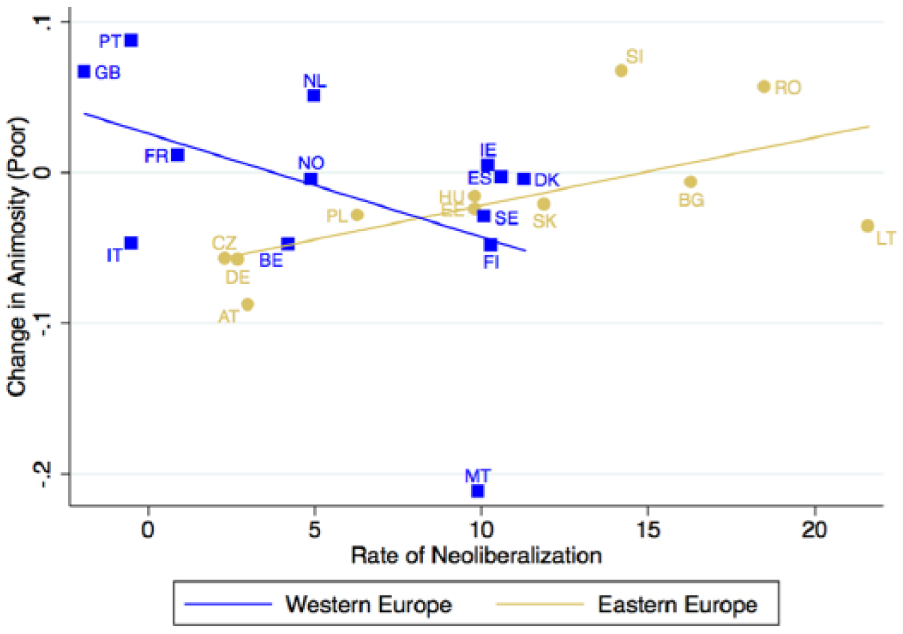
Rate of neoliberalization and boundaries toward the poor, 1990–2010.

Rate of neoliberalization and boundaries toward Muslims, 1990–2010.
In contrast, Western Europe saw a reverse pattern: blaming of the poor decreased, while animosity toward Muslims increased. That is, citizens have come to draw sharper boundaries toward the poor in countries that did not experience major neoliberal policy adoption between 1990 and 2010, such as Portugal and the United Kingdom. Conversely, citizens in countries characterized by stronger neoliberal reform from 1990 through 2010 are becoming less judgmental of the poor; France, Norway, and Finland best describe the trend. However, when we gauge citizens’ stance toward Muslim immigrants, we find the opposite pattern: higher rates of neoliberal policy adoption go hand in hand with citizens’ drawing sharper boundaries toward the “other,” as best illustrated by citizens in Spain, Ireland, and Finland.
Another general trend is the convergence within each cluster. We examine this using the coefficient of variation, a measure of the standard deviation relative to the mean for each cluster. For attitudes toward the poor in Western Europe, the coefficient of variation fell from 0.50 to 0.39 between 1990 and 2010, and it dropped from 0.29 to 0.25 in Central and Eastern Europe. There was a similarly small decrease in Eastern Europe for responses regarding attitudes toward Muslims. The exception seems to be Western Europe, where the coefficient of variation increased from 0.29 to 0.39 during this period, suggesting greater within-region variability. On the whole, however, countries tended to converge both in their adoption of neoliberal policies and toward more accepting attitudes regarding the poor during this period.
The largest outliers in the analysis of Western countries are Malta and Italy: citizens in these countries have come to draw much sharper boundaries toward Muslim immigrants, out of trend with these countries’ development toward neoliberalism. An explanation may be found in the strong increase in migration flows to and through the two countries in recent years, a point to which we return in the conclusion. Outliers among the Central and Eastern European countries are Latvia and Estonia. In fact, taken together with the third Baltic state, Lithuania, these countries better fit the trend observed for the Western European countries.
In sum, the analysis suggest that neoliberalism has gone hand in hand with a strengthening of boundaries along ethnoreligious lines in Western societies, whereas citizens in Central and Eastern Europe have come to draw stronger lines along the meritocratic dimension of perceived deservingness. These patterns can be interpreted in multiple ways. The trend in Europe could mean that solidarity nowadays is defined in ethnoreligious terms in a shift away from the civic model of nationhood, especially in those societies where neoliberalism has heightened economic competition (Bail 2008; Bobo and Hutchings 1996; Lamont and Duvoux 2014). The pattern for Central and Eastern Europe could be indicative of the rise of a meritocratic ideology in the East, as neoliberalism is washing away the memory of communism (Kunovich and Slomczynski 2007; Lepianka et al. 2010; Van Oorschot and Halman 2000). These and the other patterns discussed here are based on a small sample of countries, but the divergent direction of the two country blocks suggests that the impact of neoliberalism on boundary formation may be conditional upon the context of reform, as suggested by the theoretical approach here presented.
Conclusions
The spread of neoliberal policies, politics, and ideologies in the late twentieth century has altered social life at a variety of levels. Specifically, it has reshuffled symbolic boundaries in some societies in ways that have narrowed definitions of belonging and further marginalized the poor, the working poor, and ethnoreligious minorities. Despite the global reach of neoliberalism, however, we argue that it is important to understand these changes within a context of local, national, and regional variation. In particular, we suggest, differences in the timing and extent of neoliberal reforms, as well as differences in existing cultural, political, and social systems, are capable of shaping the resulting configurations of symbolic boundaries and patterns of social resilience.
We are aware of various limitations of the empirical illustrations here presented. First, although our analysis of changing attitudes toward the poor does not take into consideration other factors, such as the impact of economic conditions on attitudes, the literature has shown the impact of economic cycles on the explanation of poverty by individual or structural factors (Van Oorschot 2006). There are other confounding factors that may explain outcomes but are not considered in our bivariate analysis, such as migration flows and other pressures on the welfare state and labor market. 6 Also, it would be very interesting to see if, drawing on other data sources, we would find similar patterns if instead of looking at boundary work vis-à-vis the poor and (Muslim) immigrants, one by one, we look at intersections of the two categories.
Furthermore, our measurement of neoliberalism is of the rate of policy implementation, which may give a different indication of change in countries than would a focus on the popular acceptance of neoliberal ideas. Whereas the two likely go hand in hand, they are not the same, and there may be considerable lag between the two. Also, our analysis is based on two data points, whereas we would ideally have more measurements in time so as to describe trends in closer detail and in certainty that what we observe is nonrandom variation. Last, although our focus here has been on the East-West comparison, another direction is to consider the transformation of boundaries in Northern and Southern Europe, as patterns of growth and unemployment may lead to a growing polarization between countries located in these regions. These limitations suggest paths for future research.
Although we are unable to draw definite conclusions, given the data limitations here discussed, this research points to important trends worth further examination. Specifically, our contribution may have broad implications for the study of the transformation of solidarity in Europe and North America. This topic has been the object of considerable scholarly attention of late, as political philosophers and experts in comparative politics and political economy are considering institutional and other forces that transform patterns of solidarity and social capital in Europe (Emmenegger et al. 2012; Hall 2015; Kumlin and Rothstein 2005; Martin and Thelen 2007). The agenda that our contribution suggests points to the promise of connecting such institutional and normative literatures to the study of the transformation of symbolic boundaries, which has emerged from the field of cultural sociology (Wimmer 2008, 2013). For instance, while Thelen (2014) considered the way that differences in the political coalitions that preside over similar-looking neoliberal type reforms produce wholly different “varieties of liberalization,” each with quite different implications for distributional outcomes and overall levels and patterns of inequality (Martin and Swank 2012), we could consider how such coalitions also correspond to changes in patterns of boundary work in political platforms (especially around antiausterity or anti-immigrant issues). Pursuing such issues would allow the consideration of a much broader range of sociological factors contributing to paths for social change (Pierson 2002), including the transformation of patterns of inequality and stigmatization (Lamont et al. 2016).
Footnotes
Acknowledgements
For thoughtful comments and suggestions, we thank Peter Hall, Nicolas Duvoux, Kathleen Thelen, Cathie Jo Martin, Hilary Silver, and the two anonymous reviewers of this journal.