




Abstract
This article explores the relational and moral aspects of the perception of class structure and class identifications by young people in objectively vulnerable labour market conditions in Poland and Germany. Drawing on 123 biographical interviews with young people in both countries, it demonstrates that young precarious Poles and Germans tend to identify themselves against the ‘middle class’ – understood variously in the two countries – and attribute the sources of economic wealth and social status in their societies to individual merits and entrepreneurship. Positioning oneself in the broad middle and limited identification with the precariat is explained by the youth transition phase, country-specific devaluation of class discourses and the effects of individualisation.
Keywords
Introduction
The 21st century has seen a dramatic rise in social inequality in western societies. The shift from industrial to financial capitalism has affected the social inequality of income, health and life chances within Europe with income distribution becoming more unequal than ever (Sayer, 2016). Inequality is not only income or resource based but also affects political representation and political will (Schäfer, 2010). At the same time, a rapid process of individualisation, since the 1970s, has changed the way people work, live and identify. Individualisation has led to a myth of equality (i.e. the equality of chances) and the autonomy of individual life design (i.e. the decision of how, and with whom, to live). Individualisation has also led to the disruption of collective identities and a change in political participation. Individuals now tend to believe that the problems they are facing are personal which limits the capacity to understand their collective nature (Furlong and Cartmel, 1997/2007).
While for many decades (classic) class analysis has been seeking to better understand the effects of socio-economic inequalities, the forms of exploitation which enable inequality and class awareness or class imagery (Bulmer, 1975) and the relationship between class locations and class consciousness (Wright, 1997), individualisation has led authors to believe that classes are dissolving (Pakulski and Waters, 1996) and that class has become a ‘zombie category’ as social inequality is now individualised (Beck and Beck-Gernsheim, 2002: 203). Individualisation is assumed to make collective consciousness or collective action impossible. The cultural turn in class analysis (Devine, 1992; Savage, 2000) however, inspired by Bourdieu (1987), focuses on the relationship between the structural positions of social agents and the symbolic expression of class reflecting agents’ ‘similar dispositions which prompt them to develop similar practices’ (Bourdieu, 1987: 6). Even though people tend to dis-identify with class, it is observed that identities, tastes and politics might be classed even in the absence of explicit class identities (Savage et al., 2015; Skeggs, 1997).
Against this backdrop the article explores whether young workers in vulnerable labour market positions – workers who are particularly hard hit by the economic crisis (Labour Force Survey, 2017), who are disproportionately affected by precarisation and systemically disadvantaged in terms of facing a greater risk of poverty, temporary employment and unemployment than the general population (Furlong and Cartmel, 1997/2007) – are aware of social inequality and their structural class position. It asks whether and if they identify and dis-identify in terms of class. Standing (2011) suggested we might expect signs of a new class identification, in terms of a ‘precariat’, those made vulnerable by new precarious working conditions; however, some have criticised this for overplaying the convergence of class interests of precarious workers (Wright, 2016), and downplaying the diversity of resource composition, lifestyles, tastes or identities among the precariat (Manolchev et al., 2018). So, if precarisation does not lead to the formation of the precariat as a class, does class still matter for young precarious workers’ impressions of society? Or is individualisation theory correct and precarisation contributes to a further erosion of collective class identities and consciousness?
This article combines cultural and classic class analysis drawing specifically on the relational moral aspects of class, while keeping an interest in social and political attitudes and perceptions. The article borrows from Lamont (2000) and Sayer (2005a) to understand how individuals demark themselves from others symbolically and draw symbolic boundaries to categorise other people in everyday life. Exploring how young workers legitimise and potentially contest class inequalities in their societies by symbolic boundary drawing, the article contributes to the moral turn in class analysis where moral stances go beyond a narrow view of class in terms of consumption and aesthetics’ choices (Jarness and Flemmen, 2019; Jarness et al., 2019; Reay, 2005).
Empirically we draw on 123 biographical narrative interviews with young people in precarious labour market conditions in Poland and Germany. These countries were selected for two reasons: first, they represent two countries where the rise of new forms of social inequalities – particularly related to the spread of precarious employment among young people – has been vaster than compared to other countries in recent years (see Schäfer, 2010; Szafraniec et al., 2017: 166); and second, these two countries differ regarding traditions of class formations given their post-socialist and neo-corporatist economic orders respectively.
Theorising Moral Boundaries of Class
Class analysis experienced a rebirth after the economic crisis in 2007 (Savage et al., 2015; Umney, 2018). While for many years the cultural turn in class analysis had tried to avoid the marginalisation of culture and identity, it happened at the expense of underplaying the relations of economic power and domination that lie at the heart of class structure in capitalist societies (Crompton and Scott, 2005; Flemmen, 2013). Following Bourdieu (1987), authors like Atkinson (2010), Savage (2000), Sayer (2005a, 2005b) and Skeggs (1997) understood class as a descriptor for groups of people occupying similar positions in social space (grasped in terms of distribution of various kinds of capital) and exhibiting similar social practices, including lifestyles and consumption patterns. Class positions though were not considered to translate into class reflections or consciousness but rather show as symbolic and cultural expressions of class (Devine and Savage, 2005). However, recent studies of lay perceptions of social inequality demonstrate that the ways individuals perceive and refer to others might reveal a form of continuous class consciousness among various groups in contemporary society (Irwin, 2018; Jarness, 2017; Lehmann, 2009).
Lamont (2000) and Sayer (2005a), both leaning upon Bourdieu’s theory, have shown first how everyday life experience of class is centred around the norms and values assigned to material conditions of life. For them, defining one’s own way of life is constructed in relation to others, attributing moral traits to ‘people above’ and ‘people below’. They argue that morality becomes crucial for the discursive awareness of social classes. People in their daily lives are continually occupied with evaluating whether their behaviour towards others, or of others towards them, is fair or unjust. These everyday moral judgements, so-called lay morality, can find expression in direct form (i.e. formalised as norms) but also indirectly through expressed emotions (Sayer, 2005b: 951). Sayer sees the connection between morality and class in processes of othering, in which groups construct a positive identity and self-worth through the differentiation of themselves from others. For Sayer, these processes are the expression of class relations: economic and cultural bases notwithstanding, social classes are constructed and reproduced by evaluative responses to others (Sayer, 2005a: 4). Similarly, Lamont (2000: 3) shows how the working class in the United States and France categorise and stratify people, practices, tastes and attitudes in everyday life by drawing symbolic boundaries that create a kind of imagined community of ‘people like me’. Boundary drawing functions as ‘an alternative to economic definitions of success and offers them a way to maintain a sense of dignity and to make sense of their lives’ (Lamont, 2000: 2).
This article’s contribution is novel in terms of not focusing on one group of workers but acknowledging the pervasiveness of precarious working conditions across professions and educational levels (Alberti et al., 2018). The sample encompasses a diversified group of precarious workers, blue-collar and middle-class workers, all at the beginning of their careers and all under 35 years old. Further, it analyses the class perception and boundary drawing from a comparative perspective, focusing on Poland and Germany, two countries in which ‘cultural repertoires’ of class are different due to historical and political circumstances. In Poland, there is the legacy of class language due to socialism and the anti-communist movement (which combined it with religious and nationhood discourse). However, it was devalued in the public discourse after 1989 as belonging to the socialist past (Ost, 2015); instead, market individualism and entrepreneurship were presented as the only viable alternative to class collectivism (see Dunn, 2004). In Germany, the idea of a levelled-out middle-class society (Schelsky, 1965: 332) seemed to largely monopolise the discourse on stratification and class while at the same time the escalation of post-materialistic orientations contributed to the erosion of traditional class culture (Vester, 2005: 89). In the remainder of this article, the impact of local cultural repertoires of ‘lay morality’ on ways of creating discursive boundaries between social classes is comparatively explored.
Methods
For this research biographical narrative interviews (Schütze, 1983) were combined with a semi-structured interview guide. The narrative was initiated, first, through the question ‘please tell me your life story, from childhood up to the present moment’ and, second, through questions about particular life events flagged by the interviewee’s narrative. Themes such as the experience of work/precarity, the informants’ idea of decent work, a good life, social relations, social activities and class identifications were also explored.
A list of questions related to class, inspired by Lamont (2000) and Ossowski (1963), was created to understand what young people thought about the social structure of society – a topic that very rarely appeared explicitly in the ‘spontaneous’ parts of the interviews. Examples included:
Some people say our society is divided into classes or strata. What do you think?
Where would you locate/position yourself?
How would you describe people who are ‘below’ and those ‘above’ your own position in a society?
In each case, in the analysis, these questions were linked to the experiences mentioned in the first two parts of interviews making the answers to them highly ‘indexical’: this approach made it possible to analyse the descriptions of ‘people like me’, ‘people above’ and ‘people below’ in the context of biographical experiences of informants that would have been unavailable in standard semi-structured interviews.
One hundred and twenty-three face-to-face interviews took place, lasting from 50 minutes to 4 hours, with narrations lasting up to 40 minutes. As shown in Table 1, the initial target sample included those aged 18–35, whose work situation was precarious, defined as deviating from the employment norm (Dörre, 2014). Precarity was captured as: (1) having non-standard employment contracts, such as contracts of limited duration, with temporary work agencies, civil law contracts, mini jobs and marginal part-time jobs; (2) being involved in transitional labour market programmes or unpaid traineeships; and (3) being unemployed following a previous experience of a non-standard employment contract. Regarding training and education, we considered those people precarious who had an income below two-thirds of the median income in each country, and those who depended on side jobs to finance their living while working towards their qualifications. Respondents were sampled according to their employment situation, educational level, age and gender. The sample covered a broad range of occupational sectors in cities of different size.
Sampling of interviews.
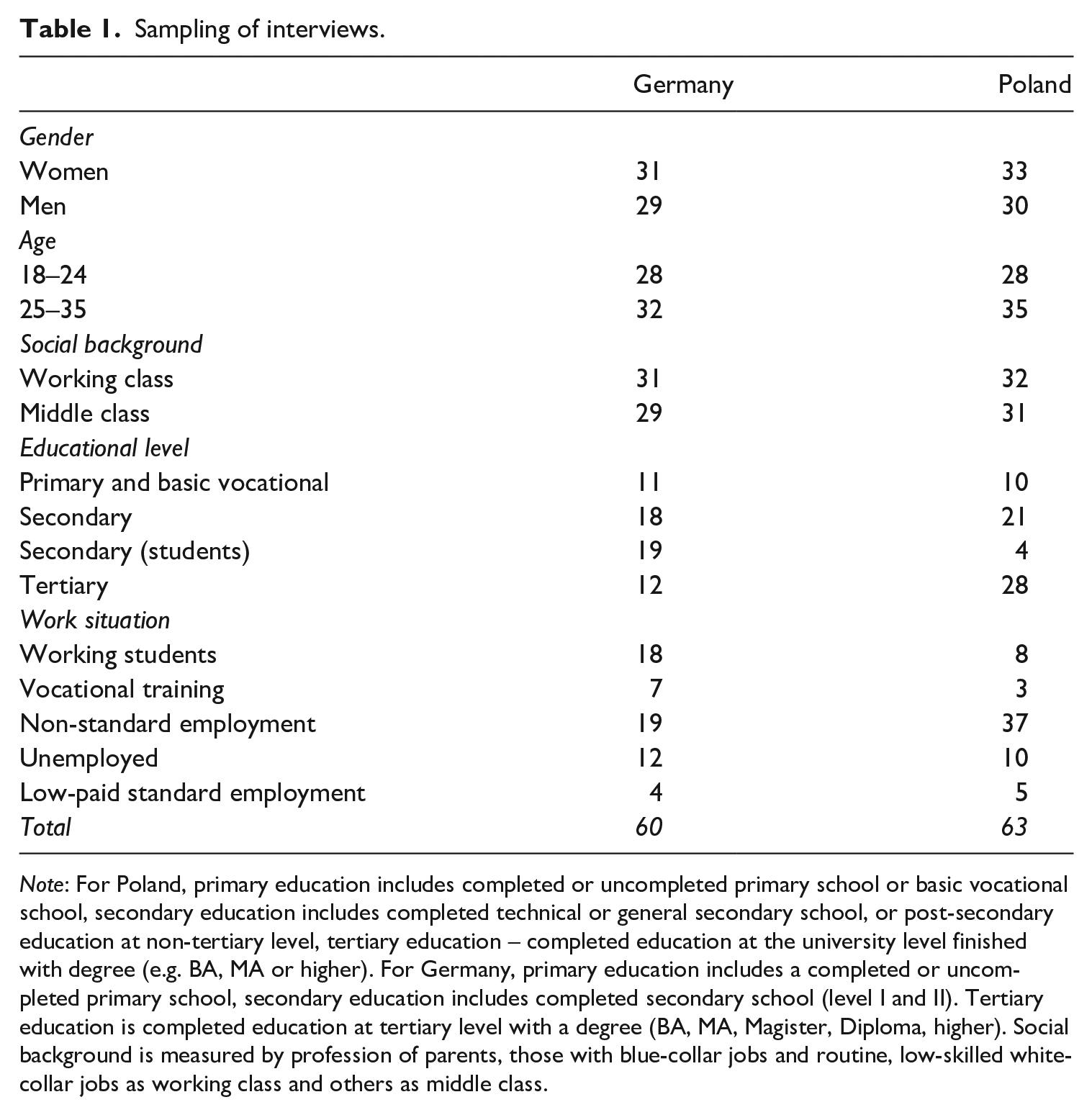
Note: For Poland, primary education includes completed or uncompleted primary school or basic vocational school, secondary education includes completed technical or general secondary school, or post-secondary education at non-tertiary level, tertiary education – completed education at the university level finished with degree (e.g. BA, MA or higher). For Germany, primary education includes a completed or uncompleted primary school, secondary education includes completed secondary school (level I and II). Tertiary education is completed education at tertiary level with a degree (BA, MA, Magister, Diploma, higher). Social background is measured by profession of parents, those with blue-collar jobs and routine, low-skilled white-collar jobs as working class and others as middle class.
The analysis was undertaken on full transcriptions of the interviews including both the narrations and the semi-structured part. Transcripts translated into English and analytical memos for each interview created by national teams served as the basis of Polish–German comparisons during joint workshops. Using the tools of grounded theory methodology (Glaser, 1978), we coded every positioning in the social fabric, or differentiations or identification of the self with other groups. We analysed if and how class experiences emerged in spontaneous parts of the interview. Subjective criteria for describing their own position in the social structure were juxtaposed with several objective factors of social position (such as family background, education, job performed). We distinguished two types of boundary drawing, analysing how our respondents would distance themselves from those perceived as being above as well as below themselves in the social space. As such, we explored if and how they legitimised their own position vis-a-vis ‘people above’ and ‘people below’ (using Lamont’s categories). Finally, we compared class positioning in response to our direct questions with the biographical experiences those individuals made that we reconstructed from the narrative parts of the interviews.
Class in the Narratives of Young Workers
Self-Positioning within the Social Order: ‘People Like Me’
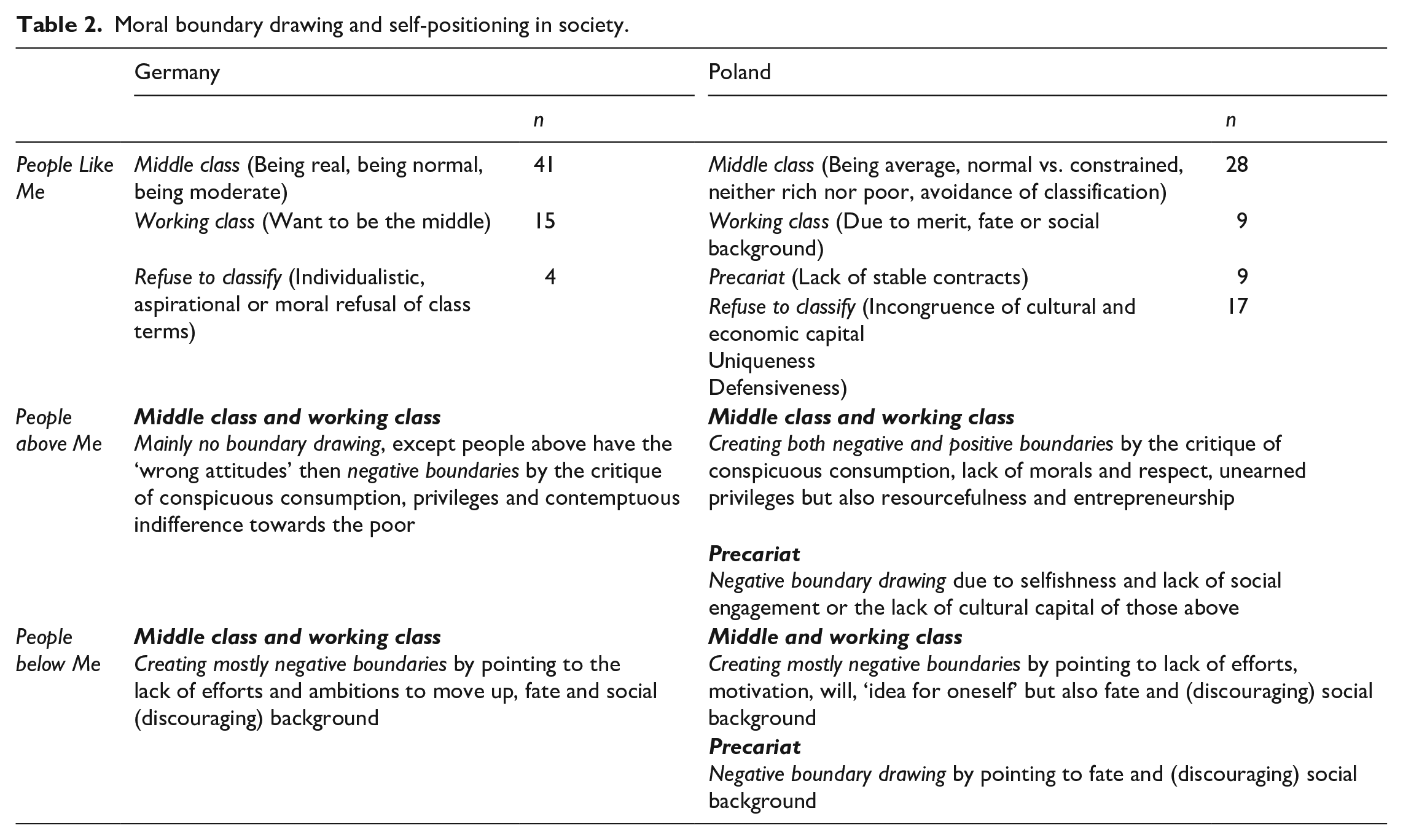
During the spontaneous narrations, there was little mention of social structure or, even more concretely, class terms for explaining one’s own position in society or their own upbringing. Class was not a central biographical concept for our informants. It was through answering the question ‘where would you locate yourself in the social structure’ where almost all interviewees showed an unconscious, Bourdieusian approach towards class, referring to their economic, cultural and symbolic resources. In both countries, the middle class was the main reference point for defining individual positions (41 in Germany, 28 in Poland, see Table 2), even in cases where the objective class position (social origin and occupational position or educational level) was working class (which was the case for a third of respondents in Germany and more than half of respondents in Poland). A smaller number described themselves as working class (nine in Poland, 15 in Germany). Differences between the two countries lay in the number of people who refused to position themselves (with huge resistance (n = 17) towards classification in Poland, compared to four in Germany) and the existence of a clear self-understanding of a minority (nine) as precariat only in Poland which was totally absent in Germany.
Moral boundary drawing and self-positioning in society.
Refusal to classify themselves happened where respondents had high cultural capital (through educational attainment), but their earnings did not reflect this, so there was an incongruence of cultural and economic capital. The refusal to classify was particularly strong in Poland (and other Central and Eastern European countries): first, as a result of labour market mismatches, overeducation and underemployment of a rising number of university graduates (Szafraniec et al., 2017: 158), and second, since the weakness of established class discourse in Poland (Ost, 2015) made Polish informants less eager to refer to classes (especially if this meant they had to accept their own inferior positions). Instead, in line with individualisation theories, both higher and lower educated informants emphasised their individual uniqueness and value irreducible to class categories. Third, the avoidance of class identification can be interpreted in terms of the defensive attitudes of those at the very bottom of the stratification ladder who saw social classifications as morally dismissive. As Przemek, 18, from Poland and unemployed with primary education, said:
I think that I’m not the one to judge and there are no people lower than me. They can be, so to say, at the same level as me or they can be better, but I never thought that there is someone worse. (M, 18, P)
In Germany, only a small number refused to locate themselves in the social structure. This might indicate the continuity of a classed perception of social order since social hierarchies are at least acknowledged even if the term class was rarely used. ‘Class’ was considered to be stigmatising: ‘I hate such class thinking’ said Sophia, 21, from an upper-class origin, and Anna, 29, an administrative consultant, stated, ‘Well I do find the idea of social strata somehow nicer, classes sound . . . a little bit depreciating.’
The majority of both Germans and Poles considered themselves to be part of the middle but their interpretations of the middle differed. Germans who considered themselves to be part of the middle avoided the term ‘class’ and used instead ‘middle strata’ and they defined the middle by income, education level and the mere fact of having work, as well as the lived family model. In moral terms, they referred to being moderate and striving for a balance between having or wanting or doing too little and too much. Being in the middle meant not being hungry but also not ‘eating from a golden spoon’, as one of our interviewees put it. The middle works as reference point even if objectively people are rather working class (based on their social background, income and education).
For 20-year-old Tom, with a secondary school education and working-class background, waiting for an apprenticeship as a medical clerk, living with very modest income from work as a delivery courier, pocket money from his parents and the state-funded child allowance, ‘realness/being real’ or modesty distinguishes the middle from other positions in society:
I am, as always in my life, in the middle and I do want to stay there. So, I don’t want to lose things to slip off or harm my body, to slip off . . . And I also do not want to drift off, even if I had the chance to earn a whole lot . . . I would certainly somehow do that for my family, but because of that I would not live snobbishly and buy myself a fast car and a fur coat. But I would rather still keep it real. And keeping it real means middle class. It means to deal with money and still clean up after yourself . . . Just as I know it from home. (M, 20, DE)
The identification with the middle in Poland occurred in three forms: first, it was a defensive strategy used to avoid identification with other classes, or even using identification altogether. A typical statement here was to deny belonging to the upper class and distance oneself from the lower class. This way of relating to the middle was present both in narratives of those performing blue-collar and white-collar jobs who were higher and lower educated. Second, the middle was presented as something aspirational by those experiencing social rise which they attributed to individual hard work. Third, a critical image of the hard-working middle emerged in the interviews with those in white-collar, creative occupations. A good illustration is Janina, a 29-year-old prison psychologist who worked part-time in two prisons and in other simple jobs to supplement her family income:
I generally think that the middle class is screwed up (. . .) I’m in this middle and I feel very bad, because, on the one hand, I won’t get this (social) flat from the commune, because I’m not eligible because I earn too much, and on the other hand, I’m being refused a mortgage because I’m too poor for the bank. (F, 29, PL)
Reflecting on being working class differed in Poland and Germany. In Germany respondents defined themselves almost always in comparison to the middle class: they were the ones that had to constrain themselves, make a living on the minimum, were not able to afford anything luxury or just beyond basic needs. They dreamt of the extra income that would allow them the additional expenditure to make life a bit more comfortable. Johanna, for example, who was a welfare-dependent single mother, could not maintain the middle-class position of her parents, it seemed out of reach for her: ‘I always wanted to belong to the better ones, in quotation marks, but now, I myself am a welfare recipient, so I would say that by now I do belong to the lower tier. Those that count every penny’ (F, 23, DE).
Marcel, who due to his social background and current situation identified with the ‘lower class’, was also striving for the middle which he linked to a settled life: ‘Middle class, for me this is people who normally pursue their job, have a regular income and a settled family life.’ However, he also mentioned the need to remember one’s social background (‘not to forget or suppress where I come from’). Such an effort to question a paternalistic perspective that denies working-class people dignity and pride was also found in some interviews with those who had working-class identifications. However, a positive picture of the working class in terms of moral traits, such as ‘keeping family together’ (with hard-working mothers as role models) was still combined with aspirational visions of social structure (‘to work your way up, slowly’) which echoes the attraction of dominant, individualistic middle-class values.
In Poland, the self-perception of respondents as working class was more varied, from being ‘minimal class’ (Aldona, office worker), ‘working class’ (Patryk, automotive worker), ‘simple slave’ (Paweł, construction worker), ‘poor’ (Marcin, car mechanic) or, in one case (Helena, shop attendant), in racialised terms of ‘white slave’. All embraced a more structural view of inequalities from a disadvantaged position. An aspirational vision of social structure was present mostly in white-collar workers’ cases (‘poorer class at the beginning of the way up’ (Marta, trainee lawyer)). An extreme image of ‘total division’ was found in the narrative of Helena, a 19-year-old shop attendant. Identifying herself with the disadvantaged, Helena also sketched a highly moralised picture of those who are willing to help other people rather than pretending ‘to be somebody you are not’:
In this country there is total division . . . of people. Either you are rich and keep with the rich. Or you are poor and keep with the poor, you are humiliated, because you are this (. . .). But in my opinion it is stupid to pretend to be somebody you are not . . . [Interviewer: Where would you place yourself . . . in this group division that you mentioned, where are you in the division?] Right in this, in this group of people who are able to do something for somebody. A person who despite that I have my own life, my problems, I am trying to help others, get involved in other people’s lives. (F, 19, PL)
Among those considering themselves being disadvantaged were nine respondents from the Polish sample who explicitly described themselves as being ‘precariat’, understood in terms of their experience of short-term jobs and used the term with some self-irony or hesitation. All had higher education and links with left-wing social movements. Adam, a cultural studies graduate, working with (usually low-paid) civil law contracts for municipal cultural institutions, expressed solidarity with ‘workers on civil law contracts in construction’, but saw the position of people like him (‘working from project to project’) as being different and called by him ‘the precariat (. . .) of cultural milieu or . . . art milieu’. For him and other informants in this category, the precariat is seen as a ‘broad term’ (Nadia) and a way to avoid clear-cut classifications rather than a tool of political mobilisation.
In Germany, no one positioned themselves as precariat rather respondents saw precarity as an individual condition not as a reflection of social/class position. Moreover, precarity was in many cases trivialised as a minor problem, as the price for more freedom or legitimised as a ‘normal’ transitional phase of young people’s lives. The way precarity was perceived and reflected on did by no means get in the way of a positioning within the middle of society. Precarity is a ‘normal’ part of young biographies (see Mrozowicki and Trappmann, 2020).
‘People below Me’
In both countries, people below interviewees’ own social position were considered to show similar consumption patterns and experience a lack of training and educational opportunities. Individuals were expressly blamed for their poor behaviour and their lack of ambition. An identification with the middle usually went together with the degradation of those in lower classes as lazy or having made the wrong decisions and, thus, being responsible for their own failure (often linked to accusations of alcohol abuse and ‘pathologic’ behaviour). In the German sample, Emilie, a vocational trainee in office management, and Nora, who at 20 years of age was repeating her secondary school qualifications, conveyed similar sentiments towards those ‘below’ themselves:
Yeah. I hope this won’t sound nasty now, but anyway, there are some who get Hartz IV
1
and have indeed just given up on themselves a bit. I’d then classify them as below us. (Emilie: F, 20, DE) Everybody can decide who’s lower class. Whoever’s got the choice between Netflix and working, and then in fact finally decides on Netflix, it’s their own fucking fault I think. (Nora: F, 20, DE)
Both women came from lower middle-class families and had a strong drive to find and pursue their own dreams in terms of education and jobs. Emilie tried out several different apprenticeships and internships without yet having figured out what kind of educational trajectory she needed to follow in order to be officially qualified for the valued and enjoyable work she does presently. Nora, on the other hand, decided to study psychology and was willing to put all the necessary efforts into her education in order to be accepted at university. She thinks of herself as someone who has managed the jump from a free and lazy teenager who was hanging out and smoking weed with friends to somebody who is also able to focus on moving forward with her life. The constant drive to improve living conditions, ‘working the way up’, is assumed as the societal norm. A lower-class position is thus considered a result of a lack of ambition and an unwillingness to change; as individual failings. Some respondents expressed a form of social envy if those who made no attempt to ‘get on’ with their lives were still protected by the welfare state.
This individualistic perspective is mainly applied by those believing in meritocracy. Those who identified mechanisms of structural inequality on a more abstract level (mostly those with degrees in higher education and/or those politically active), did not draw moral boundaries to those below them. They described clear-cut economic and cultural differences between themselves and people below but did not consider people in lower positions to be responsible for their situation or assign any inferior qualities to them (noticeably, they drew moral boundaries towards the upper class).
For some respondents in both countries, class positions were explained with reference to broader notes of social origin or biographical predicaments (‘bad luck’, health problems and/or family issues). Sina, a 31-year-old social worker who grew up with a single father (and later a violent stepmother) moved out of the family home early and relied on precarious jobs to finance her studies, reflected on the importance of family support:
It is really arduous when you are coming home and you have no energy to think what else you could do with your life. I think you really end up in such a shit circuit if you have not been lucky to be one of those who could do an A level or had somebody who said ‘yes you can do it!’ (F, 30, DE)
However, there remained a strong conviction that overcoming such difficult conditions was possible through individual hard work. As Kuba, a construction worker doing weekend studies, stated:
I think that we have a lot of poverty in Poland, for sure, you can’t hide it. I saw it and . . . it’s pity that it’s like this, because I think that these people, if they wanted, they could make up for it. Either they don’t want, or I don’t know. I don’t understand it, because you can, if you wish, find a job, even if, as I know, the majority of these families are usually pathological families. (M, 23, PL)
Another example was Marianna, a 25-year-old unemployed young mother, who was training to become an administrative technician, who saw the situation of those below her differently and who resisted too easy moral judgements. Her attempts to improve her own position do not make her less sensitive to the plight of others. Position in society was analysed on an individual level, rather than acknowledging group categories:
How would I define them . . . I do not know, maybe between those who are below or there may be a lot of reasons, either they are lazy or for example somebody offered them a hand and they did not care. Or the problems overgrew them and they had no strength to get up and there was nobody to help them get up, or simply they did not let it happen, because they were squeezed in this unhappiness so much, that they might have encountered. You can include bad start in life in this, yes. A pathological family, violence or something. Sometimes this also makes it impossible to get through. (F, 25, PL)
In both countries, only a small number of informants, mostly with working-class backgrounds who reproduced their parents’ position, albeit in (even) more precarious jobs, did identify social circumstances rather than individual characteristics for their self-assigned low class position. Julita, a shop attendant in a small Polish town, explicitly stated that she was excluded at school because she came from a farming family which she defined as ‘not having the right name’. Marcel, an already quoted Hartz IV recipient, recalled his experiences of being stigmatised at school by other children (‘you were labelled as a poor sod’) because he was from a poor family, despite his mother working full-time. Robert, in training financed by the job centre, pointed to his family background as the source of his disadvantaged position: ‘If one grows up in poor conditions, the possibility of self-realisation is as good as nil. And that’s horrible [laughs] for me. To just have to accept it.’ Nevertheless, such expressions of individual problems in more structural terms remained rather limited.
‘People above Me’
Higher social positions were perceived mainly in economic terms. Whereas the boundaries above were mainly based on economic terms, moral assessments were not directly given in reference to material wealth and the accompanying privileges as such. Most German respondents were reluctant to draw moral boundaries to those above them, if at all, but for some Polish respondents, moral boundary drawing was typically focused on people above, especially the conduct and attitudes of wealthier people. Wealth was framed as ‘overabundance’ (excessive affluence) whenever it was put on show and accompanied by behavioural expressions of personal ‘distinction’ and status-derived smugness. Some respondents, however, expressed the idea that wealth was unjustified when it can no longer be placed in a reasonable relationship to the work performed for it. Moral judgements, however, were focused mainly on the lifestyle and consumption patterns of the rich, regardless if those interviewees self-identified with the middle strata or with a working-class position.
In the German sample, only a few respondents expressed fundamental criticism of material wealth. Most thought it was deserved. Beate, however, was an exception. A single mother who earned very little as an entrepreneur, argued that even earned and saved-up wealth was not automatically justifiable. She was upset by a perceived lack of reflection (and effort) upon class by those in higher positions, the consideration of their position as righteous and their active distancing of other people through their lifestyles:
There’s also something else that, for people who somehow have lots of money, is simply different. The style of their homes, clothing, the style of living is different. Their problems are different. You don’t have, the language is different, you often have, just some kind of invisible boundary to others. And you don’t necessarily try to find it. (. . .) These people are convinced they’ve actually earned it. And they’re often blind to empathy, and so they lose a form of their humanity. (F, 35, DE)
Slightly different boundaries were drawn by Marcel, who grew up rather poor and experienced stigmatisation from wealthier children in school. Being currently welfare-dependent due to mental health issues he was facing since his partner’s miscarriage, he had met many people who experienced an ill stroke of fate and still tried to make the best of their lives. Though he also stressed that there were definitely people who had ‘worked themselves up’ – thereby calling into question the justification of inherited wealth or privileges – it was not the source of wealth or membership of the ‘high class’ that concerned him but rather their separateness from the rest of society and their perceived lack of empathy and solidarity.
Similarly, 23-year-old Toni did not question economic and cultural differences, their source and how far they were justified (or not). He focused instead on the criticism of attitudes, lifestyle and the behaviour towards others in his attempts to distinguish himself from others. Toni came from an upper middle-class background. He left home early, worked in a variety of precarious jobs (call centres, doorman, for example) and was now settling to study and work on educational projects: ‘I had the feeling people think of themselves as better. How they looked at me when I was saying I have to work during my studies. According to the motto, ’eeh don’t your parents have no money?’ (M, 23, DE).
Young Poles in the sample, like the Germans, also dismissed undeserved wealth, conspicuous consumption, the lack of empathy towards poorer people, pretentious lifestyles and excessive expenses, often with the use of credit. However, the negative moralised image of the upper class was much more present in the Polish sample, regardless of the educational achievements of informants. Agnieszka, a 21-year-old petrol station employee, openly stated that she had no contact with people in higher classes as they tended to ‘look only at themselves’. Przemek, introduced above, saw people ‘above’ him as lacking ‘respect’ and representing ‘low culture’. Radek, who despite his higher education worked in a discount shop in a low-paid job as cashier, also described the upper class as ‘assholes who want as much as possible for themselves’.
Another form of moral criticism of the upper class in the Polish sample concerned political elites. The divide between the world of ‘people’ and (state) institutions is a persistent trait of Polish social consciousness, called by Nowak (1979: 161) ‘a sociological vacuum’ in socialist times. This division is recalled, among others, by unemployed Dawid, who saw society as divided between the ‘middle class’ and ‘elites who have their hands on everything’ and include ‘politicians, their families who are better off and have connections’.
In a small number of Polish cases, there were examples of a kind of positive moral boundary drawing, a focus on merits and individual achievement that legitimised the upper position. Those in the upper classes were seen as role models for informants, people who earned their position in higher society thanks to their ‘resourcefulness’ (Julian) and entrepreneurship, who took advantage of the transformation period to move up the social ladder (Michał). For Mirek, who worked informally in removals, it was ‘self-evident’ that ‘if one has something, earned it, there is no problem’. The stronger presence of such positive images of the upper class in the Polish interviews can be linked to the dominant discourse of transformation which stressed the role of entrepreneurship, hard work and resourcefulness (Mrozowicki, 2011; Trappmann, 2013).
Discussion and Conclusion
This article has explored a moral class perspective through workers’ perceptions and attitudes to examine how individuals account for their own and others’ class position in society. The article contributes to a renewal of class enquiry that combines classic class analysis and the Bourdieu-inspired moral class framework, showing that socio-economic differences are perceived and reflected in the social consciousness of individual young workers. Objectively facing precarious employment conditions, the majority of interviewees do not, however, make precarity a part of the definition of ‘people like themselves’ or, at least, they do not do it directly. Only a handful of respondents pointed to the systemic sources of inequalities, and even less of them identified with the ‘precariat’. Instead, as shown in Table 2, the majority of the sample thought of themselves as middle class and referred to individual criteria for their self-positioning. The incongruence between objective class position and self-positioning can likely result from the young age of respondents: class positions still feel ‘in the making’ for them, lives still feel in transition, even if this is deceptive. There seemed to be a taken-for-granted assumption that there would be time to improve one’s own working and living situation in the future. A positioning in the middle can, on the one hand, be understood as a way to solve the contradiction of seeing oneself in transition but having to define oneself in the sense of a fixed location, and, on the other, it can be seen as a result of the positive prospects, expectations of future improvement and as an anticipation of the social position that they will have soon, because they would ‘move up’ in time. This was a more common position among the higher educated interviewees in our sample probably because of the ‘lead in’ time between finishing education and establishing a positive employment outcome.
While for Germany such an identification means that the discourse about a levelled middle-class society (Schelsky, 1965) still holds true even against objectively increased precarisation, for Poland apparently 25 years of market liberalism has contributed to the spread of the ideologies of the middle class (Gdula and Sadura, 2012) with the help of an entrepreneurial discourse (Trappmann, 2013) that everyone can achieve a higher (i.e. middle) class position. However, the precarious ‘middle’ functions largely as a void category reflecting aspirations of social advancement and fears of social decline. Managing precarity, the majority of young adults in both countries tended to subscribe to a performance discourse that rewards the efforts of the determined, resourceful and the industrious enough to overcome their social and labour market conditions. Such a discourse is, in particular, reflected in the image of those ‘below’ who were seen by the majority of our interviewees as not determined enough to change their situation. Yet, here social inequality was individualised, and legitimised, and structural reasons were neglected. The consequences of such an individualisation of social position were less present in the depiction of those ‘above’ who, if seen in a critical way at all, were seen as indifferent towards the poor, inward-looking and enjoying undeserved privileges. The moral boundary drawing in our sample ascribed much individual responsibility towards class position yet it also acknowledged a group belonging. As with recent results by Irwin (2018), the research demonstrates that individualisation and classed identification can go hand in hand. The boundary drawing from those ‘above’ and ‘below’ enables a construction of the middle as ‘normal’ and as a desired position in society which is achieved through meritocratic (in the case of Germany) or entrepreneurial (as in Poland) individual action.
The contribution of the article is threefold: (1) theoretically, it argues for a retention within cultural class analysis of the fundamental insights from pre-Bourdieusian class analysis that life chances are generated through capitalist institutions allocating resources (Crompton and Scott, 2005; Flemmen, 2013); (2) methodologically, it successfully combines biographic research with focused qualitative class analysis via semi-structured questions and highly ‘indexical’ interview guides; and (3) analytically, it shows that among precarious young workers social inequality is perceived, classes are recognised, and discursively constituted by moral boundaries, but the reason for class position is individualised as a matter of individual success or failure. There is a tendency to minimise the subjective relevance of class and subscribe to a broader notion of normal or ‘average’ middle which then can be seen as a vital part of the reproduction of class structures (see Bourdieu, 1987; Savage et al., 2001). Precarity is not perceived in moral terms since it is compatible with being the middle class, the desired class position. Moral boundaries are used to justify a performance-orientated society fostering the acceptance of social inequality; while a structural view on society leads to the refusal of moral boundary drawing, at least towards those below their own position in society. A moral class perspective helps identifying class perceptions in society but our research shows it also helps to justify social inequality. Class solidarity then, as suggested by Bourdieu (1987), has always been politically constructed. Hence, it can be argued – as an alternative hypothesis – that the sources of weak class consciousness among young precarious workers have more to do with the weakness of political actors capable of building their political subjectivity as precarious workers rather than their own ‘enchantment’ with the market and meritocracy. This may well require further empirical investigation.
Footnotes
Acknowledgements
The authors are grateful to three anonymous reviewers and the editor, as well as Mark Stuart and Charles Umney for their valuable comments which were helpful to improve the article. We would also like to thank our informants and the entire PREWORK project team for the discussion on earlier drafts of the article.
Funding
The authors disclosed receipt of the following financial support for the research, authorship and/or publication of this article: this article was prepared within the project PREWORK (‘Young precarious workers in Poland and Germany: A comparative sociological study on working and living conditions, social consciousness and civic engagement’) funded by the National Science Centre (NCN) in Poland and the German Research Foundation (DFG), the NCN project number UMO-2014/15/G/HS4/04476, the DFG project number TR1378/1-1.
Notes
 ).
).
).