



Abstract
What types of social contacts and support networks do recent migrants build when arriving in their host countries? The literature on social capital stresses the distinction between bonding ties (to people from the same ethnic group) and bridging ties (to people from other groups) and discusses their respective effects on migrants. However, recent critics of these approaches suggest a closer examination of bonding and bridging ties as well as what meaning they have and how they manage the flow of resources. Following this lead, I suggest a dynamic and contextualised approach to social capital that rests upon a detailed understanding of the meaning-making within supportive ties. Empirically, the article investigates bridging ties that ‘reach in’ from recently arrived refugees to more established residents in Germany. I distinguish reaching-in links from reaching-in ties and argue that both interweave in complex ways with institutions and discourses in the host country. Furthermore, the analysis suggests network-related inequalities within the group of refugees. In particular, refugees’ ego-networks vary considerably with respect to possibilities to produce and convert social capital into other forms of capital, such as cultural capital.
Introduction
Migration and flight are among the central themes of our time. The mass migration of 2015 demonstrated to even the last sceptic that growing mobilities would finally reach the centre of the Western world, particularly Europe. While migration researchers have long agreed that immigration inevitably changes receiving societies (Taft, 1953), the main burden of adaptation resides with the mobile population (Berry, 1997). The present article addresses the question of how newcomers’ processes of arrival unfold and focuses on the role of social networks in these processes. What types of social contacts and support networks do recent immigrants build when arriving in their host countries? Researchers consider two types of ties: bonding ties, which are based on homogeneous properties and allow for trust and social control (Burt, 2001; Putnam, 2007), and bridging ties to persons with different characteristics (Granovetter, 1973; Lancee, 2012). However, it has also been argued that in its current form, the distinction between bonding and bridging ties is insufficient for understanding the effects of social contacts and networks on migrants because it starts from reductionist assumptions and neglects the dynamics of social relationships and their complex inner life (Ryan, 2011; Svendsen, 2006).
The present article builds on these criticisms. To understand new tie making, I suggest looking in two directions. First, we need to understand the inner logic of ties and how meaning-making unfolds within support relationships. This calls for a renewed theoretical view that, among other things, answers the question of how networks (ties to other people) turn into social capital (in this case, support from others) (Ryan, 2016). I argue that it is essential for supportive ties to build common understandings of relational frames (e.g. friendship or kinship), mutual identifications (e.g. ‘a good friend’, ‘my older brother’) and support-related routines and expectations (e.g. whether and when support needs to be reciprocated). Second, we need to understand the impact of receiving contexts for recent migrants’ networking with established residents in the host country. Bridging ties emerge and develop in specific settings that affect not only who meets whom, when and how but also the very processes of meaning-making that surround support in personal relations. It is valuable to take a closer look at the positioning of incoming migrants and their embedding in institutions and discourses in the receiving countries. The present study shows how the positioning as refugees in Germany enables, limits and shapes bridging ties in manifold ways. Overall, this approach overcomes static and essentialist understandings of incoming migrants’ networking and puts them in a broader social context, linking them to wider processes of social exclusion and inequality that very likely impinge on the future pathways of those arriving.
Bonding, bridging and reaching in
The literature on social capital has addressed the manifold ways in which migrants use networks to arrive in their host country. To explain why social capital is effective, authors draw upon the distinction between bonding and bridging ties (Adler & Kwon, 2002; Geys & Murdoch, 2010; Putnam, 2007). Bridging ties are ties to people who are different ‘in some important ways’ (Putnam, 2007, p. 143), while bonding ties are links to people who are similar. In the case of migrants, bonding and bridging address the question of how migrants are embedded within and across their ethnic group. However, this approach is not without problems: when bonding is equated with ties to people from the same ethnic group, this comes with implicit assumptions about the nature of ties and the social positions involved. As Ryan (2011) argues, researchers often assume that migrants can readily access bonding networks and that ethnic ties offer a certain set of resources, such as trust or knowledge of the ethnic labour market. These assumptions not only reify ethnic boundaries that are in fact contested and constantly shifting (Wimmer, 2008) but also blend differences within ethnic groups and across social positions (Cederberg, 2012; Waldinger, 1993). Likewise, critiques address assumptions of bridging ties. Bridges are generally considered ‘weak ties’ (Granovetter, 1973) that reach up in the social hierarchy. Ryan (2011, p. 711) argues that this understanding overlooks the relevance of horizontal weak ties. Building on these criticisms, I suggest, first, analytical tools that allow us to look ‘inside’ bonding and bridging ties and the meaning-making of those involved. Second, I present a dynamic perspective on the positioning of recent refugee immigrants. In the empirical section, I apply this framework to the ties that bridge recent refugees to established residents.
Looking inside ties
Like all social relations, supportive ties are grounded in dynamic, meaningful interactive processes (Fuhse, 2009), and these meaningful processes should be at the centre of analysis. This approach is directed against widespread misconceptions that ‘“a relationship” is an entity or container of people that moves through time’ (Duck, 1995, p. 535). Rather, as Ryan (2011, p. 721) states, it is ‘more useful to think about the nature of the relationship and the resources available’. With a view to social capital in general, Reimer et al. (2008, p. 259) call for a renewed approach, arguing that ‘understanding social capital requires an understanding of social relations: their formation, transformation, vulnerabilities and resilience’. Seen this way, supportive acts are products of a complex architecture of relational meanings that builds on a mixture of cultural scripts, mutual expectations, interactions and common histories, and it is this mixture that should be at the centre of analysis. In the remainder of this section, I start from the assumption that the if, when, what and how of social support ensues from more or less enduring social relations. To analyse these relationships, I analytically distinguish between three constitutive dimensions of support ties: relational frames and identifications, resource flows, and reciprocity.
Relational frames and identifications
It is a common theme in sociology theory (Simmel, 1908), interactionism (Goffman, 1986; Strauss, 1997) and network research (White, 2008) that who-we-are and who-we-want-to-be emerge from relations with significant others. For some, we are a neighbour; for others, a doctor; and for others, we figure as a wife, child, or uncle. Such ‘identifications’ (Brubaker & Cooper, 2000) build on relational frames such as ‘friends’, ‘neighbours’, ‘brothers’ or ‘associates’. Cultural scripts and practical knowledge matter in all relations. However, they are merely building blocks and afford creative adaptations and inventions on the part of those involved. Adaptations sediment over time into common relational histories. ‘The reality [of a social relation] is informed by the cultural context and the scripts it provides, but reality is also a unique and partly idiosyncratic construction, reflecting the particular history, circumstances, and traits of the participants of the relationship’ (Blumstein & Kollock, 1988, p. 480). The thicker the layers of a common relational history, the greater the possibilities for personalised identifications within a social relation. Relational frames and more or less personalised identifications set the scene for social support flowing through ties. They are relevant when we decide whom to ask for what kind of support and when. In addition, they play a part in shaping expectations of reciprocity, such as why we contact a close friend when we look for emotional support at midnight (and not, say, a psychologist) or why we lend money to family members when they are in need.
Norms of reciprocity
Another constitutive feature of social relations is reciprocity, i.e. the question of whether and how one should give or return a favour, an assistance, a donation or any other kind of gift (Molm et al., 2007). While the return of gifts is by definition voluntary (Mauss, 1966), the need and desire to reciprocate is (empirically and normatively) ‘a generalized feeling’ (Williams, 1995, p. 401) in all parts of society, even for marginalised groups (p. 408). Phillimore et al. (2018) show how refugees in a situation of resource scarcity display styles of reciprocating that vary with respect to balance (i.e. a more or less one-sided flow of resources) and the addressee (i.e. to whom the return is addressed, the initial giver or someone else). Issues of reciprocity permeate social relations in fundamental ways. Different types of reciprocity (such as restricted and generalised exchange) express and simultaneously constitute relational frames. In a systematising endeavour, Uehara (1990) arranges different forms of exchange in social support relationships according to the delay of reciprocation into deals (immediate reciprocation), loans (postponed reciprocation) and gifts (unspecified reciprocation). For example, negotiating the conditions of reciprocating – which Molm et al. (2007) call ‘direct negotiated exchange’ (p. 209) – is a standard procedure for individuals who engage with one another as market participants (deal). However, the same behaviour is inadequate and potentially offensive within an intimate relationship, where the counter-gift is necessarily postponed and where the terms of reciprocation are less explicit. Overall, norms of reciprocity define the dynamic ‘terms of trade’ within a social relationship. They indicate whether reciprocating is appropriate and, if so, when and how it should occur.
Resource flows
Tie-frames and relational identifications, on the one hand, and norms of reciprocity, on the other hand, regulate the flow of social support within a relation (Figure 1). Song and Son (2011) define social support as ‘the aid – supply of tangible or intangible resources – individuals gain from their network members’ (p. 118). Social support is a ‘downstream factor’ of social capital, which in turn constitutes its structural basis. Social support and social capital are thus complementary concepts whereby one’s social capital refers to all the resources in one’s network, while social support refers to the supply of resources through one’s network (Song & Son, 2011). There are different forms of social support, typically grouped into emotional (e.g. company in difficult times), instrumental and informational (e.g. information on jobs or lending money), and social companionship (e.g. going to the movies). In addition to these positive forms, social support may comprise others’ expectations of support (House et al., 1988) and relations of conflict (Herz, 2014). The point is that not all types of support figure in all types of social relations. For example, emotional support is rare in some formal relations but essential in others (e.g. professional relations of emotional work). Additionally, relations vary with respect to the social organisation of support flows (timing, extent and variety, the right way of asking for support, preconditions) and the ensuing expectations regarding support reciprocation. Support flows feed back on relational frames, identifications and norms of reciprocity. Likewise, actual flows of resources (and their chronological orchestration) enact and indicate what type of reciprocity is at stake. For example, if there is no support within a friendship for a long period, the relational frame becomes problematic (‘pauses’ or ‘wanes’). Figure 1 presents a schematic representation of the interplay of the three dimensions that constitute the inside of support ties.
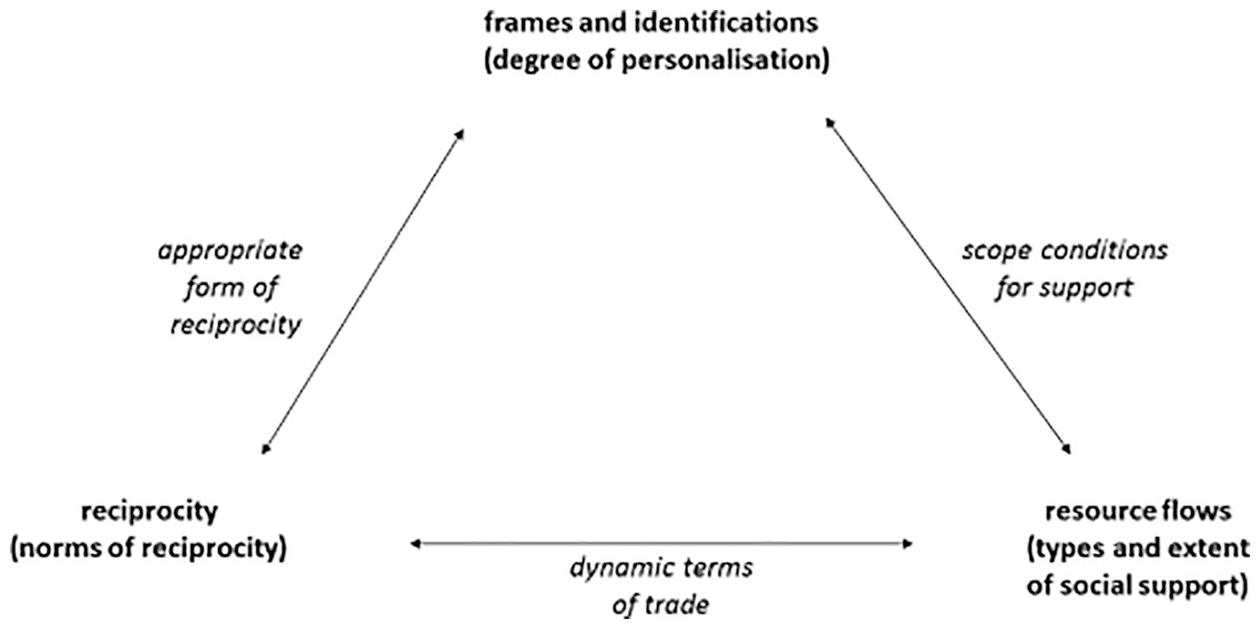
Inside social support.
Towards a dynamic understanding of networking: Reaching-in
Time is a crucial element for the analysis of the bonding and bridging ties of recent migrants. Recent migrants face the challenge of reorienting their lives and settling in a different social context after a major biographical rupture. This transition brings with it a fundamental devaluation of their capital endowment that cuts through all dimensions. This means, among other things, that educational degrees are not (fully) recognised (cultural capital), ties to old friends weaken or are lost (social capital), host country-specific practical competences and knowledge are missing (embodied cultural capital; Cederberg, 2015) or (forced) migration consumes substantial financial resources (economic capital). Moreover, new arrivals are often not familiar with the (tacit) rules of capital conversion and accumulation in the host country due to a lack of local knowledge. These circumstances mark a major difference between those who have just arrived and are still trying to gain a foothold in the new country and those who are already established. This difference emanates from the sequence of arrival and the social processes that ensue from it (Elias & Scotson, 1994). The present reconceptualisation of bonding and bridging ties refers to this difference by distinguishing, on the one hand, contacts reaching in from recent migrants to established residents (bridging ties) and, on the other hand, ties among recent migrants (bonding ties). Reaching in constitutes a major vehicle to ‘localise’ newcomers’ capital endowment and knowledge when settling in the new country. From this perspective, it is the resources of the established residents that matter, not their ethnicity (Anthias, 2007). In other words, the established residents at the other end of a tie reaching in to the host country may just as well be (earlier) migrants as people without a migration background (Wessendorf & Phillimore, 2018). This understanding of bonding and bridging ties rests on a dynamic approach to migration (Erdal & Ezzati, 2015). It identifies the first phase after arrival in the host country as a transitional positioning between earlier positionings in the countries of prior settlement and ensuing positionings in the host country.
Moving beyond static concepts of positioning and simplistic understandings of ethnicity is of particular importance for understanding the situation of recent refugees. In the German case, humanitarian immigrants confront an asylum process that temporarily positions them at the margins of society and subjected to procedures that determine their refugee status. These procedures structure a series of transitions, commencing with the request for asylum immediately after arrival in Germany, continuing with the asylum process and reaching its critical juncture when the decision on the asylum application is due (Leithold & Oesingmann, 2016). Those whose claims are rejected proceed into an infrastructure that maintains and even exacerbates their initial exclusion (culminating, in some cases, in detention), while those who are legally categorised as refugees or granted subsidiary protection (hereafter I use ‘refugees’ to refer to either category) proceed into an infrastructure that anticipates, promotes and assesses their participation (or ‘integration’) in society. In either case, immigrants pass through a sequence of temporary positionings that have far-reaching consequences for their living conditions and future prospects. Refugees stand at the intersection of the asylum system and the wider society: just released from the impositions of the asylum procedure and its concomitants and heading towards finding a place in a country that had thus far excluded them. To understand their further trajectories, it is essential to understand the supportive ties they forge and maintain to established residents. In other words, it is important to understand how they ‘reach in’.
Research design
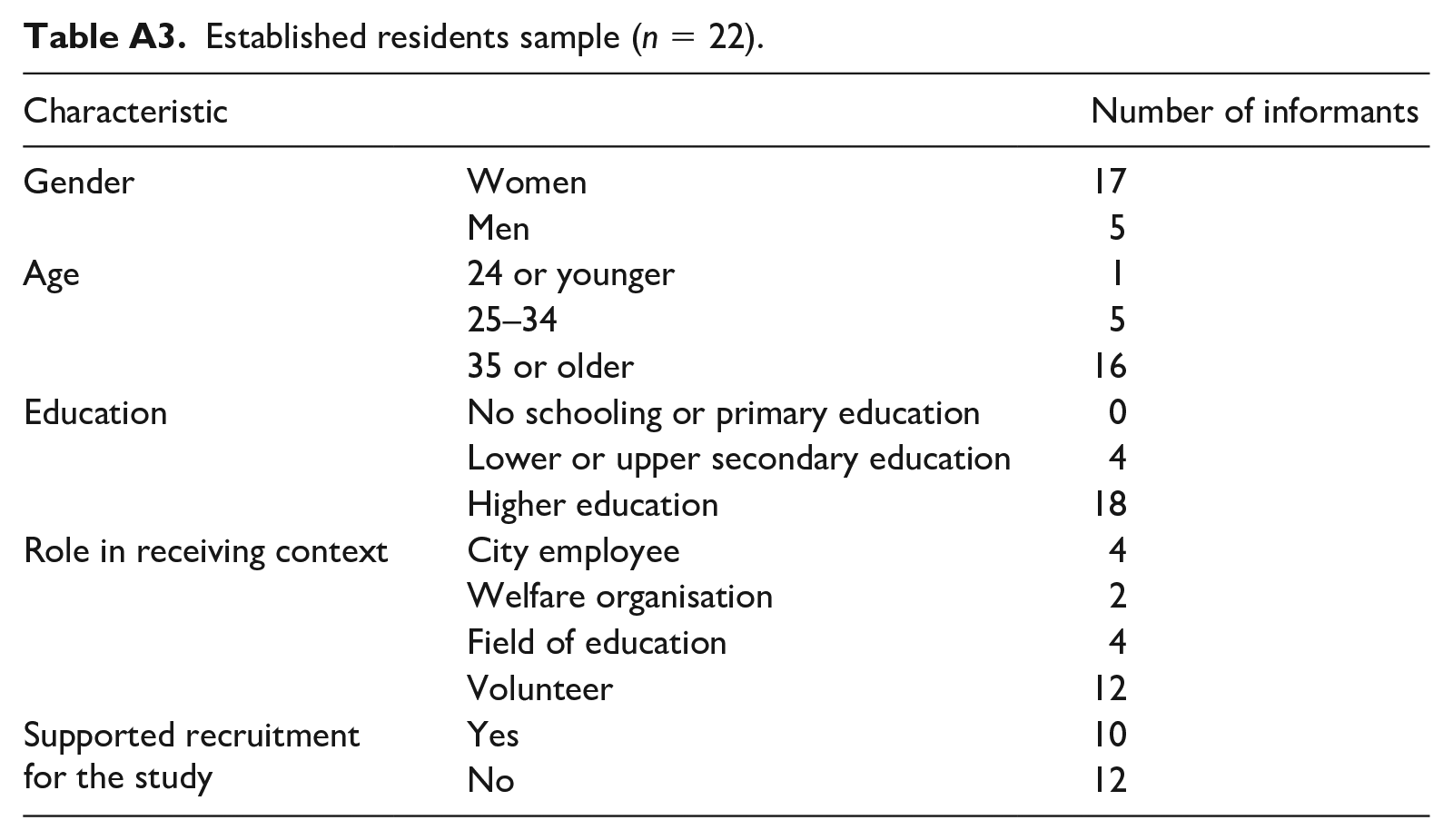
The article draws on a study of recent Syrian refugees in a major German city financed by the Federal Ministry of Labour and Social Affairs and the Federal Employment Agency. 1 Forty-two immigrants participated in the study, of whom 34 were Syrians and eight were from other major sending countries. All of them arrived in Germany between 2014 and 2016 and were interviewed in 2017 and 2018. Recruitment took place through different channels: some participants were recruited in refugee accommodation and others in international cafes, language courses, or circular emails to students. Populations that were harder to reach via the above channels, such as illiterate persons, traumatised refugees or people with less formal education, were approached with the help of volunteers and employees in welfare organisations (such as Caritas). To capture the receiving context, 22 such participants were recruited, including volunteers, employees of welfare organisations and the local administration (see the Appendix for an overview of the participants).
The interviews with refugees, on which the present analysis focuses, consisted of a biographical part and a network part. In the initial biographical part, I invited the respondents to narrate their lives and everyday experiences since immigration. In the network part, I contrived a multi-method approach to personal support networks that combined elements from standardised network analysis and qualitative network analysis. The network part began with eight standardised social support name generators covering instrumental support, emotional support, social companionship, obligations and a general item on closeness. The respondents wrote their names on Post-its and were then prompted to place them on a blank sheet in any order that made sense to them. Subsequently, the respondents could use (and draw on) these sheets to talk about their contacts and their overall perception of and satisfaction with their support network. This multi-method approach drew, on the one hand, on consolidated quantitative operationalisations from social support research (Marin & Hampton, 2007), while on the other hand it gave room to the respondents’ understandings of their ties and networks in ways explored by qualitative research on social networks (Altissimo, 2016; Bernhard, 2018; D’Angelo et al., 2016).
The analysis of the interviews with refugees was performed as an iterative multi-step process. First, I conducted structured memory protocols of key statements and observational notes on the interview setting, the informants and nonverbal aspects (such as changes in sitting position, misunderstandings or loss of concentration). In a second step, I reduced the memory protocols to case synopsis (heading plus a maximum of five bullet points) and arranged these synopses one after another on a blank sheet, placing similar cases close to one another and different cases far away. This produced a systematic overview of the rich empirical data. The stepwise comparisons facilitated the formulation of the working hypothesis on dimensions structuring similarity and differences across cases. The third step proceeded from the case level to the tie level and consisted of coding main topics and network contacts in the interviews. The final and most comprehensive analytical step dealt with the identification and analysis of different types of reaching-in relations. Again, I conducted systematic most-similar and most-different comparisons to flesh out the essence of each type of tie using the concepts of narrative positioning and identity. These analytical steps facilitated an in-depth analysis of the meaning-makings, dynamics, contexts and usages of different types of support ties.
Findings
Reaching in and the receiving context
Institutional and discursive structures in the receiving society set the scene for refugees’ attempts to forge new support ties in their host country. The 2015 migration from Syria to Germany was embedded in a complex refugee migration infrastructure that extended from the origin country over the so-called Balkan route, which most Syrians used, to the host country. In Germany, this ‘migration industry’ (Cranston et al., 2018; Gammeltoft-Hansen & Nyberg Sørensen, 2013; Garapich, 2008) excluded, administered, controlled and enabled immigrants through a complex ensemble of actors, institutions and practices. In the city where the present study took place, in addition to asylum regulations and procedures, important elements of this migration infrastructure were language schools, psychologists, job centres, facility managers at refugee accommodations, welfare organisations, pro-asylum NGOs, volunteers and municipal infrastructures (such as cultural centres). These elements were interlinked in complex ways. For example, some of the respondents lived in refugee accommodation run by welfare organisations that joined forces with neighbourhood initiatives to provide in-house language courses that complemented obligatory state-sponsored language courses (volunteer Anna 2 ). The migration infrastructure touches upon every aspect of the refugees’ lives, such as family reunion, housing situations, health, access to civil, political and social rights, and future prospects, to name but a few. The asylum request marks the entrance into this web of actors, institutions and practices. In all cases, when recounting this passage into the asylum system, the respondents’ narratives switched to passive voice and impersonal listings of the places to which they had to move during the first phase of the asylum procedure.
Discourses on refugees constituted another relevant context for the refugees’ networking. Public discourses in Germany closely attended recent refugee immigration (Czymara & Schmidt-Catran, 2017; von Hermanni & Neumann, 2019). In the wake of this, a discourse on the deservingness of refugees gained ground in Germany, which reinforced moral distinctions between good and bad refugees along economic (costly/useful), political (destabilising/assimilable) and gender-related (misogynist/victimised) dichotomies (Holzberg et al., 2018). This discourse offered tools to question the legitimacy of refugees even after the legal recognition of their status. It redirected attention from the experiences and needs of refugees to the advantages and disadvantages that they might bring to the host country (p. 535). As a result, refugees found themselves under permanent scrutiny on moral and economic grounds. Such discursive examinations occurred above and beyond the scrutinising toolkit of the active labour market policy to which refugees were subjected when entering the general social security system after the positive decision on their status.
Overall, refugees found themselves in a highly challenging context when trying to gain a foothold in their host country: standing at the interface of the asylum system and wider society, they were confronted with a country that continually questioned their legitimacy and assessed their moral integrity and economic value. This initial and transitional positioning in the receiving context had far-reaching consequences for incoming migrants, not least for their access to and meaning-making around relations reaching in.
Types of reaching in
Refugees maintain two types of relations that reach in from their transitional positioning to established residents: first, reaching-in links that have an asymmetric setup and that maintain a reference to the refugee experience of the newcomers; second, reaching-in ties that are egalitarian in their setup and that overcome refugee-related positionings.
Reaching-in links
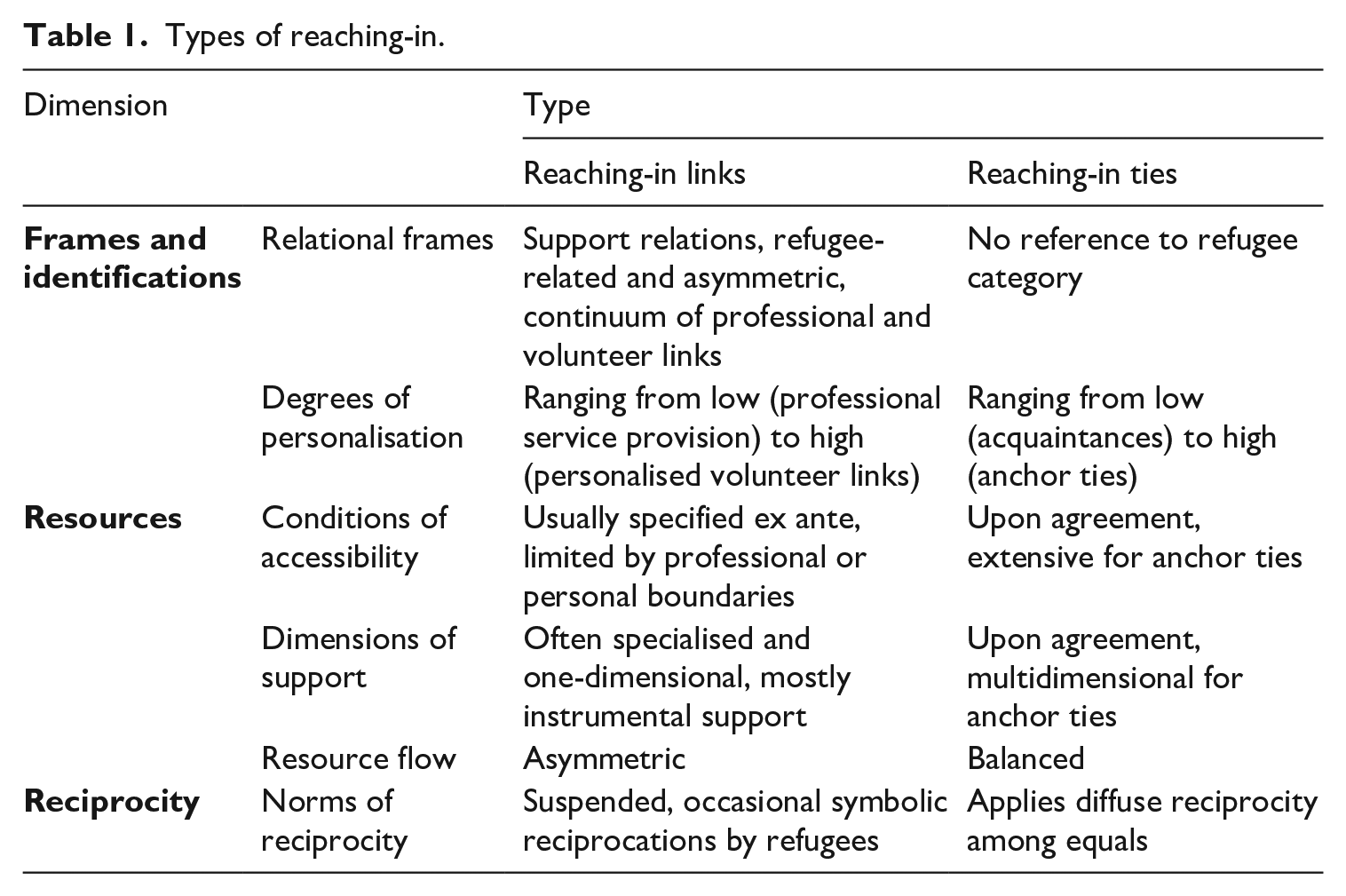
Reaching-in links are support relationships with unambiguous allocations of support-giving and support-receiving roles. Actors at the giving end of the relationship vary along a continuum of professional and voluntary support. At the professional end of the continuum, support is provided by social workers, psychologists, job centre employees or lawyers (Dominguez & Watkins, 2003). Drawing on the concept of ‘linking social capital’ by Szreter and Woolcock (2004, p. 655) I call relations that are close to the professional end of the continuum ‘social links’ and contrast them with ‘volunteer links’ at the other end of the continuum, where support is provided by volunteers (Karakayali & Kleist, 2016). Although there are many intermediary forms and entanglements between social links and volunteer links, as in the above case of language courses offered by volunteers, there are also marked differences. Social links typically frame interactions more formally, such as maintaining office hours, working in offices or specifying the type of support provided. Volunteer links diverge from such professional settings as relations become increasingly personalised. The difference from professional settings is greatest in highly personalised volunteer links that are characterised by frequent, casual contacts and access to multiple forms of support. Despite these differences along the continuum, people addressed as ‘refugees’ constitute, in all cases, the receiving end of the support relationship. With this setup, reaching-in links co-construct the positioning of the newcomers in two interlinked ways: by marking them as needy and by referring to their flight experience.
Irrespective of the asymmetry written in the relational frames and the one-directional resource flows ensuing from it, there is room for agency on behalf of the newcomers. Because frames of reaching-in links acknowledge the special situation of refugees, the general norm of balancing the score of support is suspended. Nevertheless, refugees often feel the need to reciprocate support received in linking relations. To meet this need, they engage in a variety of activities, such as baking cakes, helping with garden work or inviting others for tea. Such acts of return, however, generally do not settle the score according to common standards of reciprocation. Rather, they are counter-gifts of a different kind (Phillimore et al., 2018). They signal that the newcomers acknowledge the worth of the gift and the rules of reciprocation even though these do not apply in the present support relation. Furthermore, such symbolic acts undermine the marginalised positioning enshrined in the asymmetric setup of reaching-in links and thus constitute claims to normalcy (Lopez Rodriguez, 2010), which express the desire to leave behind the stigmatising category of being a refugee. By accepting such acts of symbolic reciprocation, professionals and volunteers simultaneously also acknowledge the newcomers’ efforts to establish a ‘normal’ life in the host country.
Social and volunteer links were of considerable importance for refugees’ personal networks, particularly for those who were unable to forge alternative ties to the host society (Dominguez & Watkins, 2003). A case in point is Firas. The totalitarian Syrian regime and war left their marks on Firas’s life. Since his engagement in the Arab Spring movement, the police had arrested and tortured him repeatedly. When he finally decided to leave the country, he not only lost countless ties to neighbours in his quarter but also found himself bereft of his reputation as an honourable man of peace and conciliation, whom others would ask for advice. In Germany, he lived in isolation, struggling with psychological stress and showing depressive symptoms, for which he was hospitalised twice. Not until he began therapy did he begin to recover and have positive new experiences, which overlaid older, detrimental memories. Amidst family members and two old friends from his childhood (all of whom lived abroad), three social links in his personal network were prominent: the social worker located in his accommodation, a social worker from an external welfare organisation and his psychologist. These three were his only contacts to people from the host society, and they were the only ones he addressed when he felt sad. Moreover, he reverted to them to discuss important matters and gather information about working in Germany. The relevance of these social links for Firas’s life in Germany can hardly be overestimated. He himself made this very clear, conceding that at least one of the three held a ‘special place in his life’ and ‘in his heart, even’ (Firas). Clearly, social links were – and would very likely remain – pillars of his life in the new country.
Reaching-in ties
As opposed to reaching-in links, participants in reaching-in ties meet each other at eye level. While casual forms of egalitarian ties occur (e.g. in ties to colleagues at work or to club mates), intimate forms are empirically particularly salient. Drawing on Grzymala-Kazlowska (2015), I call these relations anchor ties. Anchoring refers to ‘the process of finding significant reference: grounded points, which allow migrants to restore their socio-psychological stability in new life settings. The anchors people use allow them to locate their place in their world, give form to their own sense of being and provide them with a base for psychological and social functioning’ (Grzymala-Kazlowska, 2015, p. 1131). By transcending the forced identification as ‘refugees’ that the new arrivals confront in mass media coverage, on the streets, in job centres or elsewhere in everyday life, anchor ties provide footings in a new world in biographically eventful times. As intimate relations, anchor ties have the potential to make a difference and open up new directions in the new arrivals’ life. Resource flows in such ties usually cover several dimensions of social support, often including mutual emotional support and social companionship. As in friendships and other intimate relations, reciprocity is diffuse, but – as distinct from reaching-in links – inherently mutual. Refugees are expected to return support; this is essential because it indicates that the overall tie setup constitutes relations of equals. Anchor ties help to overcome negative category-related stereotypes such as victim or threat (Sadeghi, 2018) by providing relational safe spaces in which the newcomers can develop individualising identifications and have these identifications ratified by established residents.
Mahmud’s experience is a case in point. Mahmud, a 25-year-old Syrian, was in his last year of law studies when the war affected him and his family. He decided to migrate to Germany. At first, he had problems accommodating to this new life and felt lonely, but as he decided to become active again and began working out, the tide turned. He gradually became accustomed to the new country and found a job as a doorman. However, he regretted having little contact with people from the host society, especially women. Although he met some women, he had the impression that some ‘German women’ (Mahmud) did not like his black hair and beard. As he was just about to lose hope of finding a girlfriend, he met Katja. He spotted her in his gym but hesitated to approach her face to face, fearing that she would say ‘“No”, like all the others: “You have black hair and a black beard”’ (Mahmud). To avoid that reaction, he searched for her email online to contact her so that she would not see ‘my photo, I mean, my face, and then we would see what happens’. She reacted positively, and they arranged a meeting in the fitness studio and became a couple soon after.
Looking back, he recalled how, at the beginning of their relationship, he wondered why she did not ask, ‘“Where are you from?” or “Are you a refugee?” or something like that’ (Mahmud). Mahmud refers here to the widespread expectation to self-disclose one’s refugee story – an expectation that directly relates to the ongoing scrutiny of refugees for moral integrity in public discourse (see above). Katja’s silence in this respect exempted Mahmud from this examination and gave him the opportunity to decide for himself whether, when and what to tell about his ‘person’ (Mahmud). When he addressed the issue, she affirmed not having any ‘problems’ with refugees. In addition, when Mahmud invited her to his home, she visited him ‘without fear’, as he stressed in the interview, thereby implicitly invoking negative stereotypes of Muslim men as ‘sexist, traditional, and disrespectful towards women’ (Sadeghi, 2018, p. 11). The narrative of his relation to Katja culminates in the following synopsis: ‘I have never met a girl like her . . . . She only cares about the human being and not about where someone comes from . . . . Appearances do not interest her, only the content, the person, the human’ (Mahmud). This ability to be human again outshone all other forms of support from Katja (and others in his network). In his eyes, the most valuable resource of anchor ties was identificational. With this tie, Mahmud cast an anchor in Germany and felt ‘at home’.
Table 1 characterises the types of reaching-in relations according to their constitutive dimensions.
Types of reaching-in.
From ties to the personal network level: Resource inequalities across cases
Newcomers succeed to very different degrees in forging bridges to established residents. While all participants had reaching-in links, only a few maintained anchor ties. Furthermore, there was a striking polarisation between those with several close support contacts that provide multidimensional support if necessary (i.e. anchor ties and personalised volunteer links) and those with no such contacts. A key driver of the unequal distribution of types of ties across cases is differences in disposable time and energy for investments in new ties (Bourdieu, 1986; Ryan et al., 2015). Building and maintaining social relations is a carefully administered, fragile and time-consuming process (Behr, 1996). Successful newcomers need to prioritise contacts to established residents and devote considerable time and energy. The study sample shows that these investment resources vary with sociodemographic characteristics and personal circumstances. Those with several anchor ties or personalised volunteer links were academics (or had studied in their country of origin, like Mahmud above), and all of them were in their mid-twenties or younger and did not have children or other members of their core family living with them in Germany. In contrast, none of the elderly men, who struggled to cope with feelings of status loss and loss of home or psychological trauma, had anchor ties. The same held true for women and men of all ages who were responsible for cohabiting members of the family.
A good example of what it takes to forge anchor ties is Hasan. From the beginning, he aimed to meet established people and to avoid the same ethnic contacts. This objective underlay many of his activities. It was one of his motives in seeking temp jobs, joining local networks or engaging in other social activities. He successfully maintained this priority even in the face of setbacks. Other respondents could not afford these types of investments because they were caught up with psychological coping, like Firas, because they had to care for the daily needs of their numerous children, as in Abbas’s case, or because they had to care for the family members living with them in Germany, as was the case for Mara. At 20 years of age, Mara was still young enough to adapt to the new country and learn quickly, but (as the oldest of four daughters) she was old enough to be responsible for her three younger sisters and her uprooted parents. Giving everything to her family, she sometimes felt ‘as if I have five children’ (Mara), and she had virtually no time to make new friends. In general, refugees in particularly challenging life situations, such as Mara or Firas, do not have the time and energy necessary to forge egalitarian ties with established residents. Their best chance to reach in is via links to professionals and volunteers of the local integration infrastructure surrounding them, which also means they depend on such contingencies as accommodation (Is a social worker present? How big is the refugee centre?) and neighbourhood (Is the neighbourhood resourceful? Are there neighbours volunteering?).
Discussion and conclusion
The concept of reaching in moves beyond existing research on the networking of immigrants in several respects. First, it differentiates between bonding and bridging ties not along the lines of ethnicity but by the sequence of settlement in the host country. The ‘important way’ (Putnam, 2007) that separates recent immigrants from established residents emanates from the newcomers’ lack of context-specific resources, such as language proficiency, support networks and knowledge of cultural habits, or implicit labour market rules. This difference emerges from their later arrival and the little time to become accustomed to the receiving context. It distinguishes the new arrivals from those around them regardless of ethnicity. Relations with established people with (earlier) migration backgrounds constitute bridging ties as much as relations with the so-called ‘autochthon’ population. In fact, many of the supporters in refugees’ personal networks are earlier migrants. In this regard, the concept of ‘reaching in’ not only acknowledges that people with (earlier) migration backgrounds play an important role in welcoming new migrants as insiders; it also avoids jumping to premature conclusions based on essentialist understandings of ethnicity and ethnic boundaries. This is not to say that ethnicity and being identified as a stranger do not matter. Rather, the present approach adds a temporal layer to the analysis of arrival and settlement processes.
Second, the concept of reaching in understands meaning-making in bridging ties against the backdrop of ongoing settlement processes. Settling in a host country is a lengthy process that, in the case of recognised refugees in Germany, is structured by a sequence of positionings that together form an idealised trajectory from ‘organised exclusion’ (Täubig, 2009) to participation in society. Refugees’ relations to established residents refer to this trajectory in different ways. Meaning-making in asymmetric reaching-in links reproduces the societal positioning of refugees within the relation by referring to the refugee status and to pertinent needs when arranging resource flows and rules of reciprocity. In contrast, meaning-making in egalitarian reaching-in ties frees the new arrivals from the impositions of first and foremost ‘being a refugee’. Reaching-in ties function as safe spaces where new arrivals meet at eye level with established residents – as ‘humans’, in Mahmud’s words. Thus, reaching-in ties anticipate and enact a positioning further down the trajectory of arrival, whereas reaching-in links reinforce a positioning at its beginning. With this focus on meaning-making and its embedding in a sequence of positionings, the concept of reaching in adds to extant distinctions in research, such as strong and weak or horizontal and vertical bridging ties (Ryan, 2011). It considers the fact that common understandings in personal support relations as well as their overall significance depend on the interweaving of these relations with the shifting positionings of newcomers.
This observation directly leads to a more general third point: institutions, actors and discourses in the receiving society affect refugees’ networking with established residents. With respect to institutions and actors, a complex migration infrastructure (Cranston et al., 2018) accompanies recognised refugees along their trajectory from asylum applicants to full members of society. This migration infrastructure constrains refugees’ networking opportunities, among other things, by organising segregated housing, restricting regional mobility or limiting residence permits. At the same time, the migration infrastructure enables refugees’ networking opportunities by providing language courses, making professional assistance available or by volunteer support. These opportunities leave traces in refugees’ support networks, most notably in the form of links to professionals and volunteers. With respect to discourses, the findings point to the pertinence of negative and racist stereotypes for refugees’ networking. Public discourses in Germany have scrutinised and judged refugees according to economic, political and gender-related criteria. As a result, refugees remain questionable subjects even after legal recognition. They need to justify and prove their value for society, on the street, at work and in everyday interactions. This explains some of the importance that refugees attribute to intimate ties to established residents. Such reaching-in ties not only indicate a move forward along the idealised trajectory towards ‘integration’ but also offer arenas to self-identify beyond the refugee category and provide safe spaces against the insinuations and impertinences of public discourses. These findings advise against overly individualistic approaches to personal networks of migrants that overlook the manifold ways in which networking intertwines with wider social contexts in receiving societies.
Footnotes
Appendix
Established residents sample (n = 22).
| Characteristic | Number of informants | |
|---|---|---|
| Gender | Women | 17 |
| Men | 5 | |
| Age | 24 or younger | 1 |
| 25–34 | 5 | |
| 35 or older | 16 | |
| Education | No schooling or primary education | 0 |
| Lower or upper secondary education | 4 | |
| Higher education | 18 | |
| Role in receiving context | City employee | 4 |
| Welfare organisation | 2 | |
| Field of education | 4 | |
| Volunteer | 12 | |
| Supported recruitment for the study | Yes | 10 |
| No | 12 | |
Funding
This research received funding from the Federal Ministry of Labour and Social Affairs and from the Federal Employment Agency in Germany.