




Abstract
How do the semantic logics that different words accommodate in different languages map onto studies of social realities internationally and interdisciplinarily? This article is an ethnographic study of obshcheye – a corpus of phenomena pertaining to communal life in Russia. Similar to the English term ‘commons’, it marks the zone of the public – that which is shared and collective. In contrast to the commons, it displays greater semantic polyphony, bringing together social, discursive and affective qualities. Our analysis demonstrates that various semantic subsets of obshcheye sensitize research differently from the commons by indexing different societal concerns. They tune us into a wide set of concerns – with time (not wanting to be ‘Soviet’), ownership (worrying about what is ‘no one’s’), affective connectivity (one sits and waits for a conversation), and the act of caring for people and for spaces. Each word and each relationship in the semantic network reflects what is important to social actors as they go about ordering their lives together. The article concludes that obshcheye is so definitively a semantic network that expunging its conceptual heterogeneity and narrowing the multiple logics to encompass one in particular would amount to analytical reductionism and the impoverishment of social analysis.
Commons as a model-system
There is a long-respected tradition in the western social sciences of relying on ‘the model-system’, ‘an object of study that pools resources and is used by convention to stand in for a more general class of epistemic objects’ (Krause, 2016, p. 198). ‘Doctors’, for example, stand in for the ‘professions’, the ‘English working class’ for ‘class formation under capitalism’, and ‘Chicago’ as representative of ‘cities’ in general. Consequently, studies about doctors are foundational for the sociology of professions, and studies about Chicago are foundational to urban sociology and urban ethnography (Krause, 2016, p. 198; see also Abbott, 1988; Park et al., 1925; Thompson, 1963). One consequence of this is that analysis of western societies and institutions implicitly serves as a stand-in for the analysis of societies and institutions in general. The model-system thus serves as but one important way in which the hegemony of western social sciences is established.
Our ethnographic study of obshcheye – a corpus of phenomena pertaining to communal life in Russia – resonates with Krause’s argument, but probes another aspect of system modelling: language. How do the semantic logics that different words accommodate in different languages map onto studies of social realities internationally and interdisciplinarily? Our key example is the English concept ‘the commons’, which has recently enjoyed a renewed interest in various social sciences. The concept is interesting in its own right while also possessing exemplary value. A strikingly large body of literature has emerged around realities and domains as different as academic work, biodiversity, culture, public art, ideas, information, native culture, scientific data, the airwaves, the environment, the sky, the village and water – all identified as ‘the commons’ (Hess, 2008, pp. 6–7; Hess also provides a helpful review of works on each topic). Commons-the-term has come to stand for the ‘collective resources, qualities, and affects within a social and political order of being-in-common’ (Swyngedouw, in Wagner et al., 2012, p. 635) and has ‘a ubiquitous presence in the political, economic and even real estate language of our time’ (Caffentzis & Federici, 2014, p. i91). By approaching the contemporary commons as a right through the question of ‘who owns it?’, researchers try to reimagine the conditions under which the commons can ‘become the seeds of a society beyond state and market’ and a viable response to ever-widening privatization (Caffentzis & Federici, 2014, p. i95). Precisely as an ‘anti-capitalist’ form of ownership and control, the commons are seen as engendering collective action, collaboration and self-governance – commons-like thinking (Benkler, 2004). This idea was even romanticized in the early 2000s, with new literature appealing to a need for a ‘rediscovery of the commons’ and ‘our common wealth’ (Sanders [2006] and Rowe [2002], respectively, cited in Hess, 2008, p. 11). In sum, there is a wide array of practices, ideologies and politics to which the term applies in academic literature.
Yet, it is rarely acknowledged that ‘the commons’ is also a term with a history. It broke from its moorings in early modern English property rights to serve as a model-system for the contemporary ‘complex social and political ecologies’ (Chatterton, 2010, p. 626) of the ‘collective-pool resource’ (Ostrom, 1990; for more recent reflections on the meaning of the concept, see Harvey, 2012), often in non-European contexts (Bakker, 2007; Kuttler & Jain, 2015). These ‘travels’ (Bal & Marx-Macdonald, 2002) affected the concept’s ‘epistemic flexibility’ (Bal & Marx-Macdonald, 2002, p. 25). John Wagner, writing about water, notes that conventional definitions of the commons map poorly onto observable events (Wagner et al., 2012), and that there is a mismatch between academic and everyday uses of the word. Between the many academic contexts and the relative unfamiliarity of ordinary users of the commons with the term, it is not always clear what the commons actually articulates: ownership or common interest, common-pool-resources and their tragedy (Hardin, 1968), or whether commons really are about the affective states of ‘togetherness’ that collective resources recursively produce.
Rather than joining the critical chorus lamenting the blurring (Vaccaro & Beltran, 2019) of commons, we use our ethnography of obshcheye to think about the work that words do, and to demonstrate how a foreign language can be an intellectual resource for international social sciences. How might a word’s own semantic logic in practice illuminate otherwise-hidden zones of the social realities we study? Concepts are not ‘real’ but rather more or less effective ways to organize reality in the service of interest-driven research; ‘concepts are bound to carry around the concerns engrained in them when they were coined’, activating different ‘linguistic repertoires’ and making ‘different cuts’ (Mann & Mol, 2019, p. 780). Concepts like ‘commons’ ‘sensitise’ research towards certain ‘collective dynamics’ and ‘social imaginaries’ (Wagner et al., 2012, p. 617). But, we argue, sensitizing is itself a complex issue in need of examination-in-context. Academic communities in different geographical locations may react differently to the ways a single word sensitizes: towards what end, by what means, and for whom? Diverse histories and institutions, the variability of tools, places and objects deployed in knowledge production (Knorr-Cetina, 1981), and ways of wording that have different relevance all matter.
These are the main concerns that our article addresses. It is set to ethnographically explore a specific case – the Russian word obshcheye (общее) – as a variation on the commons. Russian language displays extraordinary semantic wealth when it comes to collective life, its norms and the material resources that support it. This is no doubt attributable to the country’s history, starting with the pre-revolutionary peasant obshchina (община) which subsumed ‘the role of the elders, concepts of justice, problems of the family, ethical and aesthetic views, education of youth and children, attitudes towards women’ (Lewin, 1990, p. 21; on the Russian peasant commune, see Mironov, 1985). A different shade of commonality found complex expression in the distinctly Soviet phenomenon of shared housing, the communal flat, where access, or ownership followed social belonging and trust, and was understood as shared – or not shared (Buchli, 1999; Gerasimova, 2002; Paxson, 2005; Utekhin, 2018). When communal flats went into decline in the post-socialist period, the sense of loss of ‘the common good’ abounded (Shevchenko, 2008), weakening memories of the mistrust and suspicion which also proliferated in them. The market reforms of the 1990s, while restoring private property, did not undermine public concern over collective life formulated either in terms of local communal affairs (mestnaja obshchestvennost’, местная общественность) or civic life (grazhdanskaya zhizn’, гражданская жизнь). 1
We cannot do justice to the enormous literature pertaining to things that are common or collective in Russia. The social history of the obshcheye and what it stands for is extremely complex and cannot be fully explored here. We limit ourselves to an observation that obshcheye in Russian encompasses at least three vectors of tension: one between public and private domains, another between (private) property and common resources, and the third between collectivity and individualism. The result is an array of adjectives and nouns, which while relating to the same lexemes, nevertheless take on different meanings depending upon the practical needs of the user and situation. Thus, obshcheye offers, in our view, an interesting alternative exemplar to commons. Similar to the English word, it marks the zone of the public – that which is shared and collective. In contrast to the commons, it displays greater semantic polyphony, bringing together social, discursive and affective qualities. Importantly, it does this as a vital, socially embedded idea, not an object of intellectual revival.
Our analysis demonstrates that various semantic subsets of obshcheye generate different forms of sensitizing by indexing different societal concerns. This is consequential, as it pertains directly to a more general question of whether or not coherence should be a desirable quality in social scientific taxonomies. In the case of the commons, semantic heterogeneity is said to lead to an instability in conceptual boundaries, seen by many as a downside. Obshcheye, by contrast, is so definitively a semantic network – a set of different words whose meaning is defined relationally – that expunging its heterogeneity and narrowing the multiple semantic logics to encompass one in particular would amount to analytical reductionism and the impoverishment of social analysis. To focus on obshcheye is to enrich the sociology of the commons by infusing it with other semantics. It is also to understand better the different ways in which social life in common can be organized in a given place at a given time, in which materiality, discourse and practice may converge. 2
The fieldwork
This article grew out of research that Liubov has been conducting in St. Petersburg, where she followed two urban communities representative of two types of urban living. One is a large-scale, newly constructed housing complex in a peripheral zone of St. Petersburg, the novostroika (Brednikova & Zaporozhets, 2016): typically, an agglomeration of towers and some basic amenities – roads, parking and courtyards, operating simultaneously as green and recreational zones. The community that Liubov studied is composed by approximately 70,000 people, the population of a small town, living in 33 high-rises each 29 stories high. The construction began in 2008 and continues to this day. The housing stock is designated as ‘ekonom-klass’, and thus affordable for lower-middle class residents. All the units are privately owned by families or individuals, although a considerable number are rented out by the owners. We call it ‘Placid Hollow’, or ‘The Hollow’ (Figure 1). 3
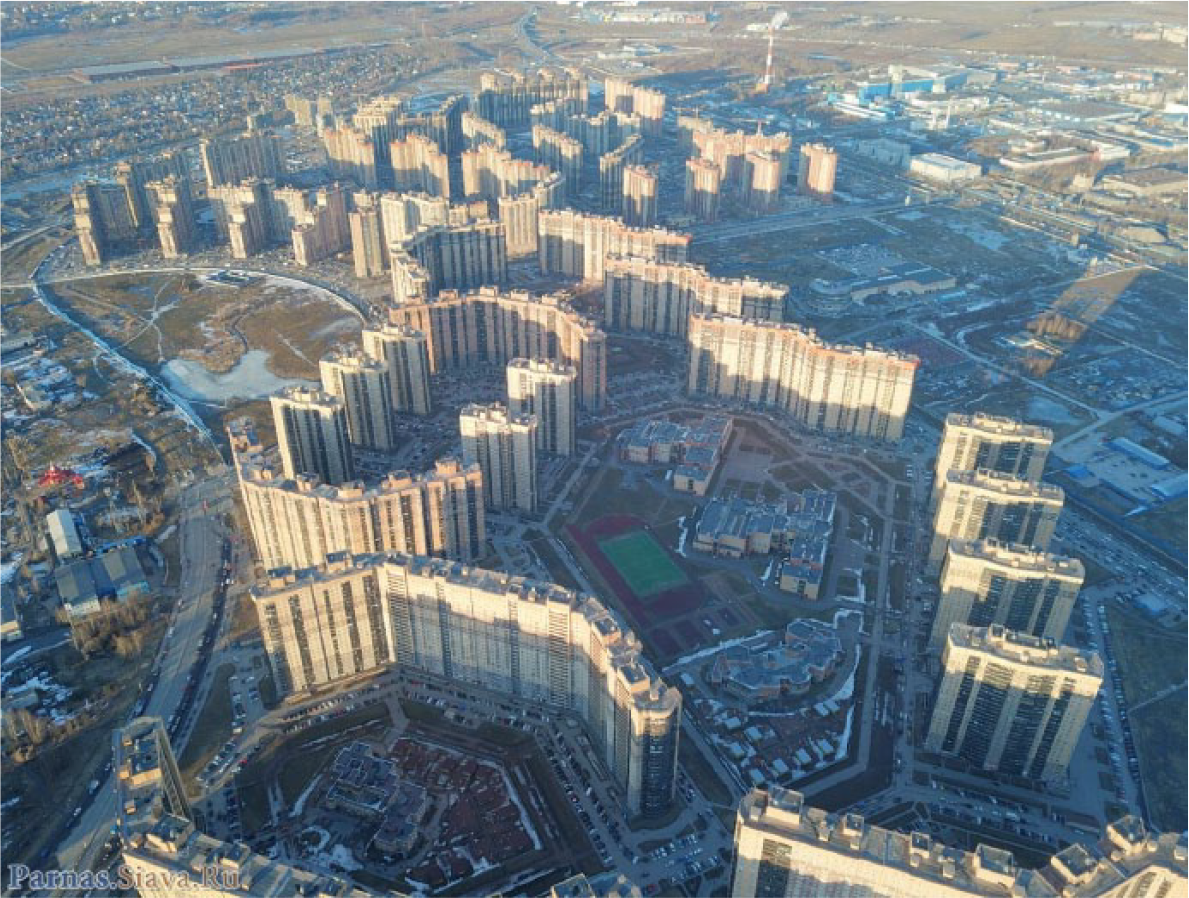
‘Placid Hollow’, May, 2016.
A second case is an example of a new but already well-known trend of forming small communes for collective living. The commune members call themselves so-obshchestvo (сообщество), sometimes ko-living (коливинг, transliterated from English: co-living). As a rule, they share a single large flat in an old part of the city. Such flats may house 6 to 15 tenants at a time. Although nominally in the private ownership of a third party, the flats are rented and no tenant can make an exclusive claim to them. On the contrary, spaces are equally shared and decisions have to be made collectively with all residents participating. Liubov conducted research on one of these, which we call Agora (Figure 2).
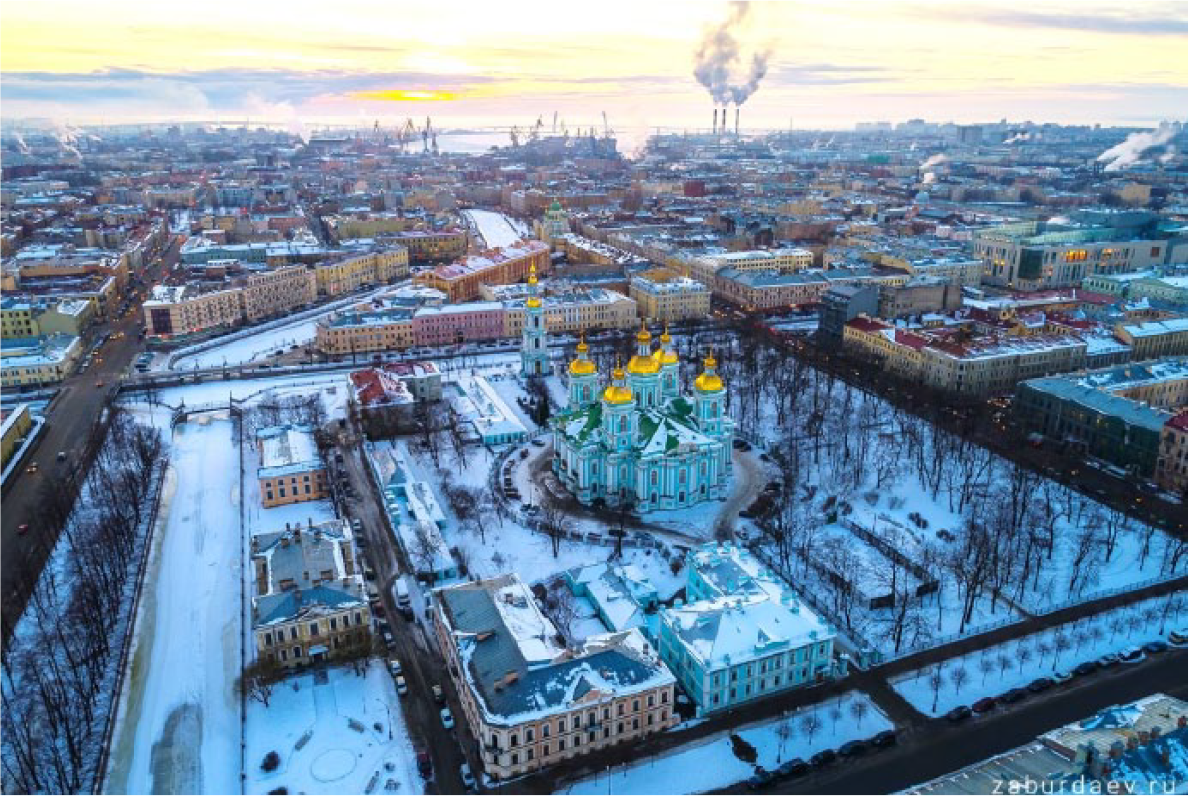
Kolomna district in St. Petersburg, where Agora is located.
Both communities practise active communication concerning rules, norms and expectations, have a strong appeal to the public good at some basic, mundane level, and provide numerous instances of coordination around cleaning, repairs and collective decision-making – all in a context that is commonly described as ‘privatist’, or privacy-oriented (Hirt, 2012). In Placid Hollow, these appear to be practices prompted by the living space itself, its lengthy hallways and malfunctioning rubbish chutes. Here, neighbours run a group page on VKontakte (‘in touch’; vk.com, the Russian version of Facebook), exchange information, discuss technical and legal problems, lend and borrow pretty much everything they need with each other, and passionately debate the ‘do’s’ and ‘don’ts’ of neighbourly behaviour. In the case of Agora, commoning is different. There, this is an explicitly proclaimed goal and the driving principle of the group, which wants to oppose ‘traditional family values’ and instead practise a more ‘open’ and collective life (according to Obshchezhitiye XXI veka, 2018, a TV programme).
Although the material collected by Liubov provided both authors with a clear sense that obshcheye was at the centre of the neighbourly life, the character of its exact material expression remained a puzzle. Where is obshcheye materially and spatial anchored and made empirically accessible? The answer came from national news, which reported incidents in different urban communities around the country. The reported incidents occurred when individual occupants renovated and beautified communal spaces in their buildings. These included lobbies, stairwells and stairs, landings, and the hallways that lead to private flats. For example, in the sunny climate of Rostov-on-Don, Mr Nikolaev, an artist and resident of a multi-unit house, painted walls and tiled the floors of the common stairs and the lobby, hung landscape paintings of his own production in gilded frames, and produced plasterwork in the style of the Italian Baroque (Gopalo, 2018). Nikolaev was sued by his neighbours, who dismissed his explanation that he was ‘working na obshcheye blago’ (на общее благо) – for the public good. They accused Nikolaev of using renovation to monopolize something that belonged to everyone. In a different case, when making plans to upgrade a dilapidated staircase in St. Petersburg, the initiator, a well-known blogger, immediately posted announcements of the so-called ‘planned’ renovation. Typed on his own typewriter, the announcements looked and read like typical announcements produced by a Russian bureaucratic office, in this case, the house management. Thus ‘informed’, the neighbours did not protest when privately hired contractors began the renovation in ways that conformed with the blogger’s personal tastes.
The news reports, as they expressed some of the key tendencies we observed in the material, convinced us that spaces such as lobbies and corridors – the common places – are the essential sites of the enactment of the obshcheye, and they are significant in a number of ways. First, there is no established relationship between obshcheye and ownership. The corridors are difficult to locate in property terms: as a rule, they are divided equally among all property owners in the building. Still, the ownership of communal spaces, customarily incorrectly attributed by their occupants to ‘the state’, is often simply unknown to them. 3 Second, the common spaces of blocks of flats in Russian cities formally designated as ‘places for common use’, mesta obshchego pol’zovaniya (места общего пользования), are a fragile social reality: hanging a picture of one’s own creation in a communal space may lead it to disintegrate. Disentangling the obshcheye of the corridor from the question of ownership without it ever losing the power to collectivize makes it a productive entry point into the world of collective things and collective concerns. How is the obshcheye of the corridor organized and in what ways is it defined?
Nash: The obshcheye that we share
The corridors in Placid Hollow are long and monotonous, lined with doors and painted in neutral colours. Each corridor begins at the lift shaft and stretches a good 35 metres, until it ends at a blind wall. The lift, the rubbish chute next to it, and sometimes the stairs form a centre, from which two, in places four, corridors radiate out. When just built, the corridor in a place like Placid Hallow gives the impression of anonymity in an institutional space (Figure 3). It is a perfectly obshcheye corridor according to housing law: its square metres are equally distributed to and owned by all of the occupants of a given tower. 4
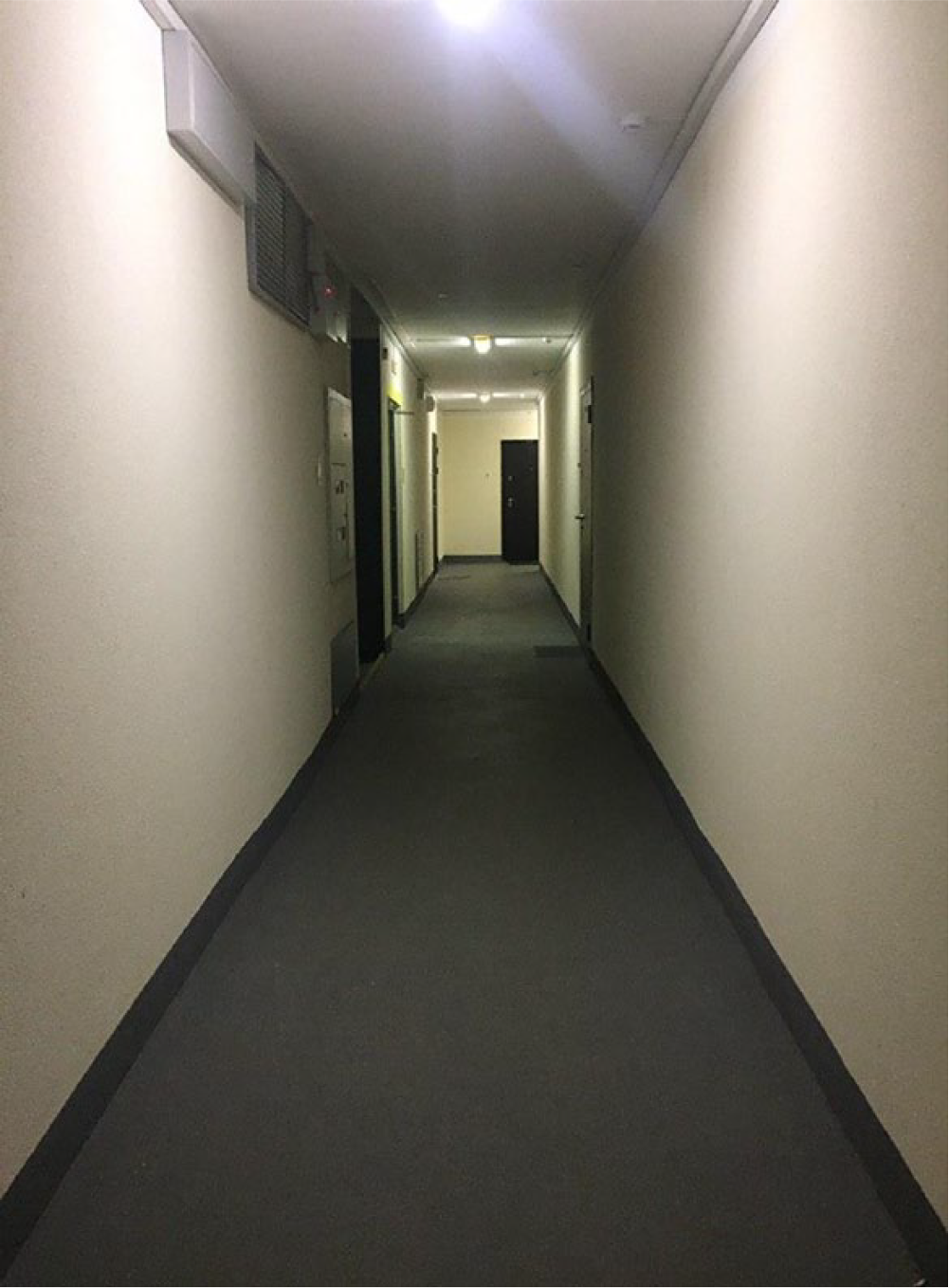
The obshcheye corridor in Placid Hollow.
There is a widespread practice dating back to the Soviet times of transforming these long corridors by partitioning them into smaller, but still shared, units. The partitioning is done by residents living on the same floor with the help of doors and locks. A new wall is built at the beginning of the corridor, close to the lift and the landing of the stairs, and a door with a lock is installed (see plan in Figure 4). An enclosure is made – a new corridor uniting six to eight flats and their occupants.
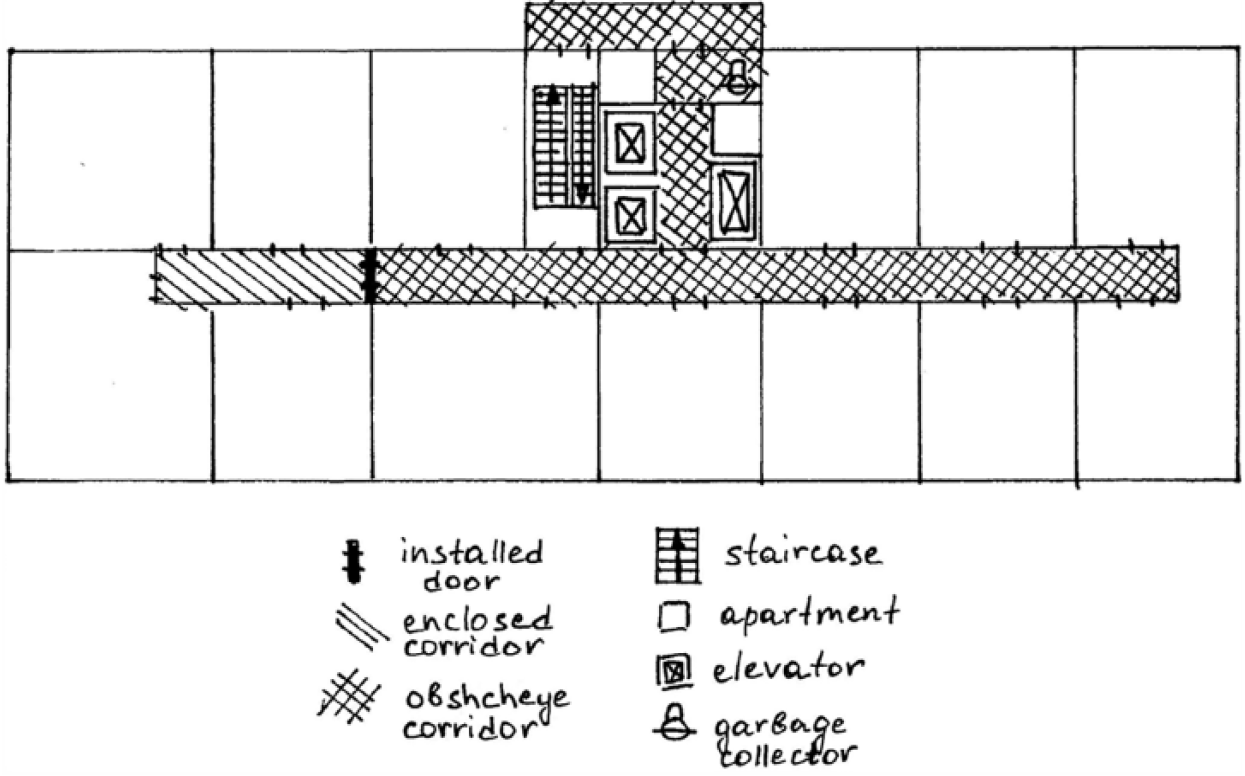
Plan of a typical floor with the enclosure in Placid Hollow.
Out of this enclosure emerges a new social ontology: nash (наш) – our – corridor. It relates to, yet is different from, a simply obshcheye – common – corridor. Below is a post on the VK group page for Placid Hollow from one resident to another. We kept the original tenor in the translation in order to convey its didactic, instructive intention: Aleksandr, the enclosure of the inter-unit hallway does not fall under ‘structural alteration’ or ‘the forcible alienation of the communal property’ – read carefully the code and keep the definitions clear. Therefore, consultation [regarding the enclosure] is only required among the occupants of the immediately affected units. The managing companies, as well as the occupants themselves, see the real advantages of such enclosure: in the enclosed corridor no one steals fire extinguishers, hides dope behind the electric junction box, shoves in unwanted advertisements, consumes alcohol or urinates; it stays clean and orderly; the neighbours are in close touch with one another.
The post makes clear that the decision to enclose or not belongs to a small group, those who live in immediate proximity to one another, sharing the floor. Legal status of the corridor’s portion has not changed: nominally the space remains communal, that is, the property of all residents of the tower. Access to it, however, is drastically reduced by the enclosure to only 20 to 50 residents. De facto, the enclosure infringes on the rights of access and use of those who do not live on that floor, or cannot be part of the enclosure (most often because of the physical layout of the hallway). Yet, no one objects, everyone seems to have a stake in the game, and so it rolls on. The contingency of events in the corridor (hiding dope, turning it into a public toilet) is minimized, and the atmosphere is rendered more pleasant. The enclosed space is common in a new way: from the abstractly ‘everyone’s’, it is turned into something that is concretely ‘ours’. Let us stay a little bit longer with this event.
Using dictionaries and a reference system called ‘The National Corpus of the Russian Language’, sociolinguist Kapitolina Fedorova demonstrates a change in the meaning of the lexeme obshcheye (Fedorova, 2011). She shows that the word has shifted towards greater abstraction and lost its specific group referent. Today, obshcheye is something that mediates between different actors and connects them as a group. It also stands for an ‘abstract’ or ‘general’ category of things: obshcheye smysl (общий смысл) – the general meaning, and obshcheye termin (общий термин) – the abstract notion. The lexeme containing obshch-, Fedorova argues, is in the process of being de-semanticized, that is, reduced in meaning.
Our material, though echoing Fedorova’s main point, goes further. Fedorova places two diverging meanings of obshcheye in a linear progression in which the concrete is superseded by the abstract over the course of a century. In our findings, by contrast, both meanings coexist and overlap, and it is this overlap that destabilizes the word’s meaning. An example from our second location, Agora, illustrates this point.
At Agora, many spaces and things are shared. The kitchen, for example, has a special obshcheye polka (общая полка), a communal shelf, demarcated by green tape (as the example in Figure 5). Consequently, everything that is placed on it is obshcheye, that is, communal. A conflict erupted when one tenant, driven by the desire to treat her co-residents, made a pie and placed it on the green shelf, and another, without consultation, ate the pie, all himself. The upset cook, when interviewed, explained to Liubov that in the way she thinks of it, obshcheye means shared, and accordingly, everyone has the right to enjoy a piece of her pie. The transgressor defended himself by pointing out that what ends up on the green shelf becomes obshcheye, and as such, belongs to no one in particular, but is available for complete appropriation (which he performed by eating it all).
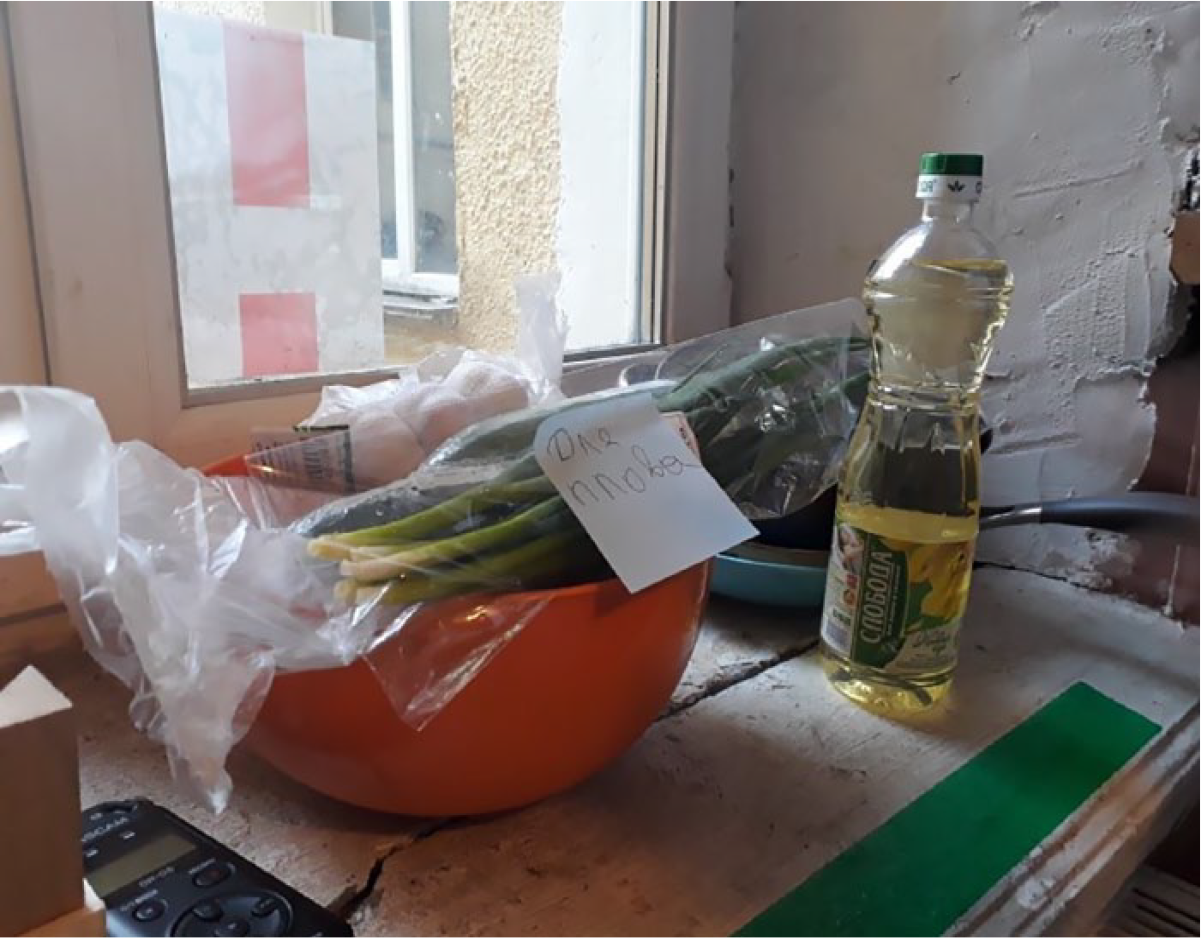
A communal shelf marked with green tape. Someone left some food and a note that these were the ingredients for a pilaf, in order to protect them from being taken by any individual. The plan was to cook pilaf for all the tenants.
In places such as Placid Hollow where collectivism is not an agreed-upon organizing principle, the work of separating ‘no one’s’ from ‘ours’ is done by physical means – a partition wall augmented by a collective agreement. A post on a VK forum pertaining to no communal setting in particular but addressing the obshcheye in general thus formulates the point: ‘Nothing in the obshcheye corridor is yours. It’s OBSHCHEYE. Which means, no one’s. One’s OWN things are kept in one’s OWN flat.’ The physical enclosure changes the semiotics of the hallway and transforms it into a corridor ‘shared by all parties involved’: According to our common agreement, the corridor is closed off and all neighbours can keep their belongings in it: strollers, bicycles . . . This was the very idea behind the enclosure. It is more convenient to keep such items in the corridor than the flat. Even in our spacious three bedroom [flat], a stroller is a nuisance.
The physical enclosure provided by the door, the lock and the partition wall has its linguistic counterpart: the pronoun nash (наш) – ours. Nash reduces the scale of the collective, signals a proprietary relation between the subject and the object, and introduces an emotional intimacy to it: nash corridor is closer than obshcheye corridor. A combination, nash obshcheye corridor, is also possible and when used, mobilizes proprietary emotions even more towards a greater sense of responsibility and collective care, ‘This is nash obshcheye corridor! Let’s keep it clean together!’ Given the unstable nature of obshcheye, both the physical and the linguistic enclosures – the partition and the word nash – ease the tension between obshcheye as ‘no one’s’ and as ‘belonging to everyone’. The exact meaning with which obshcheye is endowed determines action in, as well as towards, the common space of the corridor: its cleaning, its upkeep, noise and smell control, and much more. We might say, then, that the word and the wall order the commons, and that the central issue here is to prevent it from sliding into no one’s concern.
Kommunalka: The obshcheye we no longer want
If nash stabilizes obshcheye as a positive category, kommunalka (коммуналка) and obshchaga (общага) signify the poignancy of its negative pole. Svetlana Boym summarized the core of the kommunalka in her seminal work, ‘The archaeology of banality: A Soviet home’: Kommunalka – a term of endearment and deprecation – was a result of the post-revolutionary expropriation and resettlement of private apartments in the urban centers; it consists of the individual or family rooms (neither living rooms, bedrooms, nor studies, but all-purpose rooms that can perform any function) and ‘places of communal use’, a euphemistic expression for a shared bathroom, corridor and kitchen that usually serves as the neighbours’ battleground. Here one encounters endless schedules of ‘communal duties’, and endless scolding from fellow neighbours. (1994, p. 266).
In his study of communal flats anthropologist Ili’ya Utekhin describes one populated by as many as 56 people (Utekhin, 2004). Obshchaga is also a moniker; it refers to obshchezhitiye (общежитие) – literally, ‘common living’: the dormitory-style housing that not only colleges and universities but also factories and enterprises provided for their employees in the Soviet period. The shortage of housing was one of the most enduring and profound crises of the Soviet Union (Boym, 1994; Gerasimova, 2002; Harris, 2013; Zavisca, 2012), and as kommunalka and obshchaga were the Soviet state’s responses to it, both have negative associations: both stand for imposed-from-above commonality.
No longer much of a reality, kommunalka today signals ‘a nostalgic ruin of Soviet civilization’ (Boym, 1994, p. 266), and occupies a special fictional place in oral accounts of Soviet life. The discourses that Liubov recorded in Placid Hollow and Agora are no exception. The imagery of kommunalka and obshchaga proliferate on group pages and serve as regular points of comparison. 5 Their use in the two settings is different, however. In Placid Hollow, the references are all about the materiality of the corridor and its aesthetics. Items of personal use that are kept there elicit a major discursive nod. Pictures of spaces cluttered with bulky trunks, bicycles, footwear and unwanted furniture are posted on the group wall to shame those who exceed a ‘reasonable’ number of items stored in the obshcheye corridor or leave them in a state of disrepair, dirty, etc. Clutter is essential to kommunalka, and kommunalka is ubiquitous in Placid Hollow residents’ discourse, ‘For some reason, what I see [in the photograph] is a kommunalka somewhere in the city centre.’ 6
Object-ness is a key aspect of kommunalka imagery. Here is an exchange that illustrates this: ‘And where is the ubiquitous entresol?? Where is the rusted sleigh hung on a nail? Where are the countless skis that don’t match in size?’, mockingly enquires one group member. ‘[Emoji ‘smile’] A sleigh, skis and felt boots [valenki] combined, and you have a complete set! [emoji ‘smile’].’ The exchange triggers another post: ‘Hang the laundry to dry too . . . surely the place is too small already.’ This is not a random exercise in wit, but an act of disciplining, since the thread appeared in response to a post about a cluttered corridor. This is to suggest that kommunalka actually polices, by the way of mockery, shared space, preventing it from falling into two extremes: becoming obshcheye as in ‘no one’s’ by virtue of neighbours dumping their unwanted stuff there, or ‘privatized’ by being occupied with objects. 7
The spectre of kommunalka haunts Agora as well, but in a different way. To begin with, Agora shares many of the physical qualities of a kommunalka: it actually was one in the past, before being purchased by a private individual, renovated, and rented out to Agorians. The corridor here is long – more than 20 metres – dark, and with signs of decay: poor electrical wiring, cracked walls, worn-out hardwood floors and exposed plumbing (Figure 6). The walls, painted off-white, are decorated with paintings and drawings left or made by previous residents. The collection is random and feels crowded. Doors to individually occupied – private – rooms have no locks or even latches. The rooms are supposed to be accessible. There is an old wardrobe and a clothes rail in the corridor plus a few bicycles. A newspaper article describes Agora’s interior as ‘a pile of recycled objects’, some of which were found in ‘a nearby skip’. The place as a whole, the journalist notes, is in the state ‘of the perpetual fixing’ (‘My zhivem v kvartire-obshchestvennom prostranstve’, 2017). The appearance of Agora’s communal corridor is not that different from that of a kommunalka: in interviews with Liubov, Agorians describe a kommunalka as a space filled with useless things, with dim lighting and shabby shared facilities. Yet, Agora is no kommunalka, and one resident even called it an ‘anti-kommunalka’. Where does the difference lie? I believe that it is not so important how new and aesthetically pleasing a given space is. More important is how much love and energy has been invested in it. And ‘cosy’ is not when the renovation is up-to-date, but when the space is filled with friendship, trust, and care about the common space. One day, we may all buy our own private studios where everything will be new and up-to-snuff, but somewhere in that new kitchen we will still have a part of the wall on which each guest, each friend will leave something – a tag, a note, a drawing; and in this something will live the outlandish and unrestrained spirit of Agora.
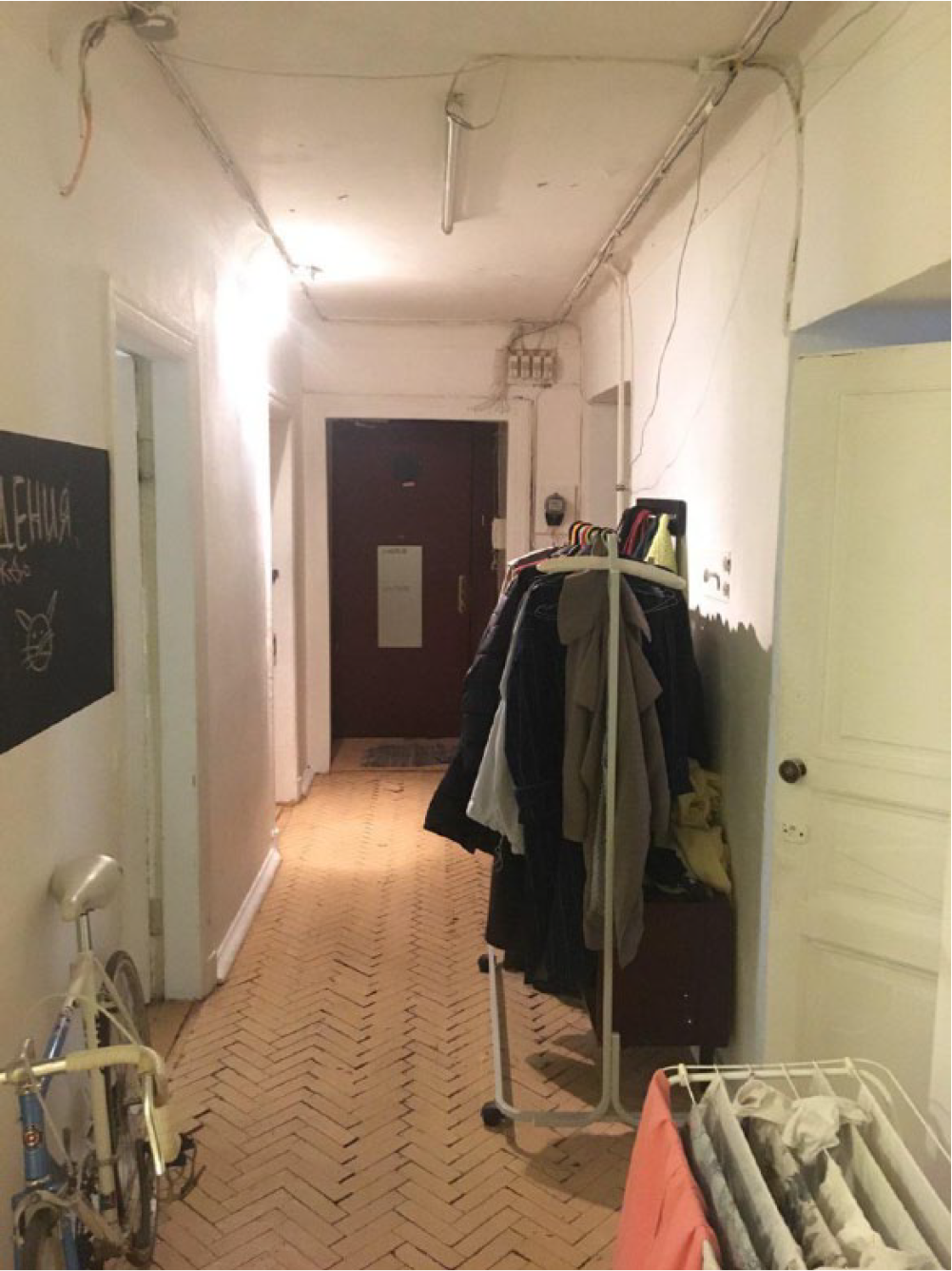
Obshcheye corridor in Agora. The walls have been painted by the tenants. The ceiling lights do not work. Personal belongings (bike, clothes and laundry) are stored outside the rooms.
This VK post written by a young female resident frames the material reality of Agora away from the kommunalka, while acknowledging its physical resemblance. It is not the materiality – ‘the shell’ – she says, but the spirit that makes the difference. In Agora, all the residents are single (couples are not admitted), tend to work for creative or not-for-profit organizations, or they freelance. Agorians are between 25 and 40 years of age, travel frequently, and accept as a norm free access to nearly all spaces in the flat, including their own rooms. Agora is a place of organized art events and public debates, often political, and when those take place, the largest room is open to the public. The physical reality of Agora displays a similarity to that of a kommunalka without being identical to it.
Agorians insist that their community’s genealogy is very different from that of a kommunalka. The founder of another communal place in Moscow expressed this well in an interview: Every time one says ‘obshchezhitiye’ or ‘kommunalka’, [one sees] a cockroach cross the wall, food disappearing from the fridge, drying laundry hanging in the smoke-filled corridor, and the alcoholic neighbour cursing his life. It seems time is needed to update and change the meaning of ‘communal flat’. ‘Koliving’ on the other hand, is a new word with a not entirely clear meaning, but with a very clear idea: a life together. (‘Kto stroit v Moskve. . .’, 2018)
The disjuncture between Agora and the kommunalka is underscored further by the words Agorians use to describe them. Whereas Agora has a ‘worn-out cosiness’, they told Liubov, the kommunalka is outright ‘sordid’, and while Agora is an ‘authentic commune’, a kommunalka is a motley assortment of involuntary occupants. If in a kommunalka ‘people are forced to leave with each other, in Agora we are happy to interact’; if kommunalka imposes endless schedules on its residents of communal duties, Agora ‘is a magnet for people with shared interests’, for whom cleaning is ‘a work of love’, work ‘that can be collectively forgotten and equally collectively and suddenly remembered’. Most importantly, identifying with co-living and opposing the kommunalka positions Agora not as a reproduction of something from the past, not a nostalgic regression into a Soviet order of things, but as a progressively political social innovation.
So-obshchestvo: Communicating, ‘hanging out’ and creating the obshcheye
Is there a positive term Agorians use to define their sociality, and if so, what is it? Recall Svetlana Boym’s apt description of the kommunalka in which the corridor figures as ‘the neighbours’ battleground’. In Agora, the corridor is defined first and furthermost as a space for ‘obshcheniye’ (общение). Obshcheniye, noun, and obshchat’sya (общаться), verb, run parallel to English, where ‘communication’ overlaps in meaning with commune and communion. However, as Fedorova reminds us, the Russian word also stands for ‘being in relation to someone’, or ‘to have a community of interlocutors’. ‘With whom do you usually obshchaesh’sya?’ is a question about one’s social circle.
In Agora, both semantic meanings of obshcheniye are at work, and both the corridor and the kitchen play an essential role as places where obshcheniye takes place. For example, ‘stepping into the corridor, stepping into the obshcheye space, means a transition from the state of privacy to the state “I am ready to obshchatsya – to interact!”’, one of the Agorians told Liubov. ‘If I want to po-obshchat’sya with someone, I go to the kitchen; if I want to po-obshchat’sya and no one is in the kitchen, I simply sit in the kitchen, read a book and wait’, another told her. Obshcheniye does not have a purpose other than that of socializing together; it is about ‘hanging out’ and ‘being engaged’.
While obshcheniye may not be utilitarian, it is nevertheless productive. Not sure what to call it, an Agorian thus formulated this point for Liubov: I think in a kommunalka, well, you have no bonus, no added value to living with someone else . . . You live there because you have to, and people there are just a nuisance to you. But here, well, you like the people, you talk to them, you have a good time with them, the talk is interesting . . . So, this is something added, some additional social space, a value.
This ‘something added’ is what Agora is as an organizational form: it is ‘so-obshchestvo’. Related to ‘obshchestvo’ – ‘society’ – ‘so-obshchestvo’ may be equated with ‘community’ in English, though it is smaller and more particular in terms of the identity of its members. ‘We are a so-obshchestvo of friends, we have nothing to mete out among ourselves, we are ready to assist each other, ready to give and to receive, in other words, we always live in close touch.’ This is how Agorians define themselves. However, whereas ‘community’ shares its morphology with ‘common’, so-obshchestvo stands in between, and takes its meaning from both, obshchestvo, society, and ‘obshchast’sya’, to communicate, to engage. It is not a coincidence that in the quote above, a resident spoke of conversing and having ‘an interesting talk’ as generative of sociality. Obshcheniye is the added value.
In Agora, so-obshchestvo is inseparable from obshcheniye, engagement; and engagement is dependent upon the corridor and the kitchen, as common – obshcheye – spaces. It is this particular kind of interlocking of words and spaces that makes Agora an anti-kommunalka – not merely different, but opposed to the communal flat – and that constitutes it as a collective predicated on engagement and interaction. Translating this into the language of the commons, we might say that ‘the resource’ is social engagement, and its by-product is so-obshchestvo.
Discussion and conclusions
Our article began with the observation that words which becomes terms are part of the making of generalized model-systems. We took as an example ‘the commons’ – a term which commands attention and is on the rise as a privileged object of research. Yet, a review of relevant literature revealed that, first, the word has been ‘stretched’ across different phenomena and lost its specificity (De Moor, 2011), and second, the differentiation between its scholarly and everyday uses has been vague. Critics note the term’s blind spots – is it about property relations or social imaginaries, management or affection? They question its ‘vagueness’ (Wagner & Talakai, 2007) and internal incoherence.
Treating concepts as sensitizing devices, we have proposed what we consider a good counterexample: the Russian-language category of obshcheye. As people go about making a life together – by being ‘neighbours’, ‘owners’, ‘good citizens’, ‘co-residents’, or simply ‘us’ – they name things and they act, and their words, practices and locations mesh. Obshcheye, with its enormously rich social history and strong cultural presence, is productive for thinking through the semantic, social and affective dimensions of life in common and giving these dimensions a theoretical significance. What we ethnographically reconstructed by following some key meaning-generating practices is a patchwork of adjectives, pronouns and nouns. They all are associated, but in any given context only a limited number of terms are drawn from this larger network. These properties take meaning – and make sense – only here-and-now and in connection with specific concerns and practices. Kommunalka is a type of domestic space, but also a social imaginary pertaining to Soviet history; so-obshchestvo is an emergent form of sociality based on a consistency of practices: communication and interaction; and nash is a zone within the obshcheye for which everyone cares, in contrast to that other obshcheye which evokes no such feeling. Semantic connectedness within obshcheye exists but is not characterized by coherence. It is instead achieved through material mediation in practice and has a strong affective dimension. Obshcheye is a semantic web with a patchwork character, but the fact it is a patchwork is not an epistemic problem. It is an asset: the selection of notions that form the network is expressive of specific concerns, and, as such, an important analytical tool. We visualize this semantic network in Figure 7.
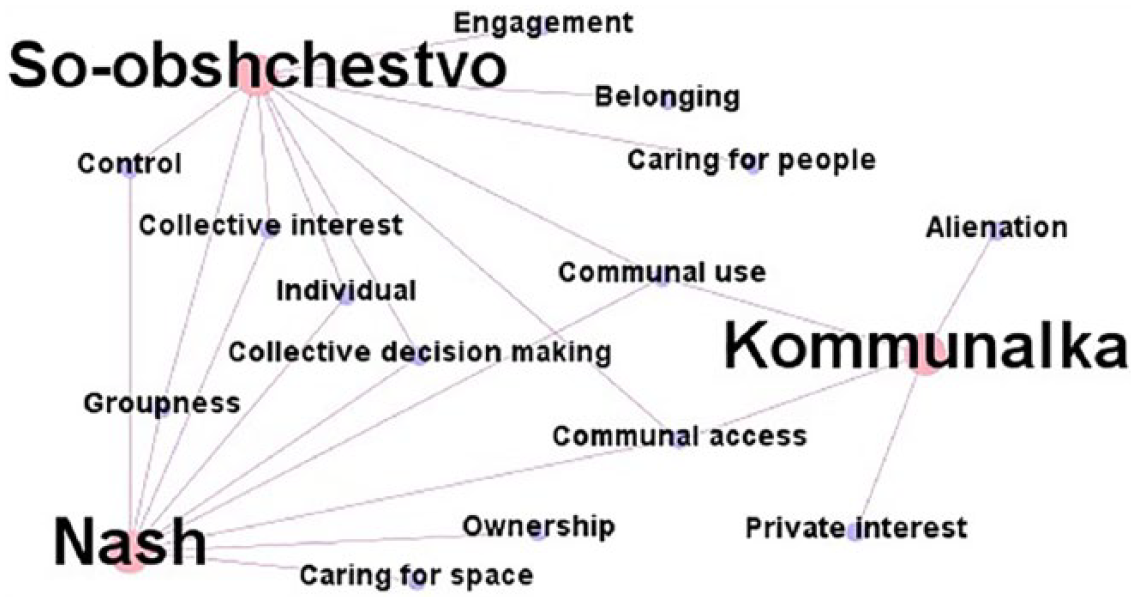
Obshcheye’s semantic network.
Nash, kommunalka (interchangeable with obshchaga), and so-obshchestvo are three semantic nodes around which clusters of relations form. 8 The relations are of resemblance and opposition organized around a set of concerns: care, access, sociability and attachment. Very rarely, if at all, is there any concern with ownership. The positive and the negative characteristics are co-present and co-constitutive of each other. This relational sociology of obshcheye is hardly surprising, but its implications for thinking about terms and their relationships with model-systems may be not be immediately obvious. Obshcheye is a hybrid and the Russian language makes this immediately apparent. The hybrid composite of obshcheye also casts doubt upon the coherence of taxonomies of ‘collective’ or ‘common’. Allow us to explain.
We take ‘concern’ to signify a matter of importance; it is a focused interest but may also be a locus of concentrated anxiety. Mieke Bal, influenced by Isabelle Stengers, wrote that ‘the role of concepts is to focus interest’: ‘de facto, concepts organise a group of phenomena, define the relevant questions to be addressed to them, and determine the meaning that can be given to observations regarding the phenomena’ (Bal & Marx-Macdonald, 2002, p. 31). Our research into the communal life in a Russian city yielded not one, but at least three phenomena pertaining to collectivity, tied by vectors of tension and generating words and emotions. They tune us into a wide set of concerns – with time (not wanting to be ‘Soviet’), ownership (worrying about what is ‘no one’s’), affective connectivity (one sits and waits for a conversation), and the act of caring for people and for spaces. Each word and each relationship in the semantic network we drew reflects what is important to residents of The Hollow and Agorians as they go about ordering their lives together. The anxiety of the dissolution of a common place like the corridor into no one’s obshcheye motivates residents of Placid Hollow, who became neighbours as a result of purchasing a property. These are people who, on a relatively arbitrary basis, reach out, stay in touch and coordinate how they will manage their corridor. Belonging, reciprocity and boundaries are of paramount importance here. In Placid Hollow, residents actively prevent the dissolution of the commons by imposing nash on the shared space and policing it with kommunalka. Words and images here bind and discipline. Members of the so-obshchestvo in Agora ascribe importance to and form matters of concern differently. Agorians are small in number and have control over whom to admit to their community. For them, what is important is the engagement itself, their interactions, communication and reciprocal care. The obshcheye of so-obshchestvo resists social atomization by propagating empathy as a building block for greater solidarity. Agorians also use the imagery of kommunalka, but not as a defence of privacy and order. Committed to the idea of progressive social innovation, members of the so-obshchestvo separate themselves from the involuntary commonality of kommunalka. The commons as a term could plausibly be applied to the range of spaces, rights and emotions that we discussed as obshcheye here, but it would not allow us to learn what is salient for each of these here-and-now, and how local history affects what is most immediately relevant.
Let us be clear: our proposition is not to replace ‘commons’ with ‘obshcheye’; this would reproduce model-centrism by privileging a particular reality. Instead, our proposal is to employ local linguistic repertoires and deploy those discoveries to move away from centring any particular reality as ‘model’ in social research. Concerns, rather than concepts, appear to us as more productive points of departure, and semantic networks accommodate this task better than singular concepts.
Footnotes
Acknowledgements
We would like to thank Andrew Barry, Nancy Ries, John Law, Annemarie Mol, Diana West and the members of Culture Club of the Department of Sociology at the University of Amsterdam for their thorough and thoughtful feedback on the earlier drafts of this article; and Helen Faller for her careful work with the English language in which this article is written.
Funding
The authors received no financial support for the research, authorship, and/or publication of this article.
Notes
Author biographies
Liubov Chernysheva is a PhD candidate at the Amsterdam Institute for Social Science Research (University of Amsterdam, the Netherland). Her PhD thesis focuses on the life-in-common in a post-socialist city. She studies the practices of sharing, governing and digitally mediating everyday realities in different forms of neighbour relations and housing. Liubov is currently involved in the international research project Estates After Transition (supported by  RUS Plus and RFBR) studying recent urbanization processes in post-socialist housing estates in St. Petersburg, Russia. She is also a part of a research team that studies urban space contestation in big Russian cities and mechanisms of interests coordination in the urban development processes (supported by the Russian Science Foundation grant).
Olga Sezneva (Ph.D., New York University, 2005) is a scholar, educator, writer and art curator. She teaches urban sociology at the University of Amsterdam. Her research on cities and memory, media piracy, and spacial justice has appeared in international journals Environment and Planning D, Journal of Urban History, Poetics and Critical Historical Studies. Olga is also a member of the international artists collective Moving Matters Travelling Workshop, where she does poetic performance art. She co-supervises (with Prof. Olav Velthuis) Liubov Chernysheva’s dissertation.