



Abstract
This article develops an empirically grounded frame for analysing varieties of alternativeness, using the case of such collaborative housing groups in Vienna (so-called Baugruppen) which aim to overcome the commodification of housing as well as the standardisation in social housing provision. Through experimenting with alternative ways of organising and living together they strive for social and political change. Taking inspiration from literature on commoning and alternative spaces, the article draws on French pragmatist sociology as well as post-actor-network theory (ANT) and assemblage approaches to focus on relational practices and different kinds of commonality as a basis for collective action. It analyses varieties of alternativeness as relational constellations by tracing how different groups compose commonality amongst each other, and how they relate to various actors. In doing so, it contributes to a situated understanding of the relations and relational practices that sustain alternatives, as well as the possibilities of scaling and transformation that specific variations of alternative housing hold.
Introduction
Against the backdrop of multiple moments of crisis, a revived interest in experimenting with alternative urban ways of living, working and organising can be observed (Bulkeley & Castán Broto, 2013; Evans et al., 2016). Such alternatives hold the potential for transformation and for being co-opted. As Evans et al. (2016) state: Clearly, urban experimentation is neither entirely subversive nor entirely reinforcing of the status quo, but includes activities that are one or the other and sometimes both. There is a clear need here to understand how different modes of experimentation coexist and interrelate at larger urban and regional scales. (Evans et al., 2016, p. 10)
Answering this call, we ask how different kinds of alternatives and their possibilities for learning and acting could be analysed in a differentiated way beyond homogenising and dichotomising ‘the mainstream’ and ‘the alternative’ (Gibson-Graham, 2008; Gritzas & Kavoulakos, 2016). Drawing on literature on commons and commoning, and alternative spaces (Farias, 2017; Fois, 2019; Pickerill & Chatterton, 2006), which elaborates how alternative practices are enabled by specific kinds of alternative commonality and ways of relating, we develop an empirically grounded frame for analysing how varieties of alternativeness are created and shaped by relational practices.
For analysing varieties of alternativeness, we use the case of so-called Baugruppen in Vienna. While these groups comprise a broad spectrum of housing projects 1 (Holm & Laimer, 2021; Lang et al., 2020), we focus on such projects which are self-initiated and self-managed by their (future) residents and which aim to create and experiment with alternative ways of housing and living, thereby encompassing both the production and the use of housing space (Ache & Fedrowitz, 2012; Fois, 2019; Lang & Stoeger, 2018; Rogojanu, 2019). Many of these cases are initiated out of a dissatisfaction with the existing housing options and they aim to overcome neoliberal market dynamics as well as standardisation in public housing provision. Due to this position between capitalist market and state provision, these groups can be considered as engaged in practices of ‘commoning’ (De Angelis & Harvie, 2014), trying to establish commonly produced, used and managed spaces. 2 It is, however, ‘impossible to separate them completely from the surrounding urban real estate markets, just as they also relate to public housing policies’ (Bruun, 2015, p. 159). Considering the relations of those Baugruppen that engage in commoning in a broader sense, to the public and private housing markets in which they are embedded, is thus crucial.
The City of Vienna used to be the builder and owner of most communal housing since the Social Democratic Party won the absolute majority in the 1920s (‘Red Vienna’, interrupted between 1933 and 1945 by Austrofascism and National Socialism). Since the mid-1990s new social housing is mostly realised by non-profit builders and subsidised by the city (including rental apartments and condominiums) (Novy et al., 2001). The city prescribes certain goals and standards, e.g. concerning architectural quality, costs and prices, ecological standards, and since 2009 also ‘social sustainability’, mainly via its core steering instrument of builder competitions which regulate access to building plots. Almost two-thirds of the Viennese population live in the social and subsidised housing sector, which is overall rather inclusive 3 and of good quality (Friesenecker & Kazepov, 2021; Rumpfhuber et al., 2012). Vienna’s housing market is thus often praised as a counter-example to a commodification of housing. However, a financialisation of the housing market and rising rents are also taking hold in Vienna (Kadi, 2015). The private housing market is subject to financial speculation and hardly affordable for many lower- and middle-income households.
Social and subsidised apartments are centrally distributed, based on general criteria of income, household size and tenure in Vienna. However, the Viennese model is quite restrictive when it comes to providing housing space to households which do not adhere to standard family forms. Shared flats, extended families or even adult siblings do not qualify for social housing. Furthermore, future inhabitants are not included in the design of buildings, and participation in the management and governance of buildings is quite limited and top-down (Novy et al., 2001; Rumpfhuber et al., 2012). Nevertheless, the City of Vienna increasingly includes Baugruppen into their planning strategies and supports them, due to the expectation that they might have positive effects on neighbourhood development (e.g. through incorporating public ground floor zones) and social cohesion (e.g. through organising social activities) (City of Vienna – MA 18 Urban Development and Planning, 2014). The Baugruppen use and adapt to these expectations, and they challenge and shape them to fit their own aims.
Studying how those Baugruppen who engage in commoning are entangled with public and private housing in Vienna provides analytical insights into how these groups create and enact alternativeness in diverse ways. We thus focus on how specific Baugruppen in Vienna promote and develop specific commonalities, while simultaneously finding ways to deal with their differences (Thévenot, 2014). Their group compositions influence how they relate to various actors in their environment – market actors as well as the city administration – and thus how commoning is done with and against state and market. Drawing on post-actor-network theory (ANT) and assemblage approaches (Farías & Benders, 2009; Rodríguez-Giralt et al., 2018), we argue that these distinct relational constellations are constitutive for diverse enactments of alternativeness. Together, these relational practices shape possibilities for transformation, as well as risks of enclosure by market dynamics.
Commoning and alternatives
We aim to contribute to poststructural approaches which are ‘reading for difference rather than dominance’ (Gibson-Graham, 2008, p. 623) and which thus emphasise and elaborate different ways of enacting alternativeness (Amin & Thrift, 2005; De Angelis, 2003; Farías & Blok, 2016) and of opening up possibilities of contingency and change through locally altering the socio-material conditions of possibility. This means, for example, that an alternative, even if it is embedded in and entangled with a capitalist system, may locally establish relations and conditions which are based on a logic of solidarity and care rather than exploitation. As Dawney et al. (2016) express it, ‘Rather than understanding the commons as the reverse of the neoliberal market, here we analyse the commons as spatio-temporal and ethical formations that are concerned with ways of living together that resist the privatisation and individualisation of life’ (p. 2). Possible drawbacks, enclosure and co-option of alternatives by capitalist logics, and how they play out in practice, are central issues in the literature (DeFilippis et al., 2019; Kirwan et al., 2016; Pickerill & Chatterton, 2006).
Literature on alternative spaces (Chen, 2016; Fois, 2019; Pickerill & Chatterton, 2006) deals with a continuous striving for and experimenting with alternatives, concerning mainly the internal community structures, DIY practices and identities. For example, Fois (2019) analyses an intentional community in Italy and how it enacts an ‘alternative space’ as a ‘utopian laboratory’. She understands it as ‘space that by experimentally enacting socio-ethical and counter-cultural practices attempt[s] to alter, challenge and resist mainstream economic, cultural and/or political institutions and discourses’ (p. 107). Here, experimentation is intended to remain a permanent practice that simultaneously improves and destabilises the current state. Also Pickerill and Chatterton (2006), who refer to ‘autonomous geographies’ in relation to alter-globalisation movements (including housing cooperatives and eco-villages), argue that alternative spaces are characterised ‘through a combination of resistance and creation’ (p. 730), aiming to create ‘workable alternatives’ (p. 730). Thereby, the importance of embodied processes and affective bonds for collective empowerment in intentional communities is emphasised (Farias, 2017; Fois, 2019). DeFilippis et al. (2019) argue that even affirmative action to address injustice that strives to improve the frameworks in place might include transformative potential, ‘by changing the subjectivity of those involved, subverting prior power dynamics, facilitating community-building, and cultivating community control’ (p. 803). We draw from these literatures an awareness for the procedural and ongoing character of enacting alternatives (Anderson, 2006) that destabilise and improve (Fois, 2019) the status quo.
An insight from literature dealing with alternatives and commoning is the crucial role of developing togetherness and community (Traill, 2021), social relations of solidarity and care, as well as subjectivities which differ from the homo oeconomicus (DeFilippis et al., 2019), for realising alternatives. The active and ongoing relational work involved in building and maintaining the commons is expressed by the term ‘commoning’ (Kornberger & Borch, 2015; Metzger, 2016). Gibson-Graham et al. (2018) emphasise that ‘Community is not a fixed identity nor a bounded locality, but is a never-ending process of being together, of struggling over the boundaries and substance of togetherness, and of coproducing this togetherness in complex relations of power’ (p. 5) (see also Bruun, 2015; Fisher & Nading, 2021; Noterman, 2016).
While literature on alternative housing and commoning highlights the crucial role of community building and social relations, there is little research on the nature of these relations, the different forms they take in practice and the preconditions for relational work by ‘relational subject[s] who [are] always already caught up in a world that is intimately shared’ (Bresnihan, 2016, p. 99). We contribute to these literatures by developing a conceptual approach for analysing how different relational constellations and modes of relating (including commonality and togetherness within groups as well as relations with external actors) allow for varieties of alternativeness. The underlying argument is that it does matter, for the transformative potential of alternatives, which kinds of relations are developed with different actors inside and outside a community, as well as on what basis and how this relational work is done.
Varieties of alternativeness as relational constellations
For analysing varieties of alternativeness as relational constellations, we draw together approaches from pragmatist sociology which are sensitive to different types of commonality as a basis for collective action (Thévenot, 2014), and post-ANT and assemblage approaches which pay close attention to (more-than-human) relational practices and their performative effects (Farías & Benders, 2009; Law & Hassard, 1999; Rodríguez-Giralt et al., 2018).
Baugruppen consist of different people, who often only get to know each other intimately while starting to plan and develop their house. They usually dedicate a fair amount of time and effort to develop collective practices of coordinating work, coming to shared agreements on living together and engaging in common activities – even before they move in. What people share and what kinds of togetherness they develop for being able to live and act in common – in Laurent Thévenot’s terms (2015), their ‘composition of commonality’ – varies across Baugruppen. Thévenot emphasises that establishing commonality between different people as a basis of communicating and interacting meaningfully relies on integrating differing personal concerns into common issues. In addition, groups need to ‘compose their differences’, i.e. they have to establish which differences can be accommodated and which have to be excluded. Establishing commonality is an ongoing form of relational work that Baugruppen have to achieve for enabling collective action and engaging (with) their environment and thus different prospects for socio-political transformation (Luhtakallio, 2019; Pattaroni, 2015).
The ‘composition of commonalities’ includes the development of shared relations to the common building project, the place and its surroundings. Bresnihan (2016) emphasises that ‘the commons was never a “resource”’ (p. 95) but the way in which resources are ‘used and cared for by and through a collective that is not only human but also non-human’ (p. 95) (see also Metzger, 2016). We draw on post-ANT (Latour, 1999; Law & Hassard, 1999) and assemblage approaches (Blok & Farías, 2016; Farías & Benders, 2009; McFarlane, 2011) to include such relations between humans and non-humans into our analysis of relational constellations (Schinkel, 2007). In return, the relations with the place and the buildings also shape the social relations between the humans involved and the politics and socio-material transformations they engage in. This sensibility alerts us to the diverse forms which alternative housing might take, depending on which actors are assembled and how they relate to each other. Further, post-ANT and assemblage approaches acknowledge the coexistence of multiple and overlapping urban assemblages (Blok & Farías, 2016). This awareness for multiplicity is well suited to study alternatives and how they coexist with, relate to and struggle with other alternatives as well as more hegemonic assemblages (Coutard & Guy, 2007).
Summing up, what makes up a Baugruppe and enables it to act in common is a constellation of relations which brings together people, places, buildings, legal forms and entities, economic entities, craftworkers, administrative units, ideas and values, habits and routines, and many more. Thereby, agency is not created through the sum of the single entities, but through specific ways of relating or assembling them. A further implication of this approach is that the boundaries between a Baugruppe and its environment, i.e. who and what gets in – or is excluded – are an effect of specific practices of relating. In this sense, we propose an analytical approach to analyse varieties of alternativeness by tracing how a group composes commonalities and differences, and how it assembles and relates to various actors and elements. Analysing the interplay between internal and external relations allows us to take into consideration the local situatedness of alternatives and their transformative potential.
Cases and analytical strategy
We selected three Viennese Baugruppen which differ in their understanding and practices of creating alternative spaces and across different dimensions (see Table 1). 4 As we do not single out and control specific criteria, this is not a systematic comparison for hypothesis testing but rather an inductive case study approach which aims at exploring a range of possible manifestations of alternativeness (Eisenhardt, 1989).
Overview of cases.
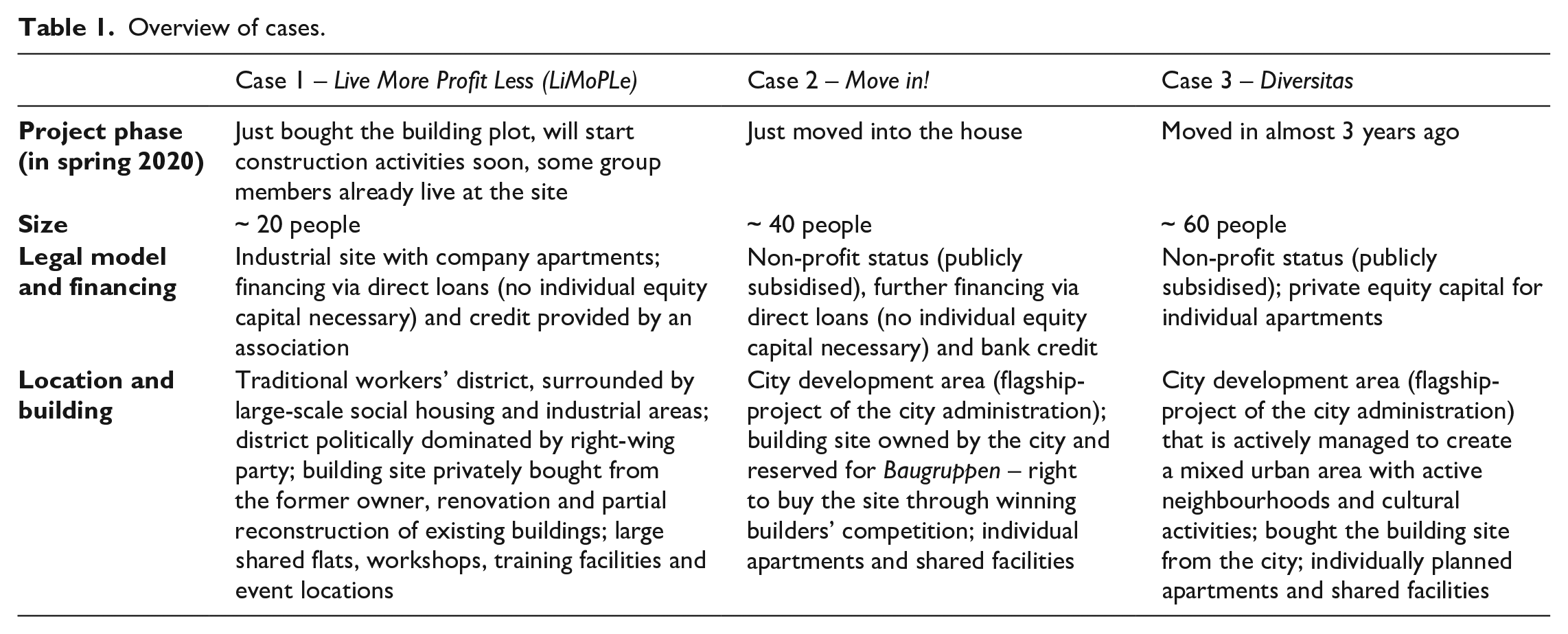
The empirical data were produced through a multi-sited ethnography (Hine, 2007) amongst a wide range of Baugruppen in Vienna, conducted by the first author since 2018. 5 Here, we focus on projects which simultaneously aim to realise their concrete projects to live together differently, and to trigger political changes beyond them in different ways. In this sense, these Baugruppen provide exemplars for testing and showcasing how housing can be organised differently. The three groups explicitly do not want to create individual private property but adopt collective ownership models to contribute to a decommodification of housing.
The empirical material for this article consists of documents, media appearances, ethnographic observation of public and semi-public events and semi-structured interviews with six members of the three Baugruppen. 6 The interviews were conducted between April 2019 and May 2020. Each interview lasted between 1 hour 45 minutes and 2 hours 35 minutes, making a total of 10 hours. The interviews were audio recorded and transcribed verbatim. Quotes which are used in this article were translated from the original German by the authors. Field notes and observation protocols from the participant observation comprise two public Baugruppen events where all three groups took part, and eight public and semi-public events (including panel discussions, workshops, guided tours and project presentations, regulars’ tables and celebrations), organised or attended by members of one or two of the groups respectively.
We developed the conceptual frame and the empirical analysis in an iterative way, according to a grounded theory approach in its constructivist version (Charmaz, 2006; Clarke, 2005). Based on first empirical observations and open coding of the material, we approached the literature and developed a framework for focused coding. We coded the materials according to self-understanding, and relations of the groups to different actors, and found that they differed mainly in how they make sense of their commonalities and differences, how they relate to each other, to professional actors they collaborate with, and to current policies and the city administration.
Findings
In the following, we analyse how each group enacts their alternativeness through specific ways of relating to each other and to other actors and elements.
Case 1: ‘Live More Profit Less (LiMoPLe)’ – Building close familiar relations
Case 1 comprises a group of about 20 young people who self-identify as members of the left autonomous scene and who express explicitly anti-capitalist aims. They bought, adapted and partly rebuilt existing buildings (in cooperation with professional construction firms and partly through self-building) on a larger construction site for collective living and working (ongoing at the time of the fieldwork at the beginning of 2020). Most of the members have a high formal education but do not have a high income, either because they are students, are mainly engaging in activism and only work to cover their basic costs of living, or because they work in the social sector. The group draws its ability to act in common from close social and political familiarity and the readiness to develop intimate bonds within the group – even before they had started to plan and build their house. The corresponding care and mutual empowerment provide them with the courage and feeling of security needed to engage in challenging endeavours such as a very complex project. One interviewee explains: So I would say, that in such a group process, people start to develop a high ability to empathise with each other and a social competency, and this is certainly a huge benefit since it allows to overcome anonymity and allows for honesty, and intimacy and dependence on each other. So that dependency is not something that you have to avoid at all costs, which is somehow desirable in an anonymous, neoliberal, capitalist society. So instead of avoiding your dependence on others, you are actively looking for it, but in a different way, which allows to transform it, in a reflexive way. [. . .] You think about how do we want to live. (Int 1_1)
7
Here, collectively taking responsibility for each other is understood as the reverse side of dependency. In this collective, commonality means to ‘encourage each other in life [. . .] having a feeling of being in safety’ (Int 1_1). Thus, it includes developing a common subjectivity, working on oneself, on one’s own emotions, desires and affects, to become the kind of person who is ready to engage in living differently. Readiness and ability for self-reflection and alternative living (proved through experiences in other self-organised and activist groups) is a major criterion when it comes to recruiting new members.
Against this background, a disconnection between group belonging and ‘individual liberties’ (Int 1_2) is something that endangers this kind of commonality and can call into question the group’s essential character. LiMoPLe orders its internal and external relations according to this criterion. When individual actions or aims could not be accommodated with the common group decisions, members have even left the group. An example is the community’s response to the Covid-19 measures in place at the beginning of 2020 in Vienna. Considering that many group members work with vulnerable groups (in hospitals, shelters, etc.), they decided to restrict their contacts with people outside of the group as far as possible and to adhere to the then available safety measures such as wearing masks. In an interview, a group member describes how these collective decisions can conflict with individual behaviour: But conflicts arise of course, if proposals for compromises are crafted by the group and then individual members ignore or circumvent them. Because then, this questions the authority of collective group decisions and this is a trust issue. (Int 1_2)
Deciding on an individual basis how they would engage with each other (or not), as was the case in the other groups, was not considered a possibility for LiMoPLe. Their close relations do not allow them to avoid each other, and thus taking care of each other means to be honest and trust the others concerning their individual risk behaviour. Their specific kind of commonality based on intimate relations and mutual care turns individual behaviours into common concerns. In turn, dependency and mutual care enable internal relations which do not follow an individualistic, capitalist logic. An example of this is that they plan to distribute the rent among residents not according to square metres, but according to other criteria, such as income levels, thus taking collective responsibility to cover common expenses.
Likewise, the relations to the physical site, which they found in 2016, are characterised by dependency and care. Due to an agreement with the previous owner they were able to start using it bit-by-bit, even before the purchase was completed in 2019 and the actual construction activities started in 2020. So, they had already begun to renovate, furnish and adapt one part of the building at a time for four years when our fieldwork took place. In the meantime, some group members lived at the site in provisional flats, and some have moved to the surrounding areas during the last years and months to be closer to the site – for pragmatic reasons and to become more familiar with the neighbourhood. As the site is located in an industrial area without direct neighbours, such a stepwise and somehow provisional and experimental appropriation was possible without causing conflicts or legal objections. This allowed getting to know the place and starting to develop caring relations to it over time, and long before they even moved in (Fois, 2019). The co-constitution between the place and the group also evoked the withdrawal of some members who did not feel comfortable with the site and its materiality, as well as the work effort and time associated with it. These people were not able or ready to relate to the place by developing dependency and care, which lead to their exclusion.
Because relations of dependency, familiarity and responsibility are constitutive of the group and their project, they also avoid strictly professional or market relations within the construction process. Our interviewees problematised a division of labour between professionals and laypersons, which would imply impersonal relations between the involved persons as well as to the building and the location. Moreover, the group would not have influence on the working conditions and salaries of workers hired by contracted firms. The interviewees thus emphasise that they do not just hire specific actors for economic or pragmatic reasons but because there is an empathy between them and they share the same political stance and affinity to a leftist scene: . . . they helped us a lot and also are quite sympathetic of our project. So therefore, we get along very well, also, because they are a political activist as well. (Int 1_2)
As such, they embed the economic relationship between a client and a service provider into a collaboration between people who share an affinity towards specific aims and values and who care for the project. Actors outside the core group of future residents, like professionals with whom familiar relations (socially and politically) and mutual trust are possible, are regarded as belonging to the Baugruppe as well.
While relations of dependency and trust are constitutive for LiMoPLe, they also fall back on formal and legal ways of relating in specific situations. Actors who do not follow their ways of relating are located outside the group and relations are very formal. For example, as the district where the building site is located was politically dominated by a right-wing party and LiMoPLe anticipated that they might encounter resistance, they tried to conform to current legal rules and regulations in an extremely correct way and to stay unobtrusive to secure the project materially and legally. As one member stated in a personal conversation: ‘We are building super-decent.’ In these cases, absolute adherence to legal regulations is done with intention of protecting the project’s future in a potentially hostile environment. Here, external relations follow the rules and regulations of the external actors and the dominant structures to force these actors to accept the project and let it be.
The group also reverts to formal relations to safeguard internal relations and agreements in the long run. For example, with professional actors who share the group values and trusting relations (such as the former owner of the site or their architect), LiMoPle demarcates professional or official settings where both sides (the future dwellers and the professionals) represent their interests and stakes, act more strategically and where also conflict or disagreement can appear. They told us that especially financial negotiations and agreements are located ‘within a clearly separate frame’ (Int 1_1). In turn, this should also secure good personal relations in the future: And of course, everything should be legally correct, like, airtight. A huge concern of everyone involved was that we [the group and the professionals] won’t start fighting afterwards and start suing each other, just because something was not clear in the beginning or has not been handled correctly. So we want that everything is sorted out correctly from the beginning. (Int 1_2)
Thus, while LiMoPLe experiments with self-organisation and building temporal, informal structures, they do so within legal bounds and they fall back on legal and formal agreements to fix specific relations in the long run.
In sum, the type of alternativeness that LiMoPLe enacts is based on a rather strong boundary between inside and outside that is drawn according to political and social familiarity and the readiness to get involved on a personal level. Internal relations are thus very strong and demanding but empowering. External relations are rather formalised and developed in a way that delimits mutual influence. LiMoPLe relates to external actors (state and market) in their own terms (rather than challenging them), which is intended to secure the possibility to relate differently internally. Staying rather separate from broader public attention, LiMoPLe can develop and showcase very different ways of living and housing, but is hard to access for people outside of a specific sub-culture.
Case 2: ‘Move in!’ – Contributing personal resources to a shared plan
Move in! is located within a city development area. It has a non-profit status and comprises individual apartments for about 40 people, as well as some shared spaces, a gastro-pub and spaces for social events. The dwellers moved in at the beginning of 2020, but the interviews were conducted prior to that. Even if the group members had not lived together yet, they had worked together closely to plan and manage the construction of the building during the last few years, and they had engaged in several common social activities. Some members of the group have relations to a leftist scene, some are related to a rather academic critical urbanist scene, some are artists, and some are also professionally involved in Baugruppen consultancy and management. While they aim to mitigate the destructive effects of the commodification and financialisation of housing, the group as a whole does not express a radical anti-capitalist stance.
The group bases its ability to act on the given personal resources of its members. While the financial resources of the group members differ, almost all of them possess high cultural capital in terms of education level, skills and professional prestige (compare Bresson & Labit, 2020). They are a group of ‘very activist people’ (Int 2_1) 8 with high self-organisational and self-representational skills. As such, they can amplify their potential to act when joining forces to realise a shared plan and relating in a mutually supportive way, which members describe as an inspiring and enabling atmosphere. The difference to Case 1, where members are also well educated and experienced in self-organisation, is that the cultural capital of Move in! is externally approved and accepted as legitimate by wider society. They thus do not only possess personal skills, but also social prestige and the corresponding attitude that is more easily acknowledged by external actors.
Here, the ability and readiness to contribute personal resources to the common endeavour serve as the main group criteria. While many group members are engaged in different political initiatives, their common political aims are formulated in a rather generic and inclusive way on their website and at events, ‘Solidarity and lived responsibility beyond the housing project’ (website) are mentioned as shared values. One interviewee states: I think that many participate also because they especially appreciate that we have somehow an overarching political goal [. . .]. And so this idea, somehow, to do a little more. So, a model project that goes somehow beyond personal fulfilment in the sense of a built object or housing space or maybe community. (Int 2_1)
Overall, community appears as ‘space where one can organise things, space for initiatives’ (Int 2_1) and as a ‘broad, enjoyable social context’ (Int 2_2) that goes beyond one’s own apartment but that does not mean having a ‘common household’ (Int 2_1). In contrast to Case 1, where chosen dependency on a group appears as core, here it becomes obvious that deeper relations of mutual dependency are not a shared aim in their own right. Good social relations are however seen as both a prerequisite for and a welcome side-effect of the common endeavour, but they are not regarded as the primary goal.
The shared commitments of the members focus on a vision and practices of sustainable urban mobility. This opposes individually owned cars, and it embraces alternative mobility means as well as public transport. Move in! works towards this vision by engaging in activism and via adapting the personal practices of its members through designing a specific infrastructure for and around their house, such as garages for bikes but not for cars, and a shared cargo bike that can also be used by neighbours. Further, Move in! successfully campaigned for measures to quell car driving in their neighbourhood. In their social media activities, the group regularly campaigns for better cycling infrastructure and measures to reduce car traffic. They thus also engage in a ‘promissory assemblage’ (Färber, 2020), in which a shared vision for a specific urban future is constitutive for the relational constellations between members and the design of the house. The demarcation line is between actors who support or alternatively hinder this vision.
Exclusion and conflicts can arise between the political values of providing housing space for a variety of residents, especially for those who are underprivileged or marginalised in our society, and the ability to mobilise resources for the common project. While the group achieves diversity in terms of family forms, ages and professions, it remains rather homogeneous in terms of educational background and social status, which goes along with a high ability to organise oneself (cf. Bresson & Labit, 2020). One member explains their rationale for selecting new members: . . . because we need people who engage in doing the work, because otherwise people [the others in the group] just die. . . And, I find it basically, socially nice if it is diverse, if there is space for everything. [. . .] And thus I think, a certain heterogeneity is worthwhile. But maybe we don’t need to create heterogeneity just now, in a phase where it is just difficult. There I am rather pragmatic. We need to take care that we just get it done. And subsequently we can still look how we deal with re-occupations. (Int 2_1)
These contradictory criteria create a social composition in which the position of a group member (and the likelihood of being selected as a new member) is negotiated depending on how much time they invest, how credible their engagement with the group’s central values are, which resources (specific knowledge or expertise, connections to other relevant actors, etc.) they bring, and not least how they fit in personally and socially, and if they add to other diversity dimensions. That the group member mentions in the quote above that those who are burdened with an unequal distribution of the workload would ‘just die’, emphasises how essential and constitutive the investment of work and resources is for this group.
Actors who do not share the common aspirations completely, such as professional firms, are included via group members with approved professional experience in the respective field (architecture, construction, etc.), who act as mediators and translate between group demands and the professionals’ interests. For instance, Move in! needed to explain and emphatically emphasise to their building contractor what collective housing implies in terms of technical specifications and infrastructure that deviates from standards – for instance, that they do not want separate accounting of electricity, internet, etc. Thus, while in Case 1 professionals were chosen who already shared the joint values of the project, here the match with group values and aims is safeguarded by professional experts from within the group.
Concerning the vision of sustainable urban mobility, specific group members with professional expertise in urbanism, consultancy and communication engage with the city administration to align its agenda with the group’s political aspirations. They regularly organise public events in cooperation with the city and they engage in lobbying and consultancy activities. In the interviews as well as in public debates, we observed how the group balances attempts to make their project attractive for the city and its agenda, and trying to shape this agenda, with open critique and contestation. For example, the project has been included in building exhibitions and competitions organised by the City of Vienna, because it was considered innovative and as contributing to the city’s strategic goal to make local neighbourhoods more liveable and safe through fostering a mix of use, attractive ground floor zones, social and cultural activities and vivid public spaces. Because they could achieve this official recognition, Move in! was able to express also alternative ideas as to how planning processes could be more democratic and participatory. While these extensive contacts with external actors hold transformative potential, there is also the risk that Move in! is used as an asset for the city marketing and the valorisation of the neighbourhood, which could undermine its alternative and critical aspirations and contribute to further capitalist exploitation of housing and gentrification processes.
Summing up, Move in! enacts a type of alternativeness which builds a rather open constellation that orders inclusion and exclusion according to the potential to contribute to the overall shared endeavours in a rather pragmatic way. Elements and actors who do not fit into this are either mobilised through mediators or addressed through political action and open critique. The material relations of Move in! are mostly focused on sustainable mobility without cars, and they engage in infrastructure for building socio-material assemblages which sustain such a vision. Through its social prestige and compatibility, the group is able to have influence on current policies and established actors, but it is also in danger of being more easily co-opted by economic or political interests. Herein lies its main difference to Case 1 – rather than separating and protecting itself from external influences on its alternative internal relations, Move in! tries to mobilise their internal and external relations to influence and transform the market and state actors with whom they interact. While it has the potential to normalise alternative ways of living and housing, it still maintains given hierarchies based on cultural capital.
Case 3: ‘Diversitas’ – Creating space for individual needs and differences
Diversitas is organised as an association with a non-profit status and is located in another city development area. The occupants had already moved into the 30 apartments almost three years before the interviews were conducted at the beginning of 2020. The project is targeted at people who self-identify as queer, but this is not a hard boundary – dwellers include gay and lesbian (but also heterosexual) people, transgender people, singles, couples and families, with and without children. The house includes individual apartments and shared spaces that can also be used by the occupants of the surrounding houses, and they regularly open their communal room to the neighbourhood.
The group draws its ability to act in common mostly from a mutual tolerance for individual differences, needs and behaviours – and the shared experiences of having been discriminated against themselves. This allows the creation of ‘an environment where I feel safe and at home’ (Int 3_1).
9
In the interview, the initiators mention that queer people have certain ‘requirements’, ‘interests’ and ‘problems’ that are not covered by mainstream housing. This characterisation of commonality diverts from the other two cases – here, commonality is not so much based on alternative goals and aims, but rather on alternative needs (which are turned into goals as they are not satisfied) and mutual tolerance for people’s respective needs. Thereby, tolerance does not mean indifference towards each other, but to put active and collective effort into enabling individuals to fulfil their needs and to protect them from being excluded. This is reflected when the interviewees talk about Diversitas as a ‘protective frame’ (Int 3_1) for people in specific personal situations in life which might even go along with ‘asocial’ behaviour: There are indeed people in the building who are in very specific situations, which is something you have to understand. [. . .] [in this situation] of course they are provocative. (Int 3_1)
The interviewees argue that individuals should be legally protected vis-a-vis group claims and thus embrace legal tenancy protection regulations for subsidised housing that other Baugruppen regard as undesired interventions in group decisions. In contrast, in Case 1, legal means were used to protect group interests from external demands and also from individual members’ claims. In the case of Diversitas, reference to legally granted rights and protections rather than to mutual agreement within the group sheds light on the specific kind of commonality which is not derived from concrete group activities or aims, but rather from the general mutual tolerance of individual idiosyncrasies, which the group members share. This means that neither shared social activities nor an equal engagement in work for the group is expected to become part of the group. Overall, social relations within the group are regarded as emergent private matters between individuals and nothing that can or should be planned on a group level. Individuality is emphasised as a crucial basis for togetherness: So there is a deliberate space for the individual in the community. Because otherwise people dissolve into the community and don’t exist anymore. But then the community dies as well, because there is no incentive and no movement anymore. (Int 3_1)
Here, again, reference that people would ‘dissolve’ and the community would ‘die’ hints at the constitutive role of the values described – in this case protection of individuality. After living in the house for almost three years, common activities and group decisions only concern the communal room that they manage together, and the garden. Other activities mostly happen in a decentralised way in smaller sub-communities based on friendships or common interests (e.g. some dwellers joined up to equip a fitness room).
Noterman (2016) argues that unevenly distributed engagement in the collective management of resources (in his case an emergent housing cooperative) in ‘instances of the commons that exist outside a self-identified, politicized activist milieu’ (p. 435) might not necessarily be interpreted as a failure. Rather, it might be read as ‘differential commoning’ in which the material and immaterial contributions of community members are distributed in time and in kind, but nevertheless constitute certain common values and togetherness. In this sense, the focus on mutual tolerance as the main commonality of the group also sets the basis for a specific kind of solidarity and togetherness. If taken seriously (as is the case for Diversitas), tolerance does not mean indifference but it implies care and protection from being excluded directly or indirectly because of individual idiosyncrasies. This is, for example, reflected in the recruiting process of group members. Unlike in Cases 1 and 2 (and most other Baugruppen), there was no common application and selection procedure where the current group would choose their future members from a pool of applicants according to specific criteria. ‘There was no selection process, apart from self-selection, so if you stay and if it fits’ (Int 3_1). Rather, the initiators promoted the project via queer media, and whoever came and was interested in the project were included on a first come first served basis: And interestingly, without being designed, then diverse people arrived, yes. [. . .] It is like a sample, obviously. Therefore we never had to choose between anything. [. . .] We also did not want to choose, since we wanted to have a diverse mix. These are great people and everyone is a bit different and everyone approached us, so, I would not have wanted to select. (Int 3_1)
The reference to the residents as ‘a sample’ reflects the initiators’ broader political aim of representing the diversity of the city population in housing rather than foremost building for ‘the standard family’ or for people with similar demands. Thus, trust in and valuing the contingent development of diversity also include the material building, creating socio-material relations that would sustain diversity and tolerance in the long run. Each apartment has been planned individually for the respective resident, accepting also unusual or curious demands and defending them vis-a-vis the building contractor, who would have preferred standard layouts. This of course concerned the spatial layout, but also the financial capabilities, which mainly referred to the size of the apartment. In turn it is assumed that the resulting material diversity of apartments would also in the long run mobilise diverse dwellers who are able to accept individual differences: Because each apartment looks different. No apartment is like any other. And this diversity is something that the building itself provokes, not just the people, so that always people in different circumstances will move in [. . .] so it will stay diverse, yes. (Int 3_1)
In this way, the group and the building shape each other in an iterative and contingent way. The focus on tolerating individual differences enables a high degree of diversity also in terms of socio-economic status. Residents include architects, doctors as well as people who are unemployed, who work in precarious sectors, or refugees still waiting for their residence status. Affordability also for people with irregular employment biographies is an explicit goal of the project, which is realised mainly through relatively small apartment sizes and an internal solidarity fund for financial emergencies. These examples show that tolerance is not a passive value for Diversitas, but that it is understood as an active obligation to enable diversity and the fulfilment of individual needs.
Mutual tolerance in a weaker form is also what regulates the relations with professional firms – as long as they tolerate the diversity in and of the project, they are included on their own terms (in the sense that usual contract relations to firms are accepted or that the legal and organisational preconditions for social housing subsidies are taken for granted). Different to other Baugruppen, acquiring specialised knowledge and encompassing self-management is not a general aim. However, if professional actors are not ready to accept the individual demands and try to impose standardised solutions (e.g. a builder or architect), the group fights for such demands to be accepted – ‘also fighting, explaining, keeping on, being frustrated (laughs)’ (Int 3_1). This again exemplifies that tolerance towards group members’ needs implies active commitment and care.
The group’s understanding of a community of solidarity that cares for its members resonates with the social democratic values of the City of Vienna. The initiators used the focus on affordability and solidarity to ‘make the idea compatible’ (Int 3_1) with Viennese social housing policies. For realising their project (and for initiating similar follow-on projects), they needed a building plot and public subsidies. They describe the current circumstances in Vienna as ‘favourable’ (Int 3_1) for their project, as recently ‘social sustainability’ has been included as a criterion for social housing subsidies and since in the new city development areas the city tries to create a diverse, lively environment and is open to Baugruppen – ‘an environment which admits you’ (Int 3_1), as one of the initiators expresses it. They thus created relationships with the city by positioning their housing project as a contribution to the wider political aim to provide affordable housing for diverse needs, while introducing a broader understanding of diversity into social housing, which also takes into consideration non-standard family and household forms in organisational and material terms. This way of relating to the city administration is similar to Case 2. However, while Case 2 creates compatibility mainly on the level of interests and strategies, Diversitas creates compatibility foremost by referring to shared values and commitments based on relations of solidarity with the city and its inhabitants. Through this way of relating to and improving current policies and ingrained values, such as solidarity, Diversitas enacts a kind of alternativeness that is inclusive (in terms of financial and cultural resources, life-forms, social abilities, etc.) in the absence of standardisation.
In sum, Diversitas creates a relational constellation of heterogeneous actors and elements bound together through mutual tolerance. This in turn creates a feeling of security and trust which enables solidarity and to act in common and to oppose attempts towards standardisation and exclusion. The type of alternativeness of this project could be characterised as an attempt to create an alternative through improving current social housing policies, which adds diversity and individualisation without challenging basic principles and values. Yet, it gives rise to specific kinds of solidarity and care that are actively practised rather than taken for granted. This kind of incremental change via improving the status quo and giving new meaning to taken for granted values might also help prepare the ground for the acceptance of other, more radical projects.
Concluding remarks
The three Baugruppen which we have analysed position themselves between and beyond the state (here represented by the city administration) and a capitalist market. They are producing, using and managing their own housing space. We thus have assumed that they are engaging in ‘commoning’ (Dawney et al., 2016; De Angelis & Harvie, 2014). The housing projects reject the universalist claims and standardised solutions of both social housing and of the private housing markets, which mostly address hegemonic household and family forms. Standardisation concerns both ground floors and architectural design, as well as the organisational models for managing the joint housing space. Commoning in our cases depends on the specific relational constellations within and around a group. As Fisher and Nading (2021, p. 1248) point out: ‘Commoning is a specific mode of organization, an ethical and political act of bringing certain kinds of things into certain kinds of relation.’ Our analysis contributes to the literature on alternative housing and commons by showing that commoning does not describe one uniform mode of organising, but a variety of relational constellations. The analysis details that ‘certain kinds of relation’ are created and lived very differently in different groups, and that similar relational practices (such as using legal regulations) can have different roles and meanings in different relational constellations. This situatedness and diversity of relational constellations make the projects alternatives in the first place. On the basis of specific commonalities and differences (Thévenot, 2014), and of specific relations between human and non-human actors (Farías & Benders, 2009), our analysis shows how collectivity and individuality are related in specific ways in the respective cases.
In Case 1, individuals strive to work actively on their own subjectivity to be able to develop close relations of mutual dependency and of living together. Thereby experimentation encompasses both the people and how they live together, and the material places and how they are designed and appropriated. The site and the affordances of its specific material composition have also shaped the group and the ways of living and working together they adopted. In turn, the site, which includes apartments, training facilities, workshops, seminar rooms and event locations, acts as a focal point to assemble people and groups beyond the core group of residents who share commitment to alternative ways of living and relating. It is, however, hard to imagine how that could be realised beyond this sub-culture. Yet, other groups and actors who are sympathetic towards the aims and values of Case 1 (like Case 2) could get inspired and take over and replicate at least parts of the model and also change their own sense of which kinds of togetherness and living are possible and worthwhile.
In Case 2, individual members invest their individual resources into working towards a shared future vision of a sustainable city that allows for housing and mobility which are less exploitative of natural and economic resources. Thereby, the given individual resources and subjectivities, which are externally approved and valued, are widely taken for granted rather than challenged. The project and the material infrastructure it creates are regarded as focal points to showcase how a more sustainable life would be possible. Thus, care towards realising and sustaining this project is developed, including the infrastructural links that would relate the project to the wider neighbourhood and city space. Case 2 thus seeks contact and interaction with external actors, whom it tries to convince and mobilise based on common interests. This might indeed influence political agendas and the socio-material fabric of the city and create conditions of possibility and affordances for more radical groups (like Case 1). Yet, it also bears the risk of compromising the group’s values and aims by embedding exclusions based on cultural capital.
Case 3 focuses on individuals with specific needs and idiosyncrasies, which need to be protected from exclusion and group demands. A change of subjectivities of the group members happens here in a subtle and incremental way, through creating a safe and inclusive environment, in which individual relationships can develop without being forced. The diversity of the building and the diversity of the residents mirror each other and are regarded as reproducing each other via the individual needs they address. Moreover, the diversity within the project seeks to reproduce the diversity in the overall city population and by doing so to contribute to the common good of a more just society beyond the group of residents. This is also what makes the project compatible with the existing agendas of social housing, based on a broader socio-political understanding of solidarity. Case 3 seeks to shape the common values in a way that would become meaningful and more inclusive. In this way, despite accepting the existing social housing regulations, Case 3 opens up transformative and subversive moments. It shapes the subjectivities of its members towards increasingly taking responsibility for the common spaces and for each other, and to reflect upon the way they want to live individually and collectively.
This overview shows that all three housing projects hold potential for transformation. It also shows that all groups also include different logics of exclusion based on differences which cannot be accommodated within their specific kind of commonality (cf. Arbell, 2021; Bresson & Labit, 2020). As Fisher and Nading (2021, p. 1248) argue: Each act of commoning is also an act of uncommoning, of designating what can be held in common and what is disruptive ‘excess’ [. . .]. By the same token, commoning is not a method for bringing everything into relation.
Against this background, there is no single model amongst our cases that could be scaled up as a universal model suitable for everyone. We argue that this is a virtue, rather than a shortcoming. It prevents the emergence of a monolithic ‘alternative’, another standardised solution that may accommodate most (but never all) differences. Instead, scaling processes directed at alternativeness should facilitate ongoing experimentation with a variety of alternatives (cf. Amin & Thrift, 2005) that constantly challenge and improve the status quo, and each other.
In sum, our analytical approach of paying attention to specific relational constellations of housing groups which highlight varieties of alternativeness shows how the interplay of different kinds of alternatives can contribute to change the socio-material assemblages that make up the urban (Farías & Benders, 2009; Farías & Blok, 2016) by slowly building up infrastructures, imaginations and hope (Amin & Thrift, 2005; Anderson, 2006; Coutard & Guy, 2007).
Footnotes
Acknowledgements
First of all, we owe deep gratitude to the members of the Viennese housing groups who shared their experiences with us despite their scarce time. We are also grateful to the two anonymous reviewers, who engaged with the manuscript in an extraordinarily productive and detailed way and helped to improve it considerably, as well as to the editorial team that supported this process. We also want to thank our colleagues who provided feedback on earlier versions of this article, especially Maximilian Fochler and Nina Fräser, as well as Fredy Mora-Gámez and Sarah R. Davies. And not least we want to mention the institutions where the research this article is based on has been conducted: the Friedrich Schiedel Endowed Chair for Sociology of Sciences of the Technical University of Munich, and the Department of Science and Technology Studies of the University of Vienna.
Funding
The authors received no financial support for the research, authorship, and/or publication of this article.