




Abstract
The concept of place has become fertile ground for sociological investigations, yet it is still undertheorized and in need of further development. Its most advanced employment is to be found within a sociological agenda on materialities of care and health architecture. In this article, we build on this work to conceptualize ‘placed care’ and to show how ecologies of care are produced and maintained through care infrastructures. The article investigates the case of an illegal baby foundling room in the Netherlands, where one may abandon one’s infant anonymously. We conceptualize this place, continuously produced through its care infrastructures, as ‘place-by-proxy’: a place that allows, by virtue of simply being there, for the animation of infrastructures around it. With this concept, we advance discussions on places as bounded and open, pointing to the work and consequences of ‘binding’ place and opening up the concept for further application to various sociological concerns, particularly in healthcare.
Introduction
I step inside. The room is small, the air stuffy. When was the last time someone walked in here? I look to my left and I see a painted tree, gracefully traced along the light-blue wall. A birdhouse is perched on the tree’s branches, purple and green. Under the tree I see a crib, covered with an olive green blanket. A teddy bear guards the crib, and in its feet I see an envelope entitled ‘Lieve Mama’ (Dear Mommy). I look around and I see a black button attached to the wall and a pictogram, depicting a woman pressing this ‘help’ button. Stuffed animals stare at me from the chair in the corner. I turn around and I see a camera, pointed toward the crib. Uneasy, I look around – am I being observed?
(Fieldnotes, December 2015)
This article engages with debates on place, care and infrastructure, in order to understand how ecologies of care are created and maintained. We do this by using a rather exceptional example: a baby foundling room, which we see as a particularly placed care-ecology for foundlings. In this room, created by the non-governmental organization ‘Beschermde Wieg’ 1 and operated by volunteers, a woman may abandon her infant anonymously. Despite the lively societal debate the room’s existence has sparked, it has remained empty, with no infants abandoned there, while paradoxically igniting much action, work and discussion around it. This incongruity forced us to think differently about (and learn from) this place: as a point where various care infrastructures (Danholt & Langstrup, 2012) temporarily meet. Theorizing the room alone could not explain its emptiness; its relationship to care came into focus only in relation to particular infrastructures (Star & Ruhleder, 1996). Therefore, this empirical analysis explores the infrastructural making of place, arguing for an understanding of places working by proxy – doing work and igniting action elsewhere.
The concept of place has proven to be a fertile ground for sociological investigations in the last decades. While it was first developed as an analytical tool in human geography (Casey, 2001; Cresswell, 2004; Massey, 2005) and anthropology (Ingold, 2000), sociological work on place has related to discussions on gender (Ward et al., 2017), class (Paton, McCall, & Mooney, 2017), nationhood (Pilkington, 2012) and memory (Degnen, 2005), as well as to wider conversations on materiality (Watson, 2003). The latter, in particular, have insisted on conceptualizing place as ‘relationally performed’ (Watson, 2003, p. 145) and emergent from a mix of human and non-human elements (Country et al., 2016). This exploration of place as an effect of heterogeneous relationships is at the center of Buse, Martin, and Nettleton’s (2018, p. 253) call for attention to the ‘outside of care’, or how designers, planners and architects do place making for care.
The relationship between place and care has been theorized as co-produced (Bowlby, 2012; Ivanova, Wallenburg, & Bal, 2016; Milligan, 2003; Milligan & Wiles, 2010), with an emphasis on its emergent character and as a relational activity between humans and non-humans (Danholt & Langstrup, 2012; Ivanova et al., 2016). Danholt and Langstrup (2012) have shown how care practices are located within infrastructures of care as heterogeneous assemblages. This focus on the infrastructure of care owes much to STS work showing infrastructures to be political (Bowker & Star, 2000; Star, 1999) and relational (Star & Ruhleder, 1996) and has further benefitted from the conceptual development of place within geography. Debates on place have seen a dichotomous conceptualization of anthropological versus non-place (Augé, 1995), problematized its boundedness (Malpas, 2012; Massey, 1994, 2005), and seen the concept evolve from a simple location to a transient mix of ‘relational, material and more-than-human’ (Country et al., 2016) elements.
It is against this background of place as dynamic and transient, the co-production of place and care, and infrastructures as relational, that this article is located. Its aim is twofold: to show placed care as an infrastructural achievement, requiring ‘binding’ work, and to argue that places, as both open and bounded, may be productive through their infrastructural forms. This infrastructural productivity is what we refer to here as place-by-proxy. The foundling room in the Netherlands is a peculiar and fascinating case, which allows unpacking the notion of place within care practices, demonstrating this proxy work. The room seems contradictory – both a place of care and intimacy and a non-place, to be entered fleetingly. A room carefully designed for use (for those who would abandon an infant), which everyone hopes will never be used (and no infant will be abandoned anonymously). Much more than a place for abandonment, this room is an experiment in caring.
Concepts and method
Infrastructures are seen as ‘something upon which something else “runs” or “operates”, such as railroad tracks upon which rail cars run’ and are easily pushed into the background, forgotten unless they break down (Star & Ruhleder, 1996, p. 113). They have been analyzed as deeply relational: infrastructures do not work when isolated from their use, only becoming ‘infrastructure in relation to practices’ (Star & Ruhleder, 1996, p. 113). In the sociology of health and illness, the term was linked to care in an attempt to make sense of care practices in relation to space and materiality. Danholt and Langstrup (2012) use ‘care infrastructure’ to understand how an individual is always intertwined with people and things in caring. Their focus is on the mundane elements that underpin medication practices, in decentering self-care from the locus of the individual. Weiner and Will (2018) apply the term to the context of home care monitoring, arguing that care infrastructures allow them ‘to see the socio-technical relations behind care’ (p. 272). Similarly, it helps illuminate spaces that are traditionally thought of as ‘outside care’, as ‘designers, architects, and planners can orchestrate environments where care may take place with intended and unintended consequences’ (Buse et al., 2018, p. 253). By relating care infrastructures to place we take this concept outside the context of mundane practices and broaden it to help us understand the making and unmaking of placed care.
Firstly, thinking in terms of care infrastructures allows rethinking the notion of place. Malpas (2012) called for clarifying the meaning of the concept after the spatial turn in sociology advanced place as relational and open (Massey, 1994, 2005), which he also understood as boundless. In Massey’s view place is a ‘meeting point’ of flows and transience – in her famous example even mountains are on the move (within a different temporality) and according to Thrift (2006), ‘there is no such thing as a boundary’. This ‘neglect of boundedness’ in relational place is problematic (Malpas, 2012, p. 238), because relations presuppose boundaries, meaning that boundedness and place must be reconsidered (p. 240). We do this here in empirical terms by conceptualizing the foundling room as both deeply relational and bounded. This case allows for rethinking the boundaries of place, because it shows how place may work beyond its physical contours, through numerous infrastructures aligning.
Secondly, and related to the issue of boundedness, the room’s peculiar positioning contributes to furthering discussions on place/non-place (Augé, 1995). Augé (1995) has argued that the notion of ‘place’ comes from a societal system anchored in living on the land, ‘in the permanence of an intact soil’, while ‘non-place’ is characteristic of postmodernity, the contemporary world of motorways, shopping malls and airports. The foundling room organization currently consists of six rooms, spread across the Netherlands. These rooms are identically designed and filled with the same objects; manufactured as places to go ‘through’, not stay in – in many ways they are non-place. Similarly, Augé (1995) sees non-places as fleeting containers for postmodernist movement, consumerism and disconnect. Yet, there are important differences, as the room is both anonymous and intimate, a last resort and – as we will show in this analysis – a place for care. We show below that, instead of a contradiction within the dichotomy of place/non-place, the room is rather a place-by-proxy, thus adding a third category to the discussion, placeness, or how places are. Through the analysis place comes to be understood as an infrastructural alignment that is deeply relational; places that appear to be placeless, or non-places, may produce strong place effects elsewhere.
This focus on infrastructures led the design of the research both theoretically and methodologically, as the article drew on Actor Network Theory (ANT) and relational ontology, in order to understand the configuration of place as a heterogeneous process, including both human and non-human elements. This article is, therefore, built on the assumptions that material entities have agency (Bennett, 2010) and that places are emergent assemblages (Delanda, 2006; Deleuze & Guattari, 1987), which stabilize briefly, while constantly changing (Massey, 1994). These insights sensitized us to the dynamic nature of place, structuring the method of this study in important ways. Using an ethnographic approach, we studied the organization ‘Beschermde Wieg’ through archives, observation and participation; conducted archival research, including newspaper articles, documentaries and Dutch laws concerning foundlings, all of which were analyzed discursively. Twenty-three documents, including positions of the UN, the Dutch Council for Child Protection and documentation of Dutch parliamentary discussions formed the bulk of our archival research; and we analyzed the website of the organization 2 discursively. Six in-depth, semi-structured interviews were conducted: with a representative of the organization, two volunteers (one interview), a hospital physician, representatives of the Council for Child Protection (one interview), FIOM 3 and a Ministry of Justice official. We furthermore conducted observations in one of the foundling rooms and of the working process of ‘Beschermde Wieg’. We observed the opening ceremony of another foundling room inside the Isala hospital. We decided to focus on one of the existing six rooms and understand its place-ness. Throughout the article we speak of ‘a room’, yet six of them exist in different parts of the Netherlands. These six rooms have been designed identically and there is no real difference between their interiors. 4 However, the infrastructural alignment around them may vary, which is why, instead of focusing our analysis on the phenomenon in general, we explore here the room in Papendrecht, a suburb of Rotterdam (Figure 1). The research took place between December 2015 and June 2016. Most of the interviews were conducted in January and February 2016, while the observations were conducted in April 2016. Follow-up conversations and observations were conducted in May and June, while archival research was concentrated in, but not limited to, March 2016. The three researchers discussed emerging patterns throughout the fieldwork period, as the data collected were openly coded.
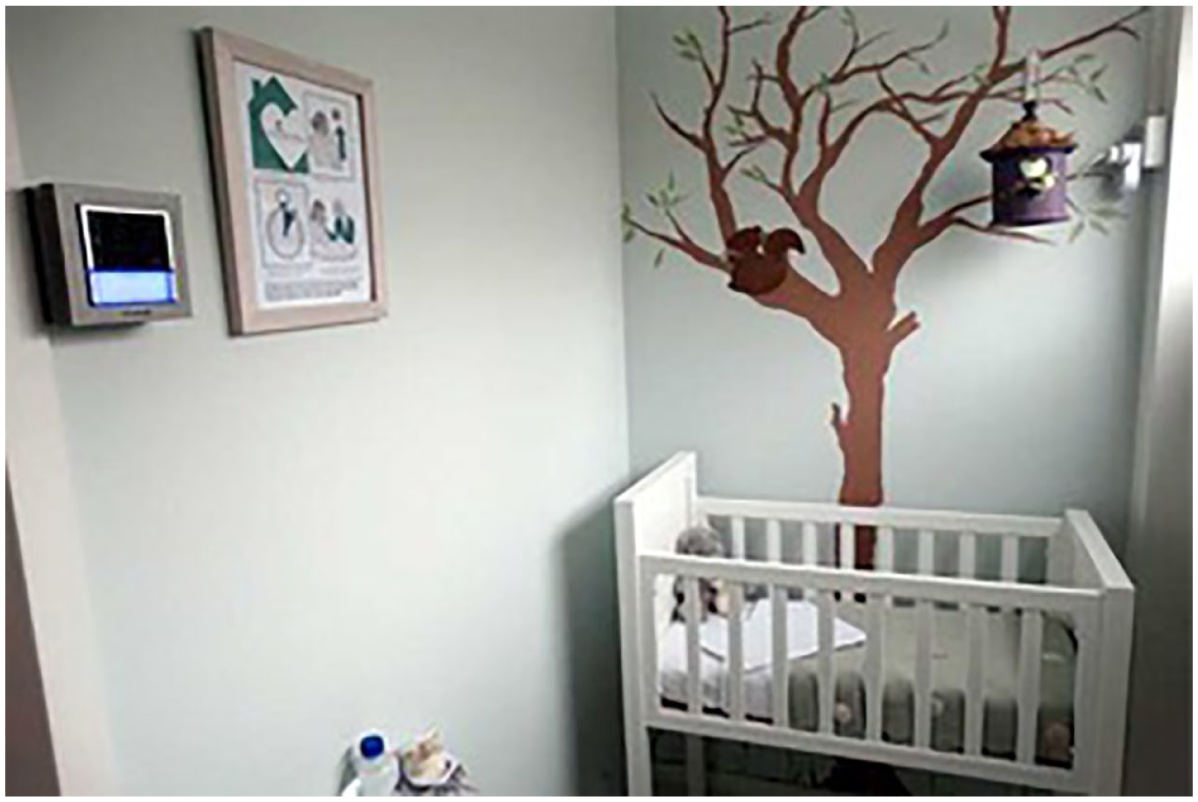
The foundling room in Papendrecht, the Netherlands.
In what follows, we invite the reader to experience the room as a gathering (Latour, 2004) through the alignment of infrastructures. The analysis is committed to ‘staying with the trouble’ (Haraway, 2016) of the room and to ‘troubling’ the concept of place as a particularly located meaning making. The room is first explored as a place of possibility, then as an alignment of infrastructures in relation and finally as a place-by-proxy. This evolution reflects our analytical steps, as well as our story of relating to the room as an object of analysis.
Enter
Entering the foundling room, one sees a black button and a poster (Figure 2), explaining what one must do to receive help. A woman holding a baby is pictured pressing the button, while the next panel shows her speaking with a volunteer. A notebook is placed on a table by the crib. Its hand-written text begs the visitor to ask for help, promising anonymity. Operating from the assumption that women find themselves in a situation of panic after an unwanted pregnancy and birth, the room’s organizers have created a story, inscribed in every object. Everything is an attempt to communicate: the painted birds and bunnies on the wall and the plush cushions say this is a place of care; the open door implies non-judgment; the button says we want to listen – all attempting deter the visitor from abandoning a child anonymously. This balance of anonymity and contact is a delicate one. A person who wishes to leave her baby completely anonymously in this room may do so. Yet, while the promise of anonymity is alluring, the room is, through its set-up, actively engaged in preventing it. The anonymous option is not desirable; it is ‘the worst case scenario’, according to the creators.
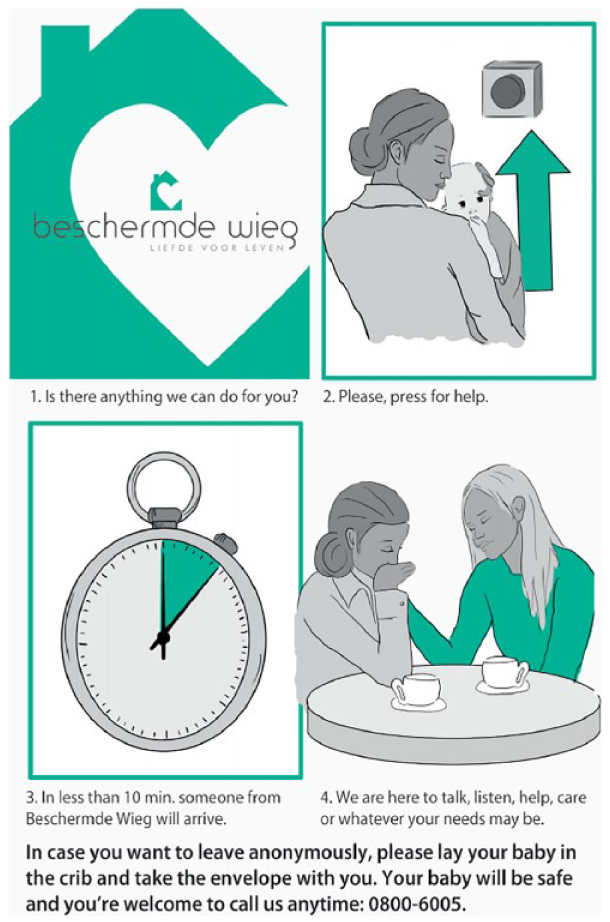
Wall poster. © Beschermde Wieg
Historically, the anonymous abandonment of infants has been addressed through the strategic employment of liminal spaces, which have existed in one form or another for centuries. In the Middle Ages in Europe it was common for parents to leave newborns in public spaces, where they might be easily found (Boswell, 1988). Infants were customarily left at the steps of a church (Boswell, 1988). Another common arrangement was the foundling wheel – a cylinder, attached to an outside wall (usually of a church) – where infants would be placed. Reaching a peak in 19th-century Europe, anonymous abandonment had become a system based on secrecy, expressed in the form of the wheel, in order to preserve infant lives, while maintaining the family regime (Tapaninen, 2004). A modern version of the wheel is the baby hatch. Popular in Germany, where it is called babyklappe, it is a place inside a wall (usually of a hospital) with a warm bed and an alarm. 5 In South Africa, such a hatch is called a ‘door of hope’. 6 In the USA the abandonment of infants is legally permitted in the so-called ‘safe havens’ (fire stations and hospitals). These brief historical notes show that, on the one hand, the foundling phenomenon is characterized by a long history and diversity of forms. On the other hand, the paradox of secrecy, produced through liminal spatial arrangements, is analogous with current anonymous abandonment provisions and sensitized to the multiplicity of foundling configurations both spatially and temporally.
Importantly, ‘Beschermde Wieg’ is the first room where one can abandon an infant, as the organizers aimed to create a place which would offer options. The room offers a narrative of different paths: when one enters it, many futures become possible; the person may reconsider, ask for help, leave some information behind or simply place the baby in the crib and never look back. A baby hatch or the steps of an orphanage are places of (legal) abandonment in many countries, but the foundling room in the Netherlands is a place of possibilities. It has the potential to remake the subjects passing through its doors. According to the creator of the room, Barbara Muller, 7 the official channels for child protection fail to offer help in every set of circumstances. 8 The foundling room project has become controversial, because it is a place to anonymously abandon a child, while anonymous child abandonment is illegal in the Netherlands. The goal is to prevent unsafe abandonment of infants – something that happens rarely 9 in the Netherlands. With six foundling rooms located throughout the country, a sleek-looking website, a 24/7 phone help line, a media presence and controversy on its heels, ‘the foundling room’ is more than a room: it is an assemblage of people, objects, organizations, worries and ideals.
The room seems to be, above all, a contradiction – a place (Cresswell, 2004) and a non-place (Augé, 1995). Much of the room is about its place-ness (the quality of how the room is a place; what meanings are produced within it): safety for the baby; danger for the one leaving it behind; possibilities for abandoning or not and for being anonymous or not; care for baby and woman, etc. And yet, there is a decisive lack of place-ness: untouched objects, stuffy air and emptiness; there is no ‘affective force’ (Duff, 2010) within these walls. We unravel these contradictions below.
A room of possibilities
Sophie 10 has worked with Barbara Muller before, on a project for temporary foster parents. As she serves tea in the living room of her home, she points to the foster children she has cared for – each little face framed in a picture on the shelf. Sophie is a volunteer: both as a foster parent and as a foundling room facilitator. ‘Beschermde Wieg’ operates on the basis of volunteers, who offer a part of their homes to be converted into a foundling room. The volunteers typically have some unused space, as in this case an adjoined garage, and let the organization convert it into a room. The space’s makeover is paid for and done by the organization. The volunteer’s job is to be at (or near) home at all times. The converted garage can be reached through two doors: one is on the outside, overlooking the street, and the other is on the inside, through the laundry room. The inside door is always locked, while the outside door is unlocked. If the help button is pressed or a baby has been placed in the crib, Sophie’s phone will ring and she must be there within five to ten minutes. Sophie’s husband and son are aware of the rules and are always in contact with her. When the family is on vacation, the phone is given to the neighbor.
There is a camera, connected to Sophie’s phone, which only points toward the crib, so that whoever places a child inside would remain invisible. The police are obliged to investigate anonymous abandonments, as it is punishable by law to leave a child under the age of 7 in a helpless situation (Dutch Penal Code 1984, article 256). Five of the identically designed rooms operate from volunteers’ homes, spread across the country. The sixth is situated within a hospital – the first such arrangement in a public place. According to the creators of the room, this option affords an alternative. A busy hospital corridor or a quiet suburban street – the foundling room exists between darkness and light and is both visible and invisible.
Inside the room one is transformed into a liminal individual. The woman entering the room may wish to leave her baby behind, yet she may have doubts about this decision. She may ask for help or not, stay anonymous or not, take a puzzle piece 11 from the envelope inside the crib or not. The child, too, is unfixed. Once becoming an anonymous foundling, 12 its life enters a liminality of a permanent character, as it may never know anything about its heritage. It may be placed with a loving family or it may struggle to find a strong connection. In a very different liminal situation, Sophie is both at home and not at home in the room. The room is in her house and she maintains it, cleans the windowsills and washes the blanket. But this is not her home anymore; it is a part of a network of identically looking places, which have been created by others with specific goals in mind.
Aligning infrastructures
The foundling room operates in the Netherlands, where anonymous child abandonment is illegal. It is therefore a curious place, where different rules apply. One is not allowed to leave one’s baby in a field or on the street, but the action is (currently) tolerated
13
in this room. According to Dutch law, anonymous abandonment is a criminal offense (Netherlands Institute for the Documentation of Anonymous Abandonment [NIDAA], n.d.) and in cases of abandonment an investigation follows, with the possibility of being sentenced to up to seven years in prison (Dutch Penal Code 1984, article 257,1). Legally, one may leave a child in the care of the state, a process requiring the woman to provide full information about herself. Some women may feel threatened by this and abandon their child unsafely – every year up to two babies are found dead or alive in parks, containers, even shopping bags, while possibly many more die unfound (Volkskrant, 2015). According to ‘Beschermde Wieg’ the room can prevent this and the lawmakers have decided to allow, or simply not acknowledge, the room for the time being. Proponents of the room argue for regulation, where provisions can be made, so that abandonment inside this place becomes legal. However, the Ministry of Justice is against discussing such possibilities, mainly because of the politically sensitive topic. Their strategy is to stay away from this political ‘hot potato’ as long as possible: It is about such a small number of cases, so why should you make a new law? Just wait and see if it happens, if a baby is abandoned. (Ministry of Justice official)
Numbers are important here, because they are missing. There is no statistic that everyone agrees on, because the problem of unsafe anonymous abandonment of infants is not isolated, but may be linked to other criminal practices, such as molestation, incest, human trafficking, etc. As a result, proponents of higher numbers argue, many babies are never found. In the official statistics only the babies that are found alive are registered as foundlings, while the dead infants do not enter this tally. Therefore, it becomes important who uses which numbers and to what ends. ‘Beschermde Wieg’ has put together their own statistics and publishes these on their website. Their numbers include the number of women who have contacted their 24/7 helpline for advice. These, they claim, show how many women look for alternative channels: Did you see the result of our emergency phone line? We helped already 70 women in the first year of our existence. There were 3 women who wanted to leave their baby in the room, but we changed their minds. (Emma Nieuwstad,
14
‘Beschermde Wieg’)
The foundling room expands here and changes; it is not about a wooden crib and stale air, but about electrical signals, transmitted into radio waves. And these electrical signals are standing guard in front of the foundling room’s door; on the phone Emma will try to convince the caller not to use the room (by explaining the alternatives), but to make arrangements, with the help of ‘Beschermde Wieg’ to go through an official channel.
The room is understood differently at the Ministry of Justice: a thick plastic folder holds clippings from newspapers and documents about the activities of ‘Beschermde Wieg’. The issue of legislation is very sensitive politically, because although the advisory governmental and supra-governmental organizations (the Netherlands Council of the Rights of the Child; the United Nations Convention on the Rights of the Child; FIOM; the International Reference Center for the rights of the children deprived of their family; UNICEF) are against the room’s existence, the public and the media favor such a place, which offers the possibility of saving infants from assured death: There is a lot of political and social pressure. The position that we are taking is a difficult one, because in the debate about this issue it is always – if you are against the room, you like to have dead babies. And this is not a black and white situation; so that makes it very hard to speak out against the foundling room. (Ministry of Justice official)
A change of law seems unlikely, especially in the context of Dutch socio-political culture, where controvtersial practices are often left unlegislated until time sways public opinion one way or the other (Kater, 2002). However, when an infant is found dead and the media explode with images of dark park alleys or, on one occasion, a trash container (NRC, 2014), the political conversation gathers momentum and proponents and opponents of the room put various arguments forward. The Ministry of Justice must be prepared for such times, when Parliament might request the minister to speak on this issue. An official has been tasked with following the unfolding controversy of the room, gathering all advisory documents (the UN, the Council for Child Protection, UNICEF), clippings from newspapers and other related documents. These are carefully placed inside the plastic folder and arranged by affiliation and importance. The folder swells, as discussion about the room continues and more paper clippings find their way inside yet another plastic pocket.
Part of the legal and political controversy around the room comes from the fact that the Netherlands is a country with relatively few anonymous child abandonments, in comparison to other European countries (as we have seen, however, numbers are controversial). This may be partially explained by historically well-established abortion regulations (van Tiggelen, 2016). A system of legal abandonment is well organized, with at least two organizations focusing specifically on helping women make informed decisions about unintended pregnancy. This means that the foundling room began operating within an already established field, where the organizations FIOM and SIRIZ 15 have decades of experience. As the cases of foundlings show, not all women take advantage of these structures and it is suspected that anonymity is a central concern for those who do not. In order to use the official provisions, a woman must disclose her personal information. All personal information about Dutch citizens is stored digitally in a central registry, to which many different governmental agencies have access. Arrangements can be made for secrecy, if social workers decide that a woman’s life may be threatened, but bureaucracy cannot always keep a secret:
When a child is born, it is registered in the system and 12 organizations receive this information. The social worker can inform these organizations in time (about this being a secret birth) but she has to talk to each of them before they act. And since there are 12, there is a chance that someone makes a mistake.
Is that a theoretical possibility or does it happen?
It does, it has happened. (Interview, FIOM)
Yet anonymity is not the only issue where the foundling room organization has an advantage over official structures. As a privately funded organization, it is able to provide more. In an attempt to get in touch with women before a baby’s arrival, they have a 24/7, free telephone line, where a volunteer will take any questions, listen to someone’s story and provide assistance, without requesting the caller’s information. Compared to the governmentally sponsored organization FIOM, this structure is more accessible.
The government is cutting expenditure, and more and more in the social field. FIOM had 14 offices all over the Netherlands 5 years ago. We have now one office, which is this one, out of 14. We try to provide the same service as before, but with fewer resources. It is difficult. (FIOM official)
‘Beschermde Wieg’ is able to afford a free line, where most calls come in late at night, while the other organizations are accessible only during office hours. For the foundling room organization, a success story is when the room is not used, and the woman in question has made contact with them by phone. In this way their success is made invisible, as essentially not using the room is their goal. The Ministry of Justice hopes for the same, because if the room were to be frequently used a new law would have to be introduced and much political work would have to be done, on a very emotional and complex subject. For the moment, the foundling room remains a folder for the Ministry and a telephone line for the NGO.
This begs the question – how to think of the room? We argue that the room is animated through the alignment of numerous infrastructures around it. The infrastructures of Dutch law, international law and different advisory bodies; the political infrastructure of Parliament and political process; the socio-cultural infrastructure of condoning controversial practices; the infrastructure of media and public opinion; the infrastructure of transmitter and received signals of a free telephone line; the infrastructure of established official channels of child abandonment; the governmental and political practices of ‘cutting expenditure’, etc. These infrastructures are only exposed if the room works in the intended way – the Ministry of Justice waits for the moment they cannot avoid the issue anymore and babies are placed in the crib; political and legal machines will only move forward once there is a necessity to do so. Before this happens, these infrastructures are invisible. Much like the camera’s view of the crib, they are not illuminated, yet when exposed, they will align up in a care infrastructure for the foundling.
Place in relation
Emma is busiest answering calls at night. That is when most women find the time or the courage to call. When asked whether it gets too much, she shrugs and says that she has helped many callers, implying that it is worth it. ‘Beschermde Wieg’ does not measure success by the number of babies abandoned anonymously in their foundling rooms. Instead, they focus on the number of phone calls they receive and the number of women they help in finding alternatives to anonymous abandonment. These statistics are presented on their website, where they are used to argue for the necessity for the foundling room in the Netherlands and a change in the law regarding anonymous abandonment inside the room. ‘Beschermde Wieg’ is more concerned with the statistics, because their desire is to prevent babies from anonymous abandonment:
. . . all the times when they wanted to leave a baby, we talked them out of it, or made arrangements.
Which is the goal?
Yes, exactly, it is the goal. (Interview, Volunteer)
The room acts as an object of attraction, drawing those who are considering anonymous abandonment or who see no alternative in their situation. The website and help line that promise the option of being completely anonymous are enticing. Once on the phone, the volunteers can establish trust (again with the promise of anonymity) and inform the caller of possible alternatives or give practical advice. The line essentially prevents the placement of babies and perpetuates the status of the room as experimental. It is beautifully photographed and placed on the organization’s website, where it generates interest, spreads awareness and embodies values such as safety, happy childhood and care. The room is very easily accessible, yet it seems to be out of reach, pointing out again that the premise of the room’s use (in its physical sense) is odd. If a woman wanted to abandon an infant, would she really travel for hours with a newborn to reach a quiet suburban street in a small town? The room’s use in its infrastructural sense, however, is what allows action to happen. The base of the room’s existence is liminal (as any experiment is), yet judgment is suspended indefinitely, as the conditions for coming to ‘closure’ are not set. Importantly, this suspension is not a natural occurrence, but a result of work being done and efforts put in. The paradox of the place – constructing a room, while hoping that it will never be employed for its purpose, which then becomes the actual purpose of it – reveals the ontological uncertainty inherent to the place. Is it a nursery or a crime scene?
Since the room has not been acknowledged by the legislator as either a legal channel for abandonment or an illegal enterprise, it is in a curious position, where it may be considered an accessory to a crime. The strategy pursued by the volunteer on the phone and the Ministry official serve very different purposes, yet they converge to sustain the room’s positioning. ‘Beschermde Wieg’ has a set of goals – to change the law for foundlings; to save the life of babies; to receive public support; to attract donations, etc. These come together in an attempt to keep the room’s special status. The same is true of the other actors – the Ministry of Justice official wants to gather information in a folder and prepare for a political situation, involving the room. The goals of the organization and the Ministry are not aligned. In fact, these are goals in relation to their own contexts; the red plastic folder is a political tool, while creating or volunteering at a foundling room may be a very personal goal. If we examine the result of these two infrastructures each working toward their goals, we see that they converge, producing the special status of the room. Crucially, this production requires different forms of labor: the telephone line must be maintained, someone must always answer the phone, flyers and an interview must raise awareness, numbers of foundlings must be carefully calculated, information about the room must be gathered and arranged, memos must be written to the minister, etc. These forms of labor – of both human and non-human entities – center the foundling room as a particularly placed care arrangement; they do the work of connecting, similar to what McLeod (2014) has called ‘collaborative connective labor’. Numerous other infrastructures are involved – the police, the Public Prosecutor’s Office, the UN, UNICEF, the Netherlands Council for Child Protection, various Dutch political parties, newspapers, this article (!). These care infrastructures work in relation to one another, maintaining and prolonging the foundling room’s current unclear status.
The unfixed character of the room brings up a puzzling question about place. We show here that the room is a place, which works by igniting action to happen elsewhere (by proxy). Yet, is it a place or a simple location? As theorists on place have argued, looking at places as locations only might miss the experiential aspect of ‘being’ in a place (Ingold, 2000), but similarly, a focus on perceiving the environment of place might miss the infrastructural work that goes into making places. This is especially true of a place like the foundling room, which is designed as generic, for a specific goal only. Such places lack true connections and are transient, non-places (Augé, 1995). Yet non-places are usually burdened with speed and movement: ‘fleeting, the temporary and ephemeral’ (Augé, 1995), while the foundling room is static, dusty, stuffy. It is replete with meaning(s), which are not solely contained in its physical contours, but also within its relationalities – its infrastructures. Far from being exclusively a non-place, the room is also place-ful. This ‘place-ness’ (the quality of how the room is a place) can only be seen in the infrastructural achievement it is produced by and contingent on. The place-ness of the room is in the way its infrastructures come together – requiring (alignment) work and caring.
Place-by-proxy
In May 2016 the news that the first ever baby had been left in a foundling room in Groningen flooded the Dutch media (NRC, 2016). Reports say that the prospective mother used the phone line to contact ‘Beschermde Wieg’ and spoke with a volunteer, who helped arrange safe labor in a professional setting. The baby was then entrusted to the foundation’s volunteers, who brought it to a hospital. ‘Beschermde Wieg’ convinced the mother to leave her personal information with a notary, where the child will be able to find it, once he or she turns 16 years.
This twist in the foundling room’s story – an abandoned baby, just as many, ourselves included, had come to think of the room as an empty place – points to a fascinating manifestation of what we call ‘place-by-proxy’. Not only does the room do much work upon other infrastructures by virtue of it being an experiment, but it also has, in a very practical sense, become a proxy for this baby’s story, which the media announced was ‘abandoned in the foundling room’. In fact, the baby did not come close to being in the room; the crib is still just as empty as it was before this occurrence. The mother phoned the organization in advance of labor and was given assistance during delivery and with surrendering the infant. The infrastructures around the room – the help line and the volunteers – worked in preventing a child from entering the room. A place-by-proxy is a place, where nothing happens and that no one enters, yet it propels action elsewhere, in the place’s infrastructures. The foundling room is a place-by-proxy, because it remains untouched, while its infrastructures are acted upon to perform certain practices outside of the room: picking up a phone, arranging a midwife, linking up to the official channel institutions and a notary, informing the police, etc. It is telling, however, that after all these things were done, the story in every news outlet talked about the first baby ‘abandoned’ in the foundling room. The room is the propeller and the performer, despite it staying empty. Without it, there would be no action elsewhere.
We understand the room to have been used in its physical sense, where use is a localized interaction within this particular place. Yet, using the room could also be understood in a wider sense, as in using the room’s infrastructures fruitfully (a baby has been saved). The latter definition is how a place-by-proxy operates. ‘Use’ is more than a localized place interaction, yet it is not completely metaphorical, because it comprises a clearly defined set of practices within the proxy’s infrastructures. As a physical place, the room contains a script: a scared, confused, often poor 16 woman who moves through the night to leave her baby. The room as care infrastructure works differently, as it is connected to actors, who want to prevent using the room as physical place. A place-by-proxy is a figurehead for infrastructural achievement; its being moves infrastructures (NGOs, governmental organizations, legal frameworks, police investigations, political parties, phone lines, hospitals, media, etc.) to enact certain practices and by doing so to come together. Therefore, a place-by-proxy not only operates through its infrastructures, but its place-ness – the quality of being a place – is its infrastructures.
Exit
Although not intended as such, the room has become an experiment not only in anonymous abandonment, but also in centering and decentering place: how care infrastructures come together, with very specific consequences. As an example of placed care, or the idea that care is always an ecology, co-produced in/with place (Ivanova et al., 2016), this case demonstrated how to understand place as an infrastructural achievement and in doing so, coined the term place-by-proxy.
Place-by-proxy challenges the idea of places as a priori centered and allows us to see the work required to make/bind place. Buse et al. (2018) called for exploring spaces ‘outside of care’, by which they mean designers, architects and planners, who are involved in making care (spaces). Place-by-proxy problematizes the very idea of an ‘outside of care’. As the room demonstrates, places require work in binding through infrastructures joining together or falling apart. These infrastructures are heterogeneous: they entail legal, care and architectural work simultaneously, connecting human and non-human elements in producing places in relation. The critique on relational geography’s inability to reconcile relationality and boundedness (Malpas, 2012) called for alternative ways of conceptualizing place. What place-by-proxy does, conceptually, is to problematize the issue of boundaries. Boundaries (and thus places) never exist a priori – they are made, accomplished through work and the temporary effect of infrastructures coming together. This case shows the importance of considering the how of boundedness; how places are constructed and what aligning structures (temporarily) sustain them. What makes this particular room a place (the event-ing of it, as Massey would say) is predicated on its other, infrastructural doings: it happens elsewhere. Whether anonymous abandonment in the room is illegal but tolerated depends on the make-up of the room in a suburb’s garage, the poster on the wall, the telephone line, the folder at the Ministry of Justice, the political landscape, i.e. all of the infrastructures that do care work, in order for this room to exist.
Place can easily become assumed, rather than interrogated in sociological analyses and often be seen as location (where does action happen?) or imaginaries (the politics of place, sense of place). The analysis of the foundling room allows for further conceptualizing place, particularly of/in (health) care. The need for conceptualizing places for care has been attested to (Oldenhof, Postma, & Bal, 2015) and steps have already been taken toward an ecological argument for care as inextricably placed (Ivanova et al., 2016). Work on care infrastructures has decentered self-care from the locus of individual practices (Danholt & Langstrup, 2012) by including heterogeneous elements in a more holistic approach to illness management. Buse et al.’s (2018) call for attention to spaces ‘outside of care’ sensitizes us to the need to explore place making’s infrastructural forms. This article represents an analytical move to link these developments in the sociology of health with geography and STS debates on relationality and infrastructures. We show that centering place (just as centering self-care) is an infrastructural achievement, requiring work. An obvious ‘outside of care’ should not be assumed, but rather interrogated, just as place as assembled, relational, heterogeneous and emergent should be understood as forms of labor, made to connect. Much more than located spatiality and if seen as a decentered heterogeneous achievement, place can help us trace connections outside of particular locations.
Footnotes
Acknowledgements
We would like to thank the members of the Healthcare Governance research group at the Erasmus University Rotterdam, and especially David de Kam for his thoughtful comments on an earlier version of this article. The article further benefitted from discussions with Claudia Egher, Bernike Pasveer, Sergio Sismondo and Michael Guggenheim. Finally, we would like to thank the three anonymous reviewers, whose generous suggestions strengthened the article greatly, as well as the editor Marie-Andree Jacob for the careful reading and very helpful remarks.
Funding
The authors received no financial support for the research, authorship, and/or publication of this article.