




Abstract
Intense interspecies engagements are central to the work of ecologists, as they seek to understand our rapidly changing world. To explore researcher-bird engagements in ecological fieldwork, we use a lens of care. Taking as a starting point the widely shared photos of bird-in-the-hand that portray situations where individual birds become sources of data about populations, we show the significance of complex care work in ethically and epistemically loaded moments. Crucial knowledge about survival, biodiversity loss and animal welfare emerges at the intersection of multispecies care for individuals, for populations and for knowledge infrastructures. We put forth the concept of intermittent care to explain the changing concerns for individual birds here-and-now or for populations of the future. Attention to care therefore helps unravel how ecological knowing depends on entanglements between humans, nature, and technologies that take shape through a constant negotiation of different strands and matters of multispecies care.
Introduction
It was spring 2020 when we first started to share with each other confused feelings about seeing photos of what we labelled ‘bird-in-the-hand’ on the Twitter accounts of bird ecologists with whom we were collaborating. That spring, we spent nearly all our time at home due to the anti-pandemic measures and we were forced to replace meadows with news feeds as our ethnographic site. When collecting data on the species they study, bird ecologists catch some individuals to measure, put colored-rings around their legs (or simply ‘to ring’ them), and tag some individuals with tracking devices. Most ecologists take photos of these moments of measuring, ringing or tagging, and use them as part of their presentations or publications. As researchers were immersed in their fieldwork, these photos were especially prominent on Twitter and formed what we came to recognize as a genre (see Figure 1).
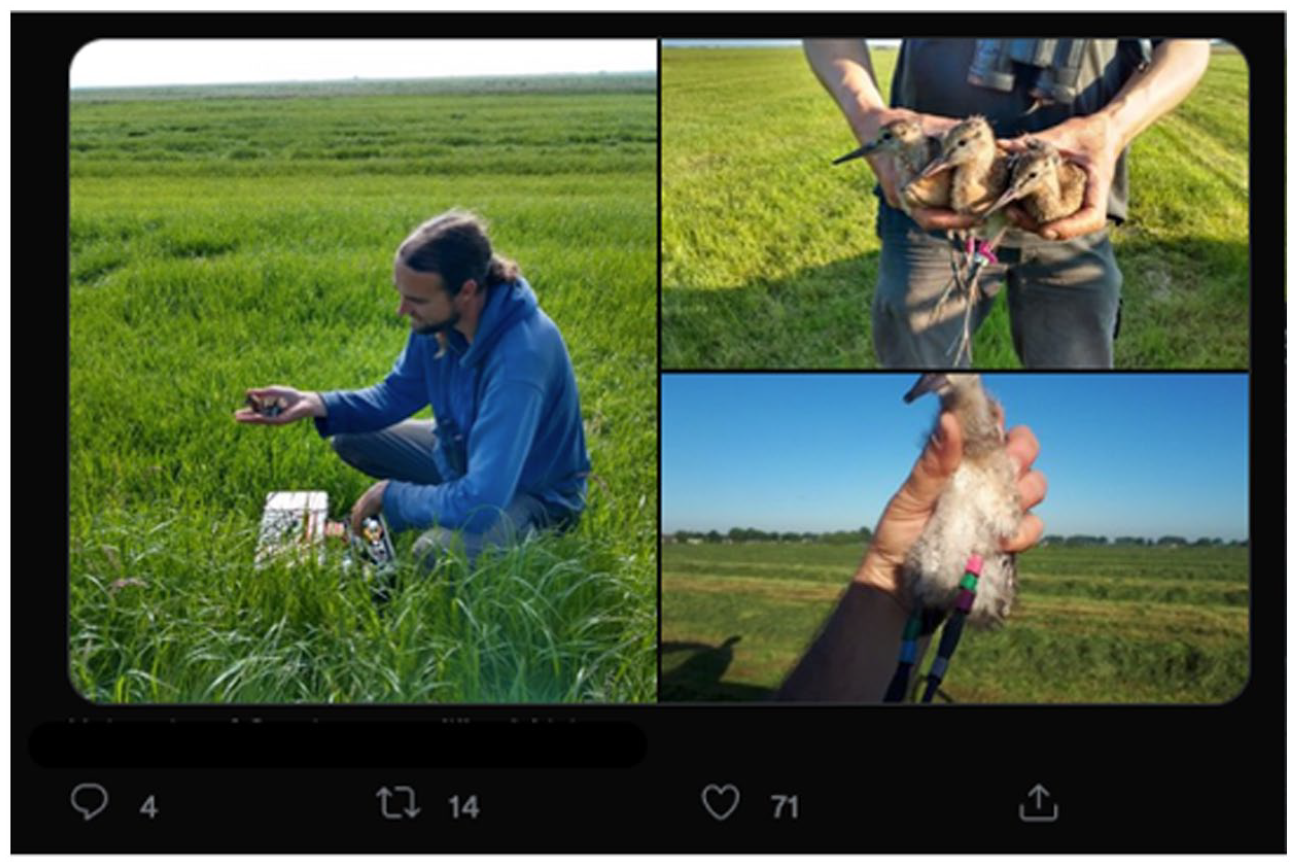
Bird-in-the-hand photographs from the Twitter account of Global Flyway Network, reproduced with permission of the photographer Iris Kromhout Van Der Meer, of the fieldworker in image, of the Twitter account owner, and with assumed permission of the godwits. The recognizability of one of our collaborators is an intrinsic feature of these images, as researchers use these photographs to situate themselves in the field and to mark their fieldwork achievements.
In these photos, ecologists display important moments in their knowledge production practices, and capture the achievement of turning individual anonymous birds into sources of data. This data later serves ecologists to understand the conditions of populations in our rapidly changing world, to contribute to conservation policies and tackle loss of biodiversity – once data is embedded in knowledge infrastructures, as robust networks of people, artifacts, and institutions that generate, share, and maintain specific knowledge about the human and natural world (Edwards, 2010), also including more-than-humans (Eren et al., under review; Jensen and Morita, 2015). Knowledge infrastructures enable the transformation of traces from the field (Beaulieu and Estalella, 2012) into knowledge claims, linking data to global crises (Beaulieu, 2022).
When we began to note a number of features that characterized photos across instances, we saw not only achievements of fieldwork but also small feathered bodies in fleshy human hands, and demonstrations of asymmetric power relations in multispecies engagements that were uncomfortable for us. We knew enough about our researchers and their fieldwork to be convinced that they were not careless in their engagements with birds. We also knew that these engagements are regulated by fieldwork protocols and the permits researchers obtain after arduous examinations by animal ethics committees. But those birds were not only held in a grip against their will, they were also kept in uncomfortable conditions for even longer to get a ‘good’ shot of those moments. We knew researchers to be careful to apply the correct techniques in their handling, yet we could not help but also see cruel engagements in those photos.
This friction is the starting point of this article, and it guided our subsequent ethnographic fieldwork, as one of us (the first author, she/her) joined the ecologists in the meadows in spring 2021.We set out to explore the kinds of researcher-bird engagements that unfold in the scientific knowledge production process of bird conservation science. Throughout the fieldwork, our focus of analysis moved beyond literal bird-in-the-hand moments captured in such photos to multispecies engagements that we observed in different spatial and temporal order during the data collection process. We analyze such engagements through the lens of care (Puig de la Bellacasa, 2017) to tackle the layered, non-innocent, and tacit dynamics that constitute these bird-in-the-hand moments, as well as the power asymmetries, noted in wader ringing practices by Isaacs (2019b). Furthermore, a lens of care enables us to foreground hidden, overlooked, or underappreciated conditions of the data collection processes.
In what follows, we discuss the complex care work of ethically and epistemically loaded moments, and show how knowledge emerges at intersection of multispecies care for individual birds and of care for knowledge infrastructures. We argue that bird-in-the-hand photos show fragile moments of balance between different strands and matters of care. Foregrounding the intermittent character of care, in contrast to foregrounding its instrumental (Candea, 2013; Despret, 2013; Giraud and Hollin 2016) and violent character (Isaacs, 2019a; Van Dooren, 2014), helps move us towards better interspecies relations and research practices by facilitating a dialogue with researchers. By shedding light on important knowledge creation practices that are key to tackling loss of biodiversity (Turnhout and Purvis, 2020), we contribute not only to the conceptual work needed to pursue better conservation science but also to navigate difficult but necessary care for creating liveable futures.
Conservation Science Research
To understand the bird-in-the-hand moments portrayed in the photographs as key moments in the constitution of knowledge, it is important to be aware of where they fit in the larger context of bird ecology and conservation research. These moments, in our case, contribute to long-term demographic study of black-tailed godwits conducted in southwest Friesland, in the Netherlands, supported by dedicated knowledge infrastructures (Eren et al., under review).
Since 2004, the ecologists and field assistants (collectively referred to as researchers hereafter) have monitored the breeding success of the Dutch population of godwits through indicators like nest survival, chick survival, adult survival, chick and adult fitness (Kentie et al., 2016). Black-tailed godwits are long-distance migrants ‘wintering’ in West Africa and breeding every spring in northern Europe, mostly in the Netherlands, which hosts 87% of the breeding population of continental black-tailed godwits (Kentie et al., 2016). Thus, if the Dutch breeding population suffers from low breeding success, that affects the species of black-tailed godwits as a whole.
There is a strong temporal and spatial ordering of researchers’ fieldwork on migratory birds. During the field season (March to July), researchers engage with hundreds of adults and their chicks both intimately and at a distance, and collect different types of data throughout each stage of the field season. The first stage is ring-reading, when researchers use scopes (one-eyed ‘binoculars’) to identify and record the individuals in large flocks of godwits from a distance, through colored rings placed on birds’ legs in previous field seasons. Counting the flocks and calculating the proportion of ringed individuals in such flocks is the next stage. This is followed by the stage of searching for nests, as birds start leaving their flocks to make their nests. Once located, researchers visit these nests regularly to check their status: abandoned, depredated or healthy. Later on, while parents are incubating eggs that are about to hatch, researchers start catching the parents, using traps set on nests. Researchers identify the eggs that are about to hatch by cracks and holes they see on the surface of the eggs during their regular visits to nests. This is the only window of time when it is possible to catch birds, for reasons we will explain later. Researchers then measure, ring, and sometimes also tag the parents they catch. Each ringed bird has a different color combination of rings that can be identified when the birds are re-sighted in the fields. A majority of these captured birds are later released to be observed and traced remotely. After the eggs hatch, researchers ring chicks in visited nests, and once chicks have left the nests, researchers start following families through tags they placed on some parents. Finally, after chicks are able to fly, researchers go back to ring-reading, as birds reconvene in flocks to forage and fuel up, before migrating back to Western Africa.
The bird-in-the-hand photos are taken when rings or tags are placed, and measurements made. These both connect and depend on the work done across these many stages, involving care between and within species, and care for knowledge infrastructures. They are key to how researchers turn an individual bird into a source of population data, and how a bird in the hand leads to data in the bank.
Care and Knowledge
Caring and knowing have at times been set in opposition, with care associated with being interested, engaged and emotional, and not fulfilling the requirements of detachment and objectivity associated with knowledge (Code, 2015; Martin et al., 2015). A growing body of work on care has shown that rather than being in opposition, or even external to knowing, care is deeply entwined with knowing (Davies, 2012; Friese, 2013; Giraud and Hollin, 2016; Haraway, 2008; Mol et al., 2010; Puig de la Bellacasa, 2017). Feminist STS literature has been especially eloquent in rigorously and fiercely showing how every knowledge claim is partial and situated, by tracing interested and affected engagements between scientists and their objects of study (Haraway, 1991; Keller, 1984). This argument has also been elaborated to show that scientists are not only interested in and affected by their study objects, but that they even have to be interested and attached for ‘good science’ to emerge (Latimer and Miele, 2013).
Strands of Care
Puig de la Bellacasa (2017) articulates, following Tronto, that care in the context of knowledge is ‘everything done to maintain, continue, and repair scientific knowledge production processes by being attentive to and sometimes affected by the needs of others’ (p. 3). She furthermore explores how care is part of the ontological work of knowledge production so that care is not only an affective relation, but ‘a vital affective state, an ethical obligation and a practical labor’ (Puig de la Bellacasa, 2012: 197). As she further states, these three strands of care (labor/work, affect/affectations, ethics/politics), however, ‘are not necessarily equally distributed in all relational situations, nor do they sit together without tensions and contradictions’ (Puig de la Bellacasa, 2017: 5).
Puig de la Bellacasa’s (2017) understanding of care also allows us to appreciate the non-human aspects of care practices in science, since she describes it as ‘everything that is done’, rather than everything that humans do, to maintain, continue and repair the world so that ‘human-nonhuman entanglements’, rather than humans, can live in it as well as possible (Puig de la Bellacasa, 2017: 170). Schroer et al. (2021) have also alluded to the potential of multispecies care ‘for opening up (or disclosing) knowledge’. Nevertheless, its potential for enabling, maintaining and excluding scientific knowledge production remains understudied in the literature. Attention to care also helps unravel how knowing depends on entanglements between humans, nature and technologies that take shape through various configurations of different strands of care. To study scientific knowledge as emergent through multispecies relations, we deploy multispecies ethnography as an ethnography of connection (Kirksey and Helmreich, 2010; Ogden et al., 2013). As we will see in our analysis of fieldwork practices, these configurations in turn bring into existence different ethical stances and different kinds of knowledge.
Care, Attachment and Detachment in Studying Animals
As Van Dooren (2014) notes, Puig’s work exposes that caring is not achieved through abstract well-wishing but is an embodied and often fraught, complex, and compromised practice. Part of the complexity has to do with the ever-changing circumstances and relations in which care is performed. Care cannot be standardized (Friese, 2013; Mol et al., 2010) and operationalized to ‘close and police spaces of thought and practice’ (Puig de la Bellacasa, 2017: 67) by becoming an epistemological standard. The study of ecological fieldwork offers an especially rich setting to explore how care requires constant tinkering, and tuning in to local conditions and interdependency (Lorimer, 2008; Waterton, 2003), and to examine its tacit and elusive character that challenges hopes of clear-cut guidelines (Mol et al., 2010; Pols, 2015; Singleton, 2010).
Despite care’s potential for creating better knowledge, its non-innocent character in scientific contexts is also noted in the literature: care practices for minimizing animal stress are not always deployed solely to meet animals’ needs, but also to address scientists’ needs to manage and control animals more easily during experiments (Despret, 2013; Giraud and Hollin, 2016; Haraway, 2008) or to avoid having impact on their object of study (Davies, 2012; Friese, 2013; Greenhough and Roe, 2011). Hence, care has also been the site of instrumentalization. This body of work points to the need to resist seeing care as a priori positive (Pols, 2015; Puig de la Bellacasa, 2017), and to consider how different care practices in the ecological fieldwork we observed are multiple and brought into being through different motivations.
Given our aim to understand the engagements that underlie the bird-in-the-hand moments, we are especially interested in the kinds of mechanisms that order them. In Candea’s (2013) work on animal behavior research on meerkats, what is transformed in animals by care practices can be clearly detached from what scientists want to measure and describe. According to Candea (2013), scientists first detach meerkats’ behaviors from each other to isolate each bit as a different ‘epistemic thing’ (Rheinberger, 1997) to focus on separately, such as meerkats’ ‘tolerance of humans’ and their ‘cooperative behavior’. This is similar to detaching the epistemic thing under study from the ‘experimental conditions’ (Rheinberger, 1997). In other words, scientists ‘multiply’ meerkats in a standardized way to ensure that they study what they are interested in studying (‘cooperative behavior’) in its ‘natural environment’, as if scientists were not there to create habituation, increasing meerkats’ tolerance of humans. Such a mechanism of multiplication is a very powerful epistemic move, since it effectively severs care from knowing, at least in some scientists’ eyes. 1
We will later engage with the discussions on instrumental care, the welcomed methodological challenges posed by its unstandardizable nature, and its underlying mechanism of multiplication of animals, while exploring the complex conditions of the multispecies engagements that we experienced as care practices in our field.
Care and Conservation
Care practices are context-dependent (Giraud and Hollin, 2016; Martin et al., 2015) and in our case, the context is conservation science. The characteristics of care in conservation practices have been empirically and critically studied in environmental humanities, cultural anthropology and animal studies literature for at least a decade. The controlling and even violent character of care have been foregrounded in conservation practices, such as helping endangered species to thrive by culling its ‘predators’ (Bocci, 2017; Clark, 2015; Van Dooren, 2015), or by keeping a number of its individuals in captivity for a breeding program (Chrulew, 2011; van Dooren, 2014).
The suffering caused by such conservation practices is justified by frameworks that favor rare and native species over least-concerned and invasive species (Van Dooren, 2015), and privilege the survival of a species over that of individuals (Chrulew, 2011; Isaacs, 2019a; Srinivasan, 2014). These dominant conservation frameworks are deployed to justify why certain species or individuals are killable or why they can be sacrificed. When conservation of species (the ethical-political strand of care for species’ needs) is clearly prioritized over caring for individuals (the labor and affective strand of care for individuals’ needs), it can be ‘just too easy’ to neglect the suffering that care practices can cause for individuals (see Van Dooren, 2014: 104). The ‘splitting of types of care’ (the affective and labor strands from the ethical-political) is furthermore often implemented in regulatory regimes (Palmer et al., 2022). This is based on the widely-held assumption that daily care practices lead to attachments to individual animals, and that this affective connection can impede decision-making about conservation resources (Isaacs, 2019b; Palmer, 2020).
Caring about species versus caring about individuals is relevant also for conservation science, where animals are both the object of study and individuals to conserve. However, when scientists want to measure, describe and conserve at the same time, we see different care dynamics than the ones observed for conservation practices. Deciding whether to take a bird in the hand is shaped by various and even contradictory strands and matters of care.
Care and Infrastructure
Let us finally highlight that care is not limited to living beings. Care practices are essential contributions to making knowledge infrastructures work meaningfully and effectively. Where large-scale global environmental technical systems (Benson, 2012) or suites of technologies are central to knowledge production (De Rijcke and Beaulieu, 2014), care is essential to ensure the maintenance and repair (Jackson, 2014) and the flowing circulation of data (Baker and Karasti, 2018). Such caring practices can furthermore add value to data (Pinel et al., 2019) or enable collective action (Baudry et al., 2021).
Vice-versa, infrastructures and their component technologies also shape care practices. When infrastructures are meant to connect to the natural world, they add a layer of digital mediation of human-animal relations (Benson, 2016; Von Essen et al., 2021), constitute a new site of labor (Urbano et al., 2010), and have the valence of both care and surveillance (Blue, 2016), reminding us that care is not always benevolent but can also involve control (Puig de la Bellacasa, 2017). While zeroing in on the conditions of care practices, we will also consider how infrastructures can embody and shape human-nature relations and analyze how they play a role in configuring the negotiation between different strands of care in and around the bird-in-the-hand moments.
Multispecies Ethnography with Care
To flesh out the role of care practices in this understudied but increasingly relevant context of scientific knowledge production, the first author lived for three months among researchers in a farm located in southwest Friesland in spring 2021. During this period, she joined researchers both in the fields and in the online/onsite meetings to organize, problem-solve and train newcomers in fieldwork. Sharing daily life in the field station gave her the opportunity to join informal chats during meals and evenings, and to help researchers in their work.
The data discussed in this article were gathered during this intense fieldwork period, itself embedded in a longer period of interaction with the bird ecologists. When fieldwork began, we had been having bilateral meetings with group leaders, attending research meetings, doing interviews, engaging in consultations and providing input for institutional developments that involved our bird ecologists for two years. We mainly interacted with a group of about two dozen individuals, with a fairly stable core set of members, with masters and PhD students coming and going. This longer period of interaction prior to the fieldwork helped us to gather relevant contextual understanding, to build trust and to develop collaboration that served as the basis for negotiating consent from participants. We repeatedly exchanged information on potential roles for the first author and held presentations about our fieldwork plans.
During the three-month fieldwork, fieldnotes were written up daily by the first author and discussed periodically with the second author. They were later coded in MAXQDA and analyzed by both authors. The main findings were discussed informally and presented formally at a research meeting. Due to the level of detail and intimacy of the empirical moments described here, we decided to use pseudonyms while referring to specific researchers and obtained explicit permission for use of descriptions and quotations.
As in all ethnographic work, we engaged in the creation of a field site, and this involved caring for our collaborators, including animals (Lindén and Lydahl, 2021). Among the first author’s ‘empirical interferences’ (Lonkila, 2021) to be attentive to care needs, we note her urge to sweet-talk godwits she was holding in her hands, desperately hoping that this would help to calm them down, literally following in researchers’ footsteps in the field to avoid accidentally stepping on a well-camouflaged chick or on a nest among high grass; or reminding herself to give some space to researchers both in the field and in the field station to prevent them from feeling as if they were under constant surveillance.
That being said, similar to the tension signaled by Lonkila (2021) in relation to farmers and cattles, the first author experienced difficulties in alternating between seeing researchers and godwits as her matter of care. She found it difficult to resist interfering with certain practices of researchers, that, as an outsider, she found potentially stress-inducing or disturbing for the birds. Yet, she mostly did resist the urge, because good relations with researchers were essential to her fieldwork. She also tried to avoid asking certain questions that would make researchers feel judged. For example, in a context where researchers were used to working alone, when joined by an ethnographer who was systematically observing and documenting the practices of different researchers, it was not lost on them that this opened up the possibility of comparison and evaluation – a sensibility that had to be managed, as it might prevent researchers from sharing certain considerations or practices, or even exclude the ethnographer. Choosing to care mostly for our relationship with researchers and not for godwits shaped the empirical material, foregrounding the researchers’ understandings of godwits.
Caring for the Immediate Needs of Birds in the Field
Care Shapes Knowledge
Being in the field to study birds, such as searching nests, doing regular nest checking visits, surveying nests with cameras, and catching parents or chicks, can cause varying degrees of disturbances to birds. The severity is affected by already existing disturbances such as other human and predator activity in the area, as well as on researchers’ personal efforts to reduce them. Disturbances caused by studying birds can substantively change the living conditions of birds and affect research data. Therefore, unless researchers care for their potential disturbances, they might mostly be measuring their own impact on birds in the field.
Researchers realize that they cannot fully remove their own impact, but they seek to reduce it to produce data that, in their eyes, is less biased. For instance, there are multiple methods to search for nests, and depending on the conditions in the field, opting for one specific method over others significantly reduces disturbances and hence the impact of research on birds. Every time researchers enter a field, birds fly off. As a result, unattended eggs can cool down or become an easy target for predators. When the grass height and the positioning of the fields allow, researchers survey the area with a scope from a distance, instead of walking across the field to find nests. In this way they try to avoid causing extra pressure on parents and putting nests in danger, especially on cold days. In other words, the physical conditions of fields and using scopes enable scientists to care for individuals by keeping their distance from godwits and reducing their impacts on data they collect.
Another instance of the epistemic value of care practices is the way researchers care about the traces they leave when they enter fields to search for or visit nests. By putting their materials on the ground, or kneeling just next to the nest, researchers can leave scent trails or footprints. Researchers are not the only ones searching for nests and such trails can easily expose the location of nests to predators, thereby increasing the already high predation risks. To reduce their impact, researchers avoid walking close, kneeling and putting things right next to the nest as their protocol instructs them. Some of them also take further measures and try to camouflage their traces by messing up the grass behind them or to obfuscate, by randomly multiplying their footprints or deliberately creating ‘dead end paths’.
Chicks are also objects of care. When researchers visit a nest to catch the parents, they may find recently-hatched chicks in the nest, next to eggs that are due to hatch. If researchers set their trap on the nest and leave the chicks in the nest after ringing them, the chicks can die of exposure. It takes time before parents feel safe again and return to the nest, especially in the presence of unusual item around their nest, namely the trap. To avoid risking chicks’ lives during this interval, researchers sometimes decide to keep the chicks with them while hiding and waiting for parents to be trapped. Meanwhile, similar to parents keeping their chicks under their wings, researchers keep chicks warm inside their jackets, close to their body. By simulating a parent’s care, researchers try to make sure that they themselves do not cause premature chick deaths, which would lead them to measuring a much lower survival rate for chicks than in a ‘normal’ situation when researchers are absent from the fields.
These empirical moments show that practices such as searching for nests with scopes, erasing or multiplying traces left behind to protect nests, and simulating ‘parenting’ behavior for chicks found in nests are not only crucial care practices for researchers to collect data that has the least bias possible in their eyes, but they are also essential to obtain data while causing as little stress as possible. Across care practices, we see the entwinement of epistemic and ethical dimensions of care that shape scientific knowledge.
Multispecies Care Enables Knowledge
Care practices that support knowledge production processes are, however, not exclusive to researchers, or even humans. Godwits’ caring practices are actually what enable the data collection process for this research in the first place. Researchers attempt to catch godwits only during their breeding season, more precisely only when they are incubating eggs that will hatch very soon. The reason is that it is only in this specific time period that godwits take the risk of going back to their nest, even if they realize that there is something unusual around it. If one attempts to catch them any earlier, godwits simply abandon the nest and attempt to lay a second brood before it is too late in the breeding season. As Jonathan, one of the researchers, once commented after a successful catch, godwits are ‘caring parents’. 2 Godwits are known as a species that relatively quickly returns to their nest to continue incubating, even after the unusual and stressful experience of being caught, handled and measured. In addition, researchers are more likely to catch the most caring parents, since these birds are more likely to take the risk of returning to their nests. If a statistically significant number of godwits were not such committed ‘caring parents’, if the majority refused to take the risk to go back to their nest before and/or after catching, then this would seriously limit the data on fitness and breeding success that could be collected. In other words, what we see here is the importance of the alignment between birds’ care for their offspring and the conservation science’s research questions, along with the data proxies determined to be useful to answer such questions.
Care for Individuals in Tension with Scientific Knowledge
Caring for individuals was not only performed to reduce research impact on data and to produce better knowledge. At times, there were also encounters that detracted from gathering better or simply more data. We observed that some researchers found themselves in situations where they felt the urge to intervene with nests to save lives, even at the cost of measuring their own impact and of creating useful knowledge to save the species.
For instance, while visiting nests, researchers sometimes find eggs that are due to hatch but cold, indicating that the parents abandoned the nest due to cold weather or predator pressure. In such cases researchers listen carefully to the abandoned eggs and put their lips on them to better understand how cold they are. If researchers are convinced that the eggs are not dead cold, or if the chick inside still moves and/or peeps, researchers can take the egg with them to put it in another nest. They then sometimes take the time to find a surrogate family for the abandoned eggs although, in their eyes, this means they are intervening with the usual course of nature, with processes that they are only supposed to ‘observe and measure’. This practice shuts down the possibility of answering some research questions, such as those related to lineage, and leaves researchers with fewer data to formulate new knowledge claims. Another difficult decision needs to be taken when researchers find a flooded nest, due to heavy rain in combination with saturated soil. Researchers were observed to elevate such nests, using soil or straw. But they remain ambivalent about such practices of saving flooded nests or abandoned eggs. On the one hand, they accept that it is inevitable to affect data and sometimes share with pride how eggs from nests they saved hatched in the end. On the other hand, they can visibly become uncomfortable and even defensive when asked to comment on these practices, as they immediately get reflexive about how they actually affect data on survival rates.
Finally, affective connections in caring for individuals is in tension with scientific credibility, as ‘expected performance of objectivity . . . restricts the expression of emotion’ (Isaacs, 2019b: 142). Yet, some researchers do not shy away from foregrounding this strand of care. One day in the field station, Pierre was telling about the first chick he found in his study area in that field season. He was mimicking the sound the chick made when handled and kept in the front pocket of a colleague’s hoodie.
Aww, I really want to feel my chicks like that in my hand and next to my chest. [. . .] They are just the cutest.
[. . .] yeah, but they will be eaten soon. . .
[visibly disturbed by Pierre’s comment] This is a very lame argument; then why do we do what we do to protect them? Then we should not do anything. . .
No, I do not say that we should not protect them, but I am just saying that we should not get so emotional about them. This is just nature, and being eaten is a part of it.
[sounding moved] No, I think we should be able to love them! They deserve to be loved by us!
Oh, but be careful Melanie; we should not mix science with emotions.
[Silence]
In these examples, we observe that prioritizing care for individuals in some contexts can come at the cost of the quality of data, the posibility to ask new research questions, and researchers’ scientific authority. Although such costs are of epistemic character at first glance, prioritizing care for indiviuals can risk the future of the same individuals as well. What we see is more complex dynamics around care than a welcomed methodological discomfort caused by its unstandardizable tacit nature (Davies, 2012; Mol et al., 2010; Puig de la Bellacasa, 2017). What our fieldwork manifests is not a simple trade-off between caring for individuals and caring for knowledge needed to intervene in land management. The individuals also stand to lose from not caring for knowledge, as the interventions can be implemented in their lifetime. As we observed, caring for individuals in certain contexts can complicate both the ethical and epistemic value of care.
Care for Future Needs of Species through Care for Knowledge Infrastructures
We showed how caring for individuals’ immediate needs shape which type of knowledge can be produced and how. But individuals’ immediate needs and suffering cannot always be prioritized. After all, researchers are dedicated to producing scientific knowledge to guide policies and everyday actions to prevent the loss of the species and the biodiversity of the meadows. However, care practices are also directed at knowledge infrastructures that enable caring for individuals and, by extension, populations and species. Knowledge of a ‘species’ refers to something abstract. Researchers can only engage with it via a smaller unit of analysis that can be scientifically measured and understood, that is ‘population’ – itself relying on knowledge of individual birds. In other words, caring for populations is enacted by caring for the needs of the knowledge infrastructure, because knowledge infrastructures enable researchers to produce data, models, and eventually knowledge claims to measure and understand populations. Therefore, we observed that caring for populations as enacted by caring for the needs of knowledge infrastructures also shapes how researchers care for the individuals in the fields.
For instance, during the catching phase of the field season, fieldwork protocols instruct researchers to catch a parent within 40 minutes. Otherwise they would usually end their attempts at catching and would not return, in order not to disturb the parent again. There is a time limit because if parents feel prolonged stress due to repeated disturbances, they might abandon their nest to protect themselves. But the rules for catching can slightly change if one of the parents is known to carry a geolocator. This is a type of tracking device that requires researchers to re-capture the bird that was previously caught and tagged. Geolocators cannot remotely transmit data to a database (as opposed to satellite transmitters), and instead need to be collected from birds so that the data collected and stored throughout the birds’ journey can be retrieved. If researchers can manage to catch this bird, the ‘catch’ yields precious location and biometric data, and the opportunity to attach a new tracking device with empty storage if needed. However, all this potential data to be harvested creates a pressure for researchers, as they admit: there is greater motivation to persist in their efforts at catching birds with geolocators. Yorgo, who as a fieldworker has strong reservations about catching birds, further elaborated that once he spots one of the parents carrying a geolocator, he sees this bird as ‘too good to be missed’. Concerned, he explains: ‘Then all of a sudden those protocols do not work that much for that kind of a bird.’ The result is that researchers spend more time around these nests or return to try again if a first catching attempt failed. Hence, individuals with geolocators become precious data sources and – in Eric’s words – ‘less of a bird’.
The care for knowledge infrastructures also shapes the selection of individuals to be studied, because of the costs and complexity of these technologies as well as the needs for statistical relevance. On a usual fieldwork day, after releasing the bird caught and processed, Jonathan commented that he had actually hesitated whether he should have put the radio tag on this bird or not. Researchers glue radio tags on one of the parents they catch to follow the family so that they can identify the habitats in which parents rear their chicks. The parent caught by Jonathan had only one live chick in the nest, and according to him it was highly likely that the parents would lose this one as well. By putting the tag on this parent, he would run the risk of using up the tag and disturbing the parent in vain, as there would be no family to follow. But Jonathan had decided to take the risk this time because otherwise he could have introduced bias in the database. If researchers keep putting tags only on the parents that are more likely to have surviving chicks due to the higher number of eggs in the nests, then the research data will be biased towards more successfully breeding pairs. However, he was skeptical, making a self-deprecating face while sharing his decision with his colleague. For their outcomes to be statistically relevant, researchers can then find themselves in difficult situations where they feel the need to further disturb individuals by keeping them longer in their hands to fit them with the precious tag, without even knowing if the disturbance they cause will eventually turn into useful data.
Besides the standards of tags and analysis methods, we also observed how conventions embedded in knowledge infrastructures shape the care for birds in the hand. The trade-off between not causing further disturbances for birds and turning labor-intensive yet disturbance-inducing visits into data is an intense one. We see the epitome of this trade-off in the following incident. Sunset was already approaching when we were about to check a nest. Researchers are not allowed to catch during this time of day, as the eggs would cool down much faster in the absence of their parents disturbed by the trap. Pierre was just expecting to see some cracks in the eggs, which would indicate that he could try catching the parents the next day. When we arrived at the nest, we saw that one chick was already hatched and the other was just hatching. Some parts of the hatching chick were still covered by egg shells while other parts were already exposed and wet. Pierre took this half-egg-half-chick in his hands and started to take off some pieces of shell, little by little, in a very slow and careful manner, while saying ‘c’mon little chick, push it harder; if you can get out now, I can ring you as well’. After a few minutes, the little chick made the last move and cracked the remaining part of the attached egg shell. Pierre looked at the first author and said: ‘This is the closest moment I can get to giving birth’. It was a very touching moment, and also a puzzling one. When she later asked why he helped the chick, he responded that he would not return to this nest because the chicks would already have left the nest by the time we would come back with catching equipment. He had therefore already missed the catching window, since these eggs hatched earlier than he expected. (Once chicks leave the nest, then there is no incentive for parents to go back to the nest and no opportunity for researchers to catch them.) And since we were already there to visit the nest, he wanted to use that moment of disturbance efficiently and ring both chicks. Once ringed, chicks could become part of the database and generate data on the population. In other words, he wanted to turn all his efforts, and the potential disturbances caused by finding this nest and surveying the development of the eggs, into as many data sources as possible.
Across these interactions, we see that different matters and strands of care compete: at times researchers have to care about the knowledge infrastructure (care as daily labor), at others to care about species (care as ethical-political obligation) rather than primarily about individual birds (care as daily labor and affective state), when it comes to retrieving as much data as possible or to pursue proper sampling and statistical relevance.
Intermittent Care for Individuals Here-and-Now and for Populations of the Future
Our bird ecologists are subject to persistent epistemological anxieties driven by their potential influence on data. In contrast, the scientists Candea (2013) studied seem much freer from such anxieties, mostly due to their approach of detaching behaviours they study from conditions and experiments’ effects on other behaviours. We see this as a compartmentalization of meerkats’ behaviours – in contrast to multiplication, as Candea writes. In our case, researchers cannot clearly detach their ‘epistemic thing’ (parents’ body mass or survival rate of chicks) from their fieldwork conditions (their care practices while visiting nests, catching and handling) and from fieldwork’s effects on godwits’ behaviors (incubating and parenting). Hence, they cannot compartmentalize godwits as ‘godwits’ tolerance of humans while being in human hands’ and ‘godwits’ parenting’ as two separate behaviors. One reason is that godwits’ reactions to engagements with humans vary significantly between individuals. For instance, while some individuals eagerly return to their nest to continue incubating, other individuals might abandon the nest after a single attempt at catching. Hence researchers cannot always know what is ‘too much’ to take for an individual, nor gauge to what extent researchers impact the behavior they seek to observe and measure. To our ecologist collaborators, godwits are perceived as more of a whole organism than a compartmentalized one, similar to Stengers’ (2010) characterization of animals used in scientific studies. Our bird ecologists therefore continuously seek to care better for individuals, better in the sense of decreasing researchers’ impact.
However, the researchers’ daily labor of minimizing their impact on individuals is not done purely out of epistemic anxiety either. As we discussed above, they perform such labor with ethical and even sometimes affective obligation they feel in their encounters with individuals’ sufferings. They sometimes act in this way to the extent of affecting (even, arguably, damaging) the scientific knowledge production process. Encounters with individual birds as whole organisms contrast with other reports of care as instrumental and violent (Giraud and Hollin, 2016; Van Dooren, 2014). More specifically, their care is not a continuous daily labor of providing for some bits of birds to effectively study the other bits (instrumental care), nor a continuous ethical obligation of prioritizing the needs of species over the immediate needs of the individuals (violent care).
Yet care for individuals is not entirely intrinsic and unwaveringly affectionate, nor is there a strict prioritization of individuals’ needs over future needs of the species. As we discussed above, researchers can still lessen certain individuals so that they can be attentive towards the needs of their knowledge infrastructures, and they do so when it is possible for them not to feel epistemic anxiety. This is especially the case when the data they seek (the history of location points stored in a geolocator) cannot be influenced by the potential disturbance they might cause to the individual through that specific engagement (taking more time than usual to try to catch an individual), or when the impact on some birds’ data can be made irrelevant statistically. More importantly, researchers can lessen certain individuals when they cannot anticipate and standardize the potential negative impact of their engagements with those individuals. Researchers’ daily labor and ethical obligations towards species (that are enacted through the daily labor for knowledge infrastructures) modulates their ethical and affective obligations towards individuals.
We label this continuous shift between different matters and strands of care as ‘intermittent care’. 3 While related to tinkering, which draws attention to assembling and making do, intermittent care has a different dynamic. The rapid cycling between the matter and strand of care is a configuration of care that seems ‘unsettling’ to us. We chose this qualification because it captures how, for the same individual, the intimate care between humans and birds, the potential data, and the possibly deadly disturbance are all present. This contrasts with Van Dooren’s (2014: 92) understanding of conservation as violent care, where ‘the intimate care for some feathered bodies . . . sits alongside the domination, coercion, and abandonment of others’, in his analysis of whooping crane conservation. In our case, care for the individuals does not ‘come as a constant second to the generation of novel scientific knowledge or the conservation of the species’ (Van Dooren, 2014: 104). Instead, it is intermittently present. Intermittent care also contrasts with labeling bird ringing as violence tout court, as done by Isaacs (2019a, 2019b) to resist relativizing suffering of birds in ringing procedures, arguing that this reasserts the ‘evaluative authority’ to the human judgment (Isaacs, 2019a: 18). We agree with Isaacs’ aims. Calling ringing ‘violence’ can prevent researchers from normalizing their practices and stimulate them to keep searching for less invasive methods. However, labeling ringing as violence foregrounds the potential harm of encounters at the expense of other harms that may come from lack of knowledge and lack of intervention in land management that also threaten those individuals. In contrast, ‘unsettling’ also opens up room for the discomfort of the researchers and creates an opportunity for dialogue with them, whereas labeling their work as violent tends to shut down any possibility for variation in practices or for reflection leading to improvement.
In conservation science, the futures of individuals, knowledge, and species are entangled – and must be kept in balance. If one of these elements comes a constant second to the others, then the knowledge needed for better conservation policies, and a better future for populations involving the future of the individuals here-and-now, would be compromised. The unsettling situation of the bird-in-the-hand that leads to species data in the bank is then the result of intermittent care for individuals and species, mediated through field and infrastructural relations.
Conclusion
Conservation science is a complex setting for care. Researchers simultaneously care for animals as the object of study and as individuals to conserve. In addition, researchers’ care for individuals does not constantly concern daily labor to respond to individuals’ needs due to epistemic concerns (instrumental care), daily labor to address the needs of populations through responding infrastructural needs by coercing the individuals (violent care), nor affection and ethical obligation to respond to individuals’ needs (intrinsic and affectionate care). Rather, researchers’ care for individuals is intermittent because it shifts on the spot due to the negotiation between different strands of multispecies care, for different matters of care. Researchers cannot care for individuals here-and-now or for populations of the future in uninterrupted ways. Based on our contextual analysis of bird-in-the-hand moments, we have shown that care in conservation science is relational and unsettling, as it requires researchers to endure and account for the troubling consequences of their intermittent care for individuals on populations, and of their intermittent care for knowledge infrastructures on individuals.
Although we showed that care for individuals’ immediate needs (short-term matters of care) and populations’ future needs mediated by knowledge infrastructure’s needs (long-term matters of care) are at times in tension, this tension itself is not set in stone. The needs of knowledge infrastructures are not only there to be attended to, but also to be actively re-shaped when needed. It is crucial to critically assess whether infrastructural needs driven by embedded standards, conventions and assumptions align with care for individuals. We have mapped out how multispecies care and knowledge infrastructures need to be aligned to support more ethical and epistemically effective monitoring that is crucial for better conservation policies to tackle global issues like biodiversity loss. More reflection with researchers on the multispecies aspect of care in knowing and such (mis)-alignments, along with design work, would support the development of better knowledge infrastructures.
Our analysis has implications beyond conservation science. Documenting intermittent care and acknowledging its value is especially important while tackling global challenges, like the climate crisis and loss of biodiversity, since addressing them entails navigating various short and long-term matters of care. A focus on the future as a matter of care, without an affective strand of care towards today’s needs, can be so damaging as to destroy potential futures. Just like prioritizing species by intensifying research practices can damage individuals, prioritizing futures of societies through radical climate or energy measures can disproportionately harm certain groups whose existence has been made precarious. At the same time, constant care for today’s matters of care can foreclose potential futures. Intermittent care, and the acknowledgment of how unsettling it can be, can encompass current and future matters and strands of care, and open up new possibilities for discernment, hope and justice.
