



Abstract
Care is an activity vital to making the world liveable. Alternative infrastructures of care have emerged that re-centre care and repair within everyday life. These infrastructures often require more care to address care deficits and repair the social fabric of society; however, insights are limited as to the implications of demands on people and the places they reside for such extra care. Through an ethnographic study of a community food hub in an area of entrenched deprivation, we examine how an alternative infrastructure of care is built in practice. We demonstrate how care unfolds expansively across people and place to (reactively) repair care deficits and (proactively) generate new care relations. We contribute to the complexity of care theorising by revealing the challenges of care provision that stem from a position of necessity and repair. We offer a critical discussion of alternative infrastructures of care that simultaneously recognises the opportunities for hope, whilst acknowledging their limits.
Introduction
Extended periods of insecurity and instability – so-called permacrisis (Turnbull, 2022) – emerging from global pandemics and the climate emergency to deepening socio-economic inequalities have compounded the importance of care. This is particularly significant for the most vulnerable urban places and communities. This has increased the prominence of care in politics and public life (Leonard and Woodly, 2022) and renewed interest in envisioning alternative infrastructures that place care at the centre of everyday life (Care Collective, 2020; Dowling, 2021; Graziano, 2018; Hobart and Kneese, 2020; Jupp, 2022). Such visions respond to an increasing sense of crisis within infrastructures of care that have been exacerbated by a continued under-valuing of care (Fraser, 2016) and under-funding of care systems (Bassel and Emejulu, 2018; Green and Lawson, 2011). These conditions create care deficits (Tronto, 2013) in which the capacity to provide care is insufficient to meet care needs and intensify burdens on an already stretched workforce within the care sector (Baines and Cunningham, 2011).
In the context of a care crisis, new visions of alternative infrastructures of care have emerged that promote a revaluing of care as a pathway to social renewal. For example, a universal care model (Care Collective, 2020) advocates for new forms of social organising based on mutual interdependence that span scales of life, from the everyday localised spaces of kinship and community through to broader market, state, political and economic systems. Similarly, radical care (Hobart and Kneese, 2020) offers strategies to respond to crises through temporary and ad-hoc interventions. Typically, such alternative visions of care are underpinned by an explicit and intentional politics of care that call for more care as a solution to current crises (see e.g. Care Collective, 2020 and critiques in Dowling, 2021). Extant research has focused attention on conceptualising new visions of care, yet has offered fewer empirical examples of alternative infrastructures of care in practice. We offer an empirical case of an alternative infrastructure of care that is motivated by an implicit politics of care: supporting everyday survival whilst not tied to an explicit reimagining of care. In doing so, we explore how an alternative infrastructure of care unfolds in practice and examine the implications for people and place.
The context of our article is a community food hub which we refer to as ‘the Park’ to protect the anonymity of the participants. The Park is located in one of the UK’s most deprived urban neighbourhoods (SIMD, 2022) and food deserts (Corfe, 2018). The Park began as an adventure playground for young children in 2014, with the core mission of facilitating a child-led and democratically-run space for outdoor play. This emerged in response to the loss of public space and, specifically, a children’s park, due to regeneration of the area in the run up to hosting an international sporting event. This community is characterised by entrenched deprivation that was deepened by this government-led regeneration project and a negative history of top-down regeneration already experienced in the area (Paton et al., 2012). The implications of this regeneration include the replacement of social housing with new mid-market housing that priced original residents out of the area, loss of amenities and local shops creating a food desert (Corfe, 2018), replacement of a local authority children’s playpark with an underused carpark and the closure of the local community centre, which was replaced with a new centre that some locals felt was no longer in their neighbourhood. In response to the loss of local amenities, the Park transformed over time from a children’s playground to include a community food hub offering free hot meals to families during weekends and school holidays and providing free access to fresh produce and redistributed food from the FareShare scheme. 1 Our insights were developed over a one-year (2019–2020) collaborative project with the Park in which we supported efforts to develop a community food hub and collaboratively explored what sustainability might look like in areas of high urban deprivation.
In what follows, we draw upon the rich, interdisciplinary literatures on care (Tronto, 2013, 2017) and repair (Corwin and Gidwani, 2021; Hall and Smith, 2015; Power and Hall, 2018; Thieme, 2021), that emphasise the uneven distribution of care and the effects of its shifting governance (Middleton and Samanani, 2021). We provide details of our methodology and outline how care informed our collaborative engagement with the Park, before presenting our findings on how care unfolds expansively across people and place to (reactively) repair care deficits and (proactively) generate new care relations. We close with a critical discussion of alternative infrastructures of care that simultaneously recognises opportunities for “spaces for hope in dark times” (Hobart and Kneese, 2020: 2), whilst cautioning against the romanticisation of such care practices by acknowledging their limits (Mattern, 2018). In doing so, we contribute to the complexity of care theorising by revealing the challenges of care provision that stem from a position of necessity and repair. While reparative care interventions are often laudable in providing care where infrastructures of care have eroded over time, our empirical case demonstrates the detrimental implications of caring expansively, to highlight the limits of alternative infrastructures of care in practice.
Thinking with care
To situate the Park as an alternative infrastructure of care, it is necessary to begin from an understanding of what care encompasses. Care has a rich, interdisciplinary history often rooted in feminist thought and understood as both an ethic (or way of doing) and a broad existing practice (Fisher and Tronto, 1990). The care literature has pointed to a range of “complex relations between people, place and care” (Milligan and Wiles, 2010: 736). We position our understanding of care as an activity that
includes everything we do to maintain, continue, and repair our ‘world’ so that we can live in it as well as possible. That world includes our bodies, ourselves, and our environment, all of which we seek to interweave in a complex, life-sustaining web. (Tronto, 1993: 103)
We find this conceptualisation useful as it offers two critical points. Firstly, it recognises care as a continuous activity of repair and maintenance – as an ongoing task that is never complete. As Tronto (2015: 4) argues: “Care practices don’t suddenly begin; they are already ongoing.” Secondly, it goes beyond more dyadic models that situate care as a relation between care giver and care receiver (e.g. Noddings, 2003), to accommodate the messier, interwoven spatialities and socialities present in caring as a practice. These characteristics of care are important as they acknowledge both the ongoing nature of care demands and the difficulty in maintaining complex caring arrangements. While dyadic models have been critiqued for disregarding the broader social domain in which care occurs, placing care in a sociopolitical and economic vacuum (Davis and McMaster, 2017), conversely, Tronto’s broad conceptualisations of care (Fisher and Tronto, 1990; Tronto, 2015) have been criticised for being overly wide-ranging (Held, 2006). Despite these differences, theorisations of care coalesce around a shared understanding of care as critical to sustaining social life. With a more utopian lens, Puig de la Bellacasa (2017) views care as about reaching for the best possible world – not merely surviving. Care, in this sense, can be about trying to enact a better world. In our empirical case, we explore the ways this better world may be limited by the circumstances and conditions of care.
Fisher and Tronto (1990) initially identified four phases of care. ‘Caring about’ in which there is recognition of unmet caring needs. ‘Caring for’ in which responsibility is assumed for those caring needs. ‘Care-giving’ that involves the delivery of care activities and ‘care-receiving’ that involves responding to the care activities. Tronto (2013) identifies a fifth phase of ‘caring with’ that goes beyond the dyadic of care giver and care receiver to acknowledge that care is co-created based on relations of trust, solidarity and reciprocity. This phase resonates with communal solidarity in which care is jointly constructed between various actors. Building on Tronto’s notion, Power (2019) introduces ‘caring with’ as a sociopolitical vision at the community scale that enables citizen caring but which is reliant on an equal distribution of care and caring responsibility. Caring with, thus, focuses on material, spatial and temporal networks that impact the capacity to care (Power, 2019). This approach recognises the political cultures that enable and disable care, and the various actors involved in care arrangements.
The dynamics of such care arrangements are complex. Lynch (2007) argues care is nested in concentric circles. Inner circles represent primary care relations (such as family) that demand greater intensities of care, compared to secondary (such as community) and tertiary care relations (such as environmental) in the outer circles representing general care and solidarity work, respectively. From this perspective, Lynch and Walsh (2009) argue care becomes increasingly distanced and removed in the outer circles and can be performed without intimacy and personal attachment. Care at the outer circles may resemble Tronto’s ‘caring about’ without translating into any performative connection associated with caring for. Milligan and Wiles (2010), however, disrupt notions of proximity by demonstrating care that can be socially and emotionally proximate despite physical distance. Instead, Milligan and Wiles (2010) move beyond a purely spatial reading of care, to prioritise the complex relations between people, place and care. Similarly, Hobart and Kneese (2020: 2) define care as “an affective connective tissue between an inner self and an outer world” that relies on “a relational set of discourses and practices between people, environments and objects”. This body of work sensitises us to the complex relationality of care visible in sociomaterial arrangements. As such, we find it valuable to explore infrastructures of care and repair as arrangements that both enable and disable care in practice.
Infrastructures of care and repair
Reflecting on Fisher and Tronto’s (1990) life sustaining web, Berlant (2016: 393) highlights the importance of infrastructures that comprise “[a]ll the systems that link ongoing proximity to being in a world-sustaining relation.” This sociomaterial approach illuminates the ways care is interwoven into daily life in numerous, kaleidoscopic ways that include both physical and social infrastructures (Hall and Smith, 2015), such as roads, finance systems, water and waste system maintenance and families that continuously sustain social life (e.g. Buser and Boyer, 2021; Corwin and Gidwani, 2021). Such attention to the more-than-human networks that produce and enact care illuminates the way it is distributed and practised in diverse ways that do not always require or reflect intent (Buser and Boyer, 2021).
Following Berlant’s (2016) sociomaterial approach, Power and Mee (2020: 489) define infrastructures of care as “the infrastructural forms that pattern the organization of care within society” and emphasise that both physical and social infrastructures mutually shape one another. Food provides a distinctive terrain in this, particularly where market forces do not provide easy access to food, requiring solutions in what Cloke et al. (2017) call the ‘meantime’. Although this can be a space of hope and ethical potential, we concur with May et al. (2020) who acknowledge that any progressive politics nurtured in spaces such as food banks are often subject to logics (e.g. scarcity) that complicate any hope situated in the space. This reflects the ‘ethical complex’ (Friedberg, 2004) complicit in terrains, such as food, that comprise multiple actors from consumers, producers, suppliers, to institutions who continuously negotiate ethical practice. However, Popke (2006: 509) highlights the limitations of ethical potential in practice for disadvantaged consumers and producers, and questions how such “opportunities [can be] mobilized to promote an expanded sense of care?” Our empirical case confirms the value of infrastructures that repair and relieve the difficulties of unequal urban lives in deprivation, while acknowledging that maintaining such infrastructures is also replete with complexity.
Physical and social infrastructures require continual repair, care and maintenance to make urban life work (Amin, 2006). This applies to both physical infrastructures, such as roads that require resurfacing, and social infrastructures, such as emotional support services that require renewed kindness. For Thrift (2005), repair offers a means to fix and patch issues within urban life, which overcomes tendencies to either romanticise notions of community and solidarity on the one hand, or fetishise dystopian visions of urban failure on the other. Understood in this way, repair work becomes an act of “improvisational resilience” (Hall and Smith, 2015: 6) that continuously unfolds in the everyday realities of life. Repair not only resides in everyday maintenance, but also operates at and across various contexts, spaces and scales (Graham and Thrift, 2007). It is, therefore, useful to understand repair as an activity in itself that operates at all scales from the local everyday to macro policy and governance and as being underpinned by a politics of constant care and attention (Hall and Smith, 2015). Power and Hall (2018) warn against the increasingly complex and uneven landscape of care that is comprised of various institutions, from private to voluntary organisations, seeking to fill gaps in state care provision in response to continued under-resourcing in the UK and many other countries. These conditions have been referred to as a patchwork quilt of care that metaphorically signifies the “diverse and uneven assemblages of providers involved in the ‘mixed economy’ of community care” (Power and Hall, 2018: 307). This has increased the necessity of depending on alternative infrastructures of care, such as family and friends and/or local voluntary organisations to provide care (Hall and McGarrol, 2013). This highlights the reactive character of alternative infrastructures of care that fill gaps in care provision (Tronto, 2013) and respond to unfilled care needs.
Such reactive strategies that emerge in alternative infrastructures of care offer a more radical approach to care (Hobart and Kneese, 2020) as they build autonomous and often grassroots initiatives as a refusal of a care deficit. As Tronto (2013), citing Engster (2010) and Stone (2000), has noted, calls for more attention and a greater radicalism in care are renewed periodically. More recent examples include the Care Collective (2020: 26) who call for a universal care model that democratises the responsibility of care in which “we are all jointly responsible for hands-on care work as well as work necessary for the maintenance of communities and the world itself.” This raises the importance of mutual interdependence as we become jointly responsible for each other’s care across all scales of social life. The examples of such ‘promiscuous care’ (Care Collective, 2020) that proliferates outwards are notably experimental, including families of choice, time banks and co-operatives that provide mutual support and resource sharing. Nevertheless, these cases demonstrate how dependencies between individuals, communities and organisations might be deepened to counter the alienation of atomistic individualism. Similar ideas emerge in ‘pirate care’, in which a common care infrastructure is developed by using legal grey areas to organise networks of solidarity (Graziano, 2018). These radical visions of care can be understood as “a set of vital but underappreciated strategies for enduring precarious worlds” that creates spaces for hope and opportunity (Hobart and Kneese, 2020: 2). Radical care is underpinned by an explicit politics that situates care as the terrain on which the world can be radically remade. In echoing Tronto’s notion of ‘caring with’, Hobart and Kneese (2020) stress the importance of viewing care as an expression of solidarity versus charity. This requires working with communities through mutual aid, collaboration and collective action that does not make assumptions about care needs.
Resituating the work of care
Radical imaginaries of care must be brought into closer conversation with an attention to the work of care. From this perspective, care is understood as a labour that is both emotionally (Held, 2006) and physically taxing (Baines et al., 2019). In contrast to broader visions of care (e.g. Engster, 2005; Sevenhuijsen, 2000; Streuning, 2002; Tronto, 2013), this strand of literature focuses on care in practice. This focus on the work of care remains central to any analysis of infrastructures of care, especially as it draws attention to increasing tensions between a neoliberalisation of care and its underlying ethics (Tronto, 2017). Recognising the centrality of care to society requires us to value care work as a public good for collective benefit (Duffy et al., 2013). This applies to both nurturant care, comprising relational and face-to-face interactions with receivers of care, as well as non-nurturant care, which support delivery of care (such as housekeepers, cafeteria workers) (Duffy, 2011). This broadens our understanding of what constitutes care work to include support functions that assist the delivery of care.
Nevertheless, care work is replete with tensions, often as a result of being under-valued in broader society. For example, organisations may exploit workers’ caring dispositions by restricting core work activities with the expectation that workers who care will continue to attend to non-essential tasks out of goodwill, encroaching on workers’ personal time and adding to emotional strain (Baines et al., 2022; Van Staveren, 2001). As such, care work is often characterised by deep hybridity (Kirton, 2013) in which the demands of paid formal care overlap into the need to engage in unpaid informal care. This can be heightened within the non-profit and voluntary sector where workers are often likely to take on additional unpaid work (Baines and Cunningham, 2011). The unequal distribution of care leads care workers into increasingly precarious economic circumstances which increases their dependency on social systems. Duffy (2011) calls for a recognition of the relationality and interconnectedness of care work with reproductive labour that are jointly necessary for society to function. Such nested dependencies (Kittay, 1999) require a broader social responsibility for carers to be cared for. These tensions are heightened with state under-funding and under-resourcing of social services (Konzelmann, 2014) that have increased pressure on the third sector to fill the resulting care gap (Power and Hall, 2018).
While politicised interpretations of alternative infrastructures of care tend to present more care as a solution to care deficits (e.g. Care Collective, 2020; Graziano, 2018; Hobart and Kneese, 2020), we argue this conversation must always acknowledge the lived realities of everyday care work. As Held (2006) argues in relation to boundless conceptualisations of care, it is important not to dilute the meaning of care as a labour that is intrinsically emotional, relational and directed at addressing care needs. A balance must be struck between attending to the arguably political refusal to accept insufficient care, whilst recognising the limits of carers’ capacities to care (Power, 2019). Additionally, care work is spatially situated; thus, it is important to explore the spatialities of generating alternative infrastructures of care. In the current article, this takes us closer to understanding areas of deprivation as both marginal spaces and sites of reimagining anew. It recognises, as hooks (1989: 21) has written, that the “margins have been both sites of repression and sites of resistance”.
Spatialities of care
The socioeconomic contexts of deprivation are central for understanding the genesis and limits of alternative infrastructures of care because it is at the margins that care is most stretched. The duality of repression and resistance develops particular characteristics in areas of high urban deprivation, as we discuss in our empirical case below. When care is reactive to care deficits, it intensifies the labour invested in caring required to repair social connection and (re)build a positive sense of place. Work on urban breakdown and repair is useful to consider how to ‘stay with the trouble’ (Haraway, 2016) of urban deprivation and marginality. For example, Thieme (2021) offers a vision of marginal sites as spaces of both loss and openings (c.f. hooks, 1989), seeing them as “neither just troublesome nor hopeful, but rather a fragile oscillation between the two” (Thieme, 2021: 1093). Refusing to valorise or critique patchwork interventions, but instead seeing them as fragile and enduring works of repair, echoes in our empirical context in a place of urban deprivation. We draw upon this particular socio-spatiality of care to attend to how the breakdown of traditional infrastructures of care may create marginal places of loss and opening (Thieme, 2021) where alternative infrastructures of care emerge. Specifically, we examine a community organisation’s attempts to repair infrastructures of care, recognising that, as Berlant (2016: 393–394) puts it, “resilience and repair don’t necessarily neutralize the problem that generated the need for them, but might reproduce them.” This is the key characteristic of reparative interventions in care infrastructures – not necessarily radical, but deeply ambivalent, even if they are replete with the potential for something resistant (hooks, 1989).
This highlights how a politics of care and repair in places of urban deprivation may not be explicitly grounded in a politics of resistance, but rather supports practices of care as a right to survival and to building an infrastructure for collective flourishing. Taking Gutierrez Sanchez’s (2022) recent extrapolation of a spatial politics of care as a form of dwelling, it becomes possible to situate the limits of alternative infrastructures of care. Gutierrez Sanchez’s (2022: 7) work focuses on post-austerity Athens, where she draws on three sites of radical care in the city, where “solidarity initiatives have contributed to politicising care.” In Athens, Gutierrez Sanchez demonstrates how care becomes political; however, it is important to recognise that reactive care often constitutes acts of survival as much as activism, and emerges out of spatially marginal or short-term practices of care (Care Collective, 2020; Hobart and Kneese, 2020). This raises questions around the wider viability of universalising visions of alternative infrastructures of care as promoted by the Care Collective (2020), especially how alternative infrastructures of care are understood in diverse contextual conditions, for example, ranging from entrenched deprivation to transitional deprivation due to the cost of living crisis. Urban regeneration in our empirical context has attempted to rectify a ‘problem place’ (Paton et al., 2012) but has instead created new challenges that may have further deepened deprivation. It is this continuous need for care and repair in areas of urban deprivation that we take forward empirically in the remainder of this article.
Methods
We develop insights from a one-year ethnographic study comprising in-depth interviews and participant observation to explore how an alternative infrastructure of care unfolds in practice, examining the implications for people and place. The research formed part of a larger collaborative project with the Park that supported the development of a community food hub and associated sustainability initiatives, including waste reduction, recycling and composting. Through funding support from the Scottish Government/EU Social Innovation Fund, our collaborative involvement provided a community gardener to facilitate food growing education with the Park staff and children, supported extra food distribution and funded visits to other community garden locations for inspiration around sustainable practices. This helped support the ambitions of the Park to expand their food work and to think about their role as a possible anchor site for sustainable behaviours in the community. Although this expanded the organisation’s remit beyond children’s play, this reflected the evolving nature of the organisation’s place within the community as a key social infrastructure, as well as the difficulties of expanding to fill the care gaps within the community, as will be explored below.
Our data includes observations and interviews with 38 individuals, namely, 8 Park staff, 24 local residents and 6 representatives from partner organisations. The interviewees represented diverse household types (families and single households) across generations (parents and grandparents) who used the space and accessed community food. This provided a diversity of perspectives, including those who were and were not food insecure. It is notable in this context that the staff were predominantly male, compared with the majority female visitors to the space (e.g. mothers, care givers). Although providing a potentially interesting dynamic to care performed within the space, we do not have the space here to fully explore matters of gender.
Participant observation was undertaken by the lead author and involved 250 hours of observations, building trust and rapport, of critical importance in an area which has experienced top-down interventions and has, in the words of locals, been ‘consulted to death’. We consider this critical to working with care alongside so-called deprived communities (c.f. Middleton and Samanani, 2021) and have written more fully on this elsewhere (see Traill et al., 2023). With the support of funding, we were able to contribute materially to the Park’s sustainability initiatives both financially and with on the ground support that created a positive working dynamic between the research and Park teams. The Park staff acted as guides, helpful critics and gatekeepers to local residents. Crucially, the staff and local residents strongly refuse to be seen as deprived but rather view the Park as an everyday space within a broader context of state under-funding and resourcing. This shaped our approach of thinking with care (Middleton and Samanani, 2021) when conceptualising the Park and its practice of caring. In doing so, we illustrate the joy and challenges of practising care in undervalued urban places. While Jerolmack and Khan (2014) caution against taking at face-value the narrations of what people say they do as what they do, we sought to capture the narratives of local people, families and staff as a way of seeing with participants. The participant observation fieldnotes and interview transcripts were manually coded and analysed thematically. Data analysis used the constant-comparative method (Glaser, 1965) as an iterative process in which intertextual similarities and differences across data sets were identified. The iterative approach allowed for greater sensitization to themes emerging from the field (Thompson, 1997) and was reinforced by sense-checking with the Park team as our research collaborators.
In what follows, we trace how care unfolds expansively within an alternative infrastructure of care that characterises our case study site. Following the use and critique of radial metaphors in the literature (e.g. Held, 2006; Lynch, 2007), we use the notion of expansion principally as a structuring device, allowing us to attend to different aspects and proximities of care, from creating ‘care-full’ spaces and caring about families, to caring with and beyond the community. While this crudely illustrates how expansive care moves across different scales of social life within such infrastructures, each level speaks to the way care is built within and from relations, forming the basis of community life. However, as the struggles presented below suggest, our findings also reveal the limits of caring expansively as a reaction to care deficits within urban life. Thus, we attend to the ambivalent politics of urban repair and suggest greater nuance is required in calls to care promiscuity and in valorising alternative infrastructures of care.
Care-full spaces in uncared-for places
The project of co-producing a community food hub within one of the UK’s most deprived communities grew out of action by the Park to address a range of local needs in response to regeneration of the area. As noted above, this government-led regeneration project resulted in the replacement of social housing with new mid-market housing, loss of shops that created a food desert, removal of a children’s playpark and closure of an established community centre. Older residents narrate this regeneration as the ‘heart [being] ripped out from the community’. The Park expanded its mission to address social struggles, including access to public space, green space and food amenities. In this context, the Park was never intended as a community food hub but quickly began to adopt other functions beyond children’s play; a place where families and locals can have a cup of tea, collect food, access resources and support and meet one another. One of the main focal points of the non-play work is around food, with meals and snacks provided most days for the children who come to play and opportunities for children to learn basic cookery skills and experience new foods and cuisines. The Park also hosts a free-to-access community larder, and a summer-long community meal five days a week that also includes access to free fruit.
The Park is located between social housing that remains untouched by the regeneration project, a council cleaning services building, and an underused carpark that once housed a local authority playpark. At first glance, the playground is not an obviously cared-for space, with its junkyard appearance. In fact, it deliberately cultivates an overgrown and DIY feel (see Figures 1 and 2). It has its own aesthetic of abandoned tyres and tree houses, built at the request of the children. In this, it brings local children into building a local place, giving them agency to shape the infrastructures of care on which they rely, and building a hopeful, participant-led vision of what care infrastructures could be (c.f. Hobart and Kneese, 2020). Platforms have been built around trees to leap onto crash mats. On muddier days, pieces of plastic are drafted in as sledges to slide down an artificially created slope. Waterproof-clad playworkers wield mallets and saws, build fires with children, but most often simply get out of the way to facilitate muddy, often loud, play and exploration within the space.
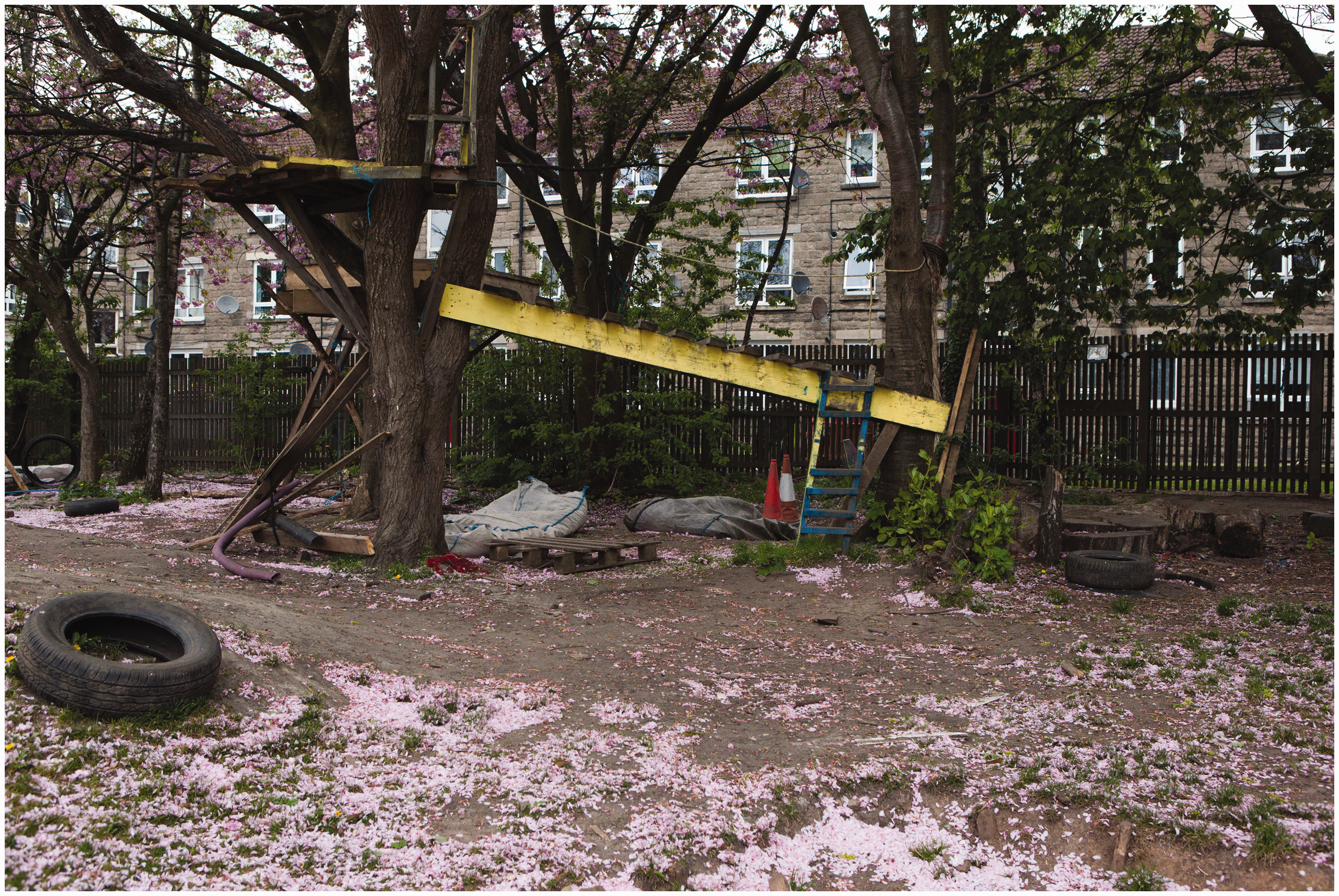
Playground equipment in spring (as photographed by the children during a workshop).
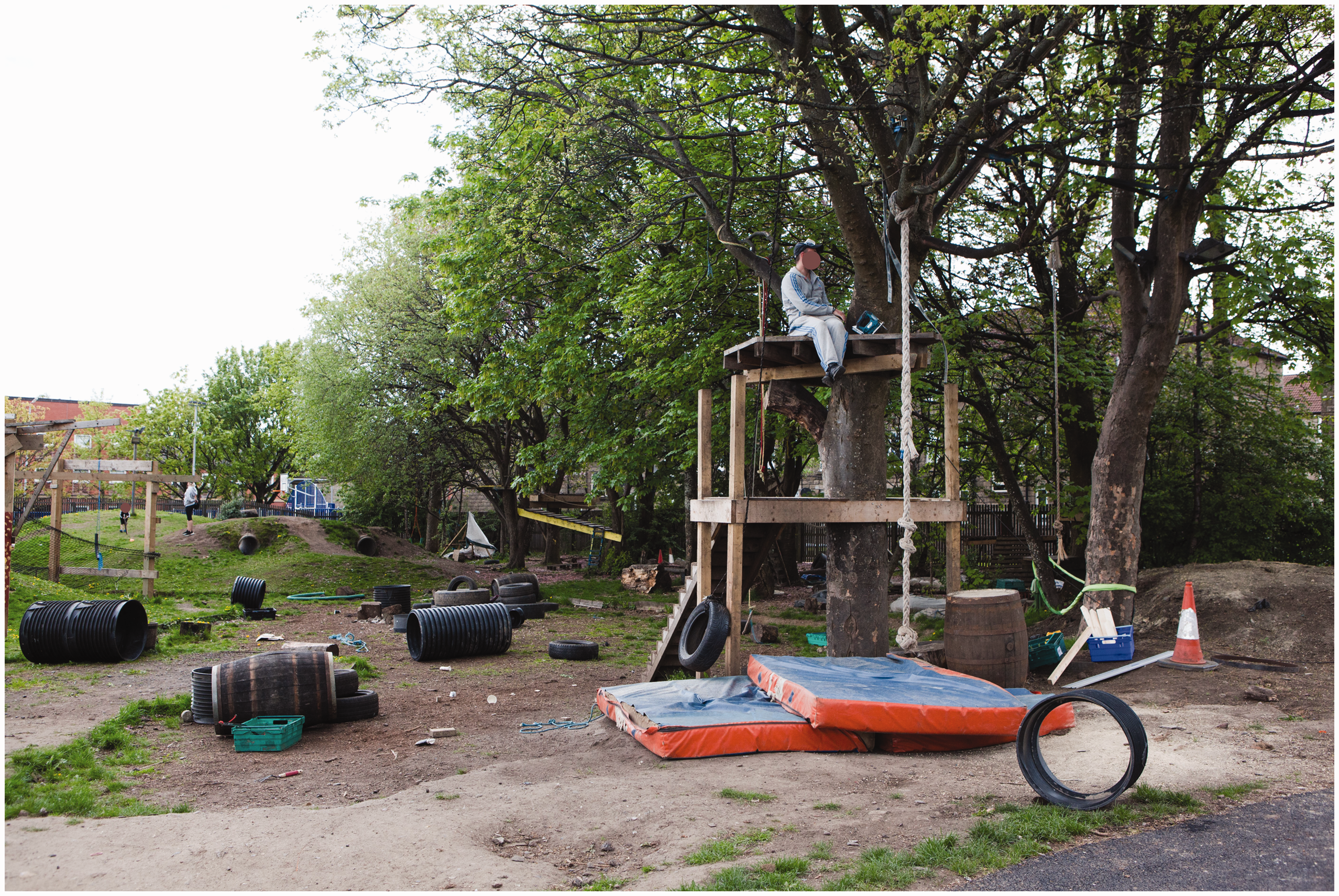
The playground (as photographed by the children during a workshop).
Creating space in the city for children is the central care practice of the Park. This extends to cultivating a space for children to explore and develop their own autonomy outdoors based on an understanding that a broad education involves learning by experience, especially in negotiating risk. Caregiving within the space is often rooted in the physical act of care provision (Tronto, 2013) that is visible in tangible expressions of care, such as comforting children who have fallen or cleaning grazed knees.
Yet, the space promotes a light touch approach to care-giving. Kieran, one of the founders of the Park, explained this as “risky play but not dangerous play” where children explore “their own limitations, their own imaginations.” Workers are imagined as playworkers first, not childcare providers. The playworkers drew a strong distinction between “looking out for” the children (e.g. ensuring their social media settings are private) yet not being “responsible” for them (e.g. telling parents that they will not enforce agreements between parents and children). The focus on agency and independence for the children, thus, forms the basis of the caring ethic at the Park. This is the mission as defined by the organisation at its narrowest. Yet, because of the wider context in which the Park operates – in an area of high deprivation – the work of the Park stretches reactively beyond this to encompass a much larger terrain of action. Care, thus, overspills into the surrounding families, community and environment.
Caring for families
From the founding of the Park, it very quickly emerged that the children were often hungry. Providing access to a reliable source of food to tackle hunger therefore became a core aspect of the Park’s mission. Over time this grew to include redistributing donated clothing and shoes, bikes, Christmas gifts and other assorted items. Kieran explains how the Park transformed over time: When we first started out it was just meant to be a playground for kids between 6 and 12 and I very quickly realised that you cannae [cannot] just work with that age group and no’ have any impact on younger siblings, on parents, on older brothers or sisters. […] I think now we’ve become an actual community asset where people now are thinking, if I need anything, I’ll go see Kieran, Ryan and Graham, I’ll go see the playground, I’ll go speak to somebody there, so which is always a benefit you know because people are starting to understand it. We urnae [aren’t] just here to look after your children, we’re here to look after the kids, we’re here to look after anybody. (Kieran, playworker)
A core part of supporting families pertains to food provision and redistribution. The Park created a community larder that is supported by charitable food redistributors, through the FareShare scheme. It uses this food to feed children during the day but is open for families and local residents to access food free of charge. For many families, this provisioning released pressure on their finances. As mothers who use the larder put it: [T]here’s times where even though it’s not your weekly shop, but it still helps ease the burden a wee tiny bit, if you know what I mean. Ease out a wee bit of money for that extra treat or whatever. Aye it definitely helps. Definitely, and it helps the whole community. The fact that everything is free. (Maureen, mother of five)
Whilst some families, like Maureen’s, use the Park to ease the financial burden of feeding their family, others’ food insecurity is more acute and emotionally challenging. Ryan, a founder and playworker, reflects upon the necessity to support whole families who live in often difficult circumstances: You feed the child, you need to feed siblings, parents, grandparents – it changes everything. […] [Y]ou harden up. I mean, you don’t totally go numb. People need someone with a bit of empathy, but you get used to it. (Ryan, Park playworker)
Ryan’s comments highlight the sense of necessity and urgency that hunger places on the space. The care-need transforms the playground into a space of social provisioning, feeding multiple generations of families. For Ryan, the ability to ‘harden up’ allows him to express empathy and engage in ‘caring moments’ (Watson, 2008) without it consuming his life. Such tropes are often associated with working-class masculinities (McDowell et al., 2014; Nayak, 2006; Nelson, 2016) that are grounded in cultural expectations of supporting others without losing oneself. There is not space to fully explore the gender implications of this, but this does highlight the personal cost of caring in uncared-for places, and the way that in this particular place it is inflected with the cultural tropes of working-class masculinity, while reacting to a lack of care within the broader landscape of deprivation.
Caring with the community
Care expands beyond the Park to generate a wider array of foci than local children and families. This is most evident in the playground’s intergenerational work that brings the children into contact with local elders as a means of breaking down age barriers within the community. Graham, the Park’s food coordinator, explains the rationale behind the intergenerational work: [The] children make up message [grocery] bags and we escort them and the children take messages to the older ones. […] It’s educating the children in showing respect for others who can’t get out the house, whatever, and it allows the older members of the community to get to know the kids and see that they’re not a threat. You know, they see them out, hanging about in a group and they think, oh I’m going to get mugged or attacked or whatever, so just that intergenerational thing, we think is really, really important. (Graham, Park food coordinator)
Beyond these caring connections that are heavily facilitated by the Park, we witness how care can be generative, catalysing community members caring for each other. Each year, the Park organises a Christmas gift distribution for anyone struggling financially. In 2019, a young mother, who had recently left an abusive partner, was facing financial hardship as her welfare payments would not arrive until after the festive season. Through the Park, gifts were sourced from the community for her two children, a selection of food from the pantry was gathered for Christmas dinner and a community collection generated £200 to support the family. Here we witness the way acts of care proliferate between community members, facilitated and supported through material and non-material circulation (c.f. Buser and Boyer, 2021). Within such alternative infrastructures of care, care becomes an expression of solidarity rather than charity as it is mobilised through non-hierarchical collective action (Hobart and Kneese, 2020). The Park becomes a generative locus of care that promotes care with (Tronto, 2013) the community (indeed, situating care and community as constitutive of each other). As such, building a local infrastructure of care fosters connections between people and encourages care to flourish within the community itself. This demonstrates the ways community organisations act as nodes in a caring infrastructure, both reaching outwards to connect and care for local people and reimagining this marginalised place as a site of joy, connection and resistance, not simply deprivation (hooks, 1989; Thieme, 2021).
This intervention expands responsibilities for social reproduction beyond the home to include wider networks of care and support that have been celebrated as unbounded and promiscuous care (Care Collective, 2020). These examples of care, however, which are demonstrably expanding outwards from the Park, must acknowledge the toll on caring individuals. Beyond the emotional labour of needing to ‘harden up’, the Park as a valued environment and infrastructure of care also burdens staff with the responsibility of keeping it going. Faced with a funding gap in the early years of the project, Kieran and Ryan both planned to take second jobs working nightshifts in order to afford to keep the playground operating: Me and Kieran were going to take on night jobs, just to keep this place open. I did a shift on the railways. Honestly, it lasted like one night, […] Came home and then had to come in here [playground]. People told us we were going to kill ourselves. (Ryan, Park playworker)
Caring beyond the local
Care expanded further as the Park developed a range of sustainability initiatives to improve the community and wider environment. This started with community food-growing and quickly expanded to include rethinking the waste generated from the space. The appearance of raised beds and compost bins stimulated conversations with local people, parents and children about the changes within the space. This was not always straightforward, as Claire, a mother of four children, explained in relation to how recycling is not her top priority: Too much else on my plate! Too much else to think about. Em, no, I’ve never done it. Everything goes in the one bin in my house. It’s just far too much else to think about. (Claire, mother of four)
As part of our collaboration with the Park, we reflected with playground staff on ways to support recycling locally. This led to an increased awareness of the lack of recycling infrastructure within the community. One day, the lead author was taken out of the playground on a drive to see the new bins that had appeared in an adjacent community: Ryan points out all the new bins (one has been pushed over onto its side already). They are shinier and look fresh […] There are also regular recycling points – either side of a park and outside the tower blocks next to the primary school, in rings of different amenities. […] Ryan says: “this is great, I’m not saying they shouldn’t have this, but that we should have it too”. The disparity is clear, and as Kieran points out, “nobody’s going to trek down here with bags of recycling or clothes for the bank”. The difference is, as Ryan says, “astronomical”. (Fieldnotes excerpt, 7 June 2018)
As such, care work emerges not just within the playground but radiates out into homes, families and community to the wider environment. In some ways, by reviewing the provision of recycling bins, the playworkers engaged in care receiving (Tronto, 2013) by evaluating if care provision meets needs. In this case, the bins were a material reminder of the community as an uncared for place. With support from the collaborative project, the Park was able to lobby local government for recycling bin provision within the playground. Such proactive care initiatives ensure a more just transition across people and place (McCauley and Heffron, 2018) and moves us towards caring with (Tronto, 2013) at an institutional level. Whilst Tronto’s (2013) language may carry the danger of romanticising such efforts as a collaborative endeavour, our findings reveal that these efforts surface from struggle and are reactive to deficits within the system. This highlights the complex interplay between reactive and proactive dimensions of care in which the former may motivate the latter, yet we find such proactive initiatives are constrained within the context of entrenched deprivation.
The infrastructure of care facilitated by the Park, thus, extends beyond a human support system to include the socio-material elements of the community. This goes far beyond direct care for children and families to include waste systems, circulating goods and providing access to food (c.f. Hall and Smith, 2015; Power and Mee, 2020), all of which contributes to the circulation of care practices in the community. At its broadest, care at the Park expands from direct care relationships with the children, through their families and neighbours to encompass a role in planetary care, however troubled by waste infrastructure and limited capacity to engage that might be. Yet, in its extension to fill gaps in the provision of care, this kind of alternative infrastructure of care raises questions about the intensity of feeling (Held, 2006) experienced by carers and what precisely is being valorised when such spaces are used as prefigurative examples of ways to reimagine care. Instead of valorising the expansion of care in contexts such as our case, we find the Park offers an alternative infrastructure of care that enables care to be practised in reactive, generative and reparative ways. While this alternative infrastructure works to extend care, it relies on redistributing care responsibilities to those already vulnerable and heavily burdened. Care literature from beyond the Global North points to the ways that care is always situated within power structures and relations, and that the work of care is negotiating these structures (Raghuram, 2016; Yu and Rosenberg, 2023). The uneven distribution of care becomes an urgent problem requiring rebalancing (Care Collective, 2020), but also a series of power-inflected relationships and modalities that are negotiated in the everyday (Yu and Rosenberg, 2023). As such, we suggest caution be extended to similar spatial projects experiencing state divestment (such as community gardens), where care demands are similarly expansive (Cumbers et al., 2018; McClintock, 2014; Rosol, 2012).
Conclusion
Care continues to offer hope for a better world and recent research affirms the importance of exploring how alternative infrastructures of care may help us reach better futures (Care Collective, 2020; Hobart and Kneese, 2020). We contribute to this care conversation by examining how care unfolds through an empirical case of an alternative infrastructure of care, and with an emphasis on conceptualising how care emerges in reaction to disinvestment. We demonstrate how care is expansive, proliferating across people and place to (reactively) repair care deficits and (proactively) generate new care relations. This advances previous accounts of care as a relational process in which the norms and boundaries of care are constantly negotiated between care givers and receivers (Yu and Rosenberg, 2023) by drawing attention to complex interplay between reactive and proactive care. Our research highlights how care is not only a mechanism of hope and opportunity (Hobart and Kneese, 2020), but also catalyses the transformation of space from a previously uncared for place, to a care-full place that expands care across communities, generations and environments. We contribute to the complexity of care theorising by revealing the challenges of care provision that stem from a position of necessity and repair and offer a critical discussion of alternative infrastructures of care that simultaneously praises these visions as opportunities for hope, whilst by acknowledging their limits.
In a context of entrenched deprivation, creating a playful, open space has been undoubtedly generative in terms of building social agency and democratic engagement. This mirrors the potential impacts of similar projects, such as community gardens (e.g. Cumbers et al., 2018; McClintock, 2014; Rosol, 2012), that create space for diverse groups of people to congregate and find mutual support for new ways of enhancing social and community values (Traill, 2023). The emergence of such phenomena under conditions of deprivation has created new and sometimes unexpected spaces of care and caring relations (Power and Hall, 2018), although these are still enmeshed problematically in broader contemporary regimes of ongoing challenges to funding and resources. As Green and Lawson (2011: 651) demonstrate, social and economic restructuring have placed certain people outside of the social and, therefore, “beyond the scope of obligation.” The Park deliberately moves against this dynamic by expanding who counts as deserving subjects of care, engaged in a social struggle to reimagine the community and its spaces as care-full. This hopeful and radical character of the Park should not be lost in the weight of care work.
Our research suggests that calls for centring care and mutual dependence in everyday life (Care Collective, 2020; Dowling, 2021) must consider the resourcing of care and the contexts in which care already does expand. Our empirical case highlights the personal costs implicated in caring expansively, of reacting to care deficits and of (re)building care relations. Caring capacities (Power, 2019) are strained by the broader landscape of deprivation and place uneven burdens upon the most vulnerable communities. Such capacities are stretched to breaking points when individuals feel obligated to care expansively. An apposite question, given the context of generational inequality and top-down restructuring that requires people in the community to build alternative infrastructures of care, might be how could people in and around the Park care less? Following Tronto (2013), there should be a right not to care. We suggest a redistribution of caring responsibilities to those sections of society better resourced to bear them.
We caution against a particular kind of optimism that situates care as radical. Mattern (2018: np, emphasis in original) notes, “we have to avoid romanticizing maintenance and repair”, not simply seeing how care builds a vision of another possible way (Hobart and Kneese, 2020; Williams, 2022), but staying with the ambivalence of, and limits to, everyday articulations of care (Bassel and Emejulu, 2018; Jupp, 2022; Middleton and Samanani, 2021). The challenge, as exemplified in the Park, is how to balance the hope and joy that staff are trying to centre against the tragedy and absence that create their need for care (and perpetuate their existence and expansion). The very exceptionalism and richness of the Park makes any singular articulation here partial; thus, we echo hooks (1989), that one must see both the resistance and the repression at the margins.
Our research also reinforces the importance of conducting research with care (Middleton and Samanani, 2021), especially in contexts of deprivation and vulnerable communities. A care-full research approach characterised by collaboration and negotiation of understandings with the Park and community, allows us to reach a more nuanced understanding of caring expansively that includes positive and negative impacts on people and place. It also highlights the political ambivalence that can characterise alternative infrastructures of care. Existing research demonstrates how alternative infrastructures of care are often characterised by radicality (Graziano, 2018; Hobart and Kneese, 2020) and an explicit politics of resistance (Care Collective, 2020), yet we demonstrate how alternative infrastructures of care may operate without an explicit politics whilst being equally radical. In doing so, we attend to the ambivalent politics of urban repair in which caring is implicit and embedded in everyday survival. Paying careful attention to the emergent nuances of our context maintains the authenticity of participants’ voice and lived experience of building an alternative infrastructure of care.
Whilst politics were not explicit in our context, we acknowledge their unavoidable role in shaping the care landscape. The care conversation should continue to critically engage with the often-unjust distribution of care and the impacts of deprivation which increase the strain on caring capacity in unfair ways (Bassel and Emejulu, 2018; Jupp, 2022), as well as the everyday hope or political inspiration that might be found in alternative arrangements to facilitate care (Hobart and Kneese, 2020). The absence of a caring polity has implications in terms of deprivation and precarious funding arrangements, but also in the localised experience of top-down regeneration, loss of services and the creation of food and amenity deserts. These issues cannot be compensated for by a patchwork of ever-extending localised interventions. Such alternative caring arrangements demand a radical revision of how we define and resource care provision to recognise and truly support the generative and expansionary potential that exist in building alternative infrastructures of care.
Footnotes
Acknowledgements
We would like to thank participants and playworkers at the junkyard playground who made this research possible. This project is a collaboration between University of Glasgow and the organisation we call here 'the Park', and was funded by EU/Scottish Government Social Innovation Funding Stage 2.
Andrew Cumbers is also affilaited with University of Bonn.
Declaration of conflicting interests
The author(s) declared no potential conflicts of interest with respect to the research, authorship, and/or publication of this article.
Funding
This work was supported by funding from the EU/Scottish Government Social Innovation Fund Stage 2 [grant number: SIF-R2-S2-LUPS-013]..
