




Abstract
Nonbelief is increasing in secular countries. Among the nonreligious/nonbelievers (hereafter nonbelievers), agnostics differ from atheists in terms of underlying psychological characteristics. Can agnosticism be considered as a transient stance from religion to atheism? Using European Values Study (EVS) data from 18 Western European countries, we investigated this question both cross-sectionally and across three waves (EVS 1999 to 2017). Cross-sectionally, in more secular societies, the proportion of atheists among the nonbelievers is higher – and agnostics’ lower. Across time, from 1999 to 2017, in most countries, the proportion of agnostics among nonbelievers decreased – and inversely the one of atheists increased, a pattern that followed secularization and seemed common across age groups. Nevertheless, the proportion of agnostics remains important. These findings suggest that the more secularism/nonbelief becomes socially normative, the more people become or ‘come out’ as clear atheists. Agnosticism seems partly a transient convictional status from faith to atheism and partly a sui-generis category.
Introduction
Nonreligious/nonbelievers in general, and their specific types in particular, have been an understudied topic in social and behavioral sciences of religion. We use here this combined term, ‘nonreligious/nonbelievers’, to focus on those who are (1) neither religious believers (2) nor ‘spiritual but nonreligious’ (still believers), but for the simplicity of the presentation we use hereafter ‘nonbelievers’ as a more generic term. Recent psychological studies provide interesting evidence on individual differences (personality, cognition, beliefs, and worldviews) of agnostics compared to atheists. Agnostics differ from atheists not only epistemically, regarding the question of existence of God/Transcendence (‘I do not know’ or ‘We cannot know’ vs ‘There is no God/Transcendence’), but also psychologically, in terms of individual characteristics known to have some – but not definitive – stability across time. Specifically, agnostics, compared to atheists, seem more prosocially oriented, more open-minded and flexible, and less dogmatic, but also higher in neuroticism and less negatively disposed toward intuitive thinking, paranormal beliefs, spirituality, and religion (Karim and Saroglou, 2023, 2024a; see also Hunsberger and Altemeyer, 2006; Lindeman et al., 2020). In several of the above characteristics, like prosociality, intuitive thinking, or spirituality, agnostics were midway between religious believers and atheists, the former typically being more prosocial and more prone to intuitive thinking than the latter. In others, like open-mindedness and neuroticism, agnostics seemed to be the highest compared to both religionists and atheists.
The agnosticism as transition to atheism hypothesis
The present work aims to go further and ask the following question: Is agnosticism a stable and definite convictional status or can it be conceived as a transition toward another convictional status? We examine this question specifically in the context of prior religious socialization and subsequent natural, not forced, distanciation form religion. In this context, one, probably major, possibility is that agnosticism, at the individual and/or societal level, is a transition from religion to atheism. We call this ‘the agnosticism as transition to atheism’ hypothesis. First, the fact that agnostics are located midway between religionists and atheists on several psychological characteristics can be considered as suggesting that, at least to some extent, agnosticism may be a transient convictional status from religion and faith to atheism. Second, agnosticism may be conceived as a first outcome of intense and prolonged religious doubt, in fact an intermediate outcome before choosing a clearly atheistic perspective. Some people with prior religious family socialization can first become religious doubters, then agnostics, and in turn atheists. Some others, also religiously socialized, can directly become atheists. Of course, especially within secular societies, several other nonbelievers, agnostics, or atheists may simply have been socialized in their family as nonbelievers.
The above trends of change from religion to atheism through agnosticism can thus be understood, at the individual level, as a personal development across the lifespan, possibly in interaction with social factors such as secularization (Wink et al., 2019). In parallel, they can also be understood, at the collective level, as societal developments and changes observable when comparing societies or cohorts within societies where religion was normative in the past and now secularism as a natural and gradual distanciation from religion’s predominance is increasing. (We distinguish this process from ‘forced’ irreligion like the one that was imposed by atheist communist regimes.) Of course, the two processes, that is changes in individual trajectories and changes at the societal level, are not necessarily or strictly parallel, but they can be so, especially if one thinks of average changes in a given population.
We make this hypothesis in the context of Western societies, more specifically Western European secularized countries, which have experienced in the recent decades an important degree of secularization. We are aware that ‘secularization’, especially in sociology of religion, has a rich and complex history with much theorization, and sometimes heated debates, about the very nature and types of secularization, and the variety of causal factors and concrete outcomes (Demerath, 2007, for a review). In this work, we consider ‘secularization’ in its broad and strong sense, that is the diminishment of both the social influence of religion and individual attachment to religion. The emphasis here is at the individual level of secularization, which implies that, in individuals’ life, religion no more plays a role on impacting or even shaping other aspects of life (Dobbelaere, 2002). Perhaps in a more radical way, we have to consider that, in the twenty-first century, disengagement from religion concerns all religion’s aspects, that is if we adopt the four basic dimensions of religion model (Saroglou, 2011), believing in a transcendence, bonding with others and the transcendence through rituals, behaving (in a religiously normative way), and belonging to a religious community or tradition. This process seems to have been active in the last decades possibly worldwide (Kasselstrand et al., 2023), but certainly in the West, especially in Western Europe (Norris and Inglehart, 2011), a cultural context historically marked by Christianity, but also by ideological atheism. To give an illustrative example from a recent international psychological study: in secular Western European countries, half of young students in the humanities report – score lower than 3 in 7-point scales – that religion for them is not a meaning and belief system, is not an emotional and aesthetic experience, is not a resource for values and guidelines, and is not a way to be inserted into a tradition or community (Saroglou and et al, 2020). This process of many people’s detachment from or fully abandoning faith, rituals, religious norms, and institutions is today, especially in the last two decades, clear and exists beyond other processes that have been or can still be present such as transformation of religion, orientation to nonreligious spirituality, believing without belonging, or believing without practicing.
The present study
In this study, we investigated the ‘agnosticism as transition to atheism’ hypothesis in Western European societies, by using the European Values Study (EVS) data of the three waves 1999, 2008, and 2017 (EVS, 2020a, 2020b). We expected that in these societies having experienced secularization and where irreligion, secularism, and atheism become progressively normative, increasingly more people among the nonbelievers would end up being atheists, clearly rejecting the idea of God and a transcendence. Inversely, increasingly less people, again among the nonbelievers, would remain agnostics.
At least three mechanisms may underline the above idea. The first is an internal process of personal development and maturation from traditional religious faith, through religious skepticism and indecisiveness regarding faith, to well-affirmed atheism. Initial evidence shows that agnostics are, from a personality perspective, more neurotic (Karim and Saroglou, 2023) and more indecisive than atheists (Karim and Saroglou, 2024b). The second integrates the role of social pressure: when people no more receive social pressure to be religious and when it becomes socially well-accepted, if not normative, to be atheist, then more people abandon religion and/or turn out to be atheist – this was anticipated a century ago by Freud (1927/1961). This could be due partly to social conformity. Third, in well-secularized social contexts, one can expect more people to dare to self-identify as atheists instead of agnostics. Unlike agnosticism, which reflects some understanding of religious faith, atheism is clearly in opposition to it (Bradley et al., 2018; Karim and Saroglou, 2023). Extensive international evidence shows that individual religiosity is positively associated with well-being and life satisfaction mostly or only in religious cultures, but less so or not in secular cultures (Diener et al., 2011; Lun and Bond, 2013). This has been interpreted as suggesting that it may be costly to be atheist in religious cultures (where being religious is a way to be integrated into a social majority), whereas this is no more the case in secular countries, because in these societies being nonbeliever no more implies being part of a small unconventional minority (Zuckerman et al., 2016). Being thus agnostic in the former cultures may protect from the detrimental effects of clearly being in the margin of the majority.
We thus expected that, in secularized Western European countries, agnosticism diminishes in favor of atheism. We tested this hypothesis both cross-sectionally, by comparing countries varying in mean religiosity/secularism, and across time, for a period of two decades, from the 1990s to the late 2010s. We also examined whether the hypothesized pattern of agnosticism’s decrease in favor of atheism is restricted to a specific age group or generalizes across age groups.
Investigating this question not only has intellectual and scientific interest and perhaps importance, but also has significant social relevance. In the United States, the percentage of agnostics and atheists seems overall small (respectively, 6% and 6%; Pew Research Center, 2022), possibly because surveys often include another category, ‘religion means nothing in particular’ and many people are spiritual but not religious. But in Europe (see European Commission, 2019), agnostics constitute 17% of the population, what corresponds to 50%–56% of the nonreligious or unaffiliated with an established religion, and atheists represent 10% of the population, what corresponds to 30% of the nonreligious or unaffiliated – very few others select ‘other’ or refuse to answer. In some countries (Sweden, the Netherlands), agnostics and atheists together are about 50% of the total population (European Commission, 2019).
Though not perfect and needing subtler distinctions (see Lindeman et al., 2020; Silver et al., 2014), the classification of nonbelievers into agnostics and atheists, at least in Europe, covers thus most non-religionists and nonbelievers. When Europeans are asked whether they (1) believe in a personal God or (2) a transcendence (spirit or force), or whether they (3) do not know what to think or (4) affirm no God or transcendence exists, the religious landscape becomes even clearer: religious (option 1) or spiritual (option 2) believers, agnostics (option 3), and atheists (option 4) correspond respectively to 37.9%, 32.8%, 13%, and 13% (EVS, 2020a; total N = 56,491). Only 3.2% do not answer, what makes agnostics and atheists representing respectively 44.4% and 44.6%, thus 89% of the nonbelievers, that is the nonreligious and the non-spiritual.
A final precautionary note we should make is that, by reminding in this work that irreligion and nonbelief are becoming progressively more accepted, if not normative, in Western European societies, we do not mean that nonbelievers or atheists constitute everywhere a majority. If we follow EVS (2020a), we simply underline here (1) that, in this cultural context, religionists, that is those believing in a personal God, are clearly no more a majority (37.9%), and (2) that in some countries (several Nordic countries of Protestant heritage), agnostics and atheists together constitute the half of the population, the other half being composed of the religious and the spiritual people. Consequently, in most Western European countries of Protestant and Catholic tradition, (3) strictly atheists are no more a thin unconventional minority of 5%–7% but constitute an important group approximating 20%. Finally, (4) in several countries, given the State and church/religion separation, a separation impacting many domains of life, being nonbeliever/atheist also means being in accordance with many society’s values.
Method
We used data from the EVS waves 1999, 2008 (EVS, 2020b), and 2017 (EVS, 2020a). We considered countries for which data existed at least for two out of the three waves. To keep homogeneity regarding the secularization process, we included data on Western, Northern, and Southern European countries (hereafter, Western). The Central and Eastern European countries were not included since they had a past of communist, mostly atheist, regimes, thus possibly experiencing in the 1990s and 2000s more complex processes regarding religion, including in some cases, temporary or more permanent rediscovering of religious heritage. For Germany, we included data from West Germany. We did not include for the analyses Malta, since the number of nonbelievers was too low (Ns = 33 in EVS 1999, and 83 in EVS 2008) to observe differences in atheists’ and agnostics’ rates. In total, we present here data from 18 European countries. These include Austria, Denmark, Finland, France, Germany (West), Great Britain, Greece, Iceland, Italy, the Netherlands, Portugal, Spain, and Sweden (13 countries with data from all three EVS waves), Belgium, Ireland, Luxembourg (data from EVS 1999 and 2008), and Norway and Switzerland (data from EVS 2008 and 2017).
The samples from these countries totalized, by wave, 18,698 participants (16 countries of EVS 1999), 22,838 (18 countries of EVS 2008), and 29,673 (15 countries of EVS 2017). The EVS survey does not include a measure of explicit self-identification for the nonreligious as ‘agnostic’ or ‘atheist’. Therefore, we used the classic across EVS waves question – and more unambiguous than self-identification – on the specific beliefs relative to the God’s existence ‘Which one of these statements comes closest to your beliefs?’ Participants must choose between four options: (1) ‘There is a personal God, (2) There is some sort of spirit or life force, (3) I do not really think there is any sort of spirit, God, or life force, or (4) I do not really know what to think’. We considered those choosing option 3 as atheists and those choosing option 4 as agnostics, since these affirmations well correspond to the epistemic distinction between agnosticism and atheism. Options 1 and 2 correspond to religious and spiritual believers. Note that, across EVS waves, the percentage of participants who did not choose any of the options 1 to 4 in the above question was very low (varying from 2% to 3.2%).
We retained each time for the analyses as nonbelievers the total number of participants who chose options 3 and 4 (see the Ns in Table 1, first column for each wave) and computed the proportion (percentage) of agnostics, that is those who chose option 4 (second column for each wave in Table 1) among the nonbelievers. The percentage of atheists (option 3) is the inverse one of the agnostics. We present the results not only on the total sample, by EVS wave, but also distinctly by country, what allows for the main findings on the total sample not to be at the risk of being an artifact of country’s characteristics (e.g. religious heritage, socio-economic level). Furthermore, to guarantee that changes in proportions were robust and not possibly due to the margins of error, we computed, by wave, in the total sample, and also by country, the 95% confidence intervals (CIs; third column for each wave in Table 1). Given that the changes were not expected to be spectacular in size, we did not expect to have in all dozens of comparisons zero overlap between the low CI of a given wave and the high CI of the next wave, but we anticipated to have such zero overlap in several cases.
Proportion of agnostics among nonbelievers, by Western European country and by EVS wave.
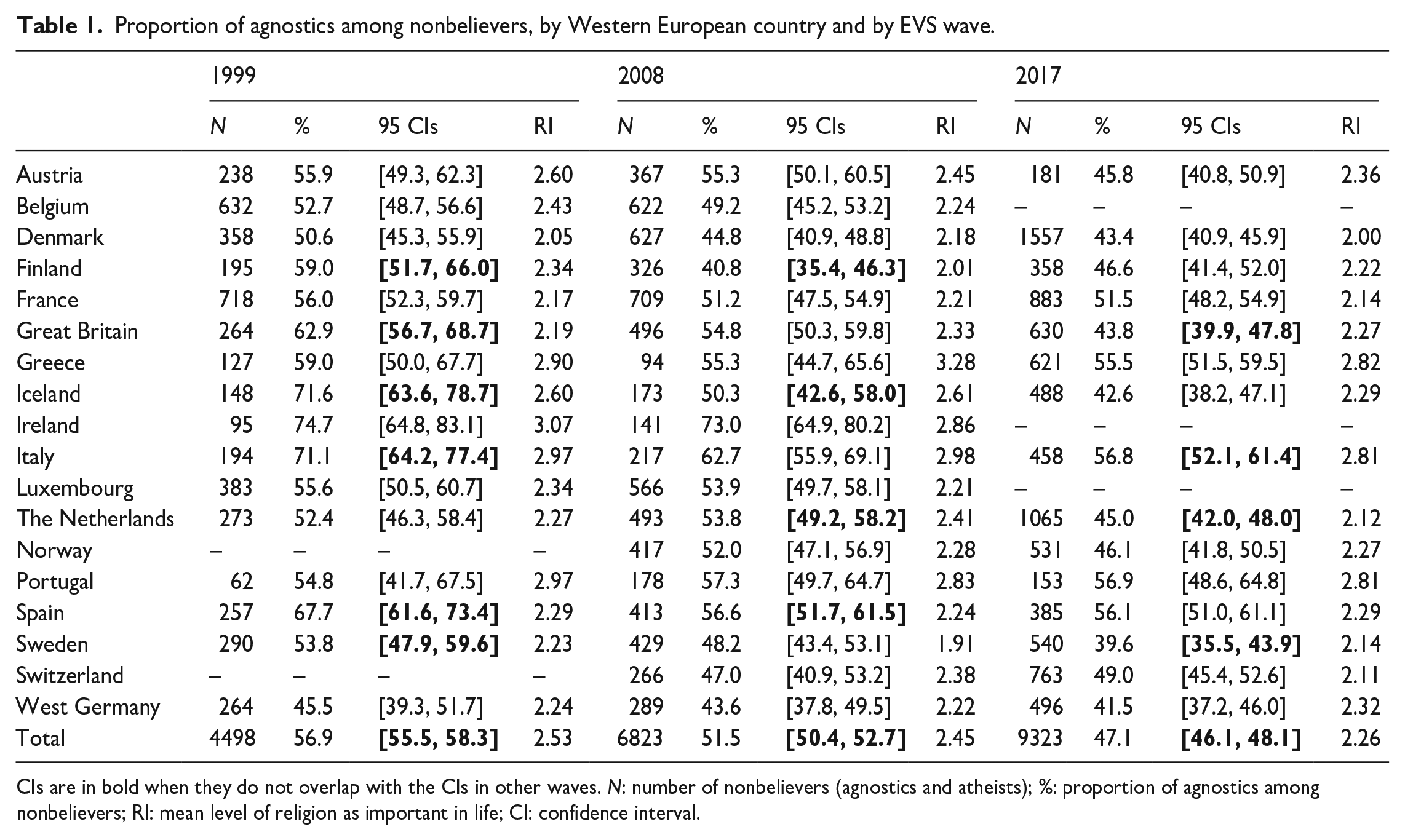
CIs are in bold when they do not overlap with the CIs in other waves. N: number of nonbelievers (agnostics and atheists); %: proportion of agnostics among nonbelievers; RI: mean level of religion as important in life; CI: confidence interval.
Furthermore, for the country-level correlational analysis between agnostics’ proportion and country’s level of religiosity/secularism, we used another question of the EVS where participants are asked to answer the question of how important religion is in their life (last column, for each wave, in Table 1). This is a different question from the one asking for selection of specific statements about God/transcendence and possibly taps in the best way, compared to religious practice or religious affiliation, the degree of religiosity/secularism. Finally, to exclude the possibility that these correlations are affected by differences on spirituality, we used, when available, that is for EVS 2008, the question ‘How much spiritual are you?’ For both questions, answers (4-point Likert-type scale) were reversed in order that higher values reflect higher religiosity or spirituality.
Results
Table 1 details, by wave, for the total sample but also by country, the number of nonbelievers (agnostics and atheists), the relative proportion of agnostics among nonbelievers, and, as an indicator of the country’s mean religiosity, the mean level of the importance of religion in life. First, the more a country was religious – or the less it was secular, the higher the proportion (percentage) of agnostics among the nonbelievers was, Spearman’s ρ = .50, p = .048, two-tailed, for EVS 1999 (k = 16 countries), ρ = .71, p < .001, two-tailed, for EVS 2008 (18 countries), and ρ = .42, p = .025, one-tailed, for EVS 2017 (15 countries). This trend was preserved even when controlling for country’s mean degree of spirituality, ρ = .41, p = .05, at least for EVS 2008, which included the question ‘How much spiritual are you?’
Second, as Table 1 indicates (see also Figure 1), in almost all countries, the proportion of the agnostics among nonbelievers decreased, in favor of atheists, from EVS 1999 to 2017 through 2008 (or to 2008 for the three countries with no data for 2017; or from 2008 to 2017 for one out of the two countries with no data for 1999). When considering the full lack of overlap between CIs (third column for each wave in Table 1), the effect was robust in the total sample and persistent across the two comparisons, that is 1999 versus 2008, and 2008 versus 2017. It was also robust overall across the years, for seven countries: Finland, Great Britain, Iceland, Italy, the Netherlands, Spain, and Sweden. In two additional countries, non-overlap of CIs was almost present, missed by 0.8% for Austria (from 2008 to 2017) and 0.6% for Denmark (from 1999 to 2017). There was some variability, with some countries showing a continuous decrease across cohorts, others showing a big gap between 1999 and 2008 and then stabilization, and others showing a gap between 2008 and 2017. The only 2 out of the 18 societies showing overall stability instead of decrease on agnostics’ proportion among nonbelievers were Portugal and Switzerland. No robust increase of agnostics’ proportion was observed in any of the 18 societies and in any of the two-time comparisons.
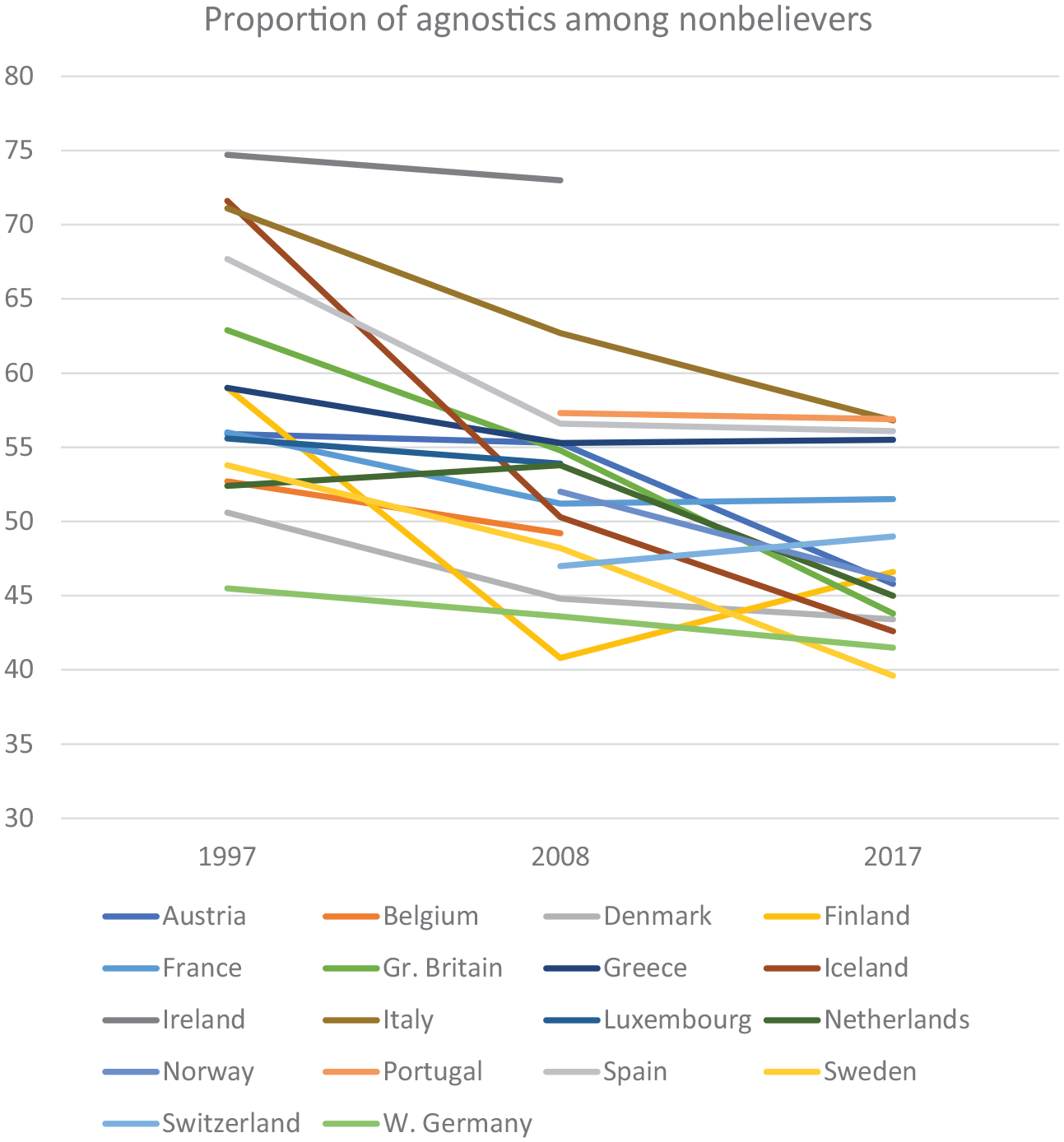
Proportion of agnostics among nonbelievers, by Western European country and by EVS wave.
Overall, except Ireland where agnostics constitute the three-fourths of nonbelievers, across countries, in almost 20 years, the ranges of the agnostics’ proportion among nonbelievers decreased from 45.5%–71.6% in 1999 to 39.6%–56.9% in 2017. This means that the proportion of atheists among the nonbelievers increased in these countries from 28.4%–54.5% in 1999 to 43.1%–60.4% in 2017. The decrease of the proportion of agnostics among the nonbelievers – and inversely the increase of the one of atheists – seemed to follow the decrease of mean religiosity (see Figure 2). As Table 1 indicates, in most countries (Great Britain being an exception when comparing EVS 1999 with EVS 2017, but not when comparing 2008 with 2017, and West Germany being an exception when comparing 2017 with 1999 and 2008), the importance of religion in life decreased across two decades, from 1999 to 2017 (data for 11 countries) or in one decade, that is from 1999 to 2008 (three additional countries) or from 2008 to 2017 (two additional ones). Across the 20 years, even the size of secularization (decrease of importance of religion) seems to parallel, to some extent, the size of the decrease of agnostics’ proportion, Spearman’s ρ = .30, a correlation being though nonsignificant given the low k (13 countries with data in both 1999 and 2017).
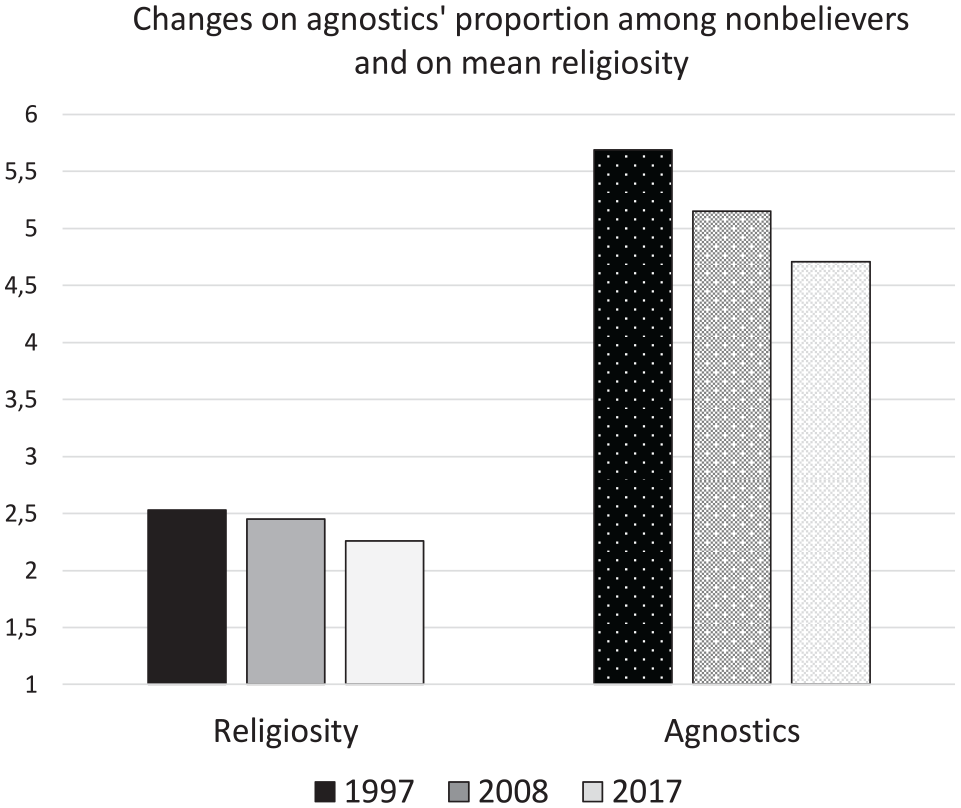
Changes on agnostics’ proportion among nonbelievers and on mean religiosity in 18 Western European countries across EVS 1999, 2008, and 2017.
Finally, to test whether the effect was present across ages, we computed, distinctly by age group, the proportion (and their CIs) of agnostics among the nonbelievers for the whole sample of the nine countries where the effect was robust or almost robust, in terms of non-overlap between CIs. We used the EVS recoding of participants’ age in three groups, that is young people (15–29 years), adults (30–49 years), and later adults (50 years and higher). As shown in Table 2 (see also Figure 3), the decrease of the proportion of agnostics was consistent across all three age groups and across time. It was also robust for all ages, for the younger adults when comparing 1999 with 2008, and for the older adults constantly across the two-time comparisons. Of importance also to note (see also Table 2) that, in EVS 1999 and EVS 2008, there were more agnostics among nonbeliever older adults compared to young and middle adults (the respective CIs did not overlap), but there were no more differences in EVS 2017 between age groups in the proportion of agnostics.
Proportion of agnostics among nonbelievers in nine Western European countries, by EVS wave and by age group.
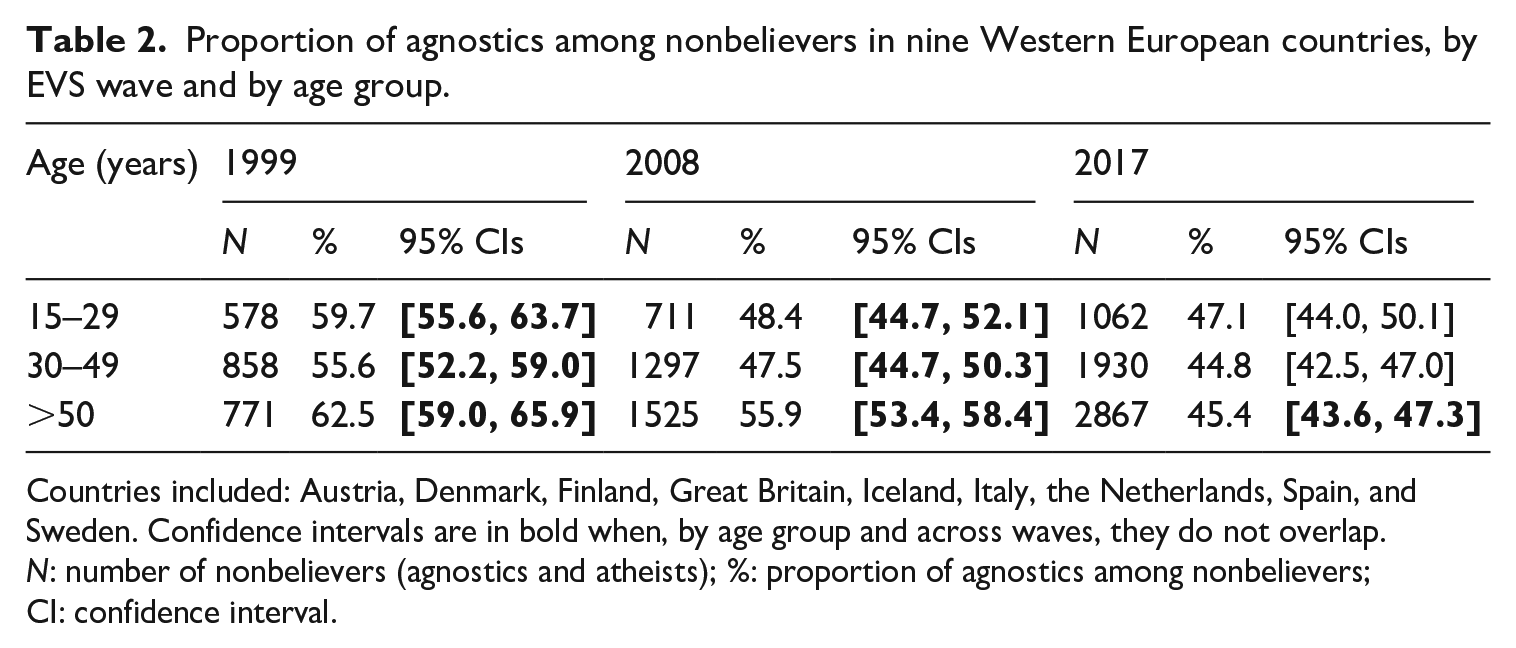
Countries included: Austria, Denmark, Finland, Great Britain, Iceland, Italy, the Netherlands, Spain, and Sweden. Confidence intervals are in bold when, by age group and across waves, they do not overlap. N: number of nonbelievers (agnostics and atheists); %: proportion of agnostics among nonbelievers; CI: confidence interval.
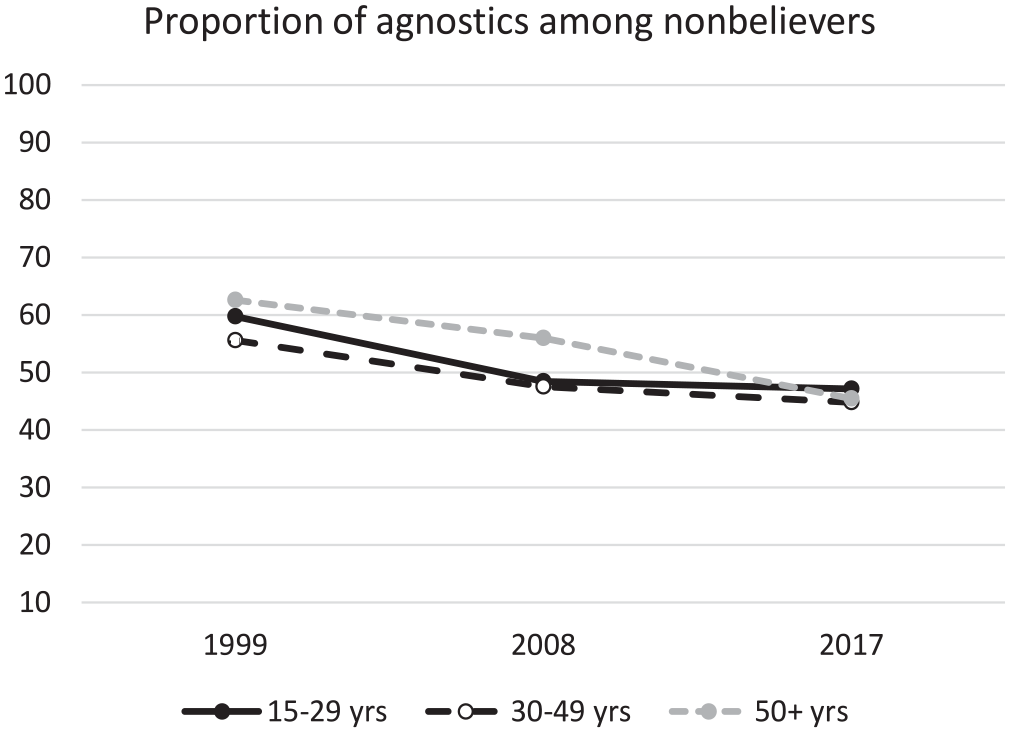
Proportion of agnostics among nonbelievers for nine Western European countries, by EVS wave and by age group.
Discussion
In this work, data from the three EVS waves 1999, 2008, and 2017 on 18 Western, Nordic, and Southern (hereafter Western) European societies of Christian (Anglican, Protestant, Catholic, and Orthodox) heritage having experienced ‘natural’, non-forced secularization at different degrees provided evidence that confirms our major expectation: in this context, agnosticism seems to be, to some extent, a transient convictional status from religious belief and spiritual faith to atheism, that is rejection of any transcendence. Across waves, within two decades, from the late 1990s to the late 2010s, among the nonbelievers (i.e. those who are neither religious nor spiritual), the proportion of agnostics decreased in favor of atheists. The effect was robust, that is beyond possible margin of error, for the total sample and for almost half of these societies, and seemed to hold for all age groups, that is young adults, middle adults, and older adults. In no country a robust opposite effect, that is agnostics’ ratio increasing, was observed. Furthermore, cross-sectionally, the more a country is secular, or the less it is religious, the lower the proportion of agnostics among nonbelievers in favor of atheists is. This was the case in each of the three EVS waves. These findings were specific to the agnostic convictional status and did not seem to be an artifact of possible country-level differences on mean level of individual spirituality.
The present work substantiates the idea that, at least in the context of Western Europe, in more religious or less secular societies, more people distancing themselves from religion and faith seem to not (dare to) affirm to themselves and the others that neither God nor any transcendence exists. They likely do not take the risk of being in full opposition with what is normative in such societies and thus become or remain ‘only’ agnostic, not atheist. In contrast, in more secular societies where nonbelief becomes well accepted and even normative, more people clearly affirm atheism and reject religion and spiritual faith.
The decrease of agnosticism in favor of atheism appeared to be a robust or almost robust effect, not due to possible margins of error, in many of the societies included in the present work. We do not see a reason to speculate that these countries showing a more robust effect shared cultural similarities that, in addition, distinguished them from the remaining countries. The former ones included countries of diverse religious heritage and varied in the degree of their religiosity/secularism in the 1990s. In addition, they were countries from strictly Western, but also Northern, and Southern Europe and reflected some non-negligible cultural and socio-economic variability.
It is important to remind here that the findings of the present work should not (necessarily) generalize to other cultural contexts than the one of Western, including Northern and Southern, European societies. Conceptually, alternatives to the ‘agnosticism as a transition to atheism’ hypothesis can also be advanced – but for other contexts than the one under study here. First, some people with too heavy religious socialization may first firmly oppose to religion by becoming atheists and then, at least some of them, may develop more equidistant attitudes toward faith and non-faith and become agnostics (see also Schnell et al., 2023). However, though legitimate for certain individuals, this hypothesis seems less plausible at the societal level: in too religious societies, it seems highly costly to directly proclaim atheism – only people high in risk-taking can do it. Second, (some) people with too heavy irreligious socialization may turn on to agnosticism, if motivated by existential and spiritual concerns, with agnosticism potentially becoming a transition to future faith and religion. This hypothesis could be tested, for instance after few decades, in the most secular of the countries included in the present study – the situation is different in ex-communist countries where atheism was not natural but forced and occasionally in opposition with vibrant religion. Nevertheless, such a trajectory, from non-faith to faith through agnosticism, may be quantitively weaker in size than the opposite one found here, that is the one from faith to non-faith through agnosticism: overall, deconversion is a much-extended reality than conversion (Wink et al., 2019).
This work has at least two key limitations. First, we certainly provided here both cross-sectional and time-based evidence, but future research should investigate whether the agnosticism as transition hypothesis can also be attested longitudinally, at the individual level. It seems reasonable to conceive that several of those religiously educated, if it is to exit from religion for personal development motives, may first become agnostics, that is be indecisive or open to various possibilities, before ending out as self-affirmed atheists. But it seems also conceptually possible that some of those who are irreligiously socialized may start later in their life, again in terms of personal development, questioning elements they associate with atheism (e.g. individualism, materialism) and thus become agnostic, either for ever or as a transition to faith or spirituality.
Second, typically, in the secularization and religious trajectory research, we can distinguish in people’s religious changes between cohort effects, age effects, and time effects (Voas and Crockett, 2005; Wink et al., 2019). More nuanced analyses will be welcome to better disentangle these sources of effects. Of interest to note that we provided here initial evidence that the decrease of agnosticism in favor of atheism was present across waves and, importantly, across age groups by each wave, that is younger adults, middle adults, and older adults. Nevertheless, it may be that the observed effects reflect specific cohorts and periods and will not extend further on time. A final limitation can be that social scientific research has typically distinguished between (religious) believers and nonreligious/nonbelievers, and distinct types of them, but an emerging category to be studied, also because of some possible overlap with agnosticism, is the one of religious indifference (Quack and Schuh, 2017).
Before concluding, it is important to highlight the fact that the decrease of agnostics’ proportion among the nonbelievers evidenced in this work, even if not negligible in size in about 20 years, was not such high to make agnostics disappear from the nonreligious landscape. As shown in this work, agnostics still represent in Western European countries approximately 40% to 55% of the nonreligious. Agnostics may decrease in size if secularization continues, but it may also be that they constitute a permanent sui-generis category among the nonbelievers, distinct from atheists. This is for a series of reasons related to their personality and other individual differences (Hunsberger and Altemeyer, 2006; Karim and Saroglou, 2023, 2024a, 2024b; Lindeman et al., 2020), that is psychological characteristics with a certain stability across life (Bleidorn et al., 2022). Therefore, it is not to be excluded that agnostics may be socially necessary to facilitate the communication and dialog between the two sides, believers and atheists, and attenuate thus possible undesirable effects of convictional polarization in modern societies.
Footnotes
Data availability

Declaration of conflicting interests
The author(s) declared no potential conflicts of interest with respect to the research, authorship, and/or publication of this article.
Funding
The author(s) received no financial support for the research, authorship, and/or publication of this article.
Ethical approval
This study is an analysis of preexisting publicly available large international data (European Values Study, waves 1999, 2008, and 2017) for which the appropriate ethical approval and consent of participants were obtained.
Author biographies
Address: Université catholique de Louvain, Institute for Psychological Sciences, Pl. du Cardinal Mercier 10, B 1348, Louvain-la-Neuve, Belgium.
Email:
Address: Université catholique de Louvain, Institute for Psychological Sciences, Pl. du Cardinal Mercier 10, B 1348, Louvain-la-Neuve, Belgium.
Email: