




Abstract
Popular and academic interest in the phenomenon of ‘non-religion’, including atheism, humanism and agnosticism, is currently on the rise, reflected in the proliferation of social research on this important theme. Yet, despite a parallel growth in scholarship on childhood, youth and religion, little interest has so far been directed towards non-religion in this context. This article brings together these two concerns through a review of research themes concerned with non-religion and their potential relevance for childhood and youth studies. In so doing, it maps out an agenda for future social research in the field of childhood, youth and non-religion.
Introduction
Popular and scholarly interest in the phenomenon of ‘non-religion’, including atheism, humanism and agnosticism, is currently on the rise. Authors such as Richard Dawkins and Christopher Hitchens have successfully raised the profile of the so-called ‘New Atheism’ in the public eye through their various books and media interventions. Similarly, non-religious organisations seem to exert an increasing presence in many countries, particularly in relation to debates regarding the role of religion in public life. At the same time, new academic research on non-religion has also begun to emerge and proliferate, through new books and journals such as Secularism and non-religion.
In somewhat separate developments, academic interest in childhood, youth and religion has now begun to gather pace, contributing to a growing body of interdisciplinary research (Hemming and Madge, 2012). Insights from the sociology of childhood and critical youth studies have contributed to an emerging perspective that acknowledges the constructed and contested nature of ‘childhood’ and ‘youth’. This perspective views children and young people as active religious and spiritual agents, playing a role in shaping and negotiating their religious identities, and with views and experiences of religion that are worthy of attention (Strhan et al., 2017). Yet despite these developments, the topic of non-religion has not been a primary theme of this literature, with only a handful of studies published to date.
In this article, I bring together these two concerns through a review of social research on non-religion and its potential relevance for childhood and youth studies. I begin by outlining the concept of non-religion, its relationship with secularisation and its global significance, followed by a summary of contemporary approaches to the study of childhood and youth. In the remainder of the article, I explore a range of research themes relating to non-religion and consider the place of children and young people in these debates. In doing so, I map out a social research agenda for the future study of non-religion from a child- and youth-centred perspective.
Secularisation and non-religion
The sociological study of religion has long taken the secularisation thesis as a central point of reference. According to this theory, the significance of religion for society is deemed to diminish in a number of ways: the decline of individual religious beliefs and practices, the increasing confinement of religion to the private sphere, and the growing differentiation between religious and other social systems, functions and services (Dobbelaere, 2002). Lee (2015) argues that this theoretical legacy has led to a view of ‘the secular’ as inherently insubstantial, with a focus on the extent to which populations and societies move away from religion, rather than what they might be moving towards. Even those accounts that acknowledge a substantive element, such as a ‘neutral’ secular that exists as a political strategy to manage religious diversity (e.g. Asad, 2003) or an aggressively anti-religious secular that unfairly burdens religious citizens (e.g. Casanova, 2006), are often unsuccessful in fully clarifying what the secular might actually entail and hence do not treat it as an equal counterpart to religion.
As a response to this issue, Lee (2015) proposes a distinction between the terms ‘secular’, and ‘non-religion’. Whilst ‘secular’ refers to ‘phenomena – objects, spaces, people and practices – for which religion is no more than a secondary concern, reference point, or authority’ (2015: 39), ‘non-religion’ has a quite different meaning, as illustrated by the following definition: [Non-religion] is used to indicate not the absence of something (religion) but the presence of something (else), charafcterized, at least in the first place, by its relation to religion but nevertheless distinct from it. Non-religion is therefore any phenomenon – position, perspective or practice – that is primarily understood in relation to religion but which is not in itself considered to be religious. Alternatively expressed, non-religion is a phenomenon understood in contradistinction to religion (Lee, 2015: 32).
The advantage of this definition of ‘non-religion’ is that, unlike ‘secular’, it refers to a positive and substantive set of phenomena that can be investigated empirically. It is also broad enough to encompass a range of positions, including oppositional stances to religion, indifference to religion and the absence of belief in God, but is distinct from concepts such as ‘alternative’ spirituality. Distinguishing ‘non-religion’ and ‘secular’ in this way leaves unknown the complex relationship between them, because a ‘secular society’ might encompass various levels of religion and non-religion.
A key feature of Lee’s (2015) account of non-religion is its relational nature. In the same way as ‘the religious’ and ‘the secular’ (e.g., see Martin and Catto, 2012), the concepts of ‘religion’ and ‘non-religion’ cannot be viewed as independent from one another, existing as mutually constituted categories with fluid boundaries. As Sjöborg (2013: 194) points out in a methodological account of research on religion with Swedish youth, ‘when [participants] define themselves as non-religious, it is also clear how their image of majority religion constitutes their framework and point of reference from which they mark their independence’. As with religion, what constitutes non-religion for any individual or group will therefore be highly contingent on the particular social, cultural and geographical context within which they are located.
The above discussion also highlights one of the limitations of Lee’s (2015) definition. Whilst non-religion might include a range of aspects, including identities, beliefs and worldviews, practices, material and embodied forms, and communities and organisations, there is a conspicuous lack of knowledge about the nature and particularities of these aspects in any given context. It remains difficult to provide a definitive account of what non-religion actually is and thus provide a clear focus for empirical enquiry. Future research is certain to begin grappling with such questions but in the meantime, Cheruvallil-Contractor et al. (2013) argue that participant self-definition currently provides the most practical, if imperfect, solution for identifying non-religion as an object of empirical enquiry.
A number of scholars have pointed to the well-documented lack of existing social research on non-religion (e.g., Bullivant, 2008; Tomlins and Beaman, 2015), despite the existence of ‘early pioneers’, such as Campbell (1972). This situation may well be a consequence of the ‘insubstantial secular’ as discussed earlier, but is deeply problematic because it threatens to limit understanding of both non-religion and religion, as well as fail to engage with recent popular and media interest in non-religious movements (Bainbridge, 2005). It is a particular issue when considering the recent rise in the numbers of people identifying as non-religious in many Western contexts over the last few decades (Zimmerman et al., 2015).
Zuckerman (2007) estimates that there are between 500-750 million people worldwide who do not believe in God. However, Tomlins and Beaman (2015: 2) report a range of different estimates, ranging from 10 percent of the world’s population as non-religious (US CIA), 23 percent as non-religious (Gallup International), and 16 percent or 1.1 billion as non-religious (Pew Research). There are clear differences between countries, with Japan, Czech Republic and South Korea frequently featuring in ‘top 10’ lists of nations with the largest number of non-believers (Zuckerman, 2007), highlighting the presence of distinctive national (non-)religious cultures. Numbers also vary for individual countries, such as the UK, where Zuckerman (2007) estimated that 31–44 percent of people were atheist, agnostic or non-believers based on social survey data – a figure much higher than the 25 percent who ticked ‘no religion’ in the 2011 census. Whatever the actual numbers, it is clear that non-religious people make up a substantial proportion of populations around the world and hence deserve serious attention.
Childhood and youth studies
The lack of research interest in a major population group as outlined above parallels the status of children and young people in sociology prior to the 1990s. Before that period, the sociological study of childhood and youth tended to be subsumed within research on education or the family, with a focus on socialisation and the young individual as an adult in the making rather than an existing member of society. Scholarly concern with children and young people as individuals was generally left to developmental psychology, which emphasised ‘natural’ biological and cognitive progress towards accepted norms of physical and mental competency (James et al., 1998). It was only when researchers started to question this lack of interest that new approaches to the study of childhood and youth began to be developed.
Contemporary childhood and youth studies now draw on a range of influences, including the ‘new’ sociology of childhood, critical youth studies and the 1989 United Nations Convention on the Rights of the Child (UNCRC). The categories of ‘childhood’ and ‘youth’ are viewed more critically, as social constructs with meanings that vary through time and across space. Childhood and youth are taken as independent variables of analysis, intersecting with other axes of social difference, rather than subsumed within units such as the family. Children’s and young people’s relationships, cultures and everyday lives are seen as worthy of attention in ways that they previously were not. Most importantly, children and young people are recognised as active social agents, shaping and negotiating their own social worlds (Prout and James, 2014).
Consequently, researchers have become much more interested in the views and experiences of children and young people, leading to a burgeoning literature on a diverse range of topics. This expansion in research has provided impetus for the development of ‘child-’ and ‘youth-friendly’ research methodologies that aim to increase opportunities for children and young people’s voices and perspectives to be heard (e.g. see Clark et al., 2014). Creative, visual and participatory methodologies have proved popular in this regard, involving activities such as art, crafts, drama and photography. In many cases, these techniques are viewed as a more appropriate way to engage children and young people in research than other more traditional methods that may be less accessible (Punch, 2002).
Despite the growth of child- and youth-centred scholarship, the field has only recently begun to engage with religion as a serious focus for research. Previous work on childhood, youth and religion had existed in somewhat fragmented forms across disciplines such as sociology, psychology, education, theology and religious studies, but often failed to engage critically with constructions of childhood and youth or to take young views, experiences and everyday lives seriously (Strhan at al., 2017). Instead, children tended to appear ‘primarily as reflections of adult concerns about the present or as projections of adult concerns for the future’ (Ridgely, 2011: 1). This is now starting to change, with an emerging body of work on childhood, youth and religion, influenced by the new paradigm of childhood and youth studies. The issue of non-religion has, however, remained largely unexplored, perhaps unsurprisingly given that social research on non-religion in general is also still in an emergent phase.
Whilst there is increasing agreement in the research community on the need for more work on childhood, youth and non-religion, there has been little discussion to date on the form or focus this might take. In the remainder of this article, I review some of the existing literature on non-religion, identifying potential avenues of future research pertaining to childhood and youth. I consider a number of themes, including non-religious identities, non-religious beliefs, practices and communities, becoming non-religious, and discrimination and exclusion. Due to the limited space available, the studies featured are necessarily illustrative rather than exhaustive, chosen primarily to highlight some of the main themes present in the literature and to outline the potential for a child- and youth-centred approach to these debates. This approach is developed throughout the various sections, before being summarised in the conclusion.
For the purposes of this article, ‘childhood’ follows the 1989 UNCRC definition in referring to persons aged 0–17 and ‘young people’ (youth) generally refers to the age range used by the UN for statistical purposes encompassing persons aged 15–24.
Non-religious identities
According to Tomlins and Beauman (2015: 1), ‘religious nones come in many varieties: they may self-identify as agnostic, atheist, agnostic-atheist, apathetic, anti-theist, bright, freethinker, humanist, irreligious, materialist, naturalist, rationalist, sceptic, secularist, a mix of these descriptors, or something else altogether’. Due to a lack of consensus over terms used to describe ‘non-religion’ in the research literature, scholars often attribute their own labels to reflect various types. For example, Martin (2007: 1) refers to ‘negative atheists’ (a lack of belief in God) and ‘positive atheists’ (rejecting belief in God), whilst Lee (2015) labels these positions as ‘non-theism’ and ‘atheism’ respectively. This lack of consistency is one of the reasons why it can be so difficult to measure levels of non-religiosity quantitatively at the national or international scale (Zuckerman, 2007).
Inconsistency in labelling is highlighted in large-scale studies on young people and religion, with different non-religious categories and age groups used in different studies making it difficult to draw meaningful comparisons. For example, Mason et al. (2007) found that 28 percent of Australian young people aged 13–24 could be defined as ‘secular’, a group made up of 36 percent ‘non-religious’, 14 percent ‘ex-religious’ and 50 percent ‘undecided’. Making use of a different set of labels, Smith and Denton (2005) reported that 16 percent of young people aged 13–17 in their US sample were ‘not religious’ and of this subsample, 54 percent were ‘non-religious’, 8 percent were ‘agnostic’, 9 percent were ‘culturally religious’ and 21 percent did not prescribe to a particular label.
It can also be challenging to know exactly what respondents mean when they tick boxes such as ‘no religion’ because the concept is fluid, contested and heavily influenced by context. Cragun et al. (2012) show that not everyone who identifies as ‘no religion’ maintains an atheist position. Researchers have found that respondents both young and old understand such terms in very different ways, and will happily select multiple and seemingly conflicting labels such as ‘Christian’ with ‘atheist’ (Bullivant, 2008; Cotter, 2015). Smith and Denton (2005) found that 52 percent of young people who identified as ‘not religious’ believed in God, 24 percent prayed alone a few times a week or more, and 7 percent read the Bible a few times a week or more. Similarly, in the Mason et al. (2007) study, 49 percent of the full sample reported that they either did not believe in God (17%) or were unsure (32%), mapping unevenly onto the 28 percent categorised as ‘secular’.
One way of addressing these problems is to improve the sophistication of survey techniques and work towards a more consistent application of categories and age phases across different contexts. For example, Sjöborg (2013) points out that surveys on young people and religion often use nominal variables to record religious affiliation, with a choice between ‘Christian’, ‘Muslim’, ‘No Religion’ and so on. In contrast, he used an ordinal scale in research with Swedes aged 16–24, asking participants to indicate ‘to which extent do you see yourself as belonging to…’ a full list of religious affiliations, by selecting from ‘completely’ to ‘not at all’ (Sjöborg, 2013: 194–195). This approach provided for more nuanced answers, acknowledging the fluid boundaries between religion and non-religion. Adaptations to traditional ways of conducting quantitative research can therefore prove successful in ascertaining the views of young people in this regard, providing participants are old enough to successfully comprehend and engage with survey instruments.
Child- and youth-centred research has, however, often favoured qualitative approaches such as ethnography for their ability to access young perspectives in much more depth and complexity, and for age groups where questionnaires are less appropriate. Such approaches can be well-placed to unpick the meanings behind non-religious labels that children and young people attribute to themselves. For example, Wallis (2014) set out to investigate reasons why young people aged 14–15 in the UK chose to identify as ‘no religion’. He found that religion had little significance for many of his participants because it was closely equated with belief, something that was not viewed as credible compared with knowledge derived from scientific evidence. There was an assumption that in order to identify as ‘religious’, individuals were required to accept every belief from a particular tradition, when this could limit freedom, choice, autonomy and authenticity. Participants also separated out morality from religion, arguing that although they supported many religious morals, they did not believe in the religion itself. This meant that even if they believed in God or prayed occasionally, this could still be a reason to tick ‘no religion’ in a survey.
A child- and youth-centred approach to the study of non-religion would also acknowledge that not all children and young people are the same. The ‘new’ sociology of childhood has emphasised the existence of multiple childhoods, structured through attributes like class, gender and ethnicity. As such, attention must be paid to the ways that young non-religious identities are shaped by, and intersect with, other social differences. Research with adults has often shown particular demographic tendencies for non-religious populations e.g. white, young, highly-educated, affluent, politically-liberal and single, although this may vary by national context (Beit-Hallahmi, 2007; Cragun, 2015). The non-religious are also more likely to be found in specific geographical areas or locales (see Voas and McAndrew, 2012).
In the case of large-scale studies on young people and religion, Smith and Denton (2005) report that non-religious teenagers in the US are more likely to be male, white, older teens, with parents with low levels of religiosity and fewer close friends involved in religious groups. Ziebertz and Kay (2006) also found that the number of males aged 16–18 in the UK was 8 percent below that of females for identifying as a religious believer and 14 percent below for engaging in private prayer. In contrast, Hemming and Madge (2016) found no significant difference by gender between those who did and did not identify as non-religious, in their sample of 13–18 year olds in multi-faith English localities. However, there were marked differences in terms of ethnicity and place of birth, with non-religious participants more likely to be white and have mothers born in the UK.
As the above findings indicate, the main reference point for previous studies has tended to be religion, meaning that non-religious identities typically receive less attention than their religious equivalents. There is potential for much more in-depth exploration, both quantitatively and qualitatively, of children’s and young people’s non-religious identities and their intersection with other social differences across a range of contexts. This may help to reveal answers to the ‘why’ and ‘how’, as well as the ‘what’ questions. Care must be taken, however, to approach categories such as class and ethnicity through a critical lens, acknowledging that these are also social constructions in the same way as ‘childhood’ and ‘youth’.
Beliefs, practices and communities
Whilst non-religion is often characterised as a lack of belief, a number of scholars have drawn on empirical research to develop typologies of non-religious worldviews (Lee, 2015; Manning, 2010). For example, Cotter (2015) presents five ‘significant narratives’ including naturalistic (science, knowledge), humanistic (human values, rights, freedoms), spiritual (non-material, meditation, experiential), familial (family, relationships) and philosophical (questioning, reflexivity). Non-religious positions can thus involve the embracing of substantive beliefs rather than just the rejection of religious ones. Such observations present challenges for large-scale studies with young people that have focused primarily on religious or spiritual beliefs, hence revealing what non-religious youth do not believe, rather than what they substantively do believe.
Bullivant (2015) explores this issue of substantive belief through an ethnographic study of a summer camp for non-religious families in Montana, US called ‘Camp Quest’. Central to the event is the idea that children can be encouraged to develop an affirmative set of beliefs without recourse to religion, hence challenging the widespread assumption that non-religious people do not hold any beliefs. Parents at the camp wanted their children to be able to explain to others what they did believe and not just what they rejected. These included ideas about science, the value of humanity, respect for nature and the environment, freedom of speech and conscience, and the importance of life in the here and now. Whilst this study is an excellent example of research that takes the issue of non-religious belief seriously, a child- and youth-centred approach would also need to ensure the inclusion of young voices to explore children’s own developing non-religious perspectives and how they compared to adults’.
Although non-religiosity is often presented as solely intellectual, drawing on discourses of science and rationalism, Catto and Eccles (2013: 41) argue that ‘(non)belief […] is formed and performed through relationships, bound up with emotions, and shaped by social and cultural structures’. The young British atheists and humanists (aged 16–26) in their study all talked positively about their beliefs rather than merely a disbelief of God. They reacted strongly against stereotypes of them as amoral, espousing values of freedom and equality, and expressing a strong affinity with science and evidence. Encounters with explicitly religious people had often reinforced their own belief positions, highlighting the relational nature of non-religious identities.
The more-than-intellectual aspects of non-religious belief are often most visible when fundamental ethical or value positions are challenged by religious others (see Knott, 2013 on the ‘secular sacred’). For young participants in a range of contexts (Cotter, 2015; Mumford, 2015), opposition to religion arose in situations where they perceived a clash between their own ‘sacred’ values or beliefs (on human rights, equality and freedom) and particular religious practices and ideologies (on abortion, homosexuality, infant circumcision and contraception). Whilst many studies on religion and youth have provided a useful framework for understanding the general values and outlooks of the younger generation (e.g. Savage et al., 2006), further research is required to establish a more in-depth profile of the ‘secular sacred’ beliefs of non-religious children and young people in different cultural contexts.
Research on religion typically considers belief and practice alongside one another, but this is less frequently the case for non-religion. However, Cimino and Smith (2015) point to the recent growth of so-called secularist rituals, encompassing a range of diverse practices and events. These include non-religious meetings involving talks focused on morality, music, mediation and the therapeutic sharing of experiences and emotions (e.g. Sunday Assembly, secularist churches). Other types of non-religious rituals include holidays (festivals of light, Darwin Day), rites of passage (weddings, funerals with trained celebrants) and political rallies, gatherings and events. Cimino and Smith (2015) argue that many of these non-religious rituals share commonalities with their religious equivalents, constituting certain non-religious forms of spirituality, the promotion of non-religious ethics and the embodied constitution of community and collective identity. Investigating children’s and young people’s roles in, and experiences of, such practices could offer important new perspectives on non-religion, as has been the case with religious equivalents (e.g. see Ridgely, 2006).
Participation in rituals often involves membership of a collectivity and a number of studies have looked more closely at the significance of community and belonging for the non-religious. Tomlins (2015) conducted research with a student atheist society in Ottawa, Canada, in order to investigate why students aged 19–30 had joined the group and what it meant to them. Rather than referring explicitly to social support, protection from discrimination, or political activism, participants most frequently expressed the desire to be around like-minded people as the main reason for their membership, allowing them to discuss issues freely or joke about religion without risking offence. However, little is yet known about the roles and experiences of younger teenagers and children in non-religious organisations.
For many of the British adults in Lee’s (2015) study, non-religion was a more latent aspect of their lives than might be the case for members of an atheist society, with solidarities reflected through weaker networks, ties and informal relationships. In such situations, various types of media can prove important for affirming and legitimising individuals’ non-religious identities as well as connecting them to others. Online interaction was viewed as important by the adult members of US atheist and secularist organisations in Cimino and Smith’s (2011) research, including use of atheist websites, blogs, email, chat rooms and forums. Texts by writers such as Richard Dawkins were also often highly valued and played a role in mobilising individuals to engage with non-religious political movements and activism.
Catto and Eccles (2013) found that although only a minority of their young participants had been involved with non-religious organisations offline, many had actively engaged with non-religion through online resources such as websites or videos, and popular media, such as atheist writers and comedians. This is an area that could benefit from further research using techniques such as netnography (online ethnography), particularly in the context of current academic interest in digital societies and children’s and young people’s use of technology.
Becoming non-religious
Children and young people embracing a non-religious identity may arrive at this position from a number of different routes, depending on their particular social and family circumstances. With both religious and non-religious communities present in many countries, some children will be socialised into a non-religious perspective by their parents, whereas others will make the decision to change their affiliation from religious to non-religious at a certain point in their life trajectory.
Previous research with adults identifying as non-religious has often assumed the latter route, typically outlining key stages by which individuals construct and develop such a position. Smith (2011), for example, presents four stages of atheist identity development: ‘the ubiquity of theism’, ‘questioning theism’, ‘rejecting theism’, and ‘coming out as atheist’. However, these stages were developed from data collected in the highly religious context of Colorado in the US and hence participants were very likely to have been socialised into a religious family rather than a non-religious one. In contrast, LeDrew (2013) presents a range of different paths that could be taken to atheism, drawing on qualitative research with adults in Canada. Five possible trajectories that he identifies are illustrated in Figure 1, but are intended to illuminate the complex, fluid and heterogeneous nature of atheist identity construction, rather than represent all possible trajectories. The diagram recognises that individuals may come to atheism from either religious or non-religious socialisation through a variety of routes.
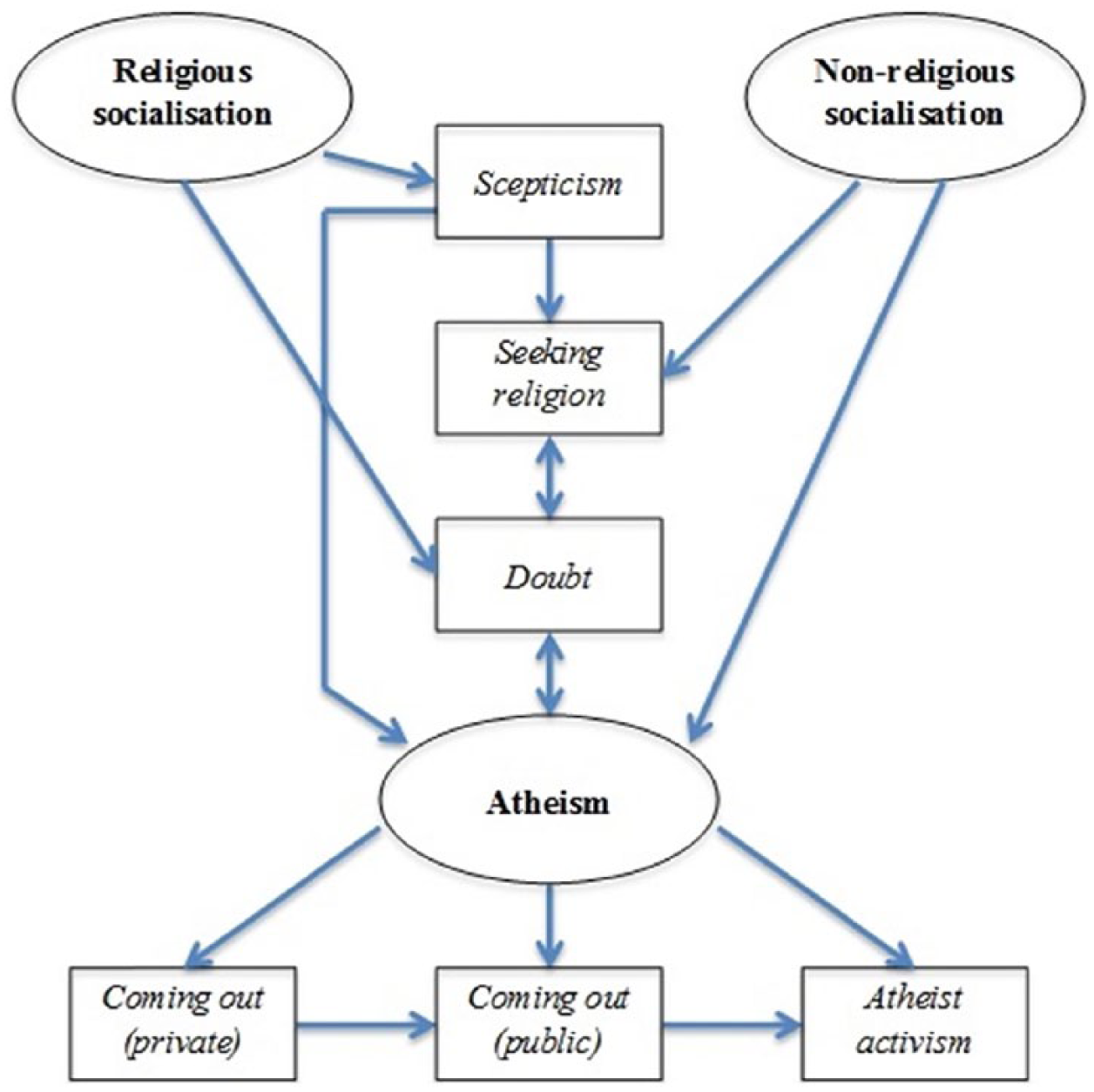
Possible trajectories to Atheism (adapted from LeDrew, 2013: 440)
Although the above model was developed with data collected from adults, the concept of multiple pathways to non-religion is also relevant for children and young people. Madge and Hemming (2016), in their research with 13–18 year olds in multi-faith English localities, found that although the majority of non-religious participants in their survey (63.1%) reported quite or very similar religious views to their mothers, a substantial proportion of respondents did not. Similarly, the British non-religious young people aged 16–26 in Catto and Eccles’s (2013) study demonstrated their agency through a range of positions in relation to their parents, including adopting similar beliefs, privately questioning their parents, openly debating and negotiating with family members, and adopting contradictory or combative stances.
Studies such as Sheard (2014) have identified a range of reasons given by adults for their non-religious stances, including disagreement with religious beliefs or practices, negative experiences of religion or religious authority figures, personal trauma such as the death of a loved one, involvement in radical politics, commitment to science or logic, positive experiences of other atheists, general indifference to religion or non-religious socialisation. More research is required that properly engages with young voices to ascertain the relevance of this work for those who adopt a non-religious stance in contrast to their parents. Even less is known about the process of socialisation into a non-religious family, including the everyday experiences of children and young people in different contexts, something that would lend itself to the use of creative child- and youth-centred methodologies to investigate values and relationships.
Notwithstanding the above, a quantitative strand of the literature has long considered the extent to which religious traditions achieve successful transmission between the generations, and non-religion is a growing focus in this regard. For example, Merino (2012) found that recent cohorts of children raised as non-religious in the US, are less likely to revert to a religious tradition in adulthood than was previously the case. Another line of quantitative enquiry is concerned with the outcomes of socialisation. Manning (2010) highlights how this literature sees religious affiliation as a beneficial influence on childhood, because of correlations with outcomes such as low levels of risky behaviour, truancy, sexual activity and high levels of emotional wellbeing, values of honesty and compassion, and engagement in the community (e.g. Smith and Denton, 2005). As a whole, this body of work often reflects the common perception in the US that non-religion is damaging for children, an idea rooted in particular constructions of childhood as naturally innocent and in need of religious protection or sinful and in need of religious guidance (James et al., 1998).
However, Manning (2010) argues that it is difficult to establish direct causation between children’s outcomes and religion and there is evidence to suggest that reported benefits are actually a result of the moral framework, learned competencies and social and organisational ties associated with religious organisational belonging. In this respect, similar benefits could be gained through involvement in non-religious communities or other socio-political organisations. Furthermore, a separate body of research exists that refutes the stereotype that non-religious adults are less moral than religious ones on a range of measures including altruistic behaviour, moral reasoning, and involvement in crime (e.g., Caldwell-Harris et al., 2011; Didyoung et al., 2013). This is therefore an area that requires more research to explore these apparent contradictions, including the role that cultural context and social constructions of childhood might play in the relationship between non-religion and children and young people’s developing morality.
Discrimination and exclusion
In many contexts, non-religious people represent a minority group and studies have documented the extent to which adults in these groups experience discrimination. Edgell et al. (2006) report that in the US, atheists are less likely to be accepted than any other minority and Hammer et al. (2012: 46) highlight the need for more research into this ‘potentially serious and overlooked form of discrimination’. They argue that such research could challenge the debate about religiosity and its positive influence on health and wellbeing, as it could be discrimination and social marginalisation, rather than lack of religion per se that has a negative effect on wellbeing for non-religious individuals. This is particularly pertinent in the context of research on children and young people’s life outcomes as discussed in the last section.
Drawing on large-scale survey analysis, Cragun et al. (2012) show that 22 percent of non-religious adult respondents in the US reported discrimination in one or more contexts, including social, family, workplace, school, military and volunteer organisations. Those identifying as atheists or agnostics fared worse than non-religious respondents in general, with 43 percent reporting discrimination in one or more contexts. Hammer et al. (2012: 46) surveyed adult atheists in the US to investigate different forms of discrimination. The five most frequently reported were: witnessing anti-atheist comments in the media (94.7%), being expected to participate in prayers against one’s will (79.1%), being told one’s atheism is wrong or immoral (75.2%), being asked to attend religious services or participate in religious activities against one’s will (74.4%) and being treated differently because of one’s atheism (67.5%). Again, those participants with stronger or disclosed atheist identities tended to report higher levels of discrimination.
Research in the UK has revealed a more mixed picture. The non-religious adults in Mumford’s (2015) research emphasised the privileged position that religion maintained in public life, for example through representation in parliament. There was a feeling that non-religion lacked in status compared with religion, and whereas religious people demanded respect from others, non-religious people did not always receive the same respect in return. This led to some reluctance from many interviewees to openly express their non-religious beliefs or identity with family and in work. In contrast, the young British atheists in Catto and Eccles’s (2013) study viewed themselves as part of the mainstream majority, constructing religious people as the minority group. They were much more likely to struggle with personal and family relationships than experience discrimination at the institutional level. Hemming and Madge (forthcoming) found that their non-religious participants aged 17–18 from English multi-faith localities reported varied experiences. These ranged from acceptance from peers, to uncertainty about others’ views, to overt insults and intolerance.
The above findings draw attention to the significance of national context for non-religious discrimination and exclusion. As a highly religious country, non-religion is less likely to be accepted in the US compared with other less religious contexts. Research in the UK has thus tended to highlight processes of exclusion more than overt discrimination. However, findings may also be influenced by the age of participants, as certain age groups may be more susceptible to, or aware of, discrimination and exclusion than others. Two environments that are particularly pertinent to children and young people are the family and education, and both warrant more research attention. Existing studies in these areas have shown how exclusionary experiences can often be quite similar for those with a non-religious and a religious affiliation (particularly in the case of minority religious groups), highlighting the close relationship and the fluid boundaries between the two concepts, as discussed earlier in the article.
Zimmerman et al. (2015) investigated the consequences of ‘coming out’ as an atheist to one’s family, drawing on qualitative research in the US. They highlight how this can be a complex and difficult process because of the potential negative reactions from family members. The authors argue that responses to the disclosure of an atheist identity are dependent on the dominant pattern of family functioning and the level of cohesion, communication and adaptability present in family dynamics. Although these findings were based on research with adults, the issues may also be significant for children and young people developing non-religious identities in the context of a religious family. For example, some participants in the Hemming and Madge (forthcoming) study felt that non-religious young people from minority religious backgrounds could encounter particular challenges if non-religion was viewed as less acceptable within their family and community.
Another key context within which exclusion may take place, but also where it might be challenged, is education. Despite some discussion in the literature on the place of non-religion in Religious Education (e.g. Barnes, 2015), there are very few existing studies on non-religious pupils’ experiences of the curriculum or on their relations with religious pupils. However, Weller et al. (2015) conducted research in the UK on the experiences of education for different religious groups more generally. They found that non-religious pupils often complained about the lack of coverage and recognition for non-religion in Religious Education, whereas non-religious parents were worried about the nature of their children’s participation in religious assemblies, visits and events run by schools. In the same study, pupils and parents from a number of other religious groups also recounted similar examples where they had felt unfairly treated in educational contexts, further underlining the interconnection between religion and non-religion. Of equal importance for future research are the ways in which non-religious school pupils actively respond to the exclusionary situations they are presented with, such as subtly and quietly declining to participate in prayer requirements (Hemming and Madge, 2012).
Directions for future research
In reviewing some of the existing social scientific literature on non-religion, the scarcity of research on childhood and youth is clear to see. Although a few of the large-scale studies on young people, religion and values offer some limited analysis of the ‘no religion’ group, only a handful of smaller projects have focused solely on non-religious teenagers and much of the research takes religion as a starting point. As for children in the pre-teen years, there is almost no research on non-religion that concerns itself with this age group, aside from studies that explore events or communities where children may be involved circumstantially. This is a real omission given that the views and experiences of children and young people offer the potential to contribute to knowledge of non-religious identities, beliefs, practices and communities. Similarly, constructions of childhood and youth are likely to be important for making sense of non-religious cultures, just as they can be for understanding religious ones.
In this article, I have outlined a number of ways in which a child- and youth-centred approach to the study of non-religion might be developed. Firstly, children’s and young people’s voices need to be properly heard in order to take seriously their views, experiences and lived realities, rather than relying on parents or professionals to speak for them. Secondly, a range of methodological approaches should be employed in order to access their perspectives, including more sophisticated and consistently used survey techniques and categories, in-depth qualitative and ethnographic methods to enable more complex understandings, and innovative child- and youth-centred methods, such as creative and web-based techniques to explore values and relationships and facilitate the involvement of younger children. Thirdly, research needs to take into account that ‘children’ and ‘young people’ are heterogeneous categories, with multiple childhoods stemming from variations in culture and locality, as well as intersecting social differences such as class, gender and ethnicity. Fourth, researchers should avoid assuming that children are passive and incompetent, being sensitive to instances where they demonstrate agency, for example in negotiating socialisation processes. Finally, the more abstract categories of ‘childhood’ and ‘youth’ and their relationship with non-religion, for example regarding ethics and morality, need to be considered critically and with reference to wider social and cultural contexts.
In the remainder of this section, I offer a number of questions pertaining to childhood, youth and non-religion, presented in Figure 2, which I hope might act as a starting point for those interested in pursuing future research in this neglected field of enquiry.
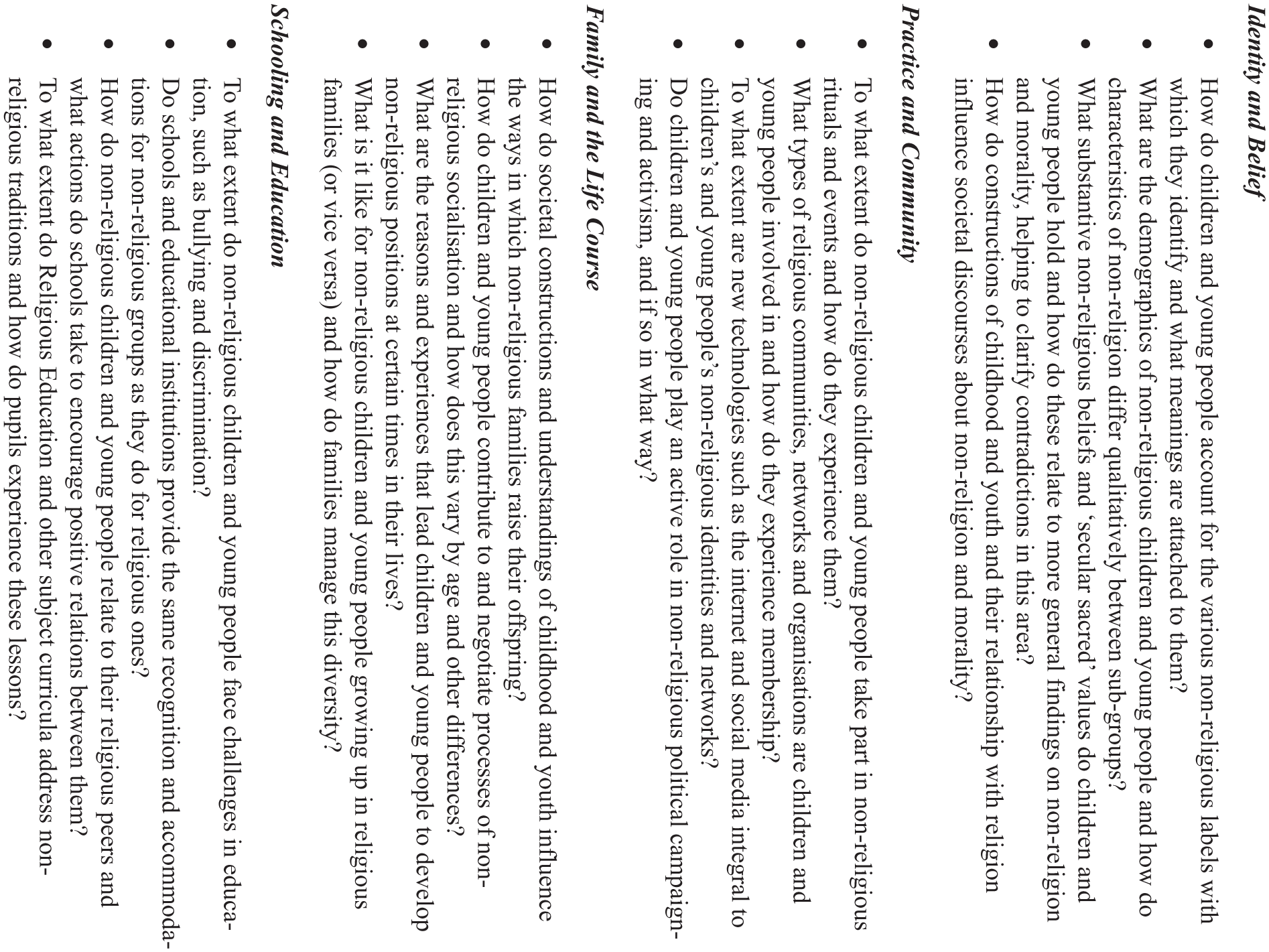
Possible research questions for a child- and youth-focused approach to non-religion
Footnotes
Acknowledgements
Thanks go to Richard Gale and two anonymous reviewers for comments on earlier drafts of this article.
Funding
This research received no specific grant from any funding agency in the public, commercial or not-for-profit sectors.
Author biography
Address: School of Social Sciences, Cardiff University, 1.22 Glamorgan Building, King Edward VII Avenue, Cardiff, CF10 3WT, UK
Email: