




Abstract
In this study, we focus on the role of religious beliefs in initiating (de)conversion processes, based on 43 interviews with people who have (de)converted from/to the Islam, Christianity, Judaism or a secular worldview in Flanders in the last 5 to 10 years. While in everyday discourses on religion, religious beliefs are interpreted as the sole reason why people belong to a religious community or why they leave or change this community, we wanted to investigate how factors at the micro-, meso-, and macro-level influence such beliefs which are at the heart of (de)conversion processes. Thematic analyses were conducted to understand the relatively recent (de)conversion pathways, using a multi-level perspective. Three main themes were revealed from our data analyses: (1) finding meaning in life events and life, (2) change in significant others and reference groups, and (3) secularising society.
Introduction
Increasing numbers of people have undergone religious (de)conversion processes, in which they have distanced themselves from a current religious tradition or converted to another religious tradition. These (de)conversion processes imply a set of changes in beliefs, emotions and behaviours that involve a departure or exit from the current experience and manifestation of religiosity (Nowosielski and Bartczuk, 2017; Rambo and Haar Farris, 2012). In sociology of religion, there is a long tradition of debates about the role religion has in postmodern societies. On one hand, proponents of the ‘secularisation theory’ (Bruce, 2011; Swatos and Christiano, 1999) argue that in more industrialised, urbanised and rationalised societies, religious authority has lost its importance in society. This contrasts with proponents of the ‘religious economy’ or ‘religious market approach’, such as Finke and Stark (2003) and Iannaccone (1992), who argue that it is not necessarily the demand for religion that is declining, but rather the supply side of religion, which is not always attuned to people’s religious needs. Increased religious competition and pluralism are necessary for religion to (again) play a greater role in society. Whereas the former is mainly exemplified by the decline of religious followers in Western Europe, the latter often holds true in the Northern American context (see, for example, Introvigne and Stark, 2005). European authors (e.g. Stolz et al., 2016), synthesise insights from secularisation and religious market approaches by coining the idea of ‘religious-secular competition’, arguing that secularisation has given individuals greater autonomy over their religious lives, thus driving the development of religious markets. Once religion becomes a ‘choice’ rather than a social and moral obligation, religions are forced to compete in the marketplace of meaning systems, competing with both religious and secular alternatives.
While these academic debates make clear that individual religious beliefs and (de)conversion processes are embedded in larger societal structures and developments, surprisingly little sociological research has studied processes of (de)conversion. Some earlier research on religious and spiritual (de)conversion has focused already on the formal trajectories that people follow, changing their religious identification and affiliation (e.g. Streib et al., 2009), but less on how people experienced these changes. Focusing on these (de)conversion changes in beliefs however is relevant because, in an increasingly secularised society where religion is often the subject of polarised public debate and people can ‘choose’ between different religious and secular offers. In these settings, the reasons for leaving or joining a specific religious denomination, are not necessarily rooted in the religious beliefs per se. Therefore, (de)conversion cannot be seen in isolation from religious praxis, religious communities and networks (including social pressures, support, and networks), and religious practices (Vliek, 2019a, 2020, 2021).
This study explores how individuals involved in conversion processes perceive their experiences and reflects on how various societal factors and developments shape (de)converts’ religious beliefs and their need for religion. Our sociological approach analyses the diversity, intensities and variations of religious beliefs that characterise both conversion and deconversion processes from/to Islam, Christianity, Judaism, and a secular worldview. This is a worthwhile endeavour, as most research to date has focused on a specific religion (e.g. Islam: Leman et al., 2010; Vliek, 2019a, 2020, 2021; Vroon-Najem, 2019; or Christianity: Stronge et al., 2021). Nevertheless, several commonalities can be found regardless of which religious group one moves from and to. These commonalities will be considered within their religious contexts, recognising the specific specificities of each religious community, organisation and affiliation. We will compare how people (de)convert from and to different religious affiliations to identify similar patterns and to explore the uniqueness of such changes. This study therefore addresses the following two research questions: ‘How do individuals experience recent (de)conversion processes involving three important religions in Flanders – Islam, Christianity, and Judaism – as well as shifts from atheism or secular worldviews to religion, and how do these experiences vary across different belief systems?’.
Theoretical approaches to (de)conversion processes
The conceptualisation of the terms ‘conversion’ and ‘deconversion’ requires a broad interpretation, which also affects our methodology. Both processes do not consist of one specific pathway and often pass through several stages (Halama, 2015). Moving into a religion can often be more easily defined in terms of change in religious/spiritual beliefs or entry in a religious community, regardless of the motives for conversion, compared to those who leave or still identify but no longer believe. As mentioned by scholars (e.g. Enstedt et al., 2020; Streib et al., 2009; Streib and Klein, 2013; Vliek, 2019b, 2020, 2021), deconversion goes beyond stopping to actively engage and behave according to religious norms and practices. Deconversion does not necessarily mean that people would no longer hold religious or spiritual beliefs (Streib and Klein, 2013). This complicates empirical research on the topic. For analytical purposes and clarity, we will refer to conversion and deconversion in a general and descriptive way, referring to a public change in affiliation. In our empirical results, we will differentiate more clearly between religious affiliation and religious/spiritual beliefs.
In addition to a comprehensive conceptualisation, the study of (de)conversion requires a multidisciplinary approach that moves beyond purely theological or religious definitions of the concepts of ‘deconversion’ and ‘conversion’ (Rambo and Haar Farris, 2012), to include emotions and broader social aspects, such as community responses, social mobility consequences or ethnic boundaries (Leman et al., 2010). When it comes to conversion, approached from a more psychological perspective, Granqvist (2003) distinguishes between a classical (or so-called ‘crisis’) and a contemporary paradigm. The classical paradigm focuses on the conversion processes of so-called ‘sick souls’ or people with insecure or changing attachment characteristics. They experience conversions as intense, sudden and strongly self-transforming during a period of great discomfort (Streib and Keller, 2004) or identity crisis (Jindra, 2021). The contemporary paradigm on the other hand holds that conversions are often gradual and less self-transforming, and are often initiated by active subjects in search of meaning. Hence, Gooren (2007) sees conversion processes in terms of the different intensities and variations with which people participate religiously and change religion. These paradigms differ in the presumed linearity and problematic nature of (de)conversion processes, which affects how they approach the cause or trigger that leads to (gradual/sudden) (de)conversion.
Bringing in a broader sociological perspective, our research is inspired by the latter paradigm to consider conversion and deconversion trajectories that are not linear and static over time. In addition, we aim to look at how individual religious beliefs are shaped by broader community and societal aspects, including ethnic and social boundaries (e.g. Leman et al., 2010) or expectations (Vroon-Najem, 2019). This follows the current research trends that focus on the influence of macro-, meso-, and micro-level factors in shaping and intensifying (de)conversion processes, and in understanding the journeys people take when leaving or joining a new religion.
At the macro-level, societal changes, such as secularisation and increased diversity in society can make it easier to distance oneself and change one’s religious affiliation. In most European countries, religious and secular alternatives compete for the attention of individuals who see their religion or worldview as a ‘choice’ rather than an obligation (Stolz et al., 2016). In mono-religious countries, however, the dominant presence of one religion and the lack of pluralism can be an obstacle in and for (de)conversion processes. Prevailing stereotypes in society, discrimination or stigmatisation of (certain) religious and non-religious affiliations can play a role in the decision to distance oneself or change one’s worldview. At the meso-level, organisational and institutional factors can facilitate or hinder (de)conversion processes. Expectations, reactions and potential mechanisms of discrimination and exclusion within and outside religious communities can create some complications (Jindra, 2021). The ‘cost’ of the initial transition to another religious conviction may be higher than the expected ‘return’, but the will to be ‘authentic to oneself’ may prevail (Fazzino, 2014). At the micro-level, specific life stages and personal crisis experiences can play a role. Puberty and adolescence seem to be particularly relevant as people are more likely to question their religious identity in the context of a broader identity formation process (Nowosielski and Bartczuk, 2017), intellectual quests and (personal) crisis experiences (Rambo and Farhadian, 2014).
The role of religious/spiritual beliefs in (de)conversion trajectories
Given the multi-level factors influencing (de)conversion trajectories and their gradual nature, we want to understand how people who have converted or left their religious tradition perceive the role of religious beliefs in this process. There are various typologies of conversion or deconversion. For instance, Streib et al. (2009) focus more extensively on ‘exiting’, taking a psychological approach and looking at the alternative religious options. Although very relevant when focusing on religious beliefs, the social spheres, identity formation and community ties in which (de)conversion trajectories take place are less considered. We therefore build on Vliek’s (2020) framework, in which she considers different social spheres, rather than focusing exclusively on the loss of (Islamic) faith. Although she does not explicitly use a multi-level approach to (de)conversion, her typology acknowledges the need to ‘recognise matters outside of one’s former religion or identity and the relative weight given to religion in one’s narrative’ (Vliek, 2020: 145).
She distinguishes five themes: (1) ‘The religious break’, (2) ‘The social break-away’, (3) ‘The entrance’, (4) ‘Unconscious secularization’, and (5) a combination of all the previous themes. The first theme, ‘The religious break’, is used to describe people who have lost their religion, including people’s belief systems crumbling because of doubt. This process is often triggered by an emotional event or trauma. Vliek notes that it is common for these people to build a new identity based on their former religion (e.g. as an anti-religious atheist or a critical ex-Muslim) and feel the need to share their newfound identity with others. The second theme, ‘the social break-away’ focuses on people who drift away because of the socio-religious impositions and restrictions, which often happens when young people search for a new version of themselves after leaving their parental home. Third, ‘the entrance’ is about people exploring new identities, such as activism or cultural identities. In her study, this is more about becoming familiar with new identities than about leaving their Muslim identity. Doubts about their beliefs arise because they question whether their new identity is compatible with their old one. In the fourth theme ‘unconscious secularisation’, people move away from their religious identity in a rather uneventful and unconscious way, often during adolescence. The last theme, which is a combination of the previous ones, consists of overlapping themes.
These themes should not be seen as chronological; they are intertwined, although one theme may be more dominant than another. Vliek (2020) does not ignore the religious and psychological reasons behind deconversion, but she acknowledges the impact of social networks on ongoing processes. Furthermore, she steps away from terms such as deconversion, preferring to speak of ‘moving out’. This narrative allows for a more nuanced view that acknowledges the stressors of transitions, such as the loss of predictability and the sudden new biographical options (EGRIS, 2001).
The religious context in Belgium
Belgium has been characterised by three major religious and sociological trends over the last century: (1) secularisation, (2) de-pillarisation, and (3) increasing religious diversity. First, as in many other Western European societies, Belgium has undergone a relatively strong process of secularisation (Dobbelaere et al., 2011). Until the Second World War, Catholicism was dominant in Belgium. It declined in Wallonia and Brussels in the mid-1960s, followed soon after by Flanders, resulting in a sharp decline in church attendance. Recent figures show that regular church attendance in 2018 and 2019 was only 2.6% (Verschraegen and Abts, 2021). Nevertheless, 62% of people of Belgian descent still identify as religious (Stuyck et al., 2018). This is mostly in the form of ‘believing without belonging’, where they don’t want to be associated with the Church, or ‘belonging without believing’, where they call themselves Christians but don’t really believe in a God or the afterlife, often referred to as ‘socio-cultural Christians’ (Davie, 1994).
A second characteristic in Belgium is the high level of pillarisation, meaning that several organisations and activities, such as schools, newspapers, labour- and youth movements, were aligned to a religious or political identity. This resulted in the creation of segmented and powerful blocs or ‘pillars’ (Catholic, Socialist, and Liberal). People were born into a pillar, which determined where their daily lives took place and their social networks. In the post-war period, a process of de-pillarisation began which resulted in religion becoming less important in shaping daily life, providing more opportunities for (de)conversion (Hellemans, 2020).
Third, since the Second World War, Flanders has experienced a strong growth of religious diversity due to increased international migration to Belgium (Geldof, 2015). This resulted in the presence of ‘new’ religions such as Islam and the evangelical churches and a greater variety of religions in general. Due to migration, as well as individualization, there is now also more variation within religions. Migration and secularisation can also lead to generational differences within a religion, with younger people interpreting their faith differently from the older generation (Abaâziz, 2021; De Hoon and Van Tubergen, 2014; Smits et al., 2010; Van Tubergen, 2013). All this can trigger (de)conversion processes.
Methodology
Research design
The data were collected for a project commissioned by the Flemish government, wherein 43 respondents were interviewed (Klaver et al., 2023). The selection criteria for our sample were (1) deconversion from atheism, Christianity, Islam, or Judaism (with possible conversion to another belief); (2) having undergone this change within the last 10 years; and (3) residence in Flanders or Brussels. We sought variation in migration background, gender, age and sexual orientation. During recruitment, we also included participants in a more ambiguous situation, not just those with a clear break from their former beliefs (see also Vliek, 2019a, 2019b, 2020). Participants were recruited through organisations, religious leaders and social media, followed by snowball sampling. To ensure a balanced representation across religious affiliations, targeted efforts were made via social media, personal networks, churches, and organisations focussed on (de)conversion. The process was supported by an expert committee of key figures from religious communities, civil society, policy makers and academics.
Recruiting individuals moving in or out of Judaism was most challenging due to the lack of supportive organisations, language barriers, and low digital literacy. Many (older) ex-Christians were eager to participate but had left their religion too long ago to fit the study’s criteria. Concerning Islam, we opened our recruitment criteria, as it was easy to find converted Muslims to participate in our interviews, but few who identified themselves as ‘deconverted’ Muslims, but rather as ‘cultural Muslims’ (e.g. Vliek, 2019b).
Data were analysed thematically (Clarke and Braun, 2017), contrasted with Vliek’s (2019a, 2020, 2021) categorisation, and using NVivo software. Ethical approval was obtained from obtained from the Ethics Committee for the Social Sciences and Humanities (SHW_21_142) at the University of Antwerp. All data were anonymised and pseudonymised. The first author conducted the interviews in close collaboration with the other authors. Her researcher positionality was taken into account during the data analysis and given the sensitive topic, great care was taken to establish a trustful relationship between the researcher and the participants.
Sample characteristics
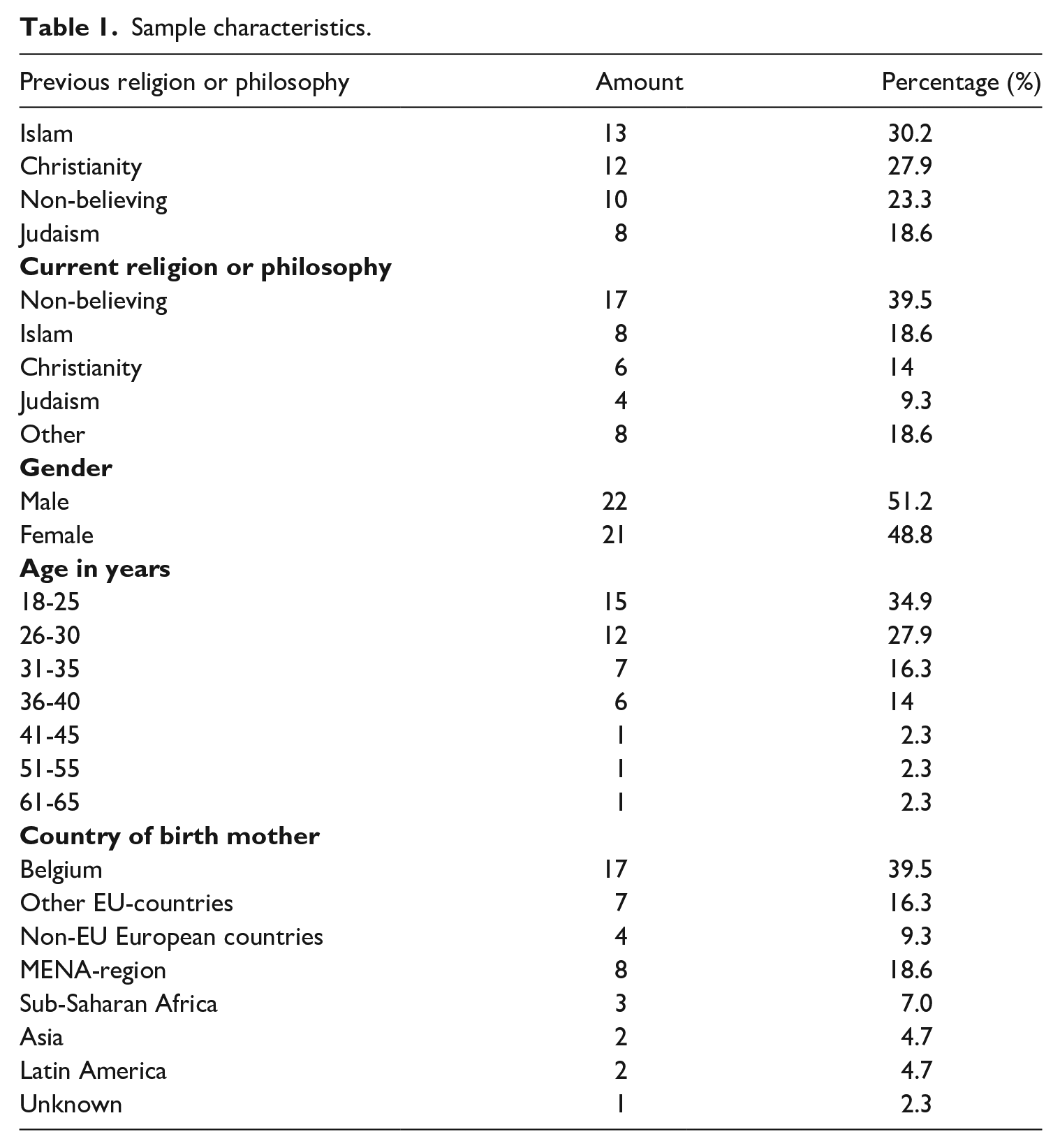
As shown in Table 1, a total of 43 participants (22 males, 21 females) took part in this study. For analytical purposes we mention ‘new’ and ‘old’ religion, but this does not necessarily imply a hard break. Respondents who consider themselves ‘agnostic’ are included in the category of non-believers. For many people who left the Islam, it was hard to identify as ‘atheist’ or denounce religion. Their loss of religious belief did not always mean disaffiliation, and so they mostly categorised themselves as ‘other’, seeing themselves as cultural Muslims.
Sample characteristics.
Results
We started from participants’ individual experiences to understand the micro-, meso-, and macro-level factors mentioned as influencing their religious beliefs, and experiences when changing religious groups or stances. At the micro-level, religious beliefs were challenged when faced with hardship or specific life events, or when participants felt that their religious beliefs were not in line with those of their religious affiliation. At the meso-level, one’s religious beliefs were also challenged by one’s social networks, and especially by peer groups, which often changed as people moved into different life stages or new social environments. Finally, changes in peer groups or significant others can also trigger or challenge one’s religious beliefs, resulting in conversion or deconversion. While many of these changes in religious beliefs occur gradually, it was often difficult for participants to distinguish between religious affiliations and beliefs. In line with earlier conceptualisations of deconversion (Enstedt et al., 2020; Vliek, 2019b, 2021), none of the participants in our sample would describe themselves as ‘atheist’, at this point in their process. Words such as ‘agnostic’, ‘spiritual’, and ‘cultural’ were used to describe their new position, referring to ‘disaffiliation’ rather than having no religious/spiritual beliefs. People who converted to a religious affiliation were more likely to identify as religious as they also referred to it in this sense and identified themselves as such.
Micro-level: finding meaning in life events and life
Difficulties and hardships in life
Major events, setbacks or mental problems were frequently mentioned as a driving force behind a process of (de)conversion. A difficult period can lead people to turn to a specific religious affiliation or a particular philosophical tradition or develop religious/spiritual beliefs. Several respondents indicated that they had struggled with psychological problems or had been in a difficult situation in the past, and that religion gave them something to hold on to. Respondents who had faced more difficult periods in their lives referred mainly to the meaningful function of ‘believing’, and not necessarily to the experience of being supported by a religious community:
I’ve had a few setbacks in my life. Then I went for a walk here in the Kempen [rural area north of Antwerp] greenery and after a few walks I encountered God. I thought there must be a reason for this, couldn’t it be otherwise? There must be a plan behind it. That was the very first beginning. (Dennis, from Atheism to Christianity)
Similarly, Didier, who converted from Atheism to Christianity after a period full of hardship, mentioned that he ‘really experienced that as a safety net, started praying, and found peace in it’. Or Jara, who converted from Atheism to Islam, mentioned that religion became important when her relationship with her father was deteriorating, stating: ‘I couldn’t find it anywhere else, and I was looking for a faith that provides something to hold on to and is always there’. This need for support led some respondents to search for a meaning in life, and to find it in religious beliefs. Others indicated that they questioned all certainties, especially during difficult periods, which also affected their religion. For instance, when you believe everything is happening according to a bigger plan, but when you simultaneously see setbacks piling up:
Around the age of 17 I had a lot of difficulties. I have always had a difficult life, in the sense that my parents are divorced, we are second generation [migrants], my mother does not speak Dutch, and I have had a lot of financial difficulties. But I always believed in the fact that one day things would work out. (…) I saw that people who were not so religious or not so correct were doing very well. I started to question a lot of things. Is this what I deserve? Because I have always done more for my religion than anyone else. I have always been very polite, always very pure. I have never drunk a drop of alcohol, I have never had sex, why do I get this? (Berra, deconversion from Islam to Other)
Berra felt that she was not being rewarded for her good behaviour and actions, which made her question the added value and proof of God. For Marouane (from Islam to Other), there was a specific negative event in which his niece was badly burned, which made him question the existence of God:
I started to communicate like ‘why are you doing this God, why does a child have to suffer? It’s an innocent pure child’ and I really felt a kind of anger within myself. Because I really valued my relationship with God so much. (…) After a while, you realise you are fooling yourself. You’re forcing yourself to believe in something, but I couldn’t explain it to myself anymore.
These experiences seem to relate mainly to the legitimising role that religion can play in giving meaning to or justifying life events and social relationships. Our data shows that in more difficult periods, religious certainties (‘everything will be alright’) are challenged and people look for other meanings and try to ‘hold on’. If this support does not come sufficiently from the religious community and/or meaning, they break with what is familiar and look for ‘change’.
Search for better religious alignment
When it comes to conversion, faith itself is often cited as a reason. Non-believers or ‘cultural believers’ who convert to a religion often say that they have always had some interest in religion, or the language and/or culture associated with it, to meet their ‘spiritual hunger’ or after struggling with important life questions. Theo described himself as an ardent atheist and often argued with believers, but gained more respect for believers through these debates:
Then I looked at myself and said all atheism does is invalidate things, inherently. You can also see it as faith, as a countermovement to other faiths, but I was still hungry in a way. (Theo, Atheism to Christianity)
Some religious respondents changed affiliation because the other religion suits them better:
Leviticus 11 says: ‘You shall not eat pork’ and every Christian I know eats it. Even though they are very Catholic, they wear their cross and all that stuff. So, when I tell them that, they say ‘yes, that’s okay’ and then I think, that’s not okay, that’s literally the basics. Whereas Islam does a lot more with that. If I ate pork, everybody would be like ‘Whaaat, no girl’ [laughs]. (Lara, conversion from Catholicism to Islam)
This quote illustrates that in the Belgian secularised context, where Christians often do not practice their religion, the Islam provides more structure, because rules are clearly set out and followed.
Troubles in life or a search for a better fit in another religion were cited as triggers for conversion. Participants found comfort in their beliefs and prayers but felt they had to change religion because their former denomination’s ideas didn’t meet their needs. This in line with Vliek’s (2019a, 2019b, 2020, 2021) ‘religious rupture’ which suggests that people who experience hardship lose their religion and doubt their belief systems. This includes those who have converted.
Meso-level: changes in significant others and reference groups
New peer groups during adolescence and when transitioning into adulthood
An important period in which religious questions were raised was adolescence. This could be due to the overrepresentation of young participants in our sample. During adolescence, participants frequently questioned themselves, including their religious beliefs and affiliation:
In any case, age, because I think you become more your own person when you turn 20. (…) So, you start to live away from your parents and you start to question things. Like why was this normal in my house, why did we do this? (Linde, from Christianity to atheism)
Adolescents and young adults are developing their identities and reference groups, wondering who they are and which group(s) they belong to:
At the age of 18, I had to continue studying and that’s when I started thinking more about it: ‘Gosh, where do I actually belong and is this what I want?’ That’s when it really started. I thought, this doesn’t really suit me and why am I saying I’m a Muslim when I’m not or I don’t feel that way anyway. (Inara, from Islam to Other)
Changing peer groups and entering different life phases led many participants to question their whole life and belief system. Belonging to a group, developing one’s own identity and searching for meaning play an important role during adolescence or young adulthood and can stimulate both deconversion and conversion processes.
Changing social environments
The transition from adolescence into adulthood was characterised by changing identities. This theme could be extended, as many respondents indicated that changes in their social environment also triggered (de)conversions. Persons or groups in one’s environment can have both an attracting and repelling effect. This could be related to how religion was dealt with in one’s upbringing, the endorsement of certain religious values, the engagement in certain religious practices and social restrictions. Some participants indicated that they never had much focus on religion in their youth, or that they experienced a change in their religious expectations or even a change in religious beliefs in their social environment or family. Significant others played a crucial role in (de)conversion processes, whether they had a different religious affiliation (e.g. partner), changed religious beliefs (e.g. family members changing their religious practices) or met religious people. These friends, colleagues, or religious meeting places (e.g. a student association, the pastoral care service of universities) often arouse an interest in a religion or religious community. For example, Tim lost interest in Catholicism because a new priest joined his church community who ‘didn’t appeal to him’, as he puts it:
That was a real break for me, I had a great attachment to that man because he was inspiring, charismatic, and then a typical boring Flemish priest came along who just read that in his sermon. (Tim, from Christianity to Other)
As Tim deconverted, it seems that a change in religious beliefs followed disaffiliation. Other interviews showed that there was not always enough space in the religious community to express questions or doubts or that their expectations did not fully correspond to the characteristics of their religious community. For example, two respondents from the Turkish community mentioned that because the Quran is taught in Arabic, and they do not speak Arabic, they could not learn about their own teaching. By deviating from the obligations of their religious teachings, they did not feel strengthened by their social networks and consequently in their religious affiliation:
Because we are Turkish, we just read it, but I really don’t know what it says. So, I thought I have to do a little ‘research’. I went to the library and borrowed a Dutch version of the Quran. My grandmother heard that and my uncle and others were like: ‘Why do you want to read that? That is not allowed, you can only read the Quran in Arabic, the original language’. I was like, I need to know what it says? They started judging me: ‘Do you have doubts?’ ‘No, but I still want to know what it says!’ (Sedat, from Islam to Other)
In addition to criticism or specific religious practices within the respondents’ social networks, there were regular references to social pressures within the religious community itself. Elizabeth grew up in France where her Jewish religious community was rather liberal. She moved to Antwerp with her (ex-)husband and ended up in the Orthodox Jewish community. She found the contrast very difficult:
They are exactly two different religions; you are really cut off from the world here. In France you can work, wear normal clothes, have internet, television at work, you can do whatever you want. Here you must stay in the same area, in your bubble. Elizabeth (from Judaism to Atheism)
Similarly, Michiel, who deconverted from Judaism to atheism, puts it this way: “These doubts or questions were not about God, but about my community’. He was not questioning ‘his God’ so much as his specific religious community.
Finally, migrating or travelling can often be a moment when respondents begin to question just about everything, including their religion or philosophy. A change of environment can trigger a loss of faith, often because of the freedom suddenly experienced. The move or migration can be relatively short in distance or timespan, but also refer to longer moves, such as when someone goes on a long trip or studies abroad for a year, or long term, such as moving to another country or city. Travelling can also spark an interest in other religions:
I was brought up in this religion. I was baptized in the church just across the street. I never really questioned it until I started to travel and encountered other religions. It kind of strengthened my cultural identity and my religious affinity. Christina (from Christianity to Other)
Jara’s interest (converted to Islam) increased when she moved from a village to a central city and was exposed to many more cultures. Conversely, geographical stability can also influence conversion processes. For example, Clara (converted from Christianism to Judaism) grew up in the Jewish neighbourhood of Antwerp, which aroused her interest in taking Jewish lessons and eventually converting.
In line with Vliek’s (2020) theme of ‘the social break-away’, many respondents questioned the socio-religious restrictions and limitations when changing social environments, during adolescence, the transition to adulthood, or after geographical mobility. Our interviewees were not only looking for places where they belonged but also for the ‘right’ reference groups, which coincided with their search for a ‘new’ identity. Similarly, changes in one’s social environment, including changes in religious practices, communities, beliefs of significant others in people’s lives, all of which sometimes resulted from geographical mobility, were found to have a similar effect.
Macro-level: a society with competing secular and religious meaning systems
Reconciling religious beliefs with the context
When discussing turning points, many life phases and encounters led to questioning or changing one’s religious beliefs. Doubts and changes in one’s religious beliefs were not solely the main or only reason for a religious (de)conversion:
When I think about it afterwards, I concluded that I first decided that I wanted to become a Muslim before I even believed in it. And that I convinced myself to believe in it afterwards. (Oscar, from Atheism to Islam and then to Atheism)
These triggers or turning points led to changes in religious beliefs. For some respondents, the sense of believing in something simply disappeared, which is in line with Vliek’s (2020) theme ‘unconscious secularisation’. Nora, for example, had always been a Christian. She had bought a necklace with a cross on it, but it felt wrong for her to wear it because she didn’t feel like that anymore, nor felt she could represent that faith. She later converted to Islam. Respondents also felt that religion no longer served them. Eefje lost her faith in God because she realised there was no point in praying for anything:
I wasn’t getting what I wanted from God. (…) I just realised that there is no point in praying or not praying because nothing changes, so it had no support for me anymore. (Eefje, from Christianity to Atheism)
These accounts highlight the mismatch between their individual needs and the offer of their religious affiliation, which supports the importance of having a religious economy to better fulfil one’s needs. For others, religion lost its importance in their lives. Nonetheless, many mentioned that religious practices and beliefs did not match their current needs. Although for this group of participants, religious beliefs and practices had become much less important, it remains unclear whether this is due to the lack of need for religion in general or whether the religious supply side is not adjusted to their needs. For Luisa, her deconversion was more about disaffiliation than stopping believing. It was not God who stopped serving her, but her religious community (i.e. the Greek Orthodox Church):
When I went to church, I remember there was a big party, and I went to church alone. I went alone to put flowers on the altar, and I remember being put in my place by a woman who worked for the church, I wasn’t supposed to do that. And I was like ‘what the f***?’ you know? I don’t need a special number to call God, this is ridiculous. (…) The problem is that these rules come up when I need support, or guidance or something. It’s like, hey, I need religion three or four times in my life, and when I do, it fails me. (Luisa, from Christianity to Atheism)
Many respondents lost their faith because, as illustrated by Tazim’s quote ‘there are many scientific errors that I believe could not have been made by God in any way’, as they are incompatible with modern science. These errors related to the Earth being flat or how the embryo and human life is created, made Tazim feel he could no longer believe in Islam. Tarik (deconverted from Islam to Other) went through his process together with Tazim (deconverted from Islam to Other). While it took Tazim some time to accept that God might not exist, it was quicker for Tarik: ‘For him, [Tazim], it took months to accept the idea that there is no God. (…) It didn’t take me that long, because I saw God as perfection. And if there is a flaw, it is not perfection’. Tarik was uncomfortable with the idea that some parts of the Quran were correct and others not. To him, one mistake meant that everything fell apart. Similarly, Rayi realised that the things he found ridiculous in other religions were also in his own:
It started when making fun of the Abrahamic God. And then I stopped for a moment and thought: ‘Wait, but that’s what we do. It’s the same belief system we have’. We also believe absurd things like that Muhammad went to seventh heaven at a very young age and came back the same night. And I don’t have a problem believing that, but if another person says, ‘This person had a divine revolution’ I would say, ‘Haha, that’s so stupid’. So that’s how it started. (Rayi, from Islam to Other)
Contemporary information and communication technologies facilitate switching faith or belief. For example, Arion says that a new world opened for him when he gained access to the Internet. He has had questions for a long time, but had not found the space in his community to ask them, and continued his search online:
I secretly bought a smartphone, which of course was strictly forbidden. Any form of technology and certainly the internet. So, I bought it secretly and then a world of anything and everything opened. Just read on the internet, Wikipedia. One site that opens and another link to another and so you just go Wow wow wow and on and on and on. And then I started joining and reading and watching Facebook groups as well. YouTube and all that. Until I lost my faith. (Arion, from Judaism to Atheism)
Participants mentioned encountering other ideas and beliefs, in science and technology, making it difficult to follow one’s own religious beliefs. Vliek (2019a, 2021) categorises this group as ‘unconscious’ as the secularising process occurred gradually.
Religious institutions and actors
A large proportion of respondents cite the values imposed by their religion or the institution behind it as the reason for their loss of faith, following the line of thought of the ‘religious economy’ theories (Finke and Stark, 2003). This is never mentioned as the sole reason, but always in combination with other factors. The Catholic Church scandals, for example, fuel existing doubts. As Tijl (deconverted from Christianity to Other) describes it: ‘And then all these abuses, these scandals came to light. The Pope, saying things like: ‘Don’t use condoms’, ‘contraception is forbidden’. You know? Of course, things like that don’t work’. Some former Muslims cite ‘9/11’ and the Charlie Hebdo attacks as moments when they began to question their religion because they now see how easily religion can be used ‘for your own gain’. Both queer and heterosexual respondents cite homophobia in religion as a factor in their deconversion. For most respondents, this was not the reason for their deconversion process, but something that ‘came on top’. For Tim, a statement by the Pope on homosexuality was a decisive factor in a longer process of doubt and alienation.
And then I thought no, this is really enough. There is nothing left to save here. I don’t have to wait another 10 years before I can feel partially accepted. And then I got debaptised. (Tim, from Christianity to Atheism)
This contrasts with Tarik and Sedat, who would not feel he had to disaffiliate if God would have loved homosexuals as well. Most respondents see homophobia as a characteristic of their church or religious institution, even if members of their networks did not explicitly mention their disapproval of their sexuality:
Then I really started to doubt myself: ‘I don’t really belong there because I like boys, and I know that’s not really in line with Islam’. Nobody else told me that, because it’s not up for discussion anyway, but I just knew it wasn’t possible. (Sedat, from Islam to Other)
His deconversion process followed several stages. There were periods when he was able to reconcile his faith and his sexuality, because the reactions of those around him were so positive:
Until I met friends here who were also very religious, but who also accepted me. Then I started to believe that ‘We can do it together’. Because yes, if they don’t ‘judge’ me too, there must be a chance that I could be a Muslim, right?
Although his trial is still ongoing, he suggests that his religious beliefs have weakened again since he fully embraced his sexuality. While certain characteristics or events within one’s own church or religious community are often cited as a reason for (de-)conversion, they tend to act as a reinforcing factor for existing doubts.
Discussion
The present study gives us more insights in how religious beliefs played a role in initiating (de)conversion processes in a society where individuals increasingly feel entitled to choose between competing belief systems, both religious and secular (Stolz et al., 2016). Our findings highlight the sociological importance of situating these beliefs within broader social processes. Important turning points and changes in one’s own environment or in the wider society may lead people to become more attached to their religious beliefs, to turn to other religions or communities, or to question their beliefs. The latter is relevant when religious values have not been followed within their own religious community, when they have needed support to face difficulties in life, or when their expectations of God have not been met. When people enter different life stages or geographical locations, they are often forced to reorient their lives, re-evaluate their practices, communities, and alter social networks, compelling them to rethink their religious beliefs – and how these are expressed and followed in their religious communities. This also highlights the ways in which religious beliefs should be perceived as valid and meaningful in people’s lives and in making sense of the society in which they live.
Our findings aimed to reconcile how the triggers that lead to a (de)conversion process also led to a questioning of existing belief systems. Using a multi-level approach to disentangle the emerging themes, we found that at the micro-level, (de)converted participants searched for meaning in life events and life, especially when they encountered hardships and difficulties in life, or they searched for a better fit between their religious beliefs and values and the actual religious organisation. This is in line with Vliek’s (2020) ‘religious break’, which suggests that people were genuinely questioning their belief system. Individual changes at the micro-level, such as the change of life stage – especially in the transition from adolescence to adulthood – often marked a change at the meso-level. At the meso-level, changes in the reference group through entering distinct institutions (e.g. labour market or educational institution) called for a revision of one’s social networks. Other participants who, regardless of their own life phase, experienced changes in their social environment also mentioned becoming more aware of their belief system and often questioning it further. This is in line with Vliek’s (2020) ‘the social break-away’, but should be interpreted more broadly, as it often also involves a search for social networks and a sense of belonging.
Finally, at the macro-level, in line with both the ‘secularisation theory’ and ‘religious markets’ theories, our findings support the idea that individuals can increasingly choose between competing secular and religious meaning systems (Stolz et al., 2016). When actual religious institutions and practices do not meet the needs of their members, for example, when participants become aware of the mischievous behaviour of religious actors, or when the expressions of religious institutions and actors do not match the beliefs of our respondents, they begin to question their sense of belonging to such institutions and consider alternatives. This finding suggests that Vliek’s (2020) category of ‘unconscious secularisation’ needs to be re-conceptualised, as secularising effects do not always go unnoticed. When participants stressed that they still had religious needs that could not be met by a specific religious denomination, this led to conversion to another religious denomination.
Vliek’s (2020) themes provided useful tools for analysis of our data. However, when applied to more religions than just Islam, and when including conversion processes, further theorising is needed as to why similar themes emerge when applied to conversion processes, rather than just deconversion processes. That is, the changes in people’s lives and environments, the role of significant others, and the relevance of religion in our increasingly secularising but also polarising and globalising society could lead to both religious conversion and deconversion. Furthermore, most multi-level approaches are applied to the factors that hinder and facilitate religious (de)conversion processes. Our study shows that a multi-level perspective is also relevant when it comes to understanding religious beliefs.
One limitation of our study is that it is very difficult to identify and subsequently recruit people who have undergone (de)conversion processes – and especially those who have undergone unproblematic (de)conversion processes, which is not uncommon in a secularising society. A second limitation concerns the age categories of most participants (<40 years). This may be related to the age of the first author during recruitment, age-specific networks that matter for snowball sampling and the life stages during which conversion processes mostly take place. We compensated for this age effect by recruiting through organisations. Future research could focus more on specific discourses, debates and beliefs within each religious affiliation, and on (online) groups where one discusses one’s religious beliefs with people from similar religious backgrounds, regardless of whether participants have converted. This could also help to see how ethnic, national and religious identities relate to each other and influence religious beliefs (Ketner et al., 2004; Van Nieuwkerk, 2006; Vroon-Najem, 2019).
Footnotes
Acknowledgements
We would like to thank all participants for sharing their stories, the advisory board and the anonymous reviewers for their useful feedback, and the Flemish government and Inge Hellemans for the support. Lore Van Praag also likes to thank Elien Colman for the provision of stability and support during insecure times across several life stages.
Funding
The authors disclosed receipt of the following financial support for the research, authorship, and/or publication of this article: This project was funded by the Flemish government (Bestek_GKII/II/2021/002).

Author biographies
Address: Sint-Jacobsstraat 2, 2000 Antwerpen, Belgium.
Email:
Address: Burgemeester Oudlaan 50, 3062PA Rotterdam, The Netherlands.
Email:
Address: Prinsstraat 13, 2000 Antwerpen, Belgium.
Email:
Address: Sint-Jacobsstraat 2, 2000 Antwerpen, Belgium.
Email: