




Abstract
This article takes the relation between religious buildings and cities as its starting point. Unlike the majority perspective in Latin America, our focus in this article is not on the construction of temples but on the disputes arising from the demolition of religious buildings. We argue that demolition implies the decomposition of religious materialities and their circulation in other spaces: museums, public buildings, and other churches. This article focuses on two cases to explore the tensions between a modern city project and Brazil’s colonial past heritage. The articulating element of these two axes is the perspective that we face (yet another) tension between religion and modernity, which, in this case, is spatially inscribed.
Introduction
This article takes the relation between religious buildings and cities as its starting point. Although this is a topic of growing attention in the sociology and anthropology of religion (Montero and Procópio, 2023; Verkaaik, 2013), there is a curious contrast between the research carried out in Latin America and that based on European cases. While in Europe, the scholarship stresses the decline of religious spaces and the re-functionalization of temples (Beekers and Arab, 2016; Kuyk, 2023; Radermacher, 2021), in contrast, in Latin America, research is primarily interested in the construction of churches, the monumentality of temples or the conversion of spaces initially built for other purposes into spaces for religious activities, such as the transformation of old cinemas into neo-Pentecostal churches (Gomes, 2011; Mafra, 2006). There are recurrent images of the continent as a hyper-religious space, where the presence of churches in the public space is made undeniable, perennial and expansive. In other words, there is a latent contrast between the sociology of religion in the global North, guided by a secularization paradigm, and the sociology of religion in Latin America, which focuses on religious expansion. Unintentionally, this contrast might reinforce modernization theories, according to which Latin American religious activities are indexes of loose modernities (Diotallevi, 2015) rather than multiple modernities (Asad, 1993; Eisenstadt, 2000).
Contrary to the hegemonic perspective in Latin America, our focus in this article is not on the construction of new religious spaces and their forms of presence in cities (Giumbelli, 2008, 2021) but instead on the disputes surrounding the demolition and preservation of religious buildings during the early-twentieth century in Rio de Janeiro. At that time, like many other Latin American metropolises, Brazil’s then capital was building its modernity, radically transforming much of its colonial urban design and, consequently, dealing with its ancient catholic urbanism and architecture. Founded in 1937, the National Historical and Artistic Heritage Service (SPHAN, acronym in Portuguese) adopted a rhetoric of loss (Gonçalves, 2004) to select and consecrate buildings and sites as places of memory. In this context, Catholic temples became ‘heritage problems’ insofar as they referred to the controversies of coloniality and posed a challenge to constructing a post-colonial modernity. Two questions arise here. First, which coloniality would be listed and consecrated as constitutive to the Brazilianness that was being invented (Chuva, 2009; Gonçalves, 2004)? Second, how can modernity be built over the colonial past? What is at stake here is to reflect on how religious temples were valued according to the (modern) heritage regime and re-inscribed in Rio de Janeiro’s modern landscape. As we argue, the urban project of modernity in Latin American cities, taking the case of Rio as a reference, implied the demolition of some historical temples and, at the same time, the heritagization and re-valuation of others.
The result of two broader researches – one on urbanism and construction works, the other on church demolition and material religion – this article aims to go beyond the well-established discussions on secularization in large cities (Monnot, 2013) and the debates on the (adjusted or conflicting) forms of religious presence in cities (Giumbelli, 2008; Griera and Astor, 2016; Mafra and Almeida, 2009). What interests us here is exploring how urban space makes and remakes religion (Araujo et al., 2024; Burchardt and Becci, 2013; Burchardt et al., 2023). If we consider space as a medium rather than a backdrop (Lefebvre, 2008; Tilley, 1994), then mediations, translations and conversions between religion and space should be approached and examined more deeply.
These questions relate to a broader agenda of interests put forward by Birgit Meyer (2019), who asks, What happens when a religious medium such as a Catholic church is closed down and demolished, or gets another purpose, and the objects it contained are to move out? What happens when these objects lose their function as authorized religious media and become (...) objects that no longer have a religious use, and yet are difficult to be discarded into the secular realm? (Meyer, 2019: 69).
As we will show from the cases discussed in this text, objects from demolished churches enter new circuits of value and circulation dynamics. Through ‘tournaments of values’ (Appadurai, 1988), some objects are converted into artistic or heritage value goods, but others take other paths. And again, we make Meyer’s question ours: ‘What happens to this material culture when it is no longer part and parcel of the networks and components of lived religion but is rendered superfluous and set afloat in secular settings?’ (Meyer, 2019: 68).
This article has two objectives. First, it addresses heritage as contested arenas where decompositions and recompositions occur. We will show that demolishing does not mean extinguishing or exterminating. As we have already argued elsewhere (Toniol and Araujo, 2023), the act of demolition implies the decomposition of religious materialities – altars, sacred images, furniture and religious artifacts previously housed in the temple – and their circulation through other places: museums, public buildings, antique shops and other churches. So we approach demolition less as erasure from space but rather as a complex work of selecting, producing and valuing materiality (Goyena, 2015) in multiple regimes of value – as heritage, art, waste and so on. The second goal delves into the interplay between urban space and landscape production. The works arise here as time-space settings where and when conflicts and adjustments in the material and symbolic production of space come out. Not only do architecture and engineering sculpt a modern landscape with skyscrapers built in reinforced concrete, but modern high-rises alongside historical heritage compose new views, one that looks toward the future without forgetting its colonial past.
In this article, we will describe the construction of Avenida Presidente Vargas between 1938 and 1944 in downtown Rio. The selection of this case is not random. The construction of this avenue is a historical event with major sociological significance. The City Plan Commission announced the avenue as Brazil’s ‘most modern’ and ‘most beautiful’ boulevard, a broad cement-paved straight line sided with skyscrapers erected in reinforced concrete and art deco style. Almost a 1000 buildings, gardens and squares, colonial sites, and four temples were demolished for its construction. Because two colonial temples were listed in 1938 as national heritage, their demolition was well-documented in official documents of the Heritage Service, newspapers, engineering projects, and urban plans. Avenida Presidente Vargas’ construction sets a milestone in the heritage discussion in Brazil.
However, the controversies raised over the demolition of cultural heritage unfolded in the creation of the de-heritagization dispositive in 1941, which allowed state officials to claim the removal of heritage seals – in other words, to desecrate the heritage. As counterintuitive as it may seem, the engineers were not averted to colonial heritage. Indeed, since the first presentations of the urban plan, Candelária Church has crowned the new boulevard. The political decision to tear down two colonial churches while preserving a third and the political invention of the de-heritagization dispositive make the Presidente Vargas Avenue construction resonate over time and space.
We rely on documents and photographs from demolition to describe this city-making process. To document the urban transformation, the city hall hired photographers to register the engineers rectifying the colonial urban design, erecting skyscrapers, and sculpting a modern landscape in reinforced concrete. To keep track of the remaining artifacts and rebuild the temples elsewhere in the future, the Heritage Service also hired photographers to register the temples’ original architecture, to document the demolitions and the decomposition of altars. There are thousands of photos of dynamite explosions, pickaxes and sledgehammers, rubbles, and ruins. To write this article, we chose three sets of photographs: two depicting the decomposition of two colonial churches before the wreckers tore them down, and the third framing the new sculpted landscape in downtown Rio, where Candelária Church stands side by side with the Central Station IBM watch and 20-story art deco buildings. In so doing, our purpose is to explore the dialectical conception of landscape as both a way of seeing the environment and the materiality to be seen. On one hand, demolitions and construction work produced a new urban space according to modernist ideals; on the other hand, architects and photographers selected what was valuable and what was rubbish, what was to be visible and seen, and what was to be hidden and taken away.
The text is divided into five main parts. First, we present the urban project to build Avenida Presidente Vargas and its celebration as an icon of Brazilian modernity. In the second part, we focus on the demolition process of two colonial churches, São Pedro dos Clérigos and Bom Jesus do Calvário, and the decomposition process of their materiality. In the third part, we explore the sociological productiveness of thinking about demolition. We explore the concept of demolition as decomposition and decomposition as a process producing materialities and enacting multiple values: sacred, artistic, market, civic, or waste. Fourth, we discuss the case of the Candelária Church, which was preserved as cultural heritage and the engineers selected as the ‘jewel of the avenue’. We describe the efforts to re-inscribe this colonial temple in the new urban landscape based on material religion scholarship (Engelke, 2012; Hazard, 2013; Meyer, 2012; Tilley, 2006; Toniol, 2021). Finally, in the closing section, we summarize our argument and analytical proposition for understanding the relations between religion and building modernity.
Opening avenue to modernity
Avenida Presidente Vargas is not the first boulevard in Rio de Janeiro. Between 1903 and 1906, Mayor Francisco Pereira Passos opened Avenida Central in downtown Rio, paving the way for modern cafés, boutiques and elegant cars. Controversial for demolishing hundreds of buildings and removing thousands of tenement dwellers, the urban reform earned Pereira Passos a place in history as a tropical Haussmann (Benchimol, 1992). Thirty years later, the Department of Transport and Public Works presented its urban plan to renew and expand the modernization begun by Pereira Passos. In 1938, in their stand at the International Samples Fair, alongside stands of modern companies, such as Siemens and Philips, the Department presented the sketches and models of a new boulevard.
At the turn of the twentieth century, the imagination of civil engineers held boulevards and avenues in high regard. As ‘arteries’ of an organism, a metaphor often used, avenues were part of the city’s vascular system. They were more suitable for the circulation of cars, which, under the intense lobbying of the Automobile Club, were gaining more prestige among the elites. Furthermore, the avenues also rectified urban rivers and the sewage system. Rectifying the rivers and landfilling the swamps for the city’s growth were measures intended to tame urban waters and improve flooding problems during rainy periods. Throughout the nineteenth century, yellow fever, smallpox, typhus, and cholera epidemics struck Rio and left thousands of casualties (Benchimol, 1992). In the early-twentieth century, based on the theory of microbes put forward by Louis Pasteur, sanitary thinking in Brazil advocated for mandatory vaccines, housing reform, and air circulation. As vectors for better circulation of people, goods, cars, water, and air, the boulevards and avenues were desired materialities ripe with promises of rational rule over nature and the city. Its politics and poetics (Larkin, 2013) of modernity and progress made them a prevailing form in urban plans for decades.
It was no different under Mayor Henrique Dodsworth during the Getulio Vargas dictatorship between 1937 and 1945. Opening a second avenue in downtown Rio had been around for years. In 1926, the city hall hired Alfred Agache (1930), a French urban planner, to draw up a Master Plan for the city. The architect’s sketches set a few straight lines tearing through the urban fabric. The project was interrupted by Getúlio Vargas’ coup against President Washington Luis that year, but it did not take long to come out of the drawer. In 1938, the City Plan Commission announced three new avenues and showcased the models at the International Samples Fair held in Rio (see Figure 1). According to an official, the models gave the ‘visual notion of our progress’.
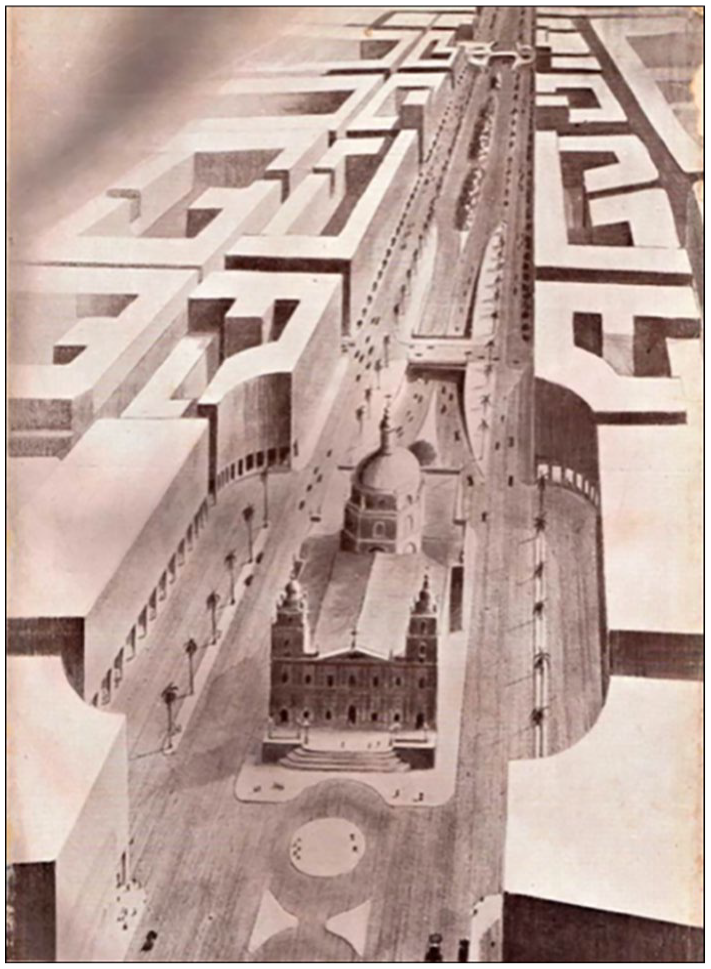
One of the sketches of Avenida Presidente Vargas.
However, there was a dense urban fabric between the blank pages of the drawing boards and the reality of urban life. To open the modern avenue, no less than a 1000 buildings, four colonial churches, two squares, part of a public garden, the Customs Building, and the Paço Municipal would have to be demolished. Not all of these sites and buildings won defenders. However, some of them did: the Church of São Pedro dos Clérigos, the Church of Bom Jesus do Calvário, the Customs Building, and the public garden, called Campo de Santana, were either already fully listed or in the process of becoming heritage. Rodrigo Melo Franco de Andrade, the Heritage Service director, exchanged dozens of telegrams and official letters with the mayor, the City Plan Commission, ministers, and the President’s office. He wrote the following in a letter sent to the Secretary of Public Works: [demolition would be] an irreparable attack on the city’s historical and artistic heritage, depriving it of two precious monuments of religious architecture, especially the Church of St. Peter, a work of great significance in national art history.
1
The director of SPHAN suggested that instead of a ‘straight line’, the avenue should be built with a ‘small detour’ to guarantee the preservation of the listed heritage. However, for the engineers, the geometric shape of the avenue was indisputable: a straight line, as ‘the path of rational men’ should be, in the jargon of modern urbanism in the 1920s and 1930s (Corbusier, 2000). In the engineers’ regard, as they wrote in a letter, colonial tradition could be sacrificed in the name of contemporary life.
Demolition and decomposition
Social sciences of religion in Latin America should pay more attention to the process of demolishing temples. The scholarship overlooks the churches demolished throughout the twentieth century in the continent’s metropolises. In Brazil, we have identified more than 200 demolished Catholic churches in different cities. In most of these cases, the reason for the demolitions was urban renewal. However, what we discuss in this article is not exclusive to Brazil. Another emblematic case is the construction of the Buenos Aires Obelisk on the iconic Avenida 9 de Julio in the Argentine capital, which demolished and reconstructed an old church in the city, the Church of San Nicolás de Bari.
There seems to be a lack of research into church demolition for at least two reasons. Despite the tradition of research into the intersections between religions and cities in the social sciences, the dominant analytical perspective describes them in terms of figure and background, in which the city is merely a context or a backdrop on which religions come about (Mafra and Almeida, 2009). This perspective places the city as a mere setting in which religions take place and so has not contributed to the opening up of horizons concerned with identifying, describing, and analyzing how religious materialities produce the city and how urban renewals, in turn, affect religious materialities (Araujo et al., 2024; Burchardt et al., 2023).
Recently, the material turn in religion studies has expanded in Latin America, filling in a gap in the studies on material culture. The scholarship on material religion considers religion in its material forms and the use of materialities in religious practices (Engelke, 2012; Giumbelli et al., 2019; Hazard, 2013; Meyer, 2012; Tilley, 2006; Toniol, 2021). This theoretical perspective reacts to understanding religion and religious practice as cognitive phenomena, which initially occur on the plane of ideas and are later projected into material representations. However, what is at stake in the perspective of material religion is the understanding that materials, their uses, and how they are experienced are – and do not simply reflect – religion. Therefore, the material approach to religion involves asking how religion arises materially, which should be distinct from the much less helpful question of how religion is expressed in material forms. Studies on material religion begin with the assumption that things, their uses, and their appreciation do not derive from creeds and beliefs but, on the contrary, are intrinsic to them. On one hand, it is possible to argue that materialities have always been on the horizon of social scientists of religion; on the other hand, it is undeniable that the shift proposed here opens novelties for the very way of defining religion and, perhaps above all, for the way we research it (Toniol, 2021).
As we have argued elsewhere (Toniol and Araujo, 2023), as counterintuitive as it seems, church demolition destroys temples’ materiality and simultaneously produces sacred objects, works of art, and religious waste. Demolition unfolds in several meticulous works. Some wreckers work as surgeons operating on patients, others as sculptors shaping raw material into aesthetic forms, and others work as explosives shattering everything around (Goyena, 2015). What comes out of their hands are materialities with multiple values.
Even though the wreckers gather experience over time and become qualified to see what is of value and what is not, they are not free to choose how to work on the demolition sites. The materialities impose themselves and defy the imagination: Is the furniture made of good wood? Are the saints beautiful? Are the altar carvings well-executed and signed? The photographs in the archives (see Figures 2 to 7) show architects coordinating the wrecker’s work, cautious of the valuables housed in the temples. These are photos taken from inside the construction sites, a particular type of documentation that allows us to follow the acts of demolition and construction. We have been working with hundreds of images in our research: photos of blowing up buildings, pickaxes and sledgehammers breaking down walls, photos of workers carrying rubbles and debris, and photos of paving and renovating buildings. The selection below shows how these photographs are much more than illustrations and offer framings of what deserves to be seen inside the construction site.
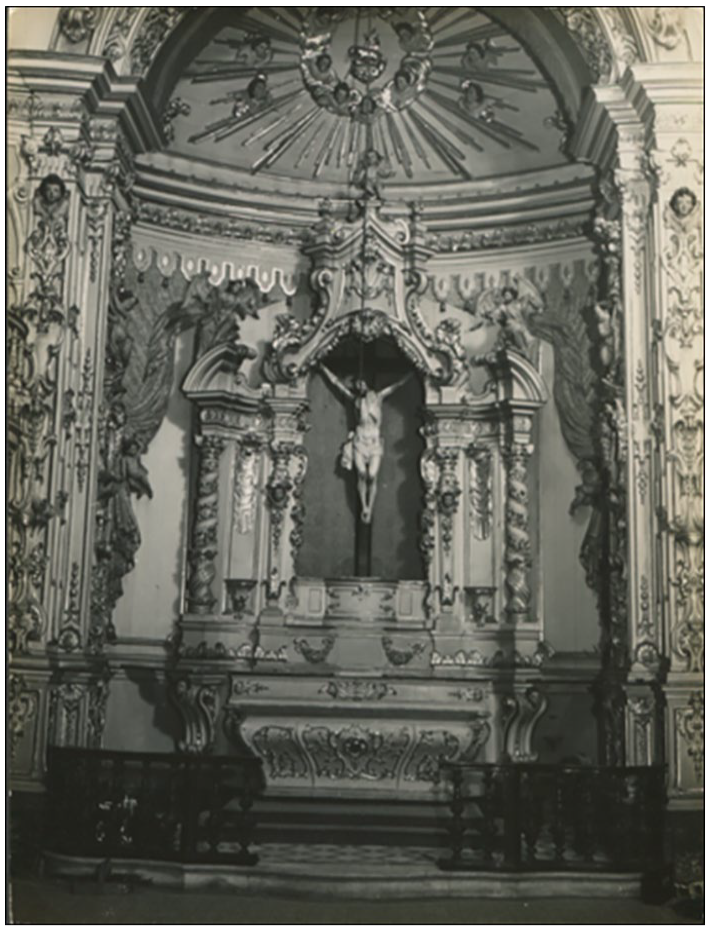
One of São Pedro Church’s altar, 1943.
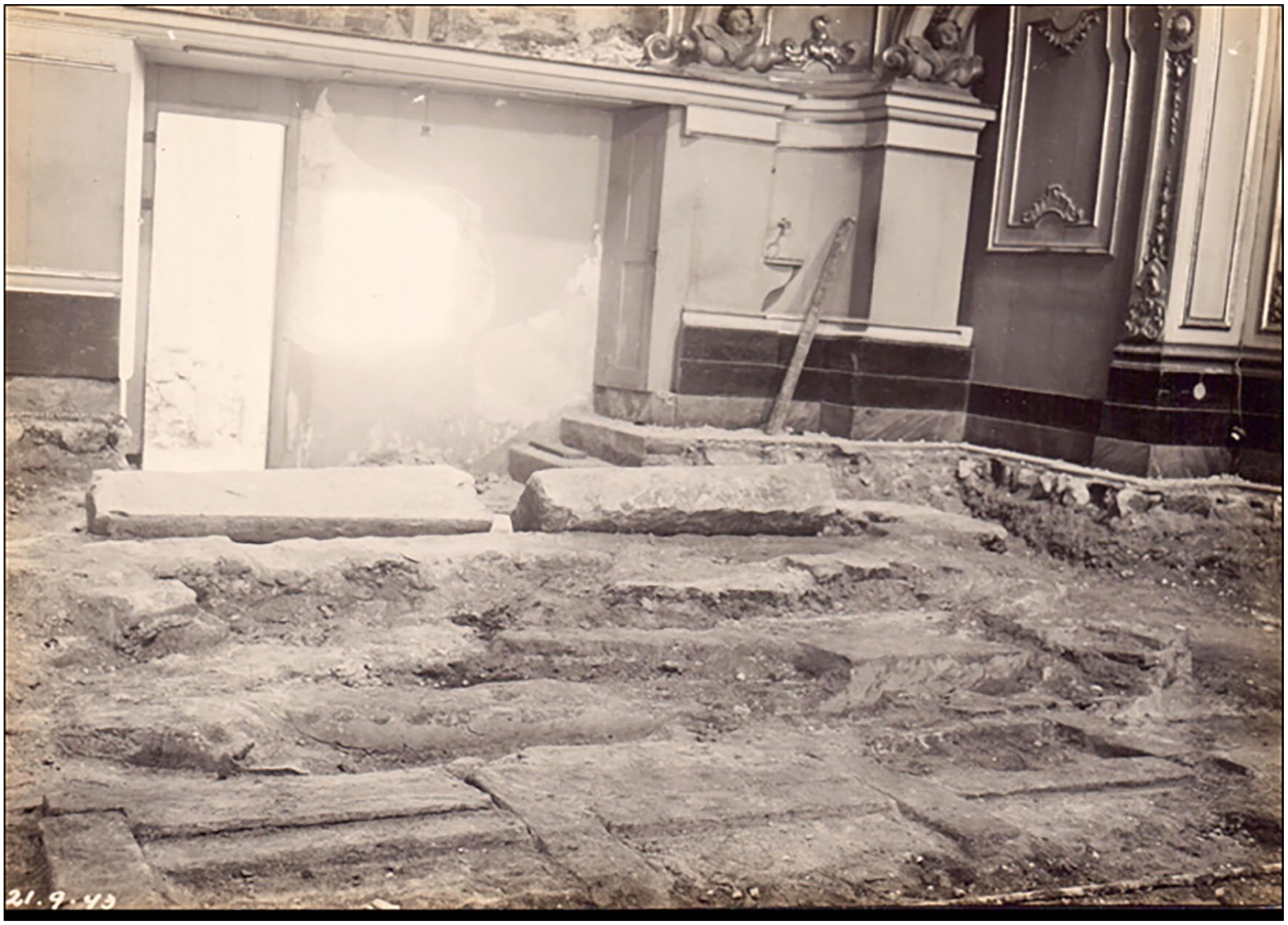
Removal of the altar’s floor of the São Pedro Church’s, 1943.
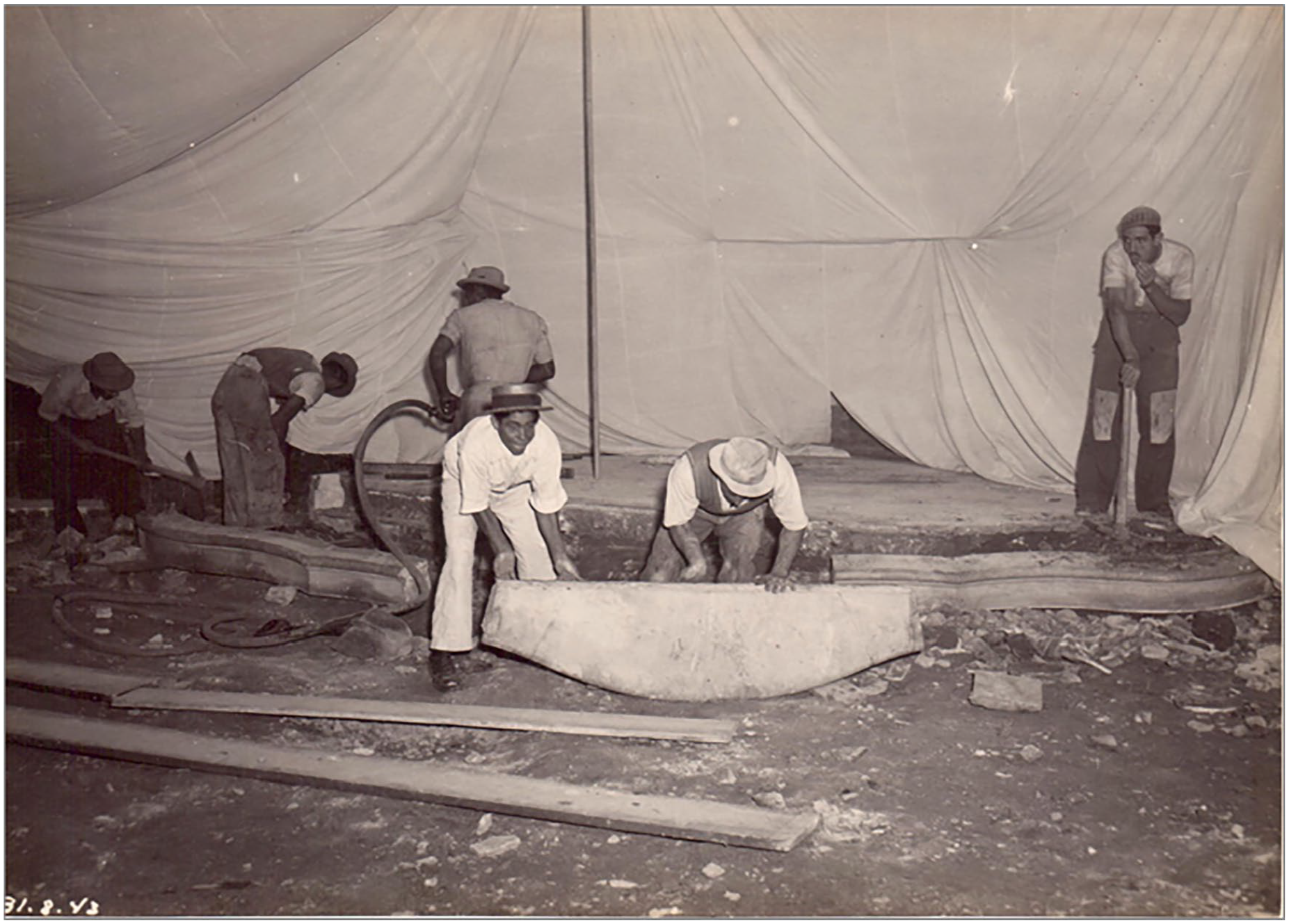
Removal of the marble floor from the crypt of São Pedro Church, 1943.
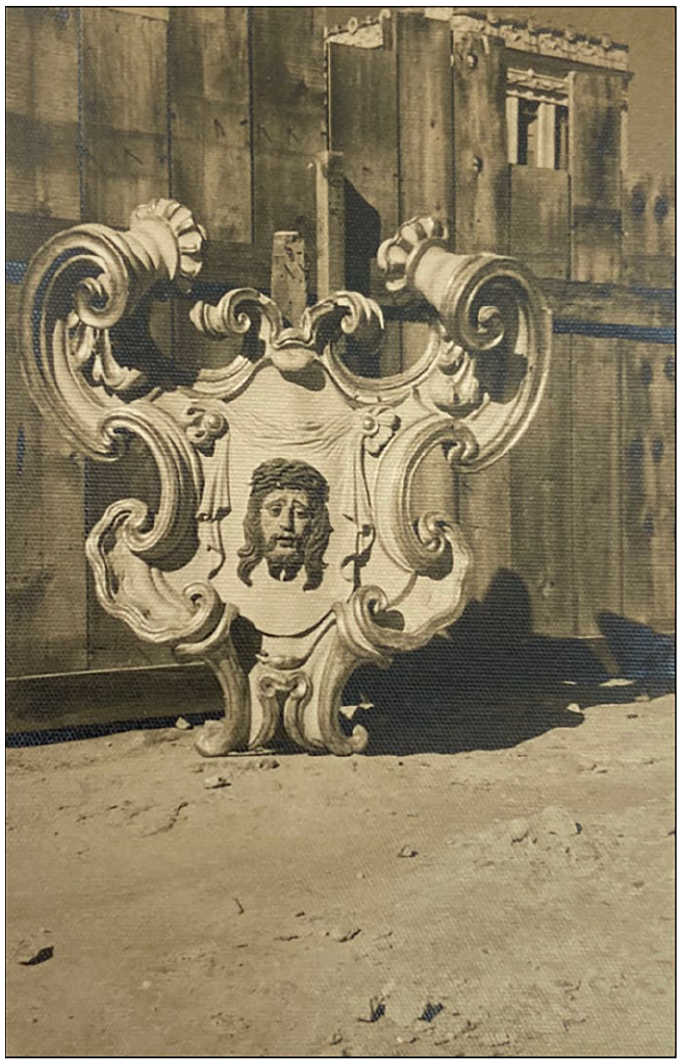
Ornament removed from the walls of the São Pedro Church, 1943.
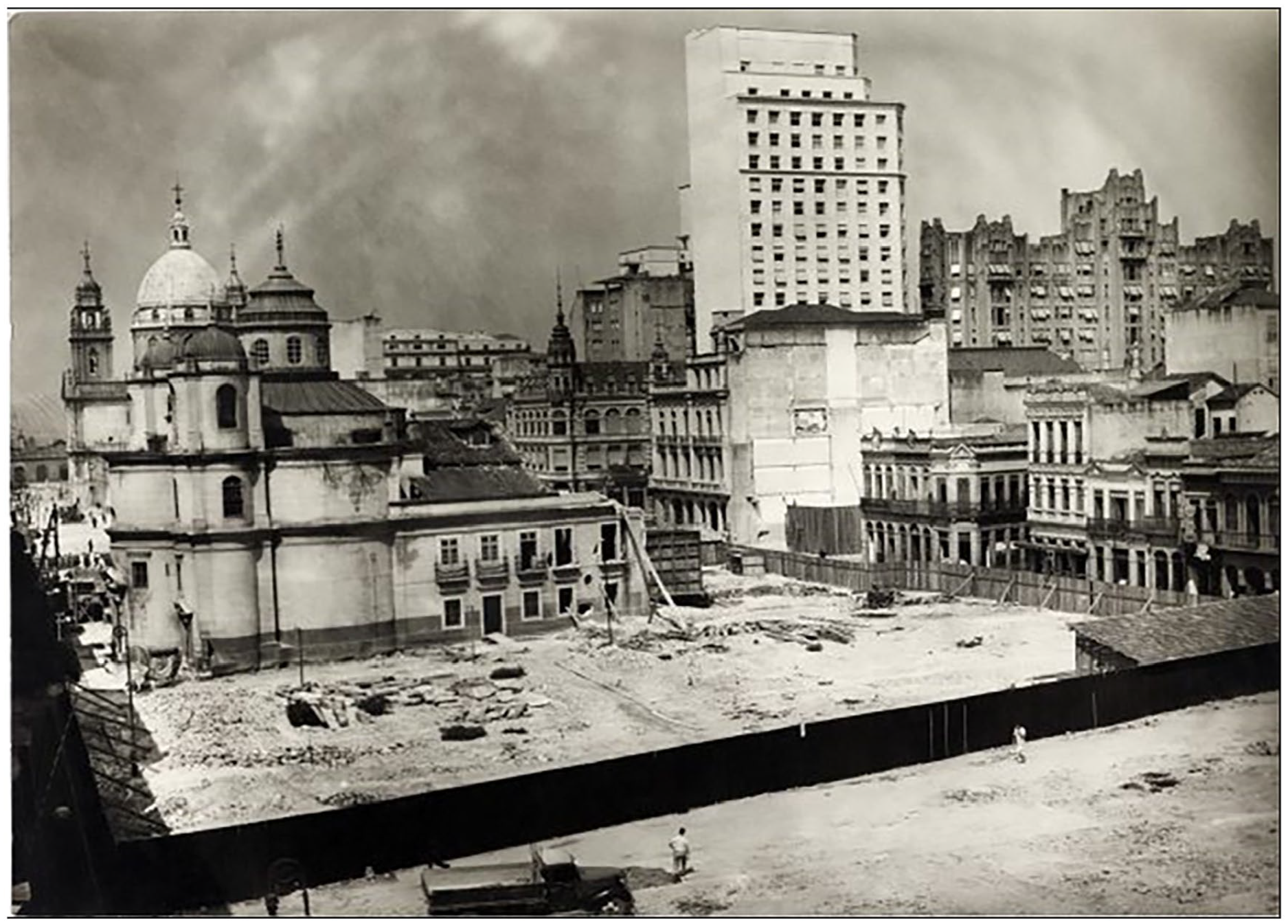
São Pedro Church isolated after the demolition of its surroundings, 1944.
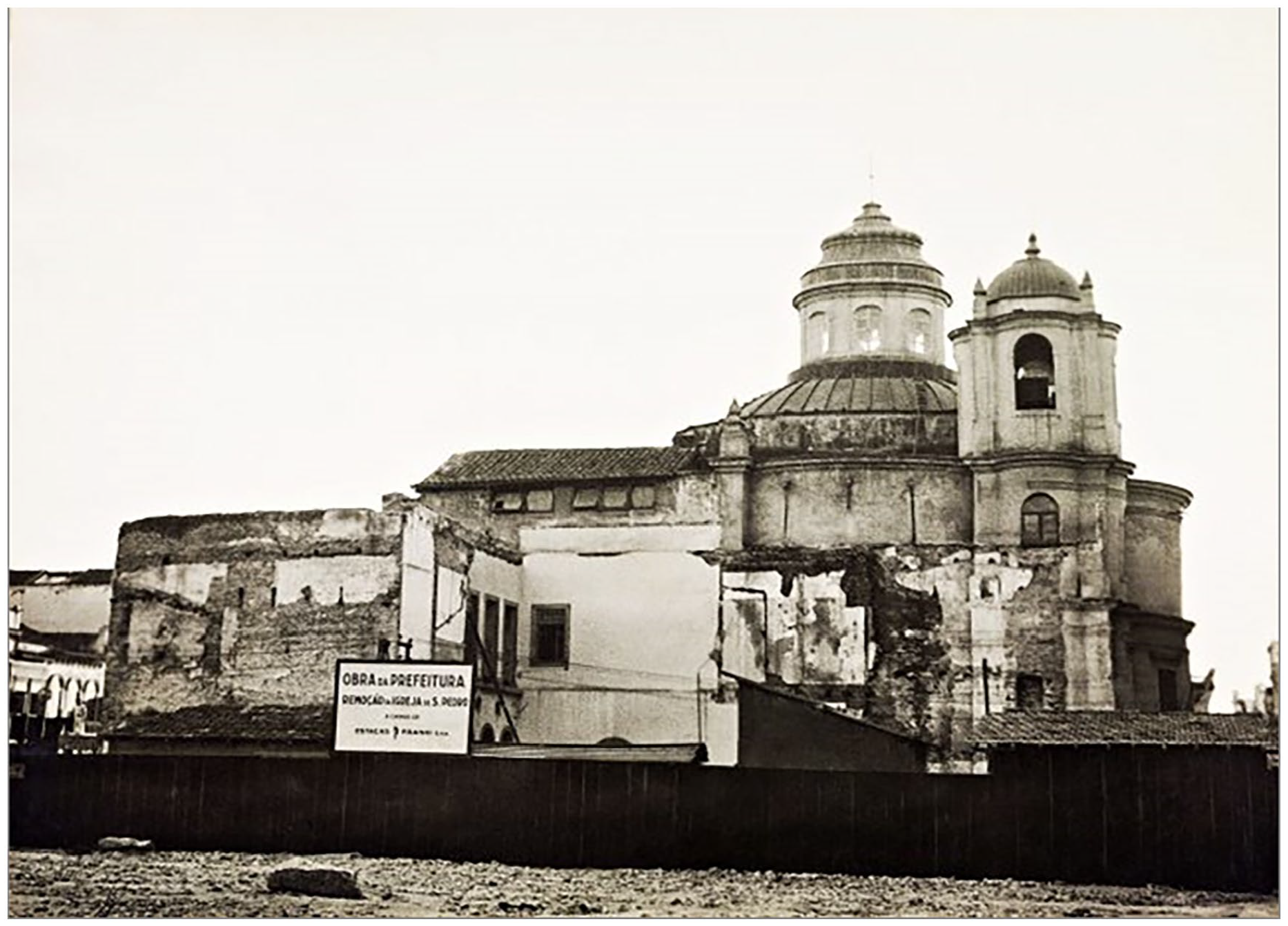
São Pedro Church before its demolition, 1944.
After a close look at the photos, we understood that demolitions did not merely mean the end of the temples’ lives but also the birth of decomposed materials as new things. In other words, church demolition does not end with the controversies over public works. Once the decision is made to demolish the churches, new questions arise: What should be done with the sacred objects, the saints, the baroque carvings, the marble doors, the altars, in short, all those things and objects that were in the temples? Where would the wood carvings and statues go? Should they go to museums, other churches, or public buildings? Who is claiming these objects? And how, based on which value regimes? Since the Avenida would tarnish the very unity of the temples and their objects, how would it be possible to reconstitute the unity of the sacred from these remaining materialities?
From an analytical point of view, we approach church demolition as an act of decomposition. In Portuguese and English, decompose has a double meaning. On one hand, it means dismantling (de-arranging) a unit into parts. On the other hand, it also means to putrefy, to die. We chose this term to highlight the smell of death impregnated in demolitions – the temples as they existed indeed die – without losing sight of the fragmentation, the dismantling of units into new parts. Refraining from approaching these fragments as mere waste, we address them as new materialities equally endowed with social life. We propose that there are three central moments for analyzing church demolitions. The first encompasses the public controversies that precede the demolitions; the second is the actual work of tearing down the churches; and the third is the afterlife of the remaining objects of the destroyed temples.
Materiality decomposition and value enactments
The church of São Domingos de Gusmão was demolished due to the construction of Avenida Presidente Vargas. This temple was not listed as heritage, but a newspaper report resonates with our account of demolition as decomposition. On 18 August 1942, on the eve of the church tear-down, a reporter from the newspaper A Noite reported what was happening in the following terms: One of the city’s oldest churches is going to disappear. Due to the construction work on Avenida Presidente Vargas, the Church of São Domingos will be demolished in a few days. Yesterday, the carriers began the meticulous task of moving the images, archives, furniture, and other belongings that enriched this relic of our colonial past – the church of São Domingos was built (...) in 1704. Yesterday morning, the careful process of moving began. The statues of St. Dominic and Our Lady were transported to the Church of St. Iphigenia. Other statues will go where the archives from the old church have already been moved. The pews, candlesticks, sacristy furniture, etc., have been split between the public storage and various other churches in the metropolis.
2
The reporter identifies and describes precisely the church’s demolition and decomposition process, indicating the fate of some of its items. The decompositions following church demolition create materialities as new units. These materialities are segregated from the demolished temples and born into new social lives. As we shall demonstrate throughout this article, the decomposed pieces of the temples travel through the religious circuit or become works of art, public icons, museum artifacts, and private collection items.
Based on extensive research in five public archives, 3 fieldwork, and interviews, we recovered the trajectory of some remaining materialities. In a previous article (Toniol and Araujo, 2023), we outlined six circuits in which the fragments of demolished churches circulate: other religious temples, the art market, cemeteries, religious waste, museums, and public buildings. This section will delve into three of these circuits – religious ones, art markets, and museums – and put forward the theoretical perspective supporting the analysis. Converting religious artifacts into sacred art is a pragmatic challenge that social actors face, and it has theoretical consequences for us. Who has the authority to claim the artistic value of a sacred object? How is the artistic value enacted? What contestations take place in the blurry boundaries between religion and art?
We are inspired here by Kopytoff’s (1988) and Appadurai’s (1988) propositions on the biographies of things and the heuristic relevance of ‘tournaments of values’. As authors have argued, things take multiple paths throughout their lives, and they face evaluation moments in which their fates are decided. However, unlike the authors, we argue for an entangled approach of material decomposition and value enactments. This perspective intends to go beyond linear and virtuous approaches to heritage, in which the unit and materiality of objects are taken for granted and evaluated according to artistic, cultural, and historical values. Paying attention to demolition, we take on a double material turn. We examine ‘tournaments of value’ (Appadurai, 1988) as material decomposition and value enactments, in which social actors dispute the fragmentation process of things and the resulting fragmented units.
As the reverse of heritage, demolition is good for thinking about the works, criteria, disputes, and tensions in the contagious zones surrounding religion. What is sacred among artworks? What is a relic among bones and funeral waste? What is civic among religious artifacts? What is waste among demolished churches? These questions do not exclude each other. They highlight the ambiguities in gray zones and focus our attention on the complex social activities that might enact a brick as religious waste, a bone as a relic, a carving as sacred art, or a saint as a museum collection item. After things lose the stability of the religious world, how are their materiality and values contested? The sociological answer to this question outlines the social biographies of remaining things.
Sacred objects and artworks
The first set of decompositions we are interested in here comes from the Church of Bom Jesus do Calvário, a church built in 1796 and demolished in 1942. Outside this church, to the left of its tower and far from its altars, two statues adorned the building, each dedicated to a religious value: Faith and Charity (see Figure 8). When pickaxes demolished the temple, these two images became remaining materialities and were moved to the Mayrink Chapel (see Figures 9 to 11) in the middle of the Tijuca Forest. 4 For a short period, the statues were uncertain about their fate. They almost became what Irene Stengs (2014) calls ‘sacred waste’. However, in 1943, their luck changed. Raimundo Ottoni Castro Maya, a prominent Brazilian industrialist and patron of the fine arts, was appointed the new ‘urban manager of the forest’. He hired the landscaper Roberto Burle Marx and other architects to renew its promenades, fountains, and gardens. To save the remaining materials from the wreckers, Castro Maya selected and transferred a few statues and images from the demolition sites to the Mayrink Chapel and the Tijuca Forest.
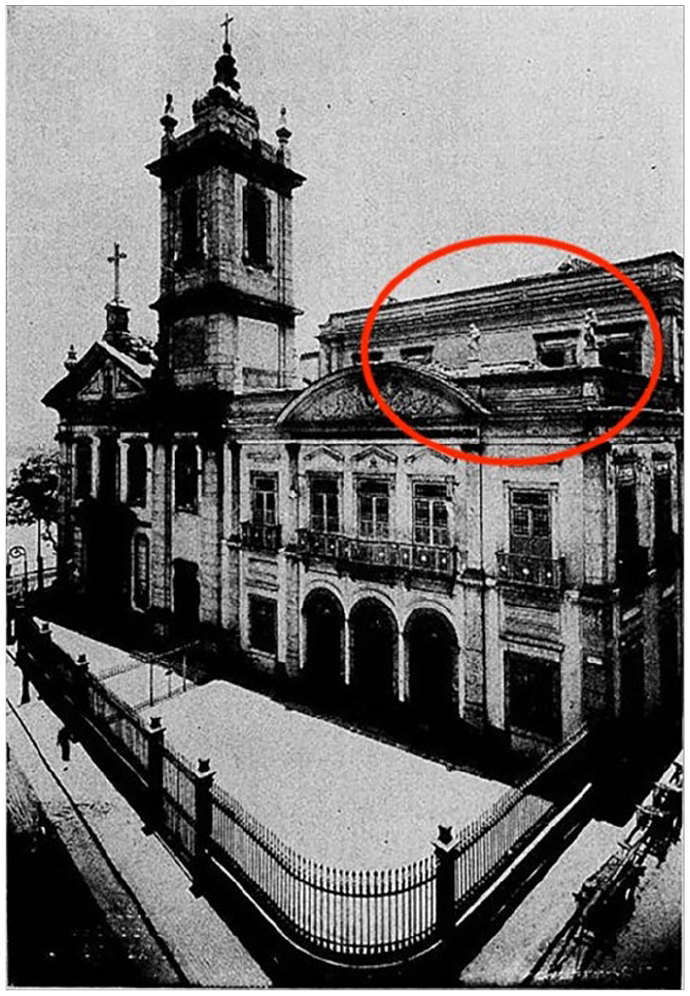
Bom Jesus do Calvario Church with the statues highlighted by the authors.
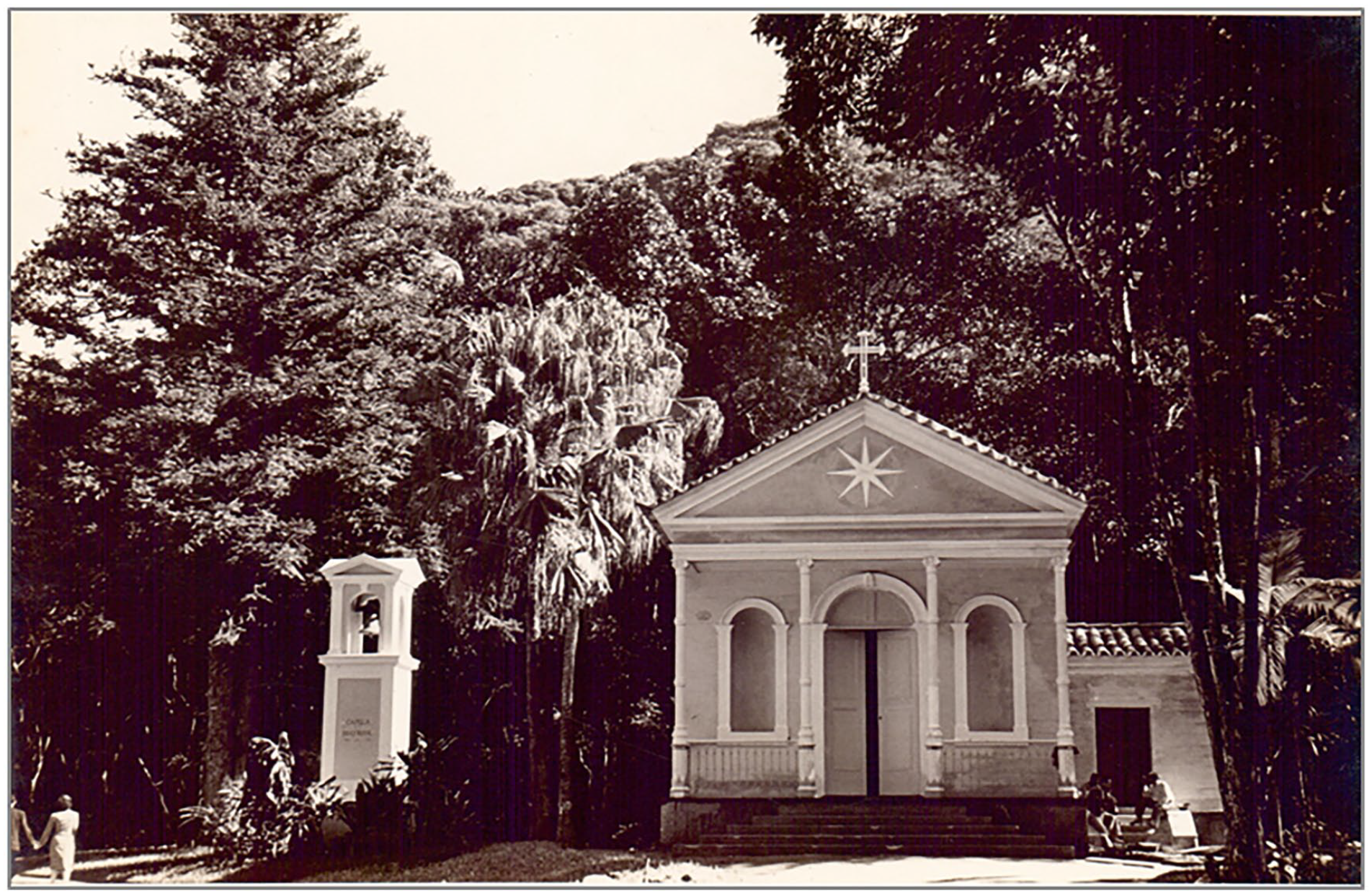
Mayrink Chapel without the statues during a reformation, 1977.
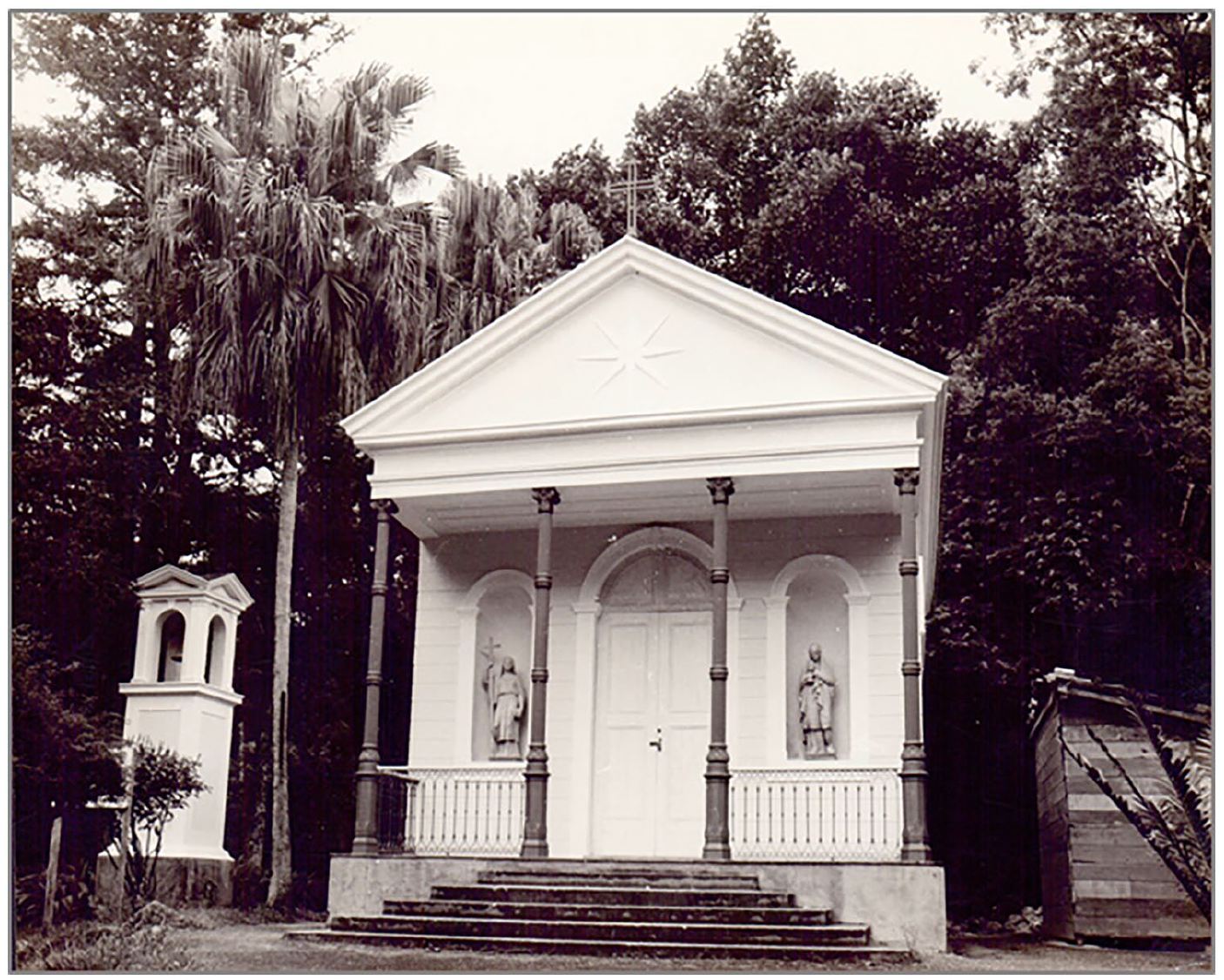
Mayrink Chapel with the statues after a reformation, 1977.
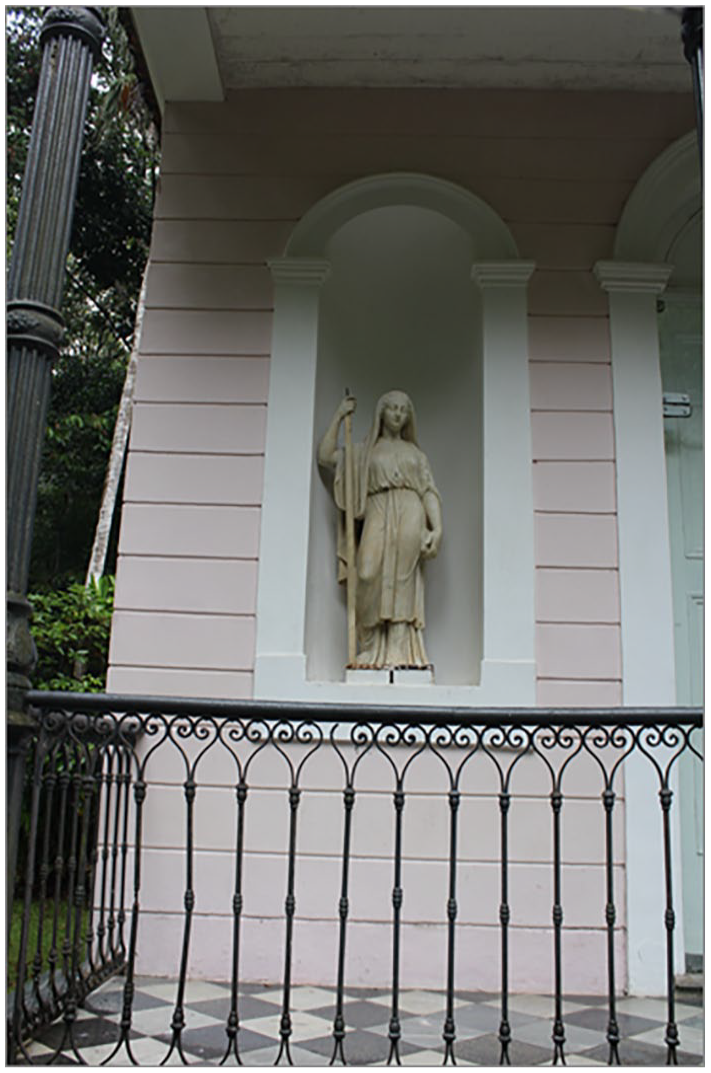
Mayrink Chapel’s statue highlighted, 2024.
The case of these statues is emblematic for two reasons. The first is their movement from a position of adornment, high up, far from the reach of hands, eyes, and daily devotions, to acquire a new status, situated in central sacred niches, on the façade, within reach of those who pass by the chapel. There are only a few days of religious services at the Mayrink Chapel. Still, visitors to the Tijuca Forest can touch the images as they touch the saints in churches. Even though they have migrated from one religious building to another, they do not sustain the same positions and relationalities. The descent from the highs to the touch of hands reinforced the statues’ religious qualities. This movement highlights the importance of a spatial perspective in line with value tournaments.
At the same time, these same images can also be described as what Dan Beekers has called ‘sacred residue’, ‘described as that quality of a religious site, or of specific that – in the perception or feeling of observers – persists after the site has lost its original religious function’ (2016: 39). 5 What results from this process of almost becoming sacred waste and then retaining a sacred residue is the fact that Faith and Charity entered the gray area between art and religion. These statues recycled a devotional appeal, recalling and, at the same time, surpassing their state as religious media.
The second transformation the two statues underwent concerns the particularities of the Mayrink Chapel itself. The temple works as a devotional site in a rather unique way. To renew the temple built in 1850, Raymundo Ottoni Castro Maya bought an altar from a church in Minas Gerais. This fact is relevant insofar as it reinforces our argument on decomposition and circulation of materialities. Unfortunately, the altar was way bigger than the chapel’s. In a second attempt to renew the temple, Castro Maya commissioned the Brazilian modernist painter Candido Portinari to create three large panels to adorn the main altar. At the time, Portinari was already known for the panels in the Pampulha Church, the first Brazilian modernist temple, designed by none other but Oscar Niemeyer, and was painting the panels for the Ministry of Education and Health building, another emblem of Brazilian modernism, under construction at the same time as Avenida Presidente Vargas’.
The panels in the Mayrink Chapel depicted Our Lady of Mount Carmel, St Simon Stock, and St. John of the Cross (see Figure 12). Portinari’s painting technique ‘reconciled the execution of rigorous classical strokes with a modern conception of sacred painting’. 6 In doing so, Castro Maya and Portinari placed the Catholic chapel into a circuit of modern artistic value. The images that once adorned a colonial church, after its demolition, disaggregated from their original environment and became icons of a chapel devoted to the arts of Brazilian modernism. Here again, the spatiality of material circulation matters.
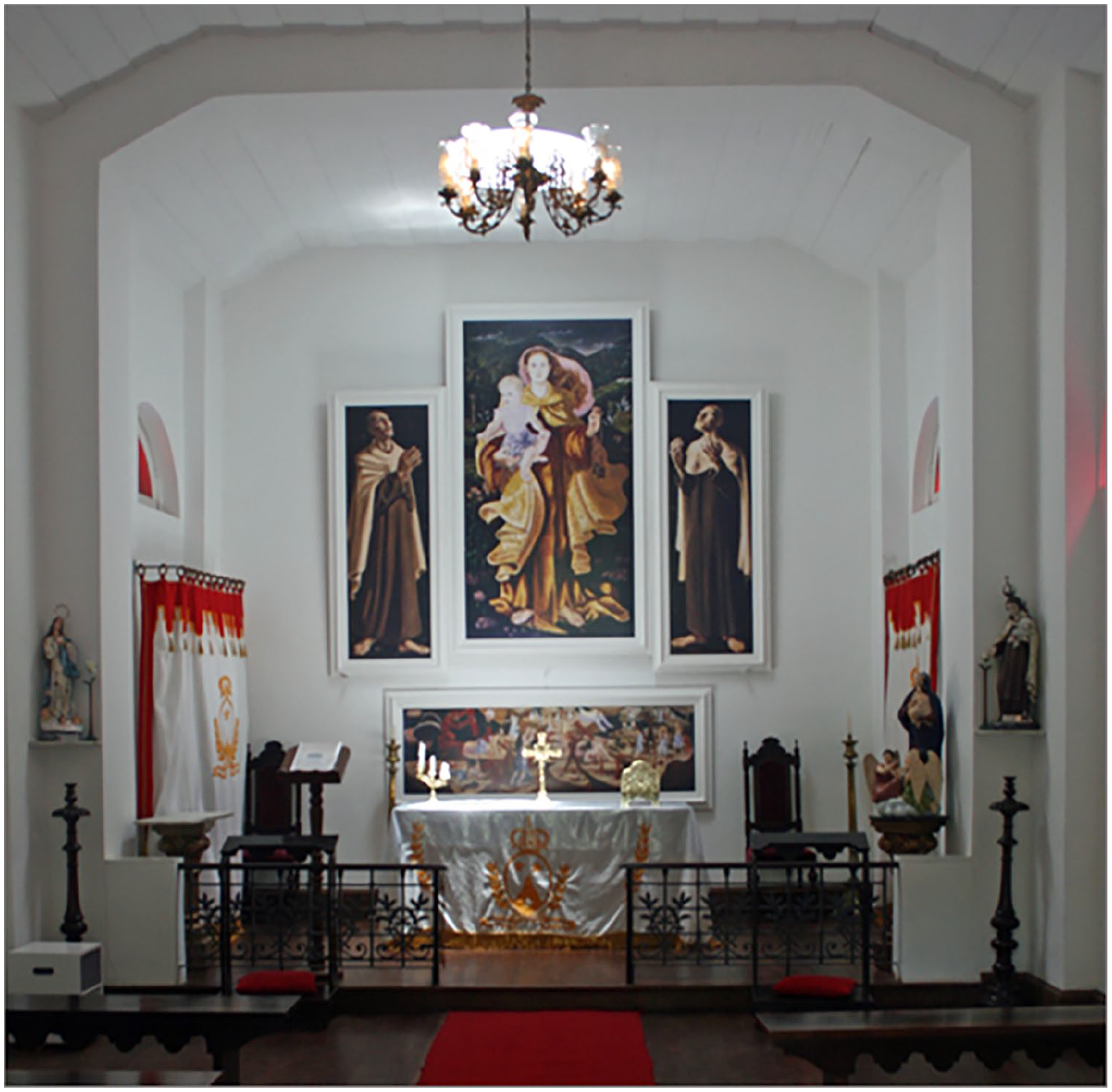
Mayrink Chapel’s painel highlighted, 2009.
The second case that interests us here is that of an image from the Church of São Pedro dos Clérigos. This church poses several new questions. As discussed in another article (Toniol and Araujo, 2023), this church was one of the first to be listed as heritage in Brazil. It was lauded for its round shape, an architectural model for constructing colonial churches in other cities. Its demolition would have been illegal if President Getúlio Vargas had not created the legal device of de-heritagization, the de-conversion of an estate as heritage. It so happens that as part of the decomposition process of this church and the inscription of its materialities in other circuits, some of its items disappeared or were stolen by art dealers.
Almost 10 years after the demolition of the São Pedro Church, on 8 September 1953, Rodrigo Melo Franco de Andrade, still the Heritage Service director, sent a letter to the head of the Department of Traffic and Public Works of Rio de Janeiro: A large part of the carved woodwork in the interior of St. Peter’s Church, which was expropriated and demolished on the initiative of your Department, is on sale at the antique store in Rua Siqueira Campos 23-B [in Copacabana]. I would like to ask you to take the necessary measures to inform the Heritage Service, with urgency, of the conditions under which these valuable works of traditional art have been sold or transferred. The present consultation is motivated by the fact that the order issued by the President of the Republic, canceling the listing of the Church of Saint Peter to allow its demolition, determined further measures that required the preservation of all the architectural and decorative elements of the church. It does not seem that the aforementioned presidential order has been rendered ineffective, facilitating the irreparable dispersal of the church’s carving work and the sale of its pieces individually. Nor does it seem credible, even if the Head of the Nation had reconsidered the same order, that your Department’s authorities would have agreed that an antique dealer could speculate, as is the case, with such essential and expressive values of our traditional art heritage, without first consulting the City Museum and the federal museums as to whether they would be interested in acquiring the pieces in question.
7
Heritagization poses a challenge to secularization theories. For some authors, it is a State practice that withdraws and effaces religious status from things and sites (Bendix et al., 2013). For others, it is a modern and secular device for consecrating materialities (Chuva, 2009; Meyer, 2019; Toniol and Araujo, 2023). Despite the secular nature of heritage, religious artifacts retain their original sacred or ‘cult’ value, and, on top of it, cultural or historical values overlap. This inherent tension, where the sacral identity of the heritage object remains, underscores the non-linear and dialectical nature of secularization (Meyer, 2019). In a previous work (Toniol and Araujo, 2023), we have also argued that the semantics of heritagization is underpinned by a syntactic of the sacred.
Through complex rational processes, heritagization ascribes to objects new sacred auras. In the cases here in question, even though the churches were demolished, the objects preserved their double auras as religious artifacts and heritage. Putting them up for sale was a problem. As religious artifacts, the things from St Peter’s Church should have continued their service in other temples; as works of art, they should have been transferred to museums, the legitimate places for safekeeping goods of exceptional value. The theft of remaining things from demolition sites posed a problem for heritage architects and, in this sense, turned heuristically relevant. The carvings had to be meticulously extracted from the altars and walls to be robbed. The decomposition work was complex and resembled sculpting in reverse. From part of the churches’ scenarios, angels, flowers, and pebbles were fragmented into new units for sale. What height should the artwork have? What new compositions should they make? We traced some carvings in museums and antique shops at the same address where Rodrigo Melo Franco de Andrade found them 70 years ago. Some artwork are 5-foot tall angel’s heads; others are small oratories with saints; others are enormous pebbles and pedestals separated from the saints they once housed. The sizes, aesthetic qualities, and materials vary and, accordingly, do the artwork prices.
Another case of artwork sale underlines the entanglement between materiality and value in decomposed things. The sale of objects from São Pedro Church has recently returned to the public eye. In June 2024, one of its altars, whose authorship is attributed to an important artist of the colonial time, Mestre Valentim, was put up for auction for approximately U$165,000.00. It is unknown how the object became the property of a couple of art collectors. A few days before the auction, Rio de Janeiro’s city hall filed a public civil suit for the altar’s immediate expropriation. As a result, the city recovered the old altar and listed it as heritage.
The fate of this recovered piece is relevant to the debate. Consecrated as heritage, it will be kept and exhibited at the Rio Art Museum, a museum dedicated to contemporary art, inaugurated in 2013 amid the urban renewals of the city for the mega-events of the 2014 Football World Cup and the 2026 Olympics. Once again, it was on the art circuit that the remaining materiality of the former colonial church regained life. On the museum circuit, it is far from the risks of the art market and its problems around the acquisition of the items and their authorship.
This case shows the reversibility between religious and cultural heritage. The altar belonged to a church listed as heritage and later de-heritagized due to an urban modernization project in Rio de Janeiro. As a result, the object in question entered the art circuit, maintaining a double aura, religious and artistic. Finally, this object returned to the public heritage circuit of Rio de Janeiro because of its previous status, including its religious significance. Religion, art, and heritage seem to linger over the altar’s materiality and are enacted values according to the social situations.
Together, the cases of the Mayrink Chapel and São Pedro Church’s altar show the convertibility and the value enactments in the gray areas between art and religion. As new units are broken down from the original unity of the temples, they are convertible into other circuits of value (Appadurai, 1988). These operations are complex. The cases explored the ‘tournaments of the value’ deciding the things’ fates but also took on a double material turn. The act of demolition shed light on the entanglement between material decomposition and enactments of value. There are no prior, well-delimited things to be extracted from churches’ scenarios. The act of demolishing sculpts in reverse new valuables. These works are acts in two parts. First, they decompose: the materiality of the temple is broken down in imagination, and later, fragments are extracted. Second, they recompose: selecting what figures together and circulating things through new environments, in new positions, and relationalities.
A matter of perspective
In this section, we step outside the temples and look from the construction site toward the city. What landscape is sculpted while and because the churches are demolished? How does the remaining church compose a new city view?
After the straight line of the avenue was paved, everything was ready for the inauguration of the ‘engineering monument’. The sequence of photos below (see Figures 13–16) shows how the Candelária Church took center stage in the composition of the landscape of Avenida Presidente Vargas. These photos are part of the Hélio de Brito Archive, 8 an engineer from the City Plan Commission. In addition to textual documents, the Helio de Brito Archive has hundreds of photos depicting building demolition, the new constructions, and the paving of the avenue. The photos’ authorship is unknown. Archivists, historians, and other researchers have two guesses: Aristogiton and Uriel Malta, sons of Augusto Malta, one of Brazil’s most outstanding public photographers, an employee of Rio’s city hall during the Pereira Passos Reform mentioned above.
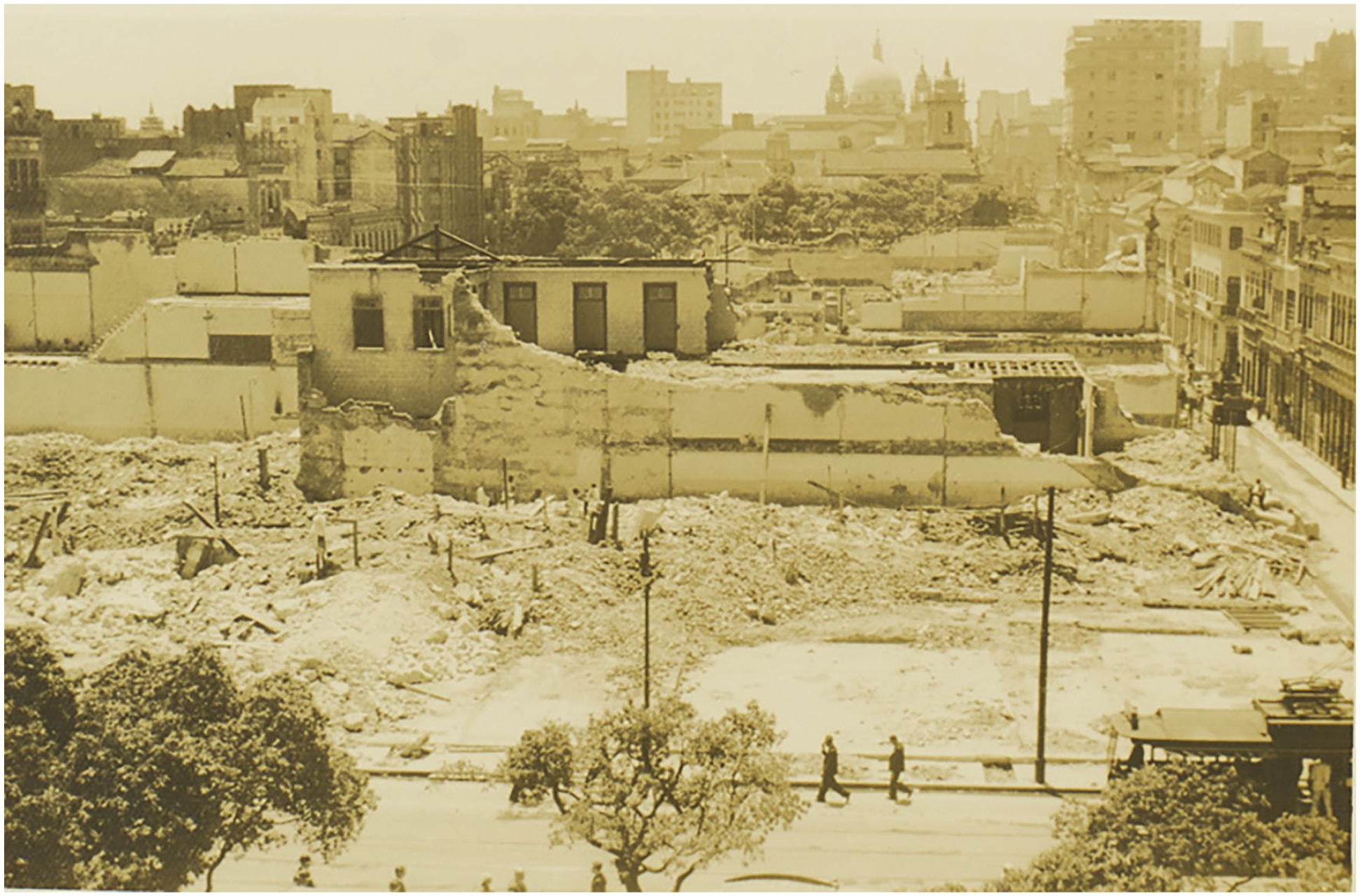
The dome of the Candelária Church rises on the horizon, 1943.
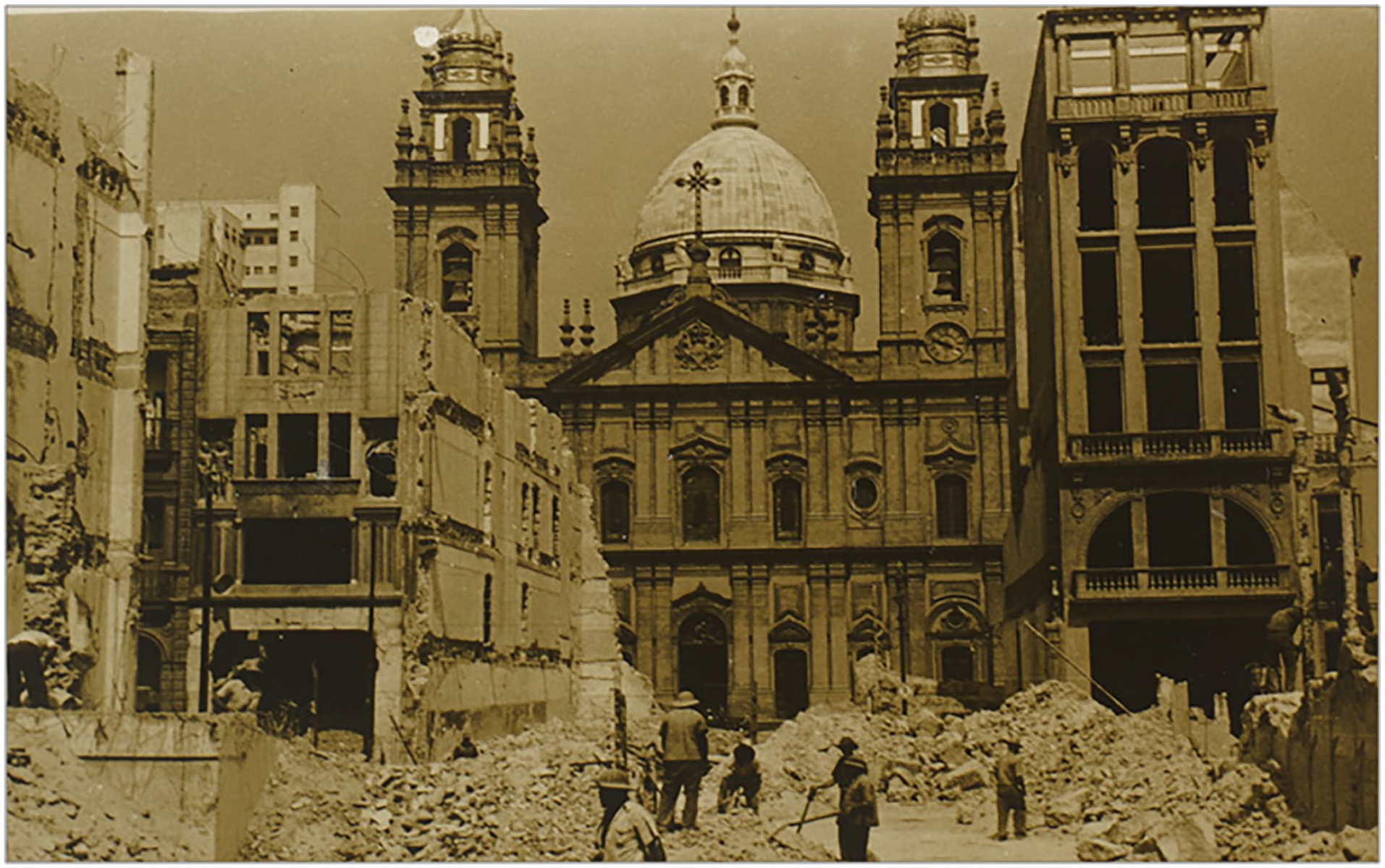
Demolition of the surroundings of the Candelária Church, 1943.
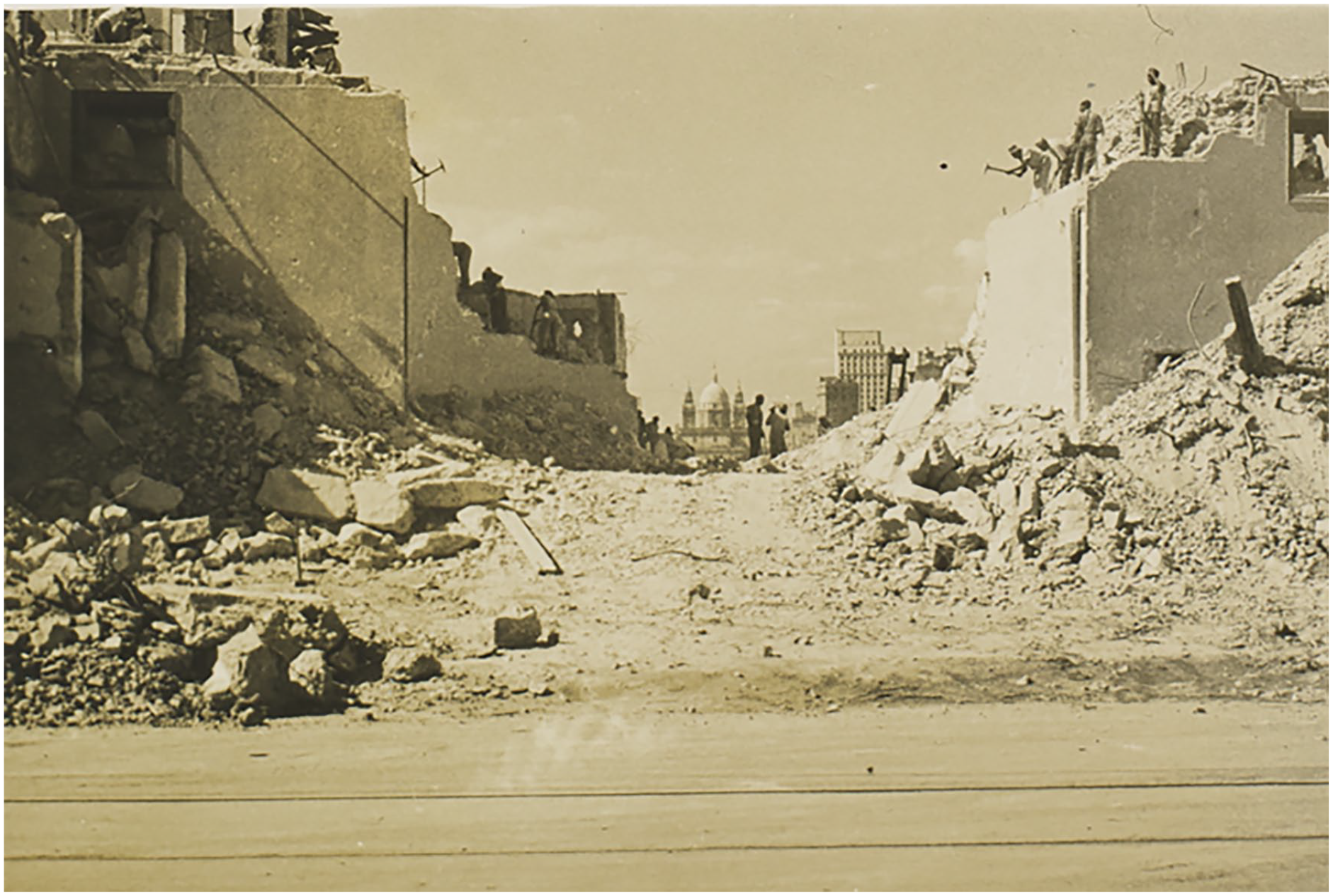
The Candelária Church is visible from inside the construction site, 1943.
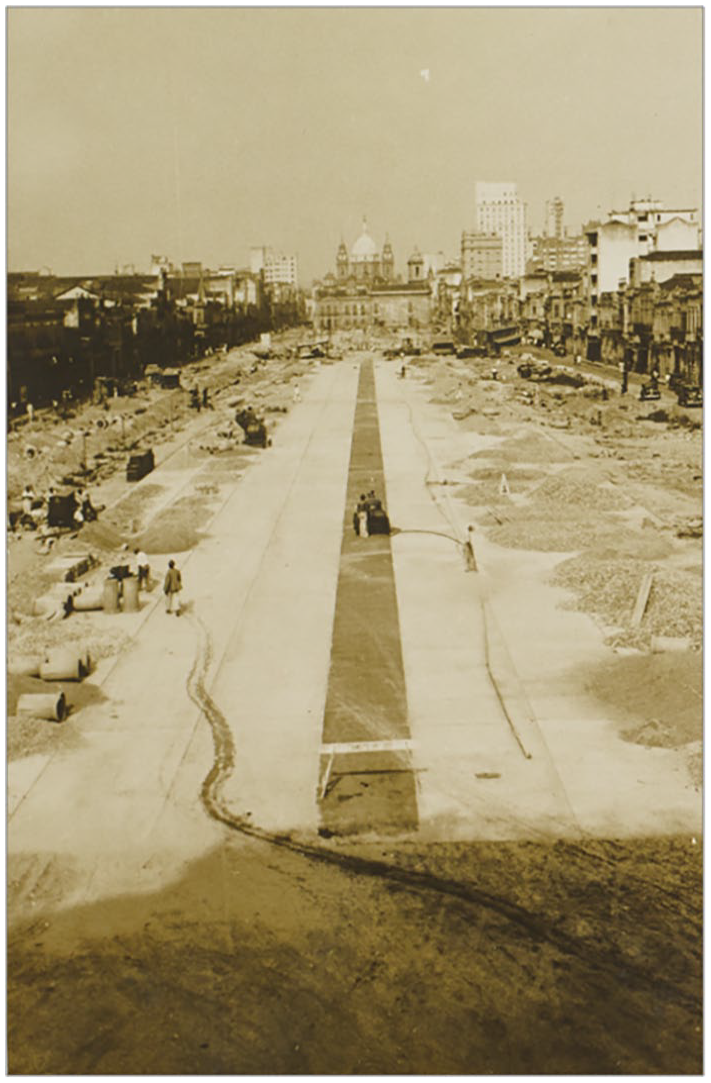
Paving of Avenida Presidente Vargas with the Candelária Church in the background, 1943.
Photographs of public works have been a way of recording engineering since the nineteenth century (Oliveira, 2018). More than depictions of the city’s material transformation, the hundreds of photographs in our research fulfill a triple role. First, they pre-figure the acts of demolition; that is, they anticipate and instruct how demolitions should unfold for political purposes. The photographers crossed the streets to be demolished, photographed the buildings to be demolished, and numbered and hand-marked the façades in the pictures. The photos thus served as documents to control the demolition process and the compensation owed to the buildings’ owners. Second, the photographs anchor the recomposition of the remaining fragments. As visual records, the photos served as inventory and an ‘assembly manual’ for reconstructing three of the four temples in another neighborhood. Finally, the photographs offer new recompositions of the city’s space. We intend to explore this third role in this section.
In themselves, the photos are complex artifacts, as they are image records of unconfirmed authorship, but which, in addition to their visuality, often offer small texts, captions, or descriptions handwritten by the photographer himself, by engineers or architects who worked with him, or by archivists. On the back of the four photos above, Helio de Brito, the Engineer, has handwritten comments about what the photographs show – clockwise:
The dome of the Candelária Church rises on the horizon as the highest point in a city of colonial townhouses;
The process of demolishing the buildings around Candelária;
The Candelária Church is visible from inside the construction site;
And the alignment of the avenue with the temple.
As Helio de Brito has handwritten on the back of the fourth photo, the axis of the avenue should align with the cross of the Candelária Church. It was a matter of spatial geometry. Volumetric proportions are an unquestionable standard of modern urbanism. Among the photos in the engineer’s archive, one depicts a pendulum measuring 90°; others frame the dome and the cross as geometric references; numerous others capture the Candelária Church from various angles – from a rooftop afar, from ground level, from left and right, from its corners.
More than a geometry problem, the alignment between the modern avenue and the colonial cross has cultural implications. In perspective painting, a fundamental geometric operation is the stipulation of a blind spot from which the axes of the painting draw. Within these lines, the proportions of the figures are born. In photography, as in painting, perspective framing remains valid for figuration. Particularly in the fourth photo above, the photographer’s gaze rests on the church cross, making it a blind spot in the image. The other spatial elements converge around the centripetal force of the church cross. In this sense, the individual elements visible in the photograph are subsumed in the composition of the landscape (Simmel, 2016).
On one hand, the photographer arranges pre-existing spatial elements – the cross, the church, the townhouses, and so on; on the other hand, making the cross a blind spot, he creates an entirely new perspective and thus a new landscape. As other authors have argued, a landscape is a matter of perspective and composition (Simmel, 2016), which implies separation and observation (Willams, 1975). Here, we stress that landscape is ‘a cultural image, a pictorial way of representing, structuring or symbolizing surroundings’ (Cosgrove and Daniels, 1988: 1), but also a cultural construction of the environment (Ingold, 1992). As Tilley proposed, the idea of landscape as an ‘anonymous sculptural form’ (1994: 23) highlights its duplicity as the act of framing and what is framed as the materiality and the aesthetic. As a social process, landscape sculpting involves the material and architectural construction as well as the visual depiction. From the material and visual composition of townhouses, the colonial church, and straight lines, a new way of seeing the city and a new city to be seen emerges.
The matter of sculpting landscape is more than just the result of our interpretative efforts. Shortly before the avenue inauguration in September 1944, the Correio da Manhã newspaper foreshadowed ‘the Candelária issue’, a controversy that would drag on for 3 years. ‘The majestic perspective of Candelária, at the center of Avenida Presidente Vargas, will be one of the most beautiful in all of America (...)’. However, ‘certain details must be foreseen and taken care of now’. With the demolition of its old colonial surroundings, the temple, which had a single façade on a narrow street, will now have four façades at vast viewing angles: These four façades must be cared for and, let us say, adjusted (emphasis in the original) – respecting the main lines of the temple but harmonizing them with the new open setting around it. (...) The avenue will surround the temple with a majestic square. It will not look good if the avenue opens up and the buildings in the square remain indifferent (emphasis in original) to the sense of this urban work, which is so straight. They should be part of it. In other words, they should form a uniform architectural ensemble subordinate to the majestic temple.
9
The newspaper highlights the church’s lack of aesthetic unity with its modern surroundings. During construction, the engineers hoped to consecrate the Candelária Church as ‘the jewel of the avenue’. After its inauguration, the inverse happened. The church became an aesthetic problem for the avenue consecration as a ‘modern monument’. As the newspaper wrote, the church became a ‘small dwarf’ in the face of engineering ‘monumentality’. For this reason, it needed to be amended. 10
Four months later, the Italian–Brazilian businessman Giuseppe Martinelli, at the time one of the wealthiest people in the country and constructor of iconic skyscrapers in São Paulo and Rio de Janeiro, echoed his annoyance at the disharmony between the avenue and its ‘crown’. Martinelli was a member and active collaborator of the Brotherhood of the Blessed Sacrament of Candelaria, responsible for the upkeeping of the church. On 21 November 1944, he sent the Brotherhood a letter sharing his annoyance and presenting a solution to the aesthetic problem.
A few days ago, I was out of Rio by car. On my way back, when I got onto Avenida Getúlio Vargas, on the side of the Mangue Canal, I came across the back of the Candelária Church. I got a very unpleasant impression seeing the building on that side so modest and ordinary, which took away a lot from the importance of that monument of art, which is admirable on the front and inside: Therefore, it crossed my mind to take the initiative to transform that simple and unsightly part with a kind of external choir, similar to a lesser extent to the one in the Church of St. Peter in Rome and other churches, especially cathedrals like that of San Martino in Lucca, where I was born and where canons sit on certain occasions. I suppose the respectable Brotherhood agrees to the above. In that case, I am willing to take the initiative in this modification and construction, opening a tender for which I could bear the costs.
11
The Candelária issue spiraled. The avenue did indeed lead to the church. However, not with its front, but with its back; not with the grandeur of its façade, but with the anti-aesthetic simplicity of its rear. Backwards Candelária did not create an ensemble with the avenue.
On receiving Giuseppe Martinelli’s letter proposing to reverse the church’s front façade, the Brotherhood’s ombudsman forwarded the document to Rodrigo Melo Franco de Andrade, the Heritage Service director. In possession of the offer to finance the church’s renovation, Rodrigo Melo Franco de Andrade asked SPHAN’s architect, Paulo Thedim Barreto, to study the project for possible modifications that would not alter the original. Barreto responded straightforwardly: ‘There will never be a solution for Candelária. What we can do is remedy it’. More than a problem arising from the construction of Avenida Presidente Vargas, the aesthetics was a long-standing problem for the architect: Candelária, as a whole, is characterized by a lack of unity. It is not a monument to live in isolation. It will not be by seeking false monumentality that Candelária’s defects, which are now exacerbated by its isolation, will disappear. No matter how much is done, the situation envisaged for Candelária in the plan for Avenida Presidente Vargas will make it insignificant. It will be difficult to harmonize the two scales: that of the church and that of the avenue. The scale of the proportions must be kept in mind. Due to the interplay of masses and volumes, Candelária, as it is now placed on the axis of the avenue, will always appear as a small chapel and a defective chapel in the eyes of experts.
12
Disproportionate, lacking in unity, defective. The work on the avenue desecrated the demolished temples and the Candelária Church that was supposed to adorn it. For Paulo Barreto, what once was described as the benefit for the church became the sin of Avenida Presidente Vargas’ engineers: the Candelária church ‘was placed in the spotlight’. In the syntax of the sacred, rendering it too visible, exposed, and accessible is a risk. Hence, SPHAN’s architect gave a curious solution: ‘For us, let us say, the best thing for Candelária’ is to do precisely the opposite of what the avenue did, ‘is to hide it’. By proposing this solution, Barreto seems to appeal to secrecy, the most eloquent issue in taboo and transgression. Taussig (1999) explained that secrecy implies a publicly known truth that cannot be made public. Secrecy intertwines with the taboo of its transgression and thus creates a powerful but invisible presence: beneath the veil, something must be unveiled. Nevertheless, unveiling the truth is an act of transgression. The possibility of this transgression enhances the truth of the secret or the sacredness of the sacred. In the case of the Candelária Church, the secrecy was an aesthetic solution to the problem of its exposure. Paulo Barreto outlines how this could materialize: For those who enter Presidente Vargas Avenue from its ends, Candelária appears petty to the observer, and the closer they get to it, the more disinterested they become. Candelária is a church that should arise by surprise. We believe that we should create a new environment for Candelária: – Surround it with a curtain of vegetation with leafy trees, which, if well-arranged, could create necessary partial points of view since the aesthetic principle of ‘unity’ has been broken. In this way, we will partly restore a more proportional scale to the monument and create the surprise that is so necessary. Candelária would appear in the middle of the vegetation, in the middle of the green. It will be the most natural and least pretentious way to better serve the Avenida and Candelária Church. The green will enrich both.
13
Creating an aura of secrecy around Candelária to restore the temple’s sacredness was the aesthetic solution supported by SPHAN throughout the controversy. In mid 1945, Lúcio Costa drew up a technical study on Candelária. The architect, who in two decades would become the famous author of Brasília, endorsed what Paulo Barreto had already said: Candelária lacked unity since its architecture mixed ‘baroque, neoclassical and bastard’ styles; its ‘roofs had been mutilated’; the ‘materials of its construction were diverse’; and the floor uneven. Lucio Costa also appealed to secrecy as an architectural solution. For the Candelária issue, he recommended, ‘planting a curtain of ficus religiosa, on the sidewalk, along the facades, the corridors, and the rear to hide it completely’. His architectural imagination materialized in the sketch below (see Figure 17).
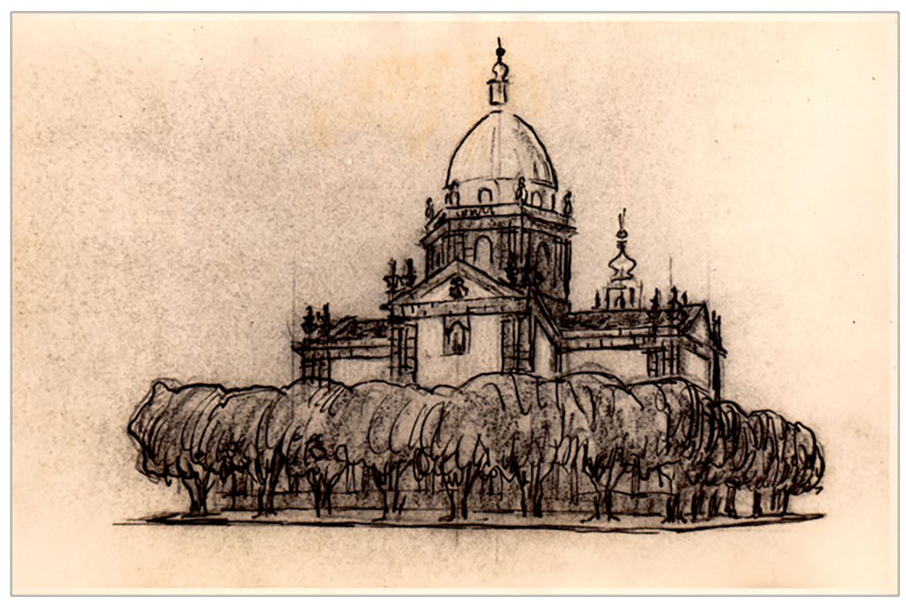
Sketch by Lúcio Costa with a proposal for intervention on the Candelária Church, 1945.
Against the proposal to hide the church among trees, Giuseppe Martinelli turned to the newspapers. In an interview with Correio da Manhã on 12 August 1945, the businessman hastened to provide a counter-project. His solution was to enlarge Candelária, make it even more prominent, and renovate it to fit the new urban setting. Martinelli’s megalomaniac project was to restore Candelária along the lines of St Peter’s Basilica in Rome. To pressure the debate, he made the sketches available in the lobby of the A Noite Building, Rio’s first skyscraper and the headquarters of one of the most popular newspapers in the 1940s.
Martinelli also sent the project to the Brotherhood, which shared it with the SPHAN director. Paulo Barreto rejected the renovation without further ado, which would have transgressed the church’s original layout. Although, in the eyes of the architects, the church was eclectic and therefore not so beautiful, it was a listed heritage and should not be altered. A copy or a technically reproduced version would not retain the aura of the original (Benjamin, 2018).
Nor did the proposal to hide the church behind a green curtain advance. At the end of 1947, the newspapers finally reported the completion of the renovation of the Church of Our Lady of Candelária. Despite all the imaginations it had awakened, the only renovations were painting on the external walls, adjusting the paving stonework, and building a toilet next to the secretary’s office.
This section focused on the remaining church and approached it from outside. The demolition also implied a material recomposition and value enactment to the Candelária Church. Although the temple was not moved from its original location, a new landscape was produced around it, defying it to re-inscribe in the urban space. The composition of a new urban perspective reduced the church to a blind spot but also struggled with its religious aura and attempted to reactivate it through secrecy. This process brought together religious regimes of value and secular regimes of aesthetic appreciation. Landscape sculpting synthetized coloniality and modernity.
Conclusion
In this article, we analyzed historical heritage from its reverse. Often approached as a regime of value that stabilizes and freezes the exceptional value of certain goods, we addressed heritage from demolition sites and contested events (Goyena, 2015). We sought to demonstrate how demolitions provide relevant analytical entries to address two questions. The first concerns the decompositions and recompositions that take place during a demolition. We discussed how demolitions do not simply destroy things but decompose and sculpt new units endowed with social life. We provided a dialectical approach to materiality and visuality, in which decomposing implies prefiguring images before working on them (Bachelard, 2008), fractioning and selecting in imagination what is of value to appropriately fragment it. Second, as the cases have shown, the remaining materialities were recomposed and entered multiple value circuits – religious, art, and museums. We stressed that recomposition selects and re-arranges material units and visual figurations. In this article, we explored how the temples and the urban space were submitted to acts of decomposition and recomposition.
The analysis of decomposition and recomposition challenges separate accounts of materialities and values. We drew upon Appadurai’s tournament of values. However, we took a double material turn and assessed how things of value were extracted from temples and how their sculpting enacted artistic, cultural, and historical values. We privileged the gray areas where religion shares blurry boundaries with other value regimes and highlighted the theoretical relevance of analyzing value enactments entangled with material decompositions.
We shed light on the controversial fringes of heritage. Approaching it from its reverse side, we stressed the consecration practices underlining secular processes, the syntax of the sacred structuring the semantics of heritage. Under demolition, heritage unveils its sacred and secular auras. After demolition, heritage struggles with its waste, residues, and remaining things.
Footnotes
Acknowledgements
The authors acknowledge and appreciate the research funding from Faperj, CNPq, and UFRJ, as well as the research support from the researchers Daniele Thomaz, Júlia Kovac, Jessica Pinheiro, and Yara Barroso. They are also thankful to the General Archive of the City of Rio de Janeiro, the National Archive, the National Library, the Archive of the Archdiocese of Rio de Janeiro, the IPHAN General Archive, the Instituto Moreira Sales, and the Brazilian open-access policy, which authorizes the free reproduction of documents and photographs for academic and scientific purposes.
Funding
The author(s) disclosed receipt of the following financial support for the research, authorship, and/or publication of this article: Rodrigo Toniol’s research for this article was supported by grants from the Fundação Carlos Chagas Filho de Amparo à Pesquisa no Estado do Rio de Janeiro, the Federal University of Rio de Janeiro and the Conselho Nacional de Desenvolvimento Científico e Tecnológico. Marcella Araujo’s research for this article was supported by grants from the Fundação Carlos Chagas Filho de Amparo à Pesquisa no Estado do Rio de Janeiro and the Federal University of Rio de Janeiro.

Notes
Author biographies
Address: Largo São Francisco de Paula, 1 – Centro, Rio de Janeiro – RJ, 20051-070, Brasil.
Email:
Address: Largo São Francisco de Paula, 1 – Centro, Rio de Janeiro – RJ, 20051-070, Brasil.
Email: