




Abstract
This article examines the intricate relationship between urban memory, the phenomenon of urban destruction (urbicide), and cultural sustainability. Cities, understood as living narratives shaped by collective memory, are profoundly affected by the erasure of urban spaces. This erasure affects community identity, urban identity, and cultural heritage. The implicit hypothesis of the article is that the selective destruction of urban layers (urbicide) disrupts urban memory, erodes cultural sustainability, and prioritizes singular historical narratives over the multilayered authenticity of cities, ultimately harming community identity and resilience. Due to this argument, the conceptual framework of the article is constructed by exploring key concepts: urban memory, cultural sustainability, and urbicide, drawing upon existing literature to establish a framework for analysis. The article then delves into the multifaceted causes of urban destruction. Specific cases of urban destruction in Turkey are analyzed to illustrate the complexities of these processes and their impact on cultural sustainability. The cases are from three cities: İstanbul and Bursa, which are included in UNESCO World Heritage List, and Ankara, the capital city. Finally, the article concludes by discussing the implications of these findings for urban planning and policy, emphasizing the critical need for holistic approaches that prioritize the preservation of urban memory and the fostering of cultural resilience.
Keywords
Introduction
Selective preservation of historical buildings, a practice that is commonplace in conservation, entails the demolition of newer structures to “purify” the appearance of a specific historical period. This approach, although it is an attempt to bring back a building to its original form, does not capture the dynamic nature of urban development. Cities as palimpsests are dynamic structures that gain their character from built environment of different periods and types. Selective destruction of urban layers affects this interplay and thus undermines the urban memory that is essential for cultural sustainability.
The hypothesis of this research may be explained as follows: Selective urban development practices that prioritize economic goals and/or specific historical narratives, leading to the intentional or unintentional destruction of diverse urban spaces (urbicide), erode collective urban memory, undermine cultural sustainability, and diminish community resilience. In contrast, holistic urban planning approaches that preserve diverse urban layers, value community input, and protect existing social fabrics foster cultural sustainability, promote community identity, and enhance urban resilience.
This study addresses this crucial oversight by examining the relationship between urban memory and cultural sustainability as well as urbicide—the destruction of urban spaces whether deliberately or accidentally. There is current literature on urban planning as well as heritage conservation, but there is a gap on the specific connection between memory loss and cultural sustainability particularly with the various intentions of urbicide. This article seeks to bridge this gap by discussing the various causes of urbicide and their impacts on cultural sustainability in Turkey. In this article, the following factors that include economic pressure, political decisions, social inequality, and environmental impacts are discussed in detail to explain how different motivations affect urban destruction and its consequences for community and cultural identity as well as cultural heritage. The analysis presented herein depicts the interconnection of the identified factors, which, in turn, proves the necessity of the development of the more cohesive and coherent approaches to urban planning. These approaches should embrace the symbiosis between physical spaces, collective memory, and cultural sustainability, prioritizing holistic preservation of diverse urban memories to foster genuine cultural resilience instead of the partial “purification” approaches that undermine the city’s uniqueness.
Literature Review: Conceptual Framework
This article explores the complex interplay between urban memory, the phenomena of urban destruction, and cultural sustainability. Recognizing that cities are living narratives shaped by collective memories, the work investigates how the erasure of urban spaces affects community identity, urban identity, and cultural heritage. The literature review is used to construct a conceptual framework that explores the interrelationships between these concepts. This framework establishes a basis for analyzing the causes and impacts of urban destruction.
Urban Memory
Urban memory is created by the people who inhabit the city and is a testimony of the people’s tendency to accumulate material evidence of the past and is different from the individual memory of an urban dweller. It results from the integration of various historical periods, layers, and cultural codes of urban space and the imprints of these on the social context. According to Halbwachs (1992), spatial images are an important part of collective memory and every piece of place represents a different aspect of social life. The more groups there are, the more memories there are. Nora (2022) like Halbwachs states that memory is relative, instrumental, and positional, and memory is made by groups that want to write their own history. To transmit the urban memory and keep it alive, the permanence of the material environment, in other words the durability of place, must be ensured. This is the only way that collective memory can survive according to Halbwachs (1992).
Rossi (2006) notes that city is a fragmented and stratified structure that reflects evolution of human mind and that these layers constitute the city’s character. On the other hand, memory is created during the socialization of man. In the “culture of remembering” place plays the leading role in the social and cultural memory consolidation techniques. This phenomenon is called “places of memory.” The places of daily life, the whole geography where the society is settled can be used as a tool of cultural memory (Assmann, 2022). According to Rossi (2006), the architecture of all urban artifacts is effective in the formation of collective memory. Therefore, the character of all nations, cultures, and ages expresses itself through the totality of architecture, which is the outermost shell of their existence.
Some of the layers that make up urban identity tend to disappear with time. Traditions, rituals, and customs change or disappear; however, these are important components of collective cultural identity. Erasing these elements from the structure will lead to a differentiation of identity. For this reason, these elements should continue their existence through places. Nora (2022) calls such places as “places of memory,” which are aimed at the preservation of experience which cannot be passed on and anchors the sense of continuity in a place. Connerton (2015) states that memory is connected with topography and that what makes memory are the images of places carried in the mind. The art of memory is a spatial method. The short life of urban architecture and the easy disappearance of traces are the main causes of social amnesia. Therefore, the existence of urban memory depends on the preservation of places of memory.
According to Durkheim (2014), society is not the sum or end of individual actions or psychological consciousness of individuals. He defines society as a unique (sui generis) reality, an entity that occurs as a result of their coexistence (which is different from their entities both individually and cumulatively). Therefore, eliminating one of the parts of this holistic entity harms this interaction and damages urban memory. Each element that makes up this unity gains meaning in urban memory in line with its context. When it is out of context, it loses its meaning which is meant to be delivered. The interruption of the urban memory, the selection and removal of some of the parts that make up this memory damages the urban memory of the individual and causes the sense of belonging to disappear. Lynch (1964, p. 2) states that: “Every citizen has had long associations with some part of his city, and his image is soaked in memories and meanings.” When the places that create these images and meanings disappear, the individual cannot feel like a part of that environment and the sense of belonging is lost.
Urban memory can be considered as one of the aspects of collective memory, which is shaped by the experience and values of the society. It encompasses a rather extensive set of factors, starting from the historical development of the city’s spatial structure and up to residents’ everyday experience (Cankurt Semiz & Özsoy, 2024). Every spatial element within a city may hold different significance for the residents based with the memories that it creates in their daily lives. Some of these meanings become anonymous over time and become part of the collective memory. Therefore, any attempt at physically removing urban features will also influence the collective memory. To comprehend the current urban collective memory, it is crucial to understand the relationship between the built environment and human experiences. The physical attributes of urban space and the activities that occur within it determine what is remembered. Conversely, individual and collective perceptions influence these spaces, making it possible for the form and experience of urban spaces to shape collective memory. Hence, it is possible to state that the contemporary city is a result of both the past and present continuities as well as disruptions visible in its built environment and social practices (Sak & Senyapili, 2019).
Key outcomes of collective memory, for example, identifying connections between memories, objects or locations, establishing linkages between generations, coming up with a specific understanding of the past, and forming meanings and identities, can enhance the feeling of belongingness by emphasizing the significance associated with that location and community (Assmann & Czaplicka, 1995). However, if collective memory is assumed as a chain composed of interconnected parts, breaking or destroying some of these links with an elitist attitude undermines the integrity of the whole. Such kind of an approach leads to the development of amnesia within the holistic memory and thus results in the failure of the parts to be connected and thus the loss of identity.
Cultural Sustainability
Cultural sustainability is a concept which refers to the evolution of the cultural practices, values, and identity that are preserved and developed over time, and in the process adapts to the changes in social, economic, and political systems. It has a significant role in the development of resilience and in celebrating diversity of the communities. Cultural sustainability is commonly defined as the ability of a certain community to sustain its culture and its traditions while accepting change. Hawkes (2001) has pointed out that cultural sustainability should be incorporated in policies in a manner that cultural diversity and heritage is enhanced. In other words, a partial transfer of cultural heritage by applying a selective approach is contrary to the principles of the pluralistic structure of the concept of cultural heritage. There is no doubt that diversity is one of the most important aspects of cultural sustainability. According to UNESCO (2002), it is important to safeguard cultural diversity to foster social cohesion and deal with issues like globalization and urbanization.
Cultural sustainability is one of the most important concepts in the achievement of sustainable development goals. For instance, cultural heritage can be used in tourism and hence generate income for the local people while protecting the culture (Mason, 2004). The complexity of the cultural heritage assets to be preserved and managed makes the sector even more relevant and valuable. For this reason, there are economic benefits in the preservation of the multilayered urban structure. However, Nocca (2017) underlines that the effects of cultural heritage conservation/regeneration do not end in the tourism impacts, but there are several other (economic, social, environmental, etc.) benefits.
Cultural sustainability is identified by several researchers as one of the key components of urban resilience. Pendlebury and Miciukiewicz (2015) argue that cultural heritage significantly contributes to the identity and character of urban environments, which, in turn, enhances a community’s resilience against social and economic challenges. On the other hand, preserving cultural heritage fosters a sense of belonging and continuity among residents, which is crucial in times of change or crisis. By maintaining cultural sites and practices, communities can draw strength from their shared history, enabling them to adapt more effectively to various pressures, such as urban development or environmental changes. A crucial point is that cultural heritage can be safeguarded through an inclusive approach that does not marginalize or divide society and its ideologies. Therefore, Pendlebury & Miciukiewicz (2015) emphasize that cultural sustainability should be an essential aspect of urban planning, as it helps to create environments that are not only functional and modern but also a reflection of the historical and cultural contexts of the communities they serve. By recognizing and integrating the diverse cultural narratives of a community, urban planners can develop strategies that not only improve the physical landscape but also uplift the cultural vibrancy of neighborhoods. Due to this fact, it can be argued that recognizing and integrating indigenous perspectives, knowledge, and practices into urban sustainability initiatives is crucial for creating resilient communities. The unique cultural heritage values nourished by the plurality of urban layers protect the city from the risk of becoming ordinary and enhance resilience. Cultural sustainability involves both the preservation of heritage and the active cultivation of creativity and innovation within urban spaces. As exemplified by Lublin, this can involve strategic investment in cultural institutions and the creation of spaces that foster intercultural dialogue (Betlej & Kačerauskas, 2021).
A living urban environment is a cumulative entity of urban layers. Thus, managing cultural heritage sites involves not only preserving individual structures and artifacts but also making decisions aimed at maintaining the spirit of place as a dynamic entity that bridges the past, present, and future (Pendlebury et al., 2009). In line with Agamben’s notion of profanation, genuine cultural sustainability requires not just preserving historical artifacts, but actively reintegrating them into contemporary life and making them accessible for diverse uses (Agamben, 2007).
It is crucial for society to know and be aware of the importance of all the components of the built environment in the construction of cultural heritage for cultural sustainability. In this regard, the chronological order of these built environment elements in historical processes is not the only factor determining their values. There are several factors that include the context in which they are located, the symbolic meaning that they hold, and the position which they occupy throughout the history of the city.
Urban Destruction: Urbicide
The concept of “urbicide,” in its wider sense, means the annihilation of memory in the physical realm, the breakdown of social bonds between people and their environment and results in the loss of the urban fabric as well as the urban experience (Gülsün, 2022). The term “urbicide” was introduced by science fiction writer Michael Moorcock in the 1960s. In the 1980s, it was employed as a criticism of the very intrusive type of urban planning decisions in the United States. In 1990s, it was employed to capture the destruction of Sarajevo during the Bosnian conflict as the annihilation of the multicultural urban identity. In all these cases, the term is used to explain the destruction of cities on decisions made by an authority (Seidel, 2022). At this stage, which of the urban layers is preferred to be demolished and which ones to be preserved is often the result of an ideological choice. Tümer (2006) defines it as elimination of the old to establish and consolidate the power of the new and to spread its ideology. He underlines that construction of identity which is done through destruction of the built environment is not limited to architectural discipline but cuts across all disciplines including religion, art, politics, and science. According to Al (2011), destruction means making people forget and this is done through power relations. Assmann (2022) states that, every community is faced with the question: “What should we forget?” to an extent. At this point, the decisions made by the authorities shape the form of historical narrative and the way history is passed on to the future generations. History appears where memory disappears, and the dominance of the historian arises when the past no longer has a “place” and when place is not used by the collective memory of the community (Assmann, 2022). The difference between building on the condition of destroying another value from a holistic urbanization practice can be explained by the power mechanisms’ conscious intention of destroying. In such an architectural production, the phenomenon of urbanization by destructing becomes a “discipline tool.” The norms produced to define new power relations over the city and to transform these relations into desired spatial focuses with the promise of urban development also clearly reveal the reasons behind the phenomenon of urbanization by destruction (Uz Baki & Ateş, 2020).
Connerton (2015) states that the changes made in the names of places/buildings/streets that exist in the city are actually made deliberately to create a change of milestone. The power mechanisms determine what is to be remembered, accordingly. Urban destruction occurs as a result of a similar political approach. Monuments have the function of being memory centers in the social sense. They are often created in anticipation of cultural amnesia. While monuments remind some things, they cause others to be forgotten. For this reason, it is extremely important to preserve diversity in the urban space to convey the urban memory in a holistic manner. Otherwise, a monopolistic urban/social memory may emerge. Connerton equates the individual’s inability to be acquainted with her or his urban environment as a result of the changes in roads, geographical features, and regions in the city, with the frustration of losing control of her or his body because s/he lost a limb. A city where s/he cannot find traces in her or his memory cannot go beyond a piece of land to which s/he does not belong. Precisely for this reason, people cannot easily destruct their homes, districts, and cities. Because, as Halbwachs (1992, p. 33) states: “. . . even if stones are movable, relationships established between stones and men are not so easily altered.” The permanence of the material environment, that is, the place, keeps the social memory alive.
According to Trancik (1991), some spatial characteristics of the urban environment have also been lost due to urban renewal. Although such urban destruction practices were carried out with the view of achieving some positive change, when wrongly applied they resulted in urban decay. In terms of spatial structure, they only mildly corresponded to the pre-existing community pattern they replaced and were not based on the existing social structures. Therefore, regardless of its justification, it is essential to thoroughly analyze the spatial and social losses caused by urban destruction beforehand, and to carefully establish the balance between the losses to be incurred and the gains to be achieved. As Lefebvre (1991) argues, space is a social product, and the destruction of urban environments disrupts the social processes and relationships that are embedded within those spaces Cultural sustainability, therefore, requires actively shaping urban space to support the reproduction of diverse social and cultural practices.
Coward (2009) defines urbicide as not only the physical demolition of buildings and infrastructures but also the abuse on the populations residing in such areas. He also notes that the destruction of urban environments results to the erasure of collective memory and cultural heritage, which can displace communities and dismantle their identities. Another important issue that should not be underestimated is the psychological effects of urban destruction on residents, including trauma and a sense of loss, which can hinder social cohesion. In this respect, urban spaces are not just physical entities but meaningful sites of social and cultural significance that deserve to be protected against urban destruction.
Causes of Urban Destruction
Social, economic, political, and environmental factors interplay and determine the formation of urban identity. Hence, there are several reasons that could lead to urban destruction based on these factors. The causes of urban destruction can be classified as follows:
Economic Reasons: Destruction of urban areas can be as a result of the aim of promoting economic growth and the development of cities. In some cases, the older neighborhoods are destructed to make way for new constructions, be it new infrastructure, business complexes, or residential areas. Harvey (1989, 2003) examines this phenomenon and dubs it as “accumulation by dispossession,” thus explaining how the remodeling of urban terrain results in the drastic alteration of the status quo regarding community and residents’ lifestyle.
Political and Strategic Reasons: In times of war or during a conflict, cities can be targeted for strategic purposes or to gain political power. Coward (2009) explains how the destruction of cities can have horrific consequences on the citizens, which can result in low morale or forced or voluntary displacement of individuals and families in areas of conflict.
Social and Cultural Reasons: Occasionally, urban destruction can be as a result of efforts to remove cultural or historical monuments that are important to specific groups of people. This can happen in ethno-religious crises where the demolition of monuments or annihilation of historical neighborhoods, which are important to the ethnic or religious group, is carried out. Vale (1992) studies the effects of these actions and claims that such destruction causes a lot of pain that comes with the loss of symbols.
Environmental and Natural Reasons: Although not always a deliberate act, urban destruction can sometimes occur as a result of environmental policies or practices, including planned demolitions aimed at mitigating the effects of natural disasters. This approach may be a component of urban renewal strategies designed to address the challenges posed by climate change (Jha et al., 2012). Such decisions, however, can have negative impacts on the residents and the fabric of neighborhoods that are meant to be protected by such decisions.
Urban Renewal and Gentrification: The effort to revitalize or gentrify neighborhoods can sometimes result in the demolition of existing buildings, which may displace long-standing communities. Smith (1996) discusses gentrification as a form of urban redevelopment that, although seeks to enhance areas, may cause the forced eviction of people and the loss of culture. This transformation can greatly influence those who have inhabited these neighborhoods for many years.
Method
The methodology of this article combines conceptual analysis, empirical investigation through case studies, and qualitative synthesis. To define key terms and establish the theoretical framework the literature on urban memory, cultural sustainability and the concept of urbicide is reviewed. The parameters used for the classification of the cases are rooted in this framework, which provides a solid foundation for the analysis.
A comparative case study analysis (Yin, 2003) approach is used in the research. To comprehensively present the current situation in Turkey, some criteria are taken into account in selection of the cases. The case selection criteria are: Represent diverse destruction motives (conservation, reconstruction, transformation, gentrification); Cover geographic and sociocultural variety (Istanbul, Ankara, Bursa); Include contested cases with public/legal backlash. Information is collected about each case study. The data involve architectural records, archival materials, news articles, government documents, and site visits. The collected data is analyzed to understand the causes of urban destruction in each case, its impact on urban memory, cultural heritage, and community identity.
In the analytical framework, three types of analysis are made. The thematic analysis identifies patterns across cases; the discourse analysis examines how stakeholders (government, NGOs, architects) frame destruction; and the spatial analysis assesses urban memory loss through before/during/after demolition visuals.
In the qualitative synthesis, the findings from the individual case studies are compared to identify common themes, patterns, and contradictions. The findings are interpreted in relation to the conceptual framework and used to illustrate the complexities of urban destruction processes and their impact on cultural sustainability. Based on the analysis, the manuscript draws implications for urban planning and policy, emphasizing the need for holistic approaches.
Findings and Discussion: Striking Cases of Urban Destruction in Turkey
Within the scope of this study, nine striking cases of urban destruction in Turkey are examined. These cases are from three important cities: İstanbul and Bursa, which are cities included in UNESCO World Heritage List, and Ankara, which is the capital city of Turkey. Table 1 is gathering all chosen cases together and presenting the architectural record of each. The construction date of the building/region, the architect if known, the function, the demolition date, the demolition reason, and the architectural value it has are mentioned in this table.
Architectural Record Chart of Urban Destruction Cases in Turkey.
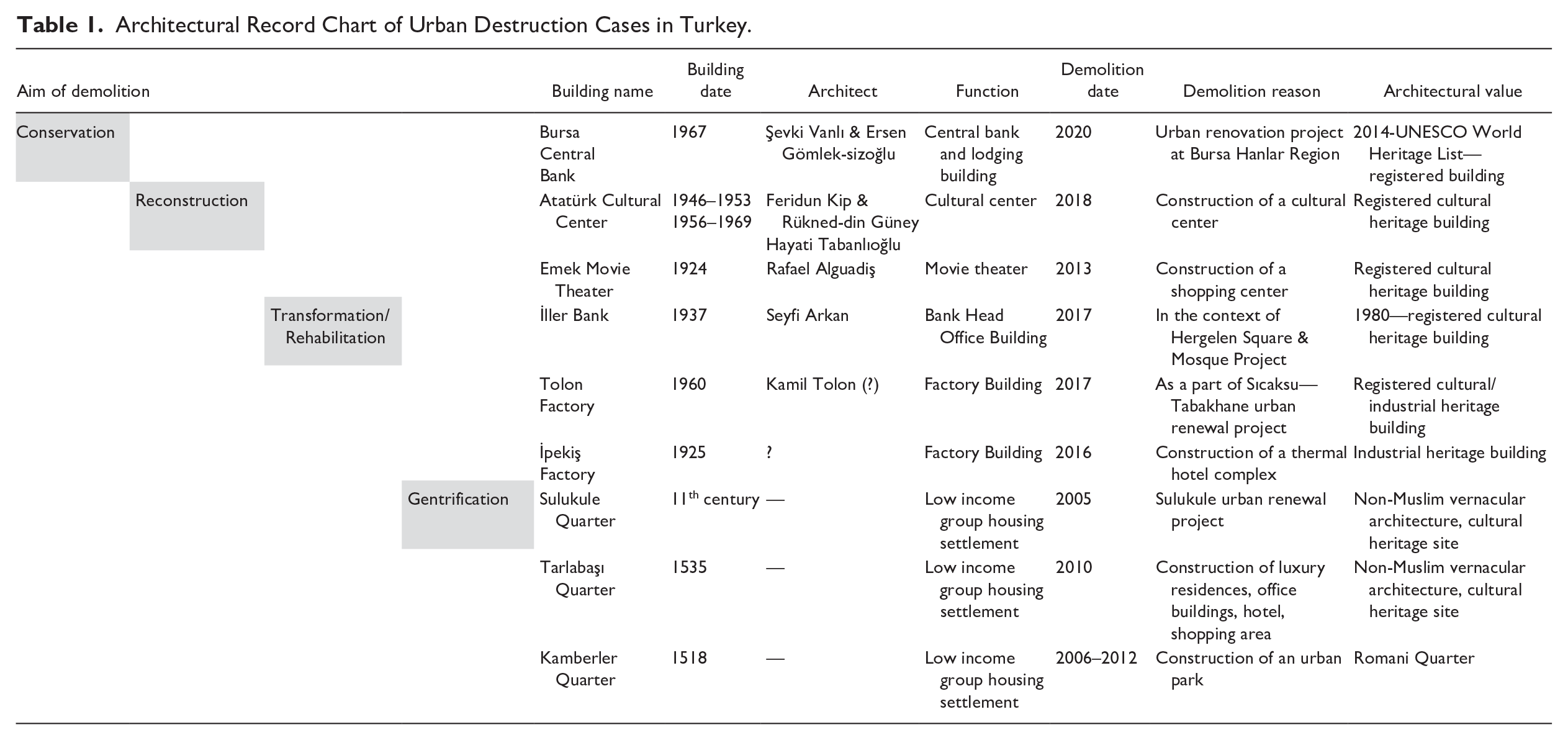
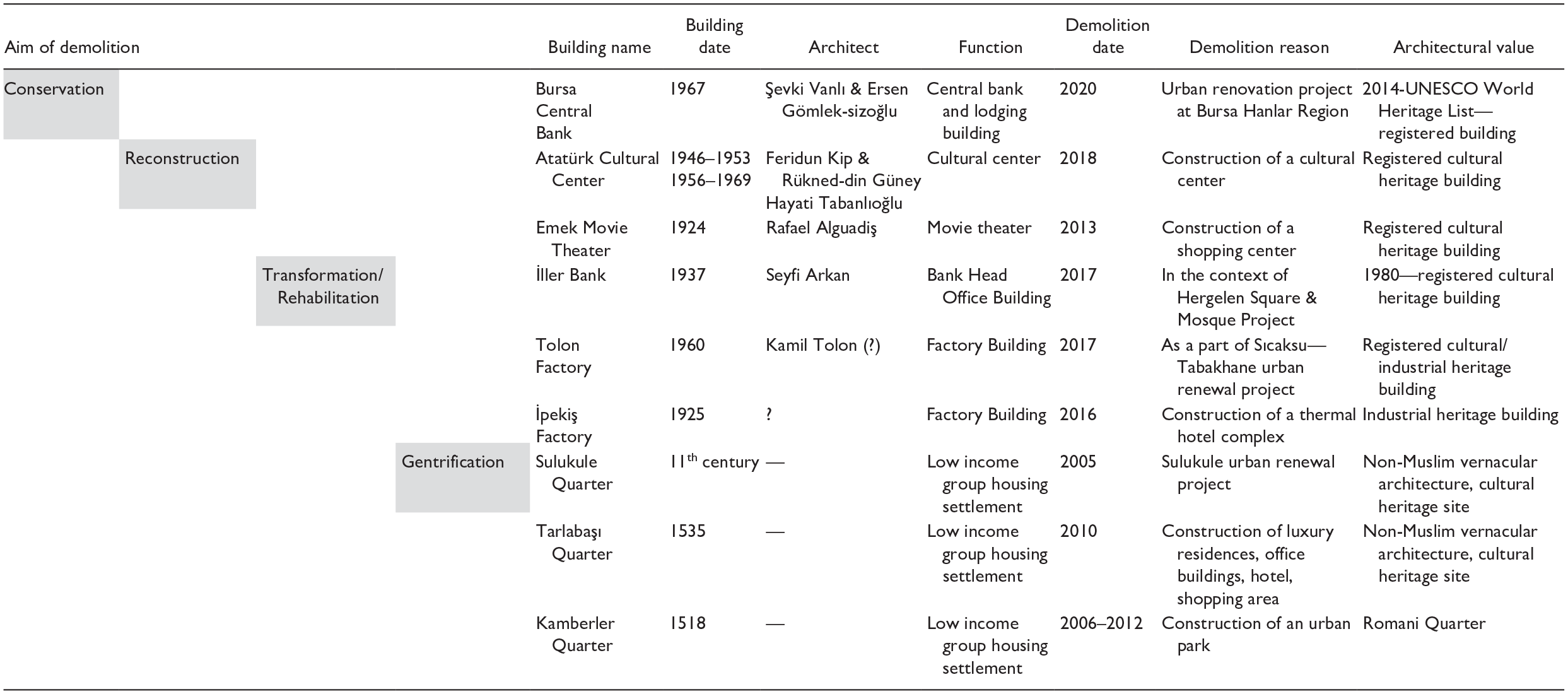
All of the examples came out with various motives, which might be grouped under four headings such as conservation, reconstruction, urban transformation/rehabilitation, and gentrification.
1. Conservation: The demolition carried out around the Bursa Khans Area, which is included in UNESCO World Heritage List, can be discussed as an example of destruction with the motive of conservation. This motive is related to environmental (structural), social, and cultural causes of urban destruction. In the context of “Bursa Khans District Çarşıbaşı” Urban Design Project, many registered and unregistered buildings in the region were demolished to reveal the historical texture of the Khans Area. The most controversial among the demolished buildings is the Bursa Central Bank building, a registered structure designed by Şevki Vanlı and Ersen Gömleksizoğlu, built in 1967. The aim of the project was to implement an urban renovation which will help to make the Khans Area, one of the important symbols of the Ottoman heritage, more perceivable in the urban tissue of Bursa. The Khans Area, located in the center of the city, has become difficult to perceive by the citizens who use the main transportation axes due to the additions made over time and the architectural layers added to the city in line with the developing needs of the inhabitants. While some of these structures built over time are architecturally unqualified; some, such as the Bursa Central Bank building, constitute original examples of modern architectural heritage. At this point, in the palimpsest cities like Bursa, which have grown over time in a multilayered way, it is a problematic approach that the preservation of the urban texture is carried out with a conservation approach that prioritizes only a certain period. Because the destruction of a building, which is a living document of Modern Architecture, also damages the multilayered urban memory. As a matter of fact, Bursa Central Bank building, which was formerly registered by the Conservation Board in 1990, was demolished upon the decision to reconstruct it, citing the earthquake risk, and the area between the Khans Area and the main transportation axis was completely evacuated. The preference of demolishing and reconstructing the building instead of strengthening it and preserving it in situ was criticized by the Chamber of Architects, NGOs and academics, but the annulment of the decision could not be achieved. Despite the Board’s decision to reconstruct, such an attempt has not been made yet (Özçakır, 2021).
2. Reconstruction: Atatürk Cultural Center (AKM) and Emek movie-theater can be examined as the examples of destructed buildings with the motive of reconstruction. This motive is related to social and political causes of urban destruction.
The original Atatürk Cultural Center, one of the important symbols of Turkey’s architectural and cultural history, was designed by Hayati Tabanlıoğlu. It was completed in 1969. But the fire, which broke out shortly after the building was put into service, largely destroyed the structure. It was reopened in 1978 after repairment and was actively used until 2008. The decision to build a cultural center in this location in Istanbul was taken in 1939 with the initiative of the then Governor Lütfi Kırdar and the recommendation of the City Planner Henri Prost. The project prepared by August Perret could not be realized, then the project of Feridun Kip and Rükneddin Güney started to be built but could not be completed due to financial insufficiencies. Tabanlıoğlu, who took over the project in 1956, developed the existing framework and gave it its final form (Ganiç, 2016). It was extremely important that AKM, which is a concrete document of the cultural transformation of the Republican Era, should be preserved as a tangible cultural asset. AKM, which was a registered building, remained inert for 10 years after it was closed to be repaired in 2008. Despite all the reactions of the public, instead of being strengthened and protected, it was demolished in 2018 and reconstructed and put into service in 2021.
Emek movie-theater, another building that was demolished to be reconstructed, was designed and built in 1924 by Rafael Alguadiş. However, it can be said that it is an extension of a much older cultural heritage. The story of Emek movie-theater begins with the Cercle d’Orient Building, which was built on the same parcel in 1884 by Architect Alexander Vallaury. In 1909, the Skating Palace was built in the space behind the building. In time, İpek and Rüya movie-theaters, Melek Apartment and Melek (later called Emek) movie-theater were built in 1924, and the building block took its final form (Kula Say, 2016; Özlü, 2016). As such, the building block had an architectural scheme in which all units were intricately related to each other and connected to the street through each other. Depending on this fact, Emek movie-theater can be accepted as a representative of the holistic structure, which was a symbol of the Westernization movement of the Ottoman Empire; not only the Early Republican Period, just because it was built in 1924. 1 The movie theater, which was used until 2013, was demolished for the construction of the Grand Pera shopping center, which was to be built on the same parcel on that date. Afterward, it was rebuilt on the seventh floor of the shopping center by using some structural elements that remained from the demolition, breaking away from the context it established with the city.
At this point, the questions arise whether reconstruction is a real conservation method, whether it can bring back the lost urban memory, and whether registration is sufficient to protect the architectural heritage buildings against destruction. Mazlum (2014) describes the reconstruction of a building which has been destroyed due to disaster or war as “an act of resurrection without a soul,” and also, she emphasizes that demolishing an existing building to rebuild it cannot be a legitimate action. Altan (2017), on the other hand, states that a conservation approach in which the protection of urban memory and architectural heritage depends on the decision not on what to preserve, but on what can be demolished, will allow the continuity of urban experiences. She suggests the establishment of “demolition approval boards” instead of conservation boards in this respect.
3. Transformation/Rehabilitation: İller Bank (Ankara), Tolon Factory (Bursa), İpekiş Factory (Bursa) examples are discussed under the title of urban transformation or urban rehabilitation, which is another motive for urban destruction. This motive is related to political and environmental (structural) causes of urban destruction. Some of these buildings have been destroyed due to their structural corruption, while others have been destroyed to make room for the projects that will be built in the region with the intention to contribute to the development and improvement of the city.
İller Bank building in Ankara, designed by Seyfi Arkan, built in 1937 and which used to be one of the most important representatives of the Republican Era Architecture, was registered as an immovable cultural property in 1980. Following the start of the Hergelen Square Regeneration and Melike Hatun Mosque Project in 2013, it was demolished in 2017 with the decision of the Conservation Board, on the condition that it will be reconstructed in another location, citing its structural instability. In 2019, two years after the demolition, which drew the reaction of the public, academia, NGOs, and the Chambers, the court canceled its decision on the grounds that it did not comply with the principles of urban conservation planning, the protection of cultural assets that are works of art, the principles of urban conservation, the relevant legislation, and the law. The court decision also emphasized that “the right of future generations to see a cultural heritage building with its original features was not protected” (TMMOB, 2019).
Tolon Factory, which was built in 1960, was Turkey’s first washing machine and dishwasher factory, included production facilities, offices, and lodging buildings. It is thought that the architectural drawings of the building, which used to have modern architecture influences, were made by Kamil Tolon, the owner of the factory, and the inventor of many products produced at the facility. The Tolon Factory Building has been given the status of a “registered structure” by the Bursa Cultural Heritage Conservation Board, considering its industrial historical importance and period characteristics. The building, which was closed to use for a long time, was evaluated for its durability within the scope of the “Kükürtlü Urban Renewal Project Implementation Development Plan.” It was decided to be demolished due to the high cost of reinforcement, and the demolition took place in 2017 (Işık & Tuncer, 2023). Within the scope of the Urban Transformation project mentioned, 690 residences and 92 stores are planned to be built in a large area including the factory site. The Bursa Branch of the Chamber of Architects, reacting to the practice, emphasized that the building was one of the most important examples of civil architecture in Bursa and that the demolition was a significant loss for the urban memory (“Türkiye’nin İlk Çamaşır Makinası Fabrikası’nın Binası Artık Yok,” n.d.).
İpekiş Factory was one of the first weaving factories of the Republic of Turkey. The groundbreaking ceremony of the factory building was realized in 1925. It is a symbolic structure of great importance in the industrialization of Bursa and the formation of its modern identity (Deniz, 2020). It was planned to demolish the factory campus, which is located on a very large land in the city center and build a thermal hotel complex in its place. For this reason, based on the zoning plan change, demolition started in 2016 just before the official holiday, and even if the demolition decision was canceled by the court after the holiday, a large part of the building was already destroyed during this period (Göz, 2016).
In all the cases mentioned above, “structural weakness due to building age” was asserted as a legal foundation for demolition. At this point, it is necessary to discuss whether structural strengthening can be a solution and whether it is possible to re-function the existing buildings by protecting the traces of urban memory.
4. Gentrification: Under the title of gentrification, which is another motive for urban destruction, Tarlabaşı and Sulukule in İstanbul and Kamberler in Bursa can be cited as examples. This motive is related to economic reasons and urban renewal intentions explained as causes of urban destruction.
Sulukule, known as the oldest Romani settlement in the world, was formed in the 11th century by the placement of Romani people from India in this region. After 1918, the neighborhood gradually started to take its current form before the demolition. It was both a ghetto where a large part of the Romani population was sheltered, and an important entertainment center of the period, especially in the 1950s–1960s (“Sulukule’nin tarihçesi,” 2008). The demolition process, which started in 2005 in the scope of the Sulukule Renovation Project, was completed in 2009. Then the construction of “Ottoman Residences” started within the project. Following the start of the demolition, TOKİ houses, 41 km away from the existing neighborhood, were offered to the inhabitants as an alternative to shelter. The people of the region organized the Sulukule Platform and tried to defend their rights in the legal platform with the support of various NGOs and UNESCO. After the demolition was completed and the construction of the new residences was completed, the Court decided to cancel the renovation project in 2012 and 2019 (Yaşar, 2020).
Tarlabaşı Quarter was established as a residential area for the senior executives working in embassies that settled in Beyoğlu after 1535, as well as those working in the workplaces and residences of Levantines and non-Muslims living in Beyoğlu. After 1960, the buildings abandoned by non-Muslims turned into an urban depression area. The cheap labor force that came to the city with internal migration settled in those abandoned buildings. With the opening of Tarlabaşı Boulevard after 1980, its organic bond with Beyoğlu was severely damaged. In 2006, the area consisting of 269 buildings, 209 of which were registered buildings, was declared a “renewal area.” In 2008, the Istanbul Branch of the Chamber of Architects filed a lawsuit for the annulment of the decisions made against Tarlabaşı and the preliminary projects; forced evictions and demolitions started in 2010 while the lawsuit was ongoing. In 2017, the Administrative Court decided to cancel the renovation project, stating that it was against the “planning principles, public interest and law” (Pişkin, 2017). However, this late decision could not prevent the disappearance of urban fabric dating back centuries.
Kamberler (Ebu İshak) Quarter, one of the oldest neighborhoods in Bursa as being existing until 1518, is an urban area where Romani citizens were densely settled before the demolition and where unplanned housing was observed. Within the scope of the Kamberler Urban Transformation Project, it was decided to expropriate 370 residences in the region and to create a park area in the evacuated area. However, as an alternative settlement area was not shown to the evacuated housing owners, a large part of the people of the region migrated to the vacant areas outside the city, causing slums (Sönmez, 2012).
The common feature of the three examples is that the people who lived in the region before the demolition were largely deprived of their rights and forced to live in a very remote part of the city, disrupting the continuity of their living habits. The decision for demolition in the mentioned projects was taken based on the law numbered 5366: “Renewing and maintaining the worn-out historical and cultural immovable assets” (Çetken, 2011). This law foresees that the existing life pattern will continue in place after the necessary rehabilitation works. However, the existing social identity, in a sense, disappears with the complete displacement of the urban dwellers living in the region as a result of gentrification. The destruction of the existing urban fabric through demolition, and the proposal of a more gentrified settlement are the other outcomes of this process. Although a massive struggle continued with the support of professional chambers, NGOs and inhabitants in the mentioned examples and annulment decisions regarding the current practice were issued through the courts, the achievements remained very limited. Also, it has been observed that cultural continuity has been severely interrupted.
Figure 1 is presenting the urban destruction panorama and bringing all mentioned cases together. In this figure, the images of each building/region before, during, and after (existing or planned) demolition are brought together to show all phases of its existence. Being examined as a whole, this figure clearly reveals the stages of urban destruction, the disappearance of urban memory, creation of a fake identity, and interruption of cultural sustainability.
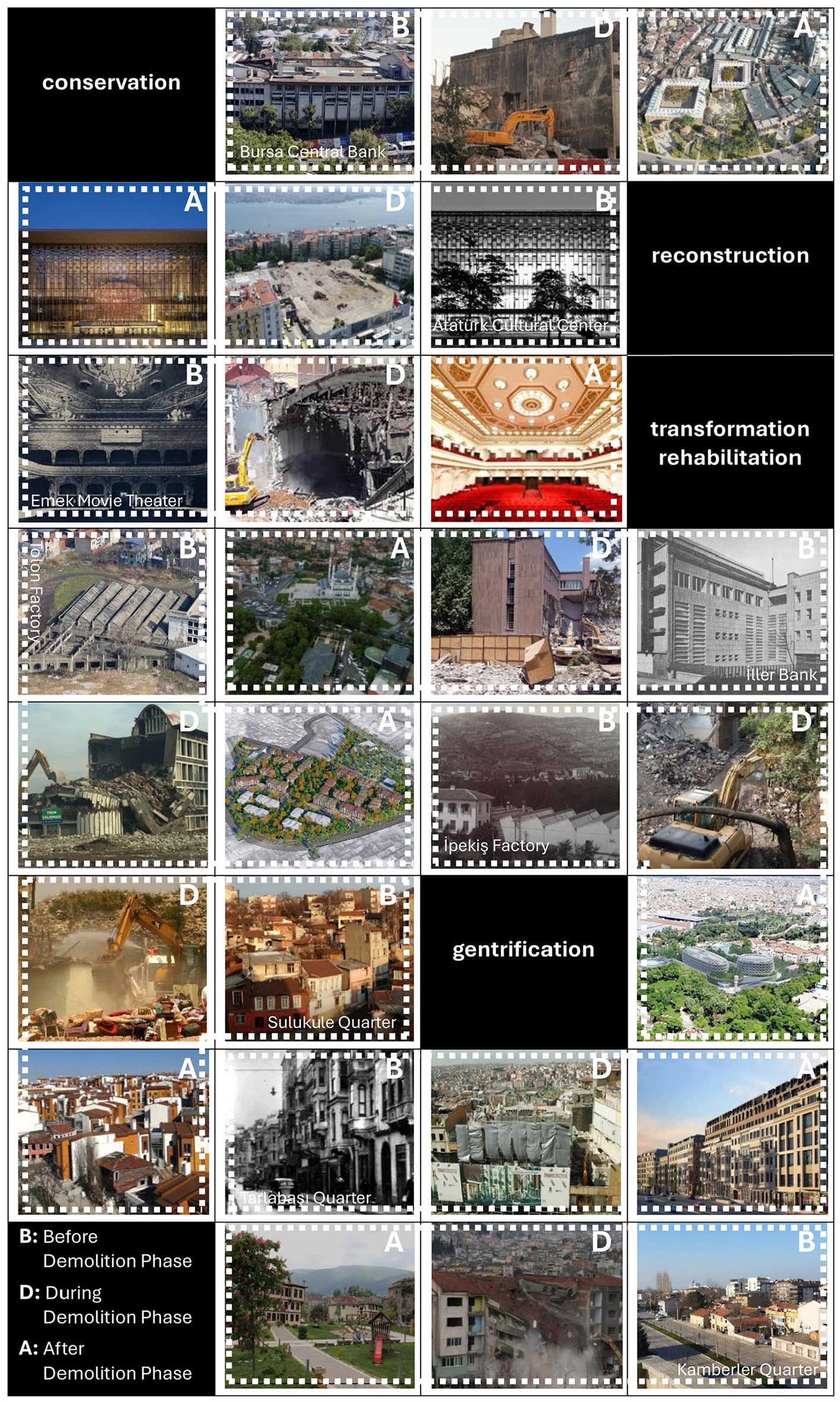
Urban Destruction Panorama Based on Striking Cases of Turkey.
Conclusion
In the cases of urban destruction carried out with different motives discussed within the scope of this study, the urban texture has been “cleaned” from the buildings belonging to various architectural periods and approaches and turned into an exhibition space of a singular understanding/style. Another determination of this article is that most of the buildings preferred to be demolished in these cases are examples of Modern Architectural heritage. Özçakır (2021) states that the architectural heritage of the 20th century is exposed to different threats today, and in addition to the architectural, documental, and aesthetic values of the buildings for their protection; emphasizes the importance of highlighting the memorial and symbolic values. While the act of building by destructing constructs the choice between the new and the old, it was not questioned what the destructed was and what it meant, because being modern meant looking at what was built, not what was destroyed (Çetken, 2011). The act of destruction is often associated with modern thought in literature. However, the choice of what to destruct belongs to the ruling power. Therefore, the fact that mostly modern architectural structures are the target of the act of destruction (which is put forward as a product of the “modern thought system”) in contemporary cities of Turkey creates an oxymoron. The rest of the mentioned destructed cases in the article are the places of “otherized” communities (as in the examples of gentrification projects). In most urban renewal and gentrification projects, there is a remarkable search for identity. Independently of urban memory, this identity is shaped according to the vision of central decision-making mechanisms. According to Tomruk and Akpınar (2009), these projects have a connotation of “elitisation,” social segregation, and social polarization and use the rhetoric of “regenerating the lost identity.” In most of the urban revitalization projects, “making the city attractive for the tourists” is a strong objective. So, no harm is seen in ignoring the expectations of the inhabitants (the real urban dwellers) and “cleaning” the urban area. The act of isolating the citizens in their gated communities and turning the city center into a touristic zone reminds Bryman’s (1999) concept of “Disneyization.” An urban area that is standardized and “cleaned” by being purified from its multilayered texture is in danger of turning into a movie set.
The findings presented in this study underscore the critical need for a paradigm shift in urban planning and conservation practices. The conceptual framework that was developed earlier based on the concept of urban memory, cultural sustainability, and urbicide shows that the strategy of selecting and “purifying” the heritage is inadequate. While the preservation of individual historical buildings is important, it is insufficient to safeguard the holistic urban memory that constitutes a city’s cultural identity. The case studies demonstrate that the seemingly efficient approach of demolishing “unnecessary” structures to highlight a specific historical period often results in an irreversible loss of collective memory, cultural diversity, and social cohesion.
The analysis presented in the scope of this article reveals that the motivations for urban destruction are complex and multilayered, reflecting economic pressures, political agendas, social inequalities, and environmental considerations. The simplistic notion of “cleaning” a city by removing certain elements ignores the dynamic, layered nature of urban space and its continuous evolution. Each layer, regardless of its age or architectural style, plays a significant role in the formation of urban memory and shapes the identity of the community as well as influence the culture. The selective demolition of particular periods, often favoring a specific aesthetic or narrative, leads to a homogenization of urban landscapes, a silencing of diverse voices, and a distortion of historical narratives.
Therefore, a more holistic approach is essential, one that values the entirety of the urban palimpsest. Thus, future planning and conservation initiatives should shift from the tendency of focusing on particular time intervals and aim for the comprehensive approach. This involves integrating the preservation of diverse urban layers into broader urban renewal and development strategies. It requires a deeper understanding of the diverse communities that inhabit and shape urban spaces, their relationships with the built environment, and the significance of those spaces to their collective memory and cultural identity. Furthermore, it calls for the recognition of the need to promote real cultural sustainability by engaging all the parties involved in the process of developing the future of their cities. Only through such a holistic and inclusive approach, it is possible to preserve the complex system of urban memory and ensure the long-term sustainability of cultural heritage.
This study makes several original contributions to academic literature and policymaking by critically examining urbicide in Turkey through the lenses of cultural sustainability and urban memory. Theoretically, the study bridges urbicide and cultural sustainability, demonstrating how everyday urban destruction erodes long-term cultural resilience. The study also makes an empirical contribution by documenting understudied cases and providing a systematic analysis of urbicide in Turkey. This highlights unique motives and establishes a four-fold framework for classifying urbicide, which facilitates comparisons across geopolitical contexts. In terms of policy, the essay critiques legal frameworks and suggests holistic preservation strategies, such as anti-purification policies that call for the preservation of all urban layers to maintain memory continuity and encourage adaptive reuse over demolition. The interdisciplinary approach adopted by the article (drawing on urban studies, memory studies, and critical heritage studies) enables it to trace the translation of physical destruction into cultural and social harm, making a nuanced contribution to the literature on urbicide.
Footnotes
Acknowledgements
This article is a revised and expanded version of a paper entitled [Urban Destruction: (De)Generation With The Intention Of (Re)Generation], which was presented at [LIVENARCH VIII-2023 Congress; Trabzon, Turkey; September 27–29, 2023].
Data Availability Statement
The data are contained in the article.
Declaration of Conflicting Interests
The author(s) declared no potential conflicts of interest with respect to the research, authorship, and/or publication of this article.
Funding
The author(s) received no financial support for the research, authorship, and/or publication of this article.
Ethical Approval Statement
This study does not require ethical approval.
