




Abstract
This article discusses the transformation of religious and non-religious practices in contemporary Japanese youth culture. The article employs both western analysis of ‘nones’ and Japanese theories to explain this transformation. Three concepts characterize (non-)religiousness in Japanese youth culture: ‘practicing belonging’, ‘vicarious spirituality’, and ‘gendered fetishism’. These concepts are first exemplified in a culture surrounding the concept of ‘tulpa’ (created paranormal beings, derived from Tibetan Buddhism) in Japan. Other examples reflecting each of these concepts are presented, along with a discussion of why Japanese youth culture came to manifest such characteristics. In so doing, we will refrain from drawing a rigid line between religious and non-religious settings, acknowledging that what may appear religious to Japanese scholars may not be viewed as such by western scholars. The factors behind the transformation of religiousness in Japan affect not only religious and spiritual but also non-religious or secular settings, resulting in parallel phenomena.
The purpose of this article is to illustrate the transforming varieties of religiousness and non-religiousness found in contemporary Japanese youth culture and to explain why such transformation has been taking place. To do so, we employ not only western but also Japanese sociological theories. By putting western and Japanese theories in ‘dialogue’, a keyword of this conference, we hope to contribute to the de-centering (another keyword in the text of the theme of the conference) of the sociology of religion without sliding into the myth of Japanese uniqueness, a popular yet problematic assumption that Japanese people and society are too unique to be understood with Western categories and theories.
More specifically, under the rubric of ‘Japanese youth culture’, we include anime, games, social media, idols (in the sense of pop stars), and so on. The western theories we will apply are those presented by Davie (1990, 2008) and other European scholars in their exploration of non-religiousness or ‘nones’. For Japanese theorists, we will refer to the influential Japanese sociologist Mita Munesue (1937–2022) and also some leading sociologists and thinkers he has inspired.
Speaking of youth subculture and religion, sociologists of religion are familiar with Possamai’s (2007) idea of ‘hyper-real religion’, Cusack’s (2010) ‘invented religion’, and Davidsen’s (2013) ‘fiction-based religion’, which have been applied to Jediism, Flying Spaghetti Monsterism, and the like. Our idea differs from these precedents in that they are more centered on beliefs or contents of beliefs while ours is more about practices. If Jediism and other fiction-based religions are modern or post-modern mythology, the examples we will present are cases of modern or post-modern rituals and customs once problematically termed magic, fetishism, or idolatry.
We will first focus on one example, the development in Japan of a culture surrounding ‘tulpa’, an originally Tibetan type of paranormal being. This serves to introduce three working concepts, ‘practicing belonging’, ‘vicarious spirituality’, and ‘gendered fetishism’, which characterize religiousness and non-religiousness in the current Japanese youth culture. We will then present more examples that reflect each of the three concepts. We will further draw upon Mita’s (1990) and other Japanese scholars’ arguments to explain why such transformation has occurred in Japan over the last several decades. We will finally discuss cross-cultural or cross-national implications of our findings and arguments.
In the course of our argument, we will refrain from drawing a rigid line between religious and non-religious settings. There have been abundant discussions about whether or not Japanese people are religious, both within and outside Japan and academia. For the reasons that we elaborate on in the following section, in this article, we use the ambiguous expression ‘religious and non-religious’ purposefully. Our basic idea is that factors behind the transformation of religiousness are not necessarily affecting only religion and spirituality. It would rather be the case that the same factors have been influencing both religious/spiritual and non-religious or entirely secular settings, 1 resulting in parallel phenomena. When our usage of the words ‘religion’ and ‘non-religion’ becomes confusing, we will add notes to avoid misunderstanding.
Our thesis posits that Japanese youth culture underwent significant transformations in the mid-1990s, after the Aum Shinrikyō affair in 1995. Although the affair did not directly cause these changes in subculture, it symptomized a major turning point, according to the periodization of post-WWII Japanese history expanded by Mita (1990) and others. Subsequently, the pursuit of self-attainment or self-realization akin to Aum followers became outdated and perilous. In the present century, Japanese youth culture exhibits traits of a ‘weak self’ and a ‘multiple self’, characterized by ‘practicing belonging’, ‘vicarious spirituality’, and ‘gendered fetishism’. The examples this article presents neither align with traditional religious practices nor with conventional spirituality, yet they also do not fit entirely within secular categories.
Strategies to tackle the conceptual problem of ‘(Japanese) religion’
There have been long-standing debates about whether contemporary Japanese people are truly non-religious as many of them claim. One popular discourse posits that Japanese people may not seem religious under the western category of religion, but they have been and remain followers of an indigenous kind of religion. Represented by Ama’s (1996) million-seller, the discourse often bears a religionist and nationalist overtone: Japanese people have a proper, traditional religion on its own, not a pseudo-religion. On the opposite side of the debate, there are scholars who argue that Japan best attests the secularization thesis, represented by Reader (2012). He argues that religion, whether organized, institutional, or deriving from folk practices, is in decline in Japan. Although based on extensive survey data, his arguments have not yet convinced all scholars, this is partly because of the familiar yet fundamental problem of how to define ‘religion’ (defining ‘Japanese’ is equally problematic).
It is now a cliché to state that our concept of religion is a modern western construct, originating in Protestantism or more broadly in Abrahamic traditions. But how can we proceed with empirical studies from that point? Functional definitions of religion would not entirely solve the problem since they often rely on a pre-existing, common notion of religion (e.g. X functions as an equivalent of a ‘god’). In order to overcome the shortcomings of previous definitions of religion, Schilbrack (2014) has presented a renewed definition of religion that is at once substantive and functional, that is, religion as ‘forms of life predicated upon the reality of the superempirical’. He argues that this definition is inclusive enough to encompass nontheistic traditions represented by Buddhism, more than definitions based on the idea of superhuman beings (Schilbrack, 2014: 135–136). He also later mentions that this definition was critiqued as being too broad.
However, it is possible to argue that even Schilbrack’s definition has resonances of theistic traditions. For example, a Japanese sociologist of religion, Yanagawa (1991 [1984]), whose thesis of Japanese religion we will revisit later in this article, argues that the religion of Japanese people is based on ‘human relationships’ rather than belief in God or an affiliation to a particular religious institution. It is true that their human relationships are extended to ancestral spirits, which can be regarded as superempirical. Nevertheless, the point is that their beliefs and practices, as observed by Yanagawa, are not centered on the ontological reality of the superempirical.
Given this background, we propose two ways to move beyond endless debates. One is to take a constructivist approach and examine who has claimed ‘Japanese people are non-/religious’, when, where, and why, as well as the resulting social effects. There is a recent attempt in this direction, that is, a genealogy of the discourse of ‘Japanese people are non-religious’ (Fujiwara, 2023). The other approach is a practical one for empirical studies. It strategically evades the debate instead of being stuck in it, taking one side. That is, rather than rigidly distinguishing between the religious and the non-religious, or between the spiritual and the entirely secular, we propose identifying and explaining a ‘trend’ or ‘Zeitgeist’ specific to a particular period and society. This trend influences youth culture, encompassing both conventionally recognized religious-spiritual and secular settings. In this article, we explore the implications of this approach. We believe that for scholars of religion who are interested in changes in contemporary religion, the most important is to grasp the trend. They do not have to investigate solely into conventionally called religious settings, considering that the distinction between the religious and the non-religious has increasingly become fuzzy in western contexts, too. We have found that the trend in youth culture can be sociologically articulated by focusing on how young people construct ‘self’ or ‘identity’. The following discussion is a result of the articulation.
Tulpas as ‘practicing belonging’, ‘vicarious spirituality’, and ‘gendered fetishism’
A ‘tulpa’ was originally a theosophical idea derived from Tibetan Buddhism. 2 It refers to a paranormal, sentient being believed to be created through one’s mental power. Scholars note that the practice of creating tulpas gained traction among some western young people around 2010, giving birth to online communities of tulpa practitioners, or tulpa-mancers (Laursen, 2020). This phenomenon is mirrored in Japan. Historically, up until the end of the twentieth century, tulpa-forming was considered an esoteric practice among Japanese occultists. However, it has now blended with the anime and game culture of young people, leading to tulpa-mancers’ communities on social media.
Tracing this transition in Japan, early references to the ‘tulpa’ can be located within the fringes of the 1980s occult culture. Certain Japanese occultists inspired by Alexandra David-Néel – who introduced Tibetan Buddhist mystical practices including tulpas to the west – advocated tulpa creation as a pathway to attain supernatural powers in their spiritual pursuits. A renowned Japanese occultist of that era remarked that, in their authentic meditation practices, Tibetan monks can powerfully concentrate their thought to create a magical alter ego made from their auras. Once gaining the ability to control their auras, they can heal disease, read others’ minds, and form tulpas right in front of themselves (Takafuji, 1987). Another commented on how tulpa creation aids in spiritual awakening and develops the psychic prowess needed to intuit cosmic principles (Saitō, 1988).
The main media for discourses on tulpas moved from books and magazines to the interactive Internet in the mid-2000s. Online threads emerged, facilitating the exchange of information regarding how to make and use tulpas.
3
While one might sit quietly with eyes closed to create a tulpa like earlier occultists had done, the practice served a distinctly different purpose. One thread described a tulpa and its creation as: ‘Tulpa’ is a name borrowed from Tibetan esoteric Buddhism, and refers to a technique and the beings created by it, constructed within the 2chan
4
bulletin board. While generally considered a secret teaching of Tibetan esoteric Buddhism, it has undergone changes before and after spreading on the 2chan bulletin board and has little in common with the original teachings besides the name. This is a technique for creating an imaginary persona with whom one can interact as if it were a real entity. With effort, one can even see the imagined persona with their own eyes or hear their voice as if it were real. (...) The creation of a tulpa mainly involves creating an imaginary persona and conversing with it. By engaging in a conversation with this imagined persona and imagining their responses, one can eventually receive responses as if they were coming from a real entity. Gradually, the tulpa persona is formed, and it may even start initiating conversations on its own or taking actions beyond just talking. (...) It is also a fact that many people create tulpas, despite much of it being unknown, and gain enjoyment and emotional bonds from it in their daily lives.’
5
Remarkably, this description omits any association with meditation, spiritual awakening, or supernatural powers. The goal of creating a tulpa is no longer to achieve enlightenment or to acquire psychic powers. Instead, a tulpa is one’s conversation partner, similar to a child’s imaginary friend. The purpose of having a tulpa is to start intimate and cozy relationships with a being that one designs at one’s will.
One of us participated in a Japanese online tulpa community in 2021 to conduct online fieldwork and discovered that the 2chan tulpa thread had been closed and replaced in part by a X (then Twitter) community of tulpa-mancers. Common hashtags used in the X community are ‘# I want to be connected to tulpa-mancers’ and ‘# I want to be connected to people around thought-forms (thought-form is a word Besant and Leadbeater (1905) used to describe a tulpa)’. The X tulpa community has been quite active, although posts are not as numerous as in English online tulpa communities that spread from the United States. Although X is generally used more by young people in Japan, the tulpa community is exceptionally so, observing quite a large portion of posts on tulpas coming from teenagers.
To unravel the nature of the tulpa phenomenon, we employ three concepts: ‘practicing belonging’, ‘vicarious spirituality’, and ‘gendered fetishism’. ‘Practicing belonging’ is a phrase one of us presented earlier (Fujiwara, 2019). ‘Belonging’ in this phrase does not mean having membership in a church or other religious institution. It rather means forming a relationship with someone, a group, or a community, out of desire to connect. With this phrase, ‘practicing belonging’, we attempt to bridge two different arguments on non-religiousness, one by European sociologists of religion who followed Davie (1990, 2008) to articulate contemporary ‘nones’, the other by Japanese counterparts led by aforementioned sociologist Yanagawa (1991 [1984]) who have tried to describe Japanese non-religiousness, which, according to Yanagawa, is a religion on its own right.
Davie’s (1990) famous notion of ‘believing without belonging’ has inspired scholars to propose variants to capture the non-religiousness they observe, such as ‘belonging without believing’ and ‘believing in belonging’. One variant popular among scholars of Japanese religion is ‘practicing without believing’, a phrase that describes a majority of Japanese people who, while not being a member of any particular religious organization, nonetheless visit temples and shrines from time to time without knowing which deity or Buddha is enshrined there (Okamoto, 2019). 6 Although these phrases look alike, the idea of Japanese religion as ‘practicing without believing’ is not at all new. Not only contemporary Japanese people in apparently secularized urban districts but also traditional Japanese people in village communities have been regarded as only practically religious and, therefore, not religious enough by the western or Protestant standard. It has been said that their primary interest lies in performing rituals in order to attain practical benefits such as wealth and health in this life.
Against this backdrop, Yanagawa (1991 [1984]: 67–73), while observing the same attitudes of Japanese people, attempted to formulate them in a way different from a simple utilitarian perspective. He argued that the religion of Japanese people is based on human relationships rather than belief in God. Religion as human relationships is composed of various kinds of rituals and festivals centered on different groups of people, namely, family, local community, friends, fellow workers, and ancestor spirits. As such, the religion of Japanese people primarily functions to build and maintain human bonds. Yanagawa’s thesis may sound like a rehash of the Durkheimian thesis, God is society. So let us be more precise. According to Yanagawa, it is not that there is a big god who watches and forces people to be moral and altruistic for the sake of social cohesion. It is rather that maintaining human relationships is in itself recognized as a powerful social norm prescribed by rituals and festivals. Social cohesion is not the latent, but manifest function of the religion.
What we want to underscore by the phrase ‘practicing belonging’ is that current Japanese young people have moved one step further and started building relationships and sacralizing them individually, instead of merely following social conventions. They want to have their own sense of belonging, and they valorize relationships they create. Belonging has become the evident purpose of what they do in religious and non-religious contexts. As mentioned before, Japanese young tulpa-mancers want to create conversational relationships with their tulpas. In addition, they join online tulpa communities in order to be ‘connected’ to other tulpa-mancers and their tulpas. The act of creating one’s own tulpa is a practice of belonging. Moreover, this practice is not without believing. Tulpa-mancers believe that their tulpas exist for real because, otherwise, it would be no different from simply imagining a friend in their minds. Nevertheless, belief in spiritual beings in general is not a cultural prerequisite for creating a tulpa, and, therefore, these young tulpa-mancers are quite different from earlier occultists. ‘Practicing belonging’ may also be rephrased as ‘subjective rituals’, which serves to both align with and diverge from Possamai’s discussion of ‘subjective myths’ within the framework of hyper-real religion (Possamai, 2007: 57–69).
The second concept we apply to the tulpa phenomenon is ‘vicarious spirituality’, a variant of another well-known notion of Davie (2008), ‘vicarious religion’. By ‘vicarious’ she means ‘religion performed by an active minority but on behalf of a much larger number, who (implicitly at least) not only understand, but quite clearly approve of what the minority is doing’ (Davie, 2008: 169). As an example, she refers to the attitudes of Swedish people after the sinking of the Baltic ferry, Estonia in 1994, with the loss of some 900 lives. Swedish people, who no longer attend their churches regularly or believe in the tenets of Lutheranism, went to their churches in the anticipation that the Archbishop would articulate on their behalf, that is, vicariously, both the sentiments of the people and the meaning of the tragedy.
By analogy, ‘vicarious spirituality’ refers to young Japanese tulpa-mancers who do not aim to achieve their own spiritual awakening or self-realization by making tulpas. Intriguingly, they rather want their tulpas to grow spiritually and personally. According to one set of online instructions for tulpa-making, which has been circulating among Japanese tulpa-mancers, when one starts imagining one’s tulpa and projecting it onto the real world, he or she is forming the tulpa’s ‘personality’. 7 Tulpa-mancers thus nurture tulpas and let them grow as independent persons. Fully autonomous tulpas can also possess their masters, tulpa-mancers. What tulpas commonly do during possession is also different from what spirits do through possessed mediums in typical spiritual cultures. Instead of communicating with otherworldly spirits or extraterrestrial beings, tulpas post on bulletin boards and social media on behalf of their masters. It is pertinent to revisit Possamai’s concept of the ‘human potential ethic’ here, defined as ‘the belief in the spiritual development of the self and its latent abilities’ (Possamai, 2007: 88), which he observed in the context of hyper-real religions. Instead of aspiring to become superheroes as hyper-real religion consumers do, tulpa-mancers seek meaning in life through the indirect route of nurturing their personal tulpas into heroes – or more precisely, heroines.
The third concept, ‘gendered fetishism’, sheds light on the sexuality of tulpa-making. When an English, international tulpa community emerged on an online bulletin board around 2010, ‘bronies’, that is, adult male fans of an animated television series, My Little Pony: Friendship Is Magic, are said to have played a central role. They attempted to create female tulpas as imaginary companions in the form of ponies that appeared in the anime. The Japanese online tulpa community also initially developed among male otakus, meaning geeks in Japanese, whose tulpas were exclusively females, in the form of their favorite anime characters. The sexual nature of the relationships between tulpas and their masters is a noticeable difference from the relationships between imaginary friends and children. Moreover, the relationships are more like emotional attachments than spiritual devotion to or veneration of the Virgin Mary or saints in Christian and other traditionally religious contexts. Thus, the word ‘fetishism’ suits well the practice of tulpa-making.
We are fully aware of the problem of the word that stems from the colonial past. It has been abandoned as a scholarly term for a long time. Therefore, our usage of the word is only heuristic, aiming at drawing attention to contemporary practices that resemble what was called fetishism, first in colonial anthropology and then in aesthetic-cultural contexts. 8 It refers to emotional attachments to materials or the physical aspects of particular human beings including the visible aspects of spiritual beings like tulpa. The difference from animism is that adorers of fetishes are attached to the materials themselves and not because they revere spiritual entities inside the materials. Acknowledging the recent circulation of the term ‘material religion’, we choose to use ‘fetishism’ in this article because ‘material religion’ does not encompass cases like tulpa or a pop-star, an example we will explore later. The gendered aspect of contemporary ‘fetishism’ will become clearer if compared with another example, its female counterpart. Therefore, let us turn to examples other than tulpas that embody ‘practicing belonging’, ‘vicarious spirituality’, and ‘gendered fetishism’.
Examples of the three concepts
‘Practicing belonging’ in religious and non-religious settings
In the aforementioned article (Fujiwara, 2019), one of us drew two examples of ‘practicing belonging’. One is the ‘tsunagari wedding’, a term coined by the Japanese wedding industry in the 2010s. ‘Tsunagari’ is a Japanese word for connecting, belonging, or relating, which has recently gained buzzword status. The literal translation of ‘tsunagari wedding’ is, accordingly, ‘Belonging-style or connection-style wedding’. As mentioned, the hashtags used by tulpa-mancers in the Japanese X community are ‘# I want to be connected to tulpas’ and ‘# I want to be connected to people around thought-forms’. The word ‘connected’ in these hashtags is tsunagari in Japanese. Since the 1980s, Christian-style weddings have gained popularity among the Japanese, most of whom are not Christians. The wedding industry now promotes the ‘tsunagari wedding’, which seeks to visualize and fortify a couple’s bond with family and close friends through special rituals. It is true that any style of wedding ceremony, be it Christian or Shinto, allows a couple to cherish their bond with their families and friends, but the tsunagari wedding more explicitly emphasizes such connections. The website of a wedding company showcases original rituals reinforcing tsunagari; for example, the ‘ring relay’, ‘last bite’, and ‘cake-cutting by six’. The ‘ring relay’ involves passing a wedding ring along a string from one guest to another. The ‘last bite’ ritual sees a bride and groom each request a bite of cake from their mothers, reminiscent of their childhood. ‘Cake-cutting by six’ involves not just the couple but also both sets of parents cutting the cake together.
The other example of ‘practicing belonging’ is the Halloween party around Shibuya Scramble Crossing in Tokyo. Thousands of young adults gather and create a festive arena, moving and shouting all night, experiencing belonging with friends and other young people. Economists and media began referring to the Shibuya Halloween as a typical form of tsunagari shōhi, that is, tsunagari consumption, around the mid-2010s. Young people back in the 1980s were known for ‘brand consumption’, that is, consumer behavior determined by designer brands, and ‘status consumption’, whereby people purchased big-name brand items as a sign of their social status. In contrast, it is observed that young people now are no longer interested in buying such commodities. What they are more committed to is an exciting and special experience of belonging. It is the tsunagari experience itself that they seek to consume.
Recent research by Wada (2022) delves into religious elements in Japanese pop songs, underscoring the significance of tsunagari in contemporary Japanese culture and society. Whereas previous studies on Japanese religiousness and non-religiousness tended to focus on ritual and other practices such as New Year’s shrine visits, Wada hypothesized that non-religious Japanese people may express their inner, subtle religiosity more casually through pop song lyrics. Her method is quantitative text analysis by means of KH Coder. Out of the data of more than 320,000 songs released between 1990 and 2022, she collected the lyrics of 11,070 songs that contain the words ‘prayer’ and ‘pray’, assuming that such songs may reflect some kind of inner and subtle religiosity. She then applied co-occurrence network analysis to the lyrics. As a result, she found that, in Japanese pop songs, people (singers, protagonists) most commonly pray to stars in the sky rather than to God or spirits. Moreover, she found that the purposes of prayers in the songs could have changed in the early 2000s. In the 1990s, prayers in pop songs most often aimed at the fulfillment of one’s own romantic love. In contrast, prayers in pop songs from the 2010s to the present most often aim at ‘happiness’, and the second most often is ‘the fulfillment of one’s wish’ to meet or to stay with a particular person. Being much less passionate than the explicit love songs of the 1990s, contemporary songs with the word ‘pray’ are sung with a desire to create and maintain tsunagari relationships. Singing such songs is a practice of belonging. 9
Examples of ‘vicarious spirituality’ in religious and non-religious settings
We have argued that a tulpa is also a manifestation of ‘vicarious spirituality’ because Japanese tulpa-mancers do not pursue their own self-realization but want to help their tulpas grow to be spiritual persons. They do not search for or sacralize the authentic self. They seem to be satisfied with ‘gaining enjoyment and emotional bonds from’ conversation with tulpas ‘in their daily lives’, as quoted above. 10 Such a mindset is actually prevalent among contemporary young people in Japan. Its outstanding equivalent in non-religious (in the sense of secular) settings can be found in the expanding culture called oshi-katsu, which means the act of cheering on or showing devotion to idols, stars, virtual YouTubers, and the like. The slang term oshi (which means the person or the thing one highly supports) has been commonly used since the beginning of this century among idol fans. Another slang word, oshi-katsu (which means activities on and for one’s oshi), refers to the recent development of activities among fandoms, many of which require significant financial investment. According to a survey conducted by a business newspaper in early 2022, 35.6% of respondents aged 16–26 were enjoying oshi-katsu. 11
A popular book titled What is ‘oshi’ for humanity (Jinrui ni totte oshi to wa nannanoka), published in 2021, encapsulates this fandom. According to its author, a male pop star fan, ‘People need “oshis” because it is currently an era where it is difficult to feel the sense of being alive, or being for real’ (Yokogawa, 2021: 18). The author repeatedly acknowledges having very low self-esteem and dedicates the book to those who have no confidence in themselves: Frankly speaking, we want to be useful to someone. If you live an ordinary life, it’s rare to feel like you’re being useful to others... That’s why being a ‘number’ [which means the amount of money contributed to an oshi] for my oshi (‘being oshi’s number’ means that one is recognized by one’s oshi and his other fans by the amount of money one offers) is the joy of oshi-katsu (oshi-activities), as it makes it clear and easy for me to confirm my own existence (...). The more I donate to my oshi, the more I receive various privileges. Nevertheless, I am happier to see my oshi become more and more popular and his dream coming true than I am gaining such benefits on my side. As my oshi grows up, I will become a flagstone of his path of life. (Yokogawa, 2021: 18–19)
The word ‘donate’ in this quote is fuse in Japanese, which is a distinctly religious word that is the same as church offering. It implies the deification of the oshi. But the fans, by practicing belonging to their oshis, are not interested in fulfilling their ideals by themselves, a point illustrated by the author. They want to see their oshis become superstars and fulfill dreams in their place. That provides them with enough encouragement to continue living a hard life, a life that feels meaningless without oshis. The author says, in conclusion, if you ask me for one last time what an oshi is, I will say my oshi is my ‘amulet’(...). I thought I had been cheering my oshi. But one day I realized it was rather that my oshi was cheering me up. That’s oshi, I think. Although our lives are long and hard, with just one such amulet, we will be able to barely survive. (Yokogawa, 2021: 254–255)
As seen in this quote, fans are often encouraged by oshis, but words popularly used in spiritual markets such as ‘empowerment’ and ‘enlightenment’ are too strong to describe the relationships between fans and oshis. The relationships between Japanese tulpa-mancers and tulpas are quite similar to oshi-activities in this regard. It is thus much more adequate to view tulpa-creation as a religious counterpart of oshi activities than an esoteric practice in the line of Theosophical or New Age cultures.
Examples of ‘gendered fetishism’ in religious and non-religious settings
As for our third concept, ‘gendered fetishism’, an example of the phenomenon on the female side in religious settings is the butsuzō buum (Buddha image boom). The media started reporting on this new culture in 2010. Increasingly, young people, particularly women, enjoyed collecting small Buddha statues or pictures. This practice resembles an otaku, an anime fan, collecting figurines of anime characters. Such Buddha image collectors are not interested in meditation as New Agers once were. Nor do they worship Buddha as Japanese people in traditional Buddhist contexts did or still do. 12 Their feelings toward Buddha images involve a strong affective, somehow romantic, attachment to their materiality, called moe in Japanese slang. Therefore, Buddha images are not mere embodiments of deities. This is why we employ the term fetish, as controversial as it may seem. Otaku, or Japanese geek, subculture, where the word moe originated, has shifted from the margins to the center of Japanese culture in this century. Nevertheless, otaku culture is still perceived as more or less abnormal or even pathetic by the public. The terms ‘fetish’ and ‘fetishism’ echo the reception of the culture in Japan, and substituting them with seemingly neutral terms like ‘object’ and ‘object-worship’ would obscure the vibrant nature of youth culture. While we do not share the negative valuation, we believe these terms more accurately depict the aspect of the culture.
The word moe accentuates one difference between Japanese otakus and their well-known western counterparts, Trekkies (Star Trek fans). It was observed that typical otakus in the late 1990s when the word came to the fore were addicted to the voice of an anime character or to specific features of its distinctive design, such as ‘cat ears’, ‘maid costume’, and ‘hair springing up like an antennae’ (Azuma, 2001: 42–43), 13 in essence, the material aspects of the characters. Conversely, most Trekkies are attracted to Star Trek characters as whole persons, and usually not sexually. Although Trekkies also express interest in specific physical attributes or costumes of characters, Spock’s ears or Worf’s forehead, these elements hold meaning only as they relate to the entire characters. Whereas otakus have attachments to body parts, Trekkies have adoration for characters. Moreover, the feeling of moe among Japanese otakus has a strong heterosexual overtone. Therefore, the term ‘fetishism’, in both meanings of De Brossesian object-worship and sexual fixation, apart from the problem of its negative nuances, seems to better describe moe and practices accompanied with the particular affection.
Once moe entered popular vernacular, people started applying it to a variety of objects of obsession in religious and non-religious settings. An instance is haka-moe, which means moe for graves, or graves to moe. There is a video which showcases a number of graves to people who love graves and have moe-feeling toward them. 14 This may sound like a bizarre example, but it helps to clarify the differences between ‘moe-fetishism’ and the traditionally religious or the spiritual in general. People who feel moe for graves are attached not to the aura or environment of graveyards but directly to the gravestones. Spiritual people may regard a graveyard as an entrance to the otherworld, or as a spiritual site where they can boast of their paranormal power of seeing the dead. Traditionally religious people regard a graveyard as a ritual place for ancestor worship. In contrast, haka-moe people are captivated by the gravestones for their intrinsic appeal. Although both spiritual and traditionally religious people also often show interest in materials, such as crystals, they value them for their perceived spiritual or miraculous properties. This is not so with haka-moe aficionados. They do not worship gravestones as if they were transcendent, nor do they expect this-worldly benefits such as healing from the gravestones.
Having the two aspects of fetishism, object-worship and erotic obsession, the moe culture is frequently gendered. Despite a growing awareness among young Japanese people regarding LGBTQ+ issues, their moe culture tends to be framed by the binary gender distinction. Initially, tulpa-mancers were predominantly male, while female Buddha image collectors have been so predominantly represented that the media dubbed them butsuzō-gāruzu (Buddha image girls). The otaku culture centered on anime, games, and girl idols has predominantly been a male world, while oshi-katsu is now more recognized as a female activity. According to a survey given by a marketing company in 2021, 75.5% of women aged 15–24 agreed with the statement, ‘I have something that can be called oshi’. 15
Why the transformation has occurred
As has been argued thus far, among young people in Japan, the occult/New Age practice of tulpa-creation has been transformed into the current tulpa trends of ‘practicing belonging’, ‘vicarious spirituality’, and ‘gendered fetishism’. Leading Japanese intellectuals have engaged in lively discussions about the nature of youth culture, especially otaku culture, and the reasons this culture has developed these characteristics over recent decades. The discussions are built on a thesis about the periodization of post-World War II Japanese history, presented by an influential sociologist, Mita, in 1990.
Mita (1990) divided post-World War II Japanese history into three eras. First, the Era of the Ideal is a period between 1946 and 1960; second is the Era of Dreams, a period between 1960 and 1975; and third is the Era of Virtuality, a period between 1975 and 1990. According to Mita, in the Era of the Ideal, Japanese people strove for recovery from the war, and regarded American prosperity and democracy as their new ideals. The Era of Dreams is the time when Japan underwent high-rate economic growth. It is also the era of a revolutionary dream. Students plunged into countercultural movements, sympathizing with American hippies and dreaming about the coming new age. With the end of enthusiastic countercultural movements, young people rapidly became apolitical and apathetic. These youth lived in the Era of Virtuality, perceiving the real as virtual or fictional, and the virtual as real. This era can be represented by Tokyo Disneyland (which was established in 1983) and Haruki Murakami’s early novels such as A Wild Sheep Chase and Hard-Boiled Wonderland and the End of the World. Tokyo itself became a fictional, unreal city like Disneyland.
Following Mita, Azuma (2009), an equally influential social critic who admits to being an otaku himself, observed young Japanese in the late 1990s, who correspond to Generations X and Y in the United States, behaving in some sense as animals, in his work published in 2001, Otaku: Japan’s database animals. A more literal translation of the original Japanese title of the book would be Animalizing postmodernity: Japanese society from an otaku perspective. Azuma named the period from 1995 onward ‘the Era of Animalness’. In explaining this era, he focused on otaku culture and pointed out a difference between early otakus around the 1980s and those in the late 90s. Whereas the former sought ‘grand narratives’ in anime and games, which constructed their shared fictional worldviews, the latter are attracted to this or that particular character. Furthermore, as already mentioned, they are often attracted to characters’ particular, mostly female, physical parts such as ‘cat ears’, fragmented and detached from any surrounding narratives. In other words, the latter otaku ‘consume databases’ instead of narratives through anime and games. Moreover, Azuma argues that the way otaku consume databases is so direct and instinctive that it resembles how animals satisfy their desires. He calls the indulging aspect of the culture the ‘animalization’ of the human. That is, Azuma sees animalness in the moe-feeling of attachment. He writes, So if we were to stretch our chain of association, this sort of otaku behavioral principle can be thought of as differing from that of intellectual aficionados (conscious people), whose interest is based in cool judgment, and from that of fetishistically indulgent sexual subjects (unconscious people). But rather, more simply and directly, the otaku behavioral principle can be seen as close to the behavioral principle of drug addicts. Not a few otaku tell a heartfelt story that, having once encountered some character designs or the voices of some voice actors, that picture or voice circulates through that otaku’s head as if the neural wiring had completely changed. This resembles a drug dependency rather than a hobby. (Azuma, 2009: 88)
Another leading sociologist Ōsawa (2008) took over the discussion and called the period from 1995 onward ‘the Era of Impossibility’, contrasting it with the preceding Era of Virtuality. 16 Ōsawa argues that the young members of Aum Shinrikyō, a new religious group that committed a sarin-gas terrorist attack in Tokyo in 1995, represent the Era of Virtuality. According to Ōsawa, young people in the Era of Virtuality, who appeared to live in a fictional world, were disposed to ‘escape from reality’, as seen, above all, in the spiritual world of Aum Shinrikyō. That world was characterized by a quest for spiritual attainment and an apocalyptic vision. On the other hand, the Era of Impossibility is represented by young people’s disposition to ‘escape to reality’, exemplified by the prevalence of wrist-cutting. Ōsawa argues that young people who intentionally injure their bodies are unable to play casually in the sea of fictions and virtual realities. Rather, they crave the realest of the real. It is true that wrist-cutting may appear to be imitative suicide, another escape from reality. However, Ōsawa (2008: 305) argues, it rather functions as taking one’s consciousness back to reality, with the feeling of actual pain and the shedding of real blood.
He argues that otakus whom Azuma called ‘animals’ consuming a ‘database’ of anime and games are also good examples of young people ‘escaping to reality’. Although it is widely assumed that otakus are living in fantasies without facing the real world, they are actually desiring simple and strong stimulants that work directly on their nervous systems, just like young people addicted to self-injurious behavior. Ōsawa further argues that otakus are not blindly devoted to otaku culture but, rather, are quite cynical of the culture and of themselves. When they talk to other people about their commitment to otaku culture, they try to present themselves as merely pretending to be crazy otakus. They are at once attached to and detached from otaku culture, intoxicated and sober at the same time. Ōsawa (2008: 94–109) calls such self-reflective consciousness of otakus ‘ironical devotion’.
The period from the mid-1990s is also characterized by a rapid development of Internet communication, which has affected young people’s interactions. According to another sociologist, Doi (2014), they have become increasingly preoccupied with obtaining recognition from people around them, friends at school and on social media, especially in closed LINE (the most popular message application in Japan in the last decade) communities. ‘Recognition’ is a better word than ‘approval’ in this context because contemporary Japanese youth tend to be so low in self-esteem that the first thing they seek is to be recognized as existing. The decrease in self-esteem is rooted in the prolonged economic recession in Japan this century, which has shrunk the job market. In order to be affirmed and praised, one needs first to have acquired a more solid identity, but teenagers stand in a dilemma: they do not want to stand out in their friends’ circles, but they know they will fail to be recognized if they always only follow others. This double-bind has made young people extremely sensitive to how they are viewed by their friends. Doi observes ‘over-connection syndrome’ among teenagers who are obsessed with keeping smooth relationships with all of their friends by being connected to them on social media 24 hours a day. With Instagram and other new social media, such strong ‘desire for recognition’ and relationships aimed at obtaining ‘mutual recognition’ have become even more intensified and prevalent.
Another notable argument has come from Uno (2011), a cultural critic. Around 2010, ‘anime holy site pilgrimage’, tourism to anime filming sites, became quite popular among fans in Japan. Referring to the craze, Uno (2011) noted a shift from VR (virtual reality) to AR (augmented reality) in subcultural expressions, because, in anime pilgrimage, fans superimpose an imagined world onto the real world rather than moving away from the real to plunge into the other world. Although, as seen in the most recent trend in Metaverse, virtual reality continues to comprise an important part of the emerging culture including subculture, augmented reality has also further developed, as seen in the technology of projection mapping (a technique to overlap video onto any surface) and the popularity of the 2.5 dimensional. 17
In summary, the key terms related to Japanese youth culture after the mid-1990s are ‘moe’, ‘database consumption’, ‘escape to reality’, ‘ironical devotion’, ‘augmented reality’, ‘connection’, ‘desire for recognition’, and ‘mutual recognition’. To compare these terms with the three concepts we have proposed to describe contemporary Japanese religiousness and non-religiousness, ‘practicing belonging’ corresponds to young people’s effort to be connected and be recognized. ‘Vicarious spirituality’ is also a religious embodiment of the desire for recognition. As stated, tulpa-mancers are satisfied with having mutual recognition with their tulpas as their conversation partners. Likewise, fans of oshis are satisfied with being connected to their oshis and being recognized by the amount of their contribution, not in the least due to their low self-esteem. ‘Gendered fetishism’ is the expression of moe-feeling and database consumption. In the case of Buddha image girls, their attachments to the materiality of Buddha images may also correspond to ‘escape to reality’ if the meditation practices of New Agers are oriented toward ‘escape from reality’. Furthermore, it is notable that a tulpa is a being in ‘augmented reality’. Tulpas are out there, not in the astral plain or other spiritual realms. Tulpas are not in, or have not come from, the other world but are created and exist within this world.
All these analyses suggest the transformation of the mode of ‘self’ or ‘identity’ among young people in Japan. The new mode may be roughly summarized by two terms, ‘weak self’ (Koike, 2007) and ‘multiplicity of self’. The former term describes the sense of self among today’s young people, who are quite low in self-esteem, as opposed to a ‘strong self’, which refers to the sense of self among positive thinkers and spiritual New Agers, who seek to enhance their potentialities and achieve self-realization. The phrase ‘multiplicity of self’ is used by western clinical psychologists as well to refer to either the state of self in general (i.e. the relational nature of any self at any time and place) or pathological cases (dissociative identity disorder, DID). If a tulpa as a conversation partner were an alter ego, it would also form the multiple self. 18
Moreover, when Japanese critics use the phrase ‘multiplicity of self’ to describe youth culture, they often focus upon a recent slang word, kyara (literally, character), or kyara-ka (characterization). They observe that young people put on different characters at schools, on different social media, and at home, and that those characters are often given by others first and then internalized by oneself. The characters are as easily recognizable and stereotypical as stock characters in movies and novels because charactering classmates and social media users is one way to manage the abundant information surrounding young people. While people on the Internet putting on a variety of avatars to perform different selves is a worldwide phenomenon, among Japanese youth, this practice permeates off-line activities as well. One of us who has been researching online tulpa communities observes that Japanese tulpas closely resemble kyaras in this sense. Doi (2009) argues that kyarak-ka is continuous with young people’s constant anxiety about how they are viewed by those around them and how they can avoid conflicts with these individuals.
Critics’ opinions on the mode of ‘weak/multiple self’ among young people are divided. Some, like Doi (2009), express concern over its pathetic aspect and argue that the introversive orientation prevents young people from addressing the disparity and inequity of a social system that has caused their low self-esteem. Others rather find an emerging post-human mode of self in young people, which challenges the mode of ‘strong self’ in the traditional view of the human as a white and heterosexual man (Takezaki and Yamamoto, 2022). Without hastily siding with either position, we will move to discuss the implications of these arguments for the study of religion, having demonstrated that the unique terms used to describe the youth culture are effective in investigating how ‘weak’ and ‘multiple’ selves are generated in interactions among young people.
Discussions and reflections
Methodology reversed
We began this article with the hope of contributing to the diversification of the sociology of religion, moving away from the predominantly northern/western perspectives that have hitherto shaped the field. However, we may have given the impression that we have not de-centered those perspectives yet because we appear to have applied western theories such as Davie’s (1990, 2008) terminology to Japanese cases. This approach was adopted to structure the article in a manner we hoped would be more accessible to the majority of ISSR members. Our initial process, however, was quite the opposite. We first surveyed discussions on Japanese culture and society among Japanese sociologists. We next considered how to convey our findings and arguments to international audiences. We then reached the three concepts through a creative reworking of well-known phrases in the sociology of religion.
In more detail, many attempts have been made to analyze contemporary Japanese youth culture, otaku culture in particular, with perspectives from the sociology of religion. However, most scholars only argue that the culture is a functional equivalent to religion because it provides fans with ‘gods’ or ‘idols’ to worship, rituals, festivals, communities, and the ultimate meaning of life. In other words, they only analogize otaku culture with religion in its conventional sense (Imai, 2018). Scholars outside the field of religious studies may even more readily employ religious metaphors in discussing otaku culture. 19 They only repeat that otaku culture is somehow religious.
Our approach is different from, or almost the opposite of, these previous attempts. Instead of arguing that ‘otaku culture is like religion’ or ‘otaku culture functions as religion’, we have asked whether there are religious phenomena that resemble otaku culture or operate in a similar fashion. In other words, rather than imposing concepts of religion/spirituality or familiar theories of religion onto this Japanese subculture, we applied theories of the subculture to religious contexts. Given the vast academic discussion on otaku culture in Japan, it made sense to utilize these insights. Azuma, Ōsawa, and other scholars that this article has introduced have been instrumental in the discussions, which have evolved around the periodization thesis presented by Mita. These scholars contend that otaku culture since the mid-1990s has its own distinctive traits, which differ from the characteristics of preceding youth cultures among baby-boomers in the 1960–1970s and the next generation in the 1980s to early 1990s.
The result is our finding that there are cases often lying on the borderline between the religious and the non-religious (again, in the conventional sense of ‘religion’) that resemble the new youth culture, sharing the elements of moe, ‘database consumption’, ‘augmented reality’, ‘connection’, ‘mutual recognition’, and so on. Those cases are tulpas, the tsunagari-wedding, Shibuya Halloween party, oshi-activities, Buddha image girls, and other examples we have referred to. We then paraphrased these local concepts as ‘practicing belonging’, ‘vicarious spirituality’, and ‘gendered fetishism’. This is one way, which we have found effective, to de-center previous western perspectives in order to bring fresh insights, without making them too exotic to be commensurable with western theories in the sociology of religion. Scholars who call for de-centralization often focus on so-called ‘indigenous’ categories and thoughts, deemed as the typical Other. What is neglected is a number of East Asian scholars who, while absorbing classic and contemporary western theories and thoughts, have presented something new, with keen eyes on emerging cultures in transforming societies, local yet connected to the other parts of world.
However, applying theories generated in Asia to cases in Asia is not enough to de-centralize existing perspectives. Therefore, we would like to ask readers if they also find cases of ‘practicing belonging’, ‘vicarious spirituality’, or ‘gendered fetishism’ in their local contexts. Or if these terms can inspire them and let them look at what is familiar to them in a different light. And if there are indeed cases of ‘practicing belonging’, ‘vicarious spirituality’, or ‘gendered fetishism’ in their local contexts, why are they there? Furthermore, if there are such cases, would they be described as being religious or spiritual? Or, rather, secular? Would the categories, religious, spiritual, and secular be too rigid to capture the fuzzy cases like the Japanese tulpa?
Religious/secular dichotomy in comparison
Another tactic we adopted is to not rigidly distinguish between the religious and the non-religious. The reason was not solely because in contemporary society more people are identified as nones, who can be either entirely non-religious, spiritual but not religious, or somehow still religious. As discussed, the superempirical or the supernatural, the essential differentia of the religious in western traditions, is not necessarily an indispensable concept in describing religions in Japan. Fundamentally, this problem arises from differences between the Japanese distinction between the religious and the non-religious/secular and that of the west.
As Beyer (2006) and other sociologists of religion have pointed out, in East Asia, religion has traditionally been a private matter whereas in Europe, church in the sense of state-church used to be public. In Europe and Japan, the relationship between ‘religious/secular’ and ‘public/private’ is reversed. This difference has often caused confusion in both academic and popular discourses on religion. Roughly speaking, this concerns the difference between Europe, which historically had a foundation based on a state religion, and East Asia, which did not.
Diagram 1 shows the European model of the state church system. Diagram 2 is a very rough sketch of Europe under secularization. The light gray box is the public sphere, which is secular, whereas the small dark gray circles show individualized religious spheres. Diagram 3 is medieval Japan without a state church. The light and the dark gray parts are the reverse of those in the European model. In Japan as well as in East Asia, historically, ‘religion’ (i.e. religions in a recognizable form with doctrines, scriptures, and organizations) was considered to be a private matter rather than a public one. 20 The nobility’s taking of Buddhist orders during the medieval, Heian period (ninth to twelfth centuries), is one prominent example of religion as a private matter. Although there were various motivations, the decision to become a monk, which is a religious choice, was an individual one. Thus, Buddhism as a religion (in a recognizable form with doctrines, scriptures, and organizations) consisted in a private sphere, which is indicated as small light gray circles in this diagram.
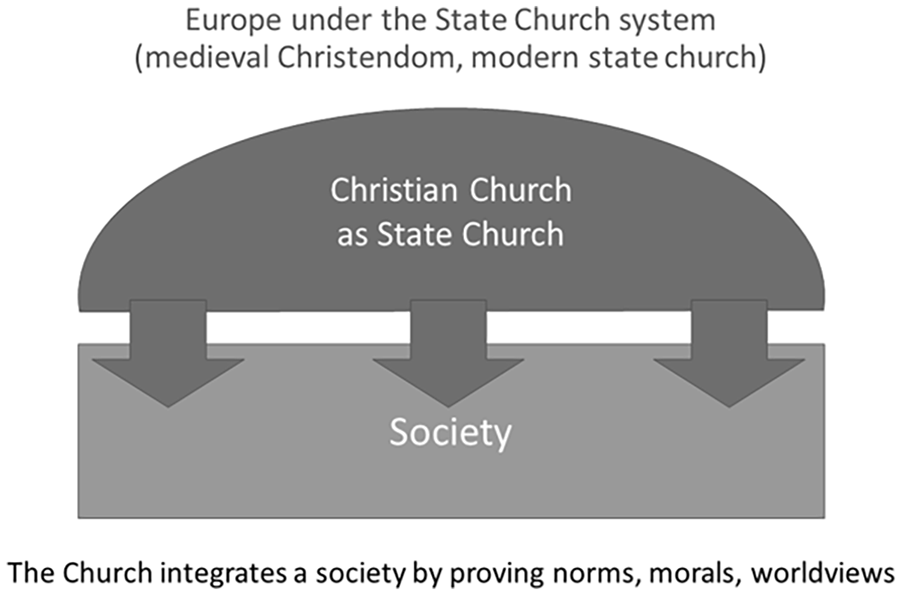
Europe under the state church system.
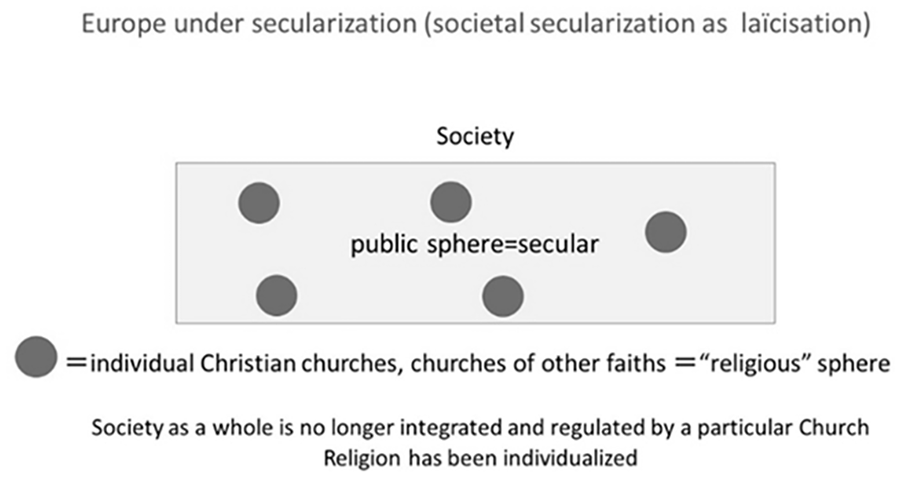
Europe under seculizaration.
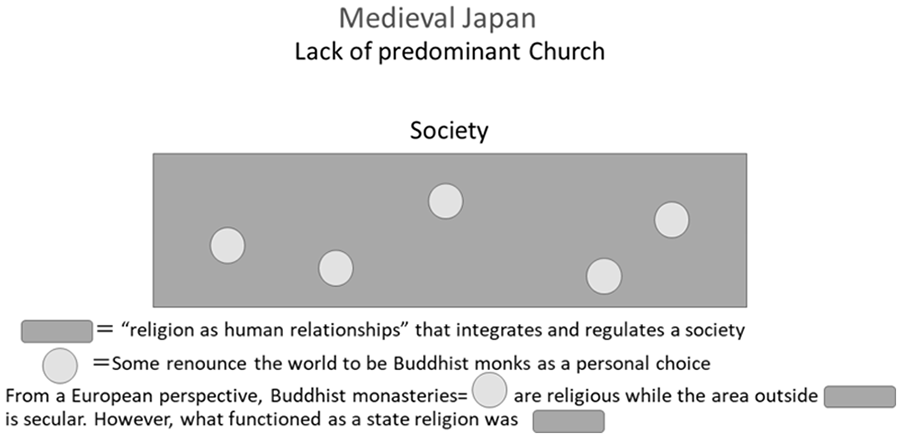
Medieval Japan.
On the other hand, social norms that governed the public sphere, which is the dark gray box in the diagram, also existed with some sort of supernatural basis (such as curses for breaking those norms). In Europe under a state religion, those social norms were also influenced by Christianity, but in Japan, they were vaguer. Some scholars use modern ‘world religion’-based concepts like Buddhism, Shinto, Confucianism, and Taoism to identify elements of those social norms, while others group them together as ‘folk beliefs’ in the case of rural communities. It was those social norms that abovementioned Yanagawa (1991 [1984]) called ‘religions of human relationships’. In any case, those social norms were not based on specific doctrines or scriptures. Therefore, they do not appear to be religious when compared to institutionalized Christianity, but functionally, if we consider providing norms to the public sphere and integrating society to be one of the main functions of religion, then those vague social norms are precisely what constitute religion.
To put it differently, in Europe’s traditional society under a state religion, Christianity integrated society, and many people had the consciousness of belonging to Christianity (church). In contrast, in Japan’s traditional society, what fulfilled that function was not something that could be clearly identified as ‘religion’, such as Buddhism or Christianity, and the conscious affiliation with religion appeared as an individual choice, for example, becoming a monk or converting to Christianity. According to the European concept of religion, people view conscious affiliation with a clear religion as a religious characteristic. Therefore, the concept of ‘religion’ is not well suited to Japan or other East Asian cases where it is impossible to encompass both social norms and personal guidelines within a specific religion. Under these circumstances, conceptual confusion arises when the European distinction between the religious and the secular is applied to East Asia. It is important to take these historical differences into consideration when discussing contemporary non-religiousness cross-culturally. What appears non-religious or secular in present Japanese society may be a modern variant of the core of functional religion, the dark gray box in Diagram 3.
Conclusion
Sociologists and social critics have argued that Japanese youth culture underwent significant changes in the mid-1990s. It is no coincidence that the Aum Shinrikyō affair took place in 1995. After the affair, it became perilous and obsolete for young people to strive for self-attainment or self-realization like Aum followers who aspired to become superhumans. Youth culture in this century, produced by a ‘weak self’ and a ‘multiple self’, bears the traits of ‘practicing belonging’, ‘vicarious spirituality’, and ‘gendered fetishism’.
At first glance, some examples we have presented might appear entirely secular. Oshi-katsu girls may look similar to Beatles fans from the 1960s to 1970s. Even Buddha image girls may seem substantially the same as secular doll collectors. However, it is essential to remember instances where western colonizers and scholars observed the lack of religion among colonized Africans and South Americans, as discussed by Chidester (1996), Smith (1998), and others. Japan experienced a comparable trajectory, resulting in Japanese people’s internalization of the discourse on the lack of religion. It is recorded that, as early as in 1871, when the Japanese term ‘shūkyō’ as a translation of ‘religion’ was yet barely in use, the Iwakura Mission members, on their diplomatic voyage to the United States, had a serious discussion on the lack of religion among Japanese people. One of them asked, ‘How should we respond when a westerner inquires about our religion?’ Another commented, ‘Well, westerners believe in this and that religion, but we have never believed anything like that so far. However, westerners regard non-religious people as beasts. So we cannot say that’ (Fujiwara, 2023: 23). Our strategy of not drawing a rigid line between the religious and the non-religious was a way to sidestep this ever-lasting discussion.
At the same time, we did not simply eschew the problem but instead traced the fundamental problem to historical differences in the demarcation between the religious and the secular between Japan and Europe. Tsunagari is a relevant subject for the study of religions in Japan because it represents a contemporary manifestation of social norms, personalized and ritualized. Young people develop and sustain their weak-self and multiple-self identities by having their substitutes to nurture, or by finding their personal objects to be deeply attached to.
Another strategy of ours was not to simply superimpose western theories and categories onto Japanese cases. Initially, our study surveyed the perspectives of Japanese sociologists on their own culture and society. In preparing this article, we focused on effectively communicating our findings and arguments to an international audience. This led to the adaptation of well-known phrases in the sociology of religion into three key concepts. Our subsequent challenge is to determine if any aspects of our findings were lost in translation and to assess if our insights offer new perspectives on cases beyond Japan.
Footnotes
Acknowledgements
We are deeply grateful to Professor Catherine Wessinger for her insightful comments and valuable suggestions during the revision of Fujiwara’s original oral presentation into an article.
Authors’ note
This article is an extended version of the keynote session that one of the authors, Fujiwara, gave on 5 July 2023 at the ISSR conference in Taipei.
Funding
The author(s) received no financial support for the research, authorship, and/or publication of this article.

Notes
Author biographies
Address: Department of Religious Studies, University of Tokyo, 7-3-1 Hongo, Bunkyo-ku, Tokyo 113-0033, Japan.
Email:
Address: Department of Religious Studies, University of Tokyo, 7-3-1 Hongo, Bunkyo-ku, Tokyo 113-0033, Japan.
Email: