




Abstract
I see the emerging new religious groups in Taiwan as an emerging form of popularism in its encounter with the post-colonial situation. This scenario differs greatly from Western new religious movements, where new religion lies outside culturally established religious traditions, and it is also distinct from other Eastern traditions, such as those found in Japan, where traditionally elite and popular traditions have a larger social and mental distance from each other. In the complex Chinese cultural and historical tradition, there exists a deeper interpenetrating elite-popular relationship, therefore determining a different route for religious phenomena. I use the term ‘popular humanism’ to label this trend in contemporary Taiwan. Finally, I use two axes to codify the emerging Taiwanese new religions, ‘methods in popular humanism’ and ‘institutional framing’, mapping the key new religious movements of Taiwan within these axes to localise each group and their mutual positions.
Introduction
The term ‘new religion’ or ‘new religious movement’ has been defined in many ways over the years but can generally be seen to relate to religious groups that have emerged during the course of the twentieth century and which sit at the periphery of traditional or mainstream religious life and sometimes as a response to secularisation by a populace seeking spiritual answers to the complexities of life. A key definition comes from David Bromley (2004: 144), who has defined the new religious movement as a group which
identifies an important but difficult to demarcate set of religious entities, and there is not a uniform pattern of usage of the concept. Most often the term is used to designate groups that have appeared in Western societies since the mid-1960s, are nontraditional and nonimmigrant religious groups, have first-generation converts as their primary membership base, have attracted among their converts higher-status young adults, have manifested social movement characteristics, have presented an anomalous profile with respect to traditional religious organization, and have proclaimed themselves to be engaged in spiritual activity.
The existence of such new religious movements highlights the ongoing birth of religiosity of a rather extraordinary or radical kind, in an otherwise presumably secular age (Dawson, 2008: 69).
In the late 1960s, Robert Bellah laid out an evolutionary model to disentangle the development of religion through the history of mankind, suggesting that there have been five major phases in the evolution of religion, and tracing changing symbols and ritual practice as well as organisation and social implications of each stage. Bellah’s (1969) vision tends to regard individuals as ultimately responsible for their choice of beliefs and the selection of their own sacred symbols and spiritual practices, rather than such practices taking form as a result of social changes. From this emphasis on responsibility for one’s own salvation, understood in very different ways depending on the religious or spiritual tradition in question, it is only a short step to the idea of unmediated spiritual growth that eventually leads to self-perception, self-liberation, or enlightenment, characteristic of many new religions around the world today.
In response to this and other definitions of new religions, especially their counterparts in East Asian countries, Peter Clarke (2006: 353–355) looked at new religions in both the East and the West, taking into account the work of Susumu Shimazono on the characterisation of new religious movements in Japan. Clarke considered the innovative characteristics of new religions on a worldwide scale, exploring their effect on mainstream religion and their social influence.
This article will take Bellah’s and Clarke’s vantage points further and discuss this unmediated spirituality within the specific historical trajectory and cultural schema of Taiwan. The aim of the article was to place new religious phenomena within a broader spectrum, grasping their dynamics within the social-cultural context of modern-day Taiwan. Specifically, I would like to suggest that, in some East Asian countries, this unmediated spirituality could be seen from the perspective of the unfolding of popularism, and in the case of Taiwan, embedded as it is in the Chinese historical and cultural context, the development of popular humanism is a special example of this.
Generally speaking, I see new religious groups in Taiwan as illustrating an emerging form of popularism, the notion of the will of the people as ethically superior to the actions of the distant elite. In Taiwan, a 38-year period of martial law was lifted in 1987, removing previous political restrictions on free association and rendering possible a wider trajectory for Chinese popular religion. New theology and practices began to emerge through the conjunction of secular capitalism and popular thought, which combined to foster the development of a new religious landscape in Taiwan.
New religious practice in Taiwan is quite different from that seen in the West, where new religion sits outside and sometimes in actual opposition to culturally established religious traditions, often being viewed with suspicion; it also differs from other Eastern traditions, such as those witnessed in Japan, where both elite and popular traditional practices have a larger social and mental distance from newer movements. In the complex Chinese cultural and historical tradition that lies at the heart of religious developments in Taiwan, there is a deeper interpenetration between the elite and the popular. Later in this article, I will label popularism in Taiwan specifically as ‘popular humanism’, to distinguish it from Japanese popularism. The details of this distinction will be discussed below.
As opposed to Melton, who has defined new religion as ‘those religious groups that have been found, from the perspective of the dominant religious community… to be not just different, but unacceptably different’ (2004: 25), I would argue that new religions in Taiwan rather form a firewall between the modern social system and the individual life worlds of the populace. This firewall stems mainly from the popular intention to build sustainable subjectivity against the colonial and post-colonial background. In this article, therefore, I intend to explain how new religions have been formed as the result of the emergence of popular practices and investigate the cultural schema which constitutes the background of such a populace in the context of post-war Taiwan.
Popularism of modern East Asian new religions
As noted above, the term ‘new religions’ usually refers to the diverse range of religious groups that have emerged mostly in Western countries during the twentieth century. Barker’s definition refers to new religions as ‘groups or movements that are new in so far as they have become visible in the West in their present form since the Second World War’ (1998: 15). In terms of social status, new Western religions tend to be seen in a negative context, with a suspicious ‘cult-like’ status. If we move to the East Asian context, however, there is even looser agreement in terms of a definition for the term, yet it remains a useful label – particularly when dealing with the history of East Asia since the nineteenth century – for it stresses a new mode of ‘institutionalised’ religious expression (Pokorny and Winter, 2018: 8). The emergence and growth of new religious developments is an important aspect of social and cultural life in almost all East Asian countries. This is perhaps one of the major differences between the religious makeup of Western and Eastern countries, in that new religions tend to be peripheral to Western culture. In addition, religious practice in East Asian countries is often characterised by a dynamic presence of the Three Teachings (Confucianism, Buddhism, and Taoism), rather than the dominance of just one specific religious system (Pokorny and Winter, 2018: 3–6).
Japanese sociologist Susumu Shimazono’s (2004) analysis of new Japanese religions may give us some hints to understanding these distinctions, reminding us of the relationship between elite and popular religious practice in that country. He considered new religious movements in Japan through the interaction between elite and popular, especially through the emergence of popularism. It is worth quoting Shimazono at length on this point:
In a premodern society, historic religions were bound to the culture of the elite and took the form of an unshakeable tradition of elite religion that enjoyed hegemony in the religious culture of those societies. (…) The growth of market economies, national governments, and the cultural milieu of urban centers brought about the collapse of this balanced relationship of peaceful coexistence. (…) Where elite religion kept a firm grip on its hegemony, the energy was drained from popular religion and secularization was able to seep into the private lives of the masses (as happened in France, Germany, and northern Europe). But where the religion of the elite lost sway, salvific religious movements came to life from out of the religion of the masses and assumed a posture of rebellion against the elite culture that was bolstering the process of secularization (as happened in the United States, Korea, and Japan). New religious movements can thus be seen as developmental modes of popular religion liberating itself from bondage to elite culture and adjusting to modern environments. (Shimazono, 2004: 164)
Shimazono showed that new religious movements in Japan, far from being a creation of the elite, are quite the opposite, in that they emerge from the loss of elite hegemony, the liberation of the populace, and its adjustment to new forms of culture. In post-war Japan, according to this theory, the framework for the religion of the elite collapsed, leaving space for the enormous growth of new religions arising from the newly emerging energetic popularism.
Shimazono has also emphasised three main characteristics of this popularism in the Japanese context: laicism, experientialism, and a vitalistic worldview. Laicism Shimazono (2004: 105), in a general sense, rejects the distinction between the clergy and the laity and asserts that through study and practices, lay people are themselves able to approach ultimate truth. Experientialism Shimazono (2004: 107) places considerable weight on the experiences of the masses as important opportunities for approaching ultimate truth. Religious popularism is therefore susceptible to the incorporation of experientialism, for people have a natural tendency to place greater value on knowledge closely associated with everyday life than on refined ritual and intellectual understanding. In terms of the vitalistic worldview (Shimazono, 2004: 49–50), the Buddha, kami (deity or spirit), and other such religious objects of worship are portrayed as the source of life, while humans and other forms of life are thought to have been born from this fundamental life power and caused to live through a sharing of their existence with it. Inherently, these three characteristics reflect a this-worldly-centred concept of salvation, in contrast to the pessimistic view of liberative or other-worldly concepts (Shimazono, 2004: 124–125).
The results of my own research are partially consistent with Shimazono’s argument. For example, based upon discourse analyses, I have shown that the biggest new religion in contemporary Taiwan, Yiguandao, clearly claims that since the beginning of the twentieth century, the True Way or Dao lineage has been transmitted to ordinary people instead of the elite (Ting, 2017: 156). The largest charitable organisation in Taiwan, the Buddhist Tzu-Chi Association, within their discourses, distinguishes itself from Western civil discourse by demanding a return to popular virtue and moral engagement (Ting, 2007a: 23–28). These clues reveal the very strong popular foundation behind Taiwan’s new religions.
However, the situation in Taiwan does display different characteristics to the Japan explored by Shimazono. New religions in Taiwan are indeed deeply related to the emergence of popularism, yet there is higher integration and mutual interpenetration between elite and populace within Chinese historical and cultural tradition than exists in Japan, which has produced a different form of popularism.
As an example, using France and China for comparison, the historian of late imperial China, Evelyn Rawski (1985: 403–404), has noted the following:
In comparison with France, China in the late imperial era experienced a much higher degree of cultural integration. This was due in part to a much greater diffusion of literacy skills through various social groups in China. French popular culture was basically illiterate (…). By contrast, Chinese illiterates lived within a literate culture that influenced their lives in manifold ways.
She went on to describe how the self-perpetuating bonds of the class structure in France aided the persistence of illiteracy in rural parts, whereas the Chinese system of meritocracy meant that ‘downward mobility was very much a fact of life for the degree-holding elite’ (Rawski, 1985: 403–404), with social mobility being a fact of life in Chinese culture. Both historically and culturally, according to this theory, highly integrated and interpenetrating elite-popular relationships exist in China. In terms of literacy, but also social mobility and the separation of town and country, China differed in very important respects from premodern societies in other countries, crucially lending a greater degree of integration to the elite and the populace. Indeed, this high level of integration and mutual interpenetration between the elite and popular strata makes Chinese popularism very different even from its counterpart in Japan.
To distinguish Chinese from Japanese popularism, where elite and popular have a greater mental and social distance from each other, I would like to label this Chinese form of popularism as ‘popular humanism’, in which a specific kind of humanism – the system of thought which attaches greater importance to the human than the divine – has been shared by both social strata (elite and popular), despite any differences that may exist in methods and practice.
According to the scholar of Chinese philosophy, Chan (1963: 3) Wing-tsit:
If one word could characterize the entire history of Chinese philosophy, that word would be humanism – not the humanism that denies a Supreme Power, but one that professes the unity of man and Heaven. In this sense, humanism has dominated Chinese thought from the dawn of its history.
In Western philosophy, ‘humanism’ generally connotes a man-centred philosophy and implies a movement away from religion. Yet in the Chinese cultural context, although maintaining a man-centred goal, humanism nevertheless remains coherent with the dictate of Heaven or a natural force (Wang, 1948: 135). The great contemporary Chinese essayist Lin Yutang (1936: 69–70) wrote in his 1936 book about Chinese humanism:
To understand the Chinese ideal of life one must try to understand Chinese humanism. (…) It [‘humanism’] implies, first a just conception of the ends of human life; secondly, a complete devotion to these ends; and thirdly, the attainment of these ends by the spirit of human reasonableness or the Doctrine of the Golden Mean, which may also be called the Religion of Common Sense. From this a humanism has developed which frankly proclaims a man-centred universe, and lays down the rule that the end of all knowledge is to serve human happiness.
To what extent this humanism arises from the influence of the elite, or whether it emanates from the tastes of the populace, is not clear. 1 Yet at least it results in a shared ideal of human potential. However, there may exist methodological differences between elite and populace in terms of how to accomplish this ideal, in that the elite rely more on their own initiative, through their own virtue and practices, while the populace tends to rely more on mystical and thaumaturgical means (see Li, 2016: 49–51).
The circumstances of the times have contributed to a greater extent to the rise of popular religion in Taiwan than the distinction between the elite and the populace. Popular religion in Japan has three manifestations, as discussed by Shimazono above. The dynamics of this era in Japan and Taiwan are similar in terms of post-war urbanisation. However, popular religion in Taiwan is unified under the form of humanism due to the mutual penetration of and circulation between the elite and the populace. Even though the Taiwanese general public has high confidence in self-fulfilment, they also believe that in the belief of Chinese humanism, it is possible to obtain salvation beyond the constraints of class.
In summary, historical circumstances have contributed to the rise of popularism in Japan, manifested through three main characteristics: laicism, experientialism, and a vitalistic worldview. Similar dynamics have given rise to popularism in Taiwan. However, the interpenetration and mutual circulation between elite and popular in Chinese history has led to a particular state of humanism shared by both strata, in which both elite and popular have strong confidence in self-cultivation and self-accomplishment, only with somewhat different methods towards the fullest enjoyment of life.
With regard to the religious means taken by modern popular humanism in Taiwan, we will soon explore this dimension further. However, we should first explore in greater detail the distribution of new religious groups in contemporary Taiwan. On this empirical basis, we will then be able to attain a better analytical framework from which to view contemporary new religions in Taiwan.
Observing new religious groups in contemporary Taiwan
I argue that, historically, secularisation in Taiwan only functions to any extent in the public space, rarely in the private. Even in the public space, secularisation is still a long way from creating a fully profane space in Taiwan. As the elite have been secularised and have spiritually withdrawn, the public space has encountered a spiritual emptiness. At the same time, the general populace have historically not withdrawn; rather, in their life space, they have made adaptations, transformed, and expanded, and thus created their own semi-public space. New religious groups have sprouted to fill this space in Taiwan, since about the 1980s.
The popularity of new religious groups in Taiwan is difficult to quantify using data from national surveys. For example, a typical social change survey 2 shows religious membership in Taiwan as follows (see Table 1):
Religious belonging in Taiwan according to the Taiwan Social Change Survey (showing % of population).
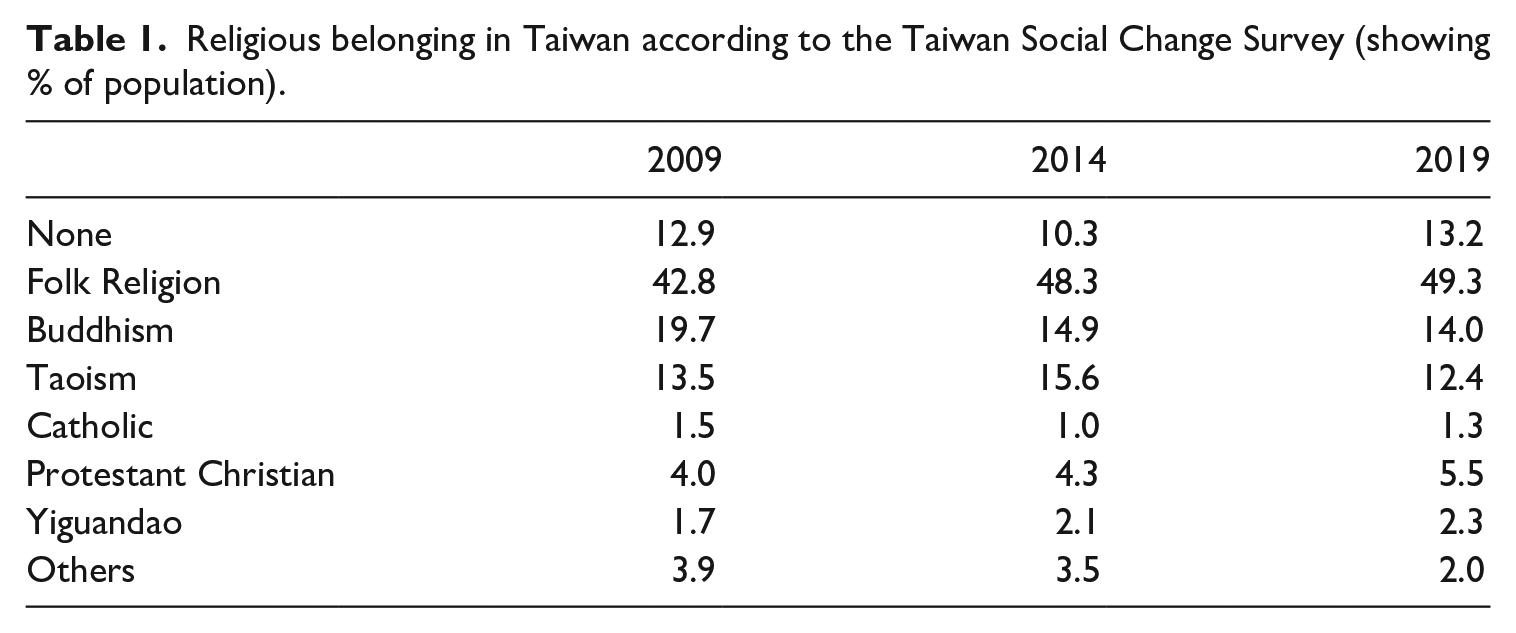
The statistics are relatively stable in the years 2009, 2014, and 2019; however, there are a few points which are worth noting. It is difficult to quantify exact attendance of new religious groups, since followers of such groups may still identify themselves as a Buddhist, a Taoist, or a follower of folk religion and the survey relies on self-reported figures. In addition, although there is a different distribution between folk religion, Buddhism, and Taoism for each of the 3 years shown, the total of these three categories reaches almost the same extent, at 76.0% (2009), 78.8% (2014), and 75.7% (2019). This could illustrate a generally stable aggregate, yet with an unstable internal flow among the three categories, depending on short-term trends and market fluctuations. 3 Ultimately, folk religion remains the category with the greatest percentage of adherents, just a little below 50% in all 3 years surveyed, while Yiguandao, the largest new religion in Taiwan, attracts a growing average of approximately 2% of the population, which represents about half a million people. The Catholic ratio is relatively stable across time, yet the rate of Protestant Christian adherence does show a certain degree of growth over this time period.
We do of course have to be careful how we interpret the figures generated by surveys such as this about the distribution of new religious groups in recent Taiwan; however, even with these statistical difficulties in classification and identification, I would like to tentatively argue that within or without the established institutional form, we can observe that there are at least four strands of ‘emerging popular humanism’, each offering the populace its own specific method of adapting to the modern world. We can elaborate these strands as follows.
Modern sectarian tradition (mainly Yiguandao 一貫道)
Sectarian traditions 4 have emerged since the Ming dynasty (1368–1644), through a syncretism of Confucianism, Buddhism, and Taoism as equal but separate elements. Since the mid-Ming dynasty, such movements have competed with Buddhism and official intellectuals as the local bearers of cultural orthodoxy. These groups often take the form of heterodox sects within the Chinese social context and are often associated with political violence in terms of both persecution and rebelling (Weller, 1982). Worship of the Eternal Mother, a feature of a range of Chinese folk religions, opened the door to a syncretic and inclusive cultural core, a path for eternal salvation through the Mother Goddess and lay emancipation, which reached a peak with the end of the Qing dynasty in 1912. Movements such as these have great capacity for mass mobilisation due to their familiarity with existing cultural and religious practices. One such movement, Yiguandao一貫道, already prosperous in mainland China, entered Taiwan after 1945, forming 18 independent branches and establishing a firm foothold in both rural and urban areas.
Yiguandao has experienced huge growth since the 1980s, with its high regard for the Chinese classics and its institution of formal programmes for the promotion of study and recitation of the classics. Yiguandao has become a cultural form in itself, with both a global syncretic framework that can absorb Christianity and Islam, and its identification as a form of grassroots fundamentalism, employing the claimed Chinese internal orthodoxy to address individual problems and construct a renewed collective identity (Ting, 2017: 148).
Yiguandao has grown rapidly, reaching an estimated membership of at least half a million, about 2% of the population of Taiwan. In addition to its success in Taiwan, it is the most energetic missionary religion of Chinese diasporas worldwide (see Yang and Billioud, 2022: 1–25). Yiguandao shows how popular sectarian groups adapt to the modern arena and transform themselves into popular speakers for a kind of modern Chinese cultural renaissance (Ting, 2017: 159–160).
Popular Buddhism transforming transcendentalism and social reformism into humanistic Buddhism (人間佛教)
The term ‘transcendentalism’ emphasises an ultimate purpose for man, an exalted goal which religious people should attain, and it is conceived as the universal domain conveyed in religious scripture (Mandelbaum, 1966: 1174). ‘Reformism’ means that people believe that the world is full of evil, but that to change the world, we must begin by changing people’s inner consciences, which collectively may lead to a more harmonious and morally embedded social order (Wilson, 1970: 39–40).
Humanistic Buddhism is a philosophy practised by Buddhist groups which integrates Buddhist practices into everyday life and shifts the focus of ritual from the dead to the living. Methodologically, Humanistic Buddhism coordinates the transcendental goal of salvation and the pragmatic goal of social reform, incorporating them into various social programmes, including charity, education, medical services, and cultural activities.
Among this Humanistic Buddhism camp, the three largest Buddhist groups in contemporary Taiwan, the Tzu-Chi Association, Buddha’s Light Mountain, and Dharma Drum Mountain in order of size, labelled both by themselves and others as Humanistic Buddhism, count within their membership over 10% of the population of Taiwan (Madsen, 2007: 35, 60, 95). 5
On the basis of this number, the category of Buddhism in general constitutes the main element of Taiwanese new religious groups. However, this is not due to people’s specific affiliation to Buddhism, but rather because of some Buddhist reformers’ earlier institutional responses to secularisation and cultural imperialism. In reacting to the risk of being culturally marginalised as a result of cultural invasion during the twentieth century (see Ting, 2007b: 246–256), the leaders of these groups implemented internal reforms to try to adjust their groups into this-worldly engaged forms, pre-adapting to change and coinciding with the emergence of the urban middle class and the rise of popular humanism in Taiwan. The fact that these groups responded earlier than others (Ting, 2007b: 246–256) gave them greater potential to fill the spiritual emptiness of the semi-public domain.
The Tzu-Chi Association, founded in 1996 by a Buddhist nun named Cheng Yen 證嚴 (b. 1937), remains largely composed of lay middle-aged women and is the foremost non-profit charitable organisation in contemporary Taiwan. Tzu-Chi mainly attracts the first generation of the emerging middle class born around 1950. Albeit with a Buddhist face, Tzu-Chi in fact conjoins the indigenous moral consciousness of filial piety and family values, while its grassroots foundation and global expansion make it a key symbol for Taiwanese identity today.
Xingyun 星雲 (1927–2023) established Buddha’s Light Mountain in Taiwan in 1967. Calling for the progress and reform of Buddhism, Buddha’s Light Mountain claims two specific features: confirming the values of this life and advocating joyful rather than painstaking cultivation of the self, and becoming a popular route for spreading Buddhism. Buddha’s Light Mountain emphasises education and service, maintaining its own universities and a television station, as well as the Buddha Museum which opened in 2011, holding tooth relics of the historic Buddha. The headquarters, located in Kaohsiung, is the largest Buddhist monastery in Taiwan and the order has over 1000 monks and nuns, over 1 million followers worldwide, and branches in over 50 countries.
Dharma Drum Mountain was founded after 1980 by Shengyan 聖嚴 (1930–2009), a doctor of Buddhism in Japan and a teacher of Zen for Westerners. The organisation focuses on teaching Buddhism to the public to improve the this-worldly realm for the benefit of all. It promotes environmentalism and new social ethics, emphasising the inner spiritual enhancement. The order has affiliated centres and temples worldwide, with more than 300,000 members.
Folk diffused religion transforming itself into an institutional form
As seen in Table 1, many Taiwanese, up to 45% of the population, associate themselves with one or other kinds of folk religious practice, 6 yet not necessarily one that is specifically affiliated with any particular group. As a result, the majority of the populace could be said to be potential members of indigenous new religious groups.
Indeed, some forms of folk practice do emerge around a teacher or master, developing from a local into an institutional form. We may call this the institutionalisation of diffused folk beliefs. Usually they take a format of client cult or audience cult (Bainbridge and Stark, 1980), that is, a loosely associated network with certain religious knowledge or techniques that promise to help or heal people.
A particularly successful example of this is Weixin Shengjia 維心聖教, founded in the early 1980s by Master Hun Yuan 混元禪師. Weixin Shengjia boasts at least 300,000 followers around the world (Chang, 2017: 46).
In Weixin Shengjia, Hun Yuan taught I Ching pagua 易經八卦 (Classic of Changers and Eight Diagrams) and Feng Shu 風水 (Chinese geomancy) techniques which interested a large number of Taiwanese people, helping followers to adjust to rapid social change, especially local businessmen travelling regularly. Traditional knowledge was repackaged as a systematic method that could help people to achieve salvation and ongoing happiness in this world (Chang, 2017: 46–50).
After 1990, the group developed their own scriptures and grand headquarters, proposing Huandi 黃帝 (Yellow Emperor), Chiyou 蚩尤 (Ferocious Beast), and Yandi 炎帝 (Inflammation Emperor) as the three original ancestors of all Chinese people and building the Holy City landscape both in mainland China and in Taiwan (Introvigne, 2017: 9–11).
As it claims to combine Chinese cultural orthodoxy and Taiwanese nationalism, this movement has also created a semi-public space, through the collective gathering called Dharma-meeting (fahui 法會). The goal of this meeting is the determination of spiritual lineage, the resolution of collective karma, the return of the ancestral root, the co-cultivation of spirit and body, and the prosperity and peace of the nation.
With spectacle appearances and labelled by media as new religions (Xinxing Zhujiao) 新興宗教
In the Taiwanese context, since the 1990s, several groups have been amalgamated in the eyes of the media and referred to as ‘new religions’. These groups usually emphasise leaders’ charismatic characteristics and promise an immediate or fast enlightenment. 7 They usually include highly engaged proselytising activity, over-enthusiastic followers, and occasional huge meetings. Observing from the surface of such movements, new religions in Taiwan seem not as prevalent or compelling as those in other East Asian countries such as Japan and Korea, yet they still form a salient exhibit for the pluralist and late-modern scenario. In Taiwan, several relatively large-scale new religious groups arose around charismatic figures during the 1990s including Suma Qing Hai World Association 清海無上師世界會, Zhenfozong 真佛宗, Yinxin Chanxue Hui 印心禪學會, and Sungqili fashenzong (The Great Sun School) 宋七力法身宗. After 2010, another group split from Yinxin Chanxue Hui, called Buddhist Rulaizong (Buddha Tathagata School) 如來宗, and grew dramatically.
In one study (Ting, 2014: 16–27), I analysed these groups’ spiritual practices and discussed how they make their seemed unconventional beliefs plausible. I found that these groups share a number of characteristics: highly syncretic, emphasising the leader’s charismatic performance, appealing to personal direct experience, penetrating everyday life, emphasising the reachable goal of immediate enlightenment and this-life salvation, appropriating scientific language, and having a transcendental orientation beyond any specific traditions.
While some establish new institutional forms, others are not interested in establishing any kind of organisational format at all. We could also see these new collectives as some kind of radical version of traditional Chinese sectarian groups, with more privatised self-cultivation and greater emphasis on facilitating life capability in the capitalist and scientific world (Ting, 2014: 9–16). Such groups peaked during the late 1990s (Ting, 2014: 10), but although most have now stagnated, Zhenfozong and Rulaizong (Buddha Tathagata School) remain consistently popular.
Mapping the new religious groups
In summary, the four categories outlined above represent a typical manifestation of new religious groups in contemporary Taiwan, their membership constituting a significant ratio of Taiwan’s population.
Cross-culturally, we can say that while new religions in the West may reflect a new kind of religiosity (configurations shaped through the process of privatisation), in the East, it is different. The proliferation of new religions globally is caused primarily by the function of social differentiation, yet this process only causes a new emerging popularism in the East, rather than formulating a new form of religiosity.
As described above, Shimazono (2004: 105–125) summarised three main characteristics of this newly emerging form of popularism in his case study of Japan: laicism, experientialism, and vitalistic worldview. Comparing the Japanese experience with popularism in Taiwan, we can identify these characteristics in Taiwan, through events such as newly established Zen-oriented schools, dissociation from the traditional sangha order, new religious practice being based upon experientialism of specific meditation methods, and the development of prosperity. The Suma Qing Hai World Association 清海無上師世界會 and Yinxin Chanxue Hui 印心禪學會 are the key representative manifestations of this orientation.
However, in addition to the three features of new Japanese religions noted by Shimazono, we can also find two other characteristics for its counterpart in Taiwan. First, a reformist orientation in opening a morality-embedded semi-public space. According to Bryan Wilson, reformists believe that the amendment of the world is essential, and the specific alterations to be made are revealed to men who obey religious or moral principles. These are the individuals who will be able to direct the supernatural influence and improve society (Wilson, 1973: 25). This confidence in change is fostered by an elite-oriented imagination penetrating the popular level. Examples of manifestations of the reformist orientation are shown in self-labelled Humanistic Buddhism groups, such as Tzu-Chi, Buddha’s Light Mountain and Dharma Drum Mountain.
Second, we can see in Taiwan a transformation of the method from a thaumaturgical to a manipulative stance. According to Bryan Wilson (1970: 39–40), ‘thaumaturgical’ refers to supernatural intervention in people’s everyday lives, in which people demand personal dispensation from the normal laws of cause and effect, often in the form of miracles and oracles. ‘Manipulationism’ Wilson (1970: 40), on the other hand, means that people learn and use a variety of systematic methods themselves to achieve salvation and ongoing happiness in this world. A confident popularism (which is also influenced by the mutual interpenetration between elite and populace) may involve the manoeuvre of the learned systematic method to change current circumstances. The manipulative orientation can be witnessed in groups transformed from folk religion, such as Weixin Shenjia and some newly established groups, such as Zhenfozong.
That is to say, in addition to the three main characteristics of popularism that manifest in new religious groups in Japan, there are extra characteristics shown in new religious groups in Taiwan, namely a social reformist orientation and a manipulative stance from followers. While the former believe in collective change through aggregated individual moral enhancement, the latter have a confidence in self-change through systematic practices and knowledge learning from the group.
The strands mentioned above represent typical new religious groups in contemporary Taiwan. To understand them within the context of popular humanism, it is useful to visually position each group within the landscape in the form of a graph. I use two axes to codify these groups, as defined below.
The X axis is the institution dimension
Within the Established Institution: the group remains within the established tradition.
New Institutional Frame: the group moves beyond the established religious community, creating its own institutional frame.
De-institutional Frame: although the group may still remain within a specific network and collective tie, yet ideologically it asks for a de-institutional or non-institutional frame.
This axis is partially determined by each group’s orientation in terms of laicism. If the group has stronger laicism, of course it may develop towards a new institutional frame (usually by deconstructing the clergy-lay boundary) or even the de-institutional frame. However, even when the group does remain within the established institution, it may still allow laicism to develop in one way or another, such as through the development of a subgroup of laity that functions independently of the clergy.
The Y-axis is the method for self-enhancement and collective change
Global Syncretic: believing that all religions are based on the same truth and that the group’s specific religious path had already acquired this universal truth.
Reformist: many individual merits and moral deeds can accumulate into the creation of a better social order, usually with a belief in a supernatural influence behind such improvement.
Experientialism: placing weight on the experiences of the masses as important opportunities for approaching ultimate truth.
Manipulationist: people can manoeuvre some systematic methods to achieve salvation and ongoing happiness in this world.
If we map the newly emerging religious groups on these two axes, popular humanism and institutional framing can be located more accurately. This is can be seen below (see in Figure 1 and Figure 2):
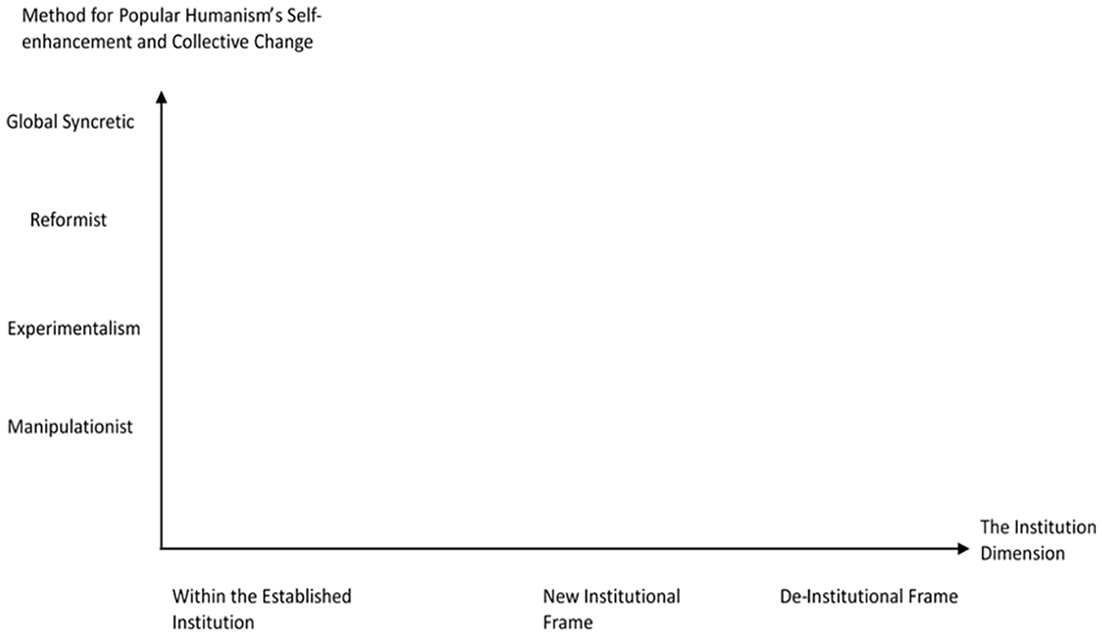
Dimensions to locate new religious groups in contemporary Taiwan.
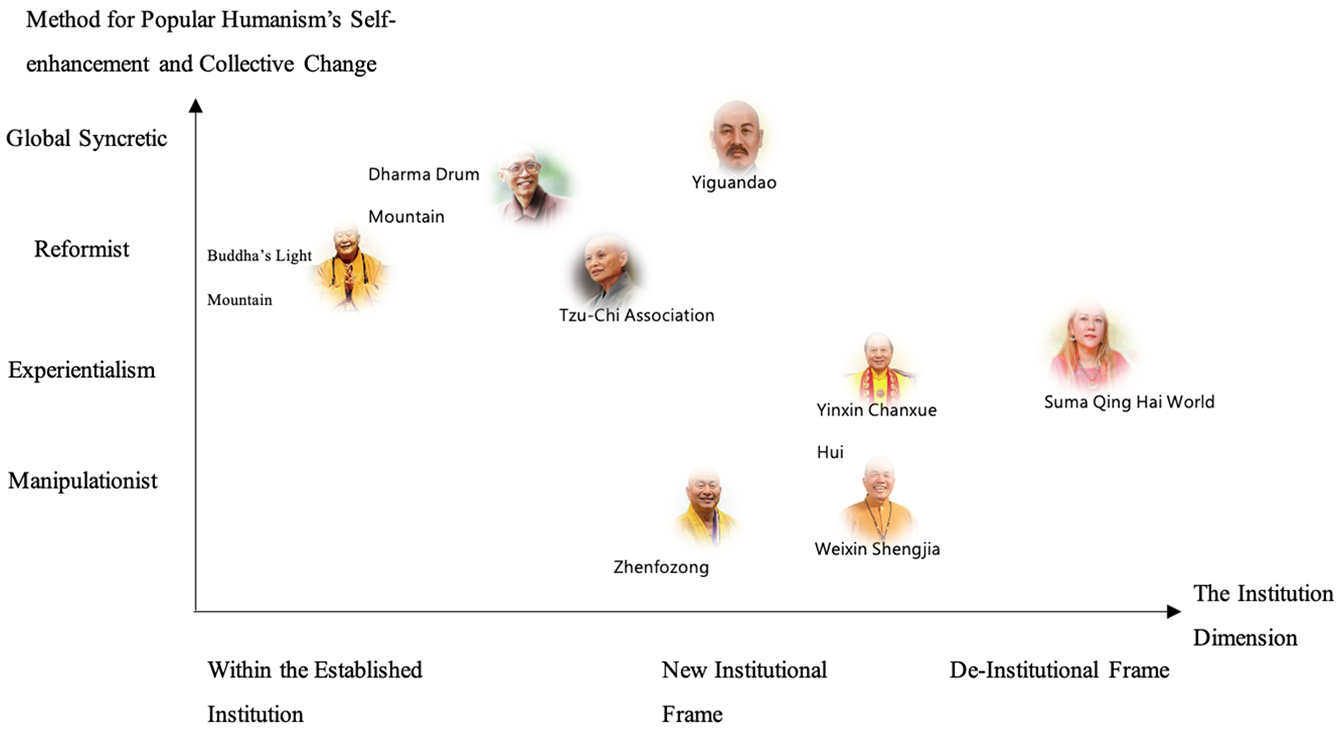
Mapping the location of new religious groups in contemporary Taiwan.
It is necessary to say one more word about Yiguandao. As the long-term incumbent of popularism, laicism within this group is innate, yet with a strong syncretic orientation (integrating the teachings of Confucianism, Buddhism, and Taoism). When it steps into modern society, Yiguandao begins to carry a redemptive mission to revitalise the Chinese Tao lineage in the world. Yet at the same time, together with the globalisation process, Yiguandao also absorbs Christianity and Islam into its own global syncretic framework. As the historical representative of popular sovereignty and a grassroots form of cultural fundamentalism, and even bearing in mind its reformist and manipulative orientation, due to its salient position within the popular movements, I will simply label Yiguandao as Global Syncretic. It is clear that even this popular form of humanism can pave its own way in a global arena without any hesitation or difficulty.
Conclusion
In summary, political power and elite hegemony have traditionally controlled mainstream religion in Taiwan, restricting popular religion, both in scale and format. The lifting of martial law in 1987 established not only a newly open and free religious market but also a meaningless secular system, fostering a new spiritual thirst.
One key beneficiary of this shift was Humanistic Buddhism as manifested through the key Buddhist groups (Tzu-Chi, Buddha’s Light Mountain, and Dharma Drum Mountain), all established by a charismatic leader, maintaining a focus on quality of life and emphasising family ethics, indicating a turn towards this-worldliness and normalising Buddhism.
Furthermore, as the state withdrew political hostility towards popular sectarian groups and an ethical vacuum was created within the mainstream secular system, modern sectarian groups emphasised Confucian values and claims to be the pillar of the internal Dao Lineage, Daotun 道統. Part of this trend, Yigoundao represents both a popular awakening and a cultural revitalisation, continuing the Chinese history of popular sectarian movements. Some groups labelled as new religions are in fact better defined as radical versions of popular sectarian groups, emphasising the synthesis of religion and science, as well as pressing and immediate salvation. Local folk religion retains a strong presence, integrating and adapting to urban settings. Some folk beliefs have evolved into a more institutionalised form, re-embedding themselves into a more fluid global environment.
Overall, tradition remains strong in Taiwan within the framework of multitudinous transformation. Humanistic Buddhism has been transformed into mainstream Buddhism. Traditional sectarian groups transformed into a kind of grassroots fundamentalism, folk religions still thrive, some having been institutionalised and with more systematic practices and teachings. New religions tend to reach a peak before diminishing, while Christianity remains relatively stable despite decades of evangelism. Recent religious movements in Taiwan are more concerned with new pathways of spiritual democracy and the adaptation of popular religion than the issue of anti-secularisation.
To conclude, in this article, I use the metaphor of a firewall, instead of new religiosity, to view new religious groups in contemporary Taiwan. Behind this firewall, the emerging popularism is crucial. We have found that the emerging trend of popularism in Taiwan has its own trajectory of specific characteristics and manifestations. As post-modernist theorist Gianni Vattimo (1998: 79) has said,
It is often said that religious experience is an experience of leave taking. But if this is true, the journey undertaken is most likely one of return (…). If it is a matter of return, could this re-presentation of religion be accidental to its proper essence – as if by some individual, social or historical accident we had simply forgotten it, distanced ourselves from it (perhaps culpably) and now, thanks to some other chance circumstance, the forgetfulness were suddenly dispelled?
In contemporary Taiwan, indeed, there are flourishing religious movements, yet they represent rather a manifestation of the repressed, than a new invention. That is, such new religions are formed as a response to survival and return, rather than a future-oriented newness. Observing Taiwan’s own historical trajectory and cultural schema, we give this tentative analysis, and hope that it may inspire more similar reflections on new religious movements worldwide.
Footnotes
Acknowledgements
This article is based on a paper presented at the International Society for the Sociology of Religion biennial meeting in Taipei 2024. The author wish to thank Professor Wei-Hsian Chi for organising this panel. He also would like to express his sincere gratitude to anonymous reviewers for their critical and professional opinions.
Author’s note
The author is writing a book on contemporary popular humanism in Taiwan. The article is partials of this project.
Funding
The author(s) disclosed receipt of the following financial support for the research, authorship, and/or publication of this article: This study has been supported by the Taiwan National Science Council’s Book Writing grants (MOST 111-2410-H-001-042-MY3).

Notes
Author biography
Address: Institute of Ethnology, Academia Sinica, Taipei.
Email: