




Abstract
This article is based on van Kessel’s study of La Tirana in Chile in 1970, over a non-representative sample of about one thousand participants including dancers, pilgrims, vendors and tourists. La Tirana is the main Marian sanctuary in the north of Chile. Van Kessel could clearly identify the importance of the religious manda as the main reason of devotion associated with complementary beliefs concerning the Virgin’s miraculous efficacy for those who strictly fulfill her. After nearly fifty years, this study finds out that the manda has tended to disappear and that religious attitudes toward the Virgin have changed; especially those related to the specifications of the fulfillment of the religious promise. Although all these changes go along with an increase in ecclesiastical mediation of the sanctuary devotion, it is the pilgrim’s educational level that best explains these changes in the religious awareness of Chilean Marianism.
Introduction
The major studies of religious shrines in Chile’s Norte Grande region date from the works of Juan van Kessel (1975, 1980, 1981, 1984), although since then researchers have continued to conduct various analyses of the fiestas’ sociological, anthropological and aesthetic aspects (primarily Nuñez, 1988; García Arribas, 1989; González, 2006; Guerrero, 2015). Religious shrines that venerate a miraculous image of the Virgin (and, on occasion, that of a saint) are common in Chile. They are usually planned around an annual liturgical calendar with a large-scale celebration that is held once a year. These celebrations occur at sanctuaries specifically designed for this purpose, almost always in a designated village that is located far away from any major cities and in an area noted for its high altitude (allowing for the common expression of ‘to go/climb up to a sanctuary’ (subir a un santuario), an act facilitated by Chile’s mountainous terrain). The main sanctuaries in Norte Grande (La Tirana, Ayquina and Las Peñas) are situated in small villages that come alive only during the fiesta religiosa. In the Norte Chico and central regions of the country, sanctuaries are located in small cities with significant populations of permanent residents (as in the case of Andacollo). The sanctuaries consist of a main temple and other smaller religious sites, all overseen by a Catholic priest. In the designated towns, the temples remain in disuse as religious centers during the rest of the year, without a regular ecclesiastical presence. At sanctuaries in the central region, in turn, it is common for temples to stay open with a permanent ecclesiastical presence, in order to receive pilgrims year round. The fiestas are also notable for their organized religious dances. All of the shrines in Norte Grande involve religious dancing. This tradition also endures in Norte Chico (Andacollo, Niño Dios de Sotaquí) and at smaller shrines in the inner valleys of the central mountain range, but it has disappeared at the large sanctuaries in the country’s central-southern region, where pilgrimages are the only surviving manifestations of popular devotion. Religious dances are a family tradition that brings together the members of one extended family or several interrelated families. In some other cases, the dance groups consist of several different families with a shared trade or living space (fishermen, for example), or who also share an ethnicity or country of origin (Bolivians residing in the country). The number of dances organized under the leadership of a permanent ecclesiastical organization (a parish) –something which is much more common at Norte Chico sanctuaries – has significantly increased only in recent times. Norte Grande shrines have also conserved an Andean style of dance with a very exacting contradanza, colorful outfits, and engrossing style of music that currently utilizes drums and brass instruments. By contrast, the Norte Chico region maintains – albeit barely – the old tradition of the baile chino, a much more modest and restrained style that is increasingly being replaced with percussion ensembles and the Norte Grande contradanza. The groups work arduously throughout the year to prepare their dance routines. The performers are overseen by a conductor, who directs the group’s movements in a dance that demands great dexterity, strength and coordination. The dancing is generally a grueling activity, which indicates sincerity of devotion, in a similar fashion to the high-altitude pilgrimages or certain forms of lacerable devotion, such as entering the temple on one’s knees. The colorful fiestas in Norte Grande attract numerous tourists and spectators of all kinds. This contrasts with the more lackluster events of the southern sanctuaries and certain events that only cater to pilgrims, thus diminishing their touristic appeal. The dance groups travel up to the sanctuaries with their families in tow, bringing along enough equipment and food to last numerous days. The sanctuaries with dances also attract regular pilgrims, meaning devotees who are not connected to any dance groups. These visitors will occasionally walk along the pilgrimage route for various kilometers over rough, steep terrain, but they also travel in mass by car or bus. Pilgrims usually attend in family groups as well, but many travel up to the sanctuary on their own for shorter visits (a day trip). This motley group of dancers, pilgrims and tourists can grow to several 100,000 people (around 200,000 at La Tirana, the country’s largest sanctuary with dances, and up to 800,000 at pilgrimage sites such as Lo Vásquez and Yumbel, located in the outskirts of large cities). The sanctuaries that lack sufficient commercial and hospitality infrastructure also attract numerous retail vendors, who set up shops at provisional sites in the vicinity of the main temple. The items they sell include all kinds of products. In fact, the wares for sale are not even primarily food and supplies, but durable and luxury goods that the vendors bring to empty their stocks and to take advantage of visitors’ propensity to spend, which is characteristic of the fiesta mindset.
Popular Marian religion
Among studies of fiesta religiosa, the investigations by the Catholic priest van Kessel during the 1970s (van Kessel, 1975, 1980) stand out. Van Kessel observed in the dances an extremely ritualistic form of religious consciousness that stood in contrast with the then ongoing overhaul of Catholic consciousness, brought on by priests educated in the spirit of the Second Vatican Council, and by the broader process of modernization and cultural change that was occurring at the time. The critical aspect of this religious discord was found in the main motivating reason of devotees who traveled up to the sanctuary to dance: to fulfill a manda. The manda is a commitment that devotees make with the Virgin in exchange for the granting of favors or blessings, which are then repaid with some kind of tribute or service, most notably the obligation to dance at her sanctuary every year. Devotees usually place their entire lives under the protection of the Virgin and honor her with various compensatory acts. Devotion to the Virgin is always individual and voluntary, but the oldest dance groups retain the tradition of pledging their children – in other words, parents place their offspring under the Virgin’s protection, which also encourages the children to participate in the dancing. On occasion, the manda can be more episodic in nature and consist of honoring a commitment offered in return for a specific favor. The commonly used expression for these cases, once the favor has been granted, is ‘to pay a manda’ (pagar una manda), which is frequently indicated via an act of thanking, a common feature of all sanctuaries (‘Thank you for the favor granted’). Entrusting oneself to the Virgin in an extraordinary moment of anguish and need is a customary attitude for any believer (and even among non-believers who activate a kind of latent religious belief in such moments), but the people who dance for the Virgin (popularly called ‘La Chinita’ in La Tirana) are usually not occasional believers ‘paying a manda,’ but rather devotees who honor the Virgin over many years through religious dancing and sanctuary visits. Seldom does a devotee stop honoring the Virgin due to some type of perceived deception or unfulfilled expectation; the Virgin is always granted the final word and her will is respected, which deprives the manda of any similarities with an economic exchange. Nor is the Virgin expected to improve one’s chances of otherworldly salvation. Rather, she helps devotees to secure worldly benefits, most often protecting the health and wellbeing of one’s family. Marian devotion remains outside the sphere of the ‘economy of salvation,’ mainly because there is no soteriological concern in the mind of the believer (Morandé, 1980). The abundance of gifts which the Virgin provides includes, in particular, wellbeing in a future life that no one really doubts. A theology of overabundant grace (‘Mary, mother of mercy’) and of the redeemed efficacy of a Mary who saves all, without much regard for merit, has freed the religious consciousness of a soteriological anguish that is more characteristic of Catholicism and, above all, of European Protestantism (Martin, 1990).
The manda is an obligation set for the believer, who must fulfill the terms exactly as promised, in accordance with the rules of reciprocity that have been thoroughly described in sociological theory (Mauss, 2009 [1925]). Only extraordinary circumstances would release the believer from this obligation, which may never be substituted for money or some other unscripted offering. Failure to observe a manda angers the Virgin and eventually results in some kind of punishment or reprisal, commonly interpreted as a misfortune that occurs in day-to-day life. On the other hand, manda observance among the dancers takes on a purely ritual nature and is restricted to honoring the Virgin’s image, without any additional moral demands. The Virgin punishes people for breaches of ritual, but not for moral offences such as robbery, adultery and domestic violence (the most common offences committed at the time of van Kessel’s investigations), which are situated in the context of a natural morality, without any religious qualifications. The Virgin proves to be entirely magnanimous when it comes to moral transgressions (as with a mother who tends to exonerate her children of any moral offence), but in the sphere of ritual observance the Virgin is more zealous and demands proper respect and recognition. In this regard, popular devotion is completely separate from the penitential framework of confession and the need to repent and make moral amends, which tends to prevail in the ecclesiastical consciousness. Crawling on one’s knees toward the Virgin’s sacred image in the main temple (an act which is often widely broadcast on television during sanctuary as a scandalous image) is not an act of penitence, but simply the fulfillment of an extraordinary manda. The significance of the mortification ritual is very pronounced and is sometimes exacerbated when the Virgin is asked to grant an extraordinary favor that must be repaid in the same way.
The Marian devotion of the dancers, of course, raises many questions and reproaches in the ecclesiastically trained religious consciousness. The most critical point of controversy lies specifically in the ritualism of popular devotion. Ecclesiastic devotion can forgive lapses in worship and failures to fulfill ritual requirements, but is much stricter when it comes to moral transgressions. The challenge of instituting a mechanism of confessing sins and religiously qualifying the daily lifestyles of believers constitutes one of the main reasons for resistance to popular marianism. Sanctuaries have been subject to some moral criticism over alcohol abuse (although the sanctuaries have enacted dry laws for many years), but Marian shrines are not carnival-esque, are not symbolically associated with the inversion of the established order, and do not give room to any type of debauchery. The fiestas occur in an atmosphere of religious enthusiasm and family unity. The ecclesiastical criticism, rather, extends to the annual cycle of the liturgy and to devotees’ negligence of other religious practices during the rest of the year. Most devotees, in effect, do not regularly attend church services, and the sacramental activities at the fiesta are, in practice, limited mostly to child baptisms (and, only on occasions, the blessing of a previously established marriage). The Eucharist is completely absent from the fiesta, even though sanctuaries have introduced schedules – sometimes quite packed – of mass readings, and dance groups have at least agreed to stop their thunderous music during the solemn mass celebrated by the local bishop. It has been stipulated that, in the case of popular religions, there is a ‘Christological deficit,’ which refers to the difficulties of establishing a religious experience with the word (Morandé, 1980) and of engaging with the believer’s life not just through veneration but also morally. Christological piety is not totally absent in popular religion, but it generally takes on a sense of ritual mortification (without any penitential effect) contained in the Passion as a means of imitating Christ, as demonstrated by the high-altitude pilgrimages or the exhausting pace of the dancing. Apart from this, a completely Marian piety prevails: The devotees do not venerate and entrust themselves to Christ, but rather to Mary, whose worship remains separate from any specific moral demands. No one repents of his/her sins before Mary nor commits to lead his/her life in a different manner. Devotion at the sanctuaries, in effect, completely lacks any ritual of purification or expiation. The dancers approach the Virgin with a salutary dance, and the pilgrims immediately light candles for their prayers, without previously carrying out any formal act of confession and sincere repentance of sins committed (as occurs, for example, in the Eucharistic devotion).
Brief history of La Tirana shrine
In Chile, every July 16, pilgrims from different parts of the country, but mainly from northern Chile, travel to the town of La Tirana located in the commune of Pozo Almonte, in the Pampa del Tamarugal, in the Tarapacá region. The emergence of the Sanctuary dates during the Spanish conquest in the sixteenth century, its first temple was not built until the eighteenth century. After the Pacific War in 1879, a process of ‘Chileanization’ led by the State began that aimed at appropriating and acculturating the territories newly annexed to national sovereignty. During this process, the State and the Catholic Church reconstructed the identity of the Norte Grande territories, creating a sense of nationality – although popular dances and sport kept emphasizing regional identity (Guerrero and Guizardi, 2012). In 1910 La Tirana was re-scheduled for a single day (July 16) while simultaneously la ‘Chinita’ was named as the Virgin del Carmen, patroness of the Chilean Army (González, 2006).
Marian devotion has traditionally been rooted in the working class, predominantly associated with nitrate miners at least until the 1950s (Gonzalez, 2006) and probably as long as the 1970s, since most of the ‘salitreras’ still functioned until then. But marianism has also become a devotion for saltpeter workers – turning to a central part of the activities of the camps – and Andean villagers, as well as descending into the cities starting in the middle of the 20th century.
Although Norte Grande`s marianism popular religiosity originated outside the institutional clergy, the Church has made several attempts to bind the dances to the institution. Despite these attempts, the dances maintained a certain autonomy from the church between 1930 and 1970. During the fifties a process of modernization took place inside the dance guilds, where organizers sought to perfect the cult, by forming and educating its members (Tennekes and Koster, 1986). Since the 1970s and with the dictatorship of Augusto Pinochet, the dances began to gradually lose self-management, moving closer to formal Catholic rites as a form of protection (Tennekes and Koster, 1986). Currently, the control of the Catholic Church over the Tirana festivity has increased mainly through the Federation (Guerrero, 2007, Guerrero and Guizardi, 2012). The priests have become more involved in the dance societies, and there are even some dances organized within the parishes that break with the traditional family model. During the fiesta itself a large presence of ecclesiastical personnel try to situate the pieties at the sanctuary within the sacramental mediation of the Church, although these efforts are usually somewhat fruitless. Contact with the Church has also intensified at Norte Grande sanctuaries, which have historically been the most independent. This growing interaction might have transformed the religious consciousness of the dancers (to be examined below).
The manda – especially the one which is paid through mortifying practices of the body – has been the central element of permanent conflict between dance groups, pilgrims and the Catholic Church. The official discourse of the Catholic Church is reluctant to this type of acts where the body is subjected to pain because these oppose the acts that the Church defines as sacred (Guerrero and Guizardi, 2012).
The van Kessel study
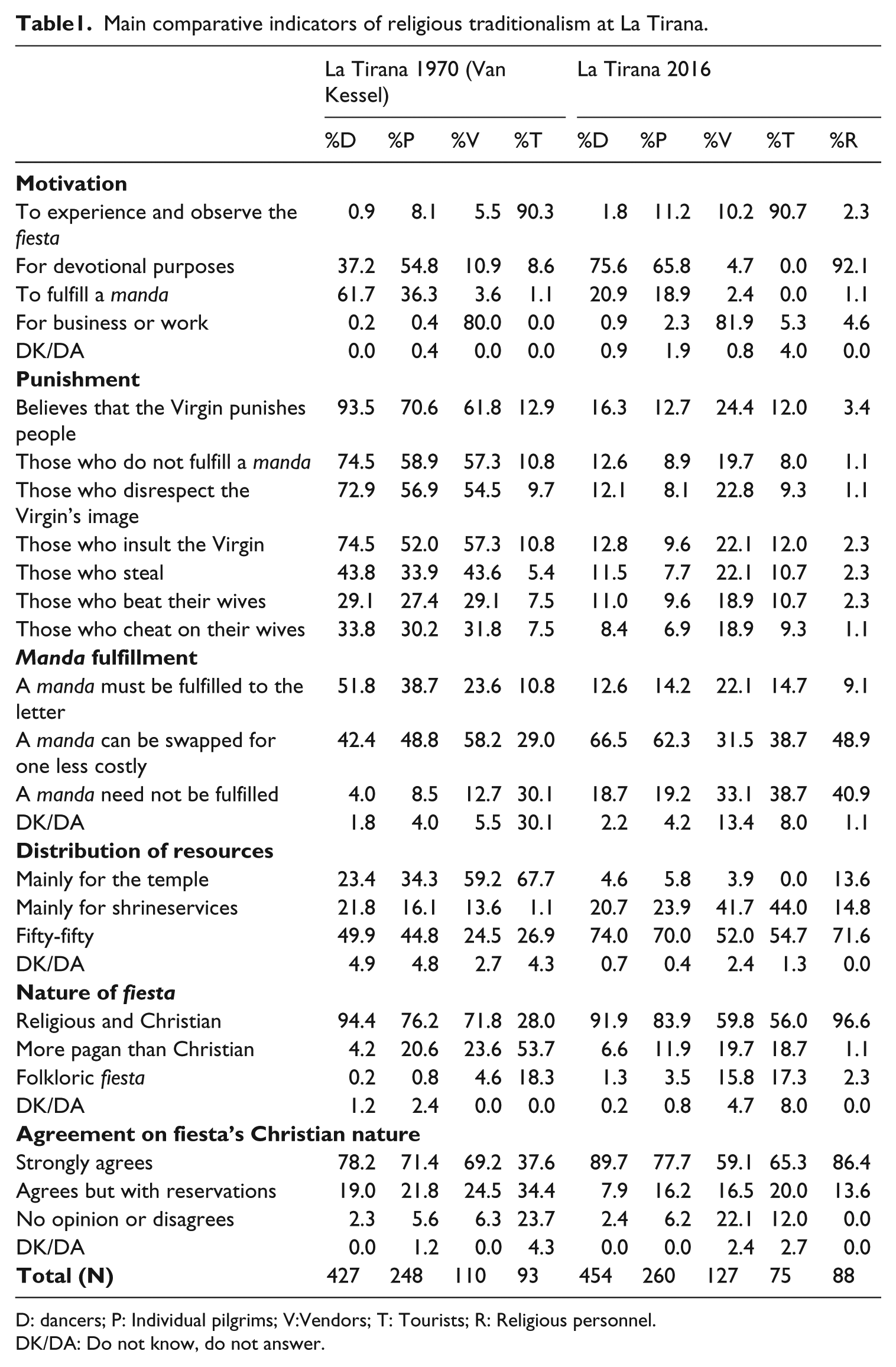
Van Kessel’s studies of religious shrines in Norte Grande include a meticulous ethnography of three dance societies, two of which danced at the sanctuary in La Tirana around 1970 (van Kessel, 1975), and, most importantly, a survey conducted at the same sanctuary on its days in that year (van Kessel, 1980). The survey identified four different groups of participants: dancers, pilgrims, vendors and tourists (n= 878). The sample design was based on the estimated percentage of participants that each group represented. The accounting method for these estimates is not documented, although van Kessel compiled an exhaustive record of the number and composition of the dance groups, who comprised almost half of the participants at the sanctuary in that era 1 . Nor are there any specific indications of the method used to select interviewees. The survey contained a relatively brief questionnaire, the core of which was a religious traditionalism index that was calculated for the four participant groups (see Table 1). This index, which consists of six items, considers as a traditional belief the ‘fulfilling of a manda’ as the main reason for visiting the sanctuary (Item 1), in contrast with simple devotions or visits to the sanctuary without any intention of performing a particular devotion (mainly vendors or tourists). It also treats as traditional the belief that devotees are required to observe a manda exactly as promised, without any leeway to replace it with a less costly manda or not fulfill it at all (Item 2). On the other hand, the index considers as traditional the belief that the Virgin punishes people, especially when the reason for punishment is a failure to fulfill a manda or some other breach of ritual, such as ‘disrespecting the Virgin’s image’ or ‘insulting the Virgin.’ The belief, in turn, loses its traditional traits if the Virgin punishes people for moral errors (stealing, beating one’s wife, or mutual infidelity) or is not believed to punish at all (items 3 and 4 combined). The index treats as traditional the belief that the temple should take precedence in the distribution of resources (Item 5), in contrast with allocating more resources to improve shrine services, and likewise considers traditional a favorable opinion of the fiesta itself (Item 6), given that at a time it was worthy of much criticism over its authenticity as a form of religious expression, or at least as a Christian fiesta (van Kessel, 1980).
Main comparative indicators of religious traditionalism at La Tirana.
D: dancers; P: Individual pilgrims; V:Vendors; T: Tourists; R: Religious personnel.
DK/DA: Do not know, do not answer.
Van Kessel’s book Danseurs dans le désert (van Kessel, 1980) contains the cursory results of his religious traditionalism index, but the questionnaire itself and the results by item appeared in his papers only very recently. This allowed for the study to be replicated at La Tirana shrine in 2016, almost 50 years after its initial application. The recent study also obtained a sampling of van Kessel’s four groups – dancers, pilgrims, vendors and tourists – but added a fifth, the religious personnel who attend the fiesta (n=1034 + 90 priests, ecclesiastical agentsclergy and pastoral agents). The sample preserves the proportional distribution of van Kessel’s groups, despite the fact that the large majority of visitors to La Tirana sanctuary (estimated at 200,000 people, 10 times more than in the era of van Kessel) are pilgrims rather than dancers, unlike in the past. It is also possible that tourists comprise a proportionally larger group today than they did previously. The new study also followed the same sex and age distributions used in the previous survey, in order to preserve the socio-demographic compositions of participants in both studies. The recruitment strategy for the sample was based on a procedure proposed by Walgrave and Verhulst (2011) that approximates random sampling and which is used to collect data in street demonstrations and/or protests. This methodology is mainly notable for maximizing sample variability and, in this manner, giving all participants an equal chance of being surveyed, reducing the chances of any systematic bias affecting the selection. To this end, the following precautions were taken in selecting the sample: Answers were collected only on the days of highest attendance (Friday, Saturday and Sunday). All of the surveys were conducted in the main square, where the participants congregate, and surveyors were placed at different corners of the square in order to cover the full space available. A random-number selection mechanism was utilized in cases where the attendees lined up (pilgrims at the temple entrance, vendors who set up their stands in a continuous line, and dancers who would remain in their double-line positions during moments of rest). The selection of tourists – the only group which did not line up at any moment – was made via a filter question that indicated whether the reason for attendance was not religious, but simply to experience and observe LaTirana’s fiesta. The survey application consisted of a brief questionnaire that exactly replicates van Kessel’s religious traditionalism index and adds a few additional questions for context.
La Tirana today is a massive fiesta attended by some 200,000 people, according to estimates by authorities, mainly arriving from the port cities of Iquique, Tocopilla and Antofagasta, as well as towns in the interior of the Andean mountain range (around 15% of attendees said they were of Aymara ethnicity in the recent questionnaire). Currently, around 200 dance groups are registered to participate in La Tirana, each mobilizing on average 100 people, between the dancers, costumed characters, musicians and their respective families and kin (some 20,000 people in all, or around 10% of attendees overall, whereas 50 years ago van Kessel estimated that the dance groups comprised 47%). The sanctuary dances have attracted a growing number of pilgrims and tourists, so that the religious dancing increasingly occurs amidst a large and cluttered audience of spectators. The social composition of dancers and pilgrims is practically indistinguishable, but tourists who usually come from the central region of the country, are younger and more educated than the average attendees, and are less likely to declare any religious affiliation (although half of them say they are Catholic). The percentage of foreign tourists, who travel in large numbers to Chile’s Atacama Desert, is still very minimal at the fiesta (around 4% of all attendees). The vendors also constitute a distinct group, one that is older and has less schooling, with a notable presence of small shopkeepers from Peru and Bolivia who take advantage of the commercial activity across the border.
Results
The major finding of this comparative study is the decline in the manda as a reason for visiting the sanctuary. The manda was, by far, the principal motivation for attendance among van Kessel’s dancers (62%, while 37% attended to perform devotions only), but now the figures have flipped dramatically. Only 21% of the dancers travel up to the sanctuary to fulfill a manda, while 76% do so to perform general devotions. A similar result was found in the reason for attending among pilgrims, where the manda accounts for a comparable percentage (19%), although this motivation was already less common among this group in van Kessel’s study (36%). Today, scarcely one out of five devotees says he/she goes to the sanctuary to fulfill or pay a manda. The manda – which van Kessel defines as a ‘coercive relation, given that the personal link between the promiser (he who has made the “manda”) and the Virgin is rather rigid and quasi-legal’ – is substituted for free devotion, ‘a trusting and emotional relationship, without any of that legal obligation’ and ‘a freely initiated link which does not involve any commitment or contract’ (van Kessel, 1980: 173, authors’ translation). The disappearance of the manda as a motivation is in line with attitudes among religious personnel, for whom there is only free devotion (92%) and for whom the manda is an archaic form of religious consciousness, too anchored in closed links – ‘rigid’ or ‘quasi-legal,’ as van Kessel says – of reciprocity. All of this is replaced with an open and personal relationship, based on trust and affection, just as occurs in the relationship between a child and his/her mother. The manda is often interpreted in a narrow sense as that of someone who, in effect, pays or repays a favor received under threat of punishment if such an obligation is not fulfilled. But the manda is enshrouded with undeniable devotional qualities that include a belief in the Virgin’s magnanimity that perseveres against all odds (extraordinary favors are asked of her), even when those favors are not obtained, as well as emotional and exuberant displays of affection, as occurs when devotees come before the miraculous image of the Virgin.
The manda’s rigidity manifests in the obligation to repay it under the belief that the Virgin punishes those who fail to do so, something which has almost completely disappeared from the consciousness of faithful people. Among the dancers, this belief was unanimous 50 years ago (reaching 94%), but today lingers at 16%. Something similar occurs among the pilgrims, with a drop from 71% to 13%. The softening of the Virgin’s image, which clearly approaches the maternal symbolism of Mary mother of mercy, is also in tune with ecclesiastical views, where definitively no one believes in this punitive trait of the Virgin. The weakening of the manda’s rigidity is also seen in the sharp decrease of those who believe that it must be fulfilled literally, in the exact terms as promised. In the past, half of the dancers thought that the manda’s fulfillment had to be precise and exact, a belief that has decreased to 13%. In turn, there has been an increase in the percentage of dancers who believe the manda can be exchanged to the believer’s benefit (‘for a less costly one’), although never to the point of admitting that the manda can be ignored. The pilgrims’ beliefs have evolved in a similar way. The hostility of religious personnel toward the manda clearly manifests in the 40% who outright believe that the manda can be left unfulfilled without any harm to the believer who has made it. The payment/repayment requirement has not disappeared, at least among those whose religious engagement with the fiesta occurs via a manda, but such a demand does not appear to be tied to any fear of punishment, nor does it function as an obligation to be scrupulously fulfilled. In effect, the current data show that 77% of those who travel up to the sanctuary to fulfill a manda do not believe that the Virgin punishes people (a figure just slightly lower than among believers attending for purely devotional reasons), and only 16% believe that the manda must be fulfilled to the letter (almost the same percentage as those who attend for devotional reasons) (figures not shown). Furthermore, the modest percentage of attendees who still fulfill a manda in the sanctuary (one out of five pilgrims or dancers, approximately) has given them greater flexibility in how they understand this religious promise, in a sense that converges with ecclesiastical views.
Another decisive aspect of the change in religious consciousness is in the ritualism practiced by devotees of the Virgin. The data collected by van Kessel in 1970 clearly shows that the Virgin punished people for breaches in ritual, but was much more flexible when it came to moral transgressions. Around 75% of the dancers believed that the Virgin would mete out punishment for any slight to her image and, most importantly, for failure to fulfill a manda. This perception dropped to 44% for punishments for theft, 34% for adultery, and just 29% for a husband who beats his wife. The response data was very similar among pilgrims and vendors. This imbalance between ritual and moral transgressions has disappeared completely in the present day, even among the scant percentage of interviewees who still believe that the Virgin punishes people. The majority of this group believes that the Virgin punishes people for all of the indicated offenses in an equal way (in percentages that skirt the previous threshold of 75% for breaches of ritual) without a prior distinction between ritual and moral offenses. In this specific group of interviewees who still believe that the Virgin punishes people, the awareness of moral offenses has been raised to a comparable level with that of breaches of ritual. All of these developments are consistent with ecclesiastic views, which treat moral transgressions with greater reproach than ritual offenses, and perhaps are also in line with more general pressures to practice a more honest and responsible way of life. However, it is difficult to say if this decline in ritualism among dancers has led to a moralization of the faith, especially in a context where the mechanism of confessing sins and the ecclesiastical arbitration of forgiveness has collapsed entirely. Furthermore, a Virgin who does not issue punishments must remain at the margins of all religious categorizations of sin, and it must still be highly unlikely that the Marian symbol elicits confessions of sins or encourages believers to make morally significant corrections or changes in their lives.
Other more minor dimensions of van Kessel’s religious traditionalism index have changed over time as well. The percentage of interviewees who would allocate resources principally to the temple – a custom which includes the care and decoration of the Virgin’s image – has decreased somewhat, but in a manner that achieves a balance between the temple and the shrine services (hygiene and sanitation for the main part) that is necessary for a festival involving many thousands of people. Past reproaches of the fiesta have also essentially disappeared, and few today (including tourists) would doubt the fiesta’s unmistakably religious and Christian nature.
The averages on van Kessel’s scale of traditional beliefs, which were calculated in the exact same way for both studies, have declined considerably, as would be expected. Among the dancers, the decrease was from 8.68 (on a scale of zero to 12 points) to 5.19 (which indicates an extraordinary 40% drop), although dancers remain the group which scores the highest on the traditional belief scale. This same decline can be seen among the pilgrims, from 6.97 to 4.73 points, and among the vendors, whose average also decreased, from 5.53 to 3.39 (drops of 32% and 38% in their respective score averages). The opposite occurs with the tourists, who doubled their scores from 1.79 to 3.57, mainly because they have upped their rebukes of the fiesta’s religious nature.
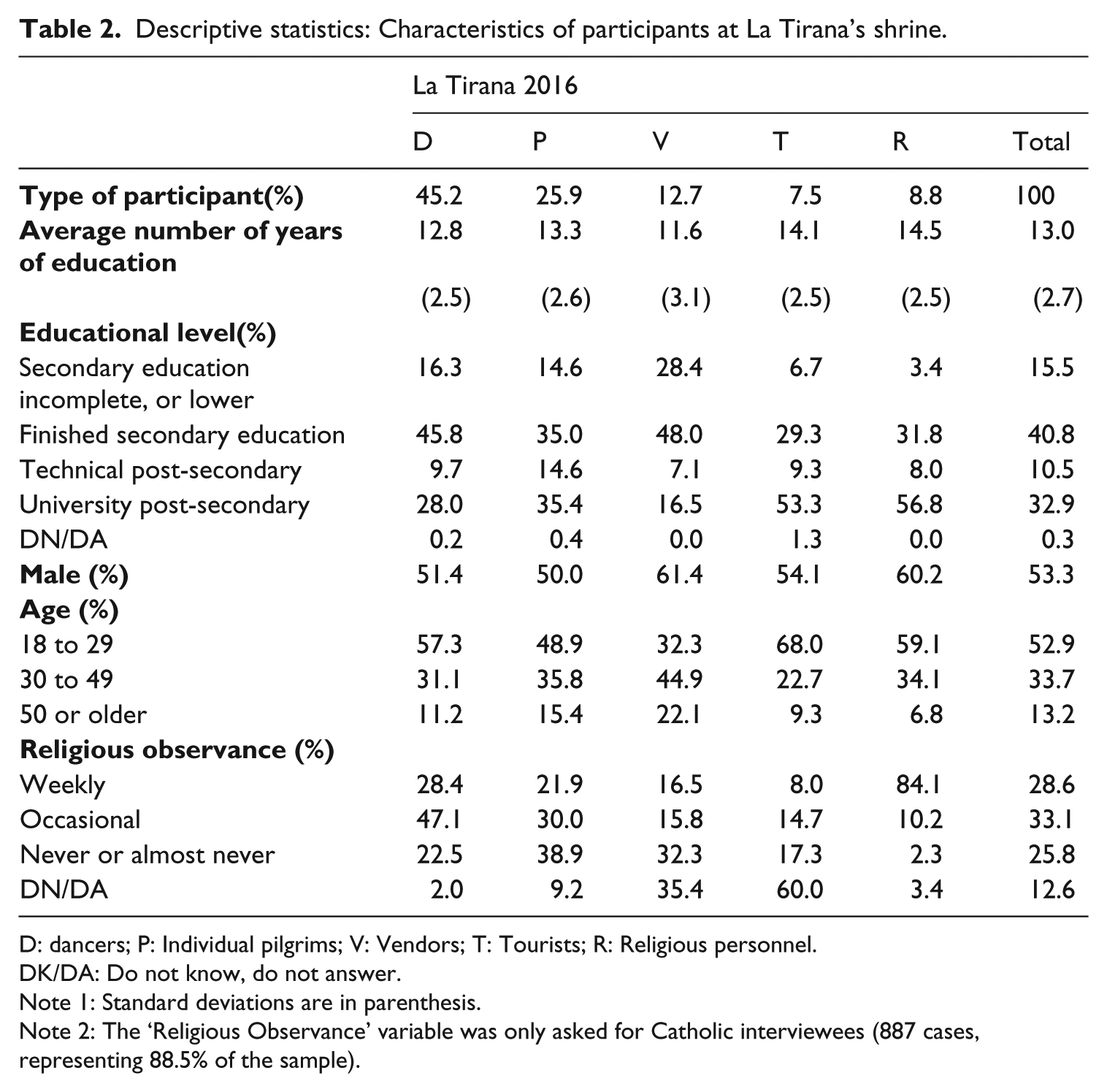
Table 2 provides descriptive statistics of the sample and essentially shows that this measure of religious traditionalism is above all sensitivity to the educational levels of participants. The level of education has increased considerably over the last few decades, to the point that currently more than one-third of dancers at La Tirana (38%) and half of the pilgrims (50%) have obtained some kind of post-secondary education. Devotion at the sanctuary has been traditionally associated with groups of lower income and educational levels, but advances in education have not dispelled religious fervor, especially among youths with relatively advanced schooling who continue family traditions of dancing and pilgrimage. Level of education, in turn, inhibits religious traditionalism that is normally associated with lesser-educated groups. In the case of the dancers, the average scores fluctuate between 7.00 and 4.96 at the extremes of the educational scale. The generational gap in education also results in an age effect, but a regression analysis found that the significant variable is the level of education achieved and not the associated age cohort. On the other hand, the convergence of religious attitudes among dancers and pilgrims on the one hand, and religious personnel on the other, could indicate a specific effect of ecclesiastical arbitration of beliefs. Interviewees declared a high level of religious observance (attending church at least once a week), to the point that almost one-third of dancers (28%) and almost one-quarter of pilgrims (22%) said they regularly attend church, a figure that is well above the national average for observant Catholics (estimated at 12% by the 2016 Bicentennial Census). The van Kessel study provides no comparable data in this regard. However, regular contact with the Church does not have an inhibiting effect on religious traditionalism, as might be expected, which diminishes the possibility of attributing the changes outlined above to ecclesiastical arbitration in devotions at the sanctuary.
Descriptive statistics: Characteristics of participants at La Tirana’s shrine.
D: dancers; P: Individual pilgrims; V: Vendors; T: Tourists; R: Religious personnel.
DK/DA: Do not know, do not answer.
Note 1: Standard deviations are in parenthesis.
Note 2: The ‘Religious Observance’ variable was only asked for Catholic interviewees (887 cases, representing 88.5% of the sample).
Table 3 summarizes the results of an OLS regression analysis carried out for the scale of traditional beliefs. Model 1 shows that years of education are inversely related to the traditional beliefs scale. Specifically, a one-year increase in education results in a significant decrease of 0.8 points on the scale. The most striking thing about the following models is that the effect of years of education is very robust and does not differ substantially when controlling for participants’ other characteristics. In effect, models 5 and 6 show that while Catholics who do not attend religious service score lower on the religious scale (in comparison to Catholics who attend services weekly), this loses significance once we control for education, participant group, sex, age and religious observation. Lastly, age does not have any effect on the scale of traditional beliefs.
OLS Regression model for religious traditionalism index.
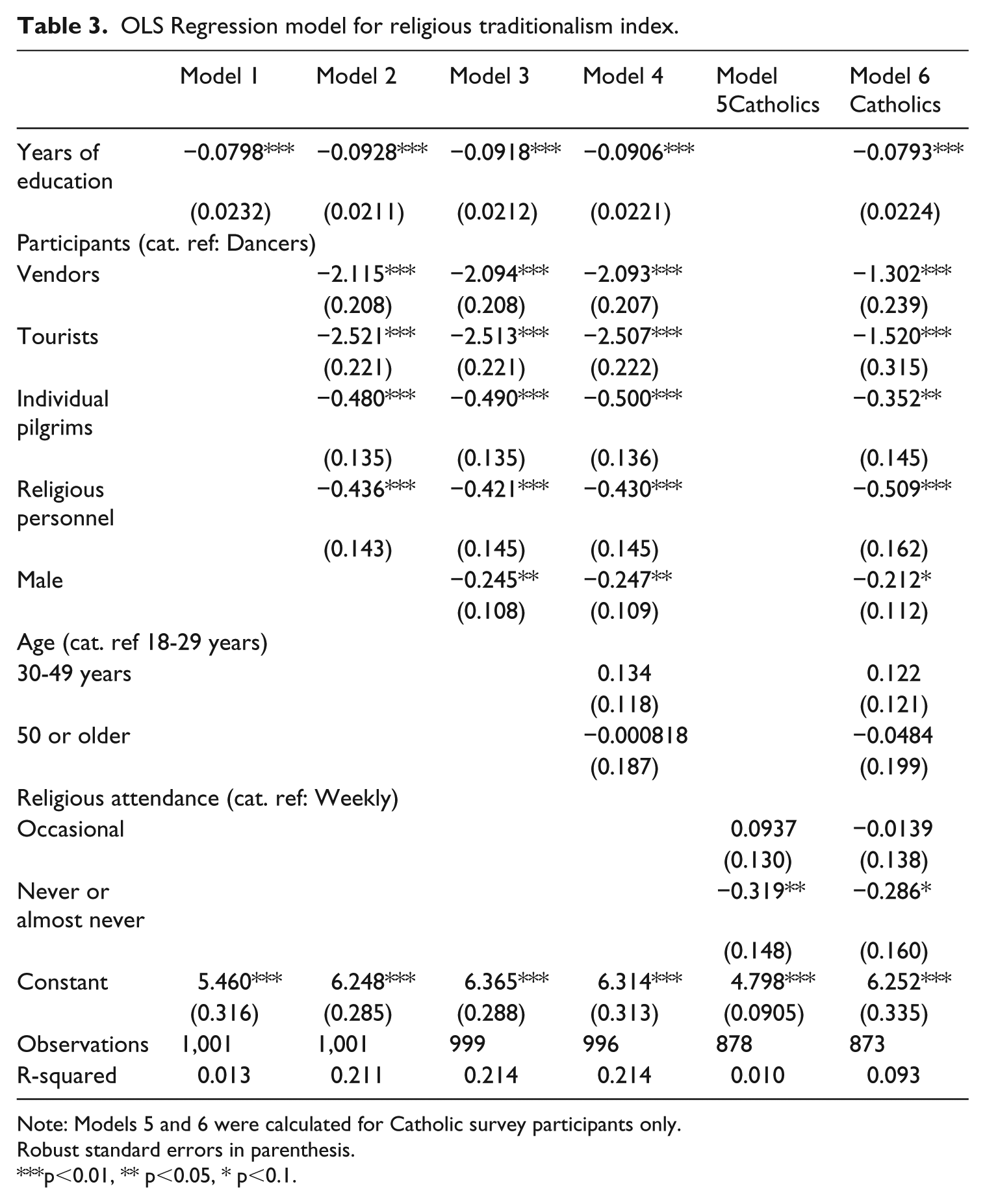
Note: Models 5 and 6 were calculated for Catholic survey participants only.
Robust standard errors in parenthesis.
p<0.01, ** p<0.05, * p<0.1.
Conclusions
The results obtained in this comparative study show a significate change over the last fifty years in the religious beliefs of attendees at La Tirana. This change points to the progressive disappearance of the manda as motivation for attending and as a characteristic form of religious consciousness among pilgrims and, in particular, dancers. Two aspects of the manda seem to be in jeopardy. On the one hand, fear of punishment by the Virgin against those who do not observe or pay their manda has faded away completely, something which now joins the Virgin’s usual graciousness toward those who violate moral precepts. On the other hand, the obligatory nature of the manda’s fulfillment has also been weakened and replaced with a more open and indeterminate compromise, less permanent and exacting than is suggested by the implications of the term ‘manda’ as a meticulous observance of a command. The Marian consciousness has evolved toward a theology of Mary’s overabundant grace, even for those who do not honor her promptly. This theology was always very present in the popular consciousness via the moral exoneration which Mary offers as the ‘refuge of sinners,’ and via the salvation she offers to those who have not led their lives correctly. Marian devotion has never been penitential. One does not dance or make sacrifices so that Mary forgives one’s sins and re-establishes a lost bond; such sins are forgiven beforehand because Mary does not even bother to reflect on them. For this very reason, ecclesiastical arbitration in the confession of sins has always seemed odd in popular Marian Catholicism. But the moral and redeemed exoneration which Mary offers did not extend to the fulfillment of ritual duties, in particular the obligation to dance each year at her sanctuary. This study’s findings show that this kind of exoneration has been amplified in the minds of pilgrims and dancers (always with some reluctance on the part of the dancers, who are more aware of their ritual duties) and that Mary’s overabundant grace has also extended its scope to breaches of ritual. There are no indications that Marian obligations have been inverted for moral observance, which remains under a theology of overabundance (as in the past) and, moreover, coincides with a general weakening of the meaning of sin and the confessional sacrament in mainstream Catholicism. Marian devotion remains far removed from Pentecostal Evangelism with its characteristic emphasis on the moral regeneration of believers and morally correct behavior in daily life. But the empirical results neither show that this devotion has moved towards a centrality of Christ or Eucharistic devotion. In spite of the decrease of the manda in the celebration of the Tirana, signs of Christocentric devotion are not appreciated, but the devotion continues to be constituted around the Virgin Maria (The Chinita). What has changed is the ritualism of the Virgin’s dancers, which opens the way for more liberal devotional practices that are free from the constraints of reciprocal obligation.
This liberal devotion has not weakened the vigor or the religious content of the fiesta. The data indicate that La Tirana has become more massive than before and that pilgrims flock to it from all over. Moreover, the fiesta is recognized much more than before as a specifically religious event. The belief that the Virgin performs miracles remains intact among dancers (94%) and pilgrims (85%). The religious personnel are slightly more resistant to this belief (73%), although it is possible that their reticence originates from Catholic orthodoxy, which treats Mary as a mediator or intercessor, instead of giving her a direct role in the granting of gifts or performing wonders. Popular devotion, accused of excessive marianism, originates in this direct attribution of redeemed efficacy to Mary, although rarely is this separated from, much less put in opposition to, the same capacity of Christ resurrected (García Arribas, 1989). The community of the faith is broken in the specific case of the tourists, whose belief in a Virgin who performs miracles declines to 56%. Around one-third of the tourists – persons who said their main reason for attending the shrine was not devotional – do not believe in the miraculous image of the Virgin, mainly because they do not follow any religion or, in some cases, because they belong to another religion in which Marian devotion is strictly prohibited. Religious tourism brings together a multitude of spectators who identify religiously with the dancers, although a portion of them fall under the specific category of persons who observe and appreciate the shrine as a spectacle only. Spectators intently observe and listen at La Tirana, admiring its elegant and colorful dances, as well as the lively, festive and deafening music. Pilgrims also adopt the posture of spectator (filming and photographing everything), and the dance groups themselves observe one another as they wait their turn to perform. However, unlike the tourists, both groups are actors and do not take on this spectator role permanently. Still, a tourist who shares the same devotional beliefs as the participants can potentially take on a different role and, at some point, trigger a devotional motivation, something that no longer makes the tourist a non-believer. Spectators introduce a principal of differentiation into the community of believers to the extent that they divert the attention of the dancers, who cease to dance for the Virgin and instead dance for the enthusiastic audience. This diversion can become all the more intense as the number of spectators at the fiesta increases, especially if the newcomers are of the religiously disconnected type. The dancers at La Tirana still unanimously declare that they perform only for the Virgin (96%) and never for the spectator (or both). However, one-third of the dancers admit that one can dance without faith, although they themselves rarely do so: Nearly all of the dancers said they were genuine devotees of the Virgin and that they performed out of faith, even if they no longer did so because of a manda. An indirect question about whether others danced out of faith or for pleasure (which sought to avoid a socially desirable response) produced the same result. Almost 90% of the dancers said that their fellow performers truly danced out of faith. This result is further confirmed in the responses of the tourists themselves, who recognized the devotional nature of the dances in elevated numbers as well (76%), indicating that the spectator’s gaze does not transform the shrine into a spectacle. The mass attendance of pilgrims, who surround the dance groups, may act as a firewall between the dancers and the tourists, although it should be noted that much of the religious tourism is culturally adjacent to the dancing. As a whole, the displacement of the manda as a motive for attending the fiesta and of its associated religious consciousness – the main finding of this comparative study – does not appear to be linked with any real indicator of secularization of the fiesta, the religious nature of which remains extremely healthy.
In addition, the effect of education on the opening of the structure of religious reciprocity that is contained in Marian devotion, eliminating the reason for punishment and the literal fulfillment of the command, can be the object of several interpretations. As Bowles and Gintis (2011) have shown, punishment plays a crucial role in the formation of cooperation in simple communities insofar as it penalizes the free-rider, the one who can obtain the goods of the Virgin without contributing the corresponding payment, and breaks with this the rules of reciprocity. The rules of the dance societies must have been very strict regarding such compliance, mainly because they lacked social or institutional resources to avoid foul play. The Virgin herself is placed as guarantor of a fulfillment that the community is not able to assure, above all because the command remains in the privacy of the believer. In fact, there is no indication that the community sanctions the person who defrauds the Virgin, although the testimonies of the misfortunes that befall the non-compliers circulate everywhere.
An ethic of punishment and literal fulfillment can also be found in Pentecostal groups that exacerbate the fear of God and recommend interpretation of the biblical text at face value. Although hostile to the popular celebration, the Pentecostal cult, which spreads everywhere among the poorest and precisely among those with lower levels of schooling, bears this similarity to the conventional form of command. As many theories of moral and cognitive development hold, the increase in education tends to displace a moral orientation based on the fear of punishment (also characteristic of childhood) by an orientation that recognizes the reference to values and moral assent (Erikson, 1993; Kohlberg, 1981). Characteristic of moral development is also the passage from a simple reciprocity (for which one only pays to the one who gives you) towards a broad or serial reciprocity that admits the possibility of paying the received good to a third (Moody, 2008), something that the Church has promoted with the payment of the mandates in charitable goods, which would replace the payment in money, still justified as an offering to the trousseau of the Virgin, both things of low prevalence, however, in the sanctuary of La Tirana. None of the forms acquired by popular Marian devotion reaches the level of an ethics of principles (contained, for example, in the maxim that it is better to give than to receive), nor the status of a post-conventional moral that is guided by universal values, but the strictest and rigid forms of reciprocity have been growing within the framework of a relationship that admits greater freedom and assent.
Footnotes
Acknowledgements
The authors thank the Center for Intercultural and Indigenous Research (CIIR) for assistance managing the project and implementing the fieldwork. The authors also thank students from the anthropology and sociology program of the Catholic University of Chile for conducting the fieldwork for this article.
Funding
This research received no specific grant from any funding agency in the public, commercial or not-for-profit sectors.
Notes
Author biographies
Address: Vicuña Mackenna 4860, Macul, Santiago, Chile.
Email:
Address: Vicuña Mackenna 4860, Macul, Santiago, Chile.
Email:
Address: Vicuña Mackenna 4860, Macul, Santiago, Chile.
Email: