




Abstract
Scholarship on religious belonging has overwhelmingly labelled believers’ religion in very broad and superficial terms, presuming that individual practices and beliefs are congruent with religious doctrines and official discourses. By splitting up religious socialisation into two crucial phases, the adoption and the adaption of religion, this article offers a more procedural understanding to investigating how young believers develop their own sense of religious belonging. Based on biographical narrative interviews with Viennese believers (aged 16–25) from 7 religious groups, we observe that the adoption of a certain religion is primarily bound to family ties. The adaption phase serves to develop personal approaches towards religion based on two major rationales: adapting one’s own religiosity by engaging with religious doctrine and community itself, and negotiating religion within society. We argue that adaption is closely tied to social relations within and across religions and to (secular) society at large.
Introduction
Numbers relating to religious affiliation in European countries leave no doubt regarding the rapidly ongoing process of secularisation, at least in terms of formal membership of religious communities. Much has been written about alternative forms of religion (Hödl, 2003), the growing number of ‘religious nones’ (Arweck et al., 2016), as well as about ‘religious creatives’ (Oostveen, 2018) who embrace hybridised forms of religious belief and practice. As early as 1967, when religious landscapes used to be much more homogeneous than they are today, Thomas Luckmann (1967) pointed out that those who remain religious must make increasing efforts to bridge secular and religious spheres. But how do young people who grow up in an increasingly secular and religiously diverse society, yet stay affiliated with a traditional religious community, negotiate their religious belonging? Building on qualitative interviews from the research project ‘Young Believers Online: Mapping on- and offline identifications of urban religious youth’, we understand religious belonging as procedural and ask how young believers adopt and adapt 1 their religion to develop their own sense of religious belonging.
To grasp the dynamic between the religious sphere and the broader societal context, we approach religious belonging from a structuration perspective (Giddens, 1986) while drawing on contemporary social scientific research on belonging, which points to fluid concepts of belonging rather than static notions of ‘identity’ (Antonsich, 2010; Hedetoft and Hjort, 2002; Yuval-Davis, 2011). The latter perspective helps us understand how people come to see themselves (and how they come to be seen by others) as part of a religious group, while Luckmann’s reflections on the significance of being religious in a (post)modern world point us to the negotiation processes that these fragmented conditions require. Below, we will first discuss contemporary scholarship on religious belonging. Following the presentation of our research design, we will highlight the factors that influence the adoption of a religion during childhood and continue with an analysis of how religion is adapted and made into a personal faith during adolescence. Based on our data, we introduce a framework that illustrates different modes in which this adaption is accomplished and outline how they emerge from different rationales either relating to individual preferences or to societal situatedness.
Adopt and adapt: religion and belonging
With ‘believing without belonging’, Grace Davie (1994) initiated a discussion about the relation between formal membership in religious organisations, belief in religious teachings, and individual religious practices. Based on her research in the United Kingdom, Davie emphasised that people continue to ‘believe’ but that few actually attend religious services or see themselves as part of a specific religious congregation. In light of religious diversification, scholars also focused on ‘multiple religious belonging’ (Roberts, 2010) and discussed blurred lines between religious traditions. Despite their central role in debates about (de-)secularisation, both approaches carry the notion of a (disrupted) congruency of individual practices and beliefs with religious doctrines and official discourses. Empirically, the concept of religious belonging has been increasingly applied in studies on religious minorities in Western countries (John, 2020; Shah et al., 2012; Tiflati, 2017). This provides interesting insights into different religious communities but reinforces the notion that religious belonging would not be a contentious issue for adherents of majority traditions (i.e., vis-à-vis an increasingly secular society), a claim that does not hold true based on our data.
According to Bourdieu (1993), the social sciences are characterised by the split between a subjectivist mode of cognition, which focuses exclusively on subjective phenomena as they exist in the everyday experience of concrete individuals, and an objectivist mode of cognition, which focuses on subject-independent structures. The strong theoretical engagement with structural functionalism, following the work of Clifford Geertz, led to a long period during which an objectivistic mode of cognition was predominant in religious studies (Limacher and Walthert, 2021: 20). This was only criticised by post-structuralist impulses and a strengthening of subjectivist positions in the engagement with qualitative social research. As a result, however, religious belonging, as conceptualised and applied in religious studies research, stands firmly in the tradition of a subjectivist paradigm and thus tends not to touch on the question of the structural conditions for experiencing religious belonging. This is also visible in religious studies research on how youth come to be religious. Here, studies on religious belonging of youth are scarce, while Klingenberg and Sjö (2019) argue that studies of religious socialisation and development seem to focus primarily on the influence of parents (see, e.g., Bebiroglu et al., 2017; Mahoney, 2021). Such research, however, does little to assess the role other aspects play for religious socialisation.
Social-scientific research taking up the concept of belonging points to its ability to capture the fluid and processual characteristics of attachment (Lähdesmäki et al., 2016) and stays away from concepts that are seen as too static, such as identity (Hendriks and Van der Braak, 2022; Oostveen, 2019). Antonsich (2010) emphasises that belonging to a social collective is inherently political in nature and a prerequisite for determining one’s position in society. For Hedetoft and Hjort, ‘belonging constitutes a political and cultural field of global contestation (anywhere between ascriptions of belonging and self-constructed definitions of new spaces of culture, freedom and identity), summoning a range of pertinent issues concerning relations between individuals, groups and communities’ (2002: x). Publicly displaying one’s affiliation with one specific (religious) group might have ramifications for other claims of belonging (e.g., to an imagined national community). Consequently, religious belonging and the way people deal with it in (semi-)public spaces come with a unique set of questions, which believers have to address explicitly or implicitly.
Thus, we argue that religious belonging of young believers is the result of two processes: the adoption and the adaption of religion. Whereas the first establishes a yet unspecified tie to a religious tradition, the second allocates personal meaning and approach to one’s own religiousness. By operationalising the concept of belonging as a two-part process of adoption and adaption, we account for the fact that religious belonging can neither be seen exclusively as a product of individual action nor can it be explained by determination through social structures alone. Individuals always, also unconsciously and unintentionally, reproduce the conditions that make action possible (Giddens, 1986); hence, the adaption of religion can eventually inform processes of adoption in the future. From this, we see that both processes, adoption and adaption, are fundamentally different rationales that negotiate between structure and agency. Whereas adoption does not determine the specific manifestation of attachment (as some might even reject the adopted religion later), it necessarily precedes the subsequent adaption of the same characteristic. Adaption attributes personal significance to a characteristic and renders it personally meaningful. Of course, characteristics differ in the extent to which they can be adapted since this is conditioned by the social situatedness of the individual and by the degree to which the negotiation of belonging is affirmed or contested by society.
Luckmann (1967) points out that the institutional specialisation of religion leads to a discrepancy between the sphere of codified religion (claiming to provide a single, holistic, and universal explanatory model) and the ever-expanding secular spheres (where meaning is constantly in flux and renegotiated). Once religious truths cease to reign supreme over our understanding and structuring of society, individuals must find ways to accommodate religion in their lives. In other words, being religious requires negotiating between secular and religious roles, and their diverging explanatory models of society. Importantly, adaption is not a one-time act but rather an ongoing negotiation that includes, as we argue, various processes, which we have identified in our empirical material.
Research design
Our data consist of 41 qualitative interviews with self-identified religious youth from 7 different religious groups, living in Vienna. We cover large (Catholics) and small (Lutherans, Jews) religious groups with a long history in Austria and the German-speaking parts of the former Habsburg empire. Furthermore, we include large (Orthodox Christians and Muslims) and small religious groups (Alevis and Sikhs) that have grown in importance during the twentieth century, due to migration processes. The selection aims at providing a good (yet incomplete) picture of the multi-religious landscape of the city (Goujon and Bauer, 2015). Participants were recruited through religious (youth) organisations, communities, and personal networks.
Our main interest lies in learning about participants’ religious lives on- and offline. We consequently conducted narrative biographical interviews focusing on participants’ biographies and their religiosity in general, with special attention given to religious activities both on social media and in the offline world. Primary data consist of transcribed conversations, which were analysed following a content-analysis approach. Coding took place in two stages: inductive categories were initially developed from the first 10 interviews and subsequently applied deductively to the rest of the material (Hsieh and Shannon, 2005). When new codes emerged in the second phase, we reviewed the data with those new codes in mind. We relied on a collaborative coding process, with three researchers developing and applying the codes (O’Connor and Joffe, 2020). In this article, we analyse codes and their corresponding quotes that are associated with the development of individual religiosity and religious belonging.
Adopting religion
Our research participants usually began with recollections from their early childhood. Many recounted how they first came in touch with religion. This contact we identify as the point in time when a religious tradition is initially adopted. Here, we see a common pattern across the observed religious traditions, as all our participants followed the religion of the larger family as well as of previous generations. Whereas not all parents were actively religious, participants considered themselves as having ties to the religious tradition that had historically been practised in the family, while other religious traditions were often seen as irrelevant at this stage. Consequently, family was the most influential factor for the adoption of religion. This paramount role of intergenerational, intra-family transmission echoes the dominant scholarly position on religious socialisation and transfer (Ateş and Schnell, 2016; Bebiroglu et al., 2017; Mahoney, 2021). As a consequence, participants’ adoption of ‘their’ religion often manifested in attending religious services, participating in communal religious initiation rites (e.g., baptism and circumcision), religious festivities, and observing religious rules. A Jewish participant recounted how she had to stop visiting a certain fast-food restaurant when her parents decided to observe religious dietary rules more closely. Friends, peers, and relatives of roughly the same age group were also mentioned as relevant factors for religious adoption. Particularly youth with a Catholic background indicated that peer dynamics kept them involved in the church. Friends and peers also played a role by introducing participants to religious youth organisations or groups and sometimes by being religious role models.
Those whose adoption process set off not during childhood, but in their teens often referred to religious mentors as decisive factors [reference excluded for peer review]. Mostly they were non-family members of an older generation, often with some form of religious training or expert knowledge. The spectrum of religious mentors was incredibly broad, ranging from imams, priests, and youth workers of religious communities, to wives of rabbis and religious experts found online. Mentors established a personal relationship with their mentees and provided religious guidance. They were referred to as important sources of knowledge. Our respondents reported that they contacted these mentors for discussions over religious doctrine, personal questions of faith, or religious practice in general (Tunger-Zanetti et al., 2019). Family, friends, and mentors were of importance for people from all religious backgrounds.
Although the process of adoption does not seem to differ greatly between different religious groups, it is subject to contextual influences. Participating in Catholic initiation rites, for example, is not only de-problematised but sometimes even promoted by public and (formally) secular educational institutions (Krainz, 2014). This shows that power relations between the secular majority, the state, and religious institutions shape the adoption of a religious tradition by young people. Specific discourses (e.g., anti-Semitism and anti-Muslim racism) and histories (e.g., diaspora religiosity) influence the position of a religious group within society and, consequently, the perspective of religious youth on society and other religious groups.
For many, the adoption of religion constituted a part of their growing up. A Jewish participant, for example, recounts that as a child he had felt pressure from his father to observe religious rules strictly, whereas it was his mother who had encouraged him to engage critically with religion during adolescence. This resulted in an intensified study of religious and secondary sources, as well as discussions with religious experts and the consumption of online material. Such steps of reconsidering childhood religiosity often appear to be the starting point of the process we understand as the adaption of religion and which lie at the heart of the narrations of young believers.
Adapting religion
Adaption follows the adoption phase during which the individual typically had acquired some religious knowledge and has come to an (initial) understanding of the position of (the own) religion in society. For most participants, the process of adaption began during adolescence (Ateş and Schnell, 2016; Mahoney, 2021). Our data indicates two different rationales, namely, the adaption of religious practice and doctrine, and the adaption of one’s religiosity to everyday social surroundings. The first rationale results from critically engaging with the adopted religion, whereas the second is tied to the social situatedness of the individual. In each rationale, we identify four distinct processes, which are not exclusive, but may occur simultaneously or sequentially in different combinations. The processes sketch characteristic ways through which young believers craft their religious belonging.
This framework can be used to analyse differences in how young believers negotiate their religious belonging as well as subtle changes and dynamics within the same individual over time. Adaption processes might vary in different areas of life (e.g., socially withdrawing at the workplace but being a religious activist in the private realm). Equally, the way religion is adapted should be considered a process in flux, rather than something with a clear end point.
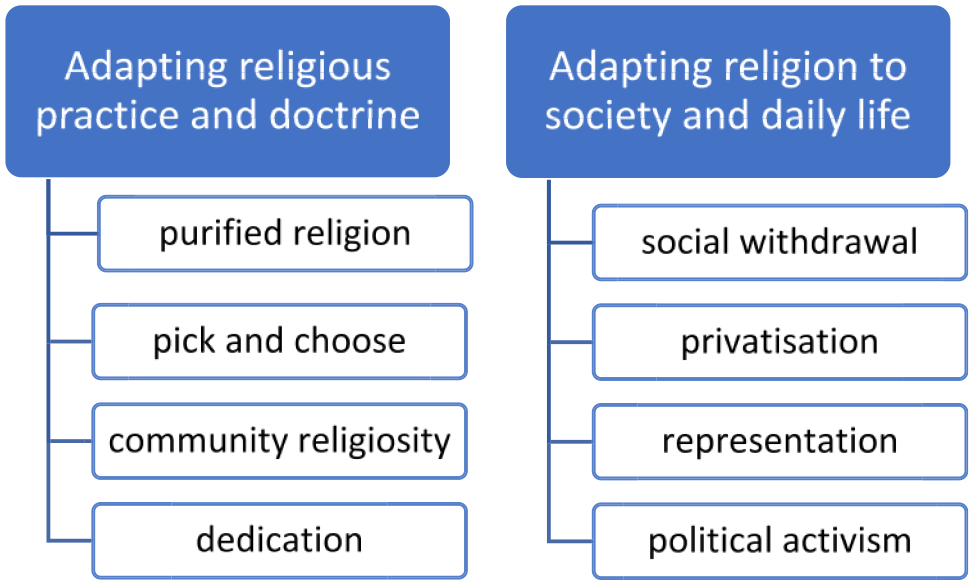
Adaption of religion, authors’ own illustration.
Adapting religious practices and religious doctrine
This first group of adaption processes rests on a critical evaluation of their own religious tradition. This critique might relate to aspects such as religious doctrine, practices, or hierarchies, yet it remains an inner-religious assessment. Throughout this process, people seek to distinguish between approaches and practices which suit them, and others which they reject. The four processes within this rationale are purified religion, pick-and-choose religiosity, community religion, and dedication.
Purified religion
The first process focuses on cleansing religion from elements that are considered not ‘really’ part of the ‘true’ religious doctrine. Practices that are rejected are considered as secular or merely cultural in origin and seen as the result of syncretism with religious doctrine. This adaption process seeks to discover a religious essence that should be followed. In line with other scholarly works, we identified this among young people whose parents had migrated (Khaliefi, 2019; Tunger-Zanetti et al., 2019), and who wanted to differentiate between the traditional elements of the religion that their parents had brought from their countries of origin and a version of religion which they saw as ‘purer’. In contrast to the existing literature, we also observed this among young people without a family migration history, who positioned themselves against what they considered biased, patriarchal interpretations of their religion. Many spoke of ‘core elements’ (such as the personal relation to God, charity, compassion, etc.), which they wanted to uphold, whereas other rules were considered part of the cultural baggage that religion had accumulated. Elements that fell into the latter category included, for example, dietary rules or religious dress codes.
To discover a religious essence, young believers often engaged in intensive studying, turning to secondary sources or academic texts. A Muslim participant with parents from Egypt and Morocco explained:
[For me] there has never been the [one, single] tradition… So in Morocco Islam is practiced differently than in Egypt. But those different directions and traditions… they don’t represent religion, because for me, religion has always been more general (05-M-m).
For this participant, as for others who used this process to adapt their religion, the religious essence that they had found has transcended inner-religious (cultural, linguistic, as well as confessional) diversity. To summarise, adapting religion through purification is driven by the conviction that the true essence of religion needs to be rediscovered and pursued.
Pick-and-choose religiosity
Similarly, we have identified an adaption process that we call pick-and-choose religiosity. Here, participants embraced some religious teachings, while they disregarded others, mostly those that they perceived as outdated or incompatible with their day-to-day activities. This process aims at practising religion according to personal preferences. A 22-year-old Jewish participant, for example, stated:
I select as much as feels right for me, … I do as much as I want, as much as I can and as much as I can enjoy. (…) I say: ‘I like to do this [but] that’s something I’d rather skip’ (42-J-f).
This means, for example, that she would celebrate Jewish holidays while not necessarily following every rule or engaging in all religious activities.
Paramount for such considerations are mundane preferences rather than an interest in discovering a religious essence, as people would also uphold religious aspects that clearly were contemporary developments (e.g., current interpretations of religious doctrine and newer practices) if they fitted their preferences. In some cases, the adaption process resulted in participants only choosing to identify tangentially with a religious affiliation, or to wear religious symbols but to omit most other religious practices. In other cases, pick-and-choose processes resulted in an intense, yet selective religious lifestyle. Often, this was tied mainly to time resources (e.g., regarding prayer times and the frequency of prayer), the availability of technology (e.g., rules regulating the use of machines), or secular values that our interlocutors considered important (e.g., particular gender norms). Religious youth might, for example, not follow rules on religious clothing while still praying regularly, or vice versa. Such practices have been described as ‘patchwork religiosity’ (Gärtner, 2016; Wuthnow, 2000), but unlike most accounts in the literature, we did not observe any crossing of religious boundaries. The participants in our study picked and chose from within their own religious traditions.
Community religiosity
This process of adaption follows a different logic. Here, the focus lies on communal religious life, such as being a part of and participating in a single congregation (or a handful of selected groups), as well as its specific religious interpretation and practice. This process of adapting religion attributes major importance to spiritual leaders and members of the congregation itself. As one Lutheran participant explained: ‘My religious education teacher [at high school] had told me that she also was a pastor at a certain Lutheran church. So, I thought, I will just go there’ (33 L-f). Eventually, this participant had her confirmation there and stayed with that church. Interestingly, even though participants regularly attended religious services, religious practice itself did not play the most important role for them, but rather the social relationships that were maintained there.
Within the age group of our participants, friends and religious peers were extremely important. Many participants found religiously like-minded friends in religious youth organisations. In contrast to many congregations, youth organisations aim to bridge ethnic, linguistic, or inner-religious boundaries. A Muslim participant indicated this when talking about the Muslim Youth Austria (MJÖ):
What’s cool about MJÖ is that there are people of different ages. Also, there is a great variety in the degree of each person’s religiosity, and that’s so interesting, I think. Culturally, too, [Islam in] the Balkans, in Bosnia is completely different [from Islam in other regions], even though it is the same and that’s cool (15-M-f).
In contrast to the previous two processes, community religiosity was not so much concerned with specific religious content but rather was aimed at establishing belonging through participation in religious communities and through personal ties. Mostly, the way in which religion was practised within the community was accepted and not necessarily adapted further.
Dedication
Finally, we identify the process of increased dedication. Here people seek to immerse themselves in as many religious practices and events (within the boundaries of their own religious tradition) as possible. Some participants told us that they would attend services at different religious communities, sometimes for hours, sometimes more than one a day, sometimes getting up early and travelling to faraway religious communities. They described a strong preoccupation with religious questions, including intensive studying and religious debates with religious mentors or peers. For some participants, this urge to dedicate themselves to their religion related to a desire for a very strong religious experience. For others, it was an answer to what they perceived as laissez-faire approaches to religion, which they considered to dominate or at least be widespread within their religious tradition (and sometimes in their families). Consequently, they would often mention a lack of religiosity especially among youths. What they embraced instead were strict and sometimes archaic interpretations of religious doctrine. In retrospect, a Catholic participant, who had at a time in her life adapted her religion through dedication, was very critical of her way of following her religion back then: ‘When I think back, I think: “Oh My God, that wasn’t healthy”. Back then I really did everything that sounded like “better safe than sorry”’ (03 C-f), indicating that, driven by fear of doing too little, she simply engaged in as many religious activities as she could (including attending services of Protestant communities).
In a few cases, dedication also resulted in a very strong observance of certain religious doctrines. Interestingly, studies of this phenomenon had previously mostly concentrated on Jewish families, where children started to live their religion much more intensely than their parents did (Sands et al., 2013; Stampfer, 2011). We observed this adaption strategy mostly among young Catholics and Christian Orthodox participants. However, as the above-mentioned quote by a Catholic participant suggests, to some, dedication might be a short-lived form of adaption.
Adapting religion within the social context
The second rationale of adaption processes attempts to bring religion in line with an individual’s social environment. The four adaption processes we identify in relation to this rationale are social withdrawal, privatisation of religion, positioning oneself as a representative for one’s religion, and political activism. They are conditioned by a person’s social location as a follower of a specific religious tradition and take account of social constraints towards religion.
The feeling of being part of a minority and of being confronted with prejudices and power imbalances played an important role for all participants, as society at large was either considered as secular or as predominantly Catholic Christian. 2 Importantly, it was not decisive whether one belonged to a large or a small religious group, as participants interpreted the term ‘minority’ in varying ways. For Catholics, the majority was considered non-religious or even atheist, for Protestants the majority against which they positioned themselves was Catholic. Similarly, for Muslims, Jews, and Sikhs, the societal majority was perceived as Christian, whereas Alevis saw themselves in a minority position in relation to Sunni Muslims.
Jews and Muslims in particular were also subject to animosity and hatred due to anti-Muslim attitudes and anti-Semitism. While Islam has been politicised in Austria in the context of migration (Mattes, 2018), Jewish participants must negotiate their religious belonging within a post-Nazist society that has long avoided dealing with its responsibility for the Shoah (Peham, 2018). Furthermore, there are some religious groups for whom – for instance, due to religious attire and symbols – religious belonging is more visible in everyday contexts than for others. In these cases, young people must decide whether to follow these rules and thus make their religious belonging visible or rather refrain from such dress codes. This especially is the case for male Sikhs who wear a turban, male Jews who wear a kippah, or female Muslims who wear a hijab.
Social withdrawal
We identified social withdrawal as a form of retreat, either to the private sphere or to a circle of people of the same faith. The reason given to us was feeling uneasy around people who are perceived as a majority that is hostile to or ignorant of the participant’s religion. It is thus rather a reaction to social constraints, prejudices, and discrimination than a voluntary decision. A Jewish participant, for example, explained changing from a public to a private Jewish school:
That’s an identity thing, where, at a certain point, I didn’t feel so comfortable any more. Among other things because I often missed school for Jewish holidays and then there were always the jokes about Jewish people and so and then I just wanted to be with people who understand me (20-J-m).
Regarding the workplace, a Sikh participant said that she would rather give up her preferred job than renounce religious clothing. Social withdrawal thus describes a process where individuals decide to interact with people from their own religious tradition while avoiding social interaction with other religions or non-religious people in certain areas (e.g., school and the workplace).
Withdrawal does not take place primarily for religious reasons (e.g., the idea that believers should stay among themselves) but for social reasons, as it aims at averting confrontations that result from dedication to religious doctrine and practices. Those who choose this form of adaption withdraw to spaces that are perceived as safe and open to their religion. As emphasised in the study of religion and social capital, seeking to be surrounded by the own religious group can prove profitable in various social aspects (Traunmüller, 2018). Luckmann also emphasises that ‘the problem of “meaningful integration” is resolved… by elimination of the inconsistent “secular” elements of the problem’ (1967: 85). In some cases, this would result in ‘an inability to perform the nonreligious roles effectively’ leading to ‘a partial withdrawal from the “world”’ (Luckmann, 1967: 85).
Privatisation of religion
The next process we identify is the privatisation of religion. It is closely related to specific faith practices, making religion a private matter. A Catholic participant said that in keeping her religion private, she would follow her father’s approach: ‘It’s about my faith and that’s between me and God, it’s nobody else’s business’ (06 C-f). Similarly, an Alevi participant stated that religion was something ‘that people should live out in themselves’ (21-A-f). This approach towards religion implies that people refrain from any form of proselytisation and are convinced that religion is something inherently personal, which should not be talked about or shown publicly (Pickel, 2016). For others, restricting religion to the private sphere is a means of avoiding negative encounters. Either way, it means that these participants kept conversations about religion to a minimum and did not display their religiosity publicly. For example, a Muslim participant decided to stop wearing the hijab in order to avoid discrimination. A Catholic participant stated that she did not discuss religion, as such conversations were ‘unproductive’, and that she would run the risk of being insulted. Among our participants, it was not only the dominance of the secular that posed a reason for living religion privately but also the possibility of experiencing intersectional discrimination as a member of a (visible) religious minority (see also El-Tayeb, 2011).
Representation
Representation, in contrast, describes a process in which people display their religious affiliation and engage with it. Here, religious youths do not refrain from discussing religion, even though they might experience it as unpleasant at times. A Muslim participant told us about discussions with a non-Muslim friend:
So we sometimes have discussions where we just talk about it and where he is interested in stuff like: ‘Why do you pray five times every day?’ or: ‘Why do you fast, is this healthy?’ or things like: ‘Is what I hear and read in social media true?’ Then we just talk about it, and he sometimes understands (04-M-m).
A Catholic participant decided to put a small cross emoji-symbol in her self-description on her social media profile and told us: ‘[Religion] is more or less the most important part of me, so God is the most important for me and the closest person I have and I stand by that fact and I want to show that’ (03 C-f).
Representation also serves to challenge negative portrayals of one’s religion. A Muslim participant performed as a representative of his religion to challenge discrimination from a teacher:
I don’t know why [the teacher] did that, but I didn’t just see it negatively, because for me the result was that I reflected more, that I constantly tried to find arguments against it. Because for me, what she said wasn’t right (05-M-m).
Some participants studied their religion more closely, to be able to speak as experts about their faith and to challenge what they perceived as misconceptions about their religion. A male Sikh participant who wore the turban while serving in the Austrian military anticipated that others would see him as a representative of his religion and tried to behave accordingly.
You just make sure that you don’t deliberately do things that you should not do as a member of this religion, because in the end you are not only responsible for yourself, but you are responsible for a whole religion, especially in a country where the religion is not yet so strongly represented (25-S-m).
Either by confronting prejudices explicitly or by more subtle acts, they engaged in the discursive struggle over the way in which their religion was constructed and seen in their immediate social environment (Hall, 1997).
Religio-political activism
Finally, religio-political activism goes one step further, as young people take action by lobbying for religious interests and religious diversity. Consequently, they might find themselves fighting against discrimination not in private contexts but publicly. Religious youth groups play an important role in raising awareness regarding discrimination against and hostility towards (religious) groups, but they also promote interreligious cooperation by working together across religious traditions. Yet, there are noteworthy differences among the religious groups included in our sample. For Sikh, Alevi, and Christian Orthodox youth, there are no religious youth groups comparable in size, structure, and resources to those of Protestant, Catholic, Jewish, and Muslim youth.
When asked about religious diversity in Vienna and contact with other religions, many participants mentioned events organised by coalitions of religious youth organisations. For example, in November 2020, some participants took part in events organised by a coalition of religious youth groups to show interreligious solidarity in the wake of the Vienna terror attack (Limacher and Novak, 2022). In May 2019, publicly displayed portraits of Holocaust survivors (a part of the ‘Lest we forget’ exhibition by artist Luigi Toscano) were attacked and destroyed. At that time, the [Muslim Youth Austria] said:
We want to be there now and join [the other youth organisations] and do a vigil to protect the portraits so that they are not attacked again. (…) That was one of my best experiences. It was just so cool to be there for such an important thing (05-M-m).
However, participants also engaged in activism outside of religious youth organisations. A Protestant participant told us about her involvement at the Vienna Pride Parade where she joined the group Religions for Equality. While only a few of our interviewees took part in religio-political activism, most of them talked positively about initiatives of youth organisations. Our analysis suggests that the main goal in this adaption process is to fight for social justice, that is, against discrimination and exclusion on religious grounds.
Discussion and conclusion
In our article, we see religious belonging as processual and as characterised by two phases, the adoption and adaption of religion. Thus, the main strength of this approach lies in breaking with one-dimensional accounts of religious belonging. In line with previous research on religious transmission (Ateş and Schnell, 2016; Bebiroglu et al., 2017; Klingenberg and Sjö, 2019), the most important drivers of religious adoption were family members, peers, and religious mentors. Religious adoption establishes a primary link to a specific religious tradition and marks the first step in crafting religious belonging. In the formative phase of adolescence, young believers decide whether, and if yes, how they want to stay affiliated with a religious tradition. Going beyond that which research has found thus far, the framework we introduce highlights multiple processes through which young believers develop their own perspective on and approach to their religious tradition and practice while also taking societal forces and discourses into consideration (Blume, 2010; Luckmann, 1967; Szocik and Van Eyghen, 2021). This adaption of religion usually involves focusing on certain religious interpretations and practices while disregarding others. It furthermore is often accompanied by conscious decisions about the role that religion should play in an individual’s life and is thus closely linked to questions of identity formation (Halafoff and Gobey, 2018).
The framework of adaption processes allows us to closely decipher how young people try to resolve the tensions between the religious and the secular spheres described by Luckmann as ‘the incongruence between the “official” model of religion and the socially predominant individual systems of “ultimate” significance’ (1967: 82). Ultimate significance refers to the capacity of the individual to account for actions in a socially intelligible manner, that is, not by solely referring to a religious rationality. Hence, the individual needs to bridge the gap between the religious and the non-religious spheres as well as between the universalistic claims of religious institutions and the increasingly diverse subjective horizons of meaning. We argue that this creates a need to adapt religion by on one hand attributing personal meaning to it, and by consciously deciding what role religion should play in one’s private and public life, on the other.
The first rationale of adaption takes an internal perspective, as it involves scrutinising religious rules, doctrine, and practices and seeks to adjust them to reduce incongruences between personal attitudes and religion. Here, we encountered different processes, including the re-evaluation of religious teachings (either by purifying religion or by making conscious choices regarding those religious rules that one deems worthy of following), the appraisal of the communal aspect of religion, or the intensification of religious practice and belief. The second rationale focuses on society and thereby addresses lacunae in many contributions on religious belonging, namely, ignoring the socio-political environment in the negotiation of religious belonging. Our concept explicitly includes the accommodation of religion into the social worlds of young believers. We identify different ways of negotiating individual religiosity in day-to-day social practices and society at large, such as the privatisation of religious practices or religio-political activism. We see that young believers apply different strategies, as they are aware of discriminatory structures or anticipate societal reactions to public displays of particular forms of religiosity.
Our analysis confirmed that Luckmann’s (1967) observations on the relationship between (religious) individuals and contemporary society may still inform an initial understanding of the ways in which religion is adopted and adapted today. Our analytical approach does not only help to see religious belonging as a two-stage process that consists of adoption and adaption but also contributes to a better understanding of how young people develop their personal practices and approaches towards religion. As the relevance of religion can no longer be seen as congruent with official religious institutions and the knowledge they provide, one must also consider the different subjective forms of individual religious lifestyles to analyse religion in contemporary society. Through its ability to register different adaption processes, our framework offers new paths to study the relevance of religion in society and may explain diversifications within religious traditions. Furthermore, as adoption and adaption processes today shape the religious belonging of future generations, our approach provides an analytical starting point towards a better understanding of larger religious transformations.
In a similar vein, our findings challenge many existing classifications of religious belonging that have hitherto dominated debates. These existing paradigms typically prioritise the individual side of the negotiation of belonging instead of considering the process of adopting and adapting religion in-between individual practices and social situatedness, or, using Gidden’s terminology, structure, and agency. So far, research on religious belonging used to focus primarily on religious minorities, most prominently Muslims (see, e.g., Ateş and Schnell (2016) categorisation of forms of religiosity, which is exclusively based on the consideration of young Muslims). Extant research may also build on anecdotal rather than systematic findings. Gärtner (2016: 564), for example, categorises religious identities on a spectrum ranging from ‘autonomous-individualised’ to ‘fundamentalist’, with ‘patchwork religiosity’ and ‘multiple-religious identities’ in-between. Our approach, in contrast, does not attempt to place participants into categories, but instead focuses on identifying the exact processes through which religion is adapted.
In our paper, we were able to lay the foundation for future analyses by highlighting that the processes of adapting one’s own religion are much more complex than had been thought previously. We thus argue that what appears to be an individualisation process in the formation of religious identity in fact constitutes a combination of different adaption processes, which are closely tied to social relations within and across religious traditions and society at large. In doing so, we demonstrate that the bifocal lens of adopting and adapting allows us to grasp the processual character of religious belonging conceptually. The model of religious adaption furthermore helps us to understand how young believers negotiate their religious belonging in private and public spheres while identifying individualised ways of accommodating religious doctrines. It will be the task of future research to analyse the adaption processes of religion at different life stages (e.g., in old age) and describe their changes over time.
Footnotes
Author’s Note
Christoph NOVAK is now affiliated to University of Vienna, Austria.
Funding
The author(s) disclosed receipt of the following financial support for the research, authorship, and/or publication of this article: This research has been funded by the Innovation Fund Science, Research and Society of the Austrian Academy of Sciences (Grant No. IF_2019_18_YOUBEON).

Notes
Author biographies
Address: Department of Practical Theology, University of Vienna, Schenkenstraße 8-10, 1010 Vienna, Austria.
Email:
Address: Research Centre Religion and Transformation in Contemporary Society, University of Vienna, Schenkenstraße 8-10, 1010 Vienna, Austria.
Email:
Address: Institute of Urban and Regional Research, Austrian Academy of Sciences, Baeckerstraße 13, 1010 Vienna, Austria.
Email:
Address: Vienna Doctoral School of Theology and Research on Religion, University of Vienna, Schenkenstraße 8-10, 1010 Vienna, Austria.
Email: