




Abstract
The aim of this paper is to analyse the reformulation of the place and role of religion in Spanish public institutions after the constitutional disestablishment of the Catholic Church and religious diversification of society. Drawing upon qualitative fieldwork in six Spanish prisons, we argue that there is a process of the realignment of forces between the religious groups that provide services in such institutions, the Catholic Church adopting an attitude in between adaptation and subtle resistance to the loss of a number of its previous prerogatives. This incomplete demonopolisation of public organisations can be explained as the result of two opposing forces: (a) convergence towards the European standards of accommodation of religious diversity; and (b) Catholic resistance to the loss of established advantages.
Introduction
The increase in international immigration has brought about important religious changes in European societies (Casanova, 2007). The appearance of new groups and the increasing visibility of others already present have striking consequences for European states. The literature suggests that the governance of religious diversity in Europe runs by a dual logic (Koenig, 2007; 2008): one of convergence between states in terms of a tendency towards the establishment of relations between religions and states through the mechanism of selective cooperation (Enyedi, 2003; Ferrari, 1995; 2008; Koenig, 2007); and another of divergence, in which policy responses to this new reality are conditioned by the traditional model of state–Church relations in each country (Bader, 2007; Fetzer and Soper, 2005; Soper and Fetzer, 2003). As stated by Koenig (2007: 912), ‘Church–State relations are today converging around a shared set of principles, including religious freedom, state neutrality and selective co-operation of state and religious communities’, while at the same time old patterns of state–Church relations are shaping the legal, political and administrative responses to increasing religious diversity. This is especially evident where there has been a process of religious demonopolisation. As Bader (2007: 207) argues, ‘disestablishment removes constitutional rigidity, bias towards old majority religions and also some of the limits to openness’, while simultaneously ‘old religious cleansings and entrenched privileges for predominant, formerly established religions’ remain. Therefore, the move towards institutional pluralism does not imply an immediate radical transformation, as states are tied to rooted majority religions that retain influence over society and whose elites are reluctant to lose their authority over other institutions (Chaves, 1994).
European countries are facing the pressure of the cultural and religious diversification of their populations on their existing model of state–Church relations (Bader, 2007) from very different starting points. Countries with no previous religious monopoly, as is the case in Germany, the United Kingdom or the Netherlands, do not have to confront the structures and routines of a past institutional religious monism. Conversely, countries with a previous strong religious monopoly or ‘mono-confessionalism’ (Madeley, 2003: 35), such as Spain, Italy, Poland and the Scandinavian countries, which opted for the constitutional establishment of a national Church (Bader, 2007: 54) or for special constitutional recognition of a particular Church, now have to deal with the requirements of liberal democracies, on the one hand, and the resistance of majority religions to the loss of privileges (Anderson, 2003), on the other. In short, ‘mono-confessional societies might be expected to be less tolerant than multi-confessional societies, where pluralism and difference has [sic] for long been part of common experience’ (Madeley, 2003: 39).
This article focuses on Spain, which has been largely overlooked by the literature in these matters. 1 The main objective is to examine how the historical state–Church pattern is being reconsidered in the context of increasing secularization of the population and religious diversification. Given the position of the Catholic Church during the Franco regime, the dynamics of demonopolisation in Spanish public institutions started only after constitutional disestablishment in 1978. The analysis of the incorporation of religious minorities in Spain must thus be framed within the process of democratisation and transition from a religious monist institutional arrangement to a post-Catholic institutional pluralism. An analysis of the dynamics of demonopolisation and the incorporation of religious diversity in Spain requires particular attention not only to the constitutional shift, but also to changes in legal patterns as well as in specific policies and in the day-to-day functioning of state organisations.
The regulation of religious diversity in Spanish prisons is the specific focus of the research. Public institutions are sites in which ‘all the political challenges, conflicts and negotiations of a multicultural society can be observed in miniature, as it were’ (Beckford and Gilliat, 1998: 11). In such institutions, religious diversity creates new controversies as well as original responses to them. Beckford (2013) identifies four main polemical issues in prisons: struggles concerning the official recognition of religious traditions, disputes between faith groups over the unequal distribution of resources and facilities, restrictions on carrying out religious practices and objections to the unequal status granted to chaplains. All of them stimulate debate about the presence and negotiation of religion in secular institutions as well as shedding light on the specific dynamics that rule prisons, in which security, order and resistance to change as well as informal interactions and rules (Mathiesen, 1966) stand out as key factors.
Our principal argument is that the reconsideration of the state–Church pattern in Spain is a contested process, resulting from the intertwining of two opposite forces: the trend towards a certain convergence with Europe through the adoption of a selective cooperation model for governance of religious diversity; and the divergence from other states due to the specificities and vestiges of the previous Catholic establishment. Moreover, we argue that in the specific context of prisons, there is a realignment of forces between the religious groups that provide services in such institutions, the Catholic Church adopting an attitude in between adaptation and subtle resistance to the loss of a number of its previous privileges.
We begin with a brief update on the accommodation of religious diversity in public institutions. Then we provide some basic information on the empirical methods used to collect the data. In the next section, we present an in-depth analysis of the practical accommodation of religious diversity in Spanish prisons and highlight its main political implications. We conclude by advancing some reflections on the ongoing demonopolisation dynamics in Spanish state institutions.
State of the art
In recent years, research has been conducted on the regulation and accommodation of religious diversity in public institutions all across Europe. Beckford’s and Gilliat’s research (Beckford and Gilliat, 1998; Beckford, 1998; 1999; 2001; 2005) on the role of religious diversity in English and Welsh prisons stands as the reference point in this field. Other sociologists have also analysed the structural setting of religion in prisons, mainly in European countries. Becci and her collaborators have studied the place of religion in prisons in Germany, Italy and Switzerland (Becci, 2011; Becci et al., 2011; Becci and Purdie, 2012; Becci and Knobel, 2014). Furseth (2003) and Furseth and Van der Aa Kühle (2011) have conducted research in the Scandinavian context. Sarg and Lamine (2011) focused on French penitentiary institutions, while Gagnon (2008) and Beckford and Gilliat (1998) conducted similar studies in Canada and the US, respectively.
These studies show that prisons are key environments for examining how multiculturalism is being politically addressed in public institutions (Beckford and Gilliat, 1998) as well as for analysing how state and religion relate to each other (Becci, 2012), in this case under specific security conditions. Although they have been conducted in diverse national contexts, they offer an interesting framework for the study of the dynamics of demonopolisation and the incorporation of religious diversity in Spain. They provide us with different concepts that will constitute the analytical matrix through which we describe the situation in Spanish prisons. The four dimensions in which those processes can been observed are policy and law, chaplaincy, sacred spaces, and everyday religious practice.
First, the governmental regulation of religious diversity refers to state action that regulates its relations with organised religions, mostly through legal means (Bader, 2007). Most European states grant religions a special status accompanied by some legal and economic benefits. In this sense, European countries, converging in their normative models of religious governance (Ferrari, 2008; Koenig, 2007), have tended towards a wider recognition of the right to religious freedom in state institutions. Some of the aforementioned researchers highlight the recognition of prison inmates’ right to religious freedom and chaplaincy. However, the formal recognition of the right to religious freedom is not sufficient for an understanding of the position granted to religion in particular institutions. As Becci (2011) puts forward, everyday religious practices are organised not only around the rules that are in force but also around the personalities involved, institutional habits, assigned spaces, local routines, etc. Therefore, it is worth considering other areas in which controversies and negotiations between different religious groups and between them and the state may appear.
Second, Beckford points to the organisation of chaplaincy as another contentious issue. With the increasing religious diversification of the population, institutions face more demands for religious care from different religious groups. Along these lines, he states that ‘competition between the representatives of the growing number of different faith groups with an interest in prisons has also intensified for a share of the resources’ (Beckford, 2013: 9). However, the claims for equality and the unequal conditions between groups refer not only to economic issues but also to what Beckford (2013: 9) calls ‘institutional respect’. The unequal treatment of non-Christian chaplains in the everyday life of state institutions has been extensively documented in previous research (Becci and Knobel, 2014; Joly and Beckford, 2006; Michalowski, 2010; Spalek and Wilson, 2001).
The consideration of the spatial dimension of religion and the politics involved is attracting progressively greater interest (Yeung, 2011). The analysis of the spatial and physical presence of religion is also worthwhile as sacred spaces are sites where social relations are embedded (Gilliat-Ray, 2010). In prisons, sacred spaces ‘were (and remain today) sites for contesting power relations’ (Gilliat-Ray, 2005: 189). They can therefore be considered as resources available for the reaffirmation of one’s presence. Through different strategies of appropriation, groups can assert power, thereby legitimising their ownership of a concrete space (Yeung, 2011). Consequently, they are sites in which the demonopolisation and diversification processes can be observed.
Finally, Beckford’s (2013: 8) findings suggest that ‘disputes about the limits that prison administrations impose on the practice of religion’ are an important area of controversy, and therefore worth examining. The banner of security serves as a key justification for the limiting of religious activities (Beckford, 2013; Gagnon, 2008). Institutional arrangements traditionally serving a more religiously homogeneous population also hinder equal religious practice. In France, according to the official state policy towards religion, prisons tend to relegate the religious practice of inmates to the private realm. In England and Wales, on the contrary, they tend towards the institutionalisation of the situation of religious minorities and attention to their needs (Beckford, 2005; Beckford et al., 2005), although this does not mean a totally equal status with that of the Church of England (Beckford, 1999; Spalek and Wilson, 2001). Switzerland, Germany, Italy and Norway have intermediate positions, where some facilities are provided for the development of individual and collective religious practices (Becci, 2011; Becci et al., 2011; Furseth, 2003).
Considering all the above, in this paper we seek to examine how the historical state–Church pattern is being reconsidered in Spain through analysing not only its development at the formal level of law and policy but also its real and informal implementation at the level of state institutions. This allows a more nuanced and precise understanding of the process of religious demonopolisation and facilitates comparison with other countries.
Methods
This paper is part of a broader project, GEDIVER-IN 2 , whose general objective is to analyse the reformulation of the place and role of religion in Spanish public institutions after the secularisation of the state and religious diversification of society. The research pays particular attention to negotiations over the incorporation of new religious demands into the functioning of prisons and hospitals.
Our inquiry, from the perspective of the sociology of religion, is based on the four analytical dimensions discussed in the previous section: legal and political regulations; the ways chaplaincy is organised, developed and negotiated; the negotiation of the places of worship; and the strategies developed to incorporate religious practices into everyday institutional life. In short, we focus on real objects – such as religious symbols, sacred spaces and religious celebrations – and areas of action, which both carry subjective and relational meanings and manifest power relations with implications for the fulfilment of citizens’ right to freedom of religion and equal treatment.
The case study presented in this article included the analysis of six Spanish prisons in the regions of Andalusia and Catalonia. Two are male prisons and the other four have areas for both men and women. The project combined three qualitative research methods (Caracelli and Greene, 1993): (1) in-depth semi-structured interviews with policymakers, prison managers and administrators; national, regional and local religious leaders; religious ministers; and faith-based NGOs 3 ; (2) observation of different religious and non-religious activities carried out by religious actors within prisons, as well as guided observation of libraries and places of worship; and (3) document analysis (i.e. prison brochures, faith-based NGO brochures and websites, and prison circulars). The use of different data collection methods allowed us to probe the complex reality under study more deeply (Woodhead, n.d.). The decision to adopt a multi-method qualitative approach was supported by previous research experiences (Becci and Purdie, 2012; Crewe, 2006). Becci (2011: 69) advocates this approach on the basis that perspectives on prison life ‘are strongly compartmentalized and can therefore develop in quite opposing directions. This is the reason why a triangulation makes particular sense if the aim is to highlight the ambiguities and the disruptions in the prison world’.
After obtaining official permission for the research and negotiating access on a daily basis (Drake and Harvey, 2013), we carried out our fieldwork between October 2011 and April 2013. It consisted of 45 tape-recorded interviews (lasting between 30 and 90 minutes) and participant observation in the six centres. The documentation was either provided by the institutions and religious actors themselves or collected using the internet.
Spanish prisons in a changing context
The new religious situation in Spanish prisons is mostly linked to the increase in migration-related religious diversity. Since 1991, Spain has received a great influx of migrants. The number of foreigners (non-Spanish citizens) rose from fewer than 350,000 in 1991, representing less than 2% of the total population, to more than 5,750,000 (12.2%) in 2011, a figure which decreased slightly due to the global financial crisis to just under 5,546,000 in 2013 (Instituto Nacional de Estadística, 2014).
This dynamic has resulted in the pluralisation of Spanish society and an increase in and greater visibility of religious diversity (Briones et al., 2010; Díez de Velasco, 2010; Martínez-Ariño et al., 2011). Religious affiliation data are not available in Spain due to a constitutional ban on their collection. However, estimates offered by the government on the number of places of worship for religious minorities point to great religious diversity. In December 2012, there were 5,871 places of worship for non-Catholic groups. Of these, Protestant churches represented 57.1%, Islamic oratories 20.9% and Jehovah’s Witness Kingdom Halls 12.1%. The remaining 9.9% was distributed among Baha’is, Buddhists, Christian Scientists, Scientologists, Hindus, Jews, Mormons, Orthodox Christians, Sikhs and other faiths, none of which exceeded 3% of the total (Observatorio del Pluralismo Religioso en España, 2012).
In recent years there has also been an increase in the number of foreigners in prisons, which has diversified the religious profile of inmates as well. The percentage of non-Spanish citizens among the total incarcerated population rose from 19.6% in 2000 to 33.4% in 2012 (Ministerio del Interior, 2012). According to an interview with officials from the Spanish Penitentiary General Secretariat, there are inmates in Spanish prisons from more than 60 nations and with very different religious backgrounds. Despite the lack of official statistics, the data from Gallego et al. (2010) show great religious diversity within the Spanish prison population: 39.1% of prisoners identify themselves as non-practising Catholics, 23.1% as practising Catholics, 12.2% as evangelical Christians (Protestants), 5.7% as Muslims, 6.2% as members of other religions and 13.8% as atheists or agnostics. 4
The legal and political demonopolisation of prisons
Until the end of the Franco dictatorship, the state agreement with the Holy See established a model of organic integration between public institutions and the Catholic Church (Martín Sánchez, 2008). This arrangement led to the strong presence of the Catholic Church in institutions such as the military, hospitals and prisons (Moreno Antón, 2006). Catholic chaplains were considered as figures akin to civil servants and were paid by the Spanish state. Chaplains working in prisons belonged to the ‘Cuerpo de Capellanes de Instituciones Penitenciarias’ (Penitenciary Chaplain Corps).
Since the drafting of the 1978 Constitution, there have been substantial legal changes, moving towards the recognition and development of the right to religious freedom. The Constitution established the non-confessional nature of the Spanish state and guaranteed the freedom of religion to every citizen (Art. 16), laying the foundation not only for the restriction of the presence of the Catholic Church in public establishments but also for the incorporation of the rights of minority religions. The 1980 Religious Freedom Act applied these rights more consistently. As a consequence, the model of organic integration was transformed into one of ‘concertation’. The latter establishes the conditions for chaplaincy through a specific agreement between the state and the Catholic Church in 1993 and three other cooperation agreements between the state and three minority religious groups (Muslims, Jews and Protestants) in 1992.
Prison legislation has also moved towards the recognition of religious diversity by incorporating the right to religious freedom in its texts. The Prison Act (1979) states in Article 54 that the administration must guarantee religious freedom and provide the means to exercise it. This theme is further developed in Article 230 of the Prison Rules (1996), which refers to chaplaincy, food, rituals and religious holidays. Royal Decree 710/2006 set the benchmark for the regulation of the rights of the three minority religions with cooperation agreements in penitentiaries. Moreover, the increasing number of inmates requiring chaplaincy other than of the Catholic variety led to the establishment of a specific normative framework on religious diversity. Instruction 6/2007 on chaplaincy in prisons regulates the access of religious ministers to prisons. 5
In summary, there has been an undeniable advance in the legal recognition of the right of every citizen to chaplaincy in prison regardless of his/her religion. Since the nature of the state and prisons is no longer defined in terms of Catholicism, and prison wardens are obliged to guarantee the recognition of the rights of inmates, the situation of religious minorities in absolute terms and in comparison with that of Catholics has certainly improved. As a Muslim representative in charge of religious care in prisons states, ‘the feeling is that the situation has improved. There has been a process of sensitisation so that the centres themselves have come to assume the responsibility’.
However, the legislation still grants better conditions to the Catholic Church, which generates discontent among the representatives of religious minorities. The Catholic legacy in public organisations and references to Catholic tradition in the collective imaginary of Spaniards remain even today (Casanova, 1994; Pace, 2007). An official from the Spanish Penitentiary General Secretariat reinforce this idea: The passage of the Constitution and Organic Penitentiary Act completely changed the situation. However, as always, the domain of law is one thing and how society changes is another, very different, thing. The Catholic majority outside prisons was also represented inside them.
Moreover, faiths with no cooperation agreement are subject to a higher degree of arbitrariness in daily decisions, as reported by several ministers of minority faiths. This compels us to consider not only the legal framework, but also the practices adopted by specific institutions and actors in concrete situations.
The demonopolisation and dislocation of chaplaincy
The secularisation of public institutions and increasing religious diversity among the imprisoned population raise crucial issues in relation to the organisation of chaplaincy and religious care delivery in prisons. Data from the survey conducted by Gallego et al. (2010) in Spanish penitentiaries show the extent of requests for chaplaincy. Almost a third (29.5%) of the surveyed prison population indicated that they had at some time required religious care and support, which means that prison authorities are confronted not only with the official recognition of diverse religious leaders but also with the institutional organisation of chaplaincy. In contrast to the situation in other countries (Beckford, 1999; Gagnon, 2008), no interfaith chaplaincy has been implemented in the Spanish penitentiary system and any religious group registered with the Ministry of Justice is permitted to enter a prison provided that it meets security criteria. All Spanish prisons require religious ministers and volunteers to be authorised by the Penitentiary Administration to offer services inside their facilities, for which a formal accreditation procedure has been instituted. Besides the presence of the Catholic Church in all Spanish prisons, there is a significant number of ministers and volunteers from different religious minorities accredited (only as volunteers, not as chaplains) to provide religious care (Table 1). 6 Moreover, it is worth noting the substantial distribution of some of these traditions throughout all penitentiaries, as recorded in the second and third columns of Table 1. Protestant and Jehovah’s Witness actors are present in more than 50% of Spanish prisons, and almost 30% of the centres are attended by an imam or a member of the Orthodox Church. Other minority religions, such as Judaism or Buddhism, on the other hand, have a token presence.
Accredited religious actors and their distribution among Spanish prisons (2011).
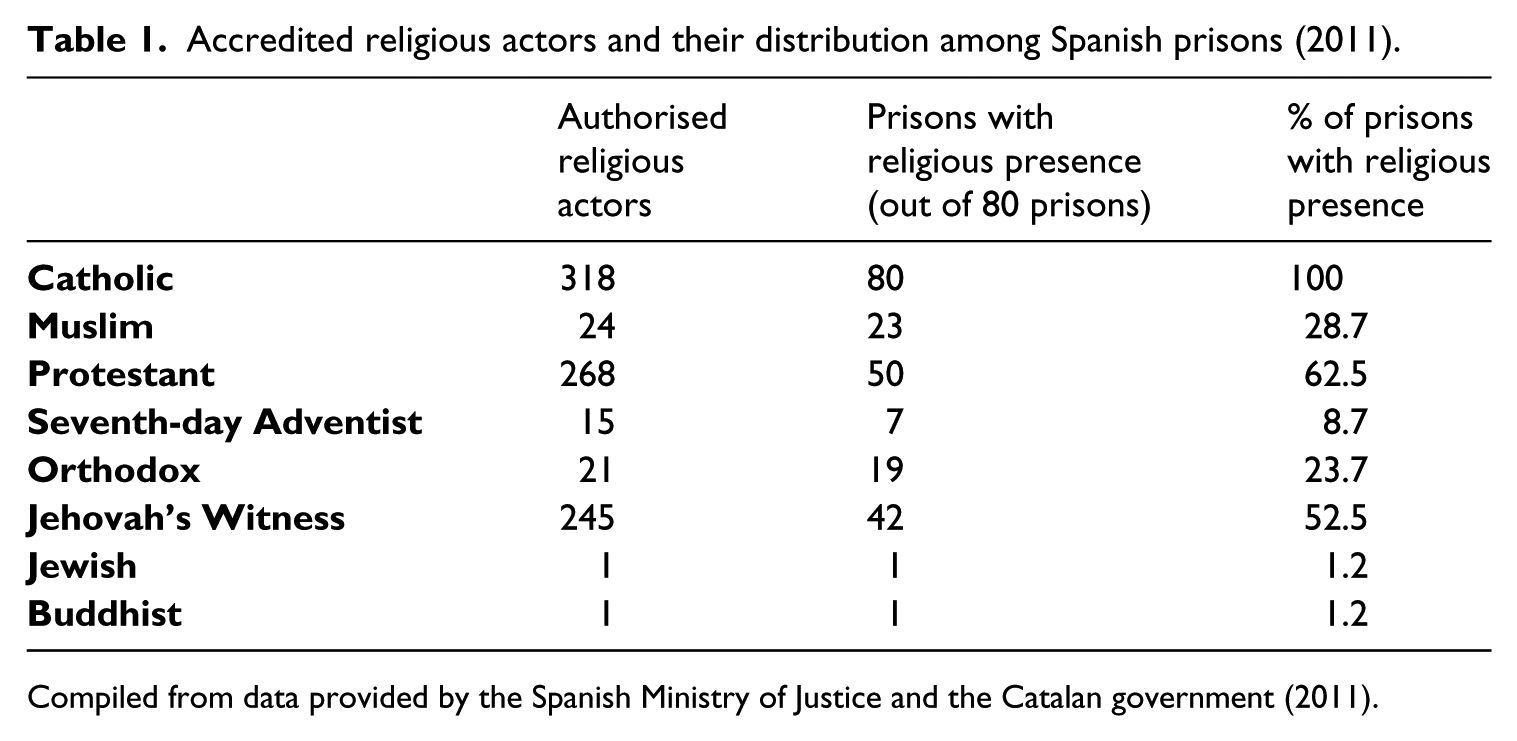
Compiled from data provided by the Spanish Ministry of Justice and the Catalan government (2011).
Our research reveals a move towards the demonopolisation of chaplaincy services, the Catholic Church no longer constituting the only option available to inmates. These figures indicate that the opening of the ‘religious market’ through the legal demonopolisation of state institutions may lead to competition between religious groups for a potential population of believers. This competition is particularly noticeable in the figures for Jehovah’s Witnesses, which may be overrepresented considering the small number of imprisoned Witnesses reported by the representatives of the group themselves.
The trend towards the broadening of religious offerings has drawn attention to the long-standing and taken-for-granted arrangements that benefit the Catholic Church. The questioning of the privileged position of Catholic chaplains by minority ministers is not a matter of personal disputes with Catholic chaplains, or complaints against particular Catholic chaplains, since most of our interviewees admitted that the attitude of Catholic chaplains was polite, receptive and friendly, but a matter of the ‘structural imbalance’ (Spalek and Wilson, 2001: 5) between Catholics and the rest of the groups.
A clear example of this asymmetry is the traditional public funding of Catholic chaplaincy, established in agreements with the Holy See in 1979. The permanence of the unequal public funding system is criticised by minority religions, especially by those that are better organised and more aware of their rights (e.g. the Protestant churches). A quote from a regional Protestant leader shows this clearly: Something that seems very unfair to us is the treatment that the Public Administration gives to Catholic chaplains in comparison to that offered to Protestants. There are no budget allocations for prison pastors; Catholics receive funding, Protestants nothing.
They consider their situation disadvantageous compared with that of the Catholic Church, whose public budget in 2010 amounted to €777,940 (Secretaría General de Instituciones Penitenciarias, 2010). Minority groups do not receive any comparable public funding for providing chaplaincy. Only three agreements with minority groups allot a small amount of money for basic expenses: an agreement between the Spanish state and the Spanish Islamic Commission (Comisión Islámica de España), signed in 2007 with a budget of €8,648.64 (Secretaría General de Instituciones Penitenciarias, 2010) for 2010, and agreements between the Catalan government and the Catalan Federation of Protestant Churches (Consell Evangèlic de Catalunya) and the Catalan Islamic Culture Council (Consell Islàmic i Cultural de Catalunya), signed in 2005 and 2006, respectively.
There are also aspects of prison organisation that exemplify unequal ‘institutional respect’ in Spanish prisons. First, unlike the Catholic Church, which has a stable and unconditional presence in every penitentiary centre, other religious groups must apply for permission for their representatives to enter a prison, applications that are subject to demand and sometimes arbitrary decisions. This is illustrated by the case of an Orthodox pastor, who entered a prison as a translator when access as a pastor had been denied. Second, representatives of these groups, unlike Catholic chaplains, often face restrictions on their movement within high security units, as a local Protestant leader and prison minister told us: ‘The Catholic chaplain walks everywhere as if he owned the place, while much more is required of us to be allowed in’. The same interviewee offered a third example of the unequal treatment representatives of minority religion sometimes receive as compared to Catholic chaplains, which indicates that prison staff are crucial actors for the way chaplaincy services develop: Once, when I arrived at the prison, the prison warden was shouting, ‘Those of you who want to attend Mass, come here!’ They opened all the doors so that the inmates could go to the chapel. By contrast, if they want to attend our Protestant service, they have to submit a written request one week in advance. Then, when they come to the service, the prison warden checks that they have authorisation.
Moreover, while prison authorities are present at the Catholic Christmas Mass and the religious celebrations of the prisons’ patron saint’s week every September, they seldom participate in minorities’ major celebrations.
Parallel to this incomplete demonopolisation process, the research also points to a trend towards a certain dislocation of religion and chaplaincy from some of the areas where they used to have a presence, such as decisions regarding restrictions imposed on particular inmates and privileges they should be allowed. Although prison managers and staff acknowledge the important task that chaplains do in prisons in terms of bringing peace to the prison or helping inmates and their families, and despite the high numbers of ministers in prisons, religion does not play a central role in these institutions. Chaplains’ presence has been increasingly relegated to religious activities, which mostly happen at weekends, when other activities are finished. Moreover, some prison managers were unable to name the religious groups that accessed their own prisons. As a Protestant minister described it, ‘We [religious groups] are a minor discomfort they [prison managers and staff] have to bear’. This displacement trend 7 , also reported by Gilliat-Ray (2005) for Britain, is still more evident in the transformations in sacred spaces discussed in the next section.
Transformations and negotiations of sacred spaces
As in other countries, sacred spaces in Spanish prisons have gone through a lengthy process of transformation and negotiation. Historically, Spanish prisons used to have Catholic chapels, where weekly Mass was celebrated. This was the most visible sign of the organic integration and monopolistic model of Catholic chaplaincy. However, the legal and social transformations that have occurred since the Spanish transition to democracy have altered this situation. More and more, the demands for space by other religious groups have resulted in a significant shortage of rooms for the celebration of religious activities, as also documented by Beckford (2001) in England and Wales. This new situation forces the establishment to adopt various solutions. In analysing them we pay particular attention not only to the physical spaces themselves, but also to their furnishing and decoration, and to the management of their use.
Generally speaking, no standard policy in the management of the spaces used for worship inside Spanish prisons can be identified. Our research has catalogued very different situations, but all of them point to the disappearance of exclusively sacred spaces. A common solution where an ancient Catholic chapel existed has been its transformation into a multipurpose room. This means that it can be used for religious activities by different faiths as well as for secular activities, such as theatrical performances, gymnastics or rehabilitation programmes for drug addicts. Nevertheless, this transformation does not necessarily imply a total removal of Catholic references or symbols. In one of the penitentiaries visited, we found a Catholic chaplain’s office and a Madonna in one of the former-chapel-now-multipurpose rooms. On account of this, the Jehovah’s Witnesses had decided to conduct their services with their backs to the icon. In other cases, a screen had been installed to hide the Catholic altar when other faiths used the room. Other centres we visited urged religious groups to use classrooms, theatres or sports halls for their prayers and celebrations. In those cases, some ministers opted to bring their own religious symbols with them.
A new accommodation strategy is being developed in the newest prisons in Catalonia. Since the late 2000s, ‘silent spaces’ are being created in a reinvention of traditional sacred spaces. These rooms with no religious symbols are designed to be used as interfaith rooms. With small variations between centres, ‘silent spaces’ are rooms with chairs, a table and lockers where religious representatives can keep their material. Although initially meant to be used only for religious/spiritual purposes, these spaces are sometimes also used for staff meetings or other activities such as theatrical performances. The rooms are presented as neutral spaces but a more accurate analysis, based on the arguments of Gilliat-Ray (2005), shows this not to be the case. The position of the furniture, with the table at the front facing several rows of chairs, brings the structure of a chapel to mind. This shows how the preconceptions of designers, despite intentions to transcend Catholic tradition, are anchored in a predominantly Catholic culture.
In terms of the arrangement of schedules for the use of worship spaces, the most common strategy is for religious activities to be held after the secular programmes are finished, indicating once more the overshadowing of religious activities by psychologists and social workers. The management usually hangs a timetable on the door of the room(s) where religious and non-religious activities are combined. However, the allocation of times for the use of these spaces sometimes shows Catholic bias and the reluctance of the Catholic Church to share privileges. A Protestant chaplain related the lack of response from the management when asked for authorisation to install a locker in a multipurpose room like the one provided for Catholics. Another Protestant minister and local leader illustrated the Catholics’ reluctance to share the use of spaces by stating: ‘The Catholic Church has its own chapel but we are not allowed in – even when it is not in use. Only they can use it. We could coordinate and use it on different days but they [the Catholics] don’t want to’. However, this situation is not universal. A Russian Orthodox leader and prison minister admitted they were allowed to use the chapels without restriction.
Examples of chapels being dismantled or used for non-religious activities point towards the reduction of the spatial presence of religion. These ‘amputations’, in Gilliat-Ray’s term, depict how secular activities and logics are gaining ground on religion. The persistence of Madonnas or other symbols, however, is not an insignificant issue. It reveals a Catholic appropriation of spaces alongside a subtle resistance, hidden under the banner of ‘tradition’ both by Catholic chaplains and by institution managers and staff, to the complete loss of a previous status. As a Protestant minister said when talking about a former-chapel-now-multipurpose room, ‘It is their [Catholics’] territory; they have their own office and images. As always, they have appropriated a space which should not be theirs, making access under the same conditions difficult for us’. He goes on to affirm that ‘Catholics are always going to be more reluctant to leave the spaces they have’.
Embedding multiple religious practices in secular Catholic-friendly settings
Analysing the place of religion in prisons requires studying how daily religious practice is incorporated into and negotiated within the context of the institutions’ everyday routines. This consideration becomes even more crucial and pertinent at a time of great heterogeneity in religious needs, of religious needs and demand that no longer fit established institutional routines. Diverse issues may be investigated: from the use of personal religious symbols to demands for specific menus, the celebration of festivals or rites of passage and the observance of holidays. We will mention only the principal challenges that we identified as well as some of the strategies developed to accommodate them and their consequences.
One of the challenges perceived by the interviewees in our research is the difficulty in reconciling religious celebrations and security. The concentration of prisoners during some religious festivities can aggravate incompatibilities between some individuals, as well as pose challenges in crowd control. Nevertheless, our fieldwork demonstrated that Catholic festivities, such as Christmas, Easter or the prisons’ patron saint’s week, are sometimes institutionally embedded and promoted, even though they can attract significant numbers of people. This selective institutional tolerance towards mass celebrations might therefore have more to do with familiarity with and proximity to some traditions than with considerations of security.
Some religious groups celebrate rites of passage among the incarcerated population. Occasionally, inmates show their desire to celebrate weddings and baptisms, which require the attendance of people from the outside as well as the adaptation of a particular space and provision of the material needed. Generally speaking, these celebrations are allowed inside Spanish prisons. In this sense, the institutions, in accordance with the religious groups’ requests, provide the spaces and sometimes the material required.
The demand for special menus motivated by religious prescriptions is a new challenge for an institution that used to host a religiously homogeneous population. The Prison Rules of 1996 oblige Spanish penitentiaries to adapt menus for religious reasons, which has been done – though reluctantly – by, for example, removing pork or creating vegetarian options. Some prison managers feel that their menus are geared entirely to Muslims’ needs. An administrator in one of the gaols said: ‘There is no problem with giving them one type of food or another, but the trend in this prison, and I think in most of the rest too, is to prepare food with Muslims in mind’. He continues by stating, ‘Honestly, we are adapting ourselves to Muslims’. At the same time, similar logics concerning Catholic traditions frequently remain uncontested as they are still part of the institutional dynamic. We refer here, for example, to the unquestioned absence of meat from meals on the Fridays of Lent in one of the prisons studied. All this points, to some extent, to the resistance to change characteristic of such institutions.
The celebration of Ramadan constitutes the major challenge in religious terms for prisons. As a civil servant from the Penitentiary Administration stated, ‘Ramadan is a massive celebration, both in terms of the number of people participating as well as in [terms of] the extent of the celebration itself’. Prison schedules are mostly arranged around mealtimes, precisely the factor that involves the greatest change in practical terms during Ramadan. In the last decade, prisons have increasingly paid attention to the requirements of this celebration. During the Ramadan fast, managers reorganise the meal schedules and the distribution of Muslim inmates in the cells to facilitate the communal evening meal. Furthermore, Muslim associations and the Consulate of Morocco are allowed to bring typical delicacies for the collective breaking of the Ramadan fast (Idu Al-Fitr), after obtaining the relevant food hygiene certificate. For one whole month each year, this celebration disrupts the institutions’ usual rhythm and calls into question the limits of institutional accommodation of religious needs. An official from the Spanish Penitentiary General Secretariat recalled a particular incident: I remember the order of the Penitentiary Surveillance judge who, hearing the complaint of a Muslim inmate who had asked the prison warden at I don’t know what time of night for a thermos with water, ruled in the inmate’s favour. In our world, having a warden open the door at three in the morning to bring the inmate something complicates things.
All in all, religious prescriptions, rituals and everyday practices pertaining to the multiple denominations assembled in Spanish public establishments prompt consideration of the limits to the accommodation of religious diversity. Likewise, their conflicting intersection with institutional routines evinces the permanence of residues from the past organic integration of the Catholic Church in state institutions.
Discussion and conclusion
The formal separation of Church and state and increasing religious diversity place the traditional organisation of chaplaincy in Spanish public institutions under scrutiny, making religion an issue that can no longer be taken for granted. At the first glance, managers and administrators do not seem to problematize the role of religions in prison but a more in-depth observation reveals some tensions. Accessing the point of view of all actors and complementing that with observations and documentary analysis provides a more complete picture. Drawing upon inquiries conducted in six prisons, we have argued that there is an ongoing realignment of forces between the religious groups that provide services in such institutions. Moreover, the trend towards the secularisation and diversification of Spanish society has meant a reconsideration of the role of the Catholic Church (Pace, 2007), which is adopting an attitude in between adaptation and subtle resistance to the loss of a number of its previous privileges. We explain this incomplete demonopolisation of Spanish state institutions – observed through the analysis of the dynamics of demonopolisation in the legal framework, organisation of chaplaincy, negotiation of sacred spaces and accommodation of daily religious practices – using the conceptual tools provided by neo-institutional theories.
Crucial transformations at the legal level towards a wider recognition and development of the right to religious freedom and the respect of religious minority practices and demands have occurred since the return of Spain to democracy. These changes in Church–state arrangements are also reflected at the level of the institutions themselves, where a certain normalisation of minority groups has occurred. The rhetoric of religious rights and commitment to cooperation between religious groups and the state has clearly entered Spanish legislation and the discourses of civil servants and institutional staff. In other words, the democratic exigencies for religious freedom and religious equality have undoubtedly been incorporated in Spain.
However, the legal framework remains unequal, as it recognises different rights for the Catholic Church, the three religious minorities with cooperation agreements and other religious groups. Consequently, the right to religious freedom is not enjoyed under the same conditions. Minority groups finance most of their own care activities and, unlike Catholic priests, who retain a special ‘quasi-formal’ status, their ministers and volunteers are often people from ‘the outside’, accredited only as volunteers. These established institutional routines and the struggle for equal treatment by minority religious groups attest to a strong logic of institutional path dependency (Fetzer and Soper, 2005; Soper and Fetzer, 2003). Furthermore, vestiges of the previous establishment, anchored not only in Catholic chaplains’ resilience, but also in the institutions’ daily functioning, account for the incompleteness of the demonopolisation process. The weight of history, not only at the formal level (laws, regulations) but also at the informal level (daily interactions), continues to grant the Catholic Church a distinct position in public institutions, impeding a fully balanced accommodation of religious diversity.
Footnotes
Acknowledgements
We would like to thank Matthias Koenig and Marian Burchardt for their valuable comments and suggestions on a previous version of this paper.
Funding
The project GEDIVER-IN: The management of religious diversity in hospitals and prisons in Spain was funded by the National Research Programme of the Spanish Ministry of Economy and Competitiveness. Julia Martínez-Ariño received support from the Max Planck Institute for the Study of Religious and Ethnic Diversity (Göttingen, Germany) and Gemma Ubasart received support from the Prometeo Program of SENESCyT (Ecuador).
Notes
Author biographies
Address: Max Planck Institute for the Study of Religious and Ethnic Diversity, Hermann-Föge-Weg 11, 37073 Göttingen, Germany
Email:
Address: b3-117 – ISOR, Departament de Sociologia, Universitat Autònoma de Barcelona, 08193 – Bellaterra (Cerdanyola del Vallès), Spain
Email:
Address: Facultat de Dret. Campus de Montilivi, Universitat de Girona, 17071 Girona, Spain
Email:
Address: b3-117 – ISOR, Departament de Sociologia, Universitat Autònoma de Barcelona, 08193 – Bellaterra (Cerdanyola del Vallès), Spain
Email: