




Abstract
Factors that currently lead Japanese men to enter and remain in the Buddhist priesthood are poorly understood. This article reports the results of a qualitative study that examines the profiles of a seminary instructor and six Shingon Buddhist priests (真言) at Kōyasan guesthouse temples (高野山). The data, collected from semi-structured interviews, were analyzed with ATLAS.ti using a thematic analysis approach. The study identified seven key themes related to (1) family, (2) mentoring relationships, (3) education, (4) labor, (5) spiritual practices, (6) religious doctrines and faith, and (7) the devotion of guests. For the six priests, family connections were found to play an especially critical role in initial decisions to enter the priesthood, whereas other factors chiefly contributed to sustained commitment. The results are discussed in terms of theories of ‘costly signalling’, ego-identity statuses, and the Japanese tendency to construct personal identity within the context of social affiliations.
Introduction
Extensive research has been conducted on doctrinal issues and foundational figures within Japanese Buddhism. Relatively less attention has been paid to the everyday lives, thoughts, activities, and motivations of the typical Buddhist priests who actually serve in temples. To address this lacuna in research, this article reports an exploration of the social and individual factors that lead Japanese men to enter and remain in the priesthood.
The research examined the lives of Japanese priests in the Shingon (真言) sect at Kōyasan (高野山). As an esoteric Buddhist sect founded by Kūkai (空海, 774–835), Shingon is, in terms of both the number of priests and adherents, one of the three largest Buddhist schools in Japan (Covell, 2005: 6). Consisting of a number of distinct lineages, its largest lineage, Kōyasan Shingon-shū (高野山真言宗), has its key training center at the monastic complex at Kōyasan, which was designated by UNESCO as a World Heritage Site in 2004.
To provide essential background, the first section of the article discusses Kōyasan guesthouse temples and priests. The second section then describes the interview methods and computer-assisted thematic analysis used to gather and analyze data from a seminar instructor and six Shingon priests working at Kōyasan temples. The main section summarizes the content of the interviews, sorted according to themes (see Figure 2) that were developed through the analysis. The discussion section reflects on the results, focusing on factors that appear to drive decisions to enter the priesthood while highlighting important differences between the respondents. Possible explanations for patterns in the data are discussed in light of research on identity formation (Marcia, 1966), costly signaling (Bulbulia, 2004), and Japanese cultural sensitivity to social roles and affiliations.
Background: the Shingon priesthood and Kōyasan guesthouse temples
The choice of a religious vocation can be a momentous decision that entails tremendous commitment. Buddhist monastic vocations have often been patterned after the story of the Buddha’s renunciation (see the Mahāsaccaka Sutta in Ñāṇamoli and Bodhi, 1995). Yet in East Asia, the ideals of such radical renunciation have sometimes been viewed as alien or anachronistic, particularly during the late nineteenth and early twentieth centuries. During this period, the region’s Buddhist institutions underwent significant restructuring as its leaders sought to ensure that doctrines and practices remained relevant to modern, and increasingly Westernized, societies (Al Qurtuby, 2020; Buswell, 1992: chapter 1; Deal and Ruppert, 2015: chapters 6 and 7; Ikeda, 1976; Kaplan, 2020). This is especially true in Japan, where Buddhism has had to deal with both the loss of government support in the wake of early Meiji (明治) era reforms and subsequent criticism of temple priests as worldly and corrupt (Covell, 2005: 14–22). These negative social perceptions can be partly attributed to the almost complete disappearance of celibate Buddhist priests in Japan following the repeal of laws forbidding clerical marriage in 1872 (Covell, 2005: 65). While priests had already begun to openly marry in some sects or did so covertly in others, the Meiji legal changes rapidly led most Japanese Buddhist priests to marry and have children (Covell, 2005: 76; Jaffe, 2001; Kawahashi, 2012). Many temples thus became family-operated, resulting in pressure on at least one of the children (usually a son) to enter the priesthood in order to maintain control over the family temple. A further disruption has come from changing demographics. Japan’s falling birthrate has led to a rapid decline in rural populations, leading to less financial viability for many rural Buddhist temples (Reader, 2011; Sakurai and Kawamata, 2016).
One typical institutional response to the situation has been to foster a positive image of prestigious temples known for strict and austere practices. For the Shingon sect, the order’s spiritual center is situated at Kōyasan in Japan’s Wakayama Prefecture (和歌山県). This monastic complex is home to over 100 Buddhist temples, including Kongōbuji (金剛峯寺), the order’s head temple. Visitors to the complex may witness Shingon monks and nuns undergoing strict regimes of monastic training in the complex’s seminaries. If they stay at one of the guesthouses (shukubō, 宿坊) run by nearly half of the Kōyasan temples, they may also enjoy distinctive traditional temple meals, attend Buddhist rituals, and participate in various sponsored activities such as meditation or sutra copying.
Guesthouse temples are operated by priests and lay workers, including terasei (寺生, students who work, mostly for room and board). Those seeking ordination must complete a specific path of training to qualify for the priesthood and advance in rank (see Figure 1). In some cases, they attend Kōyasan High School and Kōyasan University prior to their entry into the seminary. They must also complete the steps (shukke-tokudo, 出家得度) traditionally associated with renunciation of householder status and entry into the priesthood. These include having their heads shaved, donning the black robes of a priest, adopting a Buddhist name, formally taking refuge in the Three Jewels (the Buddha, Dharma, and Sangha), receiving their initial teaching, and finding a master who will take them on as a disciple.
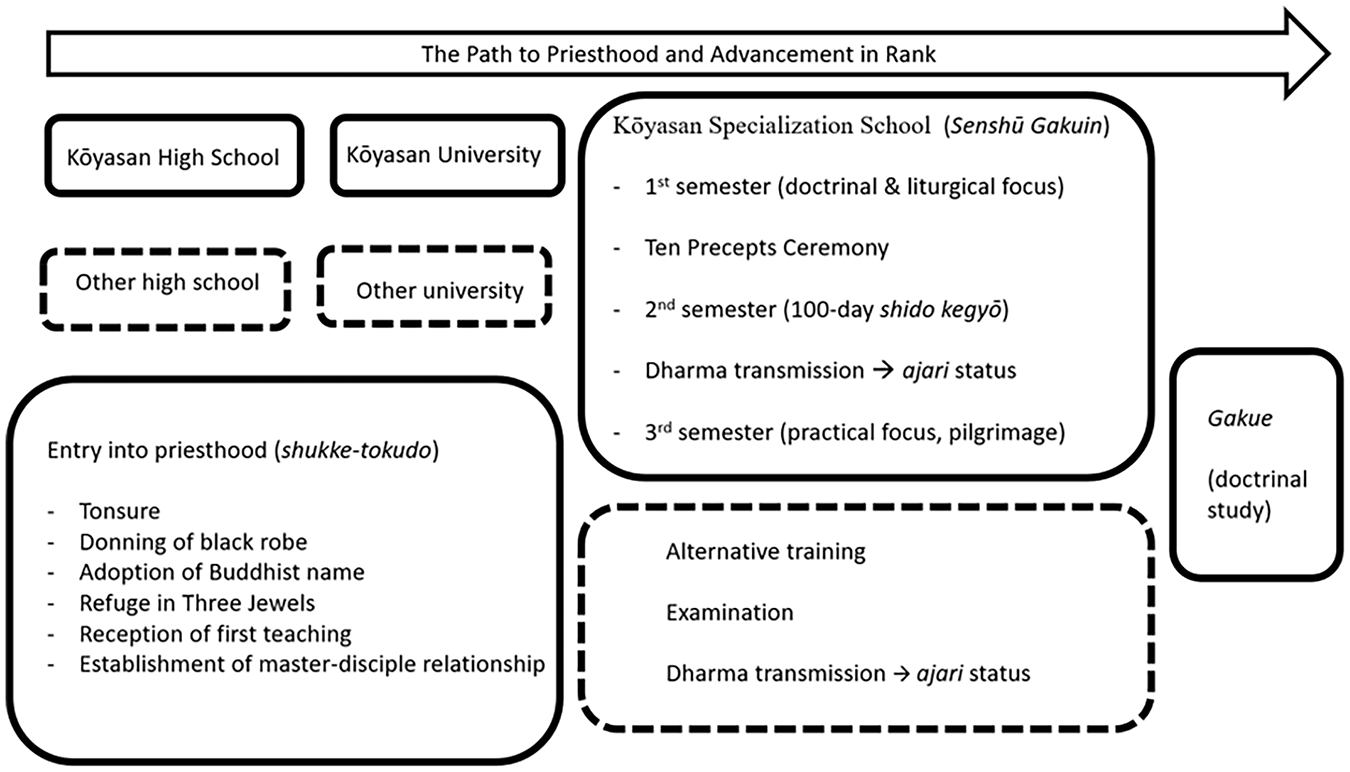
Steps to becoming a Shingon priest and advancing in rank.
Seminary training is divided into three semesters. The first semester provides an education regarding key tenets of doctrine and training in the liturgy along with training in traditional arts such as tea ceremony, flower arrangement, and calligraphy. Following the first semester, the trainees receive the 10 precepts. The second semester is an arduous 100-day period of practice (shido-kegyō, 志度加行), in which students study scriptures and are trained intensively in various ritual practices. Among the 80 or so men enrolled in the seminary program, around 10 will probably drop out at this stage (Nicoloff, 2008: 192, 193). Upon its completion, the trainees receive dharma transmission and attain ajari status, making them fully ordained Shingon priests. The third semester involves more practical training and also includes completion of major segments of a famous pilgrimage route. Recently, Kōyasan University has started a new curriculum which allows second-year students to take this seminary training. This has made it possible to complete all the steps required to attain ajari status during the 4 years of college without the need to do an additional year of training at a seminary after graduation (Kōyasan University, 2018).
As an alternative to the seminary, candidate priests can also opt to undergo training elsewhere and then take an examination, but this selection is even more stringent, with only around half of these candidates passing the exam (Nicoloff, 2008). To advance further in rank, priests can choose to undergo additional training, such as the gakue (学会) program, which involves doctrinal study focusing on Kūkai’s works.
Method
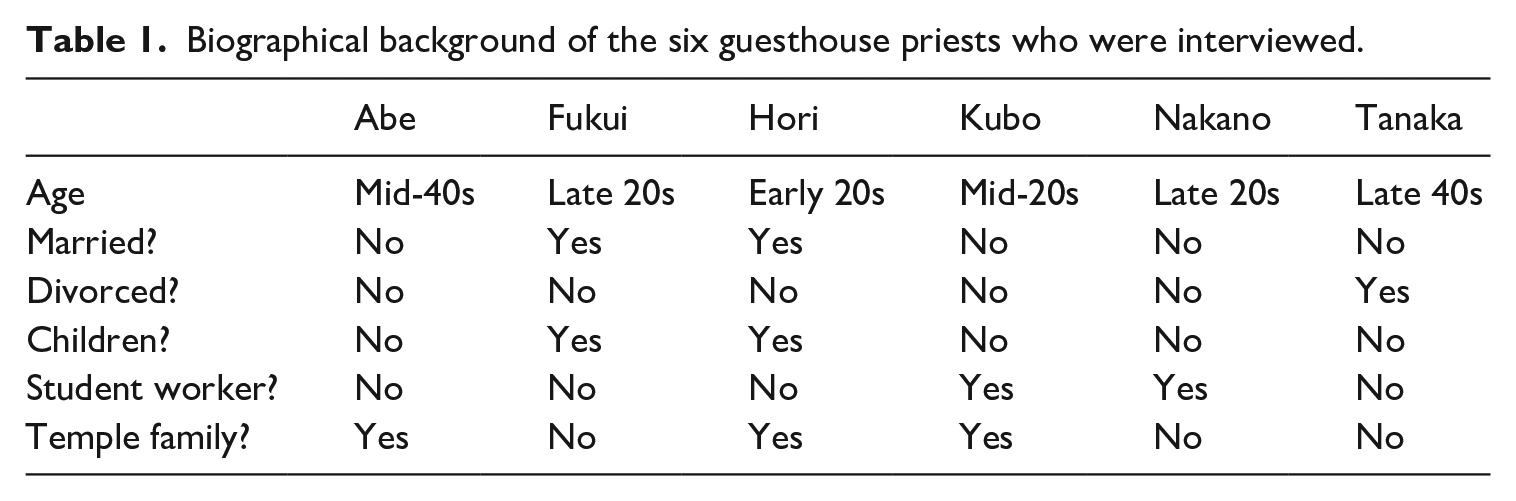
The current study was designed to explore factors that led six Japanese men to enter and remain in the priesthood. Our initial attempts to recruit participants through an organization in charge of the Kōyasan guesthouse temples were unsuccessful. We therefore contacted one of the leading administrative priests at Kongōbuji (金剛峯寺), who assisted us in setting up interviews with priests who worked at guesthouse temples. This second attempt was apparently more successful as it assuaged interviewees’ concerns about participating on their own without approval of senior figures in their institutional hierarchy. Half of the interviewees worked at the same temple, whereas the others worked at three different temples. Only three of the interviewees were from families that ran temples affiliated with Kōyasan; however, the other three interviewees (described in more detail below) who did not come from a temple family (Fukui, Nakano, and Tanaka) had some family connection that partially explains their decision to become a priest. The decision to interview six priests was due to practical constraints related to the considerable preparatory effort required when arranging the interviews through official channels, conducting the interviews around the priests’ busy schedules, and then transcribing and analyzing the data through a systematic procedure.
Semi-structured interviews were conducted in Japanese by the second author with these six priests and a seminary instructor. The semi-structured format was chosen as most suitable as it generally serves to ‘draw the participants more fully into the topic under study’ and can ‘incorporate both open-ended and theoretically driven questions’ (Galletta and Cross, 2013: 45). The interviews all lasted approximately an hour and took place either at the Kōyasan temple after the priests were finished with work or at the interviewee’s home temple at a time of his choosing. The broad topics of the interview were (1) the priests’ background prior to entry into the priesthood, (2) reasons for entry into the priesthood, (3) tasks performed in their current positions, (4) tasks regarded as pleasant or disagreeable, and (5) future aspirations. Interview excerpts quoted in the article have all been translated by the authors, and interviewees’ names have been replaced by pseudonyms. The interviewees were surprisingly candid; there were no indications that participants were attempting to ‘dress up’ their descriptions of their lives to fit with popular ideal conceptions of Buddhist priests. To give just one of many examples, one interviewee (Nakano), when asked how he spent his free hours, casually mentioned playing pachinko or computer games. Other interviewees likewise volunteered unflattering episodes in their lives ranging from divorce and unplanned pregnancies to having their driver’s license revoked. Basic biographical information about the interviewees is shown in Table 1.
Biographical background of the six guesthouse priests who were interviewed.
The interviews were recorded and transcribed. A thematic analysis approach was then employed. Braun and Clarke (2006) describe this approach as a widely used (albeit, rarely acknowledged) qualitative method in which themes are identified within a data set. They explain the process as consisting of six steps: (1) familiarization with the data, (2) generation of initial codes, (3) search for themes, (4) review of themes, (5) defining and naming of themes, and (6) production of the report. As they point out, the approach differs from other qualitative methods such as interpretive phenomenological analysis (IPA) in being less theoretically bound, and while sharing some features with content analysis, is less focused on the micro-level and quantitative analysis.
The thematic analysis was conducted using ATLAS.ti. This is a CAQDAS (Computer-Assisted Qualitative Data AnalysiS) program, which facilitates coding (to include hierarchical coding schemes), the toggling between categories and subcategories during the analysis, visualization of the frequencies of codes within the data and relationships between codes, flexibility in renaming, merging, and unlinking codes, and the use of queries using Boolean, semantic, and proximity operators. In the current study, the use of CAQDAS software helped ensure that the analytical categories were at the same level of granularity and were broadly relevant to the six interviews. The detailed coding of the transcript at the initial stages of analysis helped ensure that we were not overly influenced by the more salient comments and anecdotes that appeared during the interviews and were taking into account the full range of data.
Following these six steps, transcripts were created and read. Both researchers individually noted their initial thoughts prior to meeting to discuss these impressions. The transcripts were then entered into ATLAS.ti, and an initial set of codes were generated and then discussed. These codes were then significantly refined to ensure that they captured themes that were relevant across the data from all six interviewees and to ensure that the codes were at the same level of generality. At this point in the analysis, there were 15 codes (including one ‘miscellaneous’ category) and 290 coded passages. These codes were then further refined into a general set of themes, and possible reasons for recurrent patterns were discussed. In addition, the researchers discussed themes that were originally expected but were largely absent from the data.
The thematic patterns were then examined in light of previous theories with special attention to research on identity (e.g. McAdams et al., 1996; Marcia, 1966), spiritual modeling (e.g. Oman and Thoresen, 2003), and costly signaling (e.g. Bulbulia, 2004). Braun and Clarke (2006) claim that inductive ‘bottom up’ approaches as well as top-down approaches are both possible with thematic analysis. In this study, a decidedly bottom-up approach was adopted so as to avoid overly constraining the scope of inquiry from the outset.
Data from the seminar instructor came from a phone interview. Since these data provided a different perspective and were primarily focused on the training curriculum and experience, they were analyzed separately, after the seven themes had been identified, and this transcript was not entered into ATLAS.ti. The seven themes (Figure 2) are discussed below.
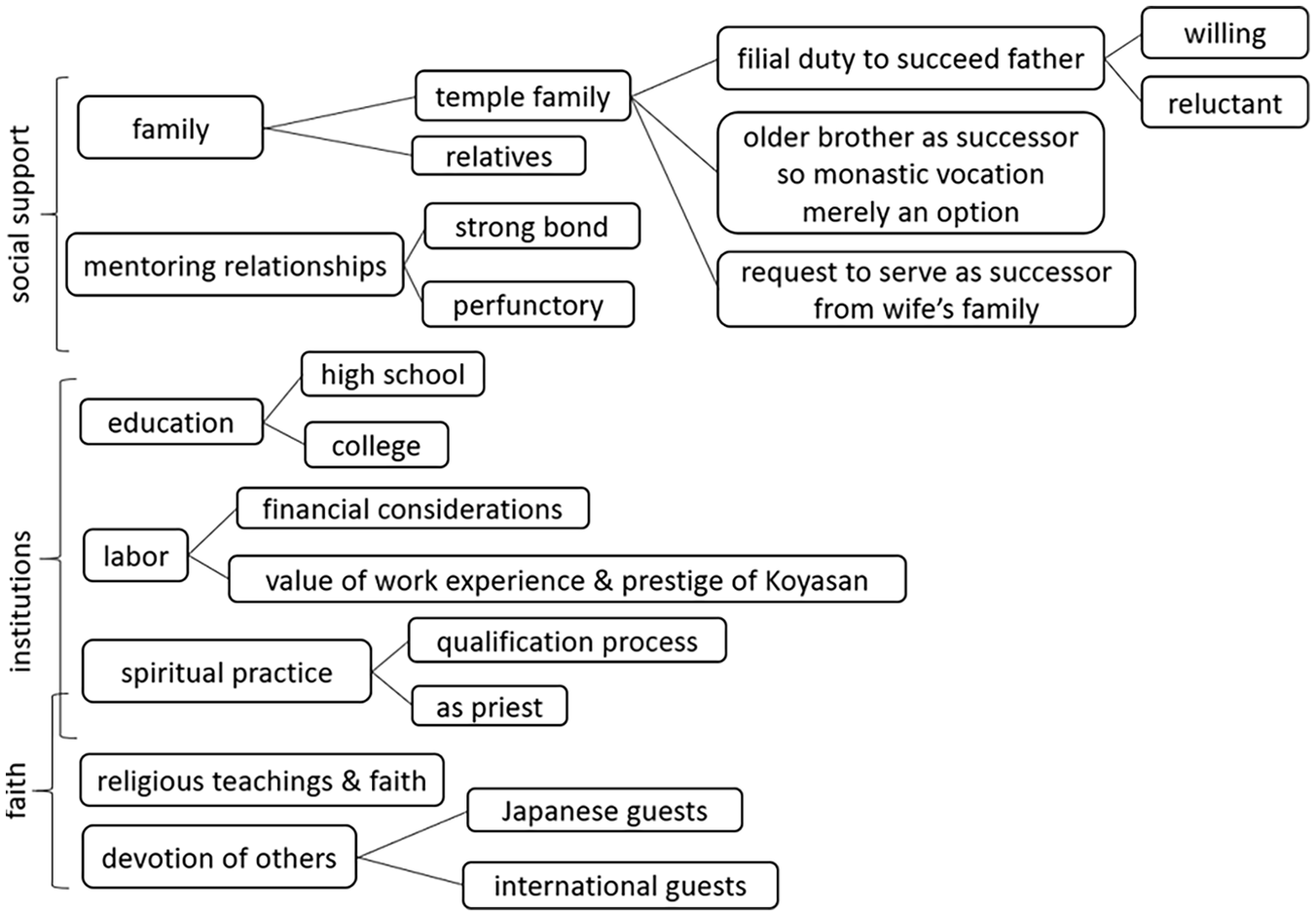
Factors supporting entry into priesthood and sustained commitment.
Results
The ATLAS.ti analysis clearly showed that the strongest source of affinity for the priesthood was family. Three interviewees (Abe, Hori, and Kubo) came from temple families, and in at least one case (Kubo), both parents had themselves come from temple families. In some cases, the interviewee had not originally been attracted to the priesthood. As Hori explains, regarding his choice to attend Kōyasan University with its monastic education track, I had no intention to become a priest, none at all. I had no intention to inherit the house [family temple], but as eldest son (…) and since this was my parents’ house (…).
Hori remained ambivalent, for even after starting to work at a Kōyasan temple, he left it at one point. Hori also frankly admitted having lackluster enthusiasm for his current work at Kōyasan: I’m afraid there’s nothing enjoyable [about the work], and if it weren’t for the fact that I’ll return to my parent’s home [temple], I wouldn’t still be here. If it wasn’t that I’ll be successor [of the temple], I wouldn’t still be here, to tell you the truth.
Some (e.g. Kubo, Abe) became priests in spite of the fact that they had older siblings who were to inherit their home temple. Kubo explained this choice as due to his lack of clear career ambitions when young: I have an elder brother four years older than me, so when I was in high school, he had already come to Kōyasan and was even engaged in spiritual practice there. My father said, ‘you can do whatever you want’, so I was playing baseball and soccer, but I wasn’t talented enough to become professional, and since there wasn’t anything in particular that I wanted to do (…) From the time I was young, I had watched my father [acting as a Buddhist priest], so I felt like it’d be good to become a priest.
As the conversations show, a sense of filial duty as well as awareness of the priesthood as a potential career path were forces leading some of the interviewees to become priests, but financial incentives were muted in cases where the family temple did not have a strong financial basis. Abe reports that his family temple had no graveyard (and thus no congregation), and that their temple belonged to the Shingon sect in an area where 80% of the population belonged to the True Pure Land sect (浄土真宗). His older brother had already become a priest in order to be successor, yet the poor financial viability of the temple required even him, as the successor, to take on side jobs. In spite of these circumstances, Abe’s father recommended that Abe undergo training to obtain monastic qualifications.
In some cases, the family connections extended beyond the nuclear family. Nakano’s father was described as indifferent to Buddhism, but his grandfather was a guide to the Shikoku Pilgrimage (a tour route of 88 temples associated with the Buddhist priest Kūkai). Nakano fondly recalled chanting the Heart Sutra with his grandfather: [He] was endowed with a well-formed knowledge of Buddhism. Since he was serving as a guide to the 88 temples, he had that sort of expertise. I was in the sixth grade of elementary school when he passed away, but because of who he was, our family worshipped at a Buddhist altar unimaginable for a typical household. The altar worship was so splendidly performed every day that one might imagine our house was a Buddhist temple.
For Nakano, the loss of his grandfather seems to be conflated with the weakening of this family tradition. I had watched my grandfather worship like this continuously up until that time, but after he passed away, there was no one in our house, which was, after all, a typical [lay] household, to perform this daily worship.
Nakano directly attributes his feelings at the time to his choice of a priestly vocation: My sense of regret that there was no one to carry out the worship became the impetus for my decision to become a priest.
While just 12 years old and in his final year of elementary school, Nakano informed his family of this decision. Since his family was of the Shingon sect, his parents recommended that he attend junior high school at Kōyasan. The school had several Buddhist studies tracks for those preparing to enter the priesthood, and if he were at Kōyasan, he would be able to later undertake spiritual training there as well. Nakano’s father’s willingness to go along with his young child’s wishes is somewhat surprising. Nakano conjectures that this was ‘due to the fact that’ he ‘was the youngest of the four children’.
Nakano’s entry into the priesthood without clear prospects of becoming the head of a temple reflects a strong sense of direction. Yet his path to a secure position is not straightforward in light of current trends. On one hand, over 20,000 of the 77,000 Buddhist temples in Japan do not have a head priest, a clear indication that the lack of successors has become an institutional crisis (Aizawa and Kawamata, 2019; Ukai, 2015). While this should signal opportunities for priests like Nakano, this is apparently not the case. Precise statistics for recent trends throughout Japan are lacking, but the numbers related to the last 50 years for the Sōtō Sect (曹洞宗), which accounts for 20% of Japanese temples, can be assumed to be representative. Whereas 73.9% of Sōtō temples reported having a successor in 1975, this number had dropped to 63.4% by 2005; yet at the same time, the number of temples in which the abbot’s child was taking over as successor fell only slightly, from 86.1% in 1965 to 81.0% in 2005 (Sawaki, 2020: 89). In other words, temple succession, in spite of the dire shortage of priests, is still largely a family affair. One option for priests in Nakano’s situation is to find a temple priest who lacks a son willing to serve as heir. Nakano, at one point, found such a temple, but the deal fell through when the abbot disapproved of the fact that Nakano already had a girlfriend and was therefore unable to marry the temple family’s daughter.
Fukui, on the contrary, was able to secure a position due to in-law connections. Although not originally from a temple family, he ended up entering the priesthood due to influence from his wife, whose relatives ran a temple. His wife’s uncle asked him if he wanted to become a priest, and his wife (who wanted to live near her family) also encouraged him to do so. Even after deciding to go along with their wishes, he had originally planned on focusing primarily on an IT business and performing his religious duties as a side job, but both his wife and master (the wife’s uncle) encouraged him to serve full-time as a priest. Fukui expects to eventually take over his uncle-in-law’s temple. While waiting, he has been able to undergo training and work at Kōyasan due to his in-laws’ help and connections.
In some cases, interviewees mentioned Buddhist family ties with more distant relatives. For example, Tanaka’s great-grandfather was a Nichiren (日蓮) priest, and perhaps for this reason, the given name that Tanaka received from his family resembled a dharma name typically given to priests. Tanaka also reports that he was familiar with temples from a young age due to frequent family visits and through the influence of relatives who were Buddhist. Like Nakano, Tanaka also became a priest without clear prospects of taking charge of a temple. He had originally planned to wait until retirement to become a priest, but after learning that the age limit for training was 45, he made the momentous decision to retire early. He also reflected that since his siblings lived close enough to his mother to help her (the father had passed away), his circumstances allowed him to make the sudden change in his vocation.
The interviewees’ accounts show that family support was often a decisive factor. While Covell’s (2005: 81) conclusion that Japan’s ‘de facto system of temple inheritance’ has effectively choked off ‘entrance into the priesthood from the laity’ may be somewhat overstated, the interviewees’ accounts suggest that family connections are typically a critical element in decisions to join the priesthood.
In addition to family relations, the interviewees’ relationship with their master and the heads of the temples where they worked often played a key role in their choice of vocation and their ability to successfully pursue their careers in the priesthood. Fukui, in particular, describes the master–disciple relationship as crucial: The person one chooses as a master when (…) becoming a priest, represents a relationship that can absolutely never be severed, a relationship beyond that of [even] parent and child.
Often, these relationships were cemented through debt and gratitude after receiving assistance. Hori, for example, ended up working at a temple in a subsect different from that of his family due to his ties to the abbot and his wife. As he explains, When I was a student, at that time I got a lot of help (…) from the abbot and his wife. (…) We’re really indebted to them.
Hori goes on to explain how the abbot and his wife were understanding and compassionate during a particularly challenging period in his life when he and his girlfriend faced an unplanned pregnancy: And then, since he was my master, he was the first person I told about [the pregnancy] after informing my parents. And then, when I told him, he was, like, ‘I’ll help’. My father at the time did not approve. My actual father. So then, he [the abbot] said, ‘feel free to live here’. He put me and my wife up in a room. And we even ate breakfast, lunch, and dinner there. So, when he later asked if I wanted to take a position working there, how could I say no? [Laughing].
In such a dire situation, compounded by condemnation from his family, the openness and acceptance of the abbot and the abbot’s wife appear to have led to a deep emotional connection.
Along more practical lines, Abe commented that the master–disciple relationship and spiritual practice help ensure that the work relationship does not become exploitative. He also suggested that the religious framing of his activities explained his willingness to continue the work, in spite of its demanding nature: If I followed this schedule with work organized like this at a company, I would have definitely already gone on strike (…) I would have already quit, to be honest.
He added that the abbot of his temple was a wonderful person, and the fact that he was able to be associated with such a person made his job feel worthwhile in spite of the conditions and low wages.
For some interviewees, the master–disciple relationship was less important. Nakano, for example, mentioned that his relationship with his master was largely a formality. Even so, relationships with temple leadership were important. In his case, he began his employment at the temple after a chance encounter with the assistant abbot at a bar. He was invited to come to work at the temple, where he ended up staying. In a few cases, attitudes toward temple leadership were more ambivalent. In contrast with Hori’s account, both Fukui and Tanaka complained that temple leaders could often be inflexible and resistant to needed reforms.
Many of the interviewees cultivated early ties to the temple through their education at Kōyasan High School and University. In Nakano’s case, it was through his high school principal, who was abbot at a guesthouse temple, that he obtained work. In many cases, interviewees developed a network of friends and acquaintances that proved helpful later in introducing them to temple-related opportunities.
While the interviewees portrayed the priesthood as a special vocation that went beyond purely pecuniary considerations, many of the practices and associated concepts and terms that they used were identical to those from secular lines of work. They thus described themselves as doing ‘jobs’ (shigoto, 仕事), ‘obtaining work’ (shūshoku、就職), and ‘being employed’ (yatowareru、雇われる). Similarly, Nakano described the temple’s abbot as being ‘like a shachō (boss、社長) in the way he thinks’. Hori reports receiving overtime for extra hours worked, and all interviewees reported having clearly defined schedules and days off. Nearly all punched into work with timecards that strictly delineated work time from free time. To some extent, these work practices can be attributed to a recent scandal. In 2017, a government labor standards inspector concluded that the depression experienced by a Kōyasan priest in his 40s could be attributed to being overworked at a guesthouse temple (Kōyasan sōryō, 2018). At the time, the case was unprecedented as it was commonly thought that everything that priests did could be viewed as a form of religious training.
The interviewees all characterized the pay in their current position, and in priestly vocations in general, as quite low and as typically inadequate to live on, especially if one also needed to support a family. Those, like Abe, who had left a secular career for the priesthood, often commented that their previous pay and vacations were much better.
A common vocational path was to begin (like Nakano) as a student worker (terasei) at a guesthouse temple. In compensation, Nakano received room and board as well as a partial tuition waiver. He described how his experience was challenging yet valuable in retrospect: It was different than I’d imagined, at the time, it was, as you might guess, tough. Having no experience of doing a part-time job, I was suddenly in charge of greeting guests and so on without any pay. It was really hard on me. I thought how much nicer it would be if I’d lived in the dorms. But somehow, I graduated, and when I look back on the experience now, I feel that without it, I wouldn’t be who I am now.
The guesthouse work at Kōyasan was described as valuable for several reasons. Kōyasan is widely treasured as the beau idéal of Japanese high culture and is one of the most popular destinations in Japan’s ‘tourist Buddhism’ (Nicoloff, 2008). It thus comes as little surprise that the interviewees (e.g. Kubo) viewed it as highly prestigious and felt that their association with Kōyasan, even after they left, would be valuable to them in their vocation as priests. Kubo also mentioned how his work there helped him develop his ability to communicate well with laity, a skill that would be necessary when he returned to his temple and had to interact with the danka (檀家, congregation). Fukui similarly mentioned the opportunities to learn skills in temple management and develop personal connections within the priest community. Most interviewees did not plan to stay at the guesthouse temples, citing the difficulty of the work, the need to return to run the family temple, or a desire to experience life at other temples. On this point, Nakano was an exception. He had worked at a community temple for years and eventually decided that he preferred life at the Kōyasan guesthouse temples.
In several cases, interviewees entered the priesthood as a second career. For example, Fukui had originally studied law in college and then worked in IT. When he became a priest, he only did so after assurances that this would not prevent him from pursuing his entrepreneurial interests. However, after his training, his priorities shifted toward his priestly duties. Likewise, Abe was originally a machine repairman at an automobile company but had to quit because of health-related issues (damage to his lungs due to the factory environment). He originally did not intend to enter the priesthood since his older brother was already a priest and was able to take over the family temple (a small temple without a danka), but his injury left him with no other viable options. Several interviewees expressed a clear sense of a calling. For example, Tanaka had been an office worker for nearly two decades but consciously chose to become a priest.
A distinctive feature of Buddhist monastic life is the focus on spiritual practice. It therefore comes as no surprise that the interviewees often placed great value on their training and the Buddhist practices that they carried out as part of their daily lives. In fact, most lamented that they spent so much of their time doing simple labor which anyone could do and insufficient time on activities that they associated with spiritual practice. Abe, after describing his sense of gratitude for the training and its importance, adds, Without that sense, I think that [life at] the temple would be difficult. Since we’re disciples, this may seem like something that goes without saying, but if one goes to a typical company, the situation is, to put it simply, that labor is compensated for by money.
While the interviewees valued their training and practices highly, nearly all mentioned that the menial guesthouse tasks (which Hori describes as 70%–80% of what they do) were not viewed as spiritual practice, although some later added that the line between work and religious activities could sometimes be gray.
The 100-day training (志度加行, shido-kegyō) was clearly perceived as arduous. According to Fukui, trainees who had been in the Japanese Self-Defense Force claimed that the challenges of military training paled in comparison to the 100-day training. When asked which particular aspects were difficult, Fukui mentioned the total lack of privacy and the lack of access to electronic devices (restrictions designed to imitate the conditions that the founder Kūkai would have trained under). Tanaka, who underwent the training in his 40s, felt that his previous work at a company prepared him for the psychological challenges, but he still found it physically challenging, and also found it difficult, at his age, to commit the extensive liturgical materials to memory.
Eisyun Kato, who underwent training at the Kōyasan Specialization School and later became principal, provides a typical description of the training as difficult yet ultimately rewarding: For a year, you live an intensely communal life bumping up against one another, so the companions you train with end up becoming friends for life. (…) Among the Kōyasan Shingon priests, the mere statement I graduated from the Kōyasan Specialization School evokes a sense of pride, sure to be followed by Which phase? (Kongobuji, 2018: 81, translated by authors)
For some interviewees, the difficult nature of the training was compounded by their lack of familiarity with Buddhist practices. As Fukui confides about his attitude before entering the priesthood, Originally, I did not by any means have deep faith, I knew nothing, but then, well (…) since it wasn’t something I disliked, since I’d enjoyed going to Shinto shrines and Buddhist temples, it wasn’t as if I had no interest. So, I began the training, feeling like I’d give it a try [laughing].
His original lack of religious background and convictions made him feel out of place: In the beginning, I still really felt nothing but awkwardness. It really seemed that the others, to some extent, had faith, or that their families, for example, had possessed deep faith from the time they were children, or if they were kids from a temple family, they’d been in that sort of environment. You see, the family I grew up in, my family was not in any way a household with deep faith.
Even worse, Fukui lacked practical knowledge. Since I didn’t even know at first the gasshō, the way to press the palms together in prayer, since I didn’t even know how to wear the clothes, the robes, since I was starting at a point of total ignorance, it was really culture shock, I must say [laughing].
Fukui, who at several points considered quitting the training, reflects on the experience: Opposite [to this first impression], after a year of training, you know, to the contrary, I felt it was tremendous. It’s strange to say this of myself, but my faith began to grow, and I firmly grasped the way I was to live, to live as a priest with something to do for the Buddha. I had an ideal image of what it meant to be a priest, and I now had a desire to live as a priest. I consistently felt that I wanted to live up to the ideal of a priest.
As a result of this new inspiration, Fukui decided to place more emphasis on his priestly role instead of focusing on more secular pursuits.
Most of the interviewees did not describe any spiritual crisis that led them to enter the priesthood. A possible exception would be Tanaka, who became a priest after a divorce. He described how visiting temples provided solace during this trying time: To begin with, in my case, I had worked in typical fashion as a company worker for nearly 20 years. During that time, due to family issues, I had various problems and ended up going through a divorce. From time to time, I’d visit temples. On these outings, I was fortunately able to find consolation.
Tanaka had considered both Kōyasan and Hieizan (比叡山) since they were famous monastic training centers associated with spiritual practice but ultimately chose Kōyasan since Kūkai’s teachings appealed more to him.
Spiritual cultivation and the achievement of enlightenment have been traditionally viewed as the proper goal of Buddhist monastics. Mahayana Buddhism, while accepting this goal, has also placed great emphasis on compassion and the aim of releasing all sentient beings from suffering. In keeping with this emphasis, the interviewees (e.g. Fukui and Hori) often described their ideal image of a priest as someone who was kind and served people’s needs. Fukui describes his ideal as follows: For one thing, I really want to be approachable from the level of the heart. I want to accord with the congregants and donors, not motivated by money but rather by the intention of giving their hearts salvation, and without concern for money, to be the first person who is there for them. In that sense, I don’t want to create some sort of wall between myself and them but instead be a priest that they can interact with in a frank manner from a position of equality.
Fukui’s comments reflect a desire to counteract negative Japanese conceptions of priests as aloof and primarily motivated by financial concerns, and to put forth, in its place, the image of priests as approachable and responsive to people’s everyday spiritual needs.
While mentors and training were generally mentioned as playing a critical function in facilitating interviewees’ socialization into priestly roles, the interviewees also made frequent mention of the role of devotees in sustaining their sense that their lives and work had value. Typical in this regard was a story that Fukui told of a devotee who came to stay as a guest at his temple. The woman brought a photo of her deceased mother who had wanted to visit Kōyasan but had passed away before she was able to do so. The woman requested that Fukui prepare a kagezen (陰膳, a meal for the deceased spirit) and bring a beer with two cups. When Fukui brought the food and beer, the woman placed her mother’s picture in front of the meal. Fukui, out of deference to the woman’s deceased mother, poured her mother’s glass first. The woman, while remarking that her mother would be overjoyed to receive the beer from a priest at a Kōyasan temple, was obviously very touched and began to cry. Fukui promised to recite a special prayer for her mother during the morning service on the following day. Fukui admits that he was not sure what advice to give the grieving woman, but he took satisfaction in knowing that the ritual interaction provided a way for him to help her through her grief.
Abe echoed this sentiment when asked what he liked about his job. He explained that a particularly rewarding aspect of work at the temple was receiving correspondence from guests who were especially touched during their experiences. He felt especially proud when former guests told him that they felt they had gained some insights during their stay. For some interviewees, the desire to serve the public led to social outreach. Hori, for example, was involved in running annual camp activities for children every year at his home temple.
Around three-quarters of the guests were said to be foreigners, so it is understandable that interactions with international guests strongly influenced how the interviewees perceived their work. Some (e.g. Nakano) mentioned positive impressions of foreign students from Buddhist countries who worked at the temple. Many (e.g. Tanaka) also mentioned being inspired by foreign guests’ avid interest in Buddhism. In particular, these guests were interested in meditation and were thus probably instrumental in ensuring that the temples provided opportunities to meditate with priests. Tanaka, for instance, describes the foreign guests as intensely curious and genuinely inquisitive: As it turns out, they don’t attend church. Rather than say they have no religious belief (…) When asked why they’ve come to Kōyasan, they say they want to learn, want to feel something spiritual – something different and something new. One might consider them to be legitimate atheists, but this isn’t the case. Rather, as one might imagine, they seem to be intent on encountering or sensing something holy or sacred. For this very reason, they’ve come to the Orient with this expectation, with the sense that they’d like to experience something. If they were heading to Kyōto or Nara, we might think of them as just blindly following the latest fad. But the fact that they’ve brought themselves all the way to Kōyasan (…) makes me think highly of them.
Some (e.g. Nakano) mentioned with pride the fact that the temple made positive efforts to provide meditation sessions and other activities, even to foreigners who were not lodging at the temple. Fukui also mentions the fact that foreigners tend to see him within his religious role, whereas many Japanese lack respect for Buddhist temples and see them as merely a form of entertainment.
The desire to display acquired skills was also a common theme. Typical, in this regard, was Kubo’s statement: The morning service, the goma rite [護摩, i.e., burning of prayer sticks], as opposed to the [guest house] labor, is [performed] as a priest. That hour and a half every day and the guided meditation session is the work we do that’s most like that of a priest. The other things, anyone could do.
For interviewees who knew English, the presence of foreigners also gave them an opportunity to display unique talents. Tanaka took pride in his English skills, acquired earlier in life during study abroad: Since I formerly did study abroad in the U.S. and since half of my work when I was employed for a company was in English, I have a basic knowledge of English which is highly prized skill at Kōyasan.
The comments reflect a pride in acquired knowledge and religious training and the desire to employ this specialized knowledge in their position as priests.
Conclusion
Among the seven themes explored in the study, family connections emerged as clearly the most decisive factor in the interviewees’ decisions to join the priesthood. For those from temple families or who had married into a temple family that lacked an heir, there was usually considerable pressure to enter the priesthood. On the contrary, those who were not from temple families had to enter the priesthood with the awareness that their prospects of eventually becoming ensconced as head priest at a financially viable temple were by no means assured. In a couple of cases, mentors also provided impetus for joining the priesthood, but they were just as often mentioned as influencing the interviewees’ positive (and occasionally negative) views of their work as priests.
Interviewees’ development of skills and expertise through training was also influential, as the time and effort were clearly seen as an investment and a source of pride. While this training began in high school and/or college for many of the interviewees (e.g. Fukui), a key element was the arduous 100-day shido kegyō completed in the middle of seminary training. To understand the role of such training in instilling a sense of commitment to the priesthood, it may be useful to consider the notion of ‘costly signalling’ put forth in the cognitive science of religion (Bulbulia, 2004; Sosis and Alcorta, 2003). Originally proposed to account for the prevalence of costly sacrifices and rituals seen in religious practices throughout history, the concept can also be applied to the costs, in terms of time and effort, of religious training. According to this theoretical account, costs are offset by the advantages of greater social cohesion. As Atran (2002: 114) explains, ‘human society is forever under threat of moral defection (…) Emotionally hard-to-fake and materially costly displays of devotion to supernatural agents signal willingness to cooperate with the community of believers’. The theory has received empirical support. Sosis (2000), in his analysis of secular and religious Utopian communities, has shown that religious communities in which costly displays of devotion typically occur tend to outlast their secular counterparts. The training’s positive effects on interviewees’ faith and sense of commitment may also be partly explained in terms of cognitive dissonance (Festinger, 1962). After successful completion of a grueling training regime, there may be psychological pressure to develop values and an identity that would justify such efforts.
While the thematic analysis was useful in identifying recurrent patterns, it should also be noted that some expected patterns failed to appear. The interviewees spent surprisingly little time discussing specific Buddhist doctrines and teachings. This perhaps reflects their conceptualization of their role as priests. Instead of viewing their vocation as centered on proselytizing efforts aimed at eliciting conversions and instilling doctrines, they generally described the ideal priest as someone who kindly serves people during their times of need and maintains treasured Japanese traditions. Moreover, the services they envisioned often involved ritual practices or, in the case of foreigners, meditation instruction. This conceptualization may explain why they report, as some of their most rewarding experiences, instances in which guests at the temple found solace or insights during their stay while taking part in ritual or contemplative practices.
Most of the interviewees could be described as rather passive in their career choice, gravitating to the priesthood due to external circumstances, almost always related to family. In terms of Marcia’s (1966) ego-identity statuses, most of the interviewees’ adolescent and early adult years could be described in terms of foreclosure or moratorium. In this respect, most would fall short of the Western ideal of strong agency in making career-related choices. Yet it should also be kept in mind that life narratives may construe life events differently due to cultural differences. As Bruner explains, (…) we wish to present ourselves to others (and to ourselves) as typical or characteristic or ‘cultural confirming’ in some way. That is to say, our intentional states and actions are comprehensible in the light of the ‘folk psychology’ that is intrinsic in our culture. (Bruner, 2001: 30)
It could be that the interviewees’ frank accounts capture the highly contingent nature of much decision-making in many modern cultures, whereas Westerners’ life narratives tend to downplay contingency and exaggerate personal agency. Alternatively, the interviewees’ narratives may be viewed as conforming to general cultural patterns. For example, Noguchi (2007) has found in survey research that Japanese, relative to Americans, tend to be highly sensitive to what others think. Along similar lines, Cousins’ (1989) empirical research suggests that Japanese, compared to Americans, exhibited a much greater tendency to construct their personal identity around social affiliations. It must also be noted that although the interviewees from temple families seemed to lack a sense of calling or life mission, their attitudes changed over time. As Covell (2005: 83) comments in his discussion of priests from temple families, ‘after serving as priest for a time, they found faith’.
In terms of personal agency, Nakano was exceptional, making the choice to be a priest at a very young age, and describing his career as ‘the fulfilment of the dream he had since childhood’. Also exceptional was Tanaka, who decided to quit his job and become a priest even though he had no temple to inherit. Tellingly, he also stands out as one of the interviewees with clearly defined goals, which were related to proselytization efforts directed toward foreigners and efforts to rekindle Japanese people’s interest in their Buddhist cultural roots.
In this article, we have suggested that the identified themes related to the interviewees’ decision to enter the priesthood can be attributed to their tendency to be influenced by external (often family) forces in their choice of career and development of a professional identity through ‘costly signalling’ during their training. It must be acknowledged that these explanatory factors are, in fact, closely related. For example, interviewee’s sensitivity to family and social forces when choosing a career is most likely reinforced by cultural notions of relationship, which in Buddhism, is said to even extend to past and future lives. The development of a sense of comradery and belonging through shared hardships during religious training is also likely to have further consolidated the interviewees’ sense of commitment toward their religious community and greater identification with their vocational role.
The current research has several limitations, particularly in terms of generalizability. Most temples in Japan are small and are financially supported through danka (congregation) fees and performance of funeral and memorial rites (Rowe, 2011). Temples at Kōyasan, on the contrary, while large and prestigious, do not have a danka. It should also be kept in mind that many aspects of the interviewees’ daily lives, such as their training and spiritual practices, are unique to Shingon Buddhism.
Hopefully, the current research will provide the impetus for more detailed and contextualized investigations of Buddhist priests and devotees. One fruitful avenue of research would be comparative studies examining the experiences of priests in various Japanese Buddhist schools as well as comparisons within different East-Asian Buddhist traditions. Korean and Japanese comparisons may be especially productive in light of the fact that Buddhist institutions in both countries have made markedly different responses to the challenges of modernization. Whereas Japanese Buddhism is characterized by highly sectarian institutions, married priests, primarily family-based temples, and training in doctrines and practices closely associated with the Japanese founders of each sect, Korean Buddhism is largely represented by a single sect (the Jogye Order), which has unmarried monks and nuns whose doctrinal training has recently been broadened to become more in line with secular Buddhist studies (Kaplan, 2020). Jogye monastics’ life contrasts in virtually every way with the six priests interviewed in this study. As Buswell (1992) notes, they often have few family ties, sometimes eliminating them completely after ordination (p. 91); their training, unlike their Japanese counterparts, contains no formal training in tradition arts (p. 221), and since temples are not passed on through family inheritance, monastics feel no pressure to become head of a temple. Of course, neither Japanese nor Korean Buddhism is monolithic, so any valid comparison of national traditions would need to take into account the full panoply of traditions.
Comparisons with other religious traditions would also be fruitful. For example, researchers may explore parallels between the themes highlighted in this research and previous research on Catholic priests. As with the interviewees in the current study, research has shown, for example, that Catholic priests’ choice of a vocation is heavily influenced by both family background and positive interactions with priests, and that many Catholic priests have considered or were formerly engaged in secular careers (Hankle, 2010). Institutionally, both Buddhist and Catholic orders have struggled to attract more people to the priesthood, which has been in precipitous decline (Stark and Finke, 2000). It would be interesting to investigate institutional responses to these changes as well as individual priests’ firsthand accounts of factors that initiate and sustain their sense of a calling to their vocation.
Footnotes
Acknowledgements
The authors thank the priests at Koyasan for their cooperation in this project.
Funding
The author(s) disclosed receipt of the following financial support for the research, authorship, and/or publication of this article: Funding for this research was provided by JSPS Grant-in-Aid for Scientific Research (KAKENHI-16KT008306).

Author biographies
Address: Department of English Language and Culture, Fuji Women’s University, 2 Chome Kita 16 Jonishi, Kita Ward, Sapporo, Hokkaido, 001-0016, Japan.
Email:
Address: Department of Media and Communication, Hokkaido University, 5 Chome Kita 8 Jonishi, Kita Ward, Sapporo, Hokkaido, 060-0816, Japan.
Email: