



Abstract
The measures and correlates of religious freedom constitute a comparatively new area of study eliciting research at the level of state agency and judicial institutions. The article adds to this the individual level of analysis by introducing a five-dimensional concept of the Social Perception of Religious Freedom (SPRF). It discusses results of its testing on a convenience sample of 1035 Italian University students. We examine the predictive power of ‘passive’ and ‘assertive’ secularism and patterns of state-religion relations vis-à-vis SPRF. While ‘passive’ secularism has a significant positive influence on four of five dimensions of religious freedom, the ‘assertive’ secularism has no effect on it. Findings suggest that the models of an endorsed Catholic Church and state control over religion have mostly negative effects on the SPRF. Moreover, individuals with stronger religious identity are more supportive of the endorsed models of state-religion relations while politically engaged respondents do not favor them.
Introduction
The relationship among religious freedom, secularism, and models of state-religion governance is not at the center of current sociological research, though all these concepts have been predominantly scrutinized within political philosophy and comparative political analysis. The main aim of this article is to explore this relationship for the purpose of empirical research by applying the perspective of the sociology of religious freedom and developing their measures. In doing that, we rely on two particular perspectives. The first regards the study of religious freedom at the level of social perceptions – through the analysis of constructed meanings and interpretations of this concept at the intersection of personal meanings and contextualized social situations. Since religious freedom functions as an individual human right protecting the individual autonomy in the quest for meaning in life (Berger, 2014) and as a social value supporting religious vitality and pluralism (Finke and Stark, 1992), empirical analysis of this concept should incorporate these dimensions. The sociological task of conceptualizing religious freedom as a multidimensional concept can be seen here within a wider theoretical debate on the multiple natures of human rights and the necessity of their evaluation by critical sociology (De Munck, 2018). The second sociological perspective is related to the study of socio-religious and socio-political correlates of religious freedom (Finke, 2013; Fox, 2020; Fox et al., 2018; Richardson, 2006, 2014; Wuthnow and Lewis, 2008; Ziebertz and Sterkens, 2018).
By combining these two perspectives, we examine the multidimensional concept of Social Perception of Religious Freedom (SPRF) and the predictive power of the scales on political secularism and patterns of state-religion relationship vis-à-vis SPRF. The concept was tested on a sample of Italian students by examining how their attitudes toward particular state policies correlate with the ideas on religious freedom.
The results of this research allow us to confirm that religious and socio-political identities together with the views toward political secularism and state-religion relations matter for the perception of religious freedom and the construction of its meaning. Meanwhile, the sociological study of the relationship between religious freedom, secularism, and relations between the state and religion adds some possibilities of associating individuals and groups with a particular perception of values of freedom and normative views toward state neutrality, thus clarifying contextual variables and possible causal relations between the concepts.
The article proceeds as follows: after revising the already constructed multidimensional concept of religious freedom and the model of its analysis (SPRF), the authors examined literatures and conceptualization schemes for the study of political secularism and state-religion relations. Applying the theory of ‘passive’ and ‘assertive’ secularism of Kuru (2009) and conceptual scheme of Durham (2012) on patterns of state-religion relations with its linkage to religious freedom, we explored, based on an empirical analysis, the religious and socio-political profiles of individuals who favor a particular model of secularism and state-religion relations. In doing that, we conducted one-way ANOVA and t-tests to control for the statistical difference between the groups with various religious, political, and social identities in their perception of ‘passive’ and ‘assertive’ ideologies of secularism and state-religion relations. Finally, the results were discussed as multivariate regressions suggested the empirical evidence on the impact of two types of political secularism and three state-religion patterns on the perceptions of religious freedom.
Theoretical framework
Social perception of religious freedom
The methodology of empirical research on religious freedom varies from the study of governmental regulations and restrictions, state preferences, and social hostilities (Finke, 1990; Finke et al., 2017; Grim and Finke, 2006, 2007) to more specific classifications of state-religion policies and their correlates (Fox, 2015, 2016, 2019). Leaving aside the normative question of how relations between religious freedom and political secularism or state-religion policies ‘ought’ to be, these studies were focused on the analysis of the social facts of religious freedom. Finke and Fox developed a coding scheme of governmental practices, constitutions, state policies and laws, and reports of governmental and nongovernmental groups and organizations, thereby measuring the presence or absence of religious freedom claims. These studies made the creation of a Government Restriction Index, the Social Hostilities Index, and the Government Favoritism Index possible (Grim and Finke, 2006) and the development of cross-national measures of state policies on religious freedom (Fox, 2015). The mainstream research models emphasized a particular level of analysis, in which the state and religious groups and institutions are the main actors.
The development of a methodology of empirical research on religious freedom at the individual level required conceptual schemes and sociological dimensions for its analysis – articulating its meaning for individuals, social groups, and society at large, together with existing dimensions of research on religious freedom as a human right and state policy. Based on the theoretical framework of interdisciplinary research of religious freedom introduced by Richardson (2006) and developing the empirical methodology of religious freedom research further, the conceptual model and measures of SPRF were suggested (Breskaya and Giordan, 2019).
Drawing from new theoretical developments in the fields of the sociology of religious freedom, political sociology, sociology of law, and sociology of religion, authors constructed the five-dimensional model of research on religious freedom. In doing that, they implemented the sociological definition of religious freedom introduced by Berger (2014) within the social constructivist perspective and emphasized the necessity of both the individual level and macro levels of analysis in the process of constructing the shared meaning of religious freedom (Breskaya and Giordan, 2019).
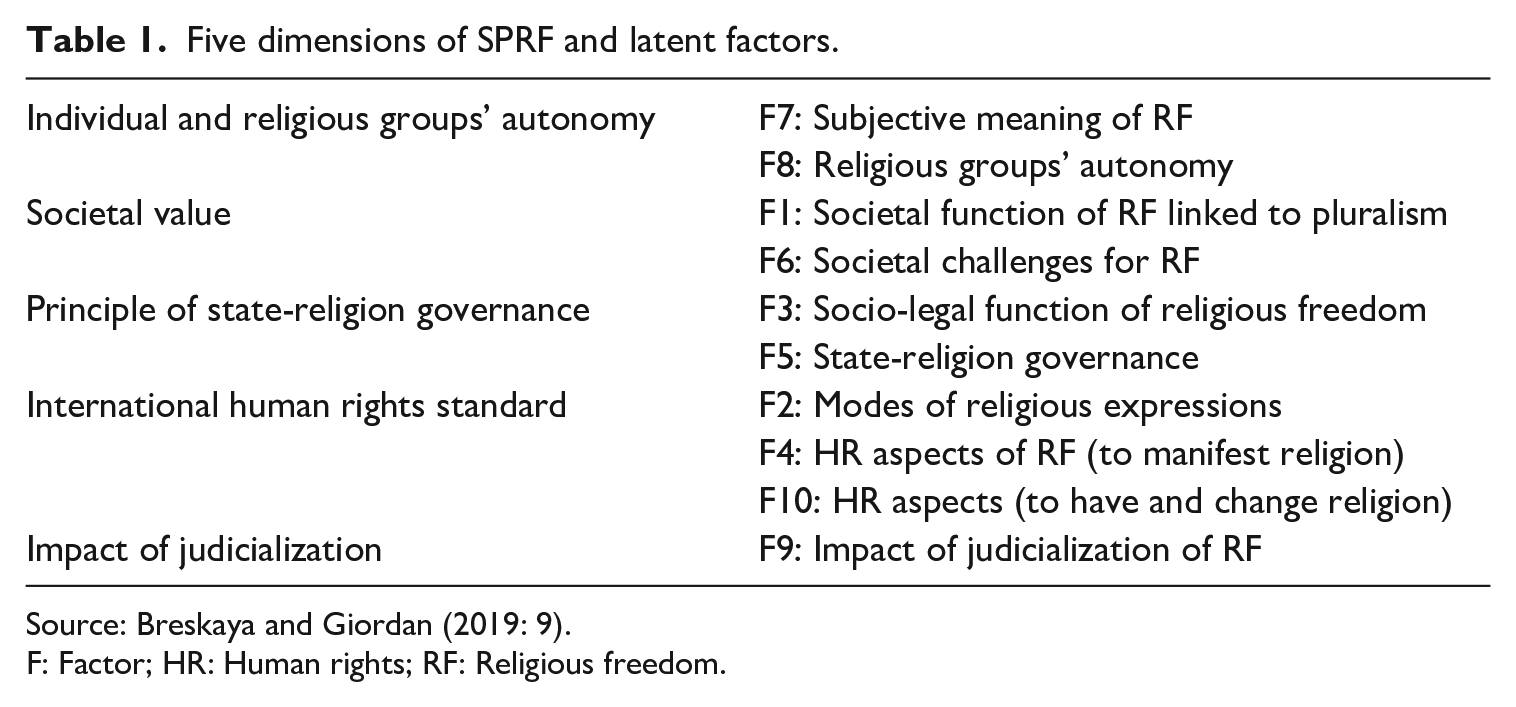
The multidimensional concept of the SPRF implies that the meaning of religious freedom for individuals is constructed at the intersection of the following five domains: (1) individual and religious groups’ autonomy, (2) societal value, (3) principle of state-religion governance, (4) international human rights standards, and (5) the impact of judicialization of religious freedom. By integrating the five dimensions of the SPRF, the measuring instrument enables us to reveal the ‘centers of gravity’ of religious freedom for certain groups and individuals. Among other aspects, the instrument shows whether the freedom to convert from one religion to another is of the same importance as the freedom to have no religion or whether the meaning of religious freedom as individual autonomy is favored more in comparison to the societal value of this concept. In this model, ‘[t]he shared meaning of religious freedom in society is produced by the intergroup dynamics – by social actors with various civil, political, religious and non-religious identities – favoring one dimension of the concept more than the other’ (Breskaya and Giordan, 2019: 1).
In the process of testing the theoretical model of the SPRF, authors concluded that a 60-item instrument showed the presence of 10 latent factors with 37 individual variables. The structure of 10 latent factors confirmed the principal theoretical ideas about the multiple nature of the concept highlighting the specific aspects of five theoretical domains of meaning of religious freedom for respondents (Table 1).
Five dimensions of SPRF and latent factors.
Source: Breskaya and Giordan (2019: 9).
F: Factor; HR: Human rights; RF: Religious freedom.
In the SPRF model, the dimensions of religious freedom as ‘International human rights standards’, ‘Principle of state-religion governance’, ‘Individual and religious groups’ autonomy’ are important constituent parts of it; however, the principal meaning of religious freedom in this model evolved from its function for maintaining the social order. The definition of religious freedom as it is formulated in Article 18 of the Universal Declaration of Human Rights, with possible modes of expressing religion in private and public spheres, was extracted as the second factor signifying the importance of human rights formulations for understanding the idea of religious freedom (Table 1).
In this perspective, religious freedom can be defined as a multidimensional concept that goes through a process of construction of its meaning in a particular society mediated by personal meanings, individual choices and experiences, and perceptions of socio-political challenges to this fundamental right. Together with the measurement of the meaning of religious freedom at the level of individuals and groups, this instrument suggests possibilities of analyzing the socio-religious, socio-political, and human rights correlates of the SPRF. However, for the purposes of this article, we are interested in exploring further the impact of political secularism and state-religion relations, which were operationalized for the measurement of correlates of religious freedom.
Secularism and religious freedom: levels of sociological analysis
Political secularism and religious freedom have overlapping functions that are aimed at providing autonomy for subjects and actors. However, these concepts cannot be seen as equal. While political secularism establishes a particular distance between political and religious spheres primarily at the level of institutions, religious freedom is initially aimed at supporting individuals in their quest for meaning in life. The variety of connotations that the concept of secularism implies in social sciences oscillates around several analytical perspectives. They designate secularism through, for example, its ethical and political forms (Bhargava, 1998), soft and hard traditions (Kosmin, 2007), ‘passive’ and ‘assertive’ ideologies (Kuru, 2009), while differentiating among three types of secularity (Taylor, 2007), or between secularity and secularism (Casanova, 2011). These classifications refer to the models of relationships between the sacred and public sphere, which in turn raise questions about the nature and principal values of secularism for individuals, institutions, and political systems. For instance, through examining issues of religious accommodation and religious freedom, modern secular societies come to terms with the place of religious culture and its values in secular public spaces. The milestone case in the European Court of Human Rights (ECtHR) on the presence of crucifixes in public schools in Italy (Lautsi and Others v. Italy) highlighted the issue of the necessity to negotiate the presence of strong religious culture in modern Italian society, legal norms justifying the endorsed church model of state-religion relations in Italy, and individual secular views. 1
The study of political secularism contains at least two kinds of sociological questions – what kind of social forms the interaction between secular and religious values or cultures or consciousness has assumed in various social contexts and how the separation and neutrality of public space produce effects on different social groups? A sociological study of the ideal-types of secularity within cultural sociology developed by Wohlrab-Sahr and Burchardt (2012) can be seen as an important elaboration of that topic. It shows, for instance, that the type of ‘secularity for the sake of individual liberties’ guided by the ideas of freedom and individuality, or the type of ‘secularity for the sake of balancing/accommodating diversity’ grounded in the ideas of toleration, respect, and non-interference can be seen as corresponding to the ideas of religious freedom.
Kosmin (2007) emphasized a particular sociological interest in differentiating levels of secular individual and institutional conscience and practice accompanying them with the analysis of cultural systems. According to Kosmin, such a model leads to the conceptualization of secularism as a system of individual and collective values and norms. Meanwhile, levels of individual distancing from religion can be conceptualized for analyzing secularism on an axis from anti-religious to religious, in terms of institutional measures; the axis of separation suggests various models of state-religion relations and doctrines of political secularism – from theocratic states to abolitionist ones.
An important combination of levels of analysis can be found in the work of Kuru (2009). With reference to the theories of modernization, civilizational approach, and rational-choice theory, Kuru in his study of political secularism highlighted two challenges that scholars face in the comparative research of secularism. Lack of consistent terminology and uniqueness of national socio-political contexts do not allow social scientists to construct clear distinctions of political secularism and state-religion policies. Kuru noted that univocal interpretation for the type of political secularism established in a specific national context is not sufficient since ‘neither economic determinism of modernization theory, nor religious determinism of civilizationalism, nor standard preferences of rational-choice theory are able to successfully explain state policies toward religion’ (Kuru, 2009: 22).
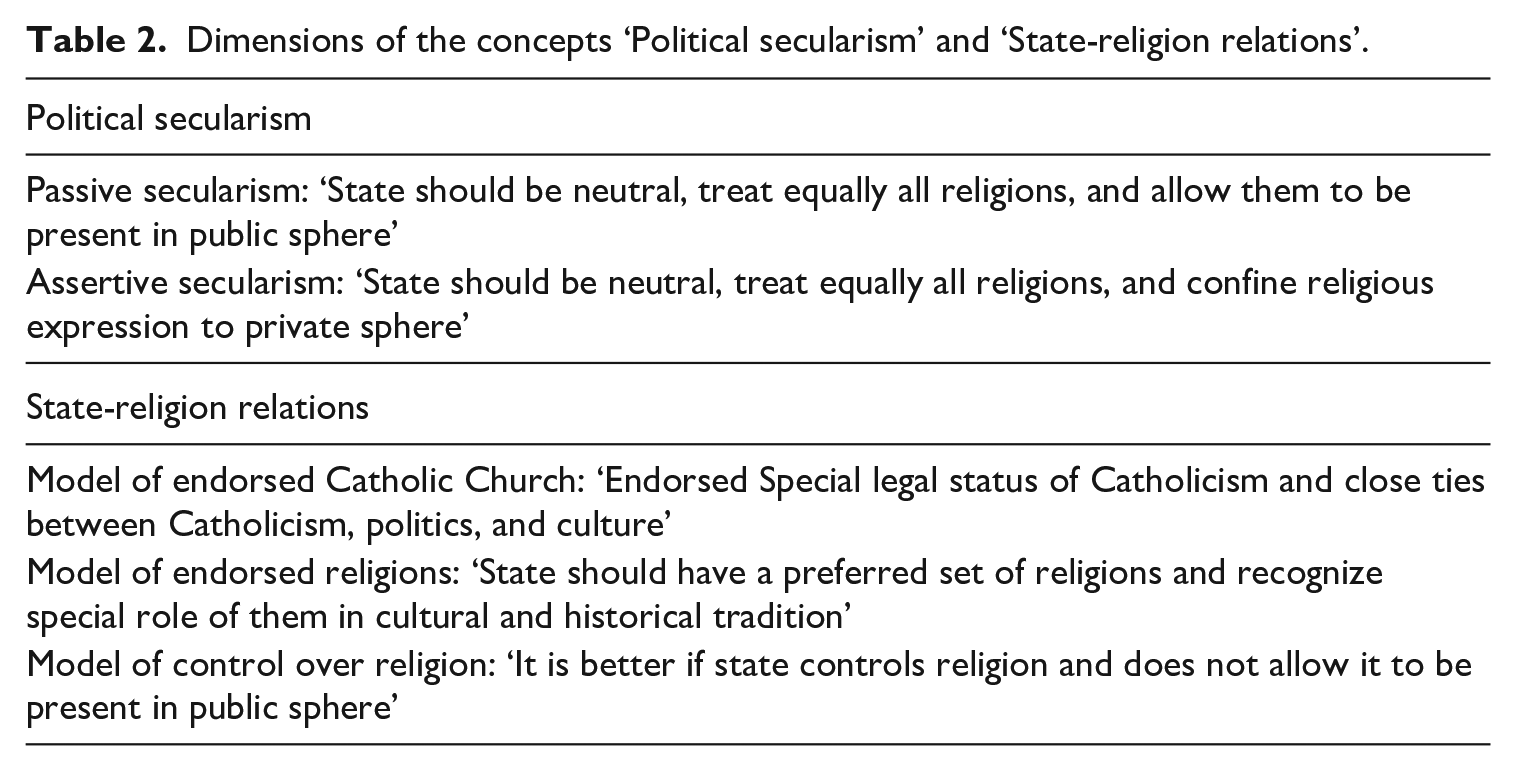
In his view, types of political secularism are conditioned by the balance between ideological struggles and cultural values, in which religious ideas and norms have a key role. He argued that ‘political relations of and perceptions about religions cause particular formations of ideologies and state-religion regimes’ (Kuru, 2009: 23). Thus, he suggested switching the focus of analysis from the state-centric approach and category of political interest to the study of ideologies within historical trajectories. For the comparative analysis of ideological struggles between politics and religion, Kuru elaborated two ideologies of political secularism – its passive and assertive variants. Both types claim neutrality of public space and the principle of equality. While ‘passive’ secularism ‘demands that the state play a “passive” role by allowing the public visibility of religion’ (Kuru, 2009: 11), the ‘assertive’ secularism ‘requires the state to play an “assertive” role to exclude religion from the public sphere and confine it to the private domain’ (Kuru, 2009: 11).
‘Passive’ and ‘assertive’ ideologies have to be seen in the context of historical conditions and relations between religious and secular actors during the modernization process and secular state-building. Benevolent historical conditions for accommodation of both religious and secular groups and the type of consensus or conflict between these spheres together with the degree of separation of state from religion are the conditions that lead to the ‘passive’ or ‘assertive’ ideologies of secularism. These two ideologies can be seen as antithetical ideal-types since the idea of inclusion and exclusion of religion from the public arena is at the center of this classification. However, modern secular states do not show a simple dichotomy but dominance of ‘passive’ or ‘assertive’ models at a certain historical stage, and in particular ways.
Relying on Kuru’s argument that political secularism has to be understood not through institutional identities and interests but through ideological struggles in which there are competing claims on the role of religion in public and on the idea of neutrality and separation of the state, we build up the first hypothesis. ‘Passive’ secularism is more consistent with a positive perception of religious freedom since it claims the public presence of religion and creates spaces of free manifestation of religion in public (Hypothesis 1). In line with that, we argue that those respondents who are believers and active in religious practices will be more in favor of ‘passive’ secularism and less supportive of ‘assertive’ secularism (Hypothesis 2).
Patterns of state-religion relations and religious freedom
The patterns of secularism and models of the relations between state and religion are pivotal for the understanding of the national or regional patterns of religious freedom (Evans, 2001: 22). Durham (2012) contributed two conceptual schemes for the relationship between religious freedom and degrees of state identification with religion. According to his approach, there are two continua: the continuum of religious freedom which can be measured from ‘zero to full religious freedom’ (Durham, 2012: 360) and the continuum of identification of the state with religion, which extends from positive to negative identification. His initial model proposed that the higher the level of identification of the state with religion is (e.g. established churches), the lower is the level of religious freedom in the country. However, the empirical analysis showed the absence of univocal correlation. While some countries, like the United States and France with negative identification with religion showed a high level of religious freedom, another type of country with establishment models showed a high level of religious freedom implementation (the United Kingdom and Finland), and the third type showed negative identification and absence of religious freedom (USSR). Thus, both extremes of the identification continuum can correlate with either ‘zero’ or ‘full freedom’ of religion. This led to the revision, though still starting with the argument that positive and negative identification of state with religion are two extremes between which various patterns of state-religion relations can be found. Thus, he hypothesized that the two continua should be analyzed as ‘not a straight-line inverse correlation but a loop’ (Durham, 2012: 360).
Durham elaborated this linkage further with the idea that the best correlation with religious freedom has patterns of state-religion relations on the continuum between cooperation and separation. Important conditions for this relationship are the type of political regime and values of political culture such as toleration, secularity, equality, or hostility and persecution. Both highly positive and negative identification can lead to a lack of religious freedom. Abolitionist regimes could create conditions for religious hostilities in society and a culture of religious intolerance. In this perspective, the socio-political attitudes about tolerance, respect, neutrality, and secularity create the axiological grounds for possible dynamics in both continua. The importance of a culture of religious freedom emphasized by Durham suggests an interesting sociological perspective for the understanding of how two continua correlate.
In the SPRF model, we operationalized three patterns of state-religion relations. Two of them are models of endorsed religion, while the third one is a model of state control over religion. In doing that, Durham’s hypothesis on extremes of strong positive and strong negative identification of the state with religion and low religious freedom was considered. Taking into account the history of the established model of the Catholic Church within the Italian political system with its later transformation into the endorsed model in 1984, the measures that we had covered two endorsed models. Drawing from Durham’s axioms, we hypothesize that both models of endorsed Catholic Church and state control over religion have negative effects on the perception of religious freedom (Hypothesis 3).
Research question
Against this background, this research attempts to bring the answers to two research questions. First, we are interested in considering the differences in perception of various models of secularism and state-religion relations and to account for the kind of religious and political variables that produce it. Second, this research explores whether and how ‘passive’ and ‘assertive’ secularism and models of endorsed religion and state control over religion influence the perceptions of religious freedom while controlling for respondents’ religious and political identities.
Method
Procedure
This study uses data from a survey of Italian University students that participated in the survey ‘La libertà di religione in Italia’ (Religious freedom in Italy). The questionnaires were completed in May to October 2018 in Padova (Northeastern Italy) by 1035 students. The surveys were administered using paper and pencil method of data collection. The timing of completing the questionnaire was up to 40 minutes. Participation in the survey was anonymous. The survey with 187 questions had four thematic sections with a 60-item section on religious freedom and included information on the demographic, socio-religious, political, and human rights background characteristics.
Measures
The dependent variable of religious freedom was assessed with the SPRF instrument (Breskaya and Giordan, 2019) explained earlier and described in Table 1. All operational variables of SPRF were measured with a five-point Likert-type-like response scales. Respondents were asked to assess ‘how much they agree with the following statements’, using a five-point scale (1 = disagree strongly, 2 = disagree, 3 = not certain, 4 = agree, 5 = agree strongly).
Table 2 explains the operationalization schemes for two types of ideologies of political secularism and three patterns of state-religion relations based on theoretical approaches described earlier.
Dimensions of the concepts ‘Political secularism’ and ‘State-religion relations’.
The socio-political context of participants was measured with the scales and items on ‘Political engagement’ and ‘Social inclusion’. The scale on ‘Political engagement’ has been measured by indicators of ‘Political awareness and interest’, and ‘Political inclusion’ which were developed for this study. The scale of ‘Social inclusion’ has been operationalized with the following indicators: ‘Perceived social isolation’, ‘Participation’, and ‘Social networks’. This scale was verified in the European Quality of life survey (Hagerty et al., 2002). The indicator of ‘Social belonging’ was added to this scale. For the measurement of the socio-religious context, the individual variables of religious belief and practice were used instead of the multidimensional scales of religiosity. Our recent studies confirmed various statistical effects of the individual dimensions of religiosity on the attitudes toward human rights and religious freedom (Breskaya and Rogobete, 2020). The independent variables are explained below with the overview of descriptive statistics (Table 3).
Overview of independent variables (means, standard deviation, and reliability).
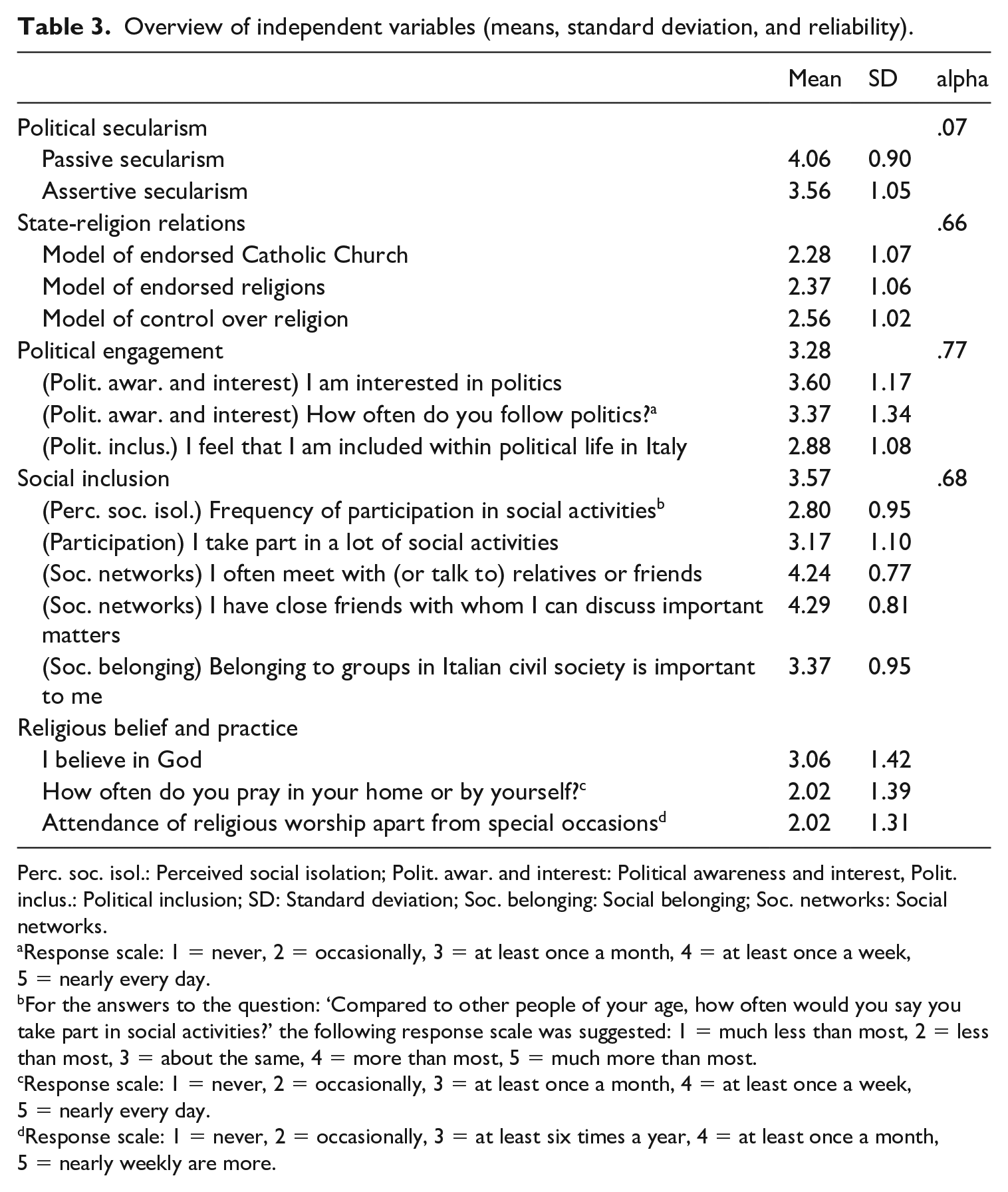
Perc. soc. isol.: Perceived social isolation; Polit. awar. and interest: Political awareness and interest, Polit. inclus.: Political inclusion; SD: Standard deviation; Soc. belonging: Social belonging; Soc. networks: Social networks.
Response scale: 1 = never, 2 = occasionally, 3 = at least once a month, 4 = at least once a week, 5 = nearly every day.
For the answers to the question: ‘Compared to other people of your age, how often would you say you take part in social activities?’ the following response scale was suggested: 1 = much less than most, 2 = less than most, 3 = about the same, 4 = more than most, 5 = much more than most.
Response scale: 1 = never, 2 = occasionally, 3 = at least once a month, 4 = at least once a week, 5 = nearly every day.
Response scale: 1 = never, 2 = occasionally, 3 = at least six times a year, 4 = at least once a month, 5 = nearly weekly are more.
Participants
The participants, 1035 Italian university students, ranged in age from 19 to 24 years with the mean age of 21. The vast majority were students of bachelor programs in social sciences including 45% freshmen. Italian citizenship amounted to 93% of them and 91% were born in Italy. Among the participants, 78% are females and 32% were born in the urban area, 38% in suburban, and 30% in rural. One third identified themselves with no religion, 64% with Roman Catholicism, and 6% with various religious minorities including Muslims (2.4%), Orthodox Christians (1.7%), and others. Around half of the sample expressed their belief in God (45%), while 34% confirmed their non-belief. In total, 16% of the young people confirmed that they attended religious services on a regular basis (monthly and weekly), while 39% do it occasionally, and 45% never attend them. Around half of the participants consider themselves politically engaged with Italian civil society (46%) and 24% do not express interest in political life. In total, 5% experience social exclusion, while 68% confirmed their engagement with social groups and networks. In terms of family educational background, 19% of respondents’ mothers and 18% of fathers had earned university degrees.
Analysis
The data were analyzed by the SPSS package using frequency, reliability, t-test, ANOVA, and hierarchical regression tests.
Results
In this section, the descriptive statistics for scales on political secularism and patterns of state-religion relations are presented. Second, applying ANOVA, the variance in perception of both concepts was considered by examining the religious and political identities of respondents. Finally, multiple linear regression analyses were used to investigate the predictive power of individual and institutional contexts on the perceptions of religious freedom.
The findings suggest that the two ideologies of political secularism were positively assessed. 2 The internal consistency of the scale on political secularism is acceptable (alpha = .07) indicating that ‘passive’ and ‘assertive’ secularism were not considered by the participants as two antithetical ideologies. The three patterns of state-religion were negatively assessed. The reliability of scale on state-religion relations is acceptable (alpha = .66).
Descriptive statistics (Table 4) suggest several interesting findings. First, the concept of political secularism was assessed with more positive support in comparison with the patterns of state-religion relations. The majority (82%) of participants favored the ‘passive’ secularism ideology, while 58% endorsed the ‘assertive’ secularism model. Second, the findings signify the acceptance of religious presence in the public sphere. This could inform us about specifics of Italian secularism when religion is among active participants in political life and everyday cultural experience wherein a political culture designating public and private spaces for religion is less represented.
Political secularism and patterns of state-religion relations (frequencies (%), means, and standard deviation).
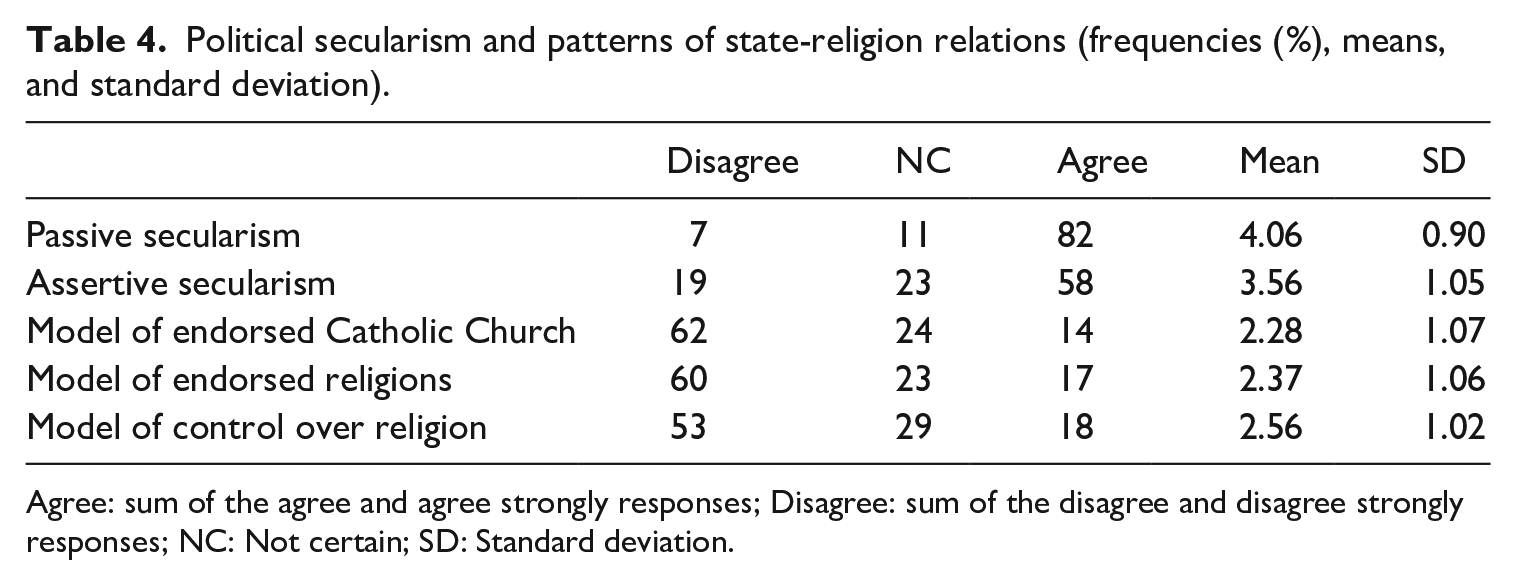
Agree: sum of the agree and agree strongly responses; Disagree: sum of the disagree and disagree strongly responses; NC: Not certain; SD: Standard deviation.
Third, among the patterns of state-religion relations, the least favored is the one that provided special legal status for Catholicism and close ties between Catholicism, politics, and culture (M = 2.28). This endorsement model got a negative assessment by 62% of participants. It is followed by the model of endorsement with a preferred set of religions with a negative evaluation of it by around 60% of participants (M = 2.37). The model of state control over religion and separation of its presence in the public sphere was negatively assessed by 53% of participants (M = 2.56).
Grasping the variances in the perception of political secularism and state-religion patterns, we applied ANOVA and a t-test to discern the role of religious and socio-political contexts in articulating the positions of participants (Table 5). The results suggest that regardless of whether young people in the sample are Catholics or religious nones, believers in God or non-believers, citizens or non-citizens, politically engaged or disengaged, they have similar perceptions of ‘passive’ and ‘assertive’ secularism models.
Religious and political identities, political secularism, and patterns of state-religion relations (results of ANOVA and t-test).
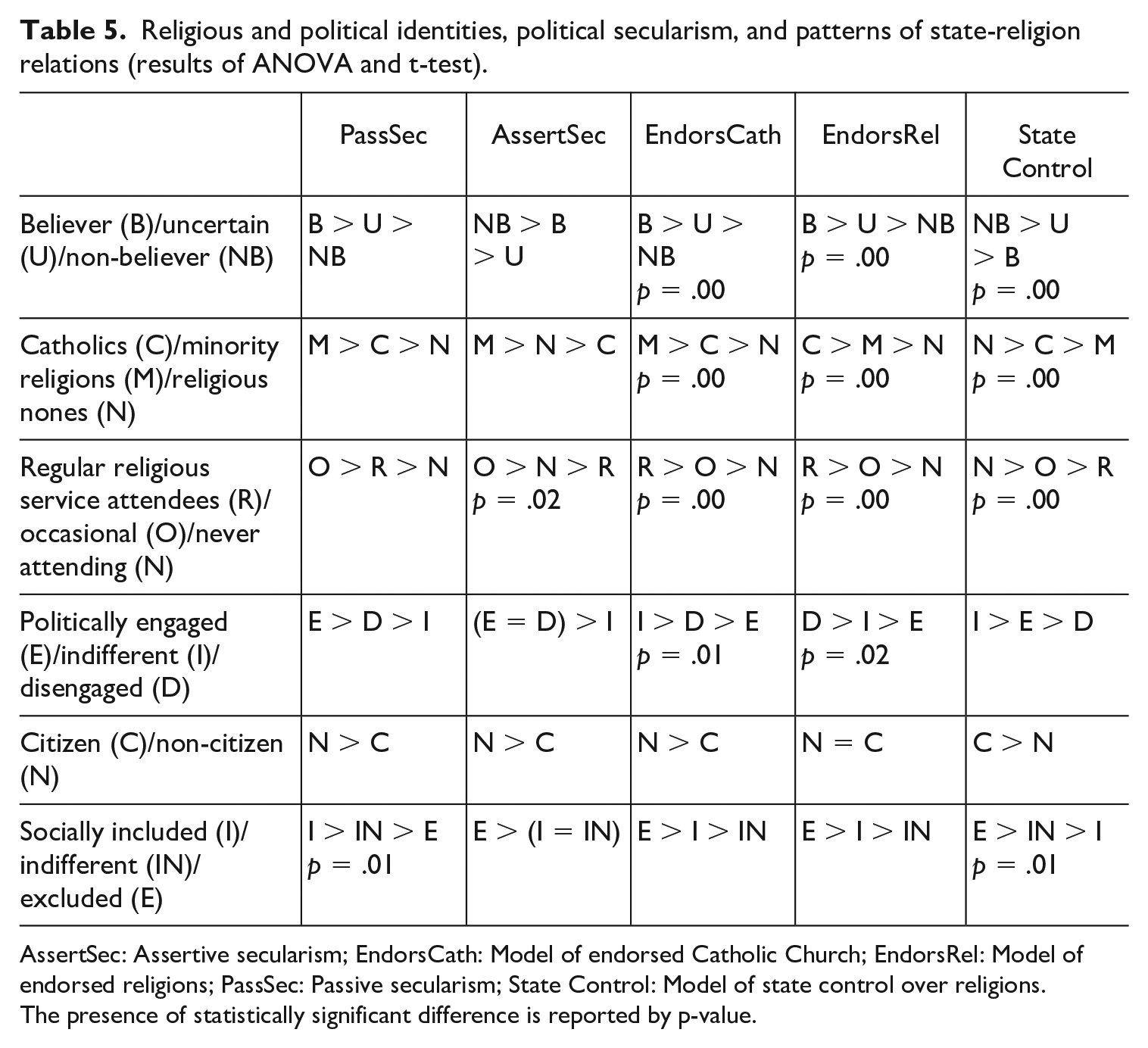
AssertSec: Assertive secularism; EndorsCath: Model of endorsed Catholic Church; EndorsRel: Model of endorsed religions; PassSec: Passive secularism; State Control: Model of state control over religions.
The presence of statistically significant difference is reported by p-value.
Meanwhile, the difference in views on ‘passive’ secularism is produced by socially included and excluded young people, and the frequency of attendance of religious services matter for the participants’ views on ‘assertive’ secularism. As data showed that the category of socially included participants were more in favor of passive secularism (M = 4.11) than socially excluded youth (M = 3.88). The value of means for ‘assertive’ secularism was of greater value for those who occasionally (M = 3.64) or never attend religious services (M = 3.55) than to regular attenders (M = 3.35). Thus, belonging to various groups in civil society and social activism provoke more open perspective toward presence of religion in public space and those who practice religious worship on regular bases are slightly less supportive to the idea of ‘assertive’ secularism in comparison with never-practicing worship in public. Those participants who believe in God and regularly attend religious services are in favor of two patterns of state-religion governance – endorsed Catholic Church and endorsed religions. Meanwhile, non-believers and those never attending religious services favor the model of state control over religion. Also, the latter is favored by socially excluded participants.
Predictors of perception of religious freedom
Table 6 presents multivariate regression models on five dimensions of religious freedom separately. Political secularism, models of state-religion relations, and religious and socio-political contexts serve as the explanatory variables, and we control for the citizens’ status, social milieu, parents’ education, sex, and age of participants.
Regression models for multidimensional concept of religious freedom.
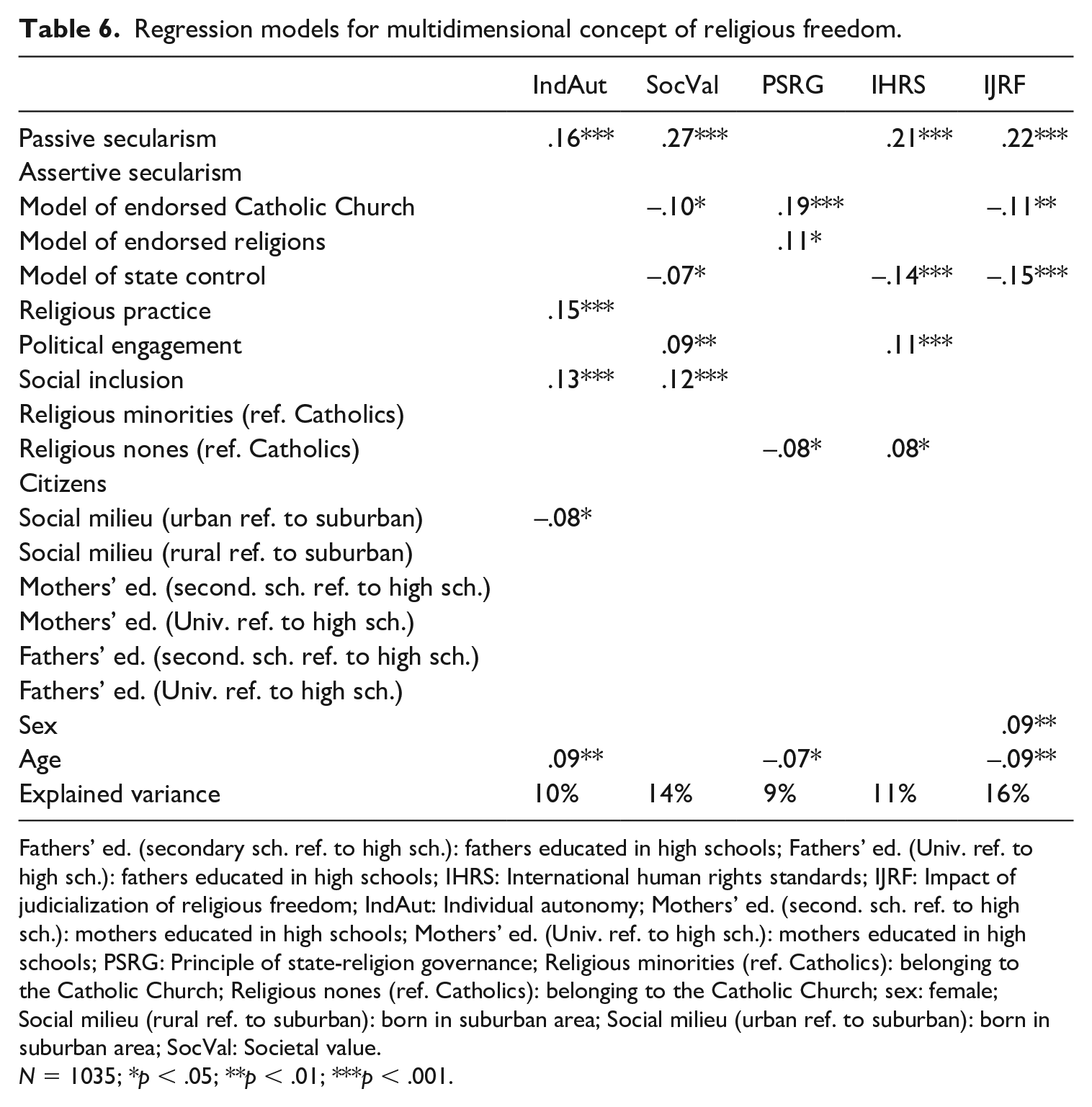
Fathers’ ed. (secondary sch. ref. to high sch.): fathers educated in high schools; Fathers’ ed. (Univ. ref. to high sch.): fathers educated in high schools; IHRS: International human rights standards; IJRF: Impact of judicialization of religious freedom; IndAut: Individual autonomy; Mothers’ ed. (second. sch. ref. to high sch.): mothers educated in high schools; Mothers’ ed. (Univ. ref. to high sch.): mothers educated in high schools; PSRG: Principle of state-religion governance; Religious minorities (ref. Catholics): belonging to the Catholic Church; Religious nones (ref. Catholics): belonging to the Catholic Church; sex: female; Social milieu (rural ref. to suburban): born in suburban area; Social milieu (urban ref. to suburban): born in suburban area; SocVal: Societal value.
N = 1035; *p < .05; **p < .01; ***p < .001.
The concept of passive secularism predicts four from five models, while assertive secularism has no predictive power vis-à-vis religious freedom. Passive secularism has a significant positive influence on the perception of religious freedom. Meanwhile, the effects of state-religion relations are mostly negative on the dependent variable. Religious practice has a significant positive effect only on the subjective meaning of religious freedom (Individual autonomy). The political engagement of participants predicts the attitudes toward the societal value of religious freedom and its human rights dimension. Social inclusion impacts the subjective meaning and societal value of religious freedom. In terms of religious affiliation, belonging to religious minorities is not sensitive to the SPRF, while the identity of a religious none has a significant positive influence on the perception of human rights aspects of religious freedom. Catholic identity is statistically significant and predicts the ‘Principle of state-religion governance’. In terms of socio-demographic variables, most of the control variables did not impact the dependent variable. Only in one case, the social milieu had predictive power for the dimension of individual autonomy (being born in a suburban area). In comparison with males, female students were more supportive of the dimension ‘Impact of judicialization of religious freedom’ and with the age, the participants more favored the dimension of ‘Individual autonomy’.
Discussion and Conclusion
While the relationships among the concepts of religious freedom, secularism, and state-religion relations have been debated by social scientists, empirical analysis of the associations among them still requires scholarly input. This research combined theoretical inquires with empirical studies addressing two issues: first, how can we develop a model of sociological research of religious freedom which elicit the normative meaning of the concept and its value for social and individual integrity, and second, how we can conceptualize political secularism and state-religion relations in order to understand the broader political effects of both concepts on religious freedom views. In doing that, we revised the previously developed five-dimensional concept of religious freedom (SPRF; Breskaya and Giordan, 2019) and conceptualized political secularism and selected models of state-religion relations referring to two specific theories (Durham, 2012; Kuru, 2009). Our choice of theoretical framework reflected the task of combining the analysis of normative concepts taking into account socio-political and cultural values prevailing in society. We considered that perspective to be central for the sociological analysis of attitudes toward political secularism and state-religion relationship and their predictive power vis-à-vis the SPRF. The results of this research have numerous implications for sociology of religious freedom and broader social-scientific analysis of normative concepts.
First, our findings accord with the theoretical arguments that conceptualizing religious freedom at the level of individual perceptions requires both a search for the multiple dimensions of the concept itself, its misconceptions (Bielefeldt, 2013; Finke, 2013; Richardson, 2006), and the necessity of understanding socio-political conditions scaffolding this freedom or impeding it. The revised model of the SPRF research highlighted five theoretical dimensions of religious freedom, specified their hierarchy, and beyond that revealed the ‘gradient’ of its latent meanings. The fact that the survey participants of this study privileged the societal values of freedom of religion provides the evidence supporting the theories of Kuru (2009) and Durham (2012), who emphasized the importance of ideological components and axiological grounds for the analysis of secularism and state-religion patterns.
Endorsement of religious freedom through its dimension of ‘Societal value’ referring to the ideals of tolerance, non-violence, promotion of religious diversity, and pluralism indicated the predominant meaning of this concept in modern societies. Whether religious freedom can be considered in terms of normative requirements (Lindholm et al., 2004) or values of spiritual well-being (Giordan, 2007, 2009), assists our understanding of the dynamics of individual and institutional religious claims.
Second, the suggested model of conceptualization of religious freedom (SPRF) is sensitive to the types of political secularism and selected patterns of state-religion-relations. Specifically, the ‘passive’ secularism is more in compliance with a positive perception of religious freedom than its ‘assertive’ type. We found some empirical support for the assumption that the participants who endorsed the concept of passive secularism would favor various dimensions of religious freedom (Hypothesis 1). The measures of ‘passive’ political secularism utilized in this study showed that its constitutive values are linked to the similar societal values of religious freedom (Maclure and Taylor, 2011; Seglow and Shorten, 2019). In contrast, the perception of the concept of ‘assertive’ secularism, which, according to Kuru, limits the ‘religious expression to private sphere’ (Kuru, 2009: 11) had no significant influence on the perceptions of religious freedom.
It is interesting to note that while the significant positive effect of passive secularist views appeared for the dimensions of religious freedom as a ‘Societal value’, ‘International human rights standards’, and ‘Impact of judicialization of religious freedom’, the participants endorsed also the importance of public presence of religions for the individual religious claims of autonomy and spiritual fulfillment. This empirical argument points toward the centrality of individual integrity claims (Laborde, 2017) when considering the relationship between political secularism and values of religious freedom for individual agency. Meanwhile, the assessment of the SPRF dimension of ‘State-religion governance’ was not influenced by the passive secularist views. That is to say, the high degree of identification of the state with religion does not correlate with the passive secularism form, which emphasizes equality of all religions and state neutrality. Meanwhile, for the Italian context, the predictive power of ‘passive’ secularism for four out of five dimensions of the SPRF has to be interpreted with reference to the active role of the dominant religion and constant presence of religious rhetoric in the Italian public sphere addressing challenging socio-political issues. Among them, for instance, are the refugee crisis, presence of religious symbols in public schools, and instrumentalization of religious identity for political purposes (Fokas, 2015; Giordan and Zrinščak, 2018; Molle, 2019).
Third, we argued that those participants who believe in God and are active in religious practices, they will be more in favor of ‘passive’ secularism and less supportive of ‘assertive’ secularism (Hypothesis 2). The absence of statistical difference between believers and non-believers, Catholics, and religious nones in their perception of ‘passive’ and ‘assertive’ secularism in the Italian sample indicated that it is not the religious identity but social inclusion that matters for passive secularist views. Meanwhile, those who regularly attend religious services are less supportive of ‘assertive’ secularism. Thus, our second hypothesis was not proven, indicating that religious identity cannot be seen as a criterion producing different understandings of political secularism, specifically among the generation of young Italians. However, the role of religious practices predicted the perceptions of individual claims of spiritual fulfillment in the regression model. The importance of socio-religious variables (religious belief, practices of worship, or religious socialization in the family and education in matters of religion) in the comparative research of religious freedom (Giordan et al., 2020) indicates the necessity of further analysis of the role of religious factors in explaining the normative concepts.
Fourth, the hypothesis that both models of an endorsed Catholic Church and state control over religion would have negative effects on the perception of religious freedom (Durham, 2012) was supported empirically. In five cases out of seven, when the predictive power of state-religion relations on the SPRF was depicted, the results indicated that the less the young people favored the models of an endorsed Catholic Church or state control over religion, the stronger they supported various dimensions of religious freedom. The indivisibility in understanding the principles of state-religion relations and claims of religious freedom as reflected by theory of religious freedom (Evans, 2001) was supported by the findings of the SPRF research. Similarly, the socio-political analysis of transformations within the system of state-religion relations in post-communist Europe and religious freedom (Zrinščak, 2011) emphasized the role of human rights culture in society, while closer comparative political research on state policies on religious freedom suggested the pattern of high religious freedom records for the states that implemented the disestablishment model (Fox, 2015). Empirical sociology of religious freedom supports those observations by suggesting that for the analysis of individual religious freedom meanings, the patterns and principles of state’s interference into religious sphere are decisive, specifically the negative impact of the models of endorsed dominant religion and state control upon religious presence in public life.
Future research should overcome the limitations of the study probably produced by this specific Italian sample of students from a particular university. While the study confirmed the influence of secularist political ideologies and models of state-religion relations on the perception of religious freedom, the way of how these correlates are perceived might be influenced differently in different socio-political contexts.
Footnotes
Author Contributions
The article was jointly conceived in dialogue between three authors. Olga Breskaya took the lead in writing the sections ‘Theoretical framework’, ‘Method’, ‘Results’, while Giuseppe Giordan and Siniša Zrinščak took the lead in writing the sections ‘Introduction’, ‘Research question’, ‘Discussion and Conclusion’. All authors have read and agreed to the published version of the manuscript.
Funding
The authors received no financial support for the research, authorship, and/or publication of this article.

Notes
Author biographies
Address: Department of Philosophy, Sociology, Education and Applied Psychology, University of Padova, via Martiri della Libertà 2, 35137 Padova, Italy.
Email:
Address: Department of Philosophy, Sociology, Education and Applied Psychology, University of Padova, via Cesarotti 10/12, 35123 Padova, Italy.
Email:
Address: Faculty of Law, University of Zagreb, Trg Republike Hrvatske 3, 10000 Zagreb, Croatia.
Email: