



Abstract
Religious freedom (RF) is important because it is posited to be a central element of liberal democracy and as having multiple additional benefits including increased security and economic prosperity. Yet, it is also a disputed concept and many liberal democracies restrict the freedoms of religious minorities. This study uses the Religion and State (RAS) dataset to examine the extent of RF in 183 countries based on six definitions of RF. The author examines whether religious minorities are restricted in a manner that the majority is not, regulation of the majority religion, and imposition of precepts of the majority religion on a country’s population. He finds that very few countries, including liberal democracies, meet any standard for RF, even when one allows for ‘loose’ standards where some violations of RF are allowed.
Religious freedom (RF) is a right many consider self-evident. Many argue that supporting RF also promotes a more stable and free society (Glendon, 2019), reduces terror and violence (Saiya, 2019), benefits national security (Farr, 2008), and economic prosperity (Gill, 2008). It has also become an important element of the foreign policy of Western states (Farr, 2008; Glendon, 2019; Joustra, 2018).
Yet, multiple studies show that RF is often present in theory more than in practice. Even democracies regularly discriminate against religious minorities and regulate the majority religion (Fox, 2019, 2020; Grim and Finke, 2011). Also, whether a state provides RF can be dependent upon the term’s definition. This study uses the Religion and State round 3 (RAS3) to examine how can RF be measured and, given such measures, where religious is freedom present?
Why is religious freedom important?
Liberal political ideology considers RF central, important, and beneficial. In contrast, many non-liberal governments consider religion a potential challenge to their rule (Koesel, 2017; Sarkissian, 2015). Consequently, a recent literature argues that RF has practical security and economic benefits. This is at least partially intended to convince those with no ideological adherence to RF that it is in their political and material interest to support it.
The basic liberal argument is that a free society is valued and all forms of freedom, including RF, are interrelated (Grim and Finke, 2011: 205). Stepan (2000) argues that RF includes freedom of worship and freedom to advance religious ideas in civil society and bans religion impinging on democracy, law, and the RF of others. It also bans religion mandating policy (2000: 39–40).
The idea of RF is increasingly present in state constitutions and international documents which protect various freedoms. Yet, guarantees of RF are often unrealized. Empirical studies find that state support for religion is an important reason for low levels of RF even in democracies (Fox, 2020; Kettell, 2013; Mataic and Finke, 2019). Kunkler (2018) argues this is because state support for religion can lead to a bureaucratization of religion where religious institutions such as religious departments and courts are incorporated into the government (see also Finke, 2013; Grim and Finke, 2011; Henne, 2016: 4; Toft et al., 2011).
Religion and security
A growing literature posits that state support for religion and a lack of RF have negative consequences. Consequently, RF has tangible benefits. One such benefit is less conflict and terror. RF can reduce grievances against the state which, in turn, reduces conflict (Grim and Finke, 2011). This grievance-based argument is echoed in the ethnic literature (e.g. Gurr, 1993, 2000); empirical studies show that states with more RF engage in less international conflict and experience less domestic conflict (e.g. Deitch, 2020; Zellman and Fox, 2020).
Others ascribe this benefit to religion-specific dynamics. State support for religion can encourage religious extremism and terrorism. For example, laws against blasphemy coerce religious conformity and silence alternative religious views both in society and government. Radicals’ views are not challenged. This empowers them to engage in violence against those they see as failing to conform to their views (Saiya, 2016, 2017, 2019; Henne, 2016; Imboden, 2013: 173).
In contrast, RF has multiple benefits. It weakens ‘the narrative of religious extremists that their faith is under attack by the state, thus making violence less likely’ (Saiya, 2016: 3). This (1) forces extremists to compete in the marketplace of ideas for adherents which exposes logical inconsistencies in their arguments, (2) allows extremists to work through peaceful political channels, (3) allows religious institutions and actors to participate in stabilizing civic activities such as education and charity, (4) can deprive fringe groups of their legitimacy, and (5) increases the chances of mutual toleration across religions (Saiya, 2016, 2017, 2019).
While these arguments focus on governments that endorse a single religion and repress others, repressing all religion can also have consequences. ‘Religious repression rarely eradicates religion, but rather drives adherents underground, creates martyrs, invites international criticism, and inspires popular animosity toward those in power’ (Koesel, 2017: 682). It can also radicalize religion which, in the longer term, creates more significant security and stability issues (Toft et al., 2011).
Religion and the economy
Gill (2008, 2013; Gill and Owen, 2017) links RF and economic prosperity. RF increases people’s interactions across religions which reduces cultural barriers to trade and increases economic activity. Religiously free societies allow more freedom to religious minorities. This encourages increased immigration by minority religions who help develop trade with their country of origin. 1 In addition, discrimination against religious minorities decreases trade with countries where that minority is a majority. 2 Religious organizations and activities such as charity and education have an economic impact (see also Rieffer-Flanagan, 2019). Competition between religious and secular charities results in more efficient charity. Like any other institution, religious organizations are employers and use the services of others. Also, participation in religious organizations increases civic skills that are also useful for economic productivity. 3 Finally, echoing Weber’s Protestant ethic argument, Gill (2013) argues that certain religious beliefs encourage economic productivity.
Alon et al. (2017) argue that discriminating against religious minorities undermines a country’s economy by reducing competition and depriving those discriminated against of economic resources. However, regulation that applies equally to all religions can reduce inter-religious social conflict.
Other consequences of religious freedom
This divergent influence of discrimination on minorities and regulating all religion is present in other policy areas. Ben-Nun Bloom (2015) finds that, especially in non-democratic states, regulating the majority religion increases women’s rights but restrictions on religious minorities undermines them. She argues this is because the former restrains patriarchal religious tendencies but the latter represents a general disdain for freedom.
Many sociologists argue that RF also leads to a more religious population (e.g. Finke, 2013; Iannaccone, 1995a, 1995b; Stark and Finke, 2000). Religious monopolies create less choice for religious consumers which make them less likely to find a religion suited to them. Monopolies reduce religious institutions’ and clergy’s incentives to provide better religious services. Also, people often resent having religion imposed upon them.
Given these practical security, economic, and other benefits, there is a strong case that RF is a wise policy even for those countries that see no intrinsic value in RF.
Secular challenges to religious freedom
RF is experiencing increased challenges in liberal democracies. For example, Glendon (2019) finds that there is a waning consensus on the importance of religious freedom, plus a good deal of open hostility to religion among opinion leaders . . . Some legal scholars now maintain that religious freedom is an unnecessary right since everything worth protecting is covered by freedom of speech and association. (2019: 6)
She attributes this to growing secularism and efforts by secular culture warriors who see religion as an obstacle to freedom. Fox (2020) finds that opposition to infant circumcision, ritual slaughter, and women covering their hair are primarily found in Western countries and motivated by secular beliefs that find these religious practices objectionable.
For example, in June 2012, a German judge banned the Muslim and Jewish practice of circumcision ruling that ‘the fundamental right of the child to bodily integrity outweighed the fundamental [religious] rights of the parents’. That is, the judge gave bodily integrity, a right based on a secular ideology, priority over RF. This ruling was shortly thereafter overturned by Germany’s legislature. 4
Freeman (2004) considers this type of secular-religious clash inevitable. Many consider human rights universal principles. Yet, aspects of human rights can clash with aspects of major religious traditions. For example, in the United States, religious beliefs have caused individuals to refuse to bake wedding cakes for gay couples, government officials to refuse to perform same-sex marriages, and companies to refuse to provide birth control as part of their health care insurance. Secular and religious political actors are increasingly clashing over whether RF or other rights should be paramount as well as over the definition of RF. It is perhaps inevitable that this undermines the popularity of RF in secular circles. Philpott (2019) similarly argues that ‘How religious freedom is to be balanced with other rights, obligations and principles is the stuff of case law, which will always be contestable, complex and evolving in any country whose laws endorse religious freedom’ (2019: 32).
What is religious freedom?
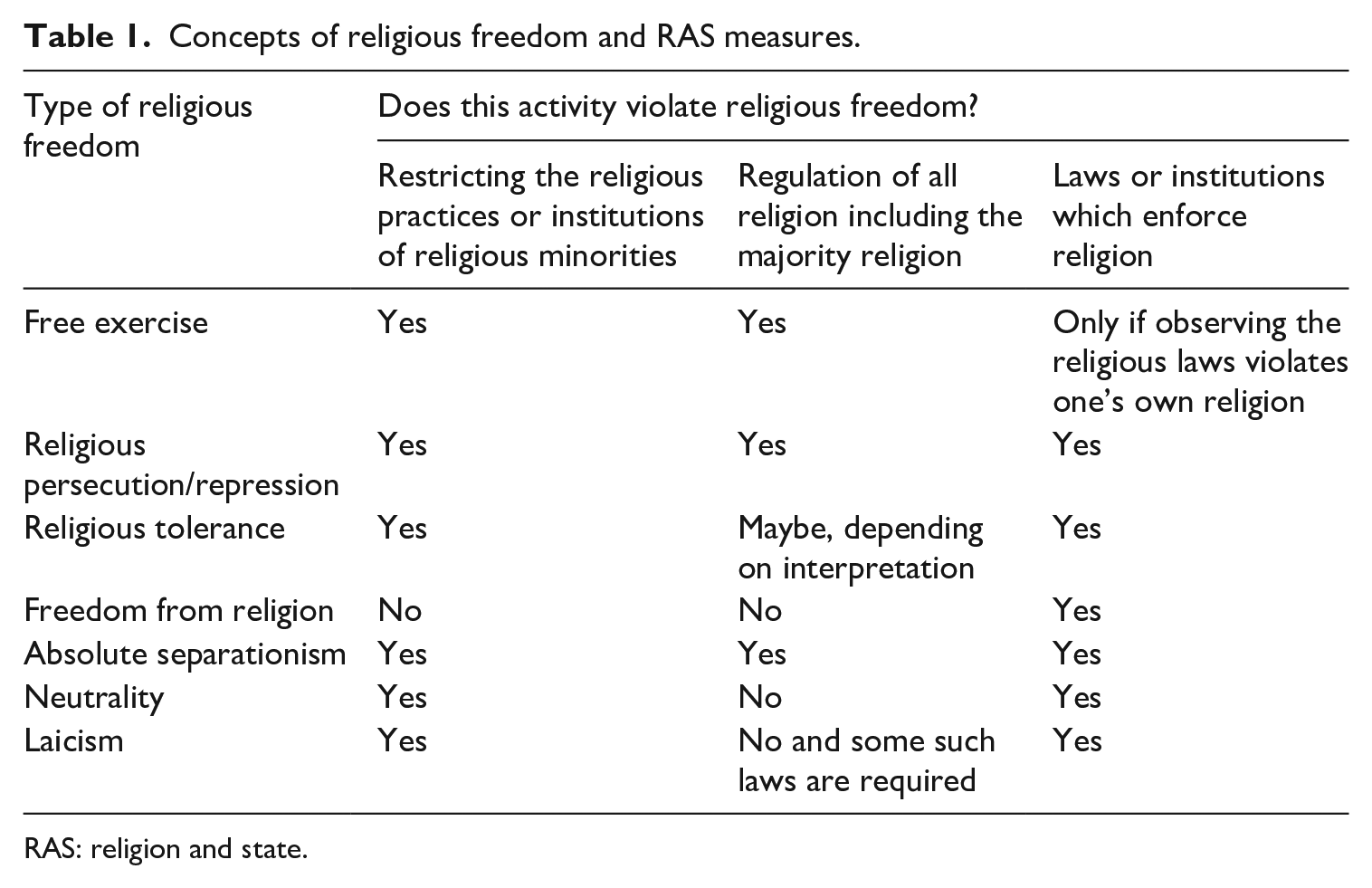
There is no agreement on what RF means. I discuss here several popular definitions but this list is not meant to be inclusive. Rather, it demonstrates that how RF is defined significantly influences the specific rights RF promises. I summarize the essentials of these definitions in Table 1 which focuses on whether each of the following three types of government religion policies violate each conception of RF. These include (1) restricting the religious practices or institutions of religious minorities, (2) regulating all religion including the majority religion, and (3) laws or institutions which enforce religion.
Concepts of religious freedom and RAS measures.
RAS: religion and state.
The term free exercise of religion comes from the first amendment of the US constitution. Essentially, it means that the government must not limit the ability to practice one’s religion. This generally includes the right to set up and manage independent religious institutions but does not include restrictions placed on religious minorities or the country as a whole that do not interfere with the free exercise of religion (Fox, 2016: 14–15). Thus, this interpretation of RF is relatively narrow, focusing specifically on the freedom to engage in religious activities. It could allow, for example, enforcing religious laws which do not directly contradict the religion of a minority. It could also, in theory, allow a secret police which arrests ‘enemies’ of the regime as long as RF is guaranteed and these arrests are not due to religious activities.
Others discuss religious persecution and repression. For example, Jenkins (2007) defines religious persecution as ‘an effort by a government to repress major activities by a given religious group, commonly with the goal of eliminating that group in the long or short term’ (2007: 3). Farr (2008) states ‘religious persecution is generally associated with egregious abuse – torture, rape, unjust imprisonment – on the basis of religion’. Sarkissian (2015) uses a similarly expansive definition of religious repression which includes limits on the free exercise of religion as well as political and economic restrictions on religious groups. Thus, religious repression and persecution involve a wider range of restrictions than the free exercise concept.
Religious tolerance focuses on giving equal rights and privileges to religious minorities. Tolerance does not mean acceptance. It means putting up with those you dislike or with whom you disagree (Eisenstein, 2008). Karpov (2002) defines political tolerance as ‘the willingness to extend civil liberties to political outgroups’ (2002: 267). Little (1996) similarly argues that ‘to be tolerant is, at a minimum, to respond to a set of beliefs and practices regarded as deviant or objectionable without forcible interference’ (1996: 81). This concept is more ambiguous than the previous ones. It can be defined narrowly as granting religious minorities only those rights granted to the majority. This allows restrictions placed on all religions equally. A broader interpretation would mirror the literature on religious persecution and repression as tolerance might include tolerance by secular people for religious practices. However, the persecution or repression literature focuses on the negative aspect by discussing what must not be done while the tolerance literature focuses on what positive rights must be granted. The tolerance concept also likely includes the freedom from religion as imposing one’s religion on others would be considered intolerant. 5
All of the above conceptions of RF, by implication, include the freedom from religion at least partially. That is, they include the right of religious minorities not to have elements of another religion forced upon them. Yet, the freedom from religion is more expansive and includes the right to be free from mandatory religious practices even for nominal members of the majority religion. Joustra (2018) points out that ‘for the ardent religious believer . . . religious freedom often means the right to restrict the freedoms of others, or to impose one’s religion on the larger world. That’s why the most important religious freedom is freedom from religion’ (2018: 33). Thus, this right is becoming increasingly important to political movements which advocate secularism (Zuckerman and Shook, 2017: 7).
All of these conceptions essentially discuss a specific set of acts that governments must avoid in order to protect RF. Other conceptions take a broader policy perspective and outline how governments must generally deal with religion in order to preserve RF.
Absolute separationism is essentially the US model where the government must explicitly be uninvolved in religion in any way, neither supporting nor restricting it. This includes the free exercise and freedom from religion conceptions. But it does not include restricting religious minorities in a manner that does not impinge on religious practices or institutions. Casanova (2012: 81–82) views this concept more expansively. Governments must respect the free exercise of religion, guarantee equal participation for all citizens, and the state may not establish a religion. However, he restricts religious establishment because establishment often leads to limits on free exercise. This model demands only separation of religion and state not separation of religion and politics. ‘Separation of church and state [and] . . . separation of religion and politics . . . are two radically different pursuits; the first one is institutional, the latter is behavioral’ (Eisenstein, 2008: 6).
Neutrality demands that governments treat all religions equally, playing no favorites. Finke (2013; Stark and Finke, 2000) argues that neutrality creates a ‘level playing field’. Supporting some religions but not others can have the same result as restricting some religions, even if this support in no way restricts other religions. Differential support does not violate the free exercise rights of the non-supported religion, nor does it repress or persecute them but it still puts them at a disadvantage. Take, for example, financial support. Religion costs money. These expenses include the building and upkeep of physical institutions and salary for clergy. When only some religions receive government funding, they become less expensive than their non-supported competitors. This can make the supported religions more attractive to potential congregants, which is an unfair advantage over the non-supported religions. This conception allows support for religion as well as repression, persecution, or restrictions on the free exercise of religion as long as the policy falls equally on all religions.
The laicism model, named after France’s religion policy, forbids state support for any religion and restricts religion’s presence in the public sphere. The public sphere should be fully secular and religion is restricted to the private sphere. This mandates restrictions on religion in the public sphere. Any such restrictions apply equally to all religions, including the majority religion. Thus, this conception bans restrictions on religious minorities not placed on the majority religion (Esbeck, 1988; Haynes, 1997; Keane, 2000; Kuru, 2009). Joustra (2018) points out that there are some inherent tensions in this perspective. It argues for greater restrictions on religion in the name of pluralism, equality, and general freedom. In addition, ‘a political system that replaces the religious with a comprehensive secular philosophy at its foundation risks making religious members into second-class citizens’ (Joustra, 2018: 57). That is, it gives preference to a secular ideology over religion (Bader, 1999).
While there are other potential conceptions of RF, as well as sub-categories within those discussed, this discussion is sufficient to show that any conception of RF is contested. Which one is the ‘proper’ type of RF is a normative issue. More importantly, each conception has significant practical consequences for exactly what aspects of religious practices are truly free and which may be restricted.
The assumption of religious freedom in Western liberal democracies
The literature on RF in liberal democracies makes two assumptions. First, RF is a core value in liberal Western democracies. Second, in practice, these countries respect the RF of all of their citizens, including religious minorities. As I discuss in more detail, this study’s results show the second assumption is unfounded which calls into question the first assumption.
There are several reasons for these assumptions. Some argue that Christianity increases religious toleration. Martin (1978: 25–49), for example, links Protestantism to toleration for four reasons. First, the Protestant reformation increased religious pluralism and toleration in the West. Second, Protestant denominations are less closely linked to the state. Third, Protestants’ focus on individualism makes them less likely to consider religion superior to the state. Fourth, support for universal rights is linked to the Protestant doctrines of election and free grace. Woodbury and Shaw (2012) similarly link Protestantism to a series of important foundations for democracy including pluralism, reduced corruption, economic development, mass education an independent civil society and religion’s independence from the state.
Others focus on evolving Catholic ideology, especially the influence of Vatican II. The Church became more tolerant of religious minorities and more supportive of democracy, human rights, and economic and social justice. Also, the Church became more separated from local politics, leaving more room for democracy (Anderson, 2007; Philpott, 2007). However, these theology-based approaches do not explain why Western Christian-majority countries would be more religiously free than non-Western Christian-majority countries.
Others focus more generally how the West’s secularity creates more RF. Calhoun (2012), for example, argues that ‘the tacit understanding of citizenship in the modern West has been secular. This is so despite the existence of state churches, presidents who pray, and a profound role for religious motivations in major public movements’ (2012: 86). Appleby (2000) argues that ‘the core values of secularized Western societies, including freedom of speech and freedom of religion, were elaborated in outraged response to inquisitions, crusades, pogroms, and wars conducted in the name of God’ (2000: 2).
Many argue this combination of secularism and RF is unique to the West. For example, Cesari (2014) argues that modernization caused RF in the West but not the Muslim world: The modernization of Muslim societies, unlike Western ones, did not lead to the privatization of religion but to the opposite, that is, the politicization of Islam in a way unprecedented in premodern Muslim societies. This is not because Islam does not separate religion and politics (which is by the way historically false) but because the Islamic tradition was integrated into the nation state-building that took place at the end of the Ottoman Empire. (2014: xiii)
Haynes (1997: 709), Imboden (2013: 164), Huntington (1996: 75), Facchini (2010), and Demerath and Straight (1997: 47), among many others, make similar arguments. Others focus on how the West is uniquely secularizing, implying that secularization leads to more RF (e.g. Berger, 2009; Bruce, 2009; Halman and Draulans, 2006; Kaspersen and Lindvall, 2008; Marquand and Nettler, 2000; Voicu, 2009).
There are a number of political and social processes that many consider unique to West which lead to this secularization. Western governments have co-opted and subordinated religious institutions as well as instituted equality policies (Haynes, 1997, 1998, 2009). Many in the West reject religion in politics because of past religious wars, increased individualism, liberalism and tolerance among Europeans, and a reduced the demand for containing collective identities (Crouch, 2000). In addition, increased secularism and liberalism among government elites have allowed governments to force national churches to take more liberal stands on a wide variety of issues including gay marriage and the ordination of women (Kuhle, 2011). Some attribute increasing secularism to increased economic development (Norris and Inglehart, 2004).
The religion and state dataset as a practical measure of religious freedom
Given the disputed-ness of the concept, any measure of RF would essentially take a normative stance on how the term is understood. This study takes a broad view RF and focuses its measures on the various ways governments may restrict religious practices or enforce religion on its population. This approach allows an examination of the commonality of most definitions of RF. However, I do not address the persecution or repression standard for the practical reason that the data included in this study have no measure for limitations that are not limitations on religious institutions and practices.
The Religion and State round 3 (RAS3) dataset provides an ideal basis to measure these conceptions of RF. RAS3 includes data on government religion policy for 183 countries worldwide for 1990–2014 but this study focuses on 2014, the most recent year available. These countries include all countries in the world with a population of at least 250,000 people and a sampling of smaller countries. As with previous rounds, to collect RAS3, each country was examined using multiple sources including primary sources such as laws and constitutions, media reports, government reports, non-governmental organization (NGO) reports, and academic sources. These reports provided the basis for coding the variables. All of the variables measure government religion policy. Policy can include laws, bureaucratic regulations, court decisions, or consistent behavior by government officials. 6
RAS3 includes three sets of variables that can measure RF. This form of measurement is ‘practical’ because it meets two criteria. First, data exist to measure the phenomenon. Second, it specifically measures government restrictions on religious practices or institutions or government enforcement of religious precepts on its population. Thus, it measures government policies in practice without involving normative considerations.
The first set of variables measures religious discrimination. Fox (2015) defines this as ‘limitations placed on the religious practices or institutions of minority religions that are not placed on the majority religion’ (2015: 136–167). To discriminate means to treat differently. Interestingly, this is the only limitation on RF banned by all of the conceptions of RF discussed here. This makes it an especially useful indicator.
RAS3 includes 36 specific types of restrictions including 12 on religious practices such as limitations on observing one’s religion in public or practicing religious dietary laws, eight on religious institutions and clergy such as limitations on building places of worship or ordaining clergy, seven on proselytizing and conversion including restrictions on foreign missionaries or proselytizing by residents of a country, and nine types of restrictions which do not fit into the previous categories such as state surveillance of religious activities and anti-cult policies. All of these are measured on a scale of 0–3 7 based on severity and placed into a cumulative measure which ranges from 0 to 108.
Religious restrictions, the second type of restriction, are those placed on all religions in the country including the majority religion. While in theory this overlaps with the previous category, in practice the types of restrictions placed by governments across the world on all religions are different from those placed only on minority religions. Also, this category is theoretically distinct because the motivations for restricting majority and minority religions are often different (Fox, 2015, 2019); RAS3 includes 29 types of religious restrictions. This includes seven on political activities by religious organizations including bans on religious political parties or political speech by clergy, seven on religious organizations, institutions, and clergy such as limitations on access to places of worship or government influence on the appointment of clergy, seven on religious practices such as religious activities outside recognized places of worship or people are arrested for engaging in religious activities, and eight types of restrictions which do not fit into the previous categories such as government influence over the content of religious education or limitations on public religious speech. All of these are measures on a scale of 0–3 8 based on severity and placed into a cumulative measure which ranges from 0 to 87.
The final set of measures measure freedom from religion. While RAS has no formal measure for this it has a measure for religious support which includes 26 measures which involve legislating religious precepts as law and government institutions which enforce religious law. That is, this variable measures government laws and enforcement agencies which enforce religious laws and precepts in a manner similar to the enforcement of other laws such as criminal laws. The presence of these laws and institutions, I argue, indicates a lack of freedom from religion. These 26 items are as follows:
Marriage or divorce only occurs under religious auspices;
Automatic civil recognition for marriages performed by clergy;
Restrictions on interfaith marriages;
Restrictions on premarital sex;
Ban on homosexuals or homosexual sex;
Prohibitive restrictions on abortion;
Restrictions on access to birth control;
Women may not go out in public unescorted;
Required public dress or modesty laws for women;
Female court testimony given less weight than male testimony;
Restrictions on women other than those listed above;
Religious dietary laws;
Restrictions on alcohol;
Laws of inheritance defined by religion;
Religious precepts define or set punishment for crimes;
Charging interest is illegal or restricted;
Required public dress or modestly laws for men;
Restrictions on conversions away from dominant religion;
Restrictions on public music or dancing;
Mandatory closing of businesses during religious holidays or Sabbath;
Other restrictions during religious holidays or Sabbath;
Blasphemy laws or restrictions on speech about the majority religion;
Censorship of press or publications for being anti-religious;
Police force or government agency exists solely to enforce religious laws;
Religious courts, jurisdiction family law and inheritance;
Religious courts, jurisdiction matters other than family law or inheritance.
Each variable is coded as 1 if present in a country and otherwise as 0 and combined to create a scale of 0–26.
Table 2 examines the presence of RF in the 183 countries included in RAS3. Fox (2020) found that patterns of religious discrimination differed greatly across several groupings of states including (1) Western democracies and Christian-majority former Soviet states which are democratic but not orthodox-majority, (2) orthodox-majority states, (3) Muslim-majority states, (4) Communist states, (5) Buddhist-majority states, (6) all other states which are democracies, and (7) all other states which are not democracies. 9 The latter two categories basically encompass much of the developing world and are mostly Christian-majority though include some developed countries and countries which are not Christian-majority such as Israel, Taiwan, and Japan.
Measures of religious freedom in 2014.
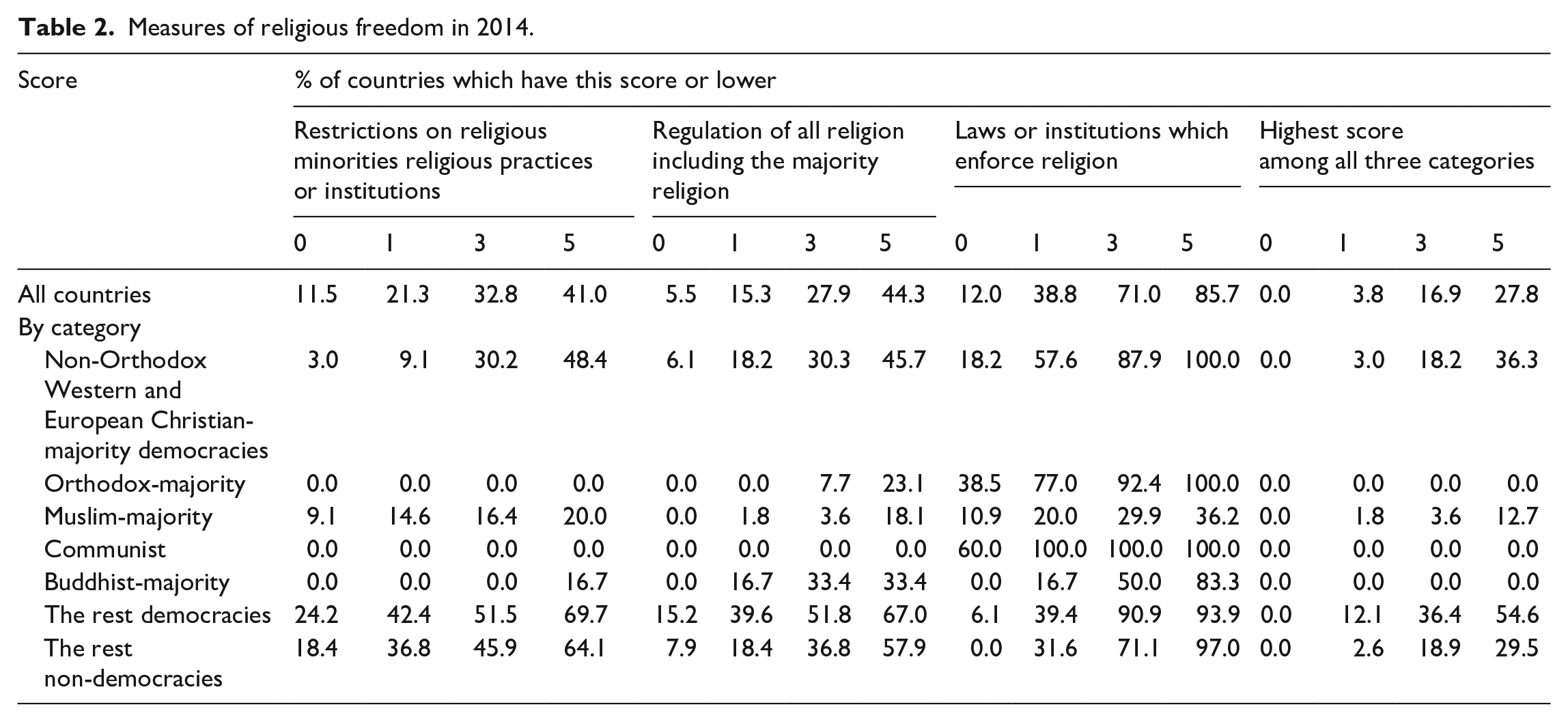
Table 2 shows what percentage of countries score 0 on each of the types of violation of RF measured here. As most states do not score 0, it also looks at those which score 1 or below, 3 or below and 5 or below. It also examines how many score 0, 1, 3, or 5, respectively, or below on all three measures. I apply these more lenient standards for two purposes. First, to allow that a state may largely protect RF but be less than perfect in some small way. Second, it demonstrates that even when using lenient standards which allow for some violations of RF, most states do not meet this standard. While these lenient standards are arbitrary, they represent a range of possibilities. I argue that the most lenient of these cutoffs allows sufficiently substantial violations of RF that few would argue a country which engages in greater violations can be considered religiously free. Thus, if, as is the case, most countries do not meet these standards, this demonstrates that the lack of RF in the world is substantial.
The results for religious discrimination are interesting in several respects. First, very few states engage in no religious discrimination. This is true even when looking at states which are democratic. Interestingly, the non-Orthodox Western and European democracies meet this standard far less often than those in ‘the rest democracies’ category. Thus, developing world democracies whose majorities are not Muslim, Orthodox, or Buddhist are more likely to avoid religious discrimination than liberal Western democracies. Even more interestingly, ‘the rest non-democracies’ also are more likely to engage in no religious discrimination than the liberal democracies of the West and Europe.
As noted earlier, religious discrimination is the one government policy disallowed by all conceptions of RF that in all categories of states a majority of countries engage in religious discrimination shows that RF is a somewhat rare commodity. Even among the non-Orthodox Western and European Christian-majority democracies, those we would expect to have the highest levels of RF, less than half meet the most lenient standard used here, a score of five or lower which allows a substantial amount of discrimination. Only those in ‘the rest’ categories are more likely than not to have RF by this standard.
The results for regulation of all religion mirror those for religious discrimination. Again, ‘the rest’ categories outperform Western and European liberal democracies and an absence of regulation is uncommon.
The results for freedom from religion – as measured by laws or institutions which enforce religion – are different. While only 18.2% of non-Orthodox Western and European Christian-majority democracies do not violate this conception both Orthodox-majority and Communist states are less likely to violate the freedom from religion. That being said, a majority of all categories of states, other than Muslim-majority states, have three or less of these 26 laws and enforcement institutions.
Finally, when applying the maximal standard of low levels of all three types of infringements upon freedom of religion, no states meet the zero-tolerance standard. That is, they all either discriminate, regulate, or legislate or enforce religion, often all three. The states which are most likely to meet the more lenient standards which allow some discrimination, restriction, and enforcement are those in ‘the rest’ categories.
Table 3 lists the countries which score five or lower on all three variables. They show that the list of states which least violate RF are mostly not among those most would assume meet it. Among Western and European states only Andorra scores one or lower on all measure and only Australia and Canada score 2 or lower. In contrast, among ‘the rest democracies’ South Africa, Taiwan, Uruguay, and Vanuatu score 1 or lower on all scores and Belize, Botswana, Lesotho, Mauritius, and the Solomon Islands score below 2. In addition, among ‘the rest non-democracies’, Benin scores 1 or lower on all three criteria and Cameroon, Colombia, Gabon, Namibia, South Sudan, and Suriname score below 2. Burkina Faso is the sole Muslim-majority state to score 1 or lower on all three scores. The other three categories have no states which score below 9.
Countries which meet minimum score standards for religious freedom in 2014.
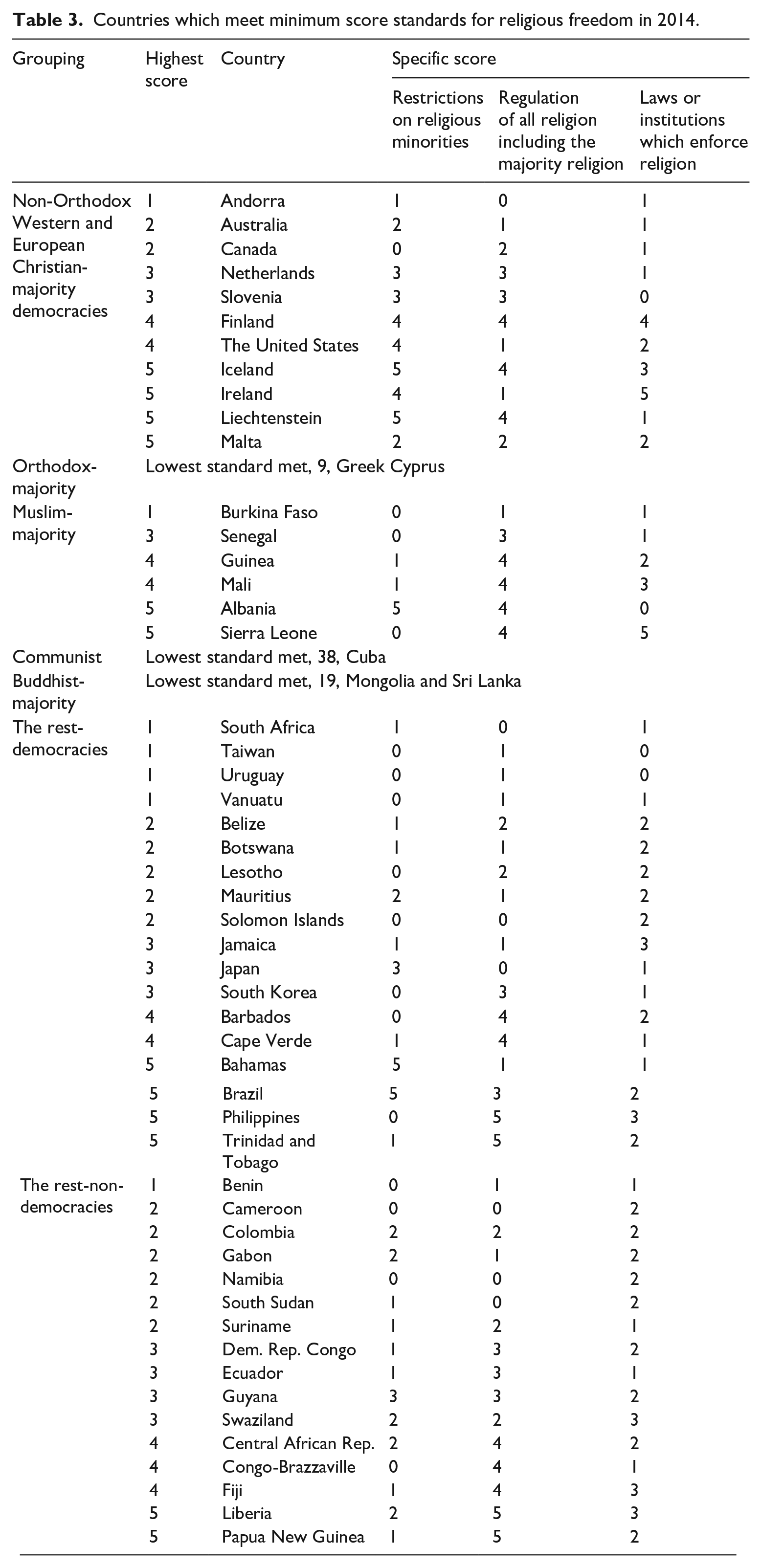
If one complies a list of states which score 0 only on the religious discrimination measure – our practical minimum RF measure – the results are similar. Only Canada scores 0 among Western and European democracies and only Andorra and Estonia score 1. In contrast, the following countries all score 0: the Muslim-majority states of Burkina Faso, Djibouti, Niger, Senegal, and Sierra Leone, ‘the rest democracies’ of the Philippines, the Solomon Islands, South Korea, Taiwan, Vanuatu, Lesotho, Barbados and Uruguay, and ‘the rest non-democracies’ of Benin, Burundi, Cameroon, Congo-Brazzaville, Guinea Bissau, the Ivory Coast, and Namibia. Again, these are likely not the states which first come to mind when one thinks of bastions of RF and tolerance. Yet, compared to most Western liberal democracies, they clearly are.
Because of this, even if one applies other standards for RF such as the neutrality or laicism standards, which essentially allows states to observe the freedom from religion and no discrimination requirements without the religious restrictions requirement, the only states which score 0 on both are Taiwan and Uruguay. If one allows a score of 1 or lower on both, it includes three Western and European democracies – Andorra, Canada, and Estonia – as well as Benin, Burkina Faso, Cape Verde, Congo-Brazzaville, Ecuador, Equatorial Guinea, Guinea Bissau, Niger, South Africa, South Korea, Suriname, and Vanuatu.
Given this, RF is found far more often in countries in Asia and sub-Saharan Africa. Several of them, including Burkina Faso, Congo-Brazzaville, Equatorial Guinea Niger, and Vanuatu, are not fully democratic. This suggests assumptions that Western democracies are the bastion of RF are flawed. It is important to note that these results are being driven primarily by religious discrimination and religious restrictions and not religious enforcement.
Conclusion
RF is a contested topic. Yet, no matter which standard of RF is used, a clear majority of countries in the world do not have it. Even when substantially loosening the standards by allowing for a certain amount of restrictions on religion or government enforcement of religious laws this still remains the case. To be clear, this is true using even the least loose of these non-zero tolerance standards examines in this study.
Based on even the very minimally loose standard of allowing a score of 1, the lowest non-zero score possible, on the religious discrimination against minorities measure any one of the following actions could be taken by a government as long as it was done only occasionally to some religious minorities: restrictions on burial rituals, restrictions on the wearing of religious symbols, restrictions building or leasing a place of worship, denial of equal access by minority clergy to jails, the military, or hospitals, and surveillance of religious activities. I submit that countries which score 1 or higher on this measure, which include 88.5% of countries, are not truly religiously free.
This also applies to liberal democracies. In particular, the assumptions of RF in liberal Western democracies are unfounded. Only two of the 33 Western and European Christian-majority non-Orthodox democracies examined in this study score 1 or lower on religious discrimination. Of the five examples of types of violations of RF given in the previous paragraph, 7, 11, 20, 15, and 12 of these 33 countries, respectively, engage in these practices. Among these 33 states, only Canada, Finland, Luxembourg, and Poland engage in none of these five activities.
In addition, Fox (2020) discusses three types of restrictions on religious minorities found in the West which are rarely found elsewhere: Sweden, Norway, and Denmark regulate circumcisions, and Germany banned them briefly. Kosher and Halal slaughter are banned or restricted in Denmark, Germany, Iceland, Norway, Sweden, Switzerland, and, as of 2019, Belgium. The wearing of religious clothing by Muslims is restricted or banned in parts of Belgium, Croatia, Denmark, France, Germany, Italy, Malta, Norway, Switzerland, and the UK. (2020: 252–253)
This is consistent with a longer standing finding that religious discrimination in the West is higher than in much of the developing world (Fox, 2008, 2016, 2020). However, these previous studies view these findings through the lens of religious discrimination which, while related to RF, is not RF. Thus, the findings in this study add a new perspective to these overall results.
In particular, there are clusters of countries in sub-Saharan Africa and Asia which have more RF by the standards used in this study than can be found among the more established Western and European liberal democracies. The exact states which are religiously free vary based on which standard is used but the general finding of the higher commonality of RF in these clusters of states than in Western and European democracies remains the same no matter which standard is used. Thus, it may be useful to better publicize in the West, the arguments that RF decreases security issues and increases economic prosperity. This also indicates that the ideology of secularism may have more of a negative influence than the positive influence of the liberal impetus to RF.
Loosening the standards for RF does not substantially change this result. If one allows the loosest standard in Table 2 which allows as many as 15 different simultaneous violations of RF and still considers a country religiously free, 71.2% of the countries in the world do not meet this standard including 63.8% of Western democracies. I submit that this level of religious freedom would violate any reasonable person’s norm of RF which demonstrates the validity of this study’s overall findings.
Given this, we must ask why practice is so different from theory. This suggests some more specific questions for future research. Why is it that most states whose core values, at least in theory, include RF do not adhere to this value? Why is it that numerous states, many of which are not democracies, provide more religious liberty to their citizens than do the Western and European democracies where the concept of RF first originated?
Footnotes
Funding
The authors disclosed receipt of the following financial support for the research, authorship, and/or publication of this article: This research was supported by the Israel Science Foundation (Grant 23/14), The German-Israel Foundation (Grant 1291-119.4/2015), and the John Templeton Foundation. Any opinions expressed in this study are those of the authors alone and do not necessarily reflect those of the supporters of this research.
Notes
Author biography
 ) at Bar Ilan University, Ramat Gan, Israel. His recent books include Thou Shalt Have No Other Gods before Me: Why governments discriminate against religious minorities (Cambridge University Press, 2020) and Why do people discriminate against Jews? (Oxford University Press, 2021).
Address: Department of Political Studies, Bar Ilan University, Ramat Gan, 5290002, Israel.
Email: