




Abstract
Conflicts occasionally arise between individuals’ religious obligations and requirements of the state. In America, these conflicts are often resolved in the courts. A major debate over religious freedom in America centers on whether exemptions to acts of government which may interfere with people’s free exercise of religion are permissible. This article employs multivariate statistical analysis to model how the use of different legal tests to resolve free exercise disputes is linked to variation in likelihoods of claimant success in state appellate courts between 1997 and 2011. Claims adjudicated with balancing tests, such as those mandated by state and federal religious freedom “restoration” legislation, were more likely to lead to decisions favorable to religious free exercise claimants than those adjudicated with rational basis tests. Religious minorities’ claims are generally less likely to prevail than members of more common faiths, and claims brought by formal organizations are more likely to succeed than those brought by individuals.
Keywords
Introduction
Religious individuals in America periodically encounter conflicts over what to do when the dictates of their creed run afoul of the law. Conduct mandated as part of one’s religious practice or belief may be prohibited under the law or limited by the government in some way. American courts have become the preeminent arena for resolving such conflicts, a phenomenon reflected in what Richardson (2015) describes as the “judicialization of religious freedom.” American courts have ruled on matters as diverse as which days of the week religious people can abstain from work for reasons of faith, how their children are to be educated, and which substances they can put into their bodies during worship services. 1
The Federal Constitution and all 50 state constitutions protect the right to practice one’s religion freely. This is exemplified by the First Amendment to the Constitution’s declaration that “Congress shall make no law respecting an establishment of religion, or prohibiting the free exercise thereof” (emphasis on the First Amendment’s Free Exercise Clause). Yet the scope of this right has been much debated, legislated, and litigated. While there is long-standing consensus that the government may not discriminate against religious groups, a more contentious issue is whether courts ought to offer accommodations or exemptions to facially neutral laws and government actions for those who cite religious objections to them. In free exercise jurisprudence, this question often takes the form of whether or not to balance allegations of substantial burdens on people’s religious rights against the state’s interests in imposing them. Following the Supreme Court’s lead in its 1990 Employment Division v. Smith decision, some courts do not consider the severity of burdens on people’s free exercise in their decision-making and will rule in favor of free exercise claimants only when it can be shown that the government acted in a discriminatory manner toward the claimants. Other courts, following the legal standard articulated in the federal Religious Freedom Restoration Act (RFRA) of 1993 and analogous state-level legislation, try to mitigate alleged burdens on people’s religious practice, excepting cases when the government’s interest in imposing those burdens is of the highest order and the resulting substantial burdens are unavoidable.
The debate over the scope of religious free exercise rights is commonly most visible during major controversies over the status of religion in American civil life. The federal RFRA was used by the Supreme Court as the basis for its 2014 ruling in Burwell v. Hobby Lobby Stores. In this decision, the Court held that some corporations have religious free exercise rights, such as the right to avoid providing some contraceptives to their employees. Likewise, the state of Indiana was at the center of a political firestorm in 2015 over objections that the state’s new RFRA legislation, signed by then-Governor Mike Pence, might lead to legally protected discrimination against the lesbian, gay, bisexual, and transgender (LGBT) population. The outcry over the bill led to subsequent legislation specifying that the Indiana RFRA would not authorize discrimination on the grounds of gender or sexual orientation.
Has the legal prescription at the core of legislative actions designed to expand the scope of free exercise rights, like the federal and state RFRAs, had the practical effect of “restoring” religious freedom? And do these efforts benefit different religious groups equally? Prior studies have found that members of religious minority groups are disproportionately more likely to raise free exercise claims (Adamczyk, Wybraniec, & Finke, 2004; Wolanek & Liu, 2017; Wybraniec & Finke, 2001). Do they likewise share in any benefits from courts being more willing to “balance” religious freedoms against the interests of government? The need for answers to these questions is particularly pressing at the state level, where a flurry of legislative activity in recent years has created definitions of religious free exercise which vary across state lines (Bridge, 2014; Claborn, 2011). A body of research in sociology, political science, and legal studies has examined the outcomes of free exercise decisions in the courts. Building on this research and using a unique dataset of state appellate free exercise decisions from 1997 to 2011, this article reports the results of multivariate quantitative analysis to examine whether variations in the legal tests judges use to evaluate free exercise claims affect the likelihood that claimants will receive decisions in their favor. It likewise explores whether members of religious minorities remain disadvantaged in pursuing their claims in court, as observed in studies that examined earlier periods of time (Adamczyk et al., 2004; Wybraniec & Finke, 2001).
The Legal Context of State Free Exercise Rights
The debate over the scope of free exercise rights hinges on the question of which legal test judges should use in adjudicating free exercise disputes. The two primary tests judges use are balancing tests and rational basis tests. When judges make decisions in free exercise cases by relying on a balancing test, they balance the severity of burdens imposed on claimants’ free exercise of religion against the government’s stated interest in doing so. Judges may find that the interest cited by the government in justifying these burdens does not warrant abridging claimants’ rights, or alternatively, they may hold that the government is justified in imposing these burdens. Consequently, courts may use balancing tests to grant claimants exemptions from laws or government policies that would otherwise apply to them.
The most common form of balancing test employed in evaluating free exercise claims is the “compelling interest” test articulated by the Supreme Court in its 1963 Sherbert v. Verner decision (374 U.S. 398), which entails using the strict scrutiny standard of judicial review. Under this standard, those credibly asserting that the state is violating its free exercise guarantees would prevail unless the state can demonstrate two facts. First, the state must show that it has a compelling interest (i.e., an interest of the highest, most important order) in denying someone’s free exercise rights, and second, it must show that it has used the least restrictive method possible in pursuing that interest (i.e., that it had no alternative means of achieving its ends except for those that would limit the claimants’ religious freedoms).
The compelling interest test was at the heart of how the Court interpreted the First Amendment’s free exercise protections from its Sherbert decision until 1990. In that year, the Court appeared to many observers (e.g., McConnell, 1990, p. 1110) to shift how it interpreted this provision of the constitution in favor of requiring a different legal test: the rational basis test. In its decision in Employment Division v. Smith, the Court held that the compelling interest test was only applicable when free exercise rights were implicated in disputes that also involved other rights (i.e., freedom of speech or association).
Disputes over free exercise rights alone, Justice Scalia held in his majority opinion, should be evaluated with a rational basis test. Under this test, judges must decide whether a law or government action allegedly burdening a person’s free exercise rights is rationally related to a secular interest of the state. In applying this test, exemptions or accommodations to government actions considered religiously neutral and non-discriminatory are not granted. The rational basis test as articulated in the Smith decision as well as in the Court’s O’Lone v. Estate of Shabazz (482 U.S. 342 [1987]) decision represents a steeper hurdle for free exercise claimants than the balancing test; to prevail, claimants must demonstrate not only that their free exercise of religion has been burdened by the state, but also that the state’s actions are discriminatory and are neither religiously neutral nor applicable to the general population. 2
The Smith decision had major consequences for how state courts could adjudicate free exercise disputes. Under the 14th Amendment to the Constitution, First Amendment freedoms are incorporated into state law, so the Supreme Court’s interpretation of the First Amendment in Smith was binding on state courts. 3 The decision provoked a considerable backlash (Wood, 1990, pp. 749-50), and in an attempt to reinstate the compelling interest test as the basis for evaluating free exercise disputes in all courts, Congress enacted the Religious Freedom Restoration Act (RFRA) of 1993. RFRA was in force in state courts for 4 years until, in its opinion in City of Boerne v. Flores (521 U.S. 507 [1997]), the Supreme Court held that RFRA did not apply to the states. The rational basis test articulated in Smith returned to its place as the standard for adjudicating state free exercise claims based on the First Amendment.
Contestation over the meaning of free exercise rights in the states did not end with the Court’s decision in Flores, however, and it is the fate of state free exercise claims decided in the period after Flores that is the focus of this article. There are three main reasons why a state court may still use a balancing test to evaluate free exercise claims. First, nearly half of states have either enacted legislation or amended their constitutions to require judges to rely on a balancing test in evaluating free exercise disputes. 4 Second, state supreme courts are free to interpret their states’ own constitutional religious freedom provisions to be broader in scope than the First Amendment’s Free Exercise Clause is under the Flores and Smith decisions. A number of state supreme courts (e.g., Alaska, Massachusetts, and Washington) have set precedents that their state constitutions call for the use of a balancing test when hearing free exercise claims.
Finally, Congress would go on to pass the Religious Land Use and Institutionalized Persons Act (or RLUIPA; 42 U.S.C. § 2000cc et seq., Public Law 106-274) in the wake of the Supreme Court’s decision in Flores. This law mandates that state courts should employ the compelling interest test to evaluate free exercise claims involving the rights of institutionalized persons (most commonly, the incarcerated population) as well as free exercise claims concerning land use regulations (Jelen, 2010, pp. 84-85). RLUIPA may be regarded as a particularized form of the original federal RFRA, and its focus on these two substantive domains of free exercise law was due in large part to resistance from civil rights advocacy groups, who were concerned with how a federal successor to RFRA could limit the rights of the LGBT community (Waltman, 2011).
In sum, free exercise claimants today confront a patchwork legal opportunity structure at the state level, the shape of which varies by state and by the nature of the claim. The volume of legislative and judicial activity in the wake of the Smith and Flores decisions have led Durham and Smith (2010) to argue that “a significant additional measure of free exercise protection has been re-established” (p. 94). State courts may use a balancing test, like RFRA’s compelling interest test, to resolve a free exercise claim if it (a) concerns prisoners’ rights or others living in government-run institutions, (b) involves land use or zoning disputes, (c) concerns a “hybrid” combination of free exercise and other rights, consistent with the Supreme Court’s ruling in Smith, or if (d) courts interpret their own state constitutions’ free exercise provisions to call for the use of a balancing test. Consequently, there is a great deal of heterogeneity in how judges evaluate religious free exercise claims in state courts across the country. Moreover, and this heterogeneity is likely to lead to significant differences in how free exercise disputes are resolved in these courts.
Free Exercise Rights and Religious Minorities
In his cross-national survey of government involvement in religion, Fox (2008) reported that the United States had the highest degree of separation of church and state among the 175 nations he studied. The lack of government involvement in religion, either through subsidizing particular religions or restricting their practice, makes the United States a global outlier. Yet incidental restrictions on religion do exist, such as blanket bans on narcotic substances that some religions use as a component of their rituals, or prison safety requirements that might limit prisoners’ ability to worship the way they see it. Moreover, it is likely that members of faiths that are small in numbers and influence are more likely to find themselves limited by these restrictions.
The scholarship on religious free exercise claims in the United States has paid considerable attention to how claims brought by religious minorities fare. Way and Burt (1983) presented the earliest systematic analysis of state and federal free exercise cases. Analyzing state and federal court cases across two time periods (1946-1956 and 1970-1980), they found that members of “marginal” faiths—including Protestant sects and fundamentalist groups, Eastern religions, and Islam—comprised the largest share of free exercise litigants in both periods. In the latter decade, they found that 41% of all free exercise cases involved members of these faiths. In contrast, Mainline Protestants and Catholics each accounted for only 8% of claims.
More recent studies have likewise found that minority faiths make an outsized proportion of free exercise claims. Wybraniec and Finke (2001) found that Muslims, members of Protestant sects, and members of new religious movements accounted for more than half of all free exercise claimants in courts between 1981 and 1997, despite these groups comprising only 16% of the population of the religious in America during this time. A study by Wolanek and Liu (2017) of federal free exercise decisions from 1990 to 2015 made using the strict scrutiny standard reported that only 33% of such decisions involved Christian claimants. Muslims made slightly less than half as many federal free exercise claims (16% of the total number), whereas members of Native American religions made 17% of claims. Goodrich and Busick (2017-2018) reported a similarly low percentage of free exercise claims made by Christians decided by the 10th Circuit Court in recent years.
The literature is more mixed on how religious minorities’ claims differ in their rates of success compared to members of more widely practiced faiths. Way and Burt (1983, p. 657) reported that marginal religious groups had greater rates of success in the courts from 1970 to 1980 than did larger groups. However, these cases were resolved in the period when the compelling interest test of the Supreme Court’s Sherbert decision was prevalent. More recently, Sisk (2005) as well as Sisk, Heise, and Morriss (2004) found that Catholics and Baptists were less likely than “other Christians” (a single category encompassing Mainline Protestants, Pentecostals, and other groups) to receive favorable decisions in federal free exercise decisions.
Yet, other studies strongly suggest that minority groups’ claims are at a relative disadvantage. Wybraniec and Finke (2001) found in multivariate analysis that members of sects and new religious movements were significantly less likely than Mainline Protestants to receive favorable decisions in their cases. Muslims, Catholics, and Jews were also less likely to receive favorable decisions (see also Adamczyk et al., 2004; Wybraniec, 1998). Multivariate analysis of cases during a similar time period by Brent (1999, 2003) yielded similar results; members of “mainstream” Christian faiths, operationalized as Mainline Protestants and Catholics, were significantly more likely to receive favorable decisions than members of other faiths. In state courts, Claborn (2008, p. 110) provided corroboration for this finding at the bivariate level. Members of liberal and Mainline Protestant faiths as well as Catholics enjoyed a significantly higher success rate than “conservative non-traditional” faiths like the Mormons and the Jehovah’s Witnesses.
Why might religious minorities have less success in pressing their claims than members of more mainstream groups? Adamczyk and her colleagues (2004, p. 246) argue that the values and beliefs of majority religious groups are already heavily embedded in American society. Consequently, members of majority faiths have less of a need to turn to the courts to resolve free exercise disputes; their beliefs and practices have already been legitimized in the law and are less likely to be proscribed in the first place. I argue further that when such disputes arise, the free exercise claims made by members of minority faiths are more likely to concern substantive issues that have been legislated against for facially neutral reasons. As Black (1976, p. 114) has argued, people who are considered minorities or outsiders are less likely to receive the benefits or protections of the legal system than are members of more mainstream groups. With limited capacity to encourage normalization of their activities through the machinery of the law, members of minority groups are more likely to become labeled as deviant. In the present context, this suggests that members of minority faiths will be at a greater risk of encountering conflicts between their religious duties and their obligations under the law and will be more likely to see their efforts to assert their religious freedoms through the court system frustrated. As such, we should expect to see that Mainline Protestants (posited as the most “mainstream” American faith) should enjoy more success in pursuing their free exercise claims than other faiths, including members of Protestant sects, Jews, members of Eastern and Native American religions, and other such groups. Consequently, I hypothesize that free exercise claims brought by members of minority faiths will be less likely to succeed in state courts than cases brought by members of more common faiths (Hypothesis 1).
In addition, it is likely that legal tests judges use in evaluating these claims will make a considerable difference in the outcomes of cases. Judicial tests that balance burdens placed on religious exercise against the gravity of the government’s interest in imposing those burdens pose a lower degree of difficulty for claimants than do rational basis tests. Justice Sandra Day O’Connor acknowledged this in her concurring opinion in the Smith decision, arguing that failing to employ the compelling interest test in Smith and other free exercise cases would place religious minorities at a greater disadvantage: “. . .[T]he Court today suggests that the disfavoring of minority religions is an “unavoidable consequence” under our system of government, and that accommodation of such religions must be left to the political process. . . . In my view, however, the First Amendment was enacted precisely to protect the rights of those whose religious practices are not shared by the majority and may be viewed with hostility. . . . The compelling interest test reflects the First Amendment’s mandate of preserving religious liberty to the fullest extent possible in a pluralistic society. For the Court to deem this command a “luxury” . . . is to denigrate ‘[t]he very purpose of a Bill of Rights’.” (494 U.S. 872 [1990])
Given the differences between what the government (and by extension, the claimant) must demonstrate to prevail when a rational basis test is used rather than a balancing test, we should expect that cases judged using a balancing test of some form will generally yield more favorable results for claimants than cases judged under a rational basis test. Stated formally, claimants will be more likely to receive favorable decisions when courts adjudicate their claims using a balancing test rather than a rational basis test (Hypothesis 2).
Data and Methods
The present study relies primarily on data collected from systematic coding of all published state appellate free exercise court decisions from June 25, 1997 (the date that the Supreme Court’s decision in Boerne v. Flores was handed down) through December 31, 2011. 5 Cases were located through an iterative search of the LoislawConnect legal database followed by a systematic removal of false-positive results, yielding a total of 453 published opinions where religious free exercise matters were ruled upon. Cases were read in their entirety by the author and were coded for various attributes as described in the sections below. A second coder reviewed and coded a random selection of court decisions to assess intercoder reliability, yielding percentage agreement statistics of at least 83% for key measures.
The present analysis excludes unpublished court opinions which were nevertheless available through LoislawConnect. A substantial number of federal and state court opinions are not released for publication, with the reasons for doing so varying by jurisdiction. Unpublished opinions are generally those which judges did not consider to have significant precedential value. Publication rates vary widely by jurisdiction, and at the federal appellate level, no circuit releases more than half of its opinions for publication (Bayer, 2009). Nevertheless, some unpublished decisions are available through LoislawConnect, though their availability varies widely across states. It is not possible to assess whether the small number of unpublished decisions available through databases such as LoislawConnect are representative of all unpublished opinions. Thus, I follow the approach of Sisk and his colleagues (2004, p. 535) in their study of religious freedom cases at the federal level by including only published decisions in my analysis. Research indicates that few external factors predict whether cases will be published. Merritt and Brudney (2001), for instance, found little difference in publication likelihood based on judges’ political affiliation, the gender composition of the panel of judges, and other factors. Moreover, factors they found to predict publication, such as judges’ ages and whether they graduated from elite law schools, would likely exert little influence on their decision-making in free exercise claims.
Measures
Dependent variable
The dependent variable in this study is a binary indicator of whether or not any aspect of the free exercise dispute was decided in favor of the claimant(s). Any ruling not completely in favor of the opposing party was coded as a favorable decision for the claimant. For example, one free exercise claim coded as a favorable decision for the claimant is Hyde v. Fisher (203 P.3d 712 [Idaho 2009]). In this case, a practitioner of a traditional Native American faith requested access to religious materials and permission to practice sweat lodge and smudging ceremonies while incarcerated. Though the claimant did not receive permission to hold a sweat lodge ceremony in prison, the court found that they should be allowed to practice a smudging ceremony, which involves bodily purification through inhaling and coming in contact with smoke from burnt elements. Their success in some but not all facets of their claim led to it being coded as a favorable decision for the free exercise claimant.
Table 1 provides frequencies for all categorical variables in the present analysis, including the dependent variable. Approximately one-third (33%) of decisions coded for this analysis yielded favorable decisions for free exercise claimants.
Frequencies for Categorical Variables.

Note. N = 453 from imputed dataset m = 1.
Independent variables
Test selection
The study’s independent variables are a mixture of those derived directly from the text of the court opinions and others derived from separate data sources which are applicable to particular cases. The legal test used to resolve a dispute was categorized into one of three groups: balancing tests, rational basis tests, and other types of tests. While differences in outcomes based on whether either of the first two tests were used, free exercise cases resolved using one of several other tests tailored to the unique nature of particular dispute types were also included in the analysis. These include cases over “ministerial exceptions” to anti-discrimination law, disputes over religious tax exemptions on free exercise grounds, and child custody disputes where one party asserted religious free exercise rights as a component of their claims. While these additional cases are external to the central debate over whether judges should balance claimants’ free exercise rights against state interests, they allow us a more comprehensive picture of how claims brought by members of minority or more mainstream faiths are evaluated by state courts.
Cases were coded as having been decided with a rational basis test based on whether judges interpreted free exercise protections as follows: no free exercise exemptions would have been possible if the burdens placed on the claimants’ rights were rationally related to a government interest and/or does not discriminate on religious grounds. Such cases tended to rely on a small number of precedents, often from the U.S. Supreme Court. Employment Division v. Smith is the most prominent and frequently cited example of a precedent judges relied on when employing a rational basis test. Two other pre-RLUIPA opinions, Turner v. Safley, 482 U.S. 78 (1987) and O’Lone v. Estate of Shabazz, 482 U.S. 342 (1987), also required the use of a rational basis test for adjudicating disputes over prisoners’ free exercise rights and were cited in several instances. Finally, some opinions cited Church of the Lukumi Babalu Aye v. City of Hialeah, 508 U.S. 520 (1993) as justification for using the rational basis test while also demonstrating how claimants might prevail under such a test. 6
Cases coded as relying on balancing tests cited a panoply of precedents and laws supporting their use. Two prominent Supreme Court precedents that judges in state courts frequently cited when justifying the use of a balancing test were Sherbert v. Verner (1963) and Wisconsin v. Yoder (1972). Balancing tests were also employed in cases relying on the federal RFRA, the RLUIPA, and the state-level “mini-RFRAs.” In addition, references to the use of “strict scrutiny” or “compelling interest tests” in justifying the courts’ decisions indicated use of this type of test.
Religious affiliation measures
A substantial majority of decisions included information about the claimants’ religious background. This information varied substantially in its level of detail; some decisions provided claimants’ specific religious denominational or congregational membership, while others identified claimants as “Christian” or “Muslim.” Using this information, claimants were initially categorized as possessing one of 15 religious affiliations. 7 This was done by noting religious affiliation information provided in the text of the decisions and supplementing it with data about the affiliation from Melton’s Encyclopedia of American Religions (2009) and from data obtained from web searches for the specific groups’ Internet presences. To obtain category sizes sufficient for multivariate analysis, the 15 affiliations were collapsed into seven analytic categories: (a) Liberal and Moderate Protestants, (b) Conservative Protestants, (c) Christians who belong to a “minority” faith (which included members of stricter Christian sects, members of historically Black Protestant faiths, and Orthodox Christians), (d) Roman Catholics, (e) Christians who could not be sufficiently identified as belong to one of the previous four categories, (f) members of new religious movements (e.g., Wicca, Scientology, and the Twelve Tribes movement), and (g) members of other religions. Members of “liberal” and “moderate” denominations were combined into a single category in the final analysis due to the small number of claimants from each type of denomination (20 liberal and 15 moderate). As for members of nondenominational Christian congregations, if no information was available regarding whether they considered themselves evangelical, liberal, and so forth, I categorized them in the “other” Christian category #5.
Classifying Protestants into one of the first two categories or as a Christian sect (which placed them in the third category) was the result of a two-step process that drew upon strict church theory to posit religious marginality rankings for each claimant. First, I identified a claimant’s religious affiliation from the text of a decision and located it in the Pew Forum’s categorization of Protestant traditions and families used in their U.S. Religious Landscape Survey (Pew Forum on Religion & Public Life, 2008). The Pew Forum’s system groups denominations by family and tradition; for example, the Southern Baptist Convention is coded as belonging to the Baptist family in the Evangelical tradition.
Next, I cross-referenced the group’s family–tradition pairing against the religious strictness scale developed by Iannaccone (1994), who surveyed religious scholars and asked them to rank Christian religious denominations by how strongly they emphasized a separate, stricter lifestyle and morality than is popular in broader American society. Iannaccone’s classification scheme uses four strictness categories: liberal, moderate, conservative, and sect. 8 Having identified a claimant’s family and tradition in the first step of the categorization process, I matched it to a group in Iannaccone’s (1994, p. 1193) classification system that belonged to the same family–tradition pairing in the Pew Forum’s (Pew Forum on Religion & Public Life, 2008) classification. I then assigned the claimant to the same strictness category as its corresponding family/tradition member from Iannaccone’s system. For example, a claimant whose religious affiliation could be identified in the Pew Forum’s classification as belonging to the Baptist family in the Evangelical tradition would be coded as “conservative” because they belonged to the same family and tradition as Southern Baptists, whom Iannaccone (1994) identified as “conservative” in his strictness coding. This coding process did not yield conflicting codings, i.e., religious affiliations with corresponding family/tradition members who could have been coded in more than one of the four strictness categories.
As shown in Table 1, the percentage of Christians who made free exercise claims during from 1997 to 2011 is relatively high. Some 77.5% of claims were brought by Christians, both in the imputed data summarized in Table 1 and in the population of cases with no missing religious affiliation data. This figure is somewhat lower than would reflect Christians’ representation in the population of Americans with any religious affiliation and in the population at large (Newport, 2015). Approximately 80% of the U.S. population and 94% of Americans with any affiliation identified as Christian in 2008. Yet, a large percentage of Christians’ claims were made by members of groups categorized as “minority faiths” in this study. Among all claims made by Christians whose denominational affiliation could be identified in the unimputed case population, 38% were brought by members of these faiths. Moreover, these claims were made largely by members of Christian sects, such as the Jehovah’s Witnesses and Mormons, rather than by members of historically Black Protestant churches or Orthodox Christians. Claims made by Christian sects comprised 76% of all brought by members of groups coded as “minority” Christian faiths. Alternatively, 22.5% of claims were made by members of non-Christian faiths, a substantially higher figure that reflects their share of the U.S. population. Taken together, these figures tend to echo the findings of previous research that members of minority faiths are disproportionately more likely to claim violations of their free exercise rights in the courts.
Other measures
Five additional sets of controls are derived from attributes of each court opinion. First, I control for the organizational identity of the claimant, that is, whether the claimant was one or more individuals, or whether they were an organization (an entire congregation or other group). I also control for the region of the country where each case was decided using the four primary U.S. Census Bureau region designations, and a measure of time period, that is, whether the cases were decided during the Clinton, George W. Bush, or Obama Administration.
The substantive basis of each free exercise dispute is measured using one of five case type categories. The first includes disputes over the rights of institutionalized persons (nearly all incarcerated persons) and cases involving criminal matters (e.g., using banned substances for religious ceremonies). The second category identifies free exercise disputes over land use, and the third captures disputes over religious exemptions from tax or tort liabilities. The fourth category identifies cases that were disputes over child welfare, such as claims involving immunization and education, while the last includes all other free exercise disputes not otherwise categorized. Finally, I control for the rate of religious minority prevalence per 1,000 in the population of the metropolitan or micropolitan statistical area where each case was decided, using data from the 2010 Religious Congregations and Membership Study (RCMS) downloaded from the Association of Religion Data Archives (www.theARDA.com). Religious minorities are defined in this calculation as those who belong to a religious group that is not classified as Catholic or Protestant. An average of 50.15 members of religious minority faiths was observed in imputation dataset m = 1, with a standard deviation of 65.60 members.
Methods
In the section below, I report the results of two series of multivariate binary logistic regression models, which model variations in the odds that a free exercise claimant will receive a favorable decision. The first set of models utilizes the seven-category religious affiliation measure described above. The second set employs one binary indicator of Christian versus non-Christian religious affiliation to isolate the effect of identifying as Christian on the odds of receiving a favorable decision. All independent variables included in these models have variance inflation factor (VIF) values less than 5.0, indicating that multicollinearity does not adversely affect the results. Approximately 17% of cases in the models have missing values for at least one independent variable, and the final models were estimated by combining results from 20 datasets generated by multiple imputation in Stata 13. Average McFadden’s pseudo-R2 values across each of the 20 datasets are reported at the bottom of each model’s column in the tables that follow.
Results
Table 2 reports the estimates from three binary logistic regression models of claimants’ success in pursuing their free exercise claims in state appellate courts. The results of Model 1 show that absent other controls, substantial differences based on religious affiliation exist in claimants’ likelihoods of receiving a favorable decision. Liberal and moderate Protestants, who are the reference group for religious affiliation in all models in this table, are significantly more likely to prevail in their claims than is any other group, Christian or otherwise. This effect is most pronounced in comparison with claimants who are members of new religious movements; members of these faiths are approximately 94% less likely to receive favorable decisions than are liberal/moderate Protestants ([.056 – 1] × 100 = −94.4%; p < .001).
Predicting Favorable Outcomes for Free Exercise Claimants.

Note. N = 453 using 20 imputations. Coefficients presented as odds ratios. Omitted categories are as follows: Religious affiliation = Liberal/Moderate Protestant; Legal test = balancing test; Region of dispute = South; Period of dispute = Obama Administration; Claim type = institutionalized persons/criminal dispute.
p < .10. *p < .05. **p < .01. ***p < .001.
Differences based on religious affiliation generally persist in Model 2 when the legal tests used to adjudicate disputes are controlled for, as well in Model 3 controlling for all other factors. Model 3 demonstrates that net of other controls, liberal and moderate Protestants are significantly more likely to prevail in their claims than are conservative Protestants, Catholics, members of new religious movements, and members of unclassified Christian groups, including non-denominational Christians (p < .05). Only members of groups categorized as Christian minorities and members of “other” religions (e.g., Jewish, Muslim, and Buddhist claimants) did not differ significantly from liberal and moderate Protestants to prevail in their claims at the 95% confidence level. Nevertheless, these models offer mixed support for Hypothesis 1. Though differences in the odds of success between new religious movements and the least conservative Protestant groups persist in each model, differences between members of “other” religions (i.e., those who are neither Christian nor members of new religious movements) and liberal/moderate Christians are not significant in all models. While differences between these groups are as expected in Model 1, this effect disappears in the presence of all controls in Model 3. A similar pattern is observed when examining differences between minority Christian groups and the liberal/moderate Protestant reference category. Though the difference in the odds of claim success is strong and significant in the initial model, it falls to marginal significance when additional factors are controlled for in Model 3 (p < .10).
The models in Table 2, however, offer unequivocal support for Hypothesis 2. Cases adjudicated under a rational basis test were substantially less likely to be resolved in favor of the free exercise claimant than cases adjudicated with some form of balancing test (p < .05). When courts use a rational basis test, free exercise claimants are approximately 74% less likely to prevail than when courts use a balancing test, such as the test mandated under the federal RFRA and state-level RFRA-style legislation. Conversely, Model 3 reveals that claims resolved under some other legal test—often claims involving ministerial exemption rights, tax exemptions, and other issues where RFRA legislation would not have been applicable—are substantially more likely to be resolved in favor of free exercise claimants than cases involving a balancing test (p < .001). These findings underscore significant divergences in the odds of success that are evident in the bivariate distribution of free exercise cases by test type. While only 5% of cases resolved using a rational basis test were decided in favor of free exercise claimants, nearly 17% of cases resolved with a balancing test were resolved in their favor. Success in free exercise decisions where neither test was used (which typically involved disputes over ministerial exemptions to anti-discrimination and tort law, religious tax exemptions, and other matters outside the contours of the RFRA debate) was drastically higher; 54% of these cases resulted in favorable decisions for free exercise claimants.
Other controls in Model 3 were not typically associated with differences in case outcomes, with two notable exceptions. Free exercise claims made by formal organizations were significantly more likely to be resolved in their favor than were claims made by individuals (either single or multiple people). The difference in odds of success was substantial. Organizations’ free exercise claims were approximately 237% more likely to be resolved in their favor than claims made by individuals. In addition, land use claims were significantly less likely (p < .05) to be resolved favorably for free exercise claimants than were claims over disputes involving institutionalized persons and criminal disputes more generally. This finding is noteworthy given that federal legislation subsequent to RFRA (the RLUIPA of 2000) is designed to apply the same compelling interest test (a balancing test) to many of the disputes that fall within both of these categories. However, no other differences in likelihood of success based on the substantive matter at hand in cases were observed. Likewise, neither region of the country nor period of the dispute, however, was associated with significantly different case outcomes. Nor were the odds of success linked to higher rates in the prevalence of religious minorities in statistical areas where cases was heard.
The models in Table 3 offer a broader look at how Christian religious identification is related to differences in case outcomes. Claimants were coded as either Christian or not in each of this table’s models. The results echo the findings from Table 2 in that members of non-Christian religions, though significantly less likely to prevail in their decisions in the absence of other controls (see Model 1), do not differ significantly from Christians in their odds of a successful claim once other factors affecting success are accounted for. Differences in the odds of a favorable decision based on the form of legal test judges use remain strong and significant in Table 3; cases resolved using a rational basis test were less likely to result in decisions favorable to free exercise claimants than were those resolved under a balancing test (p < .05). Organizational claimants remain significantly more likely to prevail than do individual claimants in Model 3 of this table, though no other control variable (including claim type) is likewise associated with significant differences in the odds of claim success.
Predicting Favorable Outcomes for Free Exercise Claimants (Isolating Christian Effect).
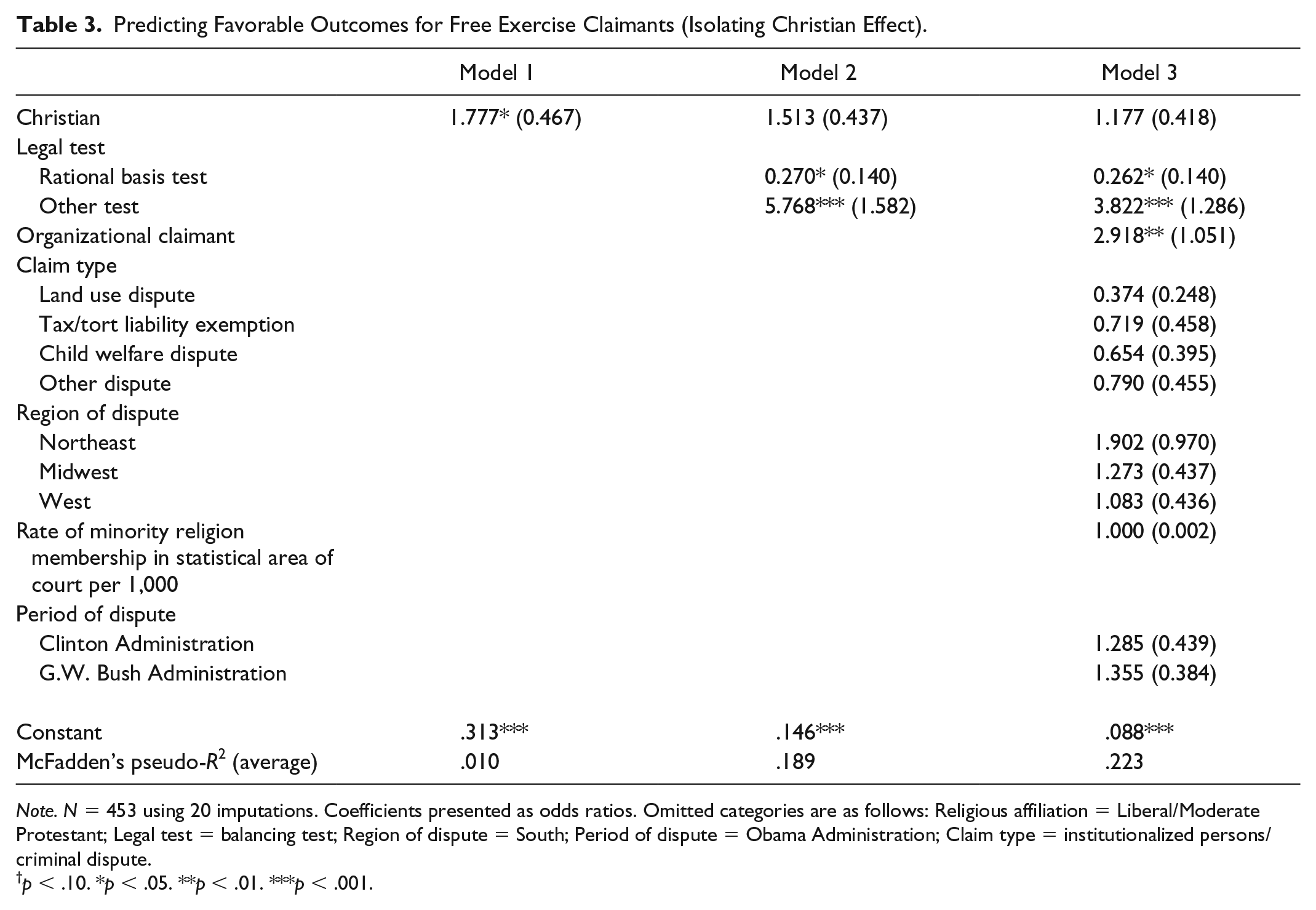
Note. N = 453 using 20 imputations. Coefficients presented as odds ratios. Omitted categories are as follows: Religious affiliation = Liberal/Moderate Protestant; Legal test = balancing test; Region of dispute = South; Period of dispute = Obama Administration; Claim type = institutionalized persons/criminal dispute.
p < .10. *p < .05. **p < .01. ***p < .001.
Discussion
This article explored differences in the odds that free exercise claims heard in state appellate courts will be resolved in favor of claimants. One central finding that emerges from this analysis is that the legal test judges use to evaluate a given free exercise claim has a significant impact on the odds of its success. Use of a rational basis test, widely employed by judges in cases where neither federal nor state RFRA legislation applies, is less likely to lead to favorable decisions for free exercise claimants than are balancing tests. This is not a surprising outcome given the greater threshold for claimant success under the rational basis test: claimants must argue in effect that their rights are being abridged by discriminatory acts of the state. The threshold for success is lower under a balancing test, such as RFRA’s compelling interest test, in which limitations on people’s religious free exercise imposed by the state are permitted only if judges find that the state’s motivation for doing so is of dire importance.
The primary policy implication of this finding is that advocates of the compelling interest test and other balancing tests appear to be correct in arguing that the use of these tests expands the scope and depth of religious free exercise rights in America. The data do not permit us to draw conclusions about the efficacy of particular legislative efforts at the federal or state level in expanding these rights, as the quantity of decisions in which judges cite a state-level RFRA or the federal RLUIPA is insufficient for multivariate analysis of adequate statistical power. Yet, despite Claborn’s (2011, p. 631) claim that “state attempts to increase religious freedom do not work,” it is clear from the present analysis that the mechanism promoted by legislative attempts to broaden the scope of free exercise rights—a form of balancing test, usually the compelling interest test—is linked to increased odds of claimant success.
This finding should be considered in light of the low success rates of claimants in cases where either a rational basis test (with 5% success) or a balancing test (17% success) is used. The hurdles to receiving a favorable free exercise decision in a state appellate court are high enough to have made such an outcome highly unlikely when either potentially applicable test is used. Yet, this should not be considered an indication that free exercise claimants in states with RFRA legislation will remain unlikely to prevail indefinitely. When state RFRAs are the basis of free exercise decisions, a significant reason why many free exercise claimants do not prevail is that judges cite compelling state interests that warrant imposing burdens on the religious rights claimants assert, in their view. Judges have considerable discretion in determining what constitutes a compelling state interest. The outcomes of future court decisions will reveal, for example, whether judges and justices consider preventing discrimination against gay, lesbian, or transgender Americans a compelling state interest. If they do not, state RFRA legislation and legal balancing tests in applicable court cases could potentially facilitate discrimination on these bases, in the name of upholding citizens’ or organizations religious free exercise rights. The potential for this outcome has animated much of the activism against enacting new state RFRAs in recent years, as was the case in Indiana in 2015.
Another finding of this study is that claims brought by religious minorities continue to be less likely to succeed than those by more “mainstream” faiths in America. This is consistent with prior research demonstrating the disadvantaged position of religious minority groups relative to more common faiths in receiving favorable outcomes to free exercise disputes (Brent, 2003; Way & Burt, 1983; Wybraniec & Finke, 2001). Yet it is important to note the complexity of this relationship. Members of religions who occupy arguably the most fringe positions on the American religious landscape—those who belong to new religious movements—are indeed less likely to receive favorable decisions in their free exercise claims than liberal and moderate Protestant are. However, this study finds that claims made by members of the strictest Christian denominations and members of historically Black Protestant churches are only marginally less likely to succeed than those made by fellow Christians who belong to liberal and moderate Protestant denominations.
Finally, of arguably the most important for the future of the debate over religious free exercise in America is the finding that free exercise claims brought by organizations are significantly more likely to result in favorable decisions for claimants than are those brought by individuals. Justice Alito’s majority opinion in the Supreme Court’s 2014 Burwell v. Hobby Lobby Stores decision established that some for-profit corporations, that is, “closely held” corporations like Hobby Lobby, have religious free exercise rights under the federal RFRA. This decision may open the door for other corporations, including those that are not closely held, to assert their free exercise rights in court. It remains to be seen how seriously the courts would take claims that larger corporations have rights to free exercise of religion, or what these rights might encompass. Yet, if this article’s findings that organizational claimants (albeit non-corporate ones) are more likely to prevail in their claims are applicable to assertions of corporate religious freedom, we may witness a substantially broader expansion of the meaning of religious free exercise in the years to come.
The limitations of the present analysis are several. One key limitation is that the cases analyzed here were drawn from the appellate levels of state court systems. Trial court opinions were not considered here due to their unavailability in the large majority of states. It is not possible with the present data to assess whether a higher proportion of cases were decided in favor of free exercise claimants in trial courts, or if test selection in those cases has a greater or lesser impact on the outcome of cases. Future research examining free exercise decisions in the trial courts would prove invaluable in expanding our knowledge of how state and federal RFRA legislation affect the outcomes of these disputes.
Likewise, an examination of differences in the outcomes of claims resolved in federal courts compared with those in state courts is beyond the scope of the present analysis and would be instructive. Are claims in federal courts more likely to be resolved for free exercise claimants? Goodrich and Busick (2017-2018, p. 30) suggest that they may be; their study of recent cases in the 10th Circuit reveals that 48% of claims decided on RFRA grounds were resolved for the claimants. Given the greater likelihood that courts will use a rational basis test to resolve claims made in some state courts, it may behoove claimants to have their cases heard in the federal courts if it is possible for them to do so.
Footnotes
Declaration of Conflicting Interests
The author(s) declared no potential conflicts of interest with respect to the research, authorship, and/or publication of this article.
Funding
The author(s) received no financial support for the research, authorship, and/or publication of this article.