



Abstract
Research on religious freedom has found a vast chasm between constitutional promises and state practices, with constitutional promises being a poor predictor of the state’s support of religious freedom. This research changes the focus from religious freedom to religious equality. We propose that constitutional promises of religious equality will be associated with less discrimination against minority religions and we explore the relationships governance and the promises of religious equality hold with religious discrimination. We find that promises of religious equality are associated with less discrimination. When exploring the interactions between promises of equality and our governance measures, we find constitutional promises of religious equality largely erase the differences in religious discrimination between countries with and without free elections and an independent judiciary. Yet, the reduced discrimination against minority religions does not suggest that the state removes restrictions on minority religions, only that they are equal with other religions.
By design, national constitutions are ‘precommitment devices’ serving to constrain the actions of future politicians and the population as a whole. In the ideal, they commit a nation to specific political structures and processes, as well as specific rights for the citizenry and all humans (Ginsburg et al., 2008). Past research has found in the areas of political structure and process, the de jure and de facto constitutional law are closely related. In the area of human rights, however, the relationship between de jure and de facto constitutional law is far more contested (Chilton and Versteeg, 2016; Elkins et al., 2009: 53).
The divergence between promise and practice is especially striking in the area of religion. Past research has documented the vast chasm between constitutional promises of religious freedom and the state’s support of these freedoms. Although national constitutions offer promises of religious freedom in more than 90% of all countries, recent data collections have documented states routinely deny these freedoms (Fox, 2016; Grim and Finke, 2011; Pew Research Center, 2014). The same collections have shown the chasm between promise and practice has widened over the past few decades. Free elections, an independent judiciary and reduced societal discrimination against religion are associated with a reduced chasm; yet, the gap between the state’s constitutional promises of religious freedom and the actual practices remains (Mataic and Finke, 2018).
Past research on the gap between the state’s promises and practices, however, has been limited in a couple key areas. First, previous studies have focused on all religions in a nation. Yet, past research is clear that the state imposes the most severe restrictions and discriminatory actions against minority religions. We address this limitation by looking at constitutional promises and the state’s actions against minority religions. Second, constitutional promises of religious freedom, which often draw on major international documents, are so common there is a little variation to explain. Rather than looking at constitutional assurances of religious freedom, we look at assurances of equality (Elkins et al., 2020). Along with offering more variation, promises of equality are of great concern for religious minorities that might not receive the freedoms granted to majority religions.
In short, this research focuses on constitutional promises of religious equality and the relationship these promises hold to the treatment of minority religions. Building on the general findings of past research, we address the following three research questions: first, do constitutional clauses on religious equality reduce state discrimination against minority religions? Second, does the relationship between the promise and practice of religious equality vary for a religious minority’s institutions and for their individual members? Finally, how does the political and social context of a nation influence the state’s ability and desire to support constitutional clauses on religious equality?
Relying on data from the Religion and State collection (Fox, 2020), the Comparative Constitutions Project (Elkins et al., 2020) and many other cross-national collections, we find that unlike promises of religious freedom, constitutional promises of religious equality are associated with reduced discrimination against religious minorities. The relationship, however, is only significant for non-institutional forms of discrimination. In addition, we find that promises of equality hold important interactions with our governance measures when predicting reduced discrimination. Our findings suggest constitutional promises serve to compensate for countries lacking free elections or an independent judiciary.
Promise versus practice
Recent research on government restrictions on religion has reached a virtual consensus in several areas directly relevant to our research. First, both qualitative and quantitative research agree minority religious institutions and their members face the brunt of government restrictions, discrimination, and persecution. Case studies from across the globe offer detailed reviews of the discrimination faced by specific minorities within specific countries; the quantitative collections have documented the discrimination is both globally pervasive and temporally persistent (Fox, 2016; Grim and Finke, 2011; Koesel, 2014; Richardson, 2004; Sarkissian, 2015). Likewise, UN documents, government reports, and advocacy groups confirm religious minorities are the most frequent targets for discriminatory laws, police actions, and inequitable treatment by a host of government entities. 1 Although governments place restrictions on all religions, minority religions typically face the harshest and most hostile discrimination from the state.
Another area of consensus is government restrictions on religion are increasing. When the Pew Research Center summarized a decade of changes in government restrictions on religion from 2007 to 2017, they reported increases in all four of the major categories they studied, including a 44% increase in government limits on religious activities and dress (Lipka and Majumdar, 2019). Summarizing the 25-year span of the Religion and State collection (1990–2014), Fox and Finke (2020) report that 17 of 19 measures for institutional discrimination against minority religions increased and 10 of the increases were statistically significant. Yet, despite this increase in government restrictions on religions over the past few decades, constitutional promises of religious freedom remained high and even showed a slight increase (Mataic and Finke, 2020). Consequently, the gap between what constitutions promise and what governments practice continues to grow.
A third key finding is the motives for states discriminating against minority religions vary, with some minority religions facing far more discrimination than others. Perhaps, the most obvious motive is the dominant religions, with close ties to the state, perceive minority religions as religious competitors (Finke, 2013; Finke et al., 2017; Gill, 2008; Stark and Finke, 2000). For this reason, religious movements with high membership commitment and supporting active outreach efforts, such as the Jehovah’s Witnesses, face increased state monitoring, restrictions, and persecution. 2 However, minority religions can pose more than a religious threat. For some groups, religion is interwoven with ethnicity and language posing a challenge to the dominant culture. Still other groups can pose a direct threat to the state through political activity or by perceptions they are a security risk (Cesari, 2013; Chebel d’Appollonia, 2015; Finke and Harris, 2011; Fox et al., 2019; Lausten and Wæver, 2003; Wald et al., 2005). Finally, religious minorities can threaten secular institutions and ideologies. This is most evident in communist and former communist nations, but a milder version of this political secularism holds that the state should confine religion to the private realm (Fox, 2015; Kuru, 2009; Yang, 2012). For each of these motives, the research has found that even small minority groups, such as Falun Gong in China (Richardson and Edelman, 2004) or the ‘new heretic’ sects in France (Palmer, 2011; Wright and Palmer, 2016), can pose a threat resulting in state action.
Finally, although the text of constitutional promises typically focuses on individual rights, recent research has demonstrated the importance of institutional rights (Zhang, 2020). There is an emerging awareness that the religious rights of individuals often depend on the rights of institutions. For example, the individual’s right of religious practice is dependent on the rights of the religious institutions making this practice possible. Abrahamic religions, in particular, consider public worship and prayer with a local gathering of fellow members an essential requirement for routine religious practice and for special rites during the life-course. The gatherings, however, are dependent on the rights of religious institutions.
These areas of consensus highlight the importance of studying minority religions and understanding the growing gap between constitutional promises and actual state practices. The diverse motives suggest the factors explaining religious discrimination also will be diverse and often interrelated. Finally, recent research suggests it is important to distinguish between discrimination enacted against the institutions and the membership of the minority religions. Building on these insights, we return to our initial questions: when do constitutional clauses on religious equality reduce discrimination against minority religions and what conditions determine the strength of this relationship?
When do constitutions matter?
When studying constitutional clauses on human rights, Keith et al. (2009) borrowed from James Madison to ask the question: ‘Is the law a mere parchment barrier to human rights abuse?’ (2009: 644). Like other research trying to understand the shortfall of constitutional promises, they noted the importance of civil war, international war, democracy, and the gross national product (GNP) of the nation. Yet, they cautiously concluded constitutions have the ‘potential to reduce a nation’s level of state terror substantially’ and noted constitutions were easier to change than building an effective democracy or increasing wealth. We pose a similar question, but we limit our attention to the relationships between constitutional promises granted to religious minorities and the actual discrimination they face.
Previous work on the constitutional rights of religious groups and individuals has focused on promises of religious freedom. Relying on three different data collections, this research has found little evidence that constitutional assurances of religious freedoms delivered the freedoms promised. The collection assembled by the Association of Religion Data Archives found of the 130 nations promising religious freedoms in their constitution, 86% had at least one law restricting religious freedoms and 38% had four or more such laws (Grim and Finke, 2011). The Pew collection found 80% of all nations had constitutional clauses or basic laws that ‘qualify or substantially contradict the concept of “religious freedom”’. 3 In a more detailed analysis of the Religion and State collection, Jonathan Fox and Deborah Flores (2009) concluded that constitutional clauses on religion ‘have at best a limited impact on government behavior . . . [and] clauses protecting religious freedom have no predictive value for levels of religious discrimination’ (2009: 1499). The conclusions seemed to suggest the constitutional promises were a ‘mere parchment barrier’ that offered de jure promises with a few de facto outcomes.
Later research, attempting to explain the size of the ‘compliance gap’ between the promise and practice of religious freedom, concluded governance and societal restrictions contributed to the gap (Mataic and Finke, 2020). The governance measures of ‘free elections’ and ‘independent judiciary’ were both significant predictors in explaining a reduced gap between the state’s ‘religious freedom commitment and violations’ for all religions. In contrast, the societal restrictions, which often reflect religious and cultural competition, were significant predictors of an increased gap for minority religions. Unlike research attempting to explain the compliance gap for other human rights (Cingranelli and Richards, 2010; Mitchell and McCormick, 1988), however, economic measures did not help to explain the ‘compliance gap’ between the promise and practice of religious freedom (Mataic and Finke, 2020).
A significant limitation of the past research on constitutional promises of religious freedom is that the vast majority of nations offer assurances of religious freedom. We address this concern by looking at constitutional promises of religious equality. This offers two important advantages. First, there is far more variation, with 74% of national constitutions offering a promise of equality compared to more than 90% offering a promise of religious freedom. Second, constitutional promises of equality address an issue that is a central concern for religious minorities. As reviewed earlier, minority religions often face restrictions and persecution not imposed on other religions.
Constitutions frequently group promises of religious equality with promises of equal legal protections for other human rights. For instance, in Canada, the constitution states, ‘every individual is equal before and under the law and has the right to the equal protection and equal benefit of the law without discrimination, in particular, without discrimination based on . . . religion . . .’ (Comparative Constitutions Project (CCP), 2020). In turn, the Religion and State Project coded Canada as having no state restrictions targeting religious minorities. Other countries from various regions are similar, such as South Korea, Estonia, Cameroon, and Ecuador.
Relying on this new measure and building on the previous research, we offer a series of predictions. First, we propose because religious equality is included in a few international documents, nations feel less pressure to include such clauses in their constitutions. The major international documents so often mimicked in national constitutions give little attention to religious equality. Whereas, religious freedom was prominently included in the UN’s 1948 Universal Declaration of Human Rights and the 1966 International Covenant on Civil and Political Rights, neither document mentions religious equality. Because the average age of a national constitution is 19 years (Elkins et al., 2009: 2), both of these influential international documents have been important in shaping the language used in constitutions. Indeed, national constitutions often borrow the wording used in these documents.
In contrast to religious freedom, we suggest that because past documents and international pressures have less influence on adopting constitutional clauses on religious equity, the clauses will reflect a stronger commitment to the equality promised. Moreover, promises of equity are easier to enact. Religious equality does not require the lifting of all restrictions and the granting of freedoms, it promises the equal treatment of all religions:
H1. Nations with constitutional clauses promising religious equality will have fewer restrictions discriminating against religious minorities.
However, we expect the strength of this relationship to vary for institutions and individuals. Previous research on human rights suggests that when constitutions grant rights to organizations, such as unions, religions, and other associations, the organizations become effective agents for ensuring the state supports these rights (Chilton and Versteeg, 2016). Chilton and Veersteeg argue that when organizations are given the ‘incentives and means’ to protect their own rights, they will be effective in doing so.
We propose, however, that this is often not the case for religious minority institutions. Whereas, unions and many human rights organizations organize at the national and international level to support specific rights related to equality or quality of life, religious minorities typically focus more on local services and missions. Often lacking in size, power, and an effective organizational structure, the institutions of religious minorities are unable to mobilize support for their own equality. When applied to Chilton and Veersteeg’s argument earlier, the institutions of religious minorities lack the ‘means’ for advocating effectively for greater equality even when they have the ‘incentives’ to do so.
Moreover, the religion rights granted in constitutions and international documents, like most human rights, focus on individuals. For example, the Universal Declaration of Human Rights declares that ‘. . . the United Nations have in the Charter reaffirmed their faith in fundamental human rights, in the dignity and worth of the human person and in the equal rights of men and women . . .’. 4 Indeed, a legal scholar recently argued that in the area of religion ‘the supremacy of individual rights to group right ought to be the interpretation of international law’ (Scolnicov, 2011: 2).
Numerous cases illustrate how the constitutional emphasis on the rights of individuals rather than institutions is associated with different levels of discrimination against religious minorities. For example, the Croatian constitution states, ‘everyone in the Republic of Croatia shall enjoy rights and freedoms, regardless of . . . religion . . .’ (CCP, 2020). However, this emphasis on ‘everyone’ seems to apply only to individuals. The state’s discrimination against individuals was nearly absent (a score of one for non-institutions) but the state’s discrimination against the institutions of minority religions was high (a score of 10). 5
Because constitutions give greater attention to individual rights and because religious minorities often lack effective means for defending their institutions, we expect the relationship between promised equality and equal treatment to vary for institutions and individuals:
H2. The relationship between constitutional promises of religious equality and reduced discrimination will be stronger for the individual members of religious minorities than for their institutions.
Understanding the relationship between promises of equality and actual discrimination requires we also consider how the nation is governed. Research has often highlighted two components of democracy that are important for reducing discrimination and repression: an independent judicial system and open and free elections (Finke and Martin, 2014; Hill and Jones, 2014). The independent judicial system more effectively protects constitutional rights of minorities and holds other government branches more accountable. The open and free elections serve to make governments more responsive to the population as a whole:
H3. Both an independent judiciary and free and open elections will reduce the level of state discrimination against religious minorities.
When we test the hypotheses earlier, we will explore how each of these governance structures interacts with constitutional promises of equality and subsequent relationship with levels of state discrimination.
Finally, our analysis will include other measures accounting for the larger social, political, and economic context of a country. Past research has consistently shown non-state actors as well as state actors have been active agents in enacting discrimination against religious minorities (Fox, 2020; Grim and Finke, 2011). Thus, we will include a measure of societal discrimination. Furthermore, we will add several measures that have been predictors of support for multiple human rights: government effectiveness, gross domestic product (GDP), a communist government and global region (Cole, 2016; Davenport and Armstrong, 2004; Poe and Tate, 1994). Each of these measures will be included as controls in our final models.
Data and methods
Our final analyses will include all nations with a constitution in 2013, a population of 500,000 or more, and no missing data (see Table 1 for summary statistics and brief descriptions of each variable), resulting in 153 countries. The core of our analyses requires multiple measures of state discrimination against religious minorities and a measure for constitutional promises of religious equality. As reviewed below, we rely on the Religion and State Project (RAS) for the first set of measures on discrimination and on the Comparative Constitutions Project (CCP) for the measure on promised equality. In addition, we turn to multiple other cross-national datasets for our remaining variables.
Summary statistics and descriptions.
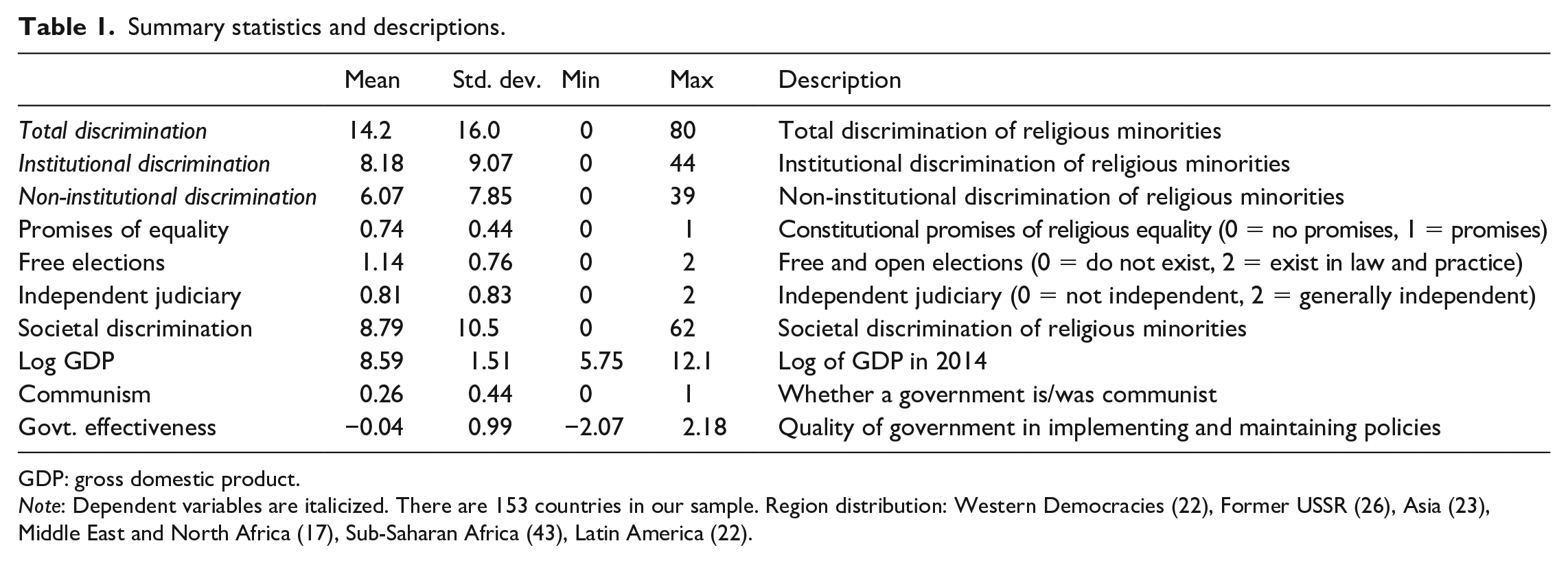
GDP: gross domestic product.
Note: Dependent variables are italicized. There are 153 countries in our sample. Region distribution: Western Democracies (22), Former USSR (26), Asia (23), Middle East and North Africa (17), Sub-Saharan Africa (43), Latin America (22).
Dependent variables
We use the RAS index for ‘Religious Discrimination Against Religious Minorities’ to measure our dependent variables (Fox, 2020). The index consists of 36 items measuring state restrictions placed on the religious institutions and practices of minorities that are not placed on the majority religion. Each item ranges from 0 (no restrictions) to 3 (the religious activity is prohibited or the government engages in a severe form of this activity). Hence, higher index values indicate increased levels of discrimination. 6
To test hypothesis 2, however, we divide the 36-item index into two distinct indexes. One measures restrictions targeting minority institutions and the second measures non-institutional restrictions typically targeting the members of the minority group. The Institutional Index is composed of 19 items, which restrict the group’s ability to worship and gather or to operate openly. The 17 items included in the Non-Institutional Index place requirements (e.g. forced observance of religious laws of another group) or restrictions (e.g. dress, practicing religious rites, or access to worship materials) on the members of minority religions. As with the full index, each item in these two sub-indexes ranges from 0 to 3, with higher values denoting more discrimination. We downloaded the data from the Association of Religion Data Archives (www.theARDA.com).
Independent variables
Testing our hypotheses, as well as controlling for possible competing arguments, requires us to draw on measures from diverse cross-national sources. We begin with the measure central to our research questions: constitutional promises of religious equality.
Constitutional promises of religious equality
We draw our binary measure for a constitutional promise of religious equality from CCP (Elkins et al., 2020). 7 The CCP has collected data on written constitutions for most independent states since 1789 and has coded the form and content of each document. Our measure will be limited to active constitutions. We use their coding of whether the constitution ever makes a statement about religious equality. The coding options were either ‘not present’ or ‘yes, present’. The final breakdown of promises resulted in 40 countries (26%) without promises of religious equality compared to 113 countries (74%) with promises.
Governance structure
Consistent with past research on religious restrictions, we also include two measures of governance structure: the presence of an independent judiciary as well as free and open elections. These data are from the Cingranelli-Richards (CIRI) Human Rights Data project (Cingranelli and Richards, 2010). There are three possible coding categories for each measure. Free and open elections include values ranging from ‘0’, where open elections do not exist, to a ‘2’, where they exist in both law and practice. Independent judiciary is similar, ranging from ‘0’, not independent, to a ‘2’, where judiciaries are generally independent.
Societal discrimination
The societal discrimination index is from the RAS project, where 27 items are used to measure non-state discrimination targeting religious minorities (see Fox et al., 2018, for a detailed overview). The items within the index address how minority religious groups are restricted in practice by non-state actors, such as prevention of religious practice and instances of vandalism, attacks and other forms of discrimination. Higher scores correspond with a greater level of societal discrimination.
Economic development
To control for the level of economic development, we utilize the log of each country’s GDP in current US dollars as reported by the World Bank (2017). Previous research has found that support for human rights holds a strong positive relationship with improved economic development (Davenport and Armstrong, 2004).
Communism
Past research routinely has found nations with a current or prior communist government place more restrictions on religious minorities (Finke et al., 2017). Drawing on the InfoPlease (2017) database, we identified whether a state had a communist government at any time. This measure is a binary coding of whether a country had a communist government, even if it is currently not active.
Governmental effectiveness
Past research on human rights, including research on religious freedoms, has suggested government effectiveness is essential for supporting government policies and constitutional promises (Englehart, 2009). We use the World Bank’s (2014) measure of government effectiveness. The final scores ranged from −2.07 to 2.18, with higher scores indicating more effective governments.
Global region
Although nations in all global regions discriminate against religious minorities, some regions have significantly higher levels of restrictions (Fox, 2008; Grim and Finke, 2011; Mataic, 2018). We use a categorical measure of global regions as a control. The regions were compiled as part of the RAS and include the following: Asia, Former USSR, Latin America, Middle East and North Africa, Sub-Saharan Africa and Western Democracies.
Results
Our analyses proceed in three steps. First, we use ordinary least squares (OLS) regression to test the relationship between constitutional promises of religious equality and the full index of discrimination against minority religions (Total Discrimination Index; Table 2). This model also will include our governance measures and other measures of interest. Together, they provide an initial test of Hypotheses 1 and 3.
Regression modeling the association between restrictions on religious minorities in 2014 (Total Discrimination Index).
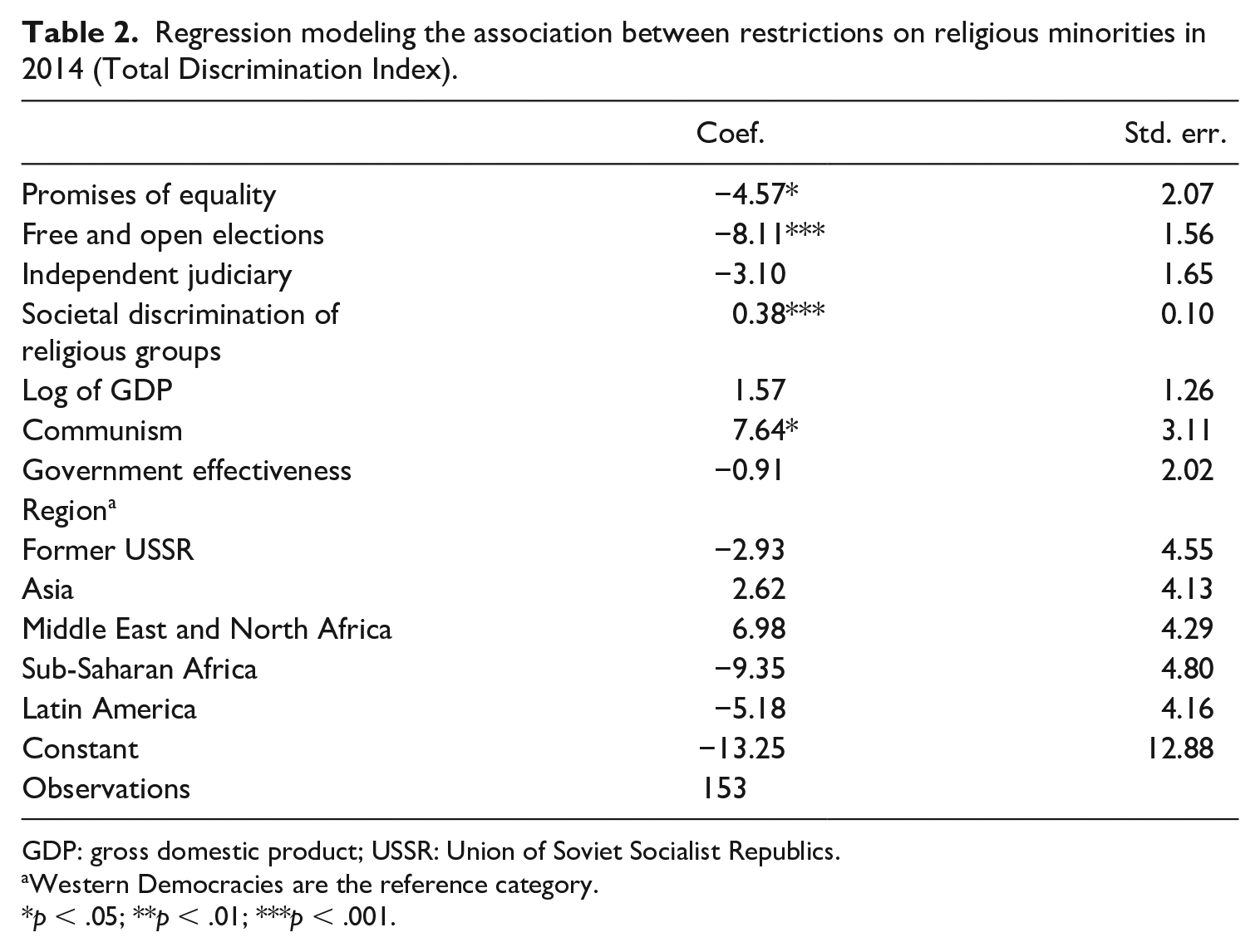
GDP: gross domestic product; USSR: Union of Soviet Socialist Republics.
Western Democracies are the reference category.
p < .05; **p < .01; ***p < .001.
Second, we utilize two additional regression models to test whether this relationship holds for institutional and non-institutional discrimination against minority religions. Rather than presenting the results separately, we compile these first three models (Total Discrimination, Institutional Discrimination, and Non-Institutional Discrimination) into a figure demonstrating the estimates and ranges for each of the independent variables (Figure 1). This allows for a concise comparison and a visual presentation of the relationships the three discrimination indexes hold with constitutional promises of equality, governance measures, and our other measures of interest.
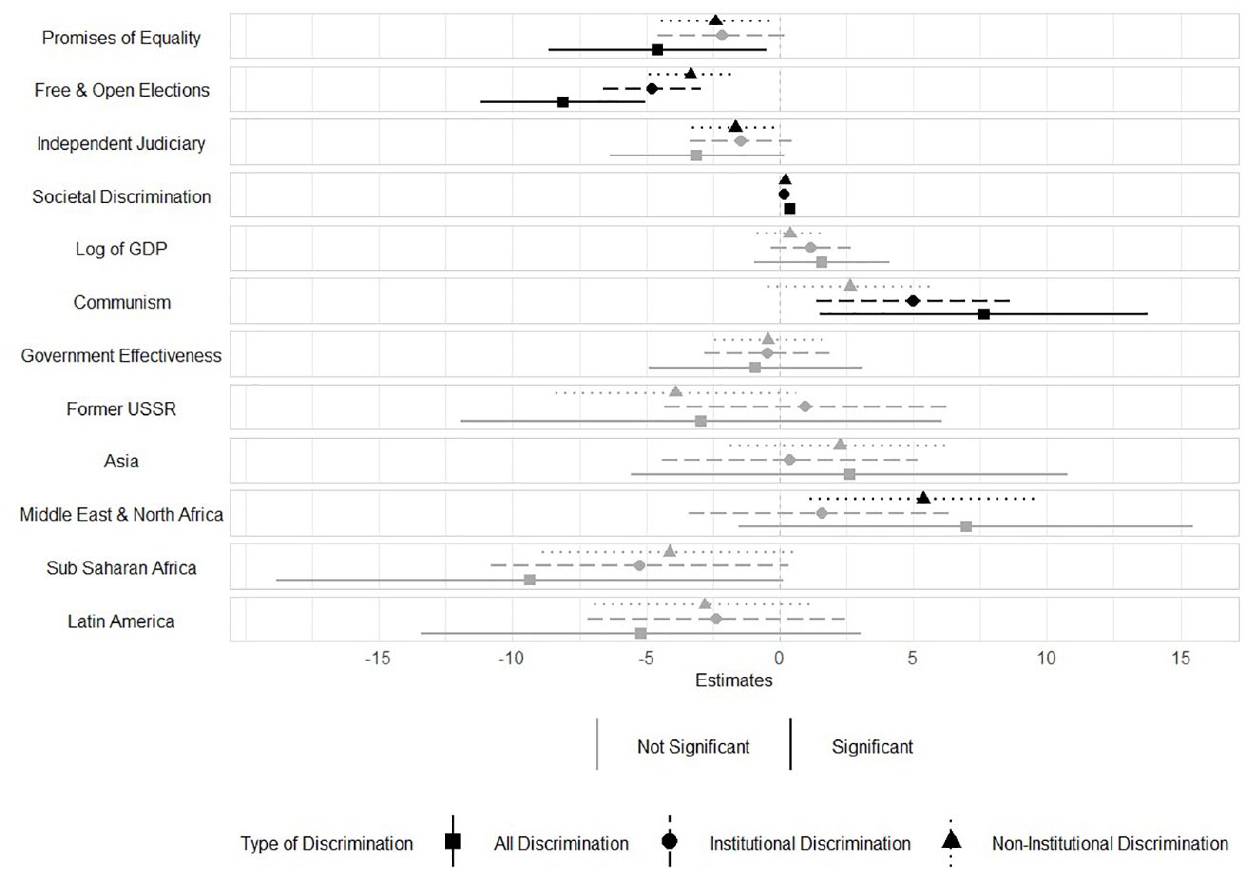
Predicting discrimination of religious minorities.
Finally, we conduct models with interactions between constitutional promises of religious equality and the governance measures of free elections and an independent judiciary. Rather than presenting the full results, we include two figures (Figures 2 and 3) which display how promises of equality interact with each governance measure to predict the level of non-institutional discrimination against religious minorities. The results shown in Figures 2 and 3 control for all of the variables from Figure 1 except for the global region. 8
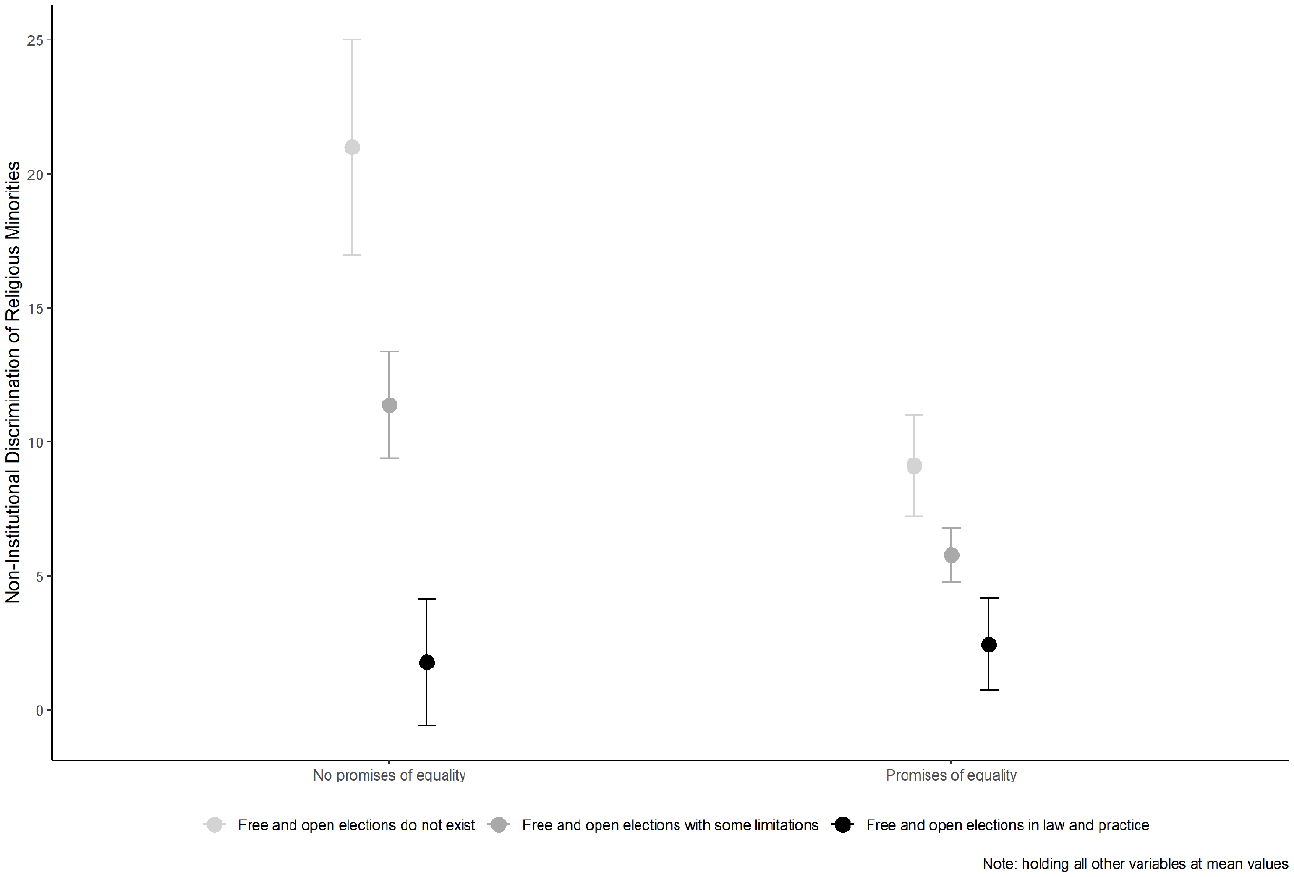
Predicted level non-institutional discrimination of religious minorities. By constitutional promises of religious equality interacted with free and open elections.
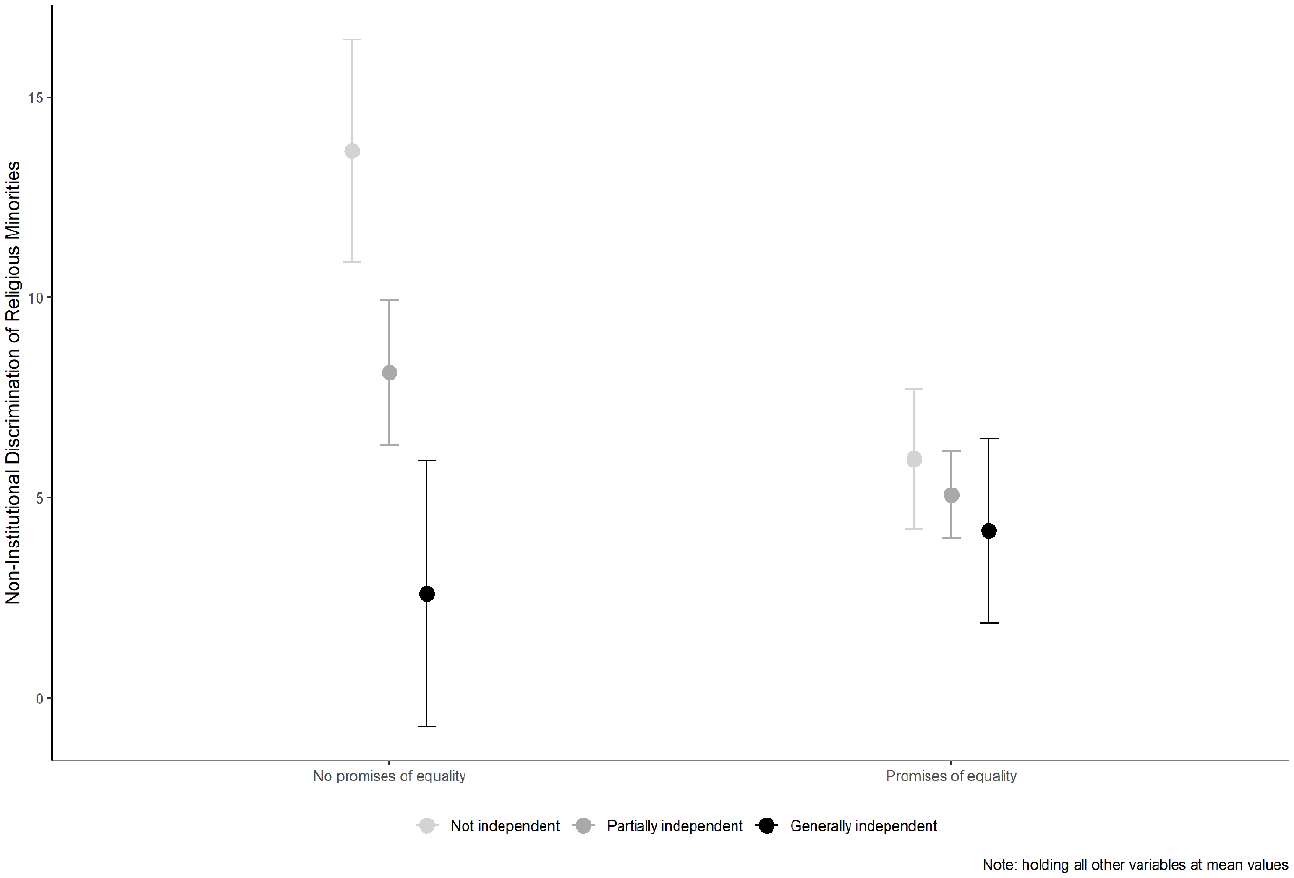
Predicted level of non-institutional discrimination of religious minorities. By constitutional promises of religious equality interacted with independent judiciary.
Promises of equality and discrimination
Table 2 offers an initial test of Hypothesis 1. When using our index for all discrimination against religious minorities, a constitutional promise of religious equality is a significant predictor of reduced discrimination (coef. = −4.57, p = .029). This finding holds even when we account for the regions of the globe. Table 2 offers partial support for Hypothesis 3. The coefficient for free and open elections is highly significant (coef. = −8.11, p < .001), but the coefficient for an independent judiciary is not (coef. = −3.10, p
Institutional versus non-institutional discrimination
Hypothesis 2, however, proposed the relationship between religious equality and reduced discrimination existed for the individual members of religious minorities rather than for their institutions. The results testing this hypothesis are presented in Figure 1. This figure visually presents the results from Table 2, as well as the results for the Institutional and Non-Institutional Indexes of discrimination. The independent variables are listed along the y-axis, corresponding with the regression coefficients and the range of confidence intervals. When reading Figure 1, the hollowed shapes correspond with the estimated coefficients while the bars represent the confidence intervals at the 95% level. Coefficients are significant when the bar does not cross the vertical, dashed line. 9 Effectively, Figure 1 presents the range of predicted coefficients (confidence interval), or the predicted direction and strength, of each variable. In the case of promises of equality, the predicted range is consistently negative for both the Total Discrimination Index as well as the Non-institutional Index. Conversely, the results for the Institutional Index are predicted to fall somewhere between –4.6 and 0.2. Thus, we cannot be confident promises of equality reduce the predicted level of restrictions for religious minorities.
Our results are therefore supportive of Hypothesis 2 when we separate the full discrimination index into Institutional and Non-Institutional indexes. The relationship between promises of equality and the level of restrictions directed at members of a religious minority are consistently negative, with an expected decrease of about 2.4 points in countries with promises of equality when accounting for other country characteristics (p = .022). As stated earlier, the predicted coefficient, or relationship, between promises of equality and Institutional discrimination is not significant (p = .077). The remaining findings are similar to those shown in Table 2. Supportive of Hypothesis 3, free and open elections are a significant negative predictor for all three indexes and the independent judiciary does have a significant, negative relationship for non-institutional discrimination. Societal discrimination remains a strong predictor of increased state discrimination for all three indexes, but current and former communist governments fail to reach significance for the Non-Institutional Index.
Promises of equality and government structure
Table 2 and Figure 1 demonstrate that constitutional promises of equality and a nation’s governance, especially open and free elections, are strongly associated with reduced discrimination against minority religions. We propose, however, that understanding the relationship between constitutional promises and governance is important. How effective are constitutional promises when free elections or an independent judiciary are lacking? In short, how do the two interact to predict levels of discrimination? To assess these interactions, we conducted additional models presented in Figures 2 and 3. 10
The interaction plotted in Figure 2 contrasts the strong relationship between free elections and reduced religious discrimination for nations with no promise of equality to the largely absent relationship for nations with a promise of equality. The differences are striking and highly significant. Whereas, nations with no free elections have a discrimination score of 21 when there is no constitutional promise of equality, the score plummets to 9 for nations when there are constitutional promises but without free elections. A similar, though less drastic, difference also occurs for countries with a limited free and open election system. By contrast, countries with open and free elections have a low score in countries with and without constitutional promises of religious equality. Even when free and open election is absent, constitutional promises of equality are associated with significantly reduced levels of discrimination.
We found similar patterns when we looked at the interaction between promises of religious equality and an independent judiciary (Figure 3). For nations with no promises of equality, the absence of an independent judiciary results in a predicted index score of 14. For nations with a promise of equality, however, the score drops to 6. While not as strong as the interaction between promises of equality and election structure, the figure demonstrates the importance of constitutional promises when an independent judiciary is not present.
Both Figures 2 and 3 find even when governance protections are absent, the constitutional promises of equality offer protections for the minority religions. Countries without free and open elections or an independent judiciary hold high levels of religious discrimination when constitutional promise of equality is absent. When a country makes a promise of equality, however, the differences are essentially erased between countries with and without these key governance structures. 11 Thus, unlike promises of religious freedom, promises of religious equality are associated with practices of equality even in the absence of governance structures to monitor these promises. This pattern further suggests there is a clear difference between constitutional promises of religious equality and promises of religious freedom.
Discussion and conclusion
Despite clear and convincing evidence that constitutional promises of religious freedom hold only a weak or no relationship with the state’s support of religious freedom, we find constitutional promises of religious equality do matter. Analyzing data on 153 countries with a population of more than 500,000 and supporting a written constitution, we find promises of religious equality are associated with reduced levels of state discrimination against religious minorities. We suggest that because major international documents on human rights stress religious freedom, countries face more international pressure to borrow or mimic clauses from these documents in their own constitution. In contrast, clauses on religious equality are not included in these documents. We also noted equal treatment is often easier to support. The RAS discrimination indexes are measures of equal treatment: restrictions the state imposes only on minority religions.
We proposed, however, the relationship between the promise and practice of equality for religious minorities would be greater for individual members than for the religious institutions. The findings were supportive, with constitutional promises holding a significant relationship with reduced non-institutional discrimination and an insignificant relationship with institutional discrimination. We concede the differences between the coefficients appear small, yet for Institutional discrimination, a relationship is not significant, unlike for non-institutional discrimination.
We also found promises of equality have important interactions with our governance measures. The interactions indicate promises of equality help compensate for the absence of both free elections and an independent judicial system in reducing the predicted levels of discrimination against religious minorities. Our findings demonstrate regardless of the type of discrimination (Total, Institutional, and Non-Institutional), the relationships between governance structures and higher levels of discrimination were largely absent when the constitution held a promise of religious equality. In other words, constitutional promises of equality effectively erased the differences between countries with or without these key governance structures.
The remaining measures included in our models reinforce some important past findings. First, societal discrimination against religious minorities often goes hand in hand with state discrimination. Like other state actions toward religion, social pressures can fuel discrimination against religious minorities. Second, nations with a current or prior communist government place more restrictions on religious minorities. For many countries, the communist government is two decades removed, yet higher rates of discrimination against religious minorities linger. Third, unlike other human rights, GDP and government effectiveness do not hold a strong relationship with reduced discrimination in the area of religion. Although the correlation between the rights of religion and other human rights remains strong, important differences occur in their sources of support.
When reviewed in tandem with existing research, our findings raise a series of additional questions and issues. First, we know a little about the consequences of equal treatment. Recent work has found that ‘state support of religion and discrimination against minorities encourages terrorism from majority religious groups’ (Henne et al., 2020) in Muslim majority countries. How is equality related to other forms of violence and in countries that are not Muslim majority? Second, our findings reviewed discrimination against all religious minorities, but previous research has found that the level and type of discrimination varies by the religious minority (Fox, 2020; Fox et al., 2019). How do the size, religious tradition, and historical legacy influence the discrimination a minority faces? Third, as noted earlier, equal treatment does not always ensure favorable treatment. Questions remain on the relationship between the equal treatment of religions and the level of restrictions the state imposes on all religious groups. Fourth, earlier we noted the varied motives for discriminating against minority religions. Do some motives supersede constitutional promises more than others? For example, do states use perceived security risk as a justification for increased discrimination? Finally, why do the significant predictors of religious discrimination and religious freedom differ from other human rights? This research established that differences occur, but fails to address ‘why’ they occur.
Yet, our research has taken us one-step closer to addressing and understanding the questions and issues just reviewed. We have found that constitutional promises of religious equality are associated with less discrimination against religious minorities; religious institutions benefit less from the promises than the institutions’ members; and that promises of religious equality help compensate for the lack of governance structures (free and open elections as well as an independent judiciary) that protect religious minorities. In short, the constitutional promises of equality are far more than a ‘mere parchment barrier’, even when considering other political and social conditions.
Footnotes
Funding
The authors received no financial support for the research, authorship, and/or publication of this article.
Notes
Author biographies
 ), and co-author of The price of freedom denied (Cambridge University Press, 2011).
Address: Department of Sociology, Pennsylvania State University, 211 Oswald Tower, University Park, PA 16802, USA.
Email:
Address: Sociology and Anthropology Department, North Dakota State University, Minard Hall 428, Fargo, ND 58102, USA.
Email: