




Abstract
Discussing the social construction of the phenomenon of exorcism, this article illustrates how it is located in contemporary culture and specifically in the religious field. Following the study done by Michel de Certeau on the mass possession of the Ursulines’ convent of Loudun (France) in the 17th century, the authors differentiate between the ‘possessed’ and the ‘possessionists’, that is between those who are possessed by the devil and those who are convinced of the reality of possession.
Although the authors cannot claim that there has been a growth of possessed people, they make the claim that there has been an increase of ‘possessionists’ through the over-policing of the devil: the more the over-policing of the devil is practiced, the more people are likely to become ‘possessionist’ and believe in the increase of the presence of the devil.
Introduction
What does it mean when people believe they are confronted by the supernatural in their everyday life and understand it to be demonic? For this article, we are following the social rather than theological definition of exorcism used by Sluhovsky (2007: 35–36), that is ‘exorcism is defined as a curing technique against evil spirits that have taken over a possessed person, an animal, or an object’. This definition is in line with the work of sociologists of religion who tend to use a methodological agnostic approach when conducting research. This means, for example, that we do not analyse the veracity of these claims from a theological perspective.
We are studying what people do with or against this belief, and what this belief does to people. In this sense, we are following de Certeau (2005) who makes a difference between the ‘possessed’ (those who claim to be possessed by an unwanted spirit) and the ‘possessionists’ (those who are convinced of the reality of possession but who are not necessarily claiming to be possessed). In opposition, we find the ‘anti-possessionists’. In his study of Loudun in France, de Certeau (2005) referred to people who witnessed the mass possession of the Ursulines’ convent in the 17th century. They admitted that they were faced by some ‘extraordinary’ events but could not explain them. They were seeking a rational explanation to what they had observed but were not able to get one. They argued instead that science was not developed enough to shed light on this. This was a matter of time for reason to develop and provide the correct answers.
This article will not delve into an analysis of what exorcism is from a psychological or medicinal point of view and will not address the anti-possessionistic discourse. It will, on the other hand, focus on the possessionists’ view point. Although we cannot claim that there has been a growth in possessed people, we will make the claim that there has been an increase of possessionists through the over-policing of the devil process, or in other words, the increase in the number of people believing in possession caused by, among many factors, the increase of professionals dealing with exorcism. Our claim is that the more religious professionals are seeing the devil, the more people will see it.
Our research method follows what Garret (1974) has called a Phenomenological Noumenalist approach. The approach followed within this research admits subjective reality as an independent variable in social analysis and focuses its research on the consequences of belief and behaviour generated by religious experiences. This school has its roots in the work by Rudolf Otto (1936), a German theologian, philosopher and historian of comparative religions who focused his research on the non-rational aspect of the religious dimension. Being both theologian and scientist, his purpose was to embrace the scientific paradigm and the religious interpretation of the world. He sought to determine the kind of rationality that is relevant to religious study and found in Kant the pertinent pair of noumenon and phenomenon. The noumenon is, in the philosophy of Immanuel Kant, the thing-in-itself (das ding an sich) as opposed to what Kant called the phenomenon, the thing as it appears to an observer. Though the noumenal holds the contents of the intelligible world, Kant claimed that human’s speculative reason can only know phenomena and can never penetrate to the noumenon. The phenomenological noumenalist school accepts the noumenal as irreducible experience and as producing effects at the individual and social levels. It is also worth noting from the work of the anthropologist Goodman (1988: 107) that demonic possession is not just about scary stories but can sometimes involve some actual and disastrous physical and psychological changes.
While the literature is full of cases of possession and witchcraft (for example, Cohen, 2007; Favret-Saada, 1991; Hirst, 1982), this article focuses only on cases of exorcism in late modernity. It does not deal with rituals welcoming someone’s possession by a spirit or putting a stop to a witch’s spell, but concentrates instead on practices of expulsing the spirit from a possessed person. While specific work on exorcism has been conducted by, for example, Cuneo (2001), Goodman (1988), and Hunt (1998), this article reveals for the first time in the literature the results of an analysis of the file of an exorcist written over a ten-year period. This type of data has never been explored and as such, this research brings a new understanding to the fore. Furthermore, this article asks why the belief in the devil and exorcism has increased in late modernity, especially since the previous research mentioned above.
In the US, Gallup polls show belief in the devil has increased from 55 percent in 1990 to 70 percent in 2004. Baker (2008: 218) uses data collected by the first wave of the Baylor Religion Survey from 2005. In his analysis, Baker discovered in the US:
African Americans tend to have a stronger belief in religious evil than do whites. Women have a stronger degree of belief than men. Net of religious controls, younger Americans hold stronger belief in conceptions of religious evil than older Americans. Finally, social class plays an important role in how certain an individual is about the existence of religious evil, with those of higher social class having weaker confidence about the existence of religious evil. However, these effects are conditioned by church attendance. For those exhibiting a high level of participation in organized religion, the influence of social class is neutralized. For those not actively participating in organized religion, the influence of social class is more pronounced. (2008: 218)
More relevant to the discussion of this article, 59 percent of respondents in the Southern Focus Poll of 1998, which had a sample of 1,200 people, agreed when asked: ‘Do you believe that people on this Earth are sometimes possessed by the devil?’ (Rice, 2003). In the second wave of the Baylor Religion Survey (2007), 53.3 percent agreed and strongly agreed when asked: ‘Is it possible to be possessed?’ Among those who attend church once or more every week, the percentage rose to 77. Republicans (65.9%) are more likely than Democrats (42.7%), and Protestants (62.9%) are more likely than Catholics (53.3%), the ‘none’ (19.5%) and the Jewish population (3.6%) to agree and strongly agree with this statement. In another part of the world, and according to the Association of Catholic Psychiatrists and Psychologists, there would be a half -million people in Italy undergoing an exorcism per year (Baglio, 2009: 7).
Popular culture, especially in the 1973 film The Exorcist and the account of Malachi Martin’s (1992) Hostage to the Devil: The Possession and Exorcism of Five Living Americans (Cuneo, 2001) have greatly impacted on bringing back the belief in exorcism in the Western world. However, rather than seeing this as a factor causing such renewed interest, it might be more appropriate to see instead these works as a catalyst to wider social and cultural changes brought about by late-modernity than the cause.
This system of beliefs must also give reasoning as to why people would be affected by these spirits. For example, although the Canons for the 17th century Church of England with regards to exorcism were repealed in 1969, a revival in the interest of this phenomenon has re-emerged from the Church hierarchy as New Age movements (seen as a manifestation of uncontrolled spirituality) were growing.
The historical research of Sluhovsky (2007) in medieval Europe is of great interest for us to understand our contemporary situation. Sluhovsky discovered in continental Europe that before exorcism became bureaucratised and codified in the 17th century, it was a common practice conducted by lay people (for example, guaritore and magara in Italy, Zauberer in south Germany, devin and guérisseur in France, Ensalmadore in Spain and Curandeiro in Portugal) and priests. Almost like a mass deliverance rally, people used to go on pilgrimages and stay for days to be cured from the devil or their ills. It is only in the 17th century that the task of the exorcist became professionalised and codified. In a Catholic country, one then had to follow the regulations of the Vatican. It was also around that period that Catholics used to perform exorcisms to validate the strength of their religion (as a form of propaganda) while protestant groups were on the rise. However, what Sluhovsky also brings out in his research is that around the same time a growth in spirituality occurred (i.e. quietism) and it was believed that when untrained people got in touch with their spiritual self they became more vulnerable to attacks from the devil. With the increase of practitioners of this new spirituality, the number of what was seen as possessed people increased. We can see here a parallel with our current period and the beliefs that with the growth of spirituality (especially alternative) there is a higher probability for people to be the victim of the devil.
On this point the exorcist we interviewed (see below) was very clear: ‘People are more vulnerable to Satan’s attacks because they play at “spiritual experiments”, which have to do with the occult and magical practices’. And the search for alternative spiritualities, according to our exorcist, increases people’s vulnerability to the possibility of possession. In his opinion, belief in the contemporary world is not in crisis since people are willing to believe anything, from horoscopes and magicians who predict the future to the effectiveness of certain occult practices that communicate with the afterlife. These people are not aware that such practices, sometimes done for fun, endanger their lives and in severe cases can give rise to evil. ‘It is therefore not the believing that is in crisis’, the exorcist told us, ‘but the faith in God, in his power, as it is revealed in the church’. As if to say that the mere fact of straying from the safe boundaries of the religious institution, albeit with the best intentions to follow a path of spiritual quest, hides unexpected dangers.
Although previous research has indicated the increase of exorcism in late modernity as an outcome of the increase of horror literature and paraphernalia, alternative spirituality and other social conditions such as the increase of individualism and the erosion of religious authority, we are questioning this further increase in the 21st century. Rather than only seeing an exponential increase based on the same factors we are putting forward a new element. Our article raises the question as to what impact the increase of religious professionals since the last quarter of the century has had on this increase of beliefs.
Before investigating the specific phenomenon of exorcism, we will first explore the social construction of the devil, or unwanted spirits. This will lay the theoretical foundation of this article which treats this phenomenon as a social construction. We will then introduce the concept of ‘over-policing’ to explain the increase in this belief since the beginning of this century. We will then explore a case study of a catholic priest who has practiced exorcism over a ten year period to shed light on our argument.
Social constructionism: Ghosts or demons?
With regards to what possession means for people, we can draw two broad types of reaction: exorcism aiming to expel the spirit and ‘adorcism’, a term borrowed by Lewis (2009) from Luc de Heusch, which deals with its reception. The decision with regards to defining this spirit as wanted or unwanted can be sociologically bounded. For example, in male-dominated societies in which women’s spirit possession religious groups abound, the spirit is often interpreted as maleficent and exorcism can be used in this context to control and subjugate female practitioners.
Research on possession cults in which people may dance in honour of their possessing spirits have been studied at length by anthropologists and sociologists (for example, Cohen, 2007). These researches on ‘adorcism’ deal with people in dialogue with the spirit. Often, counselling, orientation, guidance, clairvoyance, and healing are the practices provided in this form of possession.
Returning to exorcism in particular, we argue that it is part of popular religion, which is affected by social constructionism. Within this perspective, defining religion and popular religion can be seen as a site of power in which groups try to impose their personal view and impose their agenda, such as rejecting ‘pagan’ practices from medieval Christianity, or authenticate miracles and shrines. In certain contexts, some groups need to distance themselves from the ‘popular’ and enforce a difference between these two types of religions in a kind of power struggle to create semantic, if not physical, boundaries. Needless to say, these struggles can also lead to physical and/or legal conflict. There is a great deal of literature on new religious movements, such as cases in which there is tension between members who see their group as religious, and outsiders who do not. The uses of the definition of religion are situational and can be highly variable (Beckford, 2003: 25).
It is for reasons such as this one that Beckford (2003: 13), following a social constructionist approach, argues:
religion is … a particularly interesting ‘site’ where boundary disputes are endemic and where well-entrenched interest groups are prepared to defend their definition of religion against opponents. The history of anti-witchcraft movements in many parts of the world, particularly the Inquisition, is powerful evidence of the deadly length to which some interest groups go to enforce their definition of ‘true’ religion.
Exorcism is indeed an interesting ‘site’ within this wide religious ‘site’. It has always been part of popular religion, but was also sometimes part of official religion as well (for example, from the time that The Rituale Romanum was formally approved by the Vatican in the 17th century until the Age of Reason). One of the first conditions for exorcism to be socially constructed is that a belief system must be in place to support the existence of spirits and to claim that these spirits are in need of being expelled. In Christianity and Islam, possession is very often seen negatively. In these religions, the possessing spirits are seen as demonic and the possession is seen as an involuntary intrusion. For example, Oesterreich (1930: 326–328) details how the fathers of the Church such as Origen and Augustine interpreted the ancient Greek oracles as demoniacal. In Islam, the ruqya (Touag, 2012) was instituted to eliminate the interference of the djinns who already existed in pre-Islamic society. For some other religious perspectives where possession can be more of a voluntary intrusion, spirits are not necessarily good or bad but instead are ambivalent agents who are unpredictable. They can commit both good and bad actions. There are also variations within a religion, especially when it comes to defining what an act of exorcism means. It can vary from a practice of deliverance (such as a mass deliverance rally from some charismatic groups or as indicated by the Christian Deliverance Study Group from the Church of England (Milner, 2000)), which is about freeing and healing people or places from Satan (in this instance a person might be said to suffer from an affliction rather than a possession), to the Catholic ritual of exorcism which deals with people possessed by the devil.
If we focus on the social history of Satan we find in Wray and Mobley (2005) a shift in the conception of this creature took place between the two testaments. Originally, Satan was only a low-level cosmic lackey and only became the character we know today in Jewish apocalyptic thought between 200 BCE and 100 CE. It is only in apocalyptic books such as the Book of Enoch and the Book of Jubilees, and then in The New Testament that we meet Satan as the prince of demons.
If we turn our attention to the social history of ghosts in Britain we find in Davies (2007) that before the invention of purgatory, the walking dead could not exist in Christianity. Only God had the power to resurrect so if it was claimed that ghosts had been seen this was explained as the devil playing tricks. These were puppet cadavers used by the devil to make us believe there were spirits of the dead. In the 14th century and with the establishment of purgatory, ghosts were no longer strictly part of this satanic theory of reanimation but could be spirits of the dead in waiting. Tension between official and popular religion of course needs to be taken into account here. With the reformation, the idea of purgatory was rejected and belief in ghosts became synonymous with Catholicism. Even if the English Canon Law forbade exorcism in 1604 and considered these practices as Catholic superstition, it did not prevent Protestant clergyman from being asked to perform what was called to ‘lay’ spirits, instead of exorcism. For many, ghosts were again not real but associated with diabolic witchcraft. In the 19th century the social construction of these phenomena shifted again:
From a historical perspective we can see how, as a social and psychological strategy, possession became less pertinent and potent by the nineteenth century as the currency of diabolic intervention weakened both intellectually and in popular culture. The concept of ghost infestation, by contrast, continued as a vibrant and widespread belief (Davies, 2007: 177).
Today, within the Church of England, we find in the research of Milner (2000) that in their deliverance ministry, some activities are designed to deal with ghosts and poltergeists, as well as with Satan.
This exploration demonstrates the social construction of the supernatural and the importance of history and sociology in deciphering historical broad trends. However today, the interpretation of what is a ghost has become even more fluid. As Baker and Bader (2014: 570) state:
While spirit concepts are cross-cultural, the narrative content given to experiences of beliefs about spirit is highly flexible, molded into culturally specific expressions. In the United States, media with paranormal themes and content have never been as varied or widely available as they are at present.
The over-policing of the devil
During modernity, and in the Western world, the belief in spirits went into decline. Cases of exorcism still existed but to a far lesser extent than in the Middle Ages, and especially among the clergy. If religious experts do not believe in exorcism it will be harder, but of course not impossible, for lay members to believe as well. The theology of that time had to follow the direction imposed by the Age of Reason, and expressions of popular religion were not received positively.
Indeed, as Marsh (1998: 11) explains:
modern culture places a high emphasis on the acquisition of knowledge, and upon the development of clear, personal beliefs that can be held in one’s mind and articulated to order. … again, it may be a mistake to transport this emphasis back into the sixteenth century [and other pre-modern centuries], where it often seems that ordinary people were not at all obsessed with intellectual knowledge and verbal articulation. … Religion for them was not principally about careful, intellectual attention to questions of belief.
As modernity developed, religions became affected by these new waves of ideas based on reason which increased the gap between official religion and popular religion even more. Theologians became adept at using the tools of the rationalists to systemise and codify their belief systems and thus build a stronger conceptual gap against popular religion. Official religion had to be rational, formal, planned and systematic and was against the syncretic aspect of popular religions. What made this conceptual gap between official and popular religion grow even stronger, even if both types of religion were somewhat moving towards the same direction, is that all official religions were working on distancing themselves as far as possible from popular religion and any forms of syncretism to remain a credible way of thinking during modernity.
In the Age of Reason, God was seen as a lawgiver, providing the structure to all of life through rules and regulations that everything from stars to the smallest thing, including humans, had to follow. God was rational and made reasonable demands of creation. Theology had to stand the canons of reason, and mystical expression was viewed with suspicion (Bouma, 2006: 89).
However, we have been witnessing over the last couple of decades a reversing trend in this part of the world. The Catholic Church, for example, after having attempted to denigrate aspects of popular religion within its faith, such as by eradicating some of its processions, blessings, and now exorcist activities (Voyé, 1998), is now re-evaluating its cult of saints and the Virgin and is supporting it more strongly. The Vatican has also renewed an interest in exorcism and is catering for the formation of new theological trained experts. This renewed interest of the practice of exorcism has led to an increase of professionals in these rituals, and as such, as we will argue below, a greater belief among the population that this phenomenon exists. Here is an account about the Anglican Church:
Some Anglican clergy, recognizing the waning of the church’s influence and aware of the continued social currency of ghost-belief, have realized that re-engagement with the popular experience of haunting is one small way of maintaining their relevance in society. In 1974 the ordained Anglican John Richards, secretary of the Bishop of Exeter’s Study Group on Exorcism, commented: ‘Had I, even in the nineteen sixties, ventured to suggest that exorcism should be a small but real part of the Church’s ministry of healing, most opinion – even informed opinion – would have dismissed the suggestion as medieval superstition’ (Davies, 2007: 245)
Moving to the Catholic Church in France, in 1999, after the new ritual of exorcism, the number of exorcists increased from 15 to 120 (Muchembled, 2000: 9). In 2010, a new exorcist was appointed by Sydney Catholic church (Morris, 2010) and more recently, the Vatican has officially recognised under Canon Law the International Association of Exorcists. It has developed since the creation of the association of exorcists in Italy in 1991 and today has 250 exorcists across 30 countries (Vatican Insider, 2014). Baglio (2009) reports Pope John Paul II making a public reference in 1986 to the dangers of the devil and the real possibility of ‘bodily possession’ and Pope Benedict XVI encouraging a large group of exorcists to continue their work. The Vatican updated the exorcism ritual in 1998, the first change since 1614.
For more than 10 years Italy has played a leading role in organizing and systematizing the fight against the devil, and this not only because the number of exorcists has substantially increased in the country, but also because several dioceses have officially opened special offices dedicated to receiving people who feel possessed. Seminars have also multiplied to prepare the exorcists for their mission, and almost always such initiatives get considerable attention in local and national newspapers. The diocese of Milan, one of the largest dioceses in the world with more than 1,000 parishes and 5 million inhabitants, has more than doubled the number of exorcists in the last 10 years, passing from 4 to 10 priests engaged in such rituals. Moreover, since 2012 the diocese has opened an office with a specific telephone line, where every day a person is available to address those who need to contact the nearest exorcist.
Although it is difficult to make an accurate count of the number of exorcists in Italy, we may say that, since there are very few dioceses that do not have one, they are likely to largely exceed 300. In Sicily alone, 41 exorcists may be counted, more than all those in the United States and Canada combined. Since 2003 the Sicilian Episcopal Conference have organized a training meeting every year to help the exorcists in their ministry and invited those who feel disturbed by the presence of the Evil to participate in seminars of prayer which also include liberation and healing rituals.
Among the Pentecostals, we see a rise of charismatic deliverance ministry, as led for example by Bob Larson who is known for his mass exorcism and deliverance over the radio. He is also behind the new phenomenon of Teen exorcists. Three young women (one of them being Larson’s daughter) follow him on his mass exorcism tours and make his rituals more appealing and glamourous to a young audience. In Drozdowicz (2013), we found that Larson created an online course on exorcism, in his International School of Exorcism site. It offers three levels (the apprentice, the warrior and the exorcist), and the certificate is signed by Larson himself. Drozdowicz (2013: 104) grounds this phenomenon in the field of American folk religion and claims that:
The commercialisation of religious experience, including its extreme exemplification of the ritual of exorcism, constitutes in this regard the result of economic rationalism of the activities of religious leaders, preachers, or charlatans of all sorts, who aspire to be authority figures in the field of new spirituality.
This increase of leadership in the fight against the devil is not happening in a vacuum. As Bouma (2013: 151) states on leadership in general, it ‘can draw on and will be shaped by existing trends and expectations. Leadership can lead against the trend only to a limited degree. The socio-cultural context makes a substantial difference to the directions open to a leader’.
But what of those who are not institutionally religious, not irreligious, and interested in supernatural pursuits? As studied by Baker and Bader (2014), one outlet is paranormalism. They find in their research that paranormalism attracts young people whose religion is privatised and de-institutionalised, and provide flexible cultural concepts to understand the other world. In the three sub-groups they studied, they discovered different narratives with regards to the fluid understanding of the supernatural. There are also experts in popular religion (including New Age or alternative spiritualities) who deal with issues of possession, including channeling (Possamai, 2005).
To shed light on this, we are proposing to use the term over-policing. This concept has been used in a different field of study by Perry (2006: 416) as ‘disproportionate attention to real or perceived or potential criminal activity suspected of racial minorities’. While the large focus of this process has indeed been applied to minority groups such as indigenous peoples in Canada and Australia for example, it is not limited to an ethnic group. In its broader sense it makes reference to far above average police activities on an individual, group or community. There can be a disproportionate number of police at a location, or continual and repeated arrests of a high proportion of a targeted group for trivial offences (Cunneen, 2001). Some social commentators tend to see this presence as a cause, rather than as a reduction, of crime. For the sake of this article, and while not disregarding the situation in which some ethnic communities are poorly treated by society at large, we are going to employ this concept as a sociological tool to continue our analysis.
Baglio (2009) and Cuneo (2001)’s works detail at length how many religious leaders not only observe the activities of the devil taking place in everyday life (for example, horror movies, role playing games, Harry Potter stories, Heavy Metal) but are also active at reporting them. By reporting the activity of the devil in people’s everyday life, and by having more professionals (within religious and paranormal groups) being formed to conduct such an act, there is a likeliness that a religious believer would become a possessionist as well. The more the over-policing of the devil is practiced, the more people are likely to believe in possession and exorcism (that is, become possessionists) and in the increase of the presence of the devil. The point of this article is that there has been an increase in the belief in the devil and exorcism rather than an increase of the devil’s presence itself.
Case study
While conducting an interview with an exorcist in 2015, we were informed that this Catholic priest had been performing these activities for close to 10 years. After 40 years of teaching philosophy at a well-known Catholic University, when he was due to retire he was asked by his bishop to become the exorcist of his diocese, one of the most important and populated dioceses in Southern Europe. His case is of particular interest because his rational approach led him to look with some suspicion and disenchantment at many phenomena associated with Satanism and possessions, and then to be an exorcist who practices his role with an attitude that we could define as more ‘scientific’ rather than ‘fideistic’ (see below).
He showed us a Word document in which he kept information on everyone who made contact with him, what his assessments were, and the outcomes of their visits. His detailed document was not only dealing with a theological assessment but with some socio-demographic data as well. The document was not intended for sociological analysis, but nevertheless, it did provide some significant insights in this practice. As such, in the field of sociology and religious studies, this is the first time we have had such a large amount of data on this phenomenon. The research in this field usually involves theological analysis and court case analysis (for example, when the exorcism went wrong (Goodman, 1988) but never the exorcist data file. The large file is close to 200,000 words and we asked for all names to be removed. The data was then coded and analysed.
Over this period of time, the exorcist provided consultations for 1,075 different cases (see Table 1). By cases, we make reference to a combination of people coming on their own for themselves or others (n=802; 74.6%), and people coming accompanied by one person or more (n=272; 25.4%). These consultations do not include other possible sessions such as the exorcist going to the home of the patients for blessings, or communication over the phone or e-mail, or the various rituals performed. These are thus meetings/consultations with patients to hear their problems, to discuss possible steps to take, and to provide recommendations.
Number of consultations
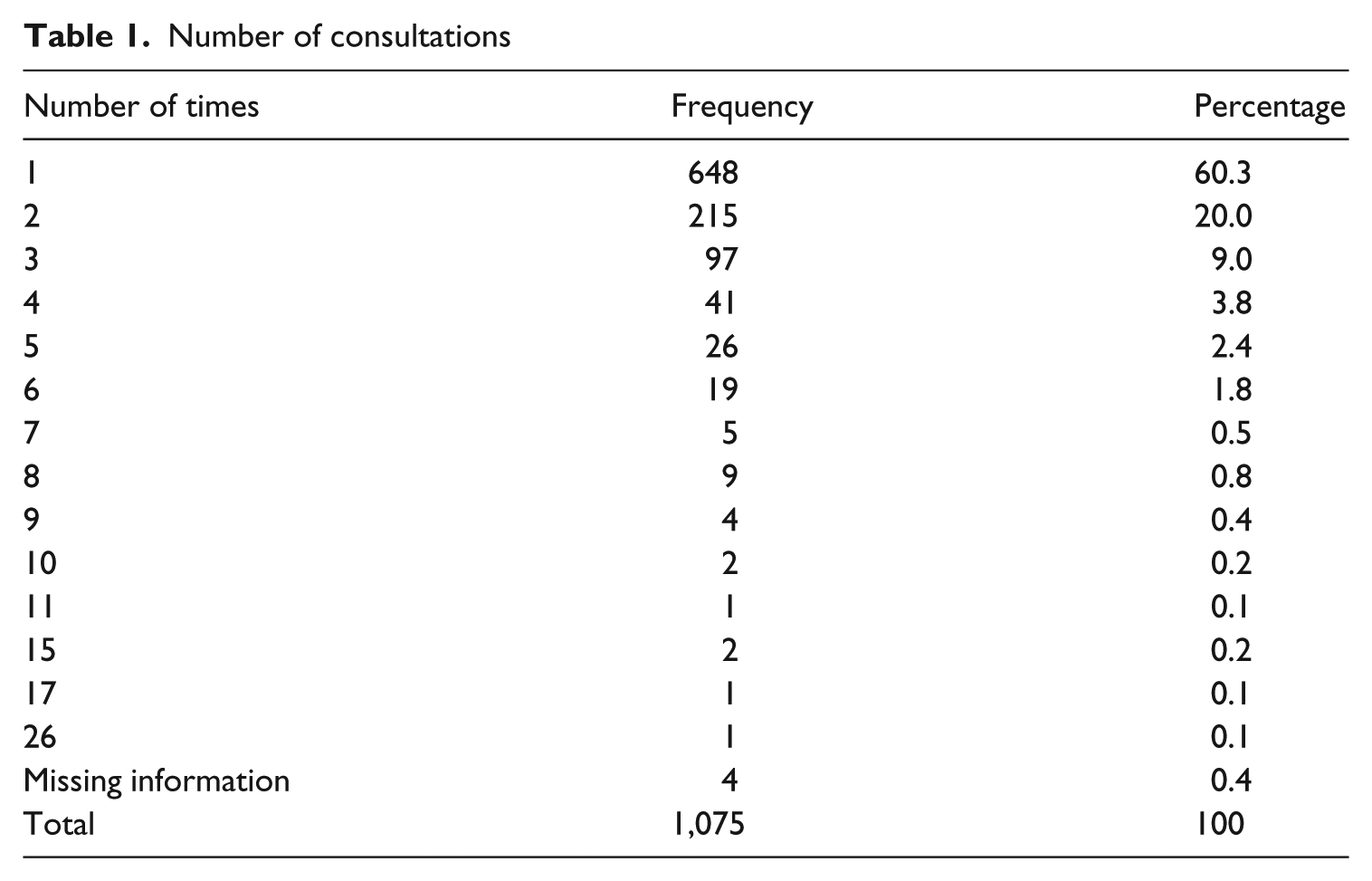
648 people (60.3%) only came for one visit, 215 for 2 (20%), and 97 for 3 (9%). As seen in Table 1, one person had 26 consultations.
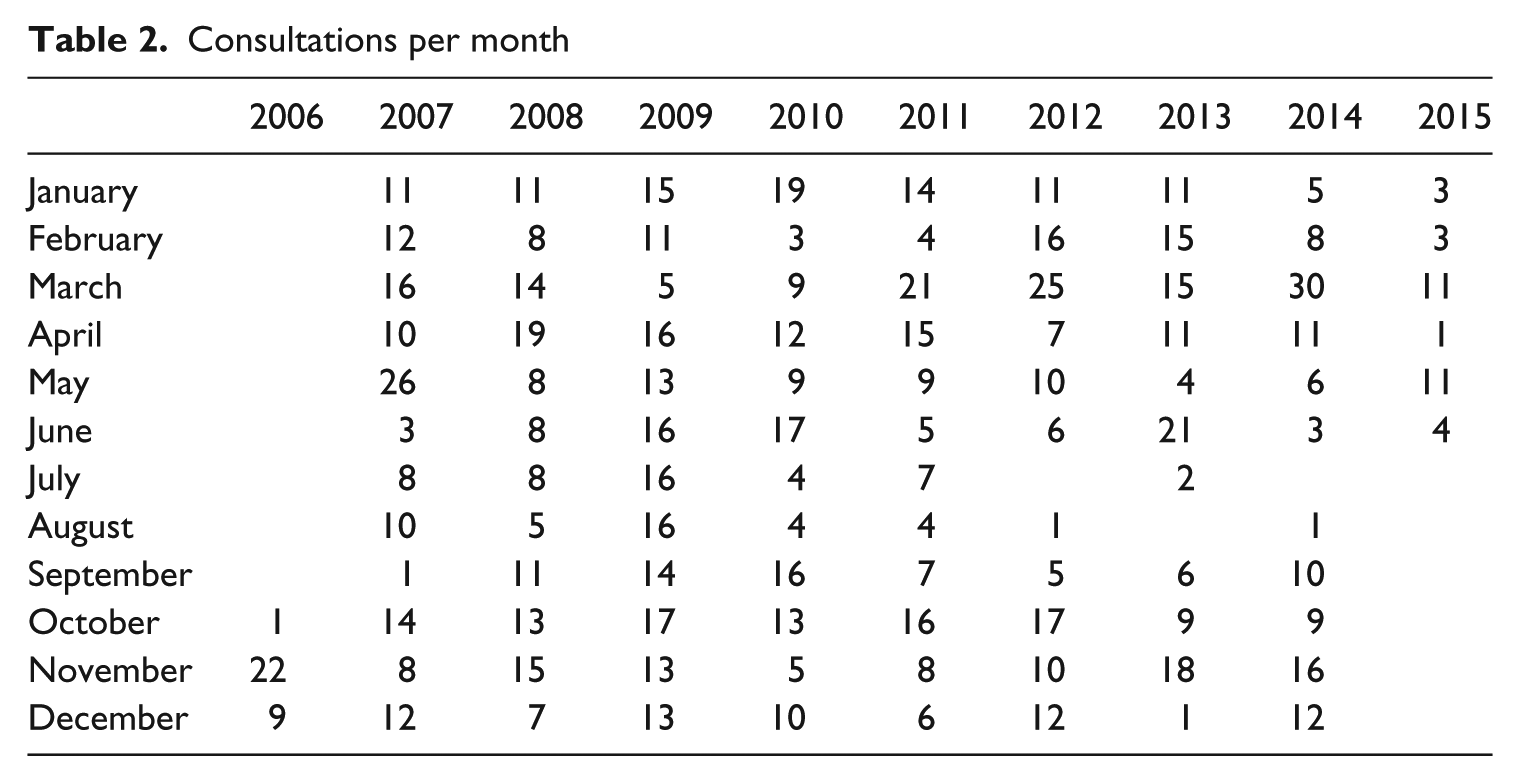
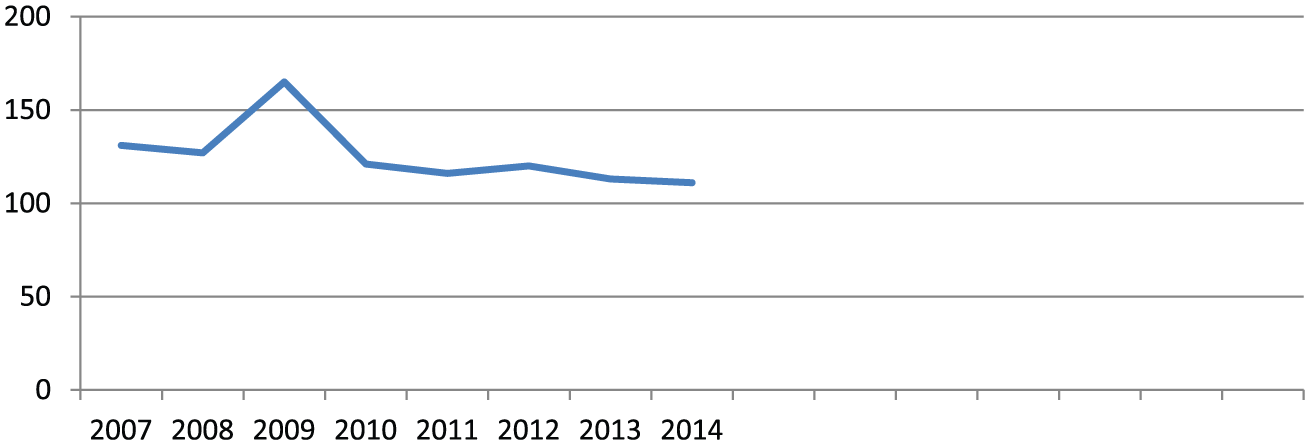
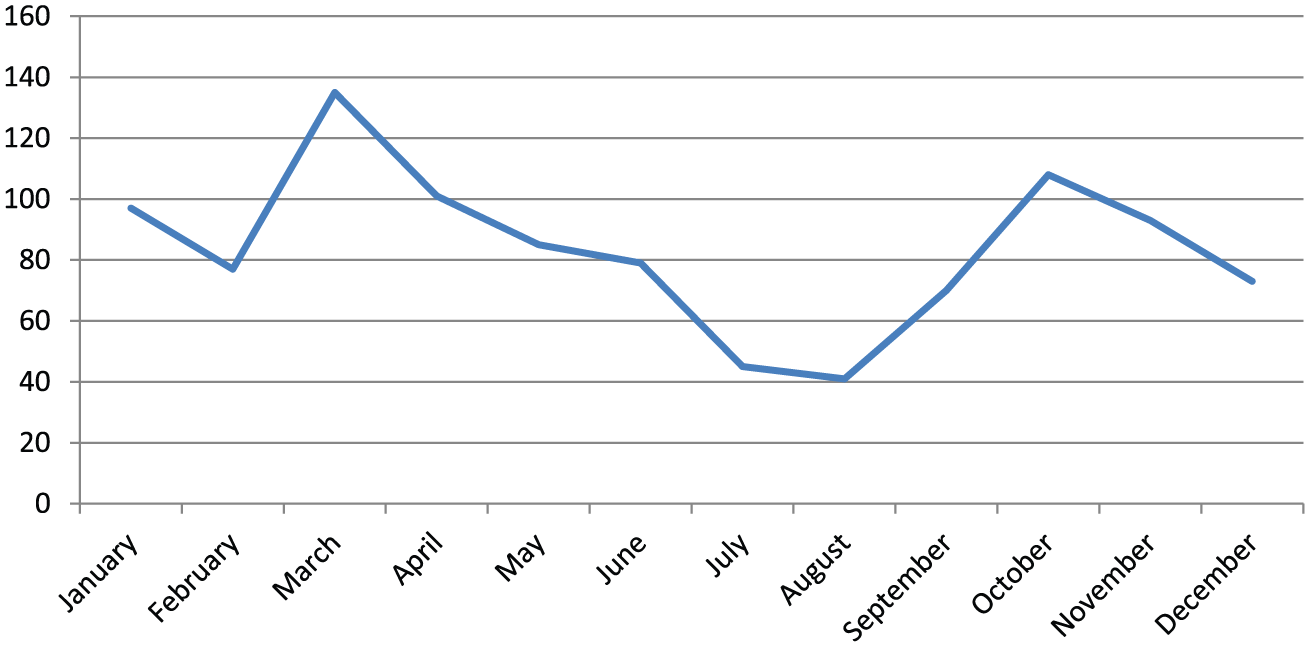
To analyse if there has been an increase of people coming to see this exorcist, we tabled the number of visits per month in Table 2 and then converted the data into graphs. Figure 1 shows the number of first consultations per year has remained steady between 2007 and 2014 with a peak in 2009. There is a slight decrease in 2014, which as the interview indicates, is due to the ageing exorcist trying to slow down, and trying to find a helper who would later replace him. Figure 2, on the other hand, reveals that peaks tend to happen in two specific periods in the year, in March–April, and in October–November. The first peak appears to be around Easter and the second around All Saints’ Day/Halloween. Although we cannot claim empirically our statement about the policing of the devil using this data, except for the year 2009, we can argue instead that at a certain time during the year, rather than across the year, there is an influx of people consulting this exorcist. Around the time of Halloween there are often discussions in the media about occult activities and we are assuming talks against the devil abound. This should be mapped out in the media, but it is beyond the scope of this article. The exorcist we interviewed draws on theology to explain the increase around the Easter period: ‘Easter is the triumph of the resurrection, that is, the victory of life over death, of good over evil, and this is triggering the anger of the devil, that attacks with more strength weak people precisely in this time of year’.
Consultations per month
Initial consultations per year
Consultations per month
According to him, Satan is aware that the final resurrection at the end of time will be his final defeat, and for this unleashes his anger. The same reasoning also works to explain the increase of consultations around the feast of All Saints, as he states: ‘The saints are the people who show how the evil does not have the last word, but it is destined to eternal defeat’.
The exorcist mentioned in the interview that he refuses to perform the ritual of exorcism without being certain of the possession. He told us about other practices in which other Catholic exorcists would perform the ritual without being certain that people are possessed. He even described a scene in which some rituals were performed in public in a small town centre with an orchestra and singing.
In this regard, he argues that a ritual of exorcism of a non-possessed person can be even dangerous, because it could convince her/him to have within her/himself the devil even if this is not true.
Indirectly, therefore, although this is not explicitly stated by our interviewee, the uncontrolled spread of the practice of exorcism contributes to the spread of the belief of the devil’s presence, and increases the chance that people believe they are possessed or influenced by evil forces.
While it is not the point to analyse the different professional practices of exorcism, we can claim in this article that the information provided by this exorcist reflects a more legal-rational form of authority and practice, rather than a more charismatic one. We are here making reference to Weber’s classic idea-types of authority, and of course, both types above, include traditional authority. We are thus claiming that the exorcist in this case study is more in line with an institutional interpretation of his religion than a popular one. The data collected from another type of exorcist could have provided different insights.
For 140 cases (13%) the exorcists recommended the client seek a psychologist, and for 5 cases, some medical services (0.5%). For the rest of the cases, the exorcist recommended the practice of other rituals such as blessings (n=206; 19.2%), confession (n=16; 1.5%), some religious homework (n=500, 46.5%), prayers (n=188, 17.5%), and rituals of liberation (n=142, 13.2%).
The data collected by the exorcist are very detailed with regards to the development of the blessing, liberation and exorcism rites. His notes also include some personal stories of the individual ‘patients’ and their past or ongoing drug therapies. In particular, the annotations of the exorcist always dwell upon analysing the patient’s family history in depth, going back two or three generations, and this shows an approach to the problem that tends to locate the cause of the current problem in past experiences, either of the patient or of the family unit.
Among the 1,075 cases present in the exorcist’s document, only 55 were found necessary to intervene with one or more exorcisms. Although the records are far from uniform, it is possible to identify a few trends and also a few elements useful for further study.
Focusing on these 55 cases of exorcised people, we can see that they are mostly men (60% of cases). Two patients are less than 20 years old; 5 patients are young people aged from 20 to 29 years and as many are adults/seniors (60 and older); 56% are aged between 40 and 49 years; the young adults (30–39 years) are 12% and 11% are between 50 and 59 years old.
The exorcised people mostly belong to the working class and lower middle class; there are only six cases of professionals/graduates. The patients present themselves alone or, much more often accompanied by their spouse or the parish priest. However the exorcism ritual is usually practiced with the help of assistants in charge of praying and/or physically holding the exorcised individual. Seventy percent of the cases take place in the presence of one or more family members; only in 30% of cases the patient preferred not to involve any family members. The involvement of the family members in the ritual of exorcism, but also in all the accompanying path of the patient, is advocated by the exorcist himself, who can gather new details and information on the patient and on his relationship with relatives and friends. The exorcism usually takes place in a chapel intended for this purpose, but not infrequently the exorcist also enters the patient’s home to bless objects and rooms suspected of being inhabited by evil spirits; on these occasions it may also be necessary to perform a ‘home’ exorcism.
Those who are exorcised usually turn to the exorcist on the advice of some priest or monk. They are being faced with problems in their working/professional field or can suffer economic disaster, harassment, physical and psychological illnesses, depression, loss of affections, violent impulses, marriage problems, sexual disorders, obsessive thoughts. The causes may also have been identified in a presumed spell or curse cast upon them. In 28 cases out of 55 (51%) the medical history shows how, in the face of headaches, genital and vaginal disorders, serious diseases, financial difficulties, fatigue, depression, inner malaises, diseases of their children, to which property damages can be added (noises, pipes breaking, water entering the house from the walls, slamming doors etc.), the patients explicitly speak of ‘suspect evil eye’ and ‘suspect evil spell’. The exorcist’s questions then are aimed, among other things, at trying to pinpoint who precisely in the family and friends entourage may have cast the evil eye or a curse or have been the medium of a possible demonic possession.
In 4 cases, the request for help is from the people or family units who do not feel possessed but who believe their homes are haunted by evil spirits. In two cases out of ten, the reason why the exorcist was contacted belongs to the sphere of those disorders considered to be personality problems: the patients are sometimes already treated by psychologists and psychiatrists for perceived ‘deviant sexuality’ (among which the exorcist even associates homosexuality with feelings of guilt and identity crisis), bipolar depression, obsessive mania, maniac-depression, obsessive-compulsive disorders, etc. Sometimes it is difficult to distinguish between personality disorders and episodes considered of sensitive and mediumistic nature by the patient or by his family entourage.
Precisely in the difficult attempt to distinguish the psychological disorder from the devilish presence, the exorcist works closely with a trusted psychiatrist to whom he sends his patients. Some patients immediately accept the advice of the exorcist. The data show how 21 patients out of 55 (38%) take psychotropic drugs and antidepressants even during their treatment with the exorcist.
While talking to the patient, the exorcist pays substantial attention not only to the family relationship dynamics, but also to the presence in the family of ‘beliefs’ somehow related to magic or esotericism. In this type of anamnesis the exorcist seems to highlight how the suspected presence of the devil arises in family units or in personalities in which, already in the past, this kind of paranormal intervention was referred to in order to explain supernatural phenomena or odd events of life. In 20% of cases, the exorcist and patient identify in the family tree (or with a neighbour, or with the mother-in-law) the presence of a person, usually a woman, renowned as a witch, medium, satanist, sorceress who had launched an evil eye or participated in Voodoo or Wicca rituals. Six percent of the patients believe they have paranormal gifts (for example, hearing voices, murmurs and perceiving strange presences). Before turning to an exorcist, 51% have participated in séances, esoteric rituals, black masses, ‘peasant magic’, blood pacts, rites with invocations to Satan and satanic music, or have turned to magicians, fortune tellers, gurus, holy men, dowsers, pranotherapists, and sects.
Twenty-eight percent of the patients have sexual disorders (for example difficulty in accomplishing the sexual act in marriage or, on the contrary, having obsessive sexual desire), sometimes also as a consequence of episodes of abuse suffered within the family in their childhood. In 41% of the cases the presence of highly religious people in the family is evident, with an approach to the sacred that in some cases the exorcist himself defines ‘devotional’ and ‘excessive’, a type of devotion that would have a negative influence on the patient.
Thirty-three percent (18 people out of 55) feel a strong and violent repulsion to the sacred and turn to the exorcist also for this reason: they retch if they receive Holy Communion, they belch or feel as if suffocated when entering a church, they feel sick if they try to pray; and then they obviously suffer, or feel the suffering of their relatives, because they cannot satisfy their desire for spirituality through the traditional practices proposed by the Catholic religion.
The number of exorcisms practiced on each patient varies greatly from person to person: ranging from a minimum of one exorcism, after which the person is liberated or during which it is possible to understand that ‘there is no need for it’, to a maximum of 354 exorcisms practiced in 9 years on the same person. In the analysed period of time 62% of the patients are subjected to a number of exorcisms ranging from 1 to 10; 14% are subjected to a number of exorcisms ranging from 11 to 20; 13% from 21 to 50; two people (4%) from 50 to 100. Four people need a number of exorcisms greater than 100: one patient received 354 exorcisms in 9 years, one, 144 in 5 years, one, 112 in 5 years, one, 108 in 4 years, with a peak of 40 exorcisms in a year. And none of the four can be said to have been liberated.
Actually the liberation does not always occur. In 40% of cases (22 people) the patient appears to have recovered, been freed from possession, and does not need any more exorcisms, even if this does not mean that diseases, depression, misfortune or the need for psychiatric drugs is over. 25% (14 people) continue to be subjected to exorcisms, either because liberation has not occurred or because relapses have occurred. In 22% of cases (12 people) the patient withdraws never to be seen by the exorcist or, in most situations, it is the exorcist himself who withdraws, considering his own efforts useless either because the family context appears to be ‘too polluted’, or because he does not find in the patient himself or herself the true will of setting himself or herself free, or because he finds the patient’s situation too ambiguous and intricate. For the remaining cases it is not possible to determine what the outcome of the exorcism is.
Conclusions
This case study highlights the fact that over a ten year period, a large amount of people (that is a set of 1,075 cases) went to consult an exorcist. To return to de Certeau (2005), these are possessionists. The amount of possessed people is far less, that is 55. Out of this sample, 4 have been in need of more than 100 rituals. Although we do not see a clear increase over this period of time, the data reveals a strong proportion of people who would make the effort to contact an exorcist. As this data set is unique, it is hard to compare and contrast it with other similar material. We can however be confident stating that we need to reconsider this phenomenon to be something other than minimal or marginal. We claim it is becoming more mainstream and normalised. While not forgetting other factors such as wider social cultural changes in late modernity, we argue that the increase of religious professionals in the field looking for the devil and being available for rituals of exorcism has had an impact, not specifically on the devil, but on people’s perception of the devil. Our argument is that by over-policing the devil, these religious professionals are reaching the population and greatly contributing to the increase of belief in the devil and the need to practice rituals of exorcism.
Footnotes
Author contributions
The article was jointly conceived in dialogue between both Authors. Possamai took the lead in writing the Introduction and sections 1 and 2; Giordan took the lead in writing the Case study and the Conclusions.
Funding
This research received no specific grant from any funding agency in the public, commercial or not-for-profit sector.
Author biographies
Address: Department of Philosophy, Sociology, Education, and Applied Psychology, University of Padova, Via Cesarotti 10-12, 35123 Padova, Italy.
Email:
Address: School of Social Sciences and Psychology, Western Sydney University, Locked Bag 1797, Penrith South DC, NSW 2571, Australia.
Email:
References
Supplementary Material
Please find the following supplemental material available below.
For Open Access articles published under a Creative Commons License, all supplemental material carries the same license as the article it is associated with.
For non-Open Access articles published, all supplemental material carries a non-exclusive license, and permission requests for re-use of supplemental material or any part of supplemental material shall be sent directly to the copyright owner as specified in the copyright notice associated with the article.
