



Abstract
Policing faces increased accountability measures, influencing officers to engage in “covering your ass” and over-documentation. In this qualitative study of police officers across three Canadian provinces, we unpack the “covering your ass” mentality by exploring the paperwork burden as an unintended consequence of movements toward greater policing accountability. We find that covering your ass leads officers to complete paperwork to protect themselves from personally being investigated. They use paperwork to ensure they overcome any legal vulnerabilities by justifying their actions and explaining their interpretations of other officers’ actions. We present policy implications of these findings tied to police accountability, the impacts of covering your ass, and the resulting paperwork burden.
Introduction
On September 19, 2021, the remains of the missing 22-year-old Gabrielle Petito were found after searching for several weeks. Petito had been murdered, allegedly by her partner, Brian Laundrie (Maxouris, 2022). On August 12, the police in Moab, Utah, were called in response to a domestic violence (DV) incident involving Laundrie and Petito. The responding officers interviewed both parties and learned that Petito had been the initial aggressor. Neither Petito nor Laundrie wanted to press charges; in response, the police separated them for the night and closed the file as “disorderly conduct” rather than filing the incident as a DV case and sending a copy of the report to the local prosecuting attorney’s office (Maxouris, 2022). Within 1 week of discovering Petito’s body, an independent investigator was tasked with conducting a complete evaluation of the circumstances surrounding the Moab incident (Ratcliffe, 2021). The subsequent report contains numerous findings concerning the officers’ actions, including: “I don’t believe the [officers’] reports were sufficiently detailed as it related to this investigation” (Ratcliffe, 2021: 41). Among the errors cited was a lack of photographic evidence of the incident, as well as a “number of details lacking from both officers’ reports as it related to the statements made by all those involved” (Ratcliffe, 2021: 28). Not surprisingly, one recommendation proffered was “at least 8 hours” of training on report writing (Ratcliffe, 2021: 44).
As the Petito case demonstrates, police paperwork has the latent function of providing a greater degree of accountability regarding police decision-making, particularly in spaces where the police exercise of discretion might otherwise be unknown or unknowable. That said, paperwork serves another key, largely unexamined, latent function: it provides individual officers and their organizations with opportunities to justify decisions made should any subsequent review or follow-up of those actions be necessary. Namely, at both levels of an organization, the police institution is uniquely aware that their efforts may need to hold up to later scrutiny and investigation. For individual officers, such scrutiny may also create legal vulnerabilities. As we demonstrate in this article, in response to real or perceived threats to their professional reputations, livelihoods, and legal jeopardy, officers engage in a well-known behavior: “covering your ass” (CYA). Said differently, paperwork is a derivative of CYA—CYA culture has always been a key aspect of policing and gives rise to excessive paperwork, which remains a source of stress for police officers.
In the current study, we unpack the “CYA” mentality as evidenced in paperwork processes that shape criminal justice institutions. We show that the police are responding to “CYA” both personally, in their occupational role, and collectively by providing information for criminal justice actors within the arms of the justice system (courts, police, and correctional services) to help these organizations overcome their own legal vulnerabilities. In this article, our emphasis remains on how the perceived need to protect themselves has dictated police actions regarding professional obligations and responsibilities and their positioning as they strive to maintain their occupation and community standing. Employing Merton’s (1936) conceptualization of the “law of intended consequences,” we frame this behavior as an “unintended consequence” of the move toward greater police accountability. The drive for greater police accountability, an apparent public good, has also, we argue, led to increasing amounts of paperwork. This “paperwork burden” (Ericson and Haggerty, 1997) results in fewer officer hours dedicated to active and primary tasks—such as patrol or investigational work—and can be a hidden cost to communities (Huey et al., 2016).
Accountability: Old and new
As with many concepts in the social sciences, there is no singular definition of “police accountability.” Instead, we have a myriad of explanations, several of which have sprung up as a result of what Walsh and Conway (2011) describe as a “significant industry” that has led to a substantial body of research, training seminars, commissions of inquiry, public policy documents, conferences and so on, all of which, they suggest, “are continuing to expand rapidly” (p. 61). Some of these definitions contain multiple overlapping elements, while others do so less. And, in certain instances, as Cheung (2005) observes, “accountability has mistakenly been used interchangeably with words such as responsibility, responsiveness, and answerability” (p. 6).
In no small part, this melange of definitions can also be attributed to the fact that accountability is used for a variety of inter-related objectives, such as effecting organizational or institutional reform (Chan, 1999), controlling officer behavior (Ferdik et al., 2013), maintaining or increasing police legitimacy (Kochel and Skogan, 2021), improving police-community relations (Chan, 1999), and facilitating citizen oversight of a public institution (Terrill, 1988). Then, police accountability encompasses both positive and negative (meaning suppressive) activities. That said, much of the literature in the area has tended to focus on accountability as a series of legal, bureaucratic, and other tools aimed at eliminating problematic institutional and individual behaviors, including racism, excessive use of force, corruption, and police shootings (Baer, 2020; Deuchar, 2021; Ferdik et al., 2013; Punch, 2009; Skolnick and Fyfe, 1993). For our study, we employ a multi-purpose definition recently proffered by Feys et al. (2018): police accountability entails oversight and the evaluation of police activities.
Throughout this article, the framing of accountability as a set of actions is focused on effecting change along two dimensions of policing—the institutional and individual levels—is deliberate. We are following in the well-worn steps of scholars such as Samuel Walker (2005), who observed, in his work on the “new” police accountability, that Police accountability has two primary dimensions. On one level, it refers to holding law enforcement agencies accountable for the essential services they deliver: crime control, order maintenance, and miscellaneous services to people and communities. At the same time, however, it also refers to holding individual officers accountable for how they treat individual citizens, particularly with regard to the use of force, equal treatment of all groups, and respect for the dignity of individuals. (p. 33)
Ransley et al. (2007) also put forward a similar conceptualization; they reference the “fluid” dual mandate that police—both individuals and organizations—be fair and effective in delivering services. Concerning police misconduct, a central concern of this literature, we see the duality in discussions of the appropriate locus of accountability efforts, framed alternatively as a problem of “rotten apples” versus “rotten barrels” (or “orchards”) (Punch, 2003; Sherman, 1974; Skolnick and Fyfe, 1993; Stark, 1972). One of the more illustrative examples of how the apple-barrel metaphor has been operationalized to explain institutional versus individual causes of misconduct, and, therefore the site of possible reform efforts, can be found in Skolnick and Fyfe’s (1993) evocative analysis of the Rodney King beating: More than 20 LAPD officers witnessed King’s beating, which continued for nearly two minutes. Those who administered it assumed that their fellow officers would not report the misconduct and were prepared to lie on their behalf. In this respect, police brutality is like police corruption—there may be some rotten apples, but usually, the barrel itself is rotten. Two cops can go berserk, but twenty cops embody a subculture of policing. (p. 12)
However, it is insufficient to simply attribute responsibility for malfeasance to an organization or institution for creating and sustaining an occupational subculture in which such behaviors are implicitly or explicitly condoned or even rewarded. Thus far, accountability discourse also involves identifying mechanisms to effect positive or negative change.
As earlier introduced, writing in 2005, Samuel Walker observed what he saw as a significant shift in policing due to what he termed “the new accountability.” An emerging emphasis on organizational change marked this shift as the necessary catalyst for improving police accountability and conduct. In support of Walker’s (2005) view, we could point out that issues with police misconduct have spawned various reform measures at institutional and organizational levels in the United States (US) and elsewhere over the past several decades. Such institutional-level efforts have included various commissions 1 and inquiries, 2 government and state-level civilian oversight programs, 3 and national and state-level funding opportunities 4 for police services willing to adopt progressive policing practices such as community or problem-oriented policing. Freedom of Information (FOI) regimes have also been implemented to enhance public accountability of policing and other institutions. Writing about the Canadian situation, Giacomantonio (2015) suggests such regimes serve as one tool for “making police practice visible” 5 (p. 55).
Historically, at the organizational level, courts have served as one of the primary mechanisms for addressing criminal and civil malfeasance in policing. Regarding the Australian context, Ransley et al. (2007) note, “an often overlooked factor is the extent to which civil litigation against police services can both highlight problematic practices, and provide a proactive, legal accountability tool that is largely independent of police organisations” (p. 143). Within and across police organizations, we have seen changes to the police recruitment and selection processes, ethics and integrity training, implicit bias training, and internal rules and accountability structures (e.g. Giacomantonio, 2015). More recently, we have witnessed increased adoption of body-worn cameras (BWCs), frequently justified by police and the public as an accountability tool.
Fostering and monitoring officer accountability at the individual level has been the focus of internal and external reporting and complaint systems intended to deter potential “offenders” and catch and punish criminalized individuals engaged in misconduct. More specific examples of these mechanisms include performance measures, department policies, internal complaint systems, and codes of conduct, most of which are oriented toward providing local supervisory controls to check behaviors (Ransley et al., 2007). Internal policies and processes have, however, been seen as ineffective by many (Reiner, 2010), in no small part because of the perception that such behaviors often go undetected or, when identified, receive minimal, if any, punishment when caught (Manning, 2010). Regarding the detection issue, one of the most descriptive and enduring metaphors for the low visibility associated with police work is Manning’s (1977) “sacred canopy of policing.” For Manning, writing in the 1970s, police decision-making at all levels of the organization occurs within a privileged social space within which they remain largely exempt from political scrutiny and thus accountability. Arguably—and Manning made a similar case in 2008—this has become increasingly frayed and torn due to often contemporaneous political and technological developments. To illustrate, look again at what has become a “signal event” in modern policing: the filming of the beating of Rodney King. The ability to record events as they happen marked a watershed time in the history of police accountability, ushering in what Andrew Goldsmith (2010) has termed a “new visibility.” As Goldsmith notes, and what most have witnessed, the prevalence of today’s mobile technologies, the ubiquitousness and reach of social media and video sharing platforms, and the constantly evolving technological capacities for capturing sound and image in even the most low-light of settings mean that scenes that might otherwise have occurred sub rosa can now be recorded and shared to millions of viewers in seconds.
In this “new visibility” era, practices that encompass CYA—long a staple, if understudied, aspect of policing culture and practice—are seen as being increasingly necessary for both police organizations and individual officers. In policing, CYA has previously been defined as actions taken to “protect your own interests and make sure that what is written expresses the best possible picture of the actions of the officer” (Manning, 2008: 459; c.f. Moskos, 2008). Manning is not the first to explicitly make this connection between risk avoidance and paperwork. In her study of police reforms and the introduction of accountability measures, Janet Chan (2007) similarly observed that for officers in her research, “accountability became synonymous with ‘paperwork’” which was employed by some as a mechanism for “covering their own bottoms” (p. 339). More recently, in a Canadian study of police officers using a mental health screening tool, it was noted that officers perceived the tool as useful because it provided a means of creating “a paper trail of their actions” for potential internal and external audiences, which the researchers (Sanders and Lavoie, 2021) termed “CYA” (p. 976). In this study, we follow the example provided by these researchers, similarly adopting a conceptualization of CYA as written actions taken to proactively justify officer decisions and to reduce real or perceived risks associated with increased surveillance of their work.
The law of unintended consequences and its relation to police paperwork
Unquestionably, institutional accountability is a public good, and any measures that can be shown to be effective in providing that good are justified. That said, we also have to recognize that any purposive action—even those ostensibly justified through reference to the public good—can run the risk of generating unanticipated consequences, both positive and negative. To date, the research literature on police accountability has focussed near-exclusively on the successes and failures of different internal and external accountability models and processes. Less considered—at least as an explicit focus of research—is the potential for such measures to produce unintended consequences.
Although a long-familiar adage in social sciences, the “law of unintended consequences” first came to attention as a sociological concept through the work of Robert K. Merton. Writing in 1936 on the effects of purposive social action, Merton noted that the complexity of the social world means there is always a possibility that any change in conditions could produce unanticipated outcomes, both negative and positive. Too often, as he observed, these outcomes are attributed to “ignorance,” as in “if we had only known enough, we could have anticipated the consequences which, as it happens, were unforeseen” (Merton, 1936: 898). For Merton, ignorance is only one possible cause. Others include errors in analysis, the presence of self or short-term interests, self-defeating prophecies and fundamental cultural, religious or other values and beliefs that might limit or change how an action is perceived and enacted on the ground (Merton, 1936).
Contrary to some issues that might generate one or two social responses, the desire for increased police accountability has spawned a range of measures and tools, each individually and cumulatively influencing adaptations in the social world and the policing institution. For example, as Cooke and Sturges (2009) note, the growing availability of content about policing on social media, while of benefit to communities, has also led to increased police investments in communication strategies for which taxpayers assume the costs. This is also the case with FOI requests: A freedom of information response published on the website of Cambridgeshire Constabulary calculated the total spent on marketing, external communications and press offices for the financial year 2007/ 2008 as £632,250; this was excluding the costs of responding to freedom of information requests, for which a further 2.25 members of staff were employed. (Cooke and Sturges, 2009: 420)
When most people think of police budgets, they think of frontline officers responding to calls or detectives chasing leads; They do not typically consider administrative burdens associated with responding to tweets or FOI requests.
Yet, the administrative burden and its impact on policing have been well documented by researchers (e.g. Cordner, 1979; Ericson, 1981; Webster, 1970), with much of the literature concerning paperwork (Brodeur and Dupont, 2006; Campbell, 2004; Ericson and Haggerty, 1997). For decades, police have decried what they see as an ever-increasing demand for paperwork. Historically, some have argued, including in Canada, that much of the paperwork demand has been driven by legal decisions, particularly decisions requiring police to provide materials relevant to disclosure (Malm et al., 2005). However, some researchers have previously documented the impact of “the new forms of accountability” on increasing officers’ paperwork burden: Accountability includes having to format knowledge to suit the purposes of these consumers, as well police openness to receiving from them knowledge concerning specific incidents, issues, and policy directions. As one of our police interviewees said, “As we move towards community-based policing, the requests for statistics and information will increase . . . There will be an increased need for information sharing . . . This creates more and more work.” (Ericson and Haggerty, 1997: 303)
Consistently, ethnographic observations—such as those offered by Ericson and Haggerty—make clear that after any action, police are to explain, rationalize, and justify their choice of behavior across paperwork obligations to create a paper trail that seeks to remedy any potential misconduct by presenting the course of action that has led to a legal positioning (Ericson and Haggerty, 1997; Huey et al., 2016).
Why is increased paperwork an issue, particularly if it leads to improved accountability? As noted, officers spend a sizable portion of their work time completing paperwork that provides them with legal recourse and responding to the paperwork demands from other criminal justice actors, who are trying to avoid legal vulnerabilities and public opprobrium. The outcome mandated administrative processes for police required to cover their own backs (e.g. individually and that of the organization) and larger justice systems (i.e. courts). Given such pressures, it is unsurprising that at least one review of case processing within a United Kingdom (UK) police service found that “the move to minimum file content” was “largely ignored” in favor of the construction of full dossiers, which were “unnecessarily compiled” (Campbell, 2004: 698). Campbell (2004) draws attention to the make-work project that is paperwork, mainly when paperwork is seen as a mechanism to protect the police as well as their sister institutions of justice from public scrutiny. The result remains an abundance of paperwork with no known purpose but many possible needs, each of which largely escapes the knowledge base of those who construct such paperwork (Huey et al., 2016). In short, and as we argue throughout this article, an unintended consequence of both new and old forms of accountability is that police are potentially over-producing data—arguably, with much of these data perceived as being of little practical value to police. To the extent that time spent on paperwork is time away from other frontline duties—notably responding to calls or engaging in proactive policing—demands for officers to repeat information multiple times in different formats are not negligible. Indeed, cumulatively, they have the potential to create resource pressures on police agencies and to produce increased policing costs for communities.
Methodology
Data materials
Data are from two mixed methods studies spanning three Canadian provinces/territories. The first study was conducted within the federal police service, which is responsible for policing in most provinces and all territories in the Atlantic region. The second was conducted with two municipal police services (one in Ontario and the other in British Columbia). These data involve 30 (n = 30) in-depth, semi-structured interviews with police officers (Table 1), each lasting around 1 hour, and ethnographic research consisting of around 150 hours of naturalistic observation recorded in field notes. In addition, each study included gathering examples of paperwork and computerized templates used by police officers with respect to the processing of different types of criminal offenses and other related community safety issues (i.e. traffic and vehicle safety). Finally, we collected for analysis any additional materials relevant to the topic understudied, including instruction manuals with descriptions on using police documentation and data systems (e.g. record management systems (RMSs)) and field training handbooks for officer trainees learning how to complete forms and document service calls. Thus, our materials involve a detailed view of police documentation practices and policies and the prevailing workplace culture, captured by both police perceptions and experiences and the formal and informal systems and processes.
Sample characteristics.
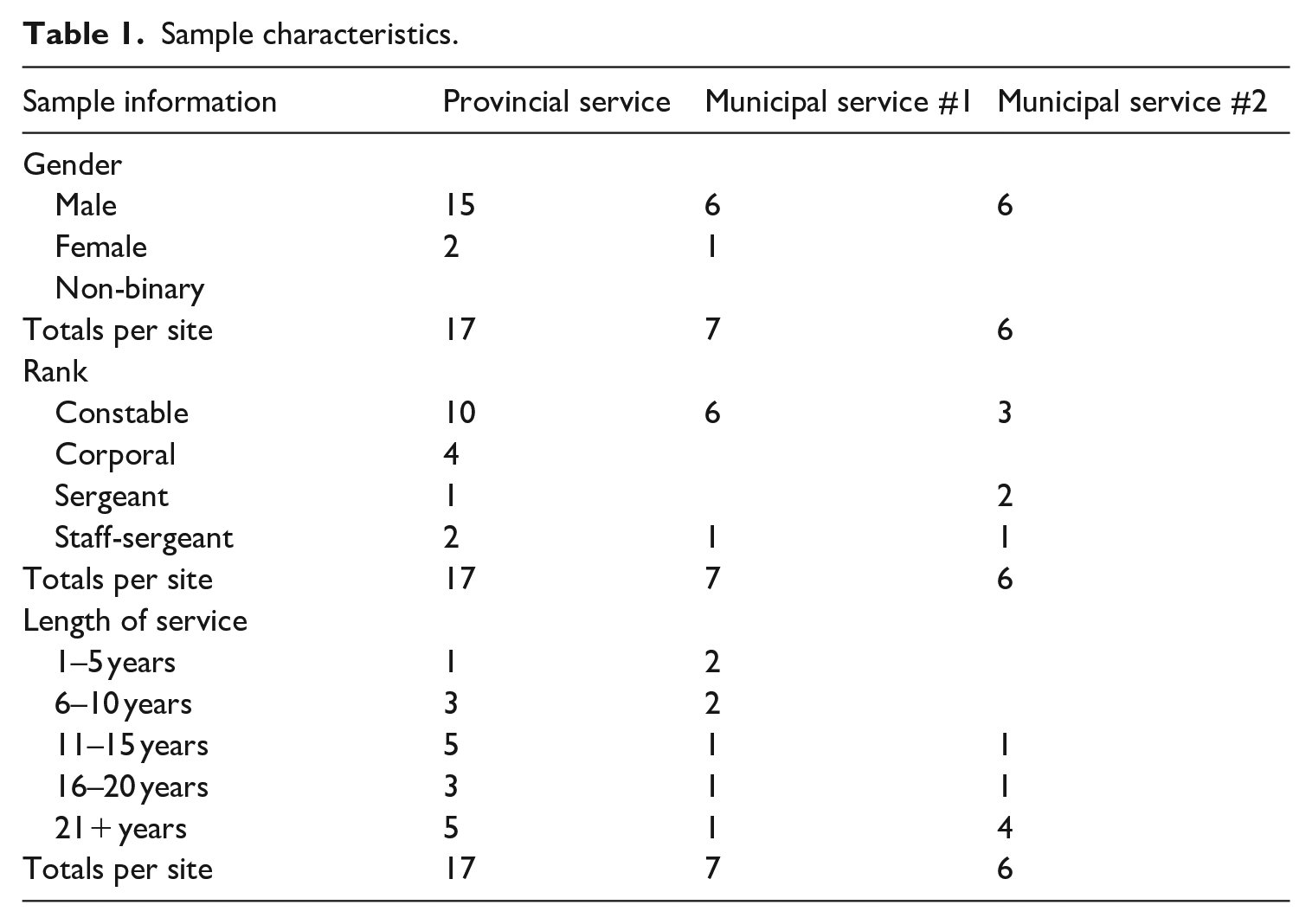
Study 1: Federal police service
In 2014, one of the authors initiated a 5-year research project focused on youth policing within the federal police service in Canada’s Atlantic region. The project aimed to evaluate and provide opportunities for constructing extra-judicial measures for youth who transgress the law to prevent youth involvement with the criminal justice system. Throughout the years this study ran, the research team carried out in-depth, semi-structured interviews with 104 police officers from detachments of the police organization across the province. 6 To do so, we used an interview guide containing questions in five main areas: (1) participant demographic information, (2) perceptions on youth crime, (3) attitudes toward youth policing, (4) the limitations and strengths of the policing environment and culture, including how this affects youth policing, and (5) operational stressors, including paperwork and documentation. We relied on this guide to ensure consistency in the topics covered while maintaining an informal and largely semi-structured, more naturalistic flow to the conversations occurring.
The interview sessions were conducted in English, audio-recorded, and then transcribed with the participant’s consent. They typically ranged from around 40–70 minutes, with most being about one hour long. On top of these interviews, 30 focus groups (n = 30) were employed as a part of this project to provide additional details on the experiences, perceptions, and attitudes. In total, the data set here included 134 officers (some participated in both focus groups and interviews). Field observations also secured additional data about our topic. One of the authors conducted fieldwork in a rural detachment for one whole working week during the day shift, while another author spent upward of 6 months in detachments across the region over the study period. During the observation period, the authors were involved with general duty (patrol officers) and had access to police commanders’ offices. Therefore, we observed the officers’ work during their daily shifts without restrictions. Afterwards, some recorded observations were shared with the studied officers to garner their feedback and verify the details captured for validity purposes, a tactic known as verification (Morse, 2002).
Study 2: Municipal police services
During field observation in Study 1, one of the authors observed officers growing frustrated in dealing with the volume and complexity of paperwork-related tasks. In subsequent interviews, she began to ask officers questions about their perceptions of their work. Their answers provided glimpses into one of the more mundane, and thus under-studied, aspects of public policing. Their answers also provided the impetus for Study 2, which allowed us to focus more acutely on data collection, handling, sharing and analysis processes in policing. To do so, we launched this research project in 2017, continuing until 2020, and involved one small- and one medium-sized municipal police service in Ontario and British Columbia regions. Similar to Study 1, Study 2 also conducted a mixed-methods analysis that blends interviews with fieldwork and document analysis. Interviews occurred in police stations and involved an interview guide; they were also conducted in English, audio-recorded, and transcribed. For Study 2, the guide focused on four principal areas: (1) the participant’s role within the police organization; (2) experiences with gathering, checking, and using crime data; (3) perceptions regarding the gathering, checking, and use of crime data; and (4) other opinions and attitudes toward factors that may impact the quality of police data. These data were accompanied by the researchers’ notes taken from field observations, consisting of around one hundred hours of fieldwork with general duty (patrol) officers in cars and on foot and bike patrol. In addition, during fieldwork, the author collected a range of pertinent materials, such as training handbooks and a selection of police forms.
Data analysis
To analyze these data, initially, the first author conducted an exploratory analysis of the interview and focus group data produced during Study 1 using open-focused coding. This inductive approach was undertaken to utilize these data to initiate the identification of major themes and sub-themes. For example, one central theme was “CYA culture,” which had sub-themes termed “accountability” (internal and external oversight) and “legal threat” (lawsuits or other external legal action). Thus, we subsequently employed thematic analysis. In line with the six-step process outlined by Braun and Clarke (2006), the first author then began conducting a more focused coding approach that allowed for the further development, comparison, and contrast of the initial major themes and sub-themes across the multiple agencies within the three provinces. This led to sorting and grouping these themes into “overarching themes” (Braun and Clarke, 2006), which were then named and defined. Once the first author finalized and completed the coding, the other two authors reviewed and independently verified the coding. Afterwards, the major themes and sub-themes were named and defined. Examples of themes are presented in Table 2. This approach was used for data abstracted from interviews, focus groups and documents. Documents were then grouped into ‘arrest type categories’—such as all documents related to “domestic violence” or ‘driving while impaired’—and further examined for overlap in information fields. As an example, “offense details” was a major code we used and tracked across multiple documents within groups.
Major theme and sub-theme code examples.
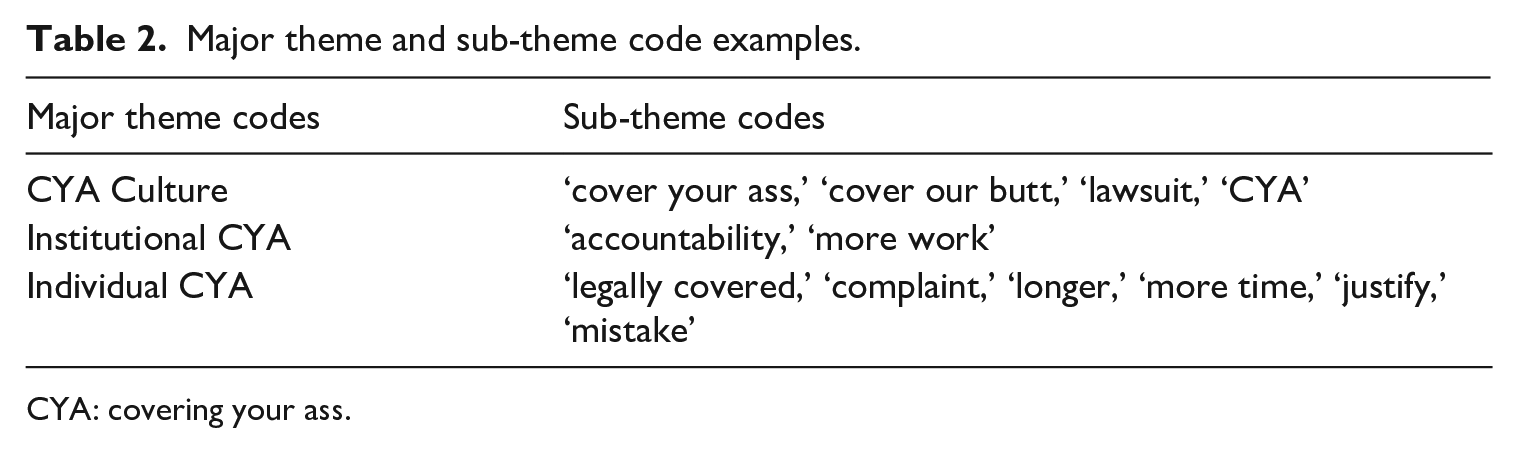
CYA: covering your ass.
We now turn to the results of this analytical process.
Results
“CYA culture” and its manifestations
Each participant in our sample complained about the volume of paperwork they were tasked with, and several cited paperwork as a frequent barrier to engaging in other duties, including proactive policing and community engagement. One reason for this imbalance was internal and external demands for ‘statistics’—that is, for knowledge that could inform policy and practice (and inadvertently shape police culture). Another reason repeatedly cited was “accountability,” that detailed knowledge of police actions would increase transparency and thus oversight by both police managers and governmental authorities. While, in theory, most of the officers in our study felt “accountability” was a reasonable goal, they also tended to see this goal as having morphed into something much more problematic: an organizational CYA mentality that had less to do with accountability and much more to do with “staying out of trouble” and being able to defend actions taken legally.
Participants provided numerous examples of the impact of CYA thinking in shaping police culture. For example, when we asked one provincial police officer whether the culture in his service had changed during his career, Tim responded, “Oh yes . . . we’re more unh . . . more ‘cover your ass’ type policing than it’s ever been.” Kurt, an officer from another location in the same province, said, “the biggest thing these days is to cover your ass.” These officers speak to the need to respond to vulnerabilities that come with paperwork—such as evidence being thrown out in court, charges not sticking, or errors in investigative processes—that can lead to repercussions and negative employment consequences. The result is that officers are left striving to ensure no legal loopholes to which they are entrenched, affecting the outcomes of their investigative efforts. Such processes have become normalized and thus incorporated into police culture: In addition, when we probed CYA responses with follow-up questions, we learned that concerns over legal liability and potentially negative mainstream media and social media stories were two predominant factors driving some aspects of police decision-making. Tim identified both concerns in his answer that addressed concern about legal repercussions, to which we asked, “Can you tell me a bit about that?.” He replied: “Just liabilities because now. . . well everything is video and audio recorded now.”
Kurt explained his interactions with citizens, “as much as you want to help people, people are out to get you,” so you need to “CYA.” In terms of how he expected people might try to “get him,” he referenced the increasingly litigious nature of North American societies: “lawsuits,” which had become “a big movement.” This response, we note, is a fair assessment of the policing landscape, where legal vulnerabilities lace presentations and interpretations of policing. Certainly, we see this in comments offered by Justin, who explains that senior managers—the ‘white shirts’—need frontline officers to ensure they are “detailing as much as they can . . . so, if for example, something happens—lawsuits, civil suit, whatever—they can go back a year or two maybe five years later, and that information hopefully will be there.” Issues of legal liability, when coupled with what is often seen as a punitive response to police mistakes, are seen to exacerbate (and reinforce the need for) CYA, according to Ed: From my experience right now, it just seems like if something goes wrong, they’ll just take a member and say, “He’s the one that did it, there you go. We didn’t do it. It was him” . . . Like if I get involved in a situation where someone gets hurt because I had to hurt him, and it was within my training, and I was legally covered, but there’s an uproar over it, I fully expect them to just push you out in front.
Although there are many notable ways CYA can potentially drive police decision-making, our focus is on the link between this aspect of police work culture and paperwork. As we document in further detail in the sections below, frontline officers must grapple with an increasing volume of paperwork to meet oversight demands from internal and external audiences that are viewed institutionally as “risk management” but are seen by officers as “CYA.” As documented elsewhere (Huey et al., 2016; Ericson and Haggerty, 1997), much of this demand entails producing knowledge in ways that double and triple the amount of time spent on this task. Asking if any aspects of paperwork seem duplicated or redundant, Jon replied, Yeah, pretty much everything, because I’m writing everything in my duty book, my notebook. Everything is going into my notebook. I always do that first because that is what is going to go to court, and that is what I am going to have to testify to, my notebook. And then once I’m finished that, I have to go into the computer mode and then basically do everything that was in my notebook that I usually spent an hour on, based on what type of call it was, and now I have to start entering all of that into the computer. It’s the same redundant stuff.
The officer above describes the taskwork as transferring his notes to a General Occurrence (GO) report within his agency’s RMS. The GO reports are essential for internal management, producing crime statistics, analysis, and call response logs and notes. The officer, however, does not describe how each of the separate reports he may be tasked with is often accompanied by filling out the same information on multiple forms sent to other internal and external audiences. In Study 1, we collected documents for numerous criminal offenses, including DV. In one province, officers are required by statute to fill out five forms: the General Occurrence Report, Emergency Protection File Orders, a checklist for cases involving violence in relationships, a victim services referral report and a victim report. If children are involved, there is a separate child protection report. In the event of an arrest, up to seven further reports may be required, including creating an entry to the Canadian Police Information Center database, swearing an information (for a warrant), witness subpoenas, and so on. Although none of the officers took exception to increasing the safety of individuals in violent relationships or improving access to justice for victims of DV, they questioned why it was necessary to produce and reproduce the same information multiple times, including in a checklist. The only reason for the duplication, even triplication of work, they felt, was CYA culture—not just the police institution trying to protect itself, but also other government agencies similarly engaged in preventive risk management. We see this most clearly in field notes taken during a ride-along with a municipal police officer. The note, dated 20 June 2017, simply reads,
- Domestic calls First call – fill out risk mgmt. [form]. Second call – fill out risk mgmt [form] again. Many officers just copy and paste.
In essence, what is being described above is the practice of having officers fill out individual risk assessments for DV calls each time they attend a call, including attending multiple calls to the same residence. This naturally raises certain questions for which we could not locate answers, including: “what is the point of collecting risk management data if there is no intervention or other plan to mitigate the risk?” and thus remove the need for multiple calls for police service.
Perhaps the best example of the impact of CYA culture in fueling the police paperwork problem can be seen in the following exchange with a veteran frontline officer. We asked him if he had been aware of the administrative tasks associated with police work when he first joined: Shane: Until you do it, you truly don’t know, right? I hear some of the young guys here complain about the amount of paperwork and stuff like that, but now that I’ve been around for a while, I acknowledge that that’s what goes with it. But when I first joined, I was like, ‘Holy cow, this is ridiculous; I shouldn’t have to do this, right?’ . . .. We have a lot of paperwork. We have a ton of paperwork.
Responding to external/internal information demands: Organizational pushes for CYA
CYA permeates institutional (or organizational) responses to external demands and challenges for police and agencies of criminal justice. This is evidenced in the example of the thirteen different forms used by police in one province for DV calls. Of those, one is for internal police use (GO Report), two are for external police use (CPIC and fingerprinting forms), five are for use in processing an individual through the criminal justice system (prisoner report, release report, sworn information statement, etc.), one is for child protection services, another is for victim services, one is presumably for the provincial solicitor general’s office (Victim Report 7 ), and another is a checklist to ensure each of the reports have been completed (as required). In short, here, as in the other two jurisdictions studied, we find multiple reports containing the same information, just for different institutional actors. In apparent frustration, David stated, “the forms we’ve got to fill out for domestics? Everything’s in my general report. Read my fucking general report.”
The “drive to document” to satisfy actual or perceived demands for internal and external accountability can also be seen in changes to the amount of content required and the style within which information must be presented. Municipal officers in another province held up as an example their provincial Use of Force form, which, once completed, is inputted into a provincial Subject Behavior/Officer Response database (SBOR). As Ken explained, officers used to be able to justify force in narrative form; however, officers are now required to translate their narrative version into a series of answers required to complete a new form they have been told is necessary to provide “checks and balances.” To help us understand what this form completion entails, Ken walked the field researcher through the process of completing the checkboxes on a SBOR form: Barring anything else that has happened, you should be submitting your report detailing and articulating any use of force, anything that is already on the form. SBOR becomes duplication in that you’re taking all the information from your [occurrence] report and putting it into a template. You hit the suspect this many times. You deployed OC spray. Was it effective? All that kind of stuff, so it becomes like this check sheet. And then the part of your narrative or the part of your statement where you articulated why you used force now gets copied and pasted into it.
A more senior officer from the same service, Todd, similarly used this form to argue that the “complexity” of the paperwork involved had increased, as evidenced by increased expectations of what officers were required to document for use of force incidents, such as how they ensured “compliant handcuffing.” However, officers fail to understand how the same information, in a different format, ensures oversight and accountability, nor could they explain it to us. In fact, Ken stated, “we’re not really doing anything different from what we did before; we just have to document more of what we’re doing.” This push to document is CYA induced and not unique to one province. Officers could also not explain, for example, why the type of force employed dictates the use of a separate form. “You write in your general report if you use force,” Kieran explained, “but then there’s a (separate[ form if you use a Taser.” He described this manner of operating as creating “forms for forms.”
While participants could not explain why certain forms were required—other than referencing vague conceptions of “accountability,” ‘oversight,’ and “transparency,” they were very clear in their understanding of the impacts of external reporting on their workload. In most police services, frontline patrol supervisors are responsible for ensuring that platoon members complete their paperwork correctly and quickly. Thus, they are placed in the best position to understand these impacts. Mel, a Sergeant in one municipal service with 18 years of service, spoke at some length on additional information requirements—meaning more forms—mandated by his provincial government as a measure to ensure officers were conforming to expectations concerning their handling of DV and missing persons’ investigations. As he explained, increases in reporting for those two file types alone have added “a significant burden to the frontline officer, but there’s no additional resources provided.” Additional forms as part of changes to police procedure also require training time to ensure that “risk assessments” and other such “tools” used primarily for external risk management purposes are correctly completed.
One of the services we studied provided us with a list of ‘templates’—computerized forms—for use by officers beyond recording in their notebook, inputting information into the service’s Computer Aided Dispatch (CAD) records, keying in a GO report (when required), and any arrest or court-related paperwork. These included 6 provincially mandated forms and 23 internal reports for events administering naloxone to someone in an overdose situation and animal-related calls. 8 Among these is something we call a meta-form (or form for forms) –a class of paperwork also known as the “checklist” (Figure 1 below). With ever-expanding reporting requirements, police services have created another oversight form to ensure that officers complete all other required forms. This is surveillance, in that policing superiors oversee their paperwork (following a checklist). It is also surveillance in that, to ensure officers complete the paperwork according to external and internal organizational demands, the organization provides additional surveillance through the checklist. Ironically, the checklist itself is a document designed to “CYA” at an organizational level, providing the summary of the legal document trail for interactions with external organizations. It is then, importantly, the responsibility of the officer—they are often at the bottom of a paramilitary hierarchical organizational structure—to complete these forms accounting for their actions. Recognizing that any error, missed form, or complex reporting can result in the officer being accountable—even investigated or prosecuted—we now turn to the individual CYA practice reported by and observed among our participants. Specifically, how officers, who must mitigate their legal vulnerability individually, not just that of the organization, practice risk management through paperwork.
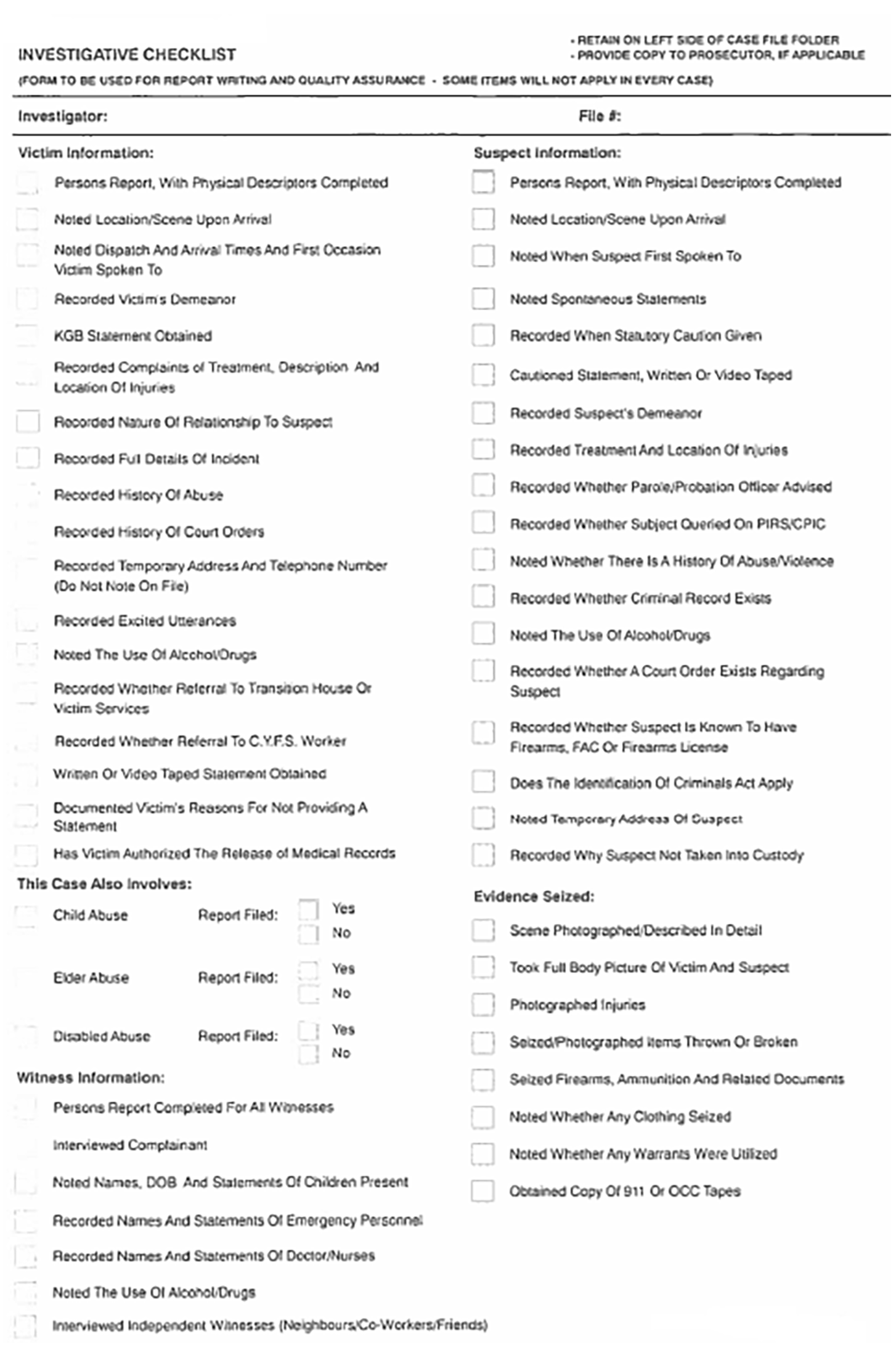
Investigative checklist.
Individual CYA
Individual officers participate in CYA indirectly, through filling out all of the forms demanded of them and directly through over-documentation within the forms. Over-documentation here includes the sheer volume of duplicate or triplicate information across forms and the over-explanation of actions and rationales as a strategy to mitigate risk. Examples of these risks include a form being returned for more information, an error or mistake on a form, and a form used as part of an investigation where an officer’s actions are to be scrutinized. Officers can be part of internal investigations (e.g. misconduct, use of force review) or external (e.g. court processes) to the organization and being part of an investigation is, or can become, stressful. Thus, risk management through paperwork—the paper trail—where officers are accountable by filling out the original documented account of their involvement in a case—encourages, even promotes, over-documentation as a form of CYA.
Participants, in describing what they acknowledged was over-documentation, used language such as “cover all your bases,” ‘cover our parameters, “cover off the steps,” and “CYA.” For example, Jen, a provincial Constable, stated, “paperwork, I must say, is really, really is massive. And it’s all about covering your . . .” Another term officers used was “nth degree,” as in Conrad advising: “you got to do all these little reports and document it to the nth degree [describing cases involving children].” In describing how they handle DV calls and the attendant paperwork, officers used the terms “do it properly” or “cover all my bases.” For example, Tony, a municipal police officer with 1 year of service, worried about the consequences of not documenting interactions very carefully: “Like if it’s a domestic assault or something like that, just trying to make sure that I cover all my bases even though it might take me a bit longer.” Thus, this officer acknowledges the increased time demand for thoroughness in their paperwork but prefers to be comprehensive, therefore risk avoidant.
Some officers attributed both excess paperwork and their own CYA actions to an occupational culture driven by risk management, which permeates the institutional level and drives officers’ individual decision-making and acceptance of the paperwork burden as a necessity. “There is a lot more paperwork, I think, just to cover our butts,” Chris, an experienced frontline officer, stated, “you know, people fuck up . . . just not in policing, it’s anywhere. I think that creates more paperwork because the higher-ups go, ‘okay, well, we want to keep everyone safe, so everyone has to do this.’” He then added, “It’s just the way the business thing is. It’s not going to change.”
Just as is the case at the institutional level, individuals who acknowledged engaging in paperwork as CYA do so from legal and professional liability concerns. For example, when we wrapped up an interview with a municipal patrol officer by asking if he had any further thoughts on police paperwork, Terry replied, I think everything I collect, the reason I do it to cover my own self. Because it wouldn’t be any surprise to me if the person A comes and makes this report and then two weeks later changes things up.
Kurt, a frontline officer in another province, had similar concerns: “Everyone wants to sue everybody. These days you spend more time covering, making sure everything you did was perfect, and filling so much paperwork.” He then laughed while explaining, “If I give you a piece of paper and we go to court, well, I need to serve you a piece of paper that says I gave you that piece of paper.” Another illustrative example is an excerpted from our interview with Chris, who wants to avoid or reduce the potential for disciplinary action as a result of a police complaint: It’s all about covering your ass. The threshold is different every time because I might go to a call, and it might be nothing, and I’ll CAD
9
clear it. I might go to the same call, and then you might end up having words with someone. Like they’re not happy with what you said, or they’re not happy with what you have done. So, you think, “you know what, this could turn into a complaint.” Instead of just being in my notes, I’ll also put a report in on it, just in case. You know, if that complaint comes in, [management] don’t ask for my notes right away, they pull it up to see if there is a report. So yeah, for sure, one hundred percent, I would say it comes with experience because you learn pretty quickly. We’ve all been bitten.
Police officers, it should be noted, in our sample, were also committed to public safety, the inherent function of their job, which also carried with it arguable over-documentation, where “just in case” you ensure any information received that could threaten public safety be passed on to the next shift. Jen provides one of the clearest examples of individual CYA through paperwork: Paperwork is huge, huge. I mean, on that little call that I just took . . . that call was two adults not getting along. There has been no violence or anything like that, but now he wants her out of the home. She has to leave; she has no matrimonial rights to the home. Tonight, if that call that I just took goes sideways and ends up in a domestic violence call, I want the people to know on shift . . . that this is what I encountered with this couple today. [Otherwise] they could go home and say, “I spoke to an officer today” . . . So now it will take me a half an hour to write that up because I need to make sure that I cover all the bases on that call that’s nothing really.
To be clear, this pressure to CYA was among officers in each of the three police services studied. They were readily open to documenting any indicator of possible threat to public safety and providing the necessary information to officers starting shifts about service calls that may arise. However, they resented the time spent engaged in CYA activities, which they saw as reducing their ability to engage in proactive work. For Chelsea, every 2 hours of time not consumed in paperwork activities is 2 hours that could be spent in community policing activities. If she had that time back, she wanted to spend it in her district by going to “hang out with the kids. Go hang out with the adults. Go to the Salvation Army and say hi to everybody.” For her and for other officers, time spent on what are perceived to be CYA-related paperwork exercises impedes an officer’s ability to be fully functional—that is, “on the road.” As she put it, “we can catch more crime when we are out on the road.”
Discussion
In our qualitative study of paperwork demands in three different police services, we found that police officers use paperwork to manage the many legal risks associated with policing, including those with the hierarchal organizational structure (e.g. internal) and criminal justice systems (e.g. external) more broadly. Officers were aware of surveillance at the hand of those in positions of authority (i.e. their superiors) and sousveillance from the civilians (i.e. the public), thus each act in which they engage requires paperwork where officers explain their actions, justify their choices, and, in essence, protect themselves from public scrutiny. The consequences of risk society (Beck, 1992) become pronounced as technological innovation (e.g. cameras and cell phones) has left police working with a new form of sousveillance that demands accountability. Paperwork then is one of the only ways officers can voice their position in their encounters. Thus, paperwork provides a space for police to explain their position despite the “blue wall of silence” (Chin and Wells, 1997; Huq and McAdams, 2016; Skolnick, 2002), reinstating the necessity of paperwork and the pressure to over-document. Moreover, paperwork and the statistics that create the push toward actuarial justice (Feeley and Simon, 1992) are braided with the information produced in each, starting with the officer—whose occupational responsibilities place them at the very root of the paper trail. Thus, the officer is the person to hold accountable for justice-related outcomes—as the process all starts with the officer who responds to the request for police services.
The resultant CYA need, pushing officers to engage in paperwork, both complying in filling out forms and over-documenting, ensures police personal actions are justified. Our research suggests two phenomena are at play here, both external and internal. Externally, agencies mandate police organizations to provide the necessary documentation to satisfy their legal needs. These agencies, particularly those of justice, are legally vulnerable and susceptible to public (and advocacy-based) scrutiny tied to their processes and outcomes, both managing pushes for actuarial justice and the technological innovation that is current-day risk society. To respond to their own vulnerabilities, agencies create processes that serve to be comprehensive in their record-keeping and data management. This often means, in reality, that they produce more forms, for example, their checklist of forms. Other examples include courts demanding police to fill out specific forms courts use in their judicial processes and victim services requiring forms if they are to provide services. Thus, if one is to follow the paperwork related paper trail, the police officer who responded to an “incident” or engaged in an “interaction” is responsible—they are liable through the information they provide and by their actions—and thus inform the outcomes of investigations at diverse external levels of significance.
Internally, police are also responsible for justifying their actions to avoid investigation or reprimand. Their elected course of action, perhaps due to changing police culture that has come to hopelessly accept paperwork, is often over-documentation. In this sense, over-documentation serves to protect their social, professional, and legal positioning—the latent functions to protect the organization and external organizations simultaneously. Police engage in providing details and writing up interactions, one, to manage risk, but also, two, to manage public safety concerns. Here discretion becomes central. Police recognize that writing up interactions that, although they may appear to have little bearing, could be predictive of future incidents or are noteworthy information tied to public safety and the prevention of harm. There is an irony, police understand the need for paperwork but feel consumed by paperwork. Yet, officers know when paperwork is valuable to provide necessary information that could inform public safety—police in our study were quick to use their discretion to ensure they wrote up incidents indicative of possible future tensions.
Police officers routinely exercise discretion during the course of their duties, and they also have the capacity to employ this discretion when documenting events—for example, knowing the difference between reactive (i.e. documenting what happened) and proactive (e.g. documenting what happened in case more follows) policing in paperwork. Thus, we believe that officers can and should provide insight into how best to streamline paperwork to meet internal, individual, and external requirements while consistently contributing to public safety.
Policy implications and future research
The replicative nature of paperwork and the unnecessary information requested in forms does not have to be as burdensome as it currently appears. The context of forms is an area for future research that, although it may not be page-turning, could help re-envision the economics of policing, facilitate more judicious use of police time, and still satisfy internal and external organizational information demands, among many other possibilities. We asked our participants, when conversational paths allowed, “What extra funding did the police department get for that . . . Who paid for it?” In other words, external demands for information were often unaccompanied by increased funding to offset other potential costs, including officer time. For an individual form, time spent may not be significant; however, cumulatively, these costs can quickly accrue. Thus, streamlining such processes represents opportunities for cost-saving, time-saving, and reducing occupational frustration.
Our participants, whose focus on forms was as much about finishing their occupational tasks as reducing their sense of vulnerability to potential risks from the scrutiny of their work, were unaware of the rationales accompanying demands for new information and/or information in new formats or for new audiences. We caution here that without adequate training across the diverse forms, police became even more susceptible to errors or unintentional omissions, which could then compromise their legal standing—leaving them accountable and legally vulnerable. Forms are often not intuitive; thus, training on forms—particularly on forms that can shape the future of the persons policed—is warranted to help officers manage their workload, mitigate risk, and also ensure they are providing information as desired by the diverse organizations making the request. Police paperwork may also be the lifeline for a criminalized person, and its accuracy and completeness are of the utmost importance.
Remaining to be seen is if the introduction of BWCs increases or decreases the paperwork burden. Although arguably, the possibility exists for BWCs to reduce paperwork given the visual documentation, history would suggest otherwise. Paperwork tied to when cameras are on versus off, and that interprets the discretion behind police actions, is likely to accompany BWCs, thus increasing the paperwork burden. Nevertheless, this remains an area worthy of future inquiry and examination, particularly as BWCs continue to be adopted across police services in Canada and beyond.
Our study has also raised questions with respect to how paperwork has informed—even shaped—police culture. We found that paperwork expectations and demands were embedded in the very fabric of police culture. Processes of completing paperwork were part of every police shift, many informal exchanges between officers on the road and at the police station and were a source of ongoing stress. Police culture, which varies by shift, detachment, and division or service, cannot evade the effect of paperwork demands. Although not the central focus of the current study, future research on police culture and how police culture is shaped by paperwork is warranted as the impacts of paperwork on police culture is lacking study. Paperwork demands, our data suggest, inform not just organizational stressors (e.g. interactions with colleagues) but also operational stressors (e.g. responding to calls for service) and general practices and attitudes within police organizations (Huey et al., 2016).
Moreover, our results suggest that police culture incorporates paperwork requirements and the repercussions of falling short on such demands. Officers expressed concerns about how their paperwork will hold up in court or under the scrutiny of investigation. This reality shapes organizational culture and illustrates the omnipresent impacts of having to manage risk—in this instance, through creating paper trails to retrospectively explain officer decisions to potentially multiple different external audiences—as part of the daily realities of frontline policing and supervision. One potential future area of research is the question of whether—or to what extent—there are similarities and differences in how different police organizational structures embody or find ways to reject an institutionalized “CYA mentality.”
Footnotes
Declaration of Conflicting Interests
The author(s) declared no potential conflicts of interest with respect to the research, authorship, and/or publication of this article.
Funding
The author(s) received no financial support for the research, authorship, and/or publication of this article.
