




Abstract
The prevailing attitude to the national churches in the Nordic countries has often been described as ‘believing in belonging’. Based on a longitudinal survey data, this article argues that this notion no longer applies to the younger generation, often referred to as Generation Y. Instead, they are challenging traditional reasons for belonging to national churches. The number of church-leavers has been unusually high in Finland since the beginning of the 21st century, the vast majority of them young adults. These same young adults were confirmed in the church only a few years earlier. This study aims to understand why such a high number of young people leave the Evangelical Lutheran Church soon after confirmation. The study shows that for Generation Y, the Church-leaving process is linked to personal beliefs and values. They leave the Church because they do not find it to be in line with their own beliefs. Tradition and culture alone are not enough to keep them as members.
Introduction
The prevailing attitude towards the national churches in the Nordic countries has often been described as ‘belonging without believing’ or even as ‘believing in belonging’. With these terms, researchers have wanted to highlight the character and importance of church membership in Nordic religiosity in contrast with the notion ‘believing without belonging’, which has been used to describe British religiosity (Davie, 1994, 2000; see also Voas and Crocket, 2005). Nordic people have traditionally considered it important to belong to their national Church – even if they do not attend or believe in the teachings of the Church. The share of church members is still high in all five Nordic countries (Denmark 79%, Iceland 76%, Norway 75%, Finland 75% and Sweden 66% in 2013), but during the past ten years the rate of decline in all five countries has increased.
In Finland, the number of Evangelical Lutheran Church-leavers has been unusually high since the beginning of the 21st century, and the vast majority of the leavers have been young adults, often referred to as Generation Y. These same young adults were confirmed in the Church only a few years earlier. In this article, by using longitudinal and national survey data, I attempt to understand the changes in attitude to the Evangelical Lutheran Church in Finland and in particular why such a high number of members of the young generation are leaving the Church. I argue that the notion of ‘believing in belonging’ does not apply to this generation of young adults, who are challenging the traditional reasons for belonging to the national Church. For them, Church-leaving is not so much an expression of their disappointment in it as an institution, but more an act of authenticity in which they follow their own true selves. Furthermore, the decision to leave the Church is not a sudden act, but one linked to wider decisions on life-course.
Background to the study
Generation Y in the midst of religious change
The idea of viewing a section of a population as a ‘generation’ was promoted in the 19th century. The existence of different generations and their division into age groups became increasingly marked with the formation of social classes as a consequence of the rapid industrialization of Western Europe after 1850 (Jaeger, 1977). Previous generational studies have distinguished such groups as the Lost Generation, the Greatest Generation, the Silent Generation, the Baby Boom Generation, and Generation X. 1 Such appellations refer to cohorts of people who were born during a certain period and who thus share similar cultural experiences.
Generation Y refers to the generation born between the early 1980s and the early 2000s (see e.g. Howe and Strauss, 2000). They are regarded as confident and tolerant, but also as more self-centered and narcissistic than preceding generations were during their teens; consequently, they are also called ‘Generation Me’. They are seen as individuals who want to be something special and believe they can be anything they wish to be. They tend to extend their youth and delay entering adulthood. They do not feel the need for approval from others, which has also resulted in a decline in adherence to social rules. In order to understand them it is also important to understand their parents’ generation, mostly Baby Boomers or members of Generation X. The Baby Boomers were the first generation to clearly differ from previous generations. They tended to think of themselves as a special generation and are generally associated with a rejection of traditional values. The generation preceding Generation Y, Generation X, is said to be the first generation to have been raised in the era of postmodernism. This generation is more heterogeneous than previous generations, and espouses more diverse religious views. These features are even more characteristic of Generation Y (Twenge, 2006; Sheanah, 2005; Owram, 1997).
Most of the members of Generation Y were young adults at the time of this study. Early adulthood, the period between the adolescence and adulthood, often also called emerging adulthood, is typically seen as covering the ages between 18 and 29. The most prominent features of emerging adulthood are self-centredness, identity exploration and instability. It is ‘the age of feeling in-between’ and ‘the age of possibilities’. During this age, young adults experiment with different identities, an experimentation that causes a feeling of instability (Arnett, 2004: 14). The period of emerging adulthood is a period of great changes. Often these changes involve belief. This time of life is frequently accompanied by a distancing from religious authority and decreasing religious activity. Members of Generation Y are likely to be sceptical of religious institutions. They question traditional beliefs and values and do not blindly follow what they have learned in childhood (Mikkola et al., 2007; Denton et al., 2008).
In any study of the young generation and their attitudes to religion, several key points need to be taken into consideration. First, numerous studies clearly indicate that this generation is less religious than the previous age cohort (Voas and Doebler, 2011; Niemelä, 2011; Kääriäinen at al., 2005: 141–144). This is especially the case in highly industrialized countries. It is also most evident in the countries where religion in general is not valued highly and where average religiosity is low (Bucher, 2009: 625). These differences between younger and older people today are not only a matter of generation, as young people have been less religious than members of older age groups as long as there has been empirical data available, but there are also clear periodic differences: young people are less religious today than young people were earlier. One of the key reasons for this decline in religiosity among the young is changes within families and a decrease in religious upbringing. Quantitative data from the ISSP and Religion Monitor, among others, shows beyond doubt that religious upbringing in homes is declining especially in highly industrialized countries (e.g. Bucher, 2009: 625; Niemelä, 2011).
Furthermore, there are also changes in attitude to religion that are related to age. Research indicates that religiosity tends to decrease after the teenage years and young adults are most often reported as being the least religious age group (see e.g. Kääriäinen et al., 2005; Mikkola, et al., 2007; Denton et al., 2008). However, the common assumption that religiosity increases with age is not fully supported by recent studies. On the contrary, studies indicate that by age cohort (or generation), religiosity seems to remain stable and not increase with age (Voas and Doebler, 2011; Niemelä 2011).
From confirmation to adulthood
According to earlier studies, the period of church confirmation often marks a turning point in the lives of young people (Niemelä, 2008, 2010a; Schweitzer et al., 2010). In Finland, as many as 83% of young people are confirmed at the age of 15 (in 2013); a small number are confirmed later in life. The confirmation period is an important part of catechesis in Protestant Churches. Typically, Protestant young people attend confirmation preparation between the ages of 13 and 15. The preparation lasts about one year and ends with a confirmation ceremony. In Finland, the confirmation period typically begins in the autumn and consists of several meetings and church visits during the year; it also includes a fairly long camp (approximately eight days), most often in the summer. International comparative research indicates that for many young people in Europe, confirmation is a positive and meaningful experience (Schweitzer et al., 2010). Only a small minority have a negative experience of confirmation, which may have long-lasting effect on their later religious life (Niemelä, 2006, 2007, 2008; Ilg and Schweitzer, 2010).
The confirmation period often changes attitudes towards the Church and faith in a positive direction (Niemelä, 2008, 2010a). This has been shown to be the case particularly in Finland, where confirmands are generally satisfied with the confirmation process and there is a positive attitudinal change among them (Niemelä, 2010a; Schweitzer et al., 2010; Ilg and Schweitzer, 2010). The confirmation period in Finland also activates young people religiously and as many as half of the young people say at the end of it that they would be interested in taking part in a Christian youth group (Niemelä, 2010a, 2010b; Schweitzer et al., 2010).
However, despite these positive results related to confirmation experience, something seems to happen in the later teens and early adulthood that changes these religious intentions. A significant number of these same young people in Finland leave the Church as they grow older (Niemelä, 2007; Niemelä, 2010b). Emerging adulthood seems to lead many of these young adults to conclude that Church membership is not for them. According to Church membership statistics in Finland, at beginning of the 21st century about one-fourth of young adults resigned from the Evangelical Lutheran Church in Finland when they were between the ages of 18 to 25. In 2011, nearly 90% of 18-year-olds belonged to the Evangelical Lutheran Church, while only 70% of women and 62% of men between the ages of 27 and 30 belonged to the Church.
The dramatic decline in Church membership in Finland during emerging adulthood is a recent phenomenon. The starting point for this decline can be dated to the passing of the law of religious freedom in 2003. Between 2003 and 2012, about 10% of members left the Church; most of them were young adults. Even though the law itself emphasized positive freedom for religion, not from religion, the practical changes that were made at the same time made Church-leaving much easier: for example, a person could resign from the Church simply by simply sending an email, while previously it had been necessary to visit the Church office in person. These changes seem to have attracted the attention of young people and various campaigns and discussions in the social media supported Church-leaving (Niemelä, 2007). Figure 1 illustrates the change in the share of those belonging to the Evangelical Lutheran Church of Finland in different age groups in 1990, 1995, 2000, 2005, and 2011. These figures clearly reveal the extent of the changes that have been taking place among Finnish young adults since the start of the 21st century.
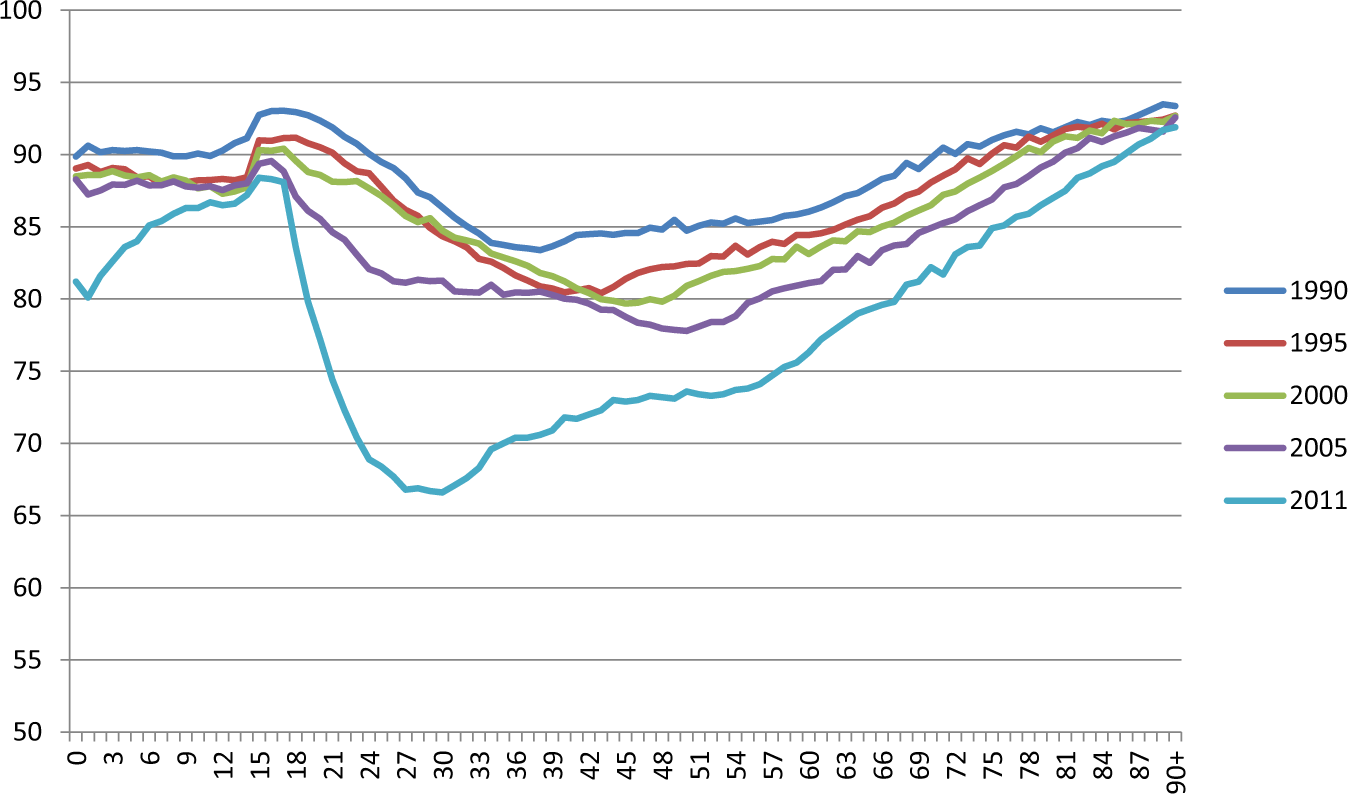
Share of those belonging to the Church by age in 1990, 1995, 2000, 2005 and 2011. Data from Statistics Finland (Community, Participation and Faith, 2013: 51) (%).
Method
Research questions
In this article, I analyse the attitude of church members to the Evangelical Lutheran Church of Finland and changes in that attitude among members of Generation Y born in the late 1980s. I analyse them during the transition period from adolescence to early adulthood, the period called emerging adulthood. Through this study, I aim to understand why such a high number of young people leave the Church soon after confirmation. In particular, I seek answers to the following questions:
How do attitudes towards the Evangelical Lutheran Church of Finland and towards Church membership change from the time of confirmation to emerging adulthood?
Why do many members of Generation Y leave the Church soon after the confirmation experience?
How do their reasons for leaving differ from the reasons of previous generations?
What link, if any, is there between their Church-leaving and their confirmation experience?
This research aims to go beyond a simple analysis of the stated reasons for leaving the Church or staying as members, and to analyse the attitudes of young people to the Church from a wider life perspective. I attempt to determine whether there are factors related to their situation and experiences before, during or after confirmation that can explain why so many young people leave the Church regardless of high confirmation attendance and typically positive experiences related to it. In order to understand the change that has happened in the pattern of Church membership, I also compare Generation Y members and their reasons for Church-leaving with those of previous generations.
Data
I base my analysis and argumentation on the analysis of two large data sets. The main data set is a ten-year follow-up study of young people who went through confirmation preparation and were confirmed in the Evangelical Lutheran Church of Finland in 2002 in the parish of Tampere. 2 The study covers the period between the ages of 14 and 25 in the lives of the young people. It contains questionnaires circulated at four points during this period: (A) at the beginning of confirmation studies in 2001 (at the age of 14/15) (N=1,322; 90% of all confirmands in Tampere); (B) at the end of the confirmation period in 2001 (at the age of 15) (N=1,159; 79%); (C) five years later, in the spring of 2006 (at the age of 20) (N=416; 30%); and (D) ten years later, in the autumn of 2011 (at the age of 25) (N=276; 21%). As can be expected, the response rate from the participants declined from the age of 14 to the age of 25. However, when comparing those who responded to the fourth questionnaire with those who did not answer, only one clear difference emerges: women are overrepresented among those who replied to the fourth survey round (68% are women, while women amounted to 50% in the first and second survey rounds). No other notable differences between the two groups could be found. In this article, I will concentrate on the last data set and distinguish between those who have remained as members and those who have left the Church ten years after confirmation. By comparing these two groups, I will try to determine if there are experiences or situations related to the confirmation period or something before or after that can explain the Church-leaving. For 206 of the respondents in the last round, their questionnaires could be connected with their questionnaires from the previous rounds and these are the respondents on whom I concentrate in this article.
In order to gain a deeper understanding of the distinctive features of the Church-leaving process among members of Generation Y, I use a large, representative Finnish survey data set called Gallup Ecclesiastica 2011 to compare this generation with previous generations. A large survey was completed by nearly 5,000 Finns in 2011 (N=4,930). The survey was commissioned by the Church Research Institute and conducted on line by TNS Gallup Finland. This data set contains (among others) questions related to reasons for belonging to the Church and reasons for leaving the Church. I use this data to compare the reasons for Church membership and Church-leaving among the members of the Generation Y with those of previous generations.
Results
Staying or leaving?
The longitudinal data shows that the question of continuing to belong to or leaving the Church becomes vital during emerging adulthood. The data from young adults who were confirmed ten years earlier in the parish of Tampere shows that at the age of 20, 7% of them had left the Church and five years later a total of 22% (24% of men and 20% of women) had left. This corresponds with the estimates that can be drawn from the Church statistics (which do not give the exact age of Church-leavers). The longitudinal data also shows that the general attitude towards Church membership becomes significantly more negative and more decisive after the age of 20 (see Figure 2). At the age of 25, only 5% of those who were confirmed ten years earlier could not think of leaving the church under any circumstances. However, while the share of those who could not think of leaving the Church had declined and the share of those who had already left had increased, the share of those who had thought of leaving, but decided to stay as members had increased (from 11% to 21%). At the same time, the share of those who had thought of leaving but were undecided had declined. This means that between the ages of 20 and 25 these young adults had increasingly taken clear stands and decided on their Church membership status.
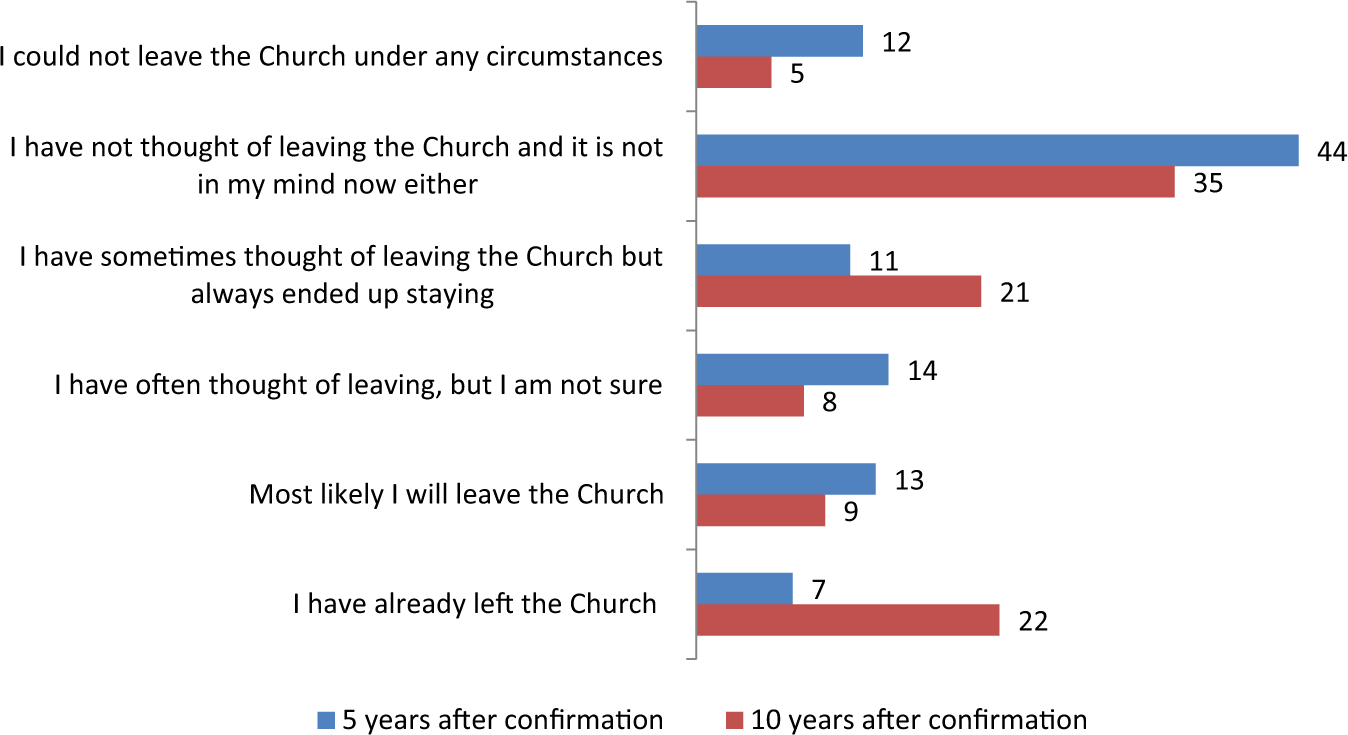
Attitudes towards Church membership five and ten years after confirmation (at the ages of 20 and 25) among those who were confirmed in Tampere in 2001. Data: Longitudinal data of confirmands 2001–2011. N=349 (2006); N=225 (2011) (%).
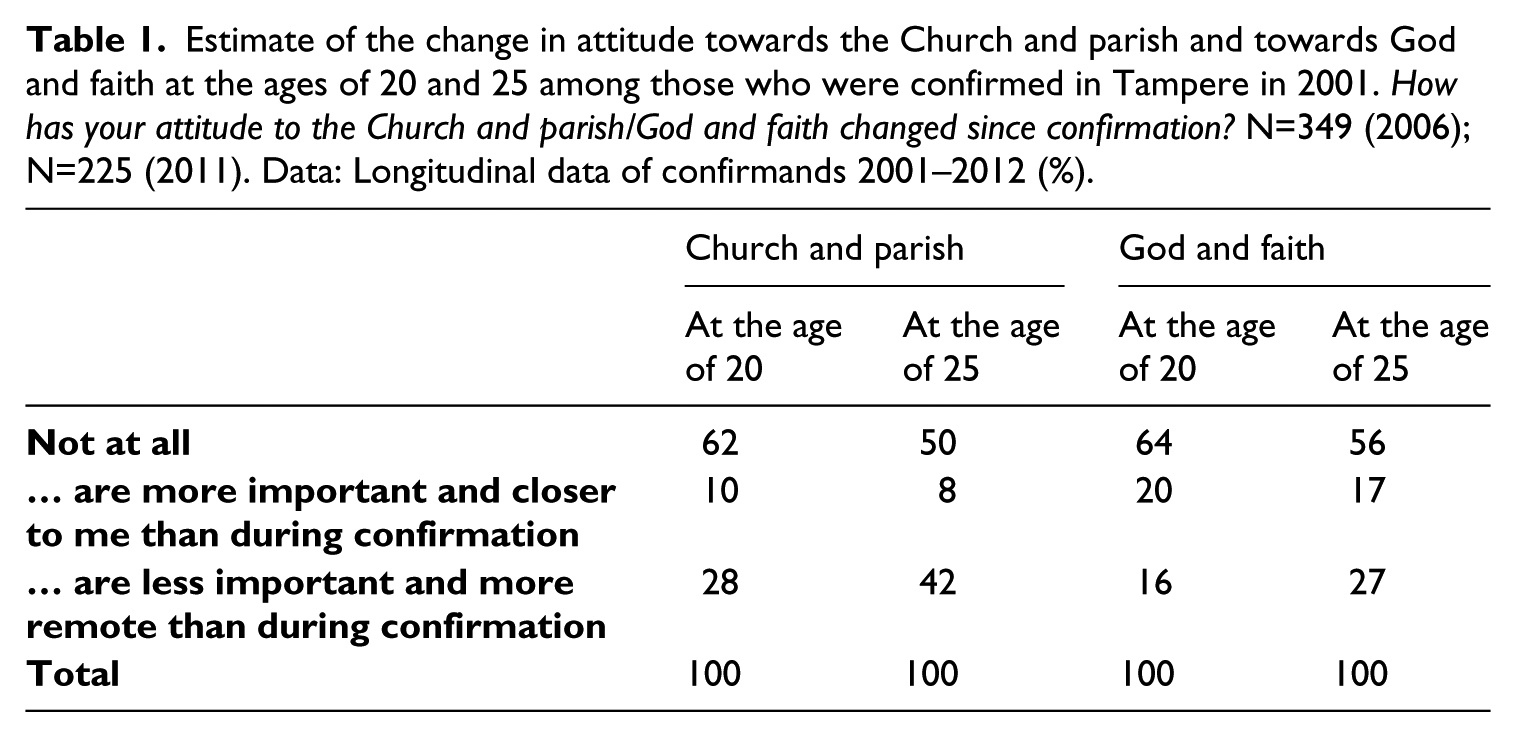
Furthermore, the data shows not only that the share of those who have considered leaving or have already left the Church increases between the ages of 20 and 25, but also that the share of those who felt that the Church and parish had become more remote from their lives than it was when they were confirmed also increases (see Table 1). At the age of 20, more than one-fourth (28%) of young people responded that they experienced the Church and parish as more remote from their lives than they had during confirmation. At the age of 25, the share had increased to 42%. This is significantly higher than the share of those who experienced God and faith as more remote in their life than during confirmation (27% at the age of 25), which means that young people tend to distance themselves from the Church and parish, though not necessarily from faith. This is especially true among those who have moved away from their former home town and parish.
Estimate of the change in attitude towards the Church and parish and towards God and faith at the ages of 20 and 25 among those who were confirmed in Tampere in 2001. How has your attitude to the Church and parish/God and faith changed since confirmation? N=349 (2006); N=225 (2011). Data: Longitudinal data of confirmands 2001–2012 (%).
Reasons for leaving the Church among the members of Generation Y
When those who had left the Church were asked (in the longitudinal study) to describe their reasons for leaving the Church, they gave several reasons. Lack of faith was mentioned most often and often by the same people as failed to find the Church as meaningful. The responses to a question about belief in God in the same data set support the fact that lack of faith is most commonly the main reason for Church-leaving: 79% of the young adults who had left the Church by the age of 25 said that they did not believe in God. Other reasons that were given for leaving the Church included the church tax, a lack of need for church services, and the intolerance or tolerance of the Church. In the case of the last reason, some felt that the Church was too tolerant regarding issues like same-sex relationships, while others felt that the Church was not tolerant enough regarding such issues. The latter attitude was more common.
The results of the Gallup Ecclesiastica 2011 survey analysing the differences in reasons for leaving the Church between Generation Y and previous generations support the results of the longitudinal study. Generation Y young adults emphasize ‘lack of belief’ as a reason for leaving the Church, while the adults from the previous generation tended to highlight disappointment with the Church. Among the 16 possible reasons for leaving that were given in the survey, the key reasons Generation Y members gave for leaving the Church were the following: ‘I am not a religious person’ (difference between generations, according to an ANOVA test: F=23.74, p<.001); ‘I do not believe in the teachings of the Church’ (F=21.83, p<.001) and ‘The Church as an institution does not mean anything to me’ (F=19.34, p<.001). These stand out as by far the most important responses among Generation Y. The average ratings on the item ‘The Church as an institution does not mean anything to me’ among the members of Generation Y were between 4.11 and 4.30 and among the Silent Generation (born before the end of the Second World War) between 2.70 and 2.92 (on a scale of 1 to 5 where 1=not at all, 5=very meaningful reason for leaving the Church). On the other hand, personal disappointment with the Church as a reason for leaving is rare among Generation Y and most common among the Silent Generation. Another reason that the current generation highlights (but to a much lesser degree than non-believing) is that the Church is too intolerant of sexual minorities (F=8.60, p<.001, mean value 2.92 among the Gen Y compared with 2.12–2.14 among the Silent and Baby Boomer generations). However, the members of Generation Y do not emphasize an unwillingness to pay Church taxes; this was a typical reason for Church-leaving among the Generation X and early Baby Boomers (F=4.67, p<.001).
Before, during and after confirmation
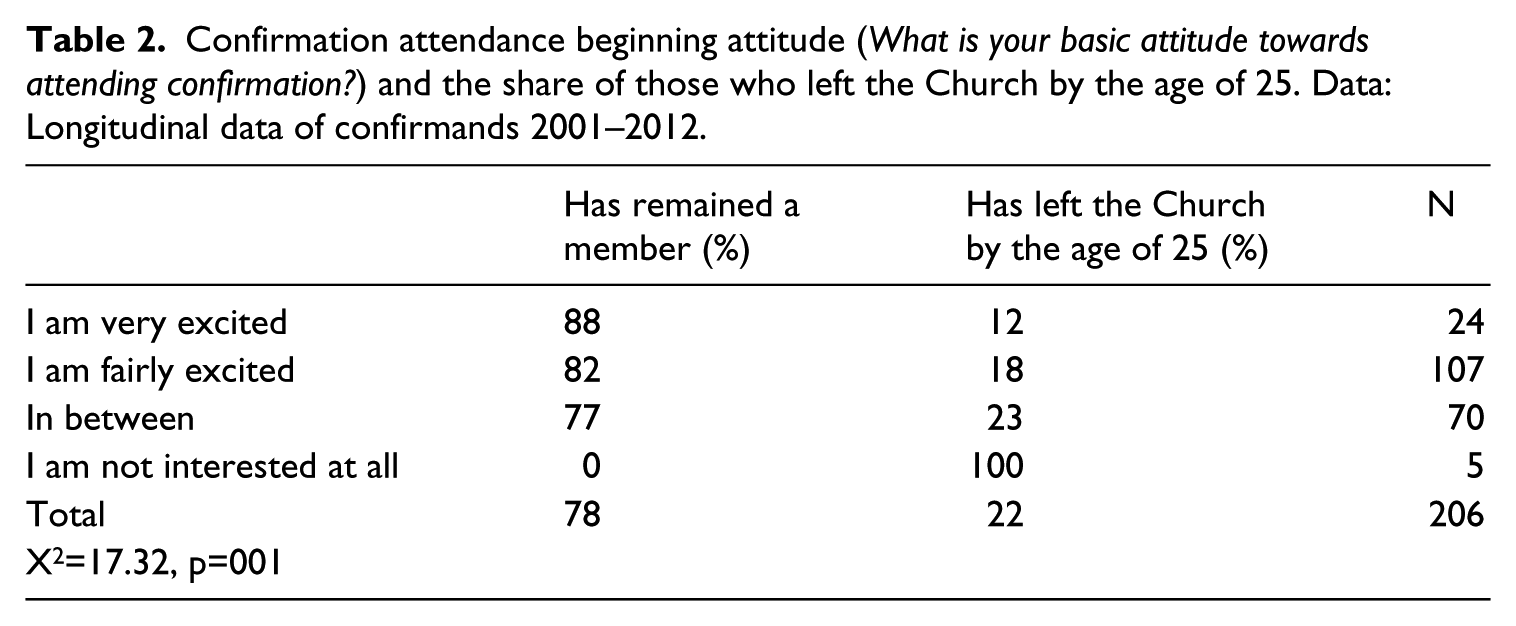
Having looked at the primary reasons for Church-leaving in the data, I now analyse the role of the confirmation period in the leaving process. Are there reasons related to their situation and experiences before, during or after confirmation that can explain why so many young people leave the Church so soon after being confirmed? I will begin by analysing the respondents’ attitudes at the start of the confirmation period. How did those attitudes differ between those who remained as members and those who left the Church? The comparison reveals that their attitudes already differed at the beginning of the confirmation period (see Table 2). Those who had a more positive attitude towards attending and who were excited about attending at the beginning were far more likely to remain members than those who were not very interested at the beginning.What does this reveal?
Confirmation attendance beginning attitude (What is your basic attitude towards attending confirmation?) and the share of those who left the Church by the age of 25. Data: Longitudinal data of confirmands 2001–2012.
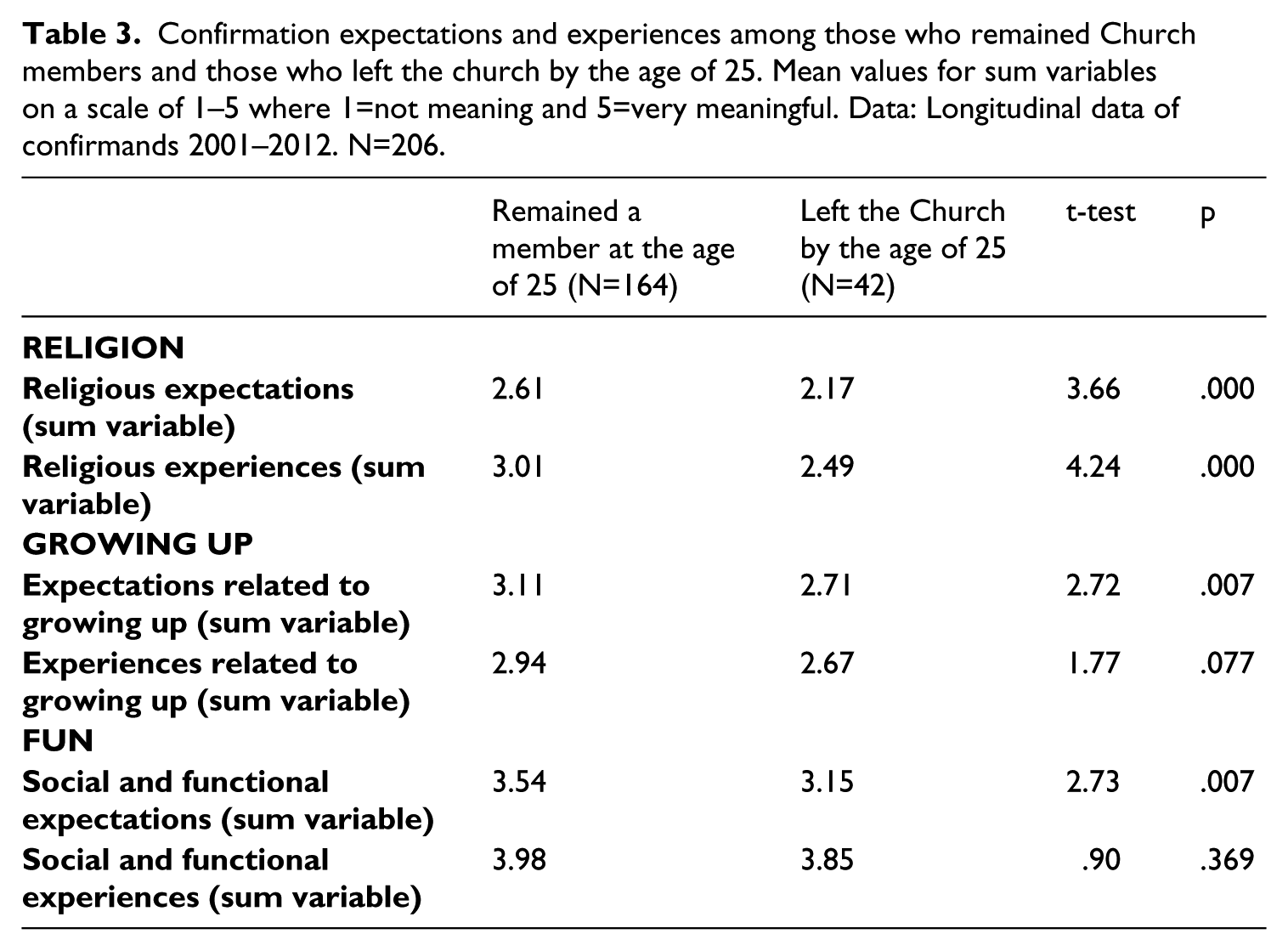
I next analyse the expectations and experiences related to the confirmation period among those who remained as members and those who left the Church. The analysis shows the same as the analysis above: those who later left the Church had a less positive orientation towards confirmation. I am using the sum variables that I formed in my former publications on this longitudinal study (Niemelä, 2006, 2008). Based on a factor analysis (of a 19-item instrument), three sum variables were formed: Religion (religious expectations), 3 Fun (social and functional expectations) 4 and Growing up (expectations related to growing up). 5 Cronbach’s alpha for these were .94, .84 and .88, respectively. Corresponding sum variables were formed from the items measuring experiences of the confirmation period (religious experiences, social and functional experiences and experiences related to growing up). The greatest differences among those who remained as members and those who left the Church are found in religious expectations and experiences (see Table 3). Those who ended up leaving the Church had only low expectations related to religious and faith issues; they neither looked forward to any religious learning or growing in faith nor experienced such growth. Their religious experiences were notably less positive than those who remained members of the Church. In addition, the expectations and experiences related to growing up were less positive. In terms of experiences related to ‘fun’, there was no statistically significant difference between those who remained and those who left the Church. This indicates that those who later leave the Church experience the confirmation period as socially and functionally rewarding, but the experience does not tend to have any deeper meaning for them.
Confirmation expectations and experiences among those who remained Church members and those who left the church by the age of 25. Mean values for sum variables on a scale of 1–5 where 1=not meaning and 5=very meaningful. Data: Longitudinal data of confirmands 2001–2012. N=206.
Those who left the Church ten years later seldom had a religious upbringing: only 17% of those who had left the Church reported having a religious upbringing at home, in contrast with 33% of those who remained as members. This shows that religious background and upbringing at home influence later religious affiliation: those with no support from home are more likely to leave the Church. However, the figures also show that the majority of those who have remained members have not been raised religiously either, since the number of those raised religiously is generally low.
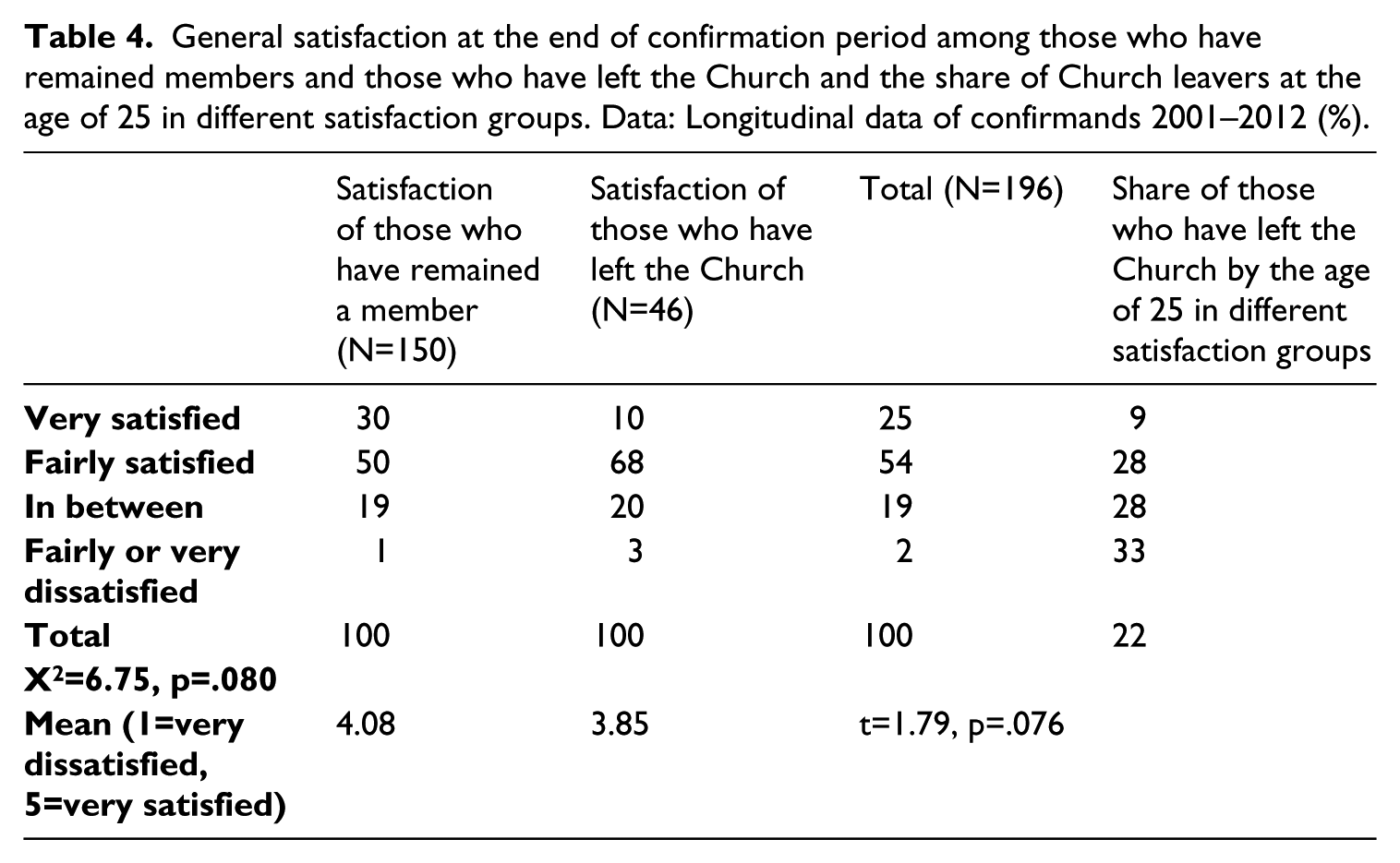
The level of satisfaction at the end of the confirmation period is also linked with the decision to stay or leave. Those who were satisfied were more likely to remain members. Of those who were very satisfied with their confirmation studies, only 9% had left the Church by the age of 25 compared with 33% of those who were fairly dissatisfied (see Table 4). However, it is important to point out that even though confirmation dissatisfaction increases the likelihood of leaving the Church, for most of those who had left the Church, the confirmation period had been a positive experience.
General satisfaction at the end of confirmation period among those who have remained members and those who have left the Church and the share of Church leavers at the age of 25 in different satisfaction groups. Data: Longitudinal data of confirmands 2001–2012 (%).
The comparison of answers to a question about belief in God before confirmation, after it and five and ten years later among those who have left the Church and those who have remained as members supports the findings above. It indicates the strong role of non-believing in the whole life-course of those young adults who end up leaving the Church (see Figure 3 see queries). First, those who have left the Church were already more sceptical towards the existence of God when they began their confirmation preparation. Only one-third of them believed in God at the beginning of the confirmation period, while half of those who were still members at the age of 25 believed in God at the beginning of the confirmation period. Second, even though the confirmation experience typically changes attitudes towards Christianity and belief in a positive direction, this does not seem to apply to those who later decide to leave the Church. There is very little change in attitudes during the confirmation period among them, while among those who were still members at the age of 25 the share of those who believed clearly increased during the confirmation period. This means that for those who ended up leaving the Church, the confirmation experience did not appear to strengthen belief, and non-believing increased dramatically after confirmation. The share of those who did not believe in God increased especially strongly between the ages of 20 and 25 (28% after confirmation, 44% at the age of 20, and 79% at the age 25).
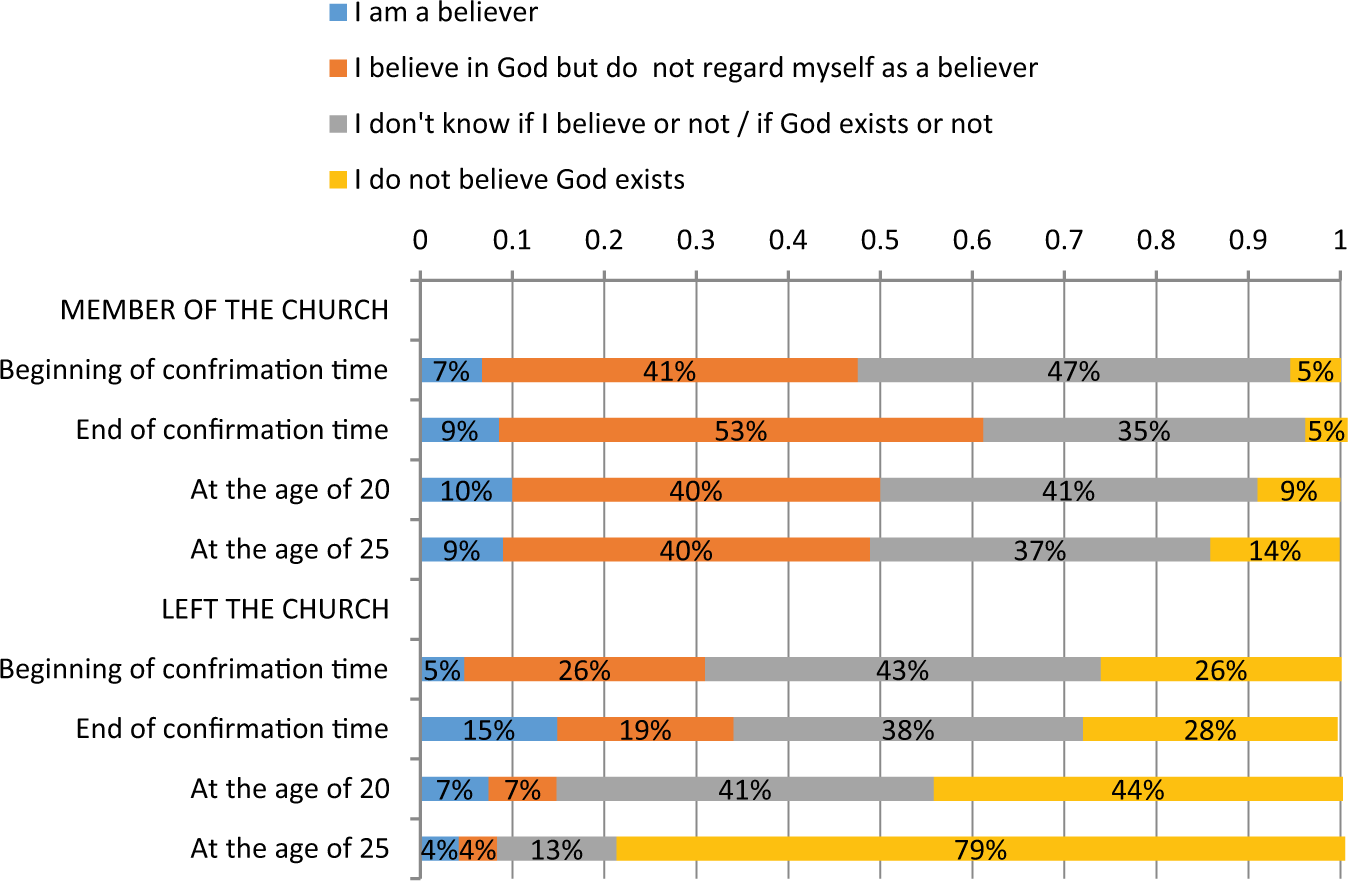
Change in belief in God among those who have remained members and those who have left the Church among those who were confirmed in Tampere in 2001. Data: Longitudinal data of confirmands 2001–2012. N=164 (members); 42 (leavers).
Discussion
In this article, I have analysed the changes in attitudes to the Evangelical Lutheran Church in Finland among the current young generation from adolescence to early adulthood and tried to understand the reasons why a high number of young people leave the Church soon after confirmation. The young people that I have been analysing belong to a generation often referred to as Generation Y. The results show that this generation has in many ways a different attitude to Church membership than previous generations: they clearly do not want to belong to the Church if they do not believe. This is in contrast to the former understanding of the role of church membership in the Nordic countries. For the Nordic people, belonging to their national Church has traditionally been regarded as important and their attitude to those Churches has often been described as ‘believing in belonging’. Most have stayed as members even if they do not believe in God or attend church. However, Generation Y is actively challenging this notion. It is a generation that strives for authenticity in life, as well as in relation to the Church and religion. For Generation Y the Church-leaving process is closely linked to beliefs and values. They do not so much leave the Church because they are disappointed with it as an institution, but because they do not find it to be in line with their own beliefs and life-view. Tradition and culture are not enough to keep them as members.
The study shows that the decision to leave the Church is seldom a sudden one, but is closely linked to an individual’s life-course. First, it is linked to childhood religious upbringing, which in the case of Church-leavers was often absent, and their basic attitude towards religion and attending confirmation. Church-leavers were not so excited about or actively oriented towards the confirmation period or religion in general. It is also linked to their confirmation experiences, which made little difference to their beliefs. Those who end up leaving the Church are typically not especially dissatisfied with their confirmation or the Church in general, but rather fail to find deep meaning in confirmation experience. They often did have fun at confirmation camp, but the experience did not have a lasting effect on them. Typically, it did not strengthen their faith or make them feel more grown-up.
It is clear that a negative attitude towards the Church and negative confirmation experiences can also increase the likelihood of leaving the Church. However, the effects of these factors are limited and should not mislead analysts. Attitudes to Church membership and confirmation experiences are both more closely linked to experiences before confirmation, home religious background and expectations attached to confirmation attendance. Those with a weaker attachment to the Church and its faith when beginning confirmation preparation tend to experience the confirmation period and the Church in general more negatively. Those with a religious upbringing tend to experience the confirmation period more positively, to regard it as spiritually more rewarding, to see Church membership in a more positive light and to be more likely to remain Church members (see Niemelä, 2008).
This study confirms that Generation Y is different from previous generations. For members of Generation Y, their attitude to religion and the Church follows a different pattern from that of earlier generations. They primarily make individual decisions based on their own beliefs and life-view and no longer belong to religious institutions because of tradition. The generation studied here is also called the ‘Generation Me’, which highlights the self-centred focus that is typical of this generation. These young people want to be something special and something different. In their understanding, Church membership does not seem to be something special, but something to be avoided if it does not fit into their values and wider understanding of life. With these attitudes, the young people are challenging religious institutions. They search for deeper personal meaning and if they do not experience it, they are likely the leave the institutions even if they do not have anything specific against them. Unlike the previous generations, they do not so much leave the Church because they are disappointed in it; they often simply lack faith.
Footnotes
Funding
This research received no specific grant from any funding agency in the public, commercial or not-for-profit sectors.
Notes
Author biography
Address: Faculty of Theology, P.O. Box 4, 00014 University of Helsinki, Finland
Email: