




Abstract
The authors explore the impact of religion on two key parental values – obedience and autonomy – in contemporary Dutch society, one of the most secularized countries in the world. Three main religious dimensions are investigated: belonging (religious denomination), behaving (church attendance) and believing (traditional beliefs about God). In analysing survey data from the 2008 European Values Study in the Netherlands, it was found that religious dimensions appear to be significant attributes of parental values. Furthermore, denominational differences in both autonomy and obedience can be explained by church attendance (network mechanism), whereas differences in autonomy can partly be explained by transcendental beliefs (moral mechanism). However, the heterogeneity of the religious population in the Netherlands makes conclusions anything but straightforward and sometimes contrary to theoretical expectations.
Introduction
Since Gerhard Lenski’s (1961) seminal work ‘The religious factor’, a significant line of research has developed exploring the role of religion on aspects of family life in general, and on child-rearing orientations – which are called parental values in the literature – in particular. Parental values can be described as the criteria or standards used as a basis to determine which characteristics are most desirable for children to acquire (Kohn, 1969). The literature distinguishes two of these values, which can be labelled autonomy and obedience 1 (see Alwin, 2001). In this context, autonomy refers to teaching children the ability to think for themselves and to reason independently. Obedience, on the other hand, means conformity to external rules and obeying adult authority.
The earliest studies investigating the impact of religion on these two value orientations focused on differences between traditional denominational lines and found that in the US Catholics were more likely than Protestants to value obedience and less likely to value autonomy, even after controlling for socio-economic background (Lenski, 1961; Kohn, 1969). These differences were explained by pointing out that Catholics are more likely to favour traditionalism and collectivism while Protestants adhere to rationalistic and individualistic views. The more rationalistic and individualistic orientation of Protestants makes them less accepting the authority of the Church as self evident and therefore Protestants are less inclined to stress obedience (Lenski, 1961: 322–323). Later, Alwin (1986) confirmed these findings for American Catholics and Protestants in the 1950s and 1960s, but he also showed that denominational differences sharply decreased later on, mainly because the values of Catholics in the US changed in the direction of emphasizing autonomy. These results made clear that there appears to be far greater variation in parental values within major denominational groups than between them. Alwin (1986) tried to explain this variation within denominations by looking at religious behaviour, such as the degree of church attendance during people’s childhood and during adulthood. Other researchers, like Ellison and Sherkat (1993) and Starks and Robinson (2005, 2007), focused on specific religious beliefs to explain variation in parental values.
Such studies reveal that not only religious denominations but also religious practices and religious beliefs should be studied in order to get a complete picture of what ‘the religious factor’ can do. After all, religion is thought to consist of precisely these three distinct – although strongly related – dimensions: belonging (affiliation to a religious community or denomination), behaving (religious practice such as church attendance) and believing (see Kotler-Berkowitz, 2001). The studies mentioned so far provide important evidence of the influence of religious denominations, church attendance and traditional beliefs on parental values. However, all studies are US based, and one wonders whether the relationship between religion and parental values is the same elsewhere in the world. For example, how would this relationship look in the secularized 2 countries of Western Europe, where increasing numbers of individuals no longer identify with any of the major religious denominations, where frequency of church attendance is low and where the influence of the Churches on people’s daily lives is waning (Davie, 2002; Dobbelaere, 2002; Norris and Inglehart, 2004)? On the one hand, it could be argued that the influence of religion on parental values is very limited, if not absent, in such secularized societies. After all, a key aspect of secularization is the declining social significance of religion (Wilson, 1982; Chaves, 1994; Halman et al., 1999; Dobbelaere, 2002). Following such reasoning, individual parental values will be influenced less by the various aspects of religion (such as religious affiliation, practice and beliefs) and more by other determinants, like education, family status, birth cohort and so on. On the other hand, we could also contest that religion continues to play a major role in the daily lives of the religious people in these secular countries. After all, these individuals choose to be religious in an otherwise secularized society, presumably not so much out of tradition or social pressure, but because the message spread by their religion appeals to them. Achterberg et al. (2009) refer to this idea as ‘purification’: in a secularized society, a hard core of passionate believers remains. 3 Their parental values might be strongly influenced by religious aspects, which implies that the association between religion and parental values will be stronger in secularized countries than in religious ones.
To see how these ideas work out for the role of religion on parental values, we focus on one of the most secularized countries in Western Europe: the Netherlands. Since the 1960s, many Dutch people have ‘lost their religion’ (Need and De Graaf, 1996) and left the churches. This ‘religious revolution’ first occurred within Dutch Catholicism, but other denominational groups swiftly followed (Felling et al., 1991). It meant the end of a ‘pillarized’ society (Lijphart, 1968), in which Roman Catholics and Protestants were strictly separated in their daily lives. Today, most people in the Netherlands can be regarded as ‘secular non-religious’ (Storm, 2009). Traditional Christian beliefs are still declining, and so are church membership rates, although at a slower pace than in the 1960s and 1970s (De Graaf and Te Grotenhuis, 2008). Roman Catholics make up the largest religious denomination, but they are a rather diverse group when it comes to practices and beliefs (Bernts et al., 2007). The various Protestant denominations can be further divided into two main groups: the Dutch Reformed (Nederlands Hervormden) and the Rereformed (Gereformeerden). 4 Although these two groups officially merged into the Protestant Church Netherlands in 2004, differences in religious behaviour, beliefs and attitudes are still likely to exist (e.g. Bernts et al., 2006), which is why we will distinguish between them here. This is also the reason why we include religious practice and religious beliefs not only as mediators but also as moderators in our analyses of the relationship between religious denomination and parental values. As mediators, religious behaviour and beliefs could explain differences in parental values between religious denominations; in the case of moderators, they point at differences within denominations.
We analyse Dutch survey data from the European Values Study collected in 2008 (EVS, 2010). These data allow us to analyse the three religious dimensions as well as parental values in detail. In addition, they provide information on important determinants of autonomy and obedience, such as respondents’ educational attainment (Kohn, 1969; Wright and Wright, 1976), gender (Alwin, 1989; Xiao, 2000), having a partner and/or children (Alwin, 1984), and birth cohort (Alwin, 1990; Scott, 2000). 5 Of course, these characteristics might be related to religion as well (for an overview of the literature on these relationships, see e.g. Sherkat and Ellison, 1999), which makes it important to control for them.
The role of religion on parental values in a secularized society
What is ‘the religious factor’ and how is it related to parental values? Because of the heterogeneity in the Dutch religious landscape, we follow the ‘belonging, behaving and believing’ approach suggested by Kotler-Berkowitz (2001) to answer these questions. In this framework, three dimensions of religion are distinguished, which – although closely related – can be investigated separately because their impact differs (see also Davie, 2007). The earliest studies on parental values focused on the first dimension: belonging or religious affiliation. From the classic work of Lenski (1961) onwards, scholars have predominantly interpreted the religious factor in terms of denominations, which – in this view – can be seen as communities that share the same orientations and values. As such, they help to shape the identity of individuals (Alwin et al., 2006): Members are socialized according to the dominant preferences of their denomination and it depends upon the specific religious doctrine of a denomination what these preferences are. When it comes to parental values, Catholics are thought to place higher value on compliance and obedience and to favour autonomy less because they are more inclined to accept traditionalistic views, which assumes ‘that the answers to life’s problems are known, and therefore those who are wise and good will accept them, and obey the precepts derived from them. With such a traditional orientation, one would expect people to stress the importance of obedience’ (Lenski, 1961: 322–323). Protestants, on the contrary, are assumed to emphasize a more rationalistic orientation, implying that they are of the opinion that all important life problems can be recognized and solved by rational means (Lenski, 1961: 323, Ellison and Sherkat, 1993). As mentioned in the introduction, Lenski (1961) and others (Kohn, 1969, Alwin, 1986) indeed observed that US Catholics in the 1950s and 1960s valued obedience more and autonomy less than Protestants.
However, research shows that the differences between US Catholics and Protestants had disappeared by the 1980s (Alwin, 1986). All denominational groups appear to have shifted in the direction of valuing autonomy, but since the change was largest among the Catholics, the parental values of Catholics and Protestants converged. In addition to a looser connection with specific ethnic subcultures – a typical American phenomenon – two processes that might be relevant for the Netherlands were mentioned to explain the large value shift among Catholics (Ellison and Sherkat, 1993). First, changes introduced after the Second Vatican Council led to more openness and less emphasis on the hierarchical structure in the Catholic Church. 6 Second, although the official ‘conservative’ doctrine of the Catholic Church with respect to family life was reaffirmed in the 1968 papal encyclical ‘Humanae Vitae’ and in many documents since, there is evidence that a number of Roman Catholics do not adhere to this official doctrine. In fact, Roman Catholics in the Netherlands are far from homogeneous (Bernts et al., 2007), which means that our predictions with respect to the parental values of Roman Catholics in the Netherlands are somewhat mixed. Following the traditional explanation proposed by Weber (1930), we would argue that Dutch Roman Catholics will value obedience more and autonomy less than other denominations. However, given the high degree of pluralism in this religious denomination, this association might appear not to be as strong as we would expect, which calls for a more refined view of the impact of religion. We will come back to this issue in our discussion of the importance of religious behaviour and beliefs as possible predictors for parental values.
Furthermore, research shows that Protestants in the US are a rather heterogeneous group as well (Schuman, 1971; Wilcox, 1998). This has led scholars to examine denominations in more detail: the parental values of fundamentalist Protestants (Alwin, 1986), conservative Protestants (Ellison and Sherkat, 1993) and evangelical Protestants (Starks and Robinson, 2005) were compared with those of mainline US Protestants. In the Netherlands, we can distinguish between two main Protestant groups: the Dutch Reformed and the Rereformed. The former denomination can be associated with rationalist and pragmatic values. The Dutch Reformed are encouraged to take individual responsibility in handling the problems of everyday life and not to rely on traditional doctrine alone (De Loor, 1981). In addition, theological multiformity within the Dutch Reformed Church has increased since the 19th century, which makes it less likely that its members will adhere to one official doctrine. This pattern is strengthened by the internal structure of this church, which is less hierarchical and more democratic than, for example, the Roman Catholic Church. The Rereformed, on the other hand, were known to see the Bible as the infallible word of God and therefore as a strict moral guide. However, between the 1960s and 1980s this changed dramatically. Religious authority declined substantially in Rereformed churches and the ‘bond of incumbents to the Confessional Creed … became notably more supple, while … the texts of the Confessional Creed almost lost [their] meaning overnight in church life’ (Van Harskamp, 2005: 49). However, most Rereformed still appear quite traditional in their beliefs and are conservative culturally (Dekker et al., 1997; Bernts et al., 2006). Therefore, we expect that Rereformed value obedience more and autonomy less than Dutch Reformed, although not to the same extent as Roman Catholics, who we predict to value obedience most and autonomy least of all. Those individuals who do not belong to a religious denomination are expected to show the lowest preferences for obedience and the highest for autonomy.
Again, we should be aware that there might also be more variation within these Protestant denominations than between them (cf. Alwin, 1986). For example, it is important to realize that the majority of Dutch Reformed are ‘nominal’ believers, and that the Dutch Reformed Church includes numerous distinct reformed churches varying in degree of traditionalism and hence quite diverse in their views (see Sengers, 2005; Bernts et al., 2006; Dekker, 1981). Instead of distinguishing more and more (sub)groups and denominations, a better way to deal with the observed heterogeneity within denominational groups – whether Catholic or Protestant – is to include the other two dimensions of religion: behaving and believing. We mentioned that the influence of religious belonging on parental values works through socialization processes in religious communities. These socialization processes are reinforced by two mechanisms: networks (related to the dimension of religious behaviour) and morals (related to the dimension of religious beliefs).
With respect to the first dimension, behaving or church attendance, we expect denominational effects to be stronger for those attending religious institutions regularly. Those who regularly attend religious services will not only hear the religious message spread by clergy more often but also have more opportunities to meet others with the same religious background. Therefore, attending religious services stimulates social interaction with people adhering to similar religious ideas. These close-knit networks will further strengthen religious norms regarding parenting. As a consequence, members will adopt the parental values displayed by their network (see Zhang, 2008). Alwin (1986) found that higher levels of religious involvement, measured by the degree of church attendance during childhood and adulthood, and the extent to which the respondents’ children participated in religious instruction classes, turned out to be positively related to preferences for obedience (but not to preferences for autonomy). Other researchers corroborated this idea but did not find positive effects for all religious groups. For example, Starks and Robinson (2005) observed that evangelical Protestants who frequently attend church were more likely to value obedience as important, but they found no effect of church attendance for Catholics.
The second dimension focuses on believing: not religious affiliation but traditional beliefs and morals foster specific parental values, such as a preference for obedience. Ellison and Sherkat (1993) mention theological tenets such as biblical literalism (the Bible is the word of God to humankind and therefore inerrant) and the doctrine of original sin and divine punishment (human beings are born sinful and must obey God and/or religious authorities), whereas Starks and Robinson (2005) focus on the belief in God as a moral authority. Both studies imply that individuals who believe in a personal God who watches over people, affecting and judging their lives, attach more value to obedience and less to autonomy. We therefore expect that traditional beliefs about God reinforce denominational differences in parental values.
Data and measurements
In order to test our hypotheses about the relationship between religion and parental values, we employ Dutch data from the 2008 wave of the European Values Study (EVS, 2010). This EVS wave is based on a random, stratified sample of private households in the Netherlands. Within each household in the sample, a person of 18 years or older was randomly selected, regardless of nationality, citizenship or language. The data were collected by means of standardized, face-to-face interviews. In total, 1,552 respondents answered questions about moral, religious, societal, political, work and family values. (For more information on the EVS, the reader is referred to the European Values Study website: www.europeanvaluesstudy.eu.)
Parental values
Respondents were asked to choose up to five ‘qualities’ 7 that they considered to be especially important from a list of ‘qualities’ which children can be encouraged to ‘learn’ at home. This list consisted of (a) good manners, (b) independence, (c) hard work, (d) feeling of responsibility, (e) imagination, (f) tolerance and respect for other people, (g) thrift, saving money and things, (h) determination, perseverance, (i) religious faith, (j) unselfishness and (k) obedience. It should be noted that respondents did not have to be parents in order to answer this question; the values mentioned reflect general ideas about important qualities for children and could also be answered by those who did not have children of their own (see Xiao, 2000). We here focus on ‘independence’, as this can be seen as ‘the crucial quality associated with autonomy’ (Alwin, 1989: 202), and on ‘obedience’ and construct two dummy variables which indicate whether these two parental values were chosen or not.
Religion: belonging, behaving and believing
Respondents could indicate whether they belonged to a religious denomination, and if yes, to which one. We distinguish five categories: (1) no religious denomination, (2) Roman Catholic, (3) Dutch Reformed, (4) Rereformed and (5) other religious denominations. The last category is a mixture of small Christian denominations, Muslims, Buddhists, Hindus, Jews and others, which are all too small in number to make further inferences using the quantitative methods employed here. When interpreting the results, we have to keep in mind the heterogeneity of this category. Religious behaviour is measured by how often individuals attend religious services, apart from weddings, funerals and christenings: (1) (practically) never, less than once a year, (2) once a year, only on specific holy days, (3) once a month, (4) once a week or (5) more than once a week. Finally, religious beliefs are operationalized by a question on transcendentalism: ‘Which of these statements comes closest to your beliefs?’: (1) there is a personal God, (2) there is some sort of spirit or life force, (3) I don’t really know what to think and (4) I don’t really think there is any sort of spirit, God or life force. The first category, belief in a personal God, comes very close to traditional Christian deistic belief, as this explicitly assumes the existence of such a God (De Graaf and Te Grotenhuis, 2008). By taking the other belief options into account as well, we can further distinguish between individuals who believe in the supernatural (transcendentalists), those who don’t know (agnostics) and those who do not believe at all (atheists). The measurements of belonging, behaving and believing turn out to be moderately, but not highly, correlated 8 , indicating that they can indeed be considered as three separate dimensions of religion.
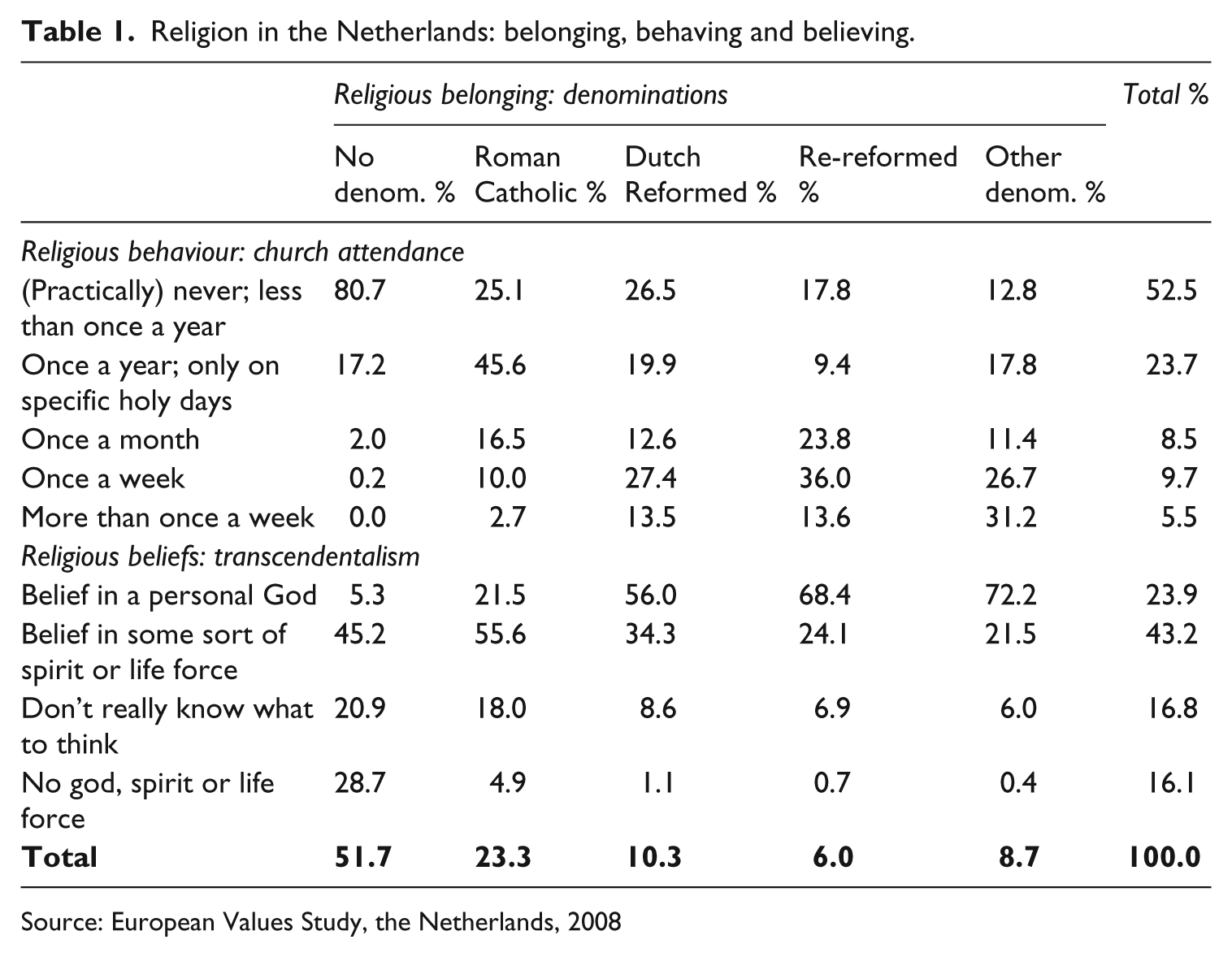
From Table 1 we observe that there is large diversity in religious belonging, behaving and believing in the Netherlands. The majority of the Dutch do not belong to a religious denomination (52%). They hardly attend religious services, and although more than a quarter of them do not believe in God or the supernatural, almost half of them believe in some sort of spirit or life force. The Roman Catholics (23%) are the largest denomination, followed by the Dutch Reformed (10%) and Rereformed (6%). The data show that the last affiliation is the most traditional when it comes to behaving and believing. Half of the Rereformed population attend church once a week or more often, and 68% believe in a personal God. The Dutch Reformed appear more heterogeneous: a large group (40%) regularly goes to religious services, but an even larger group (46%) attends church once a year or less often. A similar variation pops up in religious beliefs: 56% of Dutch Reformed believe in a personal God, whereas 34% believe in the supernatural. As has been found in other research (e.g. Bernts et al., 2007), the Dutch Roman Catholics are the least traditional. A quarter (practically) never attend religious services, and another 46% go to church only once a year or on specific holy days, mainly Christmas. In addition, only about a fifth of them believe in a personal God, about the same proportion as say they don’t know what to believe. The majority of Dutch Roman Catholics believe in some sort of spirit or life force. Finally, individuals belonging to other denominations appear to be rather traditional in their religious behaviour and beliefs: more than half of them attend church once a week or more often, and almost three-quarters of them believe in a personal God.
Religion in the Netherlands: belonging, behaving and believing.
Source: European Values Study, the Netherlands, 2008
Controls
In our multivariate analyses, we control for several important determinants of parental values. First, educational attainment is measured by asking respondents about the highest level of education completed and runs from (1) primary education to (8) university. Gender, partner and children are all dummy variables, indicating whether one is female, has a partner and has one or more children respectively. Finally, we construct seven cohorts based on birth year: born (1) before 1930, (2) between 1930 and 1939, (3) between 1940 and 1949, (4) between 1950 and 1959, (5) between 1960 and 1969, (6) between 1970 and 1979 and (7) in 1980 and after.
Results
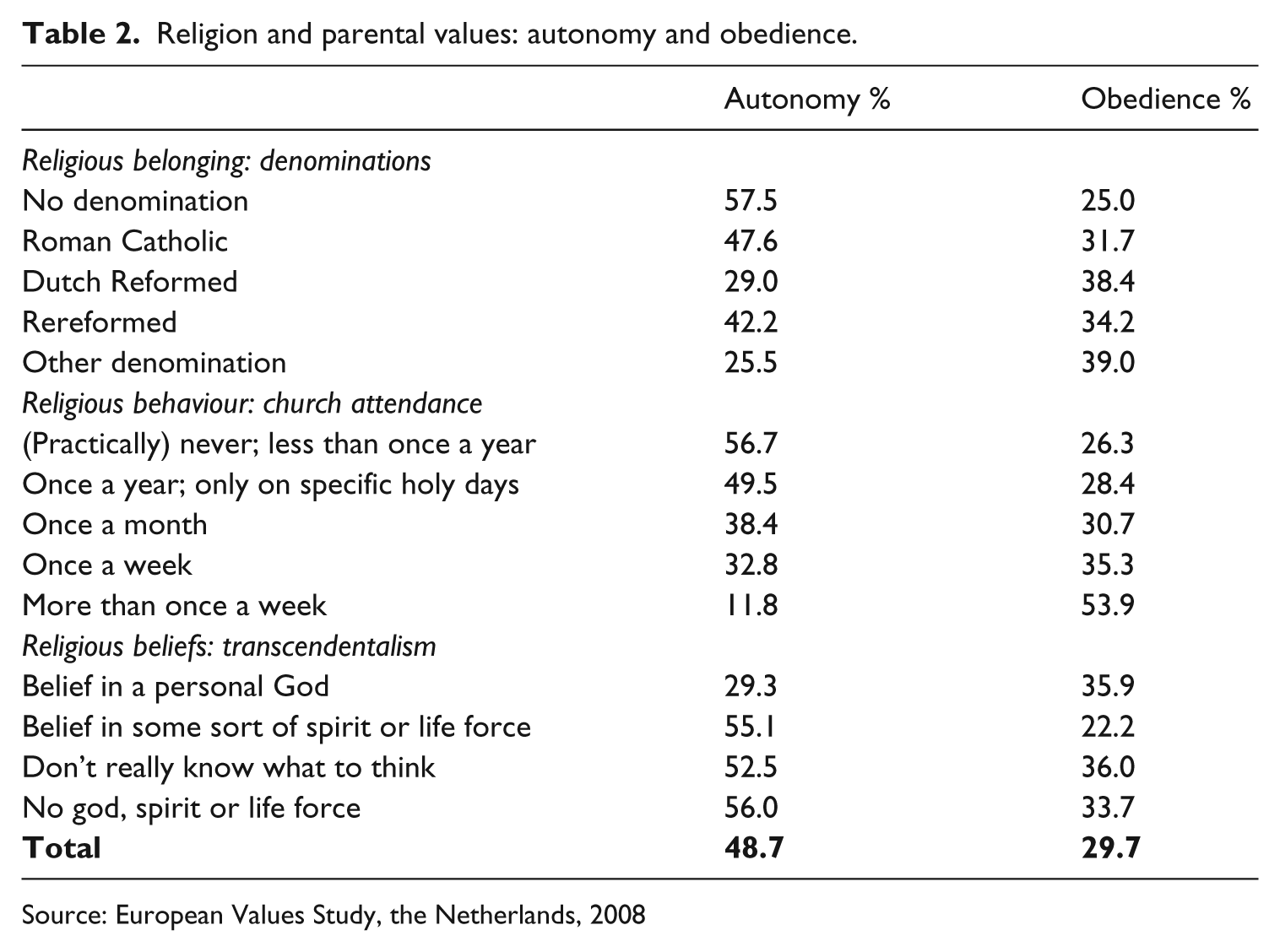
Table 2 gives an overview of the popularity of autonomy and obedience for different religious groups in The Netherlands. In general, autonomy is an important child quality according to almost half of the Dutch population, regardless of their religious belonging, behaving and believing, whereas obedience is valued by less than 30%. With respect to autonomy, there are important differences between the religious denominations, but not all outcomes are according to our expectations. Contrary to what we expected, Dutch Roman Catholics and Rereformed score equally high on autonomy, whereas the Dutch Reformed and individuals belonging to the heterogeneous category of other denominations attach significantly less value to this child quality. In line with our hypothesis, those who do not belong to a religious denomination show the highest preference for autonomy. Differences in the valuation of obedience between the four religious denominations turn out to be not significant. Here, the demarcation line is between those who are affiliated to a church and those who are not, the latter showing the lower valuation for obedience. With respect to religious behaviour, the outcomes are very clear and support our ideas about church attendance. The more often one attends religious services, the less one values autonomy and the more one values obedience. Finally, as expected, individuals who believe in a personal God attach significantly less importance to autonomy than others. The results for obedience, however, are not in line with our predictions: those with traditional beliefs (‘there is a personal God’) value obedience more highly, but so do individuals who don’t know what to think and those who do not believe in any sort of spirit, God or life force. Obedience is least valued by those who believe in the supernatural.
Religion and parental values: autonomy and obedience.
Source: European Values Study, the Netherlands, 2008
Of course, the associations described above are all bivariate in nature. To fully test our hypotheses about the religious factor in parental values, we perform multivariate logistic regression analyses. In these analyses, we control for educational attainment, gender, having a partner and/or children and birth cohort. We start with an analysis of religious belonging (denominations) and then include religious behaviour (church attendance) and beliefs (transcendentalism) in the model in order to see whether these aspects of religion can explain part of the denominational differences in autonomy and obedience. Finally, we test whether religious behaviour and beliefs reinforce the effects of religious belonging by including a number of interaction terms. 9
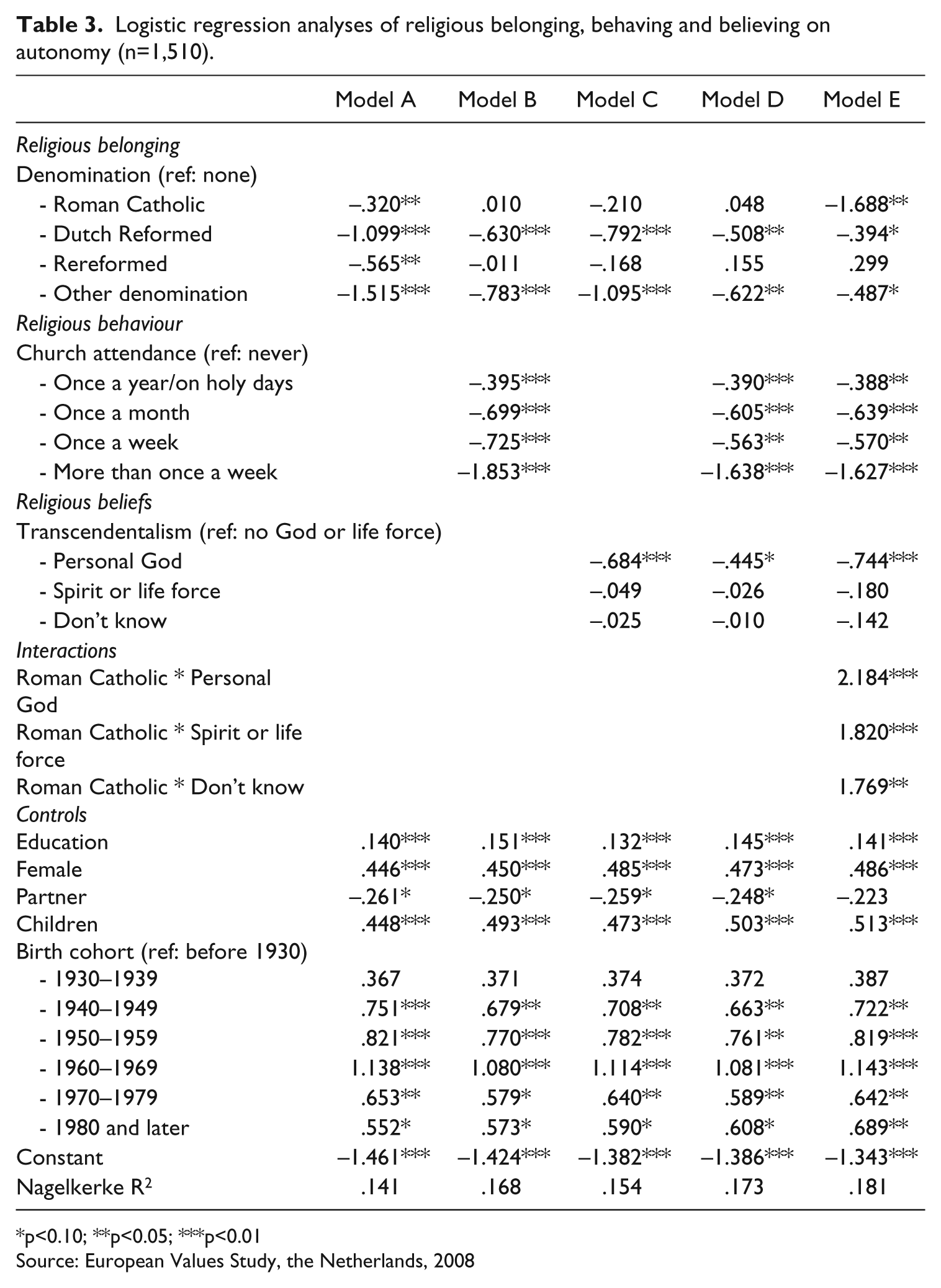
Table 3 gives the results of these multivariate analyses for autonomy. There are several observations worth noting. First, in line with previous research, we find that the higher educated, women, parents, and people born in the 1950s and 1960s have a higher preference for autonomy (see e.g. Alwin, 1984, 1989). Second, in general, the bivariate relationships between religious belonging, behaving and believing on the one hand and autonomy on the other described above persist after controlling for these background characteristics (Models A to D). Thus, individuals who are not religiously affiliated value autonomy highest, followed by Roman Catholics and Reformed, whereas the Dutch Reformed and those belonging to another denomination attach the lowest value to autonomy as an important child quality (Model A). In addition, the more one attends religious services, the less important one thinks autonomy is (Model B), whereas believing in a personal God is associated with a lower value for autonomy (Model C). Third, including church attendance (Model B) makes the differences between Roman Catholics, Rereformed and those without a religious denomination disappear: now, only the Dutch Reformed and the mixed group of individuals belonging to another denomination show a significantly lower valuation for autonomy. The same goes for including religious beliefs about transcendentalism (Model C). Believing in a personal God is significantly related to lower preferences for autonomy, and this explains part of the differences between the denominational groups. Of course, these results can also be found in Model D, where we include all three dimensions of religion at the same time: belonging, behaving and believing.
Logistic regression analyses of religious belonging, behaving and believing on autonomy (n=1,510).
p<0.10; **p<0.05; ***p<0.01
Source: European Values Study, the Netherlands, 2008
Finally, Model E shows that there are only significant interaction terms between Roman Catholics and religious beliefs. This implies that among Roman Catholics, differences in transcendentalism lead to differences in valuing autonomy as an important child quality. For the other denominational groups, religious beliefs do not matter much. Since the interpretation of these interactions can be quite complex, we plotted Roman Catholics’ predicted scores on autonomy given their religious belief in Figure 1. The results are quite surprising and in contrast to the general pattern found for religious beliefs. Controlled for all other variables included in the analyses, Roman Catholics with a traditional religious belief (i.e. belief in a personal God) attach the highest importance to autonomy as a value that children should be taught at home, whereas Roman Catholics who do not believe in a personal God, spirit or life force attach the lowest value. 10 Those who have a transcendentalist or agnostic religious belief fall in between.
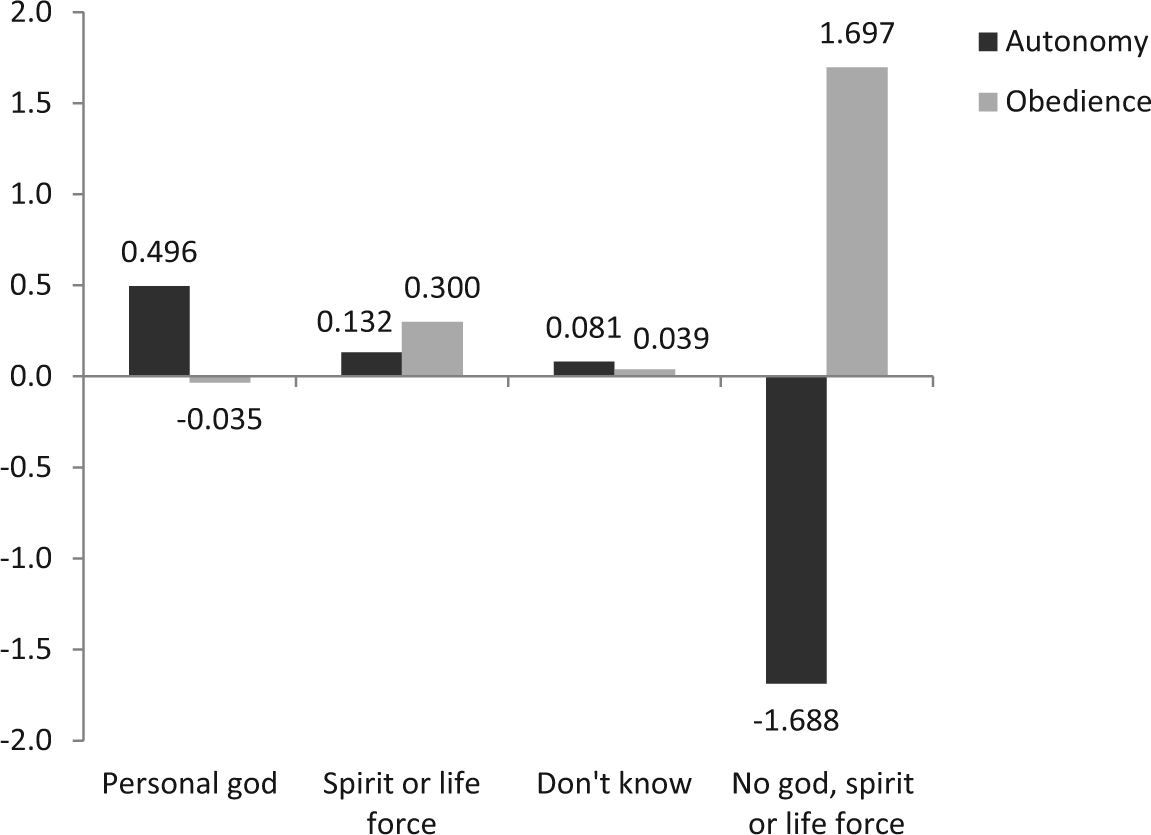
Roman Catholics’ beliefs and predicted values for autonomy and obedience.
When we look at the outcomes for obedience in Table 4, we first of all observe that the higher educated and parents attach less importance to obedience (see Alwin, 1984, 1989). Model A shows that individuals who are not affiliated with a religious denomination and the Rereformed score lowest on obedience, whereas Roman Catholics and, particularly, Dutch Reformed and those belonging to other religious denominations score higher. When we add religious behaviour (Model B), we see that church attendance completely explains these denominational differences. Individuals who attend church more than once a week give a significantly higher valuation to obedience. Religious beliefs are important predictors for valuation of obedience as well, as we observe in Model C, but not in the way we expected. Those who believe in a personal God, spirit or life force attach significantly lower importance to obedience than those who do not believe in the supernatural at all. Furthermore, adding this religious dimension does not explain away differences between denominations, but rather strengthens them. Finally, in Model E, we again test for interaction terms. With respect to church attendance, two interactions turn out to be significant. First, Dutch Reformed who attend religious services more than once a week value obedience less than those who attend church less often. Second, individuals who are affiliated with one of the other religious denominations and who often attend church (i.e. more than once a month) score higher on obedience. Apparently, the influence of religious behaviour on the valuation of obedience depends on the religious denomination. In addition, for Roman Catholics, it matters what they believe in. The interactions, which are also displayed in Figure 1, show that Roman Catholics who do not believe in a personal God, spirit or life force value obedience more highly. For adherents to the other denominations, including individuals who are not affiliated with a religious denomination, religious beliefs are not significantly related to differences in the valuing of obedience as an important child quality.
Logistic regression analyses of religious belonging, behaving and believing on obedience (n=1,504).
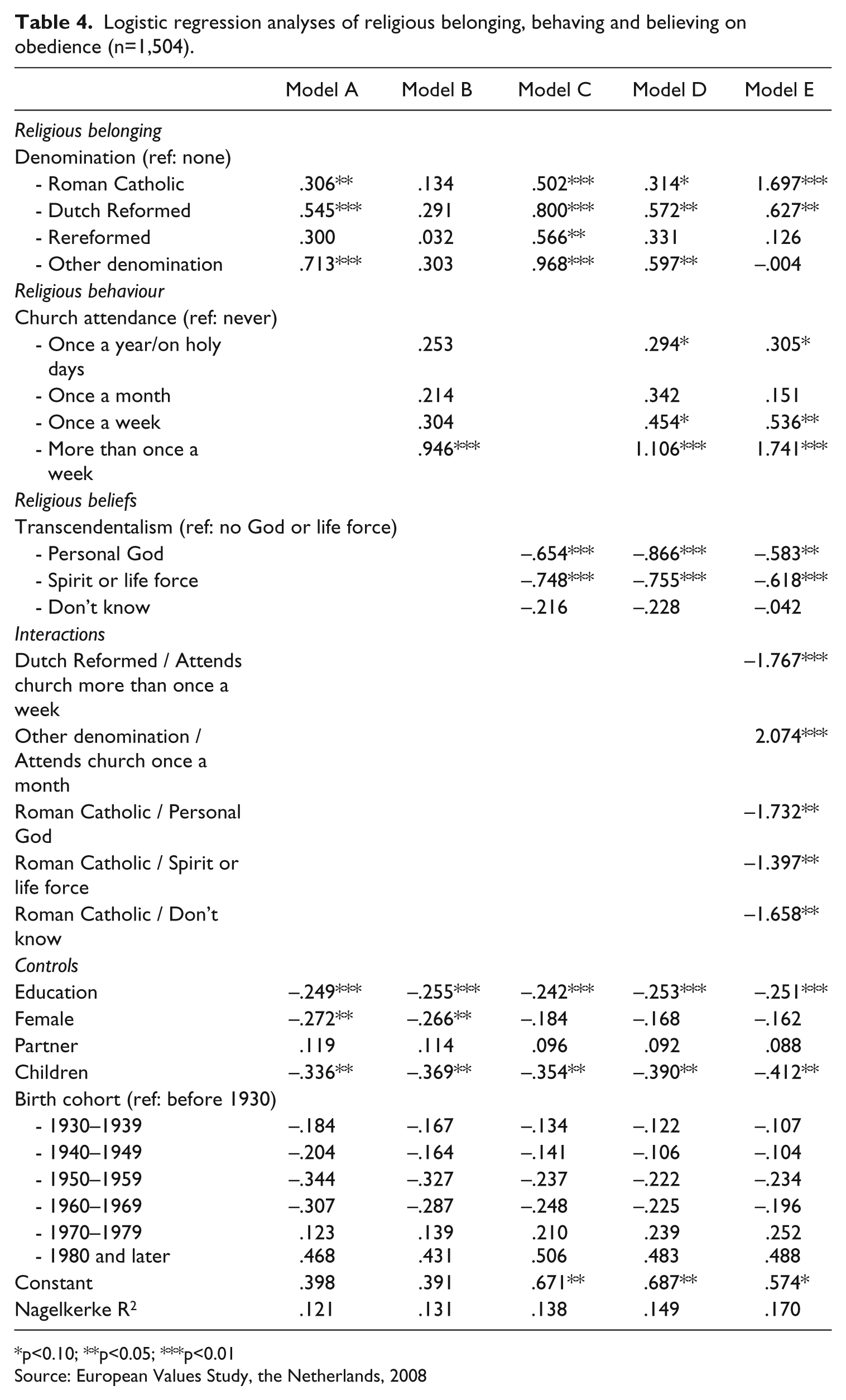
p<0.10; **p<0.05; ***p<0.01
Source: European Values Study, the Netherlands, 2008
Conclusion and discussion
What do the results tell us about the religious factor when it comes to the parental values autonomy and obedience? When we look at the differences between the main denominations in the Netherlands (Roman Catholics, Dutch Reformed, Rereformed, other denominations and no denomination), we observe – in line with our predictions – that those who are not religiously affiliated show the highest valuation for autonomy, and the lowest for obedience. Contrary to our expectations, this group is followed by Roman Catholics and Rereformed – the two denominations that, in general, assert traditional family values. These results are a clear indication that there is more to religion than belonging, which is why we took aspects of behaving and believing into account. Church attendance explains denominational differences in parental values, either partly (in the case of autonomy) or completely (for obedience). In general, the more one attends religious services, the less one values autonomy as important child quality, and the more one values obedience. In addition to this network mechanism, a moral mechanism is at work, at least for autonomy. Individuals who believe in a personal God show lower valuation of autonomy, and these religious beliefs explain part of the association between religious denominations and autonomy. With respect to obedience, we surprisingly observe that this quality is less highly valued by individuals who believe in a personal God as well as by those who believe in some sort of spirit or life force. This is not in line with our predictions. However, it should be noted that the latter observation only occurs when both denominations and beliefs are included in the analyses. The outcomes of a model regressing only religious beliefs (and controls) on obedience tell us that only those who believe in the supernatural give a lower valuation to obedience. In any case, the finding that people who have traditional religious beliefs value both autonomy and obedience less suggests that both parental values should not be interpreted as one dimension with two mutually exclusive poles (see Lenski, 1961; Kohn, 1969), but should rather be treated as two separate outcomes, as we do here.
Furthermore, our results make clear that there is not only heterogeneity in parental values within Protestant denominations, as US-based studies have revealed (Alwin, 1986; Ellison and Sherkat, 1993; Starks and Robinson, 2005), but also that the Roman Catholic population is rather diverse in this respect, at least in the Netherlands. When it comes to parental values, it matters for this religious group what kind of belief they adhere to. In contrast to the general pattern for religious beliefs, Roman Catholics who believe in a personal God score rather high on autonomy, whereas Catholics who do not believe in a personal God, spirit or life force show the lowest valuation. With respect to obedience, it works exactly the other way around. Why this is the case is not entirely clear and warrants more detailed, and preferably qualitative, research within the group of Dutch Roman Catholics.
In addition, the association between religious behaviour and obedience depends on the religious denomination. Dutch Reformed who attend religious services more than once a week surprisingly value obedience less highly than those who attend church less often. For this group, church attendance does not reinforce the doctrinal message, but works in the opposite direction. On the other hand, individuals who are affiliated to one of the other religious denominations in the Netherlands (i.e. not Roman Catholic, Dutch Reformed or Rereformed) and who attend church more than once a month, value obedience more highly as a parental value. Apparently, the network function of religious communities seems to work very well in this heterogeneous group of smaller Christian denominations, Muslims, etc. In this respect, we should take note of the fact that the direction of causality between religion and parental values might also work in the opposite direction (see Thornton, 1985). It could be the case that various other religious denominations, such as the growing Christian migrants’ Churches, have attracted individuals who place a high value on family life, like many migrant groups in the Netherlands (see e.g. Uunk, 2003). It would therefore be interesting to control for ethnicity, especially since research has found that the three major migrant groups in the Netherlands value different child qualities as important: people with a Turkish, Moroccan or Surinamese background in general stress obedience (see e.g. Van Praag and Niphuis-Nell, 1997; Herweijer and Vogels, 2004). Unfortunately, the Dutch EVS sample we employ here is too small to compare the parental values of these three groups, or, alternatively, to compare those of the total group of immigrants with those of indigenous Dutch individuals. Future studies could deal with this issue by means of surveys among samples including native Dutch as well as larger numbers of non-native respondents. In addition, qualitative case studies could provide deeper insight into the role that religion plays in valuing autonomy and/or obedience as important child qualities for different ethnic groups, including indigenous Dutch individuals.
To sum up, our results make clear that studying the religious factor in a secular society such as the Netherlands is rather complex, but worthwhile. The influence of religion on parental values is significant, even after controlling for a number of important background characteristics. Church attendance (networks) and religious beliefs (moral) are important mechanisms that explain and reinforce (part of) the denominational differences in parental values found, although not always in the way that one might expect.
One could argue that the unequivocal results described above are due to a poor measurement of parental values because the stimulus was not to choose between autonomy and obedience but to select five child qualities from a list of eleven. If other qualities rank higher, neither obedience nor autonomy will selected. Indeed, the Dutch value ‘good manners’, ‘tolerance’ and ‘responsibility’ substantially more, but this is observed for individuals of all religious groups, irrespective of how religion is defined (belonging, behaving or believing). Thus, for these three parental values, the religious factor does not appear to be very important. There are, however, marked differences in the rankings of obedience and autonomy, which, as we have seen, are partly due to religious differences. Autonomy ranks 4 among Catholics, Rereformed and unchurched, but has a very low position among Dutch Reformed. Obedience, on the other hand, is hardly mentioned among the unchurched and Catholics, but appears important for about one in every three Protestants (Dutch Reformed and Rereformed) and those belonging to the mixed group of other religious denominations. A decisive factor appears to be religious behaviour. Church attendance makes people chose more for obedience than for autonomy, while people who do not attend or not frequently attend religious services tend towards the opposite.
All in all, the heterogeneity of the religious (and non-religious) population means that conclusions about the impact of religion on parental values are not clear-cut. Some Dutch see themselves as affiliated with the Roman Catholic Church, frequently attend religious services, but do not believe in a personal God. Other Roman Catholics never attend church and believe in the supernatural: some sort of spirit or life force. The same holds for the other denominations, and for individuals who are not religiously affiliated. In fact, all combinations of belonging (member or non-member), behaving (attending church regularly or not) and believing (traditional, supernatural, agnostic or atheist) are possible, blurring the demarcations between these three dimensions and making the Dutch religious landscape rather ‘fuzzy’ (Voas, 2009; Storm, 2009). This calls for further research into the religious factor for parental values, which could be developed along two lines. First, qualitative in-depth research could improve our understanding of which aspects of religion are important when it comes to valuing autonomy and obedience as important child qualities. Second, the same objective can – to some extent – be achieved by employing quantitative research that includes a wider range of European countries with varying levels and different forms of secularization (cf. Halman and Draulans, 2006). Such a study would also improve our knowledge about the parental values of other significant religious groups in Europe, such as members of the Orthodox Church and Muslims.
Footnotes
Funding
This research received no specific grant from any funding agency in the public, commercial or not-for-profit sectors.
Notes
Author biographies
Address: Department of Sociology, Tilburg University, P.O. Box 90153, 5000 LE Tilburg, Netherlands
Email:
Address: Department of Sociology, Tilburg University, P.O. Box 90153, 5000 LE Tilburg, Netherlands
Email: