




Abstract
Rational Choice Theory has transformed the sociological study of religion. However, studies framed by Rational Choice Theory generally assume stable religious demand at the societal level, meaning the effects of individual religious preferences have received little attention. Using a sample of Christian college students from the United States, this article examines whether individual religious preferences are related to choice of congregation and frequency of church attendance. The results suggest that individual religious preferences are indeed related to these measures, meaning future studies might benefit from an increased emphasis on demand-side influences.
Recent research identifies emerging adults as the least religious age-cohort in the United States (Smith and Snell, 2009). Religious practice may be compulsory while living at home during adolescence (Smith and Denton, 2005), but many emerging adults become less religious when they leave home. Past research attributed this religious decline to college attendance, hypothesizing that college is an environment where religious beliefs are challenged, leading to a decline in religious belief and practice (Caplovitz and Sherrow, 1977; Hunter, 1983). However, recent tests of this hypothesis suggest that college attendance is not the primary cause of religious decline among emerging adults, as made evident by the fact that emerging adults who do not attend college generally have a greater decrease in religiosity compared to those who do attend college (Mayrl and Uecker, 2011; Regnerus and Uecker, 2006; Uecker et al., 2007). Even though emerging adults tend towards religious inactivity during early adulthood, many return to religious practice later in life (Desmond et al., 2010; Petts, 2009).
The decline in religious practice among emerging adults has become a point of emphasis for many Christian ministers, who often tailor their approach to emerging adults in an attempt to curb this decline (Bomar, 2009; Lutz, 2011). Some employ age-specific ministries to reach emerging adults, while others frame Christianity in seeker-friendly and relevant terms (Ellingson, 2007). This approach is sometimes referred to as the emerging church movement, which de-centralizes Christianity by placing greater emphasis on individuals, as opposed to denominations or congregations (Bader-Saye, 2006; Gibbs and Bolger, 2005; Packard, 2012). This shift towards seeker-friendly Christianity suggests that religious suppliers are becoming increasingly aware of the needs and preferences of individuals, and are eschewing traditional approaches to better appeal to religious consumers.
This interpretation is consistent with approaches to Rational Choice Theory that suggest people seek to maximize personal benefits when making religious choices (Roof, 2001). In response, religious suppliers within the emerging church choose to market themselves to Christians who prefer a congregation that focuses on them as individuals, appealing to them in ways that traditional congregations do not (Bickle and Howerton, 2004). Despite the fact that appealing to individual preferences may be the catalyst that drives the emerging church movement, little is known about the exact preferences of religious consumers.
One demographic of new religious consumers is Christian college students. Even though many college-aged emerging adults experience declines in religious practice (Smith and Snell, 2009), students who attend institutions from the Council for Christian Colleges and Universities (CCCU) often place high importance on religious faith and attend church during their college years. While many of these students frequently attended church with their families before college, college may represent their first opportunity to freely choose their own church congregation. This research seeks to better understand the religious preferences of Christian college students, as well as how these preferences relate to religious choices. How do religious preferences influence the choice of church congregation and frequency of church attendance among Christian college students?
Rational Choice Theory and religion
Rational Choice Theory has revolutionized the sociological study of religion in recent years by suggesting that individuals are rational actors who base their religious choices on costs and benefits (Iannaccone, 1995, 1997). Rational Choice Theory examines supply-side topics such as religious organizations, as well as demand-side topics such as the preferences and tastes of individuals. While many agree that religious demand is relatively stable at the societal-level and that supply-side changes are what lead to aggregate religious change (Stark and Finke, 2000), others have suggested that stable demand also applies to individual explanations of religious behavior. As Iannaccone puts it:
Over time, most people modify their religious choices in significant ways, varying their rates of religious participation and modifying its character, or even switching religions altogether. Following assumption of stable preferences, the rational choice theorist is almost never content to explain such choices with reference to changed tastes, norms, or beliefs. (Iannaccone, 1995: 77)
Rather, rational choice theorists explain changes in religious choices as occurring because of changes in the costs and benefits of religion (Iannaccone, 1995). Others challenge the assumption of stable preferences (Loveland, 2003; Sen, 1993; Warner, 1993) by noting that individual preferences for religion may be influenced by factors such as social status (Sherkat and Wilson, 1995) and interaction with relatives (Loveland, 2003). Sherkat and Wilson (1995) claim that preferences are constrained by people’s location in the social world, especially because of the tendency for preferences to converge towards the familiar.
Untangling the relationship between religious supply and demand is a difficult task because both operate simultaneously to influence religious choice. The interplay between religious supply and demand is illustrated by the phenomenon of megachurches, which seek to meet people’s needs in an engaging and relevant manner through church services that are often elaborate productions (Brook, 2013). Many megachurches also offer a variety of services including day care centers, schools, sports programs, and fitness centers (Karnes et al., 2007). Such services allow megachurches to sustain their membership, and even increase the religious capital of members who otherwise might not be very invested in the congregation (von der Ruhr and Daniels, 2012). Megachurches hold such sway in their religious markets that when they move into a community they have a similar effect as Wal-Mart, creating competition with smaller churches and forcing them to improve, find a niche, or close (Wollschleger and Porter, 2011).
Rational Choice Theory describes niches as ‘market segments of potential adherents sharing particular religious preferences (needs, tastes, and expectations)’ (Stark and Finke, 2000: 195), and perhaps megachurches are best understood as filling a niche in the religious economy. While some might study the emergence of megachurches through a supply-side perspective, religious demand and individual preferences are still an important influence for megachurches. Megachurches are usually located in urban, wealthy communities (Karnes et al., 2007), but this does not mean that there is only a market for them in such communities. Megachurches are ‘profit maximizing firms’ (Iannaccone, 1997: 39), meaning that they locate in areas that provide the most potential to attract potential attendees. Rural and low-income populations may prefer the style of megachurches, but megachurches may not choose to supply these populations, suggesting that the location of megachurches is not necessarily a good proxy for their demand. The best way to understand religious demand is by directly measuring individual preferences, yet studies that take a demand-side approach often fail to directly measure religious preferences (Loveland, 2003). One important aspect of religious choice involves the choice of church congregation. In the past, choice of congregation may have been based mainly on denomination, but this choice has become more complex as recent research suggests that denominationalism is losing its salience among Christian college students (Davignon et al., 2013). This study seeks to directly measure the individual religious preferences of Christian college students, as well as to learn how these preferences influence students’ choice of college church congregation and frequency of church attendance.
Hypotheses
This study begins by examining how religious tradition and other demographic variables influence preferences relating to church congregation. No hypotheses will be offered for how demographic variables influence church preferences, as this portion of the analysis is mostly exploratory and there is no available research to date on this topic. However, the first hypothesis explores how religious tradition influences church preferences. This hypothesis is based on Iannaccone’s (1990) theory of religious human capital, which suggests that personal characteristics, including knowledge and experiences, influence how people create and understand religious commodities. Religious human capital may even influence denominational mobility, as people who switch denominations tend to do so in ways that maintain their religious human capital (Iannaccone, 1990). Recent research affirms this assertion by suggesting that when switching denominations people tend to choose a denomination that is similar to their current denomination (Sullins, 1993). Understood in light of the theory of religious human capital, it seems that people who were socialized into more distinctive denominations would be more likely to choose a congregation from the denomination of their upbringing because their religious human capital does not transfer as easily to congregations from other denominations.
Hypothesis 1 explores how religious tradition might influence the preferences of Christian college students when choosing a church congregation, suggesting that Catholics will be more likely to view their choice of congregation as relatively fixed, choosing to attend a local congregation that shares their denominational affiliation. While the preaching ability of the pastor and style of worship may be important to them, it seems that they would be more likely to choose a congregation based on its denomination, and to accept the pastor’s preaching ability and the congregation’s style of worship. Conversely, evangelical Protestants seem less likely to be tied to any one denomination, and may be more likely to shop for a congregation based on the pastor’s preaching ability and the congregation’s worship style. Religious beliefs are also highly important to evangelicals (Hackett and Lindsay, 2008), so it seems they would place more emphasis on the pastor’s theology when choosing a congregation, while Catholics may assume that the pastor’s theology reflects the theology of the denomination.
Hypothesis 1: Christian college students who are Catholics will be more likely than evangelicals to place emphasis on attending a church from a particular denomination.
Hypothesis 1a: Alternatively, Christian college students who are evangelical will place higher emphasis on other characteristics such as the congregation’s style of worship, the preaching ability of the pastor, and the theology of the pastor.
Hypothesis 2 examines how a respondent’s preferences for church congregation might affect whether the congregation they attend during college matches the denomination of their home church. There seems to be a ‘status quo bias’ in religious choices, meaning that choices are strongly influenced by the reference point (Chaves and Montgomery, 1996). In this case, the reference point is the denomination of their home church. Alternatively, leaving home to attend college may present students with their first opportunity to freely choose a congregation that suits their own religious preferences, rather than those of their parents. This may lead some students to choose a congregation from a different denomination than that of their home congregation. Hypothesis 2 examines how congregational preferences may influence whether respondents attend a church congregation from the same denomination as their home church.
Hypothesis 2: Christian college students who place high importance on their congregation’s denomination and the theological beliefs of the pastor will be more likely to attend a church that has the same denomination as their home church.
Hypothesis 2a: Students who place a high importance on the congregation’s style of worship and the preaching ability of the pastor will be less likely to attend a church that has the same denomination as their home church.
Students who are strongly socialized into the denomination of their parents may be more likely to base their choice of congregation on denomination, and may be more likely to attend a college congregation from the same denomination as their home church. Students who place more emphasis on characteristics that might vary greatly between congregations (even within the same denomination), such as style of worship and preaching ability of the pastor, may be more likely to ‘church shop’ for congregations that fit these criteria, even if they are not from the same denomination as their home church.
Church preferences might not only influence choice of church congregation, but may also influence frequency of church attendance. Stark and Finke (2000: 201) propose that ‘to the degree that religious economies are unregulated and competitive, overall levels of religious participation will be high’. According to this reasoning, competitive religious economies with many choices can better satisfy people’s individual preferences, thereby increasing religious participation. This reasoning may also apply to church shopping. Christian college students who choose their church congregation based on its denomination may be less likely to church shop, and therefore may experience decreases in religious participation if their other religious preferences are not satisfied at a congregation within their denomination. Other Christian college students who church shop might discover congregations that better match their preferences, thereby increasing their religious participation. Hypothesis 3 examines how church preferences might influence changes in a respondent’s church attendance since they began college.
Hypothesis 3: Christian college students who place a high importance on the style of worship and preaching ability of the pastor will be more likely to maintain or increase church attendance since they began college.
Hypothesis 3a: Students who place high importance on their congregation’s denomination will be more likely to experience decreases in church attendance since they began college.
Data
Data from a survey of Christian college students from the United States are used to examine these hypotheses regarding church preferences and religious choices. In the fall of 2012 a survey was administered to students from institutions in the Council for Christian Colleges and Universities (CCCU), with 31 of the CCCU’s 118 member institutions agreeing to participate. The colleges and universities that agreed to participate in the survey span many different denominations and sizes, and there appears to be no systemic bias based on the institutions who participated in the survey. Students received an email through their student email addresses inviting them to take an online survey via the survey platform Qualtrics, with 6318 undergraduate students completing the survey.
The CCCU represents a particular segment of Christian higher education, and therefore this sample of students is not completely representative of all Christian college students in the United States. The CCCU is an organization that seeks ‘to advance the cause of Christ-centered higher education and to help our institutions transform lives by faithfully relating scholarship and service to biblical truth’ (Council for Christian Colleges and Universities, 2014), and this sample contains mostly Protestant respondents who place a high priority on their personal faith (Davignon et al., 2013). Even though this sample is not representative of college students or Christians as a whole, it provides a good starting place for studying how religious preferences may influence church attendance. CCCU students are relatively religious and generally interested in choosing a congregation and attending services, unlike many of their peers at public colleges and universities. College may also provide these respondents with their first opportunity to choose for themselves where and how often they attend church, meaning that this demographic provides a good opportunity to examine how religious preferences influence religious choices. The ability to generalize the findings beyond this sample, however, is limited.
Dependent variables
The first dependent variable measures whether the denomination of the respondent’s home church matches the denomination of the church they chose to attend in college. This measure includes 23 general religious affiliations and denominations, and only measures whether the denomination of the student’s college congregation matches the general denomination of their home congregation. For instance, there is one category for Baptist, meaning this measure does not differentiate between specific denominations within larger denominational traditions.
This analysis also examines how church preferences influence changes in the frequency of church attendance. Respondents were asked, ‘Since you began college how has the frequency of your participation in the following activities changed? … Church attendance.’ Possible responses were ‘significantly decreased,’ ‘decreased slightly,’ ‘remained the same,’ ‘increased slightly,’ and ‘significantly increased.’ The distribution of the responses is relatively normal, and the responses were coded into three categories describing whether the respondent’s church attendance increased, stayed the same, or decreased. Attempts to analyze this survey question using multinomial logistic regression violated the proportional odds assumption, so these three categories were combined into a binary variable that compares stableness and increases in church attendance to decreases in church attendance.
Church preferences
This analysis measures church preferences by asking respondents to rate the importance of factors that influenced their choice of college congregation. Only students who indicated that they attend church in college responded to these questions. Respondents rated the importance of the ‘style of worship,’ ‘theology of the pastor or college pastor,’ ‘preaching ability of the pastor or college pastor,’ and ‘denomination of the church.’ In addition, respondents were also asked to rate how the ‘strength of the college ministry’ and ‘programs and ministries offered by the church (beyond the college ministry)’ influenced their choice of college congregation, although no hypotheses are offered for these factors. The respondents rated the importance of each of these factors on a five-point scale which included the responses of ‘not important at all,’ ‘not very important,’ ‘somewhat important,’ ‘very important,’ and ‘extremely important.’
Control variables
The respondent’s academic class (e.g. first-year student, sophomore, etc.), gender, race (white v. nonwhite), and father’s education were used as control variables. A standard measure of Biblical literalism was also included, as well as whether the respondent’s parents belong to the same general denomination. Parents more effectively transmit their religious views to their children when they share the same denomination (Bader and Desmond, 2006), which perhaps influences respondents’ choice of college church and frequency of attendance. In addition, the religious tradition of these college students was controlled for using the RELTRAD measure (Steensland et al., 2000).
Methods
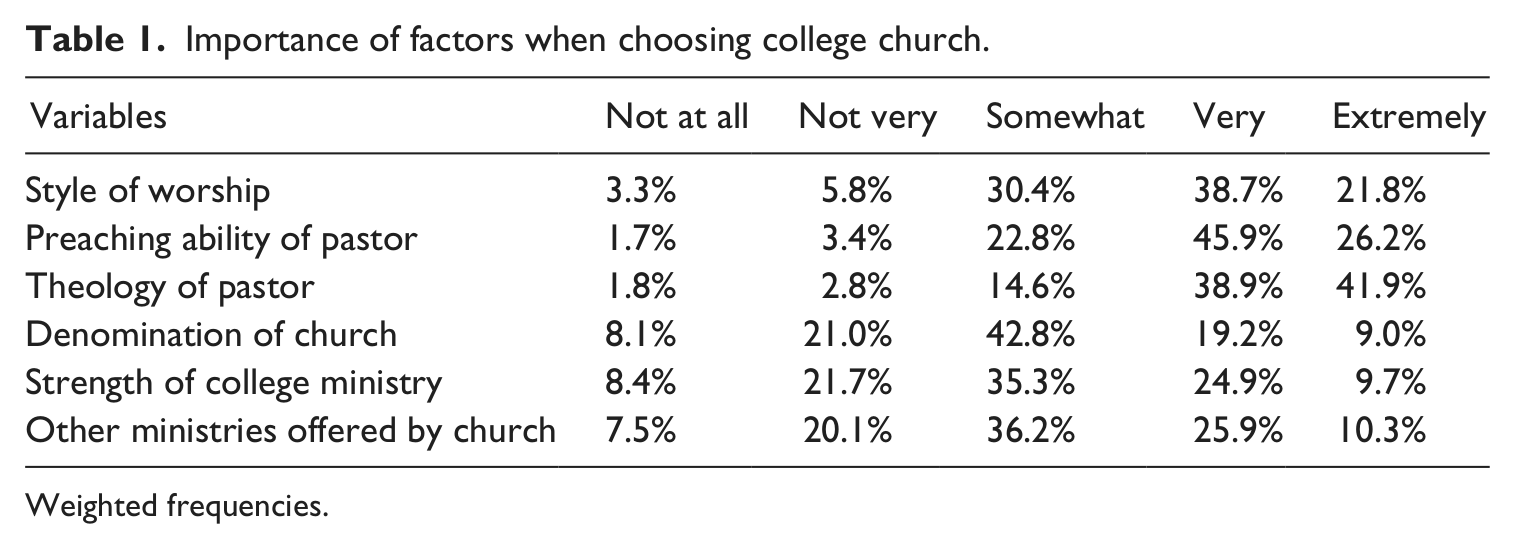
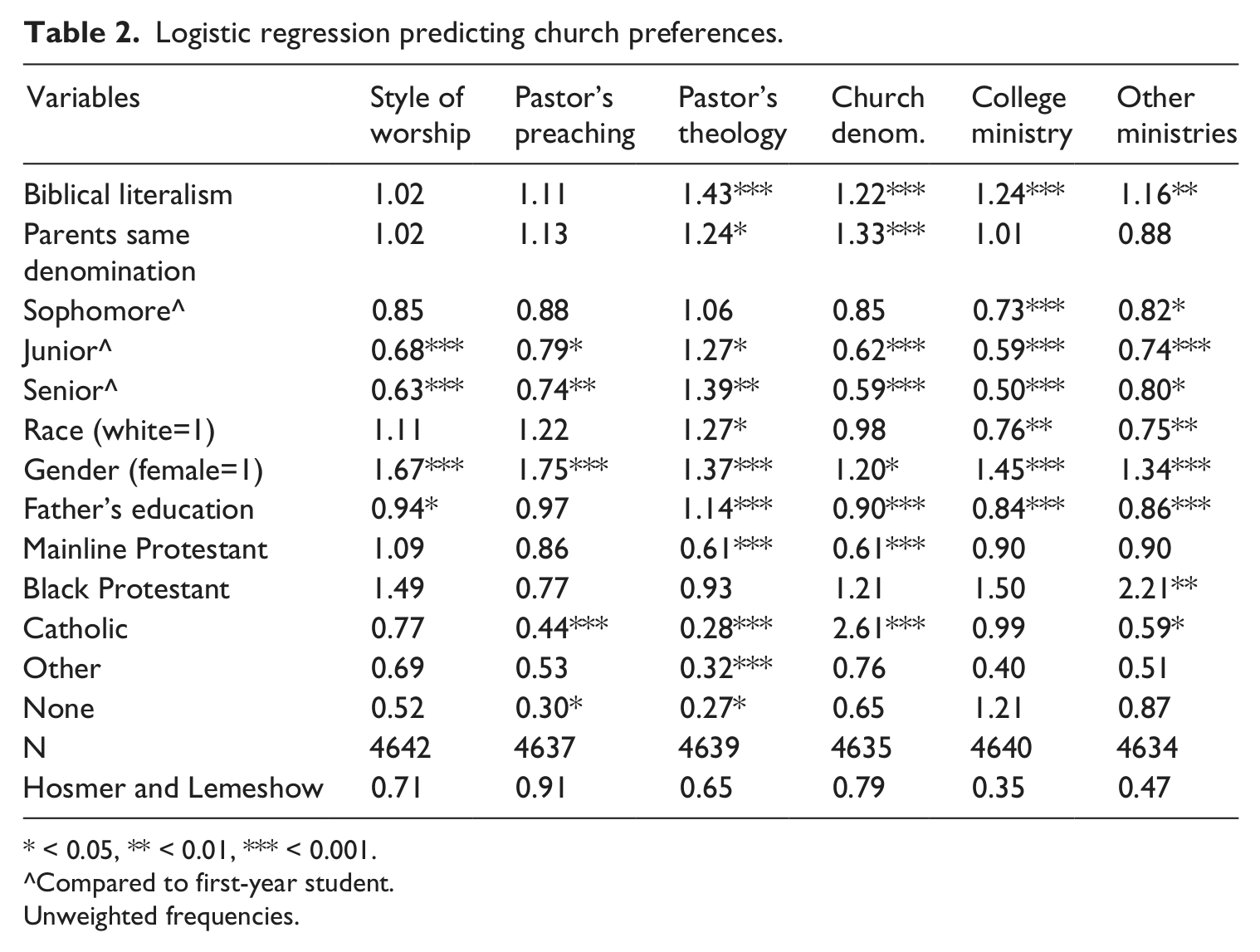
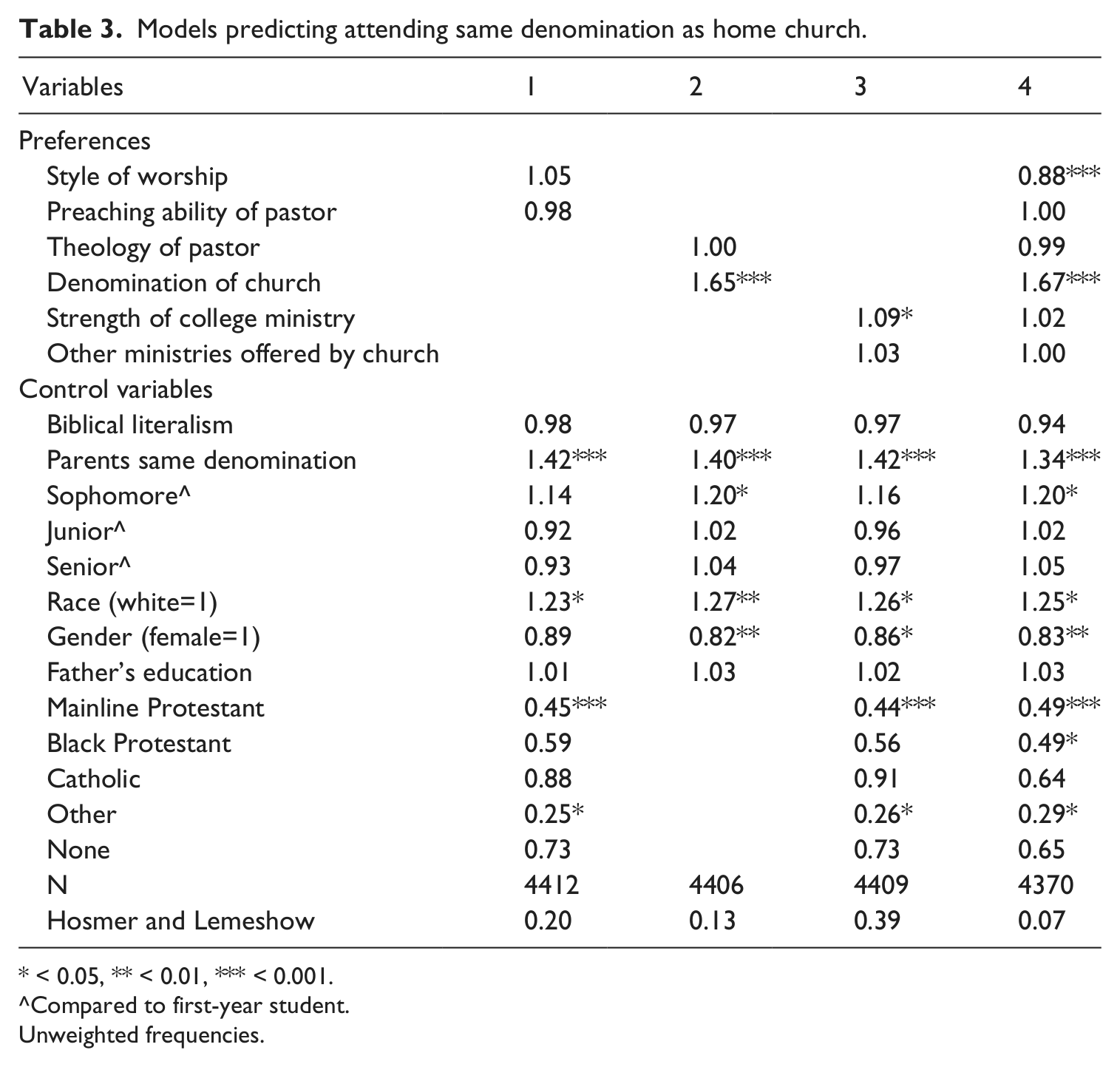
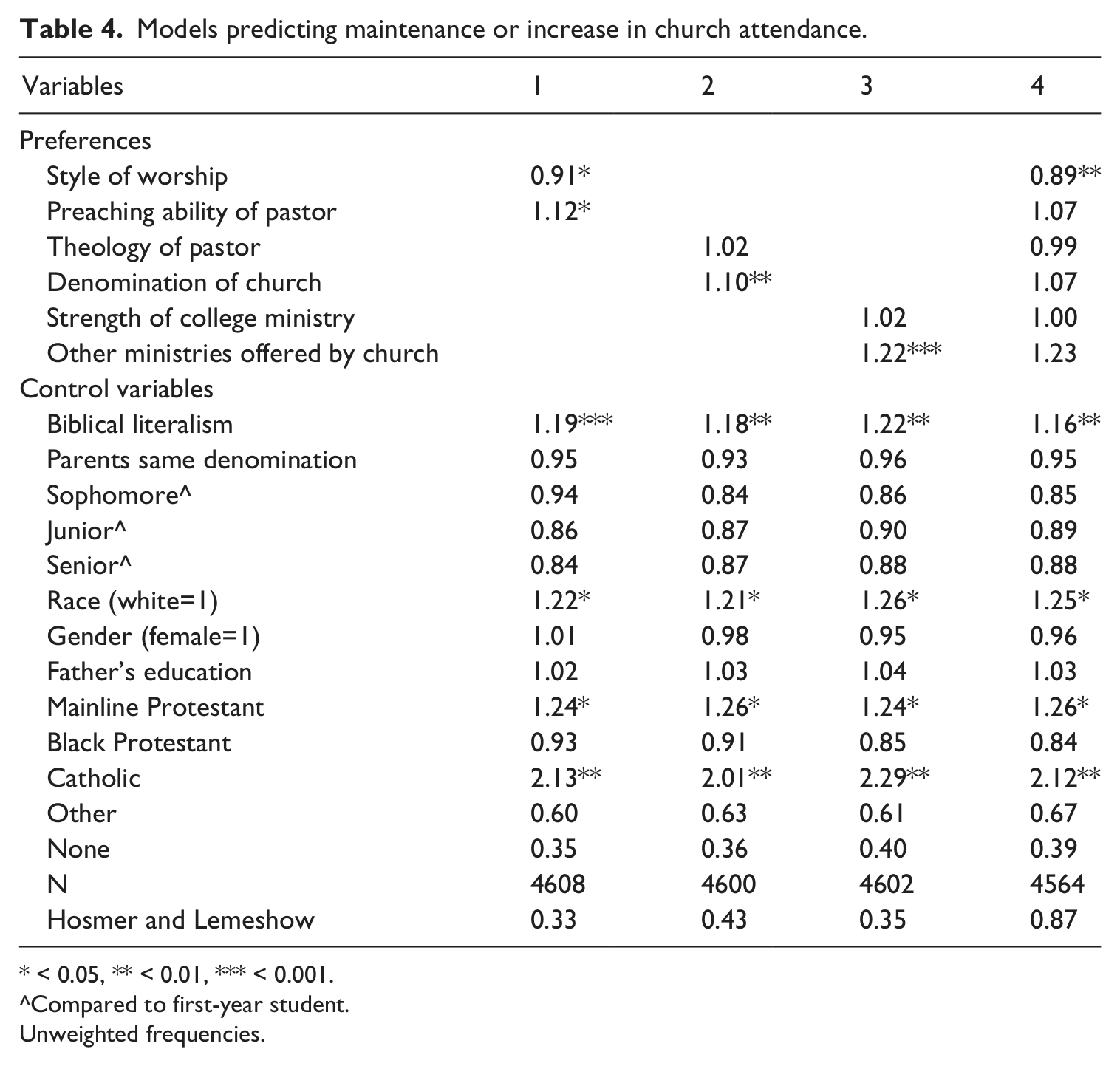
This analysis begins by presenting the frequencies of college church preferences in Table 1, which are weighted to reflect the actual race and gender composition of the population. Next, each hypothesis is tested using logistic regression. The results from Hypotheses 1 and 1a are presented in Table 2, which examines how religious tradition and other demographic variables influence preferences for congregation. Hypotheses 2 and 2a are presented in Table 3, which examines whether the respondent has chosen to attend a congregation from the same denomination as their home church. Hypotheses 3 and 3a are presented in Table 4, which examines whether different preferences for college congregation influence changes in the respondent’s church attendance since they began college. Initial findings revealed that one model from Table 3 exhibited high levels of multicollinarity, which changed the direction of some of the effects. When RELTRAD was removed from the model the multicollinearity disappeared, without substantively affecting the other predictors. Therefore, the RELTRAD measure is not included in this model.
Importance of factors when choosing college church.
Weighted frequencies.
Logistic regression predicting church preferences.
< 0.05, ** < 0.01, *** < 0.001.
Compared to first-year student.
Unweighted frequencies.
Models predicting attending same denomination as home church.
< 0.05, ** < 0.01, *** < 0.001.
Compared to first-year student.
Unweighted frequencies.
Models predicting maintenance or increase in church attendance.
< 0.05, ** < 0.01, *** < 0.001.
Compared to first-year student.
Unweighted frequencies.
Results
Students at Christian colleges and universities consider many different factors when choosing which church to attend while they are in college. The weighted frequencies for each of the available survey items regarding preferences for college church attendance are presented in Table 1.
The results show that the theology of the pastor is the most important preference, with 80.8% of respondents claiming that the pastor’s theology is very or extremely important to their choice of congregation. This importance of the pastor’s theology did not translate to rating denomination as an important criterion for choosing a church congregation. Only 28.2% of respondents claimed that the church’s denomination was a very or extremely important factor when choosing which church to attend in college. The preaching ability of the pastor and the style of worship were both moderately important to respondents, with 72.1% and 60.5% of respondents claiming that these respective factors were very or extremely important to them. Conversely, the ministries offered by churches were less important to these college students when choosing a church, with 34.6% rating the college ministry as very or extremely important, and 36.2% rating the church’s ministries as a whole as being very or extremely important in their decision of which church to attend. These basic findings suggest that theology is important, but that these Christian college students place much more importance on the theology of the pastor than the specific denomination of the church congregation itself. Characteristics of the church service such as the style of worship and the preaching ability of the pastors were also important, while the different types of ministries offered by the church were relatively unimportant.
Table 2 models the effects of religious tradition and demographic variables on church preferences. As the results show, upper-level students consistently have fewer preferences compared to first-year students, perhaps because the former have already chosen a congregation and the reasons for their original choice now seem less salient. In addition, women tended to have higher preferences than men for each factor. Biblical literalism also led to higher preferences for each category except for style of worship and preaching ability of the pastor. Father’s education was associated with increased preferences for the theology of the pastor, but it also was associated with lower preferences for the denomination of the church, the strength of the college ministry, and ministries programs overall.
In support of Hypothesis 1, religious tradition significantly influenced church preferences. Catholics place a strong emphasis on denomination, and have fewer preferences regarding the preaching ability of the pastor and the theology of the pastor compared to evangelicals. Mainline Protestants were less likely to place emphasis on denomination than evangelicals, while showing no significant difference to evangelicals in terms of style of worship and the preaching ability of the pastors. Mainline Protestants were also less likely to place high emphasis on the theology of the pastor compared to evangelicals.
The importance of these different church preferences is also likely to influence one’s choice of church congregation, as many students are likely choosing their church congregation for the first time. Table 3 examines whether these college students attend a congregation from the same general denomination as their home church. These religious preferences are entered into the model in steps to determine if different types of key predicting variables have significant effects before the final model. The first step involves stylistic characteristics of the church service itself, including the style of worship and the preaching ability of the pastor. The second step involves the framework of beliefs set forth by the congregation, including measures of the pastor’s theology and the importance of the church’s denomination. The third step measures the influence of different ministries that the church might offer, including college ministry and other ministries offered by the church.
The final step combines all of these influences into one regression model. As might be expected, those who rate the denomination of the church as highly important are more likely to attend a college church that has the same general denomination as their home church. In addition, those who rate style of worship as being important are less likely to choose a congregation from the same denomination as their home church. These results nearly perfectly support Hypothesis 1, with the only difference being that there was no significant effect of the preaching ability of the pastor on whether the respondent attends a college church from the same denomination as their home church. Respondents whose parents share the same denomination are also more likely to attend a church congregation from the same general denomination as their home church.
Table 4 examines whether church preferences are related to changes in the frequency of church attendance since college began. In the first model, respondents who place high importance on the congregation’s style of worship are less likely to maintain or increase church attendance, while the preaching ability of the pastor had a slight, positive effect on maintaining or increasing church attendance. In the second model, having higher preferences for the denomination of the church also leads to slight increases in church attendance. Those who place importance on the church’s ministries as a whole are more likely to experience increases in church attendance. In the final model, only preferences for the congregation’s style of worship had a significant effect on church attendance.
Discussion
Rational Choice Theory has focused mainly on supply-side influences of religion, but individual preferences are also important for explaining religious choice. Table 1 reveals the specific church preferences that influence Christian college students’ choice of congregation, suggesting that these students are likely to base their choice of congregation on the pastor’s theology and preaching ability, as well as the congregation’s style of worship. Hypothesis 1 was supported, as Catholics were more likely to choose their congregation based on its denomination. Hypothesis 1a also received very limited support; evangelicals were not more likely to identify style of worship and the preaching ability of the pastor as criteria for choosing their congregation compared to other religious traditions, but they were more likely to base their choice of congregation on the theology of the pastor. Only Black Protestants were as likely as evangelicals to choose their congregation based on the theology of the pastor.
This study also tested how individual preferences might influence church attendance and choice of college church. The findings generally suggest that individual preferences do relate to choice of church congregation and frequency of church attendance. Hypotheses 2 and 2a were firmly supported, with the analysis suggesting that students who base their choice of congregation on denomination are more likely to attend a church of the same denomination of their home church, while those who emphasize the style of worship are less likely to choose a congregation from the same denomination as their home church. Perhaps these college students attended a church that matched the preferences of their parents during childhood, but once they began college they were able to choose a church that matched their own religious preferences. As Table 1 shows, this sample of college students places a relatively high importance on characteristics of the church service such as the style of music and the preaching ability of the pastor. Preferring a congregation that matches these preferences may lead Christian college students to church shop, making them more likely to choose a congregation from a different denomination than their home church.
Hypothesis 3 also suggests that students who place high importance on these certain congregational characteristics will be more likely to maintain or increase their church attendance in college. Consistent with previous applications of Rational Choice Theory to religious choice (Stark and Finke, 2000), religious consumers with many available options to meet their religious preferences might experience increases in religious participation. The results provide only partial support for Hypotheses 3 and 3a, and in some cases are directly contrary to these hypotheses. In accord with Hypothesis 3, the preaching ability of the pastor may lead to increases in church attendance, but those who place importance on the style of worship are actually less likely to maintain church attendance. In addition, choosing a congregation based on its denomination was not associated with decreases in church attendance. In fact, in Model 2 placing high importance on denomination was actually associated with maintenance and increases in church attendance. These findings are somewhat surprising, as style of worship seems to be one way that congregations seek to appeal to emerging adults. While style of worship may be an important characteristic of church services, offering a relatable style of music and service may not be enough to sustain church attendance for Christian college students. It seems that college students need substantive religious content, and not just their preferred worship style, if they are going to frequently attend church.
Conclusion
These findings provide important additions to the literature. First, they affirm the importance of individual preferences in predicting religious choices. Previous research suggests that social influences may affect religious preferences (Loveland, 2003), and that college students’ preferences seem to vary based on academic classification, gender, and religious tradition. Rational Choice Theory’s reliance on the assumption of stable demands is useful for societal-level studies of religion, but this study explores variations in religious demand at the individual-level, demonstrating the importance of preferences by showing how they influence religious choice.
Second, these individual preferences influence whether college students choose to attend a church from the same denomination as their parents. Many college students seek to form their own religious identities during college (Astin et al., 2011), but some may be more likely than others to attend a church from a different denomination than their home church. Seemingly, students who place higher emphasis on the preaching ability of the pastor and the style of worship at the church are most likely to shop for a church congregation during college compared to other students who place greater importance on denomination.
Finally, this analysis draws upon Rational Choice Theory to examine whether various religious church preferences influence the frequency of church attendance. The results suggest that placing high importance on the style of worship may actually lead to decreases in the frequency of church attendance. Perhaps college students who prefer a certain worship style are unable to find a congregation that meets their preferences, thereby tempering their church attendance. Another explanation may be that college students who are developing their religious identities need substantive religious content, and not merely a congregation with a worship style that fits their preferences. Seeking a certain religious style at the expense of religious substance may not be enough to sustain religious participation.
The decline in church attendance for emerging adults has been well documented (Smith and Snell, 2009), and many congregations aim to reach emerging adults through new styles of church services, hoping to satisfy the religious demands of emerging adults and others who might be less likely to attend church. However, this research suggests that college students who place high importance on worship style are more likely to experience declines in church attendance. Congregations must seek not only to appeal to the stylistic preferences of young adults, but should also strive to provide substantive religious content as the emerging adults develop their own religious beliefs and identity.
Limitations
As noted earlier, one limitation is that this sample of Christian college students from the United States is not representative of college students or Christian college students as a whole. This research is also unable to account for the quality of the relationship between these college students and their parents, which is related to religious transmission (Bengtson, 2013). It was also unable to account for the religious markets in the locations where these students attend college, which may affect religious practice if there are few available congregations that satisfy the preferences of these students. Nevertheless, this research sheds light on how the religious preferences of Christian college students affect their religious practices, affirming the importance of studying individual religious preferences.
Footnotes
Acknowledgements
The author would like to thank Larry Lyon, Kevin Dougherty, and Perry Glanzer.
Funding
This research received no specific grant from any funding agency in the public, commercial or not-for-profit sectors.
Author biography
Phil DAVIGNON is currently an Assistant Professor of Sociology at Union University, USA. He received his PhD from Baylor University, USA and his research examines the social influences of adolescent and young adult religiosity.
Address: Union University, 1050 Union University Drive, #1850, Jackson, TN 38305, USA
Email: