




Abstract
The authors explore the effect of a religious upbringing on church attendance later in life. To this purpose, people who had been interviewed in 1983 as secondary students about their upbringing as well as other characteristics, were interviewed again in 2007 about the same topics. Comparisons between the 1983 and the 2007 data reveal that church attendance dropped significantly among these people during this period. Furthermore, it is shown that a religious upbringing is not a good predictor of church attendance later in life. These conclusions apply to Protestants and Catholics alike, as separate analyses for Catholics, Dutch Reformed and Re-Reformed reveal.
1. Introduction
In connection with the continuation of religious life and the survival of religious institutions in our modern world, it is often stated that the religious socialization of the younger generation is of vital importance. It is significant in this regard that religious institutions recruit new members particularly among the children of their existing membership—a tendency that is illustrated by research conducted in the Netherlands into changes in religious affiliation. According to the findings of Becker and De Hart (2006: 40), most people stick to the denomination they were brought up in and few change their religious affiliation. If changes do occur in this regard, most people seem to give up their religious affiliation altogether rather than switch to another denomination. Of course, this does not mean that inter-denominational switching and conversion later in life never occur. These phenomena sometimes do occur, but they remain exceptions to the general rule; i.e. most people stick to the religion they were brought up in by their parents (cf. also Hunsberger, 2000).
The qualification “by their parents” is of significance here. For research concerning the religious upbringing of children also shows that parents are by far the most influential in this regard. Parents are the most important role models, whose influence clearly exceeds that of peers and the influence of attending a religious school (Spilka et al., 2003: 106–22). But what about the long-term effects of a religious upbringing? Does the influence of a religious upbringing last until adulthood? And is a religious upbringing a strong predictor of religious affiliation later in life? Questions like these are not often raised, because most of the time researchers lack the longitudinal dataset that is required to answer them. We, however, do have such a longitudinal dataset, which enables us to study the long-term effects of a religious upbringing.
Hence, the research questions we try to answer in this article are the following: What is the long-term effect of religious socialization on church attendance later in life? and: Is there a difference in this respect between different Christian denominations? As the first question shows, our focus is on “church attendance” as one important indicator of religious affiliation and on the extent to which this is the effect of a religious upbringing in the home. In addition, as expressed by the second question, we are also interested in denominational differences: in whether the effect of a religious upbringing is stronger or weaker according to the specific denomination children were brought up in.
Our article is structured as follows. To begin with, we explain more in detail why a religious upbringing is considered to be so important and also discuss possible denominational influences in this regard (section 2). Next, we pay attention to some methodological issues and especially account for the way we gathered our longitudinal data (section 3). Our next step is to present our major research findings and provide an answer to the above research questions (section 4). The article closes with a theoretical reflection on our most important findings (section 5).
2. Religious Socialization
Socialization can be briefly defined as the process in which specific beliefs, notions, convictions, practices, values, norms, etc. are transmitted from one generation to the next in order to enable the coming generation to participate in the prevailing social life. In short, socialization is about the integration of people in existing social structures. This understanding of socialization is, of course, closely related to the work of the French sociologist Emile Durkheim (1858–1917), who wondered how social integration continued to be possible in the emerging industrial society of his time, a society that was becoming increasingly characterized by mechanistic and anonymous social relations as a result of the division of labour. Durkheim’s answer was to emphasize the role of education in inculcating the societal structure in each individual by instilling in him or her the prevailing values, norms, ideologies and roles (Durkheim, 1984: 46). Ever since Durkheim coined the concept of socialization in this way, transmission and internalization have been seen as two basic aims of the process of socialization. To put it another way, the aim of socialization is not only of a cognitive nature but also of an affective-attitudinal nature as well. It concerns not only the acquisition of beliefs, values, norms, etc. but also compliance with these beliefs, values and norms. But how does compliance with a social structure come about? This question is dealt with extensively by Berger and Luckmann.
With the help of their threefold distinction between the significant others, the generalized other and the generality of others, Berger and Luckmann (1991: 149–57) tried to explain how the internalization of roles, values, norms, etc. takes place. The significant others are the primary caretakers of the child, usually the parents, who mediate a certain social world, made up of certain roles, values, norms, etc., to the child—a social world the child accepts, or internalizes, because the significant others present this world as meaningful to the child. However, as the social world of the child expands, and the child for instance interacts with older children in the street or the kindergarten or with grandparents, an aunt or uncle, it is very important that these others too comply with the roles, values and norms of its significant others. This is very important in view of the ongoing social integration of the child, because it makes the child aware of the fact that what is meaningful to its parents is meaningful to everybody in society. This awareness Berger and Luckmann describe as the generalized other. The generalized other thus refers to the conscious identification of the child with a certain set of beliefs, convictions, roles, values and norms, because these beliefs, etc. are of importance to everybody in society. Or, as Berger and Luckmann put it, the generalized other is “the abstraction of the roles and attitudes of concrete significant others” (Berger and Luckmann, 1991: 153). It is an abstraction that enables the child to identify not only with certain significant others, but also with a generality of others, i.e. with society. This last identification Berger and Luckmann consider a crucial phase in the process of socialization, because it implies the internalization of society, i.e. the social structure, as such.
Against this theoretical background, it is not surprising that most empirical studies into the effects of religious socialization have focussed on and emphasized the role of the parents. For instance, in one of the first empirical studies that was conducted in this regard in the Netherlands by Andree (1983), the final conclusion was that the role of parents is pivotal here. More specifically, the study of Andree pointed out that parents should take care of a clear and recognizable religious climate in the family. Something parents could do best, according to Andree (1983: 264–71), by displaying overt religious behaviour to the child like churchgoing and daily prayer. Moreover, parents should also do this in an authentic way, thus showing to the child that they do not perform religious practices out of sheer habit, but because this really matters to them. This aspect of authenticity was also stressed by Hutsebaut (1995: 124–6), who also pointed to parental religious homogeneity and religious salience as important conditions for the success of religious socialization (cf. Sherkat, 1991: 183). That is to say, parents should agree on religious matters and on performing religious activities and they should also explicitly show that religion is of importance to them in their daily lives. Religious doubts or religious disputes in the family hinder the transmission of religious beliefs, Hutsebaut concluded. Most of the insights of Andree and Hutsebaut were confirmed by Alma (1999: 100–12). In her study, she too emphasized the role of the parents and especially stressed the emotional bond between the parents and the child. For parents can only function as significant others, she argued, if the child is willing and able to identify with its parents and feels it is accepted unconditionally (basic trust) by them. This feeling of unconditional acceptance, of basic trust, serves as an important foundation for the child’s ability to enter into social relations and even into a trustful relationship with God, according to Alma.
Parents are thus seen as crucial “significant others” whose influence on the growing child is often explained with the help of Bandura’s (1971) well known social learning theory (cf. for instance, Hutsebaut, 1995: 126–8; Van der Slik and Scheepers, 1997: 45; Spilka et al., 2003: 107–9). Becoming religious, then, is basically a matter of imitating the religious behaviour displayed by one’s parents—an insight that explains why it is so important for parents to confront the child with religious practices like saying grace, to perform these religious practices together with the child, to create a religious atmosphere at home and to discuss religious issues with the child, etc.
But what of the role of the religious community? Since religious socialization, as we have seen, aims at the integration of the child in a religious community, we may expect that specific features of the religious community, or denomination, are also of importance here. As well as the family, denominations provide contexts of socialization, which may interact with the influence of the parents (Sherkat, 2003). Denominations offer important social relationships and networks in support of the religious socialization of the child (Kuusisto, 2007). However, the way denominations are actually supportive in this respect may differ from denomination to denomination. For instance, in the footsteps of Durkheim one may argue that a denomination that puts more emphasis on integration into the religious community and not so much on individual faith, which Durkheim (1983: 162–85) thought was the case for Catholicism, is especially keen on supporting the religious upbringing of children so as to enable them to participate in religious practices and church life. Or one may refer to more conservative and strict religious groups and argue that these groups typically take great pains to inculcate the one true faith into the children of their membership (Kelley, 1972) – something which, according to research conducted in the United States (Bartkowski, 2007), may even result in the application of very specific, disciplinary childrearing techniques among certain conservative religious groups. There is reason to believe, therefore, that the way children are raised religiously differs according to the religious denomination the parents belong to and that this perhaps also influences the long-term effect of the religious upbringing the children had. For this reason, we not only look at the long-term effect of religious socialization processes as such, but also make separate analyses for the three major Christian denominations in the Netherlands: Catholics, Dutch Reformed and Re-Reformed.
3. Method
3.1 Research Methodology and Data Collection
Our study into the effects of religious socialization on church attendance is a so-called panel study. A panel study is a dynamic study meant to detect changes over time by questioning the same respondents at two or more points in time (Riley, 1963: 555–62). It can be distinguished from a trend study, which also looks for changes over time. The major difference is that a trend study compares different cohorts with one another, while a panel study examines the same people by way of a sequence of cross-section studies. In general, a panel study is considered more robust for detecting changes over time.
In our case, respondents were questioned twice. They were interviewed for the first time in 1983 by De Hart (1990a). As part of his research into the religious and political activities of Dutch youngsters, De Hart carried out a random sample survey among 3,532 Dutch secondary school students who at that time were in the higher grades of pre-university (VWO) or pre-college (HAVO) programmes. The sample was considered to be representative of the whole population of higher-grade VWO and HAVO students in the Netherlands. On the basis of the address file of 1983, we managed to trace 834 of these students in 2006. In the first half of 2007, a questionnaire inquiring about various religious practices and beliefs was send to these 834 former students and by July 2007 we had received completed questionnaires from 474 respondents, with an average age of 39.7 years—a response rate of 56.8 per cent. In this respect, it is important to note that we contacted only those former students who in 1983 agreed, in writing, to participate in future research.
Since De Hart’s original sample was considered representative of the whole population of higher-grade VWO and HAVO students in the Netherlands, it is interesting to enquire whether the present subsample was a random subsample of the original 1983 sample. Comparisons of sex, church attendance and religious affiliation revealed that this was not the case. Compared with the overall sample from 1983, our subsample in 2007 contained significantly more women (58 per cent) and also more churchgoers than one would expect to find on the basis of the 1983 sample. Only when it comes to religious affiliation did the numbers—of Dutch Reformed, Catholics and Re-Reformed—closely resemble the numbers expected on the basis of the 1983 sample.
Although De Hart’s original sample was never intended to be representative of all Dutch secondary school students of that time, but only of those attending the higher levels of secondary education, it was interesting to study the correspondence of our subsample with the Dutch population aged around 40. 1 This would give us a better insight into the specific profile of our subsample. To this end, comparisons were made of such general characteristics as sex, income, marital status and education. We also, by comparing church attendance and religious affiliation, studied the subsample’s correspondence with the general Dutch population in respect of involvement in institutional religion. Compared with the general Dutch population, in our subsample women were overrepresented, both the lowest and the highest income categories were overrepresented, marriage rates were higher, divorce rates lower and the level of education much higher. In addition, our subsample contained more churchgoers and, in particular, more Dutch Reformed.
As originally intended by De Hart, our subsample was representative of highly educated, native Dutch people aged around 40. Generally speaking, this is the less religious part of the Dutch population, which is also prone to religious disaffiliation (CBS, 2009). Hence the fact that our subsample contains an above-average number of churchgoers makes it a very suitable one for researching the possible effect of a religious upbringing on the preservation of religious commitment into adulthood. The other socio-demographic characteristics, which reveal the specific profile of our subsample in comparison with the general Dutch population (sex, income, marital status and education), will be included in our analyses as controls.
3.2 Measurements
Religious affiliation
This was measured along two dimensions: church membership and church attendance. Both dimension were measured in 1983 and 2007 in exactly the same way. With regard to church membership, the two-step question was used: “Do you belong to a religious denomination?”, followed by: “Which one?”. In view of this second “step”, the questionnaire offered five options: Dutch Reformed Church, Roman Catholic Church, Re-Reformed Church, other Christian church and no affiliation. Church attendance was measured with the help of the following question: “How often do you go to church or do you attend religious services?”. Here, the questionnaire offered seven options: never, very little (less than three times a year), now and then (once in two or three months), irregularly (sometimes weeks in succession and sometimes not for weeks), sometimes (less than two times a month), fairly regularly (about twice a month) and regularly (at least three times a month). It is important to note here that in 1983 and 2007 the respondents were also asked to answer these questions in respect of the church membership and church attendance of both their father and mother. Thus the information regarding the religious affiliation of the parents that is used, we also obtained from the respondents and not from the parents themselves. Moreover, if one or both parents had died between 1983 and 2007, the respondents in 2007 were asked to report their parents’ church membership and church attendance prior to their death.
Religious education
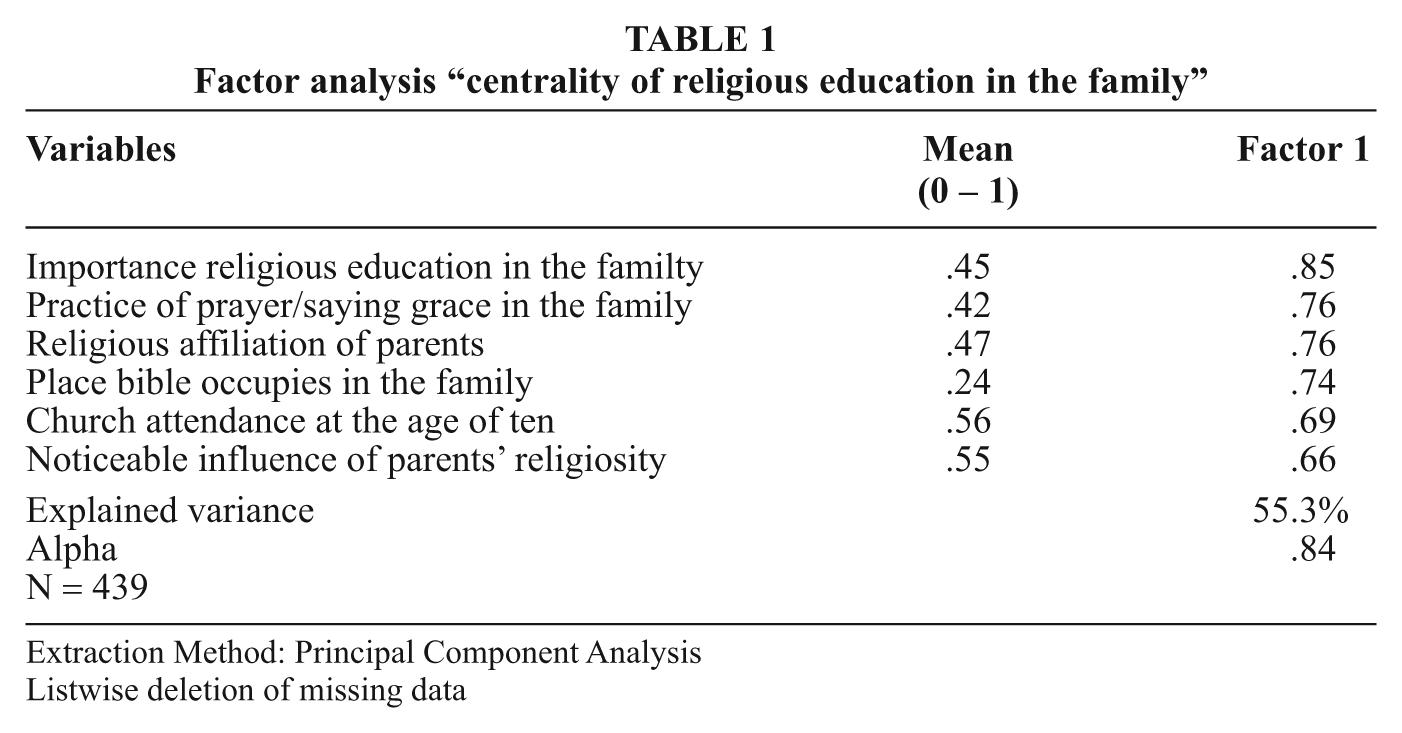
The religious upbringing the respondents experienced was measured in 1983 with the help of the scale “centrality of religious upbringing”. This scale was devised by De Hart (1990a: 291–3) on the basis of six variables. For the most part, these variables pertain to the parental behaviour we, in the previous section, identified as important in view of the religious socialization of children. The first variable concerns the religious salience of both parents and regards the questions: “Is religion of importance in the life of your father/mother?” The answers to these questions were measured on a five-point Likert-scale ranging from “very important” to “unimportant”. The second variable concerns the importance the parents attach to a religious upbringing and was measured by the question: “Is religious education an important aspect of your upbringing?” The answer to this question was again measured on a five-point Likert-scale ranging from “very important” to “unimportant”. The third variable concerns the noticeable influence of the parents’ religious faith on their daily life. Here, the question posed was: “Do you notice that your father’s/mother’s religious faith influences his/her daily life?” Respondents could answer these questions by choosing between “yes”, “no” and “not applicable”. The fourth variable concerns the church attendance of the respondent at the age of ten. The question here was: “How often did you go to church or attend religious services when you were ten years old?” In order to answer this question, the aforementioned seven options were again offered to the respondent. The fifth variable concerns the place the bible occupies in the family, measured by the question: “Does bible reading take place in your family?” Here, the respondent could choose between “regular”, “sometimes” and “never”. Finally, the sixth variable concerns the practice of prayer in the family and was measured by the question: “Does prayer or saying grace take place in your family?” This question could be answered by choosing one of the following five options: “daily”, “weekly”, “at special occasions”, “seldom” or “never”. In order to construct one single scale, these variables were first turned into dichotomies. The value “0” indicated that religion was not important to the parents, that religion did not affect the parents’ daily life, etc., while the value “1” indicated that religion was of importance to the parents, that there was a regular practice of bible reading in the family, etc. Next, these scores were simply added up, which resulted in the scale “centrality of religious upbringing” ranging from “0” to “6”, the maximum score. An additional factor analysis confirmed that underlying these six variables is one single factor (see Table 1). 2
Factor analysis “centrality of religious education in the family”
Extraction Method: Principal Component Analysis
Listwise deletion of missing data
Control variables
As already stated, this study includes the following control variables: gender, income, marital status and education. Income was measured by the question, ‘What is your monthly income?’ The response scale ran from 1 (less than 2000 Euro) to 8 (more than 5000 Euro). Respondents could record their marital status as: 1 (married), 2 (not married, single), 3 (living with a partner to whom one is not married) and 4 (divorced). Finally, education was measured by means of the question: ‘What is the highest level of secondary education you completed?’ Here the response scale varied from 1 (junior general secondary education/MAVO) to 6 (university).
4. Results
4.1 Religious Socialization and Church Attendance Later in Life
Since we assumed that the religious affiliation of parents influences the religious affiliation of the child, we took the pair “parents and child” as our basic research unit and subsequently compared the pairs of 1983 with the pairs of 2007 with respect to changes in church attendance. In more detail, we proceeded as follows. First, the variables of 1983 regarding church attendance were dichotomized. Those who answered that they went to church regularly, fairly regularly or sometimes were labelled as “churchgoers”, while those who answered that they went to church on an irregular basis or only now and then, very little or never were labelled as “non-churchgoers”. Next, the scores regarding the church attendance of both father and mother were combined into the new variable “church attendance parents 1983”. If both father and mother were churchgoers, the parents were labelled as “churchgoers”, but if one of them was a non-churchgoer they were labelled “non-churchgoers”. This procedure resulted in two dichotomous variables regarding the church attendance of the child (respondent) and its parents. With the help of a simple crosstabulation, these dichotomous variables were combined into four types of pairs:
Both parents and child are churchgoers (+ + pairs);
The parents are churchgoers and the child is a non-churchgoer (+ − pairs);
The parents are non-churchgoers and the child is a churchgoer (− + pairs); and
Both the parents and the child are non-churchgoers (− − pairs).
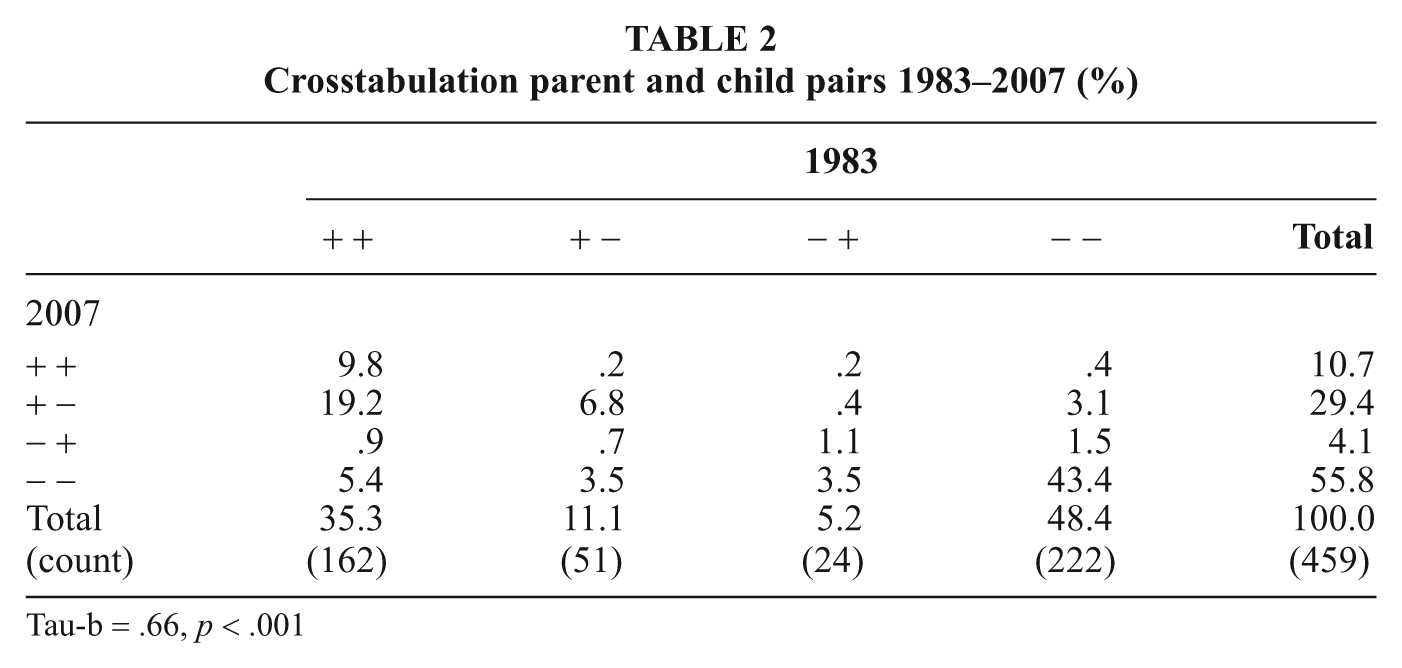
With regard to our 2007 data, we followed the same procedure and again identified these four types of pair with the help of a simple crosstabulation. 3 Finally, we combined both crosstabulations, which yielded a 16-fold table (see Table 2).
Crosstabulation parent and child pairs 1983–2007 (%)
Tau-b = .66, p < .001
Table 2 displays the way the parents and child pairs developed between 1983 and 2007. It shows, for instance, that the percentage of + + pairs dropped from 35.3 in 1983, i.e. 162 pairs, to 10.7, i.e. 49 pairs (10.7 per cent of 459), in 2007—a loss of 24.6 per cent, indicating the so-called net shift (Riley, 1963: 556). However, Table 2 also informs us about the turnover. That is to say, the net shift regarding the + + pairs results from the fact that 19.2 per cent of these pairs turned into + − pairs (children stop attending), 0.9 per cent into − + pairs (parents stop attending) and 5.4 per cent into − − pairs (parents and children stop attending). Thus between 1983 and 2007 there is a loss of 25.5 per cent of former + + pairs, which is compensated only by a small turnover of 0.8 per cent in all of former + − pairs (children become churchgoers), − + pairs (parents become churchgoers) and − − pairs (parents and children become churchgoers) into + + pairs—a minor compensation that results in a net loss of + + pairs of 24.6 per cent (25.5 per cent −0.8 per cent). 4 Table 2 also shows that this loss of + + pairs was mainly due to the fact that the children stopped attending church (19.2 per cent + 5.4 per cent = 24.6 per cent) rather than the parents (0.9 per cent + 5.4 per cent = 6.3 per cent). Insights like this, into turnover as well as net shift, are a typical feature of panel analysis (Riley, 1963: 556). And it is a valuable insight, as the disproportional ratio between the decrease and the increase of + + pairs is clearly bad news for the future of institutionalized religion in the Netherlands. Moreover, these figures also indicate that in the past 23 years, the association between the church attendance of parents and the church attendance of children has become much weaker. 5 In contrast to their children, parents are much more inclined to continue their practice of church attendance.
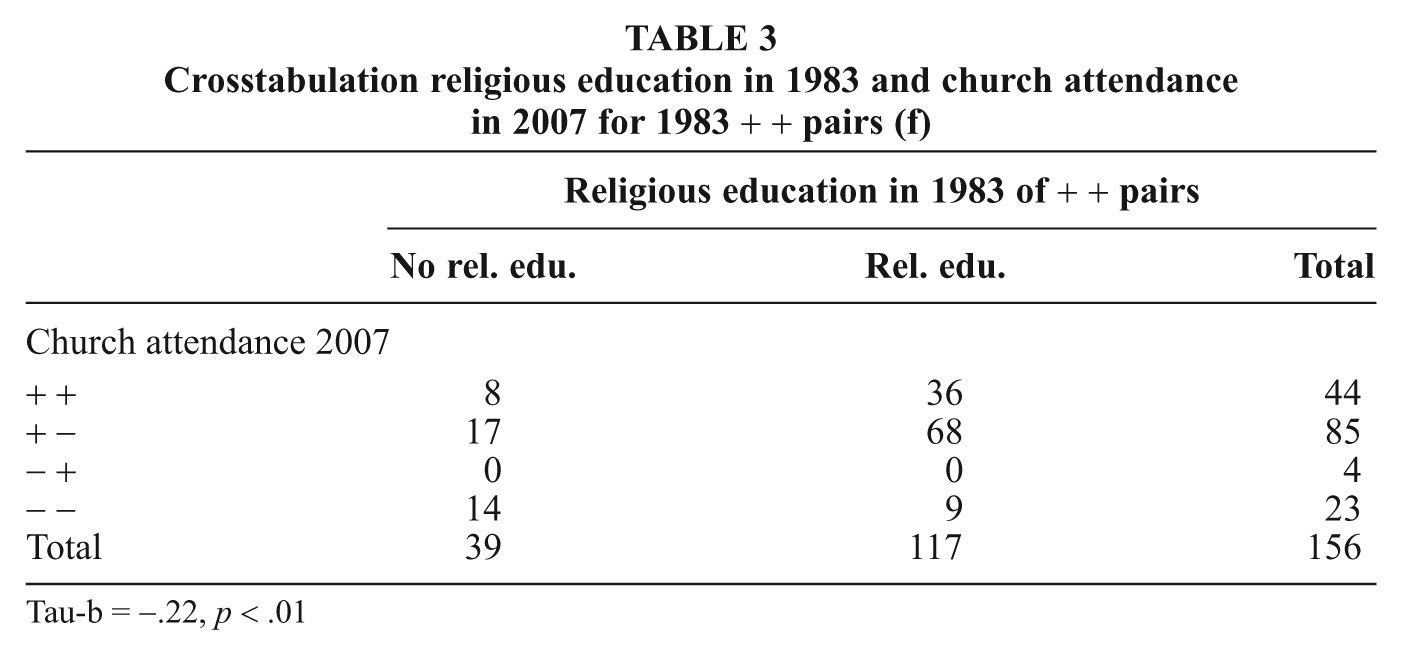
But what about the influence of family upbringing? In order to answer this question, we applied the scale “centrality of religious upbringing” to the 162 + + pairs of 1983. To achieve this, we first dichotomized this scale into the categories “religious upbringing”, denoting a score of 4 or higher, and “no religious upbringing”, a score less than 4. Next, we divided the 162 + + pairs into those in whose family there was religious education (72.2 per cent) and those in whose family there was no religious education (24.1 per cent) and combined this with the parent/child pairs of 2007. This resulted in an eight-fold table displaying the actual frequencies (see Table 3).
Crosstabulation religious education in 1983 and church attendance in 2007 for 1983 + + pairs (f)
Tau-b = −.22, p < .01
As one would expect, in 1983 religious education was of importance in the majority of families in which both the parents and the child were churchgoers. Moreover, a religious upbringing also seems to prevent children from disaffiliating later in life. For, if we consider the + + pairs of 2007, it appears that 81.8 per cent had had a religious upbringing and only 18.2 per cent had not. But this is actually an apparent effect. For, if we consider the 117 children who had a religious upbringing in 1983, 68, i.e. 58.1 per cent, had stopped attending church by 2007, while their parents continued to go to church. In contrast, of the 39 children who did not have a religious upbringing in 1983, “only” 43.6 per cent had stopped attending church. Consequently, although the majority of the now adult churchgoers were raised in a religious way by their parents, a religious upbringing clearly does not prevent children from disaffiliating later in life.
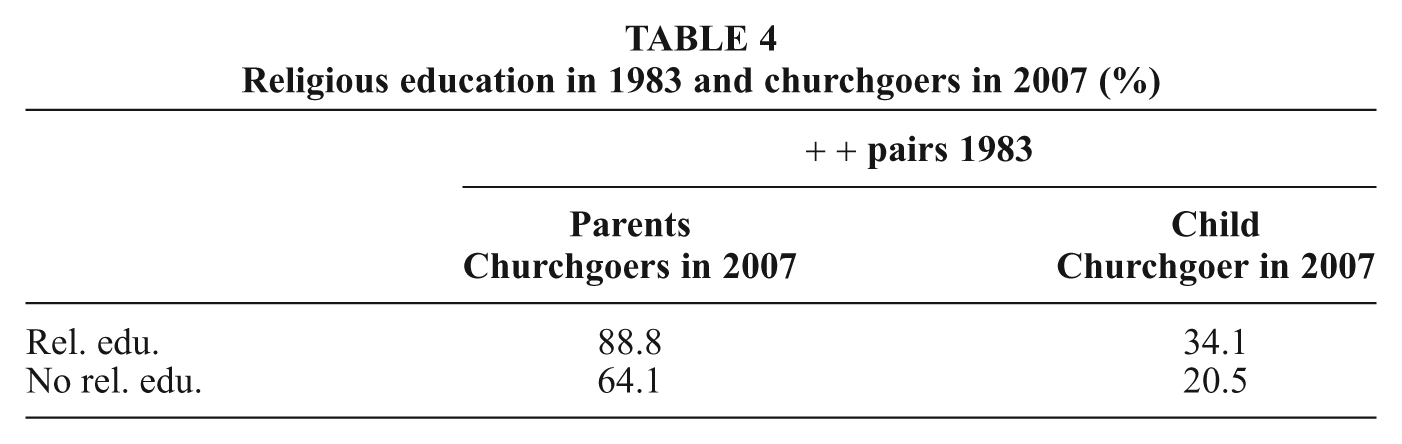
If there is an effect at all, one could argue that a religious upbringing affects parents more than their children. That is to say, parents who raised their children in a religious way were less likely to disaffiliate than those who did not give their children a religious upbringing. We can illustrate this with the help of Table 4, which elaborates on Table 3.
Displayed in Table 4 are the percentages of churchgoers in 2007, both parents and children, who provided or had a religious education (Rel. edu.) and who did not provide or have a religious education (No rel. edu.). Table 4 shows that 88.8 per cent (104/117) of the parents who raised their children in a religious way in 1983 were still churchgoers in 2007, while of those who did not raise their children in a religious way “only” 64.1 per cent (25/39) were still churchgoers in 2007. Similarly, 34.1 per cent (40/117) of the children who were raised religiously in 1983 were still churchgoers in 2007, while of those who were not raised in a religious way only 20.5 per cent (8/39) were still churchgoers in 2007. Now, if we bear in mind that these parents and children were all churchgoers in 1983, these percentages indicate that a religious upbringing has a greater effect on the religious commitment of the parents themselves than their children. Raising one’s children in a religious way seemed to strengthen, or at least preserve, the religious commitment of 88.8 per cent of the religious parents, while their educational efforts were successful only for 34.1 per cent of their children. Thus it seems that the effect of a religious upbringing is less strong between the generations than it is within the same generation.
Religious education in 1983 and churchgoers in 2007 (%)
As an additional step in studying the influence of religious upbringing, we also made a comparison between the pairs of parents and children who were all churchgoers (+ + pairs) in both 1983 and 2007 and the pairs in which the children stopped attending church (+ −) during this period (see Table 2). Was there perhaps a difference in the way the children of these 45 + + pairs (9.8 per cent of 459) and 88 + − pairs (19.2 per cent of 459) were raised in a religious way in 1983? In order to answer this question, we compared the avarage scores of both groups on the “centrality of religious upbringing” scale. Here, a t-test revealed no significant difference (t (127) = .729, p > .05) between the average score of the 45 + + pairs (4.86) and the 88 + − pairs (4.67). Consequently, those who continued attending church between 1983 and 2007 and those who did not, received more or less the same religious upbringing as children.
4.2 Religious Socialization and Church Attendance among Different Denominations
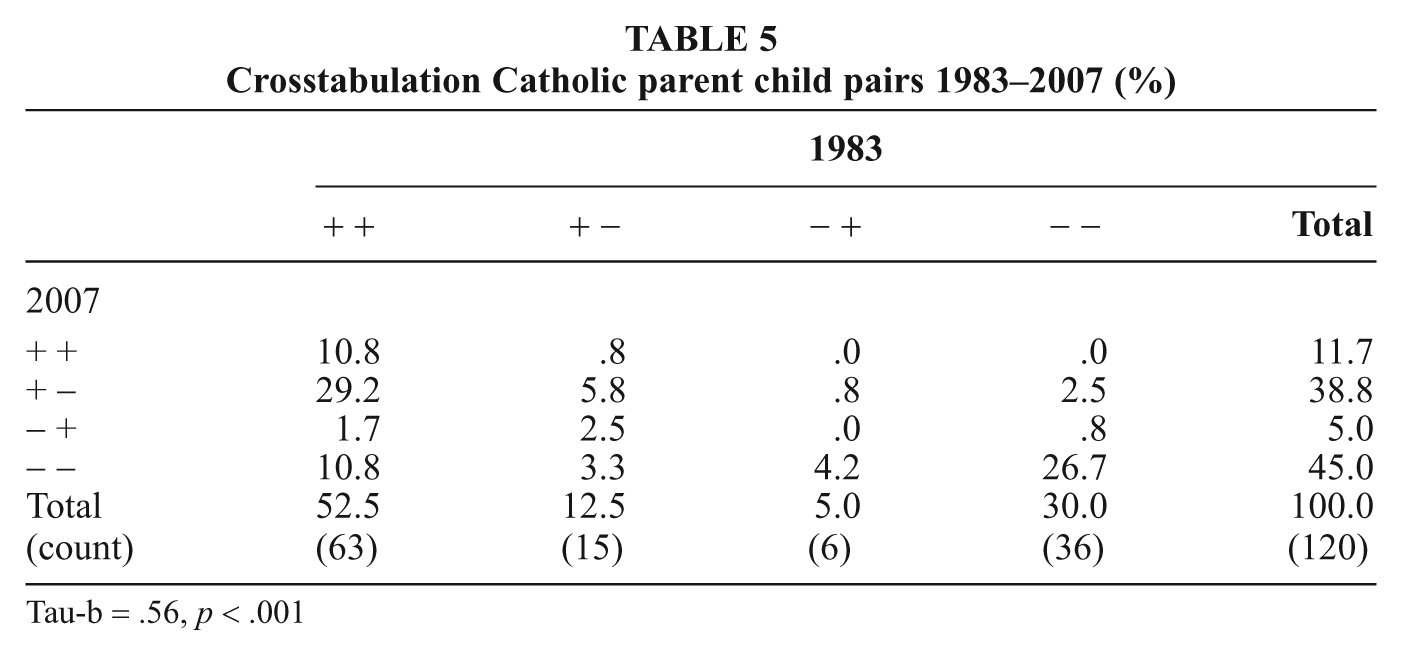
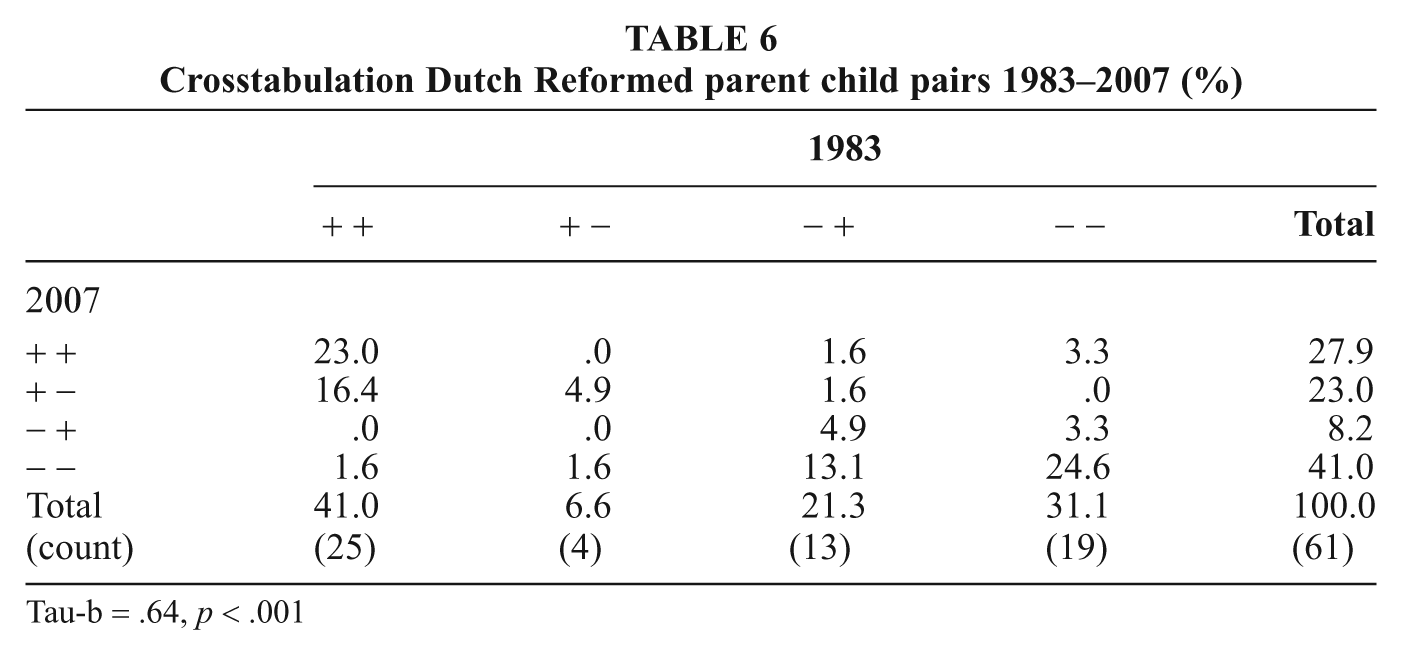
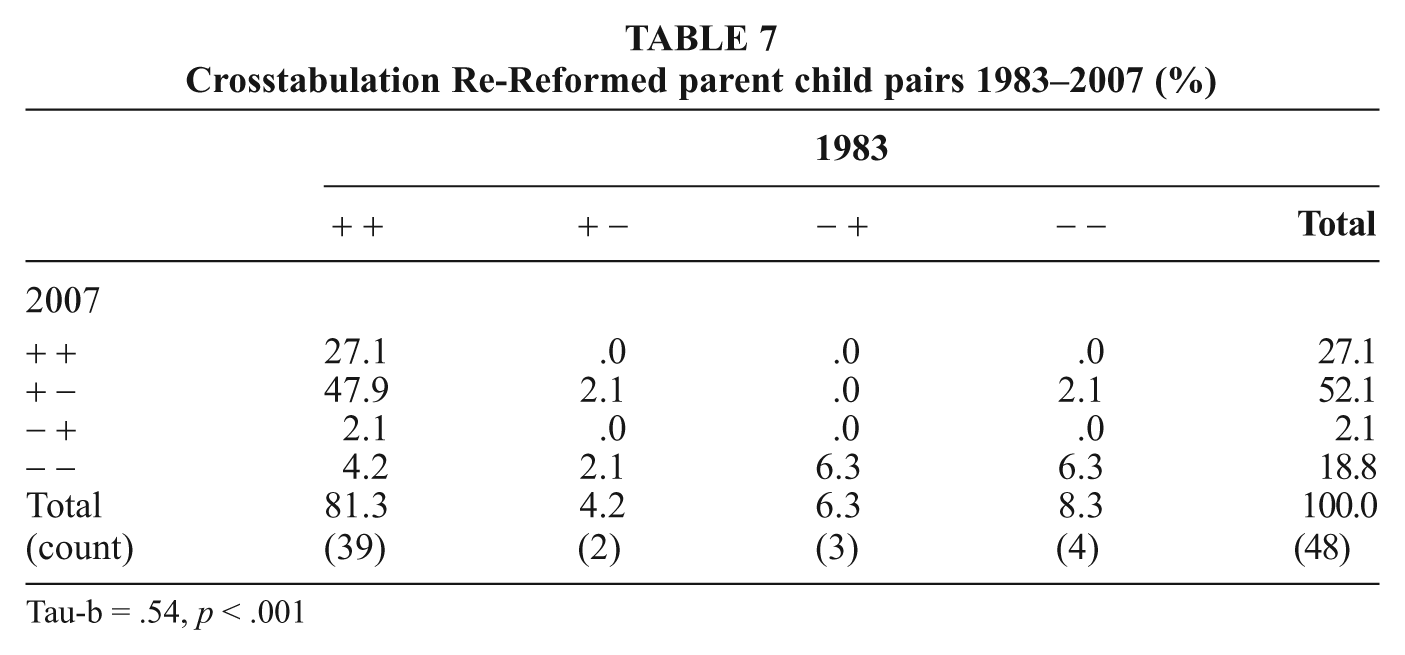
In order to study the influence of religious socialization on church attendance for different denominations, we followed the same procedure as described above. The only difference was that the analyses were now performed for Catholics, Dutch Reformed and Re-Reformed separately. The denominational groups were identified on the basis of the church membership measured in 1983. Our resulting sample contained 123 (25.9 per cent) Catholic, 62 (13.1 per cent) Dutch Reformed and 48 (10.1 per cent) Re-Reformed respondents. The changes in church attendance between 1983 and 2007 for Catholic, Dutch Reformed and Re-Reformed parent child pairs are shown in Tables 5–7.
Crosstabulation Catholic parent child pairs 1983–2007 (%)
Tau-b = .56, p < .001
Crosstabulation Dutch Reformed parent child pairs 1983–2007 (%)
Tau-b = .64, p < .001
Crosstabulation Re-Reformed parent child pairs 1983–2007 (%)
Tau-b = .54, p < .001
Even a superficial look at these tables immediately reveals interesting differences among these denominational groups. In general, Dutch Reformed parent/child pairs appear to be more stable than Re-Reformed and Catholic pairs. This is clearly revealed by the difference in net shift regarding the + + pairs, which is much higher for Re-Reformed and Catholic pairs than it is for Dutch Reformed pairs. The net shift for the Re-Reformed pairs is 54.2 per cent (81.3 per cent − 27.1 per cent) and for the Catholic pairs is 40.3 per cent (52.5 per cent − 11.7 per cent), while the net shift for the Dutch Reformed is 13.1 per cent (41 per cent − 27.9 per cent). Accordingly, the turnover also differs. Re-Reformed + + pairs are marked by a decrease of 54.2 per cent and zero increase, the Catholic + + pairs by a decrease of 41.7 per cent and an increase of 0.8 per cent, while the decrease of the Dutch Reformed + + pairs is 18 per cent and the increase 4.9 per cent. Of course, these differences leave unchanged the fact that disaffiliation is apparent in all groups. Still, it seems that especially Dutch Reformed are more likely to follow in the religious footsteps of their parents than Catholics and Re-Reformed—something which is also revealed by the changing strength of the association between the church attendance of parents and children. For Catholics and Re-Reformed this association was, respectively, .65 (Tau-b, p < .001) and .68 (Tau-b, p < .001) in 1983, but by 2007 it had dropped to .12 (Tau-b, p > .05) and .19 (Tau-b, p >.05). For Dutch Reformed, in contrast, the strength of the association between the church attendance of parents and child dropped only from .52 (Tau-b, p < .001) in 1983 to .40 (Tau-b, p < .01) in 2007. So, there clearly are differences between Catholics, Re-Reformed and Dutch Reformed. But are these differences due to differences in religious upbringing?
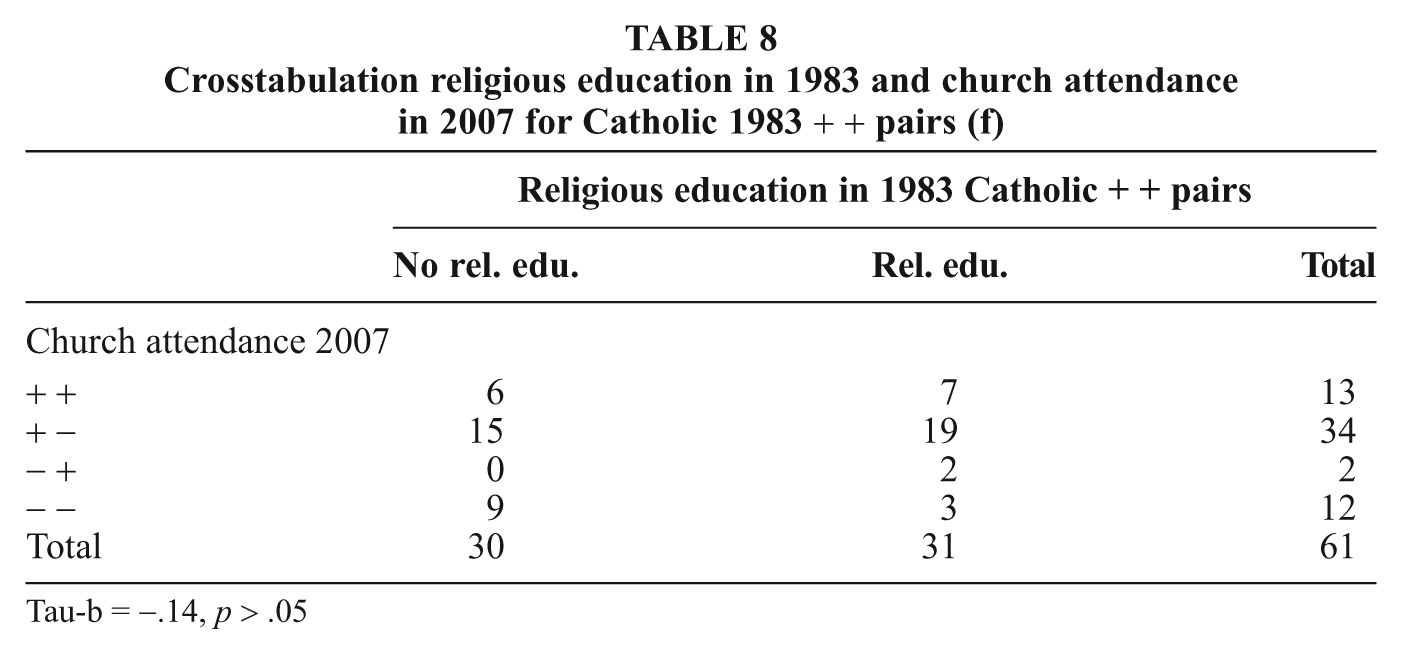
Again we followed the same procedure as before and used the dichotomized version of the scale “centrality of religious upbringing” to take a closer look at the Catholic, Dutch Reformed and Re-Reformed + + pairs of 1983 and, subsequently, combined this insight with an analysis of the parent/child pairs of 2007. This resulted in eight-fold tables displaying the actual frequencies (see Tables 8–10).
Crosstabulation religious education in 1983 and church attendance in 2007 for Catholic 1983 + + pairs (f)
Tau-b = −.14, p > .05
Crosstabulation religious education in 1983 and church attendance in 2007 for Dutch Reformed 1983 + + pairs (f)
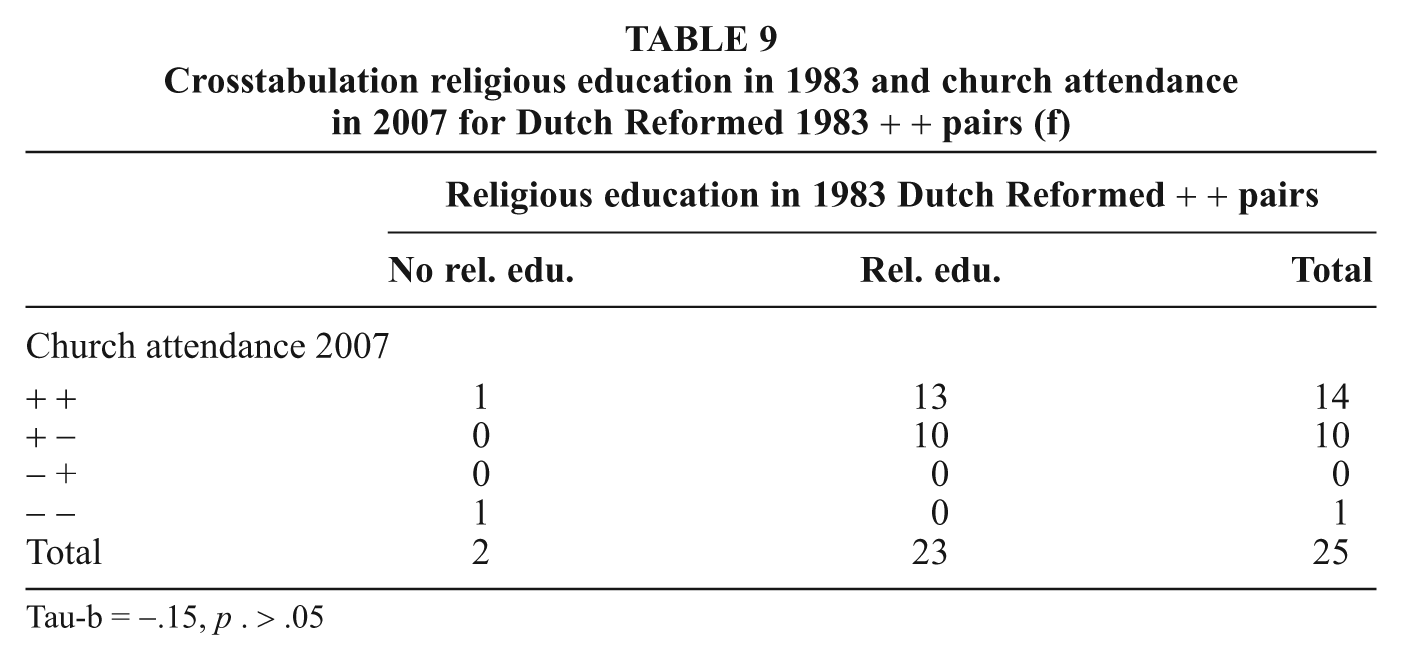
Tau-b = −.15, p . > .05
Crosstabulation religious education in 1983 and church attendance in 2007 for Re-Reformed 1983 + + pairs (f)
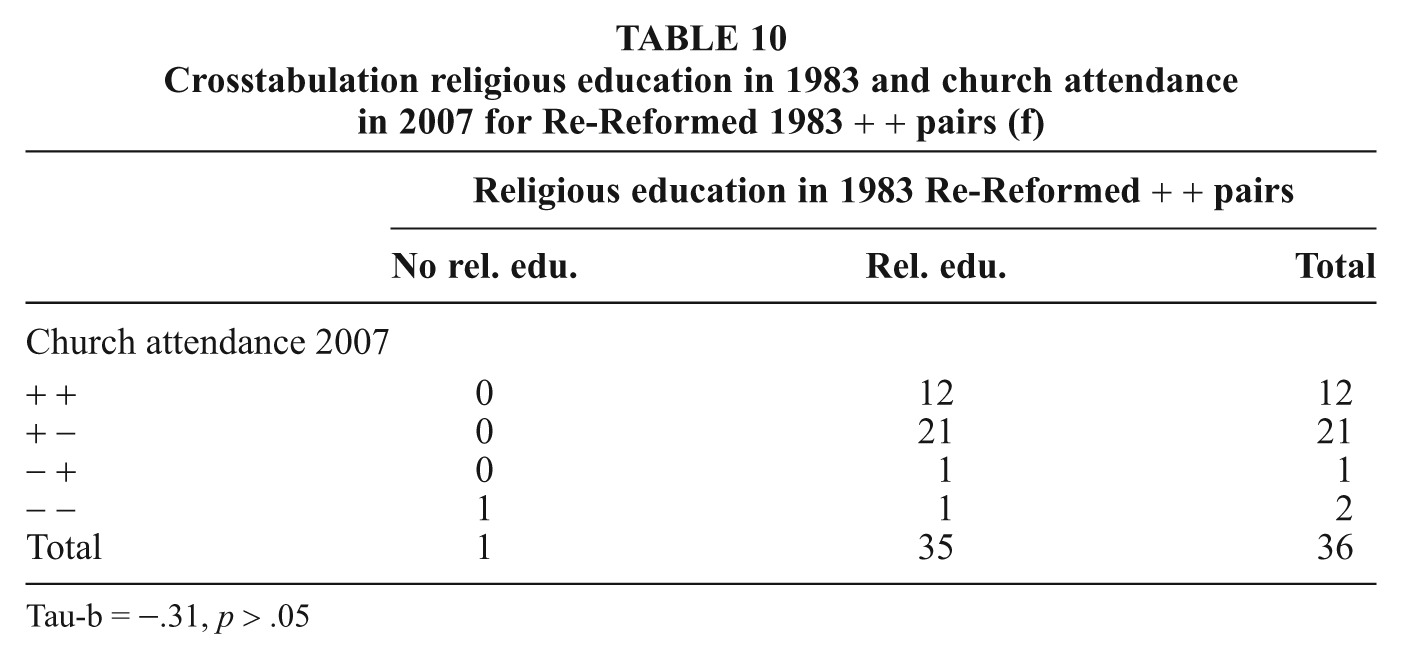
Tau-b = −.31, p > .05
If we compare these tables with one another, it is obvious that there is a big difference between Catholics on the one hand and Dutch Reformed and Re-Reformed on the other. Whereas almost all Dutch Reformed and Re-Reformed had a religious upbringing, this was certainly not the case for Catholics. Almost half of the Catholics come from families in which less attention was paid to religious upbringing.
Furthermore, the above tables seem to suggest that the effect of a religious upbringing differs by denomination. The Dutch Reformed appear to be the most successful in this respect. Whereas 61 per cent (19 out of 31) of the Catholics and 60 per cent (21 out of 35) of the Re-Reformed stopped attending church despite the fact that they had had a religious upbringing and that their parents continued to go to church, the same applied to “only” 43 per cent (10 out of 23) of the Dutch Reformed. This finding raises the additional question whether there is perhaps a difference in the centrality of religious education in the homes of the Catholic, Dutch Reformed and Re-Reformed + + pairs of 1983. A Scheffé test (F (2,121) = 50.462, p < .000) revealed that this is only partly the case. The average scores of the Dutch Reformed (5.32) and the Re-Reformed (5.61) do not differ significantly from one another, but do differ significantly from the average scores of the Catholic + + pairs (3.42). Thus we find that both Catholics and Re-Reformed tend to disaffiliate, despite the fact that both groups differ significantly with regard to the centrality of the religious upbringing they had. Does this again indicate that church attendance later in life is little influenced by the religious upbringing one did or did not have as a child?
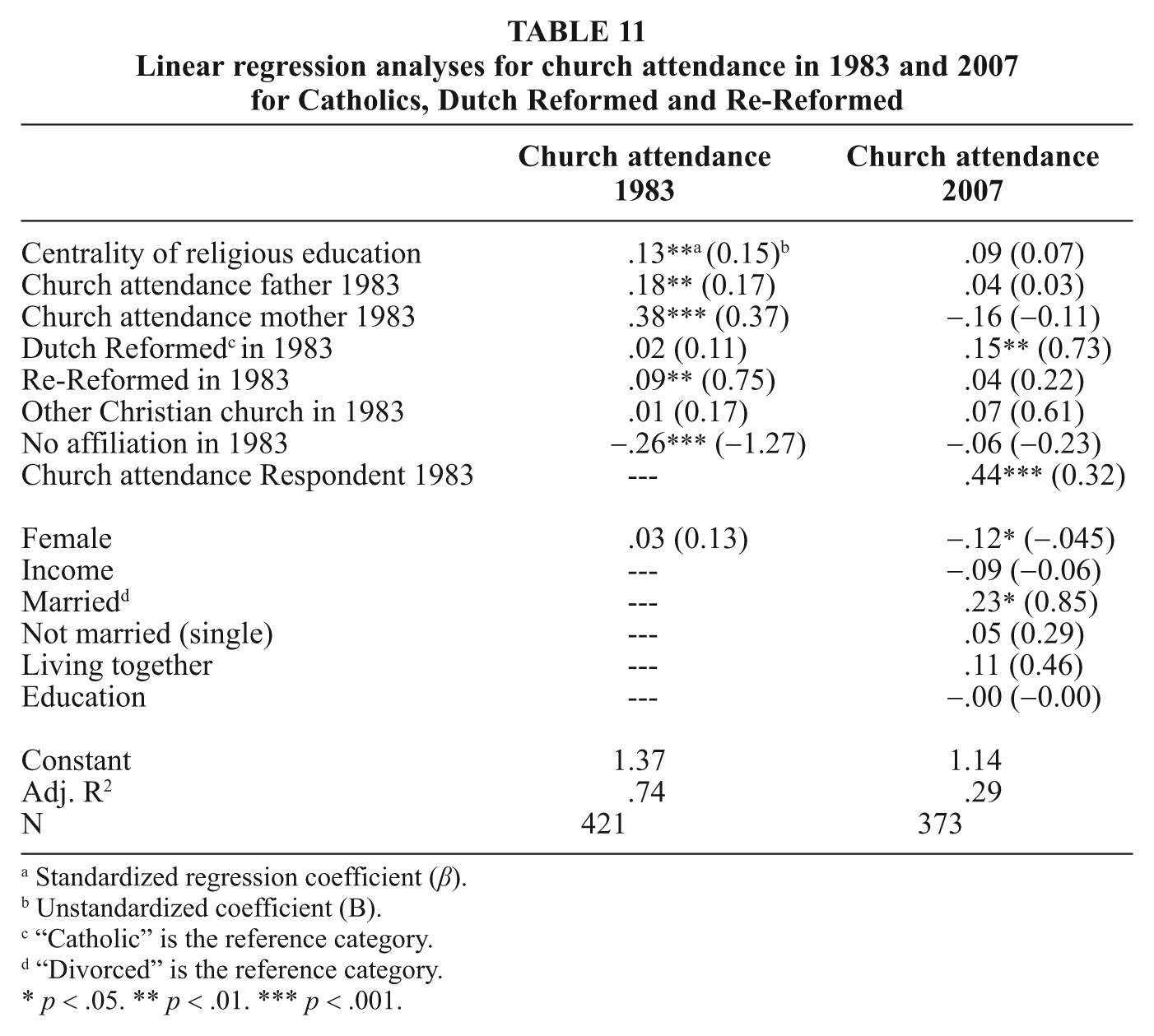
With regard to this last question, we conducted linear regression analyses for church attendance in 1983 and 2007. In view of the regression analysis for church attendance in 1983, the centrality of a religious upbringing, the church attendance of the father and the mother in 1983, and the respondent’s church membership served as the independent variables together with gender as a single control variable. When church attendance in 2007 was the dependent variable, the respondent’s church attendance in 1983 was added to the list of independent variables as well as income, marital status and education as additional control variables. Needless to say, the nominal variables gender, church membership and marital status were recoded as dummy variables before they were entered into the equation. Ideally, we would have conducted separate analyses for Catholics, Dutch Reformed and Re-Reformed. Unfortunately, due to the small number of cases in each category this was not possible. 6 in order to still be able to compare different denominations with one another, we used Catholics as the reference category in our regression models. Thus our models test the effect of being affiliated to the Dutch Reformed Church or the Re-Reformed Church or of being a non-affiliate in 1983 in comparison with being affiliated to the Roman Catholic Church.
The results are presented in Table 11, which reveals that there is no long-term or lasting effect of explicit religious socialization practices in the family on the offspring’s church attendance later in life, though there is clearly an effect on juvenile church attendance. Together with parental church attendance and the membership of a Christian denomination, a religious upbringing accounts for 74 per cent of the variance in juvenile church attendance. Although relative to parental church attendance, and especially the church attendance of the mother, a religious upbringing is already a weak predictor in this regard. However, by the age of 40 the effect of a religious upbringing has disappeared. About 29 per cent of the variance in adult church attendance may for the most part be attributed to the effect of juvenile church attendance, while a religious upbringing does not add explained variance. Adult church attendance is also influenced by religious affiliation, gender and marital status. Thus, as far as our subsample is concerned, Dutch Reformed are more likely than Catholics to still attend church as adults and this also goes for males and for those who are married instead of divorced. But the likelihood of adult church attendance is unrelated to whether or not one had a religious upbringing.
Linear regression analyses for church attendance in 1983 and 2007 for Catholics, Dutch Reformed and Re-Reformed
Standardized regression coefficient (β).
Unstandardized coefficient (B).
“Catholic” is the reference category.
“Divorced” is the reference category.
p < .05. ** p < .01. *** p < .001.
5. Discussion
In this article we set out to answer the following research questions: What is the long-term effect of religious socialization on church attendance later in life? and: Is there a difference in this respect between different Christian denominations? We may now answer these questions as follows: Although almost all Dutch Reformed and Re-Reformed adult churchgoers and more than half of Catholic adult churchgoers had a religious upbringing, the long-term effect of such a religious upbringing on church attendance is negligible or even absent. Thus, contrary to what a lot of research into religious socialization suggests (for instance Hunsberger and Brown, 1984), as far as this specific Dutch sample is concerned a religious upbringing is not a predictor of church attendance later in life. What does this overall result mean? Let us briefly raise three issues.
We start by raising an important methodological issue. Why is it that earlier research into the effects of a religious upbringing, and especially research conducted in the Netherlands (for instance Andree, 1983; Alma, 1999), yielded more positive results than our research does? This is partly due to the rare opportunity we had to make use of a longitudinal dataset. But it is also due to the fact that often inadequate comparisons are made. According to Janssen (1988; cf. De Hart, 1990b), four groups may logically be distinguished if one calls those processes of religious socialization successful that cause children to follow in the religious footsteps of their parents: religious parents with religious children; religious parents with non-religious children; non-religious parents with religious children; and non-religious parents with non-religious children. The groups that are usually studied in socialization research are the first and the fourth group. These groups are both instances of successful socialization. For in the first group parents succeeded in transmitting their religious commitment to their children and in the fourth group they succeeded in transmitting their non-commitment. Consequently, if one compares the two groups with one another and asks why children in the first group are religious and those in the fourth group are not, the (rather trivial) answer is that, in contrast to the children in the fourth group, the children in the first group were raised in a religious way. Thus the conclusion is easily drawn, that a religious upbringing is an important predictor of religiosity later in life. But this conclusion hugely overestimates the effects of a religious upbringing, because it is based on the wrong comparison. The only meaningful comparison to be made here is between the first and the second group, as we did in Tables 3, 8, 9 and 10. These tables show that a lot of our respondents turn into non-churchgoers despite the fact that they had a religious upbringing. Hence, the core question is not so much whether or not present-day churchgoers were raised religiously, but why some who were raised religiously disaffiliate while others do not. Or, as Janssen (1988: 415) puts it, the core question is: Why is a religious upbringing so ineffective in the majority of cases?
This question raises a second issue we would like to discuss. Studying the effects of a religious upbringing on church attendance means adopting a micro-perspective. However, socialization is a complex process taking place at four levels (Tillmann, 2007: 15–8; Hurrelmann, 2002). The basic level is the level of the subject. Since socialization refers to personality development, i.e. in our case becoming a religious person integrated in a religious community, the subject with its characteristics, abilities, emotional structures, experiences, intentions, etc. is always involved. The second level is interaction. This means that socialization always takes place through the face-to-face interactions of the subject with other humans in a specific setting. Of course, the fundamental interaction is that between the subject as a developing child and its parents, but the interactions between the subject and relatives, friends, teachers, pastors and so on are also of importance. These latter interactions often take place in specific societal institutions, such the kindergarten, the school or the church, which is the third level of socialization. Finally, the fourth level regards society as a whole, which also influences processes of socialization by way of its specific economical, political, social and cultural structures. The relationship between these four levels is hierarchical. This means that processes at the micro-level, i.e. the level of the subject and the level of interaction, are always related to processes at the macro-level; i.e. the level of institutions and of society. Consequently, it may be that the long-term effects of the religious upbringing our respondents received are impaired by socio-cultural developments at the macro-level. Previous research conducted in the Netherlands, for instance, stressed the importance of the process of individualization, understood as moral individualism as a result of the decrease of traditional authority (Houtman and Mancini, 2002), or identified the process of rationalization, understood in terms of urbanization and the overall increase of the level of education (Te Grotenhuis and Scheepers, 2001), as factors that may explain why people are no longer willing to participate in church life. In order to get a full picture of religious socialization processes and the way religious traditions are transmitted from one generation to the next, attention should be paid to both the micro- and the macro-level. For, as our study shows, focussing only on the family is insufficient in this respect.
The third and final issue we would like to discuss regards the denominational differences our study reveals. To begin with, it is important to note that our findings are not atypical for the Dutch situation. Developments regarding church attendance in the Netherlands between 1970 and 2004 also show (Becker and De Hart, 2006: 44) that especially Catholics stopped attending church on a regular basis during this period. Whereas 71 per cent of Catholics attended church at least once every two weeks in 1970, by 2004 this percentage has dropped to 19—a considerable drop in church attendance among Catholics, which is reflected by our findings (see Table 5). Among the Dutch Reformed, church attendance remained relatively stable, as it dropped from 50 per cent in 1970 to 46 per cent in 2004. A more modest drop in church attendance, which again is similar to our findings, was found among the Dutch Reformed (see Table 6). Surprisingly, however, among our Re-Reformed respondents the drop in church attendance clearly exceeds the overall Dutch trend. Whereas national figures show that church attendance among the Re-Reformed dropped from 89 per cent in 1970 to 63 per cent in 2004, our data reveal that the net shift for the Re-Reformed is the highest for all denominations: 54.2 per cent (see Table 7). So, what we find here is that the drop in church attendance is most considerable among those who are members of the more “strict” of the mainstream Christian churches in the Netherlands and who were raised in families in which a religious upbringing was central. This is an interesting phenomenon, which is not entirely in line with our theoretical assumptions. So, is it perhaps that the religious upbringing of the Re-Reformed was too “strict”, or too authoritarian, which might cause Re-Reformed youths to disaffiliate as soon as they leave their religious homes? This is something that in part was found by Te Grotenhuis and Scheepers (2001: 598–9), who discovered that weekly church attendance rates during adolescence are a stronger predictor of religious disaffiliation later in life than monthly church attendance rates. Or is it the case that the Re-Reformed do not disaffiliate because of their religious upbringing but in spite of it? That is to say, as members of a stricter Christian denomination, perhaps the Re-Reformed were better able than the Catholics to resist the secularizing forces in Dutch society until these forces inevitably also got a hold on the younger generation of Re-Reformed our respondents belong to—a notion that again makes us aware of the fact that socialization processes in the family cannot be studied independently from the wider socio-cultural environment.