




Abstract
The relationship between organised religion and the wider society has been of fundamental concern within the sociology of religion. The author addresses the issue in terms of how material forms of social structure relate to individual congregational memberships. Four contrasting congregations were chosen for study (Baha’i, Roman Catholic, Anglican and Independent Evangelical), all in the author’s home region of Northern Ireland. A range of interviewing methods and tools were used, including tables of indices of dissimilarity, narrative analysis and Multidimensional Scaling. Each congregation was found to be delineated according to a specific set of demographic variables, each forming the profile of a wider community beyond that generated by itself. Additional investigations revealed how the congregations operated at the micro, meso and macro levels of social integration and differentiation.
Introduction
A basic question within the sociology of religion is how organised religion relates to the wider society. The dominant paradigm is that of how religion serves as a developer and guardian of societal values. This plays an important part in the earliest works of sociology. Durkheim (2001) presented religion as the provider of a pre-scientific understanding of the world which not only bound society together but was also itself a product of that society. For Marx, the ideology of religion is understood as an essential element in the legitimisation of the powerful, over and against the masses (see McLellan, 1977: 63). Moving away from a simple homogenised society, in The Protestant Ethic, Weber (2002) introduces the concept of the power of religious ideas for specific social groups, as well as in the transformation of society as a whole. Such understandings have been built upon and nuanced ever since. Troeltsch, for example (1992), developed the Church/Sect typology which places the efficacy of ideas in relation to a social group’s attachment to the ruling elite in any given society. More recently, rational choice theorists have applied Troeltsch to the birth, life and decline of 20th-century denominations, sects and cults – in a manner in accord with the fiscal free market (Stark and Bainbridge, 1985). This relationship of religion and society through language and symbols extends across the generations and seats of learning in sociology. In 20th-century Western Europe, for example, interest in secularisation has usually been restricted to the efficacy of religious beliefs (as Bruce, 2002, and Martin, 1993).
However, it is also possible to glean within the literature an alternative approach to this relationship: one which puts structural rather than cognitive issues at the forefront of this dynamic. It is this approach which is the object of this paper. 1 The relationship of social structure with organised religion will be considered through an examination of the memberships of four congregations in Northern Ireland.
A brief conclusion will sketch some of the possibilities emanating from these findings, together with notes on potential areas for future research.
Three concepts need clarification at this point. First, that of ‘social structure’. This is broadly used in a Marxist sense as that which relates to the surface forms that distinguish any given society (the superstructure) and, at the base of those, the forces that create them (the infrastructure – see Jary and Jary, 2000: 579). In particular, attention will be given to the demographic forms of the superstructure (such as age, residential location, socio-economic classification and ethnicity) as they relate to base economic influences, and as they are expressed within the bounds of interactive social groups. As this study focuses upon material forms, cultural, ideational and cognitive types of social structure will not be considered here.
Second, ‘social networks’. These have an especially important role within this study. These are groups where face-to-face contact is made. They may be large-scale, as found within whole communities (as with villages and neighbourhoods akin to Tonnies’ ‘Gemeinschaft’, 2002), or relatively smaller units – in particular those of the family.
Third, organised religion will be examined in terms of congregational membership. This is the basic unit of organised religion (as against, say, the higher level of a Diocese) and provides demographic information. This is also the scale at which the relationship between structure and religious organisation has been found to operate within the literature. Studying the congregation also has the further significance of being a burgeoning area of study within the sociology of religion, both in the UK and to an even greater extent in the US (see Farnsley, 2004: 25).
Hypotheses, research methods and field setting
The following hypotheses are used to explore the issues in hand:
* That each congregation will be differentiated from the others according to structural roperties;
* That a distinct set of social networks (other than those generated by the religious organisations themselves) will be identified within each congregational membership.
Four congregations were chosen to provide a cross-section of types within Northern Ireland. Selected were: a small-town Roman Catholic congregation, an Anglican (Church of Ireland) rural church, a newly formed city Independent Evangelical church (referred to here as the IE church) and a non-Christian (Baha’i) congregation whose dispersed members meet in one another’s homes across the region. An initial questionnaire produced basic demographic and religious data from a total of 154 respondents. These were usually self-completed and distributed by the gate-keepers (clergy and church secretaries). Forty-six in-depth interviews, usually in the respondents’ own homes, yielded further quantitative information, together with qualitative data from open-ended questions about personal and family religious histories. These in-depth interviews lasted between 45 minutes and two-and-a-half hours.
Much of the quantitative material was summarised (see Tables 1–3 in Appendix) using tables of indices of dissimilarity (as Merschrod, 1981).
A card sort exercise was also given to each of the interviewees. This acted more as a data eliciting method than as a category construction exercise. These cards were labelled according to potential personal and community identities (including political, familial and religious identities, as well as social class and ethnicity). The exercise required respondents to freely sort these cards into as many, or as few, piles as they judged appropriate. In this way, it was possible to gauge the view of respondents from each of the congregations studied, in terms of how they themselves understood any possible relationship between religious organisation and non-religious structures (as familial, economic and ethnic). Results were generated by computer packages. 2 Using SORTPAC-3 3 , respondents’ categorisations (piles of card choices) were entered into the program for conversion, into a square symmetric matrix of (0,1) co-occurrences, and then aggregated to form a matrix of co-occurrence frequencies. These were interpreted as a similarity measure, and analysed using Multidimensional Scaling (MDS). The data were transformed by ordinal (non-metric) scaling, and a Euclidian distance model was chosen. The Roskam-Lingoes’ MINI-SSA program 4 was used to produce a series of two-dimensional maps – one for each of the congregational groups studied. The above software generated a visual, two-dimensional map of such relations, contextualising respondents’ own congregations (in-groups) and also identifying that of others (out-groups). Two of these maps can be found as Figures 2 and 3.
Qualitative measures of respondent narratives included content, structural and emplotment analyses. The emplotment analyses focussed upon respondents’ accounts of descendant family histories. The method divided narratives according to stories and the plotlines that could be identified within them. Pivotal events that marked a change in religious circumstances within each of the stories were categorised, counted and then placed within a table according to the four religious congregations (see Table 4).
Associated context and explanations for changing religious affiliation differentiated by congregation (n).
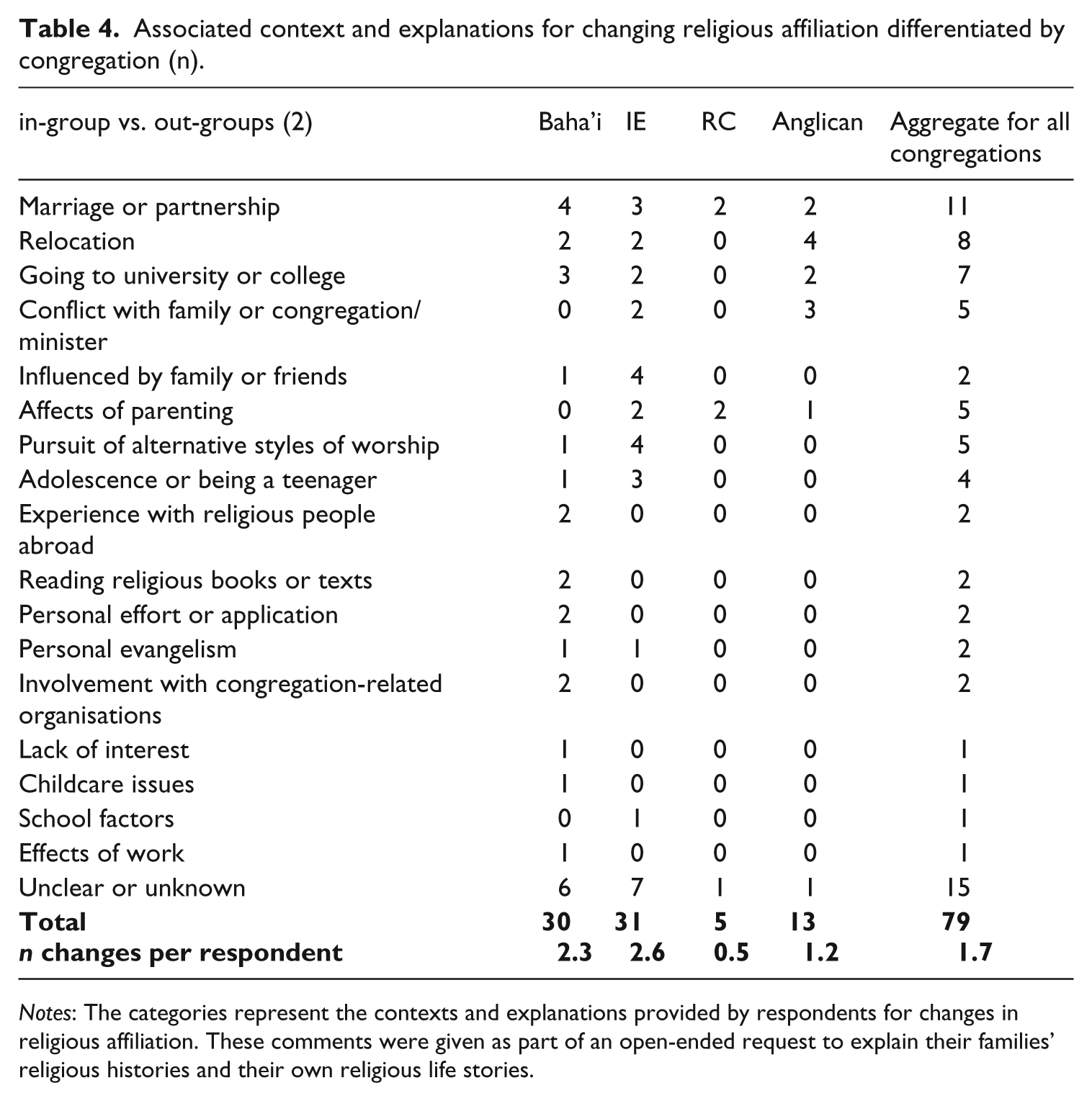
Notes: The categories represent the contexts and explanations provided by respondents for changes in religious affiliation. These comments were given as part of an open-ended request to explain their families’ religious histories and their own religious life stories.
Locating congregation and membership within social structure
Before considering the memberships of each congregation as collectives, it is useful to outline the results on individual religious choice. Compared with what has already been described for members of New Religious Movements (NRMs), social networks were found to play an important part when actors adopted a new faith. However, whereas in the sociology of conversion, interest was limited to the role of friendship groups and geographical mobility for the membership affiliation of sects and cults, the research here widens the influence of social networks in terms of both the type of religious organisation in question and the kinds of network that are at play in such affiliations. Of especial importance are the networks which belong to families. These were found to be influential across all of the congregations studied: whether of the sect type (the IE church and the Baha’is) or of the Church type (RC and Anglican). These family networks operate as an ascriptive force in the raising of children within the family church. In adult life, marriage may result in a change of affiliation in accord with a spouse’s familial adherence – indeed, it is this scenario which accounts for most changes in religious affiliation (Table 4). There are also clear associations between residence and religious membership in all but the Baha’i results, suggesting that neighbourhood friendship and kinship networks also have a role in the production of the wider, networked communities upon which these congregations are constructed.
Overall, it was found that each membership had clearly defined demographic profiles (as shown in Tables 2 and 3) – profiles which reflected the networked communities upon which each congregation was formed.
Taking each religious organisation in turn, the findings for the Anglican congregation will be considered first. As with all four congregations studied, questionnaire results here showed how church memberships were composed of interlocking sets of family groups (Table 1). Respondent narratives and participant observation illustrate how interaction between individuals from these family groups takes place within shared:
* residential settings (the rural area in which the church was built);
* workplace settings (farms and agricultural settings of the area, such as markets); and
* leisure settings (the Loyal Orange Lodges to which each family belonged and the Protestant parades in which they marched alongside one another).
Even specifically church contexts are orientated towards these familial groups, with baptism, confirmation, marriage and funeral services drawing especially large attendances. The occupational basis for this membership is further reflected in the Harvest services, which often draw the largest attendances of the whole calendar year.
Such social interactions can be seen to operate within the conditions created by the convergence of several structural factors. Whilst the family can be identified as a primary structure (see Figure 1), this in itself is affected by further factors, particularly that of the economy. It is the agricultural economy which sustains these extended families – in their livelihoods and, in turn, the material and affective opportunities available to members. These include the gift of building land to offspring at the point of marriage. It is the agricultural economy which has influenced geographical settlement and the chance for neighbourliness and co-operation between families and neighbours in farming activities. It can also be argued that these forces underpin further social organisations such as the Loyal Orange Lodges (a Masonic-type of closed society, supporting Northern Irish Unionism) to which these familial groups belong (see Bryan, 2000; Brewer and Higgins, 1998).
The comprehensive age profiling of this Anglican membership follows that of the region as a whole – a testimony to the stability and successful maintenance of such familial networks within the locality. The reliance of these networks upon a prosperous agricultural economy is reflected in Anglican members’ higher than average wealth (as expressed in the size of members’ properties and their overrepresentation among home owners without a mortgage or home loan).
Turning now to the Roman Catholic congregation, a similar bundle of structural characteristics define their membership, although, as would be expected in Northern Ireland, with significant differences in how these are expressed in comparison with the Anglicans. They too have a strong, historical base of kinship groups (see Table 1). And again, like the Anglicans, these form a networked community which includes, but also goes beyond, what may be identified as generated and maintained by the congregation itself (hence the locus of social support shown in Figure 1). As with the Anglicans, RC kinship groups have a common residential status. However, unlike the rural Church of Ireland congregation, the Catholic church primarily draws its members from the area’s two villages. Although these residential associations have their roots in the history of the Plantation – the 16th- and 17th-century confiscation of land by the British crown and colonisation by British subjects (Elliott, 2000) – they have also been reinforced and even deepened by recent violent religious and economic forces. So it is that the Catholic narratives tell of the allocation of homes by the Council, not according to need, but according to sectarianism, and of Catholics reinforcing parochial neighbourhoods as they flee from the Protestant-dominated areas they have been threatened and burn out of. (Sadly, violence is experienced on both sides of the sectarian divide, as revealed by the Anglican respondent who feels that ‘the border is getting further north’ and his account of a relative’s murder by the IRA.)
That it is secular structures which help maintain these communities can be seen in the other ways in which community socialisation operates: sport (the local Gaelic Games Association clubs) and societies (The Ancient Order of Hibernians – a Catholic equivalent of the Loyal Orange Lodge). Such activities strengthen community boundaries as well as deepen the social interaction of the networks upon which this RC congregation is built.
The economic profile of the RC congregation is clearly differentiated from that of its neighbouring Anglicans. Members’ occupations are in lower-status service industries or small independent businesses. These are further associated with predominantly lower levels of educational attainment than in either of the other congregations or the population of Northern Ireland as a whole. These are features indirectly related to the religious organisation. What can be seen to lie behind the formation of these residential communities is the economic and political forces which created and maintain them. Whether it is the 16th-century Elizabethan interest in political security and the economic drive to settle Protestants in the more productive areas of Ireland, or the more recent political struggles and economic statuses of various rural and village communities, these form the economic base upon which the superstructure of community, and in turn the religious congregation, can ultimately be located.
Whereas for the Anglicans and RCs it is primarily residence which embeds their sets of familial networks, for the IE church membership, respondent narratives reveal an interactive sub-group which is derived from yet another congregation. This mother church is located within the university sector of Belfast and when added to this the congregation’s narrowly defined age grouping, educational background and socio-economic classification (S-E-C), it is highly indicative that these members were originally a particular cohort from the university. In this way the residential nature of this interactive group is of a different kind from that of the mainstream Anglican and Catholic memberships. This shows itself in the congregation’s tightly bounded demographic profile. Members are almost exclusively graduates between the ages of 30 and 59, living on the more prosperous edges of the city and having a higher socio-economic status than either the Anglican or the Catholic congregations, and higher than the population of the region as a whole.
This (IE) founding schismatic group has become the dominant cluster within the newly formed Independent Church – both numerically and in terms of leadership. Other congregants are drawn from the edges of church members’ social networks, with connections to them (either through work or leisure activities), or are disenfranchised members from other churches.
This demonstrates once again the importance of extra-congregational interactive groups for the constitution of religious congregations. Furthermore, it broadens and expands the kinds of group which can be found to form within such memberships. It demonstrates how memberships can be composed of groupings which are part of a chain of socially networked groups. Each in turn can be envisaged as having its own socio-structural profile in which kinship, the economy and geographical location interplay with one another in providing the interactive group conditions from which differing religious memberships are founded.
Within the Baha’i congregation, two dominant categories of member can be identified. The first is reminiscent of Lofland and Stark (1973), as well as Snow and Machalek’s (1984) studies of converts to NRMs. This category is that of British males who have moved away from home and encountered the Baha’i community whilst at university. Converted during their college years, they then married a Baha’i and moved as a couple to Northern Ireland following the organisation’s Pioneer programme. These members contribute to the congregation’s profile of: a high level of educational achievement; a disproportionate number of middle-aged members (and a corresponding lack of the elderly and retired); and a class 1 S-E-C.
The second main category of Baha’i member is those who have Middle Eastern ethnicity. Their narratives tell of a middle-class professional elite who were forced out of Iran, becoming economic and religious migrants adding to the worldwide Baha’i Diaspora. The timing of this exodus centred upon the fall of the Shah in 1979. Consequently, the age of this group of Baha’is rarely exceeds that of its British-born counterparts. It also means that these two groups together have relatively little capital between them, resulting in a lower than expected size and value of home and a lower level of ownership than might be expected from a group so highly qualified and in such prominent positions of employment.
Looking at all four congregations together, these findings provide support for the hypotheses. Sets of networks whose origins and maintenance go beyond those of the congregations themselves have been identified. These networks carry discrete sets of structural properties, being easily differentiated from one another. They are primarily kinship-based, either nuclear or extended, depending on the type of congregation and the wider community in question. Therefore, not only has each congregation been found to be interwoven within a wider community, but these communities are very different from one another, reflecting the variegated sociological circumstances within which each of these congregations operates. Congregations may be embedded within clearly identified residential communities with particular socio-economic properties – such as the RCs and the Anglicans. However, they may also be of a far more complex socio-structural background, being part of a chain of communities within communities, as is the case with the Independent church and the Baha’is of Northern Ireland. This interweaving between religion and its corresponding community can make the distinction between religion and the wider community difficult, if not impossible, to distinguish – so closely are they related to one another.
The dynamic role of congregations and memberships within social structure
Not only are congregations and their memberships clearly located within social structure, they are also dynamic entities within it, operating within the processes of social and system integration and differentiation.
Whilst the terms ‘integrative’ and ‘differentiated’ refer to entities which relate in some way to one another – rather than simply being irrelevant and distinct – ‘integration’ is used where this relationship is complementary; even effective and functional. Those elements which are ‘differentiated’ are not only seen as different from each other, but are also to a lesser or greater degree in opposition and work against each other. A ‘social’ interaction is one which operates on the micro level of social relationships (for example within familial and friendship networks). A ‘system’, on the other hand, is a macro interaction operating on a larger scale at the level of the whole society. Between these two micro and macro levels of social and system interactions can be placed the meso level (see Smelser, 1997: 28–29). This intermediate level of interactions includes the religious congregation, civic and voluntary organisations, community groups and groups run by the local council. It should be noted that these are terms used for the purpose of illustration and elucidation; in practice a single interaction may involve multiple levels.
Micro-level integration
With family units forming the backbone of all four congregational memberships, it is hardly surprising that familial group integration and differentiation occurs at this base level. As this transcription illustrates, within each family, religious observance can be a measure of kinship conformity: I was brought up to, you know, attend Sunday School in [place name]. My father and, as I say, my father’s father would have all belonged to them [church organisations]… I went to Sunday School because it was just the way that I was brought up by my parents. (young male adult Anglican)
Integration into a spouse’s family upon marriage is also paralleled by religious integration, typically as a bride takes on her husband’s affiliation. Indeed, this is the most common explanation given by respondents for any change in religious affiliation. Not only integration within the family, but also inter-familial integration is perceived as crucial for Baha’is: … the consensus of six people [is] a must before Baha’i marriage can take place; that is, the couple who are getting married to each other and the parents on both sides because Baha’i marriage is not a union of two people, it is a union of whole sets of families so the unity and agreement of both families is desirable in order to maintain love and harmony in the family and outside the family. (retired female Baha’i)
Parental integration both with their children and with the wider congregation is also explained as operating through the taking of children to church-run organisations, such as Brownies groups and youth clubs.
With current and historic familial attachments to their congregation, neither the ascribed Anglican nor the RC members have much to say about the integration of friendships through religious membership – as is also the case for around half of the Baha’is, who have been born into their religion. This means that most of the information on friendship integration and differentiation is derived from the I.E church members. Results show that congregational attachment relates to friendship integration in three ways. First, new friendship relations may be inaugurated through contacts made within the congregation. Second, the decision to make a schismatic move was itself an articulation of an existing friendship group’s strength of integration. Third, friendship group maintenance and developments may be another basis for affiliation – being one of the principal justifications given by groups who split from their ‘mother’ churches.
Micro-level differentiation
Just as marriage can integrate partners’ families, so too can it create dissonance. When the two parties belong to distinct and opposing social groups, this may lead to a dislocation of one partner from their childhood network in order to attach themselves to a new one. This was the experience of a Roman Catholic respondent who had converted from her Protestant roots. Most of her birth family rejected her, whilst her husband’s family made her more than welcome. It was clearly a painful experience. It also reflects the wider meso and macro sectarian divisions within Northern Ireland.
Differentiation may not always be as dramatic as this, or as unpleasant, but it can nevertheless be as significant. The geographic and status mobility of the IE respondents is reflected in the familial dislocation with the religious congregations of their birth. Similarly, amongst the Baha’i graduates from mainland UK, their religious change of heart is matched by a geographical and cognitive distancing from their childhood origins.
Meso-level integration
Smelser (1997: 28–29) uses ‘meso’ as a term for the middle echelons of social structure. These intermediary structures include voluntary groups – those often associated with civil society. From questionnaire results, embedded within respondent narratives and gleaned from supplementary investigations, meso-level integration can be identified in five ways. First, there are the direct congregational links with other meso-level organisations. Primarily, these have a close association with, even dependence upon, the congregations themselves. These include choirs, Sunday Schools, study and house groups, committees, altar server groups and local branches of larger-scale organisations such as Brownies, Scouts, Pioneers and The Children of Mary.
Second, there are links with organisations which go beyond the congregation; for example, the Baha’i community’s involvement with the inception of a local Integrated Primary School and cross-community groups set up for the purposes of social integration. The IE church, as part of its outreach service programme, is working with the interdenominational charity Tear Fund as well as with the South Belfast Partnership Trust. Likewise, the Roman Catholic church mediates between a number of denominational and secular organisations. These include occasional organised pilgrimages, blood transfusion service visits, fostering agencies, drug rehabilitation organisations, senior citizens’ groups, marriage advice organisations, sports groups, local women’s groups. In years past the church has also welcomed the local branch of the Ancient Order of Hibernians. The Anglicans, too, have hosted local branches of the Loyal Orange Order and other Protestant fraternal societies, together with visiting speakers from charitable religious and secular organisations such as Bushfire Ministries and Women’s Aid. A similar range of public service connections exists, as with the Catholic church.
Third, individuals from all four congregations have further associations with a wide range of meso-level organisations (from the local Astronomical Society to the Farmers’ Union, marching bands and governors of local primary schools). In many of these organisations, congregants act as representatives, while in others they play key roles as leaders.
Fourth, woven within the fabric of civil society, religious congregations participate in a wide range of civic, legislative and supportive agencies, from planning authorities to health and safety organisations and grant-aiding bodies such as the Northern Ireland Environment Agency and the Lottery Fund. Adding these four types together, a picture emerges of congregations which are extensively located within the meso levels of social structure.
Fifth, the congregation acts in a mediatory role, helping to integrate members into these community forms. An Anglican explained how, when she moved into the area, she sent her children to church as a means of helping them to make friends and be part of their new local community. And again, despite some respondents’ strong objections on a number of grounds to religious beliefs (including beliefs about God’s existence, priesthood and the value of the church), two separate sets of Roman Catholic respondents nevertheless chose to send their children and grandchildren to the local church, believing it to be a necessary means to compliance with local community expectations: ‘I actually came back [to my local congregation] as our children grew to an age when for orthodoxy’s sake in [place name] they went to church and we went with them’ (retired male RC).
Interestingly, for both the Baha’i and IE church respondents (unlike the Anglican and Roman Catholic congregants, whose social networks are residentially based), the word ‘community’ is frequently used when referring to their own congregation, rather than anything exterior to it.
Meso-level differentiation
Whether as victim or perpetrator of sectarian violence (although all would regard themselves as the former), Roman Catholic and Protestant respondents report incidents of meso-level differentiation – a differentiation enveloped within their sectarian designation. Territorial claims are especially important, whether it is with reference to ranking on council housing lists, the flying of national flags or sectarian hate crimes. This differentiation is reflected in the card sort results, where MDS maps for the Roman Catholic and Anglican respondents clearly demonstrate such in- and out-group distinctions (Figures 2 and 3). The Anglican map included here (Figure 2) illustrates these perceptions well in showing a clearly defined in-group relating to its religious, ethnic and political identities, vis-a-vis the Catholic out-group with its parallel and opposing ethnic and political elements.
Whilst the RC and Anglican congregations have clearly defined and developed in- and out-groups, the same cannot be identified within the Baha’i and Independent Evangelical MDS maps. This is because the historic sectarian divisions upon which the map card items are based do not relate to these congregations. For the IE congregation, members are drawn from disaffected Protestant and Roman Catholic adherents, whilst the Baha’i congregants are drawn either from those with mixed RC and Protestant familial backgrounds or, as is the case with many of them, not from Northern Ireland at all. In other words, the MDS maps of these congregations have limited value in terms of meso structures. What can be seen from the list of organisations to which members belong, is that these congregants are well integrated into a number of leisure and community groups which go beyond that of the congregations themselves (for example, the local golf club, St John Ambulance, and local ethnic minority support groups).
Macro-level integration and differentiation
Many of the meso groups with which individuals and congregations are associated have further links with macro organisations. Branch connections include the primary school governing body with the regional Education Board, the local branch with its international counterparts within the United Nations Development Fund for Women, and the local office of the Samaritans with its head office in Surrey. However, direct meso connections within memberships can be found within the sphere of economic influence. Each congregation has been clearly affected in such a way. For the Baha’is, it is in the macro-economic and political effects of the fall of the Shah in Iran and the dispersion of that country’s people to more welcoming Western countries. For the IE church membership, it can be seen in their social mobility, which takes them from one geographical location to another, and the corresponding rise in their occupational and economic status. For the local Anglican congregation, in their rootedness within an agricultural economy, reflected in their residential location, occupations and liturgical preferences (as with the popularity of Harvest Festival services). Whilst, for the local RC congregation, their situation is one of being economically disadvantaged and their residential location has been restricted and financially impoverished, resulting in a lower S-E-C than that of the other congregations studied.
Conclusion
The four memberships – the Baha’is, the Roman Catholic and Anglican churches and the IE church – each have distinctive demographic profiles, differentiated from one another and from the population of Northern Ireland as a whole. An explanation for this is located within the sets of social networks upon which each membership is constituted. These networks were found to be primarily familial, whose origins and sustenance exist beyond that of the congregations themselves – namely, in accord with the forces of polity and economy.
That congregational memberships are associated with material forms of social structure is consistent with many works within the sociology of religion. So, too, are the findings that these correlations fall within multiple forms of structure. In the literature these are usually embedded within such headline influences as: social stratification (Bruce, 1995; Chaves, 2004: 141; Dhingra, 2004; Martin, 1967; Wilson, 1961); educational attainment and experience (Steinberg, 1983; Wadsworth and Freeman, 1983); ethnicity (Bratt, 1991; Hornsby-Smith, 1987; Larson, 2000; McGrail, 2004; Rebuhn, 2004; Smith, 2004); and residential location (Birch, 1959; Laurent, 2005; McGilvray, 1999; Pope, 1942; Wickham, 1957).
That religious congregations are associated with social networks has already been ascertained (Ammerman, 2001, 2005; Ellison and George, 1994; Herman, 1984; White, 1968). However, what this research has found is that such networks: i) have an extra-congregational dimension, both in origin and maintenance; and ii) that it is the structural properties of these networks which provide congregational memberships with their distinctive demographic profiles.
Indirectly, a small number of studies provide further corroboration for these observations. Chambers (2004: 63), for example, shows how the membership of an Anglican parish in South Wales relates closely to the wider social networks of kin and friendship which are embedded within their corresponding communities.
This modelling places material forms of social structure at the heart of congregational dynamics. Although there are traces of this modelling in the classic works by Durkheim (where religion is an entity inseparable from the tribe itself) and Weber (in the association of religion with particular social groups), it runs counter to both these works, as to many others since, in the ways in which these studies give preference to cultural and cognitive factors (i.e. the saliency of beliefs), rather than structural ones. Even where social networks and the wider community are acknowledged – as in more recent studies – the potential significance of material forms of social structure are usually ignored in favour of cognitive explanations. Two examples demonstrate this point. In Stark and Bainbridge’s joint work The Future of Religion (1985), although the presence of social networks and the clear association between congregations and their wider communities are illustrated, it is nevertheless cognitive issues which are selected in their modelling of congregational dynamics. Preference is given to deprivation theory, ‘direct rewards’ and ‘morale boosts’ in support of Stark and Bainbridge’s own interest in Rational Choice Theory (1985: 322–324).
Similarly in Ammerman – who has written more extensively on religious congregations than any other single author – the place of community and network is widely acknowledged yet eclipsed by her approach to congregations as ‘holy’ entities, largely independent of social structure, whose existence is unique, even ‘sui generis’ (Ammerman, 2001: 354).
On the other hand, if the model suggested here were to be applied to various problems within the discipline, it offers the possibility of generating fresh understanding. For example, whereas secularisation in terms of declining attendances is most commonly understood in terms of declining beliefs (as Bruce, 1995), this research suggests that it could also be a consequence of the fracture of many urban and rural communities – and thus the ending of the social network sets upon which congregational memberships are built.
Again, locating memberships within the wider communities with which they integrate, and still others from which they differentiate themselves, opens up the possibility of exploring the role of organised religion in terms of Social Control Theories (as Liska, 1997) and Social Dominance Theories (as Sidanlus and Pratto, 1999). However, before any of these areas is explored, because this fieldwork is set in Northern Ireland (with a much higher church attendance rate than is usually found in Western Europe), similar investigations are needed in more secularised locations to test this thesis further.
Footnotes
Appendix
Differentiation of socio-economic classification between congregation and region (%).
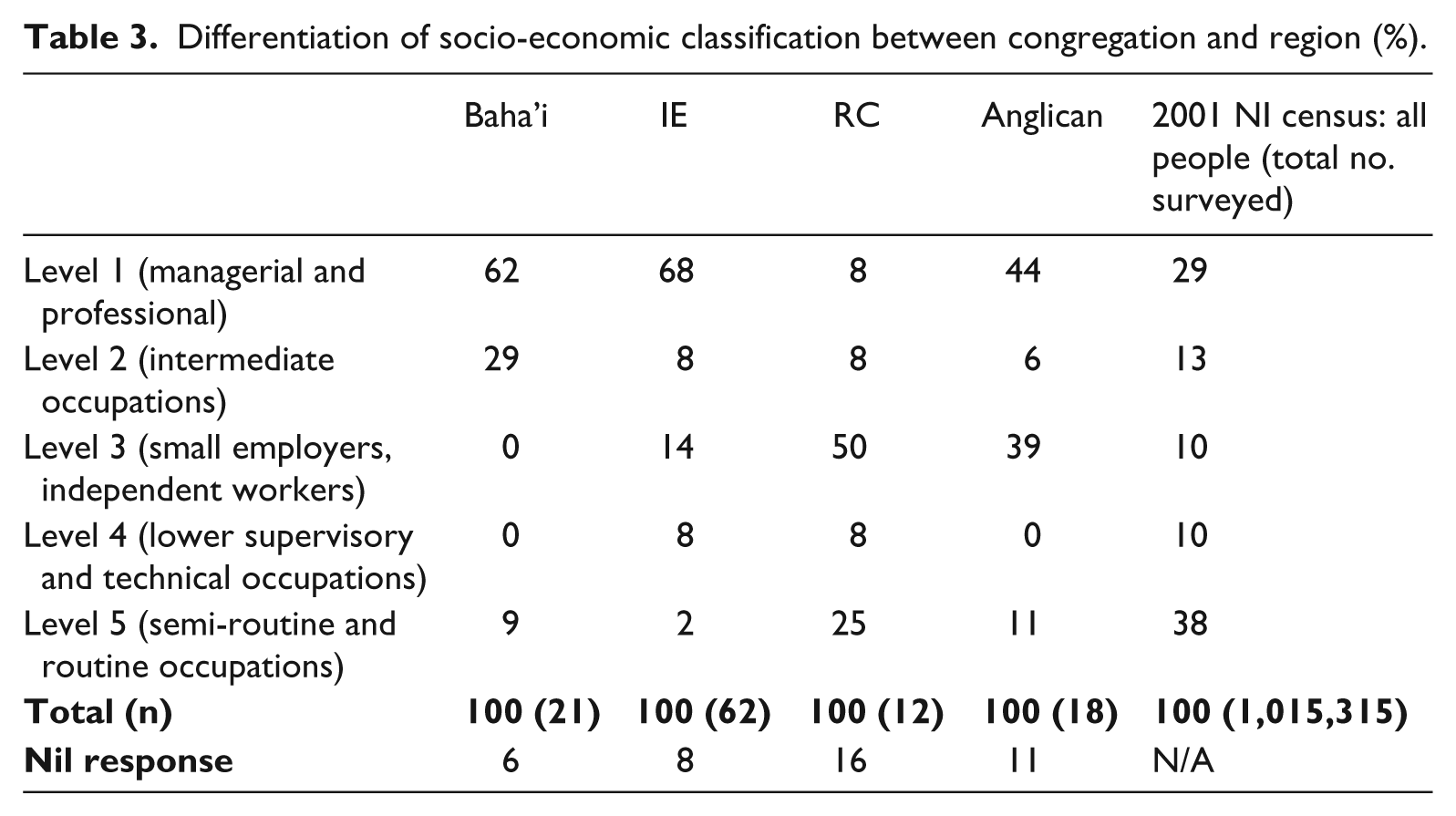
| Baha’i | IE | RC | Anglican | 2001 NI census: all people (total no. surveyed) | |
|---|---|---|---|---|---|
| Level 1 (managerial and professional) | 62 | 68 | 8 | 44 | 29 |
| Level 2 (intermediate occupations) | 29 | 8 | 8 | 6 | 13 |
| Level 3 (small employers, independent workers) | 0 | 14 | 50 | 39 | 10 |
| Level 4 (lower supervisory and technical occupations) | 0 | 8 | 8 | 0 | 10 |
| Level 5 (semi-routine and routine occupations) | 9 | 2 | 25 | 11 | 38 |
|
|
|
|
|
|
|
|
|
6 | 8 | 16 | 11 | N/A |
Funding
This research received no specific grant from any funding agency in the public, commercial, or not-for-profit sectors.
Notes
Author biography
Address: The Rectory, 24 Cookstown Road, Moneymore, Co. Londonderry, BT45 7QF, United Kingdom.
Email: