




Abstract
Giddens’ structuration theory suggests that social zoning or regionalization in worship services may occur on a front-to-back axis. To test this prediction, we observed the seating of individuals (N = 3,426) at worship services over a 3-year period at 35 churches in three Protestant denominations: Southern Baptist, United Methodist, and Episcopalian. We found that persons seated in congregations are structured into three zones front to rear. Earlier arrivers in church tend to sit in the front region and late arrivers in the back region; this tendency is strongest in large congregations and in small churches. The close fit to the data of a constrained loglinear model (p = .65) provides evidence that all the hypothesized effects are present. We argue that Giddens’ and Goffman’s categories are validated by and helpful for understanding regions in worship, and that this understudied area of research has value for understanding the sociology of religious congregations as well as structuring worship experiences and worship spaces.
The unreflective arrangement of persons in social gatherings has been an object of scholarly attention since the rise of the social sciences. Simmel’s early description of gestures in the process of sociation in dyads and triads (Simmel, 1916/1950), an alternative to Durkheim’s (1912/1995) vision of individuals beset by social forces, set the stage for recurring analyses of small-group formation dissenting from or correcting, like theoretical minority reports, the tendency toward broad generalization that has prevailed in social theory from that day to this. The explosion of cultural anthropology in the first third of the 20th century revealed the wide variation, hence relativity, in such social forms as body posture and gestures that were formerly assumed to be universal attributes of human nature (Benedict, 1934; Mead, 1953). In the 1960s, the anthropologist Edward Hall presented his intriguing comparisons of animal and human social spacing (Hall, 1959, 1963, 1966), defining basic concepts for the field he termed proxemics.
Although ethnomethodologists and those influenced by Erving Goffman (1959) have an interest in such matters, the number of research studies in the past few decades has been limited by the tendency of the followers of Mead to focus on linguistic rather than nonverbal communication and by the aforementioned tendency of social science to focus on macro- rather than microstructural questions of human society. Accordingly, studies of social spacing have tended to focus on the collective behavior of spontaneous social groupings such as crowds (Freedman, 1975), demonstrations (Heirich, 1971; Mann & Iscoe, 1971), and/or riots (McPhail & Wohlstein, 1983) rather than participation in more permanent social institutions.
By contrast, the present study attempts to examine social spacing in an ongoing institution, specifically weekly Protestant religious services. In so doing, we examine behavior in a setting typically considered more conformist than deviant, within institutions that are, by most accounts, central to the formation and maintenance of social structure. Consideration of such routinized sociation breaks new theoretical ground, prompting us to ground our hypotheses in an extensive discussion of applicable theory.
Recent theory has suggested that attention to issues of location in “social space” apart from the implicit psychological concerns with intention and meaning that pervade the classical tradition (and, we might add, the not-so-implicit concerns with rationality and usefulness that pervade modern research) may help lead to the unifying paradigms that sociology has long sought in vain. Although our hopes for this study are not so exalted, and we are not convinced that concerns for structure and teleology are necessarily incompatible, we do hope that the issues raised in this study may contribute modestly to insight into the relationship of microstructural processes to macrotheoretical concerns.
The present study also addresses a particular deficit in religious research: As far as we are aware, there has been no prior study of sociation in religious settings. Ironically, although scholars have shown little interest in the area, among religious participants, it is a matter of pervasive interest. The propensity of persons to collect in the back of the church has occasioned frequent anecdotal observation by clergy and students of churches. In popular religious culture, the back pew of the church functions as a counterpoint, not for the front pew, but for the pulpit. Analogous to their placement in the sanctuary, 1 those in the back are often seen to operate at more of a critical distance from the core of church life than those further forward. Those who are marginal to the church, the unknown and perhaps undesirable, are also perceived to be residents of the rear pews.
Although the importance of such issues for national religious policy or cultural issues of religiosity may be minimal, their value for the concrete practice and congregational experience of religion is clear and direct, with potential implications for, among many other things, liturgical practice; the placement and projection of homilies; readings and other verbal elements; temporal spacing of religious services; designated seating, as routine practice and for special events such as weddings and funerals; and movement and placement of seating options. Understanding patterns of church sociation also provides valuable instrumental knowledge to religious researchers who survey congregations and to those who design and build church worship settings.
As a first attempt in this area, we address the foundational question whether and how persons sort themselves unreflectively into social groups when they worship. Are there identifiable regions in worship settings, and if so how are they ordered? Our exploration will proceed first by reviewing applicable social theory, mostly from Goffman (1959) and Giddens, to derive five testable hypotheses (one major hypothesis and four corollaries) on spatial distribution in worship settings. As this is new territory, we discuss the theoretical resources at some length, and our resulting major hypothesis is general, that is, congregants do differentiate themselves by regions in a worship space on a front-to-rear axis. We then present, in methods and analysis sections, categorical models to test the hypotheses in original data of observations (N = 3,426) of individuals choosing personal locations in worship settings, finding that loglinear models expressing both the main hypothesis and all corollaries fit the data very closely (p = .65), thus concluding that front-to-back regionalization does occur as predicted. Our discussion identifies three regional groups of worshippers in congregations and suggests that there may be some truth to the idea that the back region expresses greater critical as well as physical distance. We conclude by addressing some of the theoretical and instrumental implications and limitations of the findings.
Theory of Sitting in Church
Social theory about the arrangement and partitioning of group behavior suggests that time-bounded worship settings will be subject to implicit front-to-back regional structuring. Goffman’s (1959) well-known distinction between front and back regions in social life defines behaviors and attitudes that also differ on the basis of critical distance. Conceiving social interaction as a series of performances in which the social actor creates and manages the impressions that others, the “audience,” have of her, Goffman distinguished the front region, the “stage” on which the performance occurs, from the back region, where “the impression fostered by the performance is knowingly contradicted as a matter of course” (p. 112). In backstage performances, actors relax the assumptions of the front stage and step, relatively speaking, out of the confines of their scripted social roles. The physical area comprises the “setting” of the interaction, which proceeds according to the “appearance” and “manner” of the actor’s personal front (Goffman, 1959, pp. 24-25). What distinguishes “back” and “front” regions is not physical location but distinct types of interaction or, in Goffman’s term, performances. Nevertheless, the delineation of front and back regions, on analogy with a theater stage, implies a physical separation—a “curtain”—between the two areas. “A region,” says Goffman, “may be defined as any place that is bounded to some degree by barriers to perception” (p. 107).
Anthony Giddens (1984) extends or recasts Goffman’s (1959) front–back distinction in two ways that are important for the current analysis. First, he argues that front and back can be, and generally are, social distinctions made within a single spatial locale. Although accepting the basic parameters of Goffman’s distinction, Giddens makes clear that physical severability is not a necessary feature of regionalization. If a region is in part a function of the setting, why is not a setting also in part a function of the region? The substantization of time and space in this manner in social theory is criticized by Giddens. “The term ‘place’ cannot be used in social theory simply to designate ‘point in space’, any more than we can speak of points in time as a succession of ‘nows’” (p. 119). Rather, Giddens argues, locales of interaction should be understood as dynamically constituted by both the setting and contextuality of the interaction, which are in turn shaped and defined by the interaction itself. Although Goffman thus conceives of the setting as a “given”—what Giddens (1984, p. 110) criticizes as a “mere environment”—for social interaction, Giddens maintains that both setting and context are part of the activity of structuring social life. “‘Regionalization’ should be understood not merely as localization in space but as referring to the zoning [structuration] of time-space in relation to routinized social practices” (Giddens, 1984, p. 119; on page 122, he gives essentially the same definition using “structuration” for “zoning”).
Second, for Giddens (1984), regionalization is a function of co-presence, not of the definition of locales. Giddens points out, “In social gatherings the regionalization of encounters is usually indicated only by body posture and positioning, tone of voice and so on.” The boundaries defining physical regions, in fact, usually “allow a greater or lesser number of the features of ‘presencing’ to permeate adjoining regions” (Giddens, 1984, p. 121). The limitation of all exteriority is so unusual an occurrence that we designate such a context as a “total institution.” However, even in situations where walls or other barriers thoroughly sequester participants, regionalization occurs, sometimes even more strongly, within the bounded physical region.
The physical restriction of what Giddens (1984) terms presence-availability does constrain regionalization to some degree, but the structuration of social interaction in small groups (what Giddens calls “situations of co-presence”) does not ultimately depend on setting or context. In fact, for Giddens, the regionalization of the contexts of interaction is rooted in a more basic physicality: the regionalization of the human body. “‘Face’ and ‘front,’” Giddens points out, “are related first of all to the positioning of the body in encounters” (p. 124). The structuring of localized social encounters are constituted, then, not by the givenness of the physical setting but by given characteristics of the human body. Giddens (1984, p. 111) adopts the premises of “time-geography,” which, in Hagerstrand’s formulation, proposes five physical constraints that form the limits of human behavior in time-space: The indivisibility of the human body, its finitude, its inability to do two things at once, that movement in space always involves movement in time, and that no two bodies can occupy the same space at the same time (Carlstein, 1980; Hagerstrand, 1975). For Giddens (1979), then, “the sustaining of a spatial discrimination between front and back is a prominent feature of the use of locale within the reflexive monitoring of action in discursive and practical consciousness” (pp. 207-208).
The matter of temporal segregation or ordering is, of course, particularly salient for religious activity. Durkheim’s (1912/1995) sociology of religion places the distinction between sacred and profane at the root of religious consciousness. The absolute boundary between these modes of social life is expressed, among other ways, by a correspondingly strict bifurcation of time:
It is necessary to assign determined days or periods to the [religious life], from which all profane occupations are excluded . . . There is no religion . . . which has not known and practiced this division of time into two distinct parts, alternating with one another. (Durkheim, 1912/1995, p. 313)
Although modern life reflects a high degree of temporal regularity and coordination generally, as Zerubavel (1976) points out, the starting and ending time of religious observances are themselves definitive religious acts in the social sphere. “Temporal segregation,” says Zerubavel, is “indispensable to the social organization of religious life” (p. 104).
To be sure, sociation structures in a local, temporary aggregation such as a worshipping religious congregation are not likely to be as determinative or simple as Giddens (1979) and Goffman (1959) conceive them to be in the accounts above, or as implied by Bourdieu’s influential notion of habitus. Sewell (1992, p. 18) points out that the structures at play in a social setting are always multiple, overlapping, and subject to varying interpretations and mobilization schemas by different social actors. Giddens (1979, 1984) himself repeatedly emphasizes the dual nature of structures, which enable and promote agency at the same time as they constrain and pattern behavior. As with any observed social feature, regional structures in congregations can express only relatively stable and relatively general patterns amid a range of fluidity and variability of collective behavior.
With regard to religious congregations, moreover, some would claim that group structures may not be as evident in favor of more focused, even purposive, considerations. Unlike many settings in which interaction is observed, worship is a highly intentional activity. For its participants, it involves not only relating to one another but also more importantly relating to God. In theory, for Protestant Christians (and Muslims), worship begins with the individual, and may be engaged in entirely as a solitary activity. Thus, the concerns of group life, although affirmed, are secondary, and to suggest that group structures may play a role in worship may be thought to understate or even belittle the unique spiritual character of worship.
On the other hand, certain features of Christian worship suggest that congregations may be highly susceptible to structurating forces. In the first place, whether or not it is uniquely intentional, Christian worship is a highly formalized, routinized activity. Although the differences among religious congregations receive the bulk of analytical attention, their similarities on a sociological level, even among those of different denominations, are actually far greater. With only a few exceptions, all Christian congregations worship facing toward a common center of attention; are read and/or spoken to from this center; face symbolic furniture, usually a pulpit and/or altar; meet at least weekly, in the same place and same time of day; sit on long benches called pews; have a single, clearly designated leader; do not prescribe or assign seats, or segregate by gender or class; sing and/or hear music; and collect an offering of money. The order of events in the worship service itself is subject to more variation, but among Protestants, it follows a recognizable common form, and for all congregations, it is routinized into a form that varies little each week.
Protestant worship contexts are so similar, in fact, that there are only two main sources of variation among them: size and structure of the pews arrangement, and size and demographic structure of the worshipping congregation. Moreover, seating patterns in churches persist with little change from week to week. Repeat participants tend to sit in about the same place in the church each week. This is not likely to be a function of the intentional or elevated nature of worship, because such persistence is also observed in other settings involving repeated gathering in ordered environments, most notably classrooms. Although it may be ignoble, we see no reason not to expect that religious congregations will likewise be subject to similar interactional structuration. Such arrangements are not obviously inconsistent with the expression of more intentional, God-focused behavior on the part of worshippers.
Although highly routinized, however, religious worship is at the same time less coercive, from the individual’s point of view, than many other social settings. By explicit social arrangement, participation in worship is subject to no formal political coercion or sanction. Impression-maintaining behavior in worship, moreover, is more relaxed than in many other official settings. Goffman (1959) points out that
The rules of decorum that prevail in sacred establishments, such as churches, . . . are [not] more numerous and more strict than those we find in work establishments. While in church, a woman may be permitted to sit, daydream, and even doze. However, as a saleswoman on the floor of a dress shop, she may be required to stand, keep alert, refrain from chewing gum, keep a fixed smile on her face even when not talking to anyone, and wear clothes she can ill afford. (p. 109)
This suggests that the mutual behaviors that promote regionalization will be free to operate even more strongly in religious congregations than in settings with more restrictive requirements for decorum.
Two common features of worship settings may be noted as especially promoting regionalization. The first is that all pews face forward, and the second is that worship begins at a stated time. The forward-facing orientation of pews combines with the corporeal limits of perception to produce a distinctive front and rear to each worship space. Part of the indivisibility of the human body, Hagerstrand’s first principle constraining human interaction, is that visual perception is limited to a forward field, in the direction of the “face” or “front” region. When standing, it is easy to quickly alter this orientation, promoting in situations of high presence- availability the formation of small huddles or groups, as at a party. When seated, however, it is very difficult to turn one’s head, and impossible to rotate one’s body, so as to change the frontward orientation of the perceiver. In most Christian worship settings, seating is provided on fixed benches (pews), which permit a range of movement from side to side but restrict perceptual orientation to the frontward direction. This constraint is augmented by the fact that pews are seldom spaced, as are seats in stadiums or theaters, so as to avoid obstructing the perception of those behind.
Thus, in addition to a clearly designated front region of the church, from the standpoint of the participant, each pew is also in the front region of all the pews behind it. The inhabitants of the front pew of the church are, as it were, on display to all the worshippers behind them, whereas the inhabitants of the rear pew are in the same sense on display to none. In terms of body language, movement, attention—all the ritual behaviors that make up impression management—the rearmost worshippers form the audience for many and perform for none (or very few), whereas the frontmost worshippers perform for many and form the audience for none (or very few). Those in the rear pews, moreover, in churches of large enough size, are less susceptible to surveillance from those formalized leaders in front who face the body of worshippers. On the other hand, those in the front pews enjoy a front region that includes fewer of their fellow worshippers and more of the formal, intentional front performance of the worship setting. Depending on whether one’s goal is to focus on the formal worship experience, the front offers fewer distractions, the rear more enticements, from the intentional act of worship. Thus, the physical setting of worship, in fixed pews facing forward, tends (we predict) to promote a differentiation of worshippers on a front-to-rear axis that corresponds in many ways to Goffman’s (1959) characterization of front and backstage behavior.
At the same time, this differentiation is strongly affected by the fact that worship in all Protestant groups involves extensive time synchronization. Most importantly, all congregations begin each service of worship at a single stated time, but the synchronization does not end there. Worship services are highly ordered with regard to time, usually explicitly by a printed “Order of Service” that provides instructions for the coordination of group behavior. Even those churches that reject a formal liturgy have a strict, reproducible time order to their worship services that, if anything, is even more rigid for not being clearly specified (Stevick, 1964, pp. 57-58). Every Protestant liturgy (a word that means “the actions of the people”), whether formal or informal, involves repeated communal activities, such as songs, prayers, and responses, which require the entire congregation to engage in the same behavior simultaneously. If for no other reason, this repeated synchronization is likely to make worship structuration different from many other collective events. If Giddens (1984) is correct that regionalization is a form of zoning in space-time, and not just space, the time-synchronicity of worship forces temporal zoning effects to “spill over” into the spatial arrangement of worship. This is likely to have the strongest effect at the first instance of synchronization, at the beginning of the service, when choices of spatial location are the least determined.
For purposes of the present study, the above theory about regionalization in worship gatherings can be summarized in one main hypothesis:
Hypothesis 1: Congregants differentiate themselves by regions in a worship space on a front-to-rear axis.
The considerations above also suggest two corollary hypotheses as follows:
Hypothesis 2: This differentiation is stronger, the further apart worshippers are.
Hypothesis 3: It is associated with their time of arrival relative to the start of the worship service.
Because the main hypothesis has to do with the dispersion of persons within a bounded space, we would also expect it to be influenced by the density of persons in that space, that is, the size of the church building relative to the size of the congregation. Because a more tightly packed space presents fewer options for spatial zoning, we propose the following two additional corollaries:
Hypothesis 4: Front-to-rear regionalization will be stronger in larger church buildings.
Hypothesis 5: Front-to-rear regionalization will be stronger in smaller worshipping congregations.
Data and Method
To examine these questions, we observed the characteristics of 3,426 worshippers in a random sample of 35 churches in a major metropolitan area. Undergraduate sociology students under the supervision of graduate students made the observations as a training exercise in research methods. Each set of observations was carefully verified and authenticated by two independent reviews. Reports of observations that were inaccurate were replicated and replaced. Three churches were eventually replaced in this manner; reports on two churches were judged irreparable and were dropped from the data set.
Each observation involved two visits to the subject church. (In common usage, the word “church” may refer either to a local group of worshippers or to the building in which they worship. To avoid confusion, we will use “congregation” to refer to the former and “church” to denote the latter, adding “building” or “sanctuary” when particular clarity is desired.) On the first visit, the field observer gained access to the church building or sanctuary at a time when it was unoccupied. Using premeasured paces, he or she measured the length and orientation of each pew in the church, as well as the distance to any sacred furniture—pulpit, altar, and/or baptistery—and entry and exit doors. The result was a diagrammatic representation of the seating area of the church building drawn to scale, with critical distances noted in inches.
The second visit was made at the time of the church’s main Sunday morning worship service, as indicated in the church’s literature or, in some cases, by the pastor or other knowledgeable person. These visits were made by all field observers within the same month, but not all on the same Sunday. Visits were not made on special holidays, if the church was celebrating a special event, or if the weather was inclement, as these events might uniquely affect seating patterns. Using the previously prepared diagram, the field observer arrived at least 30 min prior to the start of the service and took a position as unobtrusively as possible in the rear of the church. Using coded marks on the diagram, the observer noted the seat location of each worshipper as he or she arrived, as well as their time of arrival, age, sex, and group participation.
Time of arrival was measured ordinally: 29 to 20 min prior to the service (subsequently labeled for convenience “very early”), 19 to 10 min prior to the service (“early”), and 9 to 0 min prior to the service (“just in time”). Age was imputed as child (12 or under), adolescent (13-20), or adult (21 or older). 2 These categories were assigned by observation, so exact age may not be accurate in marginal cases. Group participation noted whether the subject arrived with a group, and if so, the size of the group. These characteristics were then coded for analysis. The complete observation protocol is available on request from the lead author.
Because of the difficulty of accurately observing very large churches, we limited the study to churches with fewer than 25 rows of pews. This effectively excluded most Catholic churches, so we limited the study to Protestants. To better represent the range of variation in Protestant denominations, we further restricted the sampling frame to three Protestant denominations, chosen to represent the conservative, moderate, and liberal families of denominations, respectively: Southern Baptist, Methodist, and Episcopalian. Because there were approximately equal numbers of churches of these three denominations in the metropolitan area from which we drew our samples, we included equal numbers of churches from each denomination. Our unit of analysis, however, was the individual worshipper, and we make no claim regarding generalizing findings to these denominations.
Over a period of 3 years, we drew three independent random samples with exclusion from a list of all the churches of these denominations in our subject area. The unit of analysis governing this selection was not congregations but individuals. As noted above, three churches were replaced and two were dropped, for a final total of 35 churches (13 Baptist, 12 Methodist, and 10 Episcopalian). The result is a data set that, within important limitations of scope and generality, presents as accurate a picture as possible of the worship sociation of Protestant Christians. To our knowledge, this is the first body of data to do so.
The descriptive characteristics of our data are consistent with previous studies of congregation participation (Roozen & Dudley, 2001; see Lindner, 2002, for review). In all, 60% of the worshippers were female and 78% were adults. Worshipping congregation size ranged from 21 to 306 persons, with a mean of 100.8. Of all the worshippers, 60% arrived “just in time,” that is, less than 10 min prior to the service; 25% arrived early; and 15% arrived very early. Although there were a number of minor variations, all the church buildings but two had a central aisle with one or more pews arranged laterally on each side in rows. The number of rows of pews ranged from 7 to 24, with a mean of 14.5.
Analysis
As distinct from such characteristics as posture, appearance, and manner, studied at length by Goffman (1959) or Garfinkel (1967), in this analysis, we were able to measure only persistent observable characteristics and the physical clustering and dispersion of worshippers. To the extent that regionalization is reflected by such factors, Hypotheses 1 and 2 can be resolved into questions regarding which seats in the worship space are preferred by different sets of worshippers. Because the questions of interest dealt with the distribution of worshippers along the front-to-rear axis of the worship space, we divided each church’s space into quartiles, that is, four equal sections of pews ranging from front to back, and compared the proportions of people sitting in each section. This solved two potential problems in analysis, by standardizing the measurement of front-to-rear effects in church sanctuaries of differing sizes and by providing a common specification for the rearmost pews of each church. Worshippers in churches with fewer than eight rows of pews, for whom quartile assignments would obviously be biased, a total of 204 cases, were excluded.
The summary findings for the distribution of worshippers by pew quartiles are shown in Figure 1. If the congregants were evenly distributed, each quartile of pews would contain 25% of them; this line is shown on Figure 1 for reference. As the figure shows, the front and rear quartiles contained about 2% less and the middle quartiles about 2% more of the congregation, on average, than would be true if seating choices were random. All other things being equal, then, there was a small general tendency for people to avoid the front and rear extremes in preference for the middle sections of the church sanctuary when they gathered for worship. Comparing only the front and rear quartiles, there does not appear to be any greater preference for either the front or the rear of the church. By this global measure, Hypothesis 1 is not supported, and worshippers’ overall seating choices can be described as moderate or unconditioned.

Front-to-rear seating distribution of worshippers
If Hypotheses 4 and 5 have any merit, however, the effects of church size and congregation size that they predict may confound front-to-rear differentiation. As we were not concerned with side-to-side variations in seating choices, we simply measured sanctuary size by the number of distinct rows of pews in each church’s worship space. These ranged from 7 to 24. For this analysis, we categorized as “small” those having fewer than 10 rows of pews, those having 20 or more rows of pews as “large,” and those having between 10 and 19 pew rows as “medium.” Figure 2 shows the observed effect of church size on quartile seating patterns. In accord with Hypothesis 4, taking church size into account does reveal differences between the front and rear quarters. Although the overall tendency was for the front and rear quarters to have about 2 percentage points less occupants than a random distribution (Figure 1), in small churches the front quarter and in large churches the rear quarter had about 5 percentage points more than this. In small church buildings, 28% of the worshippers sat in the front quarter; in large churches, 29% sat in the rear. The middle quartiles remain the most populated in medium-sized churches, conforming to the overall pattern, but in small churches, the front quartile, and in large churches, the rear one, had the most occupants. Thus, there appears to be a tendency to sit in the front in small churches, and in the rear in large ones.
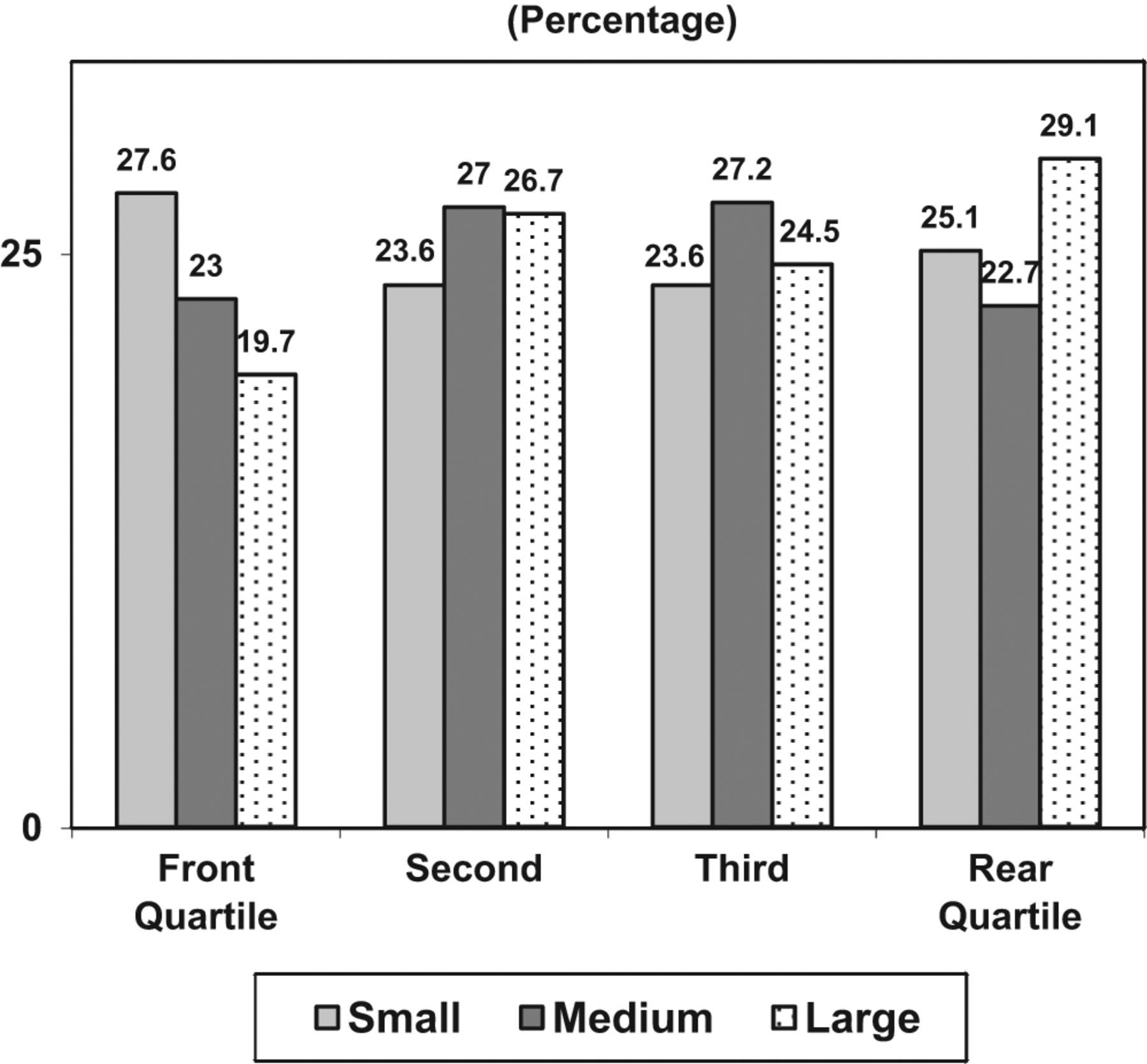
Seating distribution by church size (rows)
The size of the worshipping congregation also interacts, but in the opposite direction, with choices to sit in the front and rear quartiles of pews. Figure 3 shows the findings. As the left and right sets of bars show, in small congregations, worshippers tended to avoid the front quartile, and in large congregations, they avoided the rear quartile. In the combined data presented in Table 1, then, the effects of church size and congregation size effectively counteract one another to cancel out any significant front-to-rear differentiation in seating choices. However, the effects of church building size and congregation size are more complicated than predicted by Hypotheses 4 and 5. Front-to-rear differentiation functions differently but is not necessarily stronger in larger church buildings or congregations.

Seating distribution by congregation size
Fit of Selected Logit-Specified Loglinear Models

Note: L2 = likelihood-ratio chi-square statistic; A = arrival time; C = size of congregation; S = size of church sanctuary; L subscript = linear constraint; J subscript = just-in-time only constraint. Subordinate effects and intermediate models have been omitted for simplicity.
An assumption underlying Hypotheses 4 and 5 is that larger congregations would tend to worship in larger church buildings. To our surprise, however, we found no correlation between the size of the church and the size of the worshipping congregation. On average, churches with small buildings, in fact, had significantly larger congregations (120 persons) than those with large buildings (85 persons), although those with medium-sized church buildings had larger ones still (160 persons). However, there were gaps in our data for these variables. We found no large congregations meeting in large church sanctuaries. All the churches in our sample were urban and had been in existence more than 10 years, and many had suffered large declines in membership since the church sanctuary was built or bought. It may be that newer, less urban churches have church buildings that are more closely related to the size of the congregation, and thus would reveal more interpretable effects of church and congregation size.
Hypothesis 3 predicted that front-to-rear differentiation is affected by arrival time. Figure 4 shows the proportion of worshippers who chose to sit in the front and back quarters of the church by their time of arrival. Early arrivers preferred seats toward the front, whereas those arriving just in time for the service were more likely to sit in the back. Of those who arrived 10 min prior to the service or earlier, that is, very early or early, nearly 30% sat in the front quarter of the church, but a third less sat in the rear. For those who arrived just in time for the service, these proportions were reversed, with 27% of them favoring the rear and only 18% the front of the church. To the extent that preference is indicated by first choice, then, the front seats are preferred to those in the rear.

Seating choice by time of arrival
This tendency is not due to the fact that, for later arrivers, many of the front seats were already filled. Only a minority (40%) of the worshippers arrived early. As noted above, moreover, the tendency to sit toward the rear was stronger in large church buildings, which have more seats available in front. Finally, there was little difference between very early and early arrivers, even though the early arrivers found some seats already filled. Arrival time, in other words, had two distinct effects on seating preference: Early arrivers prefer seats in the front quarter, but those who arrive just prior to the service prefer seats in the rear quarter. Thus, Hypothesis 3 appears strongly supported by this finding.
The effects of arrival time also interacted with church and congregation size. Congregation size inhibited the preference for rear seating among just-in-time arrivals. Although the preference for the front quarter among early arrivers was not affected by the size of the congregation, the preference for the rear quarter among just-in-time arrivers was much stronger in small congregations than in large ones. As Figure 5 shows, in small congregations, twice as many just-in-time arrivers sat in the rear quarter of the church as in the front, but in large congregations, more preferred the front quarter than the rear.

Just-in-time seating choice by congregation size
By contrast, church size increased the tendency for just-in-time arrivers to sit in the rear. Figure 6 illustrates this by showing the composition by arrival time of the rear quarter of pews according to church size. The percentage of rear pew occupants who arrived just in time increased progressively from 59% in small churches to 88% in large ones, whereas the percentage who arrived very early decreased from 14% in small churches to 9% in large ones.

Seating composition (just in time and very early) of rear quarter, by church size
This finding provides general support for Hypothesis 2, which predicted that physical distance would increase differentiation. In larger churches, where the physical distance from front to rear is greater, the differentiation in seating by time of arrival is also greater. Figure 7 provides evidence for a more direct examination of Hypothesis 2 by showing the percentage of occupants of each quartile who arrived very early or just in time. Differences in seating choices by arrival time affect the front and rear, but not the middle, quarters of pews. Regarding the percentage of occupants who arrived very early, the front quartile has an elevated percentage, at 16%, but there is little difference among the remaining three quartiles. The percentage of just-in-time arrivers is lowest for the front quartile, at 55%, and highest for the rear quartile, at 72%, but there is little difference between the middle two quartiles on this proportion. Consistent with our other findings thus far, regionalization by time of arrival appears to occur only in the front and rear quarters of the church.

Seating composition (just in time and very early) of pew quartiles
Overall, the majority of worshippers (59.8%) arrived less than 10 min prior to the start of the service, the category we have labeled “just in time.” However, this varied strongly by church size. A quarter of worshippers (24.8%) arrived “early,” that is, between 10 and 20 min before the service, and only 15.4% arrived “very early,” that is, 20 or more minutes before the service. In small churches, however, the proportion arriving very early was much smaller than in medium or large churches. Only 3% of worshippers arrived very early in small churches, compared with 19% in medium and large churches.
Thus far, although we have discovered evidence to suggest that there is front-to-rear regionalization in worship spaces (Hypothesis 1), the evaluation of this evidence is hampered by the fact that the corollary effects specified in Hypotheses 3, 4, and 5 mutually interact in complex ways. To specify the separate effect and fit of these factors—congregation size, church size, and time of arrival—we attempted to fit loglinear models embodying the hypothetical effects we observed. Table 1 presents the fit of selected models. 3 Both Models 4 and 5 fit the data acceptably. These models constrain the tendency to sit in the front to be linear within the categories of arrival time and by congregation size for those arriving just in time, independent of sanctuary size and congregation size, respectively.
Figure 8 reports the effects of Model 4 from Table 1, showing the odds on sitting in the front rather than the rear of the church. The acceptable fit of this model to the data provides support for our working hypotheses that the observed effects of arrival time and church size are both linear. For each variable, the changes in odds across the categories of church size are reported as the slope of the line. On this logarithmic scale, there are no negative slopes; a “rising” slope is greater than one and a “falling” slope is less than one, reflecting the odds ratios involved. For example, the line marked “early” should be interpreted as follows: In small churches, early arrivers are about equally (1.1 times as) likely to sit in the front as in the back; in medium churches, they are 1.6 times more likely to sit in the front; and in large churches, they are 2.4 times more likely to sit in the front. Early arrivers in large churches, then, are 1.5 times more likely so sit in the front as early arrivers in medium churches (2.4 / 1.6), who are in turn 1.5 times more likely to sit in the front as early arrivers in small churches (1.6 / 1.1). Thus, early arrivers are 2.2 times (1.5 × 1.5) as likely to sit in the front in large churches as in small ones.

Odds on front seats by church size and arrival
Just-in-time arrivers, by contrast, are 0.63 times less likely to sit in the front in larger churches. The interaction of these two effects, reported in the line marked “Size by Time,” shows how much the effect of arrival time is magnified in larger churches. Just-in-time arrivers are only half (0.5 times) as likely to sit in the front as are early arrivers in medium churches. This is more than twice the difference in likelihood as in large churches, where just-in-time arrivers are only one fifth (0.2 times) as likely to sit in the front in large churches as are early arrivers, and less than half (0.43 times) the difference in likelihood as in small churches.
As Figure 8 shows, then, in small churches, there is little or no tendency to sit in the front as opposed to the rear of the church, nor is there any effect of arrival time. In larger churches, however, early arrivers are more likely to sit in the front than in the rear, whereas just-in-time arrivers are more likely to sit in the rear than in the front. As church size increases, early arrivers are increasingly more likely to sit in the front and just-in-time arrivers are increasingly more likely to choose seats in the rear. In medium churches, just-in-time arrivers are twice as likely to sit in the rear as are early arrivers; in large churches, just-in-time arrivers are 5 times as likely to sit in the rear as are early arrivers.
Figure 9 presents the odds and odds ratios from Model 5, expressing the hypothesis that there is a linear effect of congregation size on seating choice, but only for just-in-time arrivers. The very close fit of this model to the data provides strong evidence that this is the case. In congregations of all sizes, early arrivers are 1.5 times more likely to sit in the front than in the rear. Just-in-time arrivers, although less likely to sit in the front than early arrivers, are 1.7 times more likely to do so in larger congregations than in smaller ones. In small congregations, early arrivers are more than 3 times as likely to sit in the front as are just-in-time arrivers, but in large congregations, just-in-time arrivers are almost as likely to sit in the front as are early arrivers.

Odds on front seats by congregation size and arrival time, showing expected frequencies of Model 5
Discussion
Taken together, our findings provide evidence that religious worshippers do function according to distinct sets of behavior in their worship seating choices that is aptly described as regionalization or structuration. We found that there appear to be at least three distinct locales of front-to-back regionalization in church worship settings. The front region, which encompasses approximately the front quarter of rows of pews, attracts earlier arrivers. The back region, comprising approximately the rear quarter of rows of pews, attracts later arrivers. The middle two quarters of pews comprises an intermediate region, which also lies in the middle on most effects differentiating the front and rear regions.
We found that this general pattern is clarified and specified by the interaction with arrival time of the size of the worship space and the number of other worshippers present to affect in complex ways where worshippers choose to sit. Those who arrive early in a congregation of any size meeting in a large church building are most likely to sit in the front. Those who arrive just before the service in a small congregation meeting in a large church building are most likely to sit in the rear. Moreover, for large congregations in small church buildings, worshippers are about as likely to sit in the front as in the rear, and time of arrival has little effect.
Consistent with the theory advanced in the introduction, those who sit in the front of the church appear to seek both to exclude the rear and to include the formal worship center in their effective locale. In this sense, a front church seating choice is also a “front stage” choice in Goffman’s (1959) sense. This interpretation is buttressed by the fact that early arrivers tend to choose seats in the front of the church—except in small churches. This suggests that, while defining themselves as “front” and “rear” relative to one another, the object of a frontward seating choice is also to achieve a certain minimum desired proximity to the activities that emanate from the central worship area in the nave. If the range of human perception, which is fairly constant, governs this distance, then in small church buildings, which have by our definition fewer than 10 rows of pews, seating within this range can be achieved practically anywhere in the church. In progressively larger church buildings, however, a progressively larger portion of the seats toward the rear of the church lies outside of this optimum area. Thus, early arrivers, seeking to sit not too far from the nave in any church, tend to sit proportionally more strongly in the front as church building size increases.
Unlike the very early arrivers, those who arrive later must take into account, in their seating choices, those who are already seated. As Figure 7 shows, earlier arrivers define a front but not a rear region: For very early arrivers, there is a preference for the front, but no differentiation among the back three quarters of pews. Just-in-time arrivers, on the other hand, not only prefer the rear but also avoid the front more than the middle region of the church. Later arrivers must define a region, as it were, not only aspirationally, that is, with respect to the formal activity of worship, but also socially, that is, with respect to the prior presence of a seating distribution in the church. This interpretation also explains why congregation size has an effect on front quarter (vs. rear quarter) seating choices for later arrivers, but none for earlier arrivers (Figure 9, showing effects of loglinear Model 5). Very early arrivers make their seating choices when few other congregants are present, regardless of the size of the congregation.
Although the seating options of later arrivers are more constrained than those arriving earlier, the distribution of their choices does not simply reflect these constraints. The remaining seats that may be considered as options by later arrivers will be governed not only by (a) whatever motivations affect their optimal seating choice, as with the early arrivers but also by (b) the fact that fewer seats in the optimal viewing and hearing range may be available and by (c) the effect their seating will have on those already present. If the choice for a rear seat were motivated by the absence of remaining optimum seats in the front (the second factor above), we would expect the tendency to choose rear seats to be strongest in churches that are the most crowded, that is, have the fewest available seats in the optimum area. We found, however, that just the opposite is the case. Later arrivers are most likely to sit in the rear in the least crowded churches we studied, that is, small congregations meeting in large church buildings. Likewise, if the seating behavior of later arrivers were due to consideration, on some basis, of the presence of earlier arrivers, perhaps not to disturb or be seen by them (Factor 3), we would expect it to be more pronounced in small church buildings, where such results of later arrival are more likely. However, we found that the difference between earlier and later arrivers in front-to-rear seating choices is least pronounced in small church buildings.
While engaging in social differentiation, then, those who sit in the rear of the church also appear to express some qualitative differences from those seated in the front in terms of the worship experience. Later arrivers tend to prefer rear seats, in church buildings large enough for the distinction to be meaningful, not simply because of scarcity or consideration, but also for some other reason. If, as Durkheim (1912/1995) maintains, religion consists in the distinction between sacred and profane, in a bounded social sphere, there is necessarily a zero-sum relation between these two modes of social life. We cannot, of course, know the subjective reasons or motives of late arrivers without asking them. However, in a strictly concrete social sense, late arrivers/rear sitters minimize the sacred at the expense of the profane, whereas early arrivers/front sitters do the opposite. These findings thus provide some confirmation of, although they do not compel, the view that those who sit in the rear demonstrate less religious intensity than those in the front. In Zerubavel’s (1976) terms, by minimizing the temporal segregation of the religious experience, late arrivers/rear sitters directly reduce the religious character of their participation. Both spatially and temporally, they have literally come less far into the worship experience.
Late arrivers/rear sitters may be less engaged in other ways as well, as someone who is “backstage” to the worship experience. As the back region is more exposed to distracting or conflicting influences, they may also be more subject to overlapping structures or varying interpretations of resources, as Sewell (1992) suggests. This should not be taken to imply anything about the subjective experience of persons worshipping in different regions, such as greater sincerity or religious quality for those in the front. Goffman’s (1959) characterization of front and back regions, in fact, suggests just the opposite: It is the frontal region that is inherently inauthentic, hiding the actor’s “true” feelings. Giddens (1984), however, criticizes this limitation of Goffman’s model, arguing that front regions are important for the maintenance of “ontological security” (p. 125).
As ontological security is an explicit concern in worship, our interpretation takes its cue from this understanding. The notion that, other things being equal, to arrive earlier for an event implies that it has more importance in some sense for the participant seems to us more likely than the opposite. Without self-reports or detailed observations, of course, our data cannot be compelling on this point, and other interpretations are certainly possible. However, this general perception is supported by two behavioral differences we observed between the front and rear regions.
1. Location in the pew: If those in the back region are in some sense less engaged in the worship experience, it would be consistent for them to choose seats with a heightened awareness of a timely departure following the service. Thus, we would expect them to show greater preference than those in the front for seats at the end of the pew, where their departure would be less likely to be impeded, and where they are literally less physically committed to remain in the service. As Figure 10 shows, our data show this pattern of behavior. In all, 23% of those sitting in the rear quarter of the church sat in the end seat of the pew, but only 14% of those sitting in the front quarter. For the front and rear single pews, the difference is even stronger: Only 10% of those sitting in the front row sat at the end of the pew, compared with 26% of those in the rear pew.
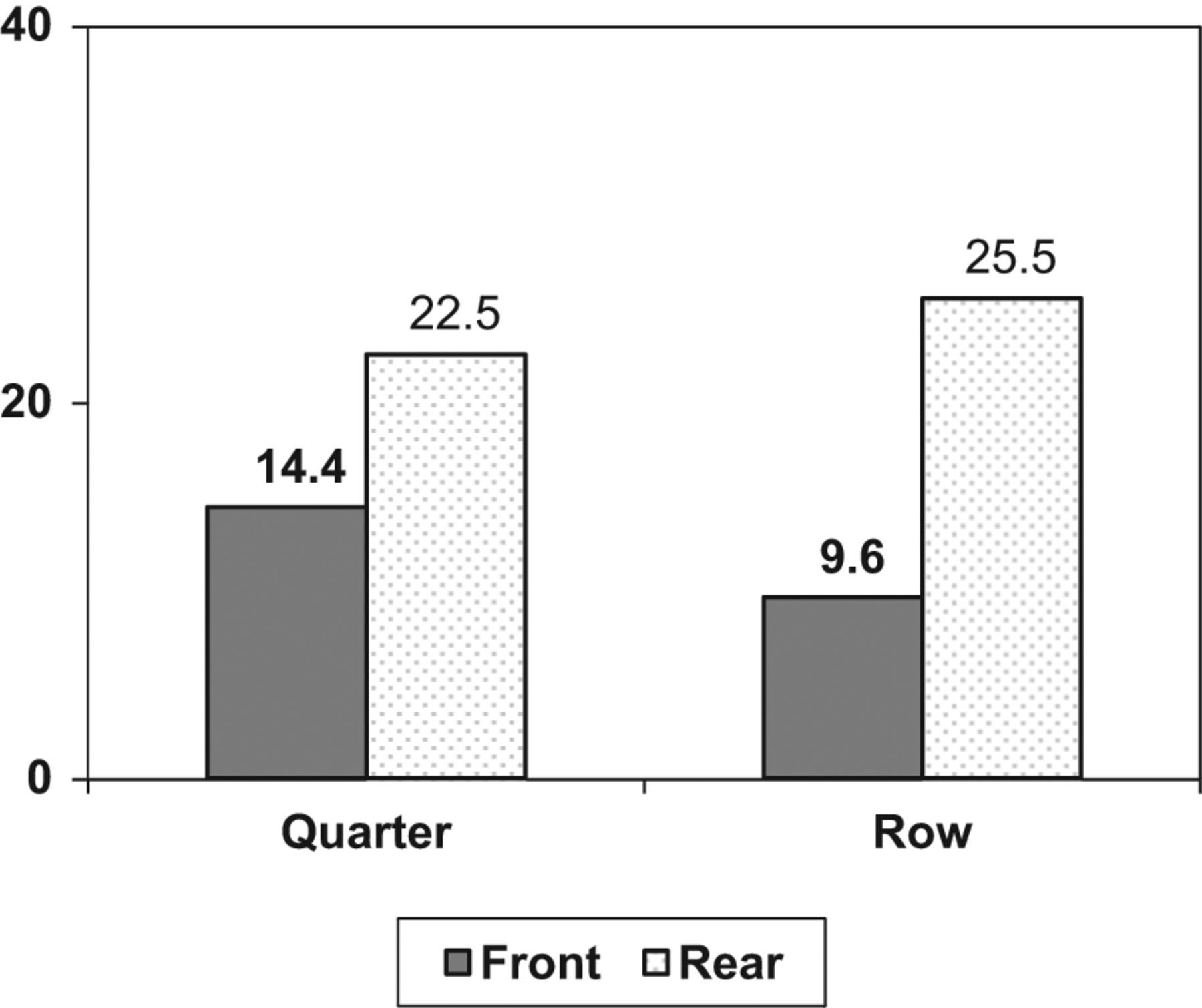
Percentage sitting at the end of the pew, comparing front and rear quarter and single pew
2. Group participation: Corporate worship is by design and definition a communal construction or experience. According to Durkheim (1912/1995), it is nothing less than society itself. Consistent, therefore, with greater detachment from the worship setting is greater detachment from others in the worship setting. This leads to the expectation that those in the rear would be more likely than those in the front to be worshipping alone, rather than with a primary group of other persons. We found this expectation to be consistent with our observations. In all, 63% of those in the front, but only 45% of those in the rear, worshipped with a group. Not only were there fewer groups in the rear, but also, their sizes were smaller. Half (50%) of the groups in the rear consisted of only two persons, whereas less than a third (32%) of the groups in the front were that small.
There are many other factors that may affect worship behavior, and many other behaviors we have not observed. Although, absent more resources, we cannot develop a more compelling argument, these behaviors suggest that our characterization is at least plausible. It is our hope that this initial perception can be verified or falsified in favor of a more accurate view by further research in this new area.
Conclusion
Our observations of worshippers clearly support the main idea that there is distinct regionalization among religious worshippers on a front-to-rear axis (Hypothesis 1). Specifically, we found evidence for three regions of worshippers: a front region, composed of the front quarter of pews; a middle region, composed of the middle half of pews; and a back region, composed of the rear quarter of pews. The other corollary factors that qualify this front-to-rear differentiation—arrival time, church size, and congregation size—all appear to have some effect (Hypotheses 3, 4, and 5), but not in as simple a manner as we hypothesized.
The findings of this study suggest that a distinction can be drawn between worshippers who, arriving early, tend to sit in the front of the church and those who, arriving late, tend to sit in the rear. These two groups of worshippers appear to express distinct seating preferences. In addition to arriving later, worshippers in the rear region sat nearer the ends of the pews and were less likely to group together, than those in the front region.
The more individualistic behavior of rear worshippers is consistent with there being a greater critical distance, insecurity, or disconnectedness among this group; however, these results hardly compel such an interpretation. Further research that includes more detailed observation of the behaviors of front and rear worshippers and/or appropriate interview or survey research to assess their motivations and interests would serve to confirm or refute whether there is any relationship between regionalization and religiosity.
We do not claim that these factors explain all or even the major portion of the variation in seating choices. We discovered small effects of other variables, most notably denomination and group participation, that were not easily interpretable, very strong, or significant; but these may, if understood better, qualify or alter the conclusions of this study. As in any categorization, moreover, within the categories we derived, there is a great deal of independent variation that may be explainable by factors we were not able to measure or failed to interpret. Moreover, the data of this study consist exclusively of cases gathered in a single urban area among three Protestant denominations, and its findings should not be generalized to all American churches with further study using a more representative sample. It is likely that our results are more accurate for urban churches than for suburban or rural ones.
To the extent that they are borne out by further research, the findings of this study have significant practical implications for research in religious congregations and similarly structured groups, such as academic classes and lecture, concert, and theater audiences.
Data gathered from individuals in such groups, whether by survey or observation, would do well to take seating location into account in the analysis of variables related to group experience or identity. The findings also have far-reaching pastoral and practical implications for churches and worship life. Pastors and masters of ceremonies planning worship events could enhance the impact and involvement of participants by taking into account the differences in behavior between front and rear occupants. Likewise, designers or builders of churches would be well served to give thought to different pew and space configurations for the front and rear of the church sanctuary. The greatest value of an understanding of group regionalization, however, may lie in increased understanding of the nature of congregations and other similar groups in the middle range of society between family and civil community.
Footnotes
Declaration of Conflicting Interests
The author(s) declared no potential conflicts of interest with respect to the research, authorship, and/or publication of this article.
Funding
The author(s) received no financial support for the research and/or publication of this article.