




Abstract
Besides its use as a powerful systems analysis tool, simulation has also been used for decades in educational settings as a teaching and learning method. Simulation can replace or augment real-world inquiry-based experiences by providing learners with a low-cost and risk-free experimentation platform to develop knowledge and skills in a simulated environment. This paper presents an overview of current applications and the ongoing transition from physical experimentation to digital simulations and immersive simulated learning environments in engineering education. The paper highlights major implementation and research gaps related to simulation-based learning and immersive simulated learning environments, namely, lack of integration with learning theories and limited formal assessments of effectiveness. Potential implementation approaches and important areas for future educational research are discussed and exemplified in response to the identified gaps. The discussions presented are intended for simulationists, educational researchers, and instructors who are interested in designing and/or utilizing engineering education interventions involving simulated learning environments and immersive technologies in their teaching and educational research. In particular, the Immersive Simulation-Based Learning (ISBL) approach discussed in the paper provides a framework for simulationists to reuse the models developed as part of their simulation projects for educational purposes.
Keywords
1. Introduction
The value of hands-on, inquiry-based experiences and experimentation is well established in engineering education and is reflected by the fact that laboratory courses are recognized as a key component and requirement for most undergraduate and graduate engineering and science degrees. The National Research Council 1 defines learning in a school laboratory (also referred to as a lab) as a learning experience in the lab, classroom, or the field that provides students with hands-on opportunities to interact directly with natural phenomena, materials, or data by using tools, materials, data collection techniques, models, and theories of science. Learning in labs takes place through teaching, training, and/or research, through which students have opportunities to design investigations, engage in scientific reasoning, perform experiments, manipulate equipment, collect and record data, analyze results, and present their findings. It is worth noting that physical simulations are also commonly used in other fields such as medical education, for example, use of human/wax models or professors acting as patients for training purposes. Technology advancement over the past few decades has enabled virtual inquiry-based learning and experimentation through the use of digital simulation models. One of the most common forms of virtual experimentation involves virtual laboratories, which present a simulation or emulation of a physical lab, allowing students to interact with virtual equipment and materials, and conduct lab experiments in a technology-mediated manner. Traditionally, such virtual experimentations are delivered in two-dimensions (2D) on a desktop or laptop computer. More recently, immersive technologies such as virtual reality (VR) have enabled virtual experimentation in immersive three-dimensional (3D) spaces viewed on a head-mounted display.
In addition to mimicking physical lab experiments, digital simulation can also be utilized as a learning tool for experimentation and what-if analysis related to complex systems. Simulation is a well-established analysis tool for modeling complex systems in various contexts such as manufacturing, 2 healthcare, 3 military, 4 supply chain, 5 and marketing, 6 to name a few. Clearly, in such cases, physical experimentation with the real system or a physical model of it is infeasible. As a result, traditional teaching methods generally focus on developing the skills related to implementation of engineering methods to solve a well-defined problem with clear objectives in an idealistic, unambiguous setting, where the solution approach is often specified. A typical problem statement is as follows: Use method X and the data provided to solve the following well-defined problem. This not only places learners in a decontextualized space, but also is far from real-world situations, where the existence of a problem and the root cause(s) are often unknown and there is uncertainty/ambiguity in the problem scope, requiring careful problem framing. Moreover, in real-world settings, engineers are responsible to determine appropriate methods and data to use as well as relevant performance measures to evaluate. Engineers also need to ensure that their model and its solutions correspond to and are feasible for the real system under study. Therefore, traditional teaching and learning methods in engineering education often lead to learning gaps related to problem framing, conceptual model development, and validation techniques as illustrated in Figure 1. Digital simulation can mitigate these gaps by serving as the learning context and an experimentation environment that are often missing in current engineering education.
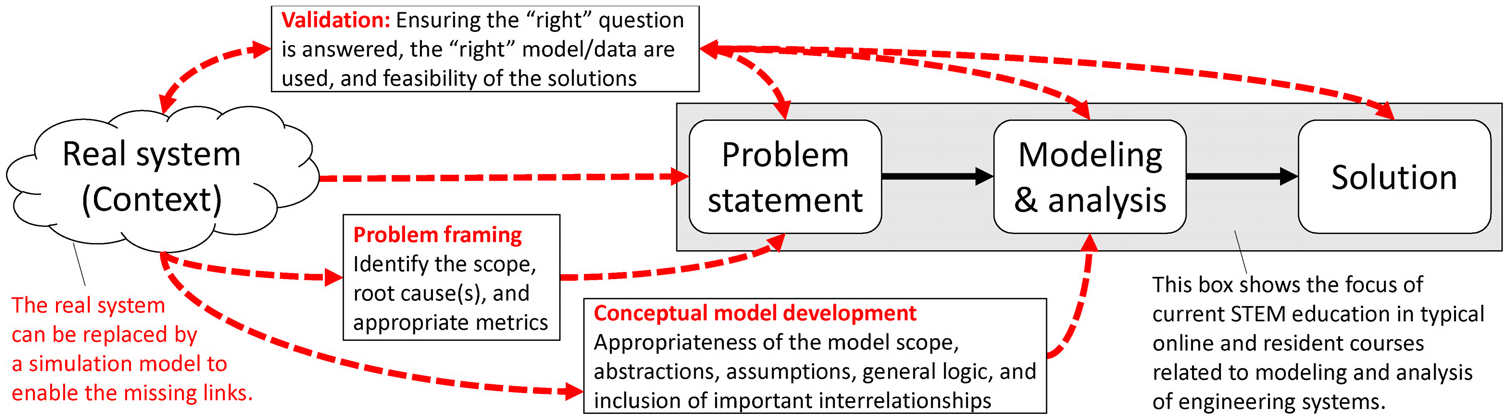
Learning gaps and missing links (denoted by red dashed arrows) in traditional teaching and learning methods related to engineering systems. A simulation model can be used as the context to enable the missing links.
This paper presents an overview of the ongoing transition from physical experimentation to digital simulations and immersive simulated learning environments in engineering education. We begin by discussing the effectiveness of lab experimentation for development of general and domain-specific competencies. We then summarize how 2-dimensional (2D) and immersive 3-dimensional (3D) simulated environments are used in engineering education. Next, the major implementation and research gaps related to immersive simulated learning environments are highlighted. Potential approaches to address the identified implementation gap are discussed and exemplified. In particular, the paper discusses the Immersive Simulation-Based Learning (ISBL) framework, which can be easily adopted by simulationists to repurpose the models developed as part of their simulation projects and enable their reuse for teaching and educational research. Finally, a set of future educational research opportunities are presented in response to the identified research gaps related to the effectiveness of immersive simulated learning environments.
2. The transition from physical experiments to digital 2D and immersive simulations
This section provides an overview of the transition from physical labs to digital 2D and immersive simulated learning environments in engineering education. The goal here is not to provide a comprehensive literature review, but rather to present sample applications and a critical analysis that will be used as the basis to highlight the transition, major gaps, and opportunities for future educational research.
2.1. Physical labs and experimentations
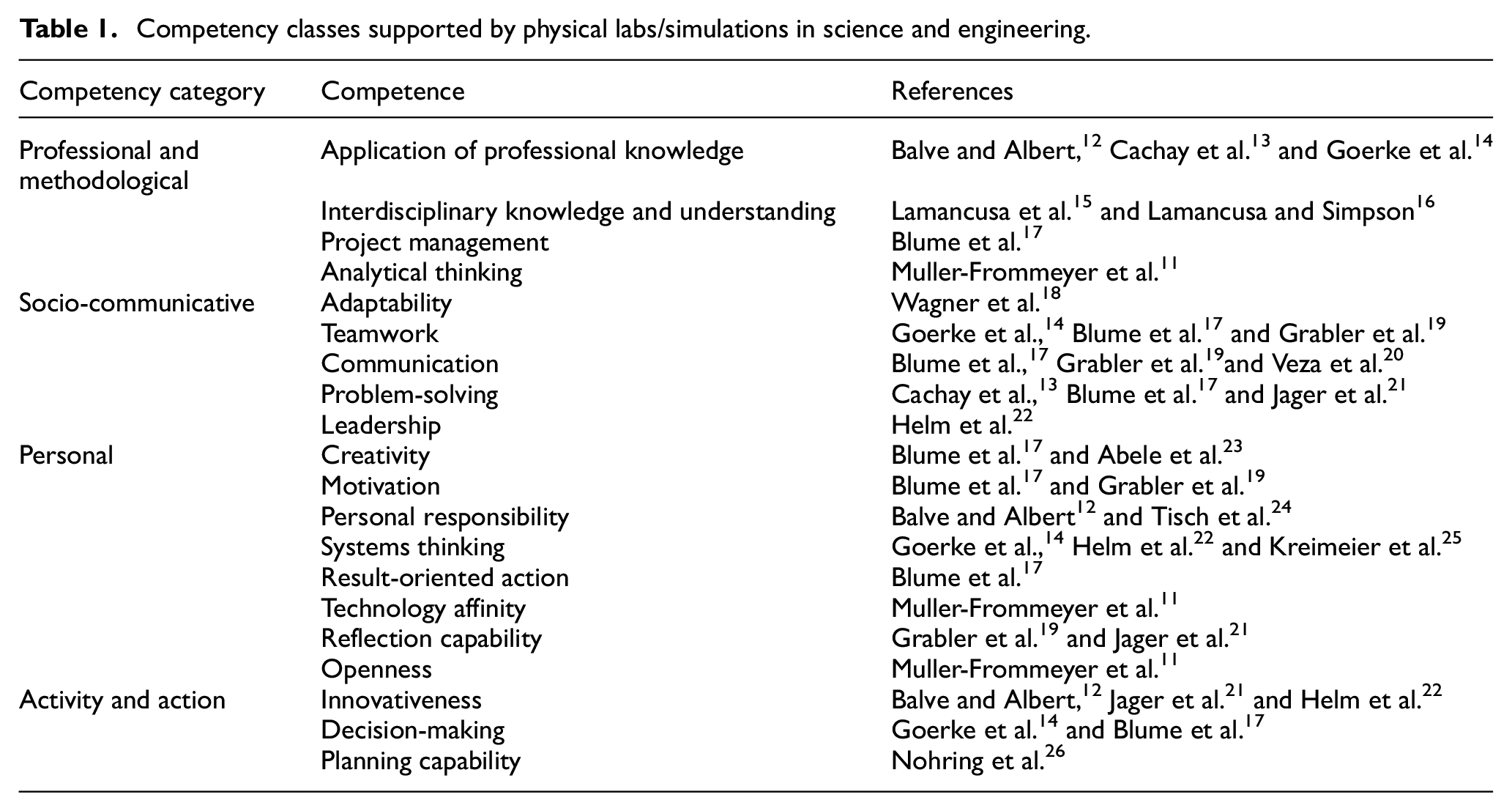
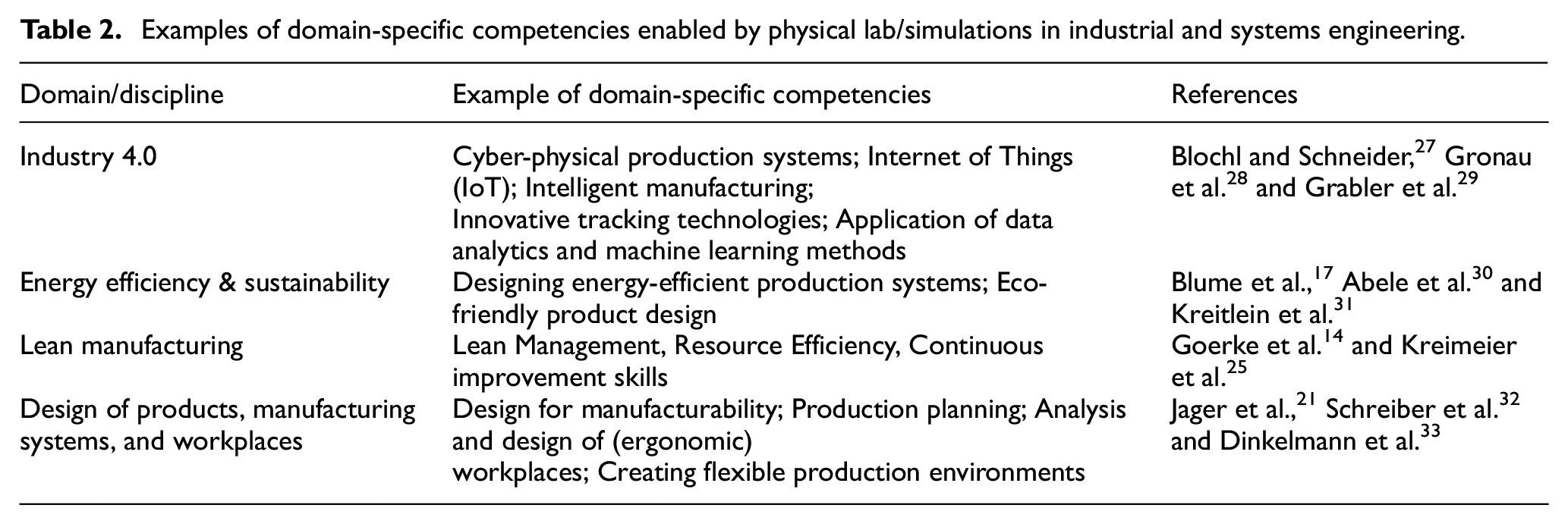
Physical laboratories have been used for over a century in science and engineering education. Labs can be considered as physical simulation and experimentation settings that provide a controlled environment to foster the process of asking questions and conducting experiments as a way to understand the real world. Learning outcomes enabled by physical labs include competency development in cognitive (recognition of knowledge), affective (interest or attitudes of the learner), and psychomotor domains (task that entails neuromuscular coordination)—the three domains in fundamental taxonomies of learning goals.7–9 This includes development in all competency classes, namely, professional and methodological competencies, socio-communicative competencies, personal competencies, and activity and action competencies. 10 Table 1 summarizes the evidence from the literature on physical lab environments related to these general competency categories. There is also significant evidence on the effectiveness of such learning environments in developing domain-specific competencies. Table 2 exemplifies such domain-specific competencies as related to the field of industrial and systems engineering (the author’s discipline). For a comprehensive list of competencies and studies, see Müller-Frommeyer et al. 11
Competency classes supported by physical labs/simulations in science and engineering.
Examples of domain-specific competencies enabled by physical lab/simulations in industrial and systems engineering.
Despite the overwhelming evidence on the effectiveness of physical labs in science and engineering education, there are several caveats associated with physical labs, namely, high initial investment for physical space and equipment, high operation costs including energy and materials costs, high maintenance cost due to inappropriate use of machinery by novice learners, and safety risks associated with working with machinery. In addition, physical labs are generally unavailable to online and informal learners—a major issue considering the continuing growth of online and remote education. These limitations, among others, are the driving force behind the transition from physical labs to digital simulations as discussed next.
2.2. Digital simulations and virtual labs
Digital simulation enables offering virtual laboratories and contexts where the experiments involve simulated systems, materials, and apparatus. Compared to physical experiments, simulation experiments are less costly and risk-free, require less set up time, and enable learners to perform more experiments (under many different configurations) in a given time window. Moreover, the use of a computer simulation enables adjusting the time scale, making it possible for learners to perform virtual experiments that would otherwise take months or years to complete in a lab or real-world setting. Another important advantage of digital simulation over physical experimentation is the possibility to investigate unobservable phenomena such as atomic-level dynamics, chemical reactions, thermodynamics, or electricity as well as conjectures that are infeasible in physical experiments such as performing what-if analysis on the impact of natural or man-made disasters on the power grid and other critical infrastructure. Computer simulation also enables online and distance learning for students who do not have access to a physical lab. This section highlights sample applications of computer simulation learning environments across various engineering disciplines and summarizes research findings on the comparison of digital simulations and physical labs in terms of students’ learning outcomes.
In the field of industrial and systems engineering, digital simulation environments can help mitigate lack of access to real-world industrial systems (such as manufacturing, healthcare, and service systems) due to geographical barriers, safety concerns, and companies’ reluctance to provide access to their facilities. For instance, students can experiment with a discrete-event simulation model of a manufacturing environment to evaluate the design and operational performance of the manufacturing system and its subsystems. 34 In the field of materials science and engineering, an agent-based simulation model can be used for teaching and learning of atomic-scale diffusion, 35 where students learn the micro-level random-walk mechanism of diffusing particles that lead to macro-level patterns of concentration change as described by Fick’s laws. In the field of mechanical engineering, students can carry out experiments using a virtual/simulated fluid mechanics laboratory, 36 which replaced the physical lab experiments as a result of school closures during the Covid-19 pandemic.
In the field of civil engineering, an interactive simulation-based construction management learning system is proposed to train students in the area of planning of construction processes by mimicking the challenges faced by a construction manager in a real-life project. 37 In the field of chemical engineering, students can be introduced to the concept of mass balances involved in tracking a pharmaceutical compound in the blood stream and the chemical reactions as a result of natural biological response to pharmaceuticals in a time- and dose-dependent manner via a pharmacokinetic simulation-based learning module. 38 In the field of electrical engineering, students can learn about circuits by experimenting with a simulation-based virtual lab that allows them to connect resistors, capacitors, diodes, LEDs, and other circuit components in a similar manner to real breadboard and simulate the resulting electronic circuits. 39 The engineering education literature contains numerous other applications of simulation-based learning environments and virtual labs as described in several literature review articles.40–46
An important question that arises is related to the effectiveness of simulation-based learning environments. The literature contains many studies that perform a controlled comparison between physical and simulated experimentation environments in terms of students’ motivation, knowledge acquisition and retention, and other learning outcomes. 47 For example, in one study, 48 two groups of students measure heat exchange, mass transfer, and humidification using physical and computer-simulated experiments. The two groups are compared based on a comprehensive exam over the course, a questionnaire answered by students regarding how well the areas of ABET engineering criteria (including problem-solving, writing, computing and mathematical skills) are met, and oral presentations given by the students. The results indicate that computer-based experiments were as effective as physical experiments in terms of student learning and performance. Another study 49 investigates the effect of experimenting with physical and virtual manipulatives on undergraduate students’ learning in physics, particularly their understanding of concepts related to light. The results indicate that students who used virtual optics materials displaying light rays outperformed those who used physical materials. In another study, 50 students experiment with physical or virtual materials with the goal to assemble mousetrap cars that would go the farthest. The results suggest that the two experimentation formats were equally effective in terms of knowledge gained on causal factors, design skills, and students’ confidence in their knowledge. Similar findings are reported in other controlled comparison studies.51–53 These findings provide substantial support for the effectiveness of digital simulations and virtual labs, especially when one considers the cost-effectiveness, risk-free nature, and flexibility of simulation-based learning environments as compared to physical labs/experimentation.
The main shortcomings of desktop simulation-based learning environments displayed on a 2D screen deal with students’ limited exposure to complexities of science (e.g. measurement errors, delays between experiments needed for careful planning, and equipment failure and re-calibration), lack of tactile information, and limited immersion and sense of presence, which can affect students’ perception of the realism of virtual experiments, their interest and motivation to learn the subject, and learning outcomes especially related to concepts that are inherently three-dimensional (e.g. wave propagation). With the recent developments in immersive technologies such as virtual and augmented reality in terms of visualization and interactions, and with their increased availability and affordability, immersive simulated learning environments have gained popularity in engineering education to mitigate some of the limitations of 2D digital simulations.
2.3. Immersive simulated learning environments
The major factor that distinguishes an immersive simulated learning environment from a desktop simulation viewed on a 2D screen is the degree of immersion, which can be defined as an objective measure of the vividness offered by a model, and the extent to which the model environment can shut out the outside world. 54 The degree of immersion depends on the number of senses activated by the environment and the quality and fidelity of the technology (hardware and software), which enables head and position tracking, allows for user interactions with the virtual environment, increases the size of the visual field of view compared to a 2D screen, and renders a different image for each eye, creating visual cues for depth perception. High immersion leads to a sense of presence in the virtual environment, which can be defined as the user’s immediate perception of “being there” and a feeling of existing inside the virtual environment, hence a subjective experience. According to the Cognitive Affective Model of Immersive Learning 55 (CAMIL), learners’ presence and agency are psychological constructs that arise from immersion and interactions with a simulated environment. CAMIL poses that presence and agency influence affective and cognitive factors that play a role in immersive learning, namely, interest, intrinsic motivation, self-efficacy, embodiment, cognitive load, and self-regulation. Therefore, teaching and learning methods that utilize presence and/or agency will especially benefit from immersive simulated learning environments in achieving important learning outcomes, including factual, conceptual, and procedural knowledge, as well as transfer of learning. 55
The literature contains numerous examples of how immersive technologies are being used in education. Here, our focus is on immersive simulated environments as opposed to 360 videos or online collaboration platforms (e.g. Mozilla Hubs) that do not involve a simulation model. We present a few examples related to engineering education and refer the interested reader to the various review articles on this topic for a comprehensive list of educational applications.56–61 As an early example from 1990s, 62 an interactive and immersive VR training environment was developed to allow construction engineering students perform a construction operation without subjecting them to the real hazard of such operations. Reviewing such early applications is useful for appreciating how much technology advancement and software development have facilitated implementation of VR environments nowadays. Moving on to more recent times, an immersive VR machining lab with a virtual CNC machine is developed 63 for science, technology, engineering and mathematics (STEM) students and training professionals to learn the use of the CNC machine without the need to be in a physical lab. Learners operate in the virtual environment via a head-mounted VR headset with realistic visuals and on-screen tutorials on how to operate the machine without the need for outside instruction. VR-based nano-simulations are developed 64 where users can fully immerse in a virtual nano world and interact with various nano structures to facilitate understanding of the scale of nanometer, different structures of nanomaterials, and nanotube chirality. In another work, an educational immersive simulation game is proposed 65 to enhance the understanding of the corn–water–ethanol–beef system nexus and foster systems thinking skills by exposing learners to an unobservable complex systems.
The literature also includes many examples of how physical labs and immersive simulation experiments can be combined to benefit from the advantages of both methods, similar to what has been done in the past for the case of non-immersive virtual labs. 47 For instance, a study of the effects of adding pre-lab VR simulation experimentation before performing live, physical experiments in a laboratory found that the combination with VR experiments improved students’ understanding of concepts in an applied strength of materials course. 66
Widespread adoption of immersive simulated learning environments faces several challenges. For example, development of high-quality immersive simulations generally requires more effort and cost compared to non-immersive simulated learning environments. While online virtual platforms such as Mozilla Hubs and Second Life can support general-purpose immersive and collaborative learning activities, engineering educators often need specialized environments for teaching and learning of specific science and engineering topics. This is evident in the fact that most of the examples of immersive virtual labs found in the engineering education literature, including those discussed in this section, involve customized environments that are not readily available in the market. Educators either need to develop the learning environment in-house or pay a company that offers immersive solutions. Funding constraints and a general lack of programming skills in VR game engines such as Unreal and Unity among educators and their student assistants present an obstacle, further increasing the development time and cost. While the technology is becoming more ubiquitous due to reduced cost of VR headsets, many learners still are not familiar with the operation of VR equipment, which is also found to be correlated with learning performance. 61 Moreover, immersive simulated experiences are often limited in terms of time duration due to VR simulation sickness—a syndrome similar to motion sickness that some users experience during VR exposure.67,68 While recent technological improvements attempt to reduce simulation sickness, exposure times remain relatively short, which can negatively affect learning outcomes especially related to learning activities that require longer exposure and experimentation.
3. Major implementation and research gaps
By looking at the patterns in the findings of several literature review articles on the application of immersive technologies in education,56–61 two major overarching gaps can be identified related to implementation and assessment of immersive simulated learning environments.
3.1. Implementation gap: lack of incorporation of learning theories
When designing any educational activity or technology-based learning intervention, it is critical to ground its use in learning theories and educational paradigms in order to define how students imbibe, process, and retain the information that they learn through the proposed teaching and learning method. In a systematic review article, 56 applications of immersive technologies in higher education are categorized based on their integration with learning theories and pedagogical frameworks such as experiential learning, constructivism learning, generative learning, gamification learning, operational learning, contextual learning, and behavioral learning. The results indicate, alarmingly, that more than two-thirds of the reviewed papers (about 70%) do not contain any mention of or reference to learning theories and pedagogical frameworks. Another review article 58 further excludes papers that only mention theoretical frameworks as part of their introduction or literature review sections, hence not deemed to have explicitly incorporated the theoretical foundations. They concluded that the majority of studies made no integration of a theoretical framework underpinning their proposed intervention. A similar finding is also reflected by a meta-analysis on the effectiveness of immersive VR using head-mounted displays on learning performance. 69 These findings reveal a major gap in the literature showing that, in most cases, the design and implementation of immersive educational simulations are not informed or supported by learning theories and well-established pedagogical frameworks as their foundation.
3.2. Research gap: lack of objective assessments
Another common theme arising from the findings of several literature review articles deals with the lack of controlled research experiments to assess the effectiveness of immersive simulated learning environments in terms of learning, skill development, motivation, engineering identity, and other learning outcomes. A comprehensive literature review 56 found that almost half of the reviewed papers did not involve any evaluation method, and among the studies that did, the majority primarily focused on evaluating usability of the technology and user experience as opposed to learning outcomes. In a different review paper, 58 the authors performed full-text screening on 197 related papers and found that only about 15% of the papers involved an experimental or quasi-experimental trial with at least one control group to evaluate a quantitative and objective learning outcome such as test scores, completion time, or knowledge retention. Another review article 57 identifies several methodological flaws among the already small percentage of studies that attempted to perform effectiveness assessments, including non-randomized trials, small sample sizes, and non-validated measures, making it difficult to generalize from the results of such studies. The review in Checa and Bustillo 60 finds that among the papers that discuss VR simulators for workforce training, about 95% of them contained no quantitative evaluations. In addition, formal assessments of long-term retention and transfer of the learned knowledge and skills are especially scarce as reported in another systematic review. 61 These findings reveal that existing studies primarily focus on development aspects (coding, software, usability), and that there is a lack of formal, quantitative assessment of the effectiveness of immersive simulated learning environments, indicating a major research gap in the current educational research literature.
In the remainder of the paper, potential implementation approaches and important areas for future research are discussed and exemplified to help educators and educational researchers mitigate the identified implementation and research gaps.
4. Integration of immersive simulations with problem-based learning
This section discusses integration of immersive simulated learning environments with problem-based learning (PBL) to exemplify how learning theories can be incorporated to address the major implementation gap identified in the previous section as well as the learning gaps illustrated in Figure 1 by having a simulation model serve as the context in lieu of a real system which is often inaccessible.
PBL is a well-established active-learning method that supports various theoretical educational and psychological foundations,70–72 with a cohesive body of research indicating its effectiveness for all learner groups (K-12, 73 undergraduate, 74 graduate and professional, 75 and online) 76 in a wide range of fields such as medical and health,77,78 sustainability, 79 chemistry, 80 mathematics, 81 design 82 as well as various engineering disciplines such as electrical, 83 mechanical, 84 civil, 85 software, 86 and industrial and systems engineering.12,87 The integration of immersive technologies with PBL enables utilizing the advantages of both paradigms 88 to improve students’ critical thinking and problem-solving skills, motivation, and overall learning experience.
ISBL involves the use of an immersive simulated environment as the context for PBL. In a series of educational research studies,89–91 ISBL is shown to improve student motivation, experiential learning, and engagement. Figure 2 summarizes the general ISBL development and implementation process. More specifically, an ISBL module consists of
A 3D animated, immersive (VR-compatible) simulation model that mimics the dynamics of a real system, its components, and processes (people, products, and raw materials that are processed, assembled, manufactured, stored, transferred, or transported depending on the simulated context). The immersive simulation provides the context for technology-enhanced PBL.
A PBL learning activity defined around the simulated system and inspired by real-world problems that learners may encounter in a professional setting or future workplace.
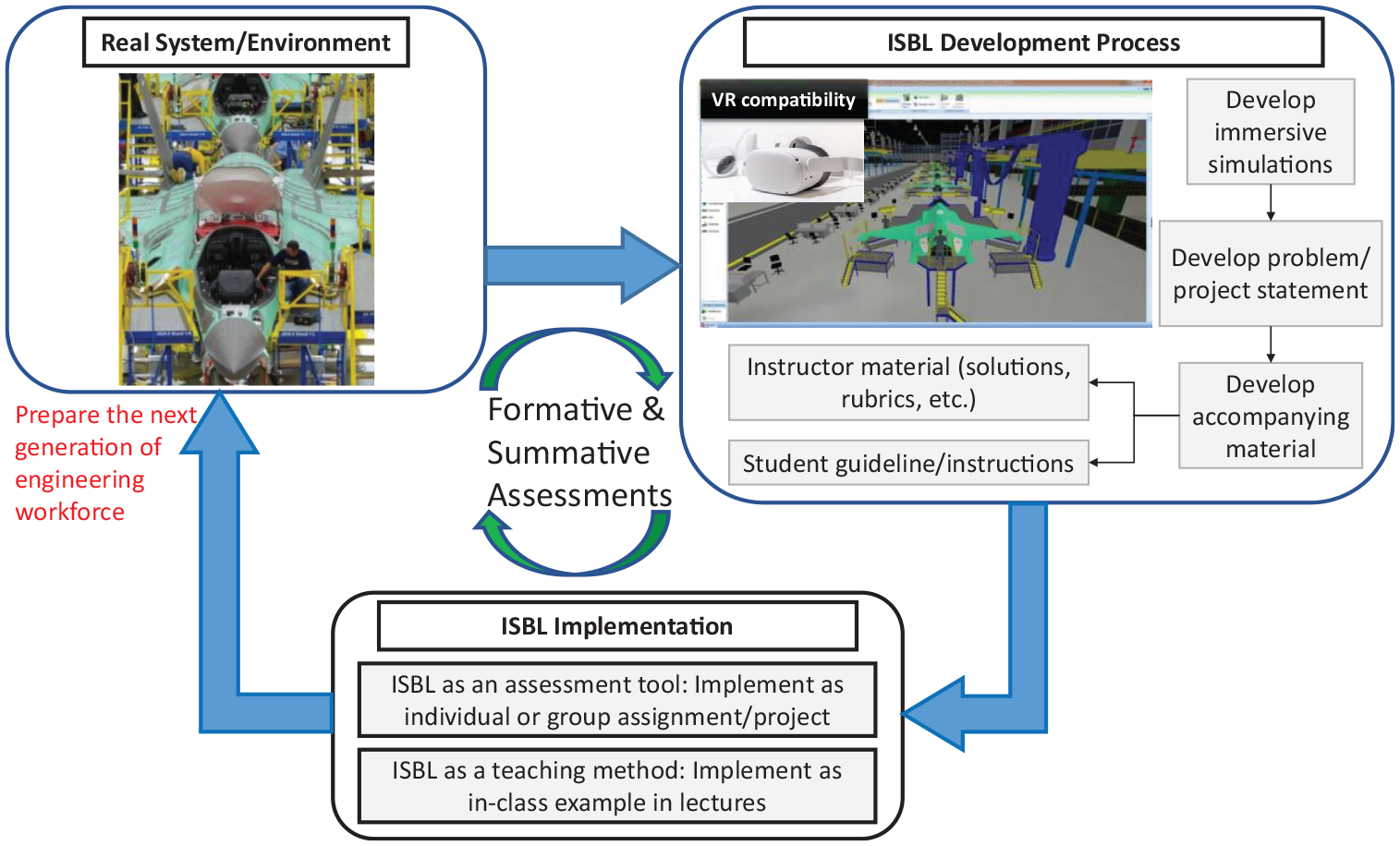
Overview of ISBL development and implementation process.
The pedagogical and psychological theories that support PBL also apply to ISBL or are augmented as a result of integration with an immersive simulated environment. For example,
Constructivism theory: 92 According to this theory, learners construct their mental models and interpretations of the real-world through cognitive and interpretive activities that accommodate new ideas/phenomena with prior knowledge. In ISBL, the immersive simulation serves as the context and provides an environment to interact with, which enables knowledge to be constructed via interactions with the virtual environment and indexed by relevant contexts.
Information Processing Approach to Learning theory: 93 The three principles of this theory are present in ISBL to support long-lasting development of critical thinking and problem-solving skills by (a) activating prior knowledge related to the context under study, (b) enabling contextually enriched learning through an immersive simulation that mimics a real-world situation, and (c) allowing learners to expand their prior knowledge to solve a realistic practical problem.
Self-determination theory: 94 This theory promotes autonomous motivators in contrast to traditional learning and teaching methods that are primarily based on controlled motivators such as rewards and punishments (e.g. passing or failing a test). Such controlled motivators can lead to superficial learning and cause a sense of stress and anxiety in students. ISBL promotes autonomous motivators as it enables students to incorporate their views and take greater responsibility for their learning.
Adult Learning theory: 95 ISBL problems closely resemble real-world systems and professional situations, which enables the main pillars of this theory by providing a self-directed and problem-centered learning experience that draws on previous work experiences and integrates into the professional learner’s everyday life.
4.1. A sample ISBL module
This section describes a sample ISBL module that was implemented in an undergraduate engineering economy course at the Pennsylvania State University. For additional ISBL examples, the interested reader is referred to the website for the NSF project associated with this paper available at https://sites.psu.edu/immersivesimulationpbl. It is worth noting that many of the ISBL modules publicly shared on our project website, including the one discussed here, utilize pre-made simulation models that come with commercial simulation packages. By doing this, it is hoped to illustrate to simulationists how they can reuse existing simulation models for educational purposes. As simulationists, we have access to many simulation models developed as part of our research and industry projects. Many existing simulation models (such as those in Meng et al. 96 and Grigoryan et al. 97 ) have the potential to be used as learning context for PBL activities through the ISBL framework summarized in Figure 2. Moreover, in recent years, many simulation software offer enhanced animation features as well as VR compatibility. Utilizing existing models and built-in simulation software capabilities significantly reduces the development effort as opposed to when immersive learning environments are coded/developed from scratch using game engines such as Unity and Unreal. This will significantly facilitate the adoption of ISBL and other simulation-based learning methods by simulationists for teaching and educational research purposes.
The ISBL module discussed here is related to an airport terminal. The module is accompanied by a 3D, VR-compatible, animated discrete-event airport simulation model that is to be treated as the “real-world system.” In other words, students perform virtual site visits of the simulated system instead of visiting and collecting data from a real airport terminal, which would involve many logistics and security constraints. Figure 3 shows a screenshot of the simulated systems developed using the Simio simulation software. 98 The airport terminal has several self-check-in kiosks, a check-in counter with airline agents, ID/boarding pass checkpoint, and two advanced imaging technology (AIT) stations for scanning passengers and their luggage. The boarding area at the terminal has two gates each with its own seating/waiting area where passengers wait before boarding on their flight. Processing times at the above stages as well as flight boarding and departures are modeled as stochastic processes specified in the simulation model. The technical details of the simulation model are out of the scope of this discussion as the focus here is on integration with PBL rather than describing a simulation modeling exercise.
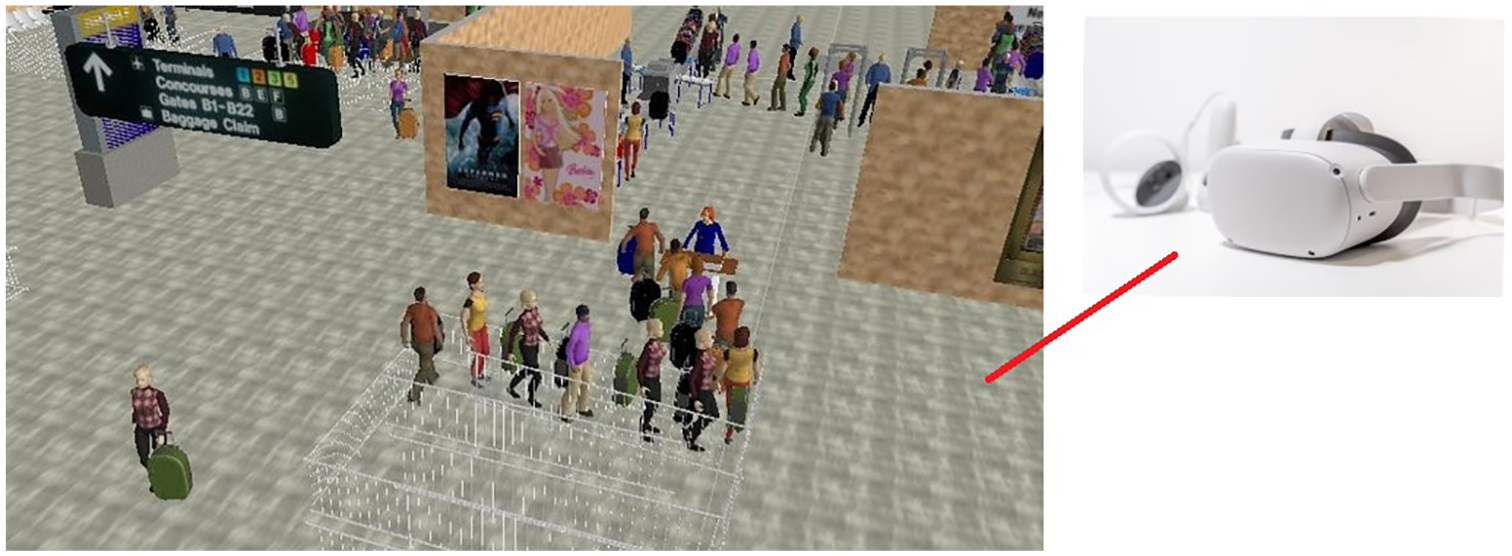
A screenshot of the VR-compatible immersive airport simulation model.
The engineering economy problem to be solved is contextualized as follows. The student is “hired” as a consultant to help the airport management compare different investment options and select the most economical alternative. More specifically, the airport terminal is contemplating purchasing and installing vending machines near the departure gates to better serve the passengers. Six candidate options have been identified which vary in terms of the number and type of vending machines to be installed, the number of menu items, price, and quality of the drinks/snacks. Students are asked to treat the simulation as the “real” system, conduct virtual site visits to observe and understand the operation of the terminal, and collect the data needed to perform an economic analysis. For example, students need to estimate vending machine sales by collecting data on the passenger arrival rate to the airport. As for the learning objectives, after successful completion of the ISBL module, the student will be able to
Collect data from a real-world system and estimate the cash flows needed for the economic analysis.
Compute the internal rate of return (IRR) for the investment options under consideration.
Perform rate of return (ROR) analysis to compare the alternatives and select the most economical option.
Perform present worth (PW) analysis to compare the alternatives and select the most economical option.
Verify the ROR and PW analyses by comparing the outcomes of the two methods.
This module was among a set of ISBL modules that were implemented and assessed as part of a controlled experiment in an educational research study. 90 The statistical results show that the ISBL modules enhanced students’ motivation and experiential learning.
5. Opportunities for educational research
As highlighted previously, there is a general paucity of scientific evidence on the effectiveness of immersive simulated learning environments in engineering education. This section presents several important areas for future educational research to address the identified research gap.
5.1. Effect of immersion
Immersive simulated environments are generally more costly to develop and implement due to the coding requirements and equipment cost as a VR headset currently can cost hundreds of dollars. Therefore, it is critical for future educational research to assess the added value and contribution of immersion to learning outcomes across engineering disciplines to enable proper cost-benefit analysis and justification for the use of immersive technologies in engineering education. To that end, controlled experiments that compare varying immersion levels can provide useful insights. As an example of a simple experimental design, one could compare learning outcomes for two groups of learners: one that uses a VR headset (high-immersion mode) versus another group that uses a typical 2D display on a desktop or laptop computer (low-immersion mode). Such experimental design can help detect how/if the additional immersion would affect or enhance learning related to the particular engineering topic at hand. Fortunately, there is growing recognition on the need for immersive environments that can also be used in a low-immersion or desktop mode (primarily due to the high cost of VR equipment and accessibility considerations). This facilitates conducting controlled experiments comparing different immersion levels as the researcher only needs to develop one simulated environment that is compatible with both modes of use, minimizing development efforts.
5.2. Learner-simulation interaction and student engagement
Quantification and understanding the role of learner–simulation interaction is another important area for future educational research as such insights can help guide and optimize the design of immersive simulated environments in terms of their interactivity and user engagement. It is well known that the interaction of learners with immersive simulated environments can profoundly influence students’ learning experience, engagement, motivation, and skill development. 99 Interaction types can vary from simple observation of the simulated system and manipulation of simulation parameters to interactions with static and dynamic objects in the virtual environment, interactions with artificial intelligence and interactive entities (such as those found in computer games), and interactions with the avatars of other learners and/or the instructor who are present in the virtual environment at the same time. Therefore, identifying the most engaging and motivating interaction types across different learner groups, learning objectives, and engineering topics can help develop more effective and engaging immersive learning experiences.
While the importance of learner–simulation interactions is well known, 100 existing literature on interaction assessment is limited and objective/quantitative studies are especially scarce. A comprehensive literature review on VR applications in higher education 56 shows that only about 7% of existing studies collect and analyze interaction data, and those that do so predominantly involve qualitative assessments via surveys and questionnaires which only provide subjective information. A handful of studies utilized manual observations of learner interactions, but this method is extremely tedious, not scalable for larger studies, and prone to human errors by the observer. The limited quantitative analysis of learner interaction in immersive simulated learning environments can be attributed, at least partially, to the inefficiency and inadequacy of these traditional data collection and assessment methods. One way to overcome this gap is by utilizing machine learning (ML) solutions that allow the full interactive experience to be tracked, recorded, and evaluated quantitatively. For instance, user navigation/interaction in the virtual environment can be screen recorded and the resulting videos can then be analyzed through video analytics to extract interaction data. One such video analytics tool is proposed in Soriano et al. 101 ML-based video analytics can also be used to track and study learner engagement by recording and analyzing students’ facial expressions as they navigate and interact with the simulated environment. 102 Therefore, exploring the potential of ML for analyzing learner-simulation interaction is a rich area for future learning analytics research.
5.3. Effectiveness for online and remote learning
As discussed previously, simulated learning environments enable remote teaching and learning as students can perform virtual site visits and experiments on a computer from anywhere, anytime. This makes simulation-based learning especially suited for online education as well as periods of remote learning (say, due to a pandemic). However, according to the findings from a critical literature review, 103 there is a general lack of studies on the use of immersive technologies in online education in terms of pedagogy and design of learning curriculum. Therefore, assessing the effectiveness of immersive simulated learning environments for online and remote education is an important area for future educational research. Nowadays, given the growing number of universities offering online versions of their engineering degrees, conducting controlled experiments comparing in-person and online use of immersive simulated learning environments is increasingly achievable, although technology cost and accessibility still remain a challenge. That said, we are starting to see several universities in the United States overcome this challenge by providing VR headsets to all their students as they launch digital twin campuses, a.k.a., metaversities. 104
5.4. Effect of choice
In many cases, providing simulated learning experiences is significantly less costly compared to physical, real-world environments. This enables educators to offer virtual experiences related to a variety of contexts, giving learners the option to choose the context of their interest, hence enhancing their motivation, engagement, and interest in the topic at hand. In a recent study, 89 three sets of ISBL modules are developed which are equivalent in terms of learning objectives, workload, and difficulty level, but each module involves a different type of simulated system or context, namely, an airport terminal, a manufacturing system, and a hospital emergency department. The research experiments involve learner groups with varying level of choice over which simulated system (context) to work with as part of their class assignments, and the results indicated that context choice had a statistically significant effect on students’ motivation. That said, the literature contains mixed findings on positive and negative effects of giving students some level of choice related to their assignments with some studies reporting unintentional and adverse effects of choice on students’ learning experience and performance in the course. 105 The conflicting findings in the literature on the effect of choice necessitate further investigation for teaching and learning via simulated environments.
5.5. Integration with learning theories
As discussed in earlier sections, the lack of incorporation of learning theories represents a major gap for immersive simulated learning environments in engineering education. Therefore, it is critical for future educational research to formally assess the integration of immersive technologies with learning theories and pedagogical frameworks, including, but not limited to experiential learning, constructivism learning, generative learning, gamification learning, operational learning, contextual learning, and behavioral learning. If carried out, the findings of this stream of studies will help determine the appropriate design of learning activities and experiences involving immersive simulated environments in terms of engagement, motivation, developing students’ engineering identity, skill development, and various learning outcomes across different learner groups and engineering topics.
6. Conclusions
In this paper, we discussed the transition from physical experimentation to digital simulations and immersive simulated learning environments in engineering education. The breadth of educational applications of digital simulation was delineated by providing examples across various engineering disciplines. Through an analysis of the findings from several comprehensive literature review papers, two overarching implementation and research gaps were highlighted, namely, lack of integration with learning theories and limited formal assessments of effectiveness. The paper discussed ISBL as an approach that allows simulationists to implement PBL activities based on the models developed as part of their simulation projects, enabling reuse of available models for educational purposes to augment teaching and learning. The paper also proposed a set of areas for future educational research to address the identified gaps related to assessment of immersive simulated learning environments.
Educational applications of immersive simulated learning environments involving virtual, augmented, and mixed reality are expected to grow for various reasons, namely, increased technology affordability and accessibility, growing industry applications and workforce training involving immersive technologies, growing need for technology-mediated active-learning in online education, and growing interest and familiarity of future generations of engineering students with immersive technologies. It is hoped that the discussions and recommendations presented in this paper will help simulation and engineering education communities design effective interventions involving simulated learning environments and immersive technologies to better prepare the next generation of engineering and science workforce.
Footnotes
Funding
This material is based upon work supported by the National Science Foundation under Grant No. 2000599. Any opinions, findings, and conclusions, or recommendations expressed in this material are those of the authors and do not necessarily reflect the views of the National Science Foundation. The preliminary stages of this work were supported by funds from the Office of the Executive Vice President and Provost at The Pennsylvania State University as part of the university’s strategic seed grant program for transforming education.
Author biography
 .
.