



Abstract
In recent years, the study of the static and dynamic mechanical behavior of porous functionally graded material (PFGM) structures has attracted much interest. However, most of the existing studies analyze their static or dynamic behaviors independently, and pay little attention to their buckling-vibration coupling mechanical responses under complex loading conditions. Firstly, a linear vibrations mechanical model for PFGM sandwich beams near their post-buckling configuration was provided based on the refined first-order shear deformation theory, von-Karman geometric nonlinearity and the concept of the physical neutral plane. Secondly, the micro-element method, separation of variables method and Nayfeh and Emam’s method were applied to obtain analytical solutions for the critical condition, post-buckling configuration and buckling-vibration coupling natural frequency. Finally, the influence mechanism of factors such as pore distribution and gradient index on the critical condition, post-buckling configuration and buckling-vibration coupling natural frequency drift was studied. The results show that the instability type of PFGM sandwich beams transitions from bifurcation instability to snap-through under the effect of the gradient index. The variation pattern of the buckling-vibration coupled natural frequency also shifts from a V-shaped trend to a discontinuous jump, with the natural frequency exhibiting nonlinear behavior in the pre-buckling stage and single or double frequency jumps occurring in the post-buckling stage. These results are expected to provide new ideas and references for the design and regulation of PFGM structures.
Keywords
Introduction
Porous material is an advanced engineering material with both functional and structural properties, which has a variety of physical properties such as low density, high strength, energy absorption, sound absorption and so on.1–3 In order to adapt to the civil engineering, aerospace engineering, energy engineering and other fields in the lightweight, multi-functional, high-strength and other aspects of the application, porous functionally graded materials (PFGM) has emerged, which combines combining the characteristics of both functional graded materials (FGM) and porous materials.4–7 It is worth noting that PFGM structures are usually in complex physical environments, making scholars particularly interested in their static/dynamic mechanical behavior under complex loading.8–10
Currently, significant progress has been made in the study of static (buckling) mechanical behavior of PFGM structures under complex loads by using various theoretical models and analytical methods. Based on Euler theory and classical shell theory, Gao et al., 11 Zhang et al., 12 Lyu et al., 13 Xi et al. 14 and Talati et al. 15 investigated the buckling behaviors of PFGM beam/shell and FGM sandwich beams under mechanical, thermal and thermo-mechanical loads by using the finite element method (FEM) and extended analytical method. Moreover, since Euler theory does not account for shear effects, for PFGM structures with a slenderness ratio <20 (L/h < 20), 16 the influence of shear effects often needs to be considered. Based on Timoshenko and refined first-order shear deformation theory, Zhao et al. 16 and Li et al. 17 investigated the buckling behavior of PFGM sandwich beams, porous functionally graded graphene platelets-reinforced composite (PFG-GPLRC) plates and metal-foam beams under thermal and thermo-mechanical loads by using the generalized differential quadrature method (GDQM), extended analytical solution method and FEM. Based on Reddy higher order shear deformation theory, Kahya et al., 18 Derikvand et al., 19 Mohd et al., 20 Liu et al. 21 and Chen et al. 22 investigated the buckling behavior and bending of PFGM beams, PFGM sandwich beams/plates and PFG-GPLRC plates under mechanical, thermal and thermo-mechanical loads by using the FEM, differential transform method (DTM), iterative method and two-step perturbation method. However, the above studies11–22 merely consider the static behavior of PFGM structure.
Compared to the static buckling behavior, the dynamic (vibration) mechanical properties of PFGM structures are also key mechanical indicators, which are essential for assessing the dynamic stability and safety of structures. Currently, significant progress has also been made in studying its vibration behavior by using different theoretical models and analytical methods. Based on Euler theory, Sari et al. 23 investigated the free and forced vibration characteristics of PFGM beams by using the FEM. Based on Timoshenko first-order shear deformation and first-order piston theory, Zhao et al., 24 Ansari et al., 25 Ma et al.,26,27 Wang et al. 28 and Burlayenko et al. 29 investigated the free and forced vibration characteristics of PFGM beams/plates and PFG-GPLRC plates under mechanical, thermal and thermo-mechanical loads by using the GDQM, FEM, DTM and Newmark’s method. Based on Reddy, Modified quasi-3D, 3D elasticity and quasi-3D trigonometric plate shear deformation theory, Rabehi et al., 30 Chu et al. 31 and Abualnour et al.32,33 investigated the free and forced vibration characteristics of PFGM plates, honeycomb sandwich cylindrical shell and advanced composite plates under mechanical and hygro-thermal loads by using the GDQM, FEM and Navier. However, it is important to note that in the aforementioned studies on the buckling/vibration mechanical behavior of PFGMs, most of the work11–33 focuses only on their buckling or vibration response.
Similarly, some studies have examined both buckling and vibration mechanical behaviors of PFGM structures. Based on Euler theory, Bagheri et al. 34 and Teng et al. 35 investigated the buckling and free vibration characteristics of PFGM beams under mechanical loads by using the GDQM and DTM. Based on Timoshenko first-order shear theory, Reddy higher-order shear deformation theory, Bui et al., 36 Mohammad et al., 37 Wu et al., 38 Patil et al., 39 Chen et al. 40 and Ramteke et al. 41 investigated the buckling and free vibration characteristics of the PFGM beam/plate, PFG-GPLRC beams and metal foam beams under mechanical and thermo-mechanical loads by using the Ritz method, GDQM and FEM. However, in the above studies involving buckling and free vibration characteristics of PFGM structures,11–41 the two are usually analyzed independently. In addition, only a few studies13,16,19,21,22,31,32,40 have focused on buckling and free vibration characteristics of PFGM sandwich structures under complex loads, Therefore, a systematic exploration is necessary for the buckling-vibration coupling nonlinear problem of linear vibration characteristics near the post-buckling configuration of sandwich structures. It is worth noting that the existing numerical methods require the prior assumption of response mode. This may result in misinterpreting the connections between the system’s parameters and responses. In addition, it is difficult to identify the bifurcation points by using existing numerical analytical methods due to the multiple solutions to the nonlinear responses of PFGM structures under complex loading conditions. Therefore, this research adopts Nayfeh and Emam’s method, 42 which can accurately satisfy the governing equations, boundary conditions and precisely identify bifurcation points without a priori assumption of response modes, thereby making up for the shortcomings of traditional numerical methods.
Aiming at the above issues, the paper aims to investigate the post-buckling and linear vibration characteristics near the post-buckling configuration of PFGM sandwich beams under uniform thermal loads. In this work, compared with our previous study that only focused on the static buckling behavior,13,14,16 this study further investigates the free vibration characteristics near the post-buckling configuration. Specifically, a mechanical model for the linear vibrations of PFGM sandwich beams near their post-buckling configuration was established, and the analytical solutions for the critical condition, post-buckling configuration and buckling-vibration coupling natural frequency were provided. Firstly, based on the refined first-order shear deformation theory, Von-Karman geometric nonlinearity and physical neutral plane, a fourth-order nonlinear partial-differential-integral governing equation for the buckling-vibration coupling deformation is established for PFGM sandwich beams under uniform thermal loads. Secondly, the micro-element method, separation of variables method and Nayfeh and Emam’s method are applied to obtain the analytical solutions for the critical condition, post-buckling configuration and natural frequency. Finally, based on the free energy evaluation principle, the variation and underlying mechanism of both the instability type and natural frequency are clarified. This study can provide a theoretical basis for optimized design of instability analysis and natural frequency of PFGM sandwich beams.
Mechanical model
In order to investigate the post-buckling deformation and linear vibration characteristics near the post-buckling configuration of PFGM sandwich beams under uniform thermal loads. In this paper, the buckling-vibration coupling effects of PFGM sandwich beams are considered on the basis of previous works.13,14,16 Figure 1 shows a schematic diagram of the static post-buckling deformation and linear vibration near the post-buckling configuration of PFGM sandwich beam, where the length is L, the width is b, and the total thickness is h = hc + 2hf, with hc and hf representing thicknesses of the core layer and the top and bottom panels, respectively. And Ws represents the static post-buckling deflection due to thermal load, while Wd represents the small vibrational displacement near the post-buckling configuration. In addition, two pore distribution types are considered for the core layer: symmetric pore distribution 1 (PFGM-I) and symmetric pore distribution 2 (PFGM-II). (a) Schematic diagram of PFGM sandwich beam, (b) thermal post-buckling deformation, and small-amplitude displacement near the thermal post-buckling configuration.
For PFGM sandwich beam, the physical parameters of top and bottom panels are P11 (elastic modulus E11, thermal expansion coefficient α11, density ρ11); the physical parameters of core layer are P(z) (elastic modulus E(z), thermal expansion coefficient α(z), density ρ(z)) with a gradient distribution along the z-axis thickness direction. The P(z) can be expressed as follows:21,22

Thermal environment and material properties
Since the PFGM sandwich beams under uniform thermal loads (UTL). For UTL, the initial temperature T0 is considered as room temperature 300 K and the temperature change is ΔT, then UTL can be expressed as:
21


Temperature-dependent coefficients of materials (SUS304 and Si3N4).

Mathematical formulae
In order to facilitate the calculations, the physical neutral plane (z0) is introduced:
21

Compared with the Timoshenko first-order shear deformation theory, the refined first-order shear deformation theory
16
allows for the separate visualization the visualization of the deviation deflection caused by the cross-section deviation and the shear deflection caused by the shear effect after deformation of PFGM sandwich beams. Denote the deviation angle be ϕ, the shear angle be β, the total angle be θ, the deviation deflection be w
b
, the shear deflection be w
s
and the total deflection be w. Their relationships can be expressed as:
16

Based on the refined first-order shear deformation theory, Von Karman geometrical nonlinearity and physical neutral plane,14,16,21 the strain-displacement components of PFGM sandwich beams can be expressed as:
The stress-strain relationship of PFGM sandwich beams is described using the following Hooke’s law for thermoelastic materials:
14


Substituting equation (6) into equation (7), and integrating them separately along the thickness pairs of PFGM sandwich beams. The axial force, bending moment and shear force can be expressed as follows:


By using equations (8) and (11), the axial displacement u can be expressed as:

Substituting equations (15) and (16) into equation (10) and using equation (9), the governing equations of PFGM sandwich beams with respect to w and w
b
can be expressed as follows:

For the PFGM sandwich beams, three boundary conditions are considered. The boundary conditions of clamped-clamped (C-C), simply-simply (S-S) and clamped-simply (C-S) can be expressed as follows:16,42


In summary, the governing equations and boundary conditions of PFGM sandwich beams have been derived. In addition, in order to facilitate calculation, the following non-dimensional variables are introduced:13,28
Solution method
Currently, although significant progress has been made in studying the buckling/vibration mechanical behaviors of PFGM structures under complex loads using various analytical methods,34–41 most existing studies focus on numerical solutions, while relatively few studies on analytical solutions. Given that analytical solutions have a significant efficiency advantage in the rapid analysis and preliminary optimization design of structures, it is particularly important to develop an analytical solution for the linear vibration near the post-buckling configuration of PFGM structures. In this section, the analytical solution of Nayfeh and Emam 42 for the post-buckling configurations and linear vibration near the post-buckling configurations of single-layer or composite beams under purely mechanical loads will be extended, breaking through the limitation that the method under purely mechanical loads. The expanded analytical solution method is able to accurately satisfy the governing equations and boundary conditions without the need to pre-assume the response modes. This improvement effectively resolves the difficulties in determining the instability type and accurately identifying the buckling-vibration coupling natural frequency, and significantly improves the applicability and accuracy of the method. The detailed derivation is presented below.
Substituting the non-dimensional equation (22) into equations (17) and (18), the non-dimensional W and Wb governing equation can be obtained as follows:
For the linear vibration characteristics near the post-buckling configuration of PFGM sandwich beams, the form of linear vibration is harmonic vibration superimposed on the static buckling deformation. Therefore, the deflection can be expressed as:
42

Post-buckling analytic solution
In this section, the method of Nayfeh and Emam
42
will be extended to solve the static post-buckling problem of PFGM sandwich beams. By neglecting the inertial term in the governing equation (23), the governing equation for the static post-buckling Ws(X) can be expressed as:
42


The general solution of equation (25) can be expressed as:
Since the boundary conditions (19)–(21) of PFGM sandwich beams contain w
b
, it is necessary to transform them. By substituting equations (10) and (15) into equation (9) and using equations (19)–(22), the non-dimensional boundary conditions of PFGM sandwich beams can be expressed as:


When the core layer of PFGM sandwich beam is a uniform core layer, the additional bending moment caused by UTF is 0. It should be noted that this conclusion holds true only for S-S and C-S PFGM sandwich beams. Therefore, by substituting boundary condition equations (28)–(30) into general solution equation (27), the post-buckling analytical solution can be expressed as:
42


The characteristic root equations of PFGM sandwich beams can be expressed as:


It should be noted that when the core layer of S-S and C-S PFGM sandwich beams are non-uniform core layer,13,14 the boundary conditions (29)–(30) include the additional bending moment caused by UTF. Therefore, by substituting the boundary condition equation (29) into general solution equation (27), the post-buckling analytical solution of S-S PFGM sandwich beam can be expressed as:
42

Substituting equation (37) into equation (26), the transcendental equation can be obtained as:
Similarly, for C-S PFGM sandwich beam. Substituting the boundary condition equation (30) into general solution equation (27), the post-buckling analytical solution can be expressed as follows:
42

Similarly, substituting equation (39) into equation (26), the transcendental equation can be obtained as:
It should be noted that the analytical solution in this section differs from that given by Nayfeh and Emam 42 for the post-buckling of single-layer or composite beams under pure mechanical loads. With the variation of core layer, there are two post-buckling analytical solutions for S-S and C-S PFGM sandwich beams under UTL. Moreover, unlike the assumed modes in traditional analytical methods, the buckling modes employed in this paper strictly satisfy the governing equations and boundary conditions. This approach avoids the difficulties in searching for post-buckling branches using numerical methods and demonstrates the advantages of the analytical solution method proposed in this paper. In addition, it can be seen from equations (38) and (40) that when solving the parameter λ in different intervals, there exists a phenomenon of different branch solutions. For this reason, this paper uses the free energy evaluation principle 11, 13, 14 and 16 to analyze the stability of these solutions, and the detailed derivation of this principle can be found in Appendix C.
Analytic solution of linear vibration near the post-buckling configuration
Next, the analytical solution method of Nayfeh and Emam
42
will also be extended to investigate the linear vibration characteristics near the post-buckling configuration of PFGM sandwich beams. By substituting equation (24) into equation (23), using equations (25), (28)–(30), and ignoring the higher-order terms under the weak excitation conditions, the model describing the linear vibration near the post-buckling configuration of PFGM sandwich beams can be expressed as:


In summary, from equations (41)–(44), it can be seen that the linear vibration problem near the post-buckling configuration of PFGM sandwich beams is a buckling-vibration coupling nonlinear problem, in which Ws represents the static post-buckling deflection, while Wd represents the small vibrational displacement near the post-buckling configuration.
It is important to note that if PFGM sandwich beam is not buckling, then 
Thus, it can be shown that equation (45) is a fourth-order nonlinear partial-integral-differential governing equation with the following solution:
42


The general solution equation (47) has the following solution:
Letting particular solution 
Therefore, the solution of equation (45) can be written as:
It should be noted that the form of the analytical solution for linear vibration near the post-buckling configuration provided in this section is similar to the results given by Nayfeh and Emam. 42 Therefore, by substituting the boundary conditions equations (42)–(44) into equations (49) and (50), five algebraic equations regarding the constants d i can be derived. By solving these algebraic equations, the buckling-vibration coupling natural frequency of PFGM sandwich beams under UTL can be obtained. In addition, for macrostructures, their dynamic response is typically dominated by the first-order mode.42,47 In contrast, for microstructures (such as microcantilever beams and nanoscale metallic beams),48,49 the research usually adopts the fifth-order mode. In this paper, we focus primarily on the macroscopic structure, and thus adopt the first-order mode.
Results and discussion
In this section, the above analytical model will be used to study the post-buckling deformation and the linear vibration characteristics near the post-buckling configuration of PFGM sandwich beams under UTL. Firstly, the analytical predictions of critical condition, post-buckling configuration and natural frequency in this paper are compared with previous results28,43 to verify the accuracy and effectiveness of the model. Secondly, the post-buckling configuration and buckling-vibration coupling natural frequency of PFGM sandwich beams under three boundary conditions (C-C, S-S, C-S) are discussed, and the instability type and natural frequency variation mechanism are clarified by combining the free energy evaluation principle. Finally, the effects of the material parameters (porosity and gradient index) on the natural frequency of PFGM sandwich beams are studied.
Reliability verification of the model
In order to verify the rationality and accuracy of the model and extended analytical solution method in this paper. Firstly, the critical load of the single-layer PFGM beam under UTL is investigated, and the prediction results of the current model are compared with the research by She et al. 43 In the calculation, correction factor ks =5/6,28,43–45 Poisson’s ratio ν = 0.343–45 and the PFGM beam composed of Si3N4 and SUS304 is selected, with the settings of its material parameters as follows: when considering the temperature-dependence (TD) of the material, the material parameters are shown in Table 1.
Critical loads ΔTcr of C-C FGM beams compared with the results of She et al. 43 (TD, e0=0).

Figure 2 shows the variation curves of buckling-vibration coupling natural frequency compared with the results of He et al.
47
In the calculation, the material parameters are consistent with those in Table 2, the natural frequency The variation curves of buckling-vibration coupling natural frequency compared with the results of He et al.
47

In order to further verify the accuracy and validity of the model, this paper compares the present analytical with the result of Wang et al. 28 In the calculation, correction factor ks =5/6,28,43–45 Poisson’s ratio ν = 0.343–45 and the PFGM single-layer beams formed by AL and AL2O3 are selected, and their elastic modulus and density parameters at T0=300 K are Ec=380 GPa, Em=70 GPa, ρc=3800 kg/m3, ρm=2700 kg/m3.
First order natural frequencies Ω of PFGM-I beams compared with the results of Wang 28 (n=1, L/h=2).

In summary, the predictions of the present model for critical load, buckling-vibration coupling natural frequency natural frequency show good agreement with the results by Wang et al., 28 She et al. 43 and He et al., 47 thereby validating the model’s accuracy.
Identification instability type by buckling path and free energy evaluation diagrams
In this section, based on the extended post-buckling analytical method 42 and free energy evaluation principle,13,14,16 the instability type and mechanism of PFGM sandwich beams under UTL will be predicted by buckling path and energy path. In the calculations, the initial temperature T0=300 K, porosity e0=0.1, slenderness ratio L/h=10, core-to-surface ratio hc/hf=5, gradient index n=1, correction factor ks =5/6,28,43–45 and Poisson’s ratio ν = 0.3.43–45
Figure 3(a)-(f) show the buckling paths of PFGM sandwich beams under UTL. Specifically, in the calculation, the post-buckling paths of PFGM sandwich beams can be found by solving the characteristic root equations (34)–(36), (38) and (40), in conjunction with the c, t and the post-buckling analytical solutions equations (31)–(33), (37) and (39). In addition, as shown in Figure 3(a)–(f), the pore distribution pattern has no effect on the buckling path of PFGM sandwich beams, but only affects the critical load. Next, we will provide a detailed explanation of the variation patterns of beam buckling path under uniform thermal loads. Instability type of PFGM sandwich beam under UTL: (a), (c), (e) PFGM-I; (b), (d), (f) PFGM-II.
As shown in Figure 3(a) and (b), for C-C PFGM sandwich beams, bifurcation instability occurs under UTL. However, as shown in Figure 3(c)–(f), for S-S and C-S PFGM sandwich beams, multiple branch solutions (S11, S22, S33 and S44) emerges with the increase in thermal loads. This is attributed to the asymmetry of the core layer relative to the geometric mid-plane, which causes the sandwich beam to exhibit asymmetry and yields a thermal-induced additional bending moment. Specifically, when the temperature rise is low, bending deformation first proceeds along the only path S11; however, once the temperature exceeds the critical loads, three additional paths (S22, S33 and S44) emerge, and snap-through occurs at this point. Additionally, it is easy to observe that C-C beams have the highest critical load, while S-S beams have the lowest. This is because the C-C boundary provides the strongest constraint, whereas the S-S boundary offers the weakest. Meanwhile, it should also be noted that under the same boundary conditions, the critical load of PFGM-I is higher than that of PFGM-II.
Since the post-buckling paths of S-S and C-S PFGM sandwich beams under UTL (shown in Figure 3(c)–(f)) exhibit multiple branch solutions (S11, S22, S33 and S44), it is necessary to discuss the actual buckling path of PFGM sandwich beams. Next, based on the free energy evaluation principle (Appendix C),13,14,16 the selection mechanism governing the buckling path of PFGM sandwich beams under UTL is investigated. Figure 4 shows the variation of free energy paths for S-S and C-S PFGM sandwich beams. Predicting post-buckling path by free energy evaluation principle: (a), (c) PFGM-I; (b), (d) PFGM-II.
As shown in Figure 4(a) and (b), for S-S PFGM sandwich beams, when the temperature is below the critical value, bending deformation is confined to a single equilibrium path (S11). However, once the temperature exceeds the critical value, three additional equilibrium paths (S22, S33 and S44) emerge, accompanied by snap-through. Specifically, among these paths, the free energy of S22 and S44 is higher than that of S33 due to the sudden release of energy. According to the free energy evaluation principle, in the absence of external energy disturbance, the system remains in an overall equilibrium state. Therefore, under a specified thermal load, the system will preferentially adopt the lower-energy branch S33 to maintain equilibrium. Additionally, combined with Figure 4(c) and (d), as the temperature load continues to increase, the deflection corresponding to the S33 branch decreases gradually, and the corresponding variation in free energy also reduces accordingly. This phenomenon can also indicate that the PFGM sandwich beam tends to be in a more stable state on this equilibrium branch.
However, as shown in Figure 4(c) and (d), for C-S PFGM sandwich beams, the post-buckling behavior exhibits a more complex double snap-through phenomenon. Specifically, once the temperature exceeds the critical load, multiple equilibrium paths (S22, S33, and S44) emerge in the system. Among these paths, as the thermal load changes, S22 and S33 sequentially become the stable branches with the lowest energy at different stages due to the sudden release of energy. According to the free energy evaluation principle, in the absence of external energy disturbance, the system remains in an overall equilibrium state. Therefore, when the thermal load is low, the system will jump from the high-energy branch S22 to the low-energy branch S33 (first snap-through, FST) to maintain equilibrium. As the thermal load increases further, the energy of branch S22 becomes the lowest; at this point, the system will jump from the relatively high-energy branch S33 to the lower-energy branch S22 (second snap-through, SST). Similarly, as can be seen from Figure 3(e) and (f), the deflection corresponding to the S33 branch exhibits a nonlinear variation of first decreasing and then increasing with rising thermal loads. The free energy also shows a corresponding change, which reflects the transition in the stability of this branch during the change in thermal loads.
In summary, C-C PFGM sandwich beams undergo bifurcation instability. For S-S and C-S PFGM sandwich beams, both experience snap-through due to the temperature-induced additional bending moment. The difference is that S-S PFGM sandwich beams exhibit a single snap-through, whereas the C-S beams exhibit a double snap-through. In addition, it should be noted that the critical load of the C-C PFGM sandwich beam exceeds 1000 K, exhibiting excellent high-temperature resistance. Relevant studies have been reported in the fields of mechanical 50 and aerospace51,52 engineering, which provides support for the physical feasibility and engineering relevance.
Linear vibration characteristics near the post-buckling configuration
In this section, the variation of first-order buckling-vibration coupling natural frequency with thermal loads in the pre and post the buckling stages of PFGM sandwich beams under UTL is investigated. In the calculations, the calculation process is consistent with that in Figure 2. It should be noted that since the linear vibration of PFGM beams is superimposed on their static post-buckling configuration, combined with Figure 3(c)–(f), it can be seen that S-S and C-S PFGM sandwich beams exhibit the multiple branch solutions phenomenon in the post-buckling stage due to the thermal-induced additional bending moment. Therefore, their first-order buckling-vibration coupling natural frequencies also present a corresponding phenomenon of multiple branch solutions.
Figure 5 shows the variation curves of buckling-vibration coupling natural frequency in the pre and post buckling stages of PFGM sandwich beams. As shown in Figure 5, under different porosity distribution patterns, PFGM sandwich beams with the same boundary conditions exhibit identical natural frequency variation curves, while only the critical load differs. Next, the variation trends and influencing factors of buckling-vibration coupling natural frequency in the pre and post buckling stages of PFGM sandwich beams will be explained in detail. First-order natural frequency in the pre and post-buckling stages of PFGM sandwich beams: (a), (c), (e) PFGM-I; (b), (d), (f) PFGM-II.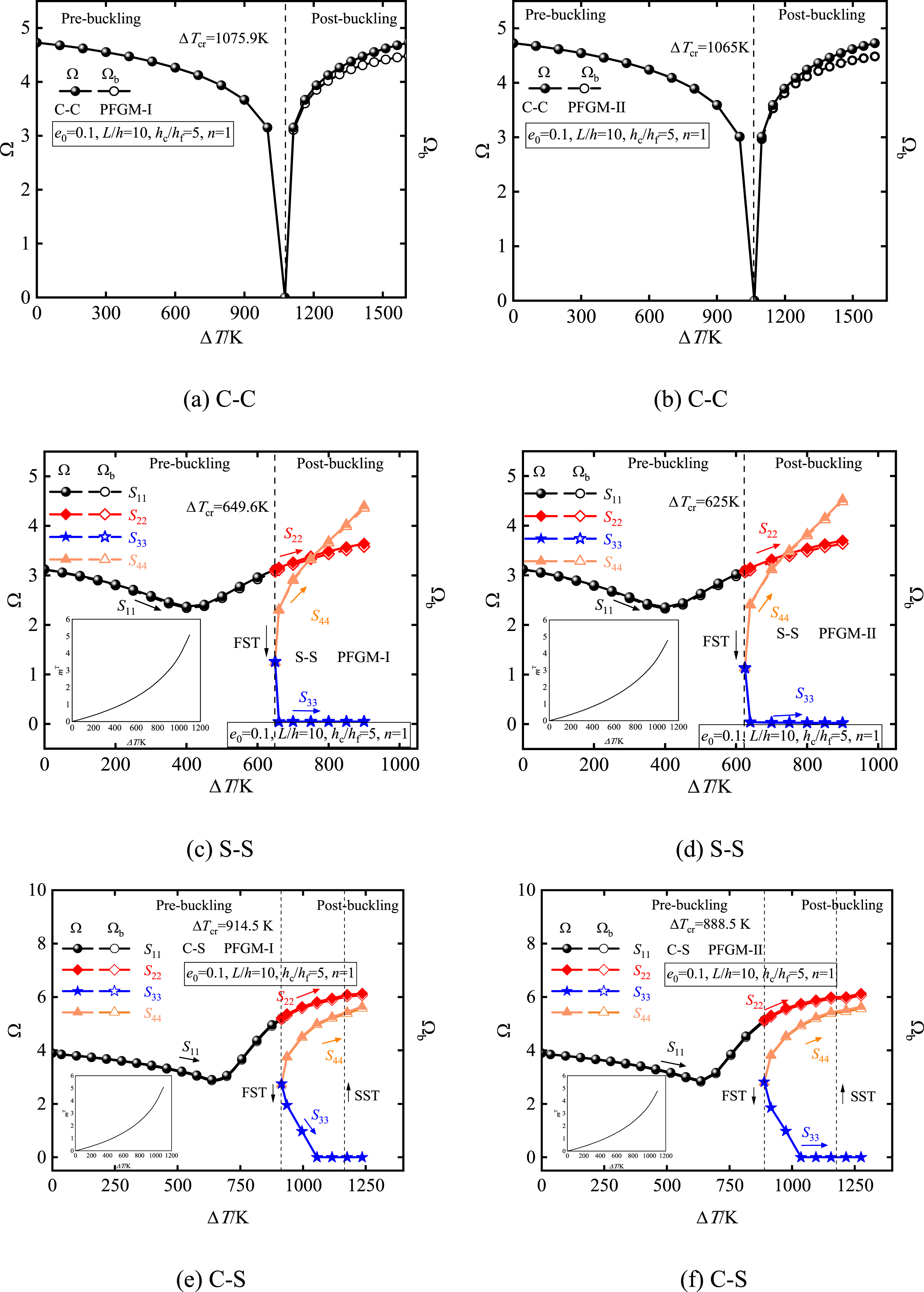
For C-C PFGM sandwich beams, as shown in Figure 5(a) and (b), in the pre-buckling stage, the first-order natural frequency decreases gradually with the increase of thermal load and tends to 0 near the critical load. The reason for this phenomenon is that temperature-induced axial force weakens the overall stiffness of the beam, which in turn leads to a decrease in the natural frequency. In the post-buckling stage, the natural frequency shows a monotonically increasing trend with the increase of thermal load. Combined with the buckling path diagrams (Figure 3(a) and (b)), this can be attributed to the continuous increase in the axial force, which causes the beam bending deformation to increase further and thereby raises the natural frequency.
For S-S and C-S PFGM sandwich beams, as shown in Figure 5(c)–(f), in the pre-buckling stage, the first-order natural frequency initially follows path S11 and exhibits a nonlinear trend of first decreasing and then increasing. Combined with the free energy diagrams (Figure 4(a)–(d)), in the pre-buckling stage, the variation in the first-order natural frequency is correlated with the trend of the free energy path. Specifically, when the thermal load is low, the free energy of the system exhibits a gentle variation trend with the increase of thermal load. At this time, the axial force induced by thermal load is dominant, the overall stiffness of the structure weakens continuously, and thus the first-order natural frequency presents a decreasing trend with the increase of thermal load. While with the continuous increase of thermal load, the free energy path shows a significant drop, the stiffness effect dominated by bending deformation gradually increases, making the first-order natural frequency present an upward trend with the increase of thermal load. In the post-buckling stage, similar to Figure 4(a)–(d), three equilibrium paths (S22, S33, and S44) emerge.
In addition, for S-S PFGM sandwich beams, combined with the energy diagrams (Figure 4(a) and (b)), after the occurrence of the multiple branch solutions (S22, S33 and S44), the system preferentially selects the low-energy branch S33 to maintain equilibrium. Consequently, in the post-buckling stage, the first-order natural frequency gradually approaches 0 as the thermal load continues to increase. However, for C-S PFGM sandwich beams, combined with the energy diagrams (Figure 4(c) and (d)), after the occurrence of multiple branch solutions (S22, S33 and S44), the system first jumps from the high-energy branch S22 to the low-energy branch S33. As the thermal load rises further, the energy of branch S22 becomes the lowest, and the system then jumps from the relatively high-energy branch S33 to the lower-energy branch S22. Therefore, in the post-buckling stage, its first-order natural frequency exhibits a non-monotonic trend of first decreasing and then increasing with the increase in thermal load.
In summary, the first-order natural frequency of PFGM sandwich beams under UTL exhibits significantly different variation characteristics in the pre and post buckling stage. For C-C PFGM sandwich beams, the first-order natural frequency curves show a V-shaped change, whereas the S-S and C-S PFGM sandwich beams exhibit jumping characteristics. It should be noted that in the post-buckling stage, the S-S undergoes only single buckling-vibration coupling natural frequency jump, whereas the C-S exhibits a double jump.
Regulation of material parameters
Figures 6 and 7 show the effect of the gradient index on the first-order natural frequency and instability type of PFGM sandwich beams. The aforementioned analysis (Figure 5) has indicated that the variation curves of Ω and Ωb are identical under the same pore distribution and boundary conditions. Therefore, to simplify the analysis, Ω and the PFGM-I are adopted in the following. The effect of gradient index on the first-order natural frequency of PFGM sandwich beams. The effect of gradient index on the instability type of PFGM sandwich beams.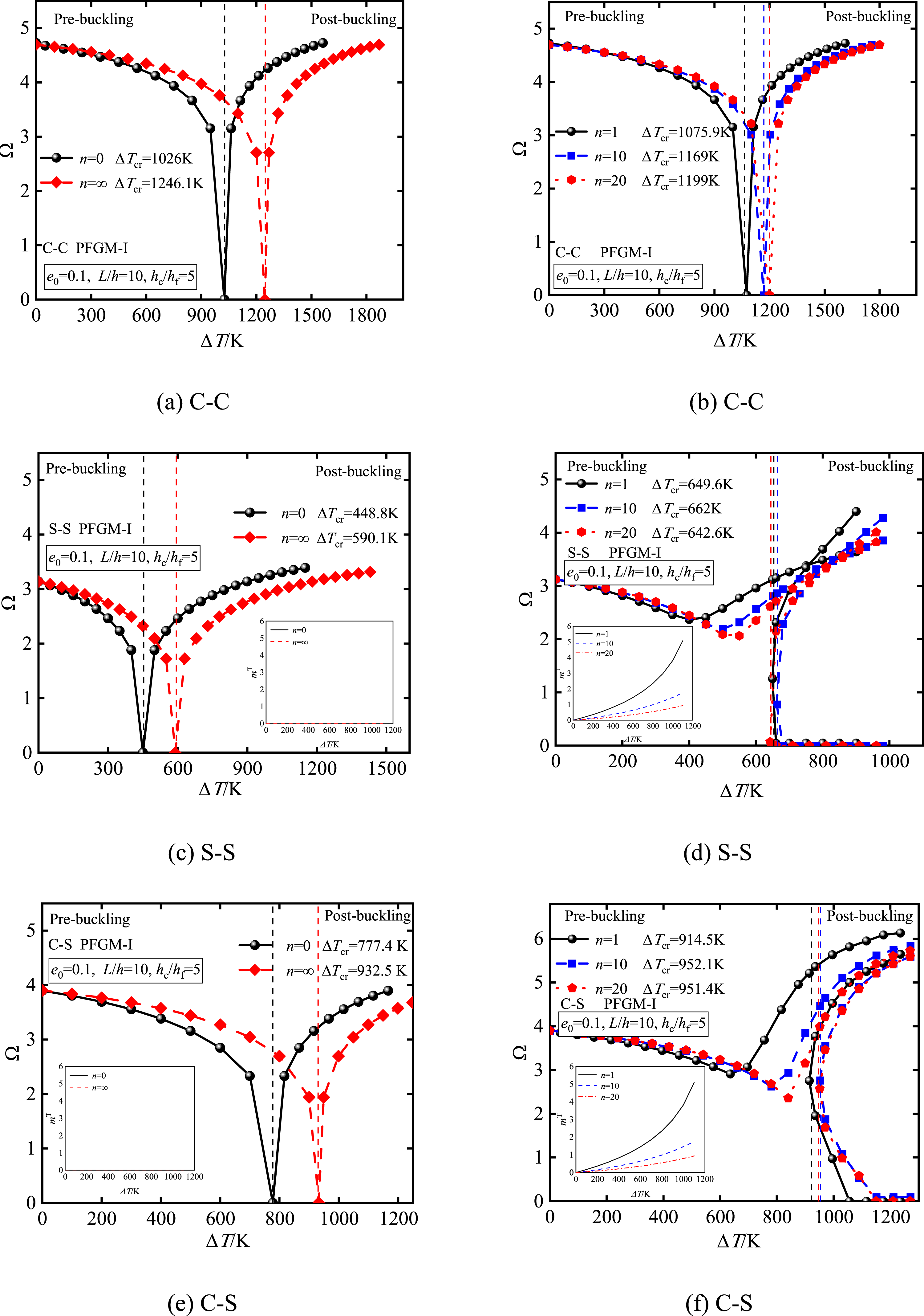

For C-C PFGM sandwich beam, as shown in Figures 6(a) and (b) and 7(a) and (b), the first-order natural frequency exhibits a V-shaped variation regardless of the gradient index, and the instability type undergoes bifurcation instability. Only the critical load differs, and it increases linearly as the gradient index rises. In addition, the variation trend of this critical load is opposite to that shown in Table 2. This is because the material in the top part of the core layer has a low elastic modulus and a high thermal expansion coefficient, while the material in the bottom part has a high elastic modulus and a low thermal expansion coefficient, leading to the increase of critical load with the gradient index; otherwise, the trend shown in Table 2.
For S-S and C-S PFGM sandwich beams, as shown in Figures 6(c)–(f) and 7(c)–(f), when n = 0 or ∞, the physical neutral plane coincides with the geometric neutral plane. At this point, the core layer becomes a uniform core layer and is symmetric about the geometric neutral plane, and the additional bending moment caused by temperature is 0. At this time, the variation trend is the same as that of the C-C beam, with both natural frequencies exhibiting a V-shaped variation, and the instability type shows bifurcation instability. However, when n ≠ 0 or ∞, S-S and C-S PFGM sandwich beams undergo snap-through and the first-order natural frequencies show a discontinuous jump. Moreover, the critical loads of both show a non-linear change with the variation of the gradient index.
Figures 8 and 9 show the effect of porosity on the first-order natural frequency and instability type of PFGM sandwich beams. It can be seen from Figures 8 and 9 that changes in porosity do not affect the variation trend of first-order natural frequency and instability type; it only affects the critical load, which increases with the rise of porosity. The effect of porosity on the first-order natural frequency of PFGM sandwich beams. The effect of porosity on the instability type of PFGM sandwich beams.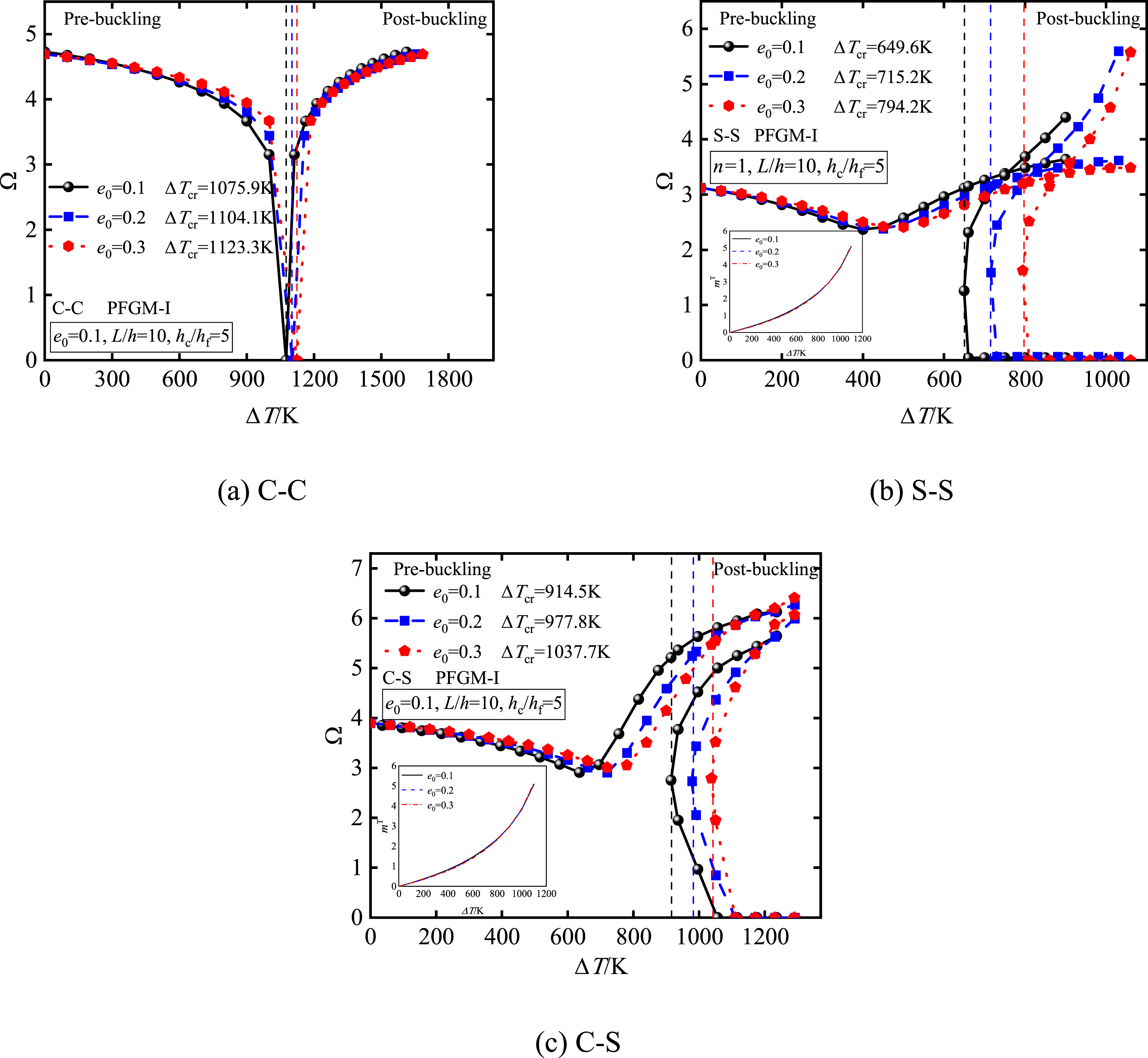

In summary, for S-S and C-S PFGM sandwich beams, when the gradient index is 0 or ∞, the buckling-vibration coupling natural frequency curve shows a V-shape variation; when the gradient index is not 0 or ∞, the buckling-vibration coupling frequency curve exhibits a discontinuous jump. It can be seen in combination with Figures 3 and 7 that these differences in frequency response characteristics, which are inherently consistent with the bifurcation instability or snap-through behavior exhibited by (C-C, S-S and C-S) PFGM sandwich beams under UTL. In addition, the stability of PFGM sandwich beams can be effectively improved by reasonably adjusting material parameters (porosity or gradient index). These insights hold certain guiding significance for the safety design of PFGM sandwich beams under complex loads.
Conclusions
In this paper, a buckling-vibration coupling mechanical model of PFGM sandwich beams under UTL was established by using the micro-element method. Furthermore, the method of Nayfeh and Emam was extended to provide the analytical solutions for the critical load, post-buckling deflection and buckling-vibration coupling natural frequency under UTL. The variation and mechanism of the instability types and buckling-vibration coupling natural frequencies are clarified by using the free energy evaluation principle. In addition, the analytical predictions of this paper were qualitatively compared with the results for critical load and buckling-vibration coupling natural frequency from previous studies, which verifies the reliability of the proposed model. The results show that: (1) Under UTL, C-C PFGM sandwich beam undergoes bifurcation instability, and its buckling-vibration coupling natural frequency curve shows a V-shaped variation. For S-S and C-S PFGM sandwich beams, both experience snap-through due to the effect of temperature-induced additional bending moment, with their buckling-vibration coupling natural frequency curves exhibiting a discontinuous jump. In the pre-buckling stage, the buckling-vibration coupling natural frequency exhibits nonlinear changes. However, in the post-buckling stage, the S-S undergoes only single buckling-vibration coupling natural frequency jump, whereas the C-S exhibits a double jump. (2) The variation in porosity exerts no influence on the instability type and the variation of buckling-vibration coupling natural frequency. As for the gradient index, when the gradient index is equal to 0 or ∞, the additional bending moment equals 0. Consequently, S-S and C-S PFGM sandwich beams undergo bifurcation instability, and their buckling-vibration coupling natural frequency curves show a V-shaped variation.
The above conclusions provide a detailed explanation for the post-buckling deformation and the linear vibration characteristics near the post-buckling configuration of PFGM sandwich beams. However, it should be noted that the existing model is currently only applicable to the free vibration characteristics of structures near the static post-buckling configuration under uniform thermal loads. It does not yet take into account the dynamic post-buckling response of structures, nor can it deal with complex loading cases such as linear thermal loads, nonlinear thermal loads and thermo-mechanical coupled loads. In view of the above limitations, future research will focus on the dynamic post-buckling vibration characteristics of structures under various complex loads. The corresponding numerical algorithms will be further optimized, and the applicable scope of the model will be expanded, so as to provide new ideas and references for the design and regulation of structures.
Footnotes

Author contributions
Funding
The authors disclosed receipt of the following financial support for the research, authorship, and/or publication of this article: This research was supported by the National Natural Science Foundation of China (No. 12172204), the Natural Science Foundation of Henan Province (No. 252300420925), the Key Scientific and Technological Projects in Henan Province (No. 232102220012), and the Xinyang Normal University Graduate Research and Innovation Foundation (No. 2024KYJJ112).
Declaration of conflicting interests
The authors declared no potential conflicts of interest with respect to the research, authorship, and/or publication of this article.
Data Availability Statement
The data used to support the findings of this study are available from the corresponding author upon request.