




Abstract
Floor stress distribution is the main index for evaluating the mining effect of upper protective coal seam. However, parameters currently used in theoretical analysis of mining-induced stress lack practicality. Therefore, in this article, a model for calculating floor stress during mining of upper protective coal seams was established based on the theory of elastic mechanics. Subsequently, the stress induced by the abutment pressure at any point in the five parts of the floor was derived. Moreover, the distribution characteristics of the horizontal, vertical, and shear stresses of the floor during mining of the upper protective coal seam were elaborated. The results show that with the continuous mining of the working face of the protective coal seam, the vertical stress of the floor strata experiences three stages, that is, rapid increase, abrupt stress relaxation, and gradual recovery to the in situ stress. With regard to the morphology, the floor strata recompress or expand in the vertical direction. Vertical and horizontal stress are relieved in the shallow part of the floor in the goaf behind the working face, and there is an abrupt reduction in the increase of concentration degree of vertical and horizontal stress in the floor strata in front of the working face. High shear stress occurs underneath the goaf near the working face. The isoline of the shear stress is distributed in a bubble shape and is oblique to the goaf. These research achievements can provide some theoretical basis for understanding the gas drainage during the mining of the upper protective coal seam.
Introduction
Deep-level coal mining is expected to gain prominence in China. Deep-level coal seams affected by high crustal stress are characterized by high gas content and low gas permeability, which is the main contributor to low gas drainage efficiency and occurrence of gas disasters,1–6 floor heave, 7 rock burst,8,9 water inrush,10,11 coal pillar failure, 12 and roadway instability.13,14 To effectively improve gas extraction and prevent gas disasters, it is necessary to increase gas permeability. Pressure relief is a direct method for realizing permeability enhancement.15–19 In the past decades, much research has been conducted on mining-induced pressure in protective coal seams. Based on theoretical analysis, Yavuz 20 proposed a method for estimating the distance to return of the cover pressure and the stress distribution in the goaf of flat-lying longwall panels. Rezaei et al. 21 proposed an analytical model based on the strain energy balance in longwall coal mining to determine mining-induced stress over gates and pillars. Zhao et al. 22 analysed the influence of the floor width, mining depth, and height of a coal seam on the horizontal stress of floor strata. Based on numerical simulations, Feng and Han 23 proposed a novel multi-grid method to analyse the crack propagation evolution. Ju et al. 24 adopted the continuum-based discrete element method to simulate the evolution of mining-induced stress and fracturing during roadway tunnelling and mining in multilayered heterogeneous rock strata. Zhang et al. 25 presented new findings regarding longwall mining-induced fractures, stress distribution changes in roof strata, strata movement, and gas flow dynamics after the extraction of the lower protective coal seam in a deep underground coal mine. Yang et al. 26 obtained different floor heave style and took the floor mechanical properties and longwall face advance into consideration. Shu et al. 27 proposed a numerical modelling approach for investigating the effect of fracture weakening on mining-induced stress redistribution and strata movement. Zhu and Tu 28 found that distributions of stress concentration and stress relief zone in the floor depended on the locations of pillars. Ghabraie et al. 29 applied three-dimensional (3D) laser scanning to physical modelling in order to investigate the mechanism of substrata movement, crack propagation, caving process, and the progressive propagation of the subsidence towards the ground surface. Yin et al. 30 analysed the effective relief protection range and found that stress distribution evolved from ‘U’ to ‘V’ shape. Wang et al. 31 investigated the characteristics of the collapse of overlying strata and mining-induced pressure in a fault-influenced zone by employing physical modelling in consideration of fault structure. Furthermore, Li et al. 32 investigated the influence of mining-induced stress and deformation, which is important for appropriate supportive design. Based on on-site engineering practice, various pressure relief measures, including protective coal seam mining,30,33–36 hydraulic slotting,37–39 hydraulic fracturing,40–42 were proposed and successfully applied for the improvement of gas drainage efficiency and effective prevention of gas disasters. Compared with the hydraulic and other pressure relief measures, mining of the protective coal seam has the obvious advantage of the realization of regional pressure relief, 43 which makes it the optimal choice under proper mining conditions. Thus, substantial research has been conducted to reveal the underlying mechanism, determine the optimal technical parameters, and evaluate the effect of gas drainage.30,44,45 Floor stress distribution is a critical factor influencing the effect of the mining of protective coal seams. Some physical experiments and field tests have been conducted to determine the floor stress distribution law; however, research on mining-induced stress has primarily been focused on certain geological conditions or overlying strata, and there are many parameters used in theoretical analysis which are unfavourable for engineering practice. Besides, the related theoretical analysis is still insufficient.
Previous studies have investigated the stress distribution of protective coal seam with different angles, strata properties, and pillar positions, which were mainly used in coal seam mining, floor heave, water inrush, and roadway instability. But the stress distribution in upper protective coal seam which focuses on gas drainage still needs to be further investigated. To overcome this, in this study, we aim to establish a calculation model of floor stress during mining of upper protective coal seams based on the theory of elastic mechanics. This is achieved by dividing the abutment pressure around the working face into five parts. Subsequently, the stress at any point of the floor in the five parts induced by the abutment pressure was derived. Moreover, the distribution characteristics of the horizontal, vertical, and shear stress of the floor during mining of the upper protective coal seam were elaborated. Finally, we discuss the characteristics of the vertical, horizontal, and shear stress. The research achievements can provide some theoretical basis for the gas drainage during the mining of the upper protective coal seam.
Mechanical model for calculation of floor stress during the mining of the upper protective coal seam
In order to investigate the distribution characteristics of floor stress during the mining of the protective coal seam along its strike, the floor strata are regarded as homogeneous elastomers. According to elasticity theory, the stress induced by the microstress

The vertical and horizontal distances of the point N from the small concentrated force are z and
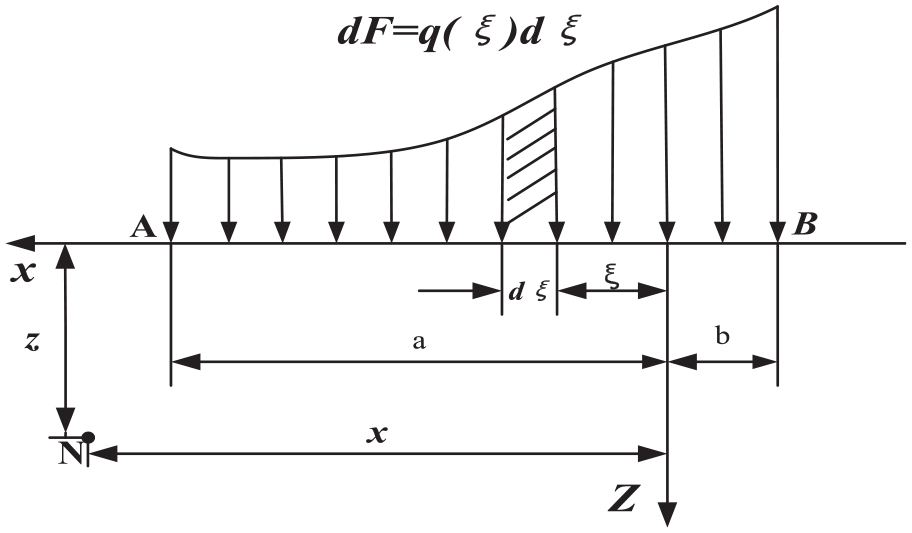
Sketch map for calculation of stress on floor strata under distributed loads.
To calculate the cumulative stress induced by the distributed forces, we only need to sum the stresses caused by each small concentrated force, that is, we need to solve the integral of the above formula. The range of the integral is that of

The activity of the overlying strata of the goaf tends to become stable after the working face of the protective coal seam is advanced to a certain distance, which enables normal mining of the working face. The gangues caved in some regions in the goaf are gradually compacted to provide different levels of supports to the upper strata that have not caved yet. Therefore, a small abutment pressure is likely to be produced in the region at a certain distance to the working face; this will approach or even reach the in situ stress as the distance to the working face increases. The calculation model shown in Figure 2 for calculating floor stress is established according to the distribution law of the abutment pressure in the normal mining period.

Calculation model for floor stress in the normal mining period of the upper protective coal seam.
Depending on the abutment pressure along the strike of the coal seam, the working face is divided into five sections, that is, AB, BO, CD, A-∞, and D-∞, as shown in Figure 2, during the mining of the upper protective coal seam. Among them, sections A-∞ and D-∞ are under uniform loads. The abutment pressures in sections AB, BO, and CD are calculated as

Based on the above analysis, the stress induced by the abutment pressure during the mining of the upper protective coal seam can be determined as follows:
1. The stress induced by the abutment pressure of section AB at any point in the floor strata can be expressed as

where
2. The stress induced by the abutment pressure of section BO at any point in the floor strata can be expressed as

where
3. The stress induced by the abutment pressure of section CD at any point in the floor strata can be expressed as

where
4. The stress induced by the abutment pressure of section A-∞ at any point in the floor strata can be expressed as

5. The stress induced by the abutment pressure of section D-∞ at any point in the floor strata can be expressed as

By superposing the results of equations (4)–(8), we obtain equation (9) that denotes the stress at any point in the floor strata during normal mining of the working face in the protective coal seam

Distribution law of floor stress during the mining ofthe upper protective coal seam
In Figure 2, suppose that the in situ stress γH is the dimensionless unit 1, the distance from the peak stress to the working face a and the influence range of the abutment pressure b are 15 and 50, respectively, which are calculated based on properties of the overlying strata; 46 the range of the goaf where the abutment pressure is 0 is expressed as c = 10, the range of the goaf where the abutment pressure recovers to the in situ stress d and the stress intensification factor k are 100 and 3, respectively, which are estimated through strata distribution in the gob. 20 The origin of the transverse axis (x axis) indicates the position of the working face of the protective coal seam (a positive value and negative value, respectively, represent the distance from a certain position in front of and behind the working face in the goaf to the working face). The longitudinal axis represents the depth of the floor. The distribution characteristics of stress in the floor strata during the mining of the upper protective coal seam are studied using the mathematical analysis software Mathcad, and Figures 3 and 4 are plotted.
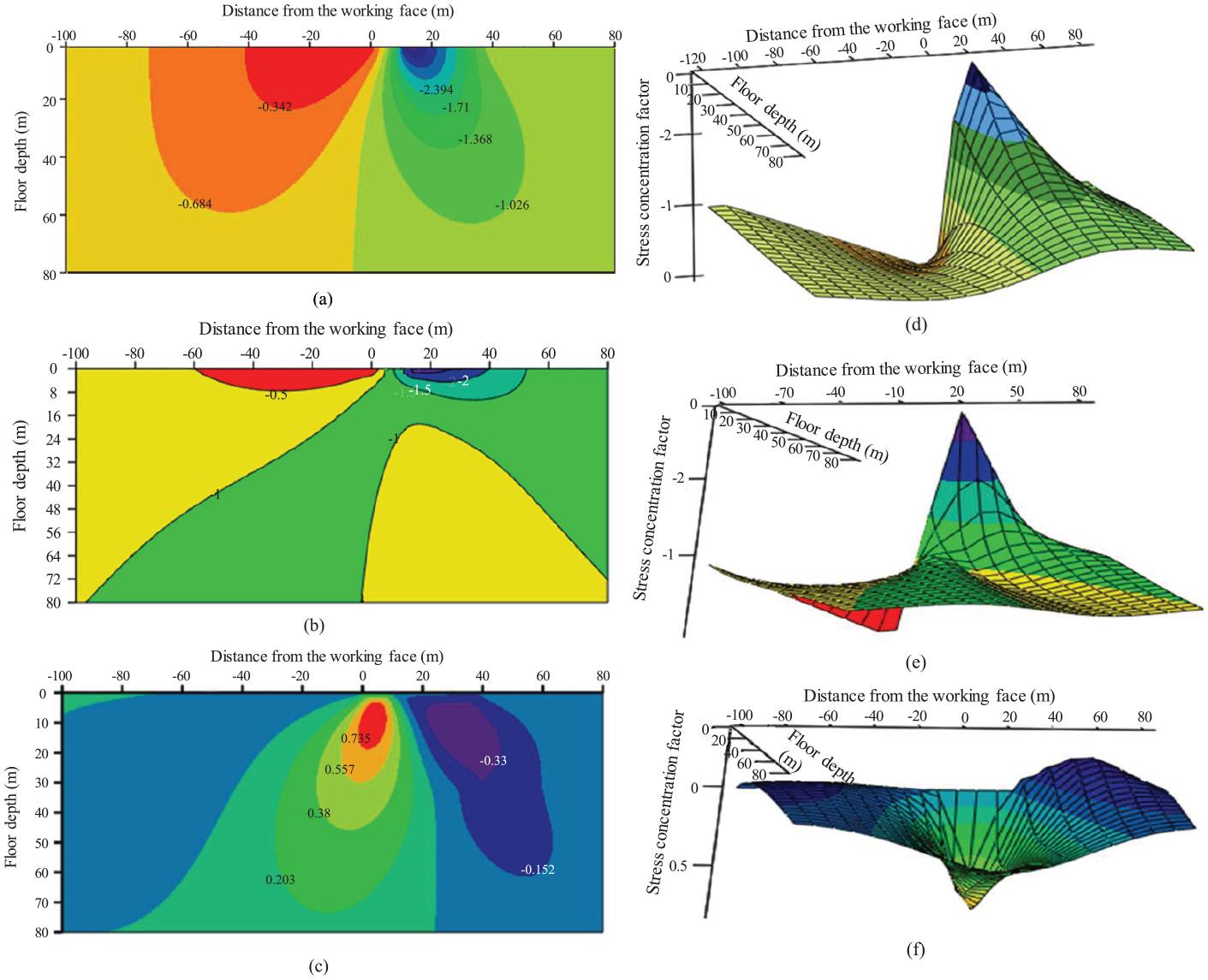
Isograms of floor stress during the mining of the upper protective coal seam: (a) distribution law of the vertical stress, (b) distribution law of the horizontal stress, (c) distribution law of the shear stress, (d) 3D representation of vertical stress, (e) 3D representation of horizontal stress, and (f) 3D representation of shear stress.

Distribution law of stress concentration factors at depths of 10, 20, 30, 40, 50, and 80 m away from the floor: change of (a) vertical stress concentration factors, (b) horizontal stress concentration factors, and (c) shear stress concentration factors.
Distribution characteristics of the vertical stress
It can be seen from the distribution of vertical stress in Figures 3(a) and (d) and 4(a) that
1. The stress concentration zone and the stress relaxation zone in the floor strata during the mining of the working face in the upper protective coal seam essentially correspond to the distribution of the abutment pressure. The stress relaxation zone is formed in the floor strata of the goaf and the stress concentration zone is formed below the coal on two sides. The two zones are divided by the isoline of in situ stress of the floor. The isoline of concentrated vertical stress below the coal is distributed in a bubble shape oblique to the coal, while the stress relief isoline below the goaf also appears bubble shaped; however, it is oblique to the goaf.
The vertical stress concentration factor of the floor strata in the goaf is lesser than 1 at 100 m behind the working face; this indicates that it is a stress relaxation zone. The vertical stress in the floor at a depth of 0–5 m at approximately 12 m behind the working face approaches 0; at 40 m depth, the ratio of vertical stress to the in situ stress of the goaf 8–93 m behind the working face is lesser than 0.8; at a depth of 30 m, the ratio 6–88 m behind the working face is also lesser than 0.8. As the depth increases, the vertical stress also increases gradually, and the relaxation degree of the stress decreases.
At a distance of 18–32 m in front of the working face and a depth of 5–40 m in the floor strata, the vertical stress reaches its peak. The intensification factor of the peak vertical stress at the depths of 5, 20, 30, and 40 m are 2.72, 2.16, 1.88, and 1.67, respectively, and the peak stress is observed at 18, 27, 29, and 32 m in front of the working face. As the depth of the floor increases, the peak vertical stress gradually decreases, and its location shows a larger distance to the working face.
2. Similar to the distribution of the advanced abutment pressure of the working face, a stress intensification zone is formed in the floor strata 70 m in front of the working face, and a stress relaxation zone is formed in the shallow floor strata of the goaf. The stress of the floor strata in the goaf at distances greater than 100 m behind the working face gradually reaches or approximates the in situ stress. In summary, during the continuous mining of the working face of the protective coal seam, the vertical stress of the floor strata undergoes three stages, that is, rapid increase, abrupt stress relaxation, and gradual recovery to the in situ stress. With regard to the morphology, the floor strata are compressed or expanded in the vertical direction.
Distribution characteristics of the horizontal stress
It can be seen from the distribution of vertical stress in Figures 3(b) and (e) and 4(b) that
After being affected by the mining-induced disturbance, the floor strata undergo vertical compression or expansion owing to the highly concentrated or relaxed vertical stress, respectively. This is accompanied by the respective compression or expansion in the horizontal direction. As a result, horizontal stress concentration and relaxation zones occur. Stress is concentrated in the shallow floor and relieved in the deep floor beneath the coal. The floor in the goaf undergoes the relief of stress and even the appearance of tensile stress in the shallow portion; however, slight stress concentration occurs in the deep portion. Horizontal stress is relieved in the shallow part of the floor in the goaf behind the working face; there is an abrupt reduction in the increase of the concentration degree of horizontal stress in the floor strata in front of the working face. Furthermore, the peak horizontal stresses at the depths of 10, 20, 30, 40, and 80 m from the floor of the coal seam are 1.53, 1.24, 1.16, 1.1, and 1 times the in situ stress.
The concentration degree of horizontal stress in the floor along the direction of mining in the working face of the protective coal seam is far smaller than that of the vertical stress. Therefore, it can be concluded that the propagation of horizontal stress in the floor slightly influences the floor strata.
Distribution characteristics of the shear stress
It can be seen from the distribution of vertical stress in Figures 3(c) and (f) and 4(c) that
Along the advance direction of the working face in the protective coal seam, high shear stress occurs at the position beneath the goaf near the working face and in the range with a certain distance in front of the working face. The isoline of the shear stress is distributed in a bubble shape oblique to the goaf. The presence of the shear stress substantially reduces the strength of the strata and damages the floor.
Shear stress gradually decreases with increasing distance to the working face of the protective coal seam. For example, shear stress of floor strata at the depth of 5 m with a distance of 30 m to the working face is only 0.18 times of the in situ stress. With the increasing depth of the floor, the shear stress grows at first, then decreases, and finally stabilizes, while with small increase amplitudes.
Conclusion
In this article, based on the theory of elastic mechanics, the calculation model of floor stress during mining of the upper protective coal seam was established, where the abutment pressure around the working face was divided into five parts. Subsequently, the stress at any point on the floor in the five parts induced by the abutment pressure was derived. Moreover, the distribution characteristics of the horizontal, vertical, and shear stresses of the floor during mining of the upper protective coal seam was elaborated. The primary conclusions can be summarized as follows:
During the continuous mining of the working face of the protective coal seam, the vertical stress of the floor strata experiences three stages, that is, rapid increase, abrupt stress relaxation, and gradual recovery to the in situ stress. With regard to the morphology, the floor strata are compressed or expanded in the vertical direction.
Horizontal stress is relieved in the shallow part of the floor in the goaf behind the working face, and there is an abrupt reduction in the increase of the concentration degree of horizontal stress in the floor strata in front of the working face. The concentration degree of horizontal stress in the floor along the direction of advance of the working face in the protective coal seam is far smaller than that of the vertical stress. This reveals that the propagation of horizontal stress in the floor slightly influences the floor strata.
Along the direction of advance of the working face in the protective coal seam, high shear stress appears at the position beneath the goaf near the working face and in the range with a certain distance in front of the working face. The isoline of the shear stress is distributed in a bubble shape oblique to the goaf. Shear stress gradually decreases with an increase in the distance to the working face of the protective coal seam. As the floor depth increases, the shear stress increases at first, then decreases, and finally stabilizes, while with small increase amplitudes.
Footnotes
Acknowledgements
The authors also thank the editor and anonymous reviewers very much for their valuable advice.
Data availability
The data used to support the findings of this study are available from the corresponding author upon request.
Declaration of conflicting interests
The author declared no potential conflicts of interest with respect to the research, authorship, and/or publication of this article.
Funding
The author disclosed receipt of the following financial support for the research, authorship, and/or publication of this article: This work was supported by the National Key Research and Development Program of China (2017YFC0804206), Tiandi Science and Technology Co., Ltd. Special Project for Innovation and Entrepreneurship Funds (2018-TD-MS076), and Special Fund for Science and Technology Innovation and Venture Capital of China Coal Science and Technology Group Co., Ltd (2018MS011).
