



Abstract
Objective
Folic acid deficiency has been implicated in various systemic and ocular conditions and is essential for the development of specific ocular tissues. Folic acid has antioxidant and anti-inflammatory effects and can benefit the tear film. Therefore, the current single-arm pre–post intervention pilot study aimed to assess the short-term impact of folic acid supplementation on the comfort, stability, volume, and quality of the tear film among young healthy participants.
Methods
A total of 46 subjects (24 males and 22 females) aged 19 to 34 years (23.2 ± 3.4 years) with no pre-existing eye diseases or disorders were recruited. No control group took part in the study. All participants were given oral folic acid tablets at a daily dose of 1 mg for three consecutive days. The standard patient evaluation of eye dryness (SPEED) questionnaire was completed first, followed by the noninvasive tear breakup time (NITBUT), tear meniscus height (TMH), and tear ferning (TF) tests. The first set of measurements was taken before folic acid intake, and the second was taken 24 hours after the third dose.
Results
Significant differences (p < 0.001, Wilcoxon signed-rank test) were observed in the SPEED, NITBUT, TMH, and TF scores before and after the consumption of folic acid supplementation. The SPEED [7.0 (9.2) versus 4.0 (7.3)] and TF [1.3 (0.6) versus 0.9 (0.9)] scores were significantly lower after the consumption of folic acid. On the other hand, the NITBUT [5.5 (4.1) versus 9.9 (6.7) s] and TMH [0.19 (0.05) versus 0.21 (0.03) mm] scores were significantly higher after folic acid consumption.
Conclusion
A 3-day regimen of folic acid supplementation may improve tear film parameters. Benefits may include improved comfort, stability, volume, and overall quality of the ocular tear film. However, the results are preliminary and hypothesis generating.
Introduction
Vitamin deficiencies can have adverse effects on health, including those affecting the visual system. The visual issues caused by vitamin deficiency are related to the biochemical function of the specific nutrient. While vitamin deficiencies are uncommon in developed nations, they still occur in some parts of the developing world and among certain vulnerable populations. A vitamin deficiency can result in or contribute to various eye diseases and may even be the initial sign of a vitamin deficiency. Therefore, eye specialists must recognize eye-related signs of vitamin insufficiencies, particularly since the complications can be serious and effectively managed if identified early. 1
Folate, or B9, also known as folic acid, is an important vitamin. It plays a crucial role in the production of amino acids, nucleotides, and vitamins. Folic acid deficiency can lead to various diseases. Folate is present in yeast, fruits, leafy vegetables, liver, and kidneys, but can be destroyed by high-temperature cooking. 2 The therapeutic dose of folic acid (Figure 1) for both adults and children is the same, and it should not exceed 1 mg per day, regardless of their age. After oral administration, folic acid reaches the plasma 15 to 30 minutes later, with peak levels usually occurring 1 to 2 hours later.3–5 Excessive homocysteine levels may be due to deficiencies in vitamins B6, B12, and folate. 6

Folic acid chemical structure.
B9 deficiency affects over 20% of people in low-income countries and 5% in high-income countries. 7 It can cause painless bilateral optic neuropathy, reduced color vision, and visual loss. Although linked to age-related macular degeneration, studies show no significant association with deficiency at 11 nmol/L.8–10 Folic acid is vital for vision, cell repair, DNA synthesis, and the regulation of inflammation. 11 Its deficiency can cause optic neuropathy. It helps protect cells from oxidative stress, promotes tissue growth, reduces inflammation, and may stabilize the tear film, supporting overall eye health.3,12
Maintaining the stability of the tear film is essential for preserving vision and ensuring a healthy ocular surface. Changes in tear film thickness can result in abnormalities in the optical system. 13 Several techniques are available to assess the tear film, including noninvasive tear breakup time (NITBUT), 14 tear meniscus height (TMH), 15 phenol red thread (PRT), 16 the Schirmer, 16 tear evaporation rate (TER), 17 osmolarity assessment, 18 and tear ferning (TF) tests. 19 In addition, dry eye questionnaires have been an easy tool for assessing the comfort of the tear film.20,21 These assessment methods are intended for research or clinical purposes and enable the evaluation of conditions that may lead to dry eye symptoms, significant damage to the ocular surface, and vision deterioration. 22
Dry eye is a complicated condition that impacts the surface of the eye due to various factors. Dry eye leads to unstable tear film, ocular symptoms, and hyperosmolarity.23,24 The tear film comprises water, lipids, and mucins, which are predominantly generated by the lacrimal and meibomian glands. These components maintain the surface tension over the cornea. Risk factors for dry eye include some medications, aging, smoking, chronic illnesses, ocular surgeries, skin conditions, allergies, and screen use. 25 The frequency of dry eye varies from 5% to 50% globally, with a higher incidence among women compared to men. The two most common types are evaporative and aqueous deficiency dry eye. 26 Symptoms include pain, excessive tearing, a burning sensation, a gritty feeling, redness, dryness, blurred vision, and eye fatigue. Regular assessment of the eye surface is crucial to prevent complications associated with dry eye.
To our knowledge, no prior study has evaluated the short-term effects of folic acid supplementation on tear film parameters. This study aims to address this gap by investigating whether brief folic acid intake can improve tear film comfort, stability, and volume. A 3-day regimen has been implemented to minimize the impact of lifestyle, diet, medications, and other risk factors on the outcome.
Materials and methods
Subjects
The current single-arm pre–post intervention pilot study involved 46 subjects (24 males and 22 females) aged 19 to 34 years (mean ± standard deviation = 23.2 ± 3.4 years), with no eye diseases or disorders. Participants were recruited from students and employees of the Department of Optometry at the College of Applied Medical Sciences. The sample size was calculated to be 46 subjects, with a statistical power of 90% and a significance level of 0.05. A difference of 3.5 seconds in NITBUT between the measurements before (day 1) and after (day 4) consuming folic acid was considered clinically significant. Smokers and those who have thyroid gland disorders, a high body mass index, diabetes, anemia, refractive errors, and ocular surgeries were excluded from the study. Breastfeeding and pregnant women, and those in their menstrual cycle, were excluded from the study. A slit lamp was used to examine the subjects’ ocular surfaces, and individuals with eye disorders were excluded. Participants were instructed to avoid topical lubricants, caffeine-containing beverages, prolonged use of digital screens, and exercise prior to testing.
Each participant provided written informed consent prior to the commencement of the research. The subjects were treated in accordance with the guidelines of the Declaration of Helsinki and approved by the University Institutional Review Board (E-24-8818). The reporting of this study conforms to STROBE guidelines. 27 All subjects received oral folic acid tablets at a daily dose of 1 mg for three consecutive mornings. This dose is the tolerable upper intake level of synthetic folic acid for adults. The study was conducted from August to October 2024. The subjects’ information was anonymized.
Procedures
The standard patient evaluation of eye dryness (SPEED) questionnaire was completed first, followed by the NITBUT, TMH, and TF tests. The tests were performed twice on each subject's right eye. The measurement was performed before consuming the supplement, and a second set was taken 24 hours after the third dose of folic acid. The measurements took place between 8:00 and 10:00 a.m. on days 1 and 4. A 5-minute gap was allowed between tests. The tests were conducted by the same examiner under controlled conditions (e.g. 20°C and 15% humidity). The examiner was blinded to and unaware of whether the NITBUT, TMH, and TF measurements and SPEED score were taken before or after folic acid intake. The examiner was unaware whether measurements were obtained on days 1 or 4.
Outcome measures
The SPEED questionnaire
The SPEED questionnaire tracks the occurrence and intensity of dry eye symptoms over a period. 20 It produces a score between 0 and 28. A score between 5 and 7 and above 8 indicates moderate and severe dry eye symptoms, respectively.
EASYTEAR View+
The EASYTEAR View + (EASYTEAR SRL, Via Maioliche, Trento, Italy) is a noninvasive and portable device. It features an internal timer and illumination system for evaluating and analyzing the tear film. It has been used to measure NITBUT and TMH.
The NITBUT test
Participants sat comfortably and were told to blink naturally while focusing on a target directly ahead. They were instructed to refrain from blinking until told otherwise. NITBUT is the length of time in seconds from the last blink to the onset of the first dry area in the tear film. Three measurements were performed, and the average was recorded. The measurements were very close and repeatable. If the NITBUT value is less than 10 seconds, it confirms the presence of dry eye symptoms.
The TMH test
The TMH test measures the volume of the tear film and the height of the triangular cross-section between the lower lid margin and the cornea, expressed in millimeters. Three measurements were performed to demonstrate repeatability, and the average was calculated. A measurement below 0.2 mm indicates dry eye.
The TF test
The TF test involves collecting a small sample of tears from the right eye of subjects (1 µL), using a glass capillary tube (10 µL), from the lower meniscus. The tear samples were dried for 10 minutes at 20°C and 15% relative humidity. An Olympus DP72 digital microscope (magnification power of 10) was used to observe and capture the TF images. 19 TF was assessed using a five-point scale (grades 0–4), where higher grades indicate poorer tear quality. A TF grade 2 is considered indicative of dry eyes. Two examiners performed the grading to 0.1 increments. In some cases, the grading score was not identical; an average was calculated and rounded to the nearest 0.1.
Statistical analysis
Version 22 of the SPSS software (IBM Software, Armonk, NY, USA) was used to analyze the data. The data were determined to be non-normally distributed using the Kolmogorov–Smirnov test (p < 0.05). The Wilcoxon signed-rank test was used to analyze the data before and after folic acid supplementation. To account for multiple testing across the four paired outcomes (i.e. TF, NITBUT, TMH, and SPEED), p-values were adjusted using the Benjamini–Hochberg (BH) procedure. Spearman's correlation coefficient (r) was used to test the association between various parameters. The mean scores were represented as the median and interquartile range (IQR).
Results
Descriptive statistics
The median [IQR] for the SPEED, NITBUT, TMH, and TF scores before and after the consumption of folic acid supplementation for three consecutive days is shown in Table 1. No significant difference in age (Wilcoxon signed-rank Test, p = 0.639) was found between male and female subjects. Both unadjusted and BH-adjusted p-values revealed significant (Wilcoxon signed-rank test; p < 0.001) differences in the median scores of the SPEED, NITBUT, TMH, and TF before and after the consumption of folic acid supplementation.
Median (IQR) scores for the SPEED, NITBUT (s), TMH (mm), and TF in the study group (n = 46) before and after three consecutive days of folic acid supplementation.

Both raw p-values and BH-adjusted p-values are reported.
*Significant difference (Wilcoxon signed-rank test).
BH: Benjamini–Hochberg; CI: confidence interval; HL: Hodges–Lehmann; IQR: Interquartile range; NITBUT: noninvasive tear breakup time in seconds; SPEED: the standard patient evaluation of eye dryness; TF: tear ferning; TMH: tear meniscus height in millimeters.
Pre- versus postsupplementation comparisons
Based on the SPEED scores, tear film comfort was improved in 32 subjects (69.5%) after consuming folic acid supplements. Meanwhile, the SPEED scores remained the same in nine subjects (19.5%) after taking folic acid. On the other hand, the SPEED score indicated that tear film comfort was worse in five individuals (11%) after consuming folic acid. In the NITBUT test, tear film stability improved in 42 subjects (91.3%) after supplement consumption, whereas it decreased in 4 subjects (8.7%). In the TMH test, tear film volume increased in 35 subjects. Meanwhile, the TMH score was unchanged in seven subjects and decreased in only four individuals following folic acid consumption. The TF grades of the dried tears indicated an improvement in tear quality in 32 subjects (69.5%) and a reduction in 12 subjects (26%) after the consumption of folic acid. On the other hand, the TF grade remained unchanged in only two subjects after folic acid supplementation.
Correlation analyses
The Spearman correlation coefficient (r) was strong between the SPEED (r = 0.780; p < 0.001) before and after consumption of folic acid. Moderate corrections were found between NITBUT (r = 0.365, p < 0.013) and TMH scores (r = 0.328; p = 0.026) before and after the consumption of folic acid. A negative association (r = –0.349; p = 0.017) was found between the median score of TMH presupplement and SPEED post-folic acid consumption.
Sex-based differences
When stratified by sex, significant differences were observed in both male and female groups. Among males, TF (Z = −3.544, p < 0.001), NITBUT (Z = −3.401, p < 0.001), TMH (Z = −3.255, p = 0.001), and SPEED (Z = −3.363, p < 0.001) all showed significant improvement after taking folic acid. Similarly, in females, TF (Z = −2.106, p = 0.035), NITBUT (Z = −4.107, p < 0.001), TMH (Z = −3.319, p < 0.001), and SPEED (Z = −2.922, p = 0.003) were improved significantly following folic acid consumption.
Results interpretation
Folic acid supplementation significantly improved all tear film parameters, as reflected by reduced SPEED and TF scores, and increased NITBUT and TMH values (all p < 0.001). The changes in the SPEED, NITBUT, TMH, and TF scores indicated that comfort, tear film stability, volume, and tear quality were significantly improved after three consecutive days of folic acid consumption. However, it should be noted that the increase in TMH was 0.02 mm after folic acid intake, which may be due to a repeatability error. The side-by-side boxplots for the SPEED, NITBUT, and TF in the study group (before and after the consumption of folic acid supplementation) are shown in Figures 2 to 5. Figure 2 illustrates a consistent decline in subjective symptoms following supplementation. Figure 3 shows an increase in NITBUT score after folic acid supplementation. For the TMH test, the score was increased after consuming folic acid. On the other hand, the TF grade decreased after folic acid intake, indicating an improvement in tear quality. The TF images from the same subjects (n = 2) before and after consuming folic acid for consecutive days are shown in Figure 6. Figure 6 shows that the ferns of the dried tears after taking folic acid were smaller and thinner compared to before its consumption.
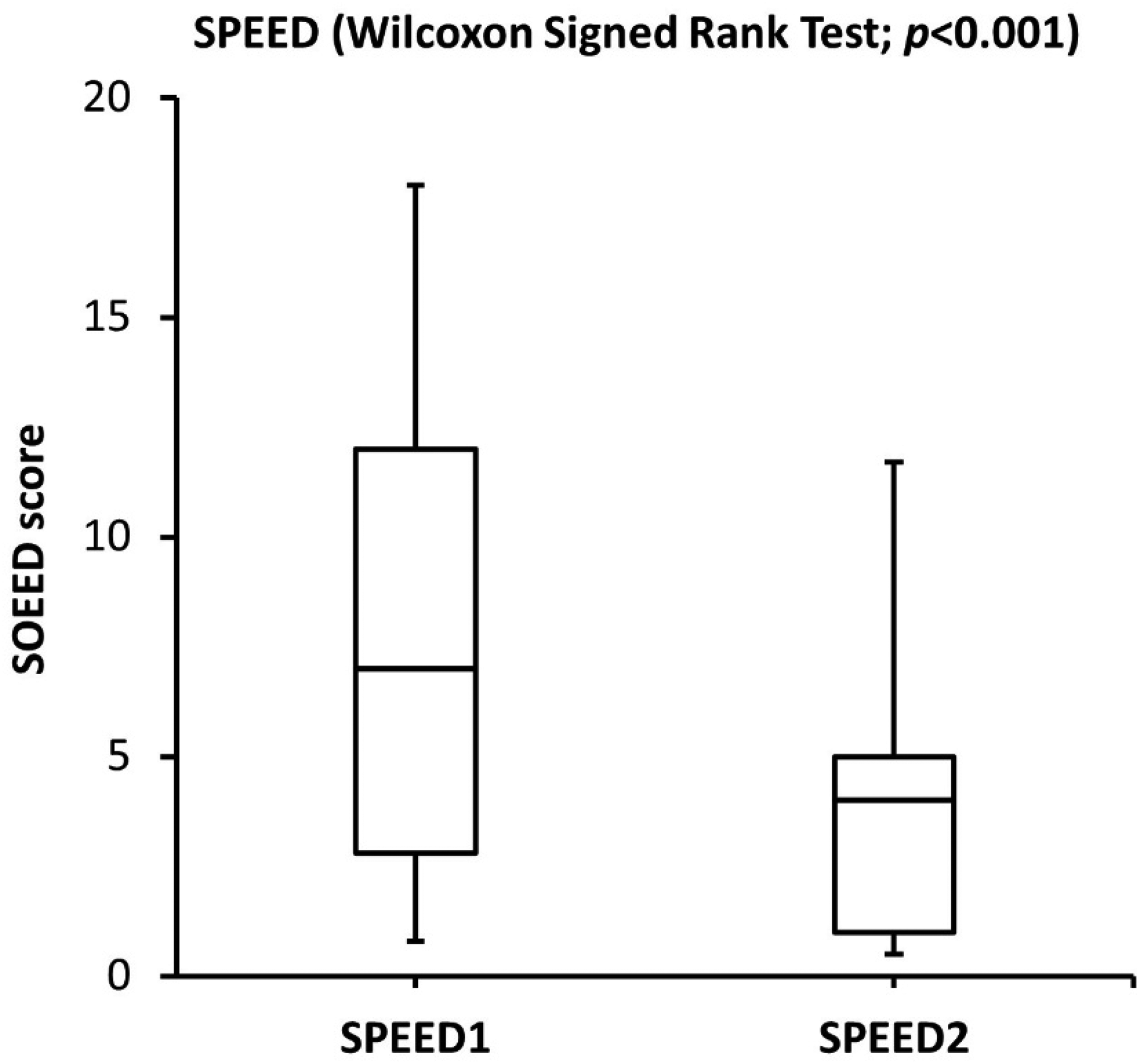
Side-by-side boxplots of the SPEED scores before and after the consumption of folic acid for three consecutive days. 1 represents the scores before taking the supplement, and 2 represents the scores after consuming it for 3 consecutive days. SPEED: standard patient evaluation of eye dryness.

Side-by-side boxplots of the NITBUT scores (s) before and after consuming folic acid. 1 represents the scores before taking the supplement, and 2 represents the scores after consuming it for 3 consecutive days. NITBUT: noninvasive tear breakup time
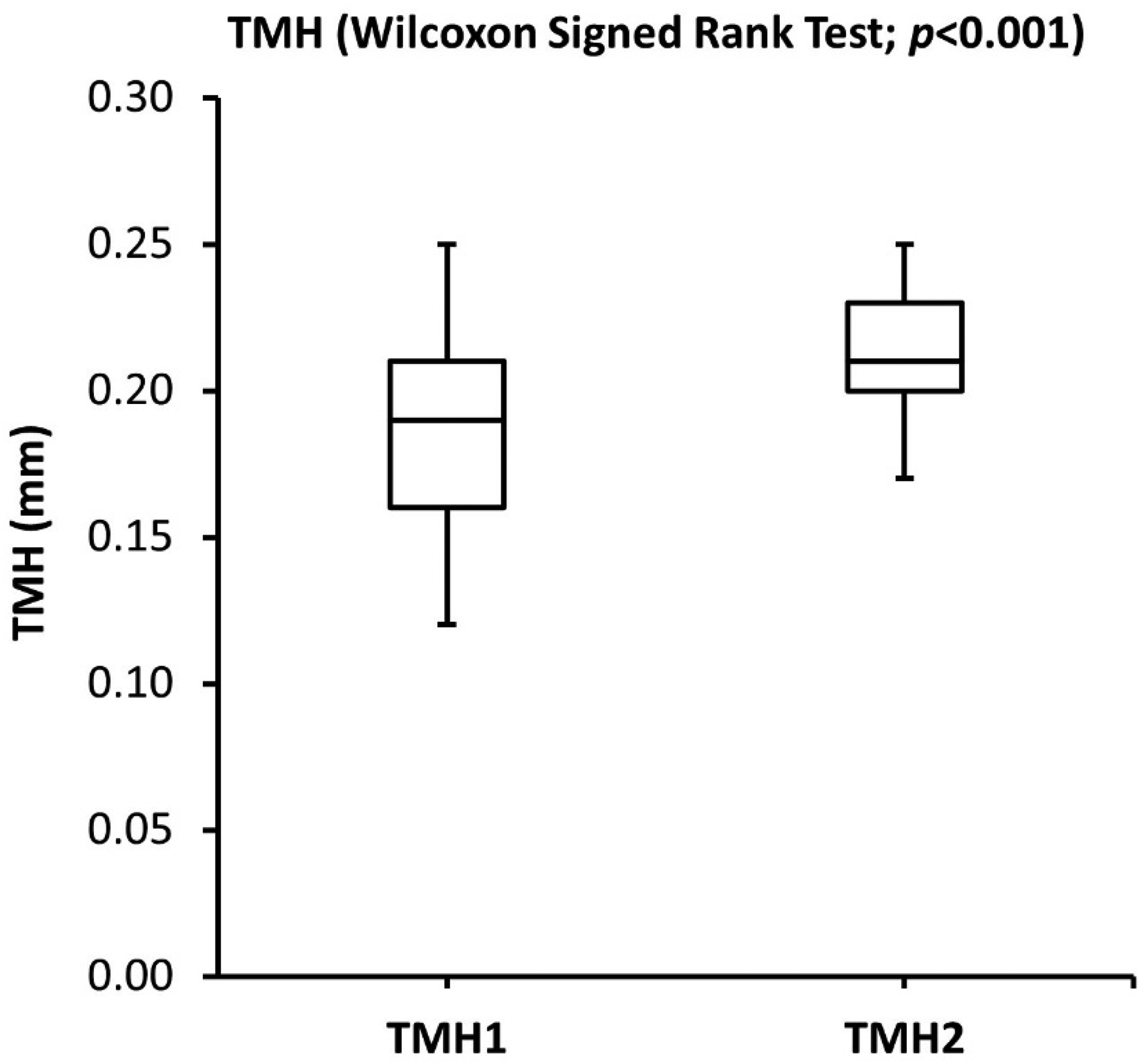
Side-by-side boxplots of the TMH scores before and after consuming folic acid. 1 represents the scores before taking the supplement, and 2 represents the scores after consuming it for 3 consecutive days. TMH: tear meniscus height.

Side-by-side boxplots of the TF grades before and after consuming folic acid. 1 represents the scores before taking the supplement, and 2 represents the scores after consuming it for 3 consecutive days. TF: tear ferning.

TF images from two subjects before (a and c) and after (b and d) consuming folic acid. (a) and (b) The TF images of dried tears collected from one subject before and after consuming folic acid, respectively. (c) and (d) The TF images of dried tears of another subject before and after consuming folic acid, respectively. TF: tear ferning.
Discussion
It is crucial to include oral vitamin supplements in the diet to maintain ocular tear film health and relieve dry eye symptoms. For example, oral vitamin B1 may help manage dry eye symptoms. 28 B1 led to a significant improvement in foreign body sensation and in corneal nerve fiber density. 28 Vitamin A supplementation for three consecutive days significantly improved tear quality and osmolarity in patients with dry eye. However, no significant improvements were seen in the PRT and TBUT scores post-vitamin A supplementation. 29 Similarly, the use of oral vitamin D3 supplements significantly improved the TF grades and tear osmolarity score. 30 Vitamin D could be a potential remedy for individuals suffering from dry eye symptoms. 31 The significant improvement in TF grades due to the intake of vitamins A and D3 matches the current findings. However, these vitamins did not significantly improve tear stability, which contrasts with the current findings.
Folates play a role in preventing congenital heart defects, 32 neural tube defects and spina bifida, 33 orofacial clefts, 34 depression, 35 cancer, 36 and age-related hearing loss. 37 Finding effective ways to relieve dry eye symptoms, such as improving tear film comfort, consistency, quantity, and composition, is crucial. That's why there is a growing need for more convenient treatment options. This study investigates the potential effects of oral vitamin B9 supplementation on tear film parameters.
The current study indicates a possible short-term improvement in tear film parameters following folic acid consumption. There were notable differences between females and males in TMH1, TMH2, and SPEED2 scores. These differences might be attributed to hormonal effects on tear production. The reason for the negative association between TMH presupplement and SPEED following folic acid intake was unclear. However, folic acid can improve oxidative stress and inflammation. The increase in the TMH score before and after consuming folic acid (0.02 mm) might fall within the measurement's repeatability range, which affects its clinical significance.
A negative correlation was found between blood B9 levels and the prevalence of glaucoma in the Korean population. 38 Folate might suppress the elevation of homocysteine. Consuming a high amount of vitamin B9 may decrease the likelihood of developing exfoliation glaucoma. 39 A high dose of B12 could contribute to the development of glaucoma. 40
The localization of folate receptor protein isoforms, reduced folate transporters, and proton-coupled folate transporters is normally present in several eye tissues. The findings of the current study suggest a potential benefit of folic acid intake for healthy eyes and good vision at all ages. 3 Unfortunately, only a few studies investigated the impact of folic acid on the prevention of eye disorders. Additionally, the relationship between folic acid deficiency and eye disease has not been investigated.
Strengths and limitations
The study was conducted by a single examiner, with tests performed between 8:00 and 10:00 a.m., under controlled temperature and humidity. Additionally, multiple objective assessments of the tear film were used, including SPEED, NITBUT, TMH, and TF, with BH correction applied for multiple testing. It is important to address the limitations of the current study. The participants were young university students from a single college, and the sample size was relatively small. Additionally, a short-term folic acid supplement was administered to assess its impact on tear film parameters, and serum folate concentration was not evaluated. This knowledge might influence their responses on subjective measures such as the SPEED score, potentially introducing performance bias. Therefore, given the hypothesis-generating findings from the current study, future randomized, placebo-controlled trials that include serum folate measurement and assessments of inflammatory markers are necessary.
Conclusion
A 3-day regimen of folic acid supplementation may improve tear film parameters. Benefits may include improved comfort, stability, volume, and overall quality of the ocular tear film. However, the results are preliminary and hypothesis generating.
Footnotes

Ethical consideration
The study was conducted in accordance with the guidelines of the Declaration of Helsinki and was approved by the Institutional Review Board (E-24-8818) of King Saud University.
Author contributions
MSA, ESA, and GAE were involved in conceptualization; MSA, ESA, MEA, and GAE in methodology; MSA, ESA, GAE, BHA, MA, SAA, and AMM in software; MSA, ESA, MEA, GAE, BHA, MA, and SAA in validation; MSA, ESA, GAE, BHA, MA, and AMM in formal analysis; MEA and GAE in investigation; MSA and GAE in resources; MSA, ESA, MEA, GAE, BHA, MA, SAA, and AMM in data curation and visualization; GAE in supervision, project administration, and writing—original draft preparation; MSA and GAE in funding acquisition; and GAE, SAA, and AMM in writing—review and editing. All authors have read and agreed to the published version of the manuscript.
Funding
The authors disclosed receipt of the following financial support for the research, authorship, and/or publication of this article: The authors acknowledge the support received from the Ongoing Research Funding Program (grant number ORF-2025-404), King Saud University, Riyadh, Saudi Arabia.
Declaration of conflicting interests
The authors declared no potential conflicts of interest with respect to the research, authorship, and/or publication of this article.
Data availability
The authors declare that the data supporting the findings of this study are available within the paper. Should any raw data files be required in an alternative format, they are available from the corresponding author upon reasonable request.