




Abstract
Objective
Global election campaigns generate substantial amounts of plastic waste, particularly banners and posters, which degrade into microplastics through weathering processes. Despite growing awareness of microplastic pollution, little attention has been paid to campaign materials as a potential source. This study aimed to qualitatively assess the potential for microplastic generation from election banners and posters and to explore sustainable strategies to reduce this emerging form of pollution.
Methods
We collected seven campaign materials (six banners and one poster) that had been displayed in typical urban environments for over one month under average conditions of 16.3 °C, 33.2 mm precipitation, 56.0% relative humidity, and 558.15 MJ/m² cumulative solar radiation. Fourier-transform infrared spectroscopy (FTIR) was used to identify polymer composition, while scanning electron microscopy (SEM) was employed to examine surface morphology before and after controlled abrasion simulating environmental weathering. Relevant literature and sustainability frameworks were further reviewed to propose mitigation strategies.
Results
FTIR analysis identified polyethylene terephthalate (PET), polyester (PES), and polypropylene (PP) as the dominant polymers in the collected materials. SEM images revealed distinct degradation patterns: mesh structures of banners exhibited severe surface cracking and fragment detachment, while poster fibers showed cotton-like morphologies after abrasion. Inset images (1500×) displayed fragments in the tens-of-micrometer range, suggesting the potential for respirable microplastics. Although this study did not quantify microplastic loads, the results provide qualitative evidence of their generation under real-world weathering.
Conclusions
This study provides the first qualitative evidence that election campaign materials can act as a source of microplastics, highlighting the urgent need for sustainable alternatives. Future research should focus on quantitative recovery and exposure assessment to strengthen risk evaluation. Integrated approaches—combining regulatory frameworks, sustainable material innovation, community-based recycling, and digital campaigning—are recommended to reduce the environmental footprint of political campaigns and align with global sustainability goals.
Introduction
The year 2024 has been termed the “Year of Super Elections” with over half of the global population—approximately 4.2 billion voters—expected to participate in national elections across 76 countries. 1 Key events include the Russian presidential election in March, the Indian general election starting in April with 900 million eligible voters, as well as elections for the European Union and the United States later in the year. These large-scale democratic processes, while vital for governance, also bring environmental challenges that merit closer scrutiny. One such issue is the pollution associated with campaign materials, which often accompanies these events but remains largely overlooked.
During election periods, promotional strategies vary widely depending on cultural, political, technological, and legal contexts. Methods range from traditional printed media such as banners, posters, and flyers to rallies, street campaigning, television and radio advertisements, and increasingly, various social media platforms. 2 Among these, traditional promotional materials, especially banners and posters, continue to play a critical role in many countries, including Korea, Japan, India, Brazil, and several African nations, due to their accessibility and ease of information dissemination.
However, the environmental footprint of these materials raises serious concerns. Banners and posters are commonly made from synthetic polymers such as polyethylene terephthalate (PET), polyvinyl chloride (PVC), polypropylene (PP), polyethylene (PE), and polyester (PES). 3 Once election periods conclude, these materials are often discarded through incineration—contributing to air pollution and greenhouse gas emissions—or landfilling, where they degrade and release microplastics, posing risks to ecosystems and human health.4,5
This study highlights the underexplored issue of microplastic pollution arising from campaign materials in urban environments, emphasizing the urgent need for regulatory, technological, and societal interventions. Using Fourier-transform infrared spectroscopy (FTIR) and scanning electron microscopy (SEM), we analyzed various campaign materials to assess their potential for microplastic generation through physical weathering. By examining samples from diverse electoral contexts, we aim to provide globally relevant insights and propose strategies for mitigating this emerging form of pollution.
Methods and materials
While the issue of textile waste and microplastics from garments, fabrics, and yarns has been widely discussed, 6 the generation of microplastics from waste banners has been scarcely studied. 5 We collected 7 banners (6 types of banners: #1–#6, and 1 type of poster: #7) that had been displayed outdoors in typical urban atmospheric environments for more than one month, under average conditions of 16.3°C temperature, 33.2 mm precipitation, 56.0% relative humidity, and 558.15 MJ/m2 cumulative solar radiation, and analyzed their components, assessing the potential for microplastic generation during physical weathering processes. The FTIR spectrum of the waste banners is shown in Figure 1. Four were identified as PET (#2, #3, #5, #6), two as PES (#1, #4), and one as PP (#7), typical materials for such banners. The types of microplastics were qualitatively identified by comparing them with standard peaks presented in previous studies. 7 We adopted a method designed by Soo et al. 8 to simulate physical abrasion in the atmospheric environment. To replicate environmental weathering, samples were subjected to controlled abrasion processes, including 15 min of hand rubbing, simulating prolonged outdoor conditions. SEM images before and after artificial abrasion (200× and 1500×) are shown in Figure 2.

FTIR Spectra of analyzed waste banners and posters.

SEM morphologies of waste banners before and after simulated weathering. Images were taken at a magnification of 200×, with insets at 1500×. The yellow scale bar indicates 500 μm, and the white scale bar indicates 50 μm.
Results and discussion
Structural degradation and fragment formation under simulated weathering
The banners exhibited a mesh structure, and the poster showed a fiber form. After hand rubbing, the mesh structure of the banners loosened, showing severe surface damage and the formation of irregularly shaped fragments. Similarly, the original fiber form of the poster was partially destroyed, forming smaller fibers. In addition, distinct degradation patterns were observed: banners such as #2 and #3 showed pronounced surface cracking and fragment detachment, while #5 and #6 exhibited fiber loosening and tensile breakage along the weave direction. The poster material (#7) displayed a cotton-like morphology after abrasion, with tangled fibers breaking into smaller fragments. Notably, the insets (1500×) revealed particles approaching tens of micrometers, within the respirable size range, suggesting that weathered campaign materials may generate airborne microplastics relevant to human exposure. The results from our study are in line with the findings of Soo et al., 8 who reported that physical abrasion of PP and PE materials in masks led to the formation of 1.5 times more microplastic fragments than new ones. Previous studies have also shown that microplastics can be generated from textile materials due to sunlight, UV, oxidative gases, wear, and abrasion,9,10 conditions that match the general atmospheric environment where banners and posters are displayed. This correlation between everyday environmental exposure and microplastic shedding from campaign materials suggests a continuous cycle of degradation and dispersion. As these microplastics become airborne, they enter the respiratory pathways of humans, where they can contribute to significant health issues such as oxidative stress, DNA damage, and inflammation. 11 These potential health risks highlight the urgent need for strategies to manage and mitigate microplastic pollution.
Perspectives on reducing microplastic pollution from waste banners
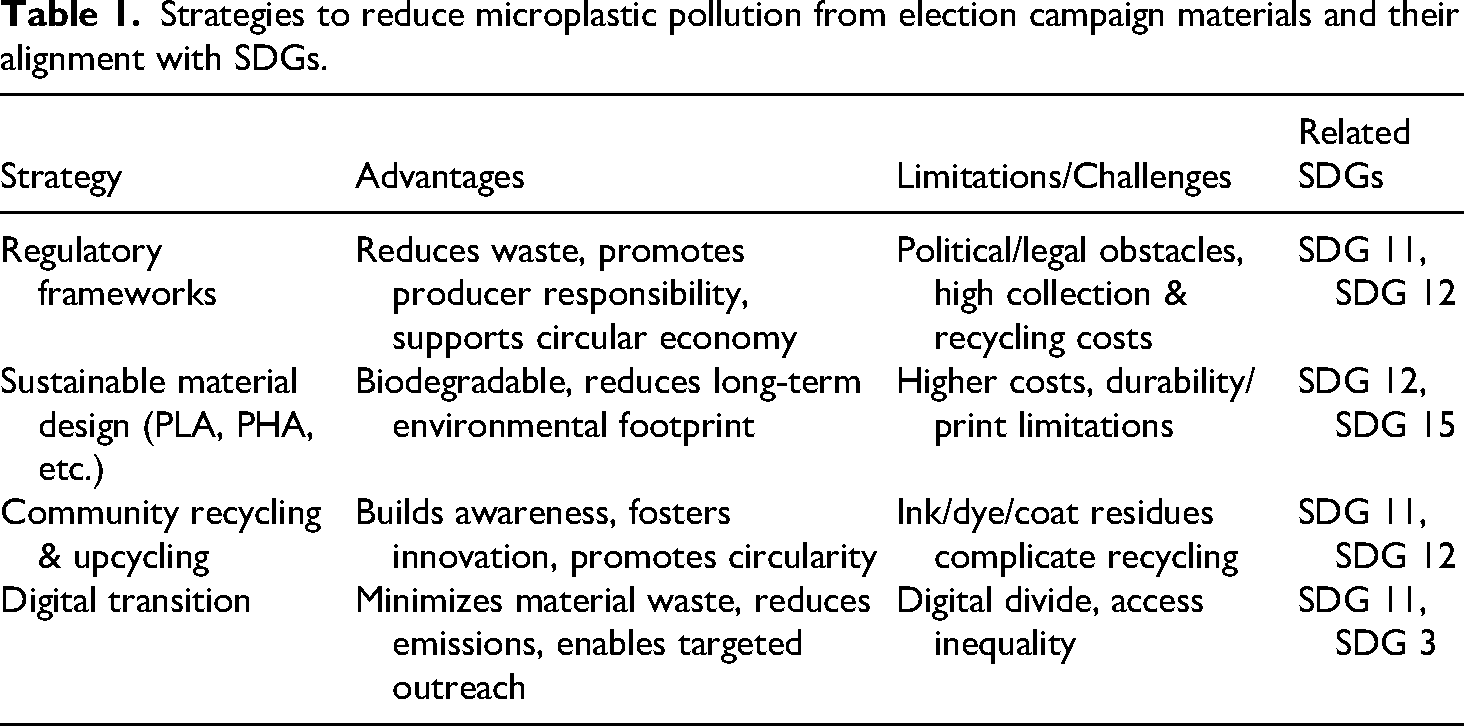
The widespread use of promotional banners and posters during election seasons presents significant environmental sustainability challenges due to microplastic generation and other pollutants. Addressing these issues requires integrated strategies that combine regulatory frameworks, sustainable material innovation, community engagement, and digital transformation. These approaches are closely aligned with the Sustainable Development Goals (SDGs), particularly SDG 11 (Sustainable Cities and Communities), SDG 12 (Responsible Consumption and Production), as well as indirect links to SDG 3 (Good Health and Well-being) and SDG 15 (Life on Land).
The key strategies, along with their advantages, limitations, and SDG connections, are summarized in Table 1.
Strategies to reduce microplastic pollution from election campaign materials and their alignment with SDGs.
Bridging promises and practices: Toward sustainable election campaigns
While many candidates and political parties frequently pledge climate action and emphasize sustainability commitments during election campaigns, a paradox persists: these same campaigns often generate significant amounts of “election waste”, including banners, posters, and flyers composed of synthetic polymers. The disposal of these materials contributes not only to microplastic pollution but also to the release of dioxins, greenhouse gases, and toxic residues through incineration and landfilling processes.
In this study, we qualitatively demonstrated the potential for microplastic generation from campaign materials using FTIR and SEM analyses. However, we did not perform quantitative recovery of microplastic loads, which remains a limitation of our work. Future studies should focus on systematic quantification under real-world conditions to better assess environmental and health risks.
In this era of intensified global electoral activities, it is imperative to rethink the environmental footprint of political campaigns. This issue extends beyond elections to include promotional materials used in public events, festivals, commercial establishments, and governmental institutions, all of which rely heavily on synthetic media that contribute to environmental degradation.
Achieving sustainable campaign practices requires collaborative governance, bringing together scientists, policymakers, local authorities, private sector stakeholders, and civil society organizations. Such multi-stakeholder engagement fosters inclusive decision-making and promotes systemic transitions toward low-carbon, resource-efficient, and pollution-free promotional strategies. These collaborative efforts are essential for supporting sustainable urban development and aligning local actions with global sustainability frameworks, particularly SDG 11 and SDG 12.
Additionally, there is an urgent need to advance research and innovation in developing eco-friendly alternatives to conventional campaign materials. Investment in biodegradable polymers, recyclable composites, and low-impact printing technologies is critical for minimizing the environmental burden of political campaigns and other large-scale public engagements. By fostering technological innovation, policy reform, and community participation, future promotional activities can actively contribute to global sustainability goals, rather than compromising them.
Conclusion
This study provides the first qualitative assessment of microplastic generation potential from election campaign materials using FTIR and SEM analyses. The findings highlight the urgent need for sustainable alternatives to conventional banners and posters, while also acknowledging the limitation of not quantifying microplastic loads. Future research should focus on systematic quantification and exposure assessment under real-world conditions. Overall, integrated strategies that combine regulation, material innovation, community recycling, and digital transition may help transform election campaigns and other mass public events from major contributors of plastic waste into opportunities for environmental stewardship.
Supplemental Material
sj-docx-1-sci-10.1177_00368504251397431 - Supplemental material for Toward sustainable election campaigns: Addressing microplastic pollution from promotional materials
Supplemental material, sj-docx-1-sci-10.1177_00368504251397431 for Toward sustainable election campaigns: Addressing microplastic pollution from promotional materials by Ji Hoon Seo in Science Progress
Footnotes
Acknowledgements
This work was supported by the National Research Foundation of Korea (NRF) grant funded by the Korea government (MSIT) (RS-2024-00406500 and RS-2025-00561448). The authors acknowledge that ChatGPT (OpenAI, San Francisco, CA, USA) was used to refine the English language of some sentences in this manuscript. No scientific data were generated or modified using AI.

Ethical considerations
Not applicable
Consent to participate
Not applicable
Consent for publication
Not applicable
Author contributions
Ji Hoon Seo: Conceptualization, Methodology, Investigation, Data curation, Formal analysis, Visualization, Writing – original draft, Writing – review & editing.
Funding
The author received no financial support for the research, authorship, and/or publication of this article.
Declaration of conflicting interests
The author declared no potential conflicts of interest with respect to the research, authorship, and/or publication of this article.
Data availability
Share upon reasonable request.
Supplemental material
Supplemental material for this article is available online.
References
Supplementary Material
Please find the following supplemental material available below.
For Open Access articles published under a Creative Commons License, all supplemental material carries the same license as the article it is associated with.
For non-Open Access articles published, all supplemental material carries a non-exclusive license, and permission requests for re-use of supplemental material or any part of supplemental material shall be sent directly to the copyright owner as specified in the copyright notice associated with the article.
