




Abstract
Climate change and plastic pollution are two main issues that our world is currently facing, and they are mainly linked through various processes, mechanisms, and chemical blueprint. Emerging issues related to microplastic (MP) contamination in freshwater are expanding and diverse research is being carried out globally. Factors causing climate change are increasing the frequency of extreme weather phenomena such as floods, drought, sea level rise, and heat waves, which can directly or indirectly influence the plastic/MP contamination in various ecosystems including groundwater environments. Here, we review the impacts of extreme weather events on MP contamination in freshwater with a specific focus on groundwater environments. This narrative review shows that flooding can have the most adverse effect on the MP pollution in groundwater environments through recharge events. Drought can also have major effects on MP pollution. Karst, alluvial, and coastal aquifers exhibit the highest levels of MP contamination among various aquifer types. Climate change's impact on different types of aquifers can vary depending on hydrogeological conditions and other factors in the groundwater environment. Prevention and comprehensive solutions are crucial for addressing MPs in the environment, with downstream measures being supplementary to upstream ones.
Introduction
Groundwater is a vital component of freshwater. More than 2 billion people depend on groundwater for drinking, agriculture (cultivation), and industry, 1 and recent investigation revealed that groundwater is contaminated by microplastics (MPs) in a way that could impact microorganisms and other environments.2–10 A study on MP occurrence in groundwater was initiated by Panno et al. 11 in Illinois, United States. MPs (<5 mm) are emerging pollutants that originated from the breakdown of plastic by degradation (weathering and crushing). 12 MPs can be divided into primary type, which are MPs that are released into natural environments directly (microbead, pellets, toothpastes, textile application, and skin care products), and secondary type, which are MPs that were fragmented from larger particles into smaller ones (such as road making and tires).3,5,13 MP pollution in groundwater has not received much attention compared to other environments such as marine, river, lake, and terrestrial environments. 14 The reason could be because the groundwater area is the most untouched area and not easily accessible for sampling and monitoring. Also, the sampling and extraction procedures for MPs in groundwater are still not comprehensive and standardized.15,16 The most frequent shape of MPs found in groundwater are PE (polyethylene), PET (polyethylene terephthalate), and PP (polypropylene).11,17,18 Previous studies suggest that the source of groundwater MP contamination could be the vertical transportation of soil movements and surface water.2,4,19,20 Aquifer recharge rates and their quantity/quality state are among those that are impacted by climate change processes.21–23
Freshwater, which includes groundwater, is a critical asset for human needs, cultivation, and ecosystems. As extreme climate change intensifies, freshwater is negatively impacted, especially by anthropogenic pollution. Extreme climate change events such as tropical storms can bring post-flooding effects which can have a big impact on MP contamination in environments.24,25 It is not only critical to apply sustainable management measures such as recharge, pumping rate regulation, and monitoring and managing contamination sources, but there is also a need to lower greenhouse gas emissions (GHG) and mitigate the effects of climate change to lessen the hazards. Climate change effects are indeed increasing recently and is becoming a serious matter when it comes to geopolitical conditions. 26 The issue of climate change has expanded since the Industrial Revolution took its first steps on the world stage in the nineteenth century.27–29 Climate change is an ongoing shift in the world's climate system, including changes in temperature and precipitation. 30 Human actions, such as the use of fossil fuels and deforestation, are mostly responsible for these changes as they raise the amount of GHG into the atmosphere and trap more heat. 25 Climate change has far-reaching repercussions, such as droughts, increasing sea levels, more frequent and severe heat waves, flooding, and changes in ecosystems.
Studies have examined the connections between marine plastic contamination and climate change.31–33 Plastic production, subsequent transportation, disposal, and degradation processes are currently impacting climate change by releasing GHG into the atmosphere.31,32,34–36 Additionally, the usage of plastic films can increase GHG emissions including CH4 and N2O.37–39 Although it seems as though MP/plastic pollution, GHG emission, and climate change are independent of one another and are separate environmental problems, they are interconnected and can have an effect on one another in certain circumstances.36,40,41 Extreme weather conditions, including floods, drought, sea level rise, and heat waves, can have a notable impact on the distribution and fragmentation of MPs in all environments, including groundwater. Recently, studies are exclusively focused on the climate change matter and plastic issues in marine areas. As one of the freshwater resources, the groundwater component is equally significant as the marine one in terms of the earth's ecosystem and mankind's existence.
When it comes to climate change and plastic/MP contamination problem in environments, these two issues have been treated as separate matters. The connection between plastic and MP pollution and its impact on climate change is interrelated across various habitats, exerting a significant influence.31,36,42 Nonetheless, there is a notable absence of comprehensive and extensive research examining the relationship between freshwater contamination by MP and the consequences of climate change. Understanding how climate change can impact the MP contamination in groundwater is a primary objective of this paper. Moreover, the aims of this study are (1) to clarify and discuss the interrelation between climate change and MP contamination in groundwater with an emphasis on different types of aquifers, (2) to observe and underscore how extreme weather activities can have an impact on the MP pollution status in the groundwater environment and (3) to point out the knowledge gaps and future perspective research opportunities on the mitigation and preventive measures.
Methodology
Extraction strategy and data mining process
Our objective was to demonstrate that the repercussions of climate change, including extreme weather events, significantly influence MP contamination in groundwater, either directly or indirectly via freshwater supplies. The whole process of the search methods, inclusion criteria, and data extraction strategy are explained in detail in the following paragraph. This review is guided by the Scale for the Assessment of narrative review articles (SANRA). 43
Primarily, research papers published between 2015 and 2023 were chosen by employing specific keywords such as “groundwater microplastic,” “groundwater microplastic and climate change events,” “freshwater/groundwater microplastic and extreme weather events: flooding, drought, sea-level rise, and heat waves,” “climate change impact on groundwater,” and “climate change impact on the fate and transport of microplastic.” A total of 904 articles and review articles were observed at first. Peer-reviewed full-text articles, review articles, books in the English Language were excluded from the screening process for this study. We have excluded preprint, proceedings, early access, editorial material, and data papers. A total of 904 articles can be arranged as follows: 110 articles with freshwater/groundwater MP search term, 322 articles with freshwater/groundwater MP and climate change events search term, 266 articles with freshwater/groundwater MP and flooding search term, 200 articles with climate change impact on freshwater/groundwater search term, and 6 articles with climate change impact on the fate and transport of MP search term. These methodologies were employed to ensure fulfillment of the research objectives, mitigate bias, ensure equitable representation of data, and facilitate its accessibility. 44 The outline of the manuscript and conducting literature reviews is improved with the help of the large language model (ChatGPT-4 version).
To ensure the solidness of the 904 publications, the screening process was done to include only updated and quality original research articles and a few review articles. The omission of duplicates of articles (80) resulted in 824 articles. Being out of scope according to the title review and section, 569 articles were removed. Among these, 46 were excluded because they were not focused on the direct and indirect linkage to the freshwater MP fate and transport impact by climate change. After filtering 904 publications (including full text excluding process), 188 were selected to build the review articles (Figure 1). Therefore, the remaining 188 full-text articles were then identified as the main base dataset to discuss the impact of climate change on groundwater MP contamination.

Description of the detailed process phases used to filter papers for this study in the form of a flowchart.
Results and discussion
Impact on groundwater in the fate of climate change
Climate change directly affects the earth's hydrological rhythm and can inevitably affect groundwater quality and quantity. A more direct relationship between climate change and the hydrological cycle is melting of glaciers due to warmer temperature globally. Glaciers are one of the most crucial sources of freshwater, especially for Asian countries. 45 It has long been confirmed that climate change affects the Earth's hydrological cycle, but most studies before only focused on the direct effects of global warming to glaciers and surface water. Studies relating to climate and groundwater were also scarce,46,47 so much so that it narrows down the capacity of the Intergovernmental Panel on Climate change IPCC to relate groundwater and climate change in its assessment reports in the past, but there has been an increase in published research since then. 48
Groundwater is the source of more than 33% of freshwater globally and is used for a variety of purposes, including agricultural, domestic, and industrial uses.48–50 Moreover, groundwater also serves as a key resource during times of drought. 49 The importance of groundwater is immense, but most laws and policies on groundwater use are outdated and are thus inefficient in terms of sustainable management. 49 Sustainable groundwater use is significant because even though groundwater is not a non-renewable resource, it is also not completely and immediately renewable; it is becoming more and more important to use it sustainably even though it is less directly affected by climate change compared to surface water because it is nonetheless connected. 51 Aside from readily replenished groundwater from shallower, more accessible aquifers, we also use “older” groundwater. Most of the groundwater being utilized in continental areas with extensive sedimentary aquifers are from precipitation that recharged these aquifers millions of years ago. 48 Groundwater that originated from recharge events during colder periods like the Late Pleistocene glaciation and the Early Holocene is commonly known as “fossil groundwater.” 48 Taylor et al. 48 emphasize that these are storage-dominated and are not as easily vulnerable to climate change as recharge-flux-dominated groundwater. However, fossil groundwater is not completely unaffected by groundwater depletion and other environmental consequences brought about by bad anthropological practices. 49 Most of the major aquifers in semi-arid to arid areas are at risk of increasing rates of depletion. 49
The main impact of climate change on groundwater revolves around the process of groundwater replenishment. Groundwater recharge is highly dependent on climate, land cover, and geology. 48 In particular, precipitation and evapotranspiration are one of the determining factors of how much groundwater can reach and be stored in subsurface aquifers, so climate variability ends up influencing groundwater as well.48,51,52 Precipitation includes snow, and the changes in snowmelt regimes brought about by global warming tend to affect the magnitude of recharge negatively. 48 Previous research has also mentioned that global warming can enhance the coupling between surface and groundwater systems. 48 The relationship between climate change and groundwater is further made intricate by anthropogenic activity. Long periods of drought and the increasing need for potable water, especially in developing areas, also encourage the over-extraction of groundwater. Taylor et al. 48 cites land use change as a major anthropogenic activity affecting groundwater, and points to the expansion of irrigated agriculture as the main culprit since irrigation-water demand contributes significantly to groundwater depletion.
In addition to its depletion, climate change also exerts an influence on the quality of groundwater. 53 Groundwater is recharged by diffuse (rain-fed) and focused recharge through surface water infiltration, and the increase in the frequency and intensity of rainfall because of climate change also increases the input of pollutants in aquifers. 54 Heavy rainfall brought about by climate change-driven extremes favors the microbial contamination of shallow aquifers, leading to disease outbreaks among populations that extract and consume them.48,55 Heavy rainfall can also increase the turbidity of natural water sources.45,49 Ahmed and others 45 also mentioned that changing climate patterns significantly impact chemical groundwater quality more so than meteorological parameters. For semi-arid aquifers, climate change can also influence the extent of recharge zones and lead to an increased susceptibility to pollution.54,56 Temperature rise has been found to affect chemical water quality, especially since it is favorable for the dissolution of agricultural waste and fertilizers that can directly contaminate water resources. 45 Another case of groundwater contamination from climate change is related to the over-pumping of wells. Over-extraction of water leads to the change in the interface between freshwater and sea water in coastal areas, leading to salinization of groundwater. Moreover, rising sea levels promote saline intrusion in groundwater close to the coast and are already affecting the drinking water of low-income countries such as Bangladesh.45,57
MP occurrence in different types of aquifers
Different aquifer types also respond to climate change differently since the response of the local groundwater system is dependent on various conditions 58 (Table 1). For alluvial aquifers, most studies expect large-scale increase in groundwater temperature and decreased groundwater recharge despite a projected increase in precipitation which could elevate the hydraulic head, consequently increasing flood risks.59–61 Karst aquifers are considered more stable, especially since covered karst is expected to be less affected due to thicker soil cover. 62 However, previous studies observed that karst aquifers tend to undergo a decrease in water storage and quality with response to warming, resulting in an increased demand for clean water supply.62–64 Within coastal aquifers, an increase in sea level is anticipated to increase the possibility of salinization of groundwater, but this can also be an effect of decreased groundwater recharge especially in areas away from the coast;65–67 however, groundwater extraction remains to have a more notable consequence on groundwater than sea level rise. 66
Relationship between climate change and different types of aquifers.

Note: PS, polystyrene; PE, polyethylene; PET, polyethylene terephthalate; PA, polyamide; P, polyester; iPP, isotactic polypropylene; HEC, hydroxyethycellulose; PVC, polyvinyl chloride; LDPE, low-density polyethylene; PP, polypropylene; N/A, not available.
The spatial features of an aquifer dictate the transport of MPs into groundwater. 77 Moreover, pH, ionic composition and strength, and dissolved organic matter (DOM) of an aquifer determine the fate and transport of MPs while controlling the physiochemical properties of the MPs in the aquifer. 78 As a matter of fact, hydro-physiochemical properties are heavily influenced by climate events such as heavy rainfall. High rainfall events might facilitate the efficient mobilization of MPs, enhancing their downward migration to groundwater through soil pores and fractures as rainfall intensity increases.78,79 Karst aquifers are particularly prone to MP contamination due to the significant connection between surface and subsurface water, facilitating the transfer of MPs from surface water to groundwater. 80 In karst areas, heavy rainfall-driven rivers promote the transfer of MPs between surface water and groundwater, intensifying the impact of rainfall. 81 MPs detected in karst regions may be linked to the hydraulic interaction between surface water and groundwater, which facilitates their movement into the groundwater system. 81 Alluvial aquifers are the second most prone area for MP contamination, and a study shows that MPs of 1–5 µm can travel larger scale in alluvial aquifer. 68 Esfandiari et al. 82 suggest that MPs could remain within the alluvial aquifer of semi-arid regions for several years to decades. The size and density of MPs significantly influence their mobility within the aquifer. Typically, MPs with larger particle sizes and lower densities such as PE (0.89 g/cm3) are likely influenced by groundwater movement, rendering them more susceptible to long-distance transfer. 83 Surface chemistry properties of MPs also regulate the transport and movement of MPs in groundwater. Among the most frequently occurring MP types, polyethylene (PE) is influenced by the age of plastic by enhancing the hydrophilicity which increases the mobility of MPs in the aquifer. 84 High-density MPs can cause high retention and lower mobility in porous media. 85
Unconfined aquifers can be more vulnerable to climate change compared with confined aquifers. Unconfined aquifers have a greater exposed surface area and surface-groundwater interactions can influence and disturb groundwater flow easily. Unconfined aquifers in humid regions may have high rainfall and low transpiration rates, whereas in semi-arid and arid areas they tend to have a variable annual balance between precipitation and evapotranspiration.67,86 While studies of MP in confined aquifers remain to be explored, MP contamination of unconfined aquifers suggests that polyethylene (PE), polypropylene (PP), polystyrene (PS), and polyvinyl chloride (PVC) are the most common types of MPs. 74 For fissured aquifer type, due to the existence of cracks and joints, heavy precipitation and long-term drought will make them more vulnerable. MP-related research is absent and needs to be carried out in these specific types of aquifers in the future.
It is crucial to keep in mind that climate change effects may be modified by regional elements including geology, geography, and groundwater management techniques. Research on MPs continues to move quickly and with growing interest in groundwater environments. The most ordinary type of MPs in the karst aquifer is PE (Table 1). Alluvial aquifers are also being contaminated by MPs. PS, PE, and PET are the most common types of MPs in alluvial aquifers.68,87 Coastal aquifers can be contaminated not only through saline intrusion but also by MPs according to recent studies (Table 2). PA, PE, P, iPP, HEC, PVC, and LDPE are the most frequently occurring types of MPs in coastal aquifers. The difference in the MP types can be observed depending on the various types of aquifer, which would then be mainly dependent on the source of the MPs. The predominant contributors to the presence of MPs are agricultural practices, intrusion from marshes and marine sources, and their penetration into soil environments. 70
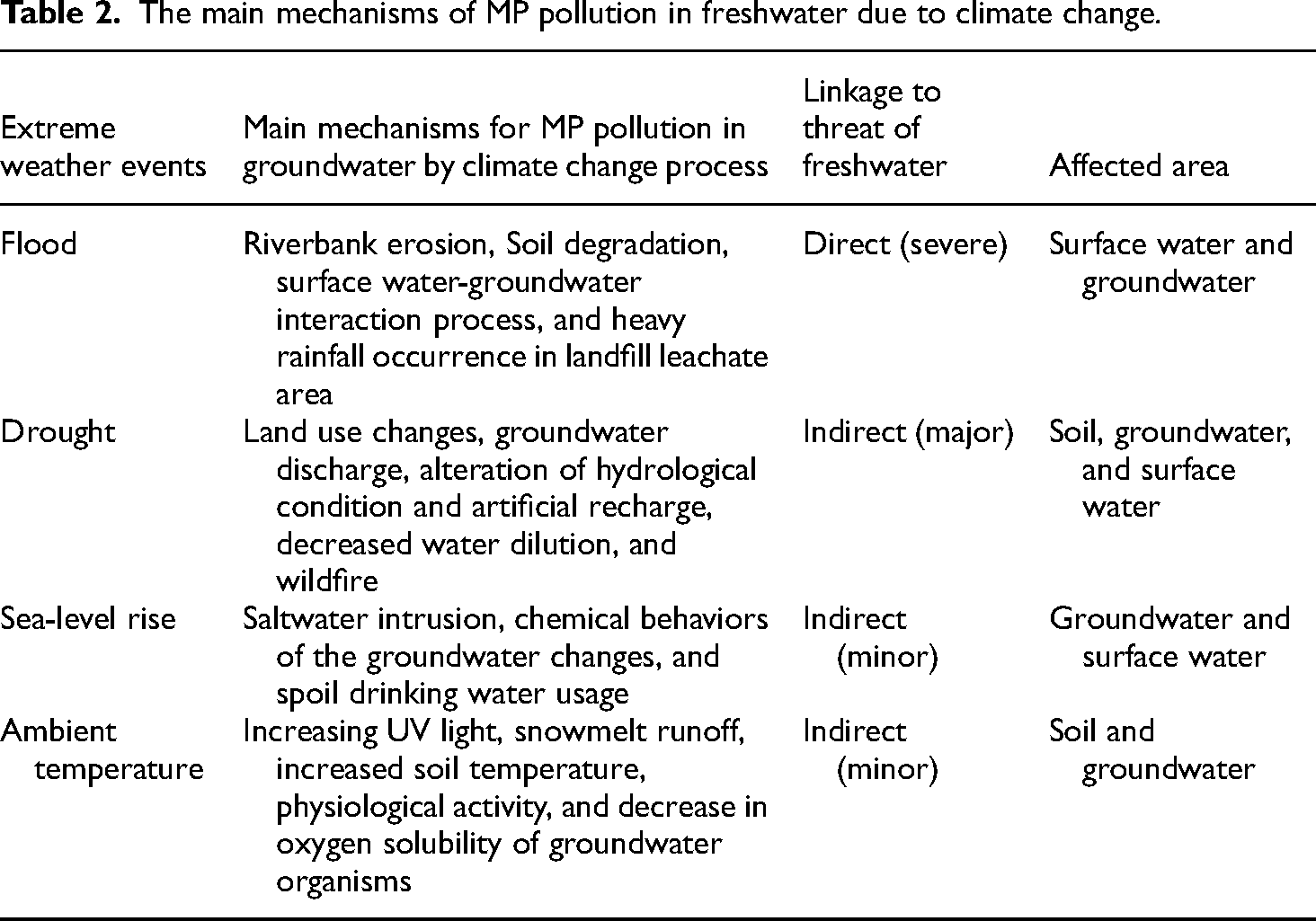
The main mechanisms of MP pollution in freshwater due to climate change.
Flooding effect
Groundwater MP pollution may be impacted by flooding. During a flood, water may bring MPs and other surface detritus into the groundwater. 88 This can result in a surge in the number of MPs in the environment, especially if flooding occurs in areas where a lot of plastic waste has previously accumulated in. The process of recharge plays a crucial part in increasing the amount of MP pollution. 89 Events (heavy rainfall, river or stream flooding, infiltration from irrigation practices) involving groundwater recharge can happen at various times and under various conditions.90,91 A multitude of factors, including the regional climate and hydrological conditions, affect the occurrence of groundwater recharge.92,93 Flood events are also among the most important events that contribute to groundwater recharge. With extreme climate change events, flooding can potentially play a major role in the pollution of groundwater.
Riverbank erosion
There is almost no study about the relationship between flooding and MP contamination in groundwater. The reason could be because the MP contamination in groundwater is in an emerging stage. However, it does not necessarily mean that there can be no positive or negative correlation between flooding events and MPs in groundwater. During periods of flooding, river catchments effectively lessen MP contamination by flushing it away. 94 However, these MPs might end up in other areas such as reservoirs and can consequently lead to the ocean 95 or other freshwater environments. When the riverbank erodes, the sediment along the riverbanks would release into water.96,97 If sediments are contaminated with MPs, a procedure known as bank filtration could carry those MPs into the rivers, streams, and eventually into the groundwater region (Figure 2).

Microplastic pollution fate and distribution to surface water and freshwater environment during flooding events and greenhouse gas emission.
Landfill leachate
Landfill areas which contain MPs can have adverse effects when flooding occurs in that surrounding area because the landfill leachate infiltrate into the freshwater easily, thereby increasing the MP concentration rate in the groundwater environment.17,98 Flooding could also accelerate the transportation of the MPs which are already in the freshwater/groundwater system. 47 The precipitation pattern also strongly influences the MP contamination in the groundwater environment. 99
Surface water–soil–groundwater interactions
It is not debatable that flooding has a direct impact on the MP pollution in freshwater environment. Flooding could favor increased recharge rates, but it can also have a detrimental effect by introducing MPs into aquifers through infiltration networks. MPs may enter the freshwater as a result of surface waste dumps and drainage system leaks. 100 Drainage system leakages mostly happen during flash floods 101 and this might lead to mild MP contamination issues in groundwater. Because of the inundation of wells during flood events, groundwater contamination can occur, significantly increasing not only the concentration of MPs but also other pollutants such as trace metals (heavy metals), chemical fertilizers, and waterborne pathogens. 102 Recharge through flooding events should be focused on as a research topic in the context of MP contamination in the groundwater environment. The impact on various types of aquifers remains a knowledge gap when it comes to MP pollution impacted by climate change. Among the various aquifer types, the unconfined and karst aquifers are the most exposed to MP contamination.11,74 Recent studies have also shown that alluvial aquifers are also polluted by MPs.16,68 Confined aquifers are the least prone to MP contamination unless there is specific access (such as boreholes or tube wells) for contaminants.
According to Severini, 89 the geometry of MPs does not undergo any changes except due to the aquifer recharge and precipitation process. The mechanism behind the impact of flooding on the MP contamination in groundwater is mainly related to the recharge process in a river (surface water interaction with groundwater), and the soil erosion and their porosity properties. There is a chance that flooding events can boost the MP distribution and contamination in the groundwater when it interacts with other aspects such as soil, surface, and subsurface water (Figure 2, Table 2). Soil erosion and riparian erosion will transport MP particles into their own systems and eventually into the groundwater system.94,103,104 In the tropical coastal area, the transportation of floating plastics through the effects of climate change is gradually expanding. 105 The aquifers near the coast can also have a partial impact when the flooding occurs in that area during heavy rainfall periods. Wetlands play a vital role in the process of recharge within freshwater environments. 106 Flooding resulting from heavy rainfall can transport MPs from other sites into the wetland area, which can eventually infiltrate groundwater. The impact of flooding events to MP pollution in groundwater should not be neglected.
Drought effect
Droughts are natural events, and they regularly affect 60% of the world's rivers. Climate change and global changes (i.e. water withdrawals, agriculture) are increasing the frequency, intensity, and duration of droughts, making them a threat to biodiversity. 107 In a way, drought events can highlight the important role of groundwater to human society as a source of drinking water and other activities such as agricultural processes. 108 Drought stands out as a highly significant global disaster event due to its detrimental impact on surface and groundwater resources. In fact, recharge processes may be severely affected by this event.109,110
Drought might increase the probability of MP pollution in freshwater by altering water conditions, lowering dilution capacity, intensifying concentrations, and influencing land use (Figure 3). Increased rates of evapotranspiration, which is a consequence of severe drought, is exacerbated, which can lead to lower groundwater depth levels. 108 There are a variety of ways wherein drought might affect groundwater level, mostly through interactions with the soil environment.111,112

Microplastic pollution fate and transport to freshwater environment during drought events and their main mechanisms.
Alteration of hydrological conditions and artificial recharge
The condition of the hydrological system usually changes during drought especially when it is severe. The primary effect is the reduction of groundwater recharge. Consequently, as the groundwater table decreases, MP pollution that has entered the groundwater may become more concentrated.16,74 Moreover, drought may also disrupt the transport and spreading system of MPs in the freshwater environment. MPs can adhere to vegetation along the riverbanks or get entangled in silt when water levels drop, which might act as potential sources for re-entrainment and further pollution. 113 Drought events can somewhat alter the transport mechanisms of MPs in groundwater environments as MPs may accumulate and settle in stagnant waters when flow and recharge processes are reduced. 114 Artificial recharge is the process which increases the amount of water by artificially injecting surface water and rainfall into the groundwater aquifer through manmade facilities such as spreading basin, artificial wetlands, percolation tanks, and recharge trenches.108,115 The purpose of artificial recharge is to prevent water scarcity issues during drought events and to ensure a sustainable supply of groundwater for drinking, agricultural, and industrial uses.116,117 However, during the artificial recharge processes, the contamination of MPs in groundwater environments is likely to occur. The reason is that most of the artificial recharge techniques such as artificial recharge wells and spreading basin involve the penetration of water through soil to recharge the underlying aquifer. If soil is contaminated with MPs prior to artificial recharge, MPs are likely to be transported, polluting the groundwater environment.
Land use changes
Land usage usually changes during drought events.118,119 Due to the lack of rainfall and stored water, farmers may lessen cultivation or give up certain agricultural fields. Soil erosion may rise as plant and vegetation cover declines and bare soil becomes exposed.120,121 MP contamination may increase if the degraded soil contains MP particles that are subsequently transported into the groundwater through infiltration.3,103,122 Soil can both be a barrier and a transport route for MPs in groundwater environments.2,4 On the other hand, drought could lead to land use practices changes, for example, increasing irrigation to compensate for the absence of rainfall and precipitation in farmland areas.123,124 Therefore, MPs may be introduced into soil by the use of plastic mulch, irrigation tubing, or other plastic-based agricultural techniques, which may subsequently percolate into the groundwater.
Groundwater discharge
During drought, groundwater is the most precious alternative water source.125–127 Groundwater discharge is the movement of water from a subterranean body of water or an aquifer to the surface of the earth. Groundwater discharge is important for the ecosystem since this process provides water to rivers, lakes, agricultural area, and serves as a water supply to some habitats and wild species. Groundwater pumping for agricultural practices and urban places can have an impact on the groundwater availability on the worldwide scale. 128 This scenario could create pathways for MPs to enter the groundwater ecosystem by being exposed to the surface of the earth and the atmosphere. Springs play a vital part in the groundwater discharge process, and if springs are contaminated by MPs, the use of this water as a clean resource may be at risk (Figure 3).
Decreased water dilution
Reduced water levels and flow rates may occur in rivers, lakes, and streams during a drought. 129 With reduced water availability, there is a diminished capacity to dilute and transport MPs, potentially leading to a decline in pollutant dilution and an elevation in the concentration of MPs in the water.130,131 As long as the MPs persist and accumulate in rivers, lakes, and streams, they might be infiltrated and percolated to the surface water, soil, hyporheic zone, and groundwater environment.132,133
Wildfire
Wildfire is a common natural hazard which happens frequently during the drought period when the surrounding environment gets dry and easily flammable. As a result of the wildfire, vegetation may be destroyed or damaged, which may reduce the amount of precipitation that naturally seeps into the ground and soil erosion can happen due to the loss of forest cover and instability of the soil structure.134,135 If rain fell over burnt land, it may produce severe erosion that could wash any MPs or silt into nearby rivers, streams, and groundwater sources. Moreover, wildfire can produce high amounts of ash, debris, and carbon particulates. 136 These can end up in the surface water and soil which could lead to an increased impact to the groundwater. The research about the interconnection between wildfire and MP contamination in the environment is still a gray area and further research needs to be done in the future.
Sea-level rise effect
Research on how rising sea levels affect MP contamination in groundwater is sparse. However, it is important to consider how sea level increase might indirectly influence MP pollution in groundwater. The presence of MPs (and plastics in general) in oceans is very significant and projected to increase tenfold by 2025.137,138 More than 50% of debris that enter oceans are plastic detritus.139–141 The presence of MPs in the marine environment can be both direct, such as in the case of fishing and agriculture,138,142 and indirect, such as the transport from terrestrial environments.138,143 Moreover, a conspicuous area of floating trash in the northern Pacific Ocean, dubbed the “Great Pacific Garbage Patch” (described as having an area equivalent to twice that of Texas),138,144 has been alluded to in many media reports and current research. The marine environment has been recognized as a huge sink for MPs and the occurrence of MPs in various marine sub environments have been well documented, 145 so it is not unlikely that rising sea levels can bring back these MPs to terrestrial environments such as groundwater. Coastal flooding enables the movement of plastics from terrestrial to marine environments, 144 and reversely, flooding and storm events near the coast can leave significant amounts of marine plastic debris on land through backflow and flooding in areas such as wastewater treatment plants and stormwater pipes. 141 Consequently, it might end up entering the freshwater environment including groundwater and lead to an increase in MP contaminants.
Coastal erosion is one of the consequent events from sea-level rise and it is a potentially crucial mechanism for MP pollution in groundwater. Through percolation, coastal erosion can mobilize and transfer MP particles from coastal regions to freshwater sources. 146 Another way by which rising sea levels and rising temperatures (as consequences of climate change) can affect MP movement is through the melting of glaciers (Figure 4). Although a deficient number of studies have been published on the presence of MPs in glaciers, it has been found that glaciers can contain MPs and transport them as incorporated in glaciers or as part of glacial melt.147,148 Marine plastics are affected by ice melt in multiple ways. The flux of MPs (specifically those trapped in ice) can be affected by the seasonal expansion and contraction of ice sheets, but since most glaciers were formed millions of years ago, the release of plastics from glaciers is expected to be minimal. 144

Indirect impact of sea-level rise and heat waves on microplastic contamination in freshwater environment.
Heat waves effect
Ambient temperature does not have a clear effect on MP degradation, since exposure to ultraviolet (UV) radiation is what contributes more to the degradation process;138,149 that is, there is no absolute effect of high or low temperature on MP degradation. 149 However, it is crucial to account that temperature plays a significant role in photodegradation of plastics, since it can affect the chemical bonding (and the ease or difficulty in breaking these bonds), molecular mobility of polymer chains, and the initiation energy of chemical reactions.149,150
Light exposition can have indirect effects on the presence of MP not only in groundwater but also in other environments such as soil and surface water resources. Alternatively, it can have a potential impact on the behavior of various factors which contribute to the MP pollution in the environment. Increasing the amount of UV light in the environment can further degrade the MPs into much smaller sizes, which can then spread more easily to various ecosystems (including groundwater), microorganisms, and wildlife.151,152 A rise in temperature has the potential to speed up the decomposition of plastic waste and change the way that MPs, including much even smaller particles (nanoplastic), might contaminate groundwater supplies in the future. 153 Heat waves are most likely to affect surface runoff, snowmelt, and rainfall patterns. Indeed, local climate systems play a vital part when it comes to increased temperature-related events born from climate change. Arctic sea ice has already been polluted with MPs, posing a threat to species living in polar areas.154–156 Increased snowmelt runoff to the oceans, rivers, and freshwater ecosystems because of polar ice melting will pave new MP pathways into each environment. Increased soil temperature can change and open the transportation portal for MPs by earthworms and soil biota, among other possible effects on the groundwater environment.157,158
Groundwater fauna (i.e. stygofauna), which is mostly inhabited by indigenous crustaceans, is extremely susceptible to the effects of anthropogenic activity159,160 and increase in temperature. 161 Rising temperature causes an increase in physiological activity and a decrease in oxygen solubility, which speeds up the pace at which groundwater flora and fauna absorb contaminants.161,162 Even though the research on how MPs could affect stygofauna is still not clear, 3 there is a chance that higher temperatures can increase the microbial activities which will lead to increased degradation rates of MPs. The relationship between microbial degradation and groundwater MP pollution remains to be explored by researchers. In warmer climates, especially in developing countries, improper waste management procedures or a lack of recycling infrastructure can worsen the MPs issue. This could lead to increased MP pollution in groundwater through a number of different pathways. Moreover, the quantity of plastic water bottle consumed could increase as temperature increases especially in populated regions including agricultural sectors, mining, and fishing sites, 163 which would eventually contribute to the production of MPs in various environments, including groundwater.
Strategies for tackling MP pollution issues
Combating the effects of climate change and MP pollution in freshwater environments requires a multifaceted approach which targets the reduction of emissions, developments in waste management system and innovation in the removal of plastic materials. Long-term solutions to these problems require a holistic approach based on scientific research, technological advancement, and legislative reform, which must address both adaptation and mitigation. The most relevant terms common between MP pollution and climate change solutions are greenhouse gas emissions (GHGs) and ocean plastic pollution. Here, the understanding of how the MP pollution in groundwater environments affects and enhances the emission of GHGs is vital in order to tackle both issues and brainstorm for sustainable solutions. The effects of MPs on GHGs in freshwater systems are mainly related to the microbial colonies, and polyethylene terephthalate (PET) is the most responsible MP type to enhance CO2 and N2 in freshwater sediments.164,165 Moreover, PET is one of the most common MPs in groundwater. 4 MPs in freshwater can release CO2 and affect the carbon sink system, eventually contributing to climate change. 32 Moreover, compared with the saltwater ecosystem, the freshwater ecosystem amplifies the MP enhancement of CO2 emissions more. 166 As the MP pollution in freshwater impacts climate change, extreme weather events (due to climate change) can also favor the increase of MPs entering the freshwater environments, creating a positive feedback loop for climate change and MP pollution in freshwater environments. MPs will be continuously input into the freshwater environment in sinks, either in isolated systems (such as lakes) or systems that are connected to each other. 167
There are a number of sustainable solutions to address both issues and their feedback loop. The most crucial aspect is that we humans must reconsider our moral duty to protect and preserve our planet for future generations. 32 Using bio-based plastics is a more favorable choice for reducing GHG and freshwater pollution during the plastic production life cycle. 168 Bioplastics are a type of plastic derived from renewable biological sources, such as vegetable fats, corn starch, or microbiota, rather than traditional plastics which are typically manufactured from petroleum. Bio-based plastics account for 2% of total plastics, and it is encouraged to do a life cycle assessment of bio-based choices. 169 Polyhydroxyalkanoates (PHAs), thermoplastic starch (TPS), polylactic acid (PLA), and polybutylene succinate (PBS) are some examples of commonly used bio-based plastics. 170 Moreover, it is anticipated that if bio-based plastics were chosen instead of traditional plastics, 66% of the world's population would have a decrease in carbon dioxide emission of 241–316 metric tons per year. 171 The European Commission (EC), South Korea, and Thailand have developed various effective initiatives to promote bio-based plastics. 168 Ban of single-use plastic is also another strategy to tackle both issues in a sustainable way. Since July 2022, India has prohibited the sale of any products made of single-use plastic. 32 The United States banned the use of microbeads since they are the main source of the secondary MP material in freshwater environments. 172 While the European Union (EU), United Nations (UN), and World Health Organization (WHO) are making efforts to tackle the plastic/MP issues, the Association of Southeast Asian Nations (ASEAN) are only focusing on the reduction of the plastic and recycling of the plastic instead of the MPs in the various environments. The World Health Organization (WHO) has not established any particular criteria or limitations that were considered acceptable for the presence of MPs in drinking water.
Reducing MPs in the freshwater environment is crucial to reduce the emission of GHGs into the atmosphere which can directly impact climate change-related processes. Certainties regarding human psychology 173 and the necessity of balancing acts of good global citizenship with national interest have made it difficult to act on climate change. 31 GHG emissions can be reduced by using renewable energy. In the United States, 50–75% of GHGs were effectively reduced from using this. 174 Scotland's Zero Waste Plan and Climate Change Act was set up in 2009 to reduce GHG emissions, develop a low carbon economy, and contribute to Scotland's fight against climate change and promotion of renewable sources.175,176 The presence of groundwater MPs is not easily observable, but individuals’ eagerness to address the problem is linked to growing environmental consciousness, which could be an entry point to addressing climate change. The complex nature of how climate change affects freshwater MP stressors requires coordinated and sustainable strategies across all sectors. In terms of worldwide sectors, Sustainable Development Goals (SDGs) stand a chance to start as a foundation of human prosperity and peace. SDG Nos. 13 and 14 are the most relevant to climate change and MP issues, respectively. SDG No. 14 only calls for awareness mostly in the marine environment. More specific calls on the freshwater environments need to be taken seriously in the future.
The Nordic Council of Ministers say that MP pollution needs to be addressed as a different category from plastic pollution, pointing out that particular control measures are required especially because the Global Plastic Treaty agreement will be implemented soon, aiming to eliminate the comprehensive pollution caused by plastic. 177 Furthermore, the Paris Agreement represents a major political achievement in the context of climate change negotiations and provides an important impetus for academic research. 178 Public awareness and education on both issues are also vital in pushing for sustainable behavior change. Enforcing stricter regulations on plastic production and use, such as banning single-use plastics and microbeads in personal care products and encouraging industry and energy production to reduce GHG emissions to mitigate climate change are also good solutions (Table 3). Efforts are being made by each country or organization through several laws and policies. To tackle both issues, more efforts are needed to be carried out and the MPs in groundwater should not be disregarded.

Upstream measures for MP pollution
Preventive measures and source reduction strategies, collectively referred to as upstream measures, are more cost-effective than mitigation measures in the case of MP pollution. These pertain to the efforts which prevent processes that allow plastic to enter in the first place. Prevention measures have been carried out across the globe, especially in the United States, Canada, and EU countries (Table 3). The United States introduced the first act linked to MP particles, called the “Microbead-free Waters Act,” in December 2015, as previously stated. Despite the fact that this act merely decreases one of the many sources of MPs, there is still a need for improvement because there is no scientific methodology for determining which MPs are in urgent need of reduction. 181 As powerful countries enforce policies connected to MPs, it is important to formally recognize MPs as a detrimental legislative element worldwide. Public concern about MPs, including the behaviors and attitudes towards them, plays a crucial role in decreasing emissions of MPs. 182 Recent studies present the importance of mitigating MPs in the marine environment and near coastal regions.179,183 Upstream measures are adequate for the marine environment; however, it should also be applicable to the terrestrial and freshwater ecosystems. A basic outline for the upstream measures is included as circular economy, behavioral changes, bio-based polymers, and market-based instruments. 184 Moreover, international collaboration, increased research funding, and extended producer responsibility (EPR) should also be included in upstream measures. As research collaboration on MPs increases, there is a greater awareness regarding the issue, which leads to stakeholders and policy makers pushing the boundaries and limits of addressing MPs globally. EPR regulations enforce product end-of-life responsibility and encourage manufacturers to design items that are easier to recycle, reuse, or dispose of without affecting the environment. EPR works well for packaging, textiles, and other MP-producing products.
Downstream measures for MP pollution
Downstream MP policy interventions aim to reduce their impacts on environments, wildlife, and human health through the management of existing contamination and supporting upstream MP prevention. Downstream measures include degradation, conversion of waste to energy, wastewater treatment plants, and cleaning up. 184 Degradation of plastic is only available to biodegradable plastic, and it has a limitation of what the degradation of MP has become and how it affects the environment. Furthermore, it is crucial to note that MPs present in wastewater cannot be fully eliminated using conventional wastewater treatment plants (WWTPs) and drinking water treatment facilities. 185 A pilot-scale rapid sand filtration (RSF) system removes MPs efficiently, with rates between 84% and 98%. 186 A recent study has demonstrated that biochar is highly successful in removing MPs when used in conjunction with coagulation effluent, resulting in a removal efficiency of over 90%. 187 However, it is imperative that additional efforts be made in order to develop methods that are both highly efficient and cost-effective in order to reduce the presence of MPs in the environment. Among the downstream measures, habit restoration deployments or projects should be initiated to protect the coral reefs, mangroves, and riverbanks which are contaminated by MPs. It is important to have balance restoration between the upstream and downstream measures of MPs in order to tackle the MP issues in different environments.
Future perspectives
MP pollution in groundwater can indirectly contribute to climate change through various mechanisms. While MPs have little direct influence on climate change, their presence can exacerbate some environmental problems that contribute to it. For example, if we use MPs contaminated groundwater for agricultural practices, this could cause harm to crop and livestock which can potentially lead to making additional land for cultivation. Later on, deforestation and subsequent GHG emissions can occur. Regardless, MP pollution in groundwater systems still needs to be explored further in the future. Moreover, the role of groundwater MP pollution in climate change should not be disregarded as part of the interdisciplinary and mitigation plans for both issues even though MPs in groundwater contribution to CO2 emissions and climate change is relatively minor. The main future perspectives of the study are as follows:
Study of climate change's impacts on plastic pollution (and vice versa) is mainly focused on the marine environment. Further research is required to pay more attention to other water environments including groundwater and surface water areas. In contrast to droughts, major flooding may have a greater influence on water quality.
188
Moreover, the interrelationship between flood and MP occurrence is more direct compared with other extreme weather events such as drought, sea-level rise, and heat waves. Evaluation of the effects of floods to MP occurrence in groundwater environments should be investigated to protect and maintain groundwater sustainability. Drought, sea-level rise, and heat wave events are also indirectly affecting the MP contamination in the groundwater ecosystem. As the MP pollution in various ecosystems is expanding, the research and evaluation of the relationship between the above extreme weather events and MP pollution in groundwater should be carried out in the future in order to understand the actual impact. Globally, water security and climate change are the two main issues as they each stand as SDG Nos. 6 and 13, respectively. The interlinkage between climate change and MP pollution in various environments needs special attention. Although climate change's impact on the MP pollution in the groundwater environment may not be as significant compared to other ecosystems such as marine or soil, the potential effect of MPs on the groundwater should not be disregarded. To comprehend the scope of the issue, it is crucial to continuously monitor groundwater quality and MP pollution. To increase the precision and effectiveness of monitoring activities, technological developments including enhanced sampling strategies and sensitive detection methodologies (groundwater modeling) should be used widely. Moreover, research should also focus on determining the main sources of groundwater MP contamination as well as the ways that climate change affects their distribution and fate. While MP pollution in groundwater is in emerged from emerging state, the contribution of MP pollution in groundwater environments to climate change should be focused on and evaluated in the future (mainly related to CH4, CO2, and N2O emissions). Obviously, climate change can have an influence on the distribution and fate of MPs in groundwater. Potentially, there could be a feedback loop where MP contamination contributes to climate change, which in turn, can impact various ecosystems and exacerbate climate change process. This research knowledge gap should be appraised more comprehensively to mitigate and minimize climate change and MP pollution issues in groundwater.
Conclusions
Concerns about the pollution of groundwater with MPs due to plastic usage are spreading around the globe. However, there is little study on the relationship between groundwater MPs and climate change. The distribution of MPs in the environment can change as a result of major climate-related events such as floods, droughts, sea-level rise, and temperature changes. Due to climate change, these occurrences are becoming more common, which can aggravate MP pollution globally. Extreme weather can affect the MP problem, whether it is directly or indirectly related to climate change. Exploring this intricate interaction should be a priority for future studies. Mitigating the effects of climate change on groundwater quality is not a new concept. 53 However, as the demand for sustainable groundwater increases, current research, and technologies on sustainable management of groundwater should keep up as well.
Footnotes
Author contributions
HK conceptualized and supervised the work. NAK prepared the outline and wrote the manuscript. RML contributed to the drafting of the manuscript. HK contributed to project administration and funding acquisition. NAK, RML, and SN edited the manuscript.
Declaration of conflicting interests
The authors declared the following potential conflicts of interest with respect to the research, authorship, and/or publication of this article: HK is a Section Editor of Science Progress and did not participate in the editorial handling or peer review process of this article. The other authors have no conflicts of interest to declare.
Funding
The authors disclosed receipt of the following financial support for the research, authorship, and/or publication of this article: This research was funded by the Korea Environmental Industry & Technology Institute (KEITI) through the Measurement and Risk Assessment Program for the Management of Microplastic Program, funded by the Korea Ministry of Environment (MOE), grant number 2020003110010; and supported by the Basic Science Research Program through the National Research Foundation of Korea (NRF) funded by the Ministry of Education (grant numbers 2019R1I1A2A01057002 and 2019R1A6A1A03033167); and Korea Ministry of Environment as “The SS(Surface Soil conservation and management) projects; 2019002820004.”
