



Abstract
Microplastic, which is of size less than 5 mm, is gaining a lot of attention as it has become a new arising contaminant because of its ecophysiology impact on the aquatic environment. These microplastics are found in freshwater or drinking water and are the major carriers of pollutants. Removal of this microplastic can be done through the primary treatment process, secondary treatment process, and tertiary treatment process. One approach for microplastic remediation is ultrafiltration technology, which involves passing water through a membrane with small pores to filter out the microplastics. However, the efficiency of this technology can be affected by the structure and type of microplastics present in the water. New strategies can be created to improve the technology and increase its efficacy in removing microplastics from water by knowing how various types and shapes of microplastics react during ultrafiltration. The filter-based technique, that is, ultrafiltration has achieved the best performance for the removal of microplastic. But with the ultrafiltration, too some microplastic that are of sizes less than of ultrafiltration membrane passes through the filter and enters the food chain. Accumulation of this microplastic on the membrane also leads to membrane fouling. Through this review article, we have assessed the impact of the structure, size, and type of MPs on ultrafiltration technology for microplastic remediation, with that how these factors affect the efficiency of the filtration process and challenges occur during filtration.
Introduction
Plastic is referred to as a synthetic organic polymer obtained from the polymerization of a single unit of monomer which is extracted from oil or gases.1–4 This plastic has been used widely around the world as it has become an essential material for various purposes. The enormous production of plastic started in 1940, the amount suddenly got increased with the production of 230 million tons which is produced globally in the year of 2009 and its today's production is around 2.4 billion tonnes,5–7 it is expected that by the end of 2050, the production will be more than 33 billion tones. As the consumption of plastic will increase production will also be increased. These plastics travel easily through the hydrodynamic process and ocean currents. With this, the mid-point quantity of plastic accumulated on the seaplane is around 18,000 items per km2 and more plastic was found in North Atlantic Ocean and Pacific Ocean. 8 Plastic takes time to degrade and the process is very slow. These plastics degrade into tiny particles through automatic action, bioremediation, or photooxidative degradation over a long period. These small molecules below 5 mm are called “microplastic.”9,10 These MPs with sizes not so much as 5 mm in length they can be found in all types of ecosystem artic areas 11 to the seawater in the Antarctic region,12,13 from rivers13–16 to the residue13,17,18 and it is also found in the atmosphere which we inhale,13,19 it can be said overall environment is sheltered with these MPs. MPs in water bodies are found in a range of sizes, with the concentration varying from zero to millions of particles per cubic meter. 20 Unfortunately, this poses a significant risk to aquatic animals as MPs can block their organs and cause serious health problems. Due to their small size, MPs can easily be ingested by aquatic animals, such as fish, birds, and other marine organisms, causing blockages in their organs. 21 This can lead to a range of issues, including decreased food intake, malnutrition, and even death. Moreover, the accumulation of MPs in the organs of aquatic animals can cause severe damage to their reproductive system, leading to a decline in their population. 22 This is a significant concern as it can lead to the extinction of certain species, which can disrupt the entire ecosystem. 23 It has been shown in many studies that these MPs are stable in aquatic environments. 24 Now, these MPs are entering into waters thus leading to serious environmental and health problems that have been increased. 25 Unfortunately, these plastics can end up in the ocean and contribute to the global plastic pollution crisis. Among the various types of plastics that are commonly found in the ocean, polypropylene (PP), polyethylene (PE), polystyrene (PS), and polyvinyl chloride (PVC) are the most abundant.26,27 These plastics are widely used in many applications due to their durability, flexibility, and versatility, but their accumulation in the ocean can lead to devastating effects on marine life and the entire ecosystem. 28 Therefore, it is crucial to reduce the use of these plastic materials and take necessary measures to prevent their release into the environment, such as proper waste management and recycling programs. By doing so, we can mitigate the negative impact of plastics on the environment and ensure a sustainable future for our planet.
These threats are as these MPs are good carriers of noxious organic chemicals that have immense areas and rigorous hydrophobicity. Many of these organic pollutants have been reported in the inshore areas of many countries, such as the USA and the UK, Japan, South Africa, Brazil, and Hong Kong. Various heavy metals such as Zinc, Copper, and Lead usually get adsorbed over the microplastic and some of these heavy metals get influenced due to the hindrance of the light.29,30 Due to the small size of microplastic, they are usually mistaken for aquatic organisms. And due to this, there is automatic harm to the organism and also decreases the nourishing ability of the organism. Also, it was found that gene expression of fish can alter subsequently microplastic adsorbed organic pollutants which can also lead to threatened human health due to the food chain.31–34 With the previous studies on microplastic removal technology using wastewater treatment plants (WWTPs), MPs were not removed completely from wastewater. Following the example, in the UK, after the preliminary, primary, secondary, and tertiary treatment process in WWTPs, the overall abundance decreased by 6%, 68%, 92%, and 96%, respectively. 35 The mechanical and chemical process removed microplastic up to 99% in WWTP. It is well known that ultrafiltration (UF) has been applied widely and will be applied in the next few decades due to the superb outflow standard they have.36,37 In this study, we have reviewed different studies in which microplastic has been removed using the UF membrane. The increasing demand for plastic products has led to a surge in plastic pollution in oceans and water bodies, causing harm to aquatic organisms and leading to the death of fish due to plastic ingestion. 38 Unfortunately, most industries do not have the capability to filter plastic waste on-site, leading to the discharge of untreated wastewater directly into water bodies like rivers and lakes. This has resulted in alarming levels of microplastic contamination in freshwater sources, with some WWTPs releasing millions of microplastic particles every day. Single-use plastic bottles and cans that contain drinking water quality are also a cause for concern, as they may contain microplastic particles that can have serious impacts on human health. 39 Therefore, various technologies are being developed for the treatment of drinking water, specifically targeting the removal of MPs.
Testing for MPs in marine fish of economic value is crucial because MPs may cause the transfer of hazardous chemicals to human tissues. Fish (such as grass carp) have been documented to swallow MPs both near the shore and in deep seas, and reports of plastics in fish digestive systems have grown quite prevalent in recent years. 40 According to Esposito et al.’s 41 findings, MPs, the major polymer of which is PE and includes fibers, films, and fragments, were found in the intestines of eight distinct deep-sea fish. Diverse marine predators mostly rely on these fish for food and energy. These are vital ecological and economic species that have the potential to have a significant influence on the whole food chain. Aquatic creatures that absorb MPs combined with various nutrients have the potential to move up the food chain and reach higher trophic levels. The detrimental effect of MPs on living things is related to the leaching of monomers and additives, such as plasticizers, stabilizers, pigments or colorants, antioxidants, and fillers or flame retardants, which are toxic, carcinogenic, or endocrine disruptors, as well as the strong mechanical injury potential of MPs ingested in the digestive tract of the organism. 42
Although microplastic pollution is not a recent phenomenon, identifying the hazards connected to micro- and nanoplastics is a growing issue. Physical properties (such as size, shape, and surface), purposefully added additives, environmental durability, and the capacity to absorb contaminants and pathogens and concentrate them along the food chain are all dangers posed by micro- and nanoplastics. 21 Depending on the level of exposure and the individual's vulnerability, MPs are thought to be potentially damaging to organisms. 43 They can lead to cytotoxicity, oxidative stress, and translocation to other organs. The consequences that might result from the desorption of pollutants absorbed by the MPs themselves and the chemical additives included in the account for a large portion of the worry generated by MPs. 44 Overall, plastic pollution is a significant environmental issue that requires immediate attention and action. Industries must take responsibility for their plastic waste and invest in effective waste management and recycling programs. Additionally, individuals can play their part by reducing their use of single-use plastic products and properly disposing of plastic waste. By working together, we can address this issue and ensure a sustainable future for our planet. With the advancement in technology many more advanced technologies are there for wastewater reuse and membrane filtration is one of the main technologies. It is accepted as most because it is cost-effective and deals with secondary treated effluent on non-potable reuses, such as agriculture irrigation, urban reuse, and water for industries.35,45–47 UF tends to remove high efficiency of total suspended solids, organic matter, microorganisms, and so on. With the studies of Muthukumaran et al., 48 and Pollices et al. 35 or Falsanisi et al. 49 it is confirmed that when prefilter is used with UF that water is qualified concerning all guidelines of World Health Organization (WHO) and that water can be reused.
Research on the use of UF membranes for microplastic remediation has been increasing in recent years. However, one research gap that still exists in this area is the limited understanding of the effectiveness of UF membranes in removing MPs of various sizes, shapes, and chemical compositions. Most studies have focused on the removal of MPs in the range of 1–100 μm, but there is a lack of information on the effectiveness of UF membranes for smaller or larger MPs. Additionally, there is a need to investigate the long-term performance and stability of these membranes in the presence of MPs, as well as the potential for fouling and degradation. However, the microplastic particles which are smaller than the pores of the membrane can still be present in the water filter the UF, the techniques to minimize this are still not known. 50 Further research is needed to optimize the design and operation of UF membrane systems for microplastic remediation, with a focus on increasing efficiency, reducing energy consumption, and minimizing environmental impacts.
Only a few articles have so far documented the use of membrane techniques to remove MPs. In this review, a study of the relevant literature has been done to show how the scientific community is becoming more aware of the issues with plastic pollution and to highlight how little is known about and has been done to remove plastic, with a focus on the use of membrane technologies. The membrane procedures that are used to remove plastic have been documented and severely examined.
Characteristics
Shape and size of MPs
MPs came in a variety of sizes, shapes, and physicochemical compositions, as well as toxicity levels. 35 The four types of MPs that were most frequently found in wastewater were fibers, pellets, fragments, and films, with the greatest abundances of 91.32%, 70.38%, 65.43%, and 21.36%, respectively. 51 The most common microplastic shape was that of the fiber, a filamentary microstructure. Domestic washings are where the microplastic fibers came from. The frequency of finding fibers has increased as a result of increased washing and textile use. Toothpaste, face masks, and soaps were the main sources of microplastic pellets and fragments in the environment. Plastic packaging bags served as the source material for microplastic films. 52 In addition, it was found that there were various microplastic shapes as well, including flakes, ellipses, foams, particles, and lines. A crucial factor affecting the performance and transformation of MPs was their size, not their shape. The food chain could come into contact with MPs. It is important to emphasize the size of the particles in MPs. By shattering the primary MPs into smaller pieces, physical, chemical, and biological processes produced the secondary MPs. 53 Plankton, fish, and other filter-feeding species were more likely to consume the smaller microplastic particles, which could have several toxicological impacts on these organisms. 54 It follows that studies on the biological toxicity and environmental transformation of MPs can learn from research on microplastic particle size, especially that of the smaller particles (less than 1 mm).
Type of polymer of MPs
Polymers include MPs. Twenty-nine different types of polymers were present in the influent and effluent of the WWTPs. PE, PP, polyamide (PA), polyester (PES), PS, and polyethylene terephthalate (PET) were the top six MPs most frequently discovered in wastewater with the greatest abundances of 64.07%, 32.92%, 10.34%, 75.36%, 24.17%, and 28.90%, respectively. 55 Plastic items, such as bags used for food packing, bottles, and cutlery, are the source of the PE, PP, and PS MPs. The main sources of home MPs are synthetic garments and textiles, which are where the PA, PET, and PES MPs primarily come from.51,56 Additionally, it was discovered that the tire and textile industries, mechanically crushed plastic products, and rubber particles in road dust could all be significant sources of PE, PP, PS, and PES MPs. 57 In addition to the aforementioned polymer categories, particular polymers were also found in WWTPs. 58 As a result, particular polymer types should receive higher research priority than ordinary polymers. Different microplastic polymer types are shown in Table 1 of the WWTP. 59
Different MPs in wastewater treatment plants with the quantity of influent and effluent (particles per liter).

Remediation of MPs by UF
UF is an economical method to remove various types of contaminants from water or wastewater and the use of UF to remove MPs allows the simultaneous removal of other unnecessary feed ingredients, for example, proteins, fatty acids, bacteria, protozoa, viruses, and suspended solids. UF is often used in conjunction with other methods as the second stage of wastewater or water treatment. MPs were removed using a combination of primary treatment processes, secondary treatment processes (biofilters), and tertiary treatment processes. The effectiveness of removing MPs using primary and secondary treatment techniques was comparable. The elimination efficiency of the tertiary therapy was just moderate. The 95% CIs showed a wide variance in the tertiary treatment steps (0.22–1.06). As a result, filter-based methods (UF) had the highest results in terms of eliminating MPs. 61
In a few previous studies, it has been suggested that the microplastic can be removed by coagulation with iron or aluminum salts in combination with UF on a polyvinyl membrane.62,63 In a conventional treatment system, the findings revealed that an average of 77 7.21 particles/L were discovered in the influent and 10.67 3.51 particles/L were discharged with the final effluent, yielding an overall removal efficiency of 86.14%. The removal efficiency rose to 96.97% when an UF unit was taken into account, and the number of MPs in the effluent decreased to 2.33 1.53 particles/L. 64
In the study of Joan et al., 65 it is shown that the UF technique of advanced treatment of microplastic removal was more effective than that of the carbon filtration stage which is an upgraded conventional treatment. But still, the concentration of microplastic in the finished water was 0.06 ± 0.04 MP/L, which is in the low range considering the state of the art.
Effect of shape, size, and types of polymers on MPs removal
Fibers were the most frequently found MPs in wastewater out of the four shapes of MPs. They had weighted average RR values of 0.31, 0.41, and 0.43 in the primary, secondary, and tertiary treatment phases, respectively. When it comes to removing fiber MPs, primary treatment is better than secondary and tertiary therapy. During the first treatment, flocculation and settling made it simple to catch fibers. Following the first treatment phase, the majority of the easily settled or skimmed particles were removed; any particles that were left over may, however, float neutrally. 66 During the secondary treatment procedure, however, fragments showed outstanding removal efficiency. Fragments had respective weighted average RR values of 0.41, 0.30, and 0.36. Lamellar-structured activated sludge ate the fragments as they continued to aggregate. 67 For the primary, secondary, and tertiary treatment processes, the weighted average RR values for the films were 0.35, 0.34, and 0.47, respectively. The primary, secondary, and tertiary treatment processes all had greater success rates at removing MPs than the tertiary treatment operation. Pellet removal was easier during the final stage of treatment. In the primary, secondary, and tertiary treatment phases, the weighted average RR values for the pellets were, respectively, 0.63, 0.76, and 0.35. Pellets could be successfully intercepted by treatment methods that use filters. Additionally, the tertiary treatment method demonstrated incredibly high efficacy in eliminating MPs with particular characteristics and tiny particle sizes. The primary and secondary treatment procedures’ weighted average RR values were, respectively, 0.70 and 0.48. Both MPs with particle sizes between 1 and 5 mm and those between 0.5 and 1 mm were more effectively eliminated during the first treatment procedures. In the size range of 0.5–1 mm, the weighted average RR values of the MPs were 0.31 and 0.74, respectively. For MPs with a size between 1 and 5 mm, the weighted average RR values were 0.06 and 0.53, respectively. 35 Processes for secondary treatment made it simple to trap MPs whose range of particle sizes was lower than 0.5 mm. Primary settling was effective at separating fibers and MPs with large particle sizes (0.5–5 mm). It has been found that fibers consist of more than 60% of the total MPs in the 0.05–0.5 mm size category, which was the most prevalent group. 64 Bacteria in the activated sludge were easily able to capture PE and particles of MPs with small diameters (less than 0.5 mm). More research should be done on the effects of various particle sizes, shapes, and types of polymer on the elimination of MPs during treatment operations. 59 Table 2 shows the removal efficiency of different sizes of microplastic in wastewater. The efficiency of these UF membranes is decreased if membrane fouling occurs, in this, the microplastic of different sizes blocks the pores of the membrane. If the accumulation of this microplastic over the membrane takes place for longer duration it then completely destroys the membrane. Figure 1 shows the degradation of plastic into microplastic and removal of these through the UF and making water ready for drinking.
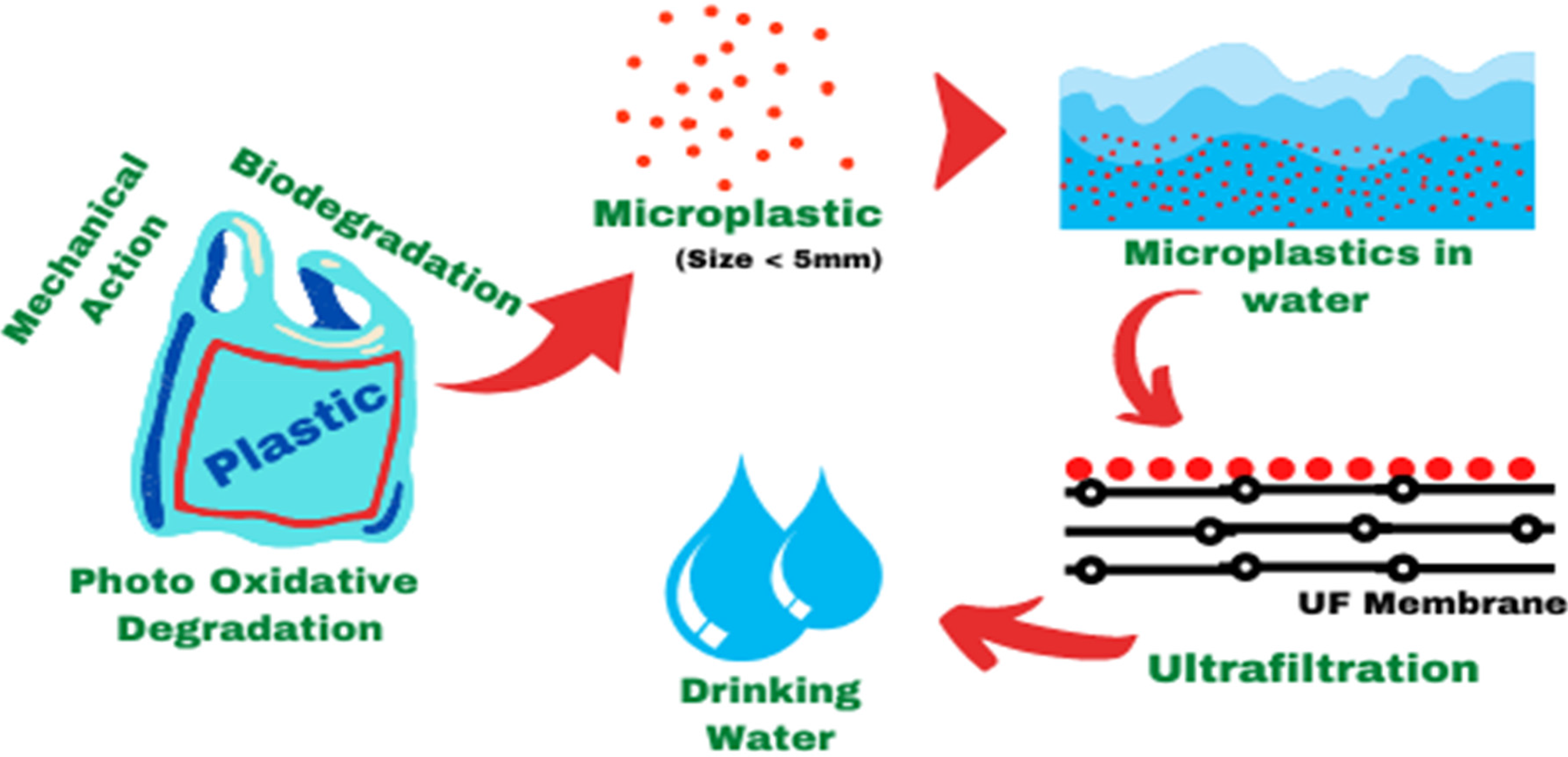
The image depicts the degradation of plastic into MPs and the subsequent removal of MPs using ultrafiltration. The ultrafiltration process involves forcing water through a membrane with pores that are small enough to filter out MPs. The filtered water is ready to drink.
The removal efficiency of different sizes of microplastic.

PES: polyether sulfone; PET: polyethylene terephthalate; PA: polyamide; PE: polyethylene; PP: polypropylene; PS: polystyrene; PAM: polyacrylamide.
Fouling of membrane
Membrane fouling, which lowers throughput, is a problem in the application of membrane filtering. Due to their ability to completely too partially block pores, small MPs have the potential to have a more powerful fouling effect than large ones.63,88 By combining the sieving and adsorption of particles and chemicals onto the membrane surface or inside the membrane pores, membrane fouling is the term used to describe the blocking of membrane pores during filtration. Pore obstruction lowers the rate at which permeates are produced and complicates the membrane filtration process. Hydraulic resistance significantly increases as a result of membrane fouling.89,90 A significant membrane fouling could result from a high MP concentration creating a thick cake layer. UF membranes were demonstrated to be completely too partially blocked by small MPs, demonstrating that small MPs may be more harmful to membranes than large ones. Throughout the treatment period, the primary membrane fouling mechanism, as mediated by MPs, changed. Membrane fouling by MPs is intermediate at the start of treatment, and it can eventually result in full obstruction. Cake formation might then take place, with internal pore blocking serving as the main membrane-clogging mechanism over time. 91 The best indications of membrane fouling are permeating flux and transmembrane pressure. 89 Cake layer development and internal pore obstruction may now be the main causes of MP-related membrane fouling as a result of environmental aging and biofilm. Additionally, these MPs and related biofilms or adsorbate can cause internal, irreversible fouling, that shortens the lifespan of the membrane and raises operating expenses.88,91 Figure 2 shows the different types of membrane fouling while the process of UF for the removal of microplastic.

The image displays different types of membrane fouling that can occur during the process of microplastic remediation using ultrafiltration. Here the first image shows the intermediate blocking, then comes the complete blocking, followed by cake filtration and internal pore blocking.
Implementation of this work in conjunction with global work
Governments and organizations are also taking action to tackle the issue of microplastic pollution. For example, in the European Union, a ban on single-use plastics was implemented in 2019. Many countries, such as Canada and the United States, have also implemented regulations to reduce the production and use of MPs. The Canadian government, for instance, has prohibited the use of MPs in cosmetic products since these pellets fall to the bottom of seas and rivers and collect there. 92 NGOs and research institutions are also conducting research and raising awareness on the issue of MPs to encourage individuals to change their behavior and reduce plastic waste. Financial strategies including penalties, taxes, fees, subsidies, deposit-refund programs, and incentives have also demonstrated their efficacy in encouraging the recycling of goods, which reduces the amount of waste that is dumped and the consequent build-up of MP pollutants in an aquatic environment. 93 The use of natural items like walnut shell powder and mineral powder has replaced micro-sized plastic pellets in cosmetic products, while compostable and biodegradable polymers and paper are being advocated for use as packaging materials. Due to their benign nature and biodegradability, polylactic acid, starch, sugarcane, and mushroom-based biomaterials are being advocated for usage in a variety of applications as alternatives to PE and PS. 93 Apart from these policies and schemes and various research, several companies and organizations have already begun exploring the use of UF membranes for microplastic remediation. For example, a Dutch company called Aqua Minerals has developed a system that uses UF membranes to remove MPs from surface water sources. Another company, Aquaporin, has developed a biomimetic UF membrane that mimics the natural filtering process of cell membranes.
Overall, the issue of MPs is being tackled through a combination of scientific research, policy changes, and individual actions. It will require a concerted effort from individuals, governments, and organizations globally to effectively address the issue and protect the health of the planet and its inhabitants.
Conclusion
As the plastic gets degraded it started forming microplastic of different shapes and sizes. MPs being size 0.5 to 5 mm are present in large quantities in water bodies and when this microplastic enters the food chain it produces toxicity into the organisms. Microplastic can enter in human food chain either through fish or through the drinking water. So, there is a need to remove microplastic from drinking water and UF is one of the fine methods for removal of these small microplastic from the water. MPs and crucial treatment technologies interacted very differently, as did the removal mechanisms. When used in UF technology, MPs rapidly adsorb to the membrane surface due to interactions with the membrane pores and surface. The sludge eventually contained some of the MPs removed by the above-mentioned technologies, but the MPs produced by the WWTPs posed environmental toxicity and dangers. Also, less understood were the effects of conventional pollutant removal, reaction intermediates, and their toxicity produced by the current treatment technique in the removal of MPs. Microplastic, in particular, contains chemicals that are hazardous to bacteria. To prevent emissions into the soil and aquatic habitats, microplastic-targeted remediation methods are also critically needed. It has been concluded that the larger microplastic can be easily removed with the help of an UF membrane but the microplastic which is of very small size can pass through the pores of the membrane so there is a need to remediate that small sized microplastic too. Due to their ability to completely too partially block pores, small MPs have the potential to have a more powerful membrane fouling effect than large ones. Membrane fouling by MPs is intermediate at the start of treatment, and it can eventually result in full obstruction. More research should be done on how different polymer kinds, particle sizes, and shapes affect the removal of MPs during various treatment techniques. Further research should be done on how crucial treatment technologies remove MPs. The development of standardized sampling and analysis techniques should be the main focus of future research to more accurately assess the fate of the MPs in WWTPs or other environmental media. From the literature analysis, it was found that the removal of microplastic by membrane technology is still insufficient.
Footnotes
Author contributions
Conceptualization: G.A., K.K.A., and M.S.S.; methodology: A.S. and P.P.P.; validation: M.S.S. and G.A.; formal analysis: G.A. and R.L.C.; investigation: S.K.; resources: V.N.; data curation: G.A. and A.R.R.; writing—original draft preparation: G.A.; writing—review and editing: A.S. and K.K.A.; visualization: G.A.; supervision: M.S.S.; project administration: G.A.; all authors have read and agreed to the published version of the manuscript.
Declaration of conflicting interests
The author(s) declared no potential conflicts of interest with respect to the research, authorship, and/or publication of this article.
Funding
The author(s) received no financial support for the research, authorship, and/or publication of this article.

Author biographies
Anuj Sharma is currently pursuing a MSc in Forensic Science from Vivekananda Global University, Jaipur, Rajasthan. He has successfully completed his BSc in forensic science from Lovely Professional University Punjab and he holds a Diploma in Photography from Maharishi Dayanand Vocational Training Institute, New Delhi. Anuj's expertise and dedication are evident in his impressive publication record, which includes 12+ research papers published in international and national journals. His work focuses on various fields, including microplastic remediation, nanoparticles targeting antimicrobial activities, carbon nanotube-based nano-biosensors, adulterants in illicit liquor, fingerprint analysis, and nanotechnology, where he explores innovative approaches and techniques to advance forensic science. Recognized for his contributions, Anuj has participated in numerous national and international conferences. At these prestigious events, he presented his research through posters and oral presentations, sharing his findings with fellow researchers and experts in the field. Anuj's commitment to his field extends beyond research and publication. He has gained valuable practical experience through internships at esteemed institutions such as the Central Bureau of Investigation (CBI) in New Delhi, the State Forensic Lab in Jammu and Kashmir, and the National Human Rights Commission. In recognition of his exceptional performance, he was awarded the first position in a research project during his internship. Anuj's dedication to forensic science and his outstanding accomplishments have earned him recognition within the field. Notably, he was honoured with the Resilient Forensic Scientist Award at the National Forensic & Criminal Investigation Summit & Awards-2023, further cementing his reputation as an accomplished researcher and aspiring forensic scientist.
Supriya Kumari is currently pursuing a MSc in Forensic Science from Vivekananda Global University, Jaipur, Rajasthan. She successfully completed BSc in Genetics from MAKAUT, WB. Supriya's passion for forensic science led her to embark on a 1-month internship at CFSL (Central Forensic Science Laboratory), CBI (Central Bureau of Investigation), New Delhi. During this valuable experience, she gained practical knowledge and hands-on training in various aspects of forensic science. Supriya's academic and research achievements are commendable. She has authored and co-authored seven research and review papers on diverse topics such as phytoremediation, heavy metals, forensic science, nanobioformulations, and microplastic remediation. These papers have been published in prestigious Scopus Indexed Journals, both at the national and international levels. Her contributions to the scientific community showcase her dedication and expertise in her chosen field. Beyond her academic pursuits, Supriya actively engages in extracurricular activities, webinars, seminars, and national and international conferences. Her participation in these events demonstrates her commitment to staying updated with the latest developments and advancements in forensic science. Through such engagements, she also nurtures her interpersonal skills and expands her professional network.
Rushikesh L. Chopade is currently pursuing a MSc in Forensic Science from Vivekananda Global University, Jaipur, Rajasthan. He has successfully completed PG Diploma in Forensic Science and Related Laws from Government Institute of Forensic Science, Aurangabad (Maharashtra). He has completed Bachelors of Science at Sant Gadge Baba Amaravati University, Maharashtra. His passion for forensic science led her to embark on a 1-month internship at CFSL (Central Forensic Science Laboratory), CBI (Central Bureau of Investigation), New Delhi. Throughout this crucial experience, he got practical understanding and hands-on training in many different aspects of forensic science. Rushikesh's academics and scientific achievements are excellent. He has published and written together 23 research and review publications on themes ranging from nanobiosensors to heavy metals, forensic science, nanobioformulations, and microplastic clean-up. These papers have been published in major Scopus Indexed Journals on both the national and international levels. His contributions to the field of science demonstrate his dedication and expertise for his chosen subject matter. He has been awarded as High Impact Factor Award in NFCI Conference. Rushikesh participates in extracurricular activities, webinars, seminars, and national and international conferences in addition to his academic interests. His attendance at these events displays her dedication to remain up to speed on the newest breakthroughs and achievements in forensic science. She also improves her interpersonal skills and builds her professional network through such activities.
Pritam P. Pandit is currently pursuing a Master's Degree in Forensic Science from Vivekananda Global University, Jaipur, Rajasthan. He has completed Post Graduate Diploma in Forensic Science and Related Laws from Government Institute of Forensic Science, Aurangabad, and graduated from Rajarshi Chhatrapati Shahu College, Kolhapur, Maharashtra. In addition to academics, he also holds a prestigious degree in music as ‘Sangeet Visharad' in subject Tabla. His passion and outstanding dedication contributing towards the field can be seen by his quality work published in peer-reviewed national and international journals. He has published 21 research and review articles and 4 book chapters during his post-graduate degree. He has also been awarded with one Indian Copyright and one International Patent (German).Pritam has received several internships including CBI(CFSL), New Delhi. Recently, he has been awarded with ‘Resilient Forensic Scientist Award’ by Legal Desire Media and Insights in National Forensic Science Criminal Investigation (NFCI) Summit & Awards, 2023.
Abhishek R. Rai is a student of Forensic Science, currently pursuing Master of Science in Forensic Science from Vivekananda Global University, Jaipur, Rajasthan. He has successfully completed Bachelor of Science in Zoology from Pune University, Maharashtra, and he holds Diploma in Photography from Maharishi Dayanand Vocational Training Institute, New Delhi. During his studies, Rai Abhishek also had the opportunity to participate in several internships and research projects in the field of forensic science. His passion for Forensic Science led him to embark on a 2-month internship at RFSL (Regional Forensic Science Lab) in Kota in Division of Toxicology. He gained valuable hands-on experience in various areas of forensic science, including DNA analysis, crime scene investigation, and forensic toxicology. Abhishek's academic and research achievements are commendable. He has authored and co-authored in eight research and review papers on topics like Fingerprint, toxicology, wildlife, heavy metal, and nanoparticle. He has received his third award in poster presentation in ‘International Conference on Forensic Science Forum’ organized by Sharda University in Greater Noida. His contribution to the scientific community showcases his dedication and expertise in his field. Beyond his academic pursuits, Abhishek actively engages in extracurricular activities, webinars, seminars, and national and international conferences. His participation in these events demonstrates his commitment to staying updated with the latest developments and advancements in Forensic Science. Through such engagements, he also nurtures his interpersonal skills and expands his professional network.
Varad Nagar is currently pursuing BSc (Honours) in Forensic Science from Vivekananda Global University in Jaipur, Rajasthan, and he holds Diploma in Photography from Maharishi Dayanand Vocational Training Institute, New Delhi. His passion for forensic science inspired him to undertake a 3-month internship at NFSU in Delhi, where he gained hands-on experience in various aspects of forensic science and research. Nagar has achieved impressive academic and research accomplishments. He has authored or co-authored more than 21 research and review articles covering diverse topics such as fingerprinting, nanotechnology phytoremediation, heavy metals, forensic science, and nanoplastic remediation. These papers have been published in Scopus Index Journals at both national and international levels. He has also been credited with one Indian Copyright and one German Patent. Nagar contributions to the scientific community demonstrate his dedication and expertise in his chosen field. He was recognized for his research work with the Junior Researcher of the Year Award at the NFCI 2023 Summit & Awards. In addition to his academic pursuits, Nagar is actively involved in extracurricular activities, webinars, seminars, and national and international conferences. These events showcase his commitment to keeping up-to-date with the latest developments and advancements in forensic science. Nagar also develops his interpersonal skills and expands his professional network through these engagements.
Garima Awasthi is an Assistant Professor in Vivekananda Global University, Jaipur, Rajasthan. She earned PhD in Biological Sciences from CSIR-National Botanical Research Institute (CSIR-NBRI) in 2016. She also worked as SERB-National Post Doc fellow at University of Lucknow from 2016-2018. In recent years, she has published more than 13 scientific articles in international indexed and peer-reviewed journals on heavy metal stress in plants, mainly in arsenic problem in rice, which have been widely cited. She has been an evaluator of scientific articles and manuscripts for various international scientific publishers. The line of research that she develops is multidisciplinary in the areas of plant abiotic and biotic stress, nanotechnology, plant physiology, and proteomics. She has collaborated with various educational institutions and research centres, as well as with the industrial sector. Garima has taught various courses and seminars and has participated in various national and international scientific conferences. Likewise, she has advised various students for the development and completion of bachelor degrees, Master of Science degrees, and Doctor of Science theses in the life sciences discipline.
Apoorva Singh is currently working as a Forensic Professional in the Cyber Forensic Division at the Central Forensic Science Laboratory Chandigarh, MHA, Govt. of India. She is a postgraduate in Forensic Science from Harisingh Gour Vishwavidyalaya and is currently pursuing her PhD in Forensic Science from Vivekananda Global University, Jaipur, Rajasthan. She has also been associated with VGU, Jaipur, as Teaching Assistant and Lloyd Institute of Forensic Science, Greater Noida as Assistant Professor in the past. Singh has been awarded with the ‘Young Scientist Award' and ‘Young Researcher Award’ for her contribution in the field of Forensic Science. Her academic achievements include 1 Copyright, 18 paper publications in renowned journals and 10 book chapters in various books.
Kumud Kant Awasthi is currently working as an Associate Professor and Head at the Department of Life Sciences, Vivekananda Global University (VGU), Jaipur, India. Prior to this position, he worked at the National Institute of Animal Welfare (NIAW), Faridabad, India, the unique and only institute in Asia governed by Ministry of Environment, Forest and Climate Change, Government of India. Awasthi is a nanotoxicology expert who received his BSc from CSJM University, Kanpur, India in year 2002, then MSc in Zoology and his PhD from the University of Rajasthan, Jaipur, India. Awasthi's research focuses on environmental toxicology in relation to nanoparticles. He has extensive experience in toxicity assessment for various nanomaterials in different in vivo and in vitro models, with a focus on their safe use for drug development. He is also guiding PhD scholars in their studies. He also authored/edited books in his field and got copyright: German and Indian patents for the innovative works. He is an active member of Institute Innovation Council (IIC), Nodal Officer of Intellectual Property Rights (IPR) Cell. Awasthi is also a member of the sectional committee that organizes international courses for Global Initiative for Academic Networks (GIAN) and has served as the course coordinator for Animal Welfare courses offered by Jawaharlal Nehru University (JNU), New Delhi, India. Awasthi was invited to debate the ethics of fur at Oxford Centre for Animal Ethics, UK. Awasthi is a lifetime member of several prestigious national and international scientific societies, including STOX: Society of Toxicology (India); ISCA: Indian Science Congress Association; SMRS: Soft Materials Research Society; MRSI: Materials Research Society of India; ISLS: International Society of Life Sciences; ESTIV: European Society of Toxicology In Vitro and many more. He is also a nominated member of the committee for ethical use of laboratory animals in research by CPCSEA, Government of India. Awasthi remains actively engaged in research activities, serving as a member of editorial boards and a reviewer for various scientific journals including Springer and Elsevier, as well as participating in organizing committees for many national and international conferences.
Mahipal Singh Sankhla is a highly accomplished Assistant Professor in the Department of Forensic Science, University Centre for Research and Development (UCRD), Chandigarh University, Mohali, Punjab, India. With extensive experience in the field of Forensic Science, he previously served as an Assistant Professor in the Department of Forensic Science at Vivekananda Global University in Jaipur, Rajasthan, Sankhla earned a Bachelor of Science (Hons.) degree in Forensic Science and a Master of Science degree in Forensic Science. He is currently pursuing his PhD in Forensic Science from Galgotias University in Greater Noida, UP, and he holds Diploma in Photography from Maharishi Dayanand Vocational Training Institute, New Delhi. Sankhla has received training from several renowned laboratories, including the Forensic Science Laboratory (FSL) Lucknow, CBI (CFSL) New Delhi, Codon Institute of Biotechnology Noida, and Rajasthan State Mines and Minerals Limited (R&D Division), Udaipur. He has received several awards and accolades for his outstanding work, including a ‘Junior Research Fellowship-JRF' from the DST-Funded Project at ‘Malaviya National Institute of Technology-MNIT', Jaipur, a ‘Young Scientists Award', a ‘Young Researcher Award', and a ‘Forensic Researcher Award’. He has also been credited with one Indian Copyright and one German Patent. Sankhla has edited five books and published over 30 book chapters in various national and international publishers. His research work has been published in more than 160 peer-reviewed international and national journals. His primary research areas include Heavy Metals Toxicity, Forensic Toxicology, Environmental Toxicology, Nanotechnology, and Fingerprint analysis.