



Abstract
Objective
This study aimed to characterize the genetic diversity, structural variation, and functional role of the cycle inhibiting factor (Cif) in Burkholderia pseudomallei, with a particular focus on its involvement in neuronal infections.
Methods
We analyzed the cif gene (bpss1385) from 1294 clinical isolates of B. pseudomallei using phylogenetic analysis and structural modeling to identify Cif variant types. Functional characterization of selected variants was performed using plaque formation assays in SH-SY5Y neuroblastoma cells. Additionally, proteomic profiling was conducted to assess differential host protein expression in SH-SY5Y cells infected with the B. pseudomallei strain K96243 versus a cif-deleted mutant.
Results
The cif gene was present in 57.7% of clinical isolates, revealing 18 distinct variant types. The wild-type variant (bpss1385) was the most prevalent and shared high sequence and structural similarity with most other variants. However, VT4, VT6, and VT15 displayed notable structural divergence, with VT4 exhibiting the most pronounced alterations, particularly in substrate-binding and catalytic regions. Although VT4 produced a similar number of plaques as the wild type, the plaque size was significantly smaller, suggesting reduced intracellular activity or attenuated virulence. Most other variants retained structural and functional similarity to the wild type. Proteomic analysis identified 52 differentially expressed proteins upon cif deletion, implicating Cif in regulating neuronal cell processes, including mRNA metabolism and cytoskeletal organization.
Conclusion
Our findings highlight substantial structural variation among B. pseudomallei Cif variants, with VT4 emerging as the most structurally distinct. Despite overall conservation in infection efficiency, VT4's reduced plaque size suggests functional consequences of its structural changes. Along with proteomic evidence of host pathway disruption, these results underscore the role of Cif in modulating host neuronal pathways and support its potential as a therapeutic target in neurological melioidosis.
Introduction
Melioidosis is an infectious disease caused by the bacterium Burkholderia pseudomallei. It is primarily found in soil and water in tropical and subtropical regions, particularly in Southeast Asia and Northern Australia. The disease can manifest in a variety of forms, ranging from localized skin infections to severe, life-threatening conditions such as pneumonia and septicemia. Neurological melioidosis, which affects the central nervous system (CNS), can lead to a range of neurological symptoms, including encephalitis, brain abscesses, and myelitis. Although rare, some patients may die during their hospitalization.1,2
B. pseudomallei has the ability to invade and persist within a variety of mammalian cells. This bacterium utilizes an array of virulence factors that are regulated by quorum sensing, 3 host cell contact, 4 and environmental signals to facilitate its intracellular survival and pathogenicity. 5 Among these factors, the Burkholderia secretion apparatus (Bsa) type III secretion systems (T3SSs) function like molecular syringes, injecting bacterial virulence proteins directly into the host cells.6,7 These injected effectors manipulate host cell processes, aiding in the progression of the disease. In our previous research, we focused on a specific T3SS-translocated effector molecule known as cycle-inhibiting factor (Cif). 8 Cif was initially discovered as a cyclomodulin in enteropathogenic Escherichia coli (EPEC) and enterohemorrhagic E. coli (EHEC), which has the capability to inhibit the progression of the host cell cycle. 9 Cif achieves this by deamidating neural precursor cell expressed, developmentally down-regulated protein 8 (NEDD8), a ubiquitin-like protein, leading to the stabilization of the cyclin-dependent kinase inhibitor p21. This stabilization results in cell cycle arrest at the G2/M phase, preventing cell division and thereby contributing to the bacterium intracellular survival. 10 Our findings further explored that Cif plays a significant role in enhancing B. pseudomallei ability to invade neuronal SH-SY5Y cells. 8 Additionally, the deletion of cif caused a defect in plaque formation, underscoring its importance in the pathogenesis of the bacterium. 8 However, the role of Cif in B. pseudomallei neuroinfection is still underwent to explore.
Generally, genetic variation, including genetic mutations, polymorphisms in B. pseudomallei may arise due to the bacterium undergoes in response to environmental pressures or host responses. 11 Such diversity could influence not only the virulence of different B. pseudomallei strains but also the outcomes of infections in different hosts.12,13 From our observation, we have found variation of cif from various B. pseudomallei strains. Therefore, we speculate about the potential role of variations within Cif across different strains of the bacterium. Variations in the cif gene might lead to differences in its protein functionality, affecting how effectively it can mediate host cell invasion and manipulate host cellular processes. At present, in silico modeling provides a powerful tool to understand how genetic variations influence protein structure, function, and interactions. Computational approaches offer a deeper understanding of protein dynamics, interaction sites, and potential mechanisms that may drive pathogenicity. By simulating these effects, in silico models help prioritize which variants are most likely to have significant biological impacts, enabling more targeted experimental research and therapeutic development.14,15 We applied this approach to study cif variants, aiming to understand the nature of cif variations and gain deeper insights into the B. pseudomallei pathogenesis. In addition to the significant role of Cif in facilitating the invasion of neuronal cells, we also explored how the host cells respond to this virulence factor. Proteomic analysis of SH-SY5Y neuronal cells infected with B. pseudomallei could reveal how the Cif virulence factor affects host cell proteins and identify potential targets to neutralize its effects during infection.
To better understand disease mechanisms, we performed phylogenetic analysis to investigate variations in the cif gene from 1294 clinical isolates of B. pseudomallei and constructed three-dimensional (3D) structural models based on the corresponding amino acid sequences to determine whether these variants alter Cif protein structures. Additionally, we examined the plaque-forming efficiencies of representative isolates carrying distinct Cif variants in SH-SY5Y monolayers. Host response to the dominant cif variant was further explored using a neuroblastoma SH-SY5Y cell infection model combined with proteomic analysis. By comparing strain K96243 to a cif deletion mutant, we identified host factors subverted during infection. Our study provides insight into how Cif contributes to the pathogen's ability to interfere with host cellular systems in neurological melioidosis and underscores the impact of genetic variation in this virulence factor on protein structure and pathogenic potential.
Materials and methods
Ethics statement
All experiments and methods were performed in accordance with relevant guidelines and regulations. This project has been exempted from the ethics committee of Faculty of Tropical Medicine, Mahidol University, Bangkok, Thailand (Reference No: MUTM-EXEMPT-2022-003).
Biosecurity aspects
General bacterial laboratory facilities were operated following all the security and safety regulations of our university. The experiments were carried out at Faculty of Tropical Medicine, Mahidol University under the national procedure for infectious agents. This is a biosafety level 2 enhanced (BSL-2 plus) facility that is currently being upgraded to biosafety level (BSL-3) practices.
This project has been approved from the biosafety committee of Mahidol University, Bangkok, Thailand (Reference No: MU 2021-030).
Bacterial strains, cell lines, and growth conditions
The B. pseudomallei reference strain used in our study was K96243, along with the cif knockout mutant (Δcif), which was obtained from a prior study. 8 Additionally, the 33 B. pseudomallei clinical isolates (Supplemental Table S1) were obtained from a previous study. 16 All B. pseudomallei strains were cultured in Luria-Bertani (LB) medium at 37 °C.
The human neuroblastoma SH-SY5Y cell line (CRL-2266; ATCC; RRID:CVCL_0019) was maintained in Dulbecco modified Eagle medium (DMEM; Gibco BRL) supplemented with 10% (v/v) heat-inactivated fetal bovine serum (Gibco BRL) and penicillin-streptomycin solution (Gibco BRL). 8 The cells were cultured at 37 °C in a 90% humidity-controlled incubator with 5% CO2, and the culture medium was replaced every 2 days. When the cells reached approximately 90% confluency, they were detached from the surface of cell culture flasks using a 0.25% (w/v) trypsin-ethylenediaminetetraacetic acid (EDTA) solution.
Variations in cif among Burkholderia pseudomallei clinical isolates
We performed Nucleotide-Nucleotide Basic Local Alignment Search Tool (BLAST) v2.10.1 of National Center for Biotechnology Information (NCBI) to determine the variation of cif (Old locus tag: bpss1385, Locus tag: BPS_RS26320, Gene symbol: BPS_RS26320) from B. pseudomallei (strain: K96243) in 1294 assembled genomes to retrieve sequences from each genome. We then subject the nucleotide alignment to CD-HIT v.4.8.1 with a 100% threshold to identify variations. 17 Nucleotide sequences of cif was then translated into amino acid sequences using the Sequence Manipulation Suite translation tool (www.bioinformatics.org) 18 and aligned using MAFFT v.7. 19 Pairwise single amino acid polymorphism (SAP) distances were then calculated using snp-dists v.0.7.0 (https://github.com/tseemann/snp-dists). SAP is defined based on single substitution of amino acid from the reference strain B. pseudomallei K96243.
To ensure clarity and consistency in reporting, all amino acid variants were annotated using HGVS (Human Genome Variation Society) protein-level nomenclature, where “p.” indicates a protein change, followed by the original amino acid, its position, and the substituted amino acid. For frameshift mutations, the notation “fs*” is used to indicate a shift in the reading frame leading to a premature stop codon, with the last amino acid of the altered sequence occurring at position 328. This standardized format was adopted to improve the clarity and comparability of reported variants.
Polymerase chain reaction
Total DNA was extracted from overnight cultures of B. pseudomallei strains (Supplemental Table S1) using a DNeasy Blood & Tissue kit (Qiagen). The full length of cif gene was determined by polymerase chain reaction (PCR) with BPSS1385 F and BPSS1385 R according to the previous study. 8 PCR amplification was carried out in a 25 μL reaction containing 12.5 μL of 2X GoTaq® Green Master Mix (Promega, Madison, USA), 1 μL each of 10 mM forward and reverse primers (Sigma-Aldrich), 9.5 μL of molecular-grade water, and 1 μL of DNA template (100 ng/μL). The thermal cycling protocol consisted of an initial denaturation at 95 °C for 5 minutes, followed by 35 cycles of denaturation at 95 °C for 50 seconds, annealing at 51 °C for 60 seconds, and extension at 72 °C for 60 seconds, with a final extension at 72 °C for 7 minutes. PCR products were resolved on a 1% (w/v) agarose gel stained with SYBR™ Safe DNA Gel Stain (invitrogen, Carlsbad, CA, USA) and visualized using the Biorad Gel Doc EQ Imaging System (Bio-Rad, Hercules, CA, USA). The resulting amplicons were purified and sequenced by Tsingke (Beijing, China), and their identity was confirmed using genome analysis tools available on the NCBI platform.
Homology modeling, structure validation and structural superimposition of Cif
The translated amino acid sequences of the selected Cif variants identified in this study, was subjected for homology modeling using the SWISS-MODEL server (https://swissmodel.expasy.org). The experimental structure of a homologous protein was used as a template for modeling the 3D structures of the Cif variants. The resulting homology models were energy-minimized and refined using the built-in algorithms in SWISS-MODEL. The quality and stereochemical properties of the modeled Cif structures were evaluated using the Ramachandran plot analysis available in SWISS-MODEL. The Ramachandran plot assesses the conformational preferences of the protein backbone by plotting the phi (ϕ) and psi (ψ) torsion angles for each residue. The distribution of residues in the favored, allowed, and disallowed regions of the Ramachandran plot was analyzed to assess the overall quality and reliability of the modeled structures.
Structural superimposition and alignment of the modeled Cif variants were performed using the CLICK server (http://mspc.bii.a-star.edu.sg/click). The WT Cif structure was used as the reference for superimposing and aligning the modeled structures of the Cif variants. The SuperPose algorithm employs a combination of global and local structural alignment techniques to optimize the superposition of protein structures. The superimposed structures were analyzed to identify structural differences, such as variations in the catalytic domain, substrate-binding sites, or other functionally important regions. Root-mean-square deviations (RMSDs) were calculated to quantify the structural divergence between the WT and variant Cif structures. Visual inspection and analysis of the superimposed structures were performed using molecular visualization software, the Discovery studio visualizer 3.5 program, to identify potential hotspots or regions of interest for further investigation.
Plaque formation assay
Plaque-forming efficiency was assessed as previously described. This assay evaluates the bacteria's ability to invade, replicate within, and spread across a monolayer of eukaryotic cells, resulting in visible plaques. The number of plaques serves as an indicator of the pathogen's infective potential. Briefly, human SH-SY5Y cells were seeded at a density of 1.2 × 10⁶ cells per well in a 6-well cell culture plate. Cells were infected with B. pseudomallei strains, including eight clinical isolates—each representing a different cif variant group—the reference strain K96243, and the Δcif mutant, at a multiplicity of infection (MOI) of 20, and incubated at 37 °C with 5% CO₂ for 2 hours. Thereafter, the infected monolayers were washed and overlaid with medium containing kanamycin (250 μg/mL) to kill the extracellular bacteria. Plates were incubated at 37 °C in a humidified 5% CO₂ atmosphere for 21 hours. Plaques were stained with 1% (w/v) crystal violet to facilitate visualization and counted under a microscope. Plaque-forming efficiency was calculated using the equation: number of plaques/CFUs of bacteria added per well.
Proteomic study of B. pseudomalli infected neuronal cells
SH-SY5Y cells were prepared and exposed to B. pseudomallei strains, as described previously. 20 Briefly, the SH-SY5Y cells were initially plated at a concentration of 5 × 10⁴ cells per well in a 24-well cell culture plate. After allowing the cells to adhere overnight, the medium was substituted with antibiotic-free DMEM to facilitate bacterial infection. Cultures of B. pseudomallei, grown overnight, were applied to the cells at a MOI of 20. Experimental conditions included infections with both the B. pseudomallei WT and Δcif mutant strains, while uninfected cells served as controls. Following a 2-hours incubation period, extracellular bacteria were eradicated by treating the cells with 250 µg/mL kanamycin (Sigma) in fresh DMEM. The antibiotic treatment continued for an additional 8 hours at 37 °C. At the 10-hour postinfection, cells were lysed using a buffer composed of 1% (v/v) sodium dodecyl sulfate, 1% (v/v) Triton X-100 and 0.5% (v/v) sodium chloride. The resulting lysates were subsequently collected and prepared for downstream proteomic analysis. Uninfected SH-SY5Y cells served as a negative control, while infection with strain K96243 served as a positive control. The Δcif mutant was used to assess the specific role of the cif gene in host proteome modulation.
Protein concentrations were determined with the Quick Start Bradford assay kit (Bio-Rad Laboratories), employing bovine serum albumin as a reference standard. For each sample, 30 µg of total protein was loaded onto a 12% sodium dodecyl sulfate–polyacrylamide gel electrophoresis (SDS-PAGE) gel for electrophoretic separation. Following electrophoresis, protein bands were visualized using Coomassie Brilliant Blue G stain (Merck). Individual lanes were then carefully excised and diced into small fragments. Prior to enzymatic digestion, the gel fragments were treated with a destaining solution consisting of 50% acetonitrile in 50 mM ammonium bicarbonate to remove excess dye. Next, the pieces were reduced in 4 mM dithiothreitol (DTT) at 60 °C for 15 minutes and alkylated by adding 250 mM iodoacetamide at room temperature in the dark for 30 min. The reaction was quenched with 4 mM DTT and dehydrated in 100% acetonitrile. The gel pieces were then rehydrated with 10 ng/µL trypsin in 50 mM ammonium bicarbonate at 37 °C overnight. Finally, 100% acetonitrile was added to extract the peptides. The supernatant was collected, and the peptide mixtures were completely dried by SpeedVac concentrator (Eppendorf, Hamburg, Germany).
Trypsin-digested samples were resuspended in 0.1% (v/v) formic acid containing 2% (v/v) acetonitrile and then analyzed using an UltiMate 3000 Nano LC system (Dionex, Surrey, UK) coupled with a micrOTOF-Q mass spectrometer (Bruker Daltonics, Bremen, Germany) to analyze the digested proteins. Data acquisitions were controlled using HyStar software (Bruker Daltonics, Bremen, Germany). Mass spectrometry (MS) and tandem mass spectrometry (MS/MS) spectra covered the mass range of m/z 400 to 2000 and m/z 50 to 1500, respectively. Liquid chromatography–mass spectrometry (LC-MS)/MS data files were searched using Mascot version 2.4.1 (Matrix Science, London, UK) against the NCBI database. Protein identification was accepted at a confidence level of 95%. Protein abundance was estimated using the exponentially modified protein abundance index (emPAI) as a semiquantitative metric. Statistical evaluation of differential expression was conducted using a two-tailed t-test (p = 0.05) within the Perseus analysis platform, and the results were visualized in the form of a volcano plot.
Statistical analysis
Comparisons of plaque-forming efficiency among cif variant groups were conducted using one-way analysis of variance (ANOVA), followed by Tukey's post hoc test to adjust for multiple comparisons. All data were tested for normality using the Shapiro–Wilk test to confirm the assumptions for parametric testing were met. Homogeneity of variances was assessed using Levene's test. Results with p < 0.05 were considered statistically significant. Data are reported as the mean ± standard error of the mean (SEM). Each experiment was performed in three independent biological replicates, each with technical triplicates. All statistical analyses were conducted using GraphPad Prism version 6.02 (GraphPad Software, La Jolla, CA, USA).
Results
Diversity of cif
To understand the genetic diversity of cif, we analyzed whole-genome sequencing data of clinical B. pseudomallei isolates provided by Seng et al. 11 This study focused on assessing the genetic variation of cif (gene ID: bpss1385) in clinical isolates of B. pseudomallei. Through the use of the BLASTn, we found that 747 out of 1294 B. pseudomallei clinical isolates (57.7%) contained the cif gene (cif-positive isolates) (Supplemental Table S2). We translated nucleotide sequences of cif from the cif-positive isolates into amino acid sequences and aligned using MAFFT v.7. 19 Pairwise SAP distances showed a total of 18 distinct variant type (VT) of the cif gene were identified (Supplemental Table S3), with bpss1385 wild type (WT) being the predominant variant and the rest designated as VT1–VT17 (Figure 1 and Table 1). Notably, the cif gene from the B. pseudomallei reference strain K96243 was categorized within the bpss1385 WT group. The variations present in the cif among B. pseudomallei isolates are summarized in Table 1, demonstrating that all identified cif types shared a degree of sequence similarity, ranging from 41.0% to 99.7%. We validated the presence of the cif gene in 30 selected cif-positive B. pseudomallei isolates, which contained different bpss1385 variants, and the absence of the cif gene in 3 selected cif-negative B. pseudomallei isolates using PCR and sequencing. The results showed that the 30 cif-positive isolates contained cif amplicons with nucleotide sequences identical to those reported in whole-genome sequencing data, while no amplification of the full-length bpss1385 gene was observed in the 3 cif-negative B. pseudomallei isolates (Supplemental Figure S1).

Phylogeny, single amino acid polymorphism (SAP) and number of isolates of cif (bpss1385) variants. Left: A phylogenetic tree showing the evolutionary relationships between different variants (VT1–VT17 and WT) of the bpss1385 gene. Tree scale indicates 0.1 nucleotide substitutions per site. Center: A heatmap displaying the pairwise SAP distances between the variants. The color scale ranges from pink (low distance) to blue (high distance), with the exact values indicated in the scale at the bottom. Right: A bar graph showing the number of genomes for each variant. Two variants (WT and VT1) have notably higher counts of 368 and 317 genomes respectively, while others have much lower counts ranging from 1 to 31.
Variations in cif among Burkholderia pseudomallei clinical isolates.
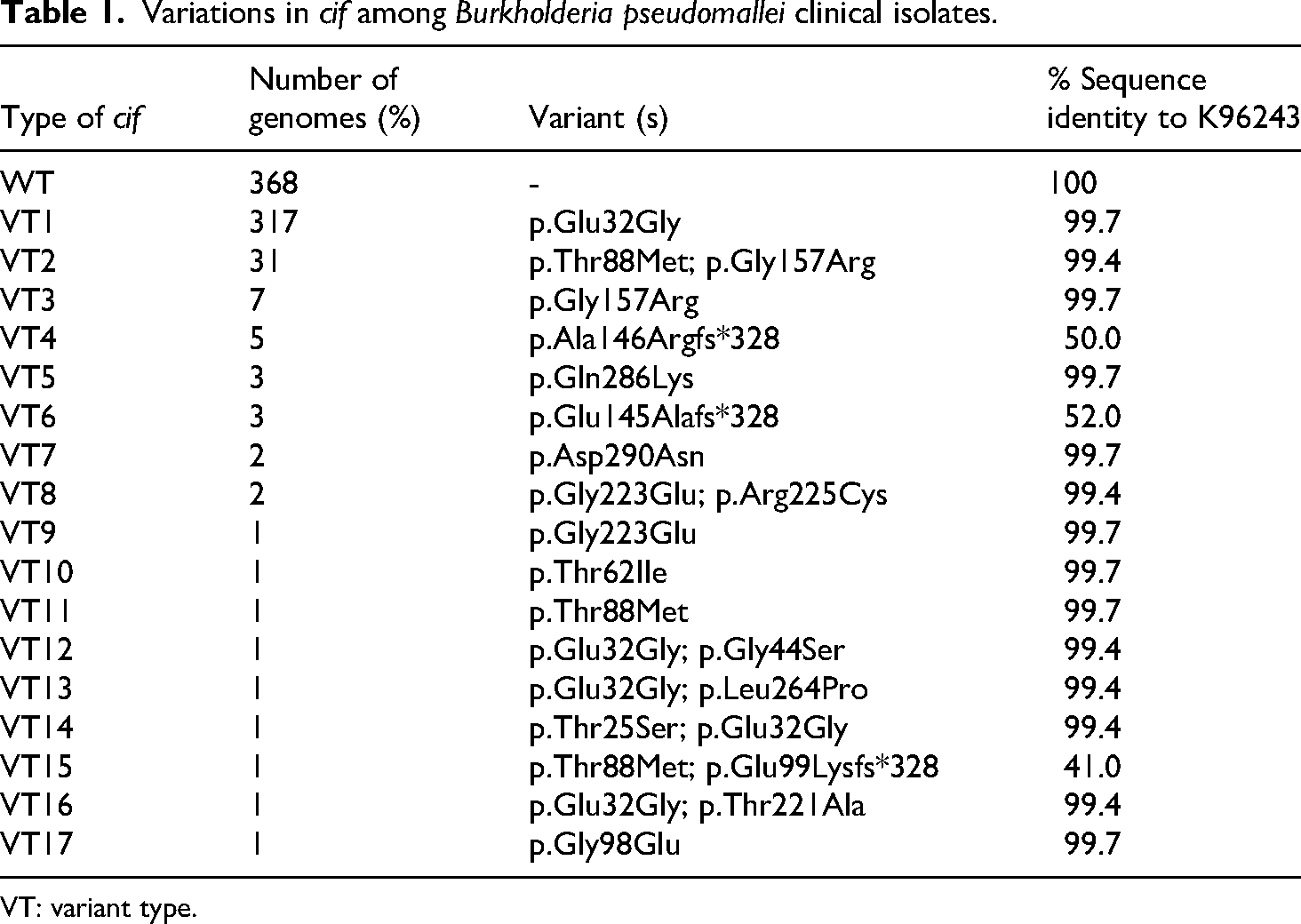
VT: variant type.
The phylogenetic analysis and heatmap data from the cif variants of B. pseudomallei (Figure 1) indicate that VT1, VT2, VT3, VT4, VT5, VT6, VT9, and VT15 are ideal candidates for further modeling and superimposition studies. These variants were selected based on their distinct clustering patterns and statistical support values. VT1 to VT5 form a closely related cluster with minimal pairwise SAP distances. Minimal pairwise SAP distances points to subtle changes at the protein level, which can have considerable functional consequences. Even small mutations, especially those that alter protein function or interaction, can drive evolutionary adaptation, especially in pathogens like B. pseudomallei. It suggested that these variants represent small yet significant evolutionary changes from the wild type, which can be pivotal in understanding subtle mutational impacts. VT6 and VT9, although slightly more distant, still share significant similarities with the aforementioned cluster, making them important for assessing intermediate evolutionary steps. VT15, with its closer association to VT4 and VT5 but slight divergence from the core cluster, adds further value in understanding the variation within this gene family. The high bootstrap values associated with these branches (ranging from 51–103) support the reliability of these relationships, ensuring that the selected variants are robust representations of the genetic diversity within the cif gene. Including these variants in further modeling and superimposition might provide a detailed and comprehensive view of the structural and functional implications of these mutations in B. pseudomallei.
3D structural analysis of Cif
Based on the structural comparison and superimposition analysis of the modeled Cif protein variants with the predominant variants considered as WT, the study revealed key insights into their structural integrity. The refined models of the protein variants were evaluated using Ramachandran plots, which assess the quality of the protein structures by plotting the backbone dihedral angles of the amino acid residues (Supplemental Figure S2). These plots categorize the residues into four regions: (1) favored regions, (2) additional allowed regions, (3) generously allowed regions, and (4) disallowed regions. Favored regions represent the most optimal and stable conformations for the protein's backbone angles. Residues in these regions are in energetically preferred positions, which indicate good structural quality. Additional allowed regions are less optimal but still allowed conformations. Residues here might still be functionally acceptable, though slightly less stable than those in favored regions. Generously allowed regions are conformations that are generally less common but are still tolerated. Residues in this category may indicate structural flexibility or regions prone to dynamic movement. Disallowed regions represent conformations that are energetically unfavorable and could indicate potential structural anomalies or issues in the protein model. The percentages of residues in these regions provide insight into the quality and reliability of the structural models for each variant. The findings for the Cif variants were as follows: VT1 had 74.8% of residues were in favored regions, and 85.9% were in allowed regions (favored + additional allowed + generously allowed). VT2 had 73.0% in favored regions and 86.8% in allowed regions. VT3 had 75.7% in favored regions and 88.9% in allowed regions. VT4 had 54.9% in favored regions and 78.4% in allowed regions. VT5 had 73.6% in favored regions and 85.3% in allowed regions. VT6 had 75.8% in favored regions and 87.1% in allowed regions. VT9 had 75.2% in favored regions and 87.7% in allowed regions. Finally, VT15 had 79.4% in favored regions and 89.9% in allowed regions, the highest percentage among all variants. The percentages indicate how well the modeled structures conform to ideal protein geometry. Higher percentages in the favored and allowed regions suggest a more reliable and accurate structural model. For VT15, which had the highest percentage of residues in favored regions (79.4%), it reflects a well-optimized structure compared to VT4, which had the lowest (54.9%). This difference highlights potential structural variations that may influence the function or stability of the Cif protein across different variants. The findings suggest that while most variants maintain good structural integrity, VT4 may require further refinement or functional investigation due to its lower percentage in the favored regions.
The superimposition results of the Cif variants onto the WT Cif using CLICK (http://mspc.bii.a-star.edu.sg/click) revealed significant structural similarities (Supplemental Table S4). Variant WT versus VT1 had 76.52% of the structure overlapped, an RMSD of 0.56, a fragment score of 1.00, a topology score of 1.00, 246 identical residues, and a Z-score of 15.09. WT-VT2 showed complete structural overlap with 100.00% overlapped, an RMSD of 0.00, a fragment score and topology score of 1.00 each, 328 identical residues, and a Z-score of 21.17. Variant WT-VT3 exhibited 76.76% overlap, an RMSD of 0.57, a fragment score of 0.99, a topology score of 1.00, 249 identical residues, and a Z-score of 15.22. WT-VT5 had 95.73% overlap, an RMSD of 1.25, a fragment score of 0.91, a topology score of 0.97, 253 identical residues, and a Z-score of 16.85. WT-VT6 showed 76.52% overlap, an RMSD of 0.51, a fragment score of 0.99, a topology score of 1.00, 244 identical residues, and a Z-score of 15.12. Finally, WT-VT15 demonstrated 81.40% overlap, an RMSD of 0.80, a fragment score of 0.98, a topology score of 1.00, 256 identical residues, and a Z-score of 15.71. These results provide a detailed comparison of the structural alignment between the WT Cif and its variants. We depict the structural superimposition and alignment of different Cif protein variants with the WT structure. Results revealed significant similarities with the WT structure, with VT2 showing perfect alignment and likely retaining similar functional capabilities; while VT4 showed moderate sequence identity, similarity scores, and numerous gaps, suggesting potential structural deviations (Figure 2). These findings were further analyzed to establish structure–function relationships and elucidate the roles of Cif variants in subverting neuroblastoma cell processes and contributing to pathogenesis.
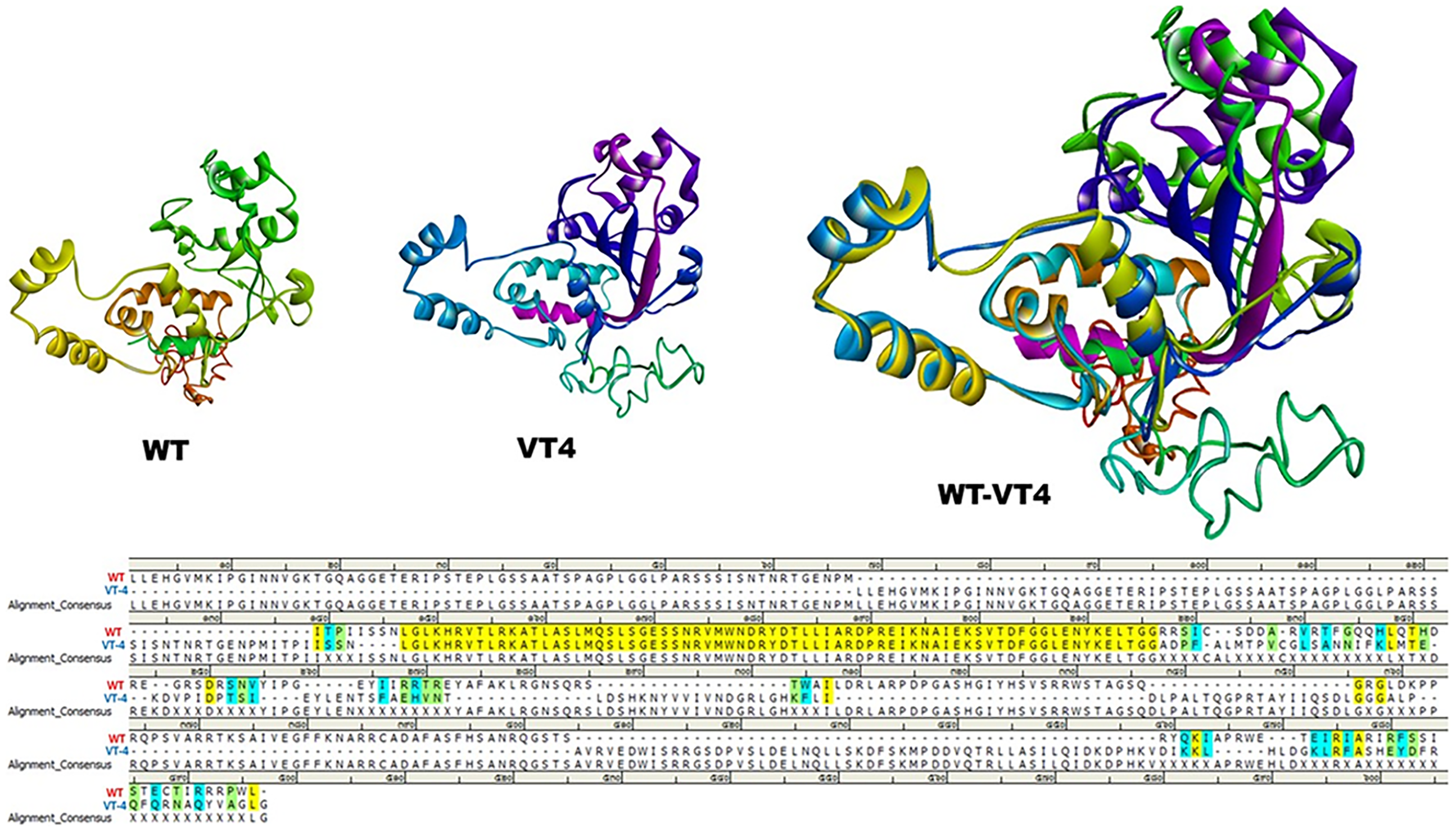
Structural superimposition and sequence alignment of the WT Cif protein with modeled VT4 Cif variants. The sequence alignment shows the residues of WT and VT4 with their consensus alignment. Residues are color-coded based on conservation and structural features: yellow indicates identical residues, cyan highlights conserved substitutions, and green marks variable regions. The alignment consensus reveals areas of high conservation and variability, providing insights into the structural and functional implications of sequence differences. Structural motifs, such as alpha-helices and beta-strands, are annotated to highlight their positions and any variations between the WT and VT4 variants. The superimposition underscores significant structural similarities, with key differences potentially affecting protein folding, stability, and interactions.
Cif variants can induce plaque formation of neuronal cells
Rungruengkitkun et al. previously reported that cif plays a crucial role in invasion and contributes to decreased plaque formation in neuronal SH-SY5Y cells. 8 In this study, we investigated the plaque-forming efficiency of representative B. pseudomallei isolates harboring the predominant WT Cif (K96243) and distinct Cif variant types (VT1, VT2, VT3, VT4, VT5, VT6, VT9, and VT15) in SH-SY5Y monolayers. We observed that all tested isolates were capable of inducing plaque formation (Figure 3(a)). The plaque-forming efficiency of each VT was assessed and is presented in Figure 3(b). SH-SY5Y cells infected with representative B. pseudomallei containing the predominant variant bpss1385 WT exhibited a mean plaque-forming efficiency of 4.5 × 10⁻⁵ ± 5.7 × 10⁻⁶ (mean ± SD), comparable to that of B. pseudomallei strain K96243 (Supplemental Figure S3), which is in the group of bpss1385 WT. This finding suggests that bpss1385 WT and strain K96243 share similar intracellular replication capabilities in neuronal cells, potentially attributed to conserved mechanisms in the cif gene family.

Plaque forming capacity in representative cif variants of clinical Burkholderia pseudomallei isolates. (a) Representative images of plaque formation in neuronal cells infected with B. pseudomallei strains harboring distinct cif gene variants. (b) Quantification of plaque formation for each cif variant. Each bar represents a distinct cif variant, demonstrating variation in plaque-forming capacity among clinical isolates. Data are presented as the mean ± standard error of the mean (SEM) from three independent biological experiments, each performed in technical triplicate. Statistical analysis was conducted using one-way analysis of variance (ANOVA) followed by Tukey's post hoc test.
Notably, significant differences in plaque-forming efficiency were observed for certain variants compared to the bpss1385 WT (p < 0.0001). Specifically, VT1 (1.2 × 10⁻⁴ ± 1.5 × 10⁻⁵), VT2 (1.2 × 10⁻⁴ ± 9.7 × 10⁻⁶), VT5 (1.3 × 10⁻⁴ ± 4.2 × 10⁻⁶), and VT15 (1.3 × 10⁻⁴ ± 1.7 × 10⁻⁶) demonstrated significantly higher plaque-forming efficiencies than those induced by the bpss1385 WT (Figure 3(b)). In contrast, no significant differences were observed between the bpss1385 WT and VT3, VT4, VT6, or VT9 variants (Figure 3(b)).
Interestingly, although Cif variants VT6 and VT9 are phylogenetically more distant from the predominant variant bpss1385 WT, their plaque-forming efficiency did not differ significantly from that of the bpss1385 wild type. This observation suggests that the diversity of Cif may not directly correlate with pathogenesis. However, the enhanced plaque-forming efficiency observed in VT1, VT2, VT5, and VT15 indicates that certain factors in these B. pseudomallei variants might be associated with increased pathogenic potential. It is worth noting that VT4 produced noticeably smaller plaques compared to other variants, despite having a similar plaque-forming efficiency. This observation warrants further investigation into the mechanisms underlying plaque size variation among different Cif variants.
Proteomic analysis of neuroblastoma cells infected with B. pseudomallei harboring bpss1385 WT and its mutant deleting bpss1385 WT
We utilized a proteomic approach to identify key proteins in human neuron cells underlying B. pseudomallei pathogenesis mediated by Cif. For this analysis, we utilized B. pseudomallei K96243, as it contains the predominant BPSS1385 WT. SH-SY5Y cells were subjected to infection by the B. pseudomallei K96243 and Δcif mutant strain that lack of BPSS1385 WT, which have been constructed from the previous study. 8 Protein profiling was performed in triplicate, and only the proteins detected in all replicates at a confidence level of 95% were subsequently identified. Then, significantly (>2-fold change) differentially expressed proteins (DEPs) were determined in neuron cells infected with B. pseudomallei K96243 compared with Δcif mutant. From a total of 1643 proteins detected in neuron cells infected with B. pseudomallei WT, there were 52 DEPs (24 upregulated and 28 downregulated DEPs), compared to those infected with B. pseudomallei Δcif mutant (Supplemental Table S5). These DEPs further analyzed for protein–protein interaction networks using the STRING analysis tool to identify potential functional associations and pathway enrichment. We found that the majority of upregulated proteins of neuron cells infected with Δcif mutant strain were involved in mRNA metabolic pathways, including pre-mRNA-processing-splicing factor 8 (PRPF8), far upstream element-binding protein 2 (KHSRP), poly(rC)-binding protein 3 (PCBP3), transcription factor ETV7 (ETV7), and beta-klotho (KLB), and some proteins with neuronal specific functions such as neuronal scaffold protein CASK-interactive proteins (Caskin1) (Figure 4 and Supplemental Table S5). PRPF8 is a core component of the spliceosome, which is essential for the splicing of pre-mRNA, a critical step in mRNA metabolism. 21 KHSRP is known to be involved in the regulation of mRNA stability and decay.22,23 PCBP3 is involved in the stabilization and translation of mRNA. 24 ETV7 is involved in transcriptional regulation, which can affect mRNA synthesis and subsequent processing. 25 Beta-klotho has also been implicated in mRNA processing and stability involved in the complex processes of mRNA metabolism, including splicing, stability, decay, and transcriptional regulation, is primarily through its role as an endocrine co-receptor and its interactions with various signaling pathways that influence gene expression and RNA processing. 26 These proteins contribute to various aspects of mRNA metabolic pathways, including mRNA splicing, stability, decay, and transcriptional regulation; while Caskin1 is typically present in neuronal cells, particularly, in the synapses.

Protein–protein interaction networks of up- and downregulated proteins in SH-SY5Y cells infected with B. pseudomallei WT and Δcif mutant strains. Proteins that were significantly upregulated (left panel) and downregulated (right panel) following infection were analyzed using STRING network analysis. The left panel highlights clusters of upregulated proteins primarily involved in the mRNA metabolic process (annotated in red). The right panel illustrates downregulated proteins, most of which are functionally associated with cellular anatomical entity processes.
In contrast, proteins involved in cellular anatomical entities, including actin, tubulin beta, and tubulin alpha, and cytoprotective pathways were downregulated in cif mutant (Supplemental Table S5). These downregulated proteins play crucial roles in maintaining the structural integrity and functional dynamics of the cellular cytoskeleton (Figure 4). Thus, it implied that Cif might be involved with the cellular cytoskeleton of neuronal cells during B. pseudomallei infection. In addition, downregulated proteins involved in cytoprotective effect were heat shock 70 kDa (HSP70) protein, Rho GDP-dissociation inhibitor 1 (RhoGDI1), and peroxiredoxin-6 (Prdx6). The HSP70 family functions as a molecular chaperone and reduces the stress-induced denaturation and aggregation of intracellular proteins. 27 HSP70 is a member of the molecular chaperone family that is highly conserved across different species. It plays a crucial role in protecting cells against various forms of stress, such as heat, oxidative stress, and other environmental stressors. 28 RhoGDI1 is involved in the regulation of Rho GTPases, which are crucial for various cellular processes, including cytoskeletal dynamics, cell motility, and cell division. RhoGDI1 acts by maintaining Rho GTPases in an inactive state in the cytosol and preventing their spontaneous activation. It also regulates the localization and cycling of Rho GTPases between the cytosol and membrane, ensuring precise spatial and temporal control of their activity. This regulatory mechanism is essential for the proper functioning of the actin cytoskeleton, cell movement, and division. 29 Prdx6 is an antioxidant enzyme that plays a critical role in protecting cells from oxidative damage by scavenging reactive oxygen species (ROS). Prdx6 has both glutathione peroxidase and phospholipase A2 activities, allowing it to reduce hydrogen peroxide and other hydroperoxides efficiently. By neutralizing ROS, Prdx6 helps maintain cellular redox balance, preventing oxidative stress-related damage, which is crucial for cellular health and preventing various diseases, including cancer. 30 Therefore, the downregulation of these proteins suggests a potential decrease in the cell ability to protect itself from stressors, which could have implications for cellular function and viability.
Discussion
Our phylogenetic analysis identified 18 distinct Cif variant types of B. pseudomallei, each exhibiting mutations in the encoding amino acid sequence. These findings corroborate previous research highlighting genomic plasticity and adaptability of this pathogen. 11 The considerable sequence divergence among Cif variant types, particularly VT4, VT6, and VT15, reflects the evolutionary dynamics and selective pressures experienced by these strains. This diversity at the amino acid level suggests that cif genes may play a crucial role in pathogen adaptability and virulence, potentially contributing to its ability to cause melioidosis in different hosts and environments. 31 This adaptability is consistent with genomic studies documenting high levels of variation in virulence factors across B. pseudomallei strains, influencing clinical manifestations and geographic distribution. 32
The overall structure of the predominant variants Cif WT and its variants comprises two distinct lobes: the N-terminal tail likely harboring the substrate-binding site and the C-terminal head containing the enzymatic site. The enzymatic site's catalytic triad (Cys, His, Gln) is conserved across all Cif homologs, underscoring its crucial role in protein function.33,34 Structural insights from superimposition data and RMSD values elucidate the relationship between Cif structural variants and their functional outcomes. VT2 shows perfect structural alignment with WT, likely retaining similar functional capabilities. VT5, VT6, and VT15 exhibit higher RMSD values, indicating structural modifications that could distinctly affect their pathogenic mechanisms. VT4 demonstrates significant structural rearrangements, particularly in regions critical for substrate binding and catalysis, potentially altering or reducing enzymatic activity. The observed structural flexibility, particularly in loop regions and elements adjacent to the catalytic site, may modulate interactions with host targets, potentially expanding or limiting the range of host proteins that Cif variants can modify.
Variations in the DNA sequence of genes encoding bacterial virulence factors, including single nucleotide polymorphisms (SNPs), can significantly impact protein structure and function, potentially leading to altered pathogenesis.33,35 Our analysis revealed that Cif variants VT1, VT2, VT5, and VT15 demonstrate significantly higher efficiencies in plaque formation compared to the bpss1385 WT. Interestingly, no significant differences were observed between the bpss1385 WT and VT3, VT4, VT6, or VT9 variants, despite VT6 and VT9 showing greater structural divergence from the WT Cif protein. These findings suggest that the relationship between Cif protein structure and B. pseudomallei pathogenesis is complex and may involve intricate mechanisms beyond simple structural variations. Notably, VT4 exhibited significantly smaller plaque sizes compared to other variants, suggesting a potentially reduced virulence or impaired ability to interact with and disrupt host cell functions. This attenuated plaque formation capacity of VT4 merits further investigation to elucidate the specific molecular mechanisms underlying this phenotype. The structural variations observed among Cif variants may lead to differential interactions with neuronal cells, potentially impacting signaling pathways and enhancing their ability to disrupt normal cellular functions, thereby promoting disease processes. However, it is crucial to acknowledge that while Cif variants are the focus of this study, the B. pseudomallei isolates possess a complex array of virulence factors that may contribute to the observed outcomes. These additional factors cannot be disregarded and may play significant roles in the overall pathogenicity of the bacteria. Future studies should aim to dissect the individual contributions of Cif variants and other virulence factors to gain a more comprehensive understanding of B. pseudomallei pathogenesis in neuronal cells.
Our proteomic analysis identified differentially expressed proteins (DEPs) associated with Cif that play important roles in neurological melioidosis. Comparison of DEPs between K96243 cells infected with B. pseudomallei and those infected with a cif mutant revealed enrichment in pathways involved in mRNA metabolism, cellular anatomical entities, and cytoprotective pathways. Of particular interest, we found upregulation of the neuronal scaffold protein Caskin1 in cells infected with the cif mutant strain. Caskin1, known to interact with CASK and the EphB1 receptor tyrosine kinase via the adaptor protein Nck, undergoes phosphorylation, suggesting its involvement in signaling pathways that could potentially influence cell cycle processes. 36 As a bacterial cyclomodulin, Cifs interfere with host cell cycles by targeting the ubiquitin-dependent degradation pathway. 37 Cif interacts with host proteins, specifically deamidating NEDD8 and ubiquitin at Gln40, leading to G1 and G2 cell cycle arrests, accumulation of cyclin-dependent kinase inhibitors, and actin stress fiber formation.10,38 Unlike cytolethal distending toxin (CDT), Cif induces cell cycle arrest through a distinct mechanism, bypassing DNA damage. 37 The detection of proteins related to cellular cytoskeleton in our proteomic study validates the contribution of Cif to cell cycle regulation and other cellular processes. Moreover, the targeting of mRNA pathways represents a potential avenue for bacteria to hijack cell growth arrest. 39
This study demonstrates that the contribution of Cif to neuronal infection is not limited to facilitating entry, but encompasses a more complex interplay with host cell processes. Specifically, Cif appears to suppress mRNA processing or specific transcripts and disrupt cytoprotective mechanisms to benefit bacterial infection. Additionally, this finding aligns with the observed effects on plaque formation, further supporting the role of Cif in disrupting the cytoskeleton when the cell fusion is formed. These findings could offers potential targets for therapeutic interventions, particularly when specific experiments investigate the identified pathways that is warranted.
While our study provides important insights into the diversity, structural features, and functional roles of Cif variants in B. pseudomallei, several limitations should be acknowledged. Although structural modeling and superimposition analyses yielded predictions regarding enzymatic activity and substrate interactions, these in silico findings were not validated through direct biochemical or crystallographic methods. As such, functional interpretations of structural deviations, particularly in variants such as VT4 and VT15, remain speculative. We explored additional structural prediction tools—MutPred2, HOPE, and Missense3D—to assess the functional impact of amino acid substitutions. However, MutPred2—a machine-learning tool trained on human proteins—was not compatible with bacterial sequences. Similarly, HOPE and Missense3D, which focus on the structural effects of single-residue mutations, were not well-suited for our analysis because most of the variants are frameshift mutations that lead to extensive structural alterations later than localized changes. For the few missense variants, these tools provided only limited additional insights beyond those obtained from our existing models. Nevertheless, they hold potential value for future investigations aimed at understanding residue-specific structural and functional effects. We acknowledge the value of molecular dynamics (MD) simulations in assessing protein flexibility and stability. While MD offers dynamic insights that surpass static structural models, its substantial computational requirements placed it beyond the scope of this study. Instead, we employed SWISS-MODEL, CLICK, and Discovery Studio for homology modeling and structural comparison. Future work will incorporate MD simulations to validate and refine our predictions, particularly for variants predicted to have significant structural or functional impact. In addition to these structural limitations, several experimental constraints should be noted. For instance, plaque assays were conducted in a single neuronal cell line, which may not fully capture the complexity of host-pathogen interactions in vivo, especially within the human central nervous system. The proteomic changes identified were correlative and require targeted experimental validation to establish a causal relationship with Cif activity. Additionally, B. pseudomallei expresses numerous virulence factors, making it difficult to attribute the observed phenotypes exclusively to Cif variants. Finally, the functional characterization included only a subset of the identified Cif variants, which may not reflect the full range of their effects. Future studies that incorporate in vivo models, complementation experiments, and broader variant analyses will be essential to clarify the specific contributions of Cif to B. pseudomallei pathogenesis.
Future research should focus on conducting complementation studies to directly compare the impact of different Cif variants on virulence, investigating the specific molecular mechanisms by which Cif interferes with the cell cycle, particularly its interactions with mRNA pathways and cell cycle regulators, and exploring the potential of targeting Cif or its downstream effectors as a therapeutic strategy for neurological melioidosis. These directions will further elucidate the role of Cif in B. pseudomallei pathogenesis and potentially lead to novel treatment approaches for this devastating disease.
Conclusion
This study reveals notable structural diversity among B. pseudomallei Cif variants, with VT4 showing the most distinct alterations in substrate-binding and catalytic regions. Although VT4 produced plaques similar in number to the wild type, its significantly smaller plaque size suggests reduced intracellular activity or virulence. Despite such structural differences, most Cif variants maintained comparable infection efficiency, indicating functional conservation in early host cell interaction. Proteomic analysis further implicates Cif in modulating neuronal processes, particularly mRNA metabolism and cytoskeletal organization. Together, these findings highlight Cif's role in neuronal pathogenesis and support its potential as a therapeutic target, despite variability among its structural forms.
Supplemental Material
sj-pdf-1-sci-10.1177_00368504251369011 - Supplemental material for Deciphering the diversity, structure, and function of cycle-inhibiting factor in Burkholderia pseudomallei neuroinfection
Supplemental material, sj-pdf-1-sci-10.1177_00368504251369011 for Deciphering the diversity, structure, and function of cycle-inhibiting factor in Burkholderia pseudomallei neuroinfection by Nitaya Indrawattana, Sirijan Santajit, Rathanin Seng, Amporn Rungruengkitkun, Thida Kong-Ngoen, Witawat Tunyong, Techit Thavorasak, Onrapak Reamtong, Thaniya Sricharunrat, Narisara Chantratita and Pornpan Pumirat in Science Progress
Supplemental Material
sj-pdf-2-sci-10.1177_00368504251369011 - Supplemental material for Deciphering the diversity, structure, and function of cycle-inhibiting factor in Burkholderia pseudomallei neuroinfection
Supplemental material, sj-pdf-2-sci-10.1177_00368504251369011 for Deciphering the diversity, structure, and function of cycle-inhibiting factor in Burkholderia pseudomallei neuroinfection by Nitaya Indrawattana, Sirijan Santajit, Rathanin Seng, Amporn Rungruengkitkun, Thida Kong-Ngoen, Witawat Tunyong, Techit Thavorasak, Onrapak Reamtong, Thaniya Sricharunrat, Narisara Chantratita and Pornpan Pumirat in Science Progress
Footnotes
Acknowledgements
We acknowledge the support from Department of Microbiology and Immunology, Central laboratory and the Office of Research Services, Faculty of Tropical Medicine for supporting the publication of this article. We also thank Dr. Natthanej Luplertlop for kindly providing the human neuronal cell line SH-SY5Y (ATCC® CRL-2266™).
ORCID iDs

Authors’ contributions
NI and PP contributed to the conception and design of the study. NI, SS, RS, AR, TK, WT, OR, TT, TS, and PP performed the experiments. NC provided the bacterial isolates and whole genome data on the experiments. NI and PP analyzed the data and wrote the manuscript. NI and PP edited the manuscript. All authors read and approved the final version of the manuscript.
Funding
The authors disclosed receipt of the following financial support for the research, authorship, and/or publication of this article: This work was supported by the National Research Council of Thailand (grant number NRCT5-RSA63015-14) and funded by Mahidol University (Fundamental Fund: fiscal year 2024 by National Science Research and Innovation Fund (SRF)).
Declaration of conflicting interests
The authors declared no potential conflicts of interest with respect to the research, authorship, and/or publication of this article.
Data availability
Supplemental material
Supplemental material for this article is available online.
References
Supplementary Material
Please find the following supplemental material available below.
For Open Access articles published under a Creative Commons License, all supplemental material carries the same license as the article it is associated with.
For non-Open Access articles published, all supplemental material carries a non-exclusive license, and permission requests for re-use of supplemental material or any part of supplemental material shall be sent directly to the copyright owner as specified in the copyright notice associated with the article.
