




Abstract
Objectives
This study aimed to develop and validate the family sports ecosystem questionnaire (FSEQ), a novel instrument measuring the family sports ecosystem construct for junior high school students, defined as a dynamic network comprising family sports environment, family physical education, and individual sports consciousness.
Design
A methodological cross-sectional study was conducted, employing a multi-phase questionnaire development and validation design: (1) initial item compilation based on theory and literature, (2) content/face validity assessment via expert consultation (three rounds, n = 23 experts), (3) preliminary survey, and (4) psychometric evaluation using split-sample methodology (n = 1344 students, randomly split into n = 672 for exploratory factor analysis (EFA)/item analysis and n = 672 for confirmatory factor analysis (CFA)).
Methods
The initial items were determined in the form of expert scoring and interviews. Internal consistency assessed via Cronbach's alpha and corrected item total correlation. The construct validity of the questionnaire was verified by EFA and CFA. Model fit indices assessed (e.g. χ²/df, root mean square error of approximation (RMSEA), comparative fit index (CFI), and Tucker–Lewis index (TLI)). The convergent validity of the questionnaire was evaluated by factor load, average variance extracted (AVE), and composite reliability (CR). The Fornell–Larcker criterion was used to evaluate discriminant validity.
Results
The final FSEQ comprised 33 items across nine factors nested within three dimensions: family sports environment (ball/leisure facilities, swimming/winter facilities, and home electronic devices), family physical education (parental support, role modeling, and sports knowledge instruction), and individual sports consciousness (cognitive identification, emotional attitude, and will/intention). Content validity: Achieved consensus after expert revisions. Reliability: Excellent internal consistency (overall Cronbach's α = 0.943; sub-dimensions α = 0.740 to 0.942). Structural validity: EFA explained 69.543% variance; CFA demonstrated excellent fit (χ²/df = 1.538, RMSEA = 0.028, CFI = 0.979, and TLI = 0.975). Convergent validity: All factor loadings > 0.6, AVE > 0.5, and CR > 0.7. Discriminant validity: Satisfied Fornell–Larcker criterion for all latent variables.
Conclusion
The present study established a comprehensive family sports ecosystem and subsequently developed the “FSEQ” for the first time.
Keywords
Introduction
The development of adolescent physical health has long been a widely researched topic by scholars worldwide. The level of physical activity plays a pivotal role in their physical well-being. 1 By 2016, over 80% of adolescents globally failed to meet the recommended standard for daily physical exercise, posing a threat to their current and future health. 2 Physical activity levels during adolescence can persist into adulthood and impact overall public health. 3
In the United States, it contributes to approximately 175,000 annual fatalities and accounts for nearly 10% of total healthcare expenditures. This evidence suggests that physical inactivity not only compromises individual health but also exerts substantial socioeconomic impacts. 4 Physical activity serves as an effective intervention for obesity prevention and management. 5 Specifically, aerobic exercise has demonstrated efficacy in ameliorating obesity-related physiological alterations, including reducing inflammation, enhancing cardiovascular function, and increasing fat oxidation. Elevating physical activity levels is therefore recognized as a validated strategy for obesity mitigation. 6 As a potent health promotion modality, physical activity has been extensively documented to exert positive effects on the physical fitness of junior high school students. Empirical studies have consistently shown that regular physical activity significantly improves cardiorespiratory capacity, muscular strength, and endurance in adolescents, thereby enhancing their comprehensive physical fitness.7,8
Empirical studies have demonstrated that familial factors play a pivotal role in enhancing physical activity levels among junior high school students. 9 A Spanish investigation spanning five provinces further revealed that adolescents with higher extracurricular sports participation typically have family members engaging more frequently in physical activities. 10 Germany has positioned family sports as a strategic focus in national fitness initiatives, developing family sports guidelines and witnessing widespread parental engagement in organizing children's sports competitions, with family sports participation becoming prevalent during holidays and weekends. 11 Jarvis et al. 12 identified that while parental attention to children's sports education remains insufficient, co-participation in physical activities and parental perceptions significantly predict children's physical activity competence. Romero-Blanco et al. 10 substantiated that paternal physical activity demonstrates stronger predictive effects on children's exercise behaviors compared to maternal influences. 10 Manuel Castanedo et al. 13 emphasized the critical role of family physical education in physical education, confirming its significant efficacy in promoting students’ physical activity engagement. Grounded in the theory of planned behavior, Budden and Sagarin 14 elucidated the robust correlation between volitional intention and exercise behavior, with empirical evidence confirming exercise intention as a significant predictor of physical activity implementation. Andersson and Moss 15 operationalized volitional intention through exercise motivation assessment, establishing its substantial impact on both exercise behavior and physiological health outcomes. Lee and Lee 16 conducted a theory-driven analysis of adolescent exercise intention–behavior relationships, with results corroborating the predictive validity of volitional intention on physical activity engagement among youth populations.
While existing research has extensively investigated the impact of familial factors on physical activity, current scholarship has yet to integrate these elements into a self-regulating and dynamically balanced system. This limitation has resulted in fragmented comprehension of factor-specific contributions to adolescent physical activity development, impeding comprehensive exploration of their intrinsic interconnections, consequently compromising the accuracy and practical applicability of research findings.
This study innovatively integrates ecological systems theory with self-determination theory (SDT), establishing the family sports ecosystem through systematic data collection and analysis. A well-defined concept of the family sports ecosystem and its theoretical basis will be delved into in the subsequent theoretical framework section.
Theoretical framework
Ecological systems theory, proposed by Bronfenbrenner, 17 serves as a pivotal model in developmental psychology for studying individual development. This theory emphasizes that individual development is influenced by their surrounding environmental systems, which are interrelated and interactive, collectively shaping individuals’ behavioral and psychological characteristics. Bronfenbrenner categorizes the ecological system into the microsystem, mesosystem, exosystem, macrosystem, and chronosystem.18–20 By establishing a multifactorial model, ecological systems theory delves into the influencing factors of organism behavior, with its core lying in precisely identifying various hierarchical levels within the environment and their specific causes. For junior high school students, the impact of family factors on their physical health is multidimensional and profound. If guided by ecological systems theory, comprehensively perceiving and addressing these diverse family level influences can significantly facilitate the promotion of physical activities among junior high school students. Thus, the construction of a family sports ecosystem for junior high school students proves particularly crucial, a process that undoubtedly draws valuable insights from ecological systems theory.
SDT, introduced by American psychologists Deci and Ryan 21 in the 1980s, is a theory about the motivational processes of human self-determined behavior. This theory underscores the proactive role of the self in the motivational process, contending that individuals are inherently equipped with three basic psychological needs: autonomy, competence, and relatedness. 22 When these needs are met, individuals’ intrinsic motivation is significantly enhanced. Self-determination represents a potential based on experiential choice, requiring individuals to freely make action choices after fully understanding personal needs and environmental information. SDT comprises five interconnected sub-theories: cognitive evaluation theory (CET), organismic integration theory (OIT), causal orientation theory, basic psychological needs theory (BPNT), and goal contents theory. Among them, three sub-theories are involved in this study. BPNT serves as the cornerstone of SDT. This theory deeply analyzes the psychological drivers behind human behavior, clearly pointing out that individuals possess three fundamental and indispensable psychological needs: autonomy, competence, and relatedness. CET, as a vital branch of SDT, extensively explores the impact of external incentives on internal motivation. 23 OIT, another significant branch, delves into the process of motivation internalization in individual behavior and its mechanisms. 24
Within the framework of ecological systems theory, the microsystem stands as a core component. It encompasses the activities, roles, and interpersonal relationship patterns that individuals experience in face-to-face situations, characterized by specific physical, social, and symbolic features. These features exert a profound influence on individuals’ interactions with their environment, either facilitating or impeding sustained and complex interactions.
The microsystem is closely intertwined with the individual, forming their immediate environment. It encompasses all direct interactions between people and objects, offering a crucial perspective for understanding individual behavior and development. By conducting a thorough analysis of the microsystem, one can uncover the core elements that influence individual growth and development, thereby gaining deeper insights into their behavioral patterns, psychological states, and interaction modes with the environment.
In the context of the family, various aspects of the family sports environment, such as the living environment, economic capital, sports atmosphere, and sports facilities, along with parents’ conscious and deliberate engagement in family sports education for their children, can be regarded as the microsystem that influences children's sports behavior. 25
However, while this constructed system emphasizes the environmental impact on individuals, it overlooks individuals’ own subjective initiative. Therefore, a further analysis based on SDT reveals that children are active organisms with inherent psychological growth and developmental momentum, prompting them to actively respond to environmental challenges and integrate them into their self-concept.
Among them, the BPNT can be employed to explore how to enhance individuals’ intrinsic motivation and identity toward sports activities by fulfilling their needs for autonomy (e.g. freely choosing sports activities and methods), competence (e.g. experiencing success and achievement in sports activities), and relatedness (e.g. feeling a sense of belonging and support within sports teams). The CET can analyze how external factors (e.g. school policies, parental support, and social recognition) affect individuals’ cognitive identification and affective attitudes toward sports activities, and how to optimize these external factors to stimulate and maintain individuals’ intrinsic motivation. The OIT can explore ways to promote the internalization of external motivation (e.g. participating in sports for health or social purposes) into internal motivation through the design and organization of sports activities, thereby enhancing individuals’ volitional intention and continuity in engaging in sports activities.
Considering the family's role in sports activities, it not only provides the microsystem environment but also plays a crucial role in meeting children's basic psychological needs. For example, parents can respect children's autonomy in choosing sports, provide opportunities for children to experience success in sports to meet their competence needs, and create a warm and supportive family sports atmosphere to meet their relatedness needs. These factors related to individuals’ own subjective initiative and the family's support can be named individual sports consciousness (ISC) and incorporated into the research on the construction of the family sports ecosystem.
Based on the above theoretical analysis, the operational definition of the family sports ecosystem in this study can be constructed: with junior high school students’ physical activity participation and physical health promotion as the core objectives, it constitutes a dynamic synergistic network comprising family sports education, family sports environment, and ISC. Among them, family sports education can serve as a subsystem of the family sports ecosystem, focusing on direct interactive sports practices within the family (e.g. parental exercise demonstrations, role modeling, and sports skill guidance), constituting the behavioral field for adolescents’ physical activities; family sports environment, as the second subsystem, establishes a supportive developmental resource network through the integration of family and community sports resources (e.g. family sports space planning, sports equipment configuration, and community sports facilities); ISC, as the third subsystem, relies on the three basic psychological needs of SDT autonomy (right to choose sports), competence (perception of athletic ability), and relatedness (emotional connection in family sports), driving adolescents’ transition from passive participation to endogenous sports motivation.
Research objective
Currently, a comprehensive questionnaire specifically designed for the family sports ecosystem is lacking in the literature. Furthermore, existing questionnaires for its three constituent subsystems exhibit notable limitations. Specifically, the family sports environment questionnaire contains an excessive number of items without systematic categorization, necessitating reorganization and refinement. The family sports education questionnaire suffers from insufficient coverage of relevant dimensions. Additionally, the individual sports awareness questionnaire may be compromised by overly granular factor divisions, potentially leading to inadequate discriminant validity.
This study, grounded in ecological systems theory and SDT, investigated the familial factors influencing adolescent physical activity levels and developed the family sport ecosystem questionnaire. This instrument provides a research tool for examining relevant indicators of the adolescent family sport ecosystem. Furthermore, this instrument provides a robust approach for investigating family related factors influencing adolescent physical health.
Materials and methods
Ethics statement
The study was approved by the Ethics Committee of Liaoning Normal University (LL2024041). The approval date is 15 March 2024, and the ethics committee is located in Liaoning Province, China. All methods were performed in accordance with the Declaration of Helsinki-Ethical Principles (as revised in 2024) for medical research involving human subjects and other relevant laws, regulations, and ethical norms. The researcher explained the concept and purpose of the study to the students and their parents who were interested in participating in the study. After agreeing to participate, they were given a questionnaire. After the parents signed the informed consent, the students and parents completed the relevant questionnaires, respectively. Participants can withdraw at any time during the process of participating in the study. All personally identifiable information (PII) has been rigorously removed from the dataset to ensure participant anonymity, including but not limited to: names, student ID numbers, and national identification numbers.
Questionnaire development
The development of the family sports ecosystem scale progresses through several stages: First (Phase 1), suitable items are selected based on existing research findings and compiled into an initial questionnaire. Next (Phase 2), the content and face validity of the questionnaire items are analyzed using an expert questionnaire method, and then revised accordingly. Then (Phase 3), a preliminary survey study is conducted based on the revised questionnaire. Finally (Phase 4), the survey data are divided into two parts for reliability analysis, item analysis, and exploratory factor analysis (EFA) to evaluate internal consistency, reduce item number, and assess structure. The other part of the data is used for confirmatory factor analysis (CFA) to verify model fit and ultimately finalize the questionnaire design. The reporting of this study conforms to COSMIN guidelines. 26
Phase 1: Compiling the initial items for the questionnaire
In the process of developing the questionnaire, the three subsystems of the family sports ecosystem were treated as first-level indicators, and the questionnaire was structured accordingly. Drawing from Yang Jiapeng's revised questionnaire on the physical environment of family sports, a total of two second-level indicators (family sports facilities and family electronic media) were formulated for assessing the family sports environment, along with 36 initial items. Based on the environment–behavior interaction mechanism within the socio-ecological model, family sports facilities and family electronic media were selected as key factors, with the former representing resource support that directly facilitates exercise behavior, whereas the latter constitutes behavioral barriers necessitating resolution through family based interventions. 27
Taking inspiration from Zhang Jialin's fitness environment questionnaire, a total of two second-level indicators (parental support and parental role model) were established to evaluate physical education for the family, accompanied by 11 initial items. Research has demonstrated that parental support and parental role modeling exert strong and sustained positive effects on adolescents’ moderate-to-vigorous physical activity (MVPA). Moreover, targeted interventions to improve parental support levels and their personal exercise habits represent a viable intervention strategy to enhance adolescent MVPA. 28
Referring to You Chuanbao's sports awareness questionnaire, a total of four second-level indicators were developed for ISC, comprising 18 initial items. 29 This study integrates the psychological “knowledge-emotion-volition-behavior” behavioral generation model with the sociological “civic health responsibility” theory, reframing sports consciousness as the inherent driving mechanism for the national fitness program.
Phase 2: Revising the questionnaire
A total of 23 experts from various fields, including sports pedagogy, sports sociology, school sports, physical health promotion, and sports management, were invited to participate in three rounds of questionnaire-based opinion solicitation for the family sports ecosystem. These experts are from universities, and their professional titles and distribution of educational backgrounds are presented in Table 1. During the first round of expert consultation, each item was voted on to determine whether it should be retained; items with a vote rate below 85% would be modified or deleted. In the second round, some experts were interviewed to discuss modifying items with a vote rate below 85%. The third round involved surveying each indicator using a five-point Likert scale (5 very important, 4 somewhat important, 3 somewhat unimportant, 2 not very important, 1 very unimportant), followed by calculating the average score for each item. An average score >3.5 and a coefficient of variation <25% indicated an acceptable level of consensus among the experts.
Distribution of professional titles and educational backgrounds of consulted experts.

Results from the first round of expert consultation indicated that 36 out of the 65 initial questionnaire items (55.38%) required revision, necessitating substantial modifications to the instrument. To gain deeper insights into the experts’ critiques of the initial items and their revision suggestions, semi-structured interviews were conducted with the six experts who provided the most extensive feedback. These experts offered the following key recommendations during the discussions on item modification:
Item distribution under “family sports facilities”: The experts observed that the sub-dimension “family sports facilities” contained a disproportionate number of items compared to other sub-dimensions. Furthermore, these items conflated household equipment with community-based sports facilities located near the home, suggesting these concepts should be categorized separately.
Focus on specific sports: Utilizing specific sports activities as observational points within the items was deemed inappropriate. The experts recommended clustering sports activities based on criteria relevant to fostering a healthy family sports ecosystem.
Relevance of “electronic media” items: Items concerning household electronic devices (e.g. televisions, computers, and tablets) were considered unsuitable. As ownership of such common devices is nearly universal, their mere presence offers limited insight into the family sports ecosystem. Experts proposed refocusing these items to assess whether these devices influence children's sports participation, enhance their sports knowledge, or cultivate their interest in physical activity.
Comprehensiveness of parental roles: The initial framework analyzing parental influence solely through parental modeling and support was judged insufficiently comprehensive. Experts strongly recommended incorporating items addressing parental transmission of sports-related knowledge. They emphasized that certain knowledge (e.g. injury prevention, sportsmanship, and activity adaptation) is often not covered in school settings. Parents imparting this knowledge daily can significantly benefit children by promoting safer participation (reducing sports injuries) and fostering correct engagement in physical activities.
Phase 3: Preliminary investigation and research
Following the revision of the questionnaire based on expert feedback, a preliminary family sports ecosystem questionnaire (FSEQ) comprising 46 items was obtained. Subsequently, an empirical study was conducted to further refine and validate the questionnaire using EFA and CFA. Adhering to the common empirical guideline that the sample size should be at least 10 times the number of questionnaire items, and considering the requirement to split the sample into two independent subsets for EFA and CFA, respectively, a minimum effective sample size of 920 was determined. Furthermore, as the developed questionnaire aims to provide a valid tool for investigating family level factors influencing the physical health of junior high school students, a stratified random sampling strategy was employed to ensure the sample encompassed students with varying physical fitness levels. This strategy utilized the results of a provincial-wide physical fitness test conducted by the local government in 2022. All cities within the province were ranked based on their aggregate test performance. Subsequently, two cities were randomly selected from the top 30%, two from the bottom 30%, and two from the middle 40% of this ranking. Within each selected city, three urban schools and three rural schools were further randomly chosen to participate in the survey. Of 1440 distributed questionnaires, 96 with incomplete responses were excluded from the analysis. Ultimately, questionnaires were completed by 1344 junior high school students. The demographic characteristics of these samples are presented in Table 2.
Sociodemographic characteristics of study participants.

EFA: exploratory factor analysis; CFA: confirmatory factor analysis.
Phase 4: Validating the FSEQ
We randomly allocated the valid questionnaire data into two equal parts, each consisting of 672 questionnaires. One part was utilized for conducting reliability analysis, item analysis, and EFA, while the other part was employed for CFA.
Data collection and statistical analysis
Participant recruitment and data collection for the questionnaire survey were conducted in April–May 2024. The database was established using EpiData 3.2 software, and questionnaire data were entered into it. Incompletely filled questionnaires were excluded during data entry. Statistical analysis was performed using SPSS 26.0 and AMOS 26 software, with a significance level of 0.05 set for both sides.
Results
Expert consultation results
The results of the first round of expert consultations
Out of the initial 65 items, 36 had a pass rate of <85%, prompting further investigation into “family sports facilities” and “family electronic media,” indicating the need for revision.
The results of the second round of expert consultations
Experts argue that the initial items in the survey, encompassing both household equipment and nearby sports facilities, should not be combined. Simultaneously, the initial survey items delve into specific sports equipment (such as soccer balls, basketballs, and treadmills), and it is recommended to categorize sports activities based on a standard conducive to building a family sports ecosystem. Furthermore, experts propose modifying the items related to electronic media within the household. The various electronic devices mentioned in the survey are commonplace and typically found in most households. Whether or not these electronic devices are present holds little significance for studying the family sports ecosystem. It is suggested that these items be revised to assess whether these electronic devices impact children's participation in sports activities, their acquisition of sporting knowledge, and their interest in engaging in such activities. Additionally, experts contend that parents’ education regarding children's involvement in sports is insufficient; apart from setting a positive example and offering support, they should also enhance their understanding of children's sporting knowledge. Certain aspects of sporting knowledge cannot be acquired through formal education; if parents can impart this knowledge during daily life interactions with their children, it would benefit correct engagement in sporting activities and reduce injuries.
Based on expert opinions, certain indicators in the questionnaire section of the family sports ecosystem were revised. The category of “sports facilities for the family” within the family sports environment was redefined as “family sports equipment” and “nearby sports facilities,” with “nearby” defined as within a 10–15 min walk from the family. Additionally, a new item on “sports knowledge impartation” was incorporated into the physical education for the family, and all items were rewritten in accordance with expert feedback.
The results of the third round of expert consultations
After revision, the initial FSEQ was developed, comprising three primary indicators, 10 secondary indicators, and 46 items. Following revision, the average scores of all items in the questionnaire were consistently above 3.5, with a coefficient of variation below 25%, indicating that experts had achieved a generally acceptable consensus on the various indicators and items within the questionnaire. Ultimately, a questionnaire consisting of three primary indicators, 10 secondary indicators, and 46 items was finalized.
Revised version of the FSEQ
The first questionnaire dataset containing 672 valid data was subjected to a reliability analysis, item analysis, and EFA using SPSS 26.0.
Reliability analysis
The overall Cronbach's alpha coefficient for the FSEQ is 0.943, and the internal consistency coefficients of each primary indicator are all above 0.8 (Table 3), indicating high reliability of the pilot testing data. The corrected item total correlation (CITC) measures the correlation between each item and all other items in the same variable dimension. If an item's CITC is below 0.4 and its removal improves Cronbach's alpha and overall reliability, it should be considered for deletion. Three items in the FSEQ have CITC values below 0.4, and their removal increases Cronbach's alpha to a total of 43 remaining items. The three deleted items were: staying indoors to watch television instead of engaging in outdoor sports activities, staying indoors to use computers instead of engaging in outdoor sports activities, and staying indoors to use mobile devices such as smartphones or tablets instead of engaging in outdoor sports activities. Statistical results indicate that these items did not provide valid information for the measurement of the family sports ecosystem among middle school students.
Reliability of the family sports ecosystem questionnaire (n = 672).

Exploratory factor analysis (EFA)
The indicators and items at different levels of the family sports ecosystem were examined for appropriateness through EFA. Prior to conducting the analysis, the questionnaire data underwent Kaiser–Meyer–Olkin (KMO) and Bartlett's sphericity test to assess item correlations and determine suitability for EFA. The KMO and Bartlett's sphericity test were performed on a questionnaire with 672 valid responses using SPSS 26.0, yielding KMO values of 0.888 for family sports environment, 0.903 for family physical education, and 0.948 for ISC. These results confirm that all subsystems of the family sports ecosystem are suitable for EFA.
We performed separate EFAs on each of the three primary indicators. Two items in the family sports environment were removed due to loading factors of <0.5. Additionally, four items in the family physical education did not align with the theoretical analysis and were also deleted. Furthermore, two items in ISC exhibited high scores across different factors, with a score difference of <0.2; six items did not match theoretical analysis and were subsequently removed, resulting in a total of 33 remaining items.
The revised FSEQ was subjected to EFA as a whole, utilizing principal component analysis for the extraction of nine fixed factors and maximum variance for factor rotation. The KMO sampling adequacy coefficient was 0.930, and the significance probability level of Bartlett's sphericity test was <0.001. Therefore, all 33 items in the revised FSEQ were deemed suitable for EFA. EFA was then performed on the initial set of 672 revised FSEQs, using principal component extraction to derive nine fixed factors and maximum variance for factor rotation. After seven iterations, convergence was achieved with the nine factors explaining 69.543% of the variance. Demonstrating an improved structure at all levels and item settings as shown in Table 4.
The exploratory factor analysis results of the family sports ecosystem.
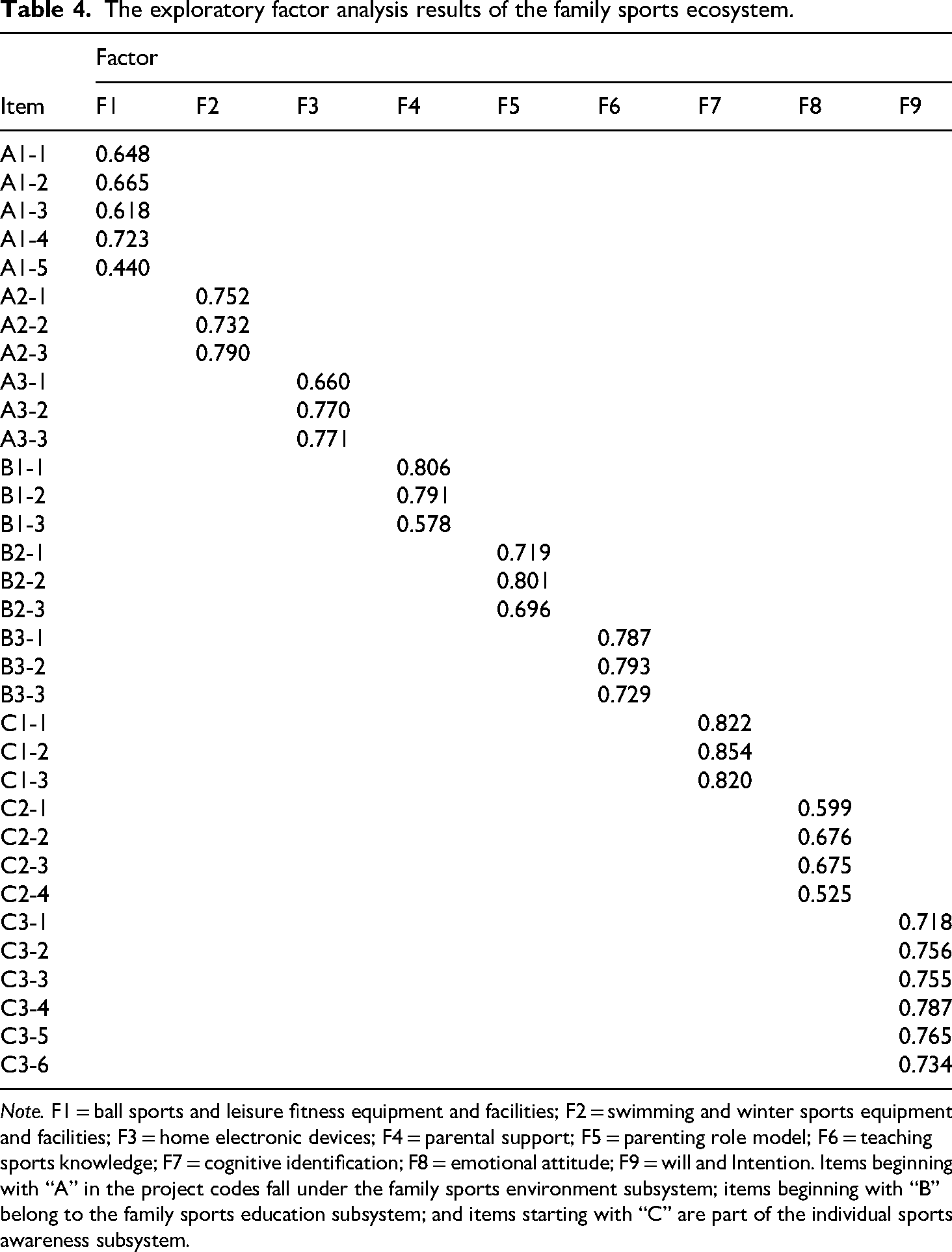
Note. F1 = ball sports and leisure fitness equipment and facilities; F2 = swimming and winter sports equipment and facilities; F3 = home electronic devices; F4 = parental support; F5 = parenting role model; F6 = teaching sports knowledge; F7 = cognitive identification; F8 = emotional attitude; F9 = will and Intention. Items beginning with “A” in the project codes fall under the family sports environment subsystem; items beginning with “B” belong to the family sports education subsystem; and items starting with “C” are part of the individual sports awareness subsystem.
Confirmatory factor analysis (CFA)
To further assess the congruence between the obtained empirical model and the theoretical model, a CFA was performed on the revised 33-item questionnaire related to the family sports ecosystem using the remaining data from the pilot test (n = 672).
In Table 5, the CFA showed that x2/df is 2.476 (<3), root mean square error of approximation (RMSEA), root mean square residual (RMR), and standardized RMR (SRMR) are all below 0.05, goodness-of-fit index (GFI), adjusted GFI (AGFI), incremental fit index (IFI), comparative fit index (CFI), normed fit index (NFI), and Tucker–Lewis index (TLI) are all above 0.9, indicating appropriate fitting indexes.
Model fit indexes of confirmatory factor analysis.
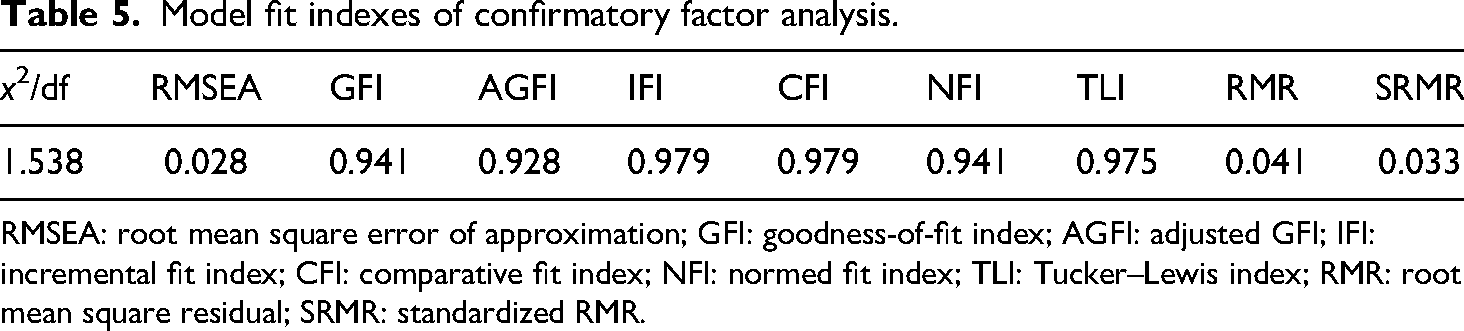
RMSEA: root mean square error of approximation; GFI: goodness-of-fit index; AGFI: adjusted GFI; IFI: incremental fit index; CFI: comparative fit index; NFI: normed fit index; TLI: Tucker–Lewis index; RMR: root mean square residual; SRMR: standardized RMR.
Convergent validity
In Table 6, all factor loadings exceeded 0.6. In addition, all the AVE values are over 0.5, and all Cronbach's alpha coefficients exceeded 0.70. In addition, all the composite reliability (CR) values are over 0.7, respectively, indicating that the convergent validity of the 33 items is acceptable.
Consolidation validity index.

AVE: average variance extracted; CR: composite reliability.
Note. A1 = ball sports and leisure fitness equipment and facilities; A2 = swimming and winter sports equipment and facilities; A3 = home electronic devices; B1 = parental support; B2 = parenting role model; B3 = teaching sports knowledge; C1 = cognitive identification; C2 = emotional attitude; C3 = will and intention.
Discriminant validity
The discriminant validity can be evaluated by using the Fornell–Lacker criterion. This method compares the square root of the average variance extracted (AVE) with the correlation of latent constructs. As shown in Table 7, the square roots of the AVEs for all factors exceeded their intercorrelations. This indicates that all the latent variables in this study are both conceptually and empirically distinct from each other. The discriminant validity of the scale is acceptable.
Discriminant validity of the latent variables.

AVE: average variance extracted.
Note. A1 = ball sports and leisure fitness equipment and facilities: A2 = swimming and winter sports equipment and facilities; A3 = home electronic devices: B1 = parental support: B2 = parenting role model; B3 = teaching sports knowledge; C1 = cognitive identification: C2 = emotional attitude: C3 = will and intention.
Discussion
The present study, grounded in family ecosystem theory, proposes a tripartite model (family sports environment, family physical education, and ISC) to capture the dynamic interplay of factors influencing junior high school students’ engagement within the family microsystem. This model extends beyond merely listing correlates by conceptualizing how the material context (environment), parental socialization processes (education), and the child's internal dispositions (consciousness) interact to shape sports participation, aligning with the theory's emphasis on multi-level interactions.
Our findings resonate with, yet also refine, prior research. The family sports environment subsystem highlights accessibility and utilization. Factors such as “Ball Games & Leisure Fitness Facilities” confirm the well-established link between convenient access to common facilities and increased activity levels.30,31 The distinct factor “Swimming & Winter Sports Equipment/Facilities” underscores the importance of specialized resources for niche activities, supporting Aleksandrova's point on their value for specific groups despite lower prevalence. 32 The “Family Electronic Devices” factor represents a modern dimension of the environment, where technology facilitates virtual physical engagement (exergaming) and mediated exposure to sports (viewing events/news), potentially shaping perceptions and interest beyond traditional equipment.
Within family physical education, the “Parental Support” factor (attendance, accompaniment, and financial backing) corroborates extensive evidence on the critical role of tangible resources and encouragement. 33 “Parental Role Modeling” (parental exercise, encouragement, and invitation) strongly aligns with social learning theory and empirical work, emphasizing the power of observational learning and behavioral cues. The inclusion of “Sports Knowledge Instruction” adds nuance, highlighting the parental role in cognitive scaffolding and skill development, a facet sometimes less emphasized than support or modeling alone.
The ISC subsystem delineates the internal drivers. “Cognitive Identification” reflects the child's rational understanding of the benefits (health, fitness, and development), forming a foundational belief system for engagement. “Emotional Attitude” captures the affective dimension (enjoyment, anticipation, joy, and admiration), directly supporting its predictive power for participation levels as noted by Phipps et al. 34 Finally, “Willpower” encompasses the crucial self-regulatory capacities (dedication, daily practice, resisting distractions/academic pressure, overcoming challenges, and persistence) necessary to translate intention and positive affect into sustained action. Critically, this model suggests that cognitive and emotional factors act as primary initiators of interest, while willpower serves as the essential sustainer of long-term participation.
Crucially, these subsystems are not isolated. A supportive environment enables parental education efforts; effective parental education (through support, modeling, and instruction) fosters positive individual cognitions and emotions; and strong individual consciousness, particularly willpower, motivates the child to actively utilize environmental resources and respond to parental guidance. This reciprocal influence exemplifies the core tenet of family ecosystem theory applied to the sports domain (see Appendixes 1 and 2).
Implications
This study makes several key contributions to theory. Firstly, it provides robust empirical validation for applying family ecosystem theory to understand adolescent sports participation, demonstrating its relevance and explanatory power. Secondly, the proposed three-subsystem model (environment, education, and consciousness) offers a comprehensive and integrated framework that captures the multi-faceted nature of family influences, moving beyond examining isolated factors. Thirdly, the explicit identification and operationalization of the three core components of ISC (cognitive identification, emotional attitude, and willpower), along with their hypothesized roles (initiation vs. sustenance), provides greater conceptual clarity to the internal drivers of sustained participation. Finally, the delineation of factors such as “Sports Knowledge Instruction” and “Family Electronic Devices” within their respective subsystems refines our understanding of the specific mechanisms at play within the broader categories of parental influence and the physical environment.
The validated 33-item questionnaire serves as an actionable tool for assessing family sports ecosystems. For parents, findings underscore the need to: (1) diversify home sports environments (including thoughtful integration of sports-related electronics); (2) combine financial support with active role modeling, co-participation, and skill/knowledge guidance; and (3) cultivate children's sports enjoyment and willpower beyond performance metrics. Schools and communities should leverage family partnerships through shared activities (e.g. parent–child sports events) and integrate willpower-building strategies into physical education. Policymakers must prioritize accessible public sports facilities (e.g. community fitness squares) to enable ecosystem-wide engagement.
Future research directions
Longitudinal studies should track ecosystem dynamics and long-term health outcomes across developmental stages. Cross-population validation (e.g. varying cultures and socioeconomic statuses) is needed to test model generalizability. Advanced methods (e.g. structural equation modeling) can elucidate interactions among subsystems (e.g. how parental education mediates environment-consciousness links). Theory-driven interventions targeting specific components (e.g. parent knowledge workshops and willpower curricula) require efficacy testing. Mixed-method designs would deepen understanding of contextual influences beyond quantitative metrics.
Limitations
However, this study also has its limitations. The sample size and geographical scope may limit the generalizability of the findings. Additionally, the cross-sectional design of the study cannot establish causal relationships between the variables. Future research should consider expanding the sample size and geographical scope to enhance the generalizability of the findings. Longitudinal studies are also needed to investigate the causal relationships between the family sports ecosystem and physical activity behavior among junior high school students.
Conclusions
The present study established a comprehensive family sports ecosystem and subsequently developed the “FSEQ” for the first time. The reliability and validity of the questionnaire were rigorously examined through EFA and CFA, resulting in the identification of nine factors and 33 items suitable for assessing the family sports ecosystem of junior high school students. This questionnaire can provide essential foundational data for future research on familial influences on the physical health of junior high school students, as well as contribute to the construction of a family sports ecosystem and exploration of pathways and strategies to promote their physical health.
Footnotes
Acknowledgments
Not applicable.

Author contributions
Guorui Zhang: conceptualization, data curation, formal analysis, investigation, methodology, validation, visualization, and writing—original draft preparation, review, and editing; Chengji Jin: methodology, supervision, and validation.
Funding
The authors received no financial support for the research, authorship, and/or publication of this article.
Declaration of conflicting interests
The authors declared no potential conflicts of interest with respect to the research, authorship, and/or publication of this article.
Data availability
Data for the study are available with the authors.
Appendix 1. Family sports ecosystem questionnaire (parent questionnaire)
This questionnaire is about your family's perception of children's physical education. There are a total of 9 questions. The answers are not right or wrong, good or bad. Please answer based on your actual situation. Your answers will be strictly confidential and used only for research purposes.
Will you go to watch your child's sports activities? 〇 Never 〇 Seldom 〇 Uncertain 〇 Occasionally 〇 Frequently Will you accompany your child to their sports games or performances? 〇 Never 〇 Seldom 〇 Uncertain 〇 Occasionally 〇 Frequently Can you provide financial support for your child's sports activities (such as paying for paid sports training, buying sports equipment, etc.) every month? 〇 Never 〇 Seldom 〇 Uncertain 〇 Occasionally 〇 Frequently Do you regularly engage in physical exercise? 〇 Never 〇 Seldom 〇 Uncertain 〇 Occasionally 〇 Frequently Will you set a good example by actively participating in sports yourself to encourage your child to participate in sports? 〇 Never 〇 Seldom 〇 Uncertain 〇 Occasionally 〇 Frequently Will you invite your child to join you in your sports activities? 〇 Never 〇 Seldom 〇 Uncertain 〇 Occasionally 〇 Frequently Will you explain the technical aspects of your child's sport of interest (including information obtained through books, the internet, etc.)? 〇 Never 〇 Seldom 〇 Uncertain 〇 Occasionally 〇 Frequently Will you explain the rules of your child's sport of interest (including information obtained through books, the internet, etc.)? 〇 Never 〇 Seldom 〇 Uncertain 〇 Occasionally 〇 Frequently Will you explain knowledge about preventing sports injuries to your child? 〇 Never 〇 Seldom 〇 Uncertain 〇 Occasionally 〇 Frequently
Appendix 2. Family sports ecosystem questionnaire (student questionnaire)
There are 24 questions on this survey, which ask about the frequency of certain situations. When filling out the survey, there are no right or wrong, better or worse answers. We assure you that your responses to this survey will be kept confidential.
Please answer the following questions.
Do you have sports equipment at home (such as a soccer ball, basketball, volleyball, ping-pong ball, badminton racket, etc.)? 〇 Not available 〇Available, but rarely used 〇Available, used occasionally 〇Available, used sometimes 〇Available, used frequently. Is there a sports venue near your home (within a 10-15 minute walk) such as a soccer field, basketball court, volleyball court, badminton court, or ping-pong table? 〇 Not available 〇Available, but rarely used 〇Available, used occasionally 〇Available, used sometimes 〇Available, used frequently. Do you have leisure sports equipment at home (such as a shuttlecock or sandbag)? 〇 Not available 〇Available, but rarely used 〇Available, used occasionally 〇Available, used sometimes 〇Available, used frequently. Is there a fitness square near your home (within a 10-15 minute walk)? 〇 Not available 〇Available, but rarely used 〇Available, used occasionally 〇Available, used sometimes 〇Available, used frequently. Do you have fitness training equipment at home (such as dumbbells, treadmill, rowing machine, etc.)? 〇 Not available 〇Available, but rarely used 〇Available, used occasionally 〇Available, used sometimes 〇Available, used frequently. Do you have swimming equipment at home (such as a swimsuit or swim ring)? 〇 Not available 〇Available, but rarely used 〇Available, used occasionally 〇Available, used sometimes 〇Available, used frequently. Is there a swimming pool near your home (within a 10-15 minute walk)? 〇 Not available 〇Available, but rarely used 〇Available, used occasionally 〇Available, used sometimes 〇Available, used frequently. Do you have winter sports equipment at home (such as roller skates or ski boards)? 〇 Not available 〇Available, but rarely used 〇Available, used occasionally 〇Available, used sometimes 〇Available, used frequently. Do you play sports-related games using a motion gaming console? 〇 Never 〇 Seldom 〇 Uncertain 〇 Occasionally 〇 Frequently Do you watch sports matches on TV or computer? 〇 Never 〇 Seldom 〇 Uncertain 〇 Occasionally 〇 Frequently Do you check sports news on your mobile phone or tablet? 〇 Never 〇 Seldom 〇 Uncertain 〇 Occasionally 〇 Frequently Do you agree that regular physical exercise can make people physically healthy? 〇 Disagree 〇 Somewhat agree 〇 Neutral 〇 Moderately agree 〇 Very agree Do you acknowledge that physical exercise can make the body fit and strong, and enhance one's willpower and concentration? 〇 Disagree 〇 Somewhat agree 〇 Neutral 〇 Moderately agree 〇 Very agree Do you believe that physical exercise can promote the simultaneous development of both physical and mental abilities? 〇 Disagree 〇 Somewhat agree 〇 Neutral 〇 Moderately agree 〇 Very agree Have you always enjoyed participating in sports since you were young? 〇 Never 〇 Seldom 〇 Uncertain 〇 Occasionally 〇 Frequently Do you get excited just thinking about participating in sports? 〇 Never 〇 Seldom 〇 Uncertain 〇 Occasionally 〇 Frequently Do you like sports stars and people who love to exercise? 〇 Never 〇 Seldom 〇 Uncertain 〇 Occasionally 〇 Frequently Do you feel very happy and relaxed after every sports workout? 〇 Never 〇 Seldom 〇 Uncertain 〇 Occasionally 〇 Frequently Are you willing to spend your time and energy on participating in sports activities? 〇 Never 〇 Seldom 〇 Uncertain 〇 Occasionally 〇 Frequently Are you willing to devote at least 30 minutes each day to physical activity? 〇 Never 〇 Seldom 〇 Uncertain 〇 Occasionally 〇 Frequently Do you make time for physical exercise even if your studies are busy? 〇 Never 〇 Seldom 〇 Uncertain 〇 Occasionally 〇 Frequently Do you prioritize your exercise plan and complete it before watching TV or playing games? 〇 Never 〇 Seldom 〇 Uncertain 〇 Occasionally 〇 Frequently Do you persist in completing your exercise plan, no matter how difficult the situation is during the exercise? 〇 Never 〇 Seldom 〇 Uncertain 〇 Occasionally 〇 Frequently Have you ever experienced 'even though physical exercise is tiring and exhausting, I have at least persisted for half a year'? 〇 Never 〇Seldom 〇 Uncertain 〇 Occasionally 〇 Frequently