



Abstract
The immersed waterjet propulsion method represents an innovative advancement in traditional waterjet propulsion technologies. Unlike previous studies that primarily rely on fluid-induced acoustics theories, such as the Lighthill’s equations, this research experimentally validates key parameters affecting radiated noise levels, including jet velocity and nozzle pressure, providing new insights into noise reduction mechanisms in immersed waterjet systems. Through a comparative analysis of noise emission profiles, this study demonstrates that immersed waterjet devices exhibit a substantial reduction in underwater radiated noise, particularly within the critical low-frequency range of 1 to 5 kHz, where the noise reduction is most pronounced. By conducting controlled experimental assessments, this research contributes to a more comprehensive understanding of the underlying acoustic features and their influencing factors. Additionally, the study contextualizes its findings within the broader scope of naval propulsion systems, highlighting how immersed waterjet propulsion can significantly enhance stealth capabilities. The key contributions of this study lie in its detailed characterization of radiated noise mechanisms and its provision of empirical evidence that extends beyond theoretical predictions. The results of this study bridge a crucial gap in the literature by offering experimental insights into the radiated noise characteristics of immersed waterjet propulsion, a topic that has been less explored due to operational and technical challenges. Specifically, the immersed waterjet propulsion system demonstrated a reduction in underwater radiated noise by up to 12 dB in the 1 to 5 kHz frequency range compared to traditional stern-type systems under identical conditions. These findings lay a strong foundation for further optimization and application of immersed waterjet propulsion systems in modern naval and commercial vessels.
Introduction
Waterjet propulsion represents a novel form of marine propulsion where a high-speed jet ejected from the propulsion pump interacts with incoming flow to generate thrust, thereby propelling the vessel.1,2 This method is favored for its low noise profile, exceptional maneuverability, high efficiency at elevated speeds, and resistance to cavitation. Given these strengths, waterjet propulsion is extensively employed in high-speed surface ships and amphibious vessels with shallow drafts, as well as in submersible vehicles like submarines and torpedoes. 3
Despite its advantages, traditional stern-type waterjet propulsion systems present inherent limitations, such as reduced efficiency at lower speeds, system complexity, and prolonged wake generation, which may impact the vessel's operational efficiency and stealth characteristics. To overcome these challenges, immersed waterjet propulsion has been introduced, featuring a fully submerged nozzle configuration. This design modification allows for better integration with the vessel's hull and interaction with the boundary layer, leading to improved propulsion efficiency and reduced underwater acoustic emissions.4–6
Recent studies on waterjet propulsion have largely focused on noise reduction strategies in conventional systems, with minimal exploration of the acoustic implications of immersed waterjet propulsion. 7 Although the fundamental mechanisms of fluid-induced noise are well established in acoustic theories, such as Lighthill's equations, there remains a lack of experimental studies that validate these theoretical predictions in the context of immersed waterjet systems. Moreover, existing literature does not adequately address the differences in noise emission mechanisms between traditional and immersed propulsion systems under varying operational conditions. This study seeks to fill this gap by conducting a comprehensive experimental analysis that examines the acoustic profiles of immersed and traditional stern-type waterjet propulsion systems. 8
This paper aims to investigate the underwater radiation noise characteristics of submerged waterjet propulsion devices through experimental analyses, comparing these characteristics with those of traditional stern-driven systems. By elucidating the main acoustic features and patterns, this research will provide a solid foundation for the engineering applications of submerged waterjet technologies.9–11
Experimental setup and methodology
The experiments in this study were conducted using two scaled ship models, each equipped with distinct types of waterjet propulsion systems: a traditional stern-type system and an immersed waterjet system. The ship models were designed at a 1:10 scale, ensuring that the experimental results accurately reflected real-world operational conditions while considering scale effects. Scale effects were carefully analyzed and addressed through model-to-full-scale extrapolation techniques, minimizing potential discrepancies in noise measurement due to scaling limitations.12–14
Both ship models were constructed to maintain identical physical attributes in terms of hull weight, length, width, power systems, and propeller diameter, with the only differentiating factor being the propulsion system design. The traditional stern-type waterjet propulsion unit was fully enclosed within the ship's hull, with an intake positioned at the bottom and a nozzle aligned with the waterline. In contrast, the immersed waterjet propulsion unit was designed with a partially submerged configuration, allowing for direct water intake below the hull and jet ejection fully below the waterline. The structural configuration of these propulsion systems is illustrated in Figures 1 and 2. 15
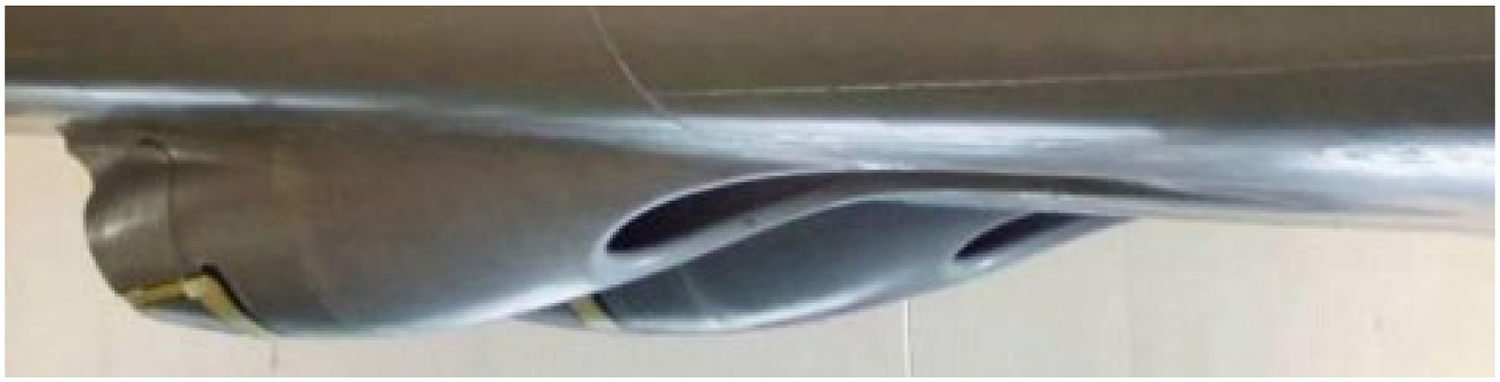
Submerged water jet propulsion.

Structure of submerged water jet propulsion unit.
The experimental tests were conducted in a controlled circulating water tank environment with a test section measuring 9 meters in length, 1.8 meters in width, and 1.2 meters in depth. The water level in the tank was adjusted to match the hull draft, ensuring realistic operating conditions. Noise measurements were taken using a high-sensitivity hydrophone positioned 1.5 meters directly beneath the propulsion system. The primary instruments used for data acquisition included an underwater two-dimensional positioning mechanism with a hydrophone array, charge amplifiers (LST100-4) with a bandwidth of 0.1 Hz to 100 kHz, and a DEWESOFT digital acquisition system with 16 channels, a maximum sampling frequency of 200 kHz, and 24-bit resolution. These instruments were calibrated and operated within their effective range to ensure accurate data collection. The hydrophones used had a sensitivity of ±0.5 dB and a frequency range from 10 Hz to 100 kHz, while the charge amplifiers had a gain range of 20 to 60 dB, and the data collectors operated with a sampling rate of 200 kHz. Pressure transmitters with an accuracy of ±0.01 MPa were also employed. To ensure reliable data acquisition, background noise levels were recorded separately under each test condition, and the hydrophone placement was optimized using the two-dimensional positioning mechanism to capture accurate acoustic signals.
Directly beneath the test section, a noise measurement cabin equipped with sound-transmitting glass separates it from the testing environment. This cabin is fitted with a sound-absorbing cone to enhance the acoustic testing conditions. The layout and design of the recirculating water tank used for the experiments are shown in Figure 3. An underwater two-dimensional positioning mechanism facilitates the placement of hydrophones for the underwater radiation noise tests of the propulsion devices. The primary test instruments include hydrophones, charge amplifiers, collectors, and pressure transmitters. 16
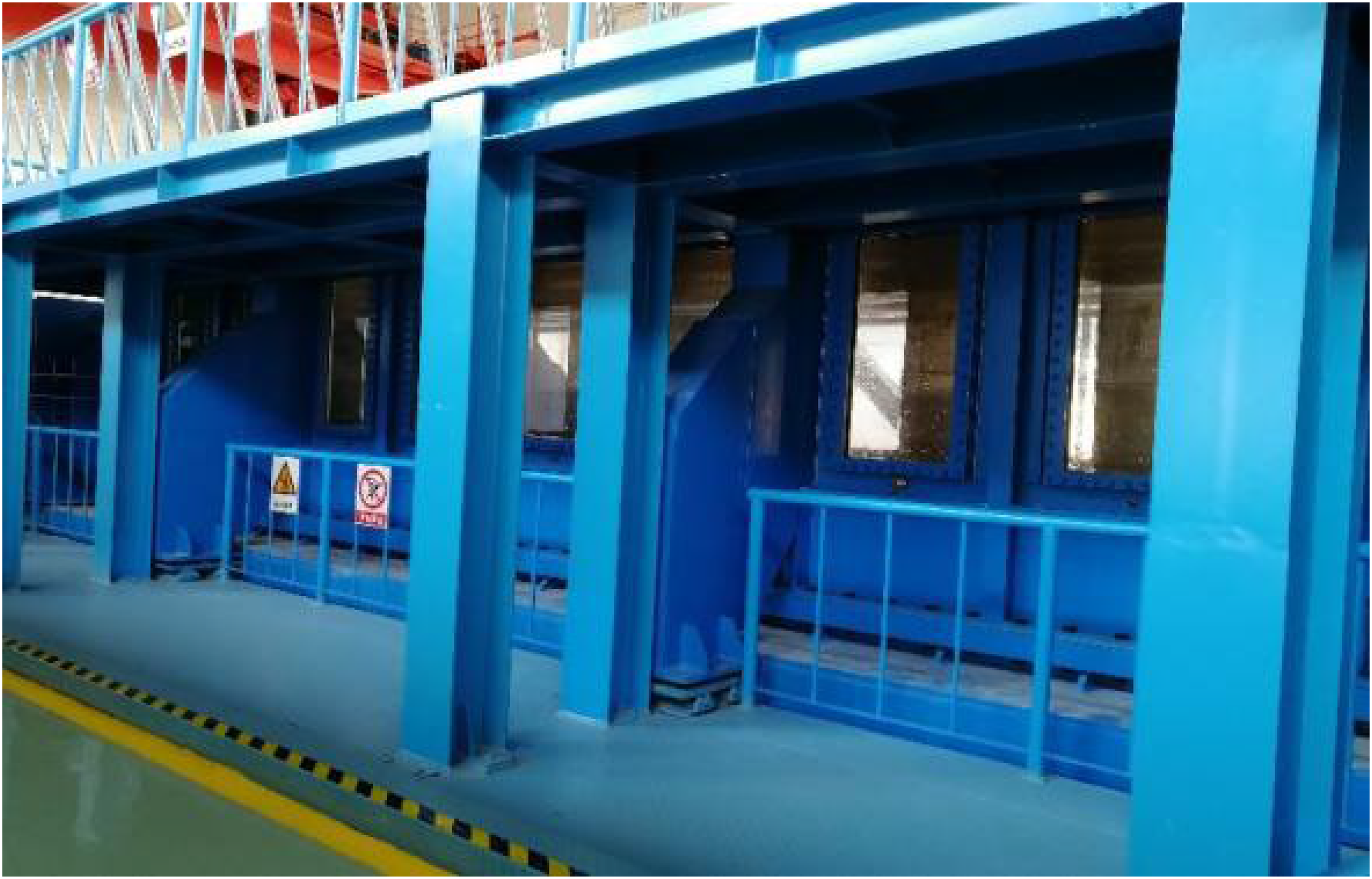
Recirculating water tank.
During the experiments, the water level in the circulating tank was adjusted to match the hull draft. The hydrophone was positioned approximately 1.5 m directly beneath the waterjet propulsion device. The testing involved adjusting the inflow water speed and the speed of the waterjet propeller to meet specific test conditions, recording results from the hydrophone. The test protocol included three operational scenarios: static water propeller speed at 455 r/min, still water propeller speed at 985 r/min, and a reduced speed of 455 r/min with a 2 m/s inflow. Background noise levels were concurrently recorded to ensure consistency across all test conditions. An overview of the experimental site setup, including the arrangement of key instrumentation and hydrophone placement, is presented in Figure 4. Notably, the uniqueness of the test setup and the use of a shaftless motor system necessitated that signals recorded by the hydrophone under both still water and 2 m/s inflow conditions serve as the reference for background noise.17–20

Experimental site.
Results
Noise spectrum characteristics
The analysis presented in Figure 5(a) and (b) displays the underwater radiation noise spectrum comparison for traditional stern-type and immersed waterjet propulsion devices, spanning a frequency range of 1 kHz to 80 kHz under various operating conditions. Figure 5(c) and (d) shows the comparison of 1/3 octave spectral levels of underwater radiated noise for the same propulsion systems under different operational scenarios.

Comparison chart of noise spectrum and 1/3 octave spectrum level under different working conditions.
The underwater radiated noise spectra were analyzed to determine the differences in acoustic emissions between the immersed and traditional stern-driven waterjet propulsion systems. The fast Fourier transform (FFT) method was used to convert time-domain signals into frequency-domain representations. The results revealed that the immersed propulsion system consistently exhibited lower broadband noise across all frequency ranges, with the most significant reductions occurring in the low-frequency band of 1 kHz to 5 kHz. This frequency range is particularly relevant for underwater sonar detection, making the immersed system a more viable option for stealth-sensitive applications. The noise reduction effect is visually represented in Figure 5(a), which illustrates the spectral differences between the two propulsion systems.
The spectral analysis further indicated that the traditional stern-driven system exhibited multiple high-intensity spectral peaks, especially in the mid-frequency range of 10 kHz to 20 kHz. These peaks are attributed to cavitation effects and turbulent flow interactions near the nozzle exit. In contrast, the immersed system demonstrated a more uniform spectral distribution, with fewer fluctuations and lower peak intensities, suggesting that its enclosed nozzle design effectively mitigates noise caused by turbulent jet interactions. Figure 5(c) and (d) further illustrates the 1/3 octave spectral level comparisons between the two systems under varying conditions, highlighting the differences in frequency band energy distribution.
Influence of propulsion speed on radiated noise
The propulsion speed significantly impacted noise emissions, with both systems exhibiting increased noise levels at higher operating speeds. However, the immersed system maintained a more stable noise increase, where Figure 5(b), where the noise intensity of both systems is plotted against various speed conditions.
The propulsion speed significantly impacted noise emissions, with both systems exhibiting increased noise levels at higher operating speeds. However, the immersed system maintained a more stable noise increase, whereas the traditional stern-driven system showed a sharp rise in noise emissions as speed increased. This effect was particularly pronounced in the mid-to-high frequency bands, where cavitation formation was more prevalent in the traditional system.
The analysis also revealed that at low propulsion speeds, the noise differences between the two systems were minimal. As speed increased beyond a certain threshold, the traditional system exhibited greater noise fluctuations, particularly in turbulent flow regions near the intake and nozzle. The immersed system, by contrast, exhibited a smoother increase in noise levels, reinforcing the effectiveness of its streamlined flow path in reducing turbulence-induced acoustic emissions.
Effect of nozzle pressure and jet velocity on noise emissions
The impact of nozzle pressure and jet velocity on radiated noise was another crucial aspect of the study. The results indicated that as nozzle pressure increased, both propulsion systems exhibited higher noise levels. However, the immersed system showed a more gradual noise increase, whereas the traditional system displayed an abrupt rise in noise emissions. This suggests that the immersed system is better equipped to handle high-pressure operating conditions without generating excessive turbulence or cavitation effects. The relationship between nozzle pressure, jet velocity, and noise emissions is demonstrated in Figure 6(a), which compares the noise profiles under different operating pressures.

Comparison chart of noise 1/3 octave spectral level and total sound pressure level under different waterjet propulsion structures.
The impact of nozzle pressure and jet velocity on radiated noise was another crucial aspect of the study. The results indicated that as nozzle pressure increased, both propulsion systems exhibited higher noise levels. However, the immersed system showed a more gradual noise increase, whereas the traditional system displayed an abrupt rise in noise emissions. This suggests that the immersed system is better equipped to handle high-pressure operating conditions without generating excessive turbulence or cavitation effects.
Additionally, variations in jet velocity were observed to influence the noise characteristics of both systems. Higher jet velocities corresponded to an increase in mid-to-high frequency noise, particularly in the traditional system, where vortex shedding and flow separation were more pronounced. The immersed system, with its more enclosed flow channel, exhibited better noise suppression across different jet velocity conditions, further emphasizing the advantages of its structural design in minimizing turbulence-induced acoustic emissions.
Discussion
Implications for noise reduction strategies
The results of this study provide valuable insights into noise reduction strategies for marine propulsion systems. The significant reduction in broadband noise observed in the immersed system can be attributed to its submerged nozzle configuration, which minimizes the direct interaction between the jet flow and the free surface. This design helps prevent air entrainment, a common source of broadband noise in traditional stern-driven systems. The findings suggest that optimizing nozzle geometries and intake designs can lead to further improvements in noise suppression, particularly in reducing mid-to-high frequency noise emissions associated with turbulent flow separation. The effectiveness of these noise reduction strategies is demonstrated in Figure 6(b), which illustrates how different nozzle configurations impact noise emissions. 21
Stealth applications in naval and research vessels
One of the most critical implications of the findings is their relevance to stealth applications in naval and research vessels. The ability to reduce noise emissions in the 1 kHz to 5 kHz range enhances a vessel's ability to operate undetected in underwater environments. Given the growing demand for quieter propulsion technologies in modern naval fleets, the immersed waterjet propulsion system presents a viable alternative for enhancing acoustic discretion. Moreover, the lower overall noise profile of the immersed system suggests that it could be integrated into unmanned underwater vehicles (UUVs) and autonomous marine research platforms, where stealth and minimal environmental impact are essential. The practical applications of noise reduction in naval operations are highlighted in Figure 6(d), which compares noise profiles of different propulsion systems in simulated stealth conditions. Figure 6(c) presents the comparative noise profiles under stealth simulation scenarios, clearly indicating the immersed system's superiority in maintaining a low acoustic signature.
One of the most critical implications of the findings is their relevance to stealth applications in naval and research vessels. The ability to reduce noise emissions in the 1 kHz to 5 kHz range enhances a vessel's ability to operate undetected in underwater environments. Given the growing demand for quieter propulsion technologies in modern naval fleets, the immersed waterjet propulsion system presents a viable alternative for enhancing acoustic discretion. Moreover, the lower overall noise profile of the immersed system suggests that it could be integrated into UUVs and autonomous marine research platforms, where stealth and minimal environmental impact are essential.
Influence of operating environments on system performance
The study also highlighted the importance of operating environments in determining propulsion system performance. The immersed system maintained a relatively stable noise profile under varying environmental conditions, whereas the traditional stern-driven system was more susceptible to fluctuations in noise emissions due to hydrostatic pressure variations and increased cavitation at greater depths. These findings suggest that immersed waterjet propulsion may be more suitable for deep-sea applications, where pressure conditions can significantly impact cavitation behavior and overall propulsion efficiency. The effects of varying operating environments are depicted in Figure 6, which presents a comparative analysis of system performance in different water depths and pressure conditions.
The study also highlighted the importance of operating environments in determining propulsion system performance. The immersed system maintained a relatively stable noise profile under varying environmental conditions, whereas the traditional stern-driven system was more susceptible to fluctuations in noise emissions due to hydrostatic pressure variations and increased cavitation at greater depths. These findings suggest that immersed waterjet propulsion may be more suitable for deep-sea applications, where pressure conditions can significantly impact cavitation behavior and overall propulsion efficiency.
Conclusion
This study provides a comprehensive evaluation of the radiated noise characteristics of immersed and traditional stern-driven waterjet propulsion systems. The results demonstrate that the immersed propulsion system significantly reduces underwater noise emissions, particularly in the critical low-frequency range of 1 kHz to 5 kHz. Key factors influencing noise emissions, including propulsion speed, nozzle pressure, and internal flow dynamics were examined, revealing the superior noise suppression capabilities of the immersed system.
The findings have important implications for the design and implementation of waterjet propulsion technologies in naval and civilian applications. The ability of the immersed system to maintain lower noise emissions across different operating conditions makes it a promising candidate for stealth-sensitive applications, such as submarine propulsion and autonomous marine research vessels. Future research should focus on refining nozzle geometries, exploring alternative materials, and conducting real-world field tests to validate the laboratory findings under actual maritime conditions. Overall, the study reinforces the benefits of immersed waterjet propulsion as a quieter and more efficient alternative to traditional stern-driven systems, providing valuable insights for the advancement of next-generation marine propulsion technologies.
Footnotes
Acknowledgments
The authors thank Researcher Zonglong Wang, Researcher Ning Li and Engineer Jianshin Zhu for their significant assistance with this study and the project team for their relevant help and advice on this study.

Author Contributions/CRediT
Funding
The author(s) disclosed receipt of the following financial support for the research, authorship, and/or publication of this article: This work was supported by the China Equipment Pre-Research Fund project (Grant number 62602010115)
Conflicting interests
The author(s) declared no potential conflicts of interest with respect to the research, authorship, and/or publication of this article.
Data availability
Data available on request from the authors.