



Abstract
Disaster environments, such as fires, distort of two-way radio communication within buildings. This article presents an experimental study on microwave attenuation based on the smoke and wall type in a disaster environment using a two-way radio with digital mobile radio communication, widely used by firefighting crews in Korea. Furthermore, we compared the microwave attenuation of the two-way radio depending on the building materials and smoke. We then present the experimental result of the microwave characteristic corresponding to the four types of walls in a specially designed anechoic chamber (3 m × 1 m × 1 m) to analyze the microwave attenuation by the building materials, with results indicating up to 82% in 200 mm thick concrete. Moreover, we evaluated the propagation attenuation based on the four types of smoke with the same density in a container space (5.8 m × 2.8 m × 2.2 m). The results showed that the microwaves were not transmitted and significantly decreased based on the building materials at 400 MHz, which is the main cause of attenuation. It shows a property of up to 36% reduction in urethane. Although the attenuation of microwaves is not significantly large according to the fuels in smoke, fuels such as urethane, plastic, and rubber have relatively small attenuation of microwaves compared to wood, and the received power corresponding to urethane in smoke decreased the most.
Introduction
When a fire or a building collapse occurs, wireless communication networks such as mobile communication networks or Wi-Fi fail to operate. Wireless communication that uses two-way radio is crucial for the safety of firefighters during rescue activities in disaster environments such as fires and building collapses. The radio converts the firefighter's information and transfers the disaster situation through the commander's instructions. However, the two-way radio with one-way communication causes microwave attenuation, resulting in several firefighter accidents. The main causes of communication distortion are propagation loss due to obstacles like building walls and the presence of smoke during a fire. In recent years, many studies have been conducted to analyze the propagation characteristics according to building walls. The propagation model was presented by simulating the effect on the attenuation of microwaves according to different wall types.1,2 Various studies have been conducted on microwave loss, which passes through materials used as building materials in common.3,4 The electromagnetic characteristic of two building materials, a brick wall, and a chip wood panel, has been measured at a 5.8 GHz band with perpendicular and parallel polarization of the incident wave. 5 However, the research was analyzed by simulation, and the return and transmission losses were evaluated using a network analyzer in the wireless local area network (WLAN) band. The WLAN is a wireless computer network that links two or more devices using wireless communication. It operates in both the 2.4 and 5 GHz bands and the WLANs based on the IEEE 802.11 standards are the most widely used computer networks in the world. Recently, some papers have presented measurements of reflection and transmission properties of building materials and multilayer dielectric models with window.6–8 But, these papers presented measurements of reflection and transmission properties in millimeter wave frequency including w band. Finally, the characteristics of the microwave were measured depending on the wall type. 9 However, the analysis was conducted using the transmission loss according to the frequency in a situation that is not completely shielded. Further, the absorber was located around the building material.
In this study, the received power of the two-way radio (ultra-high frequency (UHF) band), which is commonly used by actual fight fighters, is employed to analyze the propagation characteristics according to the building materials, rather than the microwave characteristics for reflector or transmission loss using a network analyzer. A completely shielded chamber was constructed using a perfectly sized absorber, allowing us to evaluate microwave attenuation without external noise interference. The experiments measured propagation characteristics based on the type and thickness of various building walls.
Additionally, various studies have been conducted to analyze the propagation characteristics owing to flames or smoke with fire. Several researchers conducted a study on the electromagnetic reduction of flames by simulating and measuring.10–12 The absorption and dispersion of electromagnetic waves in forest fuel flame and the effect of phase shift were analyzed and measured using an s-parameter with a network analyzer. Furthermore, the thermal ionization in forest fire environments was presented.13,14 However, the experimental study was conducted at the frequency of X-band radar in a forest fire. Various studies have conducted propagation attenuation depending on materials such as pine needles for the measurement of radar systems in wildfires.15–21 We also compared the microwave attenuation based on the size and diameter of the flame. 22 and analyzed the microwave phase perturbation and ionization in the fireplace. 23 Moreover, we evaluated the dielectric constant and moisture of high-temperature ash for radar at the frequency24,25 and reported the experimental study of microwave attenuation according to flames and smoke in a compartment fire. 26 However, the received power of the transmitter signal from the signal generator was analyzed at the representative communication frequency. Although the characteristics of electromagnetic waves differ based on the size of the flame and the density of the smoke, the experimental study was not the same in terms of the amount of flame or smoke according to the type of fuel. Finally, the characteristics of microwaves were studied to investigate the effects of environmental and human factors on communication attenuation in public protection system.27,28
The combustion comprises a series of complex exothermic reactions between fuel and oxygen, accompanied by heat and light. In this study, the microwave attenuation is analyzed according to the smoke density during a fire. We configured the experimental setup in a container space of a certain size and used the optical smoke density by light extinction measurement method to configure the same smoke in a container space. The light emitted from a light source was measured using an illuminance meter. When the value of lux is zero and light cannot be transmitted in the smoke layer, the received power of the two-way radio, which is used in the actual firefighting, was measured and analyzed. Additionally, a thermocouple was configured in the transmitter and receiver to measure the temperature of the smoke layer.
Measurement setup
Wall type
Figure 1(a) shows the measurement setup for analyzing microwave attenuation based on the type and thickness of the building material. In order to determine the influence of walls without affecting the propagation due to diffraction and reflection, the completely shielded chamber was constructed for the microwave attenuation analysis with material details. As shown in Figure 1(a), the dimension of the anechoic chamber was 3 m (L1) × 1 m (H1) × 1 m (W1).
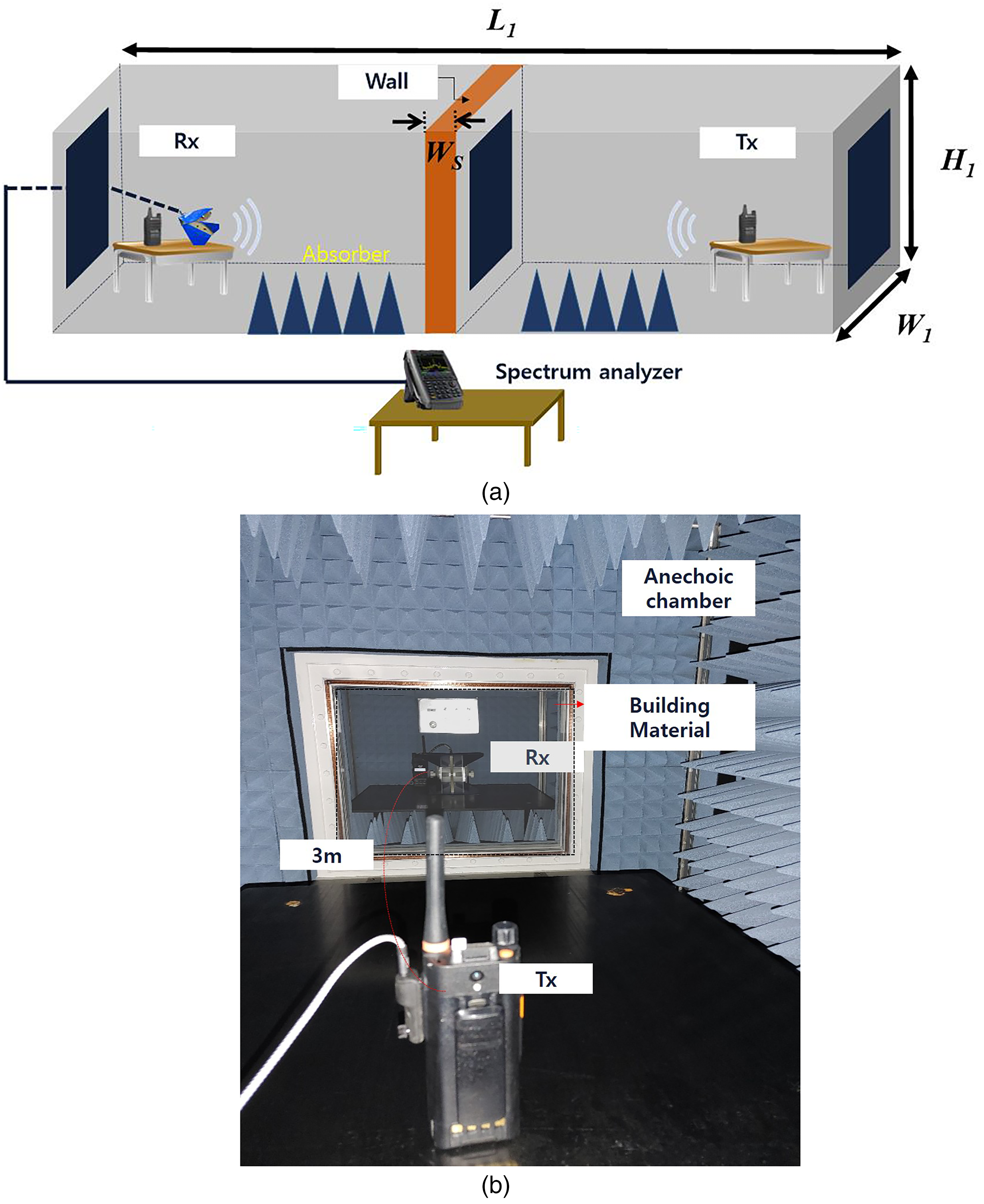
Measurement set up for microwave attenuation by the type and thickness of the building material: (a) structure of the measurement arrangement and (b) photograph of the measurement arrangement.
The size of the building material used in the experiment was 1 m × 1 m × 0.2 m (Ws), which was equal to the diameter of the chamber, and the building wall was placed in the center of the chamber. The thickness was selected according to the Korean structural plain concrete design standards (KDS 14 20 64: 2021). 28 The far field is the region that is at a large distance from the antenna. In the far field, the radiation pattern does not change shape as the distance increases. The distance between the transmitter and receiver was 3 m, far enough away from a radiation source. The walls used in this study were concrete, tiled brick, brick walls, and blocks, which are widely used as building walls. To compare the communication performance according to the thickness, a comparison experiment was conducted with a thickness of 0.15 m (Ws) in the case of concrete. Figure 1(b) shows the photograph of the measured building materials and the measurement setup. A digital mobile radio (DMR), that is, a digital two-way radio, (straffic, ST-P320) was configured in the tx part to send transmission signals one-way by using a push-to-talk button, whereas that of the firmware was modified and installed to enable transmission for over 1 min. The DMR used in this study operates with a transmit power of 30 dBm(1 W) and is the most used in the Korean fire service. The horn antenna (FT-RF) was configured in the rx part to receive the transmission signal and show the gain of 0 dBi at 435 MHz. The size of the receiver antenna was 251 mm × 173 mm × 242 mm and showed directional characteristics. The equipment used to measure the microwave attenuation by the building materials comprised a Keysight spectrum analyzer (N9344C) operating from 9 kHz to 7 GHz band, and the RF coaxial cable exhibiting low loss than 0.25 dB/m in bands below 1 GHz. It was configured to connect the spectrum analyzer outside the chamber.
Smoke type
Figure 2(a) shows the setup for measuring the microwave attenuation in smoke-field environments caused by fuels. As shown in Figure 2(a), the dimensions of the container space were similar to those in a space subjected to the real fire conditions, which is 5.8 m (L1) × 2.8 m (H1) × 2.2 m (W1). The combustion bucket was used to release smoke from the fuel. The size of the small combustion box was 0.5 m × 0.5 m × 0.5 m and it was placed at the center of the container. The fuels used in this study are wood, rubber, plastic, and urethane, which are widely used as combustion materials in fire. The distance between the transmitter and receiver was 5 m. A DMR (straffic, ST-PS20) was configured in the tx part and it sends transmission signal a one-way like as an experiment of wall type. It operates with a transmit power of 36 dBm.

Measurement set up for microwave attenuation according to the smoke caused by fuel: (a) structure of the measurement arrangement and (b) photograph of the reduced illuminance by urethane smoke.
The horn antenna (FT-RF) was configured in the rx part to the transmission signal, and the received signal was analyzed through a spectrum analyzer connected by an RF cable in the outside container. During combustion, the smoke heats up and buoyancy occurs during combustion, causing the smoke to rise to the upper floor and move along the wall. Accordingly, the transmitting and receiving system for measurements was installed in the upper position of the container, as shown in Figure 2(a). Figure 2(b) shows a photograph of the illuminance that decreases according to smoke by urethane. Generally, the smoke density is measured by the light extinction method, such as ASTM 662 standard, 29 which is the standard test method for specific optical density of smoke generated by solid materials. This study configured the smoke density according to the fuel in the container using the light extinction method. The equipment used to configure the smoke density in the container is the light source (Night watch ST 6) with 1800 lumen and digital illuminance meter (CA-2500, Konika Minolta). When the light was emitted from the light source and the value of the received illuminance was zero, the smoke density was considered uniform in the smoke layer of the container. At this time, the propagation characteristics between transmitting and receiving are measured. Furthermore, to check the safety of the two-way radio against heat, thermocouples were installed in the tx part and rx part, and the temperature of the smoke layer was analyzed.
Measurement result
Wall type
Figure 3(a) shows the received power of the two-way radio according to the building material type. The measurement result is obtained when the building material is placed in the center of the anechoic chamber and no obstruction is present. In free space without loss, there is only loss due to the distance between transmission and reception. However, in actual propagation, the propagation losses occur due to mismatches between antennas and cables, atmospheric noise, fading margin, polarization losses, and miscellaneous losses. 30

Measurement result of the received power according to the building material: (a) type of building material and (b) width of building material.
First of all, to determine the actual propagation losses, the measured and calculated power values were compared using Friis's formula in equation (1), which provided the power received by one antenna under idealized conditions with another antenna some distance away transmitting a known amount of power.

Figure 3(b) shows that the received power decreased by ∼5 dBm when building materials were present, and a 0.4–1.4 dB difference according to the building materials, as shown in Figure 3(a). This shows that the building materials drastically reduce the receiving power of the two-way radio and affect the communication performance. Figure 3(b) shows the received power of the two-way radio according to the width of building materials. Additionally, the measured receiving power with concrete for a width of 150 mm was −10.620 dBm. Furthermore, the receiving power was 2 dBm for a width of 150 mm, which is higher than that for a width of 200 mm. Therefore, the receiving power according to the width of materials is different, as shown in Figure 3(b).
Smoke type
Figure 4(a) to (d) shows the received power and illuminance of the two-way radio according to the four types of smoke released from four fuels: wood, rubber, plastic, and urethane. The fuels used were not combined and were used separately. In general, there are some dust and particles that are not pyrolysis in the smoke layer exist, and following the oxygen reaction, wood has a relatively high concentration of carbon dioxide.

Measurement result of the received power and illuminance according to the type of smoke: (a) wood, (b) plastic, (c) urethane, and (d) rubber.
The other fuels have several toxic gases such as nitrogen dioxide and hydrogen cyanide. Rubber contains mostly sulfur dioxide (SO2), urethane contains hydrogen cyanide (HCN), and plastic contains nitrogen dioxide (NO2) and hydrogen chloride (HCL). 31 This study evaluated the effects of microwaves in the smoke layer. The amount of smoke in the container was assumed to be the same according to the fuel. To compare the calculated and measured receiving powers, we used Friis's formula in equation (1). The calculated receiving power at a distance of 5.6 m was –5.9 dBm at 449.5 MHz. The measured receiving power without smoke was from −6.03 to −6.31 dBm. The received power was measured three times, and the average value was used. The illuminance was measured at 10 s intervals and the temperature of the smoke layer part was measured at 30 s intervals in the tx and rx parts, respectively. The calculated RF power and the measured rx power levels of reference were similar. As shown in Figure 4(a), in the case of wood, the illuminance decreased from 150 to 0 lux by the smoke, and the received power varied from −6.16 to −6.21 dBm for 4 min. The received power did not change significantly, and the electromagnetic wave may not have been significantly affected. In the case of plastic, the illuminance decreased from 153 to 0 lux because of the smoke in 4 min 30 s, and the received power varied from −6.31 to −7.47 dBm, as shown in Figure 4(b). The received power decreased by ∼1.1 dBm because of the smoke. As shown in Figure 4(c), the illuminance declined from 150 to 0 lux in 4 min under the effect of the smoke in the case of urethane, which was the fastest decline. The received power decreased from −6.27 to −8.2 dBm and by ∼1.9 dBm. The received power decreased the most compared to other fuels. Finally, the illuminance decreased from 150 to 0 lux under the effect of smoke according to rubber. It took 7 min 30 s until the container was filled with smoke. The received power varied from −6.03 to −6.68 dBm and decreased by ∼0.6 dBm because of the smoke. Table 1 summarizes the temperature of the smoke layer in the tx and rx parts. As summarized in the table, the temperature increased from 20 °C to 45 °C over time. Although the time to fill the container with smoke differs according to the fuel type, the temperature of the smoke layer is almost the same. Figure 5 compares the received power according to the type of smoke.

Comparison of the measurement result of the received power according to the type of smoke.
Summary of the temperature of the smoke layer in tx and rx.

When the container space is filled with smoke and the illuminance value is zero, the attenuation of microwaves is not large for each type of fuel in the smoke layer; however, the microwaves are relatively reduced for urethane, plastic, and rubber, which constitute quantities of black smoke. The large quantities of black smoke contain soot, and the toxic gases during combustion along with the fine particles in the air layer that are refractive perturbed due to incomplete combustion potentially affected the attenuation of microwaves more than wood.
Conclusion
We analyzed microwave attenuation caused by building materials and smoke in a disaster environment. A completely shielded chamber was constructed, and an experiment was performed using four types of building materials to analyze the decrease in microwaves due to the building materials. The measured receiving power based on the type and thickness of the building materials was 5 dBm lower than that based on condition of air condition.
It was observed that two-way radios operating in the UHF band experience significant microwave attenuation in building materials, which exhibit relatively higher dielectric constants compared to air. The attenuation is further exacerbated by the thickness of the material. This indicates that communication becomes difficult in the absence of dedicated repeater facilities. Furthermore, the experiment was conducted using four types of fuels to analyze the transmitting characteristic of microwaves in the smoke layer. The smoke in the container box was equally configured by employing the light extinction method. The incomplete combustion of composite materials such as urethane and plastics generates smoke, which significantly contributes to microwave attenuation. This attenuation leads to communication degradation. In particular, a smoke layer produced by burning urethane exhibited a maximum signal attenuation of up to 2 dB and reduced faster than other fuels and the combustion was relatively faster.
The communication performance in microwaves was analyzed using a two-way radio used during actual firefighting. There are many cases where firefighting activities involve entering the interior of buildings in a disaster environment. However, It can be observed that usage inside buildings is challenging, and facilities such as repeaters are essential and also, due to radio attenuation in case of smoke in a disaster environment, it appears that caution should be used during firefighter activities. It can provide guidance on proper training on the possibility of radio attenuation and information on the installation of repeaters necessary for communication in disaster situations like as fire and building collapse. Moreover, the findings of this study are expected to assist in the development of advanced firefighting technologies, such as robots and IoT devices, which require reliable communication in smoke-filled environments. Additionally, we believe the results of this study will be of help to realize efficient disaster response and firefighter rescue during a fire and help realize firefighting equipment development used by firefighters.
It is thought that sufficient training on the possibility of radio attenuation and guidance on the installation of necessary repeaters can be provided, and guidance on the use of robots and IoT devices in the interior of buildings can be provided.
Footnotes
Acknowledgements
We would like to express our gratitude to the Advanced Technology Research Team of the Fire Response Technology Lab.
Authors’ contributions
InSu Yeom has made a substantial contribution to the experimental plan, experiment and data analysis, conclusions, and language accuracy. Tae Dong Kim participated in the experiment.
Declaration of conflicting interests
The authors declared no potential conflicts of interest with respect to the research, authorship, and/or publication of this article.
Funding
The authors disclosed receipt of the following financial support for the research, authorship, and/or publication of this article: This research was supported by the Technology and Development to Support Firefighting Activities (1761002660) founded by the National Fire Agency.
