



Abstract
Despite a number of efforts to evaluate the utility of water-diesel emulsions (WED) in CI engine to improve its performance and reduce its emissions in search of alternative fuels to combat the higher prices and depleting resources of fossil fuels, no consistent results are available. Additionally, the noise emissions in the case of WED are not thoroughly discussed which motivated this research to analyze the performance and emission characteristics of WED. Brake thermal efficiency (BTE) and brake specific fuel consumption (BSFC) were calculated at 1600 rpm within 15%–75% of the load range. Similarly, the contents of NOx, CO, and HC, and level of noise and smoke were measured varying the percentage of water from 2% to 10% gradually for all values of loads. BTE in the case of water emulsified diesel was decreased gradually as the percentage of water increased accompanied by a gradual increase in BSFC. Thus, WED10 showed a maximum 13.08% lower value of BTE while BSFC was increased by 32.28%. However, NOx emissions (21.8%) and smoke (48%) were also reduced significantly in the case of WED10 along with an increase in the emissions of HC and CO and noise. The comparative analysis showed that the emulsified diesel can significantly reduce the emission of NOx and smoke, but it has a negative impact on the performance characteristics and HC, CO, and noise emissions which can be mitigated by trying more fuels variations such as biodiesel and using different water injection methods to decrease dependency on fossil fuels and improve the environmental impacts of CI engines.
Introduction
The world’s energy demand is increasing rapidly with every coming day which is mostly being fulfilled by fossil fuels. 1 Therefore, petroleum-based reserves are about to extinct in the next few decades while their prices are continuously increasing.2,3 A large fraction of petroleum is used as fuel in the transportation sector and it is the source of about 33% of total energy consumption. 4 Compression ignition engines produce a lot of noise and harmful emissions which not only disturb life as a whole but also affect the engine rigorously.5,6 Overall the 25% of NOx, HC, CO, and smoke emissions in the environment are produced by the transportation sector. 6 These emissions are the main cause of acid rain, climate change, greenhouse effect and ozone depletion presenting a huge risk to life and the environment on the Earth. 5 These statistics encourage government and researchers to find alternatives to fossil fuels that can mitigate the negative impact of depleting petroleum reserves on supply-demand mechanism along with reducing the emissions without any significant change on the engine performance.7,8
Apart from various alternative fuels, primary fuel modification is also a potential technique to decrease harmful emissions and improve performance. 8 Emulsion of water in diesel (WED) is one such modification that has been recommended by many researchers to especially reduce the NOx emissions and increase the engine performance in the case of biodiesels.9,10 In this regard, a number of attempts have been made to observe the performance of the engine using WED which revealed an increase in BSFC and reduction in power output while NOx emissions were reduced significantly.8,11–16 Subramanian and Ramesh observed the impact of WED on the performance and emissions characteristics of a single cylinder CI engine by varying loads at the constant speed of 1500 rpm using a 40% ratio of by mass of water and indicated a reduction in the NOx and smoke level along with improvement in the brake thermal efficiency. 17 A similar results are mentioned by Lif and Holmberg using the water content ranging from 5% to 45% where NOx and PM were decreased 30% and 60% respectively with 15% water in the diesel. However, this decrease was accompanied by a higher level of contents of CO and HC as the percentage of water was increased in the diesel. 18
Ithnin et al. 11 noticed that BTE was increased by 5.34% when 5% water was blended with petroleum diesel. They used a direct injection diesel engine with an emulsified diesel running at 3000 rpm. They also noticed that BSFC was decreased by 5.55%. Moreover, a 29% reduction in NOx and 31.67% reduction in PM emission was observed. Mondal and Mandal 15 prepared water emulsified diesel fuel by adding 10% water in diesel and observed an increase in BTE whereas BSFC was decreased. Moreover, NOx and smoke emissions were reduced significantly whereas reduction in CO emission was negligible.
Similarly, Alahmer 14 used a water-cooled diesel engine with a mixture of 5%–30% water in diesel fuel. They found an 8.31% increase in BSFC and a reduction in the contents of NOx. They noticed an improvement in power output while using 5% water but not a significant difference when the water content was increased by 10%. Suresh and Amirthagadeswaran 19 produced diesel-water blends by mixing 5% and 10% water content in a single cylinder, diesel engine and observed an increase in BTE and decrease in BSFC.
Fahd et al. 13 attempted to decrease the peak temperature of combustion flame by using the direct water injection method and found an improvement in NOx emissions. Vellaiyan et al. 20 found a 21.2% reduction in NOx and 40% reduction in HC when they used 10% water content in soybean biodiesel. Samec et al. 21 found out that the emissions can be significantly reduced by using water emulsified fuel without much compromising the specific fuel consumption. Armas et al. 22 observed that the density and viscosity of diesel fuel are increased and heating value and cetane number is decreased when water is added. High density provides fuel with an extra momentum that improves the air-fuel mixing process and results in improved fuel combustion. Mondal and Mandal 15 tabulated the work of different researchers and concluded that the addition of water in diesel decreases NOx, HC, PM emissions to a great extent but they did not find a significant improvement in CO emission. Moreover thermal efficiency, combustion efficiency and BSFC also found to be increased. 15
Youngtaig observed an increased BSFC with water emulsified diesel as compared to pure diesel which was attributed to zero calorific value of water which reduces the heating value. 23 Al-Sabagh et al., 24 Scarpete, 25 and Singh and Bharj 26 also agree that the level of NOx emission is decreased in a considerable amount on adding water content to petroleum diesel. Therefore, the use of water emulsion in a diesel engine is an economical way to reduce emissions as no engine design modification is needed to control the production of the pollutants.6,11 Moreover, the fractional amount of water present in the diesel can significantly reduce the net fuel cost. 19
However, despite a number of investigations to analyze the performance and emissions characteristics of CI engine by employing water diesel emulsion, its comprehensive effect on smoke and noise level is not available. Also, there are some contradictory findings of the effect of WED on engine performance specifically on BTE and the HC and CO emissions. Therefore, this study aims to validate all such existing findings by presenting a comparative analysis of diesel and WED contributing to ongoing research for alternative fuels by comparing the potential advantages of WED to reduce the emissions and pollutants over diesel fuel.
Methodology
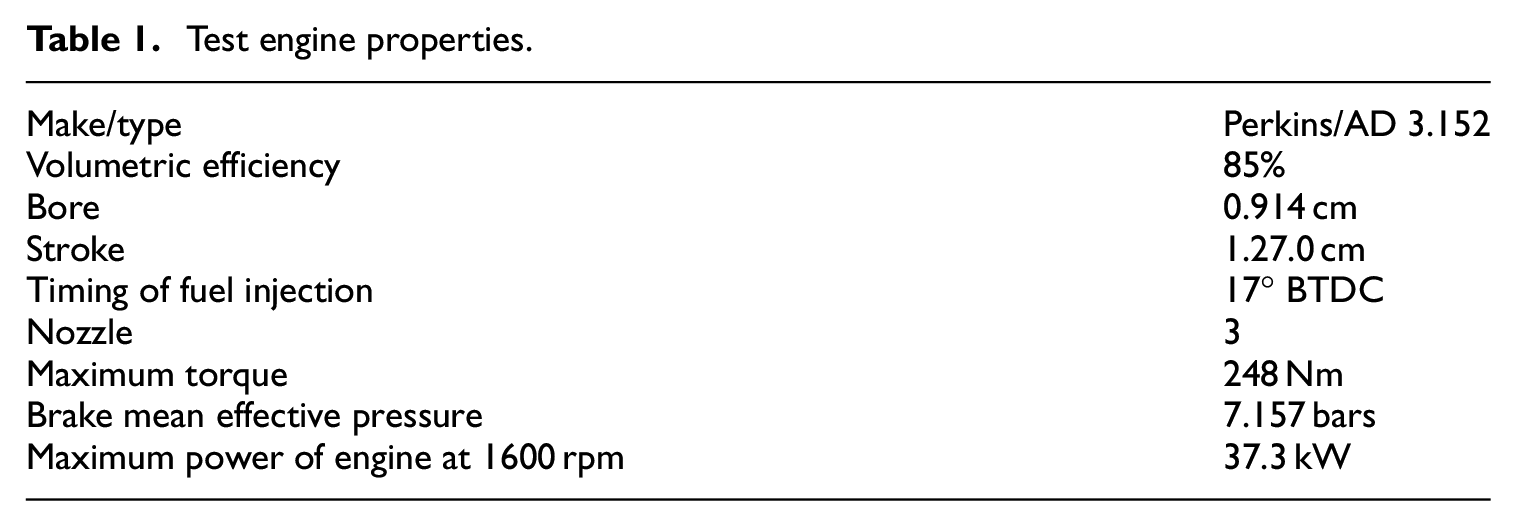
In this study, an analysis of the performance and emission characteristics of a CI engine is made when employed with water emulsified diesel. The properties of the test engine are given in Table 1.
Test engine properties.
Preparation of water-diesel emulsion
In an emulsion, a liquid is mixed in the form of tiny spherical droplets. Water-diesel emulsions were made by homogenously mixing water and diesel with the help of surfactant 27 (Span 20) to improve the stability of emulsion 6 using a high-speed magnetic stirrer operating at 1250 rpm. Surfactants are used to reduce the surface tension at the interface of water and diesel to ensure the relative longer stability of the water emulsified diesel. 28 The amount of surfactant in the emulsion was varied between 0.5% and 2% for water-diesel emulsions of 2% water and 98% diesel (WED2), 4% water and 96% diesel (WED4), 6% water and 94% diesel (WED6), 8% water and 92% diesel (WED8), and 10% water and 90% diesel (WED10). Different properties of emulsified fuel such as density, dynamic viscosity, kinematic viscosity, and calorific value are presented in Table 2.
Properties of test fuels.

It can be observed from Table 2 that as the percentage of water increases in the diesel, the density of the emulsions increases while their calorific value decreases.14,15 Similar results were obtained for viscosity. 29 However, the density of the emulsified fuel is not the average density of the water and diesel and air bubbles enter during the preparation phase which decreases the density from the average value. 12
The addition of water in diesel can bring many disadvantages as well such as the corrosion of metallic parts of the engine due to the presence of the water molecules especially on the higher temperature as noted by Wang and Pan. 30 This is the primary reason why the Cummins Inc. does not suggest to run their engines on water diesel emulsions. 15 The surfactants can also negatively impact the fuel line deposits, fuel tank, and fuel filters. 15 However, these effects can be prevented by using the non-ionic surfactants which provide lesser corrosion, anti-freezing properties, and better lubrication. 31
Experimental setup
The schematic of the whole experiment rig is presented in Figure 1. The engine was connected with a number of different equipment to measure engine performance, that is, BTE and BSFC and record emissions level, sound level, and smoke opacity. The details of each component are given below.

Schematic of the experimental rig.
Engine performance
BTE and BSFC were measured to analyze the effects of test fuels on the engine’s overall power out. BTE was calculated by using brake power (BP), calorific value (CV), and fuel consumption (FC) in equation (1).3,32 The BSFC was calculated by utilizing the values of FC and BP in equation (2).
33
Calorific value of the diesel was obtained from Pakistan State Oil (PSO) while FC was measured by noting time for 100 ml of consumption measured from scaled cylinder attached with the fuel tank. For calculating BP, voltage (V) and current (I) were measured by voltmeter and ammeter respectively from the control unit. The heaters were used to vary the load. The generator efficiency (

Where


Emissions
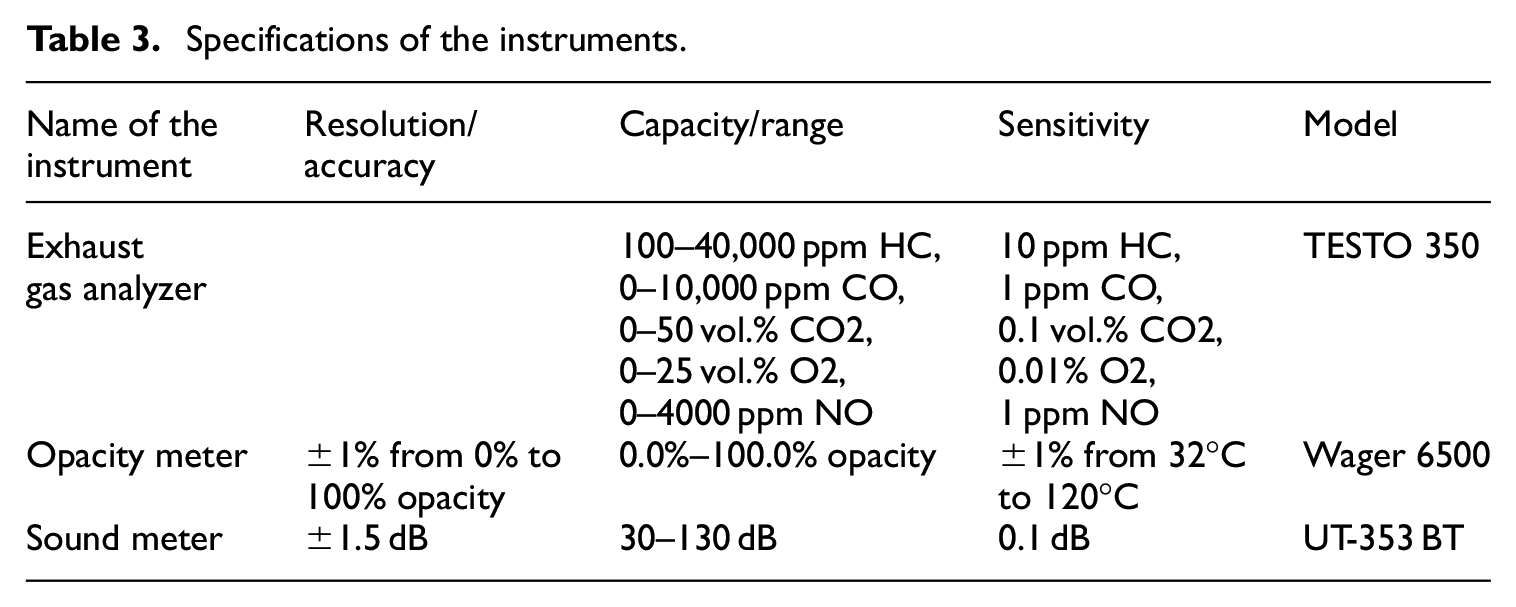
To get the emission contents of the engine, TESTO 350 exhaust gas analyzer was used while Wager 6500 Smoke (Opacity) Meter was used to accurately detect the opacity of smoke emitted by diesel engines. UNI-T UT353 sound level was utilized to measure the sound level of the engine at each test. The meter was placed at the closed point to the engine where the maximum sound was being developed. Table 3 provides the information about the measurement range and accuracy values of the instruments used in the experiment.
Specifications of the instruments.
Test strategy
In the first stage, all measuring instruments were calibrated according to their standard procedure and fuel consumption, brake power, emissions, and noise level were measured by varying load gradually in the range of 15% to 75% engine’s load capacity for petroleum diesel. The increment size was kept constant for each test run, that is, 15%. To vary the load heaters were used with the engine as shown in Figure 1. The control unit was integrated in such a way that with each switch three heaters could be on simultaneously. In the next stage, five different volume percentages ranging from 2% to 10% of distilled water were used with the diesel. Table 4 shows the testing plan for the experiments.
Testing plan.

Uncertainty analysis is of great importance to check the validity of the experiments as it provides information about the accuracy level and the confidence of the results.33,34 To check the accuracy in the measured values of emissions, Weibull distribution with a 95% confidence interval was applied. 7 The repeatability of the experiment was estimated by determining the coefficient of variation analysis for the quantities. The COV was obtained for the complete experimentation using Origin software.
Results and discussion
When water is mixed in diesel it is dispersed in the continuous phase of diesel and changes its physical and chemical nature. This affects the fuel combustion behavior and heat transfer rate. The combustion after the injection of fuel produces many small fuel particles as the result of explosion due to different boiling points of the water and the diesel. This process is called secondary atomization which produces a better air-fuel mixture because of the larger surface area of the tiny fuel particles. 16 Moreover, fuel jet momentum improves because the higher density of water that enhances the air aspiration for its better mixing with the fuel. Eventually, combustion becomes more efficient and intense as the result of a better air-fuel mixture. The following results are obtained by employing different blends of water varying from 0% to 10% in diesel for 15%–75% load at 1600 rpm.
Performance characteristics
Brake thermal efficiency
BTE is a measure of output created by the engine concerning heat provided as fuel. Figure 2 indicates the trend of BTE of different mixtures at various loads. It can be noted that efficiency increases with an increasing load while its corresponding value for different blends decreases when the concentration of the water increases. However, the difference between the values of BTE for any two blends decreases when the load is increased. Thus, the maximum efficiency of 26.99% is shown by the pure diesel at 75% load condition while a minimum BTE of 7.19% is observed when 10% water was used in diesel at 15% load. The primary reason for this decrease in the value of BTE when the concentration of the water in diesel is increased is the lower heating value of the mixture due to the zero calorific value of the water.13,35 However, at low load conditions the frictional losses and the heat sink effect produced by evaporation cause a decrease in the thermal efficiency while efficiency is improved at high load conditions due to more power generation against friction. 36
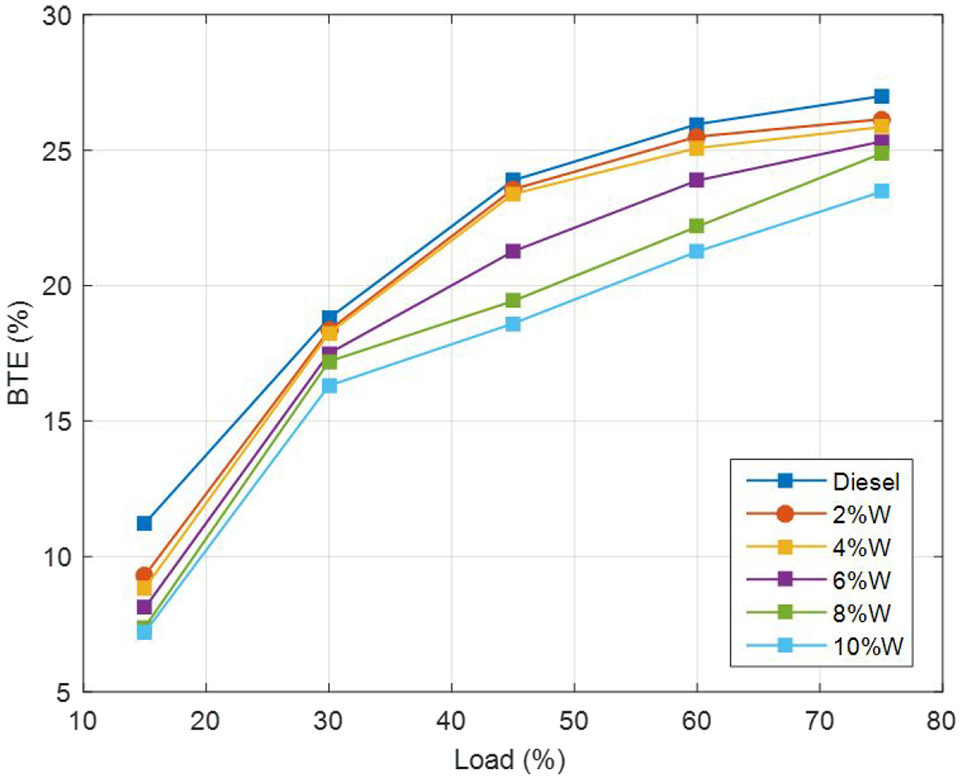
BTE versus load at various percentages of water.
Brake specific fuel consumption
Figure 3 describes the behavior of BSFC of the different mixture at various loads. BSFC decreases by increasing applied load because of higher percentage increment in BP with the increasing load when compared with the increase in fuel utilization while frictional losses almost remain the same. 11 Moreover, BSFC for water emulsified diesel at all concentrations is higher than that of pure diesel because of the relative lower heating value of the emulsified diesel which causes more fuel consumption for the same increase in BP.13,37 Furthermore, the higher flow rate of fuel brought about by high density of the mixtures causes higher mass injection for a similar volume at a similar injection pressure which eventually increases the fuel consumption. 14 Also, the heat sink effect produced in the combustion chamber due to the presence of water molecules delays the ignition resulting in more BSFC. 38 Thus, the minimum BSFC was observed for pure diesel at 75% load while 10% water emulsified diesel showed a comparatively 15.08% increase in the value of BSFC.

BSFC versus load at various percentages of water.
However, some researchers such as Suresh and Amirthagadeswaran 19 and Ithnin et al. 11 observed a significant reduction in BSFC at all the variation of loads and water content which they attributed to the better fuel economy due to the micro-explosion and secondary atomization of emulsified diesel. This is mainly due to the fact that they only considered the mass of diesel while calculating the BSFC.
Emissions characteristics
The emulsion of water in diesel affects the combustion procedure that leads to the production of finer fuel droplets resulted from micro-explosion; better air-fuel mixture because of higher momentum; longer ignition delay and reduced flame temperature as the result of the heat sink effect which directly influences the formation of emissions and pollutants.
Gases
The primary reason for the emissions of NOx in the case of CI engines is the relatively higher temperature of the combustion chamber. 39 However, the presence of even a small amount of water in diesel can affect the chemical and physical kinetic of combustion. 28 During combustion, water vaporizes which reduce the flame temperature and alters the chemical properties of the reactants resulting in higher OH radical production to control the emission of NOx. 21 Additionally the higher latent heat absorption of water molecules further reduce the peak flame temperature to reduce the NOx emissions.8,10 Therefore, most of the researchers have reported the decrease in NOx emissions for all emulsified diesels at all the operating conditions.10,22
For the current study, Figure 4 shows that NOx emissions are increasing as the load is increased but they decrease when water percentage in the diesel is increased. Since the formation of NOx is highly temperature dependent and for water emulsified diesel, the temperature is decreased due to the heat sink effect, the content of NOx is lower than that of neat diesel at all loads. 40 In fact, a relative decrease of 21.35% in NOx emissions was noted for 10% WED relative to pure diesel on average load. However, at low load, the extended ignition period and delayed combustion cause a decrease in NOx as compared to high load conditions. Moreover, at higher load conditions, the temperature of the combustion chamber also increases because of higher fuel burning that eases the cracking of the air and NOx production.23,38

Emissions of NOx at various percentages of water.
The variations of HC emissions are presented in Figure 5. It can be observed that the contents of HC are considerably higher for WED than that of neat diesel. The main reason for such a trend is the micro explosion as the highest content of HC emissions are observed in the case of 10% WED.26,38 Moreover, as the load is increased, the HC emissions increase due to less availability of oxygen for complete combustion caused by the lowest air-fuel ratio at maximum loads. Similarly, the content of CO (shown in Figure 6) is also increasing with the increasing percentage of water in diesel and high load conditions due to decreased combustion temperature and lack of air respectively. 26

Emissions of HC at various percentages of water.

Emissions of CO at various percentages of water.
However, the variation in the content of CO and HC in the case of water emulsified diesel depends on the combined effect of improved combustion by micro-explosion of water and decreased combustion temperature. 28 Therefore, in contrast to the results of the current study, Hegde et al. 41 observed a decrease in the emissions of HC and CO while Ithnin et al. 11 reported an increase in these contents in case of water-diesel emulsions.
Noise
From Figure 7, the noise emissions are increasing with the increasing percentage of water at all load conditions such that the maximum sound level was observed for 10% WED while pure diesel showed the lowest noise emissions at all loads. The reasons for such higher noise emissions for emulsified diesel is the louder and powerful combustion which occurs due to longer ignition delay and better air-fuel mixture resulted from the presence of water in diesel. 42 The higher thermal efficiency at increasing loads also contributes to louder combustion and consequently noise emissions increase with the increasing load. 6
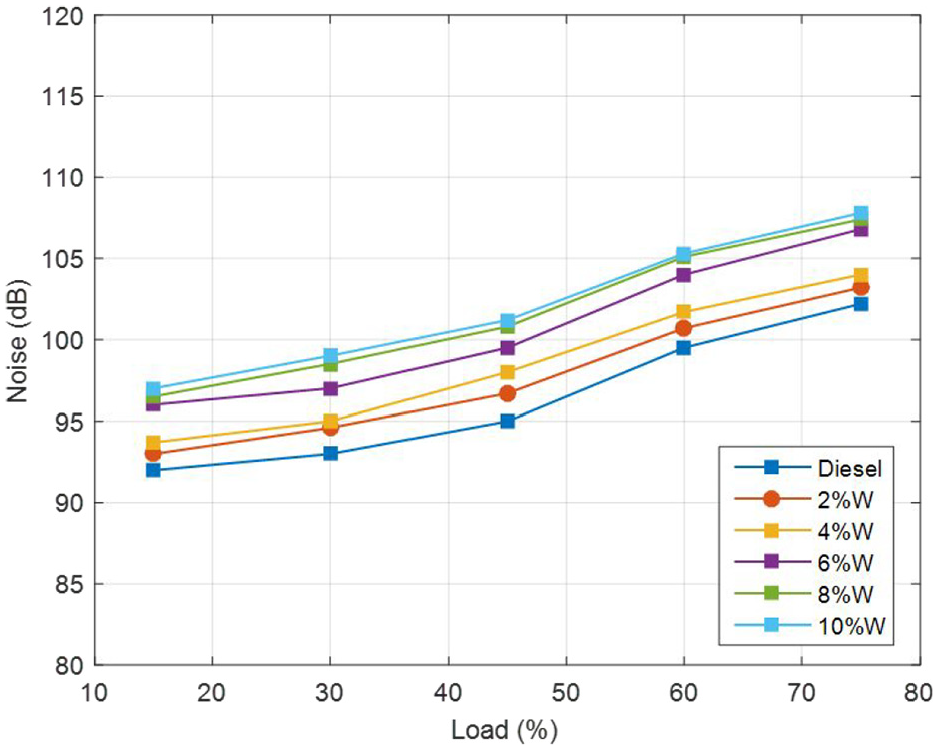
Noise level at various percentages of water.
Smoke
Water in diesel can significantly reduce smoke emission and as clear from Figure 8, smoke opacity for pure diesel was higher under all load conditions. The intense premixed combustion is the main reason for the increasing smoke opacity on higher loads for all test fuels while in the case of emulsified diesel, the better mixture formation causes less smoke opacity as compared to the pure diesel. Moreover, due to improved spray volume, sufficient amount of air contact in the emulsified fuel, micro explosion phenomenon and higher amount of OH radicals during the combustion causes less smoke emission in case of WED.10,20,40 Thus, the fuel automatization process causes a reduction in soot formation as about 48% fewer smoke emissions were observed for 10% WED in comparison to pure diesel under maximum load.

Emissions of smoke at various percentages of water.
The repeatability was estimated by determining the coefficient of variation analysis for the quantities as shown in Table 5. The COV was obtained for the complete experimentation using Origin software. The minimum variance was observed for engine noise whereas smoke measurement showed maximum variations among the measured parameters. Further, the ascertained values in Table 5 indicates that measurements are repeatable and sensible interpretations can be made for the employed fuels variations in CI engine working. In addition, Weibull distribution with Anderson darling fit was also applied to the recorded data. The fits were observed good, and data was well-bounded within the 95% confidence interval for each parameter which showed the appropriateness of the data. The sample distributions and fits for NOx emissions for diesel, WED2, WED4, WED6, WED8, and WED10 are shown in Figure 9. The NOx emission data is well contained by the 95% confidence interval and described the appropriateness.
Analysis of variations.


(a)–(f): NOx emission data distribution at 95% confidence band for different water-diesel emulsions.
Conclusion
This study provides a comprehensive analysis of the utility of water emulsified diesel in CI engine by considering performance (BSFC and BTE), emissions (NOx, CO, and HC), noise and smoke levels of the engine. All values were recorded at 1600 rpm while the load was varied with an increment of 15% from 0% to 75% of the engine’s total load capacity. The concentration of water was varied from 2% to 10% of total fuel volume while petroleum diesel was used as the primary fuel in all tests. The results showed that BTE of WED decreased as the concentration of water increased while BSFC in the case of WED was increased. WED also showed higher contents of HC, CO, and noise emissions with an increasing percentage of water. However, emissions of NOx and smoke decreased significantly relative to diesel and a reduction of 21.8% and 48% was observed in their respective contents at 10% WED on average load conditions.
Thus, this study proposes that water-diesel emulsions can be a suitable alternative to fossil fuels only when their negative impacts on engine performance characteristics and emissions of HC, CO, and noise are mitigated. For this, future studies can focus on investigating the effect of water as an additive to biodiesels and adopting new strategies to shorten the ignition delay caused by water emulsions. Researchers can also try different water injection strategies to reduce HC and CO emissions of water-diesel emulsion to make it a cost-effective and environmentally friendly alternative to conventional fuels
Footnotes
Appendix
Declaration of conflicting interests
The author(s) declared no potential conflicts of interest with respect to the research, authorship, and/or publication of this article.
Funding
The author(s) received no financial support for the research, authorship, and/or publication of this article.
