




Abstract
Smart building equipment monitoring is a well-established field focused on enhancing contemporary building comfort. The proliferation of Internet connectivity, facilitated by the internet of things (IoT), has transformed buildings from static structures into interactive environments. IoT has witnessed substantial growth across various aspects of daily life, from monitoring environmental conditions to managing building systems and storing data in the cloud. One critical application is the intelligent monitoring and control of building equipment, such as air conditioners, to optimize energy efficiency—a matter of increasing concern for building owners, design experts, and system integrators. Achieving comprehensive energy savings demands a meticulous approach to energy-efficient design and control. This paper's primary objective is to explore and analyze IoT-based energy-saving optimization techniques for intelligent building equipment, integrating building information modeling (BIM) technology. It particularly delves into the energy conservation control algorithm for air-conditioning systems. The research presents a challenge rooted in energy-saving optimization, established upon specific objective functions, followed by a detailed explanation of the energy-saving control algorithm. To validate their approach, the paper outlines a comprehensive experimental design. Over three sessions in August, they conducted control experiments in two distinct areas. Area 1 implemented the energy-saving control methodology discussed in the paper, utilizing virtual parameter enhancement mechanisms, while Area 2 adhered to conventional control methods. The results were enlightening. Area 1 demonstrated superior energy efficiency, consuming 735 kWh compared to Area 2's 819 kWh, signifying an impressive 11.43% reduction in energy consumption thanks to the optimized control strategy. This research underscores the practicality and significance of implementing IoT-based energy-saving strategies, with a focus on smart thermostats, HVAC controllers, and daylight sensors, in intelligent building equipment management to achieve substantial energy conservation gains.
Keywords
Introduction
With the growing incidence of home invasions, individual threats to building users and damage to property, it is critical to have an efficient scheme in place to monitor safety in the building and the atmosphere. The security and safety of people and property are extremely important and should be arranged. As a result, a building should be outfitted with an efficient scheme that can remotely monitor, regulate, and report on operations to the inhabitants. An intelligent building automation framework is required to achieve the security, safety, comfort, and regulation of a building. A smart building is an internet of things (IoT) application that allows inhabitants to monitor, regulate, and supervise their building operations from any locale. Corresponding to Qays et al., 1 the IoT is an interrelated scheme that enables electric strategies to interact and conversation information via grid access. Besides IoT, other related technologies centered on the notion of building information modeling (BIM) have also begun to penetrate the field of architectural design. They have a positive impact on architectural design methods, including green building design. The characteristics of the BIM have brought various advantages in all aspects of architectural design, and all sectors of society have begun to actively practice BIM-based design methods. Therefore, the BIM-based design method in the IoT domain will become a new direction for energy-saving renovation.
Intelligent systems for building automation are thus essential for maintaining a high standard of living by controlling and monitoring the surroundings. A smart building automation system's primary goals are protection like detecting damaging gases, fires, comfort through inaccessible control and monitoring of equipment and the real setting, and reducing power and water usage. Utilizations and strategies are interacted via IoT structure hardware skills of actuators and sensors for communication and mechanization, providing local or distant building regulation, 2 thus trying to make the building smart by providing services with slight human involvement or interaction. For instance, one could regulate a building over the Internet from any place, with the control scheme being provided by a specialized software system or a mobile appliance that runs on a personal computer, iPad, or mobile phone. 3 Instruments in the building can be used to monitor water and electricity utilization, detect movement, and regulate temperature, moisture, and equipment. A building with sensing devices produces a large number of measurements and information. Nevertheless, cloud-based computing facilities and machine learning procedures have improved the features of intelligent buildings. Cloud-established facilities, the advantage of building automation includes data storing, decreased risk of a server crash and loss of data, ease and effectiveness of interaction with building equipment, and routine service automation.
Besides the above, the energy consumption rate of buildings is rising these days, which is a complex installation project, more use of new materials and new technologies, more emphasis on the use of functional structures, and more emphasis on building sustainable projects. Effective monitoring of building equipment can substantially reduce building energy expenditure. Therefore, this paper studies the energy-saving of building equipment from the perspective of energy-saving optimization control. The effect of energy-conserving optimization is obtained through the analysis and statistics of the experiments when the area 1 and area 2 air conditioners are controlled using online parameter optimization control and conventional control, respectively.
The originality of this article is that (a) it relates BIM technology with energy optimization control in an IoT environment by introducing the appropriate methods of air-conditioning energy-saving control in detail. (b) In the face of energy-saving optimization control, different control systems are implemented for the two areas. By evaluating the experimental results and comparing the power consumption of the two methods, it is concluded that the optimal control has a more energy-saving effect than the conventional control.
Moreover, the pivotal role of IoT technology and BIM in transforming buildings into interactive, energy-efficient environments. It highlights the growing importance of energy conservation in building operations and introduces an energy-saving control algorithm for HVAC controllers, which incorporates IoT data and BIM technology. This algorithm, coupled with the integration of daylight sensors and smart thermostats, demonstrates an impressive 11.43% reduction in energy consumption compared to conventional control methods. This research significantly contributes to the field of smart building equipment monitoring by showcasing the practical benefits of data-driven, technology-enabled energy-saving solutions through the use of HVAC controllers, daylight sensors, and smart thermostats.
Related works
Improving environmental protection, power management, building safety, and additional elements of smart robotics systems for buildings have been the focus of numerous research papers and published works of literature. BIM and other machine learning innovations have also been used in the IoT domain for categorization, forecasting, and assessment. This segment contains publications on IoT and BIM topics related to smart buildings and the utilization of machine learning in smart machines.
The energy-saving optimization control reflects the concept of green environmental protection. Elkholy and Abd-Elkader expected to propose an ideal variable speed drive for a doubly taken care of enlistment engine (DFIM) working with insignificant misfortunes to guarantee that the DFIM created the necessary burden force at the essential speed while expanding energy investment funds. 4 Hieninger et al. demonstrated the energy-saving potential of moving a water storage unit using an optimally controlled centrifugal pump, operating at a lower cost; the energy-saving capacity and operational time were crucial. 5 Wang and Gang acquainted a general practice with the plan and regulator enhancement of building energy frameworks in the existence rotation, giving a compelling technique to further develop the energy proficiency of building vigor frameworks and advance the improvement of brilliant structures and shrewd urban communities. 6 Feng analyzed the status quo and existing problems of intelligent energy saving based on outlining the optimization of intelligent energy saving. 7 Gong et al. proposed a new electro-hydraulic energy-saving scheme that integrates retrieval and redevelopment devices. 8 However, a powerful solution to the energy-saving problem has not been obtained.
The specialized and financial investigation of development projects utilizing BIM innovation can further develop the expense assessment process at all phases of plan and development works. Akinade et al. assessed stakeholder expectations on how BIM can be used for demolition waste (CDW) management. 9 Szwarkowski and Pilecka introduced the application of BIM design methods in geotechnical production to determine the impact and extent of deep foundation pit excavation and loads for planning high-rise buildings on existing developments. 10 Goaszewska and Salamak took the highway bridge model as an example to introduce the problems and problems that may be encountered when using BIM tools for cost estimation and engineering quantity calculation. 11 Stressing the necessity of automating the process through the capabilities of BIM technology, Kysil et al. described an automated method developed using BIM model properties as a relational database. 12 These technologies have helped to a certain extent, but these processes are complex and their scope of application is limited.
Energy-saving optimization control method of air-conditioning equipment system
BIM technology
The overview of BIM
BIM is a modern technology that accomplishes the complete and entire expression of building information through computer technology and then realizes the full life cycle management of buildings. B stands for Building, that is, construction. In the earliest period, the technology was applied to the field of construction. With the further development of social technology, it is widely used in municipal, highway, bridge, and other fields. I stands for Information, that is, information, including information related to the model, such as geometric information, material information, etc. M stands for Model, that is, a three-dimensional model, which realizes the three-dimensional visual display of the model and the management of its entire life cycle. BIM is based on the three-dimensional digital model as the carrier, using digital information simulation technology to reconstruct the building, and can digitally express building components and their functional characteristics.13,14 Figure 1 is a detailed exploded view.

Usage of BIM technology. BIM: building information modeling.
Features of BIM
Through the mix of multi-party information, BIM innovation accomplishes the total assortment and incorporation of the entire cycle data from the study, plan, development, acknowledgment, and different connections. 15 To summarize, the three most conspicuous elements of BIM innovation are shown in Figure 2

BIM features. BIM: building information modeling.
Utilizing BIM innovation to recreate the structure substance and present a three-layered scene is a representation strategy and a somewhat progressed demonstrating technique in the development business at this stage. In the planning stage, creators can utilize the type of three-dimensional demonstration to develop a compositional model with complete construction and information values, making the model more natural. Simultaneously, the model is worked by contributing significant information, with the goal that the structure is more exact.16,17
Advantages of BIM
In the event that the primary update in the development business is to involve PCs for engineering plans and drawing designs, then, at that point, the utilization of BIM innovation to fabricate 3D models is one more significant update in the development business. Contrasted and computer-aided design programming, BIM innovation is more extensive, covers a more extensive territory, can connect with different units and frameworks, and has better information interoperability. Contrasted and customary PC designs, the benefits of BIM innovation are more self-evident, as displayed in Figure 3:

Comparison of CAD software and BIM technology. BIM: building information modeling.
Assessment of relevant modeling software
The comprehensive utilization of BIM technology is intricately tied to the progress in science and technology, as well as the support provided by software tools. To date, software applications tailored for each project stage have seen varying degrees of adoption both domestically and internationally, and a diverse range of BIM software solutions has gradually gained widespread usage in the market. The development of BIM 3D models, a crucial element in construction projects, relies on modeling software. 18 Today, at the core of BIM technology, the primary modeling software solutions are primarily offered by these four companies. Incorporating Smart Thermostats, HVAC Controllers, and Daylight Sensors into BIM workflows enhances the overall efficiency and functionality of building systems, as demonstrated in Table 1.
BIM technology core developing software.

BIM: building information modeling.
Building energy-saving optimization control
Research status and development trends
Efficient energy utilization is a paramount objective in the construction industry, with a multifaceted approach encompassing four pivotal aspects. Firstly, during the design phase, meticulous attention to energy-saving measures is crucial. This involves enhancing the shading capabilities of building exteriors to bolster thermal insulation and considering aerodynamics to ensure natural ventilation within residential structures. Secondly, the incorporation of innovative materials plays a significant role, necessitating precise parameter requirements for wall materials, roof construction techniques, and door/window design to bolster energy efficiency. Additionally, addressing the high energy consumption associated with building equipment is imperative. Implementing energy-efficient and environmentally conscious equipment, including the integration of frequency conversion technology, not only conserves energy but also proves cost-effective. Lastly, embracing renewable energy sources like solar and wind power, alongside technologies such as geothermal systems, allows for precise control over energy consumption and minimizes its unpredictability. These four facets collectively contribute to energy conservation in building construction.
Furthermore, the concept of energy-saving retrofitting extends these principles to existing structures. Traditionally, retrofitting seeks to enhance functional use, structural stability, and overall environmental quality in buildings no longer aligned with contemporary requirements. Such renovation efforts extend the building's lifespan. In today's context of sustainable development, energy-saving retrofitting inherently incorporates energy-efficient features, including the integration of BIM models and intelligent systems like smart thermostats, HVAC controllers, and daylight sensors. This approach is particularly pertinent for energy-intensive office buildings, aligning with green development objectives and contributing meaningfully to energy efficiency and sustainability.19,20
The concept and content of building energy efficiency have been accumulated for decades. Generally speaking, it can be divided into three stages (Table 2), and the meaning of the third stage is still cited under the current development background of China.
Content framework of building energy efficiency design method.

From the meaning of energy saving, it can be determined that the specific content of building energy saving is based on the principle of improving energy efficiency, rather than simply low energy consumption. Therefore, in the energy-saving renovation, under the premise of paying attention to the energy consumption of the space environment, it is necessary to emphasize the comfort of users during the use of the space, which is also a great significance of energy-saving renovation of existing intelligent buildings. Energy saving is not a single-stage design action, but a design activity covering multiple stages of a building. Usually, energy saving at the level of scheme design, including heating and cooling, lighting, ventilation and other energy-saving designs, is also subordinate to it. Since then, the design content of energy-saving renovation can be summarized from the overall level of renovation activities (Table 3).
Content framework for energy-saving retrofits.

Energy-saving control algorithm of air-conditioning system
Preliminary analysis of human comfort
The purpose of building air-conditioning system operation is to make people feel comfortable, and it also means that the temperature and quality of indoor air reach the standard, which is also an important goal of energy-saving optimization operation control of the air-conditioning system. There are several different views on human comfort, and it is difficult to analyze quantitatively. The next part is an analysis of the determination of the human comfort feeling index in the air-conditioned room. 21 Table 4 shows the comparison between comfort and PMV value.
Comparison of PMV value and comfort.

The affecting factors of the thermal environment of the air-conditioned room are shown in Figure 4.
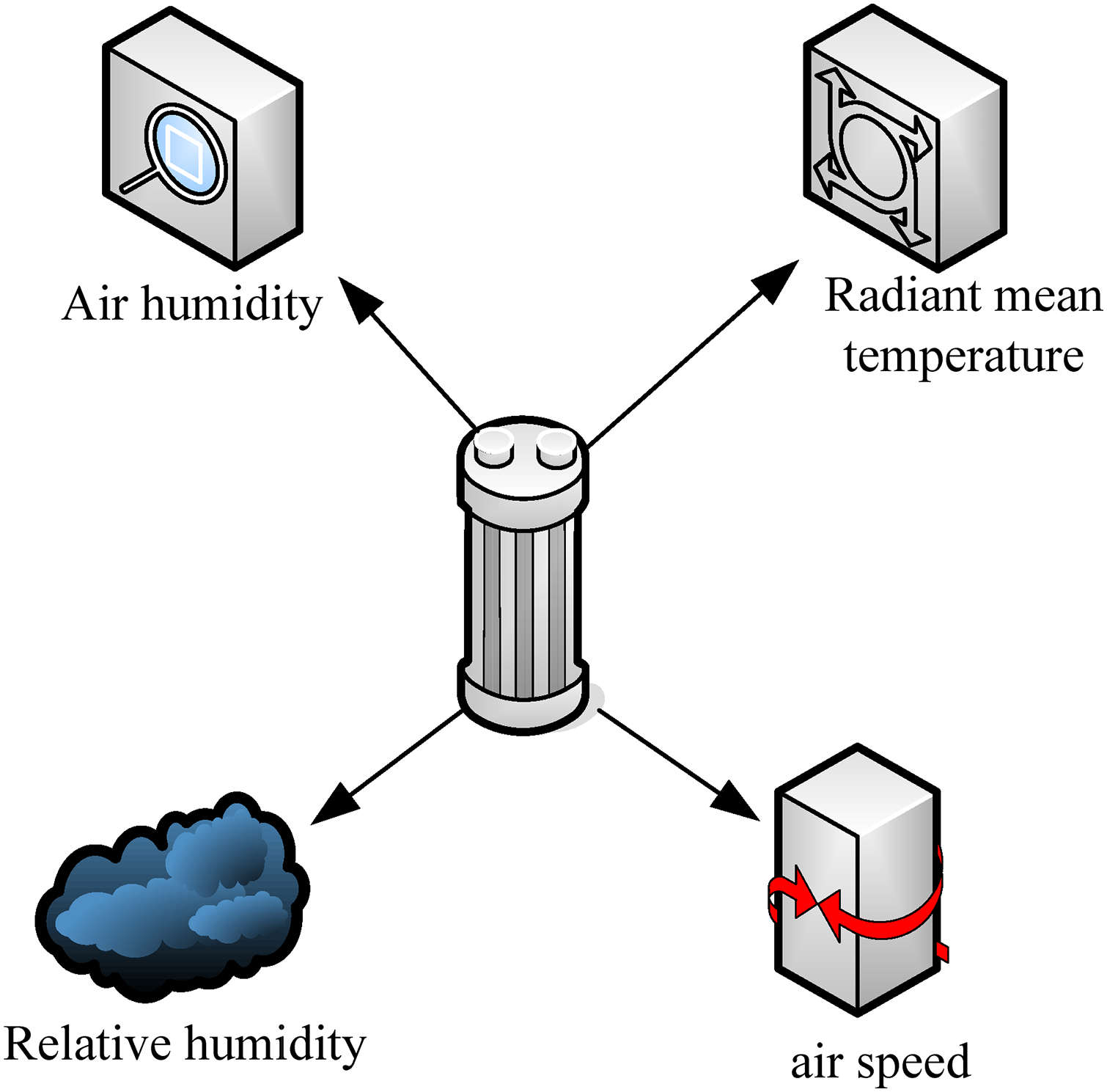
Factors affecting the thermal environment of an air-conditioned room.
Figure 5 proposes changes in temperature and stickiness to characterize a safe place. The vacillation scope of temperature is 2–4 degrees, and the changing scope of moistness is 19–73%, demonstrating that the impact of temperature on warm solace is more noteworthy than that of stickiness.

Comfort zone influence diagram.
In addition to the significant effects of temperature and humidity on PMV, wind speed also influences PMV. In 8 experiments, the internal temperature is almost the same. The experimenter stands on the side of the window, sometimes exposed to sunlight, sometimes in the shade. At this time, the PMV value varies greatly. If the internal wind speed increases from 0.72 m/s, the PMV value will drop sharply. The data are shown in Table 5.
Data sheet on the effect of wind speed on PMV value.
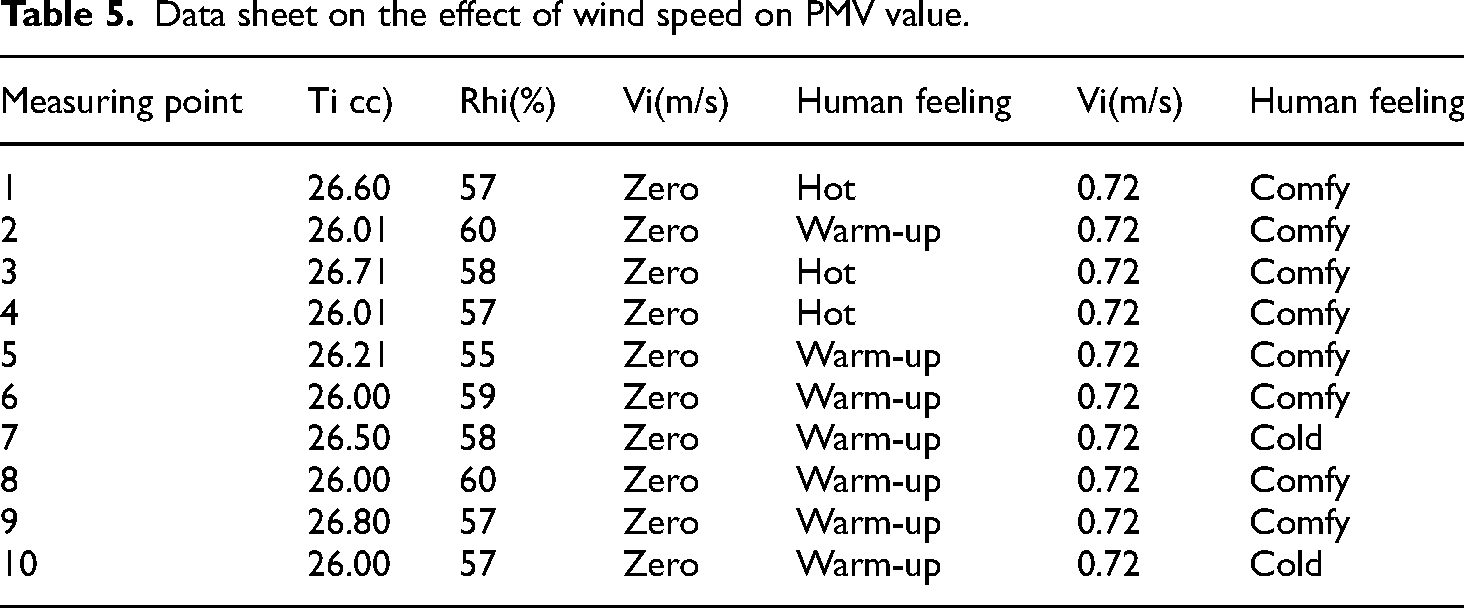
From the experimental data, it can be concluded that the power consumption is small when the fan speed is increased to 0.72 m/s, but the PMV index can be reduced.
Studies have shown that PMV values decrease significantly when wind speeds increase. It can be concluded that increasing the clean air volume and supply air temperature can keep the PMV value stable.
Considering the effects of relative humidity and temperature, the thermal comfort matching area measured in an air-conditioned room with a special instrument is shown in Figure 6.

Comfort zone of an air-conditioned room in summer.
On-line optimization control objective function of the air-conditioning system
System optimization control aims to minimize system energy consumption while ensuring room comfort. Room comfort can be measured by two metrics: room thermal comfort and air quality. The analysis of thermal comfort has been discussed in the section.
Air quality is usually measured by measuring indoor 
The comfortable temperature of the room can be determined according to the use nature of the building and the location in which it is located. Building comfort temperature should be determined on the basis of extensive investigations under unified planning, classifying buildings according to their nature of use. Comfort temperature is determined at the time of the study in two ways. One is to use a one-dimensional linear formula:


The energy consumption of the refrigeration system can be obtained from formula (5): L—fresh air volume, R——specific heat capacity of air at constant pressure, KJ/kg.o C; ρ——air density, 

According to the law of conservation of energy, the indoor cooling load can be equal to the cooling capacity of the air-conditioning system:


Fan energy consumption:


An indoor air quality assessment model is built:
The control target function of the building air-conditioning control system can be expressed as follows:
Adaptive genetic optimization algorithm
After establishing the mathematical model of the operating energy consumption of the surface cooler, fan and chiller of the air-conditioning system, it is necessary to use a certain algorithm to optimize the calculation. The design of a genetic algorithm usually includes these main steps:
The encoding method is determined:
A fitness function is determined. Suppose there is a problem to be optimized:
The selection strategy is determined: Assuming that the size of the population is m, and the fitness value of individual 

The flow process of the genetic algorithm.
It can be seen from the characteristics and design process of the genetic algorithm that the genetic algorithm is suitable for use as an optimization algorithm for optimal control and can shorten the optimization time. Therefore, the genetic algorithm is used as an online optimization method for the operation of the air-conditioning system. 22
On-line monitoring experiment of energy-saving management of air-conditioning apparatus system
Scheme design
In this paper, an experimental setup is devised, and control experiments are conducted over three periods in August. From the 1st to the 15th, two control methodologies—traditional control and an online parameter optimization mechanism—are employed across two separate areas. Area 1 employs the control method discussed in the paper, while Area 2 adheres to conventional control practices. The objective function weight coefficients δ, ω, and λ are set to 1 for both areas during this period. To streamline statistics, a 2-day interval is used as the time step, and specific experimental data is collected at noon on those days. From the 16th to the 30th, an online parameter optimization control scheme is implemented, adjusting the weight coefficients of the objective function for both experimental areas. In Area 1, δ=1, ω=1, and λ=1 are maintained, while in Area 2, these coefficients are adjusted to δ=1.3, ω=0.7, and λ=0.7.
During the period of conventional control (1st to 15th), specific control settings are applied:
Supply air temperature is set to 12°C. Water supply temperature is set to 9°C. Fresh air volume is maintained at 0.7m³/s. Indoor temperature is kept at 26°C.
This experimental design allows for a comparison between traditional control methods and an online parameter optimization mechanism, examining how different control strategies impact the controlled areas’ performance and energy usage over specific time frames.
Two rooms with the same area and the same indoor equipment layout are selected, and the indoor area is 60m2. During the experiment, rooms 1 and 2 are shown in Figure 8(a) and (b), and different air-conditioning units are used for cooling. In order to accurately count the power consumption, two electricity meters are installed to measure the power consumption of the air conditioners in the two areas during the experiment.

Experimental area. (a) Experimental area 1. (b) Experimental area 2.
Experimental data
In the context of web-based boundary advancement control, the simulation considers changes in indoor load and thermal comfort requirements. In the simulation estimation, the three control weight parameters of the system's objective control capability are set to 1, with the indoor temperature targeted at 26°C. The values for the three control parameters of the cooling equipment system—supply air temperature, water source temperature, and outdoor air volume—are derived through iterative computation using Matlab simulation. This computation is conducted under the condition that the system's objective control capability is constrained, and the control is executed based on the calculated values. 23 The simulation estimation data and experimental data are presented in Table 6 and Table 7, presumably showcasing the results obtained from the simulation and real-world experiments to compare how the system performs under different conditions or settings.
Experimental data of optimal control 1 and regular control 1 (8.1–8.15).

Experimental data of optimal control 1 and regular control 1 (8.16–8.30).

According to the simulation calculation data and experimental data in the two areas A and B are compared in two control modes: optimal control and regular control, and when the three weight coefficients in the objective function are changed, as shown in Figures 9–12.

Supply air temperature comparison. (a) Assessment of supply air temperature among optimal control and regular control (8.1–8.15). (b) Comparison of supply air temperature with weight coefficient change (8.16–8.30).

Water supply temperature comparison. (a) Comparison of optimal control and regular control water supply temperature (8.1–8.15). (b) Comparison of water supply temperature with weight coefficient change (8.16–8.30).

Controlled fresh air volume comparison. (a) Comparison of fresh air volume between optimal control and regular control (8.1–8.15). (b) Comparison of fresh air volume controlled by weight coefficient change (8.16–8.30).

Power usage comparison. (a) Comparison of power consumption between optimal control and regular control (8.1–8.15). (b) Comparison of power consumption by weight coefficient change (8.16–8.30).
Data examination
The web-based boundary streamlining control (weight coefficient δ=1, ω=1, λ=1) is taken on for the cooling control of region 1, and its worth changes in various time span. At the point when the region 2 cooling control takes on traditional control, the upsides of the three self-control boundaries of supply air temperature, water supply heat, and outside air capacity stay steady. The power utilization of region 1 is 735 degrees, and the power utilization of region 2 is 819 degrees. The improved control saves 11.43% of power than the standard control.
When employing the optimal control method for both regions 1 and 2, distinct weight coefficients are adopted. For region 1, the coefficients stand at δ=1, ω=1, λ=1, while for region 2, they are δ=1.3, ω=0.7, λ=0.7. In region 2, the focus of the control model is on energy utilization, evident from weight coefficients exceeding 1. The advantageous outcomes of the three control parameters—supply air temperature, water supply temperature, and outdoor air volume—are higher than those in region 1. Region 1 consumes 766 units, while region 2 consumes 737 units, with the added achievement of a 3.79% energy recovery in region 2.
Discussion
This paper initially grasped the relevant fundamental knowledge and examined how to research the energy-saving optimization control of intelligent building equipment based on BIM technology in the IoT domain. The energy-saving control algorithm was expounded, the adaptive genetic optimization algorithm was explored, and the optimal control and traditional control of the air-conditioning equipment studied were analyzed and compared.
The control boundaries are determined by the product and the outcomes are utilized to control the activity of the cooling hardware in the assigned exploratory region. A trial conspire was intended to look at and examine the energy utilization of cooling gear between ordinary control and online boundary advancement control and when the weight coefficient of the goal control capability was changed.24,25
In this study, the traditional constant temperature control method prioritizes achieving maximum thermal comfort without considering load reduction for optimizing energy usage. However, in optimal control, the set values of three control variables can adapt to variations in internal and external loads. When indoor and outdoor loads decrease, adjustments to supply air and water temperatures can be made accordingly. Simultaneously, fresh air volume settings can change based on indoor occupancy fluctuations. While ensuring thermal comfort, energy consumption is factored in, essentially trading off a portion of thermal comfort to reduce energy usage while maintaining overall comfort levels. The alteration of objective function weight coefficients (δ, ω, λ) impacts the control parameter values and power consumption. This experimental analysis demonstrates that optimizing control variables in response to load changes can effectively manage energy utilization without compromising fundamental thermal comfort requirements.
Conclusions
Under the background of the rapid development of computer technology and the wide application of air-conditioning systems, the use of system integration methods to monitor equipment and effectively manage information has become a bright prospect for the efficient operation of central air-conditioning systems. At the same time, it also requires a combination of computer technology, control theory, and network communication technology. Therefore, engineers and technicians need to be more proficient in technology. This work has presented an intelligent building automation system based on IoT and BIM technologies. It aims to study how to analyze and study the IoT-based energy-saving optimization control of intelligent building equipment based on BIM technology and describe the energy-saving control algorithm of the air-conditioning system. This paper has introduced the problem of energy-saving optimization based on the objective function, then elaborates on the energy-saving control algorithm and designs and analyses the case design. It created an experimental scheme and ran the control experiment three times in August. From the first to the fifteenth, two control methods, conventional control, and online parameter optimization control are used to conduct experiments on two different areas. Area 1 employs the control investigated in this paper, while Area 2 employs conventional control. It analyzed the online monitoring of the energy-saving regulation of the air-conditioning equipment system based on the above. The experiment's analysis and statistics show that area 1 air-conditioning control uses online parameter optimization and area 2 air-conditioning control uses conventional control. Area 1's power consumption is 735 kWh, Area 2's power consumption is 819 kWh, and the optimal control saves 11.43% of the energy compared to the conventional control.
Footnotes
Contributions
All author(s) have designed the study, developed the methodology, performed the analysis, and written the manuscript. All authors have read and agreed to the published version of the manuscript.
Data availability
Data will be available on request.
Declaration of conflicting interests
The author(s) declared no potential conflicts of interest with respect to the research, authorship, and/or publication of this article.
Funding
The author(s) disclosed receipt of the following financial support for the research, authorship, and/or publication of this article: This work was supported by the Science and Technology Development Project of Henan Province, (grant number 212102310956).
Institutional review board statement
Not applicable.
Informed consent statement
Not applicable.

Author biographies
Dinglong Xie was born in Kaifeng, Henan, China, in 1976. He received his master's degree from Tianjin University of Science & Technology, China. Now, he works in the School of Civil Engineering and Architecture, Henan University. His research interests include Building technology, building equipment, and building automation technology.
Qiusha Xie was born in Kaifeng, P.R. China, in 1973. She received her master's degree from Henan University, P.R. China. Now, she works in School of Minsheng, Henan University. Her research interests include product design, art design, and architectural design.