The article is studying a seismic meta-surface in the case of an oscillatory system arranged on the surface of an orthorhombic elastic half-space. The approach is based on the asymptotic hyperbolic–elliptic formulation for the Rayleigh wave excited by prescribed surface loading. The latter results in hyperbolic equations for surface displacements, with the right-hand sides involving the loading components. The derived model allows a formulation for the meta-surface in the form of a periodic spring-mass system attached to the surface as a hyperbolic equation for the horizontal displacement, with smooth contact stresses emerging from averaging the effect of a regular array of oscillators. The associated dispersion relation is constructed and illustrated numerically for both cases of exponential and oscillatory decay.
Seismic metasurfaces present a subclass of metamaterials, involving a specialised design of the surface by means of attached systems of resonators, affecting the Rayleigh wave with the aim of diverting or suppressing its propagation. The area of seismic metasurfaces and meta-barriers has become a hot topic in the last decade.1–3 Designed systems of resonators may also enable tuning of phase velocities and wavelengths of propagating waves4–9 for ideas of natural and artificial metasurfaces, see also a more general recent review of nanophotonics and metamaterials.10
A possible approach to analytical treatment of seismic meta-surfaces is based on explicit models for Rayleigh and Rayleigh-type waves11 summarising this methodology. The discussed model for the Rayleigh wave is oriented towards extracting the contribution of the Rayleigh wave to the overall dynamic response, thus allowing a more convenient analytical tool, especially on the surface, avoiding the complications arising from the analysis of exact solutions involving more sophisticated wave phenomena.
In the case of a linearly isotropic elastic half-space, the asymptotic formulation for the Rayleigh wave induced by prescribed surface loading includes a hyperbolic equation for the longitudinal displacement potential governing wave propagation, as well as an elliptic equation characterising decay away from the surface. It is worth noting that once the longitudinal potential has been determined, the displacements are expressed through the latter, using the representation of surface wave field in terms of a single harmonic function.12,13 Various recent developments of explicit models for the Rayleigh and Rayleigh-type waves, accounting for the effects of anisotropy, pre-stress, inhomogeneity and nonlocality have been reported in References.14–17 In addition, it has been recently shown that the hyperbolic–elliptic formulation may be reduced to a hyperbolic equation at a fixed depth, with the right-hand side involving a pseudo-differential operator acting on the load, with vertical coordinate essentially being a parameter only.18
This discussed approach is applicable when the Rayleigh wave dominates the mechanical response, which makes seismic meta-surfaces an ideal application of the described approach. The methodology was implemented within the context of linear isotropic elasticity, including considerations of periodic systems of spring-mass oscillators, as well as rods and beams with various boundary conditions.19–21
However, in the case of a periodic system of oscillators arranged on the surface of an anisotropic half-space, the question of constructing an explicit formulation for a seismic meta-surface relying on the asymptotic model for the Rayleigh wave remains largely open. In particular, one of the complications is due to impossibility of decomposing the displacement field via the Lamé wave potentials, hence, implementation of the methodology in the works,19–21 formulated in terms of the elastic potentials, becomes problematic. The present contribution aims at overcoming this challenge.
In this contribution, first, we derive the asymptotic formulation for the Rayleigh wave excited by prescribed surface loading on an orthorhombic elastic half-space. The obtained hyperbolic equations for surface displacements generalise the previously known results,22 confined within a particular case of anisotropy associated with pure exponential decay, to a more general case allowing oscillatory decay. In addition, the derived hyperbolic equations account for both normal and tangential components of the loading. Then, a seismic meta-surface comprised of a system of periodic spring-mass oscillators arranged on the surface of an orthorhombic half-space is studied. The dispersion relation is constructed and illustrated numerically for both cases of pure exponential and oscillatory decay.
Hyperbolic equations for surface displacements
In this section, the approximate formulation for the Rayleigh wave field excited by prescribed surface stresses is introduced. This formulation will be employed later in construction of a seismic meta-surface.
Consider a linearly elastic, orthorhombic half-space , under plane–strain assumption, that is, with the displacements satisfying and , where . The equations of motion are written conventionally as
and
where are elastic moduli, stands for the volume mass density, and a comma in the subscript indicates differentiation with respect to appropriate spatial or time variable.
The boundary conditions on the surface are taken in the form
where and are the appropriate stresses, with and being the prescribed tangential and normal components of the loading, respectively. It is also assumed that the displacement components satisfy the decay conditions
Let us now derive briefly the approximate hyperbolic equations for surface displacements, accounting for the Rayleigh wave contribution to the overall dynamic response. These will extend the results obtained in the contribution22 for a particular case of anisotropy to a more general scenario allowing oscillatory decay. At the same time, below we rely on integral transforms, contrary to perturbation scheme in the aforementioned article.
On applying the Laplace and Fourier integral transform with respect to time t and the longitudinal coordinate , respectively, the boundary value problem (1)–(4) becomes
subject to
at the surface . Here
is the Fourier–Laplace transform of the quantity , with p and s denoting the parameters of the Laplace and Fourier transforms, respectively.
Then, expressing the transformed vertical displacement from (6) and substituting the result into (5), we deduce the bi-quadratic equation for
Next, the boundary conditions (7)–(8) may be employed in order to determine the unknown quantities , , and, therefore, the transformed surface displacements follow from (12), (14) in the form
and
Here
and
The latter is readily recognised as the Rayleigh function (cf. equation (21) in Reference22), with both of the transformed surface displacements having simple poles at . Hence, accounting for the contribution of the poles results in the following approximate expressions for surface displacements, that is, employing the Taylor expansion
Applying the inverse Fourier–Laplace transforms to the above formula, we arrive at the hyperbolic equations for surface displacements in the form
and
The hyperbolic equations (22)–(23) generalise the results obtained in Reference22 by accounting for both vertical and horizontal components of the loading, and also for a stronger degree of anisotropy allowing for oscillatory decay, whereas the results of the cited article were restricted to the case of real roots for . Note the pseudo-differential operator (for more details on the theory of such operators the readers are referred to Reference23), acting on the appropriate part of the load, observed previously for isotropic medium, which could also be written as a Hilbert transform, see Appendix B in Reference.24
Seismic metasurface
Let us now implement the asymptotic model derived in the previous section to design of a seismic meta-surface in the form of a periodic system of linear oscillators attached to the surface of an orthorhombic half-space within the framework of plane-strain assumption, extending the results of Reference19 to account for anisotropy. The analysis below is carried out in the assumption that the contribution of the bulk waves into the overall dynamic response can be neglected compared with that of the Rayleigh wave,11 and references therein for greater detail. The considered periodic system of oscillators is depicted in Figure 1, where a is the distance between neighbouring oscillators.
A periodic system of spring-mass oscillators with uniform spacing attached to the surface of a semi-infinite half-space.
The motion of an oscillator is governed by
where is vertical displacement, and m, , and represent mass, stiffness of the spring, and contact vertical force, respectively, distributed per unit length. The assumed continuity of displacements and stresses on the interface implies
According to the hyperbolic model for the Rayleigh wave derived in the previous section, the tangential surface displacement satisfies
where the constant is given by
with quantities and R defined in (18) and (19), respectively, and, as above, denoting the Rayleigh wave speed, being the root of . We remark that (26) tacitly assumes zero tangential surface stress. For the considered periodic system of mass-spring oscillators, the contact surface stress may be written as19
As shown in the cited article, the consideration of a point contact between the single mass-spring system and the elastic media leads to an undesired spurious localised component of the solution. Therefore, the distribution of the contact stress is required, yielding
As usual, it is assumed that the typical wavelength is much greater than the distance between the oscillators. Hence, in view of (29), the hyperbolic equation (26) may be re-cast in the form
Note that the corresponding result within the context of linear isotropic elasticity can readily be recovered such that the surface tangential displacement is proportional to the appropriate derivative of the longitudinal Lame potential (cf. equations (4.1), (4.7) in Reference19).
Now, take the distribution for the contact force in the form associated with time-harmonic waves
where k is wave number and is angular frequency. Then, from (24), the forced solution is given by
with .
Let us now briefly derive the Rayleigh wave eigensolutions. The equations of motion are taken as (1)-(2), with the traction-free boundary conditions along the surface are given by (3)-(4), with = = 0.
Now, we search for displacement components in the form of travelling harmonic waves, that is,
Then, the equations of motion imply a bi-quadratic secular equation for the attenuation order q, given by
Then, by using the equations of motion, the displacements are obtained in the form
where
and the attenuation factors are the solutions of (34) satisfying in order to ensure decay at .
Finally, substitution of (35) into traction-free boundary conditions gives the relation between the unknown constants , , implying the following eigensolution for the Rayleigh wave field
In addition, from the continuity of vertical displacements at we have
The dispersion relation may now be inferred as a solvability condition of the simultaneous linear equations (38) and (39) in A and P, yielding
Introducing the dimensionless quantities
the dispersion relation may be rewritten as
or, more explicitly, as
It may be shown that in the case of isotropic substrate the dispersion relation (43) coincides with the corresponding result in Reference.19 Also, as previously noted in the cited article, the left-hand side in (42) is zero at , which is the Rayleigh wavefront, whereas the right-hand side equals zero at , which is associated with the eigenfrequency of the spring-mass oscillator. Hence, since the developed asymptotic formulation for the Rayleigh wave field is oriented towards the contribution of the Rayleigh wave, we may expect it to be valid in the vicinity of .
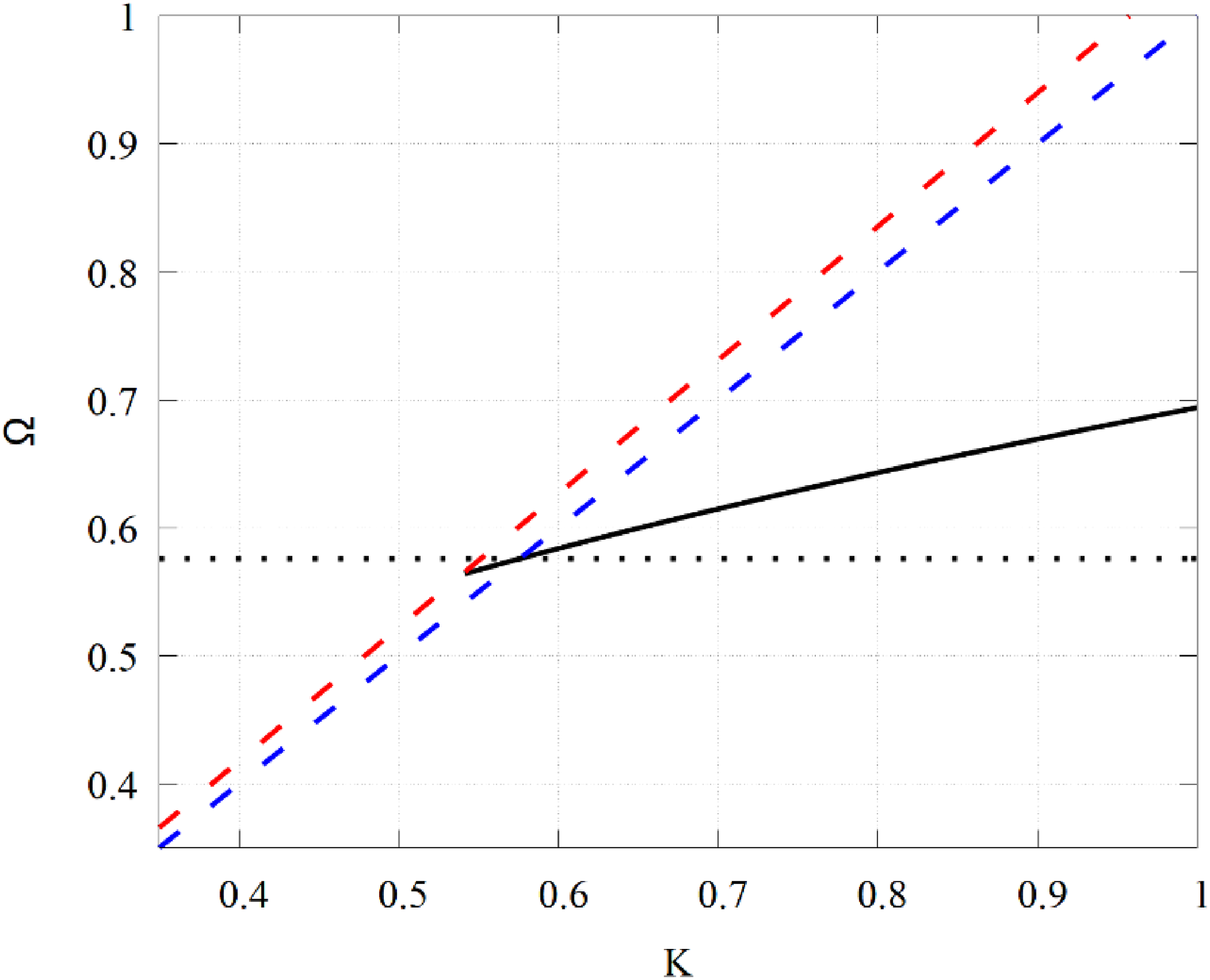
Let us now illustrate the obtained results numerically. First, we consider the case of the roots and to be real, which corresponds to relatively weak anisotropy allowing operator factorisation of a bi-harmonic equation of motion for one of the displacement components into two elliptic operators, as done in Reference.22 This scenario is illustrated in Figure 2, for the unidirectionally reinforced glass-epoxy composite material, with material parameters are defined as , , , , , .25 The parameters of the periodic system of oscillators are chosen as follows: , , and .
Dispersion diagram for the studied meta-surface, including the dispersion relation (43) (solid line), the Rayleigh wavefront (blue dashed line), the shear wave front (red dashed line), and the spring-mass eigenfrequency (dotted line). The material and geometrical parameters , , , , , , , , , correspond to purely exponential decay.
The dispersion diagram for this case is presented in Figure 2, containing the dispersion curve governed by (43) depicted by solid line, along with the Rayleigh wave front shown by blue dashed line, the shear wave front indicated by red dashed line, and the horizontal dotted line associated with the eigenfrequency of the oscillator. Clearly, in view of the decay condition, the dispersion curve (being in fact a part of a hyperbola) originates on the red line corresponding to the shear wave, with the speed of the latter given by .
The next Figure 3 is showing similar results, however, for stronger anisotropy associated with oscillatory decay, when the attenuation orders and are complex. The material of the substrate is orthorhombic sulphur, for which , , , , , ,26 with the parameters of the oscillatory system specified as , , and .
Dispersion diagram, including the dispersion relation (43) (solid line), the Rayleigh wave front (blue dashed line), the shear wave front (red dashed line), and the spring-mass eigenfrequency (dotted line). The material and geometrical parameters , , , , , , , and correspond to oscillatory decay.
It is seen from both Figures 2 and 3 that the dispersion curve intersects the straight line at the point , with the domain of validity of the derived long-wave explicit model being in a vicinity of this point. At the same time, the angle between the two oblique straight lines corresponding to the Rayleigh and shear wavefronts seems to be wider in Figure 3, being associated with a larger relative difference between the Rayleigh wave speed and the shear wave speed.
Conclusions
A meta-surface comprised of a periodic mass-spring system attached to an orthorhombic elastic half-space has been studied. First, an explicit formulation for surface displacements oriented to the contribution of the Rayleigh wave excited by prescribed surface stresses is derived, generalising the previous results22 to a stronger type of anisotropy allowing oscillatory decay, as well as presenting the results of Reference14 in a more explicit form. The obtained hyperbolic formulation is then implemented to construct a seismic meta-surface, resulting in the associated dispersion relation, extending the results in Reference19 to account for the effects of anisotropy. Numerical illustrations of dispersive behaviour are presented for both cases of pure exponential and oscillatory decay.
The obtained results may be extended to flexural meta-surfaces, complementing the results in Reference.20 Other options are related to incorporating the effects of more general types of anisotropy,14 vertical inhomogeneity,16,24,27 nonlinearity,28 as well as performing a refined treatment of the contact force.29
Footnotes
Declaration of conflicting interests
The authors declared no potential conflicts of interest with respect to the research, authorship, and/or publication of this article.
Funding
The authors disclosed receipt of the following financial support for the research, authorship, and/or publication of this article: This research is funded by the Science Committee of the Ministry of Science and Higher Education of the Republic of Kazakhstan, grant number AP09261135.
ORCID iD
Danila Prikazchikov
Author biographies
Danila Prikazchikov is a reader in Applied Mathematics. His research area is asymptotic methods in theoretical solid mechanics.
Roza Sabirova is a PhD student, specialising in solid mechanics.
Peter T Wootton is a lecturer in Mathematics. His research area is propagation of elastic waves.
References
1.
ColquittDJColombiACrasterRV, et al.Seismic metasurfaces: sub-wavelength resonators and Rayleigh wave interaction. J Mech Phys Solids2017; 99: 379–393.
2.
PalermoAKrodelSMarzaniA,et al.Engineered metabarrier as shield from seismic surface waves. Sci Rep2016; 6: 39356.
3.
BratovVKuznetsovSMorozovN. Seismic barriers filled with solid elastic and granular materials: comparative analysis. Math Mech Solids2022; 27: 1761–1770.
4.
ColombiARouxPGuenneauSRL, et al.Forests as a natural seismic metamaterial: Rayleigh wave bandgaps induced by local resonances. Sci Rep2016; 6: 19238.
5.
MaurelAMarigoJ-JPhamK,et al.Conversion of love waves in a forest of trees. Physical Review B2018; 98: 134311.
6.
MiniaciMKrushynskaABosiaF,et al.Large scale mechanical metamaterials as seismic shields. New J Phys2016; 18: 083041.
7.
LiuWYoonGHYiB, et al.Ultra-wide band gap metasurfaces for controlling seismic surface waves. Extreme Mech Lett2020; 41: 101018.
8.
LouJFangXDuJ,et al.Propagation of fundamental and third harmonics along a nonlinear seismic metasurface. Int J Mech Sci2022; 221: 107189.
9.
PuXPalermoAChengZ, et al.Seismic metasurfaces on porous layered media: surface resonators and fluid-solid interaction effects on the propagation of Rayleigh waves. Int J Eng Sci2020; 154: 103347.
10.
KrushynskaAOTorrentDAragonAM, et al.Emerging topics in nanophononics and elastic, acoustic, and mechanical metamaterials: an overview. Nanophotonics2023; 12: 659–686.
11.
KaplunovJPrikazchikovDA. Asymptotic theory for Rayleigh and Rayleigh-type waves. Adv Appl Mech2017; 50: 1–106.
12.
ChadwickP. Surface and interfacial waves of arbitrary form in isotropic elastic media. J Elast1976; 6: 73–80.
13.
KiselevAPParkerDF. Omni-directional Rayleigh, Stoneley and Scholte waves with general ¨ time dependence. Proc R Soc A2010; 466: 2241–2258.
14.
FuYKaplunovJPrikazchikovD. Reduced model for the surface dynamics of a generally anisotropic elastic half-space. Proc R Soc A2020; 476: 20190590.
15.
KhajiyevaLAPrikazchikovDAPrikazchikovaLA. Hyperbolic-elliptic model for surface wave in a pre-stressed incompressible elastic half-space. Mech Res Commun2018; 92: 49–53.
16.
MubarakiAPrikazchikovDKudaibergenovA. Explicit model for surface waves on an elastic half-space coated by a thin vertically inhomogeneous layer. In: Awrejcewicz J (ed.)Perspectives in Dynamical Systems I: Mechatronics and Life Sciences. DSTA 2019. Springer Proceedings in Mathematics & Statistics, vol. 362. Cham: Springer, 2022.
17.
PrikazchikovDA. Asymptotic formulation for the Rayleigh wave on a nonlocally elastic half-space. Vibration2023; 6: 57–64.
18.
KaplunovJDPrikazchikovDASabirovaRF. On a hyperbolic equation for the Rayleigh wave. Dokl Phys2022; 67: 424–427.
19.
EgeNErbaşBKaplunovJ,et al.Approximate analysis of surface wave-structure interaction. J Mech Mater Struct2018; 13: 297–309.
20.
WoottonPTKaplunovJColquittDJ. An asymptotic hyperbolic–elliptic model for flexuralseismic metasurfaces. Proc R Soc A2019; 475: 20190079.
21.
AlzaidiASKaplunovJPrikazchikovaL, et al.The effect of contact conditions on the performance of flexural seismic metasurfaces. Z Angew Math Phys2022; 73: 194.
22.
NobiliAPrikazchikovDA. Explicit formulation for the Rayleigh wave field induced by surface stresses in an orthorhombic half-plane. Eur J Mech A Solids2018; 70: 86–94.