



Abstract
International Dispute Settlement Bodies (IDSBs), through their judgements, have consistently urged the States to take scientific approaches in ocean governance for marine environmental protection. There has been the development of significant jurisprudence which undertake policy principles with scientific prescription in ocean governance. The jurisprudence relating to maritime dispute resolution has primarily relied on the interpretative criteria of ‘integration’ for science and policy as specified in the Vienna Convention. Indeed, this principle of ‘integration’ integrated ‘science-policy’ through various concepts, and IDSBs applied and endorsed the ‘rule of law’, ‘cooperation’, ‘precaution’ and ‘ecosystem-based approach’ to lay stress on the progressive ocean governance. This also reflects that the scientific basis in jurisprudence demonstrates a change in the international organisations’ interests (of environmental protection and global sustainability). Moreover, it is also suggested at the end how the provisions related to Marine Scientific Research can be purposefully developed and maintained to protect the marine environment and ecosystems in light of the decisions of the IDSBs. This research article analysed the relevant jurisprudence to explain the principles for science-policy integration, which operates in ocean governance for marine environmental protection.
Keywords
Introduction
Interpreters in international law of the sea frequently utilise rhetorical strategies to strengthen the persuasiveness of their reasoning, notably when a solution departs from general rule or jurisprudence. 1 Another aspect is why interpreters approach their job with a specific purpose in mind and try to make their interpretations fit that purpose. The interpreters in the field of the law of the sea seek to strengthen the ‘coherence and stability’ of environmental law principles and the current ocean governance structures. 2 While interpreting the law of the sea and making a unique and thought-provoking reference to environmental law, a problem arises that affects how legal interpretation is perceived and ultimately carried out. 3
Through their decision-making tools, the major interpreters involved in prolific implementation increase the debate in legal discourse, which further enhances communication, particularly in disagreement and conflict. The science-policy integration for marine environmental protection, which incorporates ocean and fisheries (ecosystem-based) governance, has made the legal discussion surrounding the international law of the sea more nuanced. 4 It is primarily because international dispute settlement bodies (IDSBs) interpret the United Nations Convention on the Law of the Sea (UNCLOS) with an eye towards the marine environment.5,6 Based on this interpretation, it may be argued – and is – that the IDSBs have a specific objective of ‘preserving marine biodiversity’ while observing how the ‘marine environment’ is degrading. 7
Various legal principles and rules that have emerged through the instruments of international environmental law (IEL) contribute to the normative foundations that apply to ‘marine biodiversity’ and include ‘marine environmental protection’, ecosystem preservation’ and ‘conservation and management of fisheries’. 7 In this context, the challenges to IDSBs in the field of ocean governance range from climate change and declining fisheries to marine pollution. 8 Despite these challenges, the momentum for ocean governance for marine environmental protection is maintained by the IDSBs. Indeed, this momentum continued up to and during the latest dictums given by the IDSBs.
The judgements of the IDSBs, primarily involving ‘ship arrest’ and ‘maritime delimitation, frequently cited ‘ocean governance for marine environmental protection’ as one of the primary objectives of the UNCLOS. Therefore, most of the disputes ended with a set of comprehensive judgements agreed upon by the parties. 9 The judgements from environmental perspectives are ignored and comprise a set of negotiated and agreed commitments for exploiting oceans and marine resources. This argument is firmly developed because fewer marine environmental disputes have been brought to the attention of the courts. 10 Mainly, IDSBs settled the disputes regarding maritime delimitation and ship arrests with marine environmental concerns on the sidelines.
In this context, the focus of this research article is the questions concerning the effective utilisation of the existing dictums of IDSBs in ocean governance with the perspectives of science-policy integration. It aims to scrutinise those rules and principles utilised in ocean governance, which may be used to develop a better mechanism for marine environmental protection. The old and new principles developed through jurisprudence in ocean governance, such as the rule of law, cooperation, precaution and ecosystem-based approach, are clarified for such purposes. A literature review methodology of ‘within case-qualitative analyses’ has been employed, and the results developed demonstrate new means of scientific integration. 11 While many interpretations of these principles exist, for the purpose of this research article, these principles are explained following the interpretation of the IDSBs subsequent to the science-policy integration.
The primary objective of using the ‘within case qualitative analysis’ methodology is to thoroughly analyse the judgements of the IDSBs and the ensuing literature on these judgements. The judgements of the IDSBs ensure that the marine environment, habitat and resources are protected and preserved even in disputed areas. 12 Therefore, IDSBs also allow Marine Scientific Research (MSR) in disputed areas which shall not impact the marine environment. This research article, in order to demonstrate how MSR might be constructed for marine environmental protection in disputed areas also examined the provisions of the MSR in UNCLOS under the judgments of IDSBs.
Methodology – within case qualitative analysis
Utilising the methodology of ‘within case qualitative analysis’ in this research article helped to demonstrate the existing literature and arguments on the judgements of the IDSBs. Analysis of literature has taken one of two forms: analysis of the existing literature on the jurisprudence of the IDSBs and the analysis of the arguments supporting legal and policy principles laid down by the IDSBs. The rules and principles reiterated in the jurisprudence include the rule of law, cooperation, precaution and an ecosystem-based approach.7,8 The given principles have a unique capacity to contribute to developing a mechanism for a joint system of ocean and fisheries governance. 13 However, the given rules and principles are used in a manner which tends to be confusing because of multiple meanings and their evolving patterns in interpretative debates. With an apparent resolution of the conflict, the rules formed are determined by the interpretation or judgment, but their success has to be measured by the practice. 14
Another related issue is that even if the rules and principles can be cooperative, there must be at least some common interests which genuinely exist; otherwise, conflicting goals shall question the applicability of these rules and principles. 15 While the question also arises in IEL, as the environmental principles are reiterated mainly in the interpretation and are governed by the States, to what extent can the application of environmental rules in the law of the sea work. 15 The principles are interconnected because they cross over different mechanisms of application and can be used to guide action in response to the many calls for changing current ocean-use practices that have sustained injustices, fueled conflict and deteriorated the environment. 16 In order to reform unsustainable ocean governance practices and direct future initiatives, a rigorous, iterative and transparent consensus-building method is required to establish the principles. Therefore, this methodology of within-case qualitative analysis addresses the best ways to handle these interactions in the quest for significant transformation.
By utilising the ‘within-case qualitative analysis’ methodology, this research article analysed 15 judgements of the IDSBs. As IDSBs are pertinent stakeholders in global ocean governance, it is essential to review the literature related to the role of IDSBs in ocean governance for marine environmental protection. Moreover, with the most recent impetus of ‘sustainable oceans’ under the purview of ‘ocean governance’, IDSBs confirm that a much higher level informs oceans-policymaking of scientific knowledge. In this context, marine scientists, ocean policymakers, maritime lawyers and related academia have reviewed, analysed and made arguments on judgements of the IDSBs. Therefore, ‘science-policy’ integration in ocean governance for marine environmental protection is formulated in the existing literature through close collaboration of marine scientists, ocean policymakers, maritime lawyers and related academia. Such experts are also requested to design and oversee measures for marine environmental protection. 17
Various scientific organisations are consulted in order to mitigate the potential danger of marine pollution. 18 In light of what can be learned about the incorporation of scientific knowledge into policymaking, the integration of policy and science for the purpose of mitigating marine pollution merits special consideration. The set of questions pertains to the interpretation of the rules and principles and their stability. Law of the sea, when interpreted with environmental principles, often displays a high degree of vagueness and needs to be more precise to apply to particular cases. 19 Yet the interpreters do not analyse in great depth the process by which the distinction between rules establishing rights and obligations and rules stating how primary rules are to be identified, changed and adjudicated would deserve further analysis, especially given the confusing contribution.
Essentially, what has worried IDSBs is the possibility of maintaining its mandate while interpreting the IEL and UNCLOS. This situation is not unique, as identified by the International Law Commission, and it is a significant difficulty for international law actors (IDSBs are among them). 20 The challenge posed to IDSBs is formidable and exemplifies the problems involved in governing the oceans as a shared pool of resources. In order to apply provisions of (science-policy) integration provided under the Vienna Convention on Law of the Treaties (Vienna Convention), this research article has utilised a methodology of ‘within case qualitative analyses’.11,21 Science-policy integration for environmental protection initially appeared in the Pulp Mills Case and was explicitly adopted for ocean governance in an advisory opinion, namely Responsibilities and Obligations of States Sponsoring Persons and Entities with Respect to Activities in the Area.22,23
In this regards, IDSBs in maritime disputes reiterated elements of science and law and their proper interpretation and application, which requires legal and scientific expertise. IDSBs integrate science and policy in ocean governance for marine environmental protection under the principles provided by Vienna Convention. Since the establishment of ‘sustainable development’, environmental policy integration has become a key objective for guiding and harmonising under the Vienna Convention. 24 As the Vienna Convention provides general rules of interpretation, any rules of international law applicable between the parties shall be taken into account together within the context. 21 Various judgements of the IDSBs have, therefore, highlighted the literature pertaining to the development of ‘systemic integration’ of various principles. 25
Additional analysis of scientific integration into law and policy matters by the IDSBs in the Southern Bluefin Tuna Case reveals that science-policy integration under the Vienna Convention is a crucial aspect of ocean governance. 26 The necessity of a concerted endeavour to increase the extent of science-policy integration through the IEL per the Vienna Convention is explained in the following sections. Effective integration of science and policy is based on firm legal principles ensuring efficient ocean governance for marine environmental protection. While continuously reviewing the developments in maritime dispute resolution, this research article has determined that scientific involvement in policymaking has changed ocean governance's national and regional practices. It was also clear that ‘science-policy integration is a variable concept whose requirements may change over time in light of new knowledge and concerning the risks involved in the marine environment’. 27 Therefore, 60 research articles on maritime dispute resolution, ocean governance and marine environmental protection have been analysed in the context of ‘science-policy’ integration.
Selection criteria of the principles – based on the judgements of the IDSBs
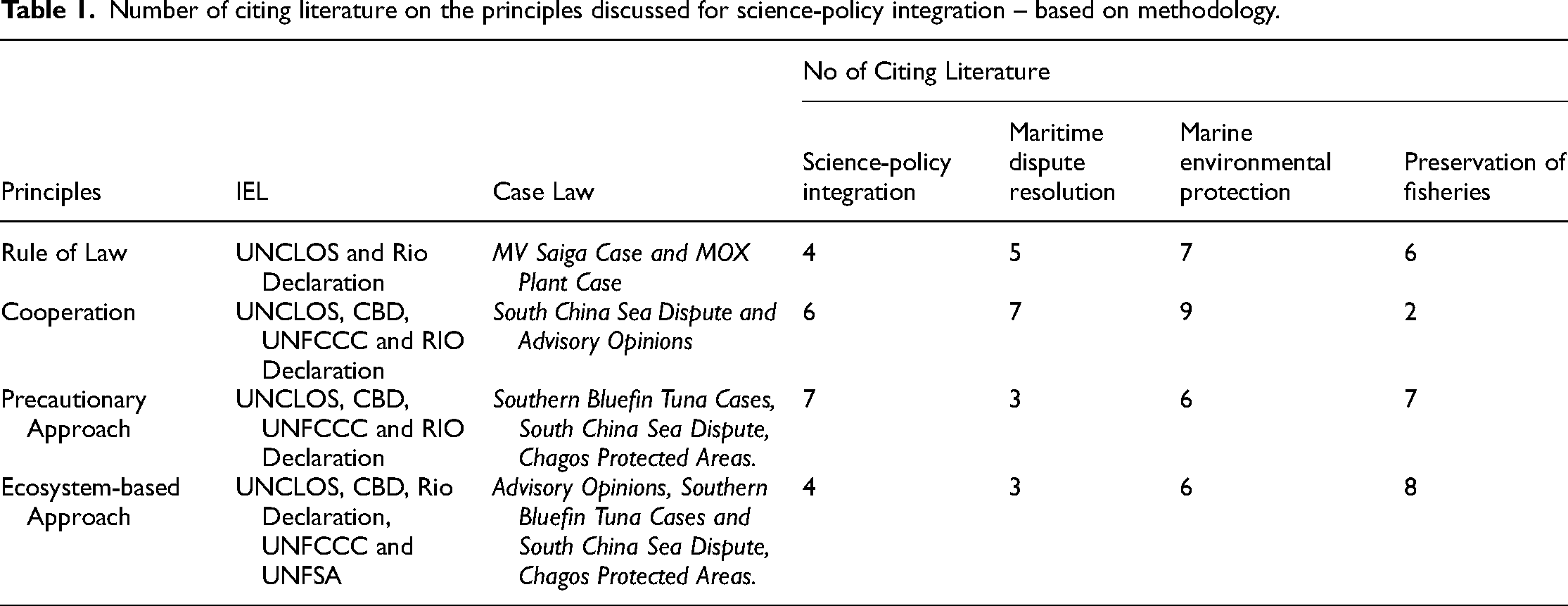
The principles for ocean governance clarified in this research article are selected on the basis of their usage in the IEL as well as the literature related to science-policy integration, maritime dispute resolution, marine environmental protection and preservation of fisheries (as mentioned in Table 1).
11
The given principles are used repeatedly and rhetorically by the IDSBs in the field of ocean, environmental and climate governance. The relevant IEL instruments which are reiterated by the IDSBs include the United Nations Declaration on Environment and Development (Rio Declaration),
28
Convention on Biological Diversity (CBD),
29
United Nations Framework Convention on Climate Change (UNFCCC),
30
Convention on International Trade in Endangered Species of Wild Fauna and Flora (CITES),
31
United Nations Fish Stock Agreement (UNFSA),
32
the International Convention for the Prevention of Pollution from Ships (MARPOL),
33
the International Convention for the Prevention of Pollution of the Sea by Oil (OILPOL)
34
and other Multilateral Environmental Agreements (MEAs). In this way, the principles of IEL developed a relationship with ocean governance for marine environmental protection as interpreted by the IDSBs. The IDSBs include the International Court of Justice (ICJ), the International Tribunal for Law of the Sea (ITLOS) and the Permanent Court of Arbitration (PCA).9,35,36 As mentioned below in the points and the Table, each principle is discussed thoroughly in the next section as the IDSBs interpret it (As mentioned in Table 1).
United Nations Convention on the Law of the Sea is among the first international documents to regulate the marine environment. Rio Declaration and UNFCCC provided ‘equitable uses of the ocean and set protection and conservation principles and standards’. Based on prise de conscience environmentale (environmental awareness), the principle of the ‘rule of law’ in UNCLOS represented a revolutionary step taken by the international community towards a mission of marine environmental protection.37,38 The rationale for selecting the ‘rule of law’ as a principle operating in ocean governance for marine environmental protection is based on a doctrine which is utilised in most of the literature of the past.
39
The innovative character of UNCLOS and IEL could even be considered a basic set of the ‘rule of law’ in the global system, having concluded for the negative.
40
In other words, the IEL integration with the rule of law was born ahead of its time but faced increased limitations in light of renewed challenges posed by rapid developments. Therefore, IDSBs adopted the ‘rule of law’ through various judgements and answered the current questions in the interface between UNCLOS and IEL. After the enforcement of UNCLOS, UNFSA consolidated efforts for enhanced coordination and ‘cooperation’ between States for fisheries governance.
41
The IDSBs repeatedly state that the States shall cooperate through international and regional bodies, such as the Regional Fisheries Management Organisations (RFMOs), to preserve fish stocks leading towards marine environmental protection.
42
United Nations Convention on the Law of the Sea, as a regulation for mare liberum (freedom of navigation) and mare clausum (territorial zones in the oceans), created UNFSA for cooperation in the context of fisheries dispute resolution.
43
It can also be equated as a sort of restriction which should be welcomed as necessary and beneficial to the conservation and management of endangered fishes (that includes straddling and highly migratory stocks). Moreover, Principle 17 of Agenda 21 of the Rio Declaration stated that strengthening international and regional cooperation and coordination is necessary for the integrated management and sustainable development of oceans.
28
Therefore, IDSBs reiterated the principle of ‘cooperation’ in many judgements for marine environmental protection and sustainable use and conservation of marine living resources on the high seas.
44
The relationship between science and policy in the judgements of the international courts is not new; it has recently gained attention. Accordingly, IDSBs have developed several techniques to cope with the necessity of a scientific understanding of marine ecosystems.
45
In this scenario, adopting a precautionary approach when natural resources are involved is one of the priorities of ITLOS while settling a dispute, and in some cases, an effective Environmental Impact Assessment (EIA) has been conducted.
46
International Tribunal for Law of the Sea stated that the precautionary approach reflects the Rio Declaration formulation, which is mutatis mutandis applicable in marine environmental protection and can also be approached by bypassing the scientific question by over-relying on the burden of proof (as ICJ did in the Pulp Mills Case).
47
The method was reiterated by the ITLOS in Responsibilities and Obligations of States Sponsoring Persons and Entities with Respect to Activities in the Area, in which States sponsoring exploration or exploitation activities were required to apply a precautionary approach.
23
On several occasions, IDSBs (mainly ITLOS) have relied on scientific and legal techniques rather than directly engaging with parties to the dispute for marine environmental protection. Although the ecosystem-based approach is not exactly defined in UNCLOS, an internationally recognised definition provided by the CBD is restated by ITLOS as ‘a dynamic and complex interaction between plant, animal and micro-organism and their non-living environment’.
12
Relevant jurisprudence in maritime dispute resolution often applies ecosystem-based approaches for marine environmental protection. IDSBs, while applying an ecosystem-based approach, have considered customary international law, general principles of law and IEL integrating and overlapping UNCLOS’ principles.
48
While taking into account the ecosystem-based approach, IDSBs reiterated the marine environmental protection provisions of the UNCLOS. More specifically, ITLOS, in Request for an Advisory Opinion Submitted by the Sub-Regional Fisheries Commission (SRFC), followed the Food and Agricultural Organisation's Code of Conduct for Responsible Fisheries features any ecosystem-based approach.
42
International Tribunal for Law of the Sea stated that under the UNCLOS, measures taken in accordance with marine environmental protection provisions should include those necessary ‘to protect and preserve rare or fragile ecosystems that include habitat of depleted, threatened or endangered species and other forms of marine life’, and through this position widens the scope of its own jurisdiction in ocean governance.
49
Number of citing literature on the principles discussed for science-policy integration – based on methodology.
Analysis and review of the principles based on judgements of the IDSBs
Generally, IDSBs attempt to maintain cardinal legal and policy principles, including transparency, accountability, consensus and the rule of law. 8 From an environmental perspective, the given principles are presented as a set of indicators that is present in all legal orders. 50 For example, the rule of law forms an essential precondition for justice, transparency and accountability to maintain responsibility, and consensus leads towards the global public good. It is apparent that while maintaining these principles, international organisations (including IDSBs) play a significant role in integrating science and policy that preserves and protects the marine environment. 51 Such principles also uphold concepts of environmental security and justice for global citizens without limiting the proper authority of any State.
In marine environmental protection, IDSBs had already taken various actions to implement further the obligations provided under the UNCLOS. 52 The jurisprudence developed so far upheld the order and stability of international law through several pertinent dictums. In its most specific sense, the IDSBs have had to rule on the meaning of ‘coastal States’ jurisdiction in marine areas to protect the marine environment in Exclusive Economic Zones (EEZs). 52 It is recalled that the IDSBs intervened in the ‘ocean governance’ of the specific States while presenting principles for marine environmental protection. As mentioned above, such principles at the core of ocean governance form a precedential value rather than a norm. 53 Similarly, it can be argued that these principles are cardinal for scientific integration in ocean governance, leading to global sustainability. 50
International law provides a solid foundation for ocean governance, and sustainability is essential for preserving global ecosystems; combining the two creates a more comprehensive environmental application. 54 From this horizon, scientific-knowledge integration into policymaking means that ocean governance is not limited to the marine environment; it also impacts atmospheric and terrestrial ecosystems. 7 With these bases of science-policy integration, various principles have become apparent through the interpretation of international law, and they are contributing to the joint governance of oceanic, atmospheric and terrestrial environments (governance of climate, marine and terrestrial ecosystems). Among others, recently emerged principles, such as integration, precaution and ecosystem approach, reflect on the dynamic international governance system for preserving the global community's interests under IEL.51,55
While the above-mentioned principles have been enshrined repeatedly in judgements of the IDSBs, their utilisation appears to be relatively ineffective in disputed areas. 56 This reflected the significance of reviewing the findings of the IDSBs in the field of ocean governance and a curiosity as to how the UNCLOS and IEL would respond to upcoming challenges in an unprecedented capacity. 57 Therefore, the principles provided through such judicial decisions for ocean governance and marine environmental sustainability in practical application by the States are still uncertain. 58 This is also because of potential conflicting interpretations of diverse IDSBs, specifically those having a significant role in ocean governance. 58 Although the IDSBs have always remained conscious of the interpretation of international law, conflicting interests of States (including other potential actors) have their own version. 58
The rules for marine environmental protection in treaty interpretation began with the adjudication of the MV Saiga Case, which unpacked some of the shared characteristics of ocean and fisheries governance. 25 The object of the interpretation in the case was to convince States’ regarding the justified release of the MV Saiga; in the judgement, ITLOS also prescribed the clauses of IEL on marine environmental protection. International Tribunal for Law of the Sea somehow expanded its jurisdiction under the Vienna Convention, and that was an interpretation design to help them achieve the aims of marine ecosystem preservation. 59 Such interpretation pertains, in other words, to the ‘meta-discourse’ about ‘environmental protection at large’. 60 It also espouses a view close to a description of adjudication as ‘a work with purpose’ or an approach with a specific goal of marine environmental protection.
‘Applicable law’ provisions in the UNCLOS are utilised by the IDSBs ‘systemically’ because it enables them to apply ‘other rules of international law not incompatible with’. 8 For example, PCA in South China Sea Dispute stated that UNCLOS and Vienna Convention enabled it to consider the CBD to interpret the marine environmental law at stake. As far as IEL is concerned, the IDSBs had substantiated the UNCLOS’ marine environmental provisions by accepting the validity of the principles of the rule of law, cooperation, precaution and ecosystem-based approach. 61 Specifically, ITLOS assigned central importance to these principles under the UNCLOS as per the obiter dictum (in line with the jurisprudence) of the ICJ. In Southern Bluefin Tuna Case, ITLOS stated that when natural resources are involved in any dispute, adopting precaution requires an ecosystem-based approach and cooperation under the international rule of law. 62 In such ways, ITLOS has developed several techniques to cope with the necessity of scientific understating of the marine environment. For such purposes, there has been significant utilisation of the Vienna Convention. 63 As these principles are not clearly presented in the UNCLOS, ITLOS has followed precedents of ICJ, PCA and other IDSBs.
Principles of international law for effective science policy integration in ocean governance
In this research article, references to rules and principles of international law (IEL and UNCLOS) by any of the IDSB are explained in a manner that establishes stare decisis (legal principles of determining points in litigation according to precedents). 61 It should also be noted that the functional limits of jurisdiction have not kept the IDSBs from indirectly illustrating their specific understanding of the rules and principles of the IEL and UNCLOS. IDSBs maintained a balance between acceptable environmental change in marine ecosystems and other priorities, including utilising ocean resources. 64 While keeping this background, it is analysed how the IDSBs adopted (science-policy) ‘integration’ principle, arguably based on the same limitations as to the applicable law of the UNCLOS. The better view is that the provisions of the UNCLOS entailing compatible rules of international law are invoked by the IDSBs to support an expansion of the jurisdictional limits of the dispute resolution mechanisms. 5
Beyond the points mentioned above, prescription by any IDSB becomes necessary in international law and can be applied through interpretation or application. This notion of the rule of law will undoubtedly be welcomed because of the need to make IEL more effective. In their recent judgements, the integrative approach pursued by the IDSBs effectively determined the rule of law for cooperation, precautionary and ecosystem-based approaches. Such an integrative approach by the IDSBs under ‘applicable law’ provisions has been applied in the M/V Saiga case, where the ITLOS referred to an MEA to apply principles of the rule of law and precautionary approach.21,65 Similarly, in the South China Sea Arbitration, PCA applied the CBD to interpret the term ‘ecosystem-based approach’ and moved forward to the actual application of IEL based on principles of ‘cooperation’, ‘rule of law’ and ‘precautionary measures’. 9 Therefore, the legal corpus of science-policy integration interpreted by the IDSBs is explained below with supporting and interconnecting principles of the rule of law, cooperation, precaution and ecosystem-based approach.
Rule of law
In the context of global ocean governance and maritime dispute resolution, the ‘rule of law’ principle becomes the ‘international rule of law’. 7 While applying the rule of law in MV Saiga Case, ITLOS maintained an impartial application of the UNCLOS as ratio decidendi (the rule of law on which a judicial decision is based) for prompt release measures and standards for the protection and preservation of the marine environment (which included fisheries). 66 International Tribunal for Law of the Sea established that in the prospects of ocean governance, it is apparent that the ‘rule of law’ is also utilised by the IDSBs to maintain an equitable utilisation of marine resources in EEZs among the States. 67 Moreover, IDSBs apply the ‘rule of law’ in inter-State relations to protect the vulnerable. That said, ‘the international rule of law’ is a principle of global ocean governance under which all persons, institutions and entities (public and private), including the State itself, are accountable to UNCLOS and IEL (because these are publicly promulgated), equally enforced and independently adjudicated’. 39
IEL defines the ‘rule of law’ as effectively implementing the law by delineating rights and duties.68 As the CBD states that ‘each State shall adopt legislative and administrative/policy measures’ to protect the environment, ‘rule of law’ requires measures to ensure adherence to the principles of supremacy, equality and responsibility before the law. 29 Moreover, environmental protection requires a fair application of the law, separation of powers (administration, legislature and judiciary), participation in decision-making and legal transparency. While interpreting the rule of law, it can be argued that ITLOS have upheld order and stability in several important judgements. In several significant judgements interpreting the rule of law, it can be argued that the ITLOS has upheld order and stability. In the MV SAIGA Case (Saint Vincent and the Grenadines v. Guinea), the ITLOS was tasked with determining the meaning of language pertaining to coastal state powers in EEZs. 69 For environmental protection as the ‘rule of law’, one of the judges in MV Saiga Case–1 (Provisional Measures) opined that the ITLOS would prescribe binding marine biodiversity preservation clauses under the UNCLOS in its future judgements. 70
The point of the ‘international rule of law’ under the IEL and UNCLOS was further illustrated by the ITLOS in the Southern Bluefin Tuna Case, which, ‘in effect, means the application of the law for the conservation of the living resources of the sea as an element in the protection and preservation of the marine environment’. 71 In Southern Bluefin Tuna Cases, the ITLOS and the Special Tribunal (constituted under the auspices of the PCA) reinforced ‘national and domestic legislation’ developed under the UNCLOS and IEL. That said, the ‘rule of law’ requires effective implementation of ‘subsidiary legislation’, which shall be more suitable and convenient for regulating oceans. 38 In this context, the effectiveness of the international rule of law has undoubtedly gained momentum in past decades in marine environmental protection. Therefore, UNCLOS was awarded as a vital part devoted exclusively to settling disputes, including ocean governance in the field of IEL.
During dispute resolution proceedings, the IDSBs pioneer compulsory procedures entailing binding judgements and specifically endorse that the marine environment shall be protected and preserved. In this scenario and such a pulverised and decentralised world, ‘rule of law’ serves as a theoretical cornerstone in global ocean governance for marine environmental protection. 72 Therefore, the ‘rule of law’ in UNCLOS is awarded as an active part of dealing with marine environmental protection. This global system with weak legislativeity requires effective implementation of the ‘rule of law’, which is ensured through IDSBs – in other words, the international judges realise that the marine environment can be protected under the thorough operation of UNCLOS along with IEL. 73 In this context, effective implementation of the ‘rule of law’ also conforms authority of IDSBs over global ocean governance for marine environmental protection.
The IDSBs maintained in several judgements that the principle of the ‘rule of law’ is an essential component of marine environmental protection. 71 Most specifically, IDSBs in Southern Bluefin Tuna Cases and MOX Plant Case exemplified integrating scientific knowledge into policymaking while stating that ‘conservation of living resources in the sea is a means of protecting and preserving the marine environment’ as a cardinal principle of UNCLOS.10,71 In this context, maintaining the ‘rule of law’ in ocean governance leads towards marine environmental protection because the operational part of the ‘rule of law’ bridges the gap between objectives and notions. As already discussed, the objective of UNCLOS and IEL is to protect the marine environment and preserve habitat (including fisheries), ‘rule of law’ pertinently ensures that law is impartially applicable through the integration and interface of science and policy.
Cooperation
IDSBs substantiated the general norms concerning the protection and conservation of the marine environment and living resources laid down in UNCLOS by construing from them a duty of the States to cooperate.41,74 International Tribunal for Law of the Sea interpreted ‘cooperation’ in various ways; in the context of marine environmental protection, ‘cooperation’ is interpreted as an obligation to prevent pollution and to bring the States together to conduct joint activities that allow them to resolve the dispute. In the Case Concerning Land Reclamation by Singapore in and Around the Straits of Johor (Malaysia v. Singapore), ITLOS prescribed to cooperate to establish a group of independent (scientific) experts with the mandate to propose measures to cope with the possible harmful consequences (by the work started by Singapore) of the land reclamation in EEZs. 75 International Tribunal for Law of the Sea did this as a provisional measure, and the States to dispute complied by establishing an expert group and concluded an agreement to avoid any possible harm to the marine environment. Establishing an expert group made it clear that it regarded the duty to cooperate and its legal basis as being conceptionally related to science policy integration.
IDSBs under the UNCLOS have moved from an initial focus on ‘responsibility’ for environmental harm to the principle of ‘cooperation’. 76 Basically, it appears that IDSBs assume their jurisdiction under the UNCLOS and do not apply MARPOL and OILPOL. 77 In fact, the principle of ‘responsibility’ arising from the MARPOL and OILPOL holds the States liable and focuses primarily on compensation. 77 However, IDSBs emphasised the preventive role of UNCLOS through cooperation for measures to reduce and control marine environment pollution. In light of such interpretation, IDSBs avoided ‘private law’ notions and applied ‘cooperation’ as a public law principle. 78 Of course, IDSBs are formed under UNCLOS, principally dealing with public maritime dispute resolution and promoting regional cooperation for marine environmental protection as a principle of IEL.
Although the principles of ‘liability’ and ‘cooperation’ are logically independent and different, they are intertwined in practice. 77 It is reasonable to expect that once a State adopts the principle of liability for marine environmental protection and undertakes all efforts to cooperate with others for mutual benefits. Therefore, IDSBs state that the States should aim at cohesion which shall enable the resolution of conflicts within the framework of the international rule of law. IDSBs establish linkages among principles of liability, responsibility, the rule of law and cooperation through such means. 79 All these principles urge that any State may not take action on the territorial zone of another State without the consent of the latter.
IDSBs typically strive to achieve the aims and goals outlined in their founding treaties, namely the UNCLOS and the Statute establishing the ITLOS. Additionally, when required, these bodies focus on facilitating other types of international collaboration. The position of IDSBs is seemingly characterised by a genuine commitment to marine environmental protection and may, therefore, be regarded as a consensus among all States. Such as, ITLOS in Malaysia v. Singapore accepted the existence of a situation of urgency to prescribe provisional measures to ensure cooperation between the States in dispute. 75 The viewpoint of IDSBs seems to be characterised by a genuine commitment to marine environmental protection and is, therefore, regarded as a consensus among all States. It is problematic that one of the States did not have exclusive jurisdiction to establish rights over any territory, the States shall cooperate for marine environmental protection. 80 Hence, the principal encounters a significant obstacle in terms of securing the cooperation of States in disputed areas.
In the South China Sea dispute, despite all the efforts made by the PCA, the States in that region are not willing to cooperate. 12 Recent initiatives by the government of China to initiate joint MSR in the EEZs of that region have been rejected by other States. However, in Croatia Vs Slovenia Dispute, both States recognised the principle of cooperation under UNCLOS as stated by the PCA that ‘cooperation is undoubtedly part of the legal background to the maritime aspects of the present case’. 81 That said, in establishing the cooperation obligations under the UNCLOS, IDSBs’ expressed obligations of IEL and UNCLOS (for the cooperation of States bordering enclosed or semi-enclosed seas) for marine environmental protection and by confirming the binding nature of the obligation to cooperate. 82 Therefore, IDSBs attempt to create cooperation duties under the UNCLOS along with the articulated obligations of IEL. 83 These obligations specifically pertain to the collaboration of states that share borders with enclosed or semi-enclosed seas, with the aim of promoting marine environmental preservation. Furthermore, the obligatory nature of the responsibility to cooperate has been affirmed in various decisions of the IDSBs, as discussed above.
Precaution or precautionary approach/measures
The rule of law and cooperation allows States to take a precautionary approach in EEZs. International Tribunal for Law of the Sea stated in MOX Plant Case that ‘prudence and caution require cooperation in exchanging information concerning risks or effects of any operation in oceans’. 10 In this way, scientific-policy integration develops a relationship between a precautionary approach, effective implementation of the law (as the rule of law) and cooperation in disputed areas. 68 While UNCLOS does not contain any express reference or definition to the precautionary approach, it can have been argued that specific reference to EIA with the broadly framed duty to protect and preserve the marine environment is a reasonable ground that reflects precautionary spirit. 7 However, due to its abstract nature, the precautionary approach principle requires further development to be suitable and effective in ocean governance for marine environmental protection.
It is pertinent to mention that the concept of maximum sustainable yield (MSY) in the UNCLOS equates with the precautionary principle. 64 In this regards, the requirement of MSY is satisfied only in the light of such a precautionary approach which is interlinked between marine environmental protection and dispute resolution. United Nations Fish Stock Agreement also provided that States are required to adopt (precautionary) measures aimed at ensuring the conservation of fish stocks (that includes marine ecosystems) and ensuring marine environmental protection (long-term sustainability and optimum utilisation of marine resources). 84 Precautionary measures can ensure MSY because these are based on the best scientific evidence available and are designed to maintain fish stocks (including the marine environment). 85 The substantive requirement of MSY and the duty to protect and preserve the marine environment should be in line with the precautionary principle.
International Tribunal for Law of the Sea, in Southern Bluefin Tuna Case, stated that a precautionary approach seems inherent in the notion of MSY. 71 International Tribunal for Law of the Sea implicitly confirmed the principle of precautionary approach by stating that ‘the States in dispute should in the circumstances act with prudence and caution to ensure that the effective conservation measures are taken to prevent serious harm to the stock of a particular marine habitat’. 86 Beyond MSY, the ITLOS has also substantiated UNCLOS's marine environmental protection provisions by recognising the precautionary approach's importance and validity. For example, in MOX Plant Case, ITLOS restated the ‘precautionary approach’ while utilising ‘integration’ of the Vienna Convention and an MEA and directed States in dispute accordingly. 87 Inter alia, ITLOS stated that the precautionary approach has been incorporated into many MEAs and IELs and is trending as a part of international law. Furthermore, ITLOS quoted ICJ in Responsibilities and Obligations of States Sponsoring Persons and Entities with Respect to Activities in the Area that science-policy integration as a new custom shall be ensured by incorporating a precautionary approach. 88 In this advisory opinion, ITLOS also opinionated that the ‘general provisions concerning the responsibilities and liability apply equally to all sponsoring States, whether developing or developed’ and ‘the requirements for complying with the obligation to apply the precautionary approach may be stricter for the developed than for the developing sponsoring States’. 88
The aforementioned opinion of the ITLOS illustrates the significant emphasis placed on the notion of the ‘precautionary approach’ in ocean governance. In the context of the marine environment, it is imperative to consider existing differences in capabilities between States. This principle of ‘precaution’ has been promoted in several RFMOs, which the ITLOS substantiates in the Request for an Advisory Opinion Submitted by the SRFC. 42 In the contemporary global setting, most MEAs apply a precautionary principle, and arguably, the potential impacts of climate change (and indeed the uncertainties associated with it) are considered when making judgements relating to MSY, fishing catches and marine environmental protection. 7 Although precautionary approaches are challenged by State parties in disputes which impact the practical aspects of protecting the marine environment, IDSBs have jurisdiction to reinforce the practical means of ‘precaution’ in disputed areas.
The precautionary principle focuses on the decision-making processes in ambiguous situations rather than determining specific outcomes.89,90 This principle is neither absolute nor flexible and, therefore, aims to cultivate adaptability and a more comprehensive approach to goal-setting in making decisions. In this way, this principle encompasses two fundamental objectives in the context of decision-making: firstly, the need for a certain level of certainty regarding predictions of future environmental impacts of activities prior to their approval, and secondly, the recognition that governing actors should not delay the implementation of remedial actions until conclusive evidence of environmental damage caused by existing activities is obtained. 91 Therefore, the precautionary principle as a legal concept has the characteristic of influencing judgments of the IDSBs without necessarily determining them.
Ecosystem-based approach
The ecosystem-based approach generally uses biodiversity and ecosystem services to support human and environmental adaptation. These wide-ranging approaches include mangrove restoration to buffer against storm surges; watershed management to protect against droughts and floods; rangeland management to prevent desertification; and sustainable management of fisheries and forests to ensure food security. UNCLOS states that ‘the measures taken following its marine environmental protection provisions shall include those necessary to protect and preserve rare or fragile ecosystems’; it can be argued that this provision expands the jurisdiction of the IDSBs for nature conservation. 92
Moreover, ecosystems in the UNCLOS are substantiated as ‘the habitat of depleted, threatened or endangered species and other forms of marine life’, which is seen to apply to the protection of species and fish stocks. Therefore, the ‘ecosystem-based approach’ under the UNCLOS develops a relationship with precaution, cooperation and effective implementation of science policy while exploiting marine resources. The PCA took this position in Chagos Marine Protected Area Arbitration that the scope of the UNCLOS’ principles and standards for marine environmental protection can be extended for coastal and tropical ecosystems. 93 In this way, PCA expanded its scope and jurisdiction to the overall earth ecosystems by stating that UNCLOS ‘goes beyond the controversy that the principles of IEL applicable to the management of marine living resources and nature conservation are limited to the oceans’ and thus ‘not limited to measures aimed strictly at controlling marine pollution’. 94
Interestingly, PCA in the South China Sea Dispute substantiated the term ‘ecosystem-based approach’ while referring to the CBD and CITES. 9 Indeed, PCA relied on the CDB to determine the meaning of the term ‘ecosystem’ and stated that harvesting endangered species, using harmful fishing methods and pollution harm the tropical coastal, marine and ocean ecosystems. Examination of this statement of PCA depicts an urgent need to address one of the principal weaknesses in the architecture of maritime dispute resolution, which is the absence of an ecosystem-based approach to managing the disputed areas. 86 In order to achieve greater integration between the scientific evidence and law following the broader marine environmental protection provisions of the UNCLOS, an ecosystem-based approach under the IEL becomes extrinsic to it. Therefore, this technical task demands a greater science-policy integration which shall involve flexible ocean governance to attain the objectives of marine environmental protection.
Although the term ‘ecosystem’ is only mentioned once in the UNCLOS, the concept following the marine environmental provisions appears implicit through the jurisprudence discussed above. 86 IDSBs specifically observed that the interpretation of the obligations in the UNCLOS would be entirely consistent with a general trend in IEL. International Tribunal for Law of the Sea, in Request for an Advisory Opinion Submitted by the SFRC, substantiated that the ecosystem approach to fisheries elaborates on the concept of species associated with and dependent on target species. 42 Such position of ITLOS means ‘interdependence of marine ecosystems (environment, habitat and fisheries)’ that ‘species associated with or dependent upon harvested species to maintain or restore populations of such associated or dependent species above levels at which their reproduction may become seriously threatened’. 95
Nevertheless, as per Southern Bluefin Tuna Case, it is questionable that the ecosystem-based approach in UNCLOS is meant to widen the scope of jurisdiction of the IDSBs, specifically concerning precaution, cooperation and the rule of law. 71 International Tribunal for Law of the Sea’ position in the Southern Bluefin Tuna Case that ‘the conservation of the living resources of the sea is an element in the protection and preservation of the marine environment’ could be about an MEA governing that specific area. 26 International Tribunal for Law of the Sea clarified this position in South China Sea Dispute by literally interpreting UNCLOS in a manner that requires States in disputes to take measures necessary to protect and preserve marine ecosystems in their environmental policies, which is confirmed through the rule of law, cooperation and precaution. Therefore, it becomes binding that all the obligations in the UNCLOS regarding precaution, effective implementation of the law, ecosystem-based approach and cooperation apply equally to measures on the conservation and preservation of ecosystems.
The scientific understanding of ecosystem-based approach has been closely associated with the principle of precaution because taking early and preventive action in response to marine environmental threats with scientific evidence has been described as an integral component of the law of the sea.96,97 In implementation of the ecosystem-based approach impartial application of law and cooperation among the States for taking scientific evidence into consideration and precaution becomes salient features of governing oceans. Although there are a lot of challenges faced by the governing actors including IDSBs in operationalisation of ecosystem-based approach, it has increasingly becoming a pertinent feature of the scientific-research for marine environmental protection. However, scientific uncertainty exists in marine environmental protection and therefore, IDSBs promote the adoption of legal mechanisms allowing MSR even in disputed areas.
Science-policy integration: IDSBs promoting ventures for MSR
From examining the jurisprudence of IDSBs, it can be observed that the mechanisms for science-policy integration have developed through principles of UNCLOS and IEL and are different in terms but similar in nature and structure. The new approaches introduced by IDSBs have resulted in the overlap and interaction between the principles concerning science-policy integration for marine environmental protection. It has been pointed out by the relevant case laws that science-policy integration encompasses the principles of the rule of law, cooperation, precaution and an ecosystem-based approach. The IDSBs further clarify that the UNCLOS provides the basis of these ‘principles to the extent the alleged harmful activities took place in the disputed areas’. 12 Moreover, following the jurisprudence developed so far, science-policy integration is for the protection of ecosystems, which is an aspect of preserving the marine environment and, thus, is ‘not confined to measures directed at controlling marine pollution’. 7
Furthermore, substantive (the rule of law, cooperation, precaution and ecosystem-based approach) and procedural principles on protecting the marine environment are encompassed in the UNCLOS. Besides the requirements of national legislation and effective implementation of ocean governance at local levels for marine environmental protection, it is also essential to develop MSR plans as a procedural principle. 18 In the Chagos Marine Protected Area Arbitration, ITLOS concluded that the ‘principles and standards’ concerning protecting the marine environment are either established in the UNCLOS or elaborated by MEAs consistent with it. 93
International Tribunal for Law of the Sea applied the standards and urged to adopt marine environmental protection procedures. Moreover, IDSBs in their judgements stated that unilateral MSR is allowed in disputed areas unless there is any risk to marine environment (which includes harm to marine habitat and fisheries).12,98 Although the ability to assess the environmental effects of MSR is limited, as demonstrated by experimental activities that manipulate the marine environment on purpose, such work can have significant environmental consequences. 18 Marine Scientific Research is also essential to the global sustainable development of oceans and their resources. 90 Marine Scientific Research is principally for effectively utilising ocean resources and protecting the marine environment. 99 Besides UNCLOS, other forms of international cooperation for MSR, including MEAs and many bilateral agreements, have established national and regional research and development centres.
UNCLOS stipulates that coastal States have the right to regulate, authorise and conduct MSR in their territorial seas and EEZs in exercising their sovereignty. As MSR is ‘exclusively for peaceful purposes and to increase scientific knowledge of the marine environment for the benefit of all mankind’, it is substantial that conflicting States in disputed areas (EEZs and continental shelf) shall agree to this. 18 Therefore, in normal circumstances, MSR shall only be conducted with the express consent of coastal states. However, MSR in disputed areas is problematic due to overlapping claims in EEZs. Therefore, ITLOS in Ghana V Cote d'Ivore (Also known as Delimitation of the Maritime Boundary in the Atlantic Ocean) stated that in disputed areas, there must be a ‘spirit of understanding and cooperation’, and States shall ‘make every effort’ into account as ‘the obligation not to endanger or hinder the conclusion of the final agreement’. 73 Such wording has led to interpreting UNCLOS as establishing general freedom of MSR in disputed areas, especially in light of the provision according to which ‘coastal States shall, in normal circumstances, grant their consent’ as a principle of cooperation.
The expansion of the corpus of procedural obligations to protect the environment (such as MSR) through the judgements of the IDSBs is well known. Initially, ICJ in the Aegean Sea Continental Shelf Case (also known as Greece V. Turkey) stated that ‘unilateral seismic exploration will not cause physical changes to the marine environment (seabed or subsoil), the activities are of a transitory character and do not involve the establishment of installations, and that no operations involving the actual appropriation or other use of the natural resources were embarked upon’. 44 This means that MSR, as a procedural requirement, is derived from the customary law of the sea. Although ITLOS and PCA abstained from explaining the said interpretation of the MSR (to refrain themselves from unjustifiable interference), they persuasively requested States in disputed areas to conduct scientific research as a trend in IEL.
IDSBs affirm that MSR is mainly required for governance of the fisheries stock because marine is considered to constitute a part of marine ecosystems, and the basic ideas of IEL concerning living species include precautionary and ecosystem approaches. IDSBs maintained this position based on UNCLOS, which urges States to ‘promote the development and transfer of marine technology to developing States in the exploration, conservation and management of ocean resources and the protection of the marine environment through MSR’. 100 In this way, IDSBs admit that there are significant and complex overlaps and interactions between precaution, ecosystem-based approach, science-policy integration and MSR.53,97 It is also necessary to consider how to search for a coherent and integrated approach by coordinating and harmonising the principles and functions concerning the marine environment. For such purpose, mutual communication and understanding between the States (as cooperation) and effective implementation of the law (the rule of law) are essential, and some states’ attempts in disputed areas are worth noting.
From this perspective, it must also be noted that ordinarily, scientific uncertainty exists in managing the marine environment. 101 The concept of MSR in conserving marine living resources is closely linked to the precaution and ecosystem-based approach. In this regards, UNFSA provided a significant impetus for expanding MSR for fisheries management implementation due to the precautionary and ecosystem approach. Moreover, in disputed areas, States shall also be aware of the importance of MSR for effective governance of marine genetic resources and environment and better understand ecosystems and their potential uses and applications. 102 Further, the interlinkages between law, science and governance for cooperation, precaution and ecosystem-based approach seem to be inherent in the notion of MSR.
Conclusion
The present research article employed the approach of ‘within-case qualitative analysis’ to determine that the IDSBs have imposed extensive requirements on states for the conservation and protection of the marine environment. IDSBs laid down principles of the rule of law, cooperation, precaution and an ecosystem-based approach to marine environmental protection. It is also documented through this methodology that science-policy integration interconnects these principles for conserving the marine environment. Moreover, it is demonstrated that MSR in the UNCLOS, and as interpreted by the IDSBs can be utilised by states for cooperation in disputed maritime areas for marine environmental protection. In the near future, it is anticipated that the IEL will produce additional principles for the sustainability of the oceans based on the aforementioned principles. In the aforesaid context, it is also anticipated that MSR for marine environmental protection in disputed areas will likely find its way into ocean governance.
Footnotes
Acknowledgements
All the materials used in this research were provided by the Institute of Eco-Environmental Forensics and the Economic & Environmental Law Institute, School of Law, Shandong University, China.
Authors contributions
• Basic idea and initial write up: 3rd Author.
• Data Collection and Analysis: 1st Author.
• Reviewing and Editing: 2nd Author.
• Preparation for Publication: 1st and 2nd Author.
• Funding Acquisition: 1st Author.
Declaration of conflicting interests
The author(s) declared no potential conflicts of interest with respect to the research, authorship, and/or publication of this article.
Funding
The author(s) disclosed receipt of the following financial support for the research, authorship, and/or publication of this article: The APC this research was funded by the Institute of Eco-Environmental Forensics, Economic & Environmental Law Institute, School of Law, Shandong University, China, (grant number 01921).

Author biographies
Shijun Zhang is a professor of Law at Institute of Eco-Environmental Forensics, Economic and Environmental Research Institute, School of Law, Shandong University, China. Professor Zhang’s area of research is international environmental law.
M Jahanzeb Butt is a post-doctoral researcher at Institute of Eco-Environmental Forensics, Economic and Environmental Research Institute, School of Law, Shandong University, China. Dr Butt’s area of research is law of the sea.
Khadija Zulfiqar is a PhD scholar at School of Law, Dalian Maritime University, China. Ms Zulfiqar’s area of research is maritime dispute resolution.