



Abstract
The aim of the current study is to examine the magnetohydrodynamic (MHD) flow over the permeable pipe containing the nanoparticles with a heat transport mechanism. The leading equations of flow are obtained in terms of partial differential equations (PDEs). The suitable transformation is applied to alter PDEs to ordinary differential equations (ODEs) and solved numerically via the RK4 method. The novelty of the current work is to investigate the MHD nanofluid overextending and shrinking pipe enclosing the chemical reaction with a heat reservoir. The outcomes of different factors are depicted through graphs and tables on the flow phenomena. It is observed that for both situations of wall extension or contraction with injection, the temperature is the increasing function of the thermophoresis and Brownian motion factors. It is explored that the heat is upraised when the heat generation is augmented but decays for heat absorption. The point to be noted here is that the Hartmann number and Prandtl number enhance the heat curves in the presence of a heat source. It is also observed that when the thermophoresis factor is increased the nanoparticles concentration is also enhanced via heat source/sink. The error estimation is computed for different order approximations. For the confirmation of the mathematical modeling, the current study is validated with the previous.
Keywords
Introduction
Due to its potential applications in engineering and biology, laminar flow in an expanding or contracting porous surface is currently capturing the interest of a lot of academics. Examples include the pumping of fluids via elastic tubes, the coordination of the respiratory and circulatory systems, and the breakdown of a heat-to-sheet in a solid powerplant.1–8 Boutros et al. 9 used a lie grouping technique to investigate the dynamics of fluid movement in a stretched conduit near a heat source. Laminar flow was studied by Si et al. 10 in a transparent cylindrical vacuum with a progressively increasing or decreasing wall. Asghar et al. 11 analyzed behavior in a purposefully warped, low-absorption network. The thermal characteristics of a 2D turbulent flow with weak permeability between gradually expanding or contracting walls were predicted by Srinivas et al.. 12 Srinivas et al. 13 lately performed a theoretical examination of the effect of heat exchange on magnetohydrodynamic motion across a stretched pipe.
Research into nanofluids (NFs) has significant implications for mathematics, industry, science, and the field of materials science. For numerous uses of practical significance, designers and academics work hard to communicate a sufficient knowledge of the heat transfer mechanism in NF. Chips, freezers, hybrid generated, food enhancement, radiators, and so on all rely heavily on NFs. The term “nanofluid” was coined by Choi. 14 Due to their numerous uses in the biological, optical, and electrical fields, nanoparticles are now a topic of significant scientific research. These may be found in metals like copper and aluminum as well as oxides, carbides, nitrides, and nanometals like carbon nanotubes15–20 and graphite. The convection of heat in NF was studied by Buongiorno. 21 Additionally, Buongiorno 21 determined that in the nonexistence of turbulent influences, the Brownian and thermophoresis diffusion will be significant. Brownian motion mention is the random motion of the particles in the fluid. This movement is driven by thermal energy and can be observed in both liquids and gases. Rosca and Pop 22 used the Buongiorno's model to examine the unsteady boundary layer flow (BLF) over a moving sheet. Kuznetsov and Nield 23 inspected the fluid flow filled with nanomaterial configured vertically flat sheet. Nadeem et al. 24 explored the stagnation point flow (SPF) past over a stretchable sheet. Fully developed flow over vertical surface filled with nanoparticles was studied by Xu and Pop. 25 Mustafa et al. 26 scrutinized the magnetized BLF towards an expanded sheet containing nanoparticles analytically using homotopy analysis method (HAM). Analytically solution has been obtained by Alsaedi et al. 27 of SPF with heat source past through a convective sheet. The convective BLF of NF towards a vertical surface was scrutinized by Chamkha et al. 28 By Buongiomo's model (BM), Malvandi et al. 29 deliberated the NFF (nanofluid flow) using the perpendicular pipe. Akbari et al. 30 inspected the fully developed NFF over a horizontal tube. The analytical solution was obtained by Ellahi 31 for magnetized and variable viscosity of viscoelastic fluid inside the pipe. Uddin et al. 32 observed the magnetohydrodynamic (MHD) NFF over the extending sheet including slip effect at the boundary. Xu et al. 33 and Malik et al. 34 examined the BM and Casson NF, individually, to study the BLF passed through a vertical stretching channel. Malvandi and Ganji 35 considered the magnetized NF in a micro-channel enclosing the slip effect. The Brownian and thermophoresis factors were also analyzed. The numerical model was obtained for heat transfer using NFF in a cylinder by Zaimi et al. 36 Currently, the MHD flow of NF in a permeable extending pipe was studied by Srinivas et al. 37 Most recently, titania water based NF over a magnetized vertical cylindrical pipe was explored by Hedayati and Domairry. 38 Similarly, the alumina water based NF over the vertical channel with Lorentz force effect was examined by Malvandi et al. 39
Solar enthusiasts, nuclear reactor protection, metalworking, and chemical technology are only a few of the areas where the impact of chemical procedures on transferring heat has been seen.40–42 The effect of chemical efficiency on the circulation through a narrowing artery was investigated by Nadeem and Akbar. 43 The physical procedures for Maxwell fluid were analyzed by Hayat and Abbas 44 Abdul et al. 45 used the BLF to examine chemical reactions occurring on a flexible sheet containing NF. The homogeneous and heterogeneous chemical processes over the permeable stretching surface were studied by Kameswaran et al. 46 The magnetized convection BLF with slippage impact across a stretched permeable plate was analyzed numerically by Uddin et al. 47 in the context of chemical reactions. For NFs flowing freely across a horizontal plane, an analytical solution was found for free convection movement (FCF). 48 Srinivas et al. 49 lately investigated the kinematic fluid over the extended pipe using chemical treatments. Uddin et al. 50 also investigated the mechanism of the magnetized FCBLF utilizing the chemical interaction of NF via a horizontal surface.
In light of the findings in the aforementioned study, the current investigation aims to investigate the motivation of chemical reactions on magnetized NF movement over expanding or contracting permeable pipes containing the impact of heat reservoirs. This sort of thought has great utility in the fields of science and technology. With this in mind, a new study has been conducted to see how chemical reactions might influence the flow of magnetized NFs across a conduit that can either expand or contract and store heat. By incorporating a new variable, fluid features are transformed into ordinary differential equations (ODEs), which are subsequently numerically clarified via the shooting approach of the Runge-Kutta fourth-order method. 51 Graphs are used to study the impact of new factors on stream characteristics, and these observations are then explained physically. RK4 is also compared to HAM for affirmation purposes. The present study is compared to other accessible works on stability assessment, and a strong connection is found.
Formulation of the problem
Consider the NF movement over a conducting permeable pipe. The radius of the pipe is at

Geometry of the flow problem.
The basic flow structure is as follows:16–22


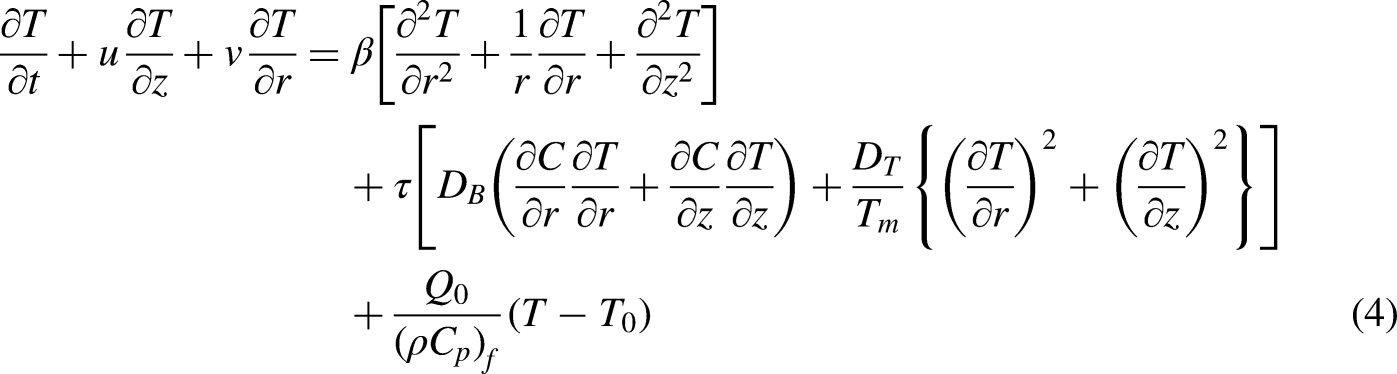

With constraints


Using the stream function


The transform boundary constraints are









Here
Numerical procedure, convergence, and validation
RK4 resolves the system of equations (23)–(25). In order to address equations (23) and (25), we first introduce additional variables to change them into the usual first ODEs, and then we solve them numerically with a step size of =0.01 to get the requirements for convergence reaching 10-5. The HAM is useful, and a wonderful settlement is developed, for accepting the results. Chart 1 explains how the numerical technique works (Figures 2 and 3). In the work by Ellahi, 31 you can get more information about this technique. Tables 1 and 2 also show comparisons between the present and earlier efforts, and the excellent settlement that resulted from those comparisons.

RK4 chart.

Assessment of RK4 and HAM for
Impact of

Impact of

Error analysis and confirmation of RK4 method
RK4 provides results that are comparatively precise for maximum differential equations. However, the outcomes are based on numerical estimation, therefore some error occurs in the solution. To find the error and residue error, two different procedures are computed, that is, the standard work precision and working precision-22. Errors are thus typically relatively minor, and reading them on a logarithmic scale might help. For visualizing variances that may correspond to zero at certain places, the real exponent [x] is a useful option since it is effectively identical to Log 10 (Abs [x]), with the exception of a singularity at zero: Following are some graphs depicting our best guesses for the error estimates of various model-physical parameters. As can be seen in Figures 4–10, the error in our numerical approach is negligible, proving its accuracy.
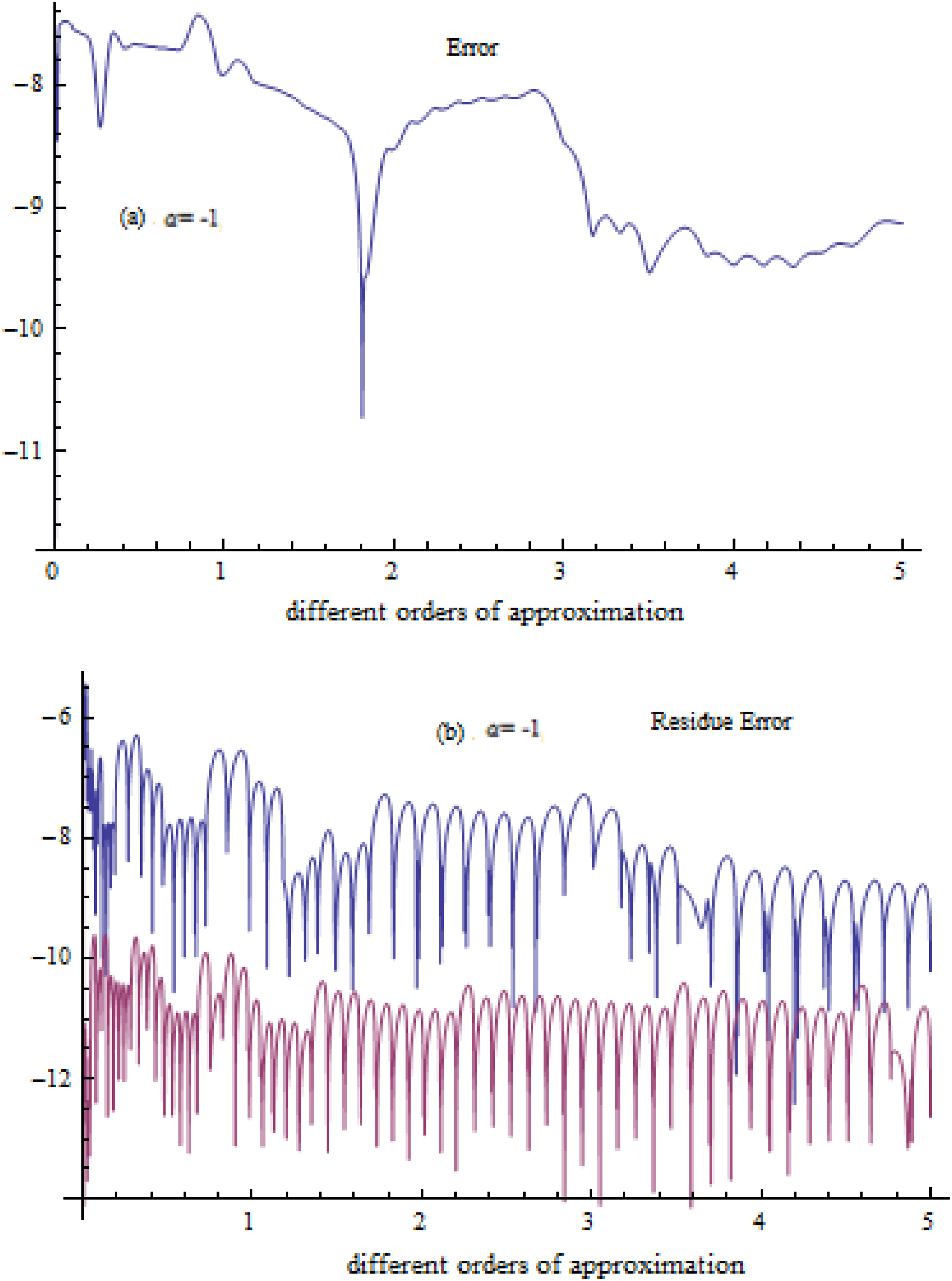
Error analysis for

Error analysis for

Error analysis for

Error analysis for

Error analysis for

Error analysis for

Error analysis for
Analysis and discussion
The effect of various parameters like thermophoresis factor Nt, the heat source/sink factor Q, the wall extension ratio, the Hartmann number M, the Prandtl number Pr, the Brownian motion factor Nb, the permeation parameter R, the Lewis number Le, and the chemical reaction parameter on the NN, SN, temperature, as well as concentration is investigated. We set the physical values to Pr = 3, Nb = Nt = 0.2, Le = 0.3, Q = 0.1, = 0.5, and M = 0.1 so that we may have a clearer picture of their physical meaning. Note that the values of Brownian motion Nb and thermophoresis factor (TF) Nt are described by the corresponding Nb and Nt parameters.
Figure 11(a) and (b) depicts the impact of Brownian motion on the heat. In Figure 11(a) and (b), we see how the Brownian phenomenon modifies the temperature distribution throughout both the wall-extension and wall-shrinking phases of injection. As the wall expands and contracts during injection, the temperature increases due to the enhancement in
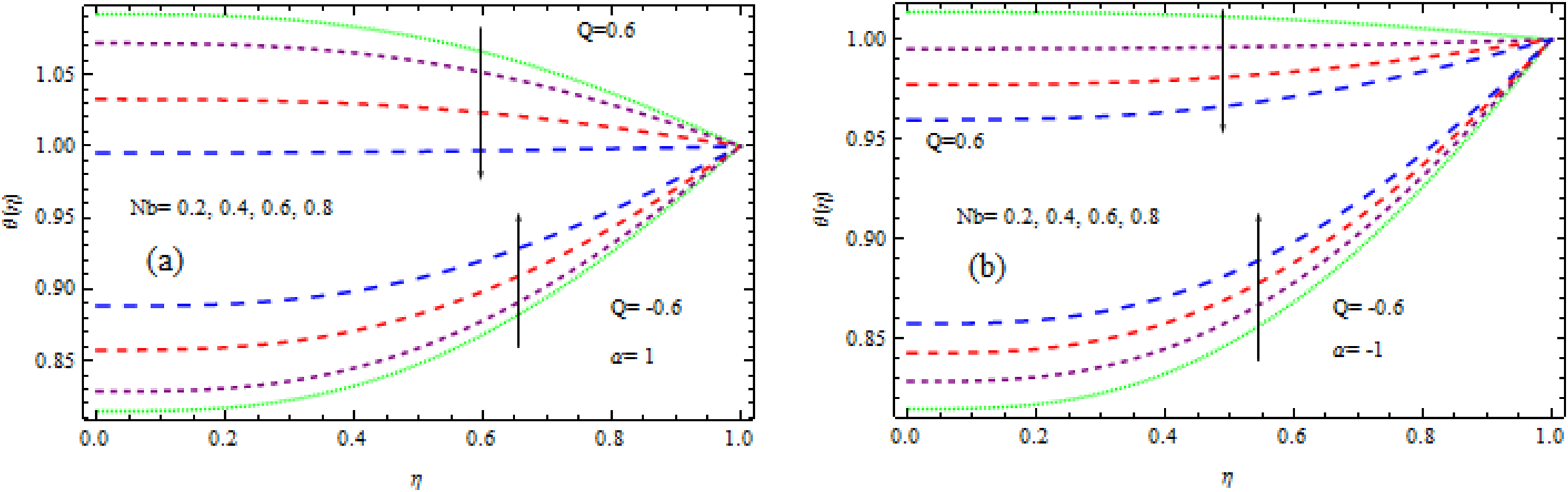
(a, b) Influence of Brownian factor on temperature.
Injections with wall contractions and expansions are shown in Figure 12(a) and (b) to show the effect of Q (heat source/sink factor) on fluid temperature. In the presence of injection with shrinking and expanding, the inner heat of the fluid is enhanced while decreasing with sink. Figure 13(a) and (b) depicts the impact of TF on heat during injection, wall expansion as well as contraction. It has been noticed that when TF increases, so does the temperature. The temperature-to-wall-expansion-ratio connection is graphically represented in Figure 14(a) and (b). The fluid heat rises for Q < 0 (heat generation) in the context of wall elongation due to infusion or suction when

(a, b) Inspiration of Q on heat.

(a, b) Inspiration of
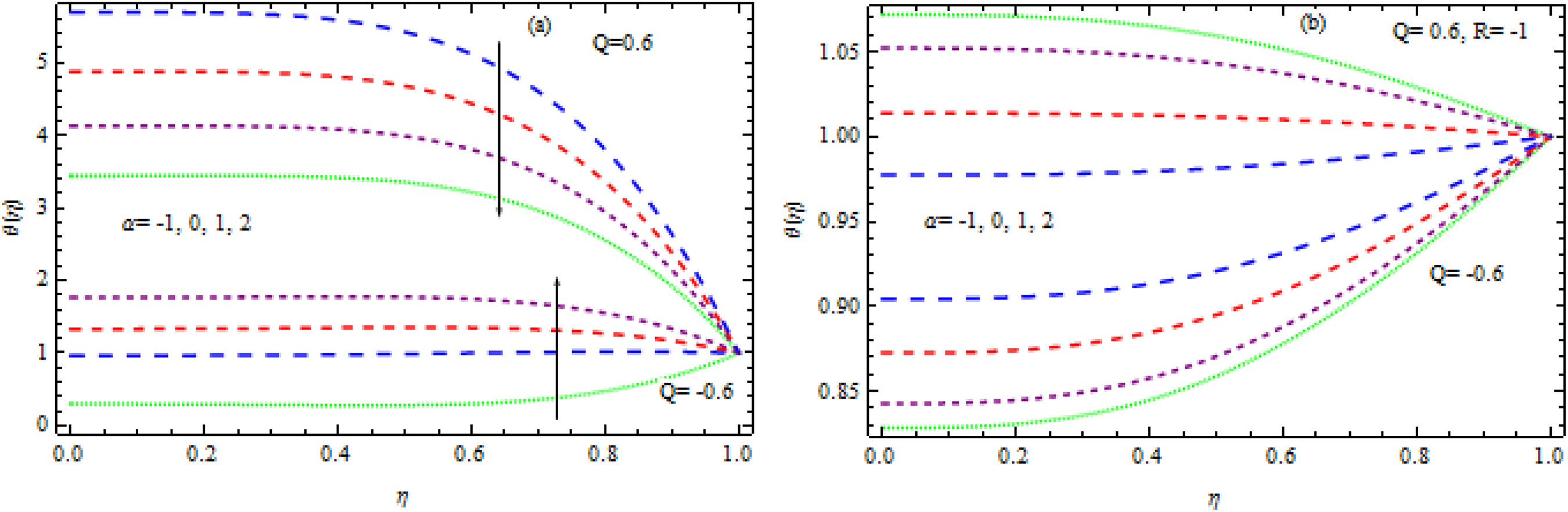
(a, b) Inspiration of
However, the situation changes when heat is introduced (for Q > 0). Figure 15(a) and (b) depicts the effect of the Harmann number (HN) on the heat variation. It has been shown that NF behaves similarly to conventional fluids with respect to the HN as a function of temperature. It is witnessed that the heat inside the fluid is enhanced when HN is increased in the presence of heat generation but inverse behavior is observed for a heat sink. The impact of the Prandtl number (PN) on heat is investigated in Figure 16(a) and (b). Keep in mind that the PN characterizes the states of metals and oils that are liquids. Oils with large Pr values have a high viscosity, while liquid metals that have small

(a, b) Inspiration of M on heat.

(a, b) Inspiration of

(a, b) Inspiration of R on heat.

(a, b) Inspiration of

(a, b) Inspiration of
The impact of a chemical component on the concentration profile is shown in Figure 20(a) and (b), for a generative and destructive reaction. In the scenario of a destructive chemical reaction factor (

(a, b) Inspiration of

(a, b) Inspiration of

Inspiration of a on concentration t.
The effect of the BM and TF is seen in Figure 23(a) to (c) on NN. Nu is discovered to be a growing function of Nt near the pipe wall. Nu increases as Nb increases near the wall for Q0, as shown in Figure 23(a), but decreases as Nb increases near the wall for Q > 0, as shown in Figure 23(b). Figure 23(c) shows that when M increases near the wall's surface, Nu similarly increases. The TF and BM against the SN are shown in Figure 24(a) and (b). As NTF at the wall's surface grows, it enhances the SN. SN decreases as Nb increases near the wall, as shown in Figure 24(a). Figure 24(b) demonstrates that SN decreases for a given increase in γ close to the wall.

(a–c) Deviation of NN for

Deviation of SN by (a) Nb, (b)
Conclusion
Here we explore how a chemical response and heat reservoirs affect magnetized NF movement in a permeable pipe during expansion and contraction. Utilizing an appropriate transformation, we transform the PDEs to differential equations, which we then solve computationally with the RK4 technique. The current work compares with earlier efforts in terms of stability evaluation. Error assessment and residue error are both computed to check the mathematical modeling, and both show an error that is too minor to matter. Here are some of the main takeaways: It is observed that for both situations of wall extension or contraction with injection, the temperature is the increasing function of the thermophoresis and Brownian motion factors.
One finding from the analysis is that if the heat source grows, the heat inside the fluid rises in either the expanding or contracting wall scenario, but falls in the heat sink situation. Increasing the Ha and Pr raises the heat near a heat source but decreases it near a heat sink. It is analyzed that It is mentioned here that
Footnotes
Declaration of conflicting interests
The author(s) declared no potential conflicts of interest with respect to the research, authorship, and/or publication of this article.
Funding
The author(s) received no financial support for the research, authorship, and/or publication of this article.

Author biographies
Zeeshan received his PhD in applied mathematics from Abdul Wali Khan University Mardan, Pakistan. He received his MPhil degree from Quaid-e-Azam university Islamabad. He has over 13 years of academic experience in different reputed institutions of the world. He is currently working as Assistant Professor at Bacha Khan University Charsadda, KP, Pakistan. He published more than 80 papers in reputed journals with more than 1200 citations in international peer-reviewed journals, including ISI Indexed/IF Journal publications.
Saeed Islam serving as Dean Faculty of Physical and Numerical Sciences, Abdul Wali Khan University Mardan, Pakistan.