




Abstract
Increased industrialization has led to unprecedented resource depletion on a global scale. The current state of affairs has compelled practitioners and academics to investigate the role of sustainable technologies in greening the operations of businesses. Previous studies have attempted to examine the number of operational aspects for their role in making firms sustainable, yet the utility of blockchain technologies is in its infancy. The role of BT in enhancing integration across supply chains has been in the limelight in the recent past. At the same time, its ability to cause sustainable supply chain performance (SSCP) in sync with the circular economy (CE) and supply chain integration (SCI) has largely remained unexplored. Therefore, this study intends to examine the association between blockchain technologies (BTs) and SSCPs through integration to fill the empirical gaps. The study was pursued to investigate the moderating role of the CE on the relationship between multiple extents of SCI and SSCP. Based on dynamic capability theory (DCT), the study considered BT a dynamic resource. BTs are used to integrate and reenergize the relationships with upstream and downstream channel members in pursuit of sustainable performance outcomes. The study opted for a cross-sectional design, where data was collected through convenience sampling from 475 managers from SMEs operating across Pakistan. PLS-SEM was used to analyze the data and to generate the required empirical outcomes. Study results favored the significant association between BT and SSCP, followed by a significant mediating role of SCI dimensions and moderating role of the CE. The study's findings propagate the utility of BTs adoption for SMEs, which holds the potential for firms to achieve system-wide integration to achieve sustainable outcomes. The given empirical investigation holds valuable insights for practitioners and scholars intending to pursue research on the subject matter.
Keywords
Introduction
Recent empirical studies in the advancement of information and communication technologies (ICT) have examined the role of Blockchain Technologies (BTs) in enhancing supply chain productivity. 1 BTs are regarded as one of the most beneficial technological tools that can revolutionize business processes for making the supply chain operate effectively. 2 BT can assist supply chain managers in increasing supply chain traceability, coordination, and sustainability. 3 It has a notable role in integrating supply chains within and across, making its processes more apparent and identifiable.4,5 Because of being geographically scattered and multi-tiered, supply chains start losing visibility across the breadth and depth of their supply chain networks, making visibility one of the biggest challenges.6–8 This is where the need for advanced technologies to be incorporated across chains and their business processes has been rising in the desire to achieve efficiencies and environment friendliness.9,10
Blockchain is a known technology with a widespread ability to facilitate eliminating supply chain complexities.1,11,12 BT has also termed the organization's strength to integrate supply chain channel members’ activities and resources to add value to all SC interactions.13,14 It also facilitates bringing transparency across chains when implemented in sync with other technologies like simulations and prototypes, 15 robotics systems, 16 big data analytics,17,18 cybersecurity 19 and Internet of Things, 20 cloud computing. 21 Through a proper influx of BTs, SMEs in Pakistan can help their supply chain managers understand the system perspective. Such technologies will let managers have an eye on all the processes at work (i.e. from the point of origination till the point of consumption), which will assist firms in achieving waste reduction and improved effectiveness. Likewise, it surely assists in making supply chain processes efficient 22 within MNCs, especially in developing countries like Pakistan. Developing countries have more challenges to face, concerning sustainability, in comparison to developed nations. Such countries are faced with the multifaceted challenge of deteriorating natural resources, compromised business operations and declining environmental exchequer.
Moreover, there are further concerns associated with supply chains, which have come to the fore recently. Making supply chains more sustainable is one such concern, closely related to SC visibility, as has already been elaborated. With invisible supply chain processes, it becomes a severe challenge for supply chain managers to ensure SC sustainability. 23 In comparison, the absence of sustainable processes can have profound social, environmental, and economic implications for SC managers and SMEs under their supervision. Many previous studies have readily established the connection between ICT adoption and its ability to cause integration across chains, which help improve overall supply chain performances. 24 Additionally, other studies have remained unable to associate spending on ICT across chains and their role in causing sustainable performance outcomes. 25 Such varying empirical outcomes increase researchers’ interest in validating the unaddressed connection between BTs and sustainable performance outcomes, especially in developing nations, where on the one hand, sustainability is compromised. On the other hand, the willingness to adopt sustainable technologies across business operations is in its infancy.
Conversely, SCI is another primary tool for increasing coordination among supply chain channel members. 26 Additionally, BT assists SC managers in keeping a record of all their transactions with other chain participants, ensuring prompt availability of chain-level information and further enhancing SCI. 13 Several studies have recognized the mediating role of SCI with sustainable performance associated with varying independent and dependent constructs. 27 Whereas, BT indeed has a role in enhancing SCI, in the desire of achieving overall business performance and environment-friendly outcomes. Therefore, the given study opted to test for the mediating role of SCI between BTs and sustainable performance outcomes. The given theoretical formation holds the potential to fill the empirical and practical gap in testing the association between blockchain technology, Supply chain integration, and concepts like circular economy.
Furthermore, the CE has also gained recent prominence as a business model, letting firms enhance value with the help of resource recovery and renewal. 28 Through CE business processes, firms can ensure pollution reduction through reduced carbon emissions. Modern firms adopt an emerging sustainable paradigm to augment value creation through resource conservation and securing natural capital.28,29 Furthermore, it has been noted that to achieve CE goals, supply chains are required to harmonize the association between channel members, their activities, and resources. 30 Keeping the relevance of CE with the concept of SCI and sustainable supply chains in mind, 31 this study considers its moderating role to add further to the body of knowledge.
This study makes numerous contributions by testing the connection between BT and SSCPs through SCI dimensions in line with the above-stated empirical developments across literature and prevailing gaps. This agenda complements the propagations of the previous studies, which consider BT a tool that enhances supply chain performance outcomes by ensuring seamless and secure dissemination of information.32,33 It also sheds light on the comparatively lesser-explored concept of CE and its role in causing integrated sustainable supply chains by testing its moderating role on the opted theoretical formation. Likewise, the study outcomes can let supply chain managers achieve traceability across value chains for sustained performance outcomes. 34 Furthermore, this study contributes by centering the empirical agenda across comparatively underdeveloped settings in Pakistan, which remain primarily unattended and under-explored in most of the related literature.
Theoretical background
Given study uses DCT to explore the proposed connection between BT, SCI dimensions, and sustainable performance outcomes. As has already been mentioned, the proposed framework specifically intended to probe the link between BT and SSCP, followed by mediating role of SCI dimensions and moderating role of CE. While capabilities are regarded as dynamic when they help uplift an organization's ability to make decisions, address problematic concerns, and assist in considering prevailing opportunities and threats. 35 Previous literature also reflects that BT implemented across supply chains lets SC managers co-create value by letting channel members integrate their activities and resources through dynamic configurations. Dynamic capability is “firms proficiency to establish, sustain and change its resources meaningfully. 36 Likewise, DCT elaborates that an organization can cause value by amending value chain processes. In the same way, BT's principles, through the use of its ability to cause transparency, privacy, consistency, and trustworthiness, are supposed to add to the existing service spectrum, letting firms and SCs operate in an improved manner.37,38
Therefore, after considering BT as a dynamic capability, the study believes it will help firms achieve cost-effectiveness and improve performance through a higher level of SCI.
39
Also, BT, with higher-level information integration capabilities, can outperform others Polim, Hu, Kumara.
40
Hence BT's study is adopted as a dynamic capability “That makes managers available with certain abilities, to coordinate, create and re-engineer firm's competencies, to counter frequently changing environmental norms”. In the same way, previous studies have also found a good connection between upstream and downstream integration and supply chain performance outcomes.
41
Therefore, the research opted for SCI dimensions as a mediator and CE as a moderator. Specific research objectives include: RO 1: To examine the association between BT, SCI dimensions, and SSCP. RO 2: To investigate the mediating effect of SCI dimensions and the moderation role of CE.
The intended research objectives are expressed through the theoretical framework as displayed in Figure 1:

Research framework.
Literature review and hypothesis development
BT adoption and SSCP
Accountability and traceability concerns have gained weight with varying and more extensive supply chain participants across most chains. The prevailing situation has resulted in unprecedented losses for firms because of undue supply chain disruptions caused by a lack of visibility and control. 42 The situation has increased the need for adopting viable technology, like blockchain, to ensure managed, transparent and traceable business transactions occur. Adopting such technologies has reaped notable results for specific firms,43,44 which have remained in a position to achieve productivity and sustainable performance outcomes simultaneously. 45 Along with the above-stated merits, BT helps increase checks and balances, 46 deterrence to fraudulent acts, 47 cyber-security, 48 as well as economic viability. 49
Likewise, BT helps curb corrupt practices by holding channel members accountable and responsible for personal, social, and economic degradation.
50
Furthermore, with the inbuilt provision of ensuring traceability and check, BTs help firms in particular and supply chains generally achieve sustainable outcomes through controlled business processes and human rights facilities. The increased credibility and trust generated through BT across supply chains are the primary antecedent to increased channel member integration and sustainable performance outcomes.
51
Therefore, considering the BT potential to cause SSCP, the study proposes the following hypothesis: Block Chain Technologies are significantly associated with SSCP.
The connection between BT, sustainable performance, and SCI
In line with the above-stated considerable merits of BT for achieving supply chain excellence, it is equally important to understand that Blockchains virtually let several supply chain members integrate and achieve traceability across business processes.52,53 Additionally, 40 have termed information integration as a significant and prime supply chain competency caused by BTs. At the same time, it is crucial to be mindful that blockchain-backed SCIs used to be secured, with no probability of data being penetrated through any unauthorized infringement. 54 Similarly, one primary philosophy behind BT adoption is ensuring seamless knowledge exchange through integrated processes caused by technological interventions. 55 BT ensures a seamless flow of information through process integration across internal and external levels of supply chains. 56 Associating BT with IOT increases the integration and helps to reach bottlenecks causing supply chain disruptions, letting chain members manage product recalls if required. 43
Likewise, with increased supply chain visibility, advanced technologies like blockchains
57
will further help in reducing supply chain uncertainty and augmenting the process coordination,
58
transparency, and traceability.
59
In the given era of economic uncertainty, especially in countries like Pakistan, no firm can afford financial leakages. Hence, adopting BTs helps firms achieve operational effectiveness through waste reduction and increased information exchanges,
60
which additionally assists managers in achieving sustainable performance outcomes. Similarly, supply chain managers have understood the significance of aligning processes with internal and external channel members to nurture strategic associations, ultimately letting firms improve their business processes.
61
With such technology-backed coordinated partnerships with suppliers, firms remain in a better position to nurture the culture of trust through joint decision-making and integrated information sharing, and firms remain ahead of emerging challenges.
62
Hence it is hypothesized that: Block Chain Technology adoption is significantly associated with SCI (SI, II, and CI). SCI (i.e. SI, II, and CI) Mediates the Relationship between BTs and SSCP.
SCI and SSCP
Environmental degradation has led companies to an increased focus on adopting tools and techniques to assist firms in achieving sustained performance. 63 Many strategies and techniques have been associated with SSCP. 64 Likewise, SCI is termed to have played an enormous role in causing a sustained competitive edge for firms. 62 Additionally, effective SCM is primarily associated with operational and supply chain performance. Supply chains are known for interlinking business processes from the point of origin to the point of consumption. Likewise, the harmonization of business processes through SCI mostly gains environmental performance. 65 Therefore, present day managers, especially SMEs in Pakistan, need to be mindful of the fact that, SCI surely influences socio-economic and environmental context of performances.
Similarly, realizing that SSCP cannot be the product of an individual effort is imperative. Instead, it takes collaboration among all channel members to reach the desired sustained results. 66 Furthermore, with the advent of information technology, customers have achieved a higher level of awareness. 67 So, integration with customers lets firms understand them better, thus meeting their expectations in a superior manner. Likewise, Kang, Yang, Park, Huo 62 suggest that customer-centric supply chains are vital in achieving sustainability. Hence, with the right level of customer integration, industries remain in a better position to ensure a seamless flow of information, letting firms focus on customers’ socio-environmental concerns. 67 Additionally, 62 observed that customer-driven supply chain processes remain better positioned to achieve sustainability.
Moreover, supply chain managers need to look outside the firm's boundaries and ensure integration with suppliers, which lets them develop strategic level trust with outside parties, which furthers their sustainable goals. Hence supplier integration is also associated with SSCP.68,69 Likewise, integration within the organization ensures seamless interaction among different functional groups through information exchange, coupled decision-making, and team building.
70
Such a closed-loop interaction among team members lets them develop new skills but also helps them achieve sustained performance for firms under consideration.
71
It also suggests that lean and green practices strongly connect with notable socio-economic and environmental performance. Therefore, internal integration lets firms align their scattered objectives to achieve sustainability. Internal integration surely reshapes firms into an eco-system which leads to sustainable outcomes.
62
Further literature suggests a strong association between SCI and SSCP.24,41 Supplier, Internal, and Customer SCI are positively associated with SSCP.
Moderating role of CE
As has already been elaborated, businesses across the globe have been made to realize the importance of going green. Firms and supply chains have started adopting technologies that will help them achieve sustainability and economic efficiency. 31 In the same way, the CE has emerged as a novel economic thought process that considers waste elimination and disposal throughout its strategic thought process for economic and social well-being. 72 In comparison, other studies have briefly considered the importance of firms operating on circular economy principles to achieve sustainable outcomes. Researchers are adopting the given concept for empirical validations. Still, it remains the under-researched domain and suffers from the reasonable contradiction in the role of CE in causing sustainable business performance. Therefore, it is of great importance to further explore the above-specified relationship. At the same time, CE is regarded as an industrial system focusing on resource conservation and counter environmental risk through renewable process adoption. A meaningful shift towards CE requires a sustainable holistic thought process, which engulfs the entire supply chain, leaving no actors, their activities, and resources.73,74
Similarly, the given study has considered that modern supply chains must establish an infrastructure that assists firms in adopting a sustainable paradigm based on CE. While previous research largely remained unable to unbox the full potential of the concept at hand. 75 The study explicitly considers the role of CE across the upstream and downstream (i.e. both external and internal integration), which is regarded as the pre-requisite for effective CE implementation.76,77 While other studies have found a significant connection between internal integration and CE because it helps establish an association among multiple activities performed within and beyond firms (from designing and production to product delivery). 78 Therefore, system-level process alignment and coordination are a prerequisite for the meaningful execution of CE.
While, along with its association with the concept of SCI, firms remain positioned to focus on environmental planning through external supplier integration through joint decision-making, strengthening CE.
79
Most previous literature mainly focused on the economic role of CR, ignoring its role as a prerequisite to sustainability.
80
Likewise, studies have considered the lack of integration among network actors as one inhibitor of the successful implementation of the CE paradigm across value chains.73,81 Therefore, this study considered the moderating role of CE on the relationship between SCI dimensions and SSCP. Hence it hypothesized that: CE moderates the relationship between the SCI dimension (i.e. SI, II, and CI) and SSCP.
Research methodology
Considering the continuously deteriorating economic and ecological standings of the SMEs across Pakistan, it is of notable significance to examine why the pace of technology adoption and sustainable orientation is lacking across the given contextual setting. Therefore, the study used quantitative data fetching tools for the targeted SMEs of Pakistan to confirm the association between multiple variables considered in the study. Furthermore, the research opted for a survey technique through structured questionnaires for data collection, considering its economic viability and time-saving potential. Similarly, a structured questionnaire was developed on a five-point Likert scale. Data was collected explicitly through SMEs from Multan, Lahore, Faisalabad, and Islamabad, considering the availability of Manufacturing firms (leather, marble, furniture, chemicals, food, logistics, paper, textile, etc.) in mind. However, scale items for all the constructs were adopted from earlier validated studies. Using simple random sampling to collect data, the respective firms’ supply chain, marketing, and operations managers were approached personally through emails, personal calls, and postal mail. Therefore, the 9-item for BTs was adopted from the study by, 1 the 4-item scale for SCI dimensions, 82 each from the 8-item scale for SSCP, 83 and the 5-item scale for CE from the study were adopted by.84,85 This study collected data from the managers of SMEs working and managing supply chains, specifically in Pakistan. Notably, 561 questionnaires were provided to the respondents, but only 475 usable questionnaires were returned.
Analysis and results
The results of the convergent validity test, which was used to determine whether the scale items used to gather data for each variable were reliable and valid, are explained in this section. Thus, the factor loadings, CR, and AVE shown in Figure 2 were examined using PLS Algorithm computations. Additionally, each scale item's factor loading values exceeded the recommended threshold. Similarly, the CR values for each variable utilized in the study were greater than 0.70. Additionally, as a general rule, the AVE value for each scale item was greater than 0.50. As a result, the findings show evident reliability and validity (see Table 1). 86

Measurement model.
Reliability, AVE, loadings, outer variance inflation factor (VIF).

Measurement model
Each study construct's validity and reliability values were determined using the PLS-SEM, and the results are shown in Table 2. The outcomes shown in Figure 2 also show that there is a clear correlation, reliability, and validity. The composite reliability values (CR) in this regard were greater than 0.70 as previous researchers advised. Additionally, all of the average variance extracted (AVE) values were greater than 0.50, as suggested by Hair et al. As a result, the findings suggest that the constructs utilized in this study to gather information from the respondents appear to have validity and reliability.
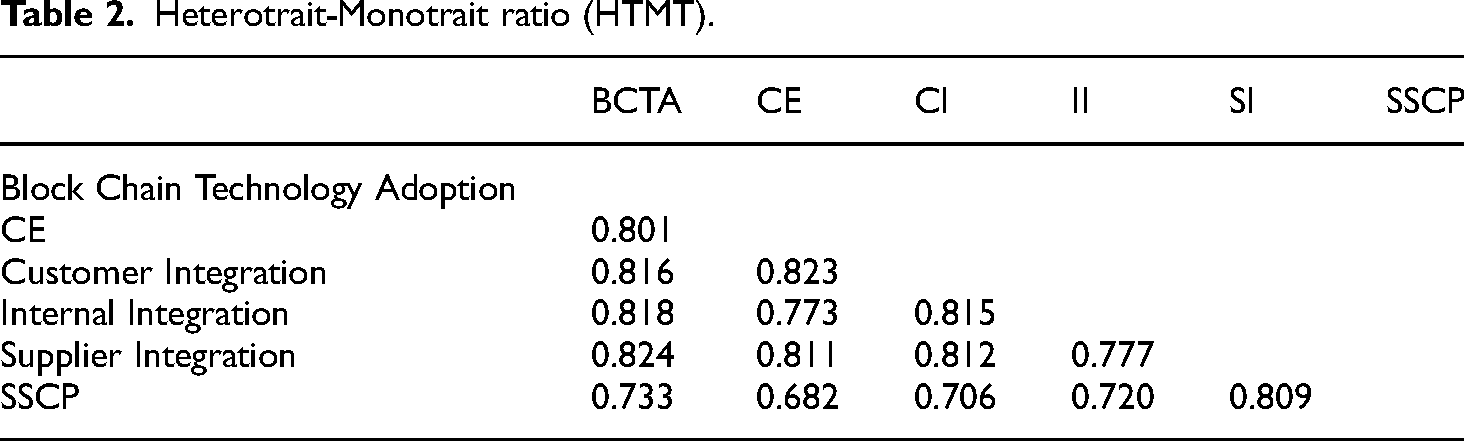
Heterotrait-Monotrait ratio (HTMT).
Discriminant validity
The Heterotrait-Monotrait (HTMT) technique was deemed appropriate to examine the discriminant validity for each scale item in this study. In order to ascertain the degree of discrimination between the scale items utilized for each study variable, PLS was used to check the values of HTMT. The results in Tables 2 and 3 indicate that every discriminant validity value obtained was within the required range of 0.90. 86 The findings demonstrate the discriminant validity of the research's data collection components applied to the respondents.
Discriminant validity (fornell-larker).

Structural model assessment
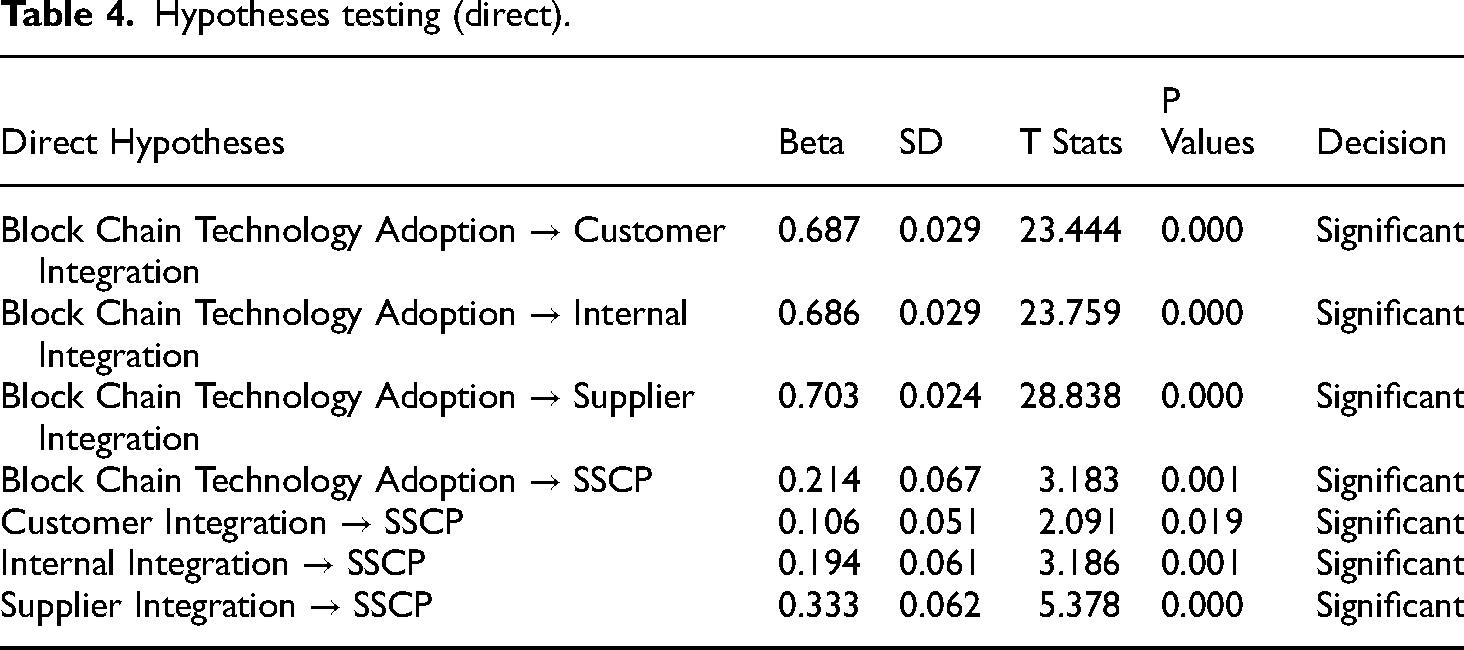
The direct association between BTs and SSCP was tested, and the results indicated a significant positive relationship between the variables (see Figure 3). Similarly, the direct impact of BT was analyzed on SCI dimensions, and results indicated the positive impact of BTs on All three dimensions of SCI, also illustrated in Table 4.

Structural model.
Hypotheses testing (direct).
Furthermore, Table 5 and Table 6 display the Predictive Relevance and F-Square values, respectively. It illustrates that the study model is predictive and contributes to the existing literature.
Predictive relevance and R-square.

F square (effect size).

Note: Small effect Size: Less than 0.15; Moderate: 0.15 and less than 0.35 Whereas, Large Effect Size: 0.35 and above
Likewise, the study tested the mediating role of SCI dimensions on the relationship between BTs and SSCP. Furthermore, the results indicated that SCI dimensions had a mediating role in all the above-stated instances, also illustrated in Figure 4 & Table 7.

Mediation model.
Mediation hypotheses.

Likewise, the moderating role of the CE was also tested on a relationship between SCI and SSCP, and results proved to favor the moderating role of the CE. The results are provided in Figure 5 & Table 8.

Moderation model.
Moderation hypotheses.

Discussion and conclusion
In assistance with DCT as an interpretive lens, the study detailed the association between BT, SCI, and SSCP. Additionally, it tested the moderating role of the CE. The outcome was that supply chain managers could escape all the modern-day disruptions by adopting BTs to contribute to SCI dimensions. The study also found BT's significant role in making firms, and supply chains, in general, operate and perform sustainably. The results align with previous studies, 5 which have found BT as a dynamic capability that can help firms mitigate internal and external concerns by reconfiguring supply chain processes. Likewise, the results are in sync with another study, which acknowledged the supporting role of internal and external SCI for the smooth adoption of BT and for causing sustainable performance outcomes. 87 Therefore, it is a well-established phenomenon that firms have a greater chance of implementing a sustainability strategy, which enables them to employ BTs for sustainable performance if supply chain stakeholders are effectively integrated. Blockchains have also been the source of transparency, security, and accessibility for all supply chain participants.56,88 Therefore, with a higher level of SCI and technology adoptions, firms become thoroughly dynamic, letting them promptly respond to environmental contingencies.
Similarly, 88 has elaborated that Blockchain technologies let firms adopt vibrant and sustainable SC strategies in response to changing stakeholders’ expectations. This looks true, as BT can be the source of quick data fetching, stocking, and distribution, ensuring timely access to products and information. 5 With the increased waste reduction and economic viability, firms remain in a better position to reach the highest efficiency level, making them greener. 87 Furthermore, BT facilitates SC disintermediation, where fewer stakeholders are bothered, reducing business waste across chains. 89 Furthermore, BT ensures data authenticity and uninterrupted flow by countering willful infringements, reducing supply chain risks, and causing business trustworthiness. 90 Additionally, with a continuous increase in fraudulent activities, governmental bodies and industrial cartels have over-emphasized the importance of transparency across chains, causing frequent adoption of SCI and BT. 5
Hence, the study reasonably enriches the scientific knowledge by making researchers available with empirical proof for the association between BTs and SSCP. It also addresses the empirical gap by testing SCI's mediating role in the relationship between BTs and SSCP. 5 It also extends the literature by considering the moderating role of the CE on the proposed theoretical formation. Therefore, it can be safely said that BT is associated with SCI and Sustainable SC performance outcomes. 88 This study also has a different role in literature because it considers multiple dimensions of SCI and CE to observe their connection with sustainable performance outcomes. Lastly, the study can be of extreme utility because it talks about adopting BT across SMEs in Pakistan, which is the least studied geographical context. Once the SC processes will become digitalized, SMEs across Pakistan and other developing nations, in general, will be in a better position to achieve sustainable performance outcomes.
Managerial implications
The SME sector of Pakistan suffers from a scarcity of dynamic thought patterns and decision-making, which has kept most of the public offices across the country, on the back foot, in terms of technology adoption. This lack of technology adoption across supply chains in Pakistan has negatively affected the entire nation's economic spectrum. Therefore, in line with this study, the findings propagate the merits of blockchain adoption for better and sustained performance outcomes. It is believed that through BT, the SME sector nurtures the culture of trust and integration of the internal and external stakeholders, making the system excel. 91 Similarly, following the research results, it has been demonstrated that BT has a notable effect on the three dimensions of SCI, underscoring its importance in facilitating the synchronized operation of SME chains. The adoption of BT significantly enhances transparency within the system, fosters trust among channel members, and improves overall performance. Hence, the study outcomes hold great importance for policymakers and decision-makers inclined toward enhancing the performance of Small and Medium Enterprises (SMEs) in Pakistan and other developing nations.
In addition, the study suggested that the mediating role of SCI dimensions is significant due to the prevalence of BTs that, under their enhanced transparency and security features, allow channel members to develop closer relationships. The findings suggest that BT facilitates supplier integration, enables firms to develop high-quality final products, and ensures on-time customer deliveries. Understanding the utility of supplier integration in meeting customer and stakeholder expectations is advantageous for SME supply chain managers operating in Pakistan.
Recognizing that value chains for Pakistani SMEs can span multiple industries and countries and must be administered by several regulatory authorities, BTs are ideally suited for their efficiency in managing reference data. It is also believed that BT reduces the likelihood of error and provides real-time access to vital information across value chains, ensuring that data is accessible, uninterrupted, and authentic. Similarly, the study's findings supported the moderating effect of CE on the association between SCI dimensions and SSCP. It is also consistent with the findings of previous studies, which have discussed the role of a channel executive in facilitating integration between channel members, resulting in overall sustainable performance. Therefore, policymakers and strategic decision-makers in Pakistan and other countries must utilize the study's findings for future policymaking. Globally operating companies can only achieve secure, transparent, and sustainable process management by implementing and utilizing blockchains, integrated mechanisms, and CE.
Limitations and future recommendations
The study aimed to test and validate the association between BTs, SCI dimensions, CE, and SSCP. Data was collected through 475 SME firms and analyzed through CFA and SEM. Based on DCT as the interpretive lens, both direct and indirect relations are validated. Despite comprehensively examining and contributing to the body of knowledge, the given is no different and has certain limitations, which, if addressed, will set the tone for future empirical validations on the subject matter. Firstly, the data were explicitly collected from the SMEs of Pakistan; there might raise an issue of the generalizability of the findings. Therefore, it is suggested that future studies must test the given empirical formation across multiple industries and geographical boundaries. Secondly, As the data was gathered on a concept (i.e. BT's) in its infancy, it might cause concern about the respondent's understanding of the concept. Hence, it is suggested that respondents’ understanding of the subject matter must be considered for future studies. Likewise, a study tested specific dimensions of SCI (i.e. Supplier, Internal, and Customer) as mediators. It is suggested that future studies must consider other tentative dimensions of SCI to extend the understanding of a given domain further. Lastly, the study tested CE as a moderator, and it is suggested that available environmental contingencies must be used to test the tentative variation in proposed relationships. Such contingencies (i.e. Environmental uncertainty, dynamism, and complexity) can be used as moderators, in line with contingency theory.
Footnotes
Declaration of conflicting interests
The authors declared no potential conflicts of interest with respect to the research, authorship, and/or publication of this article.
Funding
The authors disclosed receipt of the following financial support for the research, authorship, and/or publication of this article: The research is supported by the National Natural Science Foundation of China (72250410375).

Author biographies
Nadir Munir Hassan is an assistant professor of marketing in Air University, Pakistan.
Syed Abdul Rehman Khan is a professor of Supply Chain and Operations Management in Xuzhou University of Technology, China.
Muhammad Umair Ashraf is an assistant professor of management in The Islamia University of Bahawalpur, Pakistan.
Adnan Ahmed Sheikh is an associate professor of marketing in Air University, Pakistan.
Appendix: Details of Measurement Items
Please indicate the extent to which you disagree or agree with the following statements: 1 = Strongly disagree 2 = Disagree 3 = Neither Agree nor Disagree 4 = Agree 5 = Strongly agree.