



Abstract
This research article investigates the behavior of elastic waves in an inhomogeneous isotropic three-layered sandwich plate with soft-core and stiff-skin layers embedded in Winkler foundations, using anti-plane shear motion. The study establishes the exact antisymmetric dispersion relation, low-frequency spectrum, and overall cut-off frequency of the wave propagation. A shortened polynomial dispersion relation is developed for the long-wave low-frequency regime by considering the contrasting material setup and compared with the exact dispersion relation. This article also provides exact and asymptotic formulas for stresses and displacements in each layer of the plate, as well as approximate one-dimensional equations of motion. The results suggest that the approximate equations of motion for the three-layered sandwich plate are valid throughout the entire low-frequency range, despite the presence of Winkler foundations on both sides of the plate. This research is significant as it provides insights into the behavior of waves in composite materials and can be used to improve the design of sandwich structures used in various engineering applications. Additionally, the findings that the approximate equations of motion for the three-layered sandwich plate are valid throughout the low-frequency range, despite the presence of Winkler foundations, can help simplify calculations and make the design process more efficient.
Keywords
Introduction
Elastic waves dispersion in layered media is a complex and fascinating research topic with many potential applications. Advances in materials science are continually producing new materials with unique properties, and investigating the dispersion behavior of elastic waves in these materials could lead to optimized use in various applications. Understanding the dispersion behavior of elastic waves in layered media can also report to the development of new imaging techniques for more accurate and detailed imaging of internal structures. Additionally, studying the dispersion behavior of seismic waves in the Earth’s crust and mantle can provide valuable insights into the Earth's interior structure and processes. Also, understanding the dispersion behavior of elastic waves in layered materials can also inform the development of improved acoustic insulation materials. Overall, research in elastic waves dispersion in layered media has significant potential to impact a range of disciplines and applications from improving material design to earthquake detection to acoustic insulation, see for instance Refs.1–5
Classical and nonclassical theories are used to study the dispersion relations of elastic waves in layered media. Classical theory assumes a homogeneous and isotropic medium and neglects microstructure effects, while nonclassical theory considers the microstructure and interaction between the constituent materials. The wavelet-based approach analyzes wavelets, while multiscale modelling accounts for the interaction between different length scales. The nonlocal elasticity theory considers nonlocal interactions between material points. Both classical and nonclassical theories are used to study dispersion relations, with each providing different levels of detail and accuracy depending on the properties of the medium and desired level of analysis. Layered structures, exclusively three layers sandwich plates are increasingly being employed as structural components in contemporary engineering applications. The waveguides, elastic plates, beams, laminates, panels, rods, as well as cylindrical shells, are some of the structures that may be found in multiply-bond layers, to highlight a few, see Refs.6–25 In terms of layered structure design and structural analysis, which frequently has contrasting material and geometrical parameters, such as size, volume density, and stiffness. Layered structures offer advantages such as high resistance, lightweight, and strength; additionally, they have static and dynamic excitations. Utilizing efficient, creative, long-lasting, and sustainable structural systems is critical in modern engineering. Various analytical, numerical, and asymptotic techniques have also been used to investigate wave dispersion as well as propagation in multilayered and composite structures. Even though layered media mechanics has been a long-studied area, only a few publications have specifically addressed high contrast problems for highly inhomogeneous multilayered setups. High contrast in the mechanical characteristics of skins and cores in such structures demands the use of innovative techniques to estimate effective composite material properties. The application of asymptotic techniques22–24 enhances a better understanding of the relationship between the contrast in parameters of its components and the lowest eigenfrequencies of the structure. The authors7,11–13,17–23 used asymptotic analysis to investigate the elastic waves dispersion in highly inhomogeneous multilayered structures having three and five layers, exclusively sandwich structures with contrasting material parameter setups, and analyzed the cut-off frequency properties. In addition, regarding the influence of external forces like a hygro-thermal response, thermal stress, rotation, magnetic fields, and viscoelasticity.26–31 Likewise, for the significance of cracks and void pores on the propagation of waves in layered mediums, see Refs.32,33 and the references therein. In the dynamical and static dispersion analysis of plates and beams interacting with elastic foundations, most researchers used innovative foundation models.34–45 However, some models are so complex that they have just a few practical uses. As a result, researchers and engineers continue to choose basic but adequately realistic models, such as the Winkler model, 46 the linear pressure model, the two-parameter model as well as the elastic continuum model. 44 Authors7,35–39,43,47 have used the Winkler foundation model to investigate vibrational behavior or the effects of foundations. However, the paper aims to examine the elastic waves dispersion in an inhomogeneous isotropic sandwich plate having three layers with soft-core and stiff-skin layers, interacting with two-sided Winkler foundations due to their vibrant uses in current technology. We are particularly interested in establishing the structural parameter conditions that support the long-wave low-frequency regime. The three-layered plate symmetric about mid-plane interacting with the two-sided foundations is regarded to be symmetrical, and the symmetry simplifies the analysis by allowing the splitting of all quantities of the interest to be divided into even as well as odd components concerning the mid-plane.1,35 By symmetry, one selects whether to examine the antisymmetric or symmetric modes. 13 However, the antisymmetric vibration mode is thought to have fulfilled the global low-frequency regime.22,28
The underlying research article investigates the behavior of elastic waves in an inhomogeneous isotropic three-layered sandwich plate with soft-core and stiff-skin layers embedded in Winkler foundations, using anti-plane shear motion. The study establishes the exact antisymmetric dispersion relation, low-frequency spectrum, and overall cut-off frequency of the wave propagation. The article also provides exact and asymptotic formulas for stresses and displacements in each layer of the plate, as well as approximate one-dimensional equations of motion. The novelty of the work is that it develops a shortened polynomial dispersion relation for the long-wave low-frequency regime by considering the contrasting material setup and comparing it with the exact dispersion relation. The study finds that the approximate equations of motion for the three-layered sandwich plate are valid throughout the entire low-frequency range, despite the presence of Winkler foundations on both sides of the plate. The research provides insights into the behavior of waves in composite materials and can be used to improve the design of sandwich structures used in various engineering applications. The findings that the approximate equations of motion for the three-layered sandwich plate are valid throughout the low-frequency range, despite the presence of Winkler foundations, can help simplify calculations and make the design process more efficient. The results of this research can be applied in fields such as civil engineering, aerospace engineering, and mechanical engineering, where sandwich structures are commonly used.
The article is structured as follows: Section “Mathematical modelling” presents the mathematical modelling of the problem and outlines the contrasting material parameter setup to be analyzed. In Section “Solution of the problem,” a solution to the proposed problem is found, and exact relations for the stresses and displacements of each layer of the plate are determined. Section “Dispersion relations” determines the exact antisymmetric dispersion relation, cut-off frequency, polynomial dispersion relation, and shortened polynomial dispersion relation, subject to the contrasting setup, and compares these dispersion relations. Section “Asymptotic formulas for displacement and stresses” provides asymptotic formulas for the exact displacements and stresses. Section “Approximate equations of motion” compares the dispersion relations and provides an approximation of the equations of motion. Finally, Section “Conclusion” offers concluding remarks.
Mathematical modelling
We have taken an anti-plane shear motion of three-layered strongly inhomogeneous isotropic plate having core layer

Multi-material isotropic three-layered sandwich plate with mid-plane symmetric embedded in the Winkler foundations.
To formulate this problem, several assumptions are made. These include that the sandwich plate is thin and that the deformation of the plate is small compared to its thickness. Additionally, the face sheets are assumed to be isotropic and linearly elastic, while the core material is assumed to be elastic, homogeneous, and isotropic. The face sheets and core are bonded perfectly, and the plate is subjected to in-plane loading. The Winkler foundation is modeled as an elastic foundation that exerts a vertical reaction force on the plate proportional to its deflection. These assumptions simplify the analysis of the sandwich plate, and classical plate theory can be used to model its behavior. The equations of motion describing the vibration of each layer of the plate in



In the current research, however, we are looking at the dispersion of elastic waves in sandwich plate driven by anti-plane shear, with symmetry about mid-plane along with conditions at the interface given in Eq. (3) as well as boundary conditions presented in Eq. (4) applied to the outer surfaces. In reference to material parameter contrasting setup corresponding to stiff-skin layers and a soft-core layer, investigated by Prikazchikova et al. (2020), within the zero cut-off frequency estimates, the exact dispersion relation will be studied asymptotically, with asymptotic relationship given in Eq. (5):

Solution of the problem
In this section, we determined the exact solution to the posed problem. In this connection, Eqs. (1)–(4) will be used to calculate the relation of displacements along with stresses corresponding to each layer of the plate. Thus, we have the following classical wave equation through Eqs. (1) and (2):

where

Now, since the three-layered plate interacting with a two-sided foundation is representing the symmetric framework about

The core layer
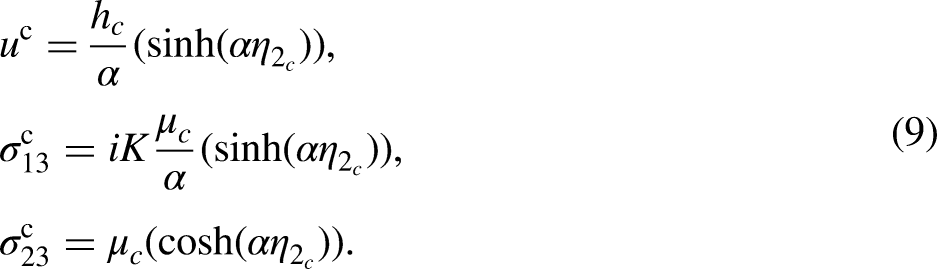
The skin layer

Where






Dispersion relations
The exact antisymmetric dispersion relation and cut-off frequency of the posed problem are provided in this section, and the resulting dispersion relation is then expressed in terms of its respective polynomial dispersion relation, as well as a shortened polynomial dispersion relation.
Exact antisymmetric dispersion relation (ASDR)
The analytical solution of the problem, provided in Eq. (8), is subject to the interfacial along with boundary conditions given in Eqs. (3) and (4), yielded a







Dispersion curves from ASDR provided in Eq. (19) for non-estimated range with

Dispersion curve from ASDR provided in Eq. (19) for estimated range with
Polynomial dispersion relation
Using Taylor's series expansion, the polynomial dispersion relation has been obtained from the exact ASDR, given in Eq. (19) as follows:


Shortened polynomial dispersion relation (SPDR)
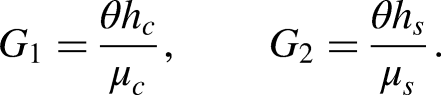
For the material contrasting setup provided in Eq. (5), we explore the ASDR asymptotically within the predicted global low-frequency inequalities. Recall also from Eq. (16) that the dimensionless stiffnesses






Asymptotic formulas for displacement and stresses
This section gives the asymptotic formulas corresponding to exact displacements and stresses earlier determined in Eqs. (9) and (10) for each layer of the plate. To achieve this objective, we make use of the following rescaling of wave number and frequency, respectively, of the form:

The core layer

The skin layers

It is worth noting here that the following conclusion may be drawn via the asymptotic relation given in Eq. (5)

Approximate equations of motion
In this part, we will ascertain the approximate equations of motions by incorporating the contrast relation given in Eq. (5). First, we scale the time and longitudinal coordinates using


Additionally, the corresponding continuity and boundary conditions are established as well,








Conclusion
In conclusion, the dispersion of elastic waves in an inhomogeneous three-layered sandwich plate with a soft-core and stiff-skin layers interacting with a two-sided Winkler foundations, driven by anti-plane shear has been investigated by adopting an asymptotic technique. The governing equations have been reduced to ordinary differential equations with the help of specified boundary and interfacial conditions, the exact displacements along with stresses in corresponding layers, and exact ASDR have been computed analytically. Due to multiple industrial applications of soft-stiff layer combinations,7–11,19,23,25 the exact ASDR and its related polynomial dispersion relation, as well as the SPDR, subject to the long-wave low-frequency region, have been investigated. Additionally, asymptotic formulas for the exact stresses and displacement have also been derived for the respective layer of the plate. It is remarkable that in the absence of the Winkler foundation by allowing
Finally, it is suggested that similar research might be conducted to ascertain the symmetric anti-plane shear vibration of a multilayered plate embedded in the Winkler foundation or other innovative foundation models. Furthermore, this study might be extended to other layered plates with varying compositions and material contrasts interacting with different foundation models.
Footnotes
Declaration of conflicting interests
The author(s) declared no potential conflicts of interest with respect to the research, authorship, and/or publication of this article.
Funding
The author(s) received no financial support for the research, authorship, and/or publication of this article.
